Article

Entrepreneurial Marketing Effects on Sustainable Social Performance of SMEs: The Mediating Role of Entrepreneurial Ecosystem Policy


by
Collins Kankam-Kwarteng
1,*,
Dennis Yao Dzansi
1,* and
Victor Yawo Atiase
2
1
Entrepreneurship Development Unit, Faculty of Management Sciences, Central University of Technology, Bloemfontein 9300, Free State, South Africa
2
Department of Accounting and Finance, Faculty of Business and Law, Leicester Castle Business School, De Montfort University, Leicester LE1 9BH, UK
*
Authors to whom correspondence should be addressed.
Adm. Sci. 2026, 16(4), 167; https://doi.org/10.3390/admsci16040167
Submission received: 9 February 2026 / Revised: 13 March 2026 / Accepted: 24 March 2026 / Published: 27 March 2026

Abstract

The Ghanaian economy faces significant challenges in providing robust policy support and cohesive ecosystem structures that enable small- and medium-sized enterprises (SMEs) operating in the country to effectively convert entrepreneurial marketing activities into sustainable social outcomes. The research examines the effect of entrepreneurial marketing on sustainable social performance of SMEs using entrepreneurial ecosystem policy as the mediating variable. The Resource Dependency Theory, Resource-Based View and the Stakeholder Theory were utilized, and the study was designed a cross-sectional survey. The data collected were based on 386 SME owners and managers of different sectors in Ghana. Structural equation modeling with SmartPLS 3 was used to test the proposed relationships. The results indicate that entrepreneurial marketing has a significant positive impact on sustainable social performance. In addition to that, ecosystem policy has a strong and positive impact on sustainable social performance. The mediating effect of ecosystem policy in the relationship between entrepreneurial marketing and sustainable social was found to be positive. The research has limitations in that it was cross-sectional and specific to Ghana, which might limit its generalizability. Longitudinal and cross-country designs may be used in future studies to include the dynamic effects of policy interventions. Hypothetically, the research moves towards the mediating role of the ecosystem policy in the relationship between marketing and sustainability. In practice, the study findings highlight the necessity to use combined policy frameworks that empower SMEs to enhance their marketing strengths and social investments to meet Sustainable Development Goals (SDGs) 8, 9, and 12. The research finds that enabling policies of entrepreneurial ecosystems are needed to convert the marketing efforts by SMEs into a sustainable social value.

1. Introduction

Small- and medium-sized businesses (SMEs) are central to the economic growth of Ghana, as they are the foundation of the local business sector and are mainly providers of employment, innovation, and income (Amoa-Gyarteng et al., 2024; Anim et al., 2024; Dwumah et al., 2024). Their significance towards the development of Sustainable Development Goal 8 (Decent Work and Economic Growth) and Sustainable Development Goal 9 (Industry, Innovation and Infrastructure) is supported by their contribution to economic diversification and inclusive growth. Regardless of these investments, most Ghanaian SMEs are struggling to attain sustainable social performance. Researchers (see Nyadu-Addo & Mensah, 2018; Barauskaite & Streimikiene, 2021) consider sustainable social performance as the capability to produce beneficial social results by recruiting and hiring employees, participating in the community, and maintaining sustainable environmental practices. These restrictions hurt their possible impact on SDG 12 (Responsible Consumption and Production) and dilute their sustainability path in general.
The effective implementation of the entrepreneurial marketing strategies could lead to the increased competitiveness of the SMEs, customer interaction, and value generation in society (Dzogbenuku & Keelson, 2019; Guerola-Navarro et al., 2024; Alshagawi & Mabkhot, 2024). Nonetheless, SMEs in Ghana are unable to use the entrepreneurial marketing mix to achieve outcomes due to limited resources, poor marketing capacity, and support mechanisms (Blankson et al., 2018; Issau et al., 2022). Not only do these challenges lead to the loss of their capacity to attract and retain customers, but also the capacity to address the issue of social and environmental factors, halting their contribution to the achievement of the SDGs. This is further compounded by the lack of a culture of strong institutional support, which is not always a reflection of the contextual reality of the SMEs in Ghana (Acquaah & Agyapong, 2015; Bamfo et al., 2023).
Researchers (see Abate & Sheferaw, 2023; Birungi et al., 2024) found that the entrepreneurial ecosystem, including the regulatory framework, financial institutions, networks, and infrastructure (Isenberg, 2016; Cavallo et al., 2019; Stephens et al., 2022), is one of the main factors that determine whether the entrepreneurial marketing strategies can lead to sustainable social performance. In Ghana, the weaknesses affecting the development of ecosystems include weak policy implementation, lack of access to credit, and inadequate entrepreneurial training programs. Programs like the National Entrepreneurship and Innovation Programme (NEIP) demonstrate the government’s willingness to invest in SMEs, but their slight orientation toward marketing-driven policies decreases their ability to influence the development of inclusive growth and sustainability (S. Mensah et al., 2020). Although supportive ecosystem policies have the potential to offer incentives, training, and access to markets that help SMEs to innovate and grow in a responsible manner, bureaucracy and inconsistency in policies are still critical barriers (Darko et al., 2021).
Although the role of entrepreneurial marketing and support of the ecosystem has been recognized as an increasing phenomenon, there is a lack of empirical studies on how ecosystem policies can mediate the connection between marketing activities and sustainable social performance. The literature (e.g., Nyarku & Oduro, 2018; Oduro & Haylemariam, 2019; Borah et al., 2022) indicates the necessity of SMEs to align marketing with the social goals but does not explore how policy frameworks facilitate such alignment or limit it. The lack of this knowledge restricts the capability of policymakers to make interventions that enhance more SME contributions to SDGs 8, 9, and 12. Moreover, the diversity of the SME sector in Ghana, in which urban-based businesses can use digital innovations whereas rural ones need support at the grassroots level, renders the significance of the context-specific policy. The need to fill this gap is thus paramount towards empowering SMEs as driving forces of decent work, inclusive innovation, and responsible production.
This research attempts to address this gap in knowledge by exploring the mediating position of entrepreneurial ecosystem policies between the entrepreneurial marketing mix approaches and sustainable social performance of SMEs in Ghana. By so doing, the study offers practical recommendations to policymakers and entrepreneurs on how to incorporate marketing activities with supportive policy frameworks. Finally, the research study can be utilized to improve the development of Ghana in achieving SDG 8 (Decent Work and Economic Growth), SDG 9 (Industry, Innovation, and Infrastructure), and SDG 12 (Responsible Consumption and Production) because it gives more power to the SMEs as agents of inclusive and sustainable development.

2. Theoretical Framework

Entrepreneurial marketing and social performance of SMEs can be analyzed with the help of Resource-Based View (RBV), Resource Dependency Theory (RDT), and Stakeholder Theory in the context of the entrepreneurial ecosystem policy. The above-mentioned theoretical perspectives provide a robust framework on how the SMEs leverage their internal resources, respond to external dependencies, and align themselves with the demands of the stakeholders in order to be socially sustainable. The RBV highlights the importance of internal resources such as unique capabilities, knowledge, and assets in the context of gaining a competitive advantage (Barney, 1991). SMEs in the context of entrepreneurial marketing leverage their internal resources to develop new products, adopt an effective pricing mechanism, optimize the distribution channels, and develop promotional activities that are social performance-oriented. RDT highlights the manner in which organizations respond to their dependence on the external environment and manage power relations in their surroundings (Pfeffer & Salancik, 1978). In the context of SMEs, external resources such as funding, market access, and government support play a pivotal role in gaining the marketing strategies that can result in the enhancement of social performance. The Stakeholder Theory assumes that organizations should strike a balance between interests of different stakeholders such as customers, employees, communities, and governments in order to be successful in the long term (Freeman, 1984). Entrepreneurial marketing aligns naturally with Stakeholder Theory because it focuses on creating value for all stakeholder groups. This is achieved by offering personalized products, ensuring fair and equitable pricing, providing accessible and inclusive distribution, and implementing promotional strategies that serve and benefit the broader community.

2.1. Conceptual Framework and Hypothesis Development

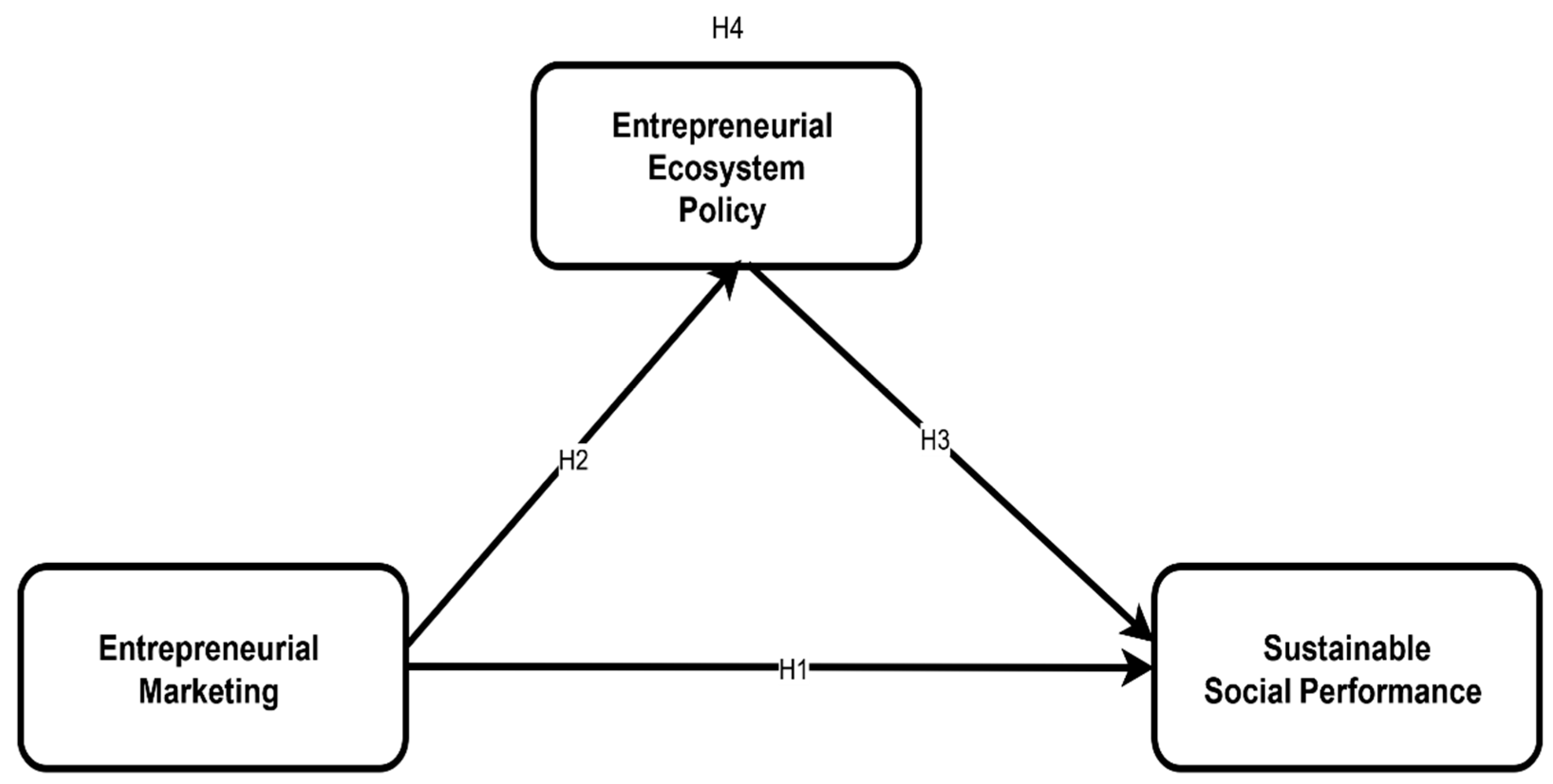
The conceptual framework that is proposed combines the three main constructs of the study, which are the independent variable entrepreneurial marketing (EM), the mediator variable entrepreneurial ecosystem policy (EEP), and the dependent variable sustainable social performance (SSP).
According to the framework, the study proposes that there is a positive relationship between entrepreneurial marketing (EM) and sustainable social performance (SSP), but the relationship is mediated by entrepreneurial ecosystem policy (EEP). When implemented in a powerful entrepreneurial ecosystem, EM will have greater chances of creating meaningful and lasting social value. Therefore, the ecosystem serves as a communication channel, which increases the effects of marketing campaigns on socially sustainable results of SMEs. In this way, the framework is based on the hypothesis that entrepreneurial marketing directly and indirectly (mediating) has an impact on sustainable social performance and that the entrepreneurial ecosystem act as a conduit in the relationship (see Figure 1).

2.1.1. Entrepreneurial Marketing and Sustainable Business Performance

Entrepreneurial marketing (EM), which uses the conventional aspects of product, price, place, and promotion, has become a strategic and innovative approach that helps SMEs to survive in competitive and dynamic markets. It helps SMEs to react and predict the changing customer expectations, resources, and environmental uncertainty (Boso et al., 2013). EM is the overlap of the marketing concept with entrepreneurial behavior, as it focuses on opportunity recognition, innovation, customer intensity, leveraging of resources, calculated risk-taking, value creation, and proactive behavior (Morris et al., 2002; M. P. Miles & Darroch, 2006). In comparison to traditional marketing, which is more concerned with the segmentation of the market and marketing, EM is more concerned with agility and innovativeness in taking advantage of the market. Such a strategy allows SMEs to be flexible and efficient in resource utilization and creates a competitive advantage of differentiation and innovation (Jones & Rowley, 2011). According to empirical evidence, EM plays a strong role in sustainable social performance (SSP) because it introduces entrepreneurial logic into marketing strategies that reconcile profit motives with social and environmental responsibilities (Fiore et al., 2019; Mort et al., 2012; Kraus et al., 2018). Firms that adopt entrepreneurial marketing (EM) often draw on social innovation, community-based practices, and collaborative value creation to promote inclusive development, strengthen community participation, and enhance constructive relationships with consumers. In emerging economy contexts, EM has been shown to increase the adaptability and resilience of small- and medium-sized enterprises, fostering locally driven innovation, deeper community engagement, and stronger trust among key stakeholders (Blankson et al., 2018). By engaging in proactive marketing and new technology, SMEs are able to create social capital, spur the creation of new jobs, and improve community welfare without losing competitiveness. Accordingly, this study hypothesizes the following.
H1. 
Entrepreneurial marketing has a significant positive effect on the sustainable social performance of SMEs.

2.1.2. Entrepreneurial Marketing and Entrepreneurial Ecosystem Policies of SMEs

Researchers in the marketing literature have discovered that the adoption of new marketing activities, in most cases, reveals the gaps in regulation and clarifies the necessity to make new adjustments to policies (Levkina & Petrenko, 2019; Sakas & Tomaras, 2019; Gao & McDonald, 2022). In their article, Berger and Kuckertz (2016) claimed that SMEs adopting unconventional promotion strategies via digital platforms and social media can promote increased access to the digital infrastructure and training, thus affecting governmental and institutional policies. According to Abbate et al. (2019), customer-led product innovation can stimulate intellectual property protection-related policies, quality certification policies, or start-up incubation. These pricing strategies of entrepreneurial SMEs can be flexible, value-based, or disruptive, which promotes the importance of special financial regulations, tax incentives, or pricing rules to new business models (Hills et al., 2008; Cöster et al., 2020; Sewpersadh, 2023; Gebremicael & Murthy, 2024). Distribution strategies are ways to compel the ecosystem actors to redesign logistics and payment systems, as well as marketplace rules. Such practices tend to lead to the creation of policy feedback loops whereby the government agencies and support institutions formulate specific interventions that are sensitive to the emerging marketing practices in the SME sector (Stam & Spigel, 2016; Zahara et al., 2023; Chooset & Sukhabot, 2025). Candeias and Sarkar (2024) believe that policies in entrepreneurial ecosystems have been able to influence the deployment of the marketing mix by the SMEs. The SMEs, according to Wang and Kesan (2022), are encouraged to adopt aggressive or experimental marketing strategies on the basis of policies that provide marketing grants or innovation vouchers or reduce tax on R&D and marketing expenditure. Basically, the ecosystem policies and entrepreneurial marketing mix go hand in hand. Researchers (See Cavallo et al., 2021; Komninos et al., 2022; Wichmann et al., 2022) explain that SMEs have a role in influencing policy by engaging in innovative and entrepreneurial marketing activities, with the ecosystem actors reacting by creating an environment in which the activities can thrive and be scaled. This interaction is important to policymakers who need to promote inclusive and innovation-led SME development. Going by the discussion of the relationship between entrepreneurial marketing and policies in the ecosystem, the study hypothesized that:
H2. 
Entrepreneurial marketing has a significant positive effect on entrepreneurial ecosystem policies.

2.1.3. Entrepreneurial Ecosystem Policy and Sustainable Social Performance

Entrepreneurial ecosystem policies are essential in influencing the sustainable social performance of SMEs. Such policies consist of regulatory systems and, availability of financial support, training and assistance to markets, aimed at providing an enabling environment for SMEs (Hasayotin et al., 2024). It has been proposed that supportive ecosystem policies can strengthen the considerability of SMEs in implementing social objectives into their business models with the required resources and incentives (Kurniawan et al., 2021; Wurth et al., 2023). The policies that allow access to cheap financing, according to Candeias and Sarkar (2024), allow SMEs to invest in socially responsible activities like community development projects or environmentally friendly activities, which can be reflected in their social performance. The efforts of the government in Ghana, like the National Entrepreneurship and Innovation Programme (NEIP), have been used to assist the SMEs in their activities through the integration of social impact objectives in the program. Nevertheless, these policies can be effective only when they are implemented and their relevance to the specific aspects of SMEs is considered (M. S. Mensah & Derera, 2023; J. Mensah, 2023). The policies of the entrepreneurial ecosystem affect network collaborations and alliances which SMEs depend on for attaining social performance objectives. The social contribution of entrepreneurial activity can be enhanced through the policies that promote cooperation among SMEs, non-governmental organizations, and community groups (Adae, 2023; Ackah & Boadu, 2025). Indicatively, the training programs are based on sustainable practices and community participation where SMEs are equipped with knowledge and skills that can help them handle local issues effectively. Nevertheless, research shows that the weak application of the policies, bureaucracy, and the lack of awareness among entrepreneurs can negatively affect the advantages of these ecosystem policies (Kansheba et al., 2024; Peprah et al., 2025; Correia & Padula, 2025). These barriers can be addressed to develop the abilities of SMEs in supporting sustainable social performance, especially in developing economies like Ghana, which has high social and environmental issues. Therefore, we propose the following hypothesis:
H3. 
There is a significant effect of entrepreneurial ecosystem policies on the sustainable social performance of SMEs.

2.1.4. Mediating Role of Entrepreneurial Ecosystem Policy

Policies in the ecosystem are essential for negotiating the strength of the entrepreneurial marketing strategies in generating a sustainable social impact of SMEs. SMEs can flourish both socially and economically in an enabling environment that is supported by policies to include and think outwardly, including social enterprise grants, corporate social responsibility (CSR)-related tax breaks, and communal-minded ventures supported by infrastructures (Isenberg, 2016; Barinova & Zemtsov, 2023; Wurth et al., 2023). Balzano et al. (2025) consider such policies to be strategic leverages which lessen financial and institutional barriers that SMEs tend to encounter when undertaking socially impactful marketing initiatives. Policies to encourage social inclusion or diversity during hiring may directly affect the people dimension of the marketing mix (Kipnis et al., 2021; Riedel et al., 2023), and platforms that allow the government to reach out to rural audiences can enhance place-based approaches by making SMEs embrace sustainable social activities (Trafford et al., 2021; Howard et al., 2022). Moreover, Spanuth and Urbano (2024) explain that ecosystem policies facilitate cooperation and the sharing of information between the principal stakeholders, such as government agencies, universities, non-profit, and corporate sectors, and intensify the social value of entrepreneurial marketing. Such working networks create common goals that are centered on sustainability and assist SMEs in coordinating their marketing activities with the priorities of society. According to Elpisah (2023), the policy frameworks that incorporate environmental and social standards into the development of the ecosystem play a decisive role in advancing SMEs to the marketing practices that can be impactful, focus on community welfare, engage in ethical production, and provide access to all. Furthermore, it is established by Dempere et al. (2024) that clear regulatory norms and surveillance instruments guarantee responsibility and motivate SMEs to maintain their adherence to social values. Without such policy-oriented support, even the most innovative and socially responsible marketing solutions, as Candeias and Sarkar (2024) argue, will have no systemic support to create social impact over the long term. Therefore, sound ecosystem policies are not only facilitators but also mediators of sustainable social performance within the SME sector. It is on this basis that we hypothesize the following.
H4. 
Entrepreneurial ecosystem policies mediate the effect of entrepreneurial marketing on the sustainable social performance of SMEs.

3. Methodology

The philosophical foundation of this study is grounded on positivism that stresses objectivity, empirical measurement, and the application of statistical methods in order to study observable social phenomena. Under this paradigm, the study aims at identifying cause and effect connections and patterns that can be generalized by testing hypotheses based on already existing theories. The positivist philosophy justifies the systematic compilation of numerical materials and the use of quantitative analysis methods to offer conclusions regarding the links between entrepreneurial marketing, ecosystem policy, and sustainable social performance. The research was based on a deductive research approach as it begins with the assessment of the theories related to the identified issue, which includes the Resource-Based View (RBV), the Resource Dependency Theory, and the Stakeholder Theory. On the basis of the developed frameworks, hypotheses were formulated for the assessment of the direct effects of entrepreneurial marketing on sustainable social performance and the mediating effect of the policies within the ecosystems. A deductive approach is applicable in the case of validation of the existing theoretical predictions and the determination of the statistically significant patterns in the dataset. This paper was based on a quantitative research design. The data collection involved a cross-sectional survey targeting SME owners and managers in various industries in Ghana. The target population is SMEs based in Ashanti Region as indicated by Ghana Statistical Service (a business with less than 100 employees). The sampling frame was SMEs registered with Association of Ghana Industries (AGIs). Participants were included if they operated as SMEs in Ashanti Region, were formally registered with a recognized authority, had been in operation for at least one year, and voluntarily agreed to participate. SMEs unregistered, had operated for less than one year, declined participation, or were located outside the selected study area were excluded from the final sample. The final sample consisted of 386 valid responses who willingly participated through online platforms. The sample size exceeds the substantially threshold and provides sufficient statistical power and reliability for hypothesis testing (Hair et al., 2019; Kline, 2016; Westland, 2010). All the participants were informed and gave their consent. Data analysis was done with partial least squares structural equation modeling (PLS-SEM) to test the hypothesized relationships.

Measurement and Scale Development

A structured questionnaire was developed for analyzing empirically the relationship between the study variables: entrepreneurial marketing, entrepreneurial ecosystem policy, and sustainable social performance. The questionnaire items were developed on the use of measurement scales previously validated by other academic studies, which gives the items construct validity and consistency with the literature. The measurements of all items were based on a five-point Likert scale, which included 1 = Strongly Disagree and 5 = Strongly Agree, to measure the level of agreement the respondents had with the statements. In order to measure entrepreneurial marketing (EM), this research modified items of Boso et al. (2013). The scale was specific to aspects of the entrepreneurial marketing mix and involved 5 items, (1) innovative product, (2) dynamic pricing (3) flexible pricing strategies, (4) innovative distribution strategies, and (5) creative promotion, which are modified to fit an entrepreneurial perspective (Bresciani & Eppler, 2010; Kraus et al., 2018). EEP was modeled after Isenberg (2016) and as primary ecosystem domain comprising 3 items, (1) policies on regulatory environment, (2) policies on tax incentives, and (3) policies on government grants and subsidies. The items were complemented with the information provided by Mason and Brown (2014) and Autio et al. (2014), who also note the significance of policy-based enablers in the development of entrepreneurial ecosystems. Sustainable social performance (SSP) measurement items were modified the existing literature (see Elkington, 1997; Carroll & Shabana, 2010; Nyarku & Oduro, 2018). Five items were used to measure the contribution of firms towards (1) community employment, (2) community partnership, (3) community development, (4) employee welfare and wellbeing, and (5) development of employees’ skills and knowledge.

4. Results

4.1. Reliability and Validity Estimations

The reliability and validity of the measurement model of the study were assessed based on multiple cut-off criteria: factor loadings, Cronbach’s Alpha (CA), Composite Reliability (CR), Average Variance Extracted (AVE), and Variance Inflation Factor (VIF). All the factor loadings exceeded the recommended threshold of 0.70 (Hair et al., 2017), thus reflecting good indicator reliability (see Table 1). Cronbach’s Alpha values ranged from 0.753 to 0.875, thus revealing acceptable to high internal consistency (Nunnally & Bernstein, 1994). In addition, all the Composite Reliability (CR) values were above 0.857, revealing a strong internal consistency and construct reliability (Fornell & Larcker, 1981). With regard to convergent validity, the AVE value for each construct was greater than the threshold level of 0.50, ranging from 0.643 to 0.668, indicating that the constructs explain a substantial portion of the variance in its respective indicators (Fornell & Larcker, 1981). Further, VIF values for all the items ranged from 1.317 to 2.693, which are below the conservative threshold level of 3.3 (Diamantopoulos & Siguaw, 2006), indicating no multicollinearity issue among its indicators. On the whole, these results confirm that the measurement model reflects acceptable reliability, convergent validity, and a lack of multicollinearity, thus rendering it adequate for the subsequent structural analysis.

4.2. Discriminant Validity

Discriminant validity was examined using both Fornell–Larcker criterion (see Table 2) and the Heterotrait–Monotrait (HTMT) (see Table 3) ratio, following the guidelines suggested by Fornell and Larcker (1981) and Henseler et al. (2015), respectively. The Fornell–Larcker findings showed that the square roots of AVE for all the constructs were greater than their respective inter-construct correlations. Furthermore, the HTMT values were less than the conservative threshold of 0.90, ranging from 0.577 to 0.847. However, the HTMT ratio between entrepreneurial ecosystem policy and sustainable social performance was 0.847 and the magnitudes were within acceptable limits, thus suggesting that the constructs were empirically distinct. These findings confirm that the model had satisfactory discriminant validity.

4.3. Model Fit

The overall model fit was checked using both saturated and estimated models. The values were identical across the indices; see Table 4. The SRMR was 0.075, below the conservative cut-off of 0.08 (Hu & Bentler, 1999), which gives evidence of acceptable fit. The discrepancy measures d_ULS 0.867 and d_G 0.452 were low, indicating little differences between the observed and model-implied correlation matrices (Hair et al., 2021). The high value of the Chi-Square statistic, 1036.523, is not surprising for structural models when sample sizes are large. The Normed Fit Index gave a value of 0.733, below the conventional 0.90 threshold (Bentler & Bonett, 1980) but above the 0.70 threshold often accepted (Hair et al., 2019). All of these together provide an indication that the model shows a good and adequate fit to test the hypothesized relationships.

4.4. Structural Model Assessment and Common Method Bias

The structural model was assessed using the coefficient of determination (R2), effect size (f2), and predictive relevance (Q2). The results indicate that sustainable social performance (SSP) has an R2 value of 0.41, meaning that entrepreneurial marketing (EM) and entrepreneurial ecosystem policy (EEP) together explain 41% of the variance in SSP, reflecting moderate explanatory power. Similarly, EEP records an R2 value of 0.25, suggesting that EM explains 25% of the variance in ecosystem policy, which meets the acceptable threshold for explanatory capability in PLS-SEM models. The effect size (f2) results show that EEP has a medium effect on SSP (f2 = 0.230), highlighting the importance of supportive ecosystem policies in enhancing social performance. In contrast, EM demonstrates small effects on SSP (f2 = 0.035) and EEP (f2 = 0.080). The Stone–Geisser Q2 values of 0.25 for SSP and 0.28 for EEP are both positive, confirming that the model possesses adequate predictive relevance and reliable predictive capability. To minimize the risk of common method bias (CMB), both procedural and statistical remedies were applied. Procedurally, the questionnaire was carefully designed using clear language, and items for the constructs, entrepreneurial marketing (EM), entrepreneurial ecosystem policy (EEP), and sustainable social performance (SSP) were randomly arranged to reduce response patterns. Respondents were also assured of anonymity and confidentiality, which helped reduce social desirability bias and encouraged honest responses. Statistically, Harman’s single-factor test was conducted, and the results showed that the first factor explained 21% of the total variance, which is below the 50% threshold, indicating that common method bias is unlikely to be a serious concern (Reio, 2010). These results suggest that CMB does not threaten the validity of the study’s findings.

4.5. Hypothesis Testing

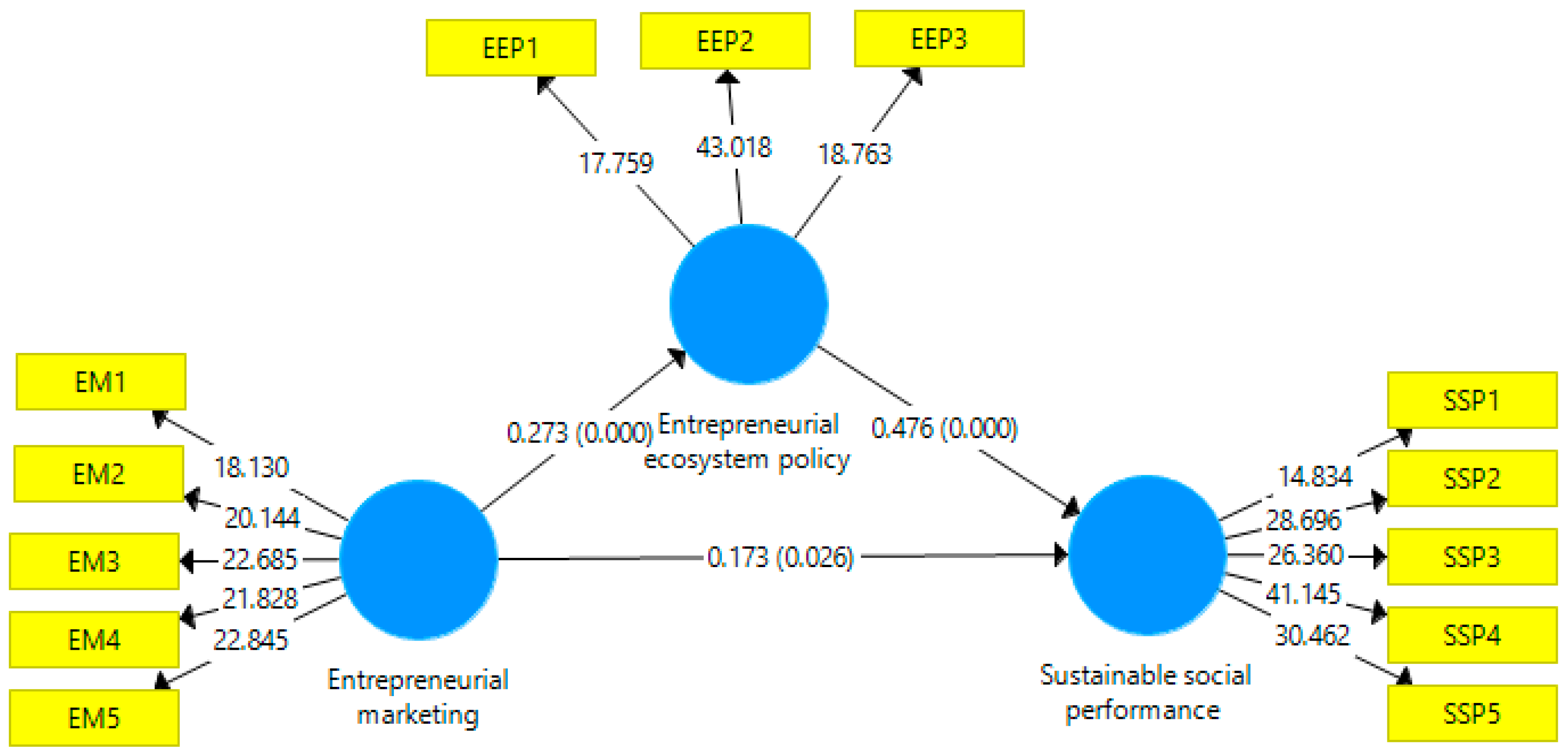
Hypothesis testing was conducted according to the proposed conceptual framework, which posits that the entrepreneurial ecosystem activities undertaken by SMEs are more likely to exert a significant influence on sustainable social performance when embedded within favorable government policies. Guided by this assumption, four hypotheses were tested using structural model estimates generated using SmartPLS 3. The results revealed several statistically significant path relationships between the core constructs, including entrepreneurial marketing (EM), entrepreneurial ecosystem policy (EEP), and sustainable social performance (SSP) (see Table 5/Figure 2).
The direct effect of entrepreneurial marketing on sustainable social performance was positive and significant at β = 0.173, t = 2.233, p = 0.026 (see Table 5/Figure 2), which therefore supports Hypothesis 1. This means that innovative marketing practices by SMEs enhance the social outcomes. The standard deviation (STDEV = 0.077) indicates relatively low variability in the bootstrapped estimates, reflecting consistency in the relationship across resamples. Additionally, entrepreneurial marketing had a positive and significant effect on entrepreneurial ecosystem policy at β = 0.273, t = 4.268, p < 0.001 (see Table 5/Figure 2), suggesting that effective marketing strategies lead to better alignment with and responsiveness to supportive institutional frameworks. The standard deviation (STDEV = 0.064) indicates a stable estimate with minimal dispersion in the bootstrapped samples. The outcome, therefore, supports Hypothesis 2 and underlines one of the ways in which entrepreneurial marketing shapes the entrepreneurial environment. The relationship between entrepreneurial ecosystem policy and sustainable social performance was significant at β = 0.476, t = 7.304, p < 0.001 (see Table 5/Figure 2), therefore confirming Hypothesis 3. The standard deviation (STDEV = 0.065) demonstrates a consistent estimate across the bootstrapped samples. The result indicates the centrality of ecosystem policies in influencing the social sustainability outcome of SMEs and would, therefore, suggest that favorable regulatory and institutional frameworks amplify the contributions of such firms towards social value creation.
The mediation analysis shows that entrepreneurial ecosystem policy plays a significant mediating role in the relationship between entrepreneurial marketing and sustainable social performance. The indirect effect was both substantial and statistically significant (β = 0.130, t = 3.856, p < 0.001), (see Table 5/Figure 2), thus providing empirical evidence to support Hypothesis 4. The relatively high t-value and low standard deviation (STDEV = 0.034) underlines the robustness of this mediating effect. These findings suggest that though entrepreneurial marketing is an important direct contributor to social performance, its effect is significantly enhanced when it is properly mediated through supportive ecosystem policies. In other words, entrepreneurial marketing may not be able to provide substantial social sustainability outcomes unless complemented by enabling policy environments. In this way, ecosystem policies are the transmission mechanism that transforms the value of entrepreneurial marketing into socially beneficial outputs. With this, there is partial mediation in the model, which further provides support for the argument that firm-level strategies are aligned with ecosystem-level policies in order for SMEs in Ghana to achieve sustainable social performance.

5. Discussion

The study results present strong evidence in support of the highly vital role of entrepreneurial marketing in enhancing the sustainable social performance (SSP) of small- and medium-sized enterprises (SMEs) in Ghana, especially through entrepreneurship ecosystem policies. The direct relationship between entrepreneurial marketing and sustainable social performance was statistically significant. This finding indicates that although entrepreneurial marketing mix—including value-based product offers, innovative and dynamic pricing, customer-focused distribution, and promotional strategies—can have a beneficial effect on social performance, including community development, fair practices, and environmental care, it also has other significant impacts (Boso et al., 2013; M. Miles et al., 2015). The results are consistent with the past literature that suggests that entrepreneurial marketing leads to the competitiveness of firms at the firm level as well as at the society level (Morris et al., 2002; Fiore et al., 2019). To design such strategies to generate the most social value, firms need to be implemented into a favorable institutional and policy context. The findings indicate that entrepreneurial marketing and sustainable social performance have a significant relationship through the mediating role of policies in the entrepreneurial ecosystem. This mediating impact was not only statistically strong, but also practical, meaning that supporting policies, access to funds, skilled workforce, and institutional support have a strong contribution to the effectiveness of marketing strategies in creating social values (Isenberg, 2010; Audretsch & Belitski, 2017). Thus, SMEs operating in an entrepreneurial ecosystem that functions well are in a better position to transform their marketing efforts into a sustainable social outcome. This assertion is in line with the fact that entrepreneurial ecosystems are enablers, which provide the requisite regulatory conditions, infrastructure, and culture, enabling businesses to grow socially and economically (Stam, 2015; Autio et al., 2014). Without such an ecosystem, entrepreneurial activities, no matter how innovative they might be, can be restricted by the environment. It is consistent with the previous studies that underline the synergistic nature of the relationship between the firm-level capabilities and the institutional environment in general (Isenberg, 2016; Boso et al., 2013). The close positive association between entrepreneurial marketing and the policy maturation of entrepreneurial ecosystems further underscores the dynamism of interaction between innovation at the enterprise level and policy responsiveness. This implies that by innovating and responding to market demands, SMEs can also be the cause of change in the entrepreneurial environment, which forms a virtuous cycle of innovation and policymaking (Acs et al., 2017; Mason & Brown, 2014). This circularity drives the point that top-down policy interventions, co-created by entrepreneurial actors through their practices, networks, and market interactions, influence entrepreneurial ecosystems (Spigel, 2017; Roundy, 2017). In this respect, entrepreneurial marketing could be both a cause and an output of ecosystem evolution, making SMEs an active participant in the formation of the institutional and policy framework that contributes to sustainable economic and social development.

5.1. Theoretical Implication

The results of the study have useful theoretical implications to various foundational frameworks. Based on the Resource-Based View (RBV), the findings confirm that entrepreneurial marketing is an asset of good internal resources that when properly exploited, leads to the sustainable social performance of SMEs. Nevertheless, it is much more effective in an enabling entrepreneurial place, indicating that internal resources have to be supported by a good external environment to provide a sustainable competitive advantage (Barney, 1991). This relates perfectly to the Resource Dependency Theory (RDT) according to which companies are not independent but are dependent on external resources as they need essential resources (Pfeffer & Salancik, 1978). The intermeeting nature of the entrepreneurial ecosystem policy signals the reliance of SMEs on external institutions including the financial system, regulatory frameworks, and institutional support, which, in combination, influence how the marketing effort can be converted into social value. Lastly, according to the Stakeholder Theory, sustainable social performance highlights the need to match the business actions with the demands of various stakeholders, such as communities, policymakers, and customers (Freeman, 1984). These results indicate that entrepreneurial marketing, which is driven by the interests of stakeholders and operates within a policy-responsive environment, is more likely to generate inclusive socially beneficial results. Combined, these theories support the idea that internal capabilities and external alliances are both critical to the SMEs attempting to generate social value in the long term.

5.2. Managerial Implication

The research findings present management implications on the owners of SME managers especially in emerging economies, including Ghana. First, the direct impact of entrepreneurial marketing on sustainable social performance is significant, implying that managers need not only develop traditional marketing strategies but also embrace innovative value-oriented approaches that focus on community development, fair practices, and the need to be environmentally responsible. The managers ought to stress the customer-based approach, innovative pricing strategies, and open distribution channels that can help achieve overall social objectives. More vital, the high mediating effect of entrepreneurial ecosystem policies implies that marketing operations are more effective when they are supported by the enabling external environment. It implies that SME managers need to be active in interacting with policy entities and entrepreneurial networks, and utilize support programs to enhance their social impact. In practice, SMEs must not only concentrate on in-house capabilities but also aim to get collaborations and demand improvements in ecosystems that can boost their functions and contribute to society. These lessons also suggest that entrepreneurial leaders should evolve the competencies to negotiate and shape their ecosystem and remain strategic with sustainability-related outcomes in focus.

5.3. Policy Implication

This study carries important policy relevance for advancing the Sustainable Development Goals (SDGs) in Ghana. In particular, it underscores the role of entrepreneurial ecosystem policies in strengthening the connection between entrepreneurial marketing and sustainable social outcomes. The findings suggest that well-designed policy frameworks are essential for enabling SMEs to contribute meaningfully to both national and global development priorities. Providing SMEs with supportive and enabling policy environments enhances their capacity to innovate and adopt socially responsible business practices. Such measures directly support SDG 8 (Decent Work and Economic Growth) by improving SME competitiveness, stimulating job creation, and fostering inclusive and sustainable economic development. Furthermore, the study highlights how ecosystem-oriented policies can amplify the social impact of SMEs, with broader implications for SDG 9 (Industry, Innovation, and Infrastructure) and SDG 12 (Responsible Consumption and Production). When appropriate policy support is in place, entrepreneurial marketing enables SMEs to develop innovative offerings, adopt environmentally responsible practices, and strengthen socially inclusive distribution systems, thereby promoting sustainable industrial development and responsible business conduct. Further, the conclusions of the research support the role of partnerships in goal achievement since the relevant policies of the ecosystem must be developed collaboratively by the government institutions, players in the private sector, financial institutions, and community stakeholders. In this respect, the research offers an insight that designing policies must not only aim at economic results but must also consider the incorporation of mechanisms that will aid in determining SMEs to create social and environmental value.

5.4. Limitations and Suggestions for Future Research

Despite the fact that this study provides significant information on the connection between entrepreneurial marketing, policies in the entrepreneurial ecosystem, and sustainable social performance of SMEs in Ghana, one must admit that there are certain weaknesses of the study. First, the study used cross-sectional data, which restricts the possibility of a long-term causal correlation. It is recommended that future researchers use longitudinal studies in order to follow the development of these relationships and get a more dynamic picture as to the cause and effect.
Second, the study relied on self-administered questionnaires for data collection, which may introduce issues of subjectivity, including social desirability bias and respondent interpretation. Future research could strengthen the evidence base by combining survey methods with qualitative techniques such as in-depth interviews or case studies to develop a deeper understanding of the processes underlying the observed relationships. Third, the focus on SMEs in Ghana limits the generalizability of the findings to other contexts with different economic structures, cultural conditions, and policy environments. Replicating this model in other emerging and developing economies would allow for comparative insights into how varying levels of ecosystem development influence sustainability outcomes. Finally, the study concentrated on three core constructs, entrepreneurial marketing, ecosystem policy, and sustainable social performance. Future studies could broaden this framework by incorporating additional dimensions such as financial performance, technological advancement, and environmental sustainability. Further avenues for research may also include the role of digital transformation, gender dynamics in entrepreneurship, and the influence of informal institutional structures as emerging areas of scholarly inquiry.

6. Conclusions

This study explored the influence of entrepreneurial marketing on the sustainable social performance of SMEs in Ghana, with particular attention paid to the mediating function of entrepreneurial ecosystem policy. The findings show that while entrepreneurial marketing on its own positively affects social performance, its influence becomes stronger within a supportive policy and institutional environment. The mediating effect of ecosystem policies was found to be both statistically significant and practically relevant, underscoring the critical role of policy structures, institutional backing, and access to resources in enhancing the effectiveness of marketing practices. In addition, the strong relationship between entrepreneurial marketing and ecosystem development suggests a dynamic interaction in which firm-level innovation contributes to shaping the wider entrepreneurial environment. Importantly, the study achieved its core research objectives by empirically examining the direct effect of entrepreneurial marketing on sustainable social performance, assessing the influence of the entrepreneurial ecosystem policy environment, and demonstrating the mediating role that ecosystem policy plays in strengthening this relationship. Overall, the results emphasize the importance of aligning strategic marketing efforts with broader ecosystem development to achieve sustainable and socially meaningful outcomes for SMEs. From this perspective, responsibility lies with both business leaders and policymakers to foster conditions that allow entrepreneurship to flourish and generate value that extends beyond financial returns. In terms of novelty, this paper contributes to the literature by integrating entrepreneurial marketing with ecosystem policy within a sustainability framework, an area that remains underexplored in emerging economies.

Author Contributions

Conceptualization, C.K.-K., D.Y.D. and V.Y.A.; methodology, C.K.-K., D.Y.D. and V.Y.A.; software, C.K.-K., D.Y.D. and V.Y.A.; validation, C.K.-K., D.Y.D. and V.Y.A.; formal analysis, C.K.-K., D.Y.D. and V.Y.A.; investigation, C.K.-K., D.Y.D. and V.Y.A.; resources, C.K.-K., D.Y.D. and V.Y.A.; data curation, C.K.-K.; writing—original draft preparation, C.K.-K.; writing—review and editing, C.K.-K.; visualization, C.K.-K.; supervision, D.Y.D. and V.Y.A.; project administration, D.Y.D.; funding acquisition, D.Y.D. All authors have read and agreed to the published version of the manuscript.

Funding

This research received no external funding.

Institutional Review Board Statement

The study was conducted in accordance with the Declaration of Helsinki and approved by the Ethics Committee of Faculty of Management Sciences, Central University of Technology, Free State, South (protocol code FMSEC11222 and 9 July 2025).

Informed Consent Statement

Informed consent was obtained from all subjects involved in the study.

Data Availability Statement

The datasets for the current study are not publicly available due to confidentiality agreements with research participants but are available from the corresponding author upon reasonable request.

Acknowledgments

This paper is based on the primary data collected during first author’s unpublished PhD thesis titled “Entrepreneurial marketing and sustainable business performance of SMEs in Ghana: mediating moderating role of entrepreneurial ecosystem”.

Conflicts of Interest

We have no known competing financial interests or personal relationships that could influence the work reported in this paper.

References

  1. Abate, T. W., & Sheferaw, H. E. (2023). Micro, small and medium enterprises and their linkage with key actors in Ethiopia: Developing entrepreneurial ecosystem mapping. Journal of Innovation and Entrepreneurship, 12(1), 71. [Google Scholar] [CrossRef] [Scilit]
  2. Abbate, T., Codini, A. P., & Aquilani, B. (2019). Knowledge co-creation in open innovation digital platforms: Processes, tools and services. Journal of Business & Industrial Marketing, 34(7), 1434–1447. [Google Scholar] [CrossRef] [Scilit]
  3. Ackah, D., & Boadu, K. O. (2025). Entrepreneurship as a catalyst for innovation and economic growth in Ghana. Dama Academic Scholarly Journal of Researchers, 10(4), 28–47. [Google Scholar] [CrossRef] [Scilit]
  4. Acquaah, M., & Agyapong, A. (2015). The relationship between competitive strategy and firm performance in micro and small businesses in Ghana: The moderating role of managerial and marketing capabilities. Africa Journal of Management, 1(2), 172–193. [Google Scholar] [CrossRef] [Scilit]
  5. Acs, Z. J., Stam, E., Audretsch, D. B., & O’Connor, A. (2017). The lineages of the entrepreneurial ecosystem approach. Small Business Economics, 49(1), 1–10. [Google Scholar] [CrossRef] [Scilit]
  6. Adae, E. K. (2023). Doing well to do good: A quick map of the field of corporate sociopolitical involvement. In CEOs on a mission: Reimagining CEO activism, development, and difference (pp. 37–48). Emerald Group Publishing. [Google Scholar]
  7. Alshagawi, M., & Mabkhot, H. (2024). The impact of strategic entrepreneurship and entrepreneurial marketing, entrepreneurship values on small and medium enterprises’ performance: Evidence from Saudi Arabia. Cogent Business & Management, 11(1), 2316947. [Google Scholar] [CrossRef] [Scilit]
  8. Amoa-Gyarteng, K., Dhliwayo, S., & Adekomaya, V. (2024). Innovative marketing and sales promotion: Catalysts or inhibitors of SME performance in Ghana. Cogent Business & Management, 11(1), 2353851. [Google Scholar] [CrossRef] [Scilit]
  9. Anim, P. A., Arthur, E., & Amoako, G. K. (2024). Entrepreneurial orientation, social media and SME performance: An emerging economy perspective. Asia-Pacific Journal of Business Administration, 16(5), 1037–1066. [Google Scholar] [CrossRef] [Scilit]
  10. Audretsch, D. B., & Belitski, M. (2017). Entrepreneurial ecosystems in cities: Establishing the framework conditions. The Journal of Technology Transfer, 42(5), 1030–1051. [Google Scholar] [CrossRef] [Scilit]
  11. Autio, E., Nambisan, S., Thomas, L. D. W., & Wright, M. (2014). Digital affordances, spatial affordances, and the genesis of entrepreneurial ecosystems. Strategic Entrepreneurship Journal, 8(1), 3–16. [Google Scholar] [CrossRef] [Scilit]
  12. Balzano, M., Marzi, G., & Turzo, T. (2025). SMEs and institutional theory: Major inroads and opportunities ahead. Management Decision, 63(13), 1–27. [Google Scholar] [CrossRef] [Scilit]
  13. Bamfo, B. A., Asiedu-Appiah, F., & Ameza-Xemalordzo, E. (2023). Developing a framework for entrepreneurship ecosystem for developing countries: The application of institutional theory. Cogent Business & Management, 10(2), 2195967. [Google Scholar] [CrossRef] [Scilit]
  14. Barauskaite, G., & Streimikiene, D. (2021). Corporate social responsibility and financial performance of companies: The puzzle of concepts, definitions and assessment methods. Corporate Social Responsibility and Environmental Management, 28(1), 278–287. [Google Scholar] [CrossRef] [Scilit]
  15. Barinova, V. A., & Zemtsov, S. P. (2023). From direct SMEs’ support to entrepreneurship policy in Russia: Why do regional entrepreneurial ecosystems matter? Regional Research of Russia, 13(3), 440–457. [Google Scholar] [CrossRef] [Scilit]
  16. Barney, J. B. (1991). Firm resources and sustained competitive advantage. Journal of Management, 17(1), 99–120. [Google Scholar] [CrossRef] [Scilit]
  17. Bentler, P. M., & Bonett, D. G. (1980). Significance tests and goodness of fit in the analysis of covariance structures. Psychological Bulletin, 88(3), 588. [Google Scholar] [CrossRef]
  18. Berger, E. S., & Kuckertz, A. (2016). Female entrepreneurship in startup ecosystems worldwide. Journal of Business Research, 69(11), 5163–5168. [Google Scholar] [CrossRef] [Scilit]
  19. Birungi, H., Mbidde, C. I., Mutunzi, A. K., & Kiwaala, Y. (2024). Entrepreneurial ecosystem pillars and performance of SMEs in the manufacturing sector of Uganda. Journal of Ethics in Entrepreneurship and Technology, 4(2), 145–173. [Google Scholar] [CrossRef] [Scilit]
  20. Blankson, C., Cowan, K., & Darley, W. K. (2018). Marketing practices of rural micro and small businesses in Ghana: The role of public policy. Journal of Macromarketing, 38(1), 29–56. [Google Scholar] [CrossRef] [Scilit]
  21. Borah, P. S., Pomegbe, W. W. K., & Dogbe, C. S. K. (2022). Mediating role of green marketing orientation in stakeholder risk and new product success relationship among European multinational enterprises in Ghana. Society and Business Review, 17(4), 485–505. [Google Scholar] [CrossRef] [Scilit]
  22. Boso, N., Story, V. M., & Cadogan, J. W. (2013). Entrepreneurial orientation, market orientation, and performance: The moderating role of environmental hostility. Journal of Small Business Management, 51(1), 27–52. [Google Scholar]
  23. Bresciani, S., & Eppler, M. J. (2010). Brand new ventures? Insights on start-ups’ branding practices. Journal of Product & Brand Management, 19(5), 356–366. [Google Scholar] [CrossRef] [Scilit]
  24. Candeias, J. C., & Sarkar, S. (2024). Entrepreneurial ecosystems policy formulation: A conceptual framework. Academy of Management Perspectives, 38(1), 77–105. [Google Scholar] [CrossRef] [Scilit]
  25. Carroll, A. B., & Shabana, K. M. (2010). The business case for corporate social responsibility: A review of concepts, research and practice. International Journal of Management Reviews, 12(1), 85–105. [Google Scholar] [CrossRef] [Scilit]
  26. Cavallo, A., Ghezzi, A., Dell’Era, C., & Pellizzoni, E. (2019). Fostering digital entrepreneurship from startup to scaleup: The role of venture capital funds and angel groups. Technological Forecasting and Social Change, 145, 24–35. [Google Scholar] [CrossRef] [Scilit]
  27. Cavallo, A., Ghezzi, A., & Rossi-Lamastra, C. (2021). Small-medium enterprises and innovative startups in entrepreneurial ecosystems: Exploring an under-remarked relation. International Entrepreneurship and Management Journal, 17(4), 1843–1866. [Google Scholar] [CrossRef] [Scilit]
  28. Chooset, N., & Sukhabot, S. (2025). Developing entrepreneurial marketing dimensions for SMEs in the digital era: A grounded theory approach. Cogent Business & Management, 12(1), 2480748. [Google Scholar] [CrossRef] [Scilit]
  29. Correia, G. B., & Padula, A. D. (2025). A characterization and analysis of entrepreneurship ecosystems in Sub-Saharan countries: The case of Guinea-Bissau. Journal of African Business, 1–26. [Google Scholar] [CrossRef] [Scilit]
  30. Cöster, M., Iveroth, E., Olve, N. G., Petri, C. J., & Westelius, A. (2020). Strategic and innovative pricing: Price models for a digital economy. Routledge. [Google Scholar]
  31. Darko, C., Occhiali, G., & Vanino, E. (2021). The Chinese are here: Import penetration and firm productivity in sub-Saharan Africa. The Journal of Development Studies, 57(12), 2112–2135. [Google Scholar] [CrossRef] [Scilit]
  32. Dempere, J., Udjo, E., & Mattos, P. (2024). The entrepreneurial impact of the European directive on corporate sustainability due diligence. Administrative Sciences, 14(10), 266. [Google Scholar] [CrossRef] [Scilit]
  33. Diamantopoulos, A., & Siguaw, J. A. (2006). Formative versus reflective indicators in organizational measure development: A comparison and empirical illustration. British Journal of Management, 17(4), 263–282. [Google Scholar] [CrossRef] [Scilit]
  34. Dwumah, P., Amaniampong, E. M., Animwah Kissiedu, J., & Adu Boahen, E. (2024). Association between entrepreneurial orientation and the performance of small and medium enterprises in Ghana: The role of network ties. Cogent Business & Management, 11(1), 2302192. [Google Scholar] [CrossRef] [Scilit]
  35. Dzogbenuku, R. K., & Keelson, S. A. (2019). Marketing and entrepreneurial success in emerging markets: The nexus. Asia Pacific Journal of Innovation and Entrepreneurship, 13(2), 168–187. [Google Scholar] [CrossRef] [Scilit]
  36. Elkington, J. (1997). The triple bottom line. Environmental Management: Readings and Cases, 2(1997), 49–66. [Google Scholar]
  37. Elpisah, E. (2023). Towards inclusive growth: Community-centered management strategies for SMEs. Golden Ratio of Community Services and Dedication, 3(1), 29–39. [Google Scholar] [CrossRef] [Scilit]
  38. Fiore, M., Silvestri, C., & Contò, F. (2019). Understanding the relationship between green entrepreneurial orientation, market orientation and sustainable development in agri-food firms. Technological Forecasting and Social Change, 149, 119762. [Google Scholar]
  39. Fornell, C., & Larcker, D. F. (1981). Evaluating structural equation models with unobservable variables and measurement error. Journal of Marketing Research, 18(1), 39–50. [Google Scholar] [CrossRef] [Scilit]
  40. Freeman, R. E. (1984). Strategic management: A stakeholder approach. Pitman. [Google Scholar]
  41. Gao, C., & McDonald, R. (2022). Shaping nascent industries: Innovation strategy and regulatory uncertainty in personal genomics. Administrative Science Quarterly, 67(4), 915–967. [Google Scholar] [CrossRef] [Scilit]
  42. Gebremicael, K. W., & Murthy, K. R. (2024). Effect of Pricing Strategy on Organization Performance: Evidence from Ethiopia’s Brewery Industry. Финансы: Mеория и Nрактика, 28(3), 84–93. [Google Scholar] [CrossRef] [Scilit]
  43. Guerola-Navarro, V., Gil-Gomez, H., Oltra-Badenes, R., & Soto-Acosta, P. (2024). Customer relationship management and its impact on entrepreneurial marketing: A literature review. International Entrepreneurship and Management Journal, 20(2), 507–547. [Google Scholar] [CrossRef] [Scilit]
  44. Hair, J. F., Astrachan, C. B., Moisescu, O. I., Radomir, L., Sarstedt, M., Vaithilingam, S., & Ringle, C. M. (2021). Executing and interpreting applications of PLS-SEM: Updates for family business researchers. Journal of Family Business Strategy, 12(3), 100392. [Google Scholar] [CrossRef] [Scilit]
  45. Hair, J. F., Risher, J. J., Sarstedt, M., & Ringle, C. M. (2019). When to use and how to report the results of PLS-SEM. European Business Review, 31(1), 2–24. [Google Scholar] [CrossRef] [Scilit]
  46. Hair, J. F., Jr., Matthews, L. M., Matthews, R. L., & Sarstedt, M. (2017). PLS-SEM or CB-SEM: Updated guidelines on which method to use. International Journal of Multivariate Data Analysis, 1(2), 107–123. [Google Scholar] [CrossRef] [Scilit]
  47. Hasayotin, K., Maisak, R., Setthajit, R., Ratchatakulpat, T., Naburana, W., & Supanut, A. (2024). Empowerment of SMEs and entrepreneurial ecosystems: A qualitative study on diversifying Pattaya’s economy. Revista de Gestão Social e Ambiental, 18(7), 1–30. [Google Scholar] [CrossRef] [Scilit]
  48. Henseler, J., Ringle, C. M., & Sarstedt, M. (2015). A new criterion for assessing discriminant validity in variance-based structural equation modeling. Journal of the Academy of Marketing Science, 43(1), 115–135. [Google Scholar] [CrossRef] [Scilit]
  49. Hills, T. T., Todd, P. M., & Goldstone, R. L. (2008). Search in external and internal spaces: Evidence for generalized cognitive search processes. Psychological Science, 19(8), 802–808. [Google Scholar] [CrossRef] [Scilit]
  50. Howard, M., Yan, X., Mustafee, N., Charnley, F., Böhm, S., & Pascucci, S. (2022). Going beyond waste reduction: Exploring tools and methods for circular economy adoption in small-medium enterprises. Resources, Conservation and Recycling, 182, 106345. [Google Scholar] [CrossRef] [Scilit]
  51. Hu, L. T., & Bentler, P. M. (1999). Cutoff criteria for fit indexes in covariance structure analysis: Conventional criteria versus new alternatives. Structural Equation Modeling: A Multidisciplinary Journal, 6(1), 1–55. [Google Scholar] [CrossRef] [Scilit]
  52. Isenberg, D. J. (2010). How to start an entrepreneurial revolution. Harvard Business Review, 88(6), 40–50. [Google Scholar]
  53. Isenberg, D. J. (2016). Applying the ecosystem metaphor to entrepreneurship: Uses and abuses. The Antitrust Bulletin, 61(4), 564–573. [Google Scholar] [CrossRef] [Scilit]
  54. Issau, K., Soni, S., & Acquah, I. S. K. (2022). Ghanaian SMEs’ perspective on the interrelationship between market and entrepreneurial orientations. Revista de Gestão, 29(2), 139–157. [Google Scholar] [CrossRef] [Scilit]
  55. Jones, R., & Rowley, J. (2011). Entrepreneurial marketing in small businesses: A conceptual exploration. International Small Business Journal, 29(1), 25–36. [Google Scholar] [CrossRef] [Scilit]
  56. Kansheba, J. M., Fubah, C. N., & Wald, A. (2024). New venture legitimacy diffusion beyond the local entrepreneurial ecosystem: The transformative role of brokerage and network activities. International Journal of Entrepreneurial Behavior & Research, 30(11), 164–180. [Google Scholar] [CrossRef] [Scilit]
  57. Kipnis, E., Demangeot, C., Pullig, C., Cross, S. N., Cui, C. C., Galalae, C., Kearney, S., Licsandru, T., Mari, C., Ruiz, V. M., Swanepoel, S., Vorster, L., & Williams, J. D. (2021). Institutionalizing diversity-and-inclusion-engaged marketing for multicultural marketplace well-being. Journal of Public Policy & Marketing, 40(2), 143–164. [Google Scholar] [CrossRef] [Scilit]
  58. Kline, D. M. S. (2016). Can restorative practices help to reduce disparities in school discipline data? A review of the literature. Multicultural Perspectives, 18(2), 97–102. [Google Scholar] [CrossRef] [Scilit]
  59. Komninos, N., Kakderi, C., Collado, A., Papadaki, I., & Panori, A. (2022). Digital transformation of city ecosystems: Platforms shaping engagement and externalities across vertical markets. In Sustainable smart city transitions (pp. 91–112). Routledge. [Google Scholar] [CrossRef] [Scilit]
  60. Kraus, S., Ribeiro-Soriano, D., & Schüssler, M. (2018). Fuzzy-set qualitative comparative analysis (fsQCA) in entrepreneurship and innovation research–the rise of a method. International Entrepreneurship and Management Journal, 14(1), 15–33. [Google Scholar] [CrossRef] [Scilit]
  61. Kurniawan, R., Budiastuti, D., Hamsal, M., & Kosasih, W. (2021). Networking capability and firm performance: The mediating role of market orientation and business process agility. Journal of Business & Industrial Marketing, 36(9), 1646–1664. [Google Scholar]
  62. Levkina, R., & Petrenko, A. (2019). Management of innovative marketing techniques as an effective business tool. Agricultural and Resource Economics: International Scientific E-Journal, 5(1), 37–47. [Google Scholar] [CrossRef] [Scilit]
  63. Mason, C., & Brown, R. (2014). Entrepreneurial ecosystems and growth-oriented entrepreneurship. OECD. [Google Scholar]
  64. Mensah, J. (2023). UNESCO world heritage sites and sustainable local community development. Journal of Community Archaeology & Heritage, 10(2), 128–143. [Google Scholar] [CrossRef] [Scilit]
  65. Mensah, M. S., & Derera, E. (2023). Analysis of Ghana’s and South Africa’s women’s entrepreneurship policies. In Women’s entrepreneurship policy (pp. 214–239). Edward Elgar Publishing. [Google Scholar]
  66. Mensah, S., Ayarkwa, J., & Nani, G. (2020). A theoretical framework for conceptualizing contractors’ adaptation to environmentally sustainable construction. International Journal of Construction Management, 20(7), 801–811. [Google Scholar] [CrossRef] [Scilit]
  67. Miles, M., Gilmore, A., Harrigan, P., Lewis, G., & Sethna, Z. (2015). Exploring entrepreneurial marketing. Journal of Strategic Marketing, 23(2), 94–111. [Google Scholar] [CrossRef] [Scilit]
  68. Miles, M. P., & Darroch, J. (2006). Large firms, entrepreneurial marketing processes, and the cycle of competitive advantage. European Journal of Marketing, 40(5–6), 485–501. [Google Scholar] [CrossRef] [Scilit]
  69. Morris, M. H., Schindehutte, M., & LaForge, R. W. (2002). Entrepreneurial marketing: A construct for integrating emerging entrepreneurship and marketing perspectives. Journal of Marketing Theory and Practice, 10(4), 1–19. [Google Scholar] [CrossRef] [Scilit]
  70. Mort, G. S., Weerawardena, J., & Liesch, P. (2012). Advancing entrepreneurial marketing: Evidence from born global firms. European Journal of Marketing, 46(3–4), 542–561. [Google Scholar] [CrossRef] [Scilit]
  71. Nunnally, J. C., & Bernstein, I. H. (1994). Psychometric theory (3rd ed.). McGraw-Hill. [Google Scholar]
  72. Nyadu-Addo, R., & Mensah, M. S. B. (2018). Entrepreneurship education in Ghana–the case of the KNUST entrepreneurship clinic. Journal of Small Business and Enterprise Development, 25(4), 573–590. [Google Scholar]
  73. Nyarku, K. M., & Oduro, S. (2018). Effect of legal and regulatory framework on SMEs growth in the Accra Metropolis of Ghana. The International Journal of Entrepreneurship and Innovation, 19(3), 207–217. [Google Scholar]
  74. Oduro, S., & Haylemariam, L. G. (2019). Market orientation, CSR and financial and marketing performance in manufacturing firms in Ghana and Ethiopia. Sustainability Accounting, Management and Policy Journal, 10(3), 398–426. [Google Scholar] [CrossRef] [Scilit]
  75. Peprah, C., Peprah, V., Acheampong, D., & Morgan, A. K. (2025). Cashew production: A conduit to attaining sustainable development goal one in rural farming communities of Ghana. Cogent Food & Agriculture, 11(1), 2535763. [Google Scholar] [CrossRef] [Scilit]
  76. Pfeffer, J., & Salancik, G. R. (1978). The external control of organizations: A resource dependence perspective. Harper & Row. [Google Scholar]
  77. Reio, T. G., Jr. (2010). The threat of common method variance bias to theory building. Human Resource Development Review, 9(4), 405–411. [Google Scholar] [CrossRef] [Scilit]
  78. Riedel, A., Beatson, A., Mulcahy, R., & Keating, B. (2023). A transformative and social marketing ecosystem investigation into drug use among young adults. Journal of Services Marketing, 37(2), 184–200. [Google Scholar]
  79. Roundy, P. T. (2017). “Small town” entrepreneurial ecosystems: Implications for developed and emerging economies. Journal of Entrepreneurship in Emerging Economies, 9(3), 238–262. [Google Scholar] [CrossRef] [Scilit]
  80. Sakas, D., & Tomaras, P. (2019). Strategic innovative marketing. Springer. [Google Scholar] [CrossRef] [Scilit]
  81. Sewpersadh, N. S. (2023). Disruptive business value models in the digital era. Journal of Innovation and Entrepreneurship, 12(1), 2. [Google Scholar] [CrossRef] [Scilit]
  82. Spanuth, A., & Urbano, D. (2024). Exploring social enterprise legitimacy within ecosystems from an institutional approach: A systematic literature review and research agenda. International Journal of Management Reviews, 26(2), 211–231. [Google Scholar] [CrossRef] [Scilit]
  83. Spigel, B. (2017). The relational organization of entrepreneurial ecosystems. Entrepreneurship Theory and Practice, 41(1), 49–72. [Google Scholar] [CrossRef] [Scilit]
  84. Stam, E. (2015). Entrepreneurial ecosystems and regional policy: A sympathetic critique. European Planning Studies, 23(9), 1759–1769. [Google Scholar] [CrossRef] [Scilit]
  85. Stam, E., & Spigel, B. (2016). Entrepreneurial ecosystems (Vol. 16, pp. 1–15). USE Discussion Paper Series. [Google Scholar]
  86. Stephens, S., McLaughlin, C., Ryan, L., Catena, M., & Bonner, A. (2022). Entrepreneurial ecosystems: Multiple domains, dimensions and relationships. Journal of Business Venturing Insights, 18, e00344. [Google Scholar] [CrossRef] [Scilit]
  87. Trafford, Z., Van Der Westhuizen, E., McDonald, S., Linegar, M., & Swartz, L. (2021). More than just assistive devices: How a South African social enterprise supports an environment of inclusion. International Journal of Environmental Research and Public Health, 18(5), 2655. [Google Scholar] [CrossRef] [Scilit]
  88. Wang, R., & Kesan, J. P. (2022). Do tax policies drive innovation by SMEs in China? Journal of Small Business Management, 60(2), 309–346. [Google Scholar] [CrossRef] [Scilit]
  89. Westland, J. C. (2010). Lower bounds on sample size in structural equation modeling. Electronic Commerce Research and Applications, 9(6), 476–487. [Google Scholar] [CrossRef] [Scilit]
  90. Wichmann, J. R., Uppal, A., Sharma, A., & Dekimpe, M. G. (2022). A global perspective on the marketing mix across time and space. International Journal of Research in Marketing, 39(2), 502–521. [Google Scholar] [CrossRef] [Scilit]
  91. Wurth, B., Stam, E., & Spigel, B. (2023). Entrepreneurial ecosystem mechanisms. Foundations and Trends in Entrepreneurship, 19(3), 224–339. [Google Scholar] [CrossRef] [Scilit]
  92. Zahara, Z., Ikhsan, S., Santi, I. N., & Farid. (2023). Entrepreneurial marketing and marketing performance through digital marketing capabilities of SMEs in post-pandemic recovery. Cogent Business & Management, 10(2), 2204592. [Google Scholar] [CrossRef] [Scilit]
Figure 1. Proposed relationship between the study variables.
Admsci 16 00167 g001
Figure 2. Path relationship.
Admsci 16 00167 g002
Table 1. Reliability and validity test.
ItemsLoadingsCronbach’s Alpharho_AComposite ReliabilityAverage Variance Extracted (AVE)VIFT-Statisticsp-Values
EEPEEP10.7850.7530.7760.8570.6681.7389.3470.000
EEP20.882 1.91710.3980.000
EEP30.781 1.3178.8630.000
EMEM10.8150.8620.8680.9000.6432.6934.3560.000
EM20.786 1.8535.3800.000
EM30.798 1.9605.7250.000
EM40.816 2.5106.3280.000
EM50.794 1.8765.9250.000
SSPSSP10.7480.8750.8850.9080.6661.7438.6160.000
SSP20.831 2.24211.6180.000
SSP30.815 2.03011.3720.000
SSP40.866 2.51214.1710.000
SSP50.813 1.9509.9130.000
Note: EEP: entrepreneurial ecosystem policy; EM: entrepreneurial marketing; SSP: sustainable social performance; CA: Cronbach’s alpha; CR: composite reliability; AVE: average variance extracted; VIF: variance inflation factor.
Table 2. Fornell–Larcker criteria.
Constructs Entrepreneurial Ecosystem PolicyEntrepreneurial MarketingSustainable Social Performance
Entrepreneurial ecosystem policy0.757
Entrepreneurial marketing0.4690.822
Sustainable social performance 0.7720.6010.794
Table 3. Heterotrait–Monotrait.
ConstructsEntrepreneurial Ecosystem PolicyEntrepreneurial MarketingSustainable Social Performance
Entrepreneurial ecosystem policy
Entrepreneurial marketing0.577
Sustainable social performance 0.8470.681
Table 4. Model fit indices.
Saturated ModelEstimated Model
SRMR0.0750.075
d_ULS0.8670.867
d_G0.4520.452
Chi-Square1036.5231036.523
NFI0.7330.733
Table 5. Hypothesis testing for relationships.
HPath RelationshipsOriginal Sample (O)Sample Mean (M)Standard Deviation (STDEV)T Statistics (|O/STDEV|)p Values
H1EM → SSP0.1730.1690.0772.2330.026
H2EM → EEP0.2730.2780.0644.2680.000
H3EEP → SSP0.4760.4810.0657.3040.000
H4EM → EEP → SSP0.1300.1330.0343.8560.000
Note: EM: entrepreneurial marketing; SSP: sustainable social performance; EEP: entrepreneurial ecosystem policy.
Disclaimer/Publisher’s Note: The statements, opinions and data contained in all publications are solely those of the individual author(s) and contributor(s) and not of MDPI and/or the editor(s). MDPI and/or the editor(s) disclaim responsibility for any injury to people or property resulting from any ideas, methods, instructions or products referred to in the content.