1. Introduction
Public sector organizations across democratic systems face growing pressures to deliver complex services efficiently while operating within increasingly constrained fiscal, political, and institutional environments (
Pollitt & Bouckaert, 2017). Despite employing a substantial share of the workforce, approximately 16% in Europe and 11% globally (
Sodergren & Gammarano, 2024), public administrations continue to experience persistent inefficiencies related to unsuccessful reforms of their public services, organizations, and staffing configurations (
Lapuente & Van de Walle, 2020). These challenges are particularly pronounced in institutions that combine administrative, political, and representative functions, where performance cannot be adequately captured through conventional efficiency indicators alone (
Arnaboldi et al., 2015).
National Assemblies (NA) and their parliamentary secretariats represent a critical yet under-researched segment of the public sector (
Egeberg et al., 2015). As central actors in legislative, oversight, and representative processes, parliamentary administrations play a pivotal role in democratic governance (
Hanson, 2022). Recent research has increasingly emphasized the importance of parliamentary administrative capacity, particularly the role of professional staff in supporting legislative effectiveness, policy scrutiny, and oversight activities (
Crosson et al., 2020;
Brandsma & Otjes, 2024;
Hofland & Otjes, 2025). However, insufficient strategic coordination, politicized governance systems, and bureaucratic inertia frequently restrict their organizational effectiveness. Because of this, parliamentary institutions usually find it difficult to adjust to changing societal needs, technological advancements, and growing complexity, which compromises institutional effectiveness and public trust.
In response to these challenges, functional analysis (FA) has emerged as an instrument in public sector reform and institutional assessment. Standardized functional reviews are frequently used to map organizational responsibilities, find overlaps, and suggest restructuring strategies (
Tunčikienė & Korsakienė, 2014;
Jahija, 2017). Even though these applications are common in policy and reform contexts, the majority of current FA techniques are procedural and descriptive, providing no analytical power to explain the persistence of inefficiencies or the interactions between various organizational components. In order to fully integrate organizational dynamics into a cohesive analytical framework, a large portion of the academic literature focuses on abstract functionalist theory or organizational design principles (
De Vries et al., 2016;
Worren, 2016;
Alam, 2017).
This paper addresses these gaps by reconceptualizing functional analysis as an organizational diagnostic framework rather than a reform-implementation checklist. Drawing on functionalist theory, organizational design literature, and New Public Management perspectives, the study develops a multidimensional FA model that links governance and strategic management, structural design, staffing configurations, and process efficiency to overall system performance. Parliamentary secretariats are selected as an analytically rich empirical setting due to their multi-functional mandates, political embeddedness, and central role in democratic systems.
Accordingly, the study addresses the following research question: How can functional analysis be operationalized as an organizational diagnostic framework for explaining system efficiency in parliamentary administrations? To answer this question, the study applied the proposed FA framework to a comparative analysis of parliamentary administrations in Armenia, Ukraine, and Serbia. Through this analysis, the paper advances three research propositions about how staffing, structure, and governance affect system efficiency. In this way, the study strengthens the analytical underpinnings of FA as a tool for comprehending organizational performance in complex public institutions and advances the public administration literature by providing both conceptual clarification and empirically supported insights.
2. Theoretical Framework
2.1. New Public Management and Modern Public Sector Reforms
The concept of New Public Management (NPM) brought a wave of managerial thinking into the public sector, shifting traditional hierarchical structures into organizations that prioritize performance (
Lapuente & Van de Walle, 2020). Since the late 1970s, reforms in the public sector have increasingly focused on efficiency, performance measurement, and restructuring, often taking cues from the private sector’s management practices (
Hood, 1990;
Pollitt & Bouckaert, 2017).
While these NPM-inspired reforms have led to improvements in transparency and accountability in some areas, they have also created notable challenges within organizations. The push for specialization and decentralization has often led to fragmentation, a lack of coordination, and overlapping functions (
Lapuente & Van de Walle, 2020). Additionally, when NPM principles like performance management are applied too rigidly, they can lead to employee dissatisfaction and a narrow focus on quantifiable results, overshadowing the broader mission and context of the public sector (
Arnaboldi et al., 2015).
In response to these limitations, subsequent reform approaches, such as post-NPM reforms and Public Service Logic, have increasingly focused on coordination, integration, and creating value. They have also prioritized developing systematic diagnostic tools to evaluate how well public institutions align in terms of functional alignment, governance coherence, and strategic coordination (
Tunčikienė et al., 2013;
Rosenberg Hansen & Ferlie, 2016;
Osborne, 2018). In this setting, functional analysis stands out as a diagnostic method that examines whether the functions of an organization, its governance structures, and resources are in sync with its institutional mandates and strategic goals (
Jahija, 2017).
2.2. Functional Analysis as a Tool for Public Sector Reform
Functional analysis has become an increasingly prominent instrument in public sector reform, commonly used to support organizational change, innovation, and restructuring processes (
De Vries et al., 2016). In practice, FA is usually presented as a collaborative and consultative method that focuses on pinpointing the strengths and weaknesses of institutions, rather than just a way to justify downsizing. The main goal is to produce actionable recommendations that boost organizational effectiveness and pave the way for sustainable reform outcomes (
Muhula et al., 2017).
Recent policy frameworks have further highlighted the importance of FA by connecting it to broader public administration reform principles. Assessments from OECD SIGMA and the European Commission’s ComPAct stress the need for alignment with the European Administrative Space, which includes key principles like transparency, accountability, participation, digitalization, and efficiency (
OECD, 2023;
European Commission, 2023). Additionally, organizational theory has played a role in shaping FA principles, making a distinction between those that guide the analytical process and those that focus on the substantive content of institutional functions (
Tunčikienė et al., 2013). However, even with this increasing attention to norms and concepts, many existing FA approaches are still quite practice-driven and fragmented, which limits their ability to systematically compare institutions or uncover long-term root causes of inefficiencies.
2.3. Functional Analysis Conceptual Framework and Propositions
Functional analysis in the public sector is most often conducted through standardized procedural stages, including preparation, data collection, analysis, and the formulation of recommendations (
Manning & Parison, 2004;
Tunčikienė & Korsakienė, 2014;
Jahija, 2017). While this procedural logic provides a useful framework for guiding reform processes, it primarily supports implementation rather than organizational diagnosis with limited adaptability to local institutional and organizational contexts (
Xavier, 2013;
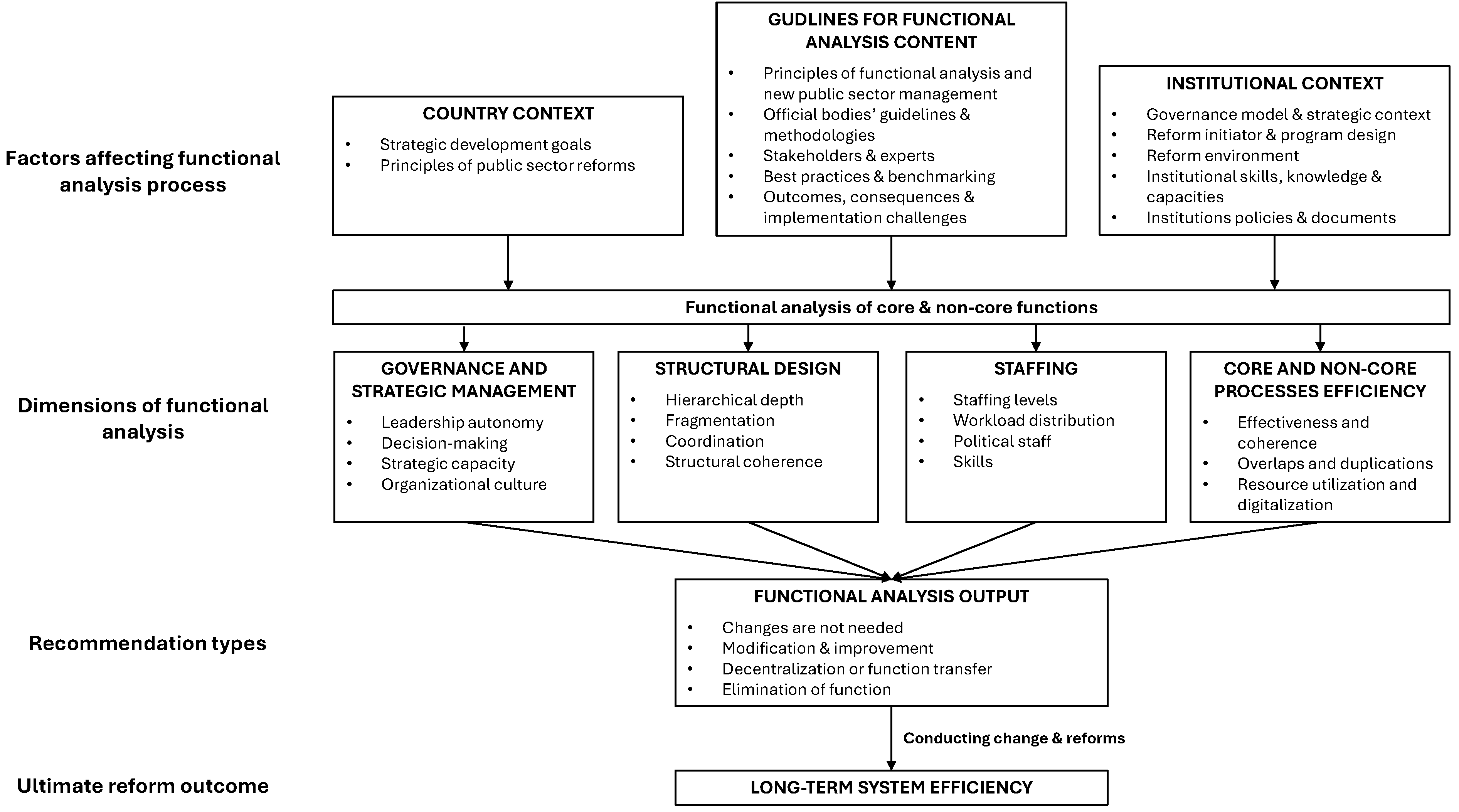
Ngouo, 2017). To address these limitations, this study reconceptualizes FA as a structured organizational diagnostic framework (
Figure 1).
Prior research suggests that public sector performance depends not only on formal organizational structures, but also on governance coherence, strategic capacity, and the interaction of functions within and across complex institutional systems. Accordingly, functional analysis models are typically adapted to the management model of the public institution, the reform initiator, design, and the broader institutional environment (
Muhula et al., 2017). The literature further emphasizes that FA should be grounded in the strategic context defined by organizational missions, visions, and culture (
Viola et al., 2012;
Favaro, 2014).
From a theoretical perspective, approaches such as Parsons’ AGIL framework emphasize the interdependence of organizational components (
Lyden, 1975). Complementary models drawing on systems theory and axiomatic design focus on identifying structural misalignments, including functional overlap and conflict (
Worren, 2016). In addition, FA models typically incorporate multidimensional criteria for function assessment, including staffing, outcome-related, user-oriented, and inter-institutional dimensions (
Tunčikienė & Korsakienė, 2014). These analytical dimensions are often supplemented by integrative organizational frameworks, such as the McKinsey 7S model and other models, to capture alignment between strategy, structure, processes, and other organizational structure elements (
Alam, 2017;
Mintzberg, 1990;
Chandler, 1969).
Drawing on complementary strands of public administration theory and organizational design literature, the proposed framework integrates key conceptual elements without replicating any single existing model. Rather than introducing entirely new organizational dimensions, it brings together well-established concepts from organizational theory and adapts them into a structured diagnostic tool specifically tailored to functional analysis in public sector institutions. Influential models such as Mintzberg’s organizational design or the McKinsey 7S framework emphasize the importance of internal organizational alignment. However, they are not explicitly designed to support functional reviews commonly used in public administration reforms.
The contribution of the proposed framework therefore lies in operationalizing functional analysis as a coherent analytical model that systematically links governance arrangements, structural design, staffing configurations, and process efficiency to institutional performance. By translating theoretical insights from organizational design and public administration scholarship into analytically observable and measurable dimensions, the framework enables a more consistent interpretation of functional review findings across diverse institutional contexts.
The resulting functional analysis framework is organized around four core analytical dimensions that capture critical organizational characteristics influencing functional performance in public institutions (
Table 1). Together, these dimensions provide a parsimonious yet comprehensive basis for diagnosing organizational strengths, identifying functional bottlenecks, and informing evidence-based institutional reform.
Based on the conceptual framework outlined above, the study advances three research propositions that guide the empirical analysis:
Proposition 1. System efficiency in public institutions is more strongly shaped by governance and strategic management arrangements than by staffing levels alone.
Proposition 2. Structural design influences system efficiency by shaping the balance, coherence, and interaction between core and non-core functions.
Proposition 3. Staffing affects system efficiency indirectly by influencing the efficiency of core and support processes rather than system performance directly.
These propositions provide an analytical lens for examining functional analysis findings across institutional contexts and support the comparative assessment presented in subsequent sections of the paper.
3. Materials and Methods
3.1. Research Design and Case Selection
This study adopted a comparative qualitative case study design, appropriate for examining complex organizational and strategic management phenomena (
Yin, 1994). This method was chosen because it can combine data from various sources and facilitate analytical triangulation, which allows for a more nuanced understanding of the functional arrangements within public institutions (
Noor, 2008). This design prioritizes analytical rather than statistical generalization, which is in line with interpretive approaches in public administration research by
Madimutsa (
2019),
Mihić et al. (
2019) and
Mihret and Woldeyohannis (
2008).
The empirical focus of the research was placed on National Assemblies as administrative bodies responsible for supporting legislative, budgetary, oversight, and representative functions (
Hanson, 2022). The development and expansion of a country’s economy and society depend on these entities operating effectively and efficiently (
Matei & Dumitru, 2020). In fulfilling the aforementioned role of NAs, parliamentary secretariats or administrative agencies play a crucial role. Accordingly, they constitute the unit of analysis.
Instead of focusing on statistical representativeness, case selection was guided by a deliberate, theory-informed logic that maximized analytical significance. Three parliamentary secretariats were selected: the National Assembly of the Republic of Serbia, the National Assembly of Armenia, and the Verkhovna Rada of Ukraine. These Eastern European parliamentary administrations were chosen because they are actively aligning with European public sector principles and implemented functional analyses as part of broader administrative reform processes between 2020 and 2024 (
Cardona Peretó & Freibert, 2007). The selected cases share a comparable institutional mandate and functional scope, enabling meaningful comparison, while differing in governance arrangements, reform trajectories, and levels of administrative capacity.
3.2. Data Sources
This study draws on multiple data sources to enable analytical triangulation and strengthen the robustness of its findings. Following the diagnostic approach of functional analysis, the research mainly focused on secondary data, including FA reports prepared for the parliamentary administrations of Armenia and Ukraine during 2020 and 2021 (
Walker et al., 2020,
2021). These were supplemented by official institutional documents, including organizational statutes, internal regulations, systematization acts, strategic planning materials, and relevant legislative frameworks governing parliamentary administration and public sector organization.
For the Serbian parliamentary secretariat, secondary data were enriched with primary data gathered during field research in 2023 and 2024. This included an employee self-assessment survey and semi-structured interviews with senior administrative officials, aimed at deepening the understanding of organizational practices, validating documentary findings, and providing extra contextual insight. Due to limited data comparability, primary inputs served an interpretive rather than a cross-case comparative function.
3.3. Analytical Framework and Procedure
The analysis applied the proposed functional analysis framework as an organizational diagnostic tool to examine functional arrangements across the selected parliamentary secretariats. The framework was structured around four analytical dimensions: governance and strategic management, structural design, staffing, and processes efficiency through the review of core and non-core functions, which were applied consistently across all cases to ensure analytical comparability. These dimensions guided the coding, categorization, and interpretation of documentary and qualitative material. Furthermore, the framework aligns with established approaches in the literature and reflects practices endorsed by the Westminster Foundation for Democracy (WFD), which promotes open, inclusive, and evidence-based, context-sensitive reform methodologies (
Kolodny, 2010).
The analytical procedure involved a systematic interpretive content analysis of FA reports and institutional documentation, complemented by qualitative inputs where available. In line with interpretive case study research, research propositions were used as analytical lenses guiding interpretation. Rather than being treated as hypotheses for statistical testing, the propositions supported pattern-matching across cases. This approach allowed the study to examine whether similar organizational patterns appear across the analyzed parliamentary administrations and how governance arrangements, structural design, staffing configurations, and operating processes interact in shaping system efficiency.
System efficiency and related organizational characteristics are interpreted through observable institutional indicators (Focus areas from
Table 1) identified in functional analysis reports and supporting institutional documentation. These indicators include governance arrangements (e.g., degree of delegation and strategic coordination), structural characteristics (such as hierarchical depth, unit size, and span of control), staffing configuration (including vacancy levels, workload distribution, and staff allocation across functions), and process-related indicators such as functional overlap, duplication of responsibilities, digitalization practices, and resource utilization. Rather than relying on single quantitative metrics, the analysis examined how these indicators collectively reflect the efficiency and coordination of organizational functions within parliamentary administrations.
The validity of this study is supported by the strong alignment between proposed conceptual FA framework and established theories of public administration and organizational design. Analytical validity is further reinforced through the consistent application of the same analytical dimensions across all cases, as well as through the use of multiple data sources, which enables triangulation and strengthens the credibility of the findings. Reliability is ensured by the transparent and systematic application of a common analytical procedure across cases. The reliance on official FA reports and authoritative institutional documents contributes to the consistency and trustworthiness of the empirical material. In addition, clear documentation of analytical steps enhances the replicability of the research design in comparable public sector settings.
As with all research employing interpretive case study design, the narrative and context-sensitive nature of the analysis inherently limits the generalizability of the findings (
Yin, 1994). Accordingly, the study findings should be interpreted with appropriate caution, focusing on analytical generalization. This limitation is particularly relevant given the focus on only three parliamentary secretariats.
4. Results
As noted, the WFD’s functional analysis studies for the Armenian and Ukrainian Parliaments provided the data used in the study (
Walker et al., 2020,
2021). For the Serbian Parliament, data were collected from both primary and secondary sources by field research conducted in 2023 and 2024 within the same institution.
4.1. Case Study Background
Given the nature of the case study, it is essential to briefly review the reform context of Serbia, Armenia, and Ukraine. Ukraine became a candidate for the EU in 2022, but Armenia has not yet entered negotiations. On the other hand, Serbia has opened 22 out of 35 chapters after ten years of candidate experience. These differences form part of the broader institutional environment in which parliamentary administrations operate.
Using coalitions and legally-based decision-making, the Republic of Serbia adheres to the continental European model (
Muhula et al., 2017). Serbia’s Parliament has experienced four significant revisions since the country’s 1990 transition to a multiparty system, which have been influenced by government-led procedures and ministries. International agreements, especially those with the IMF, have sustained Serbia’s stability despite the difficulties presented by its strict legal frameworks and resource allocation.
Armenia’s National Assembly strikes a balance between tradition and reform, preserving institutional stability in the face of political upheaval. Legislative restrictions and capacity limitations, however, impede more significant reforms. Ukraine’s Verkhovna Rada prioritizes modernization through UNDP partnerships and e-Parliament initiatives, but legislative overload, staff shortages, and weak inter-institutional communication remain obstacles.
Table 2 presents the demographic characteristics of the parliaments analyzed. These background details are important for comprehending how organizational size and administrative capability vary from instance to case. The table is not meant to be used as a foundation for evaluative comparison, but rather to place the following analysis in context.
In terms of the number of MPs, an analysis of the data found significant differences among the Parliaments observed. The average number of MPs per 100,000 inhabitants varied widely, with Armenia having the highest ratio (4.51), Serbia (3.76) close to the European average (4.03), and Ukraine (1.06) resembling European nations such as France and Germany. Disparities were also evident in average public-sector wages. In Ukraine and Serbia, public sector salaries exceed the national average, making these positions attractive, in contrast, lower public-sector salaries in Armenia act as a disincentive.
4.2. Governance and Strategic Management
A comparative analysis of the parliamentary administrations of the Republics of Armenia, Ukraine, and Serbia revealed notable differences in leadership structures and management practices.
Table 3 summarizes their key governance and strategic management characteristics.
Across all three parliamentary administrations, governance arrangements are characterized by centralized decision-making and limited delegation of tasks to operational management levels. Senior administrative leaders, whether designated as Chief of Staff or Secretary General, retain responsibility for a broad range of both strategic decisions and routine tasks. In all cases, governance structures are formally documented and politically embedded, with senior officials appointed through political processes. While such arrangements ensure political oversight, they also constrain managerial autonomy and limit the strategic capacity of parliamentary secretariats.
The analysis further revealed gaps in strategic management across all cases, where strategic practices are often treated as formal requirements with limited practical impact. To illustrate, comprehensive mission statements exist, but they focus narrowly on legislative and representative roles, neglecting oversight and budgetary functions. None of the parliamentary secretariats have established effective systems for long-term planning and performance monitoring. Finally, while analyzing organizational culture, results showed similar patterns across the three administrations, characterized by entrenched bureaucratic routines and limited capacity to manage and sustain organizational change.
4.3. Structural Design
The organizational structures of the Armenian, Ukrainian, and Serbian parliamentary secretariats also reflect the combined effects of past reforms and broader social and political changes. Their internal structures, employing a hierarchical model containing clearly defined layers of authority from the secretariat head to their support staff, are divisible by type into specialized units (e.g., the Speaker’s Cabinet), fundamental units (e.g., sectors and directorates), and smaller organizational sub-units (e.g., divisions, groups or departments). While this arrangement provides clarity in roles and responsibilities, it may also hinder flexibility, innovation, and efficiency through the fostering of a ‘silo mentality’, which limits cross-department collaboration (
Jung & Lee, 2016). In addition, such structures tend to promote top-down, process-oriented bureaucratic cultures that shift decision-making upward (
Matriano, 2024).
Furthermore, several structural deficiencies were evident across the analyzed cases. All three secretariats exhibit relatively deep organizational structures of around five hierarchical layers, which aligns with SIGMA guidance. However, public administrations in many EU and OECD countries increasingly favor flatter organizational models (
Muhula et al., 2017). Additionally, recommended thresholds for unit size of at least six staff members are not consistently met, suggesting fragmentation and the need for rationalization. The span-of-control ratio also exceeds the reference benchmark of 1:5, particularly in Ukraine, where it reaches 1:6.44.
Additional challenges relate to unclear unit nomenclature and reporting lines. For example, in Armenia and Serbia, the term “Secretariat” refers both to the entire administration and to specific units supporting parliamentary processes, creating ambiguity. Moreover, these units report directly to the Secretary General rather than to a Deputy, raising concerns about strategic oversight. Similar governance issues arise in Armenia, where the Internal Audit unit reports to the same Deputy responsible for finance, limiting its operational independence.
4.4. Staffing
Demographic staffing patterns across the analyzed parliamentary administrations revealed important structural characteristics (
Table 2). Although women represent around 70% of total staff, leadership positions remain predominantly male, revealing a persistent gender imbalance in decision-making roles, despite the fact that knowledge and work experience, not gender, should be the key prerequisites for management positions in public institutions (
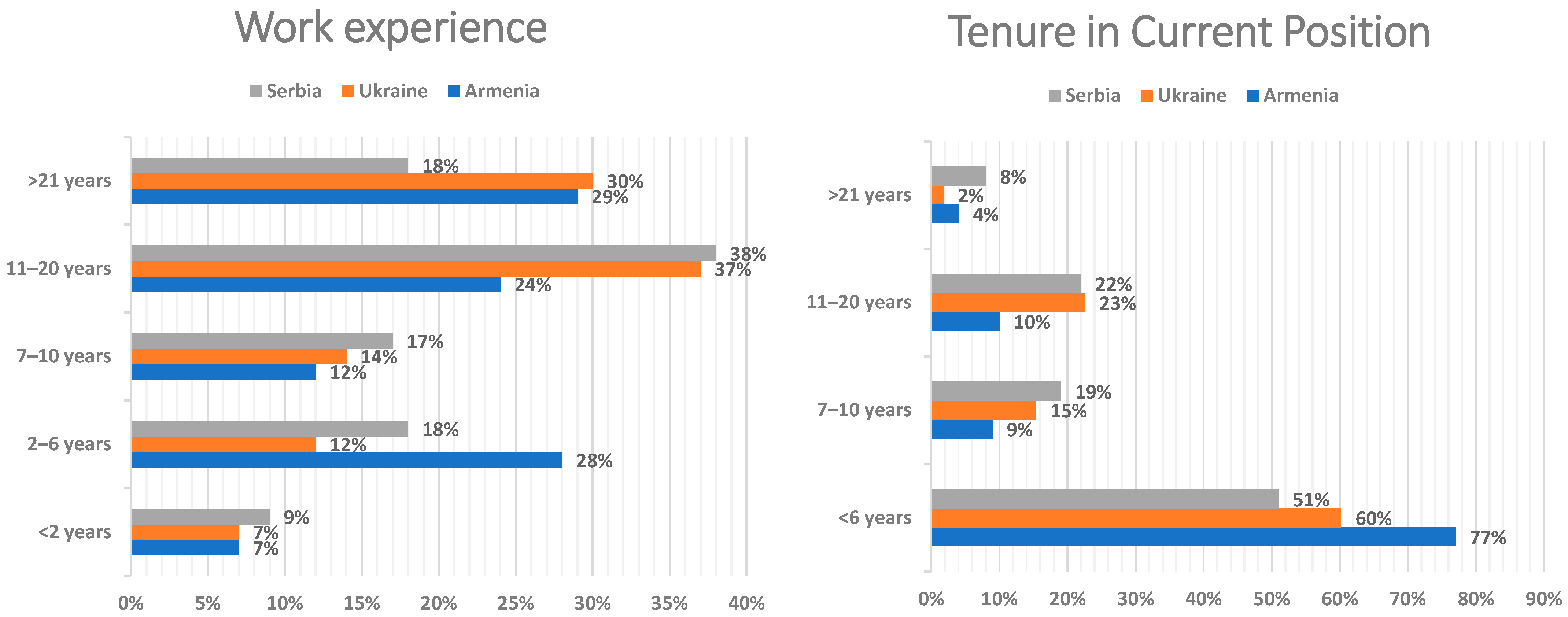
Dragičević & Mihić, 2020). Most employees are between 31 and 50 years of age, with limited youth representation, except in Armenia. Educational attainment is generally high, with the majority holding higher education degrees, including a notable share of PhD holders in Ukraine. Tenure patterns show low internal mobility, as many staff have long service records and have remained in their current positions for extended periods (
Figure 2), with job changes occurring mainly due to organizational needs rather than career progression.
Staffing profiles of the parliamentary secretariats of Armenia, Ukraine, and Serbia further revealed notable variation in workforce size, composition, and functional allocation. As an initial descriptive benchmark, the number of non-political staff was examined in relation to the number of MPs. Across European parliamentary administrations, non-political staff-to-MP ratios typically range between two and four employees per MP. Within this range, Armenia (3.22) and Ukraine (2.38) fall within the mid-range, while Serbia (1.97) is positioned toward the lower end (
Table 4). Given that parliamentary staffing levels are shaped by multiple contextual factors, including legislative workload, population size, and institutional priorities (
Otjes, 2022), these ratios are interpreted as descriptive indicators rather than as measures of under- or overstaffing.
Across the three cases, approximately 44% of total parliamentary staff were allocated to core parliamentary functions. Vacancy data and employee workload perceptions indicate capacity pressures in both core and key non-core areas. However, functional analysis findings reported 48 vacant positions in Armenia, 78 in Ukraine, and 110 in Serbia, affecting core functions as well as key support areas such as information technology (IT), public relations (PR), and human resources (HR). Approximately one-third of employees across the cases reported a very high workload, with perceived overload most pronounced in Ukraine, where 43% of staff engaged in self-assessment survey indicated excessive workload. In contrast, only a small proportion of employees (5–6%) reported low workload levels. In addition, between 20% and 25% of employees reported regularly performing tasks outside their formally assigned positions or organizational units.
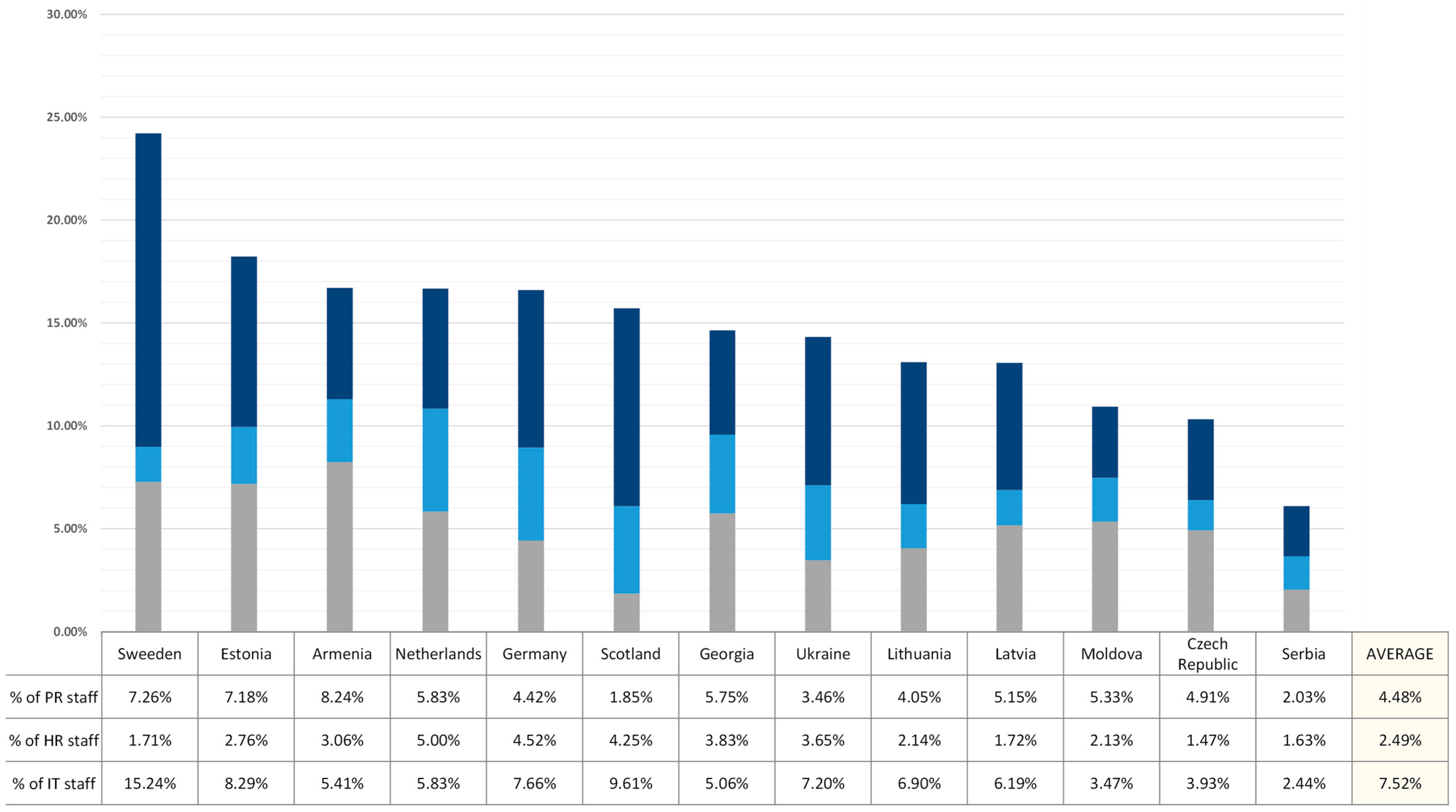
Staffing distribution across functional areas further highlights imbalances between core and non-core functions. While some units supporting parliamentary session processes exhibited staffing levels exceeding current demand, personnel shortages were evident across most core functions. In non-core areas, staffing levels varied by function and country. IT capacity appeared constrained across all three cases, while HR staffing was generally adequate except in Serbia. PR staffing levels remained comparatively low in Armenia and Ukraine (
Figure 3). Furthermore, given their overt European tendencies, it was unanticipated that only five employees in Serbian and Ukrainian Parliaments were assigned to these roles, compared to an average of 11 in the benchmarked European parliaments.
An examination of political staff supporting Speakers, Deputy Speakers, parliamentary groups, and individual MPs indicated that staffing levels remain below commonly observed European benchmarks, particularly with regard to support provided to parliamentary groups and individual MPs, while staffing of Speakers’ offices is comparatively adequate (
Table 5). In the Armenian, Ukrainian, and Serbian parliaments, political staff are employed on fixed-term contracts but generally share the same employment status as other parliamentary staff, resulting in blurred distinctions between political and administrative roles.
Furthermore, insights gained through FA show limited institutional differentiation in the regulation and management of political staff positions. Support arrangements for MPs vary across cases and are unevenly distributed among parliamentary groups, with opposition MPs typically relying on more limited advisory and expert support capacities than governing majority representatives. Access to training and professional development opportunities for political staff also varies across institutional contexts, with potential implications for the balance and quality of parliamentary support functions.
4.5. Processes Efficiency: Core and Non-Core Functions
Processes efficiency across the parliamentary administrations of Armenia, Ukraine, and Serbia was examined through the coherence, alignment, and performance of core and non-core functions. Functional analysis findings revealed that inefficiencies are primarily associated with fragmented functional allocation, overlapping responsibilities, and uneven resource utilization across organizational units.
4.5.1. Core Parliamentary Functions
Within core parliamentary functions, including legislative support, committee services, and analytical assistance, several efficiency-related challenges were identified. Over-regulation of selected procedural processes limits operational flexibility, while capacity constraints affect the ability of administrations to provide timely and comprehensive support. With the exception of parliamentary session support, where efficiency constraints are partly linked to the limited use of digital tools, staffing levels in core functions are generally lower than those observed in comparable European parliamentary administrations and the main cause of inefficiency.
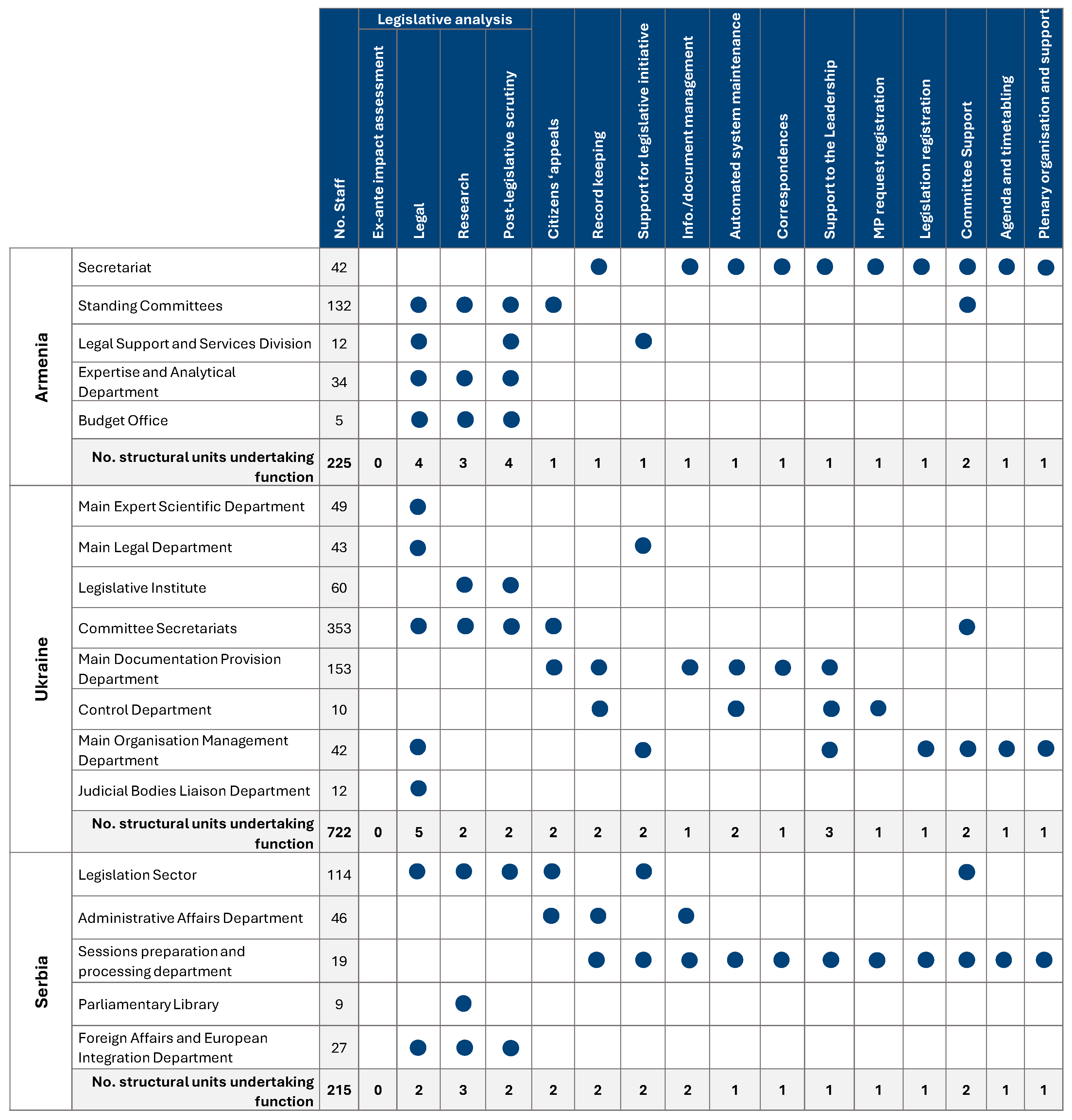
Functional overlap and duplication are evident within analytical and legislative support functions (
Figure 4). None of the parliamentary administrations examined systematically conduct comprehensive ex-ante assessments of draft legislation, nor do they consistently utilize regulatory impact assessments prepared by executive bodies. Legal support functions are unevenly distributed, with formal legislative drafting assistance often provided informally, contributing to repeated revisions during committee, plenary stages, and general parliamentary efficiency and effectiveness. The use of digital tools, especially ones enhanced by artificial intelligence (AI), to support parliamentary sessions, including speech-to-text technologies and e-parliament platforms, remains uneven across cases. In addition, the number of parliamentary researchers employed within the secretariats is comparatively low relative to commonly cited European reference points, limiting analytical capacity in legislative support functions.
When analyzing standing committees, results showed that they are primarily focused on legislative review, with oversight functions less systematically supported. The number of standing committees varied across cases, with Serbia and Ukraine (23 committees) maintaining higher numbers than the European average of 18–20, while Armenia is constitutionally limited to 12. Committee staffing levels also differ, with Ukraine meeting commonly observed benchmarks for committee membership size (5–10 members), whereas Armenia and Serbia operate with smaller average committee memberships (less than 5 members). High legislative workloads, combined with inflexible staffing arrangements, contribute to workload pressures within committee secretariats.
4.5.2. Non-Core (Support) Functions
Functional analysis findings indicate that efficiency challenges are also evident across non-core support functions within the examined parliamentary administrations, including financial management, human resources, communication, information technology, international relations, and administrative logistics. Across all three cases, non-core functions displayed varying degrees of fragmentation, limited strategic integration, and uneven resource utilization.
Financial management functions are predominantly administrative in nature, with limited incorporation of strategic planning, medium-term forecasting, or performance-oriented budgeting practices. Over the past five years, Armenia and Ukraine underspent their parliamentary budgets by 3.73% and 7.12%, respectively, while Serbia fully utilized its allocated budget. Despite these differences, financial management practices across cases remain largely focused on procedural compliance rather than strategic financial coordination.
Human resource functions similarly remain oriented toward administrative tasks, with limited evidence of systematic workforce planning, structured performance management, or comprehensive staff development mechanisms. Communication and public relations functions are distributed across multiple organizational units, resulting in fragmented coordination with media actors and inconsistent approaches to citizen engagement. Furthermore, the findings indicate a limited use of modern digital tools, inconsistent application of social media, and uneven development of outreach activities, relative to practices outlined in IPU standards (
Williamson et al., 2024).
Information technology systems are in place in all three parliamentary administrations. However, these systems remain insufficiently integrated, limiting their contribution to workflow efficiency, digital service delivery, cybersecurity, and effective data management. Findings also show that IT functions exhibit relatively low budget allocations (around 2% compared to a European average of 4.67%), alongside uneven staff training and reliance on external expertise.
International relations and protocol functions are dispersed across organizational units, contributing to coordination challenges in the management of parliamentary diplomacy, inter-parliamentary cooperation, and international engagements. Administrative and logistics functions, including maintenance, transportation, catering, and document management, are largely maintained in-house across all three cases (
Table 6), with limited outsourcing, uneven vehicle fleet utilization, and partial digitalization of document management.
5. Discussion
This study contributes to the public administration literature by reconceptualizing functional analysis from a procedural reform instrument into a structured organizational diagnostic framework that enables the systematic assessment of institutional efficiency. Although FA is frequently employed in public sector reforms (
Manning & Parison, 2004;
Tunčikienė & Korsakienė, 2014;
Jahija, 2017), the literature findings indicate that such applications often obscure deeper organizational dynamics. Similar critiques appear in earlier research on benchmarking and reform transfer, which shows that standardized tools rarely generate meaningful organizational improvement without a thorough understanding of institutional context (
Holloway et al., 1999).
The analytical approach adopted in this study frames FA as a tool for identifying functional misalignments in complex public institutions, emphasizing governance coherence, structural design, staffing, and efficiency of core and non-core processes. Empirical evidence from analyzed parliamentary secretariats shows that institutional efficiency cannot be explained by staffing levels or formal structures alone, but instead results from the interplay of governance arrangements, strategic capacity, structural coherence, operating processes, and staffing alignment.
These findings are consistent with emerging research in parliamentary studies emphasizing that administrative capacity and professional staff play a central role in supporting legislative scrutiny, policy analysis, and oversight functions within modern parliaments (
Crosson et al., 2020;
Brandsma & Otjes, 2024;
Hofland & Otjes, 2025). Furthermore, the findings also align with NPM and systems-based perspectives that prioritize coordination, integration, and institutional context over narrow performance metrics (
Pollitt & Bouckaert, 2017;
Rosenberg Hansen & Ferlie, 2016).
From a theoretical standpoint, the study goes beyond the common use of FA as an evaluation of organizational design (
Worren, 2016) or an application of abstract functionalist theory to public organizations (
Lyden, 1975). Additionally, the results emphasize the significance of alignment between structure and strategy for organizational effectiveness, following traditional organizational theory (
Chandler, 1969;
Mintzberg, 1990). The paper also contributes to the literature of
Rosenberg Hansen and Ferlie (
2016) by demonstrating that traditional public organizations, such as parliamentary secretariats, do not necessarily have to be excluded from the application of NPM instruments.
Beyond its theoretical contribution, the study provides empirically grounded insights for parliamentary administrations and reform practitioners, setting the stage for a discussion of the findings through the lens of the three research propositions.
5.1. Governance and Strategic Management as the Driver of System Efficiency (P1)
The paper’s findings indicate that governance and strategic management capacity play an important role in shaping system efficiency within parliamentary administrations, providing strong support for Proposition 1. Across all cases, functional performance was less constrained by staffing levels than by centralized decision-making, limited delegation, and weak strategic coordination. These patterns suggest that efficiency in complex public institutions is determined by how governance arrangements and strategic management are structured and enacted, rather than by the volume of human resources alone.
This pattern is consistent with the literature on NPM, which highlights how managerial reforms emphasizing control and performance measurement often fail to address deeper governance coherence and coordination challenges (
Hood, 1990;
Lapuente & Van de Walle, 2020;
Arnaboldi et al., 2015). While NPM-inspired reforms have improved transparency and accountability, the findings suggest that in parliamentary administrations, centralized and politically embedded leadership arrangements limit efficacy. Additionally, despite being widely recognized as a critical success factor in public institutions, the analysis revealed the absence of comprehensive strategic frameworks and practices (
Mihić et al. 2012;
Poister et al., 2013;
Djordjevic & Mihic, 2022).
Based on the findings, parliamentary governance in Armenia, Ukraine, and Serbia would benefit from a clearer separation between political leadership and professional management, supported by the introduction of collective and strategic leadership arrangements, such as a governing body with an executive board and audit committee. In addition, consistent with Drucker’s view, the impact of formal strategies is largely conditioned by the underlying organizational culture (
Favaro, 2014). Therefore, to address cultural and change-management constraints, the establishment of a short-term change office is recommended to support organizational transformation and facilitate the gradual integration of change functions into strategic planning structures.
5.2. Structural Design as Determinants of System Efficiency (P2)
Proposition 2, which links structural design to system efficiency through the balance and interaction of core and non-core functions, is also supported by the empirical findings. Examined parliamentary administrations exhibit hierarchical depth, fragmented functional allocation, and limited horizontal coordination. While such structures clarify formal responsibilities, they also inhibit flexibility and cross-unit collaboration, contributing to inefficiencies and functional overlap.
As already said, these findings resonate with classic organizational theory, particularly
Chandler’s (
1969) and
Mintzberg’s (
1990), as the cases reveal weak alignment between strategic priorities and organizational structures, resulting in configurations where formal divisions exist, but functional interdependencies are insufficiently managed. Similar dynamics have been identified in studies emphasizing that poorly coordinated structures amplify complexity rather than manage it (
Lyden, 1975;
Worren, 2016). The results also illustrate how fragmentation, often associated with NPM-inspired approaches, can generate coordination deficits when not counterbalanced by integrative mechanisms (
Lapuente & Van de Walle, 2020).
In response to these structural shortcomings, the analysis establishes two ways for improvements. First, by including limited adjustments within the existing structure, or by the second, which implies a more comprehensive structural rationalization that strengthens the role of the Deputy Secretary General and newly established governing body, offering greater long-term benefits despite higher implementation demands. Any reorganization in this way should align structure with institutional and national contexts (
Holloway et al., 1999;
Xavier, 2013;
Ngouo, 2017), with a transitional structure serving as a pragmatic interim step toward deeper reform with long-term benefits (
Robinson, 2013).
5.3. Staffing as a Mediating Mechanism for System Efficiency (P3)
The findings related to staffing and process efficiency provide support for Proposition 3 by demonstrating that staffing mediate, rather than directly determine, processes and accordingly system efficiency within parliamentary administrations. While variations in staffing levels and workforce composition are evident across cases, system sluggishness is more closely associated with inefficient core and non-core processes than with absolute staff numbers. This suggests that staffing functions primarily as an intermediary mechanism through which process efficiency affects functional performance.
Despite stable staffing levels and high educational attainment, the examined parliamentary administrations face workload imbalances, vacancy pressures, and limited internal mobility, driven by misaligned staffing configurations within fragmented organizational structures than by staff shortages. This finding aligns with public sector human resource management literature, which emphasizes role clarity, skill alignment, and strategic workforce planning over numerical staffing increases (
Tucker, 2022;
Marjanović & Mihić, 2025) and is reinforced by comparative research showing that staff size reflects assigned roles rather than institutional performance (
Hofland & Otjes, 2025). The analysis also identified political staff as a distinct category affecting system efficiency, corroborating the findings of
Otjes and Brandsma (
2026) that unequal access to such staff can shape parliamentary performance.
The mediating role of staffing becomes more pronounced when examined in relation to core and non-core functions. In core functions, insufficient analytical capacity, limited research activity and fragmented support services undermine process efficiency, particularly in legislative scrutiny, committee work, and oversight activities. Prior research similarly indicates that process efficiency in parliamentary administrations depends less on overall staff numbers and more on the availability, deployment, and coordination of specialized capacities (
Fitsilis & Koutsogiannis, 2017;
Brandsma & Otjes, 2024). Fragmentation of these capacities has been shown to weaken legislative quality, especially in systems characterized by high legislative throughput and increasing regulatory complexity (
Matei et al., 2019;
Crosson et al., 2020).
With regard to non-core functions, areas such as human resources, finance, communication, and information technology tend to exhibit procedural stability but limited strategic integration, constraining their capacity to support core processes effectively. This pattern aligns with earlier studies showing that support functions in public organizations often remain administratively oriented and insufficiently embedded in core workflows, particularly in contexts requiring digital coordination, greater use of new technologies such as AI, public engagement, and effective data management (
Loukis, 2011;
Papaloi & Gouscos, 2011;
Cahlikova & Mabillard, 2020). Similar dynamics can be observed in administrative and logistics functions, where the lack of outsourcing and partial digitalization reflect institutional arrangements associated with varying implications for cost efficiency and sustainability (
Karakolias, 2024).
6. Conclusions
This study set out to reconceptualize functional analysis from a procedural reform instrument into an organizational diagnostic framework capable of explaining system efficiency in complex public institutions. Drawing on a comparative analysis of parliamentary secretariats in Armenia, Ukraine, and Serbia, the paper demonstrates how functional performance is shaped by the interaction of governance arrangements, structural design, staffing configurations, and the efficiency of core and non-core processes. By focusing on parliamentary administrations, the study contributes both empirical insights and conceptual refinement to the public administration literature.
The findings indicate that system efficiency in parliamentary administrations is driven by governance and strategic management capacity, rather than by staffing levels alone. Structural design influences efficiency by shaping functional coherence, coordination, and the interaction between organizational units, while staffing affects system performance indirectly by mediating the efficiency of core and non-core processes. Importantly, inefficiencies observed across cases emerge as systemic and cumulative rather than as isolated functional failures, underscoring the limitations of reform approaches that rely on piecemeal organizational adjustments.
From a theoretical perspective, the study advances FA by operationalizing functionalist and organizational design concepts through empirically observable dimensions. By analyzing system efficiency, the proposed framework clarifies the mechanisms through which governance, structure, processes, and staffing interact to produce organizational outcomes. In doing so, the paper extends existing organizational and NPM scholarship by positioning FA as an explanatory and diagnostic tool rather than a descriptive mapping exercise.
Beyond its theoretical contribution, the framework offers practical relevance as a diagnostic lens for institutional self-assessment. Rather than prescribing standardized reform templates, it enables practitioners to identify functional misalignments, coordination gaps, and process-level inefficiencies within their specific organizational contexts. While the empirical focus is on parliamentary administrations, the analytical logic of the framework is transferable to other complex public sector organizations characterized by multi-functional mandates and politically embedded governance structures. However, the empirical findings presented in this study should be interpreted primarily within the institutional context of parliamentary administrations rather than as broadly generalizable conclusions for all public sector organizations.
Several limitations should be acknowledged. The empirical analysis focused on three parliamentary administrations with relatively similar institutional contexts and accordingly employed a qualitative research design based on a small number of comparative cases. Therefore, the findings should be interpreted primarily in terms of analytical generalization rather than as broadly generalizable conclusions for all public sector organizations. Moreover, the analysis captures organizational configurations at a specific point in time, limiting insight into longer-term reform dynamics. Future research could apply the framework to a broader range of public institutions, explore the longitudinal effects of functional realignment, and further operationalize FA dimensions using mixed or quantitative methods.
Author Contributions
Conceptualization, P.S., M.M. and Z.M.; methodology, P.S., M.M. and Z.M.; validation, M.M. and Z.M.; formal analysis, M.M. and Z.M.; investigation, P.S. and M.M.; data curation, P.S. and M.M.; writing—original draft preparation, P.S. and M.M.; visualization, P.S. and M.M.; writing—review and editing, P.S., M.M. and Z.M. All authors have read and agreed to the published version of the manuscript.
Funding
This research received no external funding.
Institutional Review Board Statement
Not applicable.
Informed Consent Statement
Not applicable.
Data Availability Statement
The data presented in this study are available on request from the corresponding author.
Acknowledgments
This research was supported by the University of Belgrade—Faculty of Organizational Sciences and, in part, by the Ministry of Science, Technological Development and Innovation of the Republic of Serbia through institutional funding (grant number: 200151).
Conflicts of Interest
The authors declare no conflicts of interest.
Abbreviations
The following abbreviations are used in this manuscript:
| NPM | New public management |
| FA | Functional analysis |
| QCA | Qualitative comparative analysis |
| NA | National Assemblies |
| WFD | Westminster Foundation for Democracy |
| OECD | Organization for Economic Co-operation and Development |
| EU | European union |
| IMF | International monetary fund |
| UNDP | United Nations Development Program |
| IPU | International Parliamentary Union |
| MP | Members of Parliament |
| AI | Artificial intelligence |
| IT | Information technology |
| PR | Public relations |
| HR | Human resources |
References
- Alam, P. (2017). Measuring organizational effectiveness through performance management system and McKinsey’s 7S model. Asian Journal of Management, 8(4), 1280–1286. [Google Scholar] [CrossRef] [Scilit]
- Arnaboldi, M., Lapsley, I., & Steccolini, I. (2015). Performance management in the public sector: The ultimate challenge. Financial Accountability & Management, 31(1), 1–22. [Google Scholar] [CrossRef] [Scilit]
- Balasubramanian, S., & Gupta, M. (2005). Structural metrics for goal-based business process design and evaluation. Business Process Management Journal, 11(6), 680–694. [Google Scholar] [CrossRef] [Scilit]
- Brandsma, G. J., & Otjes, S. (2024). Gauging the roles of parliamentary staff. Parliamentary Affairs, 77(3), 537–557. [Google Scholar] [CrossRef] [Scilit]
- Cahlikova, T., & Mabillard, V. (2020). Open data and transparency: Opportunities and challenges in the Swiss context. Public Performance & Management Review, 43(3), 662–686. [Google Scholar] [CrossRef] [Scilit]
- Cardona Peretó, F., & Freibert, A. (2007). The European administrative space and SIGMA assessments of EU candidate countries. Croatian and Comparative Public Administration, 7(1), 51–59. [Google Scholar]
- Chandler, A. D., Jr. (1969). Strategy and structure: Chapters in the history of the American industrial enterprise. MIT Press. [Google Scholar]
- Crosson, J. M., Lorenz, G. M., Volden, C., & Wiseman, A. E. (2020). How experienced legislative staff contribute to effective lawmaking. In F. M. Lee, & J. Schickler (Eds.), Congress overwhelmed: The decline in congressional capacity and prospects for reform (pp. 209–224). University of Chicago Press. [Google Scholar]
- De Vries, H., Bekkers, V., & Tummers, L. (2016). Innovation in the public sector: A systematic review and future research agenda. Public Administration, 94(1), 146–166. [Google Scholar] [CrossRef] [Scilit]
- Djordjevic, A., & Mihic, M. (2022). Strategic importance and sustainable governance of high-tech business incubators: Evidence from Serbia. In N. Mitrovic, G. Mladenovic, & A. Mitrovic (Eds.), Current problems in experimental and computational engineering. CNNTech 2021 (Vol. 323, pp. 199–221). Lecture notes in networks and systems. Springer. [Google Scholar] [CrossRef] [Scilit]
- Dragicevic, I., & Mihic, M. (2020). Women leadership in public sector—Evidence from Serbia. Lex localis—Journal of Local Self-Government, 18(2), 253–270. [Google Scholar] [CrossRef] [Scilit]
- Egeberg, M., Gornitzka, Å., Trondal, J., & Johannessen, M. (2015). The European parliament administration: Organizational structure and behavioral implications. In The Palgrave handbook of the European administrative system (pp. 227–245). Palgrave Macmillan. [Google Scholar] [CrossRef] [Scilit]
- European Commission. (2023). Enhancing the European administrative space (ComPAct). Publications Office of the European Union. [Google Scholar]
- Eurostat. (2026). Database. Available online: https://ec.europa.eu/eurostat/web/main/data/database (accessed on 16 January 2026).
- Favaro, K. (2014). Strategy or culture: Which is more important? Strategy and business blog, PWC. Available online: https://www.strategy-business.com/blog/Strategy-or-Culture-Which-Is-More-Important (accessed on 18 January 2026).
- Fitsilis, F., & Koutsogiannis, A. (2017, July 29–30). Strengthening the capacity of parliaments through development of parliamentary research services [Working paper]. 13th Workshop of Parliamentary Scholars and Parliamentarians, Wroxton, UK. [Google Scholar]
- Hanson, A. H. (2022). The purpose of parliament. In Planning and the politicians (pp. 11–28). Routledge. [Google Scholar]
- Hofland, D., & Otjes, S. (2025). Parliamentary staff size around the world. Legislative Studies Quarterly, 50(4), e70040. [Google Scholar] [CrossRef] [Scilit]
- Holloway, J., Francis, G., & Hinton, M. (1999). A vehicle for change? A case study of performance improvement in the “new” public sector. International Journal of Public Sector Management, 12(4), 351–365. [Google Scholar] [CrossRef] [Scilit]
- Hood, C. (1990). A public management for all seasons? Public Administration, 69, 3–19. [Google Scholar] [CrossRef] [Scilit]
- Jahija, J. (2017). Functional analysis as a human resources management tool: The case of the FY Republic of Macedonia. International Journal of Civil Service Reform and Practice, 5(1), 22–34. [Google Scholar] [CrossRef] [Scilit]
- Jung, C. S., & Lee, G. (2016). Organizational climate, leadership, organization size, and aspiration for innovation in government agencies. Public Performance & Management Review, 39(4), 757–782. [Google Scholar] [CrossRef] [Scilit]
- Karakolias, S. (2024). Outsourcing non-core services in healthcare: A cost–benefit analysis. Valley International Journal Digital Library, 12, 1177–1195. [Google Scholar] [CrossRef] [Scilit]
- Kolodny, R. (2010). Political aid and the development of party politics: The case of the UK’s Westminster Foundation for Democracy (Working Paper No. 1663950). SSRN. [Google Scholar] [CrossRef] [Scilit]
- Lapuente, V., & Van de Walle, S. (2020). The effects of new public management on the quality of public services. Governance, 33(3), 461–475. [Google Scholar] [CrossRef] [Scilit]
- Loukis, E. (2011). Using advanced information technologies for increasing public participation in the Greek Parliament. Journal of Balkan and Near Eastern Studies, 13(1), 13–35. [Google Scholar] [CrossRef] [Scilit]
- Lyden, F. J. (1975). Using Parsons’ functional analysis in the study of public organizations. Administrative Science Quarterly, 20(1), 59–70. [Google Scholar] [CrossRef] [Scilit]
- Madimutsa, C. (2019). Using the case study method to examine the implications of public sector reform for public sector unions. In Research methods cases. SAGE Publications. [Google Scholar] [CrossRef] [Scilit]
- Manning, N., & Parison, N. (2004). Determining the structure and functions of government: Program and functional reviews. World Bank. [Google Scholar]
- Marjanović, M., & Mihić, M. (2025). The role of strategic HRM in change leadership: Driving organizational transformation. In V. Štavljanin, I. Mijatović, & I. Luković (Eds.), Unlocking the hidden potentials of organization through merging of humans and digitals. SymOrg 2024 (Lecture notes in networks and systems) (Vol. 1681). Springer. [Google Scholar]
- Matei, A., Ciora, C., Dumitru, A. S., & Ceche, R. (2019). Efficiency and effectiveness of the European Parliament under the ordinary legislative procedure. Administrative Sciences, 9(3), 70. [Google Scholar] [CrossRef] [Scilit]
- Matei, A., & Dumitru, A. S. (2020). The subsidiarity principle and national parliaments’ role: From formal need to real use of powers. Administrative Sciences, 10(2), 24. [Google Scholar] [CrossRef] [Scilit]
- Matriano, M. (2024). Organizational structure, its drawbacks and shortcomings, and overall impact on organizational behavior. Global Scientific Journal, 12, 1873–1882. [Google Scholar]
- Mihić, M., Obradović, V., Todorović, M., & Petrović, D. (2012). Analysis of implementation of the strategic management concept in the healthcare system of Serbia. HealthMED, 6(10), 3448–3457. [Google Scholar] [CrossRef] [Scilit]
- Mihić, M., Shevchenko, S., Gligorijević, E., & Petrović, D. (2019). Towards strategic corporate social responsibility approach in international projects—Review of South–South cooperation: A case study of Chinese projects in Angola. Sustainability, 11(10), 2784. [Google Scholar] [CrossRef] [Scilit]
- Mihret, D., & Woldeyohannis, G. (2008). Value-added role of internal audit: An Ethiopian case study. Managerial Auditing Journal, 23(6), 567–595. [Google Scholar] [CrossRef] [Scilit]
- Mintzberg, H. (1990). The design school: Reconsidering the basic premises of strategic management. Strategic Management Journal, 11(3), 171–195. [Google Scholar] [CrossRef] [Scilit]
- Muhula, R., Svirčev, S., Drasilov, K., Getachew, F., Vukovic Tasic, H., Fozzard, A., & Evans, G. (2017). Getting the most out of Serbia’s central administration for improved public sector management. World Bank. [Google Scholar]
- Ngouo, L. (2017). The World Bank’s approach to public sector management for 2011–2020: Proposals to push forward the debate. International Review of Administrative Sciences, 83(3), 541–562. [Google Scholar] [CrossRef] [Scilit]
- Noor, K. (2008). Case study: A strategic research methodology. American Journal of Applied Sciences, 5(11), 1602–1604. [Google Scholar] [CrossRef] [Scilit]
- OECD. (2023). Public administration in the Republic of Moldova: SIGMA monitoring reports. OECD Publishing. [Google Scholar]
- Osborne, S. P. (2018). From public service-dominant logic to public service logic: Are public service organizations capable of co-production and value co-creation? Public Management Review, 20(2), 225–231. [Google Scholar] [CrossRef] [Scilit]
- Otjes, S. (2022). What explains the size of parliamentary staff? West European Politics, 46(2), 374–400. [Google Scholar] [CrossRef] [Scilit]
- Otjes, S., & Brandsma, G. J. (2026). Staff matters: The effect of political group staff on MP activity in the Netherlands. Politics and Governance, 14, 10588. [Google Scholar] [CrossRef] [Scilit]
- Papaloi, A., & Gouscos, D. (2011). E-parliaments and novel parliament-to-citizen services. JeDEM—eJournal of eDemocracy and Open Government, 3(1), 80–98. [Google Scholar] [CrossRef] [Scilit]
- Poister, T. H., Edwards, L. H., Pasha, O. Q., & Edwards, J. (2013). Strategy formulation and performance: Evidence from local public transit agencies. Public Performance & Management Review, 36(4), 585–615. [Google Scholar] [CrossRef] [Scilit]
- Pollitt, C., & Bouckaert, G. (2017). Public management reform: A comparative analysis—Into the age of austerity. Oxford University Press. [Google Scholar]
- Robinson, M. (2013). The politics of successful governance reforms: Lessons of design and implementation. In The politics of successful governance reforms (pp. 119–146). Routledge. [Google Scholar]
- Rosenberg Hansen, J., & Ferlie, E. (2016). Applying strategic management theories in public sector organizations: Developing a typology. Public Management Review, 18(1), 1–19. [Google Scholar] [CrossRef] [Scilit]
- Sodergren, M.-C., & Gammarano, R. (2024). Who powers the public sector? International Labour Organization. Available online: https://ilostat.ilo.org/blog/who-powers-the-public-sector/ (accessed on 15 January 2026).
- Tucker, E. (2022). Strategic workforce planning: From closing skills gaps to optimizing talent. Strategic HR Review, 21(1), 14–19. [Google Scholar] [CrossRef] [Scilit]
- Tunčikienė, Ž., & Korsakienė, R. (2014). Sustainable development of public institutions: The model of functional review. Journal of Security and Sustainability Issues, 4(2), 187–195. [Google Scholar] [CrossRef] [Scilit] [PubMed]
- Tunčikienė, Ž., Skačkauskienė, I., & Grenčiková, A. (2013). Sustainable development of public sector: The state and assumptions of improvement of functional review in public institutions. Journal of Security and Sustainability Issues, 3(1), 11–21. [Google Scholar] [CrossRef] [Scilit] [PubMed]
- Viola, N., Corpino, S., Fioriti, M., & Stesina, F. (2012). Functional analysis in systems engineering: Methodology and applications. In Systems engineering—Practice and theory (pp. 71–96). InTech. [Google Scholar] [CrossRef] [Scilit]
- Walker, A., Levick, C., Galitchi, S., & Harutyunyan, D. (2021). Functional analysis of the administration of the National Assembly of the Republic of Armenia. Westminster Foundation for Democracy. [Google Scholar]
- Walker, A., Levick, C., Galitchi, S., Shevchuk, H., Volkov, A., & Venher, V. (2020). Institutional and functional analysis: Secretariat of the Verkhovna Rada of Ukraine. Westminster Foundation for Democracy. [Google Scholar]
- Williamson, A., Richardson, A., & Bikha, A. (2024). World e-Parliament report 2024. Inter-Parliamentary Union. [Google Scholar]
- Worren, N. (2016). Functional analysis of organizational designs. International Journal of Organizational Analysis, 24(5), 774–791. [Google Scholar] [CrossRef] [Scilit]
- Xavier, J. (2013). The World Bank approach to public sector management 2011–2020: Lessons from the Malaysian experience. International Review of Administrative Sciences, 79(3), 426–432. [Google Scholar] [CrossRef] [Scilit]
- Yin, R. K. (1994). Discovering the future of the case study method in evaluation research. Evaluation Practice, 15(3), 283–290. [Google Scholar] [CrossRef] [Scilit]
| Disclaimer/Publisher’s Note: The statements, opinions and data contained in all publications are solely those of the individual author(s) and contributor(s) and not of MDPI and/or the editor(s). MDPI and/or the editor(s) disclaim responsibility for any injury to people or property resulting from any ideas, methods, instructions or products referred to in the content. |