1. Introduction
Export performance is a topic that attracts significant attention in both academic research and business practice. With increasing globalization and intensifying competition, foreign markets have increasingly been viewed as a natural growth opportunity for firms (
Cavusgil & Zou, 1994;
Kulu, 2024). Due to the increasingly important role of exports in world trade, scholarly interest in understanding how firm-specific characteristics, managerial and strategic decisions, and environmental factors influence export performance has grown substantially.
Export performance is one of the areas that attracts sustained interest in both the business world and academic research. With increasing globalization and intensifying competition, foreign markets have increasingly been viewed as a natural growth opportunity for firms (
Cavusgil & Zou, 1994). Consequently, a substantial body of research has examined how firm characteristics, managerial capabilities, strategic choices, and environmental conditions influence export performance.
Despite this well-documented importance, a critical gap remains in understanding how the factors influencing export performance can be systematically organized and comparatively assessed to guide both theory development and managerial decision-making. Much of the existing literature examines internal firm capabilities and external environmental conditions either separately or in a fragmented manner, which limits a comprehensive understanding of their combined and relative influence on export strategy and performance. Moreover, broad classifications of export performance determinants often reduce practical applicability, as they do not clearly indicate which internal resources or external conditions are most critical for firms operating under similar competitive and institutional environments.
Reflecting these challenges, despite extensive research efforts aimed at identifying and explaining the determinants of export performance, there is no consensus on which factors matter most (
Aaby & Slater, 1989;
Bonaccorsi, 1992;
Chen et al., 2016;
Diamantopoulos, 1999;
Haddoud et al., 2019;
Moini, 1997;
Shoham, 1999;
Zou & Stan, 1998). The lack of clear and precise conclusions stems largely from fragmented research approaches, differences in empirical contexts, and the absence of comprehensive frameworks that integrate diverse internal and external determinants within a single analytical structure (
Leonidou & Katsikeas, 1996).
Building on these foundational insights, the present study adopts the Resource-Based View (RBV) and Industrial Organization (IO) theory as complementary perspectives to categorize export performance determinants into internal and external factors. While prior studies often examine these dimensions independently or rely on broad categorizations, there remains a need for an integrated and prioritized framework—particularly in emerging economy contexts, such as Turkey, where institutional structures, resource constraints, and market dynamics differ markedly from developed economies.
Addressing this gap, this study is among the first to apply the Stepwise Weight Assessment Ratio Analysis (SWARA) method to provide a structured and transparent prioritization of 25 internal and external export performance drivers. By systematically ranking these determinants, this study offers a comparative evaluation of their relative importance and contributes to the ongoing theoretical debate between internal explanations grounded in RBV and external explanations derived from IO theory. The findings indicate that while internal organizational capabilities carry greater aggregate importance, key external factors also play a decisive role, offering nuanced insights into the drivers of export performance and advancing understanding beyond fragmented or unidimensional perspectives.
The remainder of this study is organized as follows.
Section 2 presents the theoretical framework and reviews the literature on the internal and external determinants of export performance.
Section 3 describes the research methodology, detailing the SWARA method and the data collection process.
Section 4 presents the empirical results and the prioritization of the factors.
Section 5 discusses these findings in the context of existing literature and theoretical perspectives.
Section 6 provides a comprehensive sensitivity analysis to evaluate the robustness of the results across various scenarios.
Section 7 concludes the study with a summary of the core findings. Finally,
Section 8 outlines the managerial implications, acknowledges the study’s limitations, and suggests directions for future work.
2. Theoretical Framework
2.1. Determinants of Export Performance
In the literature, the determinants of export performance have been classified in various ways. For example,
Zou and Stan (
1998), categorize export performance determinants into managerial factors (including firm characteristics, export managers’ characteristics, and export marketing strategies) and external environmental factors, further distinguishing between controllable and uncontrollable variables.
Similarly,
Aaby and Slater (
1989), identify technology, market knowledge, planning, marketing strategies, firm size, and managers’ export attitudes as key determinants of export performance.
Louter et al. (
1991) classify these determinants into three main groups: firm-related, managerial, and strategic factors, while
Donthu and Kim (
1993) simplify this framework by dividing export performance determinants into internal and external factors.
The distinction between internal and external determinants of export performance is grounded in different theoretical perspectives. Internal determinants are primarily rooted in RBV, whereas external determinants are explained by IO theory. RBV views the firm as a bundle of tangible and intangible resources—such as assets, capabilities, organizational processes, managerial skills, and knowledge—that enable firms to formulate and implement strategies to enhance efficiency and effectiveness. According to RBV, sustainable competitive advantage and superior export performance stem from firm-specific resources that are valuable, rare, inimitable, and non-substitutable (
J. Barney, 1991;
Collis, 1991).
From this perspective, a firm’s export performance and export strategy are primarily driven by its internal resources and capabilities (
J. Barney, 1991;
Collis, 1991). On the other hand, IO theory emphasizes the role of the external environment, arguing that firm strategies are largely shaped by industry structure, competitive forces, and market conditions, which in turn influence export performance (
Scherer & Ross, 1990). External pressures compel firms to adapt their strategies in order to survive, grow, and remain competitive in international markets (
Collis, 1991). According to resource-based theory, the main determinants of the firm’s export performance will be determined by internal factors and the firm’s export strategies.
In addition to RBV and IO perspectives, contingency theory has also been applied to export performance research.
Lages (
2000) argues that no single strategy is universally optimal, as the effectiveness of any strategy depends on specific internal and external conditions. From a contingency perspective, export performance can be improved by continuously adjusting the marketing mix in response to environmental changes and by learning from past export experiences (
Lages, 2000).
While IO theory focuses on the external environment and RBV emphasizes the internal firm resources, relying on either perspective in isolation may lead to incomplete or fragmented explanations of export performance. Given the limited research supporting both approaches independently, integrating these perspectives is essential for fully explaining global strategy and performance (
Zou & Cavusgil, 1996). Accordingly,
Zou and Cavusgil (
1996) propose an integrated global strategy framework that integrates IO and RBV perspectives, based on two key propositions:
Global strategy reflects the firm’s response to external industry forces driving globalization; and
Internal factors constrain both the firm’s global strategy choices and its ability to implement those strategies effectively.
Consistent with this integrated view,
N. A. Morgan et al. (
2004) argue that integrating RBV and IO perspectives provides a more comprehensive explanation of export performance, as it captures both firm-specific capabilities and external competitive pressures (
N. A. Morgan et al., 2004).
2.1.1. Internal Factors
Early studies emphasize that while the external environment influences export outcomes through macroeconomic, social, cultural, and political conditions, managers have limited control over these forces (
Aaby & Slater, 1989). Consequently, research has increasingly focused on internal firm-level factors—such as managerial capabilities, organizational characteristics, and strategic choices—that can be influenced by decision-makers. Based on a comprehensive review of 55 studies published between 1978 and 1988,
Aaby and Slater (
1989) proposed a strategic export model highlighting the importance of firm characteristics, capabilities, and strategies in determining export performance.
Among internal determinants, management quality and leadership are consistently identified as critical drivers of export success.
Bilkey (
1978) was among the first to argue that management quality constitutes the most fundamental determinant of export performance. Subsequent studies confirm that management commitment, vision, and willingness to engage in international markets positively influence export outcomes. Managers’ export attitudes, international experience, and market knowledge also play a decisive role in shaping firms’ internationalization efforts and export success (
Chetty, 1999;
Katsikeas et al., 1996;
Louter et al., 1991).
Firm characteristics such as size, age, and accumulated experience are generally considered internal but relatively uncontrollable in the short run, although they may evolve over time (
Zou & Stan, 1998).
Strategic orientation and organizational RBV capabilities represent another key group of internal determinants. Studies show that firms with formal export strategies, clear market selection processes, and well-developed marketing plans tend to achieve higher export performance (
Cavusgil & Nevin, 1981;
Denis & Depelteau, 1985;
Diamantopoulos & Inglis, 1988). Strategic decisions related to product adaptation, pricing, promotion, and distribution directly affect firms’ competitiveness in international markets (
Aaby & Slater, 1989). Firms operating across multiple foreign markets also benefit from learning effects and diversification, which positively influence export sales and performance (
Cooper & Kleinschmidt, 1985).
Innovation, R&D, and technological capabilities are consistently identified as major drivers of export performance. Technological innovation enhances exports by reducing production costs, improving product quality, and enabling the development of new products for international markets (
Alvarez, 2004). Empirical evidence shows that innovative firms export more intensively than non-innovative firms (
Lachenmaier & Wößmann, 2006), and that product innovation significantly increases export probability and propensity (
Roper & Love, 2002). Similarly, born-global firms demonstrate that strong innovation capabilities and knowledge assets can compensate for limited financial and human resources in international markets (
Knight & Cavusgil, 2004).
Finally, organizational culture, market orientation, and operational efficiency play a crucial role in sustaining international competitiveness. A strong organizational culture can shape strategic behavior and become a source of competitive advantage (
J. B. Barney, 1986;
Kotter, 2008;
T. J. Peters & Waterman, 2008). Market-oriented firms—those that systematically generate, disseminate, and respond to market intelligence—are better positioned to identify customer needs, anticipate competitors’ actions, and achieve superior performance in global markets (
Jaworski & Kohli, 1993;
Kohli & Jaworski, 1990;
Lusch & Laczniak, 1987;
Narver & Slater, 1990). Moreover, efficient internal operations and effective cost management enhance firms’ ability to compete internationally by supporting competitive pricing and sustainable profitability (
Zou & Stan, 1998).
2.1.2. External Factors
The alignment between a firm’s external environment and its organizational structure is widely recognized as a fundamental determinant of firm performance (
R. E. Morgan, 1999), as environmental conditions shape the strategic choices firms make (
Stewart & McAuley, 2000). In the export context, both domestic and foreign market conditions—such as trade barriers, regulatory frameworks, cultural differences (
Cavusgil & Zou, 1994;
Katsikeas et al., 1996;
Zou & Stan, 1998), competitive intensity (
R. E. Morgan, 1999), macroeconomic conditions (
Chen et al., 2016;
Sung & Wen, 2018), and demand potential (
Kaynak & Kuan, 1993)—significantly influence export development and success (
Perçin & Talha, 2007).
A substantial body of research highlights the importance of market relationships and competitive conditions in shaping export outcomes. Strong relationships with distribution channels—supported by sales force training, technical assistance, and marketing support—positively influence export performance, as do competitive pricing strategies tailored to export markets (
Katsikeas et al., 1996;
Perçin & Talha, 2007).
Competitive dynamics within domestic markets may also drive firms toward international expansion. For example,
Ito (
1997) identifies an inverted U-shaped relationship between relative domestic market position and export intensity among Japanese firms, suggesting that firms facing strong domestic competition may pursue exporting as an alternative growth strategy.
External market characteristics further influence firms’ export strategies through information availability and market knowledge. Firms possessing detailed knowledge of foreign customers, competitors, and market structures tend to achieve superior export performance (
Ling-yee, 2004). Market knowledge—acquired through market research, competitive intelligence, and experiential learning—constitutes a critical external resource that supports sustainable competitive advantage (
Bradshaw & Burridge, 2001;
Calantone et al., 2006;
Koed Madsen, 1989;
Nahapiet & Ghoshal, 1998). Conversely, insufficient market research, weak competitive intelligence, and uncertainty regarding foreign regulations represent major barriers to internationalization, particularly for smaller firms (
Aaby & Slater, 1989;
Bradshaw & Burridge, 2001;
Moini, 1997).
Prior studies also emphasize the role of institutional, regulatory, and cultural environments. Legal requirements, political conditions, cultural differences, and regulatory frameworks significantly influence firms’ market entry decisions and export performance (
Azar & Drogendijk, 2016;
Erramilli & Rao, 1993;
García et al., 2013;
Kotler, 1986;
Styles & Ambler, 1994).
Firms tend to prefer export markets with cultural and institutional characteristics similar to their home country, particularly during early stages of internationalization, in order to reduce uncertainty and perceived risk (
Erramilli & Rao, 1993;
Styles & Ambler, 1994).
Technological and economic factors represent additional external drivers of export performance. Technological change facilitates globalization by reducing communication and transportation costs and enabling firms to coordinate international operations more effectively (
Hax, 1989;
Levitt, 1984). Technology-intensive industries, in particular, benefit from opportunities to standardize marketing strategies across markets (
Cavusgil & Zou, 1994). Moreover, government regulations, trade agreements, incentives, and industrial policies significantly shape firms’ export opportunities and competitive positions in international markets (
Jain, 2016;
Kaushal, 2022;
Studnicka et al., 2019;
Yip, 1989;
Zou & Cavusgil, 1996).
Synthesizing the theoretical perspectives and empirical evidence reviewed above—particularly the distinction between internal firm-specific capabilities and external environmental conditions—this study identifies a comprehensive set of factors influencing export performance. These internal and external factors, along with their corresponding sub-factors and supporting literature, are summarized in
Table 1, which forms the conceptual basis for the subsequent SWARA analyses.
To mitigate the risk of omitted variable bias, the set of 25 export performance determinants was derived through a systematic review of the export performance literature. Factors were included only if they were repeatedly identified across prior empirical and conceptual studies and could be clearly categorized within the RBV or IO theoretical frameworks. This theory-driven selection process ensured comprehensive coverage of both internal organizational capabilities and external environmental conditions while avoiding arbitrary inclusion of factors.
3. Materials and Methods
The Stepwise Weight Assessment Ratio Analysis (SWARA), originally introduced by
Keršulienė et al. (
2010), is a widely recognized method for criteria weighting in multi-criteria decision-making. Its primary advantages include computational simplicity, a significantly reduced number of pairwise comparisons, and independence from fixed evaluation scales, thus facilitating expert collaboration (
Keršulienė et al., 2010;
Stanujkic et al., 2015). Considering these strengths, this study employs the SWARA method to assess the internal and external factors affecting export performance in the Turkish manufacturing industry.
The present study uses a purposive sampling approach to select decision-makers based on predefined criteria to ensure relevance and expertise (
Di Fatta et al., 2019;
Hossain et al., 2022). All experts possessed a minimum of 15 years of professional experience, direct involvement in export-related decision-making or international business strategy, and substantial familiarity with the Turkish manufacturing sector. Three of the experts were senior managers from export-oriented manufacturing SMEs, while the remaining two were senior policy professionals working in export policy and international economic analysis within national public institutions. The panel therefore included individuals with managerial, strategic, and industry-level perspectives, ensuring that both firm-level and environmental considerations were adequately represented in the evaluation process.
In line with prior SWARA applications, the number of experts was intentionally kept limited to maintain consistency and depth of judgment. SWARA studies frequently employ small expert panels—typically ranging from three to ten decision-makers—as the method prioritizes expert competence over numerical representation (
Keršulienė et al., 2010;
Stanujkic et al., 2015).
Expert-based multi-criteria decision-making (MCDM) approaches are commonly applied using relatively small expert panels, as the emphasis is placed on the depth and relevance of expert knowledge rather than on sample size. Prior studies demonstrate that robust and meaningful results can be obtained with limited numbers of decision-makers. For example,
Bai et al. (
2024),
Heidary Dahooie et al. (
2018),
Kablan et al. (
2025), and
Kirişci et al. (
2025) successfully implemented MCDM techniques using panels of three experts. Similarly,
Zolfani and Chatterjee (
2019) employed five experts, while
Raj et al. (
2020) conducted their analysis with six experts. These precedents support the adequacy of a small, carefully selected expert panel for MCDM-based evaluations. Accordingly, five experts were deemed sufficient to ensure analytical robustness while minimizing inconsistency in comparative judgments.
3.1. Application of SWARA Method
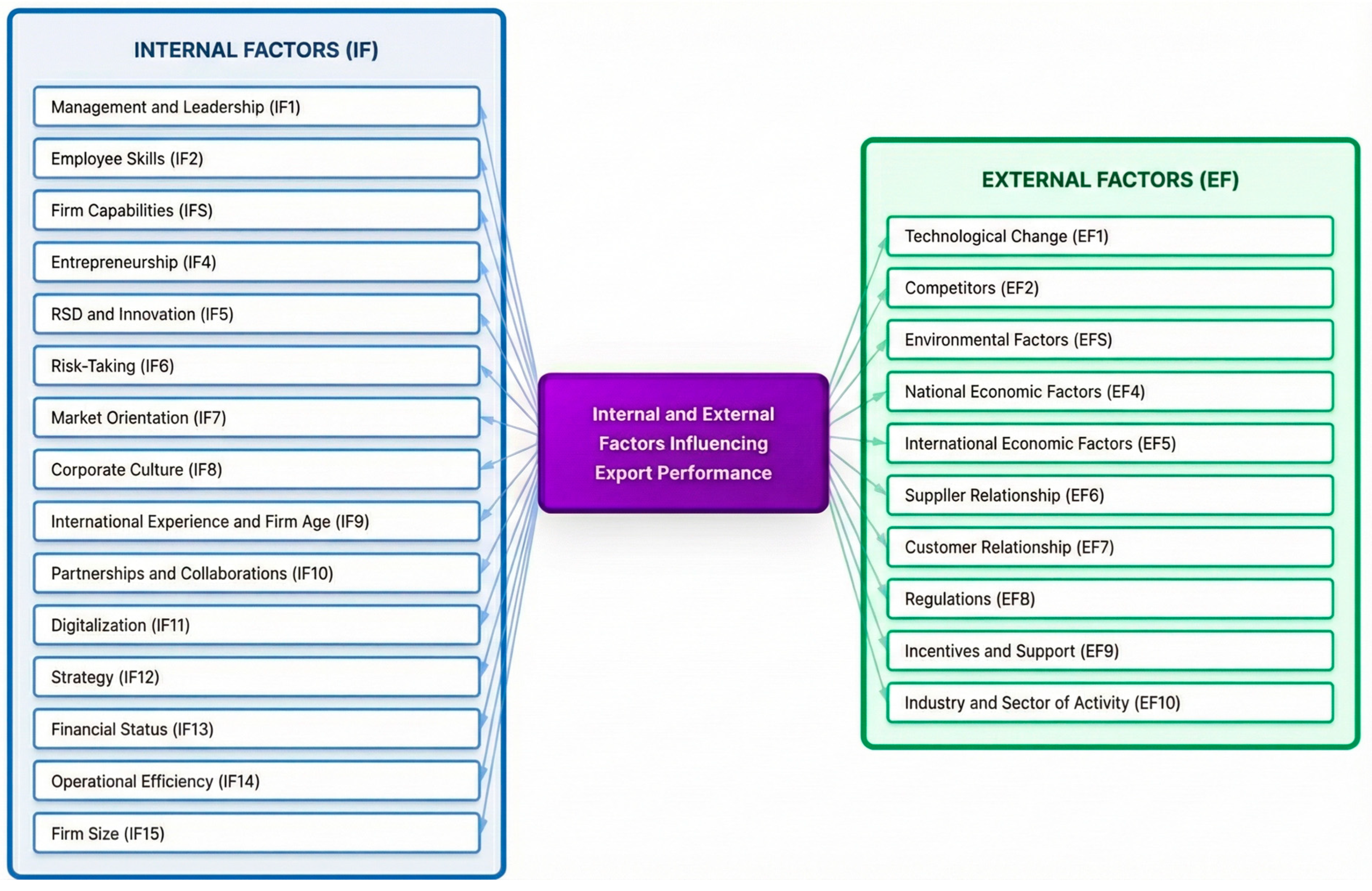
This section presents the application of the SWARA method to prioritize the factors influencing export performance. The hierarchical decision model, comprising two main criteria—Internal Factors (IF) and External Factors (EF)—and 25 associated sub-criteria, is presented in
Figure 1. The step-by-step application of the methodology, involving the weighting of both main and sub-criteria, is detailed in the following subsections.
3.1.1. Weighting the Main Criteria with the SWARA Method
Step 1: Ranking the criteria and determination of their comparative importance of average values ().
In the first step, DMs were asked to evaluate the two main criteria. The DMs first ranked these criteria according to their perceived relative significance. Following the ranking, each criterion ( was compared with the preceding criterion ( assigning a score ranging from 0 to 1, in increments of 0.5. The assigned value represents the comparative importance (.
To illustrate the application of the proposed methodology, the evaluation process is presented in
Table 2. As illustrated in the table, DM-1 identified Internal Factors (IF) as the most important criterion. Consequently, the External Factors (EF) criterion was compared with IF, and a value of 0.50 was assigned. This value corresponds to the comparative importance
and indicates that IF is considered 0.50 units more important than EF. This procedure was repeated for all five DMs.
Step 2: Calculation of coefficient values ().
The coefficient values (
) were calculated using Equation (1) and are presented in
Table 3. As shown in the table, the value of
is set to 1.00 for the most significant criterion, while for subsequent criteria, it is derived using the comparative importance values (
).
Step 3: Computation of recalculated weights ().
The recalculated weights were determined using Equation (2) and are presented in
Table 4.
Step 4: Calculation of relative weights of main criteria for each DM ().
The relative weights of the main criteria for each DM were calculated using Equation (3), and the resulting values are presented in
Table 5.
Step 5: Determination of final weights of main criteria ().
The final weights were calculated by taking the arithmetic mean of the relative criteria weights obtained from all DMs in Step 4. The final weights of the main criteria are presented in
Table 6.
3.1.2. Weighting the Sub-Criteria with the SWARA Method
This subsection outlines the weight calculation process for the 25 sub-criteria, using the same methodological framework as for the main criteria in the previous section. The procedure is executed as follows:
Step 1: The experts ranked the sub-criteria in descending order of perceived relative significance and determined their comparative importance values ().
Step 2: The coefficient values () were derived using Equation (1).
Step 3: The recalculated weights () were calculated using Equation (2).
Step 4: The relative weights of sub-criteria () were computed using Equation (3).
To maintain conciseness, the detailed step-by-step calculations are exemplified using data from the DM-1. The corresponding calculations are presented in
Table 7.
Step 5: The procedure described above was repeated for each of the five decision-makers. The local weights of the sub-criteria were obtained by computing the arithmetic mean of the relative weights (
) derived from the DMs’ evaluations. Subsequently, the global weights were determined by multiplying the local weight of each sub-criterion by the final weight of its corresponding main criterion.
Table 8 presents the resulting local and global weights for the sub-criteria, along with their respective rankings.
4. Results
The findings revealed that Internal Factors (IF) significantly dominate External Factors (EF) with weights of 58% and 42% respectively (
Table 8). This indicates that Turkish exporting firms perceive internal organizational capabilities as having a greater overall influence on export performance than external environmental conditions.
Examining the overall results without separating internal and external categories reveals that the top five key factors influencing export performance in the Turkish export industry are: (1) Management and Leadership (IF1), (2) Strategy (IF12), (3) Technological Change (EF1), (4) Industry and Sector of Activity (EF10), and (5) Competitors (EF2) (
Table 9). Although IFs have the highest aggregate weight (0.580), followed by EFs (0.420), it is observed that only 2 out of the top 5 critical factors are internal, while 3 are external.
The most significant factor identified is Management and Leadership (IF1) with a global weight of 0.096, ranking first overall among all sub-criteria. Following this, Strategy (IF12) occupies the second position with a global weight of 0.062. The third criterion, Technological Change (EF1), ranks as the most important external factor with a global weight of 0.053. The fourth factor, Industry and Sector of Activity (EF10) with a global weight of 0.050. Finally, Competitors (EF2) ranks fifth with a global weight of 0.050. Notably, International Economic Factors (EF5, global weight 0.049) and Firm Capabilities (IF3, global weight 0.048) also emerge as critical factors, ranking sixth and seventh respectively.
An interesting finding is the relatively lower ranking of factors such as International Experience and Firm Age (IF9, rank 25), Firm Size (IF15, rank 24), and Digitalization (IF11, rank 23).
Examining internal factors separately reveals additional insights. While Management and Leadership (IF1), Strategy (IF12), and Firm Capabilities (IF3) rank among the most important factors, Digitalization (IF11), Firm Size (IF15), and International Experience and Firm Age (IF9) occupy the lowest positions (
Table 10).
Similarly, among external factors, Technological Change (EF1), Industry and Sector Activity (EF10), and Competitors (EF2) are substantially more important than Incentives and Support (EF9), Regulations (EF8), and Environmental Factors (EF3) (
Table 11).
5. Discussion
The finding that internal factors collectively outweigh external factors (58% vs. 42%) is broadly consistent with the resource-based view (RBV) tradition, which emphasizes firm-specific capabilities as the primary source of sustained competitive advantage (
J. Barney, 1991;
Kaleka, 2002). This result provides an important theoretical contribution to the literature by supporting the proposition that internal factors are more critical determinants of export performance than external factors (
Balabanis & Katsikea, 2003;
Cavusgil & Zou, 1994;
Kaleka, 2002;
Piercy et al., 1998;
Stewart, 1997;
Styles & Ambler, 1994;
Zou & Cavusgil, 1996;
Zou & Stan, 1998). However, the margin between internal and external factors is relatively moderate—not a decisive gap—which calls for a more nuanced interpretation than a straightforward endorsement of RBV primacy. The sub-criteria rankings reinforce this nuance: three of the top five determinants overall are external (Technological Change, EF1; Industry and Sector of Activity, EF10; Competitors, EF2), indicating that individual external factors carry competitive weight that aggregate scores alone do not fully capture. Therefore, rather than viewing the two perspectives as mutually exclusive, the present findings suggest that export performance is better understood as the outcome of a dynamic interaction between internal capabilities and external pressures. Firms cannot afford to focus exclusively on building internal strengths while ignoring the external environment, nor can they rely on favorable external conditions to compensate for weak internal capabilities. Both dimensions must be managed simultaneously.
Among internal factors, the top rankings of Management and Leadership (IF1) and Strategy (IF12) are particularly noteworthy and align strongly with the existing literature. Management quality has long been identified as a foundational determinant of export performance, with studies consistently showing that leadership commitment, international vision, and managerial competence are decisive in shaping a firm’s internationalization trajectory (
Cavusgil & Zou, 1994;
Zou & Stan, 1998). These findings align with Transformational Leadership Theory (
Bass, 1985) and Upper Echelons Theory (
Hambrick, 2007;
Hambrick & Mason, 1984), both of which underscore that the values, cognitions, and capabilities of top management teams directly shape organizational outcomes. Quality leadership provides strategic direction, allocates resources efficiently, and creates an organizational culture and capabilities that support international expansion. The primacy of Strategy similarly confirms that a well-defined export strategy—one that aligns organizational resources with market opportunities—functions as a critical organizing mechanism for international competitiveness. Crucially, both of these top-ranked factors are behavioral and organizational in nature rather than structural, suggesting that export competitiveness in Turkish manufacturing is largely within managerial reach.
This is further reinforced by the lower rankings of Firm Size (IF15) and International Experience and Firm Age (IF9), within the internal factors. These findings challenge conventional assumptions that larger, more experienced firms necessarily perform better in export markets (
Zou & Stan, 1998). What a firm does—through its leadership quality and strategic choices—appears to matter considerably more than what it structurally is. The relatively low ranking of Digitalization (IF11) does not imply that technology is unimportant; rather, it suggests that firms view digital capabilities as a baseline requirement that can be internalized and adapted as needed, rather than as a standalone differentiating factor. This is consistent with the entrepreneurial orientation literature (
Balabanis & Katsikea, 2003), which finds that behavioral and strategic dispositions can compensate for structural disadvantages, enabling even smaller and less experienced firms to compete effectively in export markets.
Examining external factors separately reveals an equally clear hierarchy. Market dynamics—Technological Change (EF1), Industry and Sector of Activity (EF10), and Competitors (EF2)—rank substantially higher than policy-related factors such as Incentives and Support (EF9), Regulations (EF8), and Environmental Factors (EF3). This suggests that Turkish exporters orient their attention primarily toward competitive market forces rather than toward government support mechanisms or regulatory frameworks. The high ranking of Technological Change aligns with the Dynamic Capabilities perspective (
Teece, 2007;
Teece et al., 1997), which emphasizes that firms must continuously sense and respond to shifts in the external technological environment to sustain competitive advantage in international markets. The industrial organization (IO) perspective (
Porter, 1998) similarly accounts for the prominence of Industry and Sector of Activity and Competitors, underscoring that industry structure and competitive intensity create the performance environment within which internal capabilities must operate. The relatively low weight of Incentives and Support and Regulations suggests that public policy instruments, while not irrelevant, are perceived as secondary to market-driven forces—a finding with direct implications for the design of export promotion policies.
A particularly noteworthy finding is the divergence between Technological Change (EF1, rank 3 overall) and Digitalization (IF11, rank 23 overall). This apparent paradox—whereby technology matters enormously for export performance as an external force while internal digital investment ranks near the bottom—can be understood through the absorptive capacity framework (
Cohen & Levinthal, 1990): the ability to recognize, assimilate, and apply externally generated technologies may be more critical for export performance than developing proprietary digital capabilities from within. Firms benefit more from quickly adopting technologies developed elsewhere than from investing in internal digital infrastructure that is not directly aligned with external market demands. Export markets often impose technological standards that all competitive firms must meet, making responsiveness to external technological change a more binding competitive requirement than the level of internal digitalization. This suggests that Turkish exporters perceive their environment as characterized by exogenously driven technological evolution to which they must respond—and that this responsiveness, rather than internal digital investment per se, is what drives export competitiveness.
6. Sensitivity Analysis
To assess the robustness of the SWARA results, a Leave-one-out (LOO) sensitivity analysis was performed by systematically excluding each decision-maker and recalculating the aggregated ranks (
Puri & Singh, 2025).
Table 12 presents the aggregated ranks of each sub-criterion across the five scenarios, created by sequentially excluding DM-1 through DM-5, and compares them against the baseline model presented in
Table 9.
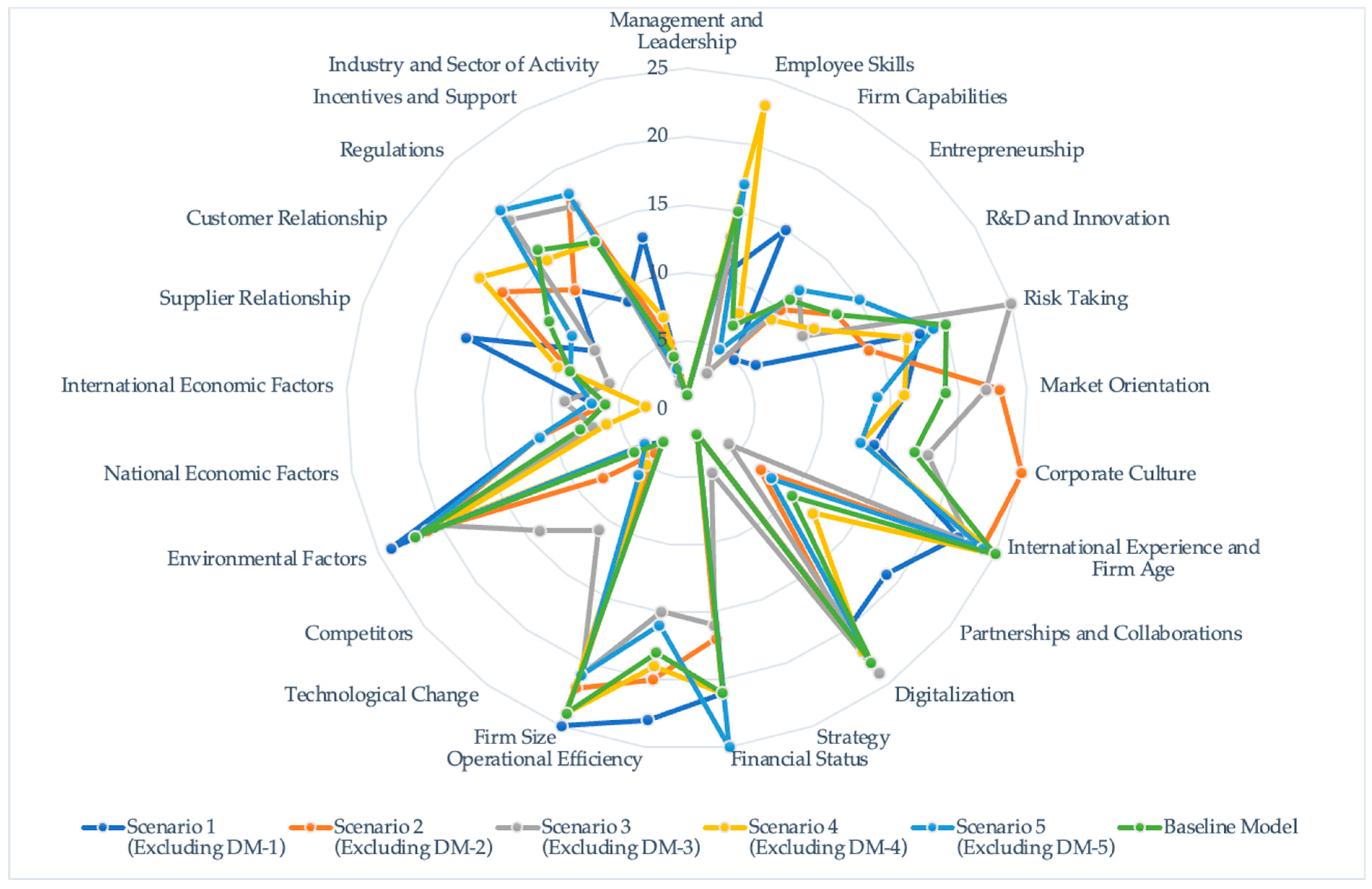
These results are further visualized using a radar chart in
Figure 2. As the figure illustrates, although there are minor rank variations, Management and Leadership (IF1) and Strategy (IF12) consistently rank as the highest-priority factors, highlighting a shared consensus among decision-makers regarding their fundamental impact on export performance. Similarly, the sensitivity analysis reveals a high degree of stability among the lowest-priority factors, such as Firm Size and International Experience (IF15) and Firm Age (IF9), which consistently occupied the bottom ranks across all LOO scenarios, further confirming the model’s structural consistency.
Furthermore, the stability of these LOO scenarios was statistically verified against the baseline model using Spearman’s rank correlation coefficients (
, as detailed in
Table 13. The resulting coefficients, ranging from 0.793 to 0.944 (
< 0.001), indicate strong to very strong positive correlations. These empirical results demonstrate that the final SWARA rankings are highly robust to individual biases and maintain their core structure even when the panel composition changes.
In essence, these findings not only reinforce confidence in the reliability of the proposed SWARA model but also suggest that firms aiming to enhance their export performance should strategically prioritize and allocate their resources toward Management and Leadership (IF1) and Strategy (IF12).
7. Conclusions
This study prioritized the factors influencing export performance in the Turkish manufacturing industry, utilizing the SWARA method. The findings revealed significant drivers, including the critical importance of management and leadership, strategic planning, technological change, industry characteristics, and competitive dynamics.
The results highlight the importance of addressing these key factors to facilitate enhanced export performance in Turkish manufacturing. It is essential to strengthen management and leadership capabilities at all organizational levels. Organizations must develop clear export strategies that align with their core competencies and market opportunities, ensuring commitment and coordination across all departments. Furthermore, staying abreast of technological changes and industry trends is crucial for maintaining competitiveness in international markets. Companies must invest in technological infrastructure and innovation capabilities to meet evolving global standards and customer expectations.
The predominance of internal factors (58% overall weight) indicates that Turkish manufacturers possess significant agency in shaping their export outcomes. This finding suggests that export performance is not primarily determined by external market conditions or governmental support, but rather by organizational capabilities and strategic choices. Companies should therefore focus on building strong internal capabilities, particularly in areas of management excellence, strategic planning, and firm-specific competencies.
Interestingly, the relatively low importance of factors such as firm size, international experience, and firm age suggests that even smaller, less experienced companies can achieve export success through effective leadership, clear strategy, and organization capabilities. This democratization of export opportunities provides encouragement for emerging exporters in the Turkish manufacturing sector.
8. Implications, Limitations and Future Research
Practical implications—The results provide actionable guidance for Turkish manufacturers seeking to enhance export performance. Companies should prioritize investment in management development and leadership training, formulate comprehensive export strategies with clearly defined objectives and implementation roadmaps, strengthen organizational capabilities, develop competitive intelligence to monitor and respond to competitive threats, and align firm positioning with industry-specific dynamics, and build adaptive capabilities to respond to technological changes. The lower importance of firm size and experience suggests that even smaller, newer companies can achieve export success through effective management and strategic planning.
In this context, export-oriented firms and managers may benefit from actively participating in training, consulting, and mentorship programs offered by public institutions, development agencies, and industry organizations that aim to strengthen internal capabilities, leadership skills, and strategic planning competencies. In Türkiye, organizations such as KOSGEB and the Ministry of Trade provide a range of support mechanisms, including export training programs, advisory services, sector-specific incentives, and internationalization support that can help firms upgrade their managerial and strategic capacities.
At the same time, the importance of external factors such as technological change, industry structure, and competitive dynamics highlights the need for firms to remain closely connected to evolving market conditions. Companies are encouraged to follow sectoral fairs, international exhibitions, and industry meetings, as well as to monitor developments in international markets and global trade environments. Such platforms facilitate access to up-to-date market information, emerging technologies, and competitive practices, enabling firms to align internal capabilities with external market requirements.
For resource-constrained SMEs, the findings suggest several concrete strategic pivots. Rather than attempting to scale rapidly or replicate the structures of larger firms, SMEs should focus on strengthening managerial decision-making, clarifying export market priorities, and selectively investing in capabilities that enhance responsiveness to technological and competitive changes. Leveraging external training, advisory services, and export support programs can help SMEs compensate for limited internal resources while maintaining strategic flexibility.
By focusing on these critical success factors, the Turkish manufacturing sector can not only enhance its export performance but also strengthen its position in increasingly competitive global markets. The emphasis on controllable internal factors provides a pathway for companies to systematically improve their export capabilities regardless of their current size or experience level.
Research limitations/implications—The study is limited to the Turkish manufacturing sector and reflects perceptions at a specific point in time. Accordingly, the findings should be interpreted within this contextual and temporal scope. As export environments are inherently dynamic and subject to technological, economic, and institutional change, the relative importance of internal and external export performance drivers may evolve over time or vary across industries. Future research could therefore explore temporal variations and cross-industry or cross-country comparisons to enhance external validity.
The study relies on expert-based evaluations obtained through the SWARA method rather than firm-level quantitative export performance data. While this approach enables a structured and transparent prioritization of heterogeneous internal and external determinants, it also entails an inherent degree of subjectivity and contextual dependence. Consequently, the results should be interpreted as an expert-informed ranking of export performance drivers rather than as causal or statistically generalizable evidence. The SWARA method is particularly appropriate when the research objective is to synthesize accumulated managerial and sectoral knowledge and to assess relative importance across multiple dimensions that are difficult to measure simultaneously using firm-level datasets.
Despite these limitations, the findings contribute theoretically by highlighting the central role of internal organizational capabilities in export performance and by challenging traditional assumptions regarding the primacy of structural characteristics such as firm size and international experience. At the same time, the results underscore the importance of considering internal and external factors jointly, providing a foundation for future studies that integrate expert-based prioritization with firm-level empirical analysis.
Future Research—Future research could build on the present study by integrating SWARA-based prioritization with firm-level export performance data, enabling empirical validation of whether highly ranked determinants exert stronger effects on export outcomes. Longitudinal research designs would further allow scholars to capture temporal changes in the relative importance of internal and external drivers, while cross-sector and cross-country comparisons could enhance external validity and policy relevance. Such mixed-method approaches would provide a more comprehensive understanding of export performance by combining expert judgment with quantitative evidence.
Beyond methodological extensions, future studies could examine the effectiveness of specific managerial and strategic interventions aimed at strengthening critical export performance drivers. In particular, research could explore how management and leadership capabilities are developed, how export strategies are formulated and implemented in practice, and how firms can more effectively leverage technological change for competitive advantage. Sector-specific comparative studies may further reveal how export performance determinants vary across industries, offering more targeted insights for both researchers and practitioners.