Systematic Review

The Governance of Global Value Chains from the Perspective of Economic Competence: A Literature Review


by
Carine Dalla Valle
1,*,
João Garibaldi Almeida Viana
2 and
Andrea Cristina Dorr
2
1
Business School, Campus Pantanal, Federal University of Mato Grosso do Sul (UFMS), Avenida Rio Branco, 1.270, Bairro Universitário, Corumbá 79303-220, MS, Brazil
2
Department of Agricultural Education and Rural Extension, Federal University of Santa Maria (UFSM), Av. Roraima, 1000, Santa Maria 97105-900, RS, Brazil
*
Author to whom correspondence should be addressed.
Adm. Sci. 2026, 16(3), 138; https://doi.org/10.3390/admsci16030138

Submission received: 2 February 2026 / Revised: 3 March 2026 / Accepted: 6 March 2026 / Published: 11 March 2026

Abstract

This article examines the governance of Global Value Chains (GVCs) through the lens of economic competence based on a systematic literature review of 32 selected studies. The findings show that economic competence functions as a governance-contingent construct whose effects vary across hierarchical, captive, relational, and modular governance structures. Rather than directly determining upgrading outcomes, competence dimensions operate through governance repositioning and shifts in dependence asymmetries within value chains. The review identifies recurring mechanisms—such as substitutability reduction, coordination cost mitigation, and institutional alignment—that explain how competence and governance interact. The analysis further demonstrates that economic competence is multidimensional, encompassing innovation-oriented, market-oriented, decision-making, relational, and systemic components. These dimensions operate differently depending on coordination complexity and power distribution within the chain. By advancing a contingency-based framework, the study refines GVC governance theory through a micro-foundational explanation of upgrading dynamics. From a managerial perspective, the framework offers a structured tool for aligning competence development strategies with specific governance configurations, supporting informed capability investments and improved strategic positioning. Overall, the study contributes by systematically integrating competence theory with governance typologies and power asymmetries, providing a coherent analytical model for future empirical research.

1. Introduction

Economic competence refers to the capacity of economic actors—firms, clusters, regions, or countries—to mobilize resources, knowledge, and innovation in order to generate and appropriate value within Global Value Chains (GVCs). In the context of globalization and the increasing fragmentation of production, such competences become central to determining the strategic positioning of actors across geographically dispersed production stages. Rather than merely reflecting resource endowment, economic competence captures the structured ability to deploy and coordinate assets under competitive and institutional constraints.
At the organizational level, this notion aligns closely with the Resource-Based View (RBV), which posits that firms achieve sustained competitive advantage through valuable, rare, inimitable, and non-substitutable resources (Wernerfelt, 1984; Barney, 1991). From this perspective, competence emerges not simply from resource possession, but from the firm’s ability to articulate and recombine resources to achieve superior performance. Dynamic capability theory further extends this understanding by emphasizing the capacity to integrate, reconfigure, and renew competencies in response to environmental change (Teece et al., 1997).
The Global Value Chain approach complements this view by examining how economic activity is coordinated across organizationally fragmented and geographically dispersed production networks. Within this framework, governance becomes a central analytical concept, as it explains how coordination is achieved and how value is distributed among actors (Bair & Mahutga, 2023). Governance structures—ranging from hierarchical and captive to relational, modular, and market forms—shape the degree of power asymmetry, coordination complexity, and strategic autonomy within chains (Gereffi et al., 2005).
From this integrated perspective, economic competence can be understood as the governance-sensitive capability through which actors influence, adapt to, and strategically position themselves within value chain structures mediated by power relations, institutional norms, and knowledge flows. Accordingly, the type of governance configuration directly conditions the competences that actors must develop to participate competitively and pursue upgrading within GVCs.
According to Mazur (2022), governance analysis helps us understand how a chain is controlled and coordinated when some actors have more power than others. In a scenario of regularly occurring disruptions, organizations need to be agile and innovative to respond to changes in the business environment and customer demands, or risk being at a disadvantage in rapidly evolving GVCs (Dallas et al., 2019).
On the one hand, some studies have suggested that governance in GVCs has a marked, somewhat automatic positive impact on local firms’ productivity, profits, exports, and technological growth (Raei et al., 2019). On the other hand, most of the research agenda to date has leaned more toward analyzing how local firms can enter value chains and the influence of types of TCV governance on the economy (Epede & Wang, 2022), suggesting that economic indicators not only affect integration into GVCs but are also a necessary or sufficient condition for participation in GVCs.
In the contemporary scenario, issues such as sustainability, digital traceability, and social and environmental responsibility are reshaping supply chain governance. This requires actors to develop not only productive but also normative and institutional competencies, as noted by Gölgeci et al. (2021) and Ponte (2022). Although prior research has examined upgrading, dynamic capabilities, and governance structures in GVCs, the literature has not systematically analyzed how distinct dimensions of economic competence operate contingently across different governance structures. In particular, the interaction between competence development and power asymmetries in hierarchical, captive, relational, and modular chains remains underexplored.
Thus, the ability to deal with multiple requirements (environmental, social, technological) becomes a core economic competence in the competition for better positions in the chain. In this context, this study seeks to answer the following question: How do different dimensions of economic competence interact with governance structures in Global Value Chains to shape firms’ upgrading trajectories?
To address this issue, the article is grounded in a main theoretical anchor, Governance in GVCs (Gereffi et al., 2005), supported by complementary theoretical perspectives such as RBV (Barney, 1991) and Global Value Chains (Kaplinsky & Morris, 2000). This theoretical framework allows us to explain performance heterogeneity among firms within the same chain, understand the structural constraints imposed by lead firms, analyze economic development in export sectors, and investigate value capture and competitive sustainability.
To address this gap, this study systematically analyses and synthesizes the literature on economic competence indicators in relation to Global Value Chain (GVC) governance. A systematic literature review was conducted using the Web of Science Core Collection, following the PRISMA 2020 guidelines to ensure transparency and methodological rigour. Unlike prior narrative reviews, this systematic review identifies recurring competence dimensions. It analyzes their differential effects across governance types, thereby advancing a theory-building synthesis rather than a purely classificatory overview.
For managers operating within Global Value Chains, the findings provide guidance on which competence dimensions are strategically critical under different governance structures. Rather than pursuing generic capability development, firms must align competence investments with their governance position and dependence structure within the chain.
This study contributes by (1) integrating economic competence with GVC governance structures through a contingency-based framework; (2) providing a systematic synthesis of competence dimensions and their governance implications; and (3) offering managerial guidance on how competence development strategies should be aligned with governance positioning and power asymmetries in Global Value Chains.

2. Materials and Methods

2.1. Research Design

This study adopts a systematic literature review (Tranfield et al., 2003) approach, following the PRISMA 2020 (method) (Moher et al., 2011) guidelines to ensure transparency, replicability, and methodological rigour. The review aims to identify, classify, and theoretically integrate the dimensions of economic competence within the context of Global Value Chains (GVCs).
Given the study’s conceptual and governance-oriented focus, a structured protocol was established prior to data collection, including database selection, search strategy, screening criteria, and quality appraisal procedures. This study conducts a systematic review of the literature to identify, analyze, and synthesize scientific output on governance and economic competence in global value chains published between 1989 and 2023. The selected period was defined to examine indicators in which economic competence contributes to and shapes the structures and dynamics of governance in GVCs (Wen & Wen, 2024), and to propose a framework to classify indicators that support both theoretical advancement and managerial practice.
In line with the systematic literature review approach, the study is guided by the following comprehensive research question: How was economic competence over governance structures in Global Value Chains (GVCs), in light of the indicators pointed out by the literature, conceived, investigated, and operationalized in academic research in the time frame from 1989 to 2024? To address this question, the review integrates bibliometric mapping to identify structural and thematic patterns in the literature, which are subsequently interpreted through qualitative synthesis.
The year 1989 was chosen because it was the year of publication of Pelikan’s (1989) article on economic competence, while 2024 was the last full year before the research. At this stage, 225 articles were collected. Thus, PRISMA 2020 was adopted because it provides a clear, systematic, and reproducible methodological framework for conducting systematic reviews (Moher et al., 2011). Although the PRISMA model, in its original formulation, is organized into four central stages (identification, screening, eligibility, and inclusion), this study adjusted the protocol to accommodate the specificities of bibliometric synthesis and qualitative analysis.
Thus, the PRISMA stages guided the overall design of the review process (study identification, duplicate removal, eligibility assessment, and final corpus definition). At the same time, the operational procedures were structured into four analytical phases, detailed below. Operationally, the methodological process comprised the following phases:
(a)
Delimitation of the search strategy and choice of database;
(b)
Application of inclusion and exclusion criteria;
(c)
Processing, coding, and categorization of records;
(d)
Descriptive, thematic, and comparative analysis of results.

2.2. Information Sources and Search Strategy

At this stage, articles were collected from the Web of Science (WoS) database due to its international reach and high reliability of indexing, as it covers publications particularly relevant to management and business research. The use of this database improves the completeness, robustness, and representativeness of the final sample. It reduces the risk of database-specific bias, in line with methodological recommendations for systematic reviews in the social sciences (Codina, 2020).
The process of identifying research related to this study began on 20 July 2024, using the WoS platform. To ensure full reproducibility, the exact Boolean query was, the following filters were applied to the search: (a) The keywords economic competence and Global Value Chain must appear in the title or abstract. (b) The document type should be article; (c) Articles should cover all areas of knowledge. (d) The time period was set from 1989 to 2024.
Although database-level filters for year, language, and document type were not technically embedded in the Boolean syntax, these criteria were established prior to the search and systematically applied during the identification stage through structured refinement. This approach reflects the practical constraints of Scopus query design while remaining consistent with PRISMA 2020 requirements regarding the a priori definition of eligibility conditions.
Data extraction was performed using a structured coding protocol composed of predefined variables aligned with the study’s theoretical framework. Two independent reviewers separately coded all selected articles to minimize subjective bias. Inter-rater reliability was assessed using Cohen’s Kappa coefficient. The overall agreement rate exceeded 85%, with a Cohen’s Kappa value of κ = 0.82, indicating substantial agreement according to established limits (Landis & Koch, 1977).
Discrepancies were resolved through discussion until consensus was reached. When necessary, a third reviewer was consulted to ensure coding consistency. To improve clarity and reproducibility, the research was structured into two conceptual groups, with both variants combined using the Boolean operator OR: economic competence (“competence” OR “competence over governance” OR “competence over governance” OR “governance structures” OR “company capabilities” OR “economic competence” OR “governance capacity”) AND (“value chains” OR “Global Value Chain” OR “Global Production Networks” OR “International Value Chains”).
The search string was pilot-tested and iteratively refined to achieve an appropriate balance between sensitivity and specificity, thereby ensuring conceptual precision while limiting thematic dispersion. The selected terms were included only when embedded in discussions explicitly addressing competence, governance, value chains, or global production networks at the firm level, thus preserving analytical coherence. The timespan was restricted to 1989—corresponding to the first identified publication on economic competence (Pelikan, 1989)—to 2024, the last complete year prior to data collection. Only peer-reviewed scientific articles indexed in the Web of Science, published in English or Spanish, and available in full text were considered, ensuring both relevance and accessibility of the final sample.

2.3. Selection Process and Inclusion/Exclusion Criteria

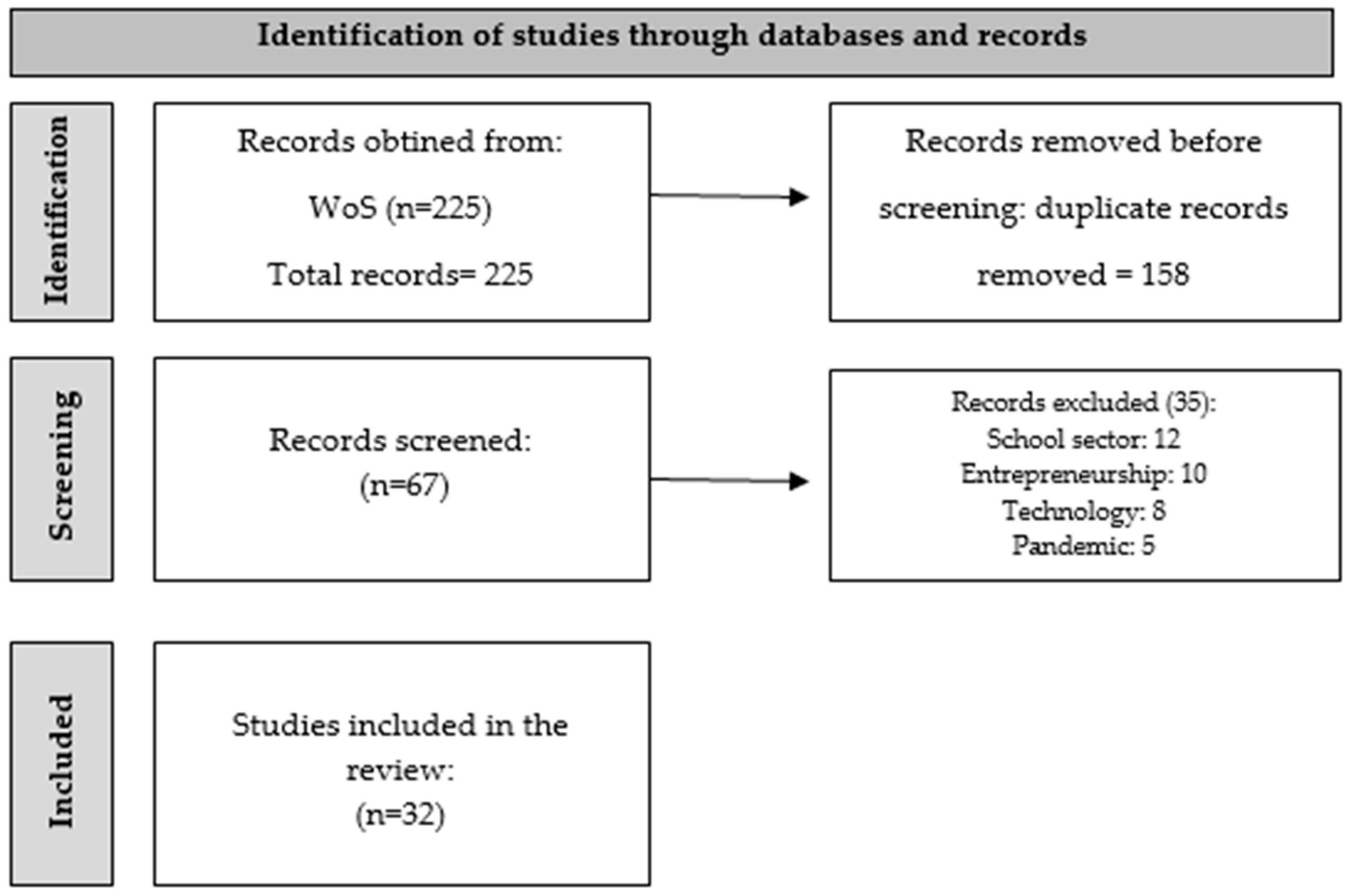
The initial search resulted in 225 records in WoS. According to PRISMA 2020, duplicate records were removed immediately after identification, before applying the eligibility criteria. In accordance with PRISMA standards, automatic database filters (year, subject area, document type) were applied during the identification phase. In contrast, eligibility criteria requiring conceptual validation were applied during screening after reading the title, abstract, and full text. This distinction clarifies the sequential separation between database filtering and manual eligibility assessment.
At this stage, 67 articles were excluded because, although they addressed aspects of economic competence, they did not include indicators linked to this competence or, when described, did not meet the characteristics of economic competence as defined by Pelikan (1989) and applied in other contexts. In other words, to be included in the final sample, the article had to present indicators considered rare and unusual, incorporated into the way individuals and organizations make economic decisions to govern global value chains.
The following inclusion criteria were then applied: (a) studies analyzing economic competence, governance, or capacity in global value chains; (b) publications in English or Spanish between 1989 and 2024; (c) availability of the full text and sufficient bibliographic information (title, abstract, keywords, DOI); (d) empirical, theoretical, or review studies addressing economic competence/capacity or governance/structure applied in global value chains. Studies were excluded if (I) they did not belong to the field of management or governance; (II) they addressed competence from academic, technological, or entrepreneurial perspectives; (III) they did not explicitly mention economic competence, capacity, governance, or governance structures. After manual review of titles and abstracts, 35 references were excluded, resulting in a final corpus of 32 valid studies (Figure 1).
The excluded references (n = 67) mainly correspond to studies that, although they contained some search terms, did not meet the thematic criteria of the analysis, such as articles that did not conceptualize competence at the company or chain level, or did not address governance or coordination, or had a purely macroeconomic focus, or were not linked to the dynamics of the value chain.
Given the objective of this study, which is a systematic mapping and synthesis of research trends, no formal quality appraisal or exclusion based on methodological rigour was applied. This approach is consistent with systematic mapping reviews in the social sciences, which aim to capture the breadth and diversity of scholarly production rather than to evaluate effect sizes or causal relationships (Codina, 2020).

2.4. Classification and Coding of Records

The final corpus was coded using a systematic protocol designed specifically for this study in order to ensure the homogeneity and reliability of the information analysis. Thirteen variables were grouped into four categories to characterize the bibliographic, thematic, and methodological aspects of the included documents (Table 1).
The research used descriptive bibliometric analysis to explore the temporal evolution of publications, identify the most prolific journals, map the authors and institutions with the highest output, and examine the geographical distribution, languages, and document types represented in the dataset. To this end, the selected variables (journal, authorship, country, keywords, and methodological design) were chosen for their ability to reveal structural patterns, dominant thematic groups, and predominant research orientations within the corpus.
Two researchers independently coded the selected articles. Discrepancies were discussed and resolved through consensus. Inter-coder agreement exceeded 85%. Full texts were assessed based on the following inclusion criteria:
(a)
Explicit or implicit discussion of economic competence or related constructs;
(b)
Relevance to governance, upgrading, or inter-firm coordination;
(c)
Clear theoretical grounding;
(d)
Methodological transparency (for empirical studies).
(e)
Following full-text assessment, 32 studies were retained for final analysis.
The substantial reduction from 225 to 32 reflects the conceptual specificity of economic competence within the GVC governance literature, rather than overly restrictive criteria.

2.5. Quality Appraisal and Data Extraction and Synthesis

To strengthen methodological rigour, a formal quality appraisal was conducted. Each article was evaluated using a structured assessment framework adapted for management and governance studies. The criteria included (i) clarity of research objective; (ii) theoretical grounding and conceptual coherence; (iii) methodological transparency; (iv) relevance to GVC governance; and (v) analytical contribution to competence literature.
Each criterion was scored on a 0–2 scale (0 = absent; 1 = partial; 2 = fully addressed). Articles scoring below a minimum threshold were excluded. This procedure ensured that the final sample met acceptable standards of theoretical and methodological robustness.
Data were extracted systematically, including the conceptual definition of competence, the type of competence dimension, governance implications, identified upgrading mechanisms and the level of analysis. A thematic coding process was conducted to identify recurring dimensions, yielding five analytical categories presented in the following section.

3. Results and Discussion

3.1. Conceptual Delimitation of Economic Competence

Below, we present the analytical level at which the study primarily analyses the organizational and relational levels, based on the concept of economic competence as a multilevel coordination capacity that operates at the individual, organizational, relational, and systemic levels within Global Value Chains.

3.1.1. Theoretical Delimitation Ontological

The concept of economic competence is introduced in this study as a governance-oriented coordination capability that explains how actors position themselves within structurally asymmetric Global Value Chains (GVCs). While prior literature has extensively examined governance structures (Gereffi, 1994; Gereffi et al., 2005), firm capabilities (Teece et al., 1997), and resource endowments (Barney, 1991), less attention has been devoted to the structured economic decision capacity that mediates between firm-level capabilities and governance outcomes.
In this sense, this definition incorporates four foundational elements:
(1)
Structured ability—Economic competence is not an isolated managerial skill but a patterned and reproducible organizational capacity (Nelson & Winter, 1982).
(2)
Institutional embeddedness—Economic decisions are conditioned by formal and informal rules (North, 1990).
(3)
Strategic coordination—It involves relational alignment and inter-firm governance dynamics (Williamson, 1985).
(4)
Positional impact—It affects upgrading trajectories and bargaining power within GVCs (Kaplinsky & Morris, 2000).
That said, economic competence therefore differs from a generic capacity, as its explanatory power lies specifically in the positioning of governance in conditions of asymmetric power.

3.1.2. Levels of Analysis

To avoid conceptual fragmentation, economic competence is conceptualized as a multilevel construct, with this study focusing analytically on the organizational and relational levels, as described in Table 2.
Otherwise, the unit of analysis in this study is the firm embedded in governance structures within Global Value Chains (GVCs).

3.1.3. Conceptual Distinction of Economic Competence

Although economic competence intersects with several established perspectives, it remains conceptually distinct, as presented in Table 3.

3.1.4. Theoretical Contribution

The theoretical contribution of economic competence lies in its capacity to bridge: (a) governance theory in GVCs; (b) micro-foundations of strategic decision-making; (c) institutional embeddedness; (d) power asymmetry in value chains. Thus, unlike dynamic capabilities, which emphasize adaptation, or RBV, which emphasizes resource possession, economic competence focuses on how actors evaluate, coordinate, and position themselves within governance structures marked by asymmetrical power relations.
By positioning economic competence as a governance-centred coordination construct, this study bridges firm-level capability research with macro-structural analysis of global production networks. This distinction draws from construct theory in organizational research, where constructs represent abstract explanatory mechanisms (Nelson & Winter, 1982).
To enhance conceptual clarity, economic competence is positioned as:
-
Ontologically, economic competence is a multidimensional construct integrating rationality, coordination, and institutional embeddedness.
-
Operationally, it manifests as a capability observable through governance arrangements, contractual structures, upgrading trajectories, and strategic positioning.
-
Theoretically, it functions as a middle-range explanatory mechanism linking micro-level decision processes (Simon, 1947) to macro-level governance structures in GVCs (Gereffi et al., 2005).
By adopting this epistemological positioning, the concept avoids redundancy with dynamic capabilities while offering a governance-centred explanatory lens for GVC research.
This section presents indicators from the literature on economic competence, which were classified into innovation, market-oriented, decision-making, rationality, relationship, interaction, and system and order competence. The discussion section presents the relationship between economic competence in Global Value Chains (GVCs).

3.2. Indicators and Dimensional Structure of Economic Competence in Global Value Chains

3.2.1. Innovation

The first economic indicator in the literature concerns innovation, which enhances competitiveness and economic success through technological support (Wong & Ngai, 2021; Van Kleef & Roome, 2007). They identify productivity and competitiveness through organizational and social innovations, while technological and product innovations can be used instead of process innovations to increase efficiency.
Organizational/social innovation is often associated with a company’s competence to (I) use its existing knowledge base and (II) acquire knowledge from external sources through imitation, licensing, partnerships, or acquisitions (Do et al., 2023; Prashantham et al., 2019). In this regard, innovation can be measured by a company’s performance in terms of ideas and products derived from new product development (Sun & Liu, 2021), process innovation (Loon & Chik, 2019), and technological innovation performance.
Humphrey and Schmitz (2002) identify four types of economic aspects that can be stimulated through link-induced innovation: innovation that enables suppliers to transform inputs into products more efficiently (process upgrading), that allows the development of higher-quality goods and services (product upgrading), that enables suppliers to change the mix of value-adding activities (functional upgrading), and that allows suppliers to move into more skill-intensive industries (industry upgrading) (Ambos et al., 2021).
In other words, innovation-oriented competence affects upgrading indirectly through governance repositioning. By enabling firms to recombine internal and external knowledge into process and product innovations, it increases efficiency and differentiation, reducing substitutability within the value chain. Lower substitutability decreases dependence asymmetry and enhances bargaining power, thereby creating structural conditions conducive to process, product, functional, and industry upgrading.

3.2.2. Market-Oriented Competence

Market-oriented competence refers to mobilizing resources to address new opportunities and to understand and satisfy customers’ current and future needs by developing new services and products to enhance competitive advantage (Wong & Ngai, 2021). Fowler et al. (2000) further state that market-oriented competence refers to an organization’s ability to satisfy current and future customer needs by developing new products and services that enhance its competitive advantage.
For Davis and Golicic (2010), market-oriented organizations closely align their product decisions with customer operations and prioritize customer-linking capabilities, such as value chain activities, delivery, handling, and service. According to Bartoloni and Baussola (2020), a market-oriented company consistently pursues product and marketing innovation while implementing organizational changes and training initiatives to manage and enhance its long-term knowledge assets. Supporting this, Habib et al. (2020) state that market-oriented companies capture these needs and mobilize firm resources for sustainable initiatives, meaning they systematically collect, monitor, analyze competitor strategies and take actions to gain competitive advantages.
In short, market-oriented competence influences governance outcomes not directly, but through its effect on substitutability and coordination within value chains. By systematically generating market intelligence and aligning resources accordingly, firms reduce information asymmetries and coordination costs. This reduction decreases dependence on lead firms and enhances bargaining power, thereby improving governance positioning and creating structural conditions conducive to upgrading.

3.2.3. Decision-Making and Rationality

This economic indicator initially aims to provide a reliable tool that provides information on new forms of global and local economies and on transformations in the production and operating processes of GVCs. Currently, there is a shift in the paradigm of economic knowledge, reflected in society’s economic culture and determined by the economic competence of the individual (Sergeeva, 2019). According to Oberrauch and Kaiser (2020), individuals make economically reasonable decisions while pursuing their own legitimate interests (individual perspective).
Assuming that perceptions of certain environmental events affect economic competence, strategic decision-making has potential, as it is based on rationality and intuition (Acciarini et al., 2021). Additionally, due to changes in the internal context of GVCs, individuals tend to depart from rationality, thereby affecting strategic decision-making in companies. Therefore, an association arises between limited and bounded rationality, potential biases, and strategic decisions for developing this economic indicator.
Within chains, decision-makers face various risks (e.g., supply and demand, financial, logistics and infrastructure, environment, climate) and uncertainties regarding management, operations, policies, and regulation (Sharma et al., 2024). Thus, individuals are compelled to mentally represent information about the world in the most economical way possible.
Decision-making and rationality influence upgrading indirectly through governance configuration. By improving firms’ ability to evaluate trade-offs under uncertainty, decision-making competence shapes contractual design, asset allocation, and dependence structures within GVC. These governance adjustments reduce vulnerability and power asymmetry, thereby enhancing the structural feasibility of upgrading.

3.2.4. Relationships and Interactions

The GVC structure describes the global economy as a “complex and dynamic economic network composed of interfirm and interfirm relationships” (Gereffi & Wyman, 2014, p. 10), focusing on how value is generated and appropriated across functionally integrated but internationally dispersed activities, accounting for power dynamics among various global economic actors (Fernandez-Stark & Gereffi, 2019).
In this approach, stakeholder theory holds that corporate social activities help organizations achieve better performance by fostering productive relationships with stakeholders (Wang et al., 2020). In this vein, Reinecke et al. (2018) argue that the economic indicator of relationships and interaction is based on the premise that GVCs have become sites of interaction among individuals who are socially embedded in the norms, institutions, and values inherent in geographical origins, professions, business regimes, and distinct cultures.
Authors Islam and Chadee (2023) also confirm the role of buyer-supplier relationship quality as a boundary condition for network competence’s influence on knowledge exchange. In short, relationship and interaction competence help build trust, commitment, and shared understanding that contribute positively to desired innovation outcomes. GVCs’ economic transactions are enabled and influenced by social ties, such as networks of personal relationships, as well as by institutionalized norms and beliefs.
Relationship and interaction competence influences upgrading indirectly through governance stabilization. By building trust-based, institutionally embedded ties, firms reduce coordination costs and information asymmetries, thereby facilitating knowledge exchange and capability accumulation. These relational improvements decrease substitutability and dependence asymmetry, thereby improving governance positioning and creating structural conditions for upgrading.

3.2.5. System and Order

Building on the understanding that the definition of economic competence according to Retzmann and Seeber (2016) is based on the concept of “competence” as “cognitive and non-cognitive prerequisites to meet complex demands”, the system and order indicator focuses on systemic analysis, which implies, among other components, a view of economic concepts, including the need for market regulation and the possibilities of altering such regulations (Oberrauch & Kaiser, 2020).
In this sense, to measure competence through this indicator, one must assess regulatory issues in which individuals understand economic mechanisms, central economic concepts, and the corresponding political institutions in the market economy (from a social and systemic perspective). In addition, the system and order indicator refers to situations in which leading companies assume governance of the GVC due to various factors, such as ensuring product quality, compliance with target-market regulations, cost management across the value chain, or research and development (Salminen & Rajavuori, 2019).
System and order competence influences upgrading indirectly through institutional positioning. By enabling firms to interpret and strategically respond to regulatory and systemic requirements, this competence enhances legitimacy and reduces perceived risk within the value chain. As firms assume greater governance responsibilities—such as compliance coordination and quality assurance—they become structurally embedded in higher-value functions, thereby improving upgrading feasibility.
Based on the arguments presented, adequate governance in the GVC, through economic competence, encompasses the central mandatory content of regulations and how they reflect legal duties and regulatory subjects and, crucially, responsibility (type of regulation, statutory duty, statutory repercussions, and impact on responsibility variables), as shown in Table 4.
By relating the types of governance to the indicators of economic competence (innovation, market-oriented competence, decision-making and rationality, relationships and interaction, system and order), we conceptualize governance factors as the regulation and coordination of activities by key actors through a variety of formal and informal instruments to influence value addition and profit distribution in GVCs. Considering this perspective, it is proposed that,
Proposition 1.
Innovation-oriented competence positively influences upgrading by increasing productivity and differentiation, thereby reducing substitutability and altering dependence asymmetries within GVCs.
Proposition 2.
Market-oriented competence positively affects upgrading by reducing substitutability and asymmetry in dependence within buyer-driven value chains, thereby improving the firm’s governance positioning.
Proposition 3.
Decision-making competence positively influences upgrading by improving trade-off evaluation under uncertainty, thereby shaping governance configurations and reducing dependence asymmetries within GVC.
Proposition 4.
Relationship and interaction competence positively influence upgrading by reducing coordination costs and dependence asymmetries, thereby improving governance positioning within GVC.
Proposition 5.
System and order competence positively influences upgrading by enabling institutional alignment and regulatory compliance, thereby reducing institutional dependence and improving access to higher value segments within GVCs.
Drawing on governance typologies developed by Gereffi et al. (2005), this study argues that competence requirements vary according to the distribution of power, coordination complexity, and degree of supplier autonomy embedded in hierarchical, captive, relational, and modular governance forms. Because governance structures shape dependence asymmetries and strategic discretion, the extent to which specific competence dimensions translate into upgrading depends on these structural conditions.
In highly hierarchical or captive chains, upgrading opportunities may remain constrained despite the presence of firm-level competencies. In contrast, in relational or modular structures, the same competences can generate stronger positional shifts and governance reconfiguration. Table 5 synthesizes the contingent propositions, highlighting how competence effects differ across governance types and clarifying the model’s explanatory logic.
To address the governance gap within Global Value Chains (GVCs) in the organizational environment, participation in these networks is essential for all economies, particularly for developing countries, where supplier firms engaged in GVCs benefit from greater learning opportunities, enhanced competitiveness, and higher income (Islam & Polonsky, 2020). In this context, effective GVC governance can foster economic competence by promoting sustainable practices that enable sectors to achieve their objectives, integrating internal and external stakeholders into decision-making processes, and addressing societal demands through participatory and transparent mechanisms (Allais et al., 2017).

3.3. Cross-Study Integration and Theoretical Convergence

Across the reviewed studies, three recurrent mechanisms emerge consistently: (1) competence-driven reduction in substitutability, (2) mitigation of coordination costs under complex governance structures, and (3) institutional alignment as a precondition for strategic repositioning. In the literature on global value chains (GVCs), authors such as Gereffi et al. (2005) highlight that economic skills are essential for firms in developing countries to evolve within chains.
A study by Lema et al. (2018) discusses the relevance of digital skills as a new frontier for competitiveness, especially in contexts of technological transformation and digital integration in GVCs. Ponte (2022) takes a critical approach, showing how governance in GVCs is often structured to maintain power asymmetries, even as suppliers acquire skills, and argues that skills alone do not guarantee autonomy or progress.
Studies conducted by Kiers et al. (2022) argue that the essential skills and competencies for resilient supply chains are (a) supplier relationship management, (b) innovation sourcing, (c) automation, and (d) technical skills. In addition, (e) networking, (f) results orientation, (g) imagination, (h) sales, and (i) insight and organizational governance are necessary conditions for executing the competencies. Corroborating our findings, the authors Kissi and Herzig (2024) identified in their studies that different governance factors, such as regulatory policies and structures, conflicts of interest, social capital, norms and networks, institutional support and capacity building, infrastructure development and partnerships, enable economic upgrading (capability) and the relationships between the five types of governance in GVCs.
This study advances GVC scholarship by introducing a micro-foundational explanation of upgrading contingent on competence–governance alignment. The framework reframes economic competence as a governance-contingent construct, thereby extending GVC theory beyond structural typologies toward a capability–governance interaction perspective, as shown in Table 6.
Based on this, integration suggests a contingency model where competence directly influences progress when the governance structure allows autonomy (e.g., relational), and differentiation reduces substitutability (e.g., modular). Indirectly, competence influences improvements when the structure is buyer-oriented and power is asymmetrical, requiring a repositioning of governance. In short, competence has a limited effect when hierarchical control concentrates power and governance remains unchanged.
The integrative framework reveals both convergence and divergence patterns across governance structures. Convergence emerges where competence reduces substitutability and coordination costs, particularly in relational and specialized modular governance. Divergence arises in hierarchical and captive structures, where competence may improve productivity without necessarily altering dependence asymmetries or governance positioning. These findings reinforce the contingency-based nature of economic competence and demonstrate that upgrading outcomes depend on the interaction between competence dimensions and governance configurations rather than on competence alone.
The literature on global value chains (GVCs) reveals recurring patterns in the relationship between economic competencies and outcomes of progress and improvement, especially when governance is considered a mediating variable. Multidisciplinary reviews highlight that many studies converge on the importance of internal mechanisms, such as reducing substitutability and mitigating coordination costs through collaborative interactions, in explaining how companies advance in globalized markets (Kano et al., 2020).
These converging patterns suggest that the effect of competencies on upgrading is not one-dimensional but is mediated by how these competencies interact with the coordination and power mechanisms present in different forms of governance. Despite these convergences, the literature also exposes significant divergences that reflect contextual and structural differences. For example, while some studies (Marano et al., 2024; Awan et al., 2022) emphasize that economic competencies tend to generate productivity and facilitate entry into higher-value positions, other studies show that without an explicit repositioning in governance—that is, without a substantial reduction in dependency asymmetries—upgrading may remain limited, especially in chains with hierarchical governance structures or those highly controlled by buyers.
Therefore, a list of indicators has been developed to assess economic competence and guarantee a governance structure that can reduce environmental impact and contribute to the Sustainable Development Goals (SDGs) in which GVCs operate. Building on the above, this study focuses on the definition of indicators for the development of economic competence, the process of adding value to products, the global industrial connection, and industrial upgrading under the globalization of GVCs.
This review contributes to the literature in three distinct ways. First, it goes beyond descriptive aggregation by identifying recurring governance-dependent mechanisms in heterogeneous empirical contexts. Second, it resolves apparent inconsistencies in previous findings, demonstrating that competence effects are mediated by the repositioning of governance rather than directly determining the outcome of the update. Third, it offers a microfoundational refinement of GVC governance theory, linking power asymmetries to competence configurations.

4. Conclusions

This article presents an integrated perspective on the governance of Global Value Chains (GVCs) by proposing a comprehensive framework for identifying and classifying indicators related to economic competence. A systematic literature review consolidates dispersed research findings and advances a cohesive understanding of how governance structures both influence and are influenced by the development of economic competence within GVCs. By linking these dimensions, the study contributes to the theoretical refinement of GVC governance and provides insights into how firms and networks can enhance their strategic positioning and value creation.
The review demonstrates that economic competence does not exert uniform effects across governance structures. Rather than operating as a universal driver of upgrading, its impact is contingent upon governance configuration and mediated by shifts in dependence asymmetry. By identifying recurrent mechanisms—substitutability reduction, coordination-cost mitigation, and institutional alignment—this study advances an integrative perspective that links competence development to governance positioning within GVCs.
Importantly, the findings translate into governance-specific managerial implications. In captive chains, where monitoring and buyer control are intense, managers should prioritize process innovation and compliance-oriented competencies. Concretely, firms can invest in production standardization systems, certification schemes (e.g., quality and sustainability standards), and performance-tracking technologies that reduce monitoring costs and signal reliability to lead firms. These actions increase bargaining credibility and may gradually reduce vulnerability to unilateral buyer pressure.
In relational governance structures, upgrading depends on strengthening trust-based coordination and knowledge exchange. Managers should therefore institutionalize structured interaction mechanisms such as joint problem-solving routines, cross-organizational teams, and co-development agreements. Investments in relational competences -such as boundary-spanning roles, technical liaison units, and transparent information-sharing systems—can enhance mutual dependence and facilitate functional upgrading.
Within modular chains, where substitutability is structurally higher, firms must focus on differentiation and market diversification. Operationally, this implies investing in proprietary design capabilities, niche product specialization, and multi-buyer strategies that reduce over-reliance on a single lead firm. Developing market-intelligence systems and flexible production architectures enables firms to reposition strategically and capture higher value segments.
In hierarchical governance structures, where power is concentrated and upgrading opportunities are structurally constrained, managers may focus on internal productivity gains and capability accumulation aimed at long-term repositioning rather than immediate governance shifts. Building absorptive capacity, strengthening managerial decision-making under uncertainty, and developing system-level competences can prepare firms for future transitions into more relational or modular arrangements.
The governance indicators proposed in this study thus function not merely as analytical dimensions but as actionable diagnostic tools. Managers can systematically map their governance structure, assess asymmetries in dependence, and identify which competence dimensions are most strategically relevant. This structured alignment supports more deliberate decisions regarding capability investments, upgrading pathways, risk mitigation, and resilience strategies.
As with any systematic review, this study is subject to methodological constraints. The reliance on a single database and predefined search strings may have influenced corpus composition, potentially excluding relevant studies that are indexed elsewhere or that use alternative terminology. Although the structured coding process enhanced reliability, thematic synthesis inevitably involves interpretive judgement. Moreover, the absence of quantitative meta-analytic techniques means that the identified relationships remain theoretically synthesized rather than statistically tested.
These limitations open important avenues for future research. Empirical studies should test the contingency-based propositions advanced here, particularly examining how specific competence dimensions interact with governance configurations and power asymmetries across industries. Comparative cross-sectoral and cross-regional analyses may clarify how institutional contexts moderate competence effectiveness. Longitudinal research is also needed to examine how competence accumulation and governance structures co-evolve over time.
Future work could operationalize the proposed governance indicators into measurable constructs and assess their impact on upgrading trajectories, sustainability performance, and supply-chain resilience. By moving from conceptual synthesis to empirical validation, subsequent research can refine, extend, and potentially recalibrate the contingency-based framework proposed in this study.

Author Contributions

Conceptualization, C.D.V., J.G.A.V. and A.C.D.; methodology, C.D.V., J.G.A.V. and A.C.D.; software, C.D.V., J.G.A.V. and A.C.D.; validation, C.D.V., J.G.A.V. and A.C.D.; formal analysis, C.D.V. and J.G.A.V.; investigation, C.D.V. and J.G.A.V.; resources, C.D.V. and J.G.A.V.; data curation, C.D.V., J.G.A.V. and A.C.D.; writing—original draft preparation, C.D.V., J.G.A.V. and A.C.D.; writing—review and editing, C.D.V., J.G.A.V. and A.C.D.; visualization, C.D.V. and J.G.A.V.; supervision, C.D.V. and J.G.A.V.; project administration, C.D.V. and J.G.A.V.; funding acquisition, J.G.A.V. All authors have read and agreed to the published version of the manuscript.

Funding

This research was funded by Research Support Foundation of the State of Rio Grande do Sul (Fundação de Amparo à Pesquisa do Estado do Rio Grande do Sul, FAPERGS) (project number 23/2551-0001874-8) and the National Council for Scientific and Technological Development (Conselho Nacional de Desenvolvimento Científico e Tecnológico, CNPq) – Brazil0) (project number 408711/2023-0).

Institutional Review Board Statement

Not applicable.

Informed Consent Statement

Not applicable.

Data Availability Statement

The data supporting the conclusions of this article might be made available by the authors upon reasonable request, subject to Brazilian research ethics policies and regulations regarding the protection and confidentiality of research participants.

Acknowledgments

The authors acknowledge the FAPERGS and CNPq for providing financial support for this work.

Conflicts of Interest

The authors declare no conflicts of interest.

References

  1. Acciarini, C., Brunetta, F., & Boccardelli, P. (2021). Cognitive biases and decision-making strategies in times of change: A systematic literature review. Management Decision, 59(3), 638–652. [Google Scholar] [CrossRef]
  2. Allais, R., Roucoules, L., & Reyes, T. (2017). Governance maturity grid: A transition method for integrating sustainability into companies? Journal of Cleaner Production, 140, 213–226. [Google Scholar] [CrossRef]
  3. Ambos, B., Brandl, K., Perri, A., Scalera, V. G., & Van Assche, A. (2021). The nature of innovation in global value chains. Journal of World Business, 56(4), 101221. [Google Scholar] [CrossRef]
  4. Awan, U., Gölgeci, I., Makhmadshoev, D., & Mishra, N. (2022). Industry 4.0 and circular economy in an era of global value chains: What have we learned and what is still to be explored? Journal of Cleaner Production, 371, 133621. [Google Scholar] [CrossRef]
  5. Bair, J., & Mahutga, M. C. (2023). Power, governance and distributional skew in global value chains: Exchange theoretic and exogenous factors. Global Networks, 23(4), 814–831. [Google Scholar] [CrossRef]
  6. Barney, J. (1991). Firm resources and sustained competitive advantage. Journal of Management, 17(1), 99–120. [Google Scholar] [CrossRef]
  7. Bartoloni, E., & Baussola, M. (2020). Is there a profit premium for market-oriented firms? A panel data investigation. Economics of Innovation and New Technology, 29(5), 501–521. [Google Scholar] [CrossRef]
  8. Codina, L. (2020). Revisiones bibliográficas sistematizadas en ciencias humanas y sociales. 1: Fundamentos. In C. Lopezosa, J. Díaz-Noci, & L. Codina (Eds.), Methodos anuario de métodos de investigación en comunicación social (Vol. 1, pp. 50–60). Universitat Pompeu Fabra. [Google Scholar]
  9. Cohen, W. M., & Levinthal, D. A. (1990). Absorptive capacity: A new perspective on learning and innovation. Administrative Science Quarterly, 35(1), 128–152. [Google Scholar] [CrossRef]
  10. Dallas, M. P., Ponte, S., & Sturgeon, T. J. (2019). Power in global value chains. Review of International Political Economy, 26(4), 666–694. [Google Scholar] [CrossRef]
  11. Davis, D. F., & Golicic, S. L. (2010). Gaining comparative advantage in supply chain relationships: The mediating role of market-oriented IT competence. Journal of the Academy of Marketing Science, 38(1), 56–70. [Google Scholar] [CrossRef]
  12. Do, H., Nguyen, B., & Shipton, H. (2023). Innovation and internationalization in an emerging market context: Moderating effects of interpersonal and organizational social networks. Journal of International Management, 29(2), 101014. [Google Scholar] [CrossRef]
  13. Epede, M. B., & Wang, D. (2022). Competitiveness and upgrading in global value chains: A multiple-country analysis of the wooden furniture industry. Forest Policy and Economics, 140, 102737. [Google Scholar] [CrossRef]
  14. Fernandez-Stark, K., & Gereffi, G. (2019). Global value chain analysis: A primer. In Handbook on global value chains (pp. 54–76). Edward Elgar Publishing. [Google Scholar] [CrossRef]
  15. Fowler, S. W., King, A. W., Marsh, S. J., & Victor, B. (2000). Beyond products: New strategic imperatives for developing competencies in dynamic environments. Journal of Engineering and Technology Management, 17(3–4), 357–377. [Google Scholar] [CrossRef]
  16. Gereffi, G. (1994). The organization of buyer-driven global commodity chains: How US retailers shape overseas. Greenwood Press. [Google Scholar]
  17. Gereffi, G., Humphrey, J., & Sturgeon, T. (2005). The governance of global value chains. Review of International Political Economy, 12(1), 78–104. [Google Scholar] [CrossRef]
  18. Gereffi, G., & Wyman, D. L. (Eds.). (2014). Manufacturing miracles: Paths of industrialization in Latin America and East Asia. Princeton University Press. [Google Scholar]
  19. Gölgeci, I., Makhmadshoev, D., & Demirbag, M. (2021). Global value chains and the environmental sustainability of emerging market firms: A systematic review of literature and research agenda. International Business Review, 30(5), 101857. [Google Scholar] [CrossRef]
  20. Habib, M. A., Bao, Y., & Ilmudeen, A. (2020). The impact of green entrepreneurial orientation, market orientation and green supply chain management practices on sustainable firm performance. Cogent Business & Management, 7(1), 1743616. [Google Scholar] [CrossRef]
  21. Humphrey, J., & Schmitz, H. (2002). How does insertion in global value chains affect upgrading in industrial clusters? Regional Studies, 36(9), 1017–1027. [Google Scholar] [CrossRef]
  22. Islam, M. T., & Chadee, D. (2023). Stuck at the bottom: Role of tacit and explicit knowledge on innovation of developing-country suppliers in global value chains. International Business Review, 32(2), 101898. [Google Scholar] [CrossRef]
  23. Islam, M. T., & Polonsky, M. J. (2020). Validating scales for economic upgrading in global value chains and assessing the impact of upgrading on supplier firms’ performance. Journal of Business Research, 110, 144–159. [Google Scholar] [CrossRef]
  24. Kano, L., Tsang, E. W., & Yeung, H. W. C. (2020). Global value chains: A review of the multi-disciplinary literature: Liena Kano et al. Journal of International Business Studies, 51(4), 577–622. [Google Scholar] [CrossRef]
  25. Kaplinsky, R., & Morris, M. (2000). A handbook for value chain research (Vol. 113). University of Sussex, Institute of Development Studies. [Google Scholar]
  26. Kiers, J., Seinhorst, J., Zwanenburg, M., & Stek, K. (2022). Which strategies and corresponding competences are needed to improve supply chain resilience: A COVID-19 based review. Logistics, 6(1), 12. [Google Scholar] [CrossRef]
  27. Kissi, E. A., & Herzig, C. (2024). Labour relations and working conditions of workers on smallholder cocoa farms in Ghana. Agriculture and Human Values, 41(1), 109–120. [Google Scholar] [CrossRef]
  28. Landis, J. R., & Koch, G. G. (1977). An application of hierarchical kappa-type statistics in the assessment of majority agreement among multiple observers. Biometrics, 33(2), 363–374. [Google Scholar] [CrossRef]
  29. Lema, R., Rabellotti, R., & Gehl Sampath, P. (2018). Innovation trajectories in developing countries: Co-evolution of global value chains and innovation systems. The European Journal of Development Research, 30(3), 345–363. [Google Scholar] [CrossRef]
  30. Loon, M., & Chik, R. (2019). Efficiency-centered, innovation-enabling business models of high tech SMEs: Evidence from Hong Kong. Asia Pacific Journal of Management, 36(1), 87–111. [Google Scholar] [CrossRef]
  31. Marano, V., Wilhelm, M., Kostova, T., Doh, J., & Beugelsdijk, S. (2024). Multinational firms and sustainability in global supply chains: Scope and boundaries of responsibility. Journal of International Business Studies, 55(4), 413–428. [Google Scholar] [CrossRef]
  32. Mazur, A. W. L. (2022). O setor de autopeças do Brasil sob a perspectiva das cadeias globais de valor no período de 2007 a 2020. Available online: http://www.repositorio.ufal.br/jspui/handle/123456789/9427 (accessed on 14 May 2025).
  33. Moher, D., Liberati, A., Tetzlaff, J., & Altman, D. G. (2011). Bevorzugte report items für systematische übersichten und meta-analysen: Das PRISMA-statement. DMW-Deutsche Medizinische Wochenschrift, 136(08), e9–e15. [Google Scholar] [CrossRef]
  34. Nelson, R. R., & Winter, S. G. (1982). The Schumpeterian trade-off revisited. The American Economic Review, 72(1), 114–132. [Google Scholar]
  35. North, D. C. (1990). Institutions, institutional change and economic performance. Cambridge University Press. [Google Scholar]
  36. Oberrauch, L., & Kaiser, T. (2020). Economic competence in early secondary school: Evidence from a large-scale assessment in Germany. International Review of Economics Education, 35, 100172. [Google Scholar] [CrossRef]
  37. Pelikan, P. (1989). Evolution, economic competence, and the market for corporate control. Journal of Economic Behavior & Organization, 12(3), 279–303. [Google Scholar] [CrossRef]
  38. Ponte, S. (2022). The hidden costs of environmental upgrading in global value chains. Review of International Political Economy, 29(3), 818–843. [Google Scholar] [CrossRef]
  39. Prashantham, S., Kumar, K., & Bhattacharyya, S. (2019). International new ventures from emerging economies: Network connectivity and legitimacy building. Management and Organization Review, 15(3), 615–641. [Google Scholar] [CrossRef]
  40. Raei, M. F., Ignatenko, A., & Mircheva, M. (2019). Global value chains: What are the benefits and why do countries participate? International Monetary Fund. [Google Scholar]
  41. Reinecke, J., Donaghey, J., Wilkinson, A., & Wood, G. (2018). Global supply chains and social relations at work: Brokering across boundaries. Human Relations, 71(4), 459–480. [Google Scholar] [CrossRef]
  42. Remmele, B., & Seeber, G. (2012). Integrative economic education to combine citizenship education and financial literacy. Citizenship, Social and Economics Education, 11(3), 189–201. [Google Scholar] [CrossRef]
  43. Retzmann, T., & Seeber, G. (2016). Financial education in general education schools: A competence model. In International handbook of financial literacy (pp. 9–23). Springer. [Google Scholar] [CrossRef]
  44. Sako, M., & Zylberberg, E. (2019). Supplier strategy in global value chains: Shaping governance and profiting from upgrading. Socio-Economic Review, 17(3), 687–707. [Google Scholar] [CrossRef]
  45. Salminen, J., & Rajavuori, M. (2019). Transnational sustainability laws and the regulation of global value chains: Comparison and a framework for analysis. Maastricht Journal of European and Comparative Law, 26(5), 602–627. [Google Scholar] [CrossRef]
  46. Sergeeva, M. G. (2019). Formation of economic competence of the head of the educational organization in terms of professional development. Revista San Gregorio, 1(30), 7–13. [Google Scholar]
  47. Sharma, R., Shishodia, A., Kamble, S., Gunasekaran, A., & Belhadi, A. (2024). Agriculture supply chain risks and COVID-19: Mitigation strategies and implications for the practitioners. International Journal of Logistics Research and Applications, 27(11), 2351–2377. [Google Scholar] [CrossRef]
  48. Simon, H. A. (1947). A comment on “the science of public administration”. Public Administration Review, 7(3), 200–203. [Google Scholar] [CrossRef]
  49. Sun, B., & Liu, Y. (2021). Business model designs, big data analytics capabilities and new product development performance: Evidence from China. European Journal of Innovation Management, 24(4), 1162–1183. [Google Scholar] [CrossRef]
  50. Teece, D. J., Pisano, G., & Shuen, A. (1997). Dynamic capabilities and strategic management. Strategic Management Journal, 18(7), 509–533. [Google Scholar] [CrossRef]
  51. Tranfield, D., Denyer, D., & Smart, P. (2003). Towards a methodology for developing evidence-informed management knowledge by means of systematic review. British Journal of Management, 14(3), 207–222. [Google Scholar] [CrossRef]
  52. Van Kleef, J. A., & Roome, N. J. (2007). Developing capabilities and competence for sustainable business management as innovation: A research agenda. Journal of Cleaner Production, 15(1), 38–51. [Google Scholar] [CrossRef]
  53. Wang, Q., Huo, B., & Zhao, X. (2020). What makes logistics integration more effective? Governance from contractual and relational perspectives. Journal of Business Logistics, 41(3), 259–281. [Google Scholar] [CrossRef]
  54. Wen, Y., & Wen, S. (2024). The relationship between dynamic capabilities and global value chain upgrading: The mediating role of innovation capability. Journal of Strategy and Management, 17(1), 123–139. [Google Scholar] [CrossRef]
  55. Wernerfelt, B. (1984). A resource-based view of the firm. Strategic Management Journal, 5(2), 171–180. [Google Scholar] [CrossRef]
  56. Williamson, O. E. (1985). Reflections on the new institutional economics. Zeitschrift für die gesamte Staatswissenschaft/Journal of Institutional and Theoretical Economics, 141(1), 187–195. [Google Scholar]
  57. Wong, D. T., & Ngai, E. W. (2021). Economic, organizational, and environmental capabilities for business sustainability competence: Findings from case studies in the fashion business. Journal of Business Research, 126, 440–471. [Google Scholar] [CrossRef]
Figure 1. PRISMA 2020 flow diagram applied to the search in Web of Science (1989–2024). Source: Authors owns elaboration based on the PRISMA 2020 model. The complete list of references included in the corpus is provided at the end of the article.
Admsci 16 00138 g001
Table 1. Variables were analyzed for the coding.
CategoriesIncluded Variables
  • Document characteristics
Year, language, type, number of authors, country of corresponding author
2.
Journal and impact Journal title
WoS
quartile (Q1–Q4); impact indicators (JCR/SJR).
3.
Content and methodology
Keywords: thematic area (competence, governance, GVCs); research design (qualitative, quantitative, mixed, or bibliometric).
4.
Citations and relevance
Number of citations; main contribution (theoretical or applied).
Source: Developed by the authors.
Table 2. Organizational and relational levels.
LevelDescription
Micro-Foundational LevelAt the individual level, economic competence is grounded in bounded rationality and economic judgement (Simon, 1947). However, the unit of analysis in this study is not the individual actor.
Organizational Level (Primary Focus)At the firm level, economic competence manifests as a structured ability to evaluate trade-offs, allocate resources strategically, and design governance arrangements. While dynamic capabilities emphasize adaptation and reconfiguration (Teece et al., 1997), economic competence emphasizes positional governance outcomes under structural constraints.
Relational Level (Primary Focus)At the inter-firm level, economic competence involves negotiation capacity, contractual structuring, and strategic alignment within value chains. Unlike relational capabilities, which focus primarily on trust and collaboration, economic competence explicitly incorporates power asymmetry and coordination costs (Williamson, 1985).
Institutional ContextInstitutions shape opportunity structures and constraint conditions (North, 1990). However, institutions condition competence; they do not constitute it.
Source: Developed by the authors.
Table 3. Theoretical Differentiation from Established Capability and Resource Frameworks.
ConstructCore FocusAnalytical LevelPrimary ObjectiveKey Difference from Economic Competence
Dynamic Capabilities
(Teece et al., 1997)
Adaptation and reconfiguration of resourcesFirmRespond to environmental changeEconomic competence emphasizes governance positioning in the face of structural asymmetries rather than adaptation alone.
Absorptive Capacity
(Cohen & Levinthal, 1990)
Acquisition and assimilation of knowledgeFirmLearning and innovationEconomic competence extends beyond knowledge acquisition to include strategic coordination and rational economic decision-making.
Resource-Based View (RBV)
(Barney, 1991)
Possession of valuable, rare, inimitable resourcesFirmSustained competitive advantageEconomic competence focuses on decision quality and governance positioning rather than resource ownership.
Global Value Chains
(Kaplinsky & Morris, 2000)
Functional or product movement within value chainsFirm/ChainMove to higher value activitiesEconomic competence explains the capability enabling upgrading, not the upgrading outcome itself.
Relational Capabilities
(Teece et al., 1997)
Inter-firm collaboration and trustInter-firmCooperative performanceEconomic competence integrates economic rationality and governance power asymmetry beyond relational harmony.
Source: Developed by the authors.
Table 4. Indicators of Global Value Chain (GVC) governance that contribute to the development of economic competence.
IndicatorDefinitionAuthors
InnovationThe competence of the organization that seeks to identify productivity and competitiveness through organizational and social innovations, technological innovations, and product innovations to enhance efficiency.Islam and Chadee (2023)
Wong and Ngai (2021)
Sako and Zylberberg (2019)
Van Kleef and Roome (2007)
Market-oriented CompetenceAn organization’s competence lies in satisfying customers’ current and future needs by developing new products and services that enhance competitive advantage.Kiers et al. (2022)
Wong and Ngai (2021)
Habib et al. (2020)
Fowler et al. (2000)
Decision-making and RationalityIt is the individual’s competence to make rational choices among alternatives and to analyze the consequences of economic decisions.Acciarini et al. (2021)
Oberrauch and Kaiser (2020)
Relationships and InteractionIt is the competence of the individual to recognize and consider, from a social perspective, the economic interests of other stakeholders in interactions that are responsible.Islam and Chadee (2023)
Wang et al. (2020)
Remmele and Seeber (2012)
System and OrderThe organization’s competence is to analyze and judge regulatory issues through economic mechanisms and concepts, as well as the corresponding political institutions in the market economy, from a social and systemic perspective.Kissi and Herzig (2024)
Kiers et al. (2022)
Oberrauch and Kaiser (2020)
Source: Developed by the authors.
Table 5. Contingent reformulation of propositions.
Governance StructuresApproachDominant CompetenceEffects
HierarchicalIn hierarchical governance structures, activities are vertically integrated within lead firms. Coordination is internalized, and power asymmetry is structurally high, as suppliers have limited autonomy.
-
Decision-making competence
-
System and order competence
Innovation or market-oriented competence plays a secondary role in changing governance positioning, as strategic discretion is limited. Instead, decision-making competence increases the efficiency of internal coordination and resource allocation within organizational boundaries.
CaptiveCaptive governance structures are characterized by high power asymmetry and strong supplier dependence on lead firms. Suppliers face strict monitoring and limited strategic autonomy.
-
Innovation-oriented competence (process-focused)
-
Market-oriented competence (alignment-focused)
In captive chains, innovation competence primarily supports process upgrading, improving efficiency and compliance rather than enabling functional upgrading. Market-oriented competence strengthens alignment with lead-firm requirements but rarely shifts governance positioning.
RelationalRelational governance involves complex transactions requiring mutual dependence, trust, and knowledge exchange. Power asymmetries may persist, but are moderated by interdependence.
-
Relationship and interaction competence
-
Innovation-oriented competence
-
Decision-making competence
Relational competence becomes central, as trust-based coordination enables intensive knowledge flows. Innovation competence translates more effectively into product and functional upgrades through collaborative learning. Decision-making competence enhances strategic positioning within negotiated governance structures.
ModularModular governance is characterized by codified transactions and relatively high supplier autonomy. Suppliers possess significant technical capabilities and operate under standardized interfaces.
-
Innovation-oriented competence
-
Market-oriented competence
-
Decision-making competence
In modular structures, innovation competence directly influences product differentiation and technological sophistication. Market-oriented competence enhances access to diverse buyers, reducing asymmetry in dependence. Decision-making competence supports strategic diversification and investment in capabilities.
Source: Developed by the authors.
Table 6. Integrative Summary Table.
Governance StructureDominant CompetenceMain Governance InstrumentConvergence/Divergence Pattern
HierarchicalInnovation-orientedInternal control, vertical integrationDivergence: competence improves performance, but not necessarily governance repositioning
Decision-makingCentralized authorityConvergence in efficiency, divergence in power shift
CaptiveInnovation-orientedStrict monitoring; codified standardsDivergence: upgrading depends on buyer recognition
Market-orientedBuyer-driven demand signalsStrong convergence
Relationship & InteractionCompliance coordinationLimited divergence
RelationalRelationship & InteractionTrust-based coordinationStrong convergence
Innovation-orientedJoint problem-solvingConvergence
Decision-makingShared governanceConvergence
ModularMarket-orientedStandardized interfacesDivergence: depends on differentiation
Innovation-orientedModular codificationConvergence when specialization exists
System & OrderInstitutional alignmentContext-dependent divergence
Source: Developed by the authors.
Disclaimer/Publisher’s Note: The statements, opinions and data contained in all publications are solely those of the individual author(s) and contributor(s) and not of MDPI and/or the editor(s). MDPI and/or the editor(s) disclaim responsibility for any injury to people or property resulting from any ideas, methods, instructions or products referred to in the content.