1. Introduction
The COVID-19 pandemic has affected several sectors of the economy, as well as several organizations (
Chen et al., 2021;
Heo et al., 2021). These organizations were harmed and even closed for not having prepared for such an event (
Mahmoudi et al., 2022).
Nassif et al. (
2020) highlight that small businesses were the most affected by the pandemic, and, in this sense, entrepreneurial solutions emerged with the aim of guaranteeing a minimum of dignity and financial conditions for the population. These entrepreneurial activities are part of a new reality in the post-pandemic world (
Guimarães et al., 2022).
Therefore, based on this scenario of uncertainty, organizations must be prepared for the occurrence of unforeseen events. In this sense, organizations must have some characteristics such as flexibility, persistence, and coping capacity. These characteristics are seen in companies considered resilient (
Mahmoudi et al., 2022). These companies need to develop their resilience as a way to promote their future success to survive in complex environments, withstanding bad economic conditions and unexpected crises (
Duchek, 2020;
Heredia et al., 2022;
Huang et al., 2020).
Resilience is a constant target of studies involving aspects of the external environment and the organization’s day-to-day activities (
Gonçalves et al., 2022;
Huang et al., 2020). This concept has become increasingly popular, both in academic research and in management practice (
Miceli et al., 2021).
Since organizations seek to adapt to the variability occurring in the market over time, according to
Gibson and Tarrant (
2010), this aspect will depend on how organizations monitor, understand, and address the risks they face. Risk is understood as the possibility of loss or the probability of experiencing something harmful and is part of several economic decisions. Therefore, it is considered necessary in the context of finance (
Holzmeister et al., 2020).
The concept of risk tolerance allows us to understand how people behave in response to different situations (
Amonhaemanon, 2022). This concept can also be described as the ability to regulate internal risks and adapt to the impact of external risks, thus ensuring the organization’s competitiveness. Therefore, risk tolerance is considered an essential factor in ensuring business viability (
Orlova & Timoshin, 2022).
Contemporary research suggests that the risk tolerance profile of managers and companies can influence not only current decisions but also the future trajectory of organizational performance and resilience in the face of environmental shocks and market uncertainties. Studies on corporate risk culture demonstrate that organizations with cultures that balance risk awareness and adaptive strategies tend to integrate risk management into their strategic objectives, which favors sustainable performance without falling into extremes of conservatism or recklessness. This integration of risks into planning has been identified as a key element in fostering organizational resilience and avoiding both excessive caution and undue exposure to volatility (
Bockius & Gatzert, 2024).
In the literature on entrepreneurship and risk tolerance, there is evidence of non-linear relationships between risk tolerance and business performance: moderate levels of risk tolerance may be associated with greater business survival and better performance indicators compared to very low or very high levels of risk assumed (
Koch & Menkhoff, 2024). This suggests that both extremely conservative and excessively aggressive companies may face distinct challenges—the former may reduce opportunities for growth and adaptation, while the latter may suffer greater losses in volatile environments.
These findings corroborate studies on organizational resilience in dynamic environments, where the capacity for adaptation and organizational learning—often driven by proactive and risk-tolerant behaviors—has a positive impact on organizational performance and innovation in contexts of frequent change. The literature also reinforces that cultural and strategic factors, such as organizational flexibility and open communication, enhance resilience in the face of uncertainty (
Muadzah & Suryanto, 2024).
Therefore, considering the relationship between risk tolerance, managers’ behavioral profiles, and organizational resilience, companies with different levels of conservatism regarding risk tend to face distinct trajectories of adaptation and competitiveness in the long term. More conservative companies may preserve resources and reduce short-term volatility, but risk losing opportunities for innovation and strategic adaptation in highly changeable scenarios. On the other hand, companies with a higher tolerance for risk can respond more quickly to shocks and explore new opportunities, although they also face greater exposure to financial and operational instability.
The link between risk tolerance and organizational resilience can be explained by four main mechanisms: the strategic experimentation mechanism, in which risk-tolerant managers tend to promote exploration and innovation, increasing strategic diversity and organizational flexibility; the investment maintenance under uncertainty mechanism, in which, during crises, risk-averse leaders tend to cut investments prematurely, while risk-tolerant leaders maintain strategic investments, strengthening adaptive capacity; the resource reconfiguration mechanism, in which the willingness to take risks facilitates decisions on structural reconfiguration, resource reallocation, and business model changes; and the cognitive threat perception mechanism, in which individuals with greater risk tolerance perceive uncertainties less as threats and more as opportunities, influencing organizational responses (
Lauriola et al., 2020).
In this study, “small enterprises” are operationally defined based on national and international institutional frameworks. In the Brazilian context, the Statute of Micro and Small Enterprises (Complementary Law No. 123/2006) classifies small enterprises as those with annual gross revenue between BRL 360,000 and BRL 4.8 million, establishing clear parameters for the classification of small businesses (
Brazil, 2006). In the United States, the Small Business Administration (SBA) defines small businesses primarily by annual revenue or number of employees, varying by industry, but in many cases considering as small enterprises those with up to 500 employees (
U.S. Small Business Administration, 2019). In the European Union, Recommendation 2003/361/EC defines small enterprises as those with fewer than 50 employees and an annual turnover or balance sheet total not exceeding EUR 10 million (
European Commission, 2003). In the case of China, the definition of small enterprises is based on criteria such as number of employees, annual operating revenue, and total assets, which are synthesized and compared in international reports on small and medium-sized enterprises (
OECD, 2019). Thus, for the purposes of this article, we adopt “small enterprises” as those that fall within the lower size thresholds defined by these regulatory frameworks in terms of revenue and number of employees, thereby ensuring international comparability.
This work is based on the following general objective: Investigating the relationship between tolerance to financial risk and organizational resilience of managers of small businesses in the northeast region of Brazil.
In light of these gaps, this study offers three main contributions. From a theoretical perspective, it brings together the fields of behavioral finance and organizational resilience by empirically examining how the financial risk tolerance of small business managers relates to different dimensions of resilience in an emerging economy context. In terms of public policy, the results can inform the design of support programs and initiatives for entrepreneurship in Brazil’s northeast that take into account behavioral traits, such as attitudes toward risk, to strengthen the adaptive capacity of small enterprises. From a managerial standpoint, the study provides evidence on the role of risk tolerance in aspects such as adaptability, teamwork, knowledge sharing, and leadership in small businesses operating under high uncertainty.
There is still little research in the literature relating financial risk behavior and resilience. However, it is essential to understand how resilience relates to risk attitudes so that these studies can offer more information about the impact of personal qualities on risk tolerance (
Brooks & Williams, 2021).
The remainder of this article is structured as follows. First, we present a literature review on organizational resilience and financial risk tolerance, highlighting the main concepts and previous empirical findings that support the proposed relationships. Next, we describe the methodological procedures adopted in the study, including the research design, sample, measurement instruments, and data analysis techniques. We then report and discuss the empirical results, with emphasis on the relationship between financial risk tolerance and the different dimensions of organizational resilience. Finally, we present the concluding remarks, in which we summarize the main findings, discuss theoretical, policy, and managerial implications, acknowledge the limitations of the study, and suggest directions for future research.
2. Literature Review
2.1. Risk Tolerance
Risk is a significant component of fundamental and financial investments. When making investment decisions, individual and institutional investors consider the possible risk and return ratio of the investment (
Bayar et al., 2020). The relationship between risk and return has attracted considerable research attention as it is of fundamental importance in risk analysis (
Wen et al., 2022).
Despite the importance of risk, there is little consensus on its definition. In finance, risk is broadly described as the variance or standard deviation of returns; that is, risk and return are the two dimensions of financial decision-making (
Ainia & Lutfi, 2019;
Holzmeister et al., 2020), which is a complex process that occupies a central place in the field of behavioral finance (
Ahmed et al., 2021).
Classic finance theories indicate that high risk generates high returns, which can be understood as a positive risk–return relationship (
He, 2022;
Seo et al., 2022;
S. S. Rai et al., 2021). This idea maintains that people usually are risk-averse and, therefore, demand a premium for assuming risk, which ends up generating a favorable trade-off between risk and return (
Fifield et al., 2020).
Priolo et al. (
2022) add that this positive relationship is explained by the fact that people willing to invest more will result in more significant gains, unlike a safer investment, whose expected returns do not vary as much.
Furthermore, risk perception has two main dimensions: the cognitive dimension and the emotional dimension. The first concerns how much people know and understand the risks, and the second refers to people’s feelings regarding the risks (
Javed et al., 2022).
The study of risk has been of interest to investors and academics for hundreds of years (
Ramudzuli et al., 2018). Risk is understood as the uncertainty of the results that will be achieved in the future and may cause losses (
Walker et al., 2003). This term is also associated with the probability of events and can be defined as a measurable uncertainty (
Knight, 1921).
Risk can be categorized into four different groups: financial, psychological, physical, and social. Financial risk relates to possible monetary losses. Psychological risk occurs when a client has a more significant potential for reward from the investment despite the possibility of losses. Physical risk refers to bodily injuries, and social risk concerns the reputation and perception of others (
Bapat, 2020). This study will address financial risk.
In the organizational context,
Nkundabanyanga et al. (
2020) state that risk and uncertainty create distinct challenges for the survival and effectiveness of companies. Therefore, companies must be adaptable to their operating environment. In this way, resilience supports valuable business health perspectives and invaluable risk management benefits, which increases business survival.
2.2. Organizational Resilience
To
S. S. Rai et al. (
2021), the concept of resilience is linked to one’s ability to return to a stable state after facing a disruptive situation. Ruptures are inevitable, and several factors in the internal and external environment cause ruptures in organizations. Resilience is considered essential in overcoming barriers to change and developing diverse sources of competitive advantage (
Hillmann, 2021).
There are different types of resilience evidenced in the most different scientific works: business or organizational resilience (
Adekola & Clelland, 2020;
Liang & Cao, 2021), community resilience (
Adekola & Clelland, 2020), urban resilience (
Elkhidir et al., 2022), personal resilience (
Jefferies et al., 2023), and financial resilience (
Martins et al., 2021), among other types.
Regarding the organizational context, resilience explains the adaptation of organizations to disruption and seizing opportunity, which results in business transformations rather than a return to a previous status (
Kim, 2020). In this way, resilience is a progressive state of evolution, which represents the constant change of organizations and their adaptability (
Jiang et al., 2019).
Furthermore, resilience is considered an essential capacity for organizations that operate in turbulent and unstable environments and can be seen as a desirable characteristic for the organization and its members to overcome adversity (
Akpan et al., 2022;
Beuren & Santos, 2019). This is because resilient organizations can adjust their management structures, processes, and practices, which provide flexibility to respond to and recover from environmental turbulence (
Jiang et al., 2019).
2.3. Organizational Resilience and Risk Tolerance in Small and Medium Enterprises (SMEs)
Literature suggests that SMEs present distinct structural characteristics compared to large companies, such as less access to capital, a less formalized organizational structure, greater decision-making centralization, and a strong influence from the owner–manager profile. These characteristics make SMEs more sensitive to the individual decisions of the manager (
Doern et al., 2019).
International studies indicate that, in SMEs, resilience is strongly associated with decisional agility, strategic flexibility, and the capacity for improvisation (
Conz & Magnani, 2020). Unlike large companies, where formal routines and governance dilute individual impact, in SMEs the manager’s profile exerts a direct influence on adaptive strategies. During the COVID-19 crisis, research demonstrated that SMEs led by more risk-prone managers adopted more innovative strategies and showed greater capacity for reconfiguration (
Kraus et al., 2020).
In large companies, resilience tends to be supported by structural systems, organizational redundancies, and formal governance (
Hillmann & Guenther, 2021). In SMEs, however, resilience depends heavily on individual decisions and the manager’s ability to take strategic risks under uncertainty. This difference suggests that risk tolerance may have a more pronounced effect on organizational resilience in SMEs than in large companies.
Despite recent advances, the literature presents significant gaps: most studies on organizational resilience focus on large corporations; there is a scarcity of studies that integrate individual risk tolerance with organizational resilience; few studies explore microfoundational mechanisms in SMEs, and the relationship between risk tolerance and adaptive capacity is still predominantly theoretical and lacks empirical validation.
Furthermore, different theoretical perspectives (dynamic capabilities, microfoundations, behavioral entrepreneurship) are still poorly integrated. This study contributes by integrating individual behavior and organizational capability, focusing on SMEs, where the manager’s effect is more direct, and empirically testing the relationship between risk tolerance and organizational resilience.
3. Research Methodology
This study adopts a positivist epistemological paradigm, seeking to explain relationships between observable variables based on empirical data and statistical analysis. In line with this paradigm, the research is characterized as quantitative (
Casarin & Casarin, 2012), using structured instruments and numerical indicators to measure the constructs of interest.
In terms of its objectives, the study is correlational, as it aims to explore the relationships between variables, specifically financial risk tolerance and organizational resilience, without the intention of establishing causal links between them (
Thomas et al., 2009). Regarding the underlying scientific method, the research is grounded in a hypothetico-deductive logic, starting from theoretical assumptions and empirical evidence in the literature to formulate expectations that are then tested with the collected data.
With respect to technical procedures, the study is based on an ex post facto design; in other words, it analyzes relationships among variables that have already occurred, without manipulation or control by the researcher (
Jung, 2004). In this type of design, the researcher observes the phenomena as they are found in the field, identifying patterns and associations. Data collection was carried out through a field survey using a structured questionnaire.
Regarding temporal design, the research is cross-sectional (
Jung, 2004), since data were collected at a single point in time, between July and August 2023. The target population consists of managers of small businesses located in the nine states of the northeast region of Brazil.
A non-probabilistic sampling approach was adopted, based on convenience and accessibility criteria. Managers who met the following criteria were invited to participate: (i) being responsible for decision-making in a small enterprise (MEI, ME, or EPP) located in one of the northeastern states and (ii) having at least some degree of involvement with financial and strategic decisions of the business. A total of 249 questionnaires were administered, of which 199 were completed in person and 50 were completed online via the Google Forms platform. After screening for incomplete or inconsistent responses, 218 valid questionnaires were retained for analysis (adjust this number if it is different in your article).
Financial risk tolerance was measured using an adaptation of the scale developed by
Grable and Joo (
2004). The instrument consists of 6 items rated on a 5-point Likert-type scale, ranging from 1 (totally disagree) to 5 (totally agree), capturing the degree to which respondents are willing to accept financial uncertainty and potential losses. The adaptation involved linguistic and contextual adjustments to the Brazilian reality, following standard procedures of translation and content validation described in the original and subsequent applications of the scale (detail here if you performed back-translation, pretesting, etc.).
Organizational resilience was assessed using the scale proposed by
Marca et al. (
2022), which was previously validated and adapted to the Brazilian context and aims to measure the strategic capacity for organizational resilience. The instrument comprises 2 dimensions and 13 indicators, operationalized through 40 statements evaluated on a 5-point Likert scale, ranging from 1 (totally disagree) to 5 (totally agree). The dimensions and items of this scale, as well as its psychometric properties, are described in detail in
Marca et al. (
2022).
Data analysis procedures included both descriptive and inferential techniques. Initially, descriptive statistics were calculated to characterize the sample and summarize the distribution of responses for all items and constructs. Regarding the latent variables, financial risk tolerance and organizational resilience, Confirmatory Factor Analysis (CFA) was conducted to test the dimensionality of the constructs and verify whether the measurement models were adequate for the empirical data. From the CFA, we assessed factor loadings and calculated indicators of convergent validity, discriminant validity, and composite reliability for the extracted factors.
It was necessary to exclude some intensities in the dimensions to obtain more reliable results. In the Adaptability dimension of the Organizational Resilience scale, the following items were excluded: RO08 (Information and Knowledge), as it presented a factor loading below the minimum recommended criterion (λ < 0.50), in addition to showing a high residual correlation with other items of the same factor, suggesting conceptual redundancy; RO06 (Team Engagement and Involvement), as it showed instability in the loading matrix, with a reduced contribution to the explained variance of the factor and a negative impact on the internal consistency of the dimension; RO23 and RO24 (Monitoring and Status Reports), as they presented high cross-loadings and modification indices, suggesting that the items could be capturing elements related to the Planning dimension, compromising the factorial purity of Adaptability. After removing these items, the Cronbach’s alpha for the dimension increased to 0.875, the KMO remained high (0.869), and the CFA fit indices improved (RMSEA = 0.068; CFI = 0.918). These results indicate improved internal consistency and greater structural stability of the model.
In the Planning dimension, the following items were excluded: RO39 and RO40 (Recovery Priorities), since these items presented factor loadings lower than the recommended cutoff point and contributed to a reduction in the dimension’s composite reliability index. Furthermore, the modification indices indicated possible overlap with Proactive Posture items. After exclusion: Cronbach’s alpha = 0.841 and KMO = 0.808. The fit indices remained adequate.
After validating the measurement models, inferential analyses were performed to examine the relationships between the constructs and their associations with managers’ sociodemographic and organizational characteristics. For this purpose, we employed correlation analysis and analysis of variance (ANOVA), which are typical statistical techniques in descriptive and correlational studies. All data processing and statistical analyses were conducted using the software JASP 0.95.4.
Finally, although the statistical procedures adopted allow for testing relationships between the variables in the analyzed set, the results should not be automatically generalized to all small Brazilian companies or to other international contexts. The non-probabilistic nature of the sample and the regional delimitation imply that the findings predominantly reflect the profile of the companies participating in the study. Thus, the conclusions should be understood as contextualized empirical evidence, contributing to theoretical advancement and to the understanding of the phenomenon in similar environments, but not as universally representative estimates.
4. Results
4.1. Sociodemographic Data
With the aim of investigating the relationship between tolerance to financial risk and organizational resilience of managers of small businesses in the northeast region of Brazil, 249 questionnaires were administered. Of these, 31 observations were excluded from the analysis: 11 contained missing values, 16 were individual microentrepreneurs, and 4 were medium entrepreneurs. In this way, 218 observations were considered.
The final sample is mainly made up of female managers (58.3%) of mixed race (41.3%), who do not have children or stepchildren (43.2%), and who live in their residences (67.0%). Regarding the variables concerning Education, Marital Status, and Income, approximate numbers of respondents are noted: in terms of education, high school (35.3%) and graduation (36.7%) stand out; in marital status, singles (43.1%) and those married or in a stable union (47.2%); and as for the income variable, 40.4% of respondents receive up to R$ 2500 and 36.7% receive between R$ 2500.01 and R$ 5000.
Regarding the small business activity sector, the majority is commerce (73.4%). Regarding the type of organization, most managers responded that it is an organization owned by someone else but managed by them (49.5%). In relation to the state, it was not possible to obtain samples from three states: Maranhão, Pernambuco, and Sergipe. Most respondents are from Rio Grande in the north (28%), followed by Piauí and Alagoas (18.3%), Ceará (17.9%), Bahia (16.6%), and, finally, Paraíba (0.9%).
The age of respondents varies between 18 and 74 years old, with an average of 32 years old. In terms of working time, the minimum presented was one year, and the maximum was 56 years, with an average of 5 years. Regarding the age of the organization, the youngest organization is one year old, and the oldest is 88 years old, with an average of 9 years. Finally, in the variable concerning the number of employees, small companies have from 4 to 49 employees, with an average of 9 employees.
4.2. Financial Risk Tolerance
The financial risk tolerance construct was measured using a Likert scale that varies between 0 and 5, with 0 indicating total disagreement regarding the item and 5 indicating total agreement regarding the item.
The items that presented the highest averages were “I feel more comfortable investing my money in my business than in the stock market” and “I feel more comfortable investing my money in my business than keeping it in financial investments”.
The reliability of financial risk tolerance was estimated using the McDonald Fit Index (MFI), obtaining a value of 0.98, which attests to the internal reliability of the model. The Kaiser–Meyer–Olkin (KMO) measure verified the sampling adequacy for the analysis (KMO = 0.683) since values between 0.5 and 1.0 are considered acceptable (
J. Hair et al., 1987). Bartlett’s sphericity hypothesis test (chi-square = 306.863,
p-value < 0.001) indicated that the correlations between the items are sufficient to carry out the analysis. The reliability of the construct presented a coefficient of α = 0.711.
With the aim of evaluating the adequacy of the relationships between the latent variable financial risk tolerance and the observable variables, the Confirmatory Factor Analysis (CFA) technique was used. The adjustment measures for the construct are described in
Table 1, and the adjustment values are considered adequate and acceptable (
J. F. Hair et al., 2005).
Based on the results detailed in
Table 1, the following hypothesis tests were taken into consideration for the model fit indicators: Comparative Fit Index (CFI), Root Mean Square Error of Approximation (RMSEA), Normed Fit Index (NFI), and Goodness-of-fit Index (GFI), as found in the specialized statistical literature (
Bentler, 1990;
McDonald & Ho, 2002).
As criteria for adjusting the model to the data, the following index values were adopted in accordance with the statistical literature: CFI, NFI, and GFI greater than 0.90, and the RMSEA close to or less than 0.08. Next, we sought to compare the observed rates to the results found in the study. In this way, it is possible to assess the degree of validity of this model based on the research sample.
Furthermore, transgressive estimates that make the model unfeasible, such as damaging or non-significant error variances for the constructs, standardized coefficients exceeding 1.0, or significant standard errors associated with any coefficient estimated in the model (
J. F. Hair et al., 2005), were not identified in the results.
In addition, cluster analysis was carried out to divide managers into groups, and analysis of variance hypothesis testing (ANOVA) was carried out to investigate differences between groups. Cluster analysis indicated the formation of three groups, which are presented in
Table 2.
Table 2 shows that Group 1, composed of 95 respondents, has an average risk tolerance (average of 3.168); Group 2, composed of 74 respondents, has a high tolerance for financial risk (average of 4.009); and Group 3, composed of 49 respondents, has a low tolerance for financial risk (average of 2.714). The results indicate that most managers have an average risk tolerance, followed by managers who have a high risk tolerance.
ANOVA was used to check whether there were statistically significant differences in means between the groups. From the values found in F and
p in
Table 2, it is possible to see that the groups have statistically significant differences between them.
4.3. Organizational Resilience
The organizational resilience construct was measured using a Likert scale that varies between 0 and 5, with 0 indicating total disagreement regarding the item and 5 indicating total agreement regarding the item, and it was divided into two dimensions: Adaptability and Planning.
During the confirmatory factor analysis, some items were excluded in order to improve the psychometric quality of the dimensions. The exclusion decision was based on technical criteria widely recommended in the literature (
J. F. Hair et al., 2005), including low factor loadings, high residuals, and modification indices that indicated model specification problems. The removal of these items resulted in improved overall fit indices and increased internal reliability, reinforcing the stability of the final factor structure used in subsequent analyses.
4.3.1. Adaptability
The Adaptability category is subdivided into eight indicators, which are: Silo Mentality (RO1, RO2, and RO3), Internal Resources (RO4 and RO5), Team Engagement and Involvement (RO6), Information and Knowledge (RO7, RO8, and RO9), Leadership (RO10 to RO16), Innovation and Creativity (RO17, RO18, and RO19), Decision-Making (RO20, RO21, and RO22), and Monitoring and Status Reports (RO23 and RO24). To better adapt the results, item RO08, from the ‘Information and Knowledge’ indicator, was excluded. The indicator concerning ‘Team Engagement and Involvement (RO06)’ was also excluded, as were the indicator concerning ‘Monitoring and Status Reports’ (RO23 and RO24).
The reliability of the adaptability category was estimated using the McDonald Fit Index (MFI), obtaining a value of 0.71, which attests to the internal reliability of the model. The Kaiser–Meyer–Olkin Measure (KMO) verified the sampling adequacy for the analysis, with the value of KMO = 0.869. In Bartlett’s sphericity hypothesis test, the chi-square (835.049) and the p-value (<0.001) were found. These values indicate that the correlations between the items are sufficient to carry out the analysis. Category reliability resulted in a coefficient of α = 0.875.
With the objective of evaluating the adequacy of the relationships between the latent variable of organizational resilience and the observable variables, the Confirmatory Factor Analysis (CFA) technique was used. To this end, the CFA for each category of the organizational resilience construct was calculated. The adjustment measures for the Adaptability category are described in
Table 3, and the adjustment values are considered adequate and acceptable (
J. F. Hair et al., 2005).
Transgressive estimates that make the model unfeasible (negative or non-significant error variances for the constructs, standardized coefficients exceeding 1.0, or significant standard errors associated with any coefficient estimated in the model) were not identified in the results. An analysis of descriptive statistics was carried out for the Adaptation Capacity category. For this category, the highest averages stand out in the indicators concerning Silo Mentality, with an average of 3.940, and Leadership, with an average of 3.950.
4.3.2. Planning
The Planning category is subdivided into five indicators, and they are Planning Strategies (RO25 to RO30), Participation in Exercises (RO31 and RO32), Proactive Stance (RO33 to RO36), External Resources (RO37 and RO38), and Recovery Priorities (RO39 and RO40). To better adapt the results, the Recovery Priorities indicator (RO39 and RO40) was excluded.
The reliability of the Planning category was estimated from the MFI, obtaining a value of 0.86, which attests to the internal reliability of the model. The KMO verified the sampling adequacy for the analysis, finding a value of 0.808. In Bartlett’s sphericity hypothesis test, the following values were found: chi-square = 363.419 and
p-value < 0.001. These values indicate that the correlations between the items are sufficient to carry out the analysis. Category reliability resulted in a coefficient of α = 0.841. The CFA for the Planning category was also calculated. The adjustment measures for this category are described in
Table 4, and the adjustment values are considered adequate and acceptable (
J. F. Hair et al., 2005).
For the Planning category, the highest averages in the ‘Participation in Exercises’ indicators stand out, with an average of 3.714, and ‘Proactive Stance’, with an average of 3.775.
4.4. Relationships Between Financial Risk Tolerance and Organizational Resilience
The organizational resilience construct was divided into two categories: adaptation capacity and planning. Thus, the analysis of variance (ANOVA) hypothesis test and cluster analysis were performed. ANOVA was used to check whether there were statistically significant differences in means between the groups. Cluster analysis allows individuals to be grouped. Therefore, the respondents were divided into three groups. Group 1 consists of managers who have an average TRF, and Group 2 consists of managers who have a high TRF and who have a higher level of adaptability. This result is presented in
Table 5.
Table 5 also shows the results of the ANOVA for the Adaptation Capacity category. According to the
p-value, it can be stated that there are significant differences between the groups: the ANOVA results indicate that group 3 differs in relation to groups 1 and 2, while between groups 1 and 2, no significant differences are found.
Therefore, the results indicate that there is a direct relationship between adaptability and tolerance to financial risk, which means that managers of small businesses who have greater adaptability are also individuals in groups with average or greater tolerance to financial risk.
Likewise, the ANOVA test and cluster analysis were performed for the planning category. The three groups presented a medium to high level of planning, as shown in
Table 6.
According to the
p-value seen in
Table 6, there are no significant differences between the groups for the planning category. Associations between the two variables were also evaluated and calculated using Spearman’s rho correlation coefficient.
The ANOVA of the planning category in relation to the TRF presents a very similar mean for the planning construct among managers of small enterprises that have low, medium, or high levels of risk tolerance. The results indicate that there are no differences between the averages; that is, the fact that the company has a manager who is more tolerant or less tolerant of risk is not related to the organization’s level of planning.
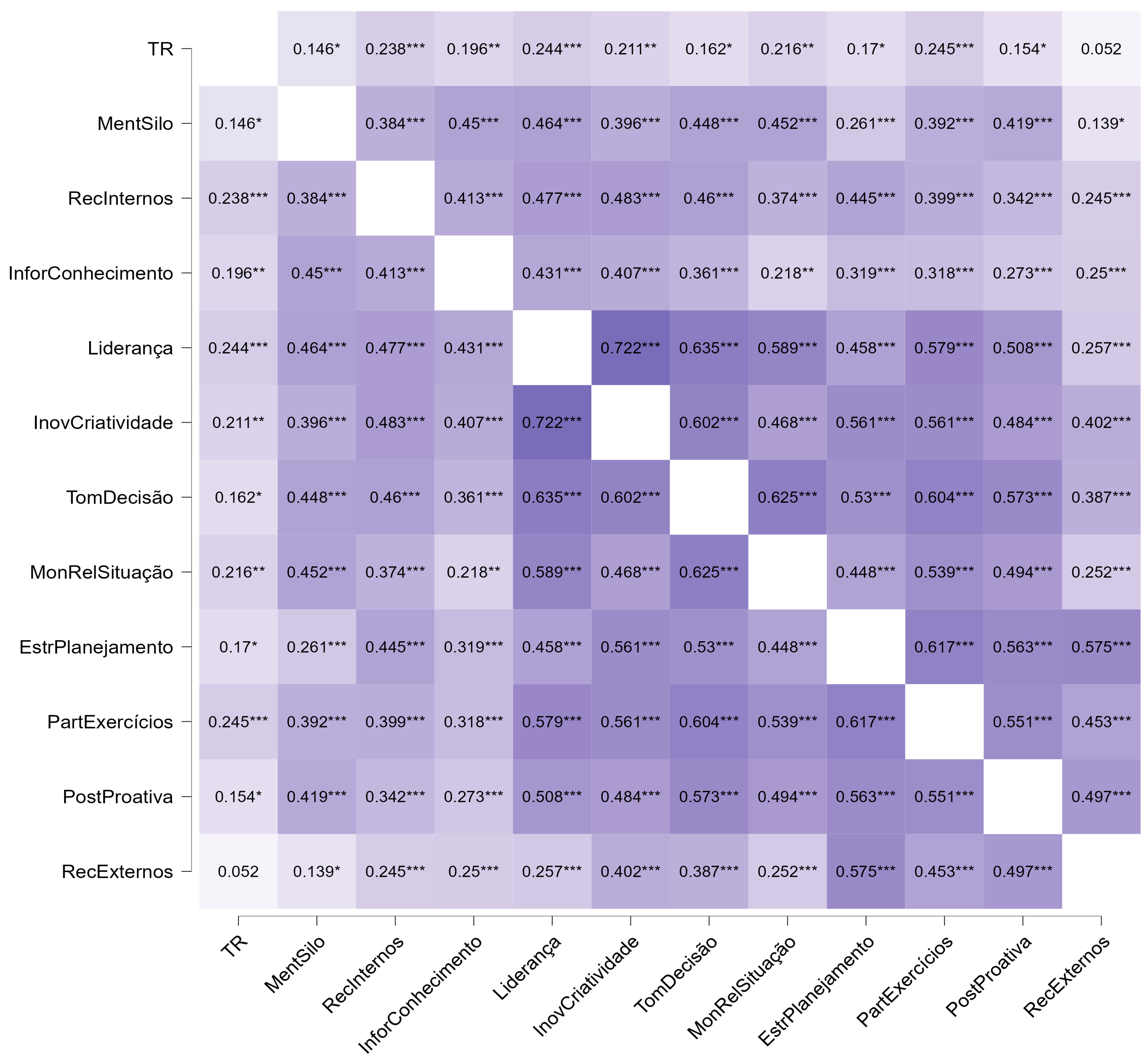
In addition to ANOVA, with the aim of presenting the relationships between Financial Risk Tolerance and the constituent elements of organizational resilience, a Heat Map of Spearman’s rho correlation coefficient was created, as shown in
Figure 1.
The Heat Map indicates that the darker the color, the more significant the correlation between the variables. Upon analyzing the correlation between the constructs of Risk Tolerance and Organizational Resilience, the results in
Figure 1 indicate more significant correlations in the Internal Resources and Leadership indicators for the Adaptation Capacity category. For the Planning category, the indicator that shows the highest correlation with Risk Tolerance is the ‘Participation in Exercises’ indicator. Upon analyzing the Organizational Resilience construct in general, the results showed higher correlations in the ‘Innovation and Creativity’ indicators.
Beyond the statistical significance observed in the ANOVA tests, it is important to highlight the practical magnitude of the differences found. The difference between the low risk tolerance group and the high risk tolerance group represents an approximate increase of 0.327 points on a scale of 0 to 5, which corresponds to a percentage variation of approximately 6.5% in average adaptive capacity. Although this difference may seem numerically moderate, in organizational contexts characterized by resource scarcity—as is the case for small businesses in northeast Brazil—variations of this magnitude can represent substantial differences in how companies respond to crises, implement strategic changes, engage teams, share knowledge, exercise leadership in uncertain environments, among others.
Regarding the Planning dimension, the absence of a statistically significant difference also has practical relevance. The result indicates that formal planning routines seem to operate relatively independently of the manager’s individual risk tolerance profile, suggesting that structured practices may be more associated with institutional or cultural requirements than with behavioral characteristics.
5. Discussion
By measuring the level of tolerance to financial risk among small business managers in Brazil’s northeast region, the present study sought to elucidate how psychological dimensions interact with organizational capabilities in highly uncertain environments. The empirical findings allow us to conclude that the majority of these managers exhibit a medium to high level of financial risk tolerance. This specific behavioral profile presents an intriguing contrast to several established perspectives within the international literature. For instance, this fact stands in contrast to the results of the study by
Țiclău et al. (
2021), who state that small companies tend to be less resilient because they possess inherently few financial resources. According to their logic, any adverse situation, macroeconomic shock, or localized disruption immediately puts the survival of these organizations at severe risk, which would typically foster a highly conservative and risk-averse managerial mindset. In contrast, the theoretical framework proposed by
Jiang et al. (
2019) offers an alternative lens that better aligns with our observations. These authors state that, despite having fewer financial resources at their disposal, small companies are generally more flexible and adaptable organizations in the face of disasters. This inherent agility is positively related to overall organizational resilience, allowing managers to absorb shocks and reconfigure their operations more dynamically than larger, bureaucratic competitors. Furthermore, our findings differ significantly from the results of the study by
Hirawati et al. (
2021), which proved that microbusiness owners generally exhibit a predominantly neutral attitude toward risk. In their context, these individuals do not dare to take excessive risks, but they do not avoid risks either; however, they tend to be significantly more cautious in their daily financial operations. The medium to high risk tolerance observed in our sample suggests that the specific socioeconomic environment of the Brazilian Northeast may force managers to embrace higher levels of financial risk simply to remain competitive and ensure business continuity. Alongside these behavioral findings, we also found that, in general, the average financial management of the investigated microenterprises is still squarely in the poor category. This critical vulnerability indicates an urgent need for improvement in foundational financial literacy, as high-risk tolerance without robust financial management and control systems exposes these vulnerable firms to an increased probability of failure.
By comprehensively measuring the multifaceted level of organizational resilience across our sample, we can confidently conclude that companies characterized by good teamwork tend to be measurably more resilient when navigating operational and economic disruptions. This fact is strongly corroborated by the empirical study conducted by
Beuren and Santos (
2019). The authors explicitly state that good communication, transparent information sharing, and adequate, inclusive participation between different working groups profoundly help organizations deal effectively with environmental turbulence and unexpected adversity, thus directly improving overall organizational resilience. In small enterprises, where human capital is often the most critical asset, the ability of a team to synergize and coordinate responses to external threats becomes a primary defensive mechanism against market volatility. Similarly, the authors
Wong et al. (
2022) concluded in their extensive study that workers who have consistent access to structural and emotional support from other people within their organization report significantly high levels of resilience. This phenomenon can be clearly explained by the fundamental psychological fact that people who have a robust, accessible social support network are able to share the heavy burden of responsibility during crises. They actively receive both emotional and instrumental support from each other, mitigate the individual stress associated with high-stakes decision-making, and are therefore collectively more resilient and capable of sustaining operational continuity (
Melo et al., 2020). In the context of small businesses in the Brazilian Northeast, fostering a collaborative, highly integrated workplace culture is a vital strategic imperative for survival in a region historically marked by severe economic fluctuations.
One of the most theoretically significant findings of this study is the observed lack of a statistically significant association between a manager’s financial risk tolerance and the organization’s structural planning capacity. While seemingly counterintuitive at first glance, this disconnect can primarily be explained by the fundamental conceptual distinction between individual risk orientation and the implementation of structured management routines. Risk tolerance essentially represents a deeply ingrained behavioral, cognitive, or dispositional trait of the individual manager; it reflects their psychological comfort with uncertainty and their inherent willingness to expose their enterprise to potential financial losses. Planning capacity, conversely, involves highly formal organizational processes, technical resources, and systematic operational routines that often operate completely independently of the lead manager’s personal psychological profile. In small companies, particularly those facing the intense regional institutional and financial constraints typical of the Brazilian Northeast, the presence or absence of formal planning is likely driven far more by external structural contingencies than by an individual’s internal risk disposition. These structural contingencies include severe resource limitations, a lack of organizational formalization, the manager’s prior administrative experience (or lack thereof), and stringent external requirements imposed by stakeholders, such as credit institutions or government regulatory bodies. Because these exogenous pressures largely dictate the necessity and format of strategic planning, the manager’s personal appetite for risk becomes decoupled from the firm’s formal planning outputs.
Furthermore, it is highly plausible that formal planning acts as a transversal compensatory mechanism within these small enterprises, serving divergent strategic purposes depending on the manager’s behavioral profile. More conservative, risk-averse managers may heavily rely on detailed planning as a defensive shield to avoid uncertainties, mitigate threats, and maintain strict control over their limited resources. Conversely, those managers with a much greater tolerance for risk may utilize similar planning tools not to avoid danger, but rather to aggressively structure future market opportunities, map out bold expansion strategies, and secure capital for risky ventures. Because both completely opposite psychological profiles actively utilize formal planning for fundamentally different strategic and operational reasons, the statistical variability observed in traditional linear regression models is effectively canceled out or significantly reduced. Part of the evolving international literature suggests that the relationship between risk and performance may be inherently non-linear, indicating that extreme levels of risk-taking produce distinctly different organizational effects compared to moderate levels. Thus, it is highly possible that the underlying relationship between a manager’s risk tolerance and the firm’s planning routines is also non-linear, requiring more complex methodological approaches to untangle. Studies focusing specifically on organizational resilience further indicate that dynamic, fluid dimensions of the organization—such as strategic adaptability and rapid organizational learning—tend to consistently show a far greater positive association with risk-tolerant behaviors than rigid, structural dimensions like formal strategic planning.
Although not statistically significant in a traditional linear sense, the lack of a relationship between risk tolerance and formal planning significantly contributes to the theoretical advancement of the field. It strongly suggests that not all dimensions of organizational resilience are uniformly or symmetrically influenced by the behavioral traits of the leadership. This critical finding reinforces the absolute necessity of distinguishing carefully between the structural dimensions of resilience and the behavioral or dynamic dimensions, thereby avoiding broad overgeneralizations in the literature. In our analysis, risk tolerance was found to significantly associate with adaptability especially regarding proactive leadership, the rapid mobilization of internal resources, continuous innovation, and open knowledge sharing. This suggests that highly risk-tolerant managers deliberately create flexible, decentralized organizational environments that are inherently prone to experimentation. In highly practical terms, an elevated risk tolerance essentially acts as a powerful catalyst for adaptive capacity, actively stimulating faster, more decisive actions and fostering a culture of incremental innovation in the face of unexpected market shocks. Conversely, the glaring lack of a significant relationship with planning indicates that strategic formalization is heavily dependent on external, structural factors, such as strict accounting requirements or established sectoral practices. Therefore, a major practical implication for policymakers and managers lies in identifying precisely which specific dimensions of resilience are highly sensitive to the manager’s individual behavioral profile, and which require external structural interventions to improve.
Finally, while these results offer valuable new insights into the microfoundations of organizational resilience, they must necessarily be analyzed considering the study’s specific methodological characteristics and limitations. The conscious use of a non-probabilistic convenience sample, coupled with the strict regional concentration of the data collection in the northeast of Brazil, may heavily influence the observed statistical patterns. The northeast region’s historical structural instability, infrastructural deficits, and unique socioeconomic environment may have fundamentally shaped the average risk conservatism profile observed in the sample, as highly unstable and unpredictable environments tend to paradoxically encourage certain cautious organizational behaviors even among risk-tolerant individuals. Consequently, extrapolating these highly contextualized results to other geographic regions or comparing them to fully developed international economies should be done with extreme caution, as differing levels of access to credit and distinct regulatory environments may fundamentally alter these behavioral dynamics. Consequently, the results strongly suggest an urgent need for further empirical testing. Scholars should prioritize testing non-linear statistical models, such as the inclusion of quadratic terms for risk tolerance. Furthermore, investigating critical moderating effects (such as overall company size or time in operation) and evaluating possible mediating effects (particularly the manager’s prior administrative experience) could elucidate the mechanisms translating risk tolerance into firm-level resilience. Future studies should also employ multi-group analyses across fundamentally different economic sectors and conceptually differentiate between various types of planning such as formal strategic planning, financial forecasting, and operational scheduling as behavioral relationships may vary. Lastly, future studies utilizing strictly probabilistic, nationally representative samples or employing a broader comparative international scope are essential to verify the ultimate robustness of these findings and rigorously test the impact of distinct contextual variations.
6. Conclusions
6.1. Theoretical Contributions
This research presents theoretical and empirical contributions to the understanding of financial risk tolerance and organizational resilience by demonstrating the relationship between these two constructs among managers of small businesses in the northeast region of Brazil. The main objective of this study was to investigate the relationship between financial risk tolerance and organizational resilience of small business managers in this context. The findings show that most managers reported feeling more comfortable investing their money in their own business and being willing to take risks. Managers were grouped into three segments according to their level of financial risk tolerance (low, medium, and high), with a higher concentration in the medium group, followed by the high-tolerance group. The analyses also indicate that companies with stronger teamwork, more knowledgeable people, and good leadership tend to be more resilient.
Regarding the relationship between the constructs, the category “Adaptability and financial risk tolerance” shows a directly proportional relationship: managers of small businesses with greater adaptive capacity also tend to exhibit higher financial risk tolerance. In contrast, the category “Planning” associated with “Financial risk tolerance” indicates no significant differences; that is, the level of organizational planning does not appear to influence individuals’ tolerance to financial risk. In this sense, the general objective of the research was achieved, and the study broadened the understanding of resilience and financial risk tolerance within the organizational context by measuring these constructs in managers of small businesses in Brazil’s northeast.
From a theoretical standpoint, the results reinforce the relevance of incorporating managers’ behavioral characteristics, particularly financial risk tolerance, into explanations of organizational resilience in small enterprises. By showing that higher levels of risk tolerance are positively associated with adaptability, teamwork, knowledge sharing, and leadership, but not with planning capacity, the study contributes to nuancing models that assume a uniform relationship between risk attitudes and different dimensions of resilience. By focusing on small businesses in Brazil’s northeast, the study also broadens the geographical scope of the literature, still concentrated in developed economies, and underscores the importance of considering contexts of resource scarcity and structural vulnerability.
6.2. Policy and Managerial Implications
In terms of public policy, the findings suggest that entrepreneurship support programs and small business development initiatives in peripheral regions may benefit from combining traditional instruments (credit, technical training, market access) with components aimed at developing behavioral and leadership competencies. Training initiatives that foster a balanced tolerance for risk, combined with practices of collaboration, knowledge sharing, and incremental innovation, tend to support the construction of more resilient routines in contexts characterized by recurrent uncertainty.
From a managerial perspective, the study offers practical insights for owners and managers of small enterprises by showing that risk tolerance is more directly associated with relational and adaptive dimensions of resilience than with formal planning routines. This indicates that managerial development efforts may prioritize strengthening competencies related to leadership, teamwork, and knowledge management, while not neglecting the institutionalization of planning processes that are relatively independent of individual risk attitudes. Taken together, these contributions point to the need to integrate behavioral, institutional, and managerial perspectives in future research on the resilience of small businesses in emerging economies.
6.3. Limitations and Future Research
Regarding the limitations of the research, it is important to note that it was not possible to obtain a sample from all states in Brazil’s northeast. Of the nine northeastern states, no data were collected from Maranhão (MA), Pernambuco (PE), or Sergipe (SE). Another limitation concerns the studied population itself, which, although generally composed of individuals who are relatively accessible, may not be fully representative of all small business managers in the region. In addition, the analyses did not systematically control for potential confounding variables such as firm size, sector of activity, or managers’ prior entrepreneurial and managerial experience. These characteristics may influence both financial risk tolerance and organizational resilience, potentially affecting the strength or direction of the observed relationships.
A further limitation of this study is the exclusive reliance on self-reported data provided by managers, which may be affected by biases such as social desirability and common method variance. Respondents may tend to over-report positive behaviors and underreport vulnerabilities in their firms, potentially inflating the observed relationships between financial risk tolerance and organizational resilience. Future research should complement self-report measures with alternative data sources, such as objective indicators of firm performance, archival financial data, or qualitative evidence obtained through interviews and case studies. The use of mixed-methods designs could provide a more nuanced and triangulated understanding of how risk attitudes and resilience manifest in the everyday practices of small enterprises.
Building on these limitations, future research could adopt more rigorous methodological designs to strengthen the robustness of the evidence. First, the use of probabilistic sampling procedures would allow for greater generalizability of the findings beyond the group of managers who were more easily accessible. Second, studies should incorporate control variables into the analytical models, or even examine interaction effects, in order to disentangle the specific contribution of financial risk tolerance from other structural and experiential factors associated with small business resilience. Third, procedures to address potential biases, such as common method bias and social desirability, could be implemented by applying temporal separation in data collection, using multiple informants, or combining self-reported measures with objective indicators. Finally, mixed-methods designs and longitudinal studies are recommended to capture how financial risk tolerance and organizational resilience evolve over time and to explore underlying mechanisms in greater depth, complementing the cross-sectional and purely quantitative approach adopted in this study.
As for substantive avenues for future research, new analyses are suggested that expand the focus to the team or organizational level. Further studies on the topic are recommended, covering a larger number of cities and other regions of the country, so as to deepen knowledge about the resilience and financial risk tolerance of managers within the organizational context.



 ,
,