Abstract
This study examines the impact of Environmental Management Accounting (EMA) on Corporate Environmental Performance (CEP). Furthermore, it explores the mediating role of Green Process Innovation (GPI) in this relationship. Data from 558 employees across registered Saudi Arabian oil and natural gas companies were collected and analyzed with Smart-PLS software. Results revealed a significant positive impact of EMA on CEP, with GPI partially mediating this relationship. These insights are valuable for corporate policymakers aiming to improve environmental performance through the strategic implementation of EMA and GPI. Additionally, the study emphasizes the importance of EMA and GPI for managerial strategies, showing how these tools can enhance environmental performance. Overall, this research expands the understanding of EMA’s impact on CEP and recommends integrating EMA and GPI into managerial and policy efforts to address stakeholder sustainability concerns and retain competitive advantage.
1. Introduction
Environmental challenges have become a global concern, driven by irrational decisions relating to resource consumption and intensified industrial activities (Alnaim & Metwally, 2024a; Buhaya & Metwally, 2024a; Gunarathne et al., 2021; A. M. Hasanein & Rashwan, 2025). Stakeholder pressures have led firms to address harmful waste, actively engage in environmental safety initiatives, and prioritize environmental responsibility (Tang et al., 2018; Ayad & Hasanein, 2025). Industrial developments have significantly contributed to environmental issues such as air and water pollution, as well as elevated temperatures (Singh et al., 2020). Hence, manufacturing firms are compelled to engage in Corporate Social Responsibility (CSR) practices and product development to meet stakeholder demands for green initiatives (Alnaim & Metwally, 2024b; Buhaya & Metwally, 2024b; Channa et al., 2021). These pressures drive firms to prioritize green innovations to enhance their Corporate Environmental Performance (CEP) and competitive advantages (Hanif et al., 2023; A. M. Hasanein et al., 2025).
In recent years, CSR and CEP have become among the most significant areas of scholarly investigation, especially within firms that tend to report their CSR efforts comprehensively. The focus is on examining the effectiveness with which these entities fulfill their stated commitment to providing transparent disclosures (Alnaim & Metwally, 2024b; A. Metwally et al., 2021). Previous research in emerging economies linked engagement with CSR to legitimizing corporate actions rather than to real enhancement of CEP (El-Bassiouny & Letmathe, 2018; Lee & Schaltegger, 2018; Schaltegger, 2018; A. B. M. Metwally et al., 2024a, 2024b). It has also been associated with earning management, firm financial performance (Sial et al., 2018), employees’ creativity (Abdelmotaleb et al., 2018), socio-political factors that result in different practices (Diab & Metwally, 2020), and cost reduction, as CSR disclosure is identified as a rhetorical strategy to conceal cost reduction efforts (A. B. M. Metwally et al., 2022).
An outcome of this tendency has prompted stakeholders to strongly encourage managerial emphasis on environmental concerns and the evaluation of CEP (Rodrigue et al., 2013). Many companies, in pursuit of this objective, have begun to consider implementing sustainable development strategies. One of the main tools for enhancing CEP in the literature is the adoption of Environmental Management Accounting (EMA), along with deploying proper digitalization in the processes (Alnaim & Metwally, 2024a; Buhaya & Metwally, 2024b). However, the effectiveness of employing both practices simultaneously to enhance a firm’s overall environmental performance remains uncertain. Notably, in some countries like Egypt, Libya and Tunisia, reporting on environmental performance remains voluntary, and there exists a lack of transparency, as few disclosures are made, especially in these emerging markets (A. Metwally et al., 2021), necessitating urgent further investigation (Solovida & Latan, 2017).
The natural resource-based theory is used to clarify the connection between organizational capabilities and the natural environment, emphasizing the importance of resource utilization in manufacturing processes (Andersén, 2021). Organizations aiming for environmental sustainability implement green practices, enhance work strategies, and utilize intangible resources to reduce stakeholder concerns (Asadi et al., 2020; El-Kassar & Singh, 2019). Green Process Innovation (GPI) emerges as a central way that can help organizations in producing environmentally friendly products and processes, thus mitigating adverse environmental impacts (Awan et al., 2021; Hanif et al., 2023; A. Hasanein & Ayad, 2025). Despite being costly, GPI enables organizations to improve environmental sustainability and reduce harmful waste. Compared to alternative practices, GPI proves more efficacious in sustaining environmental practices, contributing positively to firms’ competitive advantage (Hanif et al., 2023). GPI was connected with enhancing financial (Xie et al., 2019) and non-financial performance (Li et al., 2020; Qalati et al., 2025).
EMA involves managing both financial and non-financial information to evaluate decision consequences on environmental and economic aspects (R. L. Burritt et al., 2019). Many organizations in developing nations are yet to adopt EMA, hindering their active participation in environmental stability (Hanif et al., 2023; Solovida & Latan, 2017). EMA, when compared to traditional accounting and control techniques, has proven to be a valuable tool in improving the CEP of manufacturing companies (Alnaim & Metwally, 2024a). It helps organizations achieve their environmental, economic, and financial goals more effectively, and creates a positive reputation among stakeholders, attracting investors (Hanif et al., 2023; Latan et al., 2018).
Despite the significant benefits of EMA and GPI on CEP, there remains a lack of in-depth research exploring the specific roles these factors play within the manufacturing industry. Furthermore, the intermediary role of GPI in the relationship between EMA and CEP has received minimal scholarly attention (Hanif et al., 2023). The combined effects of EMA and GPI in enhancing CEP are under-researched. An exception is Hanif et al. (2023), who explored this relationship in Pakistan recently and reported a positive impact of both EMA and GPI on CEP. Thus, this study seeks to address this empirical gap and extend the literature.
One of the main contributions of this study is investigating this blind spot in the literature, thereby enhancing our understanding of CEP and the roles of EMA and GPI in the oil and gas industry, which faces many environmental challenges. Moreover, the Saudi oil context is an ignored context in the literature. In this context, exploring the mediating influence of GPI in the relationship between EMA and CEP represents a unique contribution of the current study, as it will confirm or reject the early investigation of Hanif et al. (2023) in another Asian emerging market. Hence, the current study seeks to answer the following research questions: (1) What is the impact of EMA practice on CEP? (2) Does GPI mediate the relationship between EMA and CEP?
The structure of this paper is outlined as follows. Section 2 introduces the theoretical framework guiding this research. In Section 3, a review of the existing literature is conducted to identify gaps and develop the study’s hypotheses. Section 4 details the methodology and approach used in the research. Section 5 presents and interprets the findings. Finally, Section 6 concludes the paper, highlighting the study’s limitations and suggesting areas for future investigation.
2. Theoretical Framework
Several theories have been employed in the literature to explain the role of EMA as an internal managerial tool for enhancing the efficiency and effectiveness of operations, and how this role can enhance CEP. Several studies in the literature have focused on stakeholder and agency theories, along with the Natural Resource-Based View (NRBV) theory. From a theoretical standpoint, stakeholders concentrate on value creation and consider environmental strategies as tools for enhancing shareholders’ wealth, as they align with shareholders’ best interests (Freudenreich et al., 2020). In a similar vein, substantial empirical evidence indicates that positive environmental outcomes are expected when companies adopt clear environmental initiatives (Asiaei et al., 2022; Peng et al., 2021). Conversely, sustainable development can be viewed through an agency perspective, where managers might engage heavily in environmental and sustainability discourse for personal gain (Rahman & Zheng, 2022; Sial et al., 2018). For instance, managers may invest disproportionately in CSR practices to enhance their reputation as good corporate citizens, generating positive signals to shareholders against reality (Chen et al., 2018). Environmental strategies and the differences in their implementation techniques may result in conflicts of interest between stakeholders (Bouma & Kamp-Roelands, 2000).
Several studies in the literature emphasize the importance of harmonizing environmental resources with conservative management and accounting systems. These studies underline the crucial role of EMA, as it enables effective management of green resources. (Alnaim & Metwally, 2024a, 2024b). Furthermore, other have studies clarified that EMA contributes to strategic objective achievement through proper management of risks and uncertainties, which ultimately enhances sustainability performance (Wijethilake, 2017). Sustainability control systems are theorized to assume a multifaceted role, not solely confined to enabling top management’s execution of sustainability initiatives through the promotion of core values and performance measurement (Arjaliès & Mundy, 2013). In addition, adopting EMA further helps companies address both sustainability-related threats and opportunities. This proactive approach helps companies reduce agency costs through enhancing transparency and accountability systems (Asiaei et al., 2022; Solovida & Latan, 2017). Following this line of research, many studies have employed the NRBV theory as a theoretical framework (Alnaim & Metwally, 2024a; Buhaya & Metwally, 2024a).
The NRBV theory serves as an adjunct dimension to the Resource-Based View theory, positing that organizations can attain a competitive advantage in the industry through responsible responses to environmental concerns (Barney, 1991; Hart, 1995). The NRBV framework explains the interrelationship between the natural environment and firms’ resources and capabilities. This theory highlights three key strategic abilities essential for the practical and thoughtful distribution of resources: preventing pollution, managing products responsibly, and promoting sustainable development (Hanif et al., 2023). Additionally, the NRBV emphasizes how organizations utilize their resources and skills to gain a competitive advantage in the marketplace (Alnaim & Metwally, 2024a; Buhaya & Metwally, 2024a; Yahya et al., 2021). From the perspective of NRBV, an organization’s resources, final products, and production methods are assessed based on their environmental impact (Andersén, 2021). By reducing environmental harm, companies can boost profitability while leveraging their internal capabilities (Hart, 1995).
The NRBV framework is valuable for evaluating CEP, especially by focusing on innovation in production processes and employees’ skills (Barney, 1991). When examining innovation, NRBV stands out as a key theory in strategic management, exploring how innovation and technology can help overcome environmental challenges. It also links environmental responsibility to organizational capabilities, emphasizing the use of eco-friendly resources (De Stefano et al., 2016). The pollution prevention strategy within the NRBV aims to reduce waste and minimize the harmful effects of pollutants on business operations. The product stewardship strategy focuses on reducing the negative impacts of products throughout their entire life cycle (McDougall et al., 2019). Finally, the sustainable development strategy encourages companies to develop environmentally sustainable products and technologies (Yahya et al., 2021). Through GPI, aligned with the three strategies of the NRBV, organizations can efficiently utilize natural resources in accordance with sustainable directives to foster a green environment (Hanif et al., 2023).
3. Literature Review and Hypotheses Development
3.1. EMA and CEP
EMA includes a collection of accounting tools and practices designed to aid management in making decisions to reduce environmental impact (R. L. Burritt et al., 2002) and improve economic performance. The key difference between traditional and environmental accounting is that environmental accounting explicitly identifies, measures, analyzes, and interprets information related to a firm’s environmental activities. In contrast, this distinction is less clear within conventional accounting methods (R. L. Burritt et al., 2019).
EMA also concentrates on making companies optimize their environmental management efforts through the best utilization of their financial and accounting information (Alnaim & Metwally, 2024b). Several studies have revealed that EMA can help companies in many instances, including guiding strategic planning, supporting decision-making, and ensuring operational oversight (Alnaim & Metwally, 2024a; Asiaei et al., 2022; R. L. Burritt et al., 2019). EMA has been heavily studied recently in the literature, yet it lacks a single, established definition due to its evolving nature. What many recent studies have confirmed is that EMA plays a crucial role in systematically collecting, analyzing, and sharing information on corporate sustainability. This, in turn, helps in achieving sustainability and environmental goals and enhancing overall CEP (Alnaim & Metwally, 2024b; Gunarathne et al., 2021).
More specifically, EMA is seen as a framework based on accounting principles designed to aid organizational decision-making regarding environmental issues and their management (Lee & Schaltegger, 2018; Schaltegger, 2018). This framework involves various functions, such as monitoring compliance, reporting financial data, supporting decision-making processes, and encouraging continuous improvements (Passetti et al., 2014). EMA is key to implementing environmental strategies, as it enhances both financial and environmental performance data (Alnaim & Metwally, 2024a; R. L. Burritt et al., 2002). As such, EMA represents comprehensive principles and methods that provide crucial information for managing environmental strategies related to waste, materials, water, carbon, energy, and biodiversity, whether in its monetary or physical form (Gunarathne et al., 2021).
In practice, EMA involves integrating financial and non-financial data to assess the impact of decisions on improving CEP (Solovida & Latan, 2017). Many studies highlight the importance of EMA role in reaching sustainable and environmental goals, with effective implementation offering organizations a competitive edge by improving their environmental performance (Visintin et al., 2022). Through robust EMA practices, companies can enhance their CEP, gaining benefits across financial, environmental, and economic domains (R. Burritt & Christ, 2016). Environmental disclosures can also pinpoint certain environmental practices, boosting the organizational outcomes (i.e., financial and economic) (Ogunode, 2022).
However, some organizations continue to resist integrating environmental factors into their accounting practices, adhering to traditional norms that may harm stakeholder interests (Agustia et al., 2019; Alnaim & Metwally, 2024a). Companies that focus solely on profit maximization at the expense of environmental strategies may suffer significant financial setbacks, particularly as environmental stability gains greater importance. Stakeholder pressures are pushing companies to improve their CEP, driving proactive efforts toward environmental stability. EMA, in this context, becomes an essential tool for creating and implementing environmental strategies by gathering both financial and non-financial data on environmental activities (Sari et al., 2021). Accurate, timely, and relevant information is crucial for organizational success and for achieving all strategies, including environmental ones (Alnaim & Metwally, 2024a; Hanif et al., 2023). Based on this, the following hypothesis is proposed:
H1:
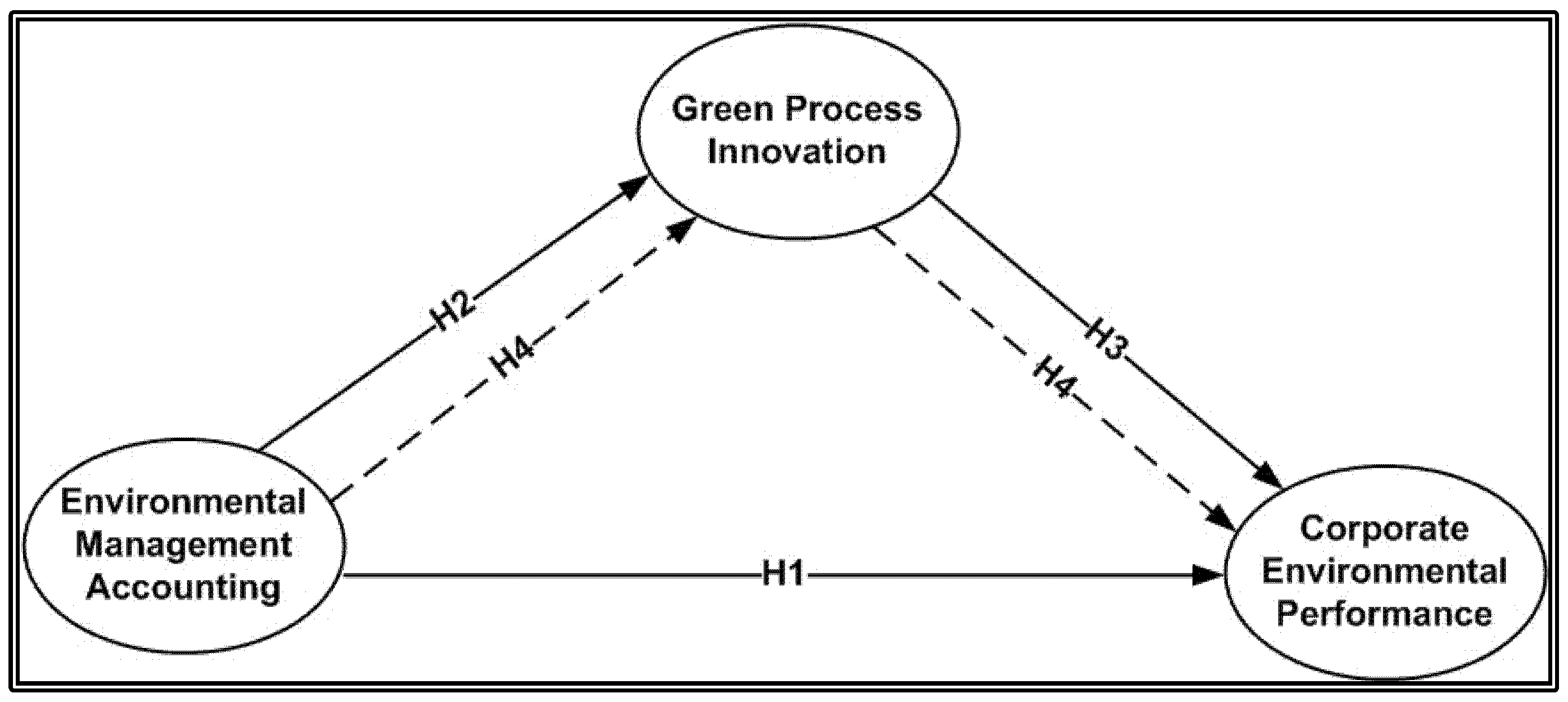
A positive association exists between the use of EMA and CEP.
3.2. EMA and GPI
Through the adoption of GPI, firms seek to minimize waste, reduce costs, and enhance the value of products and services (Hanif et al., 2023; Karim Suhag et al., 2017). This entails a focus on ecological innovation, encompassing reductions in production costs and liabilities (Gunday et al., 2011). By innovating their processes and placing a strong emphasis on environmental factors, companies can strengthen their competitive position and improve overall performance (Zhai et al., 2018). EMA aligns with organizational sustainability, particularly when organizational performance is positive. Drawing insights from prior research, organizations adopt environmental-based accounting systems to enhance both financial and environmentally friendly performance (Nawaz et al., 2019).
The primary objective of GPI is to produce environmentally friendly products by engaging in eco-friendly processes, minimizing harmful waste (i.e., produced water containing heavy metals and hydrocarbons, oily sludge/drilling muds, and toxic emissions). Implementing GPI is a complex endeavor requiring substantial investments (Jermsittiparsert et al., 2020). Decision-making for such substantial investments necessitates specific information for successful GPI implementation (Tu & Wu, 2021). Accurate, detailed, and pertinent information for such significant investments in sustaining the environment is facilitated through EMA. Without EMA, organizations encounter challenges in decision-making and successful GPI implementation. Some organizations, neglecting EMA, face impediments in enhancing their environmental performance (Sari et al., 2021).
Conventional accounting practices fall short in addressing environmental concerns, underscoring the imperative role of EMA in facilitating environmentally conscious decisions and participation in environmental stability. EMA proves crucial in providing details regarding costly decisions associated with GPI, essential for improving organizational environmental performance (Somjai et al., 2020). EMA also offers traceable information about GPI investments, addressing stakeholder concerns. The combined implementation of EMA and GPI has the potential to enhance CEP. Despite the acknowledged significance of EMA and GPI on CEP, scant attention has been directed toward understanding the mediating role of GPI between EMA and CEP in the literature. This study introduces this novel perspective, representing a valuable contribution to the existing literature. Based on this, the following hypothesis is proposed:
H2:
A positive association exists between EMA and GPI.
3.3. GPI and CEP
GPI refers to the application of innovative production processes aimed at reducing environmental pollution compared to substitution methods (Ma et al., 2021). GPI encompasses diverse measures to minimize wastage in production processes (Hanif et al., 2023; Severo et al., 2017). Organizations focus on modifying both the process and design to integrate ecological considerations and foster product innovation (Xie et al., 2019). GPI aims to diminish emissions at the end of the production process, employing advanced terminal treatment equipment and processes to mitigate adverse environmental impacts (Cai & Li, 2018). It further facilitates water conservation, efficient resource utilization, reduced energy consumption, and the substitution of fossil fuels with bioenergy (Kivimaa & Kautto, 2010).
The primary objective of GPI is to manage the production process by reducing energy consumption and transforming waste into valuable materials (Salvadó et al., 2012). Organizations employing GPI play an active role in environmental stability, serving as a strategic management approach to address environmental issues during the production process (Tang et al., 2018; Xie et al., 2019). To gain a competitive edge, organizations often focus on reducing production costs and enhancing product quality through innovation in their production processes (Tang et al., 2018). Establishing a green image in the market distinguishes organizations, contributing to their competitive advantage (Li et al., 2020). Maintaining a green image involves reducing environmental pollution and improving product quality, making GPI an essential solution (Tu & Wu, 2021).
GPI allows organizations to build a reputation for environmental leadership by optimizing resource use, especially in the manufacturing sector, where a growing number of organizations are investing in green solutions (Hanif et al., 2023). This strategic move not only enhances their green image but also fosters customer loyalty and market competitiveness. GPI is considered an organizational resource that adds unique value to manufacturing processes, making replication challenging (A. Hasanein & Metwally, 2025; Rehman et al., 2021).
While acknowledging the potential benefits of GPI, research studies, such as Li et al. (2020), indicate that improving overall processes, including managerial and operational aspects, can be expensive and resource-intensive. Furthermore, the time-intensive nature of such innovation sometimes yields less productive results. Despite these challenges, Xie et al. (2019) found that GPI contributes to firms’ financial performance. Stakeholders also influence organizations to adopt GPI, as suggested by Guoyou et al. (2013). However, limited attention has been given to understanding the consequences faced by organizations upon adopting GPI (Hanif et al., 2023).
Several studies in the literature highlight various dimensions of the relationship between green innovation, knowledge transfer, ecological investment, digital technologies, Corporate Social Responsibility (CSR), and leadership in influencing organizational and environmental performance (Awan et al., 2021; Hanif et al., 2023; Li et al., 2020; Wang et al., 2021). However, the mediating role of GPI between EMA and CEP remains largely unexplored. In light of this gap, this study proposes that GPI serves as a mediator in the relationship between EMA and CEP, thereby influencing CEP positively (Hanif et al., 2023). Based on this, the following hypotheses are proposed:
H3:
A positive association exists between GPI and CEP.
H4:
GPI mediates the relationship between EMA and CEP.
The relationships between the study variables are presented in Figure 1 below.
Figure 1.
The conceptual model.
4. Research Design
4.1. Measures and Scale Development
The first section describes the research objectives and the techniques required to conduct the survey. The second section contains information on the participants’ socioeconomic background. The final part of the investigation entails examining several facets. A 5-point Likert scale was used, with 1 representing “strongly disagree” and 5 indicating “strongly agree”. Concerning the EMA scale, four items were used, adapted from Latan et al. (2018). In addition, the GPI scale was adopted from Chen et al. (2006) and includes four items. To measure the CEP scale, seven items were used, which were adapted from Kim et al. (2019).
Environmental Management Accounting (EMA) and Corporate Environmental Performance (CEP) are organizational-level constructs that are often evaluated using objective archival indicators. However, consistent with prior management and sustainability research, both constructs were operationalized through validated perceptual scales adapted for employee respondents (see Appendix A). This approach is theoretically supported, as knowledgeable organizational informants—particularly employees in operational and managerial roles—possess direct experiential insight into internal control systems, environmental accounting practices, and sustainability initiatives (Kumar et al., 1993; Podsakoff et al., 2003). Furthermore, perceptual assessments of corporate environmental performance are widely utilized when objective environmental data are not publicly accessible, and empirical evidence indicates substantial convergence between perceptual and objective performance measures (Dess & Robinson, 1984; Wall et al., 2004).
The internal consistency of these variables was measured using alpha, which was found to be (0.790, 0.831, 0.723). Academics and business specialists have evaluated the survey to ascertain its consistency and usability. To maintain the content validity of the survey, specific statements were revised in language and structure based on feedback from participants and researchers.
4.2. Sampling and Collecting Data Method
Information was gathered from top three Saudi Arabian oil and natural gas companies (i.e., ARAMCO, SABIC, Petro Rabigh) that employ environmentally friendly process innovations and have adopted EMA practices. The rationale behind selecting this sector lies in its concentration of major firms that typically embrace environmentally conscious operational approaches (Wilkinson et al., 2001). Additionally, companies within the oil and gas industry in Saudi Arabia demonstrate a heightened awareness of environmental concerns (Amanullah et al., 2016). A convenience sample approach was employed to collect the data, primarily focusing on Saudi Arabian employees in the oil and natural gas industry. Data collection for the current research began in February 2025 and lasted for six months. A total of 558 of the 700 surveys sent were completed, yielding an impressive 79.7% response rate. Notably, no data was missing. With 558 valid responses, the sample size met Nunnally and Bernstein (1994) requirements for maintaining a 1:10 item-to-sample ratio. Given that the survey had 15 items, a minimum sample size of 150 participants was deemed suitable in this particular scenario. Of the 558 legitimate responses, 387 respondents, or 69.4%, identified as male, while 171 respondents, or 30.6%, identified as female. A total of 68.5% of respondents were in the 26–40 age range, which comprised most of the respondents. Concerning their level of education, the majority of employees (62.5%) educated had a bachelor’s degree. Furthermore, a significant proportion of respondents (65.2%) had 1–5 years of experience, as indicated in Table 1.
Table 1.
Employee profile *.
The employees’ responses yielded a wide range of average scores, demonstrating significant diversity in their answers. The standard deviation (SD) values further emphasize the extent of variability in their responses. Based on the results, the replies were not closely clustered (Tabachnick et al., 2019). Additionally, according to Nunnally and Bernstein (1994) criterion, the statistical data’s skewness and kurtosis values were within the permissible range of −2 to +2, indicating a normal distribution. This indicates that the data distribution adhered to the expected normal distribution pattern. Furthermore, it is worth noting that the all of the measuring scale items in the study had Variance Inflation Factors (VIF) values of less than 5. This indicates that there are no concerns regarding multicollinearity (see Table 2).
Table 2.
Measurement model.
4.3. Analyzing Data Techniques
Smart partial least squares (Smart-PLS) software, a nonparametric method specifically designed to handle latent constructs that cannot be directly observed, was employed in the analysis phase of this study because it allows for reliable estimation without assuming normal data distribution. It also effectively handles complex models with multiple constructs and indicators, and provides robust results even with relatively small or heterogeneous samples (Henseler et al., 2009). Data analysis was conducted using Smart PLS software version 4. The social sciences have long acknowledged Smart-PLS’s capacity to produce accurate findings, especially when examining correlations between several variables (Wetzels et al., 2009). As mentioned in (Hair et al., 2011). It is especially well-suited for research that seeks to forecast dependent variables rather than validate an established conceptual model. As suggested by Leguina (2015), the research analysis was conducted in two stages. While the subsequent stage focused solely on examining the hypotheses proposed in the research, the first phase primarily concerned validating convergent and discriminant validity.
5. Results
5.1. Measurement Model
Following the recommendations of Hair et al. (2011) and Kline (2023), the conceptual research model convergent and discriminant validity and the scale reliability were assessed using several standard guidelines. These guidelines included the assessment of composite reliability (C.R) scores, internal consistency (α) scores, and convergent and discriminant validity measures. To test convergent validity, C.R. scores, outer loadings and average variance extracted (AVE) values were used as a criteria. All values were above the suggested minimums of C.R. (more than 0.7) and AVE (more than 0.5), which means extraordinary internal consistency reliability. The results of the study imply that the research constructs used in the present study exhibit sufficient convergent validity. This is supported by the fact that all the outer loadings were found to be over 0.708 and statistically significant, which is in line with the requirements provided by (Hair et al., 2011). Table 2 shows these findings and reveals that the measures used in the study are reliable and valid.
To determine the discriminant validity, the current study evaluated cross-loadings, Heterotrait–Monotrait (HTMT) proportions, and Fornell and Larcker (1981) proportions. The outer loading of each of the latent variables was consistently better than its cross-loading, based on the data shown in Table 3. However, unlike other conceptions, this implies that each variable is more strongly related to its target construct. The correlations between the variables are not significant compared to the diagonal values of the AVE scores, as Table 4 once again shows. The results also demonstrate discriminant validity, indicating that the measures applied in the research do not show the expected conceptual correlations with other measures. The study meets the conditions of discrimination validity, as suggested by Leguina (2015), since the ratios of HTMT are lower than 0.90 (see Table 4). This outcome indicates that the research constructs do not significantly overlap, providing a solid foundation for drawing conclusions.
Table 3.
Cross-loadings indicators.
Table 4.
Measuring discriminant validity scales.
5.2. Testing Research Hypotheses
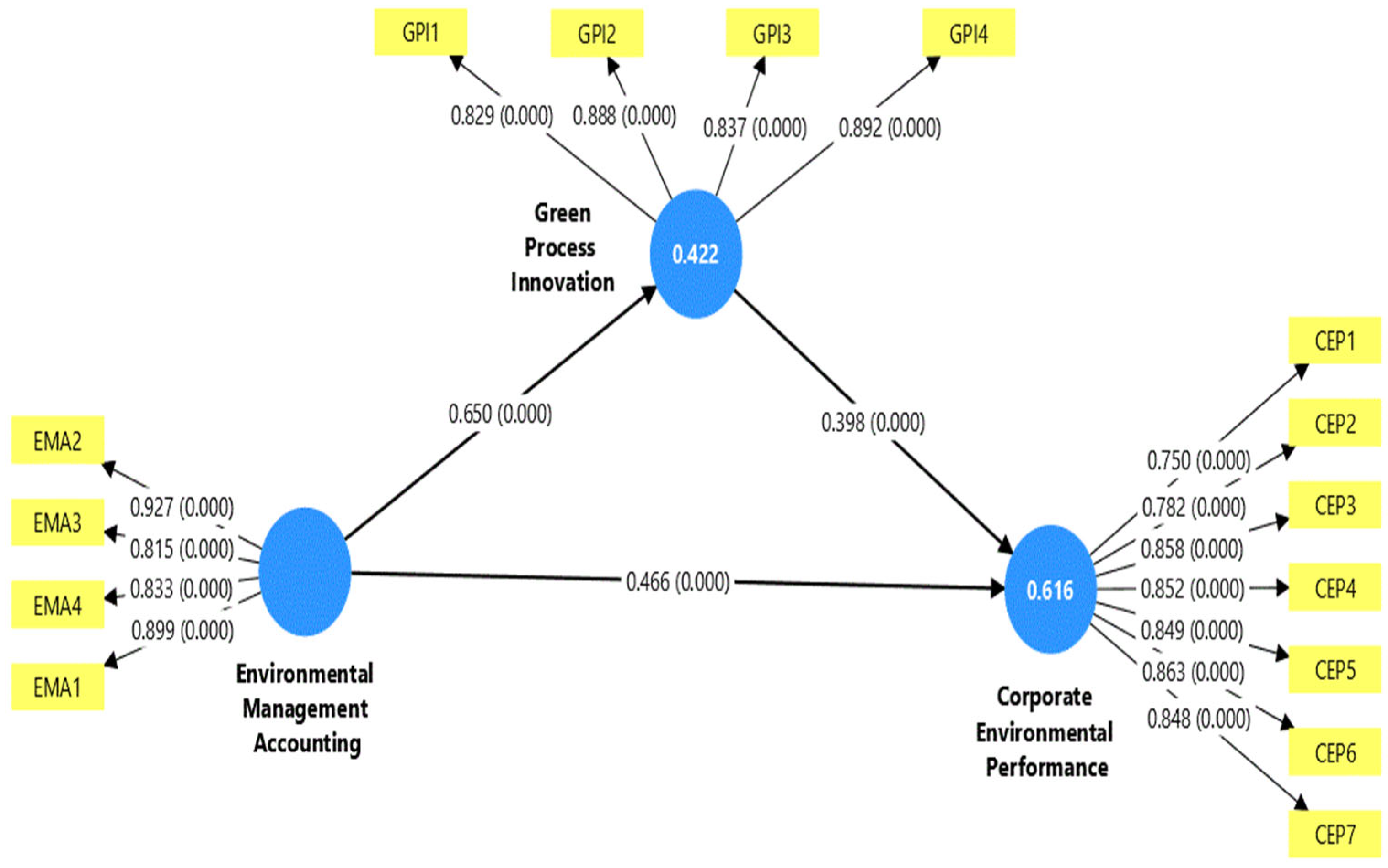
As indicated in Table 5 and Figure 2, all hypothesized direct and indirect relationships are significant and strongly support the proposed structural model. Comprehensively, the findings show that EMA has both direct and indirect impacts on CEP via GPI. The magnitudes of the significant effects along the paths highlight the theoretical and practical significance of incorporating EMA practices into green strategies for innovation and performance. The model demonstrates strong explanatory and predictive power (R2 = 0.45–0.63; f2 = small to large; Q2 > 0.20), good fit (SRMR = 0.062), and no multicollinearity issues (inner VIF = 1.66–1.99) (see Table 5). Bootstrapped 95% confidence intervals exclude zero, confirming robustness. Collectively, these results highlight the theoretical and practical importance of EMA in enhancing CEP through green process innovation.
Table 5.
Assessments of structural parameters.
Figure 2.
Research final model.
Regarding the direct effects, the first hypothesis showed that EMA positively and significantly influenced CEP (β = 0.466, T= 6.651, p < 0.001), indicating that practices in the field of environmentally oriented accounting directly and positively impact CEP. Likewise, the second hypothesis revealed that EMA has a significant positive influence on GPI (β = 0.650, T = 11.979, p < 0.001), reflecting a very strong and consistent effect across the sample. The high T-value indicates that the relationship is highly robust, demonstrating that organizations implementing EMA systematically and rigorously are reliably more capable of fostering green process innovations by integrating environmental considerations into decision-making and aligning operations with sustainability goals. Moreover, the third hypothesis demonstrated that GPI had a substantial impact on CEP (β = 0.398, T = 4.923, p < 0.001), indicating that the role of GPI is determinant in the development of CEP.
Regarding the indirect effects in the bootstrapped mediation analysis, the fourth hypothesis was supported: GPI mediates the relationship between EMA and CEP partway (β = 0.258, T = 4.426, p = 0.001). This implies that EMA affects CEP, in part, by improving firms’ green innovation processes. Collectively, the structural model illustrates a consistent, theoretically adequate framework in which EMA can play a direct or indirect role, leading to better CEP through GPI.
6. Discussion
The study’s findings demonstrate that EMA significantly improves CEP, which is consistent with earlier research in the field indicating that EMA is essential for facilitating the application of environmental strategies by improving both financial and non-financial environmental data (Hanif et al., 2023). Additionally, EMA is essential to environmental sustainability, and effective EMA implementation can give organizations a competitive edge by increasing their CEP (Visintin et al., 2022). The results of the study show that the GPI has a significant and favorable impact on CEP, suggesting that manufacturing companies’ use of the GPI enhances environmental sustainability. Existing research supports these conclusions, indicating that companies can reduce adverse environmental effects by adopting creative, eco-friendly production methods (Cai & Li, 2018; Kivimaa & Kautto, 2010; Salvadó et al., 2012).
Moreover, the study’s findings indicate that the GPI serves as a mediator in the relationship between EMA and CEP. Consequently, organizations can enhance their environmental performance by implementing both EMA and GPI practices. Prior research has suggested that the adoption of EMA practices not only improves an organization’s financial standing but also facilitates engagement in environmentally friendly production methods, aligning activities with organizational objectives (Singh et al., 2020; Yu et al., 2020). The combined influence of GPI and EMA fosters the adoption of environmentally responsible behaviors among employees (Chen et al., 2014), directing them towards green practices to mitigate adverse environmental impacts (Awan et al., 2021). Notably, the study’s contribution lies in its unique exploration of the mediating role of GPI in the relationship between EMA and CEP, addressing a gap in the existing literature (Hanif et al., 2023).
Finally, the study’s findings can be theoretically interpreted through a coherent integration of stakeholder theory, agency theory, and the Natural Resource-Based View (NRBV), thereby moving beyond mere empirical confirmation. From a stakeholder perspective, the significant positive effect of EMA on CEP indicates that firms respond substantively to stakeholder pressures by embedding environmental considerations into internal accounting and decision-making systems. EMA enhances transparency, improves the credibility of environmental disclosures, and aligns organizational actions with stakeholders’ expectations, thereby facilitating value creation rather than symbolic compliance. From an agency standpoint, the results suggest that EMA functions as a governance mechanism that reduces information asymmetry between managers and stakeholders. By formalizing environmental data and linking it to performance evaluation, EMA constrains managerial opportunism and limits the likelihood of superficial sustainability engagement. Importantly, the mediating role of GPI provides deeper theoretical insight: it indicates that environmental accounting information becomes effective only when translated into operational and technological changes. This aligns strongly with NRBV, which argues that competitive advantage stems from embedding environmental concerns into firm-specific capabilities such as pollution prevention and sustainable process development. Thus, the findings collectively demonstrate that EMA is not merely a reporting tool (stakeholder logic) nor simply a monitoring device (agency logic), but a strategic resource enabler whose impact on CEP materializes through capability development in the form of GPI (NRBV logic). By explicitly linking governance, stakeholder alignment, and capability transformation, the study provides a theoretically grounded explanation of how and why EMA enhances environmental performance.
7. Conclusions, Limitations, and Future Research
Using a sample of 558 employees working in Saudi Arabian oil and natural gas companies, the present study investigates the influence of EMA on CEP, considering the mediating role of GPI. The study’s results reveal a significant impact of EMA practices on CEP, underscoring the diminishing efficacy of conventional accounting practices in fostering organizational green performance (Hanif et al., 2023). Moreover, the study underscores the pivotal role of GPI in achieving environmental objectives, highlighting the significance of green innovation in enhancing environmental performance. All hypotheses, both direct and indirect, receive empirical support. The study suggests that policymakers should refine GPI practices and encourage employee engagement in EMA to advance ecological considerations within organizations. The study’s outcomes align with prior research, which also demonstrated the positive influence of EMA on CEP (Gunarathne et al., 2021; Hanif et al., 2023; Solovida & Latan, 2017). Furthermore, the findings resonate with the literature in related domains, emphasizing the importance of green process innovation for enhancing green performance (Hanif et al., 2023).
The study’s outcomes contribute to confirming the arguments of both agency and stakeholders theories and the advancement of the NRBV theory (Barney, 1991; Hart, 1995) by elucidating the roles of GPI and EMA in perpetuating the environmental performance of the firm. In accordance with these findings, the study posits that GPI should be recognized as a strategic resource for manufacturing organizations, influencing CEP. Aligned with NRBV principles, which emphasize the difficulty of imitation for leaders and followers as predominant resources within a firm (Barney, 1991), the study contends that GPI enhances the impact of EMA on CEP. Furthermore, the findings underscore the essential nature of EMA practices in providing valuable information to stabilize both environmental performance and financial positions of organizations, thereby contributing theoretically to the NRBV framework. Consequently, the study recommends that companies integrate EMA practices with GPI to instigate transformative behaviors in human capital and financial practices, thereby augmenting CEP and fostering competitiveness against other firms. The study underscores the significance of a firm’s attention to EMA practices in elevating green performance and securing a competitive advantage (Hanif et al., 2023).
The study’s findings advocate for policymakers to strategically invest in green management, positing it as a means for firms to enhance their reputation among stakeholders. Stakeholders’ environmental consciousness drives demand for companies to adopt eco-friendly practices. The research provides managerial insights, emphasizing the importance of fostering eco-friendly leadership behaviors within organizations to facilitate the implementation of GPI practices. Furthermore, the study underscores the strategic value of EMA practices in cultivating an environmentally friendly organizational culture. In addition to emphasizing the significance of EMA, the findings underscore its pivotal role as a strategic asset that influences the development of an environmentally conscious culture. The study highlights the importance of policymakers integrating EMA into the organizational structure to stimulate green innovation, ultimately conferring a competitive advantage on the firm.
A practical implication of the study concerns the quality of process innovation that influences green performance. The research recommends that managerial leaders assume ecological responsibility in employee evaluations and within the management system. This entails recognizing and fostering green job behaviors such as workplace analysis, waste management, energy efficiency, and recycling. Such efforts contribute to the enhancement and sustainability of ecological performance among employees. Consequently, the study provides practical considerations for leaders, supervisors, and policymakers, directing attention toward achieving and sustaining higher environmental performance through the adoption of Green Process Innovation and Environmental Management Accounting.
While the current research yields both practical and theoretical implications, it is imperative to acknowledge certain limitations that pave the way for future research opportunities. The study, confined to survey questionnaire data collected from oil and natural gas organizations in Saudi Arabia, limits the generalizability of its results to other industries. Subsequent research could encompass diverse sectors and industries, facilitating comparative analyses and potentially extending the scope to other Gulf and Middle Eastern countries. A noteworthy limitation is the cross-sectional nature of the study, in which data were collected at a single time point. Given the anticipated long-term nature of environmental outcomes, future research could adopt a longitudinal approach to capture the unfolding dynamics over time. Additionally, the research’s exclusive reliance on a quantitative design may overlook valuable insights embedded in respondents’ qualitative responses. Hence, future studies should employ both quantitative and qualitative methodologies to address the rationales behind participants’ responses comprehensively. Furthermore, recognizing the pivotal role of Green Human Resource Management (GHRM) practices in shaping green behavior and enhancing CEP, prospective research could quantify the impact of GHRM on CEP. Another promising avenue would be the inclusion of control variables such as gender, age, and education in the structural model, which could provide additional insights into the factors influencing environmental performance. In conclusion, these identified limitations and proposed directions pave the way for enriched avenues of inquiry and methodological diversification in future research endeavors.
Author Contributions
Conceptualization, A.B.M.M., and A.M.H.; methodology, A.B.M.M., and A.M.H.; software, A.B.M.M., and A.M.H.; validation A.B.M.M., and A.M.H.; analysis and interpretation of the data A.B.M.M., and A.M.H.; the drafting of the paper A.B.M.M., and A.M.H.; revising it critically for intellectual content A.B.M.M., and A.M.H.; funding acquisition, A.B.M.M., and A.M.H. All authors have read and agreed to the published version of the manuscript.
Funding
This work was funded by the Deanship of Scientific Research, Vice Presidency for Graduate Studies and Scientific Research, King Faisal University, Saudi Arabia. [Project No. KFU250026].
Institutional Review Board Statement
The study was approved by the deanship of the scientific research ethical committee of King Faisal University (protocol code KFU250026 and 1 January 2025).
Informed Consent Statement
Informed consent was obtained from all subjects involved in the study.
Data Availability Statement
Data are available upon request from researchers who meet the eligibility criteria. Kindly contact the corresponding author privately through e-mail.
Acknowledgments
During the preparation of this manuscript, the authors used QuillBot and Grammarly for the purposes of language proofreading and stylistic editing. The authors have reviewed and edited the output and take full responsibility for the content of this publication.
Conflicts of Interest
The authors declare no conflicts of interest.
Appendix A
Table A1.
Measurement scales.
Table A1.
Measurement scales.
| Environmental Management Accounting (EMA) | EMA1 | My organization systematically identifies and records environmental-related costs. |
| EMA2 | My organization evaluates potential environmental liabilities in its financial and operational planning. | |
| EMA3 | Environmental costs are allocated to specific processes, departments, or products in my organization. | |
| EMA4 | My organization uses environmental cost information to support managerial decision-making. | |
| Green Process Innovation (GPI) | GPI1 | Our production processes are designed to reduce hazardous waste emissions. |
| GPI2 | The organization actively recycles or reuses waste and by-products generated during production. | |
| GPI3 | Our manufacturing processes are structured to reduce energy and resource consumption (e.g., water, electricity, fuel). | |
| GPI4 | The organization continuously improves production methods to minimize raw material usage. | |
| Corporate Environmental Performance (CEP) | CEP1 | My organization has significantly reduced waste generation through environmental initiatives. |
| CEP2 | My organization has effectively decreased water consumption. | |
| CEP3 | My organization’s energy usage has been reduced through environmentally responsible management practices. | |
| CEP4 | My organization has minimized the use of non-renewable materials and harmful chemicals. | |
| CEP5 | My organization’s environmental initiatives have contributed to lowering operational costs. | |
| CEP6 | My organization has improved its overall environmental management performance over time. | |
| CEP7 | My organization’s environmental efforts have enhanced its corporate reputation. |
References
- Abdelmotaleb, M., Metwally, A. B. E. M., & Saha, S. K. (2018). Exploring the impact of being perceived as a socially responsible organization on employee creativity. Management Decision, 56(11), 2325–2340. [Google Scholar] [CrossRef]
- Agustia, D., Sawarjuwono, T., & Dianawati, W. (2019). The mediating effect of environmental management accounting on green innovation—Firm value relationship. International Journal of Energy Economics and Policy, 9(2), 299–306. [Google Scholar]
- Alnaim, M., & Metwally, A. B. M. (2024a). Green intellectual capital and corporate environmental performance: Does environmental management accounting matter? Administrative Sciences, 14(12), 311. [Google Scholar] [CrossRef]
- Alnaim, M., & Metwally, A. B. M. (2024b). Institutional pressures and environmental management accounting adoption: Do environmental strategy matter? Sustainability, 16(7), 3020. [Google Scholar] [CrossRef]
- Amanullah, M., Ramasamy, J., Al-Arfaj, M. K., & Aramco, S. (2016). Application of an indigenous eco-friendly raw material as fluid loss additive. Journal of Petroleum Science and Engineering, 139, 191–197. [Google Scholar] [CrossRef]
- Andersén, J. (2021). A relational natural-resource-based view on product innovation: The influence of green product innovation and green suppliers on differentiation advantage in small manufacturing firms. Technovation, 104, 102254. [Google Scholar] [CrossRef]
- Arjaliès, D., & Mundy, J. (2013). The use of management control systems to manage CSR strategy: A levers of control perspective. Management Accounting Research, 24(4), 284–300. [Google Scholar] [CrossRef]
- Asadi, S., Pourhashemi, S. O., Nilashi, M., Abdullah, R., Samad, S., Yadegaridehkordi, E., Aljojo, N., & Razali, N. S. (2020). Investigating influence of green innovation on sustainability performance: A case on Malaysian hotel industry. Journal of Cleaner Production, 258, 120860. [Google Scholar] [CrossRef]
- Asiaei, K., Bontis, N., Alizadeh, R., & Yaghoubi, M. (2022). Green intellectual capital and environmental management accounting: Natural resource orchestration in favor of environmental performance. Business Strategy and the Environment, 31(1), 76–93. [Google Scholar] [CrossRef]
- Awan, U., Arnold, M. G., & Gölgeci, I. (2021). Enhancing green product and process innovation: Towards an integrative framework of knowledge acquisition and environmental investment. Business Strategy and the Environment, 30(2), 1283–1295. [Google Scholar] [CrossRef]
- Ayad, T. H., & Hasanein, A. M. (2025). Investigating the impact of green transformational leadership on pro-environmental behavior in tour operators. Testing the mediating role of employer attractiveness. Geo Journal of Tourism and Geosites, 59(2), 835–843. [Google Scholar] [CrossRef]
- Barney, J. (1991). Firm resources and sustained competitive advantage. Journal of Management, 17(1), 99–120. [Google Scholar] [CrossRef]
- Bouma, J. J., & Kamp-Roelands, N. (2000). Stakeholders expectations of an environmental management system: Some exploratory research. European Accounting Review, 9(1), 131–144. [Google Scholar] [CrossRef]
- Buhaya, M. I., & Metwally, A. B. M. (2024a). Green intellectual capital and green supply chain performance: Do external pressures matter? Cogent Business & Management, 11(1), 2349276. [Google Scholar] [CrossRef]
- Buhaya, M. I., & Metwally, A. B. M. (2024b). The interplay between digital technologies and sustainable performance: Does lean manufacturing matter? Sustainability, 16(22), 10002. [Google Scholar] [CrossRef]
- Burritt, R., & Christ, K. (2016). Industry 4.0 and environmental accounting: A new revolution? Asian Journal of Sustainability and Social Responsibility, 1(1), 23–38. [Google Scholar] [CrossRef]
- Burritt, R. L., Hahn, T., & Schaltegger, S. (2002). Towards a comprehensive framework for environmental management accounting—Links between business actors and environmental management accounting tools. Australian Accounting Review, 12(27), 39–50. [Google Scholar] [CrossRef]
- Burritt, R. L., Herzig, C., Schaltegger, S., & Viere, T. (2019). Diffusion of environmental management accounting for cleaner production: Evidence from some case studies. Journal of Cleaner Production, 224, 479–491. [Google Scholar] [CrossRef]
- Cai, W., & Li, G. (2018). The drivers of eco-innovation and its impact on performance: Evidence from China. Journal of Cleaner Production, 176, 110–118. [Google Scholar] [CrossRef]
- Channa, N. A., Hussain, T., Casali, G. L., Dakhan, S. A., & Aisha, R. (2021). Promoting environmental performance through corporate social responsibility in controversial industry sectors. Environmental Science and Pollution Research, 28(18), 23273–23286. [Google Scholar] [CrossRef]
- Chen, Y., Chang, C., & Lin, Y. (2014). Green transformational leadership and green performance: The mediation effects of green mindfulness and green self-efficacy. Sustainability, 6(10), 6604–6621. [Google Scholar] [CrossRef]
- Chen, Y., Hung, M., & Wang, Y. (2018). The effect of mandatory CSR disclosure on firm profitability and social externalities: Evidence from China. Journal of Accounting and Economics, 65(1), 169–190. [Google Scholar] [CrossRef]
- Chen, Y., Lai, S., & Wen, C. (2006). The influence of green innovation performance on corporate advantage in Taiwan. Journal of Business Ethics, 67(4), 331–339. [Google Scholar] [CrossRef]
- Dess, G. G., & Robinson, R. B., Jr. (1984). Measuring organizational performance in the absence of objective measures: The case of the privately-held firm and conglomerate business unit. Strategic Management Journal, 5(3), 265–273. [Google Scholar] [CrossRef]
- De Stefano, M. C., Montes-Sancho, M. J., & Busch, T. (2016). A natural resource-based view of climate change: Innovation challenges in the automobile industry. Journal of Cleaner Production, 139, 1436–1448. [Google Scholar] [CrossRef]
- Diab, A., & Metwally, A. B. M. (2020). Institutional complexity and CSR practices: Evidence from a developing country. Journal of Accounting in Emerging Economies, 10(4), 655–680. [Google Scholar] [CrossRef]
- El-Bassiouny, D., & Letmathe, P. (2018). The adoption of CSR practices in Egypt: Internal efficiency or external legitimation? Sustainability Accounting, Management and Policy Journal, 9(5), 642–665. [Google Scholar] [CrossRef]
- El-Kassar, A., & Singh, S. K. (2019). Green innovation and organizational performance: The influence of big data and the moderating role of management commitment and HR practices. Technological Forecasting and Social Change, 144, 483–498. [Google Scholar] [CrossRef]
- Fornell, C., & Larcker, D. F. (1981). Structural equation models with unobservable variables and measurement error: Algebra and statistics. Journal of Marketing Research, 18(3), 382–388. [Google Scholar] [CrossRef]
- Freudenreich, B., Lüdeke-Freund, F., & Schaltegger, S. (2020). A stakeholder theory perspective on business models: Value creation for sustainability. Journal of Business Ethics, 166(1), 3–18. [Google Scholar] [CrossRef]
- Gunarathne, A. N., Lee, K., & Kaluarachchilage, P. K. H. (2021). Institutional pressures, environmental management strategy, and organizational performance: The role of environmental management accounting. Business Strategy and the Environment, 30(2), 825–839. [Google Scholar] [CrossRef]
- Gunday, G., Ulusoy, G., Kilic, K., & Alpkan, L. (2011). Effects of innovation types on firm performance. International Journal of Production Economics, 133(2), 662–676. [Google Scholar] [CrossRef]
- Guoyou, Q., Saixing, Z., Chiming, T., Haitao, Y., & Hailiang, Z. (2013). Stakeholders’ influences on corporate green innovation strategy: A case study of manufacturing firms in China. Corporate Social Responsibility and Environmental Management, 20(1), 1–14. [Google Scholar] [CrossRef]
- Hair, J. F., Ringle, C. M., & Sarstedt, M. (2011). PLS-SEM: Indeed a silver bullet. Journal of Marketing Theory and Practice, 19(2), 139–152. [Google Scholar] [CrossRef]
- Hanif, S., Ahmed, A., & Younas, N. (2023). Examining the impact of environmental management accounting practices and green transformational leadership on corporate environmental performance: The mediating role of green process innovation. Journal of Cleaner Production, 414, 137584. [Google Scholar] [CrossRef]
- Hart, S. L. (1995). A natural-resource-based view of the firm. The Academy of Management Review, 20(4), 986–1014. [Google Scholar] [CrossRef]
- Hasanein, A., & Ayad, T. (2025). Hospitality goes green: The role of employee environmental engagement in the relationship between green csr and environmental performance. Geo Journal of Tourism and Geosites, 62(4), 2043–2052. [Google Scholar] [CrossRef]
- Hasanein, A., & Metwally, A. (2025). Hospitality leading green for a sustainable scene: The mediating role of green organizational culture in the relationship between green servant leadership and environmental performance. Geo Journal of Tourism and Geosites, 60, 1243–1253. [Google Scholar] [CrossRef]
- Hasanein, A. M., Al-Okaily, M., Metwally, A. B., & Jassem, S. (2025). Exploring the antecedent factors of green creativity: A mediated-moderated model. Information Discovery and Delivery. [Google Scholar] [CrossRef]
- Hasanein, A. M., & Rashwan, K. A. (2025). Sustainable consumption behavior: Unveiling the influence of awareness, attitudes, emotions and organizational behavior. Journal of Hospitality and Tourism Insights, 1–21. [Google Scholar] [CrossRef]
- Henseler, J., Ringle, C. M., & Sinkovics, R. R. (2009). The use of partial least squares path modeling in international marketing. In R. R. Sinkovics, & P. N. Ghauri (Eds.), New challenges to international marketing (Vol. 20, pp. 277–319). Emerald Group Publishing Limited. [Google Scholar]
- Jermsittiparsert, K., Somjai, S., & Toopgajank, S. (2020). Factors affecting firm’s energy efficiency and environmental performance: The role of environmental management accounting, green innovation and environmental proactivity. International Journal of Energy Economics and Policy, 10(3), 325–331. [Google Scholar] [CrossRef]
- Karim Suhag, A., Solangi, S. R., Larik, R. S. A., Lakh, M. K., & Tagar, A. H. (2017). The relationship of innovation with organizational performance. International Journal of Research-Granthaalayah, 5(2), 292–306. [Google Scholar] [CrossRef]
- Kim, Y. J., Kim, W. G., Choi, H., & Phetvaroon, K. (2019). The effect of green human resource management on hotel employees’ eco-friendly behavior and environmental performance. International Journal of Hospitality Management, 76, 83–93. [Google Scholar] [CrossRef]
- Kivimaa, P., & Kautto, P. (2010). Making or breaking environmental innovation? Management Research Review, 33(4), 289–305. [Google Scholar] [CrossRef]
- Kline, R. B. (2023). Principles and practice of structural equation modeling. Guilford Publications. [Google Scholar]
- Kumar, N., Stern, L. W., & Anderson, J. C. (1993). Conducting interorganizational research using key informants. Academy of Management Journal, 36(6), 1633–1651. [Google Scholar] [CrossRef]
- Latan, H., Jabbour, C. J. C., Jabbour, A. B. L. d. S., Wamba, S. F., & Shahbaz, M. (2018). Effects of environmental strategy, environmental uncertainty and top management’s commitment on corporate environmental performance: The role of environmental management accounting. Journal of Cleaner Production, 180, 297–306. [Google Scholar] [CrossRef]
- Lee, K. H., & Schaltegger, S. (2018). Accounting for sustainability: Asia Pacific perspectives. Springer. [Google Scholar]
- Leguina, A. (2015). A primer on partial least squares structural equation modeling (PLS-SEM). International Journal of Research & Method in Education, 38(2), 220–221. [Google Scholar] [CrossRef]
- Li, W., Bhutto, T. A., Xuhui, W., Maitlo, Q., Zafar, A. U., & Bhutto, N. A. (2020). Unlocking employees’ green creativity: The effects of green transformational leadership, green intrinsic, and extrinsic motivation. Journal of Cleaner Production, 255, 120229. [Google Scholar] [CrossRef]
- Ma, Y., Zhang, Q., & Yin, Q. (2021). Top management team faultlines, green technology innovation and firm financial performance. Journal of Environmental Management, 285, 112095. [Google Scholar] [CrossRef]
- McDougall, N., Wagner, B., & MacBryde, J. (2019). An empirical explanation of the natural-resource-based view of the firm. Production Planning & Control, 30(16), 1366–1382. [Google Scholar] [CrossRef]
- Metwally, A., Mohamed, A., & Ali, S. (2021). The management report usefulness in lending decision: Investigating Egyptian credit managers perceptions. Scientific Journal for Financial and Commercial Studies and Researches (SJFCSR), 2(1), 1–53. [Google Scholar] [CrossRef]
- Metwally, A. B. M., Aly, S. A. S., & Ali, M. A. S. (2024a). The impact of corporate social responsibility on cash holdings: The moderating role of board gender diversity. International Journal of Financial Studies, 12(4), 104. [Google Scholar] [CrossRef]
- Metwally, A. B. M., Diab, A., & Mohamed, M. K. (2022). Telework operationalization through internal CSR, governmentality and accountability during the COVID-19: Evidence from a developing country. International Journal of Organizational Analysis, 30(6), 1441–1464. [Google Scholar] [CrossRef]
- Metwally, A. B. M., Elsharkawy, A. A. M., & Salem, M. I. (2024b). The impact of corporate social responsibility on operating cash flow opacity: The moderating role of tax avoidance. Cogent Business & Management, 11(1), 2390692. [Google Scholar] [CrossRef]
- Nawaz, A., Waqar, A., Shah, S. A. R., Sajid, M., & Khalid, M. I. (2019). An innovative framework for risk management in construction projects in developing countries: Evidence from Pakistan. Risks, 7(1), 24. [Google Scholar] [CrossRef]
- Nunnally, J. C., & Bernstein, I. H. (1994). Psychometric theory New York. McGraw-Hill. [Google Scholar]
- Ogunode, O. A. (2022). Legitimacy theory and environmental accounting reporting and practice: A review. South Asian Journal of Social Studies and Economics, 13(1), 17–28. [Google Scholar] [CrossRef]
- Passetti, E., Cinquini, L., Marelli, A., & Tenucci, A. (2014). Sustainability accounting in action: Lights and shadows in the Italian context. The British Accounting Review, 46(3), 295–308. [Google Scholar] [CrossRef]
- Peng, B., Chen, S., Elahi, E., & Wan, A. (2021). Can corporate environmental responsibility improve environmental performance? An inter-temporal analysis of Chinese chemical companies. Environmental Science and Pollution Research, 28(10), 12190–12201. [Google Scholar] [CrossRef] [PubMed]
- Podsakoff, P. M., MacKenzie, S. B., Lee, J. Y., & Podsakoff, N. P. (2003). Common method biases in behavioral research: A critical review of the literature and recommended remedies. Journal of Applied Psychology, 88(5), 879. [Google Scholar] [CrossRef]
- Qalati, S. A., Badwy, H. E., Al-Romeedy, B. S., & Hasanein, A. M. (2025). Leading sustainability in restaurants: How authentic leadership cultivates green commitment through innovation and trust. Journal of Hospitality and Tourism Insights, 1–20. [Google Scholar] [CrossRef]
- Rahman, J., & Zheng, X. (2022). Whether family ownership affects the relationship between CSR and EM: Evidence from Chinese listed firms. Journal of Family Business Management, 13(2), 373–386. [Google Scholar] [CrossRef]
- Rehman, S. U., Kraus, S., Shah, S. A., Khanin, D., & Mahto, R. V. (2021). Analyzing the relationship between green innovation and environmental performance in large manufacturing firms. Technological Forecasting and Social Change, 163, 120481. [Google Scholar] [CrossRef]
- Rodrigue, M., Magnan, M., & Boulianne, E. (2013). Stakeholders’ influence on environmental strategy and performance indicators: A managerial perspective. Management Accounting Research, 24(4), 301–316. [Google Scholar] [CrossRef]
- Salvadó, J. A., Verde, M. D., & López, J. E. N. (2012). Environmental innovation and firm performance: A natural resource-based view. Springer. [Google Scholar]
- Sari, R. N., Pratadina, A., Anugerah, R., Kamaliah, K., & Sanusi, Z. M. (2021). Effect of environmental management accounting practices on organizational performance: Role of process innovation as a mediating variable. Business Process Management Journal, 27(4), 1296–1314. [Google Scholar] [CrossRef]
- Schaltegger, S. (2018). Linking environmental management accounting: A reflection on (missing) links to sustainability and planetary boundaries. Social and Environmental Accountability Journal, 38(1), 19–29. [Google Scholar] [CrossRef]
- Severo, E. A., de Guimarães, J. C. F., & Dorion, E. C. H. (2017). Cleaner production and environmental management as sustainable product innovation antecedents: A survey in Brazilian industries. Journal of Cleaner Production, 142, 87–97. [Google Scholar] [CrossRef]
- Sial, M. S., Chunmei, Z., Khan, T., & Nguyen, V. K. (2018). Corporate social responsibility, firm performance and the moderating effect of earnings management in Chinese firms. Asia-Pacific Journal of Business Administration, 10(2/3), 184–199. [Google Scholar] [CrossRef]
- Singh, S. K., Del Giudice, M., Chierici, R., & Graziano, D. (2020). Green innovation and environmental performance: The role of green transformational leadership and green human resource management. Technological Forecasting and Social Change, 150, 119762. [Google Scholar] [CrossRef]
- Solovida, G. T., & Latan, H. (2017). Linking environmental strategy to environmental performance. Sustainability Accounting, Management and Policy Journal, 8(5), 595–619. [Google Scholar] [CrossRef]
- Somjai, S., Fongtanakit, R., & Laosillapacharoen, K. (2020). Impact of environmental commitment, environmental management accounting and green innovation on firm performance: An empirical investigation. International Journal of Energy Economics and Policy, 10(3), 204–210. [Google Scholar] [CrossRef]
- Tabachnick, A. R., Raby, K. L., Goldstein, A., Zajac, L., & Dozier, M. (2019). Effects of an attachment-based intervention in infancy on children’s autonomic regulation during middle childhood. Biological Psychology, 143, 22–31. [Google Scholar] [CrossRef]
- Tang, M., Walsh, G., Lerner, D., Fitza, M. A., & Li, Q. (2018). Green innovation, managerial concern and firm performance: An empirical study. Business Strategy and the Environment, 27(1), 39–51. [Google Scholar] [CrossRef]
- Tu, Y., & Wu, W. (2021). How does green innovation improve enterprises’ competitive advantage? The role of organizational learning. Sustainable Production and Consumption, 26, 504–516. [Google Scholar] [CrossRef]
- Visintin, F., Tomasinsig, E., Chimienti, G., & Montesanto, F. (2022). Integrated environmental accounting for assessing the value for money in marine protected areas: The case of Tremiti Islands (Italy). Journal of Environmental Accounting and Management, 10(03), 253–267. [Google Scholar] [CrossRef]
- Wall, T. D., Michie, J., Patterson, M., Wood, S. J., Sheehan, M., Clegg, C. W., & West, M. (2004). On the validity of subjective measures of company performance. Personnel Psychology, 57(1), 95–118. [Google Scholar] [CrossRef]
- Wang, M., Li, Y., Li, J., & Wang, Z. (2021). Green process innovation, green product innovation and its economic performance improvement paths: A survey and structural model. Journal of Environmental Management, 297, 113282. [Google Scholar] [CrossRef] [PubMed]
- Wetzels, M., Odekerken-Schröder, G., & van Oppen, C. (2009). Using PLS path modeling for assessing hierarchical construct models: Guidelines and empirical illustration. MIS Quarterly, 33(1), 177–195. [Google Scholar] [CrossRef]
- Wijethilake, C. (2017). Proactive sustainability strategy and corporate sustainability performance: The mediating effect of sustainability control systems. Journal of Environmental Management, 196, 569–582. [Google Scholar] [CrossRef]
- Wilkinson, A., Hill, M., & Gollan, P. (2001). The sustainability debate. International Journal of Operations & Production Management, 21(12), 1492–1502. [Google Scholar] [CrossRef]
- Xie, X., Huo, J., & Zou, H. (2019). Green process innovation, green product innovation, and corporate financial performance: A content analysis method. Journal of Business Research, 101, 697–706. [Google Scholar] [CrossRef]
- Yahya, S., Jamil, S., & Farooq, M. (2021). The impact of green organizational and human resource factors on developing countries’ small business firms tendency toward green innovation: A natural resource-based view approach. Creativity and Innovation Management, 30(4), 726–741. [Google Scholar] [CrossRef]
- Yu, W., Chavez, R., Feng, M., Wong, C. Y., & Fynes, B. (2020). Green human resource management and environmental cooperation: An ability-motivation-opportunity and contingency perspective. International Journal of Production Economics, 219, 224–235. [Google Scholar] [CrossRef]
- Zhai, Y., Ding, Y., & Wang, F. (2018). Measuring the diffusion of an innovation: A citation analysis. Journal of the Association for Information Science and Technology, 69(3), 368–379. [Google Scholar] [CrossRef]
Disclaimer/Publisher’s Note: The statements, opinions and data contained in all publications are solely those of the individual author(s) and contributor(s) and not of MDPI and/or the editor(s). MDPI and/or the editor(s) disclaim responsibility for any injury to people or property resulting from any ideas, methods, instructions or products referred to in the content. |
© 2026 by the authors. Licensee MDPI, Basel, Switzerland. This article is an open access article distributed under the terms and conditions of the Creative Commons Attribution (CC BY) license.