

Empowering Women Across Generations: AI-Enhanced Learning for Inclusive Leadership Development


Abstract
1. Introduction
- How can AI-enhanced learning help women leaders bridge generational gaps in the workplace?
- What developmental frameworks and leadership practices can support women leaders in creating inclusive, intergenerational workplace cultures?
2. Literature Review
2.1. Women’s Leadership and Structural Barriers
2.2. Intergenerational Dynamics in the Workplace
2.3. AI in Leadership Development and Organizational Transformation
2.4. Intersection of Gender, Technology, and Generational Differences
3. Theoretical Framework
3.1. Path-Goal Theory of Leadership
3.2. Social Identity Theory (SIT)
3.3. Technology Acceptance Model (TAM)
4. Illustrative Case Studies
4.1. Case Study 1: Skill Evolution in the Age of AI: Using Text Analytics for Skill Gap Analysis to Prepare Women for Leadership Roles
4.2. Case Study 2: Harnessing Artificial Intelligence for Women Empowerment: Opportunities and Challenges
4.3. Case Study 3: Intergenerational Leadership: A Leadership Style Proposal for Managing Diversity and New Technologies
5. Discussion
5.1. How Can AI-Enhanced Learning Help Women Leaders Bridge Generational Gaps in the Workplace?
5.2. What Developmental Frameworks and Leadership Practices Can Support Women Leaders in Creating Inclusive, Intergenerational Workplace Cultures?
5.3. Inclusive Leadership Development in the Era of AI
6. Implications for Practice and Policy
6.1. Managerial and Organizational Implications
- AI-enabled intergenerational learning hubs: To promote inclusive women’s leadership development, organizations should implement AI-enabled leadership simulations, which allow women leaders to practice decision-making in realistic, AI-mediated and intergenerational workplace scenarios while receiving adaptive, personalized feedback. In addition, intergenerational learning hubs can be established as physical or virtual spaces designed for the exchange of knowledge, collaboration, and reciprocal learning between different age groups. Furthermore, data-driven insights can be used by customized AI-based learning pathways to tailor leadership development content to specific career stages, learning styles, and generational needs. These initiatives may incorporate mentoring components, as mentoring facilitates knowledge transfer through collaborative relationships, reduces negative stereotypes, expands social networks, enhances both tacit and explicit knowledge, and strengthens technological adaptability across generations.
- AI-driven leadership analytics: Use AI-driven leadership analytics to regularly evaluate the abilities, leadership styles, and intergenerational team dynamics of women leaders. These analytics can predict how AI and automation may impact leadership positions, identify development gaps, and recommend personalized leadership learning pathways.
- AI-driven leadership simulations: Use to replicate typical workplace challenges, such as emotional complexity, hierarchical dynamics, and organizational resistance. This approach allows women leaders to practice decision-making in safe, adaptive environments. By experimenting, they can deliberately design and implement a series of actions to test and evaluate hypotheses, relationships, and outcomes. Through inquiry, they can facilitate the discovery of causal relationships through systematic and rigorous observation. Reflection enables learners to interpret their experiences and integrate new knowledge effectively.
6.2. Policy Implications
- Ethical AI governance for successful intergenerational leadership: Honesty, integrity, transparency, respect, and principled decision-making are key traits of ethical leadership. It focuses on leaders persuading their followers to act morally and entails delegating authority, promoting professional growth, and engaging staff members in the decision-making process (Ramírez-Herrero et al., 2024). Building on these concepts, companies can create AI governance frameworks that proactively prevent algorithmic bias related to age and gender.
- Intergenerational AI leadership literacy funds: For organizations looking to employ AI efficiently and responsibly, AI literacy is now a must. Consequently, dedicated funds should be allocated to promote AI leadership literacy across generations. To prevent unequal access to AI-enabled leadership development from marginalizing women leaders at different career stages, targeted investment is especially important.
- Right to question and appeal AI-supported decisions: As the use of AI systems increases, concerns about their accountability, legitimacy, and fairness are also on the rise. One approach to promoting transparent AI practices is to design contestable systems that are open and responsive to dispute, ensuring that stakeholders have avenues for human review and the ability to request intervention. This includes providing access to tools for scrutiny by affected individuals or third parties. Debate can sometimes be inevitable in these systems and may even serve a beneficial purpose by promoting ongoing development. This encourages the development of procedural, agonistic mechanisms that facilitate the identification and resolution of disputes.
7. Limitations
8. Recommendations for Future Research
Author Contributions
Funding
Institutional Review Board Statement
Informed Consent Statement
Data Availability Statement
Conflicts of Interest
Abbreviations
| AI | Artificial intelligence |
| LDPs | Leadership development programs |
| MENA | Middle East and North Africa |
| SIT | Social identity theory |
| TAM | Technology acceptance model |
| TRA | Theory of reasoned action |
| UN | United Nations |
References
- Abousweilem, F., Alzghoul, A., Khaddam, A. A., & Khaddam, L. A. (2023). Revealing the effects of business intelligence tools on technostress and withdrawal behavior: The context of a developing country. Information Development, 42(1), 02666669231207592. [Google Scholar] [CrossRef]
- Agrawal, S., Khare, A., Bano, S., Bagra, Y., & Bhattarai, S. (2023). Managing across generations: Bridging the leadership gap. Samdarshi, 16(5), 896–900. [Google Scholar]
- Allen, T. D., Eby, L. T., Poteet, M. L., Lentz, E., & Lima, L. (2004). Career benefits associated with mentoring for protégés: A meta-analysis. Journal of Applied Psychology, 89(1), 127–136. [Google Scholar] [CrossRef]
- Alzghoul, A., Elrehail, H., Emeagwali, O. L., & AlShboul, M. K. (2018). Knowledge management, workplace climate, creativity and performance: The role of authentic leadership. Journal of Workplace Learning, 30(8), 592–612. [Google Scholar] [CrossRef]
- AMA Enterprise. (2011). Identifying and developing high-potential talent. AMA Enterprise. [Google Scholar]
- Ashforth, B. E., & Mael, F. (1989). Social identity theory and the organization. Academy of Management Review, 14(1), 20–39. [Google Scholar] [CrossRef]
- Augoustinos, M., Donaghue, N., & Walker, I. (2014). Social cognition: An integrated introduction. SAGE Publications Ltd. [Google Scholar]
- Bailey, J., Kaiser, F., Rhone, R., & Atchley, S. (2023). Working across boundaries: School leaders redefining communities of practice through twitter. NASSP Bulletin, 107(3), 270–286. [Google Scholar] [CrossRef]
- Bans-Akutey, A. (2021). The path-goal theory of leadership. Academia Letters, 2, 748. [Google Scholar] [CrossRef]
- Barbaroux, P. (2022). Developing leadership skills through simulation-based training: A research framework and interpretive case study. Management International, 26(1), 192–208. [Google Scholar] [CrossRef]
- Barocas, S., Hardt, M., & Narayanan, A. (2019). Fairness and machine learning. Available online: https://fairmlbook.org/ (accessed on 15 January 2026).
- Barthakur, A., Kovanovic, V., Joksimovic, S., Zhang, Z., Richey, M., & Pardo, A. (2022). Measuring leadership development in workplace learning using automated assessments: Learning analytics and measurement theory approach. British Journal of Educational Technology, 53(6), 1842–1863. [Google Scholar] [CrossRef]
- Beckman, C. M., & Phillips, D. J. (2005). Interorganizational determinants of promotion: Client leadership and the attainment of women attorneys. American Sociological Review, 70(4), 678–701. [Google Scholar] [CrossRef]
- Bock, G. W., Zmud, R. W., Kim, Y. G., & Lee, J. N. (2005). Behavioral intention formation in knowledge sharing: Examining the roles of extrinsic motivators, social-psychological forces, and organizational climate. MIS Quarterly, 29(1), 87–111. [Google Scholar] [CrossRef]
- Brachle, B., & McElravy, L. J. (2023). What are we missing? Problems with using generational cohorts in leadership research and suggestions for a better direction. Journal of Leadership Education, 22(1), 1–18. [Google Scholar] [CrossRef]
- Cao, R., Koning, R., & Nanda, R. (2024). Sampling bias in entrepreneurial experiments. Management Science, 70(10), 7283–7307. [Google Scholar] [CrossRef]
- Chavatzia, T. (2017). Cracking the code: Girls’ and women’s education in science, technology, engineering and mathematics (STEM). United Nations Educational, Scientific and Cultural Organization. [Google Scholar]
- Chen, Z. (2025). From traditional to technological: Integrating AI tools into leadership development programs. Leadership & Organization Development Journal, 46(4), 543–558. [Google Scholar] [CrossRef]
- Chiu, T. K., Ahmad, Z., Ismailov, M., & Sanusi, I. T. (2024). What are artificial intelligence literacy and competency? A comprehensive framework to support them. Computers and Education Open, 6, 100171. [Google Scholar] [CrossRef]
- Cockburn, I. M., Henderson, R., & Stern, S. (2018). The impact of artificial intelligence on innovation: An exploratory analysis. In The economics of artificial intelligence: An agenda (pp. 115–146). University of Chicago Press. [Google Scholar]
- Cui, H., & Yasseri, T. (2025). Gender bias in perception of human managers extends to AI managers. arXiv, arXiv:2502.17730. [Google Scholar] [CrossRef]
- D’Agostino, M., Levine, H., Sabharwal, M., & Johnson-Manning, A. C. (2022). Organizational practices and second-generation gender bias: A qualitative inquiry into the career progression of US state-level managers. The American Review of Public Administration, 52(5), 335–350. [Google Scholar] [CrossRef]
- Dashper, K. (2019). Challenging the gendered rhetoric of success? The limitations of women-only mentoring for tackling gender inequality in the workplace. Gender, Work & Organization, 26(4), 541–557. [Google Scholar]
- Davidescu, A. A., Apostu, S. A., Paul, A., & Casuneanu, I. (2020). Work flexibility, job satisfaction, and job performance among Romanian employees—Implications for sustainable human resource management. Sustainability, 12(15), 6086. [Google Scholar] [CrossRef]
- Davis, F. D. (1989). Perceived usefulness, perceived ease of use, and user acceptance of information technology. MIS Quarterly, 13(3), 319–340. [Google Scholar] [CrossRef]
- Davis, F. D., Bagozzi, R. P., & Warshaw, P. R. (1989). User acceptance of computer technology: A comparison of two theoretical models. Management Science, 35(8), 982–1003. [Google Scholar] [CrossRef]
- Eagly, A. H., & Sczesny, S. (2019). Editorial: Gender roles in the future? Theoretical foundations and future research directions. Frontiers in Psychology, 10, 1965. [Google Scholar] [CrossRef]
- England, P., Levine, A., & Mishel, E. (2020). Progress toward gender equality in the United States has slowed or stalled. Proceedings of the National Academy of Sciences, 117(13), 6990–6997. [Google Scholar] [CrossRef]
- Erwin, K., & Mohammed, S. (2022). Digital literacy skills instruction and increased skills proficiency. International Journal of Technology in Education and Science, 6(2), 323–332. [Google Scholar] [CrossRef]
- Falckenthal, B., Au-Yong-Oliveira, M., & Figueiredo, C. (2025). Intergenerational tacit knowledge transfer: Leveraging AI. Societies, 15(8), 213. [Google Scholar] [CrossRef]
- Feuerriegel, S., Hartmann, J., Janiesch, C., & Zschech, P. (2024). Generative AI. Business & Information Systems Engineering, 66(1), 111–126. [Google Scholar]
- Flanders, M. L. (1994). Breakthrough: The career woman’s guide to shattering the glass ceiling. Paul Chapman Publishing. [Google Scholar]
- Galos, D. R., & Coppock, A. (2023). Gender composition predicts gender bias: A meta-reanalysis of hiring discrimination audit experiments. Science Advances, 9(18), eade7979. [Google Scholar] [CrossRef] [PubMed]
- Gaucher, D., Friesen, J., & Kay, A. C. (2011). Evidence that gendered wording in job advertisements exists and sustains gender inequality. Journal of Personality and Social Psychology, 101(1), 109. [Google Scholar] [CrossRef]
- Gibson, L. A., & Sodeman, W. A. (2014). Millennials and technology: Addressing the communication gap in education and practice. Organization Development Journal, 32(4), 63–75. [Google Scholar]
- Gilliam, L. S. (2023). Examining successful management practices among senior women using AI technology [Doctoral thesis, Walden University]. [Google Scholar]
- Glikson, E., & Woolley, A. W. (2020). Human trust in artificial intelligence: Review of empirical research. Academy of Management Annals, 14(2), 627–660. [Google Scholar] [CrossRef]
- Gragnano, A., Simbula, S., & Miglioretti, M. (2020). Work–life balance: Weighing the importance of work–family and work–health balance. International Journal of Environmental Research and Public Health, 17(3), 907. [Google Scholar] [CrossRef]
- Guo, Y., & Wei, L. (2025). AI technology adoption and intergenerational knowledge transfer among older employees. Frontiers in Psychology, 16, 1673730. [Google Scholar] [CrossRef]
- Heilman, M. E., Manzi, F., & Caleo, S. (2019). Updating impressions: The differential effects of new performance information on evaluations of women and men. Organizational Behavior and Human Decision Processes, 152, 105–121. [Google Scholar] [CrossRef]
- Hejase, A. J., Hejase, H. J., & Hejase, H. A. (2015). Gender wage gap in Lebanon: Explorative analysis. Journal of Applied Economics and Business Research, 5(1), 1–19. [Google Scholar]
- Hernandez-de-Menendez, M., Escobar Díaz, C. A., & Morales-Menendez, R. (2020). Educational experiences with generation Z. International Journal on Interactive Design and Manufacturing, 14(3), 847–859. [Google Scholar] [CrossRef]
- Himanshu, H., & Kumar, G. (2024). Gender and discrimination in IT projects leadership: Analyzing issues in male-dominated development teams [Master’s thesis, Stockholm University]. DiVA Portal. Available online: http://www.diva-portal.org/smash/record.jsf?pid=diva2:1955660 (accessed on 16 January 2026).
- Holzinger, A., Keiblinger, K., Holub, P., Zatloukal, K., & Müller, H. (2023). AI for life: Trends in artificial intelligence for biotechnology. New Biotechnology, 74, 16–24. [Google Scholar] [CrossRef] [PubMed]
- House, R. J. (1971). A path goal theory of leader effectiveness. Administrative Science Quarterly, 16(3), 321–339. [Google Scholar] [CrossRef]
- House, R. J., & Mitchell, T. R. (1975). Path-goal theory of leadership (No. TR7567). Washington University.
- Huang, X., Shi, K., Zhang, Z., & Cheung, Y. L. (2006). The impact of participative leadership behavior on psychological empowerment and organizational commitment in Chinese state-owned enterprises: The moderating role of organizational tenure. Asia Pacific Journal of Management, 23(3), 345–367. [Google Scholar] [CrossRef]
- Hutson, J., & Plate, D. (2024). The algorithm of fear: Unpacking prejudice against AI and the mistrust of technology. Journal of Innovation and Technology, 2024(38), 702. [Google Scholar] [CrossRef]
- International Labor Organization (ILO). (2022). The gender pay gap in the health and care sector. World Health Organization. [Google Scholar]
- Iqbal, A. (2024). Understanding intergenerational collaboration: Exploring challenges and collaboration strategies in the multigenerational workforce. Economics Business and Organization Research, 6(1), 15–43. [Google Scholar]
- Kaur, D. B. (2024). Harnessing artificial intelligence for women empowerment: Opportunities and challenges. International Journal of Research Publication and Reviews, 5(6), 1210–1215. [Google Scholar]
- Kelta Tabaku, M. (2024). Importance of intergenerational leadership in organizations. University of New Hampshire. [Google Scholar]
- Klein, F. B., Hill, A. D., Hammond, R., & Stice-Lusvardi, R. (2021). The gender equity gap: A multistudy investigation of within-job inequality in equity-based awards. Journal of Applied Psychology, 106(5), 734–753. [Google Scholar] [CrossRef]
- Kong, H., Yin, Z., Baruch, Y., & Yuan, Y. (2023). The impact of trust in AI on career sustainability: The role of employee–AI collaboration and protean career orientation. Journal of Vocational Behavior, 146, 103928. [Google Scholar] [CrossRef]
- Labidi, N., & Gtifa, S. (2023). Women’s empowerment and leadership: Barriers and perspectives. In Centering gender in the era of digital and green transition: Intersectional perspectives (pp. 109–125). Springer International Publishing. [Google Scholar]
- Lee, J., Suh, T., Roy, D., & Baucus, M. (2019). Emerging technology and business model innovation: The case of artificial intelligence. Journal of Open Innovation: Technology, Market, and Complexity, 5(3), 44. [Google Scholar] [CrossRef]
- Lehman, E. C., Jr. (1993). Gender and work: The case of the clergy. State University of New York Press. [Google Scholar]
- Linehan, M., & Walsh, J. S. (1999). Mentoring relationships and the female managerial career. Career Development International, 4(7), 348–352. [Google Scholar] [CrossRef]
- Lyons, S., & Kuron, L. (2014). Generational differences in the workplace: A review of the evidence and directions for future research. Journal of Organizational Behavior, 35(S1), S139–S157. [Google Scholar] [CrossRef]
- Madanchian, M., Taherdoost, H., Vincenti, M., & Mohamed, N. (2024). Transforming leadership practices through artificial intelligence. Procedia Computer Science, 235, 2101–2111. [Google Scholar] [CrossRef]
- Madera, J. M., Hebl, M. R., & Martin, R. C. (2009). Gender and letters of recommendation for academia: Agentic and communal differences. Journal of Applied Psychology, 94(6), 1591. [Google Scholar] [CrossRef] [PubMed]
- Mann, G., & O’Neil, C. (2016). Hiring algorithms are not neutral. Harvard Business Review. Available online: https://hbr.org/2016/12/hiring-algorithms-are-not-neutral (accessed on 20 January 2026).
- Mañebo, J. K., Roque, R., & Torres, J. (2024). Exploring biases among female workers in male-dominant industries: Basis for gender-inclusive workplace framework. Education Digest, 19(1), 34–44. [Google Scholar]
- Markus, A., Pfister, J., Carolus, A., Hotho, A., & Wienrich, C. (2024). Effects of AI understanding-training on AI literacy, usage, self-determined interactions, and anthropomorphization with voice assistants. Computers and Education Open, 6, 100176. [Google Scholar] [CrossRef]
- Martins, M. R. (2025). Artificial Intelligence in business strategy: How AI driven analytics is reshaping decision making. International Journal of Humanities and Information Technology, 7(01), 63–71. [Google Scholar]
- Marzo, R. R. (2024). Bridging the gap: Understanding and fostering intergenerational communication in the digital age. In Intergenerational relations-contemporary theories, studies and policies. IntechOpen. [Google Scholar]
- Milkman, K. L., Akinola, M., & Chugh, D. (2012). Temporal distance and discrimination: An audit study in academia. Psychological Science, 23(7), 710–717. [Google Scholar] [CrossRef] [PubMed]
- Mogaji, E., Viglia, G., Srivastava, P., & Dwivedi, Y. K. (2024). Is it the end of the technology acceptance model in the era of generative artificial intelligence? International Journal of Contemporary Hospitality Management, 36(10), 3324–3339. [Google Scholar] [CrossRef]
- Mohammed, A., Bambale, S. A., & Abdullahi, U. (2025). AI-driven decision-making in leadership: Balancing automation and human judgment for optimal organizational performance. Journal of Economics and Administrative Sciences, 31(150), 129–141. [Google Scholar] [CrossRef]
- Mutuma, B. G., Ouma, M., & Kanyiri, B. (2025). Skill evolution in the age of AI-utilizing text analytics for skill gap analysis to prepare women for leadership roles. Communications of the IIMA, 23(1), 9. [Google Scholar] [CrossRef]
- Myers, K. K., & Sadaghiani, K. (2010). Millennials in the workplace: A communication perspective on millennials’ organizational relationships and performance. Journal of Business and Psychology, 25(2), 225–238. [Google Scholar] [CrossRef]
- Naseer, F., Khan, M. N., Tahir, M., Addas, A., & Aejaz, S. H. (2024). Integrating deep learning techniques for personalized learning pathways in higher education. Heliyon, 10(11), e32628. [Google Scholar] [CrossRef]
- Nassar, C., Nastacă, C. C., & Nastaseanu, A. (2021). The leadership styles of men and women—Has the perception regarding female leaders changed. Journal of US-China Public Administration, 18(2), 68–80. [Google Scholar] [CrossRef]
- Otis, N. G., Delecourt, S., Cranney, K., & Koning, R. (2024). Global evidence on gender gaps and generative AI. Harvard Business School. [Google Scholar]
- Ouakouak, M. L., AlBuloushi, N., Ouedraogo, N., & Sawalha, N. (2021). Knowledge sharing as a give-and-take practice: The role of the knowledge receiver in the knowledge-sharing process. Journal of Knowledge Management, 25(8), 2043–2066. [Google Scholar] [CrossRef]
- Parent-Rocheleau, X., & Parker, S. K. (2022). Algorithms as work designers: How algorithmic management influences the design of jobs. Human Resource Management Review, 32(3), 100838. [Google Scholar] [CrossRef]
- Patil, D. (2024). Human-artificial intelligence collaboration in the modern workplace: Maximizing productivity and transforming job roles. SSRN. Available online: https://papers.ssrn.com/sol3/papers.cfm?abstract_id=5057414 (accessed on 5 January 2026).
- Peifer, Y., Jeske, T., & Hille, S. (2022). Artificial intelligence and its impact on leaders and leadership. Procedia Computer Science, 200, 1024–1030. [Google Scholar] [CrossRef]
- Post, C., Lokshin, B., & Boone, C. (2022). What changes after women enter top management teams? A gender-based model of strategic renewal. Academy of Management Journal, 65(1), 273–303. [Google Scholar] [CrossRef]
- Ragins, B. R., & Cotton, J. L. (1999). Mentor functions and outcomes: A comparison of men and women in formal and informal mentoring relationships. Journal of Applied Psychology, 84(4), 529–550. [Google Scholar] [CrossRef]
- Ramírez-Herrero, V., Ortiz-de-Urbina-Criado, M., & Medina-Merodio, J. A. (2024). Intergenerational leadership: A leadership style proposal for managing diversity and new technologies. Systems, 12(2), 50. [Google Scholar] [CrossRef]
- Rane, N. L., & Shirke, S. (2024). Digital twin for healthcare, finance, agriculture, retail, manufacturing, energy, and transportation industry 4.0, 5.0, and society 5.0. Artificial Intelligence and Industry in Society, 5, 2–51. [Google Scholar]
- Rigg, C., & Sparrow, J. (1994). Gender, diversity and working styles. Women in Management Review, 9(1), 9–16. [Google Scholar] [CrossRef]
- Rosener, J. B. (2011). Ways women lead. In Leadership, gender, and organization (pp. 19–29). Springer. [Google Scholar]
- Sánchez-Hernández, M. I., González-López, Ó. R., Buenadicha-Mateos, M., & Tato-Jiménez, J. L. (2019). Work-life balance in great companies and pending issues for engaging new generations at work. International Journal of Environmental Research and Public Health, 16(24), 5122. [Google Scholar] [CrossRef]
- Schieder, J., & Gould, E. (2016). “Women’s work” and the gender pay gap: How discrimination, societal norms, and other forces affect women’s occupational choices—And their pay. Economic Policy Institute. [Google Scholar]
- Setia, D. P. B., Romadhona, M., Firdausi, N. A., & Abdullah, T. M. K. (2021). The influence of women leaders and their leadership style on employee engagement through talent management as mediating variable. Turkish Journal of Computer and Mathematics Education, 12(3), 3377–3388. [Google Scholar]
- Shah, S. S. (2024). Gender bias in artificial intelligence: Empowering women through digital literacy. Journal of Artificial Intelligence, 1, 1000088. [Google Scholar] [CrossRef]
- Shal, T., Ghamrawi, N., & Naccache, H. (2024). Leadership styles and AI acceptance in academic libraries in higher education. The Journal of Academic Librarianship, 50(2), 102849. [Google Scholar] [CrossRef]
- Sheherazade, Tsang, S. M., & Lanusi, A. A. (2022). The power of woman-to-woman mentorship in creating long-term changes in biodiversity conservation in Southeast Asia. Frontiers in Conservation Science, 3, 1006437. [Google Scholar] [CrossRef]
- Shrivastava, P. (2025). Understanding acceptance and resistance toward generative AI technologies: A multi-theoretical framework integrating functional, risk, and sociolegal factors. Frontiers in Artificial Intelligence, 8, 1565927. [Google Scholar] [CrossRef]
- Song, Y., Qiu, X., & Liu, J. (2025). The impact of artificial intelligence adoption on organizational decision-making: An empirical study based on the technology acceptance model in business management. Systems, 13(8), 683. [Google Scholar] [CrossRef]
- Sun, C., Zhao, X., Guo, B., & Chen, N. (2025). Will employee–AI collaboration enhance employees’ proactive behavior? A study based on the conservation of resources theory. Behavioral Sciences, 15(5), 648. [Google Scholar] [CrossRef]
- Tajfel, H., & Turner, J. C. (1979). An integrative theory of social conflict. The Social Psychology of Intergroup Relations, 2, 33–47. [Google Scholar]
- Teo, T. (2010). Examining the influence of subjective norm and facilitating conditions on the intention to use technology among pre-service teachers: A structural equation modeling of an extended technology acceptance model. Asia Pacific Education Review, 11(2), 253–262. [Google Scholar] [CrossRef]
- Tidhar, L. (2022). Leadership in an intergenerational gap—A study of managers’ views of management and leadership of generation z employees. Journal of Public Administration, Finance and Law, (26), 328–337. [Google Scholar] [CrossRef]
- UNESCO. (2023). Ethical principles for AI in education. Available online: https://unesco.org (accessed on 22 December 2025).
- UN Women. (2025). Women in Politics: 2025. Available online: https://www.unwomen.org/en/digital-library/publications/2025/03/women-in-politics-map-2025 (accessed on 22 December 2025).
- Venkatesh, V. (2022). Adoption and use of AI tools: A research agenda grounded in UTAUT. Annals of Operations Research, 308(1), 641–652. [Google Scholar] [CrossRef]
- Wang, H. Y., Liu, R. H., & Ao, L. (2025). Transformational leadership and employee AI usage: The role of perceived organizational support and competitive workplace climate. Frontiers in Psychology, 16, 1581337. [Google Scholar] [CrossRef]
- Wang, Y. (2021). Artificial intelligence in educational leadership: A symbiotic role of human-artificial intelligence decision-making. Journal of Educational Administration, 59(3), 256–270. [Google Scholar] [CrossRef]
- Weber-Lewerenz, B., & Vasiliu-Feltes, I. (2021). Women leadership in the digital era. International Journal of Responsible Leadership and Ethical Decision-Making, 3(1), 23–49. [Google Scholar] [CrossRef]
- Wey Smola, K., & Sutton, C. D. (2002). Generational differences: Revisiting generational work values for the new millennium. Journal of Organizational Behavior: The International Journal of Industrial, Occupational and Organizational Psychology and Behavior, 23(4), 363–382. [Google Scholar] [CrossRef]
- Wijayati, D. T., Rahman, Z., Fahrullah, A. R., Rahman, M. F. W., Arifah, I. D. C., & Kautsar, A. (2022). A study of artificial intelligence on employee performance and work engagement: The moderating role of change leadership. International Journal of Manpower, 43(2), 486–512. [Google Scholar] [CrossRef]
- Wong, F., de la Fuente-Nunez, C., & Collins, J. J. (2023). Leveraging artificial intelligence in the fight against infectious diseases. Science, 381(6654), 164–170. [Google Scholar] [CrossRef] [PubMed]
- World Economic Forum. (2023). Global gender gap report 2023. World Economic Forum. [Google Scholar]
- Yin, Z., Kong, H., Baruch, Y., Decosta, P. L. E., & Yuan, Y. (2024). Interactive effects of AI awareness and change-oriented leadership on employee-AI collaboration: The role of approach and avoidance motivation. Tourism Management, 105, 104966. [Google Scholar] [CrossRef]
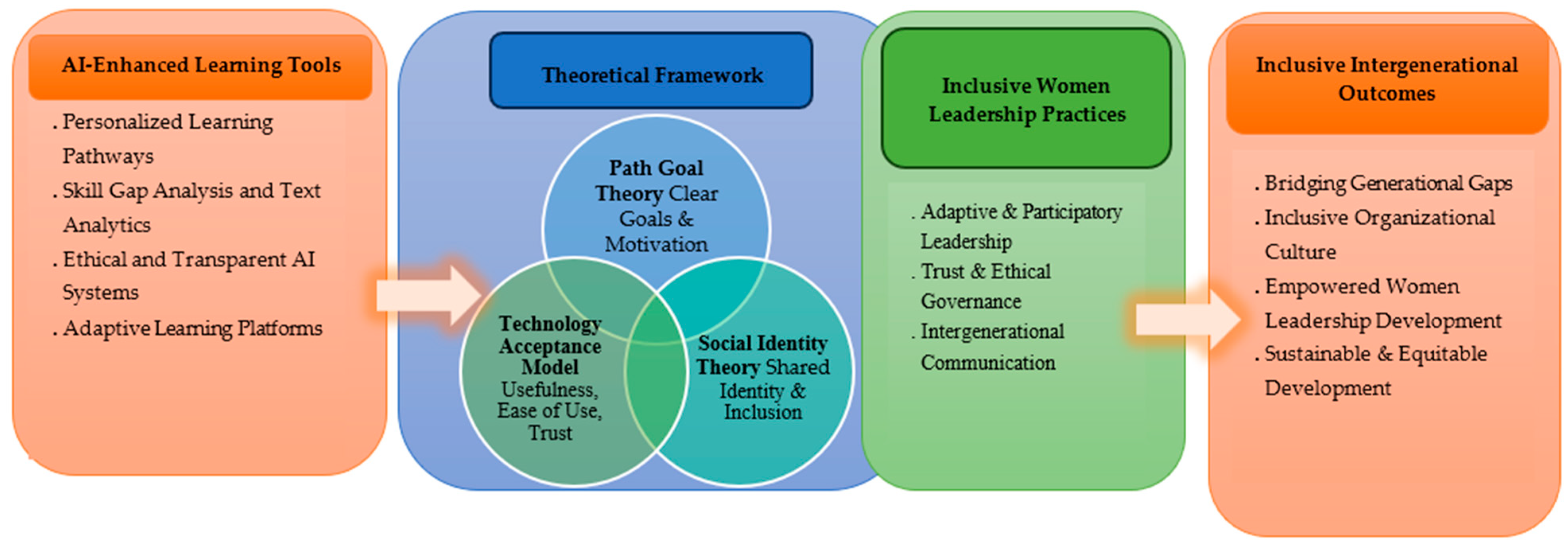

| Case Study | Primary Theory | Application in Case | Selection Rationale |
|---|---|---|---|
| Case Study 1 Mutuma et al. (2025) | Path-Goal Theory | AI text analytics identifies leadership skill gaps, helping clarify developmental pathways for women leaders. | Focuses on AI text analytics for women’s leadership skill gaps (AI literacy/emotional intelligence); directly exemplifies Path-Goal via developmental path clarification. |
| Case Study 2 Kaur (2024) | Social Identity Theory (SIT) | Addresses algorithmic bias and digital exclusion to reduce the marginalization of women as an out-group in AI systems. | Addresses AI risks (bias/exclusion), positioning women as out-groups; illustrates SIT through inclusive AI governance mitigating identity marginalization. |
| Case Study 3 Ramírez-Herrero et al. (2024) | Technology Acceptance Model (TAM) | AI acceptance varies across generations requiring adaptive leadership approaches rather than uniform automation. | Examines generational leadership differences and tech acceptance; demonstrates TAM via differing generational perceptions of usefulness/ease in AI deployment. |
Disclaimer/Publisher’s Note: The statements, opinions and data contained in all publications are solely those of the individual author(s) and contributor(s) and not of MDPI and/or the editor(s). MDPI and/or the editor(s) disclaim responsibility for any injury to people or property resulting from any ideas, methods, instructions or products referred to in the content. |
© 2026 by the authors. Licensee MDPI, Basel, Switzerland. This article is an open access article distributed under the terms and conditions of the Creative Commons Attribution (CC BY) license.
Share and Cite
Shouman, L.; Vidal-Suñé, A.; Alarcón Alarcón, A. Empowering Women Across Generations: AI-Enhanced Learning for Inclusive Leadership Development. Adm. Sci. 2026, 16, 93. https://doi.org/10.3390/admsci16020093
Shouman L, Vidal-Suñé A, Alarcón Alarcón A. Empowering Women Across Generations: AI-Enhanced Learning for Inclusive Leadership Development. Administrative Sciences. 2026; 16(2):93. https://doi.org/10.3390/admsci16020093
Chicago/Turabian StyleShouman, Lina, Antoni Vidal-Suñé, and Amado Alarcón Alarcón. 2026. "Empowering Women Across Generations: AI-Enhanced Learning for Inclusive Leadership Development" Administrative Sciences 16, no. 2: 93. https://doi.org/10.3390/admsci16020093
APA StyleShouman, L., Vidal-Suñé, A., & Alarcón Alarcón, A. (2026). Empowering Women Across Generations: AI-Enhanced Learning for Inclusive Leadership Development. Administrative Sciences, 16(2), 93. https://doi.org/10.3390/admsci16020093

