The Missing Link in Albania’s Innovation System: Evidence on Academia–Business Cooperation and Sustainable Innovation



Abstract
1. Introduction
2. Theoretical and Conceptual Framework
2.1. Theoretical Framework
2.2. Conceptual Model and Hypotheses
- i.
- Hypotheses on building academia–business collaboration (H1–H3)
- ii.
- Hypothesis on the impact of collaboration on innovation (H4)
- iii.
- Hypotheses on the measurement of sustainable innovation (H5–H6)
- iv.
- Hypothesis about the robustness of the model (Multi-Group SEM) (H7)
2.3. Research Context
3. Methodology
3.1. Survey Instrument Development and Measurement Model Specification
3.2. Data Collection and Sample Description
3.3. CB-SEM Estimation Procedure
3.4. Measurement Quality and Factorability Diagnostics
4. Results
4.1. Structural Equation Model Results
4.2. Item-Level Loadings and Key Contributors
4.3. Robustness Checks: Multi-Group SEM
5. Discussion
6. Conclusions
Author Contributions
Funding
Institutional Review Board Statement
Informed Consent Statement
Data Availability Statement
Conflicts of Interest
Abbreviations
| A2B | Academia–Business |
| ACAB | Actors of Cooperation Academia–Business |
| CMAB | Cooperation Model Academia–Business |
| CSIH | Challenges of Sustainable Innovation at Home |
| CSI | Characteristics of Sustainable Innovation |
| GDP | Gross Domestic Product |
| GII | Global Innovation Index |
| IP | Intellectual Property |
| INSTAT | Institute of Statistics (Albania) |
| KMO | Kaiser–Meyer–Olkin |
| NIFO | National Interoperability Framework Observatory |
| OECD | Organisation for Economic Co-operation and Development |
| R&D | Research and Development |
| SEM | Structural Equation Modeling |
| CB-SEM | Covariance-Based Structural Equation Modeling |
| SD | Standard Deviation |
| SMEs | Small and Medium-Sized Enterprises |
| TCAB | Type of Cooperation Academia–Business |
| WIPO | World Intellectual Property Organization |
| 1 | See https://useipm.com/ (accessed on 16 June 2025). |
References
- Adams, R., Jeanrenaud, S., Bessant, J., Denyer, D., & Overy, P. (2015). Sustainability-oriented innovation: A systematic review. International Journal of Management Reviews, 18(2), 180–205. [Google Scholar] [CrossRef]
- Albania Investment Council. (2021). Improvement of transparency and investment climate. Available online: https://www.investment.com.al/wp-content/uploads/2022/05/AIC_On-the-Improvement-of-the-Investment-Climate-2015-2021.pdf (accessed on 16 June 2025).
- Albats, E., Alexander, A. T., & Cunningham, J. A. (2022). Traditional, virtual, and digital intermediaries in university-industry collaboration: Exploring institutional logics and bounded rationality. Technological Forecasting and Social Change, 177, 121470. [Google Scholar] [CrossRef]
- Aldeanueva-Fernández, I., & Contreras, F. (2025). Drivers and outcomes of sustainable innovation in the business and management field: A systematic literature review. Schmalenbach Journal of Business Research, 77, 1–28. [Google Scholar] [CrossRef]
- Alexandre, F., Costa, H., Faria, A. P., & Portela, M. (2022). Enhancing university–industry collaboration: The role of intermediary organizations. The Journal of Technology Transfer, 47, 1584–1611. [Google Scholar] [CrossRef]
- Alpaydın, U. A. R., & Fitjar, R. D. (2024). How do university-industry collaborations benefit innovation? Direct and indirect outcomes of different collaboration types. Growth and Change, 55(2), e12721. [Google Scholar] [CrossRef]
- Ankrah, S., & Al-Tabbaa, O. (2015). Universities–industry collaboration: A systematic review. Scandinavian Journal of Management, 31(3), 387–408. [Google Scholar] [CrossRef]
- Aragón-Correa, J. A., & Sharma, S. (2003). A contingent resource-based view of proactive corporate environmental strategy. Academy of Management Review, 28(1), 71–88. [Google Scholar] [CrossRef]
- Arroyave, J. J., Sáez-Martínez, F. J., & González-Moreno, Á. (2020). Cooperation with universities in the development of eco-innovations and firms’ performance. Frontiers in Psychology, 11, 612465. [Google Scholar] [CrossRef] [PubMed]
- Belitski, M., Aginskaja, A., & Marozau, R. (2019). Commercializing university research in transition economies: Technology transfer offices or direct industrial funding? Research Policy, 48(3), 601–615. [Google Scholar] [CrossRef]
- Benedetti, M. H., & Torkomian, A. L. V. (2011). Uma análise da influência da cooperação universidade-empresa sobre a inovação tecnológica. Gestão & Produção, 18, 145–158. [Google Scholar] [CrossRef]
- Bentler, P. M., & Chou, C.-P. (1987). Practical issues in structural modeling. Sociological Methods & Research, 16(1), 78–117. [Google Scholar] [CrossRef]
- Biberaj, A., Sheme, E., Rakipi, A., Xhaferllari, S., Kushe, R., & Alinci, M. (2022). Cyber-attack against E-Albania and its social, economic and strategic effects. Journal of Corporate Governance, Insurance, and Risk Management, 9(2), 341–347. [Google Scholar] [CrossRef]
- Bishop, K., D’Este, P., & Neely, A. (2011). Gaining from interactions with universities: Multiple methods for nurturing absorptive capacity. Research Policy, 40(1), 30–40. [Google Scholar] [CrossRef]
- Bos-Brouwers, H. E. J. (2010). Corporate sustainability and innovation in SMEs: Evidence of themes and activities in practice. Business Strategy and the Environment, 19(7), 417–435. [Google Scholar] [CrossRef]
- Boschma, R. (2005). Proximity and innovation: A critical assessment. Regional Studies, 39(1), 61–74. [Google Scholar] [CrossRef]
- Brimble, P., & Doner, R. F. (2007). University–industry linkages and economic development: The case of Thailand. World Development, 35(6), 1021–1036. [Google Scholar] [CrossRef]
- Bruneel, J., D’Este, P., & Salter, A. (2010). Investigating the factors that diminish the barriers to university–industry collaboration. Research Policy, 39(7), 858–868. [Google Scholar] [CrossRef]
- Bu, F., Tian, X., Sun, L., Zhang, M., Xu, Y., & Guo, Q. (2025). Research on the impact of university–industry collaboration on green innovation of logistics enterprises in China. Sustainability, 17(11), 5068. [Google Scholar] [CrossRef]
- Byrne, B. M. (2016). Structural equation modeling with AMOS: Basic concepts, applications, and programming (3rd ed.). Routledge. [Google Scholar] [CrossRef]
- Cassiman, B., & Veugelers, R. (2006). In search of complementarity in innovation strategy: Internal R&D and external knowledge acquisition. Management Science, 52(1), 68–82. [Google Scholar] [CrossRef]
- Cohen, W. M., & Levinthal, D. A. (1990). Absorptive capacity: A new perspective on learning and innovation. Administrative Science Quarterly, 35(1), 128–152. [Google Scholar] [CrossRef]
- Council of Ministers. (2023). Decision no. 620, dated 1 November 2023: On the establishment, organization and functioning of the Innovation and Excellence Agency. Available online: https://qbz.gov.al/share/gvUQMIvzSYqTUdB1SE0-XQ (accessed on 16 June 2025).
- Cvetanović, S., Ilić, V., Despotovic, D., & Nedić, V. (2015). Knowledge economy readiness, innovativeness and competitiveness of the Western Balkan countries. Industrija, 43(3), 27–53. [Google Scholar] [CrossRef]
- Çabiri, K. M., & Qosja, E. (2022). A synthesis of the current situation of university-industry cooperation in Albania following the Triple Helix Model. Economicus, 22, 83–99. [Google Scholar] [CrossRef]
- Çabiri, K. M., & Qosja, E. (2023). Challenges of university–industry cooperation in Albania. International Journal of Management, Knowledge and Learning, 12(SI), 13–27. [Google Scholar]
- Ćudić, B., Alešnik, P., & Hazemali, D. (2022). Factors impacting university–industry collaboration in European countries. Journal of Innovation and Entrepreneurship, 11(1), 33. [Google Scholar] [CrossRef]
- de Almeida Couto, J. P., & Natário, M. M. S. (2023). Sustainable Innovation. In S. O. Idowu, R. Schmidpeter, N. Capaldi, L. Zu, M. Del Baldo, & R. Abreu (Eds.), Encyclopedia of Sustainable Management (pp. 3544–3549). Springer International Publishing. [Google Scholar] [CrossRef]
- Despotovic, D. Z., Cvetanović, S. Ž., & Nedić, V. M. (2014). Innovativeness and competitiveness of the Western Balkan countries and selected EU member states. Industrija, 42(1), 27–45. [Google Scholar] [CrossRef]
- D’Este, P., & Patel, P. (2007). University–industry linkages in the UK: What are the factors underlying the variety of interactions with industry? Research Policy, 36(9), 1295–1313. [Google Scholar] [CrossRef]
- Di Maria, E., De Marchi, V., & Spraul, K. (2019). Who benefits from university–industry collaboration for environmental sustainability? International Journal of Sustainability in Higher Education, 20(6), 1022–1041. [Google Scholar] [CrossRef]
- Etzkowitz, H., & Leydesdorff, L. (2000). The dynamics of innovation: From national systems and “Mode 2” to a Triple Helix of university–industry–government relations. Research Policy, 29(2), 109–123. [Google Scholar] [CrossRef]
- Evans, N., Miklosik, A., & Du, J. T. (2023). University-industry collaboration as a driver of digital transformation: Types, benefits and enablers. Heliyon, 9(10), e21017. [Google Scholar] [CrossRef]
- Fitjar, R. D., & Gjelsvik, M. (2018). Why do firms collaborate with local universities? Regional Studies, 52(11), 1525–1536. [Google Scholar] [CrossRef]
- Gattringer, R., Hutterer, P., & Strehl, F. (2014). Network-structured university-industry collaboration: Values for the stakeholders. European Journal of Innovation Management, 17(3), 272–291. [Google Scholar] [CrossRef]
- Hair, J. F., Black, W. C., Babin, B. J., Anderson, R. E., & Tatham, R. L. (2018). Multivariate data analysis (8th ed.). Cengage India. [Google Scholar]
- Hart, S. L., & Dowell, G. (2011). A natural-resource-based view of the firm: Fifteen years after. Journal of Management, 37(5), 1464–1479. [Google Scholar] [CrossRef]
- Hermundsdottir, F., & Aspelund, A. (2021). Sustainability innovations and firm competitiveness: A review. Journal of Cleaner Production, 280, 124715. [Google Scholar] [CrossRef]
- Hinkin, T. R. (1998). A brief tutorial on the development of measures for use in survey questionnaires. Organizational Research Methods, 1(1), 104–121. [Google Scholar] [CrossRef]
- Institute of Statistics (INSTAT). (2021). Innovation activities in enterprises. 2018–2020. Available online: https://www.instat.gov.al/media/8661/innovation_2018-2020_anglisht.pdf (accessed on 16 August 2025).
- Institute of Statistics (INSTAT). (2024a). Active legal units by economic activity and size. 2024. Available online: https://www.instat.gov.al/en/themes/industry-trade-and-services/business-registers (accessed on 20 June 2025).
- Institute of Statistics (INSTAT). (2024b). Innovation activities in enterprises. 2020–2022. Available online: https://www.instat.gov.al/media/13558/innovation_2020-2022.pdf (accessed on 16 August 2025).
- Jing, L. C. (2024). How does university-industry collaboration drives the green innovation? SAGE Open, 14(3), 21582440241274500. [Google Scholar] [CrossRef]
- Jirapong, K., Cagarman, K., & von Arnim, L. (2021). Road to sustainability: University–start-up collaboration. Sustainability, 13(11), 6131. [Google Scholar] [CrossRef]
- Jjagwe, R., Kirabira, J. B., Mukasa, N., & Amanya, L. (2024). The drivers and barriers influencing the commercialization of innovations at research and innovation institutions in Uganda: A systemic, infrastructural, and financial approach. Journal of Innovation and Entrepreneurship, 13(1), 78. [Google Scholar] [CrossRef]
- Kleiner-Schaefer, T., & Schaefer, K. J. (2022). Barriers to university–industry collaboration in an emerging market: Firm-level evidence from Turkey. The Journal of Technology Transfer, 47(3), 872–905. [Google Scholar] [CrossRef]
- Klewitz, J., & Hansen, E. G. (2014). Sustainability-oriented innovation of SMEs: A systematic review. Journal of Cleaner Production, 65, 57–75. [Google Scholar] [CrossRef]
- Kline, R. B. (2023). Principles and practice of structural equation modeling. Guilford Press. [Google Scholar]
- Kostoska, O., & Hristoski, I. (2017). IKT i inovacije za konkurentnost: Zapadni Balkan vis-à-vis Europske Unije. Zbornik Radova Ekonomskog Fakulteta u Rijeci: Časopis Za Ekonomsku Teoriju i Praksu, 35(2), 487–518. [Google Scholar] [CrossRef]
- Landoni, M., & Muradzada, N. (2024). No interaction, no problem? An investigation of organizational issues in the university–industry–government triad in a transition economy. Administrative Sciences, 14(10), 246. [Google Scholar] [CrossRef]
- Laursen, K., & Salter, A. (2006). Open for innovation: The role of openness in explaining innovation performance among U.K. manufacturing firms. Strategic Management Journal, 27(2), 131–150. [Google Scholar] [CrossRef]
- Lee, K. J. (2011). From interpersonal networks to inter-organizational alliances for university–industry collaborations in Japan: The case of the Tokyo Institute of Technology. R&D Management, 41(2), 190–201. [Google Scholar] [CrossRef]
- Lee, K. J., Ohta, T., & Kakehi, K. (2010). Formal boundary spanning by industry liaison offices and the changing pattern of university–industry cooperative research: The case of the University of Tokyo. Technology Analysis & Strategic Management, 22(2), 189–206. [Google Scholar] [CrossRef]
- Mansour, M., Shubita, M. F., Lutfi, A., Saleh, M. W., & Saad, M. (2024). Female CEOs and green innovation: Evidence from Asian firms. Sustainability, 16(21), 9404. [Google Scholar] [CrossRef]
- Ministry of Education and Sports. (2021). National education strategy 2021–2026. Available online: https://arsimi.gov.al/en/arsimi-i-larte/reforma-ne-arsimin-e-larte/strategjia-kombetare-per-arsimin-2021-2026/ (accessed on 20 September 2025).
- Morgan, D. L. (1997). Focus groups as qualitative research (Vol. 16). Sage. [Google Scholar]
- Muscio, A., & Vallanti, G. (2014). Perceived obstacles to university–industry collaboration: Results from a qualitative survey of Italian academic departments. Industry and Innovation, 21(5), 410–429. [Google Scholar] [CrossRef]
- National Business Center. (2024). Business demographics in Albania 2024. Available online: https://qkb.gov.al/wp-content/uploads/2025/04/Raport-Vjetor-per-Regjistrin-Tregtar-Regjistrin-e-Licencave-Autorizimeve-dhe-Lejeve-dhe-Regjistrin-e-Pronareve-Perfitues-2024.pdf (accessed on 16 June 2025).
- National Interoperability Framework Observatory (NIFO). (2024). Digital public administration factsheet: Albania. Interoperable Europe, European commission. Available online: https://interoperable-europe.ec.europa.eu/sites/default/files/inline-files/NIFO_2024%20DPAF_Albania_vFinal_rev.pdf (accessed on 20 September 2025).
- Nie, L., Gong, H., Zhao, D., Lai, X., & Chang, M. (2022). Heterogeneous knowledge spillover channels in universities and green technology innovation in local firms: Stimulating quantity or quality? Frontiers in Psychology, 13, 943655. [Google Scholar] [CrossRef]
- OECD. (2025). Economic convergence scoreboard for the Western Balkans 2025. OECD Publishing. [Google Scholar] [CrossRef]
- Orecchini, F., Valitutti, V., & Vitali, G. (2012). Industry and academia for a transition towards sustainability: Advancing sustainability science through university–business collaborations. Sustainability Science, 7(Suppl. 1), 57–73. [Google Scholar] [CrossRef]
- Perkmann, M., Tartari, V., McKelvey, M., Autio, E., Broström, A., D’Este, P., Fini, R., Geuna, A., Grimaldi, R., Hughes, A., Krabel, S., Kitson, M., Llerena, P., Lissoni, F., Salter, A., & Sobrero, M. (2013). Academic engagement and commercialisation: A review of the literature on university–industry relations. Research Policy, 42(2), 423–442. [Google Scholar] [CrossRef]
- Polzin, F., von Flotow, P., & Klerkx, L. (2016). Addressing barriers to eco-innovation: Exploring the finance mobilisation functions of institutional innovation intermediaries. Technological Forecasting and Social Change, 103, 34–46. [Google Scholar] [CrossRef]
- Qejvani, O., & Gjipali, D. (2024). Business and academia collaboration: Empowering internationalization in Albania. Interdisciplinary Journal of Research and Development, 11(1 S1), 39. [Google Scholar] [CrossRef]
- Rossoni, A. L., de Vasconcellos, E. P. G., & de Castilho Rossoni, R. L. (2024). Barriers and facilitators of university-industry collaboration for research, development and innovation: A systematic review. Management Review Quarterly, 74(3), 1841–1877. [Google Scholar] [CrossRef]
- Ryan, P., Geoghegan, W., & Hilliard, R. (2018). The microfoundations of firms’ explorative innovation capabilities within the triple helix framework. Technovation, 76, 15–27. [Google Scholar] [CrossRef]
- Samoilikova, A., Kuryłowicz, M., Lyeonov, S., & Vasa, L. (2023). University-industry collaboration in R&D to reduce the informal economy and strengthen sustainable development. Economics & Sociology, 16, 339–353. [Google Scholar] [CrossRef]
- Schofield, T. (2013). Critical success factors for knowledge transfer collaborations between university and industry. Journal of Research Administration, 2(44), 38–56. [Google Scholar]
- Sjöö, K., & Hellström, T. (2019). University–industry collaboration: A literature review and synthesis. Industry and Higher Education, 33(4), 275–285. [Google Scholar] [CrossRef]
- Teece, D. J. (2007). Explicating dynamic capabilities: The nature and micro foundations of (sustainable) enterprise performance. Strategic Management Journal, 28(13), 1319–1350. [Google Scholar] [CrossRef]
- Tibshirani, R. J., & Efron, B. (1993). An introduction to the bootstrap. Chapman & Hall. [Google Scholar]
- Vandenberg, R. J., & Lance, C. E. (2000). A review and synthesis of the measurement invariance literature: Suggestions, practices, and recommendations for organizational research. Organizational Research Methods, 3(1), 4–70. [Google Scholar] [CrossRef]
- Varblane, U., Mets, T., & Ukrainski, K. (2008). Role of university–industry–government linkages in the innovation processes of a small catching-up economy. Industry and Higher Education, 22(6), 373–386. [Google Scholar] [CrossRef]
- Wolf, E. J., Harrington, K. M., Clark, S. L., & Miller, M. W. (2013). Sample size requirements for structural equation models: An evaluation of power, bias, and solution propriety. Educational and Psychological Measurement, 76(6), 913–934. [Google Scholar] [CrossRef]
- World Intellectual Property Organization. (2025). Global innovation index 2025: Innovation at a crossroads—Unlocking the promise of social entrepreneurship. World Intellectual Property Organization. [Google Scholar] [CrossRef]
- Xia, S., Zhou, Y., Wang, Z., He, Q., & Parry, G. (2025). Enhancing green innovation through university–industry collaboration and artificial intelligence: Insights from regional innovation systems in China. The Journal of Technology Transfer. [Google Scholar] [CrossRef]
- Yang, Q., Wang, C., Ying, H., Jiang, H., & Fu, Z. (2025). Review on barriers and drivers of university–industry collaborative innovation: A stakeholder perspective. Sustainable Futures, 9, 100771. [Google Scholar] [CrossRef]
- Zahra, S. A., & George, G. (2002). Absorptive capacity: A review, reconceptualization, and extension. Academy of Management Review, 27(2), 185–203. [Google Scholar] [CrossRef]


| Country | Albania | Bosnia & Herzegovina | North Macedonia | Serbia |
|---|---|---|---|---|
| Overall Index | 67 | 88 | 65 | 57 |
| Institutions | 47 | 121 | 78 | 73 |
| Human capital and research | 99 | 77 | 71 | 49 |
| Infrastructure | 40 | 72 | 53 | 39 |
| Market sophistication | 47 | 80 | 69 | 77 |
| Business sophistication | 61 | 130 | 80 | 98 |
| Knowledge and technology outputs | 85 | 72 | 52 | 35 |
| Creative output | 77 | 99 | 78 | 87 |
| Country | Albania | Bosnia & Herzegovina | North Macedonia | Serbia |
|---|---|---|---|---|
| R&D expenditure as % of GDP | 0.19% | 0.20% | 0.38% | 0.90% |
| Variables | No. of Items | Items (Code) |
|---|---|---|
| Type of cooperation Academia—Business [TCAB] | 8 | Bilateral research projects (TCAB1); Knowledge transfer and joint training/education (TCAB2); Student internships (TCAB3); Provision of training/courses (TCAB4); Use of research labs (TCAB5); Technological solutions by universities (TCAB6); Innovative programs (TCAB7); Financial support by projects (TCAB8); |
| Actors of cooperation Academia—Business [ACAB] | 10 | Start-ups (ACAB1); Investors (ACAB2); Academia/Universities (ACAB3); Government (ACAB4); Accelerators (ACAB5); Research centers (ACAB6); Entrepreneurs (ACAB7); Leaders of industry (ACAB8); Innovative companies (ACAB9); Policymakers (ACAB10) |
| Drivers of cooperation model Academia—Business [CMAB] | 6 | Clear strategic orientation (CMAB1); Management of intellectual property (CMAB2); Transparency (CMAB3); Educational programs (CMAB4); Culture of innovation (CMAB5); Research incubators (CMAB6) |
| Characteristics of sustainable innovation [CSI] | 6 | Resource efficiency and use of renewable resources (CSI1); Minimal waste and circular economy (CSI2); Environmental responsibility and social impact (CSI3); Adaptability and flexibility (CSI4); Green technology and reduction in emissions (CSI5); Positive economic impact (CSI6) |
| Challenges of sustainable innovation at home [CSIH] | 6 | Lack of infrastructure (CSIH1); Lack of financing (CSIH2); Lack of public awareness (CSIH3); Regulatory barriers and complex regulations (CSIH4); Weak connections to global markets (CSIH5); Lack of entrepreneurship culture (CSIH6) |
| Variables | Options | Percentage |
|---|---|---|
| Gender | Female | 64.76% |
| Male | 35.24% | |
| Education | Tertiary Education–First cycle | 26.18% |
| Tertiary Education–Second cycle | 61.07% | |
| Tertiary Education–Third cycle | 5.37% | |
| Secondary Education | 7.38% | |
| Field of Study | Humanities and social sciences | 51.00% |
| Natural sciences | 16.79% | |
| Engineering/technical sciences | 32.21% | |
| Company size | Large | 36.92% |
| Medium | 31.20% | |
| Small | 31.88% | |
| Sectors | Agriculture, forestry and fishing | 1.74% |
| Industry | 5.92% | |
| Construction | 4.53% | |
| Distribution, transport, hotels and restaurants | 25.08% | |
| Information and communication | 13.96% | |
| Financial and insurance activities | 13.24% | |
| Real estate activities | 1.74% | |
| Professional, administration and support services | 26.83% | |
| Public administration, education and health | 4.87% | |
| Arts, entertainment and other services | 2.09% |
| Factors | Items | Cronbach’s α | Average | SD | Skewness | Kurtosis |
|---|---|---|---|---|---|---|
| TCAB | TCAB1–TCAB8 | 0.86 | 4.18 | 0.91 | −1.31 | 2.09 |
| ACAB | ACAB1–ACAB10 | 0.86 | 4.18 | 0.91 | −1.31 | 2.09 |
| CMAB | CMAB1–CMAB6 | 0.86 | 4.35 | 0.80 | −1.53 | 3.44 |
| CSI | CSI1–CSI6 | 0.86 | 4.30 | 0.84 | −1.54 | 3.19 |
| CSIH | CSIH1–CSIH6 | 0.78 | 4.35 | 0.78 | −1.33 | 2.53 |
| Factors | No. of Items | KMO | Bartlett Chi-Square | DF | Sig. |
|---|---|---|---|---|---|
| TCAB | 8 | 0.879 | 875.4 | 28 | <0.001 |
| ACAB | 10 | 0.871 | 1151.51 | 45 | <0.001 |
| CMAB | 6 | 0.858 | 714.15 | 15 | <0.001 |
| CSI | 6 | 0.825 | 752.28 | 15 | <0.001 |
| CSIH | 6 | 0.826 | 401.7 | 15 | <0.001 |
| Latent Variable | Indicator | Std. Loading | p-Value | Conclusion |
|---|---|---|---|---|
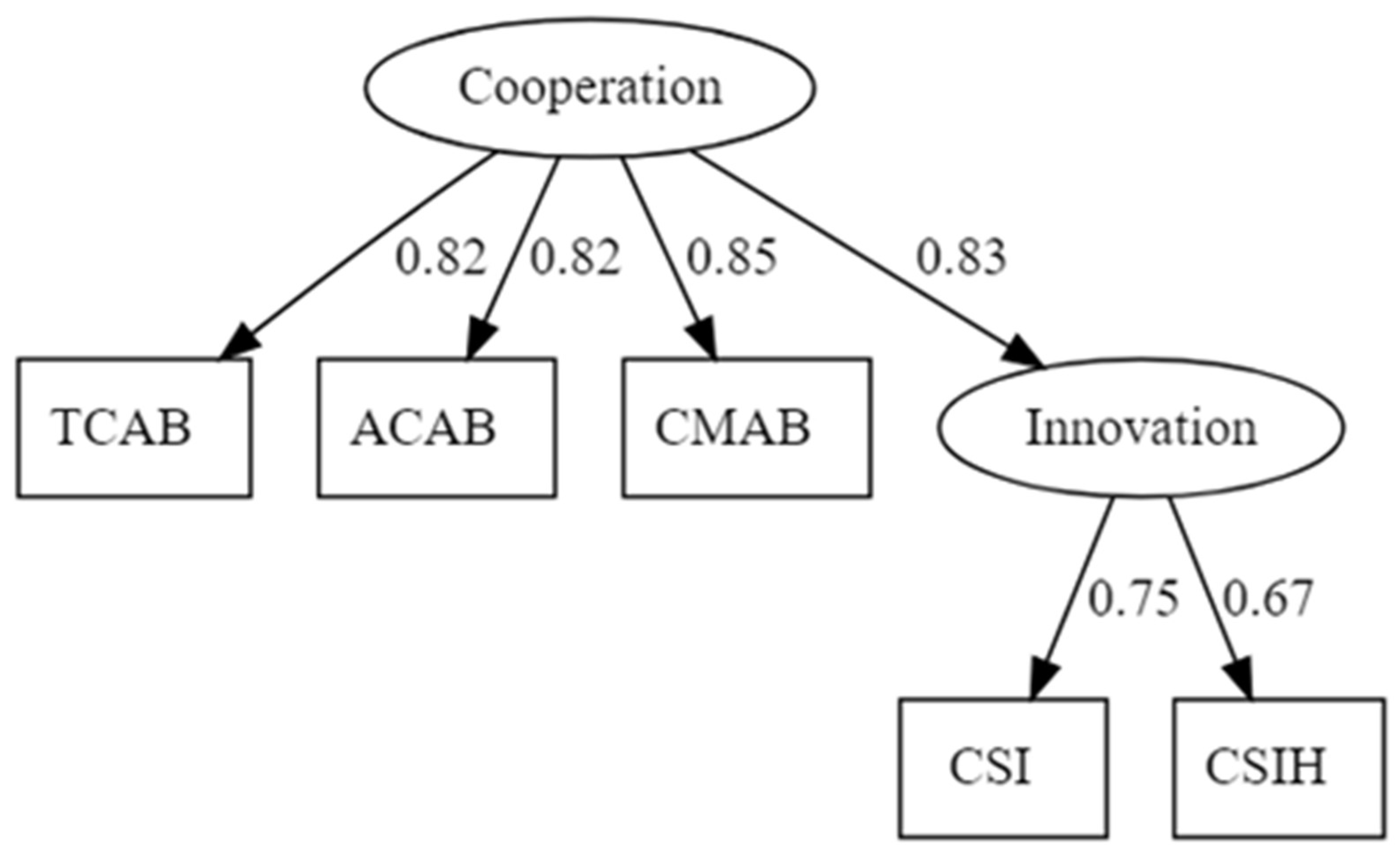
| Cooperation | TCAB | 0.824 | <0.001 | Very strong contribution |
| ACAB | 0.823 | <0.001 | Very strong contribution | |
| CMAB | 0.845 | <0.001 | Very strong contribution | |
| Innovation | CSI | 0.751 | <0.001 | Strong contribution |
| CSIH | 0.674 | <0.001 | Strong contribution | |
| Structural Path | Effect of Cooperation on Innovation | 0.829 | <0.001 | Very strong and significant relationship |
| Latent Variable | Var. Explained (R2) |
|---|---|
| Cooperation | ~70–75% by TCAB, ACAB, CMAB |
| Innovation | 69% by Cooperation |
| Estimate | Std.Err | z-Value | P(>|z|) | Std.lv | Std.all | |
|---|---|---|---|---|---|---|
| Innovation~Cooperation | 1.481 | 0.244 | 6.077 | 0.000 | 0.829 | 0.829 |
| Latent Variable | Interval of Factor Loadings | Most Influential Items | Impact on Cooperation/Innovation (SEM) |
|---|---|---|---|
| Types of cooperation Academia–Business (TCAB) | 0.62–0.77 | TCAB5–Use of research labs TCAB6–Technological solutions by universities TCAB1–Bilateral research projects TCAB7–Innovative programs | Strong contribution to Cooperation (λ = 0.824). Significant indirect effects on Innovation through Cooperation. |
| Actors of cooperation Academia–Business (ACAB) | 0.55–0.76 | ACAB7–Entrepreneurs ACAB2–Investors ACAB6–Research centers ACAB5–Accelerators | Strong contribution to Cooperation (λ = 0.823). Indirect effect on Innovation; the most relevant actors are entrepreneurs, investors and research centers. |
| Drivers and mechanisms of Academia–Business cooperation (CMAB) | 0.74–0.80 | CMAB5–Culture of innovation CMAB4–Educational programs CMAB1–Clear strategic orientation CMAB6–Research incubators | Strongest contributor to Cooperation (λ = 0.845). Largest indirect effect on Innovation. |
| Characteristics of sustainable innovation (CSI) | 0.71–0.84 | CSI3–Environmental responsibility and social impact CSI4–Adaptability and flexibility CSI2–Minimal waste and circular economy CSI5–Green technology and reduction in emissions | Strongest contribution to Innovation (λ = 0.751). Main determinant of the Innovation dimension. |
| Challenges of sustainable innovation at home (CSIH) | 0.64–0.73 | CSIH3–Lack of public awareness CSIH4–Regulatory barriers and complex regulations CSIH5–Weak connections to global markets CSIH1–Lack of infrastructure | Medium–strong contribution to Innovation (λ = 0.674). Indicates the intensity of obstacles that reduce innovative capacity. |
| Variables | Group | No. | Beta (Cooperation–Innovation) | 95% CI | R2 |
|---|---|---|---|---|---|
| Company size | Large | 110 | 0.583 | [0.444, 0.730] | 0.372 |
| Medium | 93 | 0.851 | [0.647, 1.039] | 0.497 | |
| Small | 95 | 0.481 | [0.349, 0.717] | 0.362 | |
| Gender | Female | 193 | 0.669 | [0.560, 0.783] | 0.422 |
| Male | 105 | 0.579 | [0.389, 0.823] | 0.402 | |
| Education | Tertiary Education–First cycle | 78 | 0.530 | [0.350, 0.690] | 0.280 |
| Tertiary Education–Second cycle | 182 | 0.720 | [0.620, 0.780] | 0.510 | |
| Tertiary Education–Third cycle | 16 | 0.230 | [−0.350, 0.650] | 0.050 | |
| Secondary Education | 22 | 0.700 | [0.520, 0.870] | 0.490 | |
| Field of Study | Humanities and social sciences | 152 | 0.660 | [0.560, 0.750] | 0.440 |
| Natural sciences | 50 | 0.790 | [0.600, 0.900] | 0.620 | |
| Engineering/technical sciences | 96 | 0.580 | [0.430, 0.720] | 0.340 |
Disclaimer/Publisher’s Note: The statements, opinions and data contained in all publications are solely those of the individual author(s) and contributor(s) and not of MDPI and/or the editor(s). MDPI and/or the editor(s) disclaim responsibility for any injury to people or property resulting from any ideas, methods, instructions or products referred to in the content. |
© 2026 by the authors. Licensee MDPI, Basel, Switzerland. This article is an open access article distributed under the terms and conditions of the Creative Commons Attribution (CC BY) license.
Share and Cite
Grabova, P.; Tushaj, A.; Kule, D.; Leka, B.; Petković, S. The Missing Link in Albania’s Innovation System: Evidence on Academia–Business Cooperation and Sustainable Innovation. Adm. Sci. 2026, 16, 68. https://doi.org/10.3390/admsci16020068
Grabova P, Tushaj A, Kule D, Leka B, Petković S. The Missing Link in Albania’s Innovation System: Evidence on Academia–Business Cooperation and Sustainable Innovation. Administrative Sciences. 2026; 16(2):68. https://doi.org/10.3390/admsci16020068
Chicago/Turabian StyleGrabova, Perseta, Arjan Tushaj, Ditjona Kule, Brikena Leka, and Saša Petković. 2026. "The Missing Link in Albania’s Innovation System: Evidence on Academia–Business Cooperation and Sustainable Innovation" Administrative Sciences 16, no. 2: 68. https://doi.org/10.3390/admsci16020068
APA StyleGrabova, P., Tushaj, A., Kule, D., Leka, B., & Petković, S. (2026). The Missing Link in Albania’s Innovation System: Evidence on Academia–Business Cooperation and Sustainable Innovation. Administrative Sciences, 16(2), 68. https://doi.org/10.3390/admsci16020068