Article

Empowering Green Transformation: The Strategic Nexus of Innovation, Regulation, and Sustainability in Chinese SMEs


1
School of Management, Jiangsu University, Zhenjiang 212013, China
2
Department of Administrative Science, Boston University Metropolitan College, Boston, MA 02215, USA
*
Author to whom correspondence should be addressed.
Adm. Sci. 2026, 16(2), 67; https://doi.org/10.3390/admsci16020067
Submission received: 17 December 2025 / Revised: 15 January 2026 / Accepted: 20 January 2026 / Published: 29 January 2026
(This article belongs to the Special Issue Comprehensive Studies on the Development of International Business)

Abstract

Growing pressure for sustainability has intensified the need for small- and medium-sized enterprises (SMEs) to adopt environmental innovation while maintaining competitive performance. This study examines how green innovation strategy, environmental regulations, and green absorptive capacity jointly shape the sustainable performance of Chinese manufacturing SMEs. Drawing on Resource-Based View, Institutional Theory, and Dynamic Capability Theory, we develop and empirically test a model that positions green innovation as a mediating mechanism linking strategic intent and regulatory forces to environmental, social, and economic performance outcomes. Data were collected through a structured survey of 250 SME managers in Jiangsu Province and analyzed using PLS-SEM. Results show that green innovation strategy significantly enhances both green innovation and sustainability performance, and that green innovation partially mediates the effects of both strategy and regulatory pressure on performance. While environmental regulations positively influence green innovation, they do not directly improve sustainability outcomes unless translated into innovation. Furthermore, green absorptive capacity displays a boundary-conditioning role, unexpectedly weakening the strategy–innovation path when knowledge integration exceeds implementation capacity. The findings extend the sustainability-oriented innovation literature by clarifying the indirect nature of regulation–performance linkages and revealing conditions under which absorptive capability accelerates or impedes green transformation. The study offers practical guidance for policymakers seeking to design innovation-enabling regulatory frameworks and for SMEs aiming to balance capability development with strategic focus to advance sustainability transitions.

1. Introduction

Growing pressure on firms to adopt environmentally responsible practices while maintaining financial performance has intensified globally, presenting a major strategic challenge for organizations (Baah et al., 2021; Nazir et al., 2024). Green innovation refers to the development and application of processes, products, and technologies that reduce environmental harm by replacing inefficient practices and operational systems (Khan et al., 2021a; Le et al., 2024). When effectively implemented, such innovations not only mitigate ecological impacts but also act as key drivers of environmental, social, and economic performance, thereby supporting broader sustainable development goals (Sarfraz et al., 2023; Shan & Ji, 2024). Green innovation is typically classified into three domains—process, product, and design—where environmental objectives are embedded into production mechanisms, operational efficiency, and new product development (Oduro et al., 2022; Awwad et al., 2025). Firms that expand sustainable product and service offerings empower consumers to make environmentally responsible choices, contributing directly to global sustainability transitions. Accordingly, recent efforts have focused on enhancing organizational performance through strategies that align commercial outcomes with societal and ecological well-being, promoting better stewardship and utilization of natural resources (Koval et al., 2021; Regmi et al., 2023).
Scholars have proposed three underlying factors that facilitate sustainable practices in both research and decision-making, environmental, social, and economic factors, often referred to as the triple bottom line (TBL) of sustainability (S. Singh & Srivastava, 2022; Kuo et al., 2023; Nogueira et al., 2025). From this perspective, organizations must strike a harmonious balance among environmental, social, and economic considerations to advance sustainable development (Hariram et al., 2023; Priya, 2024; Nogueira et al., 2025). Managing environmental issues is a significant challenge for organizations across communities, as unsustainable organizational practices contribute to the degradation of natural resources (Garg, 2023; Aiguobarueghian et al., 2024). Therefore, organizations should dedicate themselves to implementing a positive strategy to protect the environment from the impacts of their actions, including excessive use of natural resources and waste generation (Koval et al., 2021; Camilleri, 2022; Aiguobarueghian et al., 2024).
Small- and medium-sized enterprises (SMEs) represent a cornerstone of China’s economic development, contributing significantly to gross domestic product (GDP) and national tax revenue (R. Wang & Kesan, 2022; S. Yang, 2023). By 2025, Chinese SMEs were estimated to generate approximately 60% of GDP and to account for about 50% of total tax contributions (Schulze Brock et al., 2025; UNDP, 2024). As of 2024, China had registered around 61.2 million business entities, most of which were small-, micro-, or medium-sized, highlighting the extensive scope of SMEs across the industrial and service sectors (Lihong, 2024; The State Council PRC, 2025). In recent years, these enterprises have played an increasingly prominent role in advancing China’s environmental agenda by integrating green innovation into their operational frameworks (Xiang et al., 2022; Hui et al., 2024). These efforts reflect a broader national strategy to harmonize economic growth with ecological sustainability, facilitated through the digital economy and targeted technological advancement. As part of this agenda, the Chinese government has introduced regulatory mechanisms, including fiscal incentives, tax relief, and grant programs, to foster green innovation among SMEs and improve their environmental performance (Ozturk et al., 2024; Jiang et al., 2025). These policies not only align with China’s vision of economic prosperity and ecological modernization but also provide institutional scaffolding for firms to adopt sustainable technologies and practices. Empirical evidence suggests a notable increase in the uptake of green technology and sustainable business practices among SMEs following these initiatives (S. Huang & Ge, 2025; Hui et al., 2024), reinforcing the interdependence between regulatory support and environmentally oriented innovation in emerging economies.
Chinese manufacturing firms and SMEs are increasingly adopting pollution-control measures and energy-efficient technologies to mitigate their environmental footprint. The transition toward sustainability not only protects the environment but also enhances competitive positioning by stimulating market demand for environmentally friendly products and services (L. Liu et al., 2022; L. Yang et al., 2023). Growing interest in green innovation, particularly within the manufacturing sector, where environmental pressures are pronounced, has accelerated the development of eco-efficient processes and technologies. Chinese industrial enterprises have responded by implementing a range of environmental initiatives aimed at reducing emissions and resource consumption (A. Zhang et al., 2022; Sheng et al., 2023). Despite these advancements, greater conceptual and empirical clarity is needed to understand how strategic green innovation systems are operationalized, how absorptive capacity supports this process, and the extent to which green innovation functions as a mediating mechanism in sustainability outcomes. Such insights are critical for informing policy design in China and internationally, enabling decision-makers to broaden support for effective sustainability transitions.
This study is grounded in the Resource-Based View (RBV), which argues that firms achieve a competitive advantage through unique environmental capabilities, such as green innovation, that are valuable, rare, and difficult to replicate (Khanra et al., 2022; El Nemar et al., 2025). Institutional Theory reinforces this perspective by emphasizing that regulatory pressure encourages firms to adopt sustainability practices to maintain legitimacy and competitive standing (Ebrahimi & Koh, 2021; Bhuiyan et al., 2023). By integrating these strategic, institutional, and capability-based lenses, the study explains how innovation transforms regulatory and strategic intentions into environmental, social, and economic value.
The overarching aim of this study is to examine how green innovation strategy and environmental regulation influence sustainable business performance in Chinese manufacturing SMEs, with particular attention to the mediating role of green innovation and the moderating role of green absorptive capacity. To operationalize this central aim, the study pursues four specific objectives:
  • Examine the relationship between environmental regulation and sustainable business performance.
  • Determine whether green innovation mediates the effect of environmental regulation on sustainability outcomes.
  • Assess the role of green absorptive capacity in enhancing the effectiveness of green innovation strategies; and
  • Identify the key drivers—particularly regulatory pressure and innovation strategy—underpinning the adoption of green alternatives within Chinese manufacturing enterprises.
Despite increasing scholarly attention to green innovation, existing research often examines environmental regulation, innovation strategy, and absorptive capacity in isolation (Alkaraan et al., 2024). This fragmented approach limits understanding of how these drivers interact to shape sustainability performance, particularly among SMEs in emerging economies where resource constraints and technological readiness vary widely. By applying an integrated theoretical model to the Chinese manufacturing context, this study clarifies how regulatory pressures and green innovation strategies jointly influence sustainability outcomes, while also revealing that high absorptive capacity may, in some cases, weaken innovation effectiveness. This suggests that under constrained conditions, excessive knowledge acquisition may hinder rather than enhance sustainable performance—offering a novel insight into the boundary conditions of capability-driven innovation.
This study contributes to the sustainability-oriented innovation literature by integrating strategic, institutional, and capability-based perspectives into a single empirical framework. Beyond examining direct effects, the model reveals how green innovation operates as a transmission mechanism between strategic intent, regulatory pressure, and sustainable business performance. Most notably, the study identifies a counterintuitive boundary condition whereby high levels of green absorptive capacity weaken, rather than strengthen, the translation of green innovation strategy into innovation outcomes, offering novel insight into capability misalignment in resource-constrained SMEs. The analysis employs partial least squares structural equation modeling (PLS-SEM), which is well-suited for examining complex models involving mediation and moderation effects (Cheung et al., 2024).
To empirically test the proposed framework, this study draws on survey data collected from 250 manufacturing SME managers in Jiangsu Province, China, one of the country’s most economically advanced and industrialized regions. Jiangsu represents a critical empirical setting for examining sustainability-oriented innovation because it combines strong environmental regulatory enforcement, high manufacturing intensity, and active government promotion of green transformation among SMEs. As a leading province in China’s low-carbon and green manufacturing initiatives, Jiangsu provides a theoretically relevant context in which the interaction between strategic innovation, regulatory pressure, and absorptive capacity can be meaningfully observed. While the empirical analysis is conducted at the provincial level, the study aims to generate analytically generalizable insights into the mechanisms through which green innovation strategies and institutional pressures shape sustainable performance in emerging-economy SMEs, rather than statistically generalizable national estimates.
The remainder of the article is organized as follows. Section 2 reviews the relevant literature and develops the hypotheses. Section 3 describes the research methodology. Section 4 presents the data analysis and results. Section 5 discusses the findings and outlines theoretical and practical implications, followed by conclusions and limitations.

2. Literature Review

Theoretical and empirical insights on the interaction among green innovation strategy, environmental regulation, and green absorptive capacity are synthesized to explain how these mechanisms jointly shape sustainable business performance in SMEs, particularly within emerging-economy contexts such as China. In this study, green innovation strategy refers to firm-level strategic intent and orientation; green innovation captures the implementation of eco-efficient products and processes; and sustainable business performance represents multidimensional outcomes encompassing environmental, social, and economic dimensions.
Anchored in resource-based and institutional perspectives, the review highlights how innovation capabilities and regulatory forces drive sustainability outcomes. On this basis, the study advances a set of theory-driven hypotheses that are empirically tested using a confirmatory PLS-SEM approach (Aboelmaged, 2018).

2.1. Green Innovation Strategy and Sustainable Business Performance

From an institutional perspective, environmental regulations impose legitimacy-driven pressures on firms, while resource-based theory suggests that firms capable of aligning internal resources with these external constraints can convert regulatory compliance into superior environmental, social, and economic performance (C. Zhang et al., 2023; Duan et al., 2025).
An eco-friendly innovation strategy integrates ecological considerations into business practices and innovation guidelines (Aprile, 2025; Ejibe et al., 2024; Khandare & Bansod, 2024). As part of this initiative, eco-friendly products, processes, and practices can be disseminated and implemented to reduce the environmental impact and promote economic and social development. As environmental sustainability has gained popularity, businesses have increasingly turned to green innovations to achieve their environmental objectives (Le, 2022; Hao et al., 2023; Le et al., 2024). Business and manufacturing processes can be integrated with environmental sustainability through green innovation concepts (Ullah et al., 2022). In addition to reducing environmental damage, increasing resource efficiency, and enhancing public welfare, these activities can produce new goods, services, and tactics. In multiple studies, green innovation has been emphasized as an essential factor in gaining a competitive edge and implementing sustainable business practices (Barforoush et al., 2021; Tu & Wu, 2021; Suki et al., 2023; Bataineh et al., 2024).
Business development that enhances social, environmental, and economic well-being is multidimensional. Aspects such as community involvement, employee well-being, and customer satisfaction demonstrate a company’s ability to positively impact society. Sustainable practices help mitigate adverse environmental effects by reducing waste, preventing pollution, and enhancing energy efficiency (Andersson et al., 2022; Hariram et al., 2023). From an economic viewpoint, profitability refers to a company’s financial success, often measured by profit margins, market share, and shareholder value.
By implementing green innovation strategies, companies can adopt socially responsible models that enhance their reputations and foster relationships with stakeholders, including customers, employees, and communities, while focusing on reducing environmental impact through sustainable practices (Le, 2022; Le et al., 2024). The increased environmental performance can be attributed to reduced resource consumption, waste generation, and pollution generation (Y. Zhang & Wu, 2022; Rahmani et al., 2024). Long-term benefits include improved resource efficiency, enhanced brand reputation, and compliance with environmental guidelines, despite the initial investment being high (Wolniak et al., 2023; Malik, 2024). It is hypothesized that sustainable performance is correlated with a green innovation strategy (Baeshen et al., 2021; Le, 2022). By examining social, environmental, and economic factors, this study aims to deepen understanding of how green innovations can enhance sustainable business practices. From the RBV perspective, a strong green innovation strategy equips firms with unique sustainability-oriented resources that enable environmentally efficient innovation activities (Alshammari & Alshammari, 2023; Zameer et al., 2024). By integrating institutional pressures, firms strategically respond to environmental expectations through innovation (D. Zhu et al., 2024; Zhong & Um, 2025). While most studies find a positive link between green innovation strategy and green innovation outcomes, some report inconsistent empirical effects when firms lack managerial competencies or resource readiness (L. Liu et al., 2022; Asiaei et al., 2023; Ullah et al., 2024a, 2024b). This outcome-oriented conceptualization ensures alignment between the theoretical framework, empirical measurement, and the causal ordering of constructs in the proposed model. Hence, the proposition leads to the following hypothesis:
H1. 
The implementation of the Green Innovation Strategy is positively associated with sustainable business performance, comprising social, environmental, and financial outcomes.

2.2. Environmental Regulations and Sustainable Business Performance

Institutional theory posits that regulatory pressure compels firms to adapt their practices to maintain legitimacy, while dynamic capability theory explains how firms respond to such pressure by reconfiguring innovation processes to develop green products and technologies (Bae et al., 2022; Okeke, 2025). It suggests that external regulatory forces compel firms to implement sustainable innovation to maintain legitimacy and market access (Adomako & Nguyen, 2023; Bhuiyan et al., 2023). However, empirical findings are mixed: some studies confirm that stricter regulations increase both innovation and performance, whereas others find that compliance costs may weaken firm competitiveness in the short term (Y. Zhu & Zhao, 2022; Fabrizi et al., 2024). Environmental regulations require pollution control and conservation measures, which encourage businesses to adopt greener practices. Zhong and Um (2025) argue that stringent environmental regulations may drive innovation that offsets compliance costs by enhancing efficiency, improving resource use, and reducing waste. Scholars have argued that environmental regulations can enhance environmental performance by promoting the adoption of cleaner technologies, thereby reducing pollution byproducts (M. Wang et al., 2023). By improving public health through environmental regulations, companies are better equipped to foster positive relationships with the community, thereby enhancing their social performance (Fosu et al., 2024; Strazzullo et al., 2025). Environmentally friendly businesses tend to have a more positive reputation among stakeholders, including customers, employees, and local communities (Yan et al., 2022; Khalil et al., 2024). In addition to improving workplace conditions, compliance can enhance employee well-being and satisfaction by mitigating harmful factors (Piao et al., 2022; Madero-Gómez et al., 2023).
Although compliance with environmental regulations can impose high upfront costs, evidence shows that these investments yield long-term benefits through improved resource efficiency and operational performance (Ma et al., 2023; Hong et al., 2025). Firms that successfully reduce emissions often experience enhanced public perception, which translates into stronger economic performance (Ahmad et al., 2021; Gao & Wan, 2023). The development of environmentally friendly products and services further expands market opportunities as consumer preference shifts toward sustainability-oriented offerings (Thakkar, 2021; Ikram, 2022; Vasilescu et al., 2023). When environmental regulations are strictly implemented and strategically supported, businesses can leverage these pressures to strengthen stakeholder relationships, improve environmental outcomes, and enhance long-term competitiveness and profitability (Tu & Wu, 2021). Accordingly, the following hypothesis is proposed:
H2. 
Environmental Regulations have a positive effect on sustainable business performance.

2.3. Green Innovation Strategy and Green Innovation

Grounded in the Resource-Based View (RBV), a green innovation strategy represents a firm’s deliberate allocation of valuable and inimitable resources toward environmental objectives, which enables the development of green innovation as an operational outcome (Sun, 2025).
Environmental management and long-term economic performance have become increasingly dependent upon eco-friendly products and methods (Cui & Wang, 2022; L. Huang et al., 2024). An organization’s efforts to integrate environmental considerations into its innovation process are referred to as its green innovation strategy (GIS), which examines its relationship with green innovation performance (GIP), employing academic criteria to provide a comprehensive understanding of these connections (Hayat & Qingyu, 2024; Riaz et al., 2024). A green innovation strategy involves developing goods, processes, or behaviors that reduce an organization’s environmental impact. Besides commercial and regulatory requirements, sustainability is always a consideration when developing these strategies (Sheehy & Farneti, 2021; Ahmed et al., 2023). Several studies have cited the economic and environmental benefits of these green technologies, including enhanced market competition, cost savings, energy savings, and reduced emissions (Ekins & Zenghelis, 2021; Khurshid et al., 2023; Celestin et al., 2024). The theoretical foundation for comprehending the effect of GIS on GIP is provided by a resource-based view (RBV) and dynamic capacity theory (Idrees et al., 2025). The RBV theory argues that environmental sustainability may be a competitive advantage due to its unique qualities and skills (Nayak et al., 2023; El Nemar et al., 2025). A business’s ability to adjust to rapidly changing environmental conditions relies on its ability to combine, develop, and realign internal and external skills (Moşteanu, 2024; Sidik et al., 2024). Additionally, with GIS, businesses can respond dynamically to environmental challenges and opportunities (Ali et al., 2024; Maurya & Kumar, 2024).
Empirical evidence consistently demonstrates a positive relationship between GIS and GIP (M. Wang et al., 2022). Firms that adopt proactive environmental practices tend to achieve higher innovation performance, supported by improved operational efficiency and reduced resource consumption (Mubarak et al., 2021; Asiaei et al., 2023). When GIS is effectively resourced, economic outcomes strengthen through cost reductions, favorable market positioning, and enhanced environmental results (C. H. Wang & Juo, 2021; Aftab et al., 2023). Strategically driven green innovation, therefore, yields both ecological and financial advantages (Barforoush et al., 2021; Le, 2022). Moreover, firms are increasingly recognized for integrating environmental commitment with innovative capability, thereby reinforcing the GIS–GIP link, which may itself be shaped by multiple contextual and organizational factors (Idrees et al., 2025).
Employee engagement is influenced by several factors, including a company’s culture, its support from upper management, and employee involvement (Abduraimi et al., 2023; Oladimeji et al., 2023). Sustainability-driven corporate cultures are crucial for implementing green innovation concepts (Le et al., 2024; Ivanov, 2025). Technical advancements, market conditions, and regulatory frameworks facilitate this process. Businesses may be more likely to utilize GIS to comply with environmental regulations as they strive to enhance productivity (Esfahbodi et al., 2023; Bataineh et al., 2024). Market conditions, including consumer demand for green products, also influence new green product strategies (Q. Zhang et al., 2020; Khan et al., 2021a, 2021b; Borah et al., 2023).
A considerable body of literature supports the positive impact of green innovation strategies on green innovation performance. Companies can maximize their environmental and economic benefits by incorporating environmental considerations into their innovation (Trevlopoulos et al., 2021; Ávila, 2022; Hermundsdottir & Aspelund, 2022; Le, 2022; Souto, 2022). A sound regulatory framework, strong institutional support, and a favorable market environment are all essential for successfully implementing these strategies (Adanma & Ogunbiyi, 2024). Research should continue to explore the complexities of this relationship so businesses can learn how to grow sustainably. From a resource-based and dynamic-capability perspective, a clearly articulated green innovation strategy provides direction and prioritization for innovation-related investments, thereby increasing the likelihood that environmental intentions are translated into realized green innovation outcomes. Hence, the proposition leads to this study’s third hypothesis:
H3. 
Green innovation strategy positively influences green innovation.

2.4. Environmental Regulations and Green Innovation

According to the Natural Resource-Based View (NRBV), green innovation constitutes an environmentally oriented capability that allows firms to simultaneously improve ecological outcomes and achieve sustained competitive advantage, thereby enhancing overall business performance (Makhloufi et al., 2022). In this study, green innovation strategy represents the focal strategic resource that reflects firms’ deliberate orientation toward integrating environmental objectives into innovation-related decision-making. Green absorptive capacity is conceptualized as a complementary dynamic capability that conditions the effectiveness with which this strategic resource is translated into realized green innovation outcomes (Lajmi & Shiri, 2025).
Regulation of the environment is often viewed as a double-edged tool for businesses and the economy. Aside from restricting and costing, firms foster innovation, especially in green technologies (Fatima et al., 2025). Various studies and theoretical frameworks contribute to the literature on the notion that environmental regulations benefit green innovation performance (Y. C. Huang & Huang, 2024). Porter and van der Linde’s (1995) concept of environmental sustainability, recently reinforced by W. Xie (2025), posits that stringent environmental regulations can facilitate innovation that offsets compliance costs by enhancing productivity, ultimately yielding a competitive advantage. Such an argument largely explains the relationship between green innovation and environmental regulation. Studies indicate that rules governing the environment are driven by green innovation (Y. Liu et al., 2021; M. Zhou et al., 2021; Farooq et al., 2024). Studies have found a correlation between stricter environmental regulations and research and development (R&D) spending on environmentally friendly technologies (Shahzadi et al., 2022; Dahmani, 2024). Other studies argue that firms subject to more stringent environmental regulations are more likely to invest in green innovations, thereby improving their environmental and economic performance (Guo et al., 2023; Nie et al., 2024).
Dynamic Capability Theory highlights that innovation capabilities enable firms to convert environmental knowledge into superior economic and environmental outcomes. However, the extent of sustainability gains may vary depending on market conditions and technology readiness (Aliasghar et al., 2023; Ullah et al., 2025). Depending on the industry, environmental regulations can significantly influence green innovation, as seen in the cases of renewable energy technologies, feed-in tariffs, and renewable portfolio standards, which have substantially boosted innovation (Chen et al., 2022; Shen et al., 2022; Guo et al., 2023). Similarly, environmental regulations have also been credited with positively influencing green innovation at both national and international levels; countries with stricter environmental policies tend to exhibit higher levels of green patenting activity (Borsatto & Bazani, 2021; Y. Liu et al., 2021; H. Wang et al., 2022; P. Xie et al., 2023). Therefore, a stronger regulatory framework may create a favorable environment for green innovation overall. Although there is strong support for environmental regulations that foster green innovation (Pan et al., 2023; Dong et al., 2024), the effects can be mixed or context-dependent. There is a need to best understand how environmental regulations influence green innovation, considering factors such as the size and nature of projects, as well as the specificity of regulations.
Regulatory pressure can stimulate innovation in several ways. Environmental regulations have increasingly been recognized as crucial drivers of green innovation within firms. Scholars emphasize the need for companies to internalize the environmental costs associated with their operations, highlighting that such internalization can influence firm behavior and innovation strategies (Kou et al., 2025; Ofosu et al., 2025). Furthermore, the emergence and expansion of green markets are often a direct consequence of regulatory frameworks, which stimulate innovation by generating demand for environmentally friendly products and services (Mahmood et al., 2022; Zhong & Um, 2025). Regulations also compel firms to reallocate resources toward compliance and innovation, enabling the discovery of more efficient and sustainable practices (Ning & Shen, 2024; Stojčić et al., 2025). Although theoretical and empirical findings vary, there is substantial evidence supporting the notion that well-designed environmental regulations positively influence green innovation performance (Mulaessa & Lin, 2021; C. Zhang et al., 2023; Nie et al., 2024). Effective environmental policies not only encourage firms to develop environmentally supportive innovations but also enhance their competitive positioning by aligning sustainability with business strategy. Therefore, the following hypothesis is proposed:
H4. 
Environmental regulations positively influence green innovation.

2.5. Green Innovation and Sustainable Business Performance

From a resource-based perspective, strategic commitment to green innovation reflects a firm’s intention to mobilize resources toward sustainability goals, which can directly influence performance by shaping long-term investment priorities and stakeholder perceptions (Khanra et al., 2022).
Increasingly, companies are emphasizing green innovation to address environmental challenges while maintaining competitiveness. Green innovation is a new product, process, or practice designed to reduce the environmental impact of a product or activity. Green innovation is supported by an expanding body of research demonstrating its positive impact on business sustainability from social, environmental, and economic perspectives (Le, 2022; Lopes et al., 2022; Le et al., 2024).
Green innovation has been widely shown to enhance environmental performance and reduce ecological harm (Ha et al., 2024; J. Xie et al., 2024). The adoption of green technologies and processes lowers waste generation, energy consumption, and greenhouse gas emissions (Habiba et al., 2022). The substitution of conventional inputs with cleaner or renewable resources further reduces carbon footprints across industries (Mahapatra et al., 2021; Onukwulu et al., 2023). Beyond emissions reduction, green products and processes tend to be more resource-efficient and less energy-intensive, supported by practices such as recycling systems and renewable energy integration. Firms that implement these innovations not only comply more readily with environmental regulations but also outperform those reliant on traditional technologies in terms of environmental outcomes (Celestin et al., 2024; Seif et al., 2024).
Sustainability outcomes extend beyond environmental benefits and depend heavily on the engagement of communities, employees, and other stakeholders. The adoption of green technologies can strengthen corporate social responsibility (CSR), enhance community relationships, and support healthier working environments (Le, 2022). Eco-friendly practices lower emissions and occupational exposure to pollutants, contributing to safer and more sustainable workplace conditions (Swathi & Johnpaul, 2025). Firms that actively pursue green innovation also tend to exhibit stronger CSR performance, improving stakeholder trust, social legitimacy, and corporate reputation (Le, 2022; Le et al., 2024).
Corporate involvement in the environment enhances employee satisfaction and retention, as employees value working for companies that share their values (Boutmaghzoute & Moustaghfir, 2021; Padmavathi, 2023). In terms of economic performance, green innovation is a complex and multifaceted concept. There is some evidence that green innovation requires higher up-front costs but also leads to cost savings, greater market competition, and better brand recognition in the long run. Efficiencies and economic benefits are achieved by incorporating green innovations into new products (Porter & van der Linde, 1995; M. Wang et al., 2021; Hayat & Qingyu, 2024).
Empirical evidence indicates that green innovation contributes directly to economic growth. Studies show that eco-innovation can increase revenue and generate cost savings through process efficiency, product differentiation, and stronger competitive positioning (Leão & da Silva, 2021; López-Sánchez & Santos-Vijande, 2022). Environmentally oriented firms also benefit from growing consumer demand for sustainable products, resulting in higher sales volumes and greater market share (Borah et al., 2023; Zhao et al., 2023). Moreover, green innovation reduces regulatory compliance risks and operating costs, thereby attracting investment and supporting long-term financial stability (Hsu et al., 2021; Q. Zhang & Ma, 2021; D. Wang et al., 2023). Companies that adopt green technology are therefore better positioned to navigate regulatory environments, avoid penalties, and build stronger economic resilience (Emon et al., 2025; Jiang et al., 2025). Beyond financial outcomes, green innovation enhances sustainability performance more broadly by lowering emissions, reducing resource consumption, and improving workplace conditions, thereby reinforcing CSR commitments and long-term social value (Baeshen et al., 2021; Le, 2022).
Additionally, increased activity increases social performance. Economically, although the initial costs may be high, there can be long-term benefits in terms of cost savings, market competitiveness, and risk mitigation (Vîrjan et al., 2023). Businesses face increasing environmental challenges, and green innovations are becoming increasingly important. Hence, the proposition leads to the fifth hypothesis:
H5. 
Green innovation positively contributes to sustainable business performance by improving environmental, social, and financial outcomes.

2.6. The Mediating Role of Green Innovation in the Relationship Between Green Innovation Strategy and Sustainable Business Performance

Integrating institutional pressure with the resource-based view, green innovation can be understood as the mechanism through which strategic intent is transformed into tangible sustainability outcomes, consistent with mediation logic in dynamic capability theory (Wan et al., 2025). Green innovation functions as a core mechanism through which strategic sustainability initiatives translate into measurable performance outcomes. Grounded in the Resource-Based View (RBV), superior competitive positioning emerges when firms possess capabilities that are valuable, rare, and difficult to imitate, while the Natural Resource-Based View extends this logic to environmental capabilities, emphasizing that green innovation strengthens long-term resilience and competitive advantage (Hart, 1995; Akhtar et al., 2024; Romadhon et al., 2025).
Empirical research further demonstrates that firms with strong green innovation strategies develop more eco-efficient products and processes, reduce waste, enhance operational efficiency, and improve stakeholder relations—ultimately achieving greater environmental, social, and financial performance (Asni & Agustia, 2022; Le, 2022; Sarfraz et al., 2023; J. Xie et al., 2024). Given this evidence, green innovation is expected to operate as the mediating channel through which green innovation strategy improves sustainable business performance (S. Liu, 2025), leading to the following hypothesis:
H6. 
Green innovation mediates the relationship between green innovation strategy and sustainable business performance.

2.7. The Mediating Role of Green Innovation in the Relationship Between Environmental Regulations and Sustainable Business Performance

From an institutional perspective, environmental regulations impose external pressures that compel firms to adapt their practices to maintain legitimacy (Akhter et al., 2025), while the resource-based and dynamic capability views suggest that these pressures translate into sustainable business performance only when firms develop green innovation capabilities that internalize regulatory demands and transform them into environmental, social, and economic values (S. K. Singh et al., 2022).
Environmental regulations increasingly serve as catalysts for green innovation, encouraging firms to adopt cleaner technologies and sustainability-oriented practices to meet legal and societal expectations (D. Wang et al., 2023; Fabrizi et al., 2024). Institutional theory suggests that regulatory pressures push firms to acquire and apply new environmental knowledge, thereby enhancing their innovation capabilities and enabling them to improve long-term sustainability performance (Mishra & Yadav, 2021; Qi et al., 2021). Empirical research across manufacturing sectors shows that green innovation plays a crucial role in converting regulatory compliance into improved environmental, social, and economic performance (Stojčić, 2021; Z. Huang & Xiao, 2023; Khurshid et al., 2024). Thus, firms that respond to regulations with innovative solutions are more likely to achieve superior sustainability outcomes, leading to Hypothesis 7:
H7. 
Green innovation mediates the relationship between environmental regulations and sustainable business performance.

2.8. Green Absorptive Capacity as a Moderator Between Green Innovation Strategy and Green Innovation

Dynamic capability theory suggests that absorptive capacity conditions the extent to which strategic resources are effectively transformed into innovation outcomes, implying that green absorptive capacity moderates the relationship between green innovation strategy and green innovation (Bedoya-Villa et al., 2023).
Green absorptive capacity (GAC) reflects a firm’s ability to acquire, assimilate, transform, and apply external environmental knowledge (Truong & Nguyen, 2024). Building on the broader absorptive capacity construct, GAC enables firms to internalize sustainability-related knowledge and leverage it to support the implementation of green innovation strategies (Çakmak, 2023; Dantas et al., 2025). By integrating external green knowledge into internal processes, firms can enhance their innovation capability and accelerate the development of green technologies and practices (Cui et al., 2021). The Resource-Based View suggests that firms with stronger absorptive capacity are better positioned to convert strategic resources into competitive advantage, including in the environmental domain (Lubis, 2022). Prior theoretical and empirical work, therefore, indicates that GAC operates as a boundary condition that can strengthen the link between green innovation strategy and green innovation outcomes, thereby improving the extent to which strategic initiatives translate into concrete innovation outcomes (Baquero, 2025). Absorptive capacity originates from the knowledge-based view, which emphasizes firms’ ability to acquire, assimilate, and exploit knowledge as a source of competitive advantage. However, this study adopts a dynamic capability perspective because it focuses on how firms reconfigure and deploy external environmental knowledge in response to regulatory and strategic pressures, particularly under conditions of resource constraints.
Empirical studies show that green absorptive capacity (GAC) significantly shapes how effectively firms convert green innovation strategy (GIS) into innovation outcomes. Organizations with high levels of GAC are better able to acquire, integrate, and apply external environmental knowledge, enabling them to translate strategic intent into concrete green innovation more efficiently (Yu et al., 2023; Akhtar et al., 2024). The assimilation of external expertise strengthens firms’ capacity to operationalize GIS, promote eco-efficient innovation, and sustain continuous learning (Idrees et al., 2025). As a dynamic capability, GAC enhances a firm’s responsiveness to environmental challenges and reinforces the pathway from strategic green initiatives to innovation performance (Riaz et al., 2024). Theoretical and empirical evidence consistently support the notion that GAC not only facilitates GIS implementation but also magnifies its innovation impact. Conversely, firms, particularly SMEs, with weak knowledge-absorption routines may struggle to leverage strategic resources effectively, thereby diminishing or even reversing GIS’s influence on green innovation. Therefore, the following hypothesis is proposed:
H8. 
Green Absorptive Capacity moderates the relationship between Green Innovation Strategy and Green Innovation.

2.9. Green Absorptive Capacity as a Moderator Between Environmental Regulation and Green Innovation

While institutional theory explains how environmental regulation creates external pressure for innovation, dynamic capability theory highlights that firms’ absorptive capacity determines how effectively regulatory demands are interpreted and converted into green innovation (Akhtar et al., 2024). Green absorptive capacity (GAC) influences the extent to which firms translate environmental regulation into meaningful green innovation outcomes. While regulatory pressure can stimulate innovation, its impact depends heavily on a firm’s ability to recognize, assimilate, and apply external environmental knowledge (Cui et al., 2021; Ullah et al., 2024b). Firms with high GAC are better able to interpret regulatory demands, integrate them into internal processes, and convert compliance requirements into innovation opportunities (Aliasghar et al., 2023; Ullah et al., 2024a, 2024b). Rather than perceiving regulation solely as an operational burden, organizations with strong learning and knowledge-processing capabilities can leverage external constraints to drive forward-looking innovation and competitive advantage (Abikoye et al., 2024; Truong & Nguyen, 2024).
In this context, GAC functions as a pivotal boundary condition that determines whether environmental regulations merely enforce compliance or actively stimulate green innovation. Firms with strong absorptive capacity are therefore better positioned to transform regulatory requirements into proactive, sustainability-oriented innovation, while those with weak learning structures may struggle to do so effectively (Riaz et al., 2024; Ogwu et al., 2025). Accordingly, the following hypothesis is proposed:
H9. 
Green absorptive capacity moderates the impact of environmental regulations on green innovation.
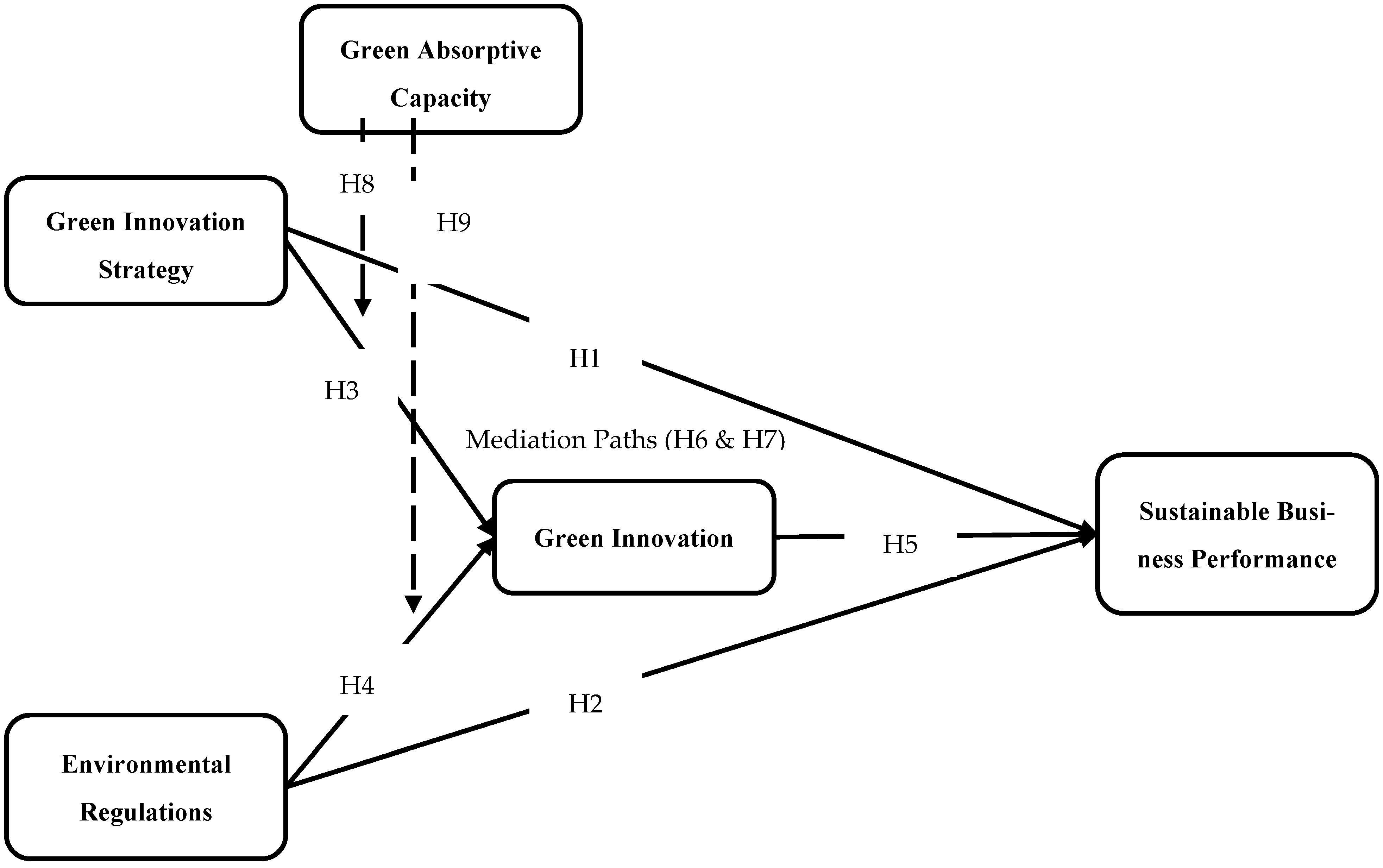
Building on the theoretical foundations and premises in the literature, this study proposes an integrative model to examine the interactions among green innovation strategy, environmental regulations, green absorptive capacity, and sustainable business performance within Chinese SMEs. Drawing on the resource-based view (RBV), institutional theory, and dynamic capability theory, the framework highlights both the mediating role of green innovation and the moderating influence of green absorptive capacity. The model illustrates how strategic initiatives and regulatory pressures influence sustainability outcomes, while absorptive capacity determines the extent to which firms translate external knowledge and compliance mandates into actionable innovations. The proposed conceptual model, presented in Figure 1, visually encapsulates these relationships and provides a foundation for empirical testing.
Figure 1 illustrates the proposed conceptual framework integrating institutional theory, RBV, and dynamic capability perspectives. The model positions Green Innovation Strategy (GIS) and Environmental Regulations (ER) as the primary strategic and institutional drivers influencing Sustainable Business Performance (SBP) in Chinese manufacturing SMEs. Green Innovation (GI) is theorized as the central mechanism that translates both internal strategic intent (GIS) and external regulatory pressures (ER) into environmental, social, and economic sustainability outcomes. Accordingly, GI mediates the relationships between: 1. GIS → SBP (H6); and 2. ER → SBP (H7).
Furthermore, Green Absorptive Capacity (GAC), a dynamic capability enabling firms to acquire, assimilate, and apply external environmental knowledge, is modeled as a boundary condition shaping the effectiveness of innovation responses. Specifically, GAC moderates: the GIS → GI relationship (H8), and the ER → GI relationship (H9).
Thus, SBP improvements depend not only on regulatory pressure or strategic intent, but also on a firm’s capability to internalize external knowledge and convert it into innovation outcomes. The framework strengthens theoretical logic by demonstrating how internal capabilities and institutional pressures jointly influence sustainability transitions in resource-constrained SMEs within emerging economies. his conceptual model responds directly to gaps in sustainability research by explaining why green innovation does not always translate into performance gains—SMEs must develop absorptive capabilities to unlock value from environmental strategy and regulatory mandates.
Despite extensive research on green innovation and sustainability, prior findings remain fragmented, particularly regarding the joint role of strategic intent, regulatory pressure, and absorptive capacity. Empirical studies report inconsistent effects of absorptive capacity, and limited attention has been paid to how these mechanisms interact in resource-constrained SMEs. This gap motivates the integrated framework proposed in this study. Building on these theoretical foundations, the next section outlines the research design, sampling procedure, measurement instruments, and analytical methods employed to empirically test the proposed hypotheses.

3. Research Methodology

To empirically validate the proposed conceptual framework and hypotheses, this study adopted a quantitative research methodology grounded in a positivist paradigm. A structured survey was designed to collect data from managers of manufacturing SMEs in Jiangsu Province, as the empirical context, due to its strategic importance in China’s manufacturing economy and its role as a national pilot region for environmental regulation and green innovation policies. The province hosts a large concentration of export-oriented and technology-intensive SMEs operating under relatively stringent environmental standards, making it a suitable setting for examining how firms respond strategically to regulatory and sustainability pressures. Data collection focused on perceptions and practices regarding green innovation strategies, environmental regulations, absorptive capacity, and sustainable performance. The online questionnaire was distributed from August to October 2024 via email invitations and WeChat professional groups affiliated with industrial associations. Respondents were reminded twice to increase participation and ensure adequate response rates.

3.1. Data Collection and Sampling

A purposive sampling strategy was employed to ensure participation from individuals with direct responsibility for sustainability-related decision-making (Robinson, 2024). SME managers were selected as the primary respondents because they oversee both operational and strategic activities related to green innovation implementation within their firms. Eligible companies were identified using publicly available listings of registered manufacturing SMEs obtained from the Jiangsu Provincial Department of Industry and Information Technology, regional industrial associations, local SME support agencies, and official business directories issued by the Ministry of Industry and Information Technology (MIIT). Firm size, age, ownership type, and industry sub-sector were used descriptively and included as control variables to reduce omitted-variable bias.
This non-probability approach was appropriate given that the objective was not to achieve statistical representativeness of all SMEs in Jiangsu, but rather to target respondents with relevant expertise and involvement in sustainability decision-making. By focusing on knowledgeable managerial personnel, the sampling strategy strengthened construct validity and ensured that the data collected reflected informed perspectives on green innovation and sustainability practices.
The research team collaboratively designed, formatted, and distributed the online survey instrument. Local investigators led field coordination due to their direct access to and familiarity with manufacturing SMEs in Jiangsu Province, which facilitated communication with respondents and contributed to a high response rate. The lead investigator managed data curation, cleaning, preliminary analysis, and secure dataset storage, while two U.S.-based co-investigators contributed primarily during later analytical stages, focusing on statistical interpretation, visualization, and the development of theoretical and practical implications. A full breakdown of author contributions is presented in the CRediT authorship statement accompanying this article. Data were collected using the Wenjuanxing platform, a widely utilized online research tool in China, with survey links distributed via email and professional managerial networks to ensure participation from individuals with relevant industry experience.

Sample Size Determination

To determine the required sample size, an a priori power analysis was conducted using G*Power 3.1.9.2. Following conventional parameters for behavioral and social science research—a medium effect size (f2 = 0.15), an α level of 0.05, and a statistical power of 0.80—the minimum sample size was estimated at 150 respondents (Cohen, 1992). In total, 320 online questionnaires were distributed to manufacturing SME managers in Jiangsu Province, resulting in 250 valid responses and a response rate of 78.13%. Data collection was conducted via Wenjuanxing, an online survey platform designed to facilitate broad and accessible participation across the province. The achieved sample exceeds the minimum required threshold, providing adequate statistical power for subsequent analyses. To improve model validity and reduce omitted-variable bias, firm-level control variables, including firm size, firm age, ownership type, and industry sub-sector, were incorporated, reflecting factors known to influence innovation behavior and sustainability outcomes in SMEs.

3.2. Survey Instrument and Structure

The questionnaire was divided into two sections. The first section collected socio-demographic data, including age, gender, education level, and work experience. The second section comprised 35 items measuring the study constructs, including seven items for Green Innovation Strategy (GIS), four items for Environmental Regulations (ER), six items for Green Innovation (GI), five items for Green Absorptive Capacity (GAC), and 13 items for Sustainable Business Performance (SBP)All measurement items were adapted from established literature to ensure content validity and contextual relevance.

3.3. Ethics and Informed Consent Statement

This study was conducted in accordance with the ethical principles of the Declaration of Helsinki and institutional guidelines for research involving human participants. The Institutional Review Board (IRB) of Jiangsu University reviewed the study protocol and determined that formal approval was not required, as the research posed minimal risk and relied solely on anonymous online survey data. Informed consent was embedded into the survey’s landing page, where participants were clearly informed of the study purpose, procedures, estimated completion time, voluntary participation, and data confidentiality. Respondents were required to affirm consent before proceeding, and those who chose not to participate could exit without penalty. No personally identifiable information was collected, and all demographic items were optional, ensuring participant autonomy and privacy throughout the data collection process.

3.4. Measurement of Variables

To ensure the validity and reliability of the constructs, measurement items were adapted from well-established scales in the literature. Each construct was measured using at least three indicators, consistent with SEM best-practice recommendations for construct reliability and identification. All items were adapted from validated scales, with minor contextual wording adjustments to reflect the Chinese manufacturing SME context, without altering the underlying constructs.
All constructs were measured using a five-point Likert scale ranging from 1 (“strongly disagree”) to 5 (“strongly agree”). This scale was selected to balance response sensitivity with cognitive simplicity, particularly given the managerial respondent group and the online survey format. Prior methodological research suggests that five-point scales provide sufficient variance and reliability for structural equation modeling (Cheung et al., 2024) while reducing respondent fatigue and measurement error, especially in cross-cultural and SME research contexts. Compared to longer scales, the five-point format enhances response consistency and completion rates without materially compromising explanatory power. The constructs assessed in this study included:
  • Sustainable Business Performance (SBP)—Sustainable business performance was measured across three key dimensions: environmental, economic, and social. Sustainable business performance is modeled as a second-order construct comprising only environmental, social, and economic performance dimensions. Environmental performance was captured using a five-item scale developed by C.-H. Wang (2019), Ramanathan (2018), and Asadi et al. (2020). Economic and social performance were each measured using four-item scales adapted from Li (2014) and Asadi et al. (2020), respectively. Sustainable business performance was modeled as a second-order reflective construct composed of three performance dimensions: environmental, social, and economic. This specification reflects the inherently multidimensional nature of sustainability, in which performance outcomes are conceptually distinct yet interrelated and jointly constitute a higher-order construct. A second-order model parsimoniously captures the shared variance among these dimensions, reducing model complexity while preserving theoretical coherence. Compared to a first-order specification, this approach avoids redundancy among closely related indicators and enables a more accurate assessment of the overall effect of strategic and institutional drivers on sustainability performance. This modeling choice is consistent with prior sustainability and innovation research employing hierarchical component models in PLS-SEM when higher-order constructs represent aggregate conceptual domains.
  • Green Innovation Strategy (GIS)—The measurement of the Green Innovation Strategy (GIS) was based on a scale developed by Ge et al. (2018), comprising seven items that reflect the integration of environmental objectives into firms’ innovation-related decision-making processes and strategic initiatives. In this study, green innovation strategy is conceptualized as a decision-oriented strategic construct rather than a measure of implemented practices or realized innovation outcomes.
  • Green Innovation (GI) Green innovation was assessed using a six-item scale focusing on green product and process innovation, adopted from Chan et al. (2016). In this study, green innovation is conceptualized as a realized innovation outcome (i.e., implemented green products and processes), rather than as green innovativeness or innovation outcomes ability. The items evaluate the extent to which firms have implemented eco-friendly products and environmentally conscious production processes.
  • Environmental Regulations (ER)—Environmental regulations were measured using a four-item scale adapted from Chan et al. (2016) and Z. Zhu et al. (2011). The items reflect the stringency, enforcement, and influence of regulatory frameworks on firms’ environmental practices.
  • Green Absorptive Capacity (GAC)—GAC was measured using a five-item scale developed by Chan et al. (2016). This construct captures a firm’s ability to acquire, assimilate, transform, and apply external green knowledge to improve innovation capabilities.
To provide context for the empirical findings, demographic data were collected to describe the characteristics of the respondents and their affiliated enterprises. To address common method bias (CMB), several procedural and statistical safeguards were employed. Anonymity and confidentiality were assured, item order was randomized, and measurement items were designed to minimize evaluation apprehension (Podsakoff et al., 2024). Statistically, Harman’s single-factor test showed that the first factor explained less than 50% of variance, and collinearity assessments confirmed all VIF values were below 3.3, indicating that CMB was not a substantive concern.
This information helps validate the representativeness and relevance of the sample for examining green innovation strategy among Chinese manufacturing SMEs. Table 1 summarizes the demographic profiles of the participants, including gender, age, monthly income, managerial roles, and industry categories. It summarizes the respondent and firm profiles and serves two purposes in the study design. First, it demonstrates that the sample comprises relevant informants, managers operating in manufacturing SMEs, who are likely to possess direct knowledge of sustainability and innovation decision-making, thereby supporting the appropriateness of the key-informant data. Second, the firm characteristics (e.g., firm size, age, ownership type, and industry subsector) provide contextual information on the heterogeneity of the sampled SMEs and inform the interpretation of the structural relationships. These characteristics provide contextual information on sample heterogeneity and support the interpretation of the results by situating the findings within the profile of manufacturing SMEs in Jiangsu Province. These insights offer a foundational understanding of the organizational and individual backgrounds from which data on green innovation and sustainability practices were obtained.
Table 1 presents the demographics, which include the following gender distribution: male (51%) and female (49%). For age, the following categories were reported: less than 25 (26%), 26 to 35 (22%), 36 to 45 (27%), and 46 or older (26%). Based on income, less than 5000 RMB (37%), 5000 to 10,000 (32%), and above (31%) were reported. The respondents’ positions are as follows: Middle Managers (17%), Lower Managers (18%), Operational Managers (21%), Supervisors (22%), and Related Representatives (21%). Enterprises are categorized as Textile (21%), Chemicals (28%), Pharmacy (27%), and Accessories Production (24%).
Partial least squares structural equation modeling (PLS-SEM) was employed as the primary analytical technique due to its suitability for predictive and theory-development-oriented research involving complex models. The proposed framework includes multiple direct relationships, mediation and moderation effects, and a second-order construct for sustainable business performance, thereby increasing model complexity and favoring a variance-based approach. PLS-SEM is particularly appropriate for studies with managerial survey data and moderate sample sizes, as it imposes fewer distributional assumptions and yields robust parameter estimates under non-normality. In contrast to covariance-based SEM, which emphasizes model fit and theory confirmation, PLS-SEM aligns more closely with the study’s objective of explaining and predicting sustainability-related outcomes in SMEs. Accordingly, PLS-SEM offers a methodologically coherent approach for estimating the proposed relationships and assessing the model’s explanatory power.
Following PLS-SEM best practices, the analysis was conducted in two sequential stages. First, the measurement model was evaluated to establish indicator reliability, internal consistency reliability, and construct validity. Indicator reliability was assessed through outer loadings, while internal consistency was examined using Cronbach’s alpha and composite reliability. Convergent validity was evaluated via average variance extracted (AVE), and discriminant validity was assessed using the Fornell–Larcker criterion and the heterotrait–monotrait (HTMT) ratio (Rönkkö & Cho, 2022). Only after confirming the adequacy of the measurement model was the structural model assessed. The structural model evaluation examined path coefficients and their significance using bootstrapping, as well as explanatory power (R2), effect sizes (f2), predictive relevance (Q2), and collinearity through variance inflation factors (VIF).

4. Data Analysis and Results

4.1. Descriptive Statistics and Preliminary Analysis

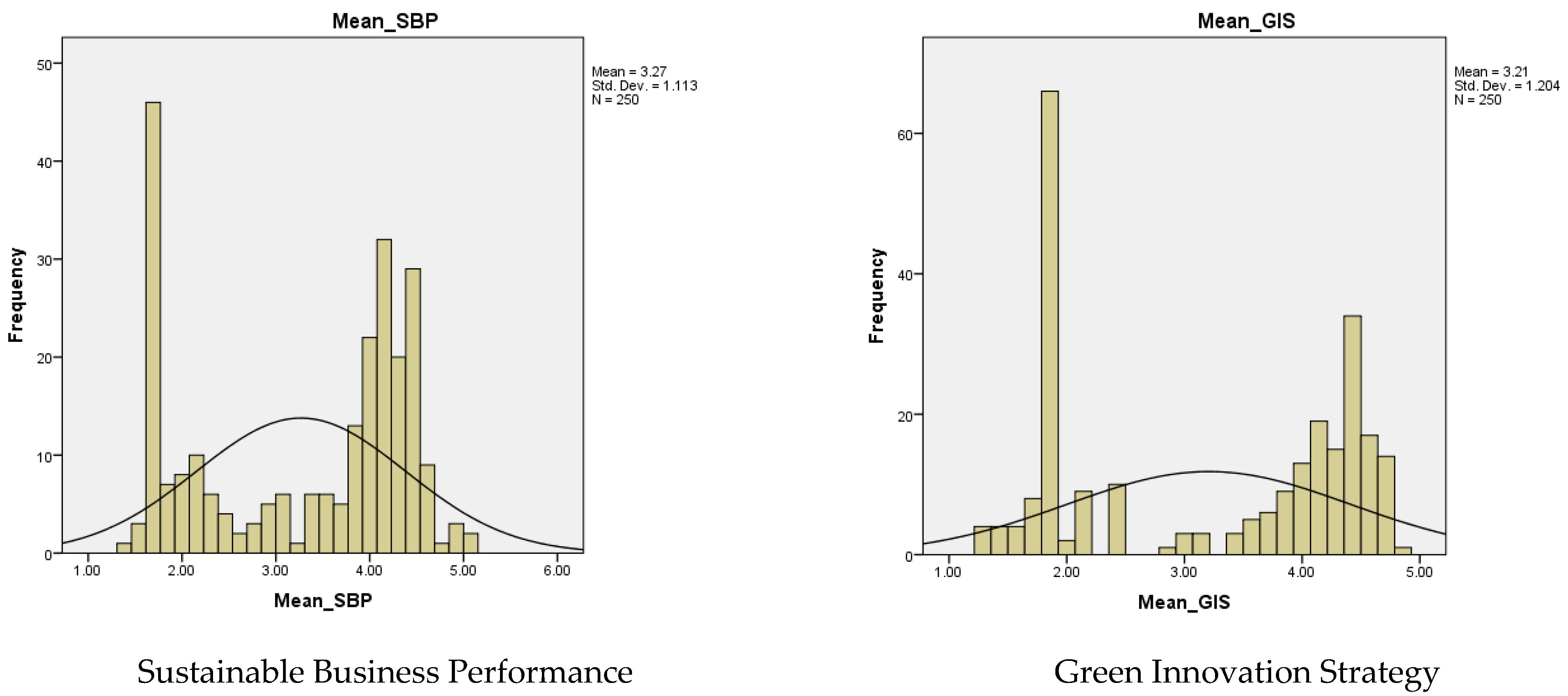
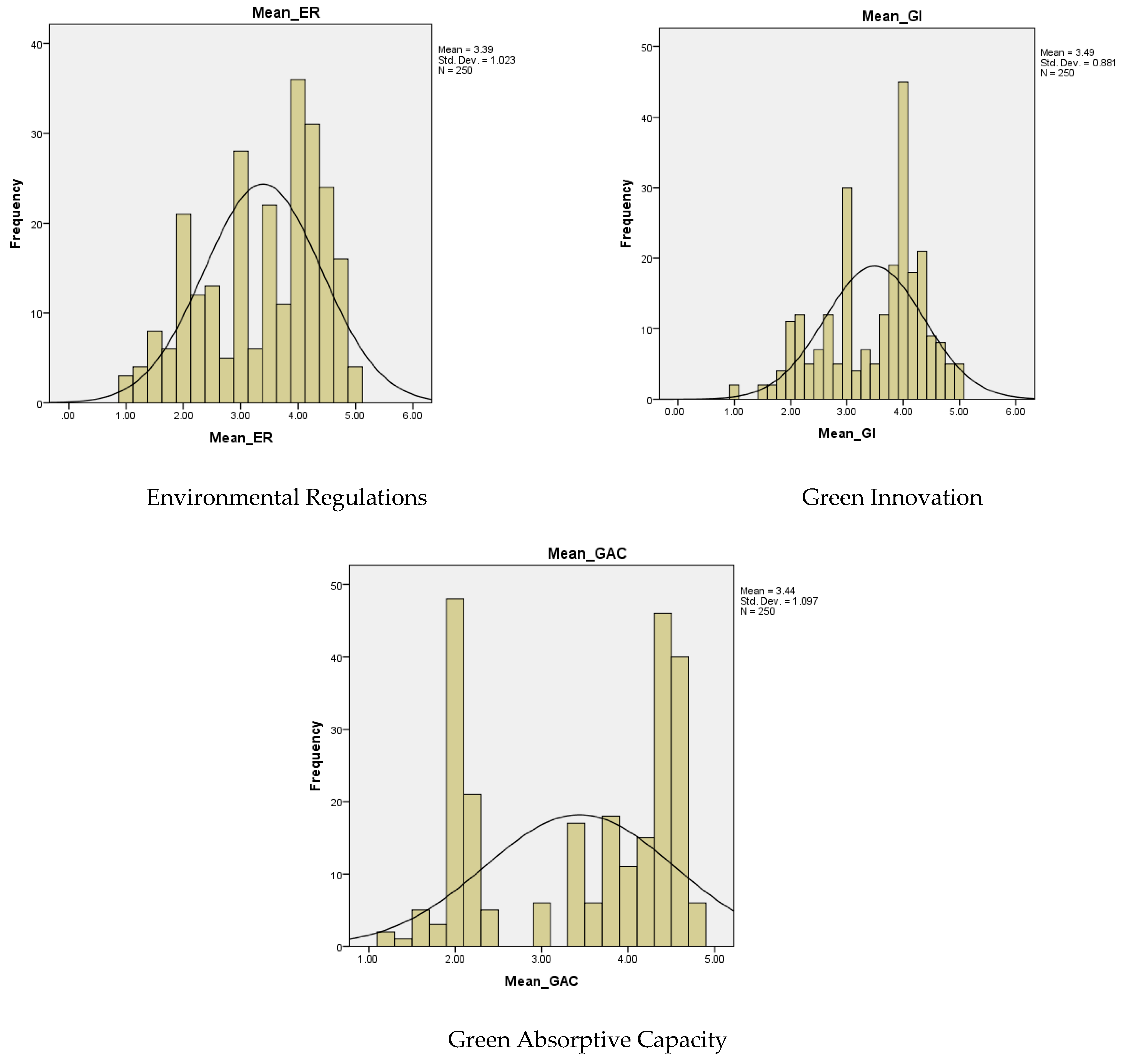
Descriptive statistics were computed using SPSS version 24.0, including means, standard deviations, and distributional properties. As illustrated in Figure 2, all constructs exhibit mean values close to the midpoint of the five-point Likert scale, indicating moderate engagement in sustainability-related practices among the sampled SMEs. Specifically, Sustainable Business Performance (SBP) reported a mean of 3.27 (SD = 1.11), Green Innovation Strategy (GIS) 3.21 (SD = 1.20), Environmental Regulations (ER) 3.39 (SD = 1.02), Green Innovation (GI) 3.49 (SD = 0.88), and Green Absorptive Capacity (GAC) 3.43 (SD = 1.10). All variables displayed approximately normal distributions with slight negative skewness. PLS-SEM analysis was conducted using SmartPLS version 3.3.9, following established guidelines for predictive and explanatory modeling.

4.2. Measurement Model Assessment

Sustainable business performance was estimated as a hierarchical component model, with environmental, social, and economic performance specified as first-order dimensions loading onto a second-order construct. Consistent with the analytical procedure outlined in the methodology, the measurement model was evaluated prior to testing the structural relationships to ensure adequate reliability and validity. Internal consistency reliability was assessed using Cronbach’s alpha and composite reliability (CR), with all values exceeding the recommended threshold of 0.70. Indicator reliability was confirmed as all standardized outer loadings surpassed 0.70.
Convergent validity was assessed through the average variance extracted (AVE). As reported in Table 2, all constructs exhibited AVE values above 0.50, confirming adequate convergent validity. Discriminant validity was evaluated using both the Fornell–Larcker criterion and the heterotrait–monotrait (HTMT) ratio. The square roots of AVE exceeded inter-construct correlations, and all HTMT values were below the conservative threshold of 0.85, supporting discriminant validity (Table 3).
The higher-order structure of Sustainable Business Performance (SBP) was assessed using the repeated-indicator approach, with environmental, economic, and social performance specified as first-order dimensions loading onto the second-order construct. All second-order loadings exceeded 0.70 and were statistically significant, confirming the empirical appropriateness of the hierarchical specification.
To assess potential common method bias, the correlation-based procedure recommended by Kock et al. (2021) was applied. The results indicated no evidence of common method variance. Collectively, these findings confirm that the measurement model satisfies established quality criteria and is suitable for structural model evaluation.

4.3. Structural Model Assessment

Following confirmation of the measurement model, the structural model was evaluated. Prior to hypothesis testing, multicollinearity among predictor constructs was assessed using the Variance Inflation Factor (VIF). All VIF values—including those associated with mediation and moderation terms—were below the recommended threshold of 3.3, indicating no collinearity concerns.
The quality of the structural model was assessed using multiple criteria. Explanatory power was evaluated using coefficients of determination (R2), predictive relevance was examined using the Stone–Geisser Q2 statistic (Q2 > 0), and effect sizes were assessed using Cohen’s f2 benchmarks. Overall model fit was evaluated using the standardized root mean square residual (SRMR), with values below 0.08 indicating acceptable fit. As reported in Table 4, all indicators met recommended thresholds, supporting the adequacy of the structural model.

4.4. Hypothesis Testing

The hypothesized direct, mediating, and moderating relationships were tested using a bootstrapping procedure with 5000 resamples.

4.4.1. Direct Effects

The analysis revealed statistically significant positive relationships between green innovation strategy and sustainable business performance (H1), green innovation strategy and green innovation (H3), environmental regulations and green innovation (H4), and green innovation and sustainable business performance (H5). The direct relationship between environmental regulations and sustainable business performance (H2) was not statistically significant.

4.4.2. Mediation Effects

The mediating effects were assessed using the variance accounted for (VAF) approach, which evaluates the proportion of the total effect transmitted through the mediating variable (Gaskin et al., 2023). Following established guidelines, VAF values below 0.20 indicate no mediation, values between 0.20 and 0.80 indicate partial mediation, and values above 0.80 indicate full mediation.
As reported in Table 5, green innovation transmits the effect of environmental regulations to sustainable business performance through a significant indirect pathway, even though the direct effect of environmental regulations on performance is not significant. This pattern reflects an indirect-only (instrumental) effect, whereby environmental regulations influence sustainable performance primarily by stimulating green innovation rather than through a direct pathway. The indirect effect is positive and statistically significant (β = 0.136, t = 4.672, p < 0.01), with a VAF value of 0.310, supporting Hypothesis 6. Similarly, GI partially mediates the relationship between environmental regulations (ER) and SBP, with a significant indirect effect (β = 0.190, t = 4.248, p < 0.01) and a VAF value of 0.680, supporting Hypothesis 7.
Overall, these findings confirm that green innovation serves as an important transmission mechanism through which both strategic and regulatory drivers influence sustainable business performance.

4.4.3. Moderation Effects

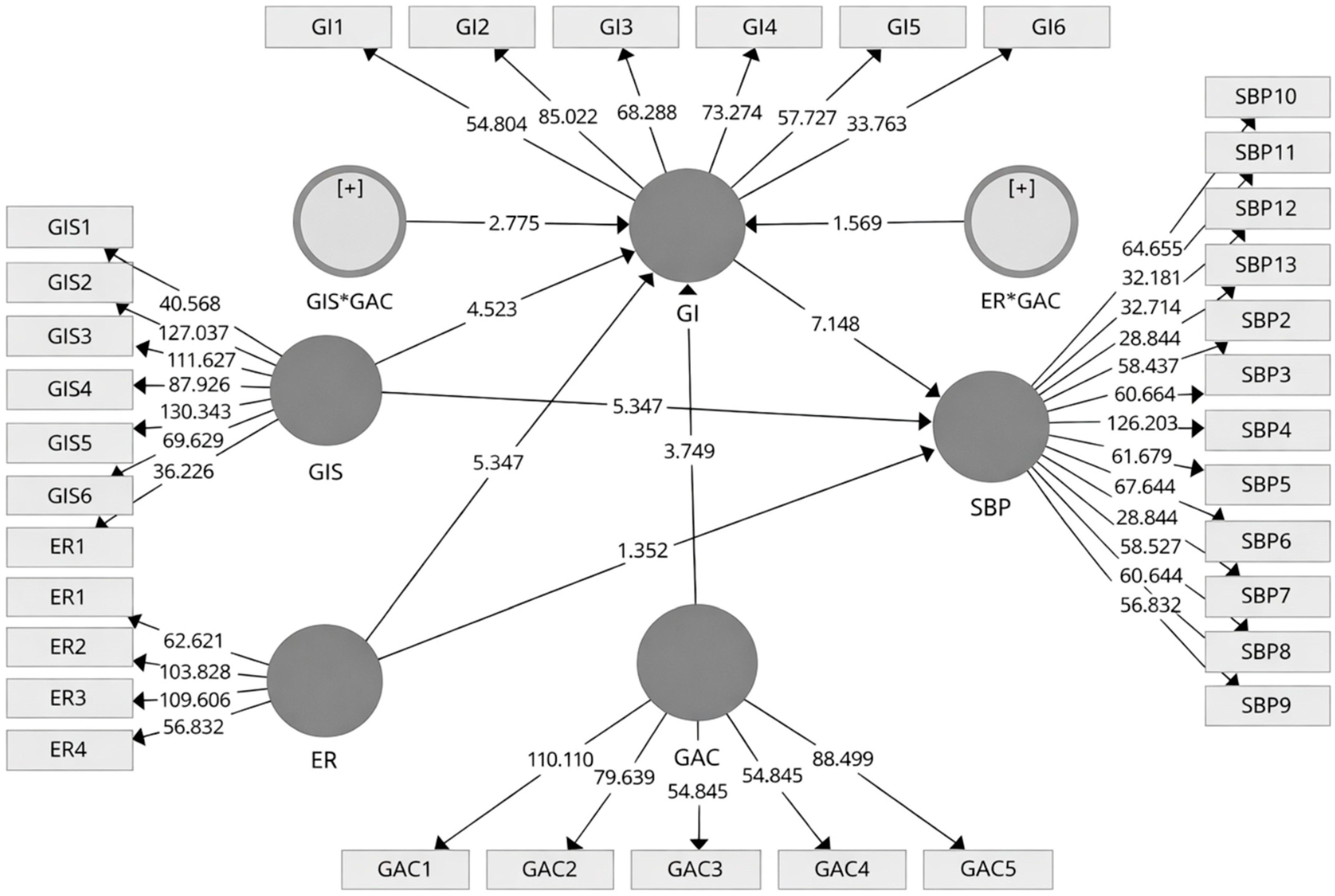
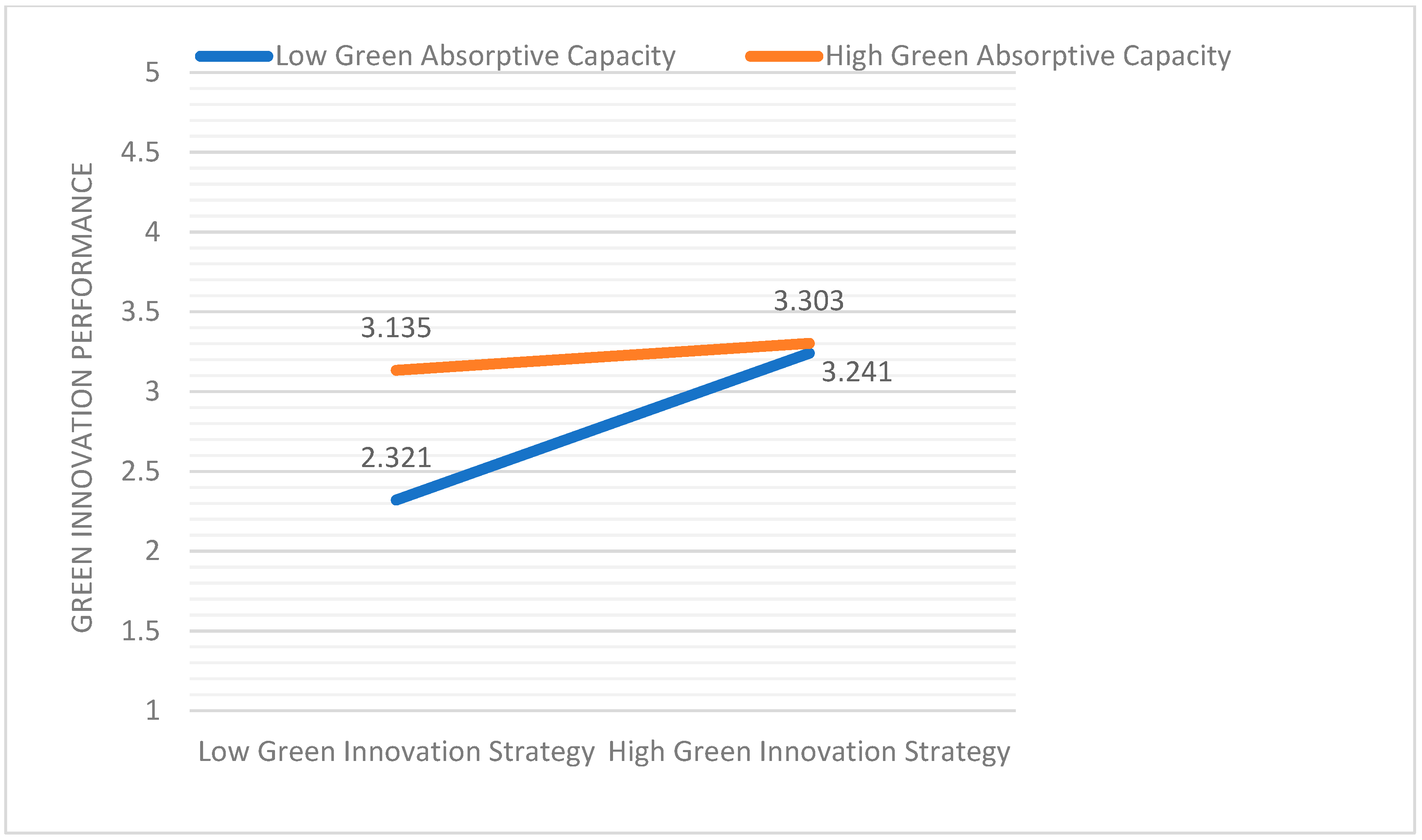
The moderating role of green absorptive capacity (GAC) was examined for the relationships between environmental regulations and green innovation (H8) and between green innovation strategy and green innovation (H9). As reported in Table 5, the interaction between environmental regulations and GAC was not statistically significant (β = 0.107, t = 1.569, p = 0.117), leading to rejection of H8. In contrast, the interaction between green innovation strategy and GAC exhibited a statistically significant negative moderating effect on green innovation (β = −0.188, t = 2.775, p = 0.006), supporting H9.
The significant interaction indicates that higher levels of green absorptive capacity weaken the positive relationship between green innovation strategy and green innovation. This moderation effect is illustrated in Figure 3, which depicts both significant and non-significant structural paths identified through the bootstrapping procedure. All moderation results, together with the direct and mediating effects, are summarized in Table 5, providing a comprehensive overview of the structural model estimates.
As presented in Table 5, the structural model assessment revealed that seven of the nine hypothesized paths were statistically significant. Specifically, the path corresponding to Hypothesis 1, examining the relationship between GIS and SBP, was significant (β = 0.309, t = 5.347, p < 0.01), thus supporting H1. Hypothesis 2, which tested the relationship between ER and SBP, was not supported, as the path was non-significant (β = 0.090, t = 1.352, p > 0.05). In contrast, Hypothesis 3, assessing the link between GIS and GI, was supported (β = 0.272, t = 4.523, p < 0.01), as was Hypothesis 4, which evaluated the relationship between ER and GI (β = 0.380, t = 5.889, p < 0.01). Finally, Hypothesis 5, testing the effect of GI on SBP, was also supported (β = 0.501, t = 7.148, p < 0.01). These findings indicate robust support for the majority of the proposed relationships within the structural model.
The moderation analysis further reveals that green absorptive capacity significantly conditions the relationship between green innovation strategy and green innovation. As indicated in Table 5, the interaction effect is negative, suggesting that higher levels of absorptive capacity weaken the positive impact of strategic green orientation on innovation outcomes. This counterintuitive result indicates that, in resource-constrained SMEs, excessive knowledge acquisition or integration may create coordination challenges or dilute strategic focus, thereby reducing innovation effectiveness. The moderation findings therefore introduce an important boundary condition to prevailing assumptions regarding the uniformly positive role of absorptive capacity.
Notably, the moderating effect of GAC on the relationship between GIS and GI is negative and statistically significant. As illustrated in Figure 4, absorptive capacity is typically regarded as an enabler of innovation; however, its interaction with strategic initiatives may introduce complexity, strain resources, or create competing cognitive priorities, thereby reducing innovation efficiency (Hashem, 2024; Xiong et al., 2025). These findings suggest that when firms simultaneously pursue multiple strategic demands, excessive knowledge acquisition or processing may overextend managerial capacity and dilute implementation effectiveness. The results underscore the need for firms to align absorptive capability with strategic focus to avoid capability–strategy misfit and unintended innovation slowdowns.
Overall, the results indicate that green innovation plays a central role in linking strategic orientation and regulatory pressures to sustainable business performance. While green innovation strategy and environmental regulations both foster green innovation, only green innovation demonstrates a strong direct association with performance outcomes. Mediation analyses confirm that innovation serves as a key transmission mechanism, while moderation analysis reveals a counterintuitive negative boundary condition associated with absorptive capacity. These findings provide the empirical foundation for the theoretical interpretation presented in the subsequent Discussion section.

5. Discussion

Rather than reiterating empirical results, this section interprets the study’s findings through the theoretical lenses established earlier and situates them within the broader sustainability and innovation literature. By integrating resource-based, institutional, and dynamic capability perspectives, the discussion elucidates how strategic intent, regulatory pressures, and organizational capabilities jointly shape sustainability outcomes in resource-constrained SMEs operating in emerging economies.
A central insight of the study is the pivotal role of green innovation in transforming both internal strategies and external regulatory pressures into environmental, social, and economic values. This finding reinforces the Resource-Based View by demonstrating that competitive advantage does not stem solely from sustainability-oriented strategies, but also from firms’ ability to operationalize them through innovation capabilities. Green innovation thus represents a higher-order capability that enables SMEs to convert environmental intentions into tangible performance outcomes, extending prior work that has emphasized innovation as a driver of sustainable competitiveness.
The findings also nuance institutional theory by revealing that environmental regulations, while essential in shaping firms’ strategic orientation, do not automatically translate into improved performance. From an institutional theory perspective, this non-significant direct relationship may reflect a decoupling dynamic, whereby firms respond to environmental regulations primarily to secure organizational legitimacy rather than to achieve substantive performance improvements. In such cases, regulatory compliance remains symbolic, with limited integration into core operational or innovation processes. This interpretation aligns with prior institutional research suggesting that regulatory pressure can motivate conformity without necessarily improving efficiency or competitiveness, particularly among resource-constrained SMEs. Instead, regulatory pressures exert their influence indirectly by stimulating innovation responses. This supports the view that compliance-based approaches are insufficient on their own, and that performance gains materialize only when firms actively engage in innovation that reconfigures processes, products, and resource use. In this sense, the study aligns with and extends ecological modernization arguments, highlighting innovation as the critical conduit between regulation and sustainability outcomes. This decoupling logic helps explain why environmental regulations exert their influence indirectly through green innovation rather than directly enhancing sustainable business performance.
One of the most theoretically significant contributions of this research lies in its treatment of green absorptive capacity. While absorptive capacity is commonly conceptualized as a dynamic capability that enhances innovation by facilitating knowledge acquisition and integration, the findings indicate a more nuanced role in the context of SMEs. Under conditions of limited managerial attention and resource constraints, higher levels of absorptive capacity may introduce coordination costs, strategic overload, or cognitive fragmentation, thereby weakening the effectiveness of green innovation strategies. This counterintuitive pattern challenges the prevailing assumption that absorptive capacity is uniformly beneficial and advances the dynamic capability literature by identifying important boundary conditions under which capability accumulation may hinder, rather than support, innovation performance.
These insights contribute to a more refined understanding of sustainability-oriented capabilities in SMEs. The study demonstrates that successful green transformation depends not only on strategic commitment or regulatory pressure, but on the alignment between innovation efforts and firms’ capacity to implement and prioritize knowledge effectively. By clarifying how internal capabilities interact with external institutional forces, the findings offer a more integrated and context-sensitive explanation of sustainability performance in emerging economies.

6. Theoretical and Practical Implications

This study advances theoretical understanding of sustainability-oriented innovation in three keyways. First, it integrates resource-based, institutional, and dynamic capability perspectives to explain how strategic initiatives and regulatory pressures jointly influence sustainable performance through green innovation, offering a more holistic explanatory framework. Second, it demonstrates that innovation capabilities are not merely complementary but essential mediating mechanisms, clarifying the indirect nature of the relationship between regulation and performance. Third, it challenges prevailing assumptions about absorptive capacity as a universally positive moderator, showing that under certain strategic conditions, excessive knowledge integration can impede rather than enhance innovation outcomes. These findings extend current theory by refining boundary conditions and contingencies that shape sustainability-driven competitive advantage in SMEs operating within emerging economies.
This study offers actionable insights for SME managers and policymakers seeking to accelerate sustainability transitions. The results highlight that adopting a green innovation strategy alone is insufficient unless firms invest in concrete innovation capabilities that transform environmental intent into operational and market value. For managers, this underscores the importance of developing structured innovation processes, targeted R&D, and cross-functional knowledge-sharing mechanisms to maximize sustainability payoffs. For policymakers, the findings suggest that regulatory frameworks must go beyond compliance enforcement to actively support capability development—for example, through financial incentives, innovation networks, and training programs—enabling SMEs to overcome resource constraints and capture the long-term competitive advantages of sustainability-driven innovation.
Building on the proposed model and the factors influencing the adoption of green innovations, this study offers actionable insights for policymakers and SME managers seeking to accelerate sustainable transitions. The findings confirm that green innovation has a significant impact on environmental performance, underscoring its dual role in driving ecological improvements and enhancing firms’ competitive positioning. To capture these benefits, managers should adopt a structured, long-term approach to green innovation investments, embedding them within strategic roadmaps that align environmental initiatives with profitability and market growth objectives. SMEs that proactively integrate sustainability considerations into core operations are better positioned to unlock new market opportunities, strengthen stakeholder relationships, and achieve superior performance compared to competitors with weaker environmental commitments. Beyond economic returns, green innovations generate positive societal externalities by reducing pollution, conserving natural resources, and improving community well-being. Given the clear link between poor environmental practices and lower profitability in manufacturing sectors (Cerciello et al., 2023; D. Zhou et al., 2024), managers must move beyond compliance-driven approaches to systematically embed pollution control, resource efficiency, and eco-innovation practices as strategic imperatives for long-term sustainability and value creation.
Governments play a pivotal role in accelerating sustainability transitions by designing policies and incentives that encourage SMEs to adopt innovative green practices. Targeted interventions, such as financial incentives, regulatory support, and knowledge-sharing networks, can promote the growth of green-oriented industries and foster sustainable business ecosystems. The findings of this study highlight that firms adopting environmentally responsible practices consistently achieve superior returns compared to traditional counterparts, with social performance emerging as a key driver of green innovation adoption. Moreover, the results confirm that green innovation positively influences corporate social responsibility (CSR), reinforcing the need for firms to integrate environmental and social considerations into their strategic decision-making to enhance legitimacy and long-term value creation.
Environmental standards can act as catalysts for innovation, triggering technological improvements that not only reduce ecological impact but also enhance competitiveness and overall business performance. Green innovation, encompassing pollution prevention, product stewardship, and sustainable development practices, directly contributes to both environmental and economic benefits. However, SMEs often face financial and operational barriers, such as high upfront investment costs and resource limitations, which can hinder the adoption of such innovations. Well-designed environmental regulations can mitigate these constraints by incentivizing eco-innovation and creating indirect benefits, such as improved reputation and market access. Nevertheless, dynamic capabilities, particularly absorptive capacity, may generate complexity or resource allocation conflicts when multiple strategic initiatives compete for managerial attention, potentially reducing the effectiveness of innovation efforts.
Understanding the factors that shape the adoption of green innovation is crucial for effective policymaking and managerial action. Prior studies (Asiaei et al., 2023; Zahid et al., 2024) have demonstrated that improvements in environmental performance are typically accompanied by enhancements in social performance, suggesting a synergistic relationship between these dimensions of sustainability. This research contributes to that understanding by providing empirical evidence that green innovation has a positive impact on both environmental and social outcomes in SMEs. These insights can inform policymakers seeking to refine sustainability policies and guide managers in optimizing their green innovation strategies, ultimately advancing sustainable performance across the manufacturing sector.
Overall, this study advances the discourse on sustainability-oriented innovation by clarifying how strategic intent, regulatory pressures, and organizational capabilities interact to shape the long-term performance of SMEs in emerging economies. The findings underscore that achieving sustainable competitive advantage requires more than regulatory compliance or high-level strategic alignment—it demands innovation capabilities that effectively translate environmental goals into operational, social, and financial value. By identifying the pivotal mediating role of green innovation and the contingent, sometimes counterintuitive, effects of absorptive capacity, this research refines existing theories of sustainable business strategy and innovation management. These insights not only enrich academic debates but also provide policymakers and managers with a clearer understanding of the mechanisms through which environmental initiatives create tangible value, paving the way for more targeted interventions that foster resilient, innovation-driven sustainability transitions.

7. Conclusions

The primary contribution of this study lies in demonstrating that sustainability-oriented innovation outcomes are shaped not only by strategic and regulatory drivers, but also by how organizational capabilities interact with those drivers. In particular, the negative moderating role of green absorptive capacity challenges prevailing assumptions in the RBV and dynamic capabilities literature that capability accumulation is uniformly beneficial. This finding advances theoretical debate by highlighting the conditions under which capabilities may generate diminishing or adverse returns, especially in emerging-economy SME contexts.
This study provides empirical evidence that green innovation strategies—encompassing pollution prevention, product stewardship, and sustainable development—are critical drivers of environmental, social, and economic performance in SMEs. The findings underscore that firms integrating sustainability principles into their core strategies can develop innovative products and processes that not only mitigate environmental impacts but also enhance competitiveness and long-term value creation. In particular, the results highlight the pivotal role of regulatory and market pressures in shaping the adoption of green innovation, while demonstrating that firms that proactively embrace eco-innovation gain efficiency advantages, capture new market opportunities, and strengthen their stakeholder legitimacy.
Environmental regulations have been shown to be important catalysts for green innovation, confirming that well-designed policy frameworks can stimulate technological advancements and improve both environmental and economic performance. However, the results also reveal that dynamic capabilities, particularly absorptive capacity, may create complexities or resource allocation conflicts when misaligned with strategic initiatives, tempering the expected benefits of innovation. These findings suggest that the effectiveness of sustainability strategies depends not only on external pressures and internal intent but also on the careful orchestration of organizational capabilities to avoid innovation inefficiencies.
Overall, this research advances understanding of how SMEs can leverage green innovation to achieve sustainable business performance in emerging economies. By integrating strategic, regulatory, and capability-based perspectives, the study highlights pathways for firms to transform environmental challenges into opportunities for competitive advantage. The insights generated provide valuable guidance for both managers and policymakers seeking to foster innovation-driven sustainability transitions within resource-constrained contexts.

8. Limitations and Future Research

Despite this study’s contributions to understanding how green innovation strategy, environmental regulation, and absorptive capacity interact to shape sustainable business performance, several limitations should be considered when interpreting the findings. First, the cross-sectional research design limits causal inference and fails to capture the dynamic or lagged effects through which green innovation may influence environmental, social, and financial performance. This limitation is particularly relevant when interpreting the mediating role of green innovation and the counterintuitive moderating effect of absorptive capacity, which may evolve over time as firms accumulate experience. Future studies employing longitudinal or experimental designs would provide stronger causal validation and enable the examination of temporal adjustment processes.
The reliance on self-reported survey data introduces the potential for common-method bias, despite procedural remedies and diagnostic tests. While the statistical robustness of the core relationships suggests that this risk is limited, future research should integrate multi-source data, such as archival environmental indicators, third-party sustainability ratings, or objective financial measures, to further strengthen measurement validity. Also, the analytical model focuses on a specific set of strategic and organizational capabilities. Other potentially influential enablers, including digital transformation, environmental leadership, inter-firm collaboration, and supply chain integration, were not explicitly examined. Their omission may condition the magnitude of the observed effects and represents an opportunity for theoretical extension.
In addition, the study’s purposive, non-probability sample of manufacturing SMEs located in Jiangsu Province limits the generalizability of the findings. Accordingly, the findings should be interpreted as analytically generalizable to similar manufacturing-intensive and institutionally proactive regions in China and other emerging economies, rather than as statistically representative of all Chinese provinces. Although Jiangsu represents a critical hub for China’s manufacturing and green transition initiatives, regulatory enforcement intensity, institutional support, and technological readiness may differ across regions and countries. Accordingly, the conclusions should be interpreted within this contextual boundary. Future research should adopt multi-regional or cross-national comparative designs to assess whether the identified mechanisms operate similarly under different institutional and regulatory regimes.
Building on these limitations, several avenues for future research emerge. From a theoretical perspective, extending the framework to incorporate complementary lenses, such as stakeholder theory, organizational learning, and institutional complexity, would deepen understanding of how firms navigate competing sustainability demands. Future studies could also explore multi-level interactions among firm strategies, supply chain networks, and policy environments, as well as boundary conditions such as market turbulence, technological uncertainty, and resource scarcity.
Methodologically, longitudinal and mixed-methods approaches would allow researchers to capture the evolving nature of green innovation capabilities and their long-term performance implications. Advanced analytical techniques, including multi-group SEM, fuzzy-set qualitative comparative analysis (fsQCA), or hierarchical linear modeling, could further illuminate configurational effects, nonlinear relationships, and contextual heterogeneity. Cross-country studies are particularly warranted to test the robustness of the proposed relationships across diverse institutional settings.
Finally, future research should systematically incorporate firm-level control variables—such as firm size, age, ownership structure, and industry sub-sector—to better isolate causal effects and reduce the influence of unobserved organizational characteristics. Addressing these issues would strengthen internal and external validity and advance a more nuanced understanding of sustainability-oriented innovation in SMEs.

Author Contributions

Conceptualization, H.J.; methodology, H.J. and M.V.G.; software, H.J.; validation, H.J., M.V.G. and H.A.; formal analysis, H.J. and M.V.G.; investigation, H.J.; resources, H.J.; data curation, H.J.; writing—original draft preparation, H.J. and M.V.G.; writing—review and editing, M.V.G. and H.A.; visualization, H.J. and M.V.G.; supervision, M.V.G.; project administration, H.J.; funding acquisition, H.J. All authors have read and agreed to the published version of the manuscript.

Funding

This work was supported by the Key Project of the National Social Science Fund of China (under grant 22AGL028) and, in part, by the Key Research Base of Universities in Jiangsu Province for Philosophy and Social Science’s “Research Center for Green Development and Environmental Governance”.

Institutional Review Board Statement

This study was conducted in accordance with the ethical standards outlined in the Declaration of Helsinki. Formal ethical approval was waived by the Institutional Review Board of Jiangsu University, as the research involved no medical procedures or vulnerable populations and was based solely on voluntary participation in an anonymous online survey.

Informed Consent Statement

Informed consent was obtained from all participants prior to data collection, and all respondents were assured of the confidentiality and anonymity of their responses.

Data Availability Statement

The data will be made available upon special request to the corresponding author.

Conflicts of Interest

The authors declare no conflict of interest.

References

  1. Abduraimi, P. B., Mustafi, M., & Islami, X. (2023). The role of organizational culture on employee engagement. Business: Theory and Practice, 24(1), 109–122. [Google Scholar] [CrossRef]
  2. Abikoye, B. E., Umeorah, S. C., Adelaja, A. O., Ayodele, O., & Ogunsuji, Y. M. (2024). Regulatory compliance and efficiency in financial technologies: Challenges and innovations. World Journal of Advanced Research and Reviews, 23(1), 1830–1844. [Google Scholar] [CrossRef]
  3. Aboelmaged, M. (2018). The drivers of sustainable manufacturing practices in Egyptian SMEs and their impact on competitive capabilities: A PLS-SEM model. Journal of Cleaner Production, 175, 207–221. [Google Scholar] [CrossRef]
  4. Adanma, U. M., & Ogunbiyi, E. O. (2024). A comparative review of global environmental policies for promoting sustainable development and economic growth. International Journal of Applied Research in Social Sciences, 6(5), 954–977. [Google Scholar] [CrossRef]
  5. Adomako, S., & Nguyen, N. P. (2023). Eco-innovation in the extractive industry: Combinative effects of social legitimacy, green management, and institutional pressures. Resources Policy, 80, 103184. [Google Scholar] [CrossRef]
  6. Aftab, J., Abid, N., Cucari, N., & Savastano, M. (2023). Green human resource management and environmental performance: The role of green innovation and environmental strategy in a developing country. Business Strategy and the Environment, 32(4), 1782–1798. [Google Scholar] [CrossRef]
  7. Ahmad, N., Scholz, M., AlDhaen, E., Ullah, Z., & Scholz, P. (2021). Improving firm’s economic and environmental performance through the sustainable and innovative environment: Evidence from an emerging economy. Frontiers in Psychology, 12, 651394. [Google Scholar] [CrossRef]
  8. Ahmed, R. R., Akbar, W., Aijaz, M., Channar, Z. A., Ahmed, F., & Parmar, V. (2023). The role of green innovation on environmental and organizational performance: Moderation of human resource practices and management commitment. Heliyon, 9(1), e12679. [Google Scholar] [CrossRef]
  9. Aiguobarueghian, I., Adanma, U. M., Ogunbiyi, E. O., & Solomon, N. O. (2024). An overview of initiatives and best practices in resource management and sustainability. World Journal of Advanced Research and Reviews, 22(2), 1734–1745. [Google Scholar] [CrossRef]
  10. Akhtar, S., Li, C., Sohu, J. M., Rasool, Y., Hassan, M. I. U., & Bilal, M. (2024). Unlocking green innovation and environmental performance: The mediated moderation of green absorptive capacity and green innovation climate. Environmental Science and Pollution Research, 31(3), 4547–4562. [Google Scholar] [CrossRef]
  11. Akhter, J., Irfan, M., & Abid, B. (2025). Green finance and environmental sustainability: Evidence from developing economies. International Journal of Social Dynamics, 2(1), 33–43. [Google Scholar]
  12. Ali, A., Hadeed, M. Z., Safavi, S., & Ahmad, M. (2024). Leveraging GIS for environmental planning and management. In Global challenges for the environment and climate change (pp. 308–331). IGI Global. [Google Scholar]
  13. Aliasghar, O., Sadeghi, A., & Rose, E. L. (2023). Process innovation in small-and medium-sized enterprises: The critical roles of external knowledge sourcing and absorptive capacity. Journal of Small Business Management, 61(4), 1583–1610. [Google Scholar] [CrossRef]
  14. Alkaraan, F., Elmarzouky, M., Hussainey, K., Venkatesh, V. G., Shi, Y., & Gulko, N. (2024). Reinforcing green business strategies with Industry 4.0 and governance towards sustainability: Natural-resource-based view and dynamic capability. Business Strategy and the Environment, 33(4), 3588–3606. [Google Scholar] [CrossRef]
  15. Alshammari, K. H., & Alshammari, A. F. (2023). Green innovation and its effects on innovation climate and environmental sustainability: The moderating influence of green abilities and strategies. Sustainability, 15(22), 15898. [Google Scholar] [CrossRef]
  16. Andersson, S., Svensson, G., Molina-Castillo, F. J., Otero-Neira, C., Lindgren, J., Karlsson, N. P., & Laurell, H. (2022). Sustainable development—Direct and indirect effects between economic, social, and environmental dimensions in business practices. Corporate Social Responsibility and Environmental Management, 29(5), 1158–1172. [Google Scholar] [CrossRef]
  17. Aprile, M. C. (2025). Innovation and environment: Definition and adoption of eco-innovation. In L. Aldieri (Ed.), Technological evolution. Contributions to economics. Springer. [Google Scholar]
  18. Asadi, S., Pourhashemi, S. O., Nilashi, M., Abdullah, R., Samad, S., Yadegaridehkordi, E., Aljojo, N., & Razali, N. S. (2020). Investigating influence of green innovation on sustainability performance: A case on Malaysian hotel industry. Journal of Cleaner Production, 258, 120860. [Google Scholar] [CrossRef]
  19. Asiaei, K., O’Connor, N. G., Barani, O., & Joshi, M. (2023). Green intellectual capital and ambidextrous green innovation: The impact on environmental performance. Business Strategy and the Environment, 32(1), 369–386. [Google Scholar] [CrossRef]
  20. Asni, N., & Agustia, D. (2022). The mediating role of financial performance in the relationship between green innovation and firm value: Evidence from ASEAN countries. European Journal of Innovation Management, 25(5), 1328–1347. [Google Scholar] [CrossRef]
  21. Awwad, A., Anouze, A. L. M., & Elbanna, S. (2025). Green product innovation: Influences on environmental sustainability performance. Management Decision. ahead-of-print. [Google Scholar] [CrossRef]
  22. Ávila, M. M. (2022). Competitive advantage and knowledge absorptive capacity: The mediating role of innovative capability. Journal of the Knowledge Economy, 13(1), 185–210. [Google Scholar] [CrossRef]
  23. Baah, C., Opoku-Agyeman, D., Acquah, I. S. K., Agyabeng-Mensah, Y., Afum, E., Faibil, D., & Abdoulaye, F. A. M. (2021). Examining the correlations between stakeholder pressures, green production practices, firm reputation, environmental and financial performance: Evidence from manufacturing SMEs. Sustainable Production and Consumption, 27, 100–114. [Google Scholar] [CrossRef]
  24. Bae, M. G., Wang, Y. C., & Liu, N. (2022). Revisiting the relationship between the strength of environmental regulation and foreign direct investment. Frontiers in Psychology, 13, 899918. [Google Scholar] [CrossRef] [PubMed]
  25. Baeshen, Y., Soomro, Y. A., & Bhutto, M. Y. (2021). Determinants of green innovation to achieve sustainable business performance: Evidence from SMEs. Frontiers in Psychology, 12, 767968. [Google Scholar] [CrossRef] [PubMed]
  26. Baquero, A. (2025). Organizational factors, ambidextrous innovation, absorptive capacity, and a firm’s green competitive advantage. Management Decision. ahead-of-print. [Google Scholar] [CrossRef]
  27. Barforoush, N., Etebarian, A., Naghsh, A., & Shahin, A. (2021). Green innovation a strategic resource to attain competitive advantage. International Journal of Innovation Science, 13(5), 645–663. [Google Scholar] [CrossRef]
  28. Bataineh, M. J., Sánchez-Sellero, P., & Ayad, F. (2024). Green is the new black: How research and development and green innovation provide businesses a competitive edge. Business Strategy and the Environment, 33(2), 1004–1023. [Google Scholar] [CrossRef]
  29. Bedoya-Villa, M., Pérez-Sánchez, E., Baier-Fuentes, H., Zapata-Molina, C., & Román-Castaño, E. (2023). The effects of dynamic absorptive capacity on innovation strategy: Evidence from SMEs in a technological context. Mathematics, 11(10), 2366. [Google Scholar] [CrossRef]
  30. Bhuiyan, F., Rana, T., Baird, K., & Munir, R. (2023). Strategic outcome of competitive advantage from corporate sustainability practices: Institutional theory perspective from an emerging economy. Business Strategy and the Environment, 32(7), 4217–4243. [Google Scholar] [CrossRef]
  31. Borah, P. S., Dogbe, C. S. K., Pomegbe, W. W. K., Bamfo, B. A., & Hornuvo, L. K. (2023). Green market orientation, green innovation capability, green knowledge acquisition and green brand positioning as determinants of new product success. European Journal of Innovation Management, 26(2), 364–385. [Google Scholar] [CrossRef]
  32. Borsatto, J. M. L. S., & Bazani, C. L. (2021). Green innovation and environmental regulations: A systematic review of international academic works. Environmental Science and Pollution Research, 28(45), 63751–63768. [Google Scholar] [CrossRef]
  33. Boutmaghzoute, H., & Moustaghfir, K. (2021). Exploring the relationship between corporate social responsibility actions and employee retention: A human resource management perspective. Human Systems Management, 40(6), 789–801. [Google Scholar] [CrossRef]
  34. Camilleri, M. A. (2022). Strategic attributions of corporate social responsibility and environmental management: The business case for doing well by doing good! Sustainable Development, 30(3), 409–422. [Google Scholar] [CrossRef]
  35. Celestin, M., Vasuki, M., Sujatha, S., & Kumar, A. D. (2024). Implementing green technologies to reduce environmental impact: Economic and competitive advantages of eco-friendly practices. International Journal of Scientific Research and Modern Education, 9(2), 33–39. [Google Scholar]
  36. Cerciello, M., Busato, F., & Taddeo, S. (2023). The effect of sustainable business practices on profitability. Accounting for strategic disclosure. Corporate Social Responsibility and Environmental Management, 30(2), 802–819. [Google Scholar] [CrossRef]
  37. Chan, H. K., Yee, R. W., Dai, J., & Lim, M. K. (2016). The moderating effect of environmental dynamism on green product innovation and performance. International Journal of Production Economics, 181, 384–391. [Google Scholar] [CrossRef]
  38. Chen, J., Cheng, Z., Gong, R. K., & Li, J. (2022). Riding out the COVID-19 storm: How government policies affect SMEs in China. China Economic Review, 75, 101831. [Google Scholar] [CrossRef]
  39. Cheung, G. W., Cooper-Thomas, H. D., Lau, R. S., & Wang, L. C. (2024). Reporting reliability, convergent and discriminant validity with structural equation modeling: A review and best-practice recommendations. Asia Pacific Journal of Management, 41(2), 745–783. [Google Scholar] [CrossRef]
  40. Cohen, J. (1992). Statistical power analysis. Current Directions in Psychological Science, 1(3), 98–101. [Google Scholar] [CrossRef]
  41. Cui, R., & Wang, J. (2022). Shaping sustainable development: External environmental pressure, exploratory green learning, and radical green innovation. Corporate Social Responsibility and Environmental Management, 29(3), 481–495. [Google Scholar]
  42. Cui, R., Wang, J., Xue, Y., & Liang, H. (2021). Interorganizational learning, green knowledge integration capability, and green innovation. European Journal of Innovation Management, 24(4), 1292–1314. [Google Scholar] [CrossRef]
  43. Çakmak, Z. (2023). Adapting to environmental change: The importance of organizational agility in the business landscape. Florya Chronicles of Political Economy, 9(1), 67–87. [Google Scholar] [CrossRef]
  44. Dahmani, M. (2024). Environmental quality and sustainability: Exploring the role of environmental taxes, environment-related technologies, and R&D expenditure. Environmental Economics and Policy Studies, 26(2), 449–477. [Google Scholar]
  45. Dantas, D., Ferreira, J. J., & Jayantilal, S. (2025). Green absorptive capacity and environmental management: The main challenges, gaps and research agenda. Management of Environmental Quality: An International Journal, 36(6), 1372–1391. [Google Scholar] [CrossRef]
  46. Dong, Q., Wu, Y., Lin, H., Sun, Z., & Liang, R. (2024). Fostering green innovation for corporate competitive advantages in big data era: The role of institutional benefits. Technology Analysis & Strategic Management, 36(2), 181–194. [Google Scholar]
  47. Duan, W., Xue, X., Chen, Z., & Liu, L. (2025). How do institutional pressures influence corporate social responsibility?—A perspective based on state-owned enterprises. Information Technology and Management, 1–15. [Google Scholar] [CrossRef]
  48. Ebrahimi, S. M., & Koh, L. (2021). Manufacturing sustainability: Institutional theory and life cycle thinking. Journal of Cleaner Production, 298, 126787. [Google Scholar] [CrossRef]
  49. Ejibe, I., Nwankwo, T. C., Nwankwo, E. E., Okoye, C. C., & Scholastica, U. C. (2024). Advancing environmental sustainability in the creative sectors: A strategic HR framework based on data analytics and eco-innovation. World Journal of Advanced Research and Reviews, 21(3), 050–060. [Google Scholar] [CrossRef]
  50. Ekins, P., & Zenghelis, D. (2021). The costs and benefits of environmental sustainability. Sustainability Science, 16(3), 949–965. [Google Scholar] [CrossRef]
  51. El Nemar, S., El-Chaarani, H., Dandachi, I., & Castellano, S. (2025). Resource-based view and sustainable advantage: A framework for SMEs. Journal of Strategic Marketing, 33(6), 798–821. [Google Scholar] [CrossRef]
  52. Emon, M. M. H., Khan, T., Rahman, M. A., Hamid, A. B. A., & Yaakub, N. I. (2025). GreenTech revolution: Navigating challenges and seizing opportunities. In AI and green technology applications in society (pp. 63–90). IGI Global Scientific Publishing. [Google Scholar]
  53. Esfahbodi, A., Zhang, Y., Liu, Y., & Geng, D. (2023). The fallacy of profitable green supply chains: The role of green information systems (GIS) in attenuating the sustainability trade-offs. International Journal of Production Economics, 255, 108703. [Google Scholar] [CrossRef]
  54. Fabrizi, A., Gentile, M., Guarini, G., & Meliciani, V. (2024). The impact of environmental regulation on innovation and international competitiveness. Journal of Evolutionary Economics, 34(1), 169–204. [Google Scholar] [CrossRef]
  55. Farooq, U., Wen, J., Tabash, M. I., & Fadoul, M. (2024). Environmental regulations and capital investment: Does green innovation allow to grow? International Review of Economics & Finance, 89, 878–893. [Google Scholar]
  56. Fatima, T., Li, B. X., & Zhang, D. (2025). Fostering innovation sustainability with the impact of incremental environmental information disclosure under green credit constraints. Environment, Development and Sustainability, 27(8), 18997–19024. [Google Scholar] [CrossRef]
  57. Fosu, E., Fosu, F., Akyina, N., & Asiedu, D. (2024). Do environmental CSR practices promote corporate social performance? The mediating role of green innovation and corporate image. Cleaner and Responsible Consumption, 12, 100155. [Google Scholar]
  58. Gao, L., & Wan, L. (2023). Does corporate environmental responsibility contribute to financial performance? A dual path analysis through operational efficiency and the cost of debt. Corporate Social Responsibility and Environmental Management, 30(1), 308–323. [Google Scholar] [CrossRef]
  59. Garg, D. K. (2023). Environmental challenges and sustainable development. Journal of Global Values, 14, 203–210. [Google Scholar]
  60. Gaskin, J., Ogbeibu, S., & Lowry, P. B. (2023). Demystifying prediction in mediation research and the use of specific indirect effects and indirect effect sizes. In Partial least squares path modeling: Basic concepts, methodological issues and applications (pp. 209–228). Springer International Publishing. [Google Scholar]
  61. Ge, M., Bangui, H., & Buhnova, B. (2018). Big data for internet of things: A survey. Future Generation Computer Systems, 87, 601–614. [Google Scholar] [CrossRef]
  62. Guo, M., Wang, H., & Kuai, Y. (2023). Environmental regulation and green innovation: Evidence from heavily polluting firms in China. Finance Research Letters, 53, 103624. [Google Scholar]
  63. Ha, N. M., Nguyen, P. A., Luan, N. V., & Tam, N. M. (2024). Impact of green innovation on environmental performance and financial performance. Environment, Development and Sustainability, 26(7), 17083–17104. [Google Scholar] [CrossRef]
  64. Habiba, U., Xinbang, C., & Anwar, A. (2022). Do green technology innovations, financial development, and renewable energy use help to curb carbon emissions? Renewable Energy, 193, 1082–1093. [Google Scholar] [CrossRef]
  65. Hao, X., Fu, W., & Albitar, K. (2023). Innovation with ecological sustainability: Does corporate environmental responsibility matter in green innovation? Journal of Economic Analysis, 2(3), 21–42. [Google Scholar] [CrossRef]
  66. Hariram, N. P., Mekha, K. B., Suganthan, V., & Sudhakar, K. (2023). Sustainalism: An integrated socio-economic-environmental model to address sustainable development and sustainability. Sustainability, 15(13), 10682. [Google Scholar] [CrossRef]
  67. Hart, S. L. (1995). A natural-resource-based view of the firm. Academy of Management Review, 20(4), 986–1014. [Google Scholar] [CrossRef]
  68. Hashem, G. (2024). Adopting Industry 4.0 through absorptive capacity and innovation ambidexterity with the moderation of learning capability. Business Process Management Journal, 30(6), 1995–2024. [Google Scholar] [CrossRef]
  69. Hayat, K., & Qingyu, Z. (2024). The synergistic effects of green innovation strategies on sustainable innovative performance with the mediation of green innovative competitive advantage. Corporate Social Responsibility and Environmental Management, 31(5), 4172–4189. [Google Scholar] [CrossRef]
  70. Hermundsdottir, F., & Aspelund, A. (2022). Competitive sustainable manufacturing-Sustainability strategies, environmental and social innovations, and their effects on firm performance. Journal of Cleaner Production, 370, 133474. [Google Scholar] [CrossRef]
  71. Hong, X., Ning, M., Chen, Q., Shi, C., & Wang, N. (2025). How does command-and-control environmental regulation impact firm value? A study based on ESG perspective. Environment, Development and Sustainability, 27(5), 11477–11508. [Google Scholar] [CrossRef]
  72. Hsu, C. C., Quang-Thanh, N., Chien, F., Li, L., & Mohsin, M. (2021). Evaluating green innovation and performance of financial development: Mediating concerns of environmental regulation. Environmental Science and Pollution Research, 28(40), 57386–57397. [Google Scholar] [CrossRef]
  73. Huang, L., Solangi, Y. A., Magazzino, C., & Solangi, S. A. (2024). Evaluating the efficiency of green innovation and marketing strategies for long-term sustainability in the context of Environmental labeling. Journal of Cleaner Production, 450, 141870. [Google Scholar] [CrossRef]
  74. Huang, S., & Ge, J. (2025). Do environmental regulations truly reduce risks? Evidence from the heterogeneity of resource-based cities. Risk Analysis, 45, 2713–2735. [Google Scholar] [CrossRef]
  75. Huang, Y. C., & Huang, C. H. (2024). Exploring institutional pressure, the top management team’s response, green innovation adoption, and firm performance: Evidence from Taiwan’s electrical and electronics industry. European Journal of Innovation Management, 27(3), 800–824. [Google Scholar] [CrossRef]
  76. Huang, Z., & Xiao, Z. (2023). Dynamic capabilities, environmental management capabilities, stakeholder pressure and eco-innovation of Chinese manufacturing firms: A moderated mediation model. Sustainability, 15(9), 7571. [Google Scholar] [CrossRef]
  77. Hui, L., Luo, Z., Liu, K., & Swathi, A. (2024). Impact of pollution prevention practices and green environmental practices on sustainable performance: Empirical evidence from Chinese SMEs. Environmental Research, 255, 118991. [Google Scholar] [CrossRef] [PubMed]
  78. Idrees, H., Xu, J., & Andrianarivo Andriandafiarisoa Ralison, N. A. (2025). Green entrepreneurial orientation and knowledge creation process as enablers of green innovation performance: The moderating role of resource orchestration capability. European Journal of Innovation Management, 28(3), 754–782. [Google Scholar] [CrossRef]
  79. Ikram, M. (2022). Transition toward green economy: Technological Innovation’s role in the fashion industry. Current Opinion in Green and Sustainable Chemistry, 37, 100657. [Google Scholar] [CrossRef]
  80. Ivanov, K. (2025). Values-based barriers and good practices in sustainability-oriented innovation management. Corporate Social Responsibility and Environmental Management, 32(2), 1393–1411. [Google Scholar] [CrossRef]
  81. Jiang, Y., Ding, X., & Zhang, J. (2025). Toward environmental efficiency: Analyzing the impact of green innovation initiatives in enterprises. Managerial and Decision Economics, 46(2), 1206–1223. [Google Scholar] [CrossRef]
  82. Khalil, N., Che Abdullah, S. N., Haron, S. N., & Hamid, M. Y. (2024). A review of green practices and initiatives from stakeholder’s perspectives towards sustainable hotel operations and performance impact. Journal of Facilities Management, 22(4), 653–682. [Google Scholar] [CrossRef]
  83. Khan, S. J., Dhir, A., Parida, V., & Papa, A. (2021a). Past, present, and future of green product innovation. Business Strategy and the Environment, 30(8), 4081–4106. [Google Scholar] [CrossRef]
  84. Khan, S. J., Kaur, P., Jabeen, F., & Dhir, A. (2021b). Green process innovation: Where we are and where we are going. Business Strategy and the Environment, 30(7), 3273–3296. [Google Scholar]
  85. Khandare, R., & Bansod, A. (2024). Agriculture, innovation, and sustainability: Cultivating an organic future. Vigyan Varta, 5(11), 231–233. [Google Scholar]
  86. Khanra, S., Kaur, P., Joseph, R. P., Malik, A., & Dhir, A. (2022). A resource-based view of green innovation as a strategic firm resource: Present status and future directions. Business Strategy and the Environment, 31(4), 1395–1413. [Google Scholar] [CrossRef]
  87. Khurshid, A., Huang, Y., Cifuentes-Faura, J., & Khan, K. (2024). Beyond borders: Assessing the transboundary effects of environmental regulation on technological development in Europe. Technological Forecasting and Social Change, 200, 123212. [Google Scholar] [CrossRef]
  88. Khurshid, A., Rauf, A., Qayyum, S., Calin, A. C., & Duan, W. (2023). Green innovation and carbon emissions: The role of carbon pricing and environmental policies in attaining sustainable development targets of carbon mitigation—Evidence from Central-Eastern Europe. Environment, Development and Sustainability, 25(8), 8777–8798. [Google Scholar] [CrossRef]
  89. Kock, F., Berbekova, A., & Assaf, A. G. (2021). Understanding and managing the threat of common method bias: Detection, prevention and control. Tourism Management, 86, 104330. [Google Scholar] [CrossRef]
  90. Kou, A., Liu, S., & Si, J. (2025). Does differential electricity pricing stimulate green innovation in firms? Evidence from China. Environment, Development and Sustainability, 1–34. [Google Scholar] [CrossRef]
  91. Koval, V., Mikhno, I., Udovychenko, I., Gordiichuk, Y., & Kalina, I. (2021). Sustainable natural resource management to ensure strategic environmental development. TEM Journal, 1022–1030. Available online: https://www.ceeol.com/search/article-detail?id=977526 (accessed on 2 July 2025). [CrossRef]
  92. Kuo, Y. C., Huang, Y. H., Sun, L., Small, G., & Lin, S. J. (2023). Identifying key factors of sustainability practice in financial institutions based on decision-making trial and evaluation laboratory method. Asian Review of Accounting, 31(5), 661–679. [Google Scholar] [CrossRef]
  93. Lajmi, A., & Shiri, D. (2025). The mediating role of green innovation on the relation between environmental regulations and firm performance: Evidence from European context. International Journal of Law and Management. ahead-of-print. [Google Scholar] [CrossRef]
  94. Le, T. T. (2022). How do corporate social responsibility and green innovation transform corporate green strategy into sustainable firm performance? Journal of Cleaner Production, 362, 132228. [Google Scholar] [CrossRef]
  95. Le, T. T., Tran, P. Q., Lam, N. P., Tra, M. N. L., & Uyen, P. H. P. (2024). Corporate social responsibility, green innovation, environment strategy and corporate sustainable development. Operations Management Research, 17(1), 114–134. [Google Scholar] [CrossRef]
  96. Leão, P., & da Silva, M. M. (2021). Impacts of digital transformation on firms’ competitive advantages: A systematic literature review. Strategic Change, 30(5), 421–441. [Google Scholar] [CrossRef]
  97. Li, Y. (2014). Environmental innovation practices and performance: Moderating effect of resource commitment. Journal of Cleaner Production, 66, 450–458. [Google Scholar] [CrossRef]
  98. Lihong, Z. (2024). Small and medium-sized enterprises in PRC under crisis. Journal of European Economy, 23(4), 654–669. [Google Scholar] [CrossRef]
  99. Liu, L., Zhang, J., Xu, J., & Wang, Y. (2022). Intellectual capital and financial performance of Chinese manufacturing SMEs: An analysis from the perspective of different industry types. Sustainability, 14(17), 10657. [Google Scholar] [CrossRef]
  100. Liu, S. (2025). Green management promotes long-term business competitive advantage through the resource-based view. Total Quality Management & Business Excellence, 36(9–10), 946–973. [Google Scholar]
  101. Liu, Y., Wang, A., & Wu, Y. (2021). Environmental regulation and green innovation: Evidence from China’s new environmental protection law. Journal of Cleaner Production, 297, 126698. [Google Scholar] [CrossRef]
  102. Lopes, J. M., Gomes, S., Pacheco, R., Monteiro, E., & Santos, C. (2022). Drivers of sustainable innovation strategies for increased competition among companies. Sustainability, 14(9), 5471. [Google Scholar] [CrossRef]
  103. López-Sánchez, J. Á., & Santos-Vijande, M. L. (2022). Key capabilities for frugal innovation in developed economies: Insights into the current transition towards sustainability. Sustainability Science, 17(1), 191–207. [Google Scholar] [CrossRef]
  104. Lubis, N. W. (2022). Resource based view (RBV) in improving company strategic capacity. Research Horizon, 2(6), 587–596. [Google Scholar] [CrossRef]
  105. Ma, Y., Sha, Y., Wang, Z., & Zhang, W. (2023). The effect of the policy mix of green credit and government subsidy on environmental innovation. Energy Economics, 118, 106512. [Google Scholar] [CrossRef]
  106. Madero-Gómez, S. M., Rubio Leal, Y. L., Olivas-Luján, M., & Yusliza, M. Y. (2023). Companies could benefit when they focus on employee wellbeing and the environment: A systematic review of Sustainable Human Resource Management. Sustainability, 15(6), 5435. [Google Scholar] [CrossRef]
  107. Mahapatra, S. K., Schoenherr, T., & Jayaram, J. (2021). An assessment of factors contributing to firms’ carbon footprint reduction efforts. International Journal of Production Economics, 235, 108073. [Google Scholar] [CrossRef]
  108. Mahmood, N., Zhao, Y., Lou, Q., & Geng, J. (2022). Role of environmental regulations and eco-innovation in energy structure transition for green growth: Evidence from OECD. Technological Forecasting and Social Change, 183, 121890. [Google Scholar] [CrossRef]
  109. Makhloufi, L., Laghouag, A. A., Meirun, T., & Belaid, F. (2022). Impact of green entrepreneurship orientation on environmental performance: The natural resource-based view and environmental policy perspective. Business Strategy and the Environment, 31(1), 425–444. [Google Scholar] [CrossRef]
  110. Malik, S. (2024). Sustainability in business management: Strategies for long-term success. Journal for Business Research Review, 2(1), 39–50. [Google Scholar]
  111. Maurya, A., & Kumar, A. (2024). The role of GIS in the study of sustainable development and environmental management. International Journal for Multidisciplinary Research, 6(6), 1–13. [Google Scholar] [CrossRef]
  112. Mishra, P., & Yadav, M. (2021). Environmental capabilities, proactive environmental strategy and competitive advantage: A natural-resource-based view of firms operating in India. Journal of Cleaner Production, 291, 125249. [Google Scholar] [CrossRef]
  113. Moşteanu, N. R. (2024). Adapting to the unpredictable: Building resilience for business continuity in an ever-changing landscape. European Journal of Theoretical and Applied Sciences, 2(1), 444–457. [Google Scholar] [CrossRef]
  114. Mubarak, M. F., Tiwari, S., Petraite, M., Mubarik, M., & Raja Mohd Rasi, R. Z. (2021). How industry 4.0 technologies and open innovation can improve green innovation performance? Management of Environmental Quality: An International Journal, 32(5), 1007–1022. [Google Scholar] [CrossRef]
  115. Mulaessa, N., & Lin, L. (2021). How do proactive environmental strategies affect green innovation? The moderating role of environmental regulations and firm performance. International Journal of Environmental Research and Public Health, 18(17), 9083. [Google Scholar] [CrossRef]
  116. Nayak, B., Bhattacharyya, S. S., & Krishnamoorthy, B. (2023). Integrating the dialectic perspectives of resource-based view and industrial organization theory for competitive advantage—A review and research agenda. Journal of Business & Industrial Marketing, 38(3), 656–679. [Google Scholar]
  117. Nazir, S., Zhaolei, L., Mehmood, S., & Nazir, Z. (2024). Impact of green supply chain management practices on the environmental performance of manufacturing firms considering institutional pressure as a moderator. Sustainability, 16(6), 2278. [Google Scholar] [CrossRef]
  118. Nie, L., Gong, H., & Lai, X. (2024). Green research intensity and diversified performance: The moderating role of environmental regulation. European Journal of Innovation Management, 27(2), 447–473. [Google Scholar] [CrossRef]
  119. Ning, Y., & Shen, B. (2024). Environmental regulations, finance, and firm environmental investments: An empirical exploration. Total Quality Management & Business Excellence, 35(7–8), 713–738. [Google Scholar] [CrossRef]
  120. Nogueira, E., Gomes, S., & Lopes, J. M. (2025). Unveiling triple bottom line’s influence on business performance. Discover Sustainability, 6(1), 43. [Google Scholar] [CrossRef]
  121. Oduro, S., Maccario, G., & De Nisco, A. (2022). Green innovation: A multidomain systematic review. European Journal of Innovation Management, 25(2), 567–591. [Google Scholar] [CrossRef]
  122. Ofosu, G., Arthur-Holmes, F., & Siaw, D. (2025). Internalizing corporate social responsibility (CSR) in ASM: The making of small-scale miners as environmental and work safety “‘champions’”. Strategy & Leadership, 53(3), 321–346. [Google Scholar] [CrossRef]
  123. Ogwu, M. C., El Malahi, S., & Izah, S. C. (2025). Policy and regulatory frameworks for sustainable environmental practices. In Evaluating environmental processes and technologies (pp. 513–544). Springer Nature. [Google Scholar]
  124. Okeke, V. (2025). Regulatory policies and corporate sustainability in Nigerian SMEs: Exploring the roles of dynamic capability and institutional theory in shaping SMEs sustainable practices [Master’s thesis, Jönköping University]. [Google Scholar]
  125. Oladimeji, K. A., Abdulkareem, A. K., & Ishola, A. A. (2023). Talent management, organizational culture and employee productivity: The moderating effect of employee involvement. Journal of HRM, 26(1), 43. [Google Scholar] [CrossRef]
  126. Onukwulu, E. C., Agho, M. O., & Eyo-Udo, N. L. (2023). Sustainable supply chain practices to reduce carbon footprint in oil and gas. Global Journal of Research in Multidisciplinary Studies, 1(2), 24–43. [Google Scholar] [CrossRef]
  127. Ozturk, I., Alqassimi, O., & Ullah, S. (2024). Digitalization and SMEs development in the context of sustainable development: A China perspective. Heliyon, 10(6), e27936. [Google Scholar] [CrossRef]
  128. Padmavathi, T. (2023). Does sustainable work environment influence work engagement, job satisfaction and employee retention? Perspectives from E-commerce industry. Revista de Gestao Social e Ambiental, 17(4), 1–13. [Google Scholar] [CrossRef]
  129. Pan, W., Cao, H., & Liu, Y. (2023). “Green” innovation, privacy regulation and environmental policy. Renewable Energy, 203, 245–254. [Google Scholar] [CrossRef]
  130. Piao, X., Xie, J., & Managi, S. (2022). Environmental, social, and corporate governance activities with employee psychological well-being improvement. BMC Public Health, 22(1), 22. [Google Scholar] [CrossRef]
  131. Podsakoff, P. M., Podsakoff, N. P., Williams, L. J., Huang, C., & Yang, J. (2024). Common method bias: It’s bad, it’s complex, it’s widespread, and it’s not easy to fix. Annual Review of Organizational Psychology and Organizational Behavior, 11(1), 17–61. [Google Scholar] [CrossRef]
  132. Porter, M. E., & van der Linde, C. (1995). Toward a new conception of the environment-competitiveness relationship. Journal of Economic Perspectives, 9(4), 97–118. [Google Scholar] [CrossRef]
  133. Priya, M. S. R. (2024). The triple bottom line of green transitions: Assessing the economic, social, and environmental impacts of sustainable development goals by 2030. In Green transition impacts on the economy, society, and environment (pp. 182–201). IGI Global. [Google Scholar]
  134. Qi, G., Jia, Y., & Zou, H. (2021). Is institutional pressure the mother of green innovation? Examining the moderating effect of absorptive capacity. Journal of Cleaner Production, 278, 123957. [Google Scholar] [CrossRef]
  135. Rahmani, A., Naeini, A. B., Mashayekh, J., Aboojafari, R., Daim, T., & Yalcin, H. (2024). Green innovation for a greener future: A meta-analysis of the impact on environmental performance. Journal of Cleaner Production, 460, 142547. [Google Scholar] [CrossRef]
  136. Ramanathan, R. (2018). Understanding complexity: The curvilinear relationship between environmental performance and firm performance. Journal of Business Ethics, 149, 383–393. [Google Scholar] [CrossRef]
  137. Regmi, R., Zhang, Z., & Zhang, H. (2023). Entrepreneurship strategy, natural resources management and sustainable performance: A study of an emerging market. Resources Policy, 86, 104202. [Google Scholar] [CrossRef]
  138. Riaz, M., Jie, W., Ali, S., & Chang, S. (2024). Assessing the role of organizational strategic factors in stimulating green innovation performance: Moderating effects of green absorptive capacity. Business Process Management Journal, 30(4), 1013–1043. [Google Scholar] [CrossRef]
  139. Robinson, R. S. (2024). Purposive sampling. In Encyclopedia of quality of life and well-being research (pp. 5645–5647). Springer International Publishing. [Google Scholar]
  140. Romadhon, F., Fitri, A., & Sari, I. W. (2025). Green intellectual capital and sustainable performance: The role of green competitive advantage and green innovation. Jurnal Reviu Akuntansi dan Keuangan, 15(1). [Google Scholar] [CrossRef]
  141. Rönkkö, M., & Cho, E. (2022). An updated guideline for assessing discriminant validity. Organizational Research Methods, 25(1), 6–14. [Google Scholar] [CrossRef]
  142. Sarfraz, M., Ozturk, I., Yoo, S., Raza, M. A., & Han, H. (2023). Toward a new understanding of environmental and financial performance through corporate social responsibility, green innovation, and sustainable development. Humanities and Social Sciences Communications, 10(1), 1–17. [Google Scholar] [CrossRef]
  143. Schulze Brock, P., Katsinis, A., Lagüera González, J., Di Bella, L., Odenthal, L., Hell, M., Lozar, B., & Secades Casino, B. (2025). Annual report on European SMEs 2024/2025, SME performance review. Publications Office of the European Union. Available online: https://publications.jrc.ec.europa.eu/repository/handle/JRC142263 (accessed on 12 August 2025).
  144. Seif, R., Salem, F. Z., & Allam, N. K. (2024). E-waste recycled materials as efficient catalysts for renewable energy technologies and better environmental sustainability. Environment, Development and Sustainability, 26(3), 5473–5508. [Google Scholar] [CrossRef]
  145. Shahzadi, I., Yaseen, M. R., Khan, M. T. I., Makhdum, M. S. A., & Ali, Q. (2022). The nexus between research and development, renewable energy and environmental quality: Evidence from developed and developing countries. Renewable Energy, 190, 1089–1099. [Google Scholar] [CrossRef]
  146. Shan, C., & Ji, X. (2024). Environmental regulation and green technology innovation: An analysis of the government subsidy policy’s role in driving corporate green transformation. Industrial Engineering and Innovation Management, 7(1), 39–46. [Google Scholar]
  147. Sheehy, B., & Farneti, F. (2021). Corporate social responsibility, sustainability, sustainable development and corporate sustainability: What is the difference, and does it matter? Sustainability, 13(11), 5965. [Google Scholar] [CrossRef]
  148. Shen, W., Shi, J., Meng, Q., Chen, X., Liu, Y., Cheng, K., & Liu, W. (2022). Influences of environmental regulations on industrial green technology innovation efficiency in China. Sustainability, 14(8), 4717. [Google Scholar] [CrossRef]
  149. Sheng, X., Chen, L., Yuan, X., Tang, Y., Yuan, Q., Chen, R., Wang, Q., Ma, Q., Zuo, J., & Liu, H. (2023). Green supply chain management for a more sustainable manufacturing industry in China: A critical review. Environment, Development and Sustainability, 25(2), 1151–1183. [Google Scholar] [CrossRef]
  150. Sidik, H. M., Raharjo, E. S., & Anggiani, S. (2024). Organizational design and competencies as sources of sustainable competitive advantage in a rapidly changing technological environment. Jurnal Pendidikan Indonesia, 5(12), 2125. [Google Scholar] [CrossRef]
  151. Singh, S., & Srivastava, S. K. (2022). Decision support framework for integrating triple bottom line (TBL) sustainability in agriculture supply chain. Sustainability Accounting, Management and Policy Journal, 13(2), 387–413. [Google Scholar] [CrossRef]
  152. Singh, S. K., Del Giudice, M., Chiappetta Jabbour, C. J., Latan, H., & Sohal, A. S. (2022). Stakeholder pressure, green innovation, and performance in small and medium-sized enterprises: The role of green dynamic capabilities. Business Strategy and the Environment, 31(1), 500–514. [Google Scholar] [CrossRef]
  153. Souto, J. E. (2022). Organizational creativity and sustainability-oriented innovation as drivers of sustainable development: Overcoming firms’ economic, environmental and social sustainability challenges. Journal of Manufacturing Technology Management, 33(4), 805–826. [Google Scholar] [CrossRef]
  154. Stojčić, N. (2021). Social and private outcomes of green innovation incentives in European advancing economies. Technovation, 104, 102270. [Google Scholar] [CrossRef]
  155. Stojčić, N., Vujanović, N., & Baum, C. F. (2025). Breaking or making futures: How laws and regulations shape innovation in emerging innovation systems. Review of Managerial Science, 19(6), 1743–1782. [Google Scholar] [CrossRef]
  156. Strazzullo, S., Mauriello, R., Corvello, V., Cricelli, L., & Grimaldi, M. (2025). How open innovation can improve companies’ corporate social responsibility performance? Business Ethics, the Environment & Responsibility, 34(1), 1–16. [Google Scholar]
  157. Suki, N. M., Suki, N. M., Sharif, A., Afshan, S., & Rexhepi, G. (2023). Importance of green innovation for business sustainability: Identifying the key role of green intellectual capital and green SCM. Business Strategy and the Environment, 32(4), 1542–1558. [Google Scholar] [CrossRef]
  158. Sun, W. (2025). Green signals or red flags? The impact of greenhouse gas disclosure on product market threats under political risk. Corporate Social Responsibility and Environmental Management. early view. [Google Scholar] [CrossRef]
  159. Swathi, A., & Johnpaul, M. (2025). Eco-friendly practices impact on organizational climate: Fostering a sustainable work culture. In Green management approaches to organizational behavior (pp. 145–174). IGI Global Scientific Publishing. [Google Scholar]
  160. Thakkar, R. (2021). Green marketing and sustainable development challenges and opportunities. International Journal of Management, Public Policy and Research, 1(1), 15–23. [Google Scholar]
  161. The State Council PRC. (2025). China sees robust growth in loans to small, micro firms. Available online: https://english.www.gov.cn/archive/statistics/202502/22/content_WS67b9cb7fc6d0868f4e8efe39.html?utm_source=chatgpt.com (accessed on 4 December 2025).
  162. Trevlopoulos, N. S., Tsalis, T. A., Evangelinos, K. I., Tsagarakis, K. P., Vatalis, K. I., & Nikolaou, I. E. (2021). The influence of environmental regulations on business innovation, intellectual capital, environmental and economic performance. Environment Systems and Decisions, 41(1), 163–178. [Google Scholar] [CrossRef]
  163. Truong, B. T. T., & Nguyen, P. V. (2024). Driving business performance through intellectual capital, absorptive capacity, and innovation: The mediating influence of environmental compliance and innovation. Asia Pacific Management Review, 29(1), 64–75. [Google Scholar] [CrossRef]
  164. Tu, Y., & Wu, W. (2021). How does green innovation improve enterprises’ competitive advantage? The role of organizational learning. Sustainable Production and Consumption, 26, 504–516. [Google Scholar] [CrossRef]
  165. Ullah, S., Ahmad, T., Kukreti, M., Sami, A., & Shaukat, M. R. (2024a). How organizational readiness for green innovation, green innovation performance and knowledge integration affects sustainability performance of exporting firms. Journal of Asia Business Studies, 18(2), 519–537. [Google Scholar]
  166. Ullah, S., Ahmad, T., Lyu, B., Sami, A., Kukreti, M., & Yvaz, A. (2024b). Integrating external stakeholders for improvement in green innovation performance: Role of green knowledge integration capability and regulatory pressure. International Journal of Innovation Science, 16(4), 640–657. [Google Scholar] [CrossRef]
  167. Ullah, S., Khan, F. U., & Ahmad, N. (2022). Promoting sustainability through green innovation adoption: A case of manufacturing industry. Environmental Science and Pollution Research, 29(14), 21119–21139. [Google Scholar] [CrossRef]
  168. Ullah, S., Kukreti, M., Sami, A., & Shaukat, M. R. (2025). Leveraging technological readiness and green dynamic capability to enhance sustainability performance in manufacturing firms. Journal of Manufacturing Technology Management, 36(3), 714–730. [Google Scholar]
  169. UNDP. (2024). Annual report 2024. Available online: https://annualreport.undp.org/ (accessed on 18 July 2025).
  170. Vasilescu, M. D., Dimian, G. C., & Gradinaru, G. I. (2023). Green entrepreneurship in challenging times: A quantitative approach for European countries. Economic Research-Ekonomska Istraživanja, 36(1), 1828–1847. [Google Scholar] [CrossRef]
  171. Vîrjan, D., Manole, A., Stanef-Puică, M., Chenic, A., Papuc, C., Huru, D., & Bănacu, C. (2023). Competitiveness—The engine that boosts economic growth and revives the economy. Frontiers in Environmental Science, 11, 1130173. [Google Scholar] [CrossRef]
  172. Wan, X., Chun, S., Xue, S., & Shehzad, M. U. (2025). The causal and interactive approach to drive sustainability: Role of green dynamic capabilities, ambidextrous green innovation strategy and resource orchestration capability. Business Process Management Journal. ahead-of-print. [Google Scholar] [CrossRef]
  173. Wang, C.-H. (2019). How organizational green culture influences green performance and competitive advantage: The mediating role of green innovation. Journal of Manufacturing Technology Management, 30(4), 666–683. [Google Scholar]
  174. Wang, C. H., & Juo, W. J. (2021). An environmental policy of green intellectual capital: Green innovation strategy for performance sustainability. Business Strategy and the Environment, 30(7), 3241–3254. [Google Scholar] [CrossRef]
  175. Wang, D., Si, R., & Fahad, S. (2023). Evaluating the small and medium sized enterprises motivating factors and influencing barriers about adoption of green practices. Environment, Development and Sustainability, 25(4), 3029–3041. [Google Scholar] [CrossRef]
  176. Wang, H., Qi, S., Zhou, C., Zhou, J., & Huang, X. (2022). Green credit policy, government behavior and green innovation quality of enterprises. Journal of Cleaner Production, 331, 129834. [Google Scholar] [CrossRef]
  177. Wang, M., He, Y., Zhou, J., & Ren, K. (2022). Evaluating the effect of Chinese environmental regulation on corporate sustainability performance: The mediating role of green technology innovation. International Journal of Environmental Research and Public Health, 19(11), 6882. [Google Scholar] [CrossRef]
  178. Wang, M., Li, Y., Li, J., & Wang, Z. (2021). Green process innovation, green product innovation and its economic performance improvement paths: A survey and structural model. Journal of Environmental Management, 297, 113282. [Google Scholar] [CrossRef]
  179. Wang, M., Li, Y., & Wang, Z. (2023). A nonlinear relationship between corporate environmental performance and economic performance of green technology innovation: Moderating effect of government market-based regulations. Business Strategy and the Environment, 32(6), 3119–3138. [Google Scholar] [CrossRef]
  180. Wang, R., & Kesan, J. P. (2022). Do tax policies drive innovation by SMEs in China? Journal of Small Business Management, 60(2), 309–346. [Google Scholar] [CrossRef]
  181. Wolniak, R., Gajdzik, B., & Grebski, W. (2023). Environmental sustainability in business. Zeszyty Naukowe. Organizacja i Zarządzanie/Politechnika Śląska, 611–630. Available online: https://managementpapers.polsl.pl/wp-content/uploads/2023/07/175-Wolniak-Gajdzik-Grebski.pdf (accessed on 22 June 2025). [CrossRef]
  182. Xiang, D., Zhao, T., & Zhang, N. (2022). How can government environmental policy affect the performance of SMEs: Chinese evidence. Journal of Cleaner Production, 336, 130308. [Google Scholar] [CrossRef]
  183. Xie, J., Abbass, K., & Li, D. (2024). Advancing eco-excellence: Integrating stakeholders’ pressures, environmental awareness, and ethics for green innovation and performance. Journal of Environmental Management, 352, 120027. [Google Scholar] [CrossRef]
  184. Xie, P., Xu, Y., Tan, X., & Tan, Q. (2023). How does environmental policy stringency influence green innovation for environmental managements? Journal of Environmental Management, 338, 117766. [Google Scholar] [CrossRef]
  185. Xie, W. (2025). Porter might be right: Environmental policy, innovation, and product differentiation. Innovation, and Product Differentiation. Available online: https://ssrn.com/abstract=5275766 (accessed on 4 December 2025). [CrossRef]
  186. Xiong, F., Li, S., Zhang, W., & Xu, N. (2025). Individuals’ capacity to innovate: A literature review of individual absorptive capacity. Innovation, 27(4), 564–584. [Google Scholar] [CrossRef]
  187. Yan, X., Espinosa-Cristia, J. F., Kumari, K., & Cioca, L. I. (2022). Relationship between corporate social responsibility, organizational trust, and corporate reputation for sustainable performance. Sustainability, 14(14), 8737. [Google Scholar] [CrossRef]
  188. Yang, L., Liu, Y., & Deng, H. (2023). Environmental governance, local government competition and industrial green transformation: Evidence from China’s sustainable development practice. Sustainable Development, 31(2), 1054–1068. [Google Scholar] [CrossRef]
  189. Yang, S. (2023). Factors influencing SME growth performance in China: A conceptual analysis. Journal of Digitainability, Realism & Mastery (DREAM), 2(3), 50–59. [Google Scholar] [CrossRef]
  190. Yu, H., Wang, J., Hou, J., Yu, B., & Pan, Y. (2023). The effect of economic growth pressure on green technology innovation: Do environmental regulation, government support, and financial development matter? Journal of Environmental Management, 330, 117172. [Google Scholar] [CrossRef]
  191. Zahid, Z., Zhang, J., Shahzad, M. A., Junaid, M., & Shrivastava, A. (2024). Green Synergy: Interplay of corporate social responsibility, green intellectual capital, and green ambidextrous innovation for sustainable performance in the industry 4.0 era. PLoS ONE, 19(8), e0306349. [Google Scholar] [CrossRef]
  192. Zameer, H., Yasmeen, H., Wang, Y., & Saeed, M. R. (2024). Sustainability-oriented corporate strategy: Green image and innovation capabilities. Management Decision, 62(6), 1750–1774. [Google Scholar] [CrossRef]
  193. Zhang, A., Deng, R., & Wu, Y. (2022). Does the green credit policy reduce the carbon emission intensity of heavily polluting industries?-Evidence from China’s industrial sectors. Journal of Environmental Management, 311, 114815. [Google Scholar]
  194. Zhang, C., Huang, L., & Long, H. (2023). Environmental regulations and green innovation of enterprises: Quasi-experimental evidence from China. Environmental Science and Pollution Research, 30(21), 60590–60606. [Google Scholar] [CrossRef]
  195. Zhang, Q., & Ma, Y. (2021). The impact of environmental management on firm economic performance: The mediating effect of green innovation and the moderating effect of environmental leadership. Journal of Cleaner Production, 292, 126057. [Google Scholar] [CrossRef]
  196. Zhang, Q., Zhao, Q., Zhao, X., & Tang, L. (2020). On the introduction of green product to a market with environmentally conscious consumers. Computers & Industrial Engineering, 139, 106190. [Google Scholar] [CrossRef]
  197. Zhang, Y., & Wu, Z. (2022). Environmental performance and human development for sustainability: Towards to a new environmental human index. Science of the Total Environment, 838, 156491. [Google Scholar] [CrossRef] [PubMed]
  198. Zhao, J., Qu, J., Wei, J., Yin, H., & Xi, X. (2023). The effects of institutional investors on firms’ green innovation. Journal of Product Innovation Management, 40(2), 195–230. [Google Scholar] [CrossRef]
  199. Zhong, D., & Um, K. H. (2025). How customer integration drives green innovation: Exploring the influence of regulatory pressures and market changes. Journal of Manufacturing Technology Management, 36(3), 731–754. [Google Scholar] [CrossRef]
  200. Zhou, D., Saeed, U. F., & Agyemang, A. O. (2024). Assessing the role of sustainability disclosure on firms’ financial performance: Evidence from the energy sector of belt and road initiative countries. Sustainability, 16(2), 930. [Google Scholar] [CrossRef]
  201. Zhou, M., Govindan, K., Xie, X., & Yan, L. (2021). How to drive green innovation in China’s mining enterprises? Under the perspective of environmental legitimacy and green absorptive capacity. Resources Policy, 72, 102038. [Google Scholar] [CrossRef]
  202. Zhu, D., Zhu, H., & Arkorful, V. E. (2024). Institutional pressure and eco-innovation: The moderating role of environmental uncertainty. Science, Technology and Society, 29(1), 160–182. [Google Scholar] [CrossRef]
  203. Zhu, Y., & Zhao, T. (2022). Exploring the role of environmental regulation and technological innovation in financial performance: Evidence from Chinese heavy-polluting industry. Sustainability, 14(16), 9844. [Google Scholar] [CrossRef]
  204. Zhu, Z., Nelson, R. P., Hartmann, L., Espaillat, C., & Calvet, N. (2011). Transitional and pre-transitional disks: Gap opening by multiple planets? The Astrophysical Journal, 729(1), 47. [Google Scholar] [CrossRef]
Figure 1. Conceptual Framework Illustrating the Relationships Among Green Innovation Strategy, Environmental Regulations, Green Innovation, Green Absorptive Capacity, and Sustainable Business Performance. Source: Authors.
Admsci 16 00067 g001
Figure 2. Descriptive Statistics of Key Constructs.
Admsci 16 00067 g002aAdmsci 16 00067 g002b
Figure 3. Structural Model Results Illustrating Path Coefficients and Hypothesis Outcomes. The asterisk (*) denotes an interaction (moderation) term.
Admsci 16 00067 g003
Figure 4. Moderating effect of Green Absorptive Capacity on the relationship between Green Innovation Strategy and Green Innovation. Source: Authors.
Admsci 16 00067 g004
Table 1. Demographic profiles of respondents.
GenderFrequencyPercentage
Male12851%
Female12249%
Age
<256426%
26–355422%
36–456727%
>456526%
Monthly Income
Less than RMB 50009237%
RMB 5000–RMB 10,0008132%
Above RMB 10,0007731%
Positions
Middle Managers4317%
Lower Managers4618%
Operational Managers5221%
Supervisors5622%
Related representatives5321%
Enterprise category
Textile5321%
Chemicals7128%
Pharmacy6727%
Accessories Production5924%
Table 2. Reliability and Validity.
Variables/ItemsItem LoadingCACRAVEVIF
Environmental Regulations0.9230.9450.8121.693
ER10.875
ER20.923
ER30.914
ER40.892
Green Absorptive Capacity0.9320.9480.7851.370
GAC10.921
GAC20.900
GAC30.804
GAC40.893
GAC50.906
Green Innovation0.9380.9510.7651.888
GI10.865
GI20.910
GI30.884
GI40.896
GI50.853
GI60.839
Green Innovation Strategy0.9610.9680.8121.500
GIS10.874
GIS20.929
GIS30.933
GIS40.916
GIS50.940
GIS60.850
GIS70.861
Sustainable Business Performance0.9700.9730.736-
SBP10.802
SBP20.859
SBP30.885
SBP40.759
SBP50.885
SBP60.869
SBP70.910
SBP80.877
SBP90.897
SBP100.895
SBP110.845
SBP120.824
SBP130.829
Table 3. Discriminant Validity.
Constructs12345
Environmental Regulations0.901
Green Absorptive Capacity0.3600.886
Green Innovation0.6200.5080.875
Green Innovation Strategy0.4750.4830.5520.901
Sustainable Business Performance0.5470.5000.7270.6280.858
Table 4. Predictive Relevance and Model Fit.
Constructsf2Q2R2SRMR
Environmental Regulations0.012 0.054
Green Absorptive Capacity0.075
Green Innovation0.3380.4000.535
Green Innovation Strategy0.162
Sustainable Business Performance-0.4420.608
Note SRMR = Standard residual of mean root.
Table 5. Hypotheses Result.
Direct Effects
HypothesisRelationship(β) Betat-Statsp-ValuesDecision
H1GIS → SBP0.3095.3470.000Supported
H2ER → SBP0.0901.3520.176Not supported
H3GIS → GI0.2724.5230.000Supported
H4ER → GI0.3805.8890.000Supported
H5GI → SBP0.5017.1480.000Supported
Mediation Effects
H6GIS → GI → SBP0.1364.6720.000Supported
H7ER → GI → SBP0.1904.2480.000Supported
Moderation Effects
H8ER*GAC → GI0.1071.5690.117Not supported
H9GIS*GAC → GI−0.1882.7750.006Supported
Note Green Innovation Strategy (GIS), environmental regulations (ER), sustainable business performance (SBP), Green Innovation (GI), Green Absorptive Capacity (GAC). The asterisk (*) denotes an interaction (moderation) term.
Disclaimer/Publisher’s Note: The statements, opinions and data contained in all publications are solely those of the individual author(s) and contributor(s) and not of MDPI and/or the editor(s). MDPI and/or the editor(s) disclaim responsibility for any injury to people or property resulting from any ideas, methods, instructions or products referred to in the content.