Article

Examining Relational Capital, Structure Embeddedness, and Open Innovation in Indonesian Business Incubators and Startups


Management Department BINUS Business School, Doctor of Research in Management, Bina Nusantara University, Jakarta 11480, Indonesia
*
Author to whom correspondence should be addressed.
Adm. Sci. 2026, 16(1), 35; https://doi.org/10.3390/admsci16010035 (registering DOI)
Submission received: 22 October 2025 / Revised: 23 December 2025 / Accepted: 31 December 2025 / Published: 12 January 2026

Abstract

Despite the growing role of business incubators in fostering digital startups in emerging economies, the mechanism through which business incubator characteristics, specifically relational capital and structural embeddedness, influence startup innovation performance remains underexplored, particularly in the context of open innovation practices. This study examines how relational capital and structural embeddedness of business incubators affect the innovation performance of digital startups in Indonesia, with open innovation as a moderating variable. Using a cross-sectional survey design, data were collected from 201 startup owners or managers in Jakarta, West Java, and Banten. Partial Least Squares Structural equation modelling (PLS-SEM) was employed to test the hypothesized relationship. The results indicate that relational capital significantly enhances both innovation performance and structural embeddedness. However, structural embeddedness does not directly affect innovation performance nor mediate the link between relational capital and innovation. Notably, open innovation significantly moderates the relationship between structural embeddedness and innovation performance. This study contributes by integrating relational capital, structural embeddedness, and open innovation into a coherent framework within the underexplored context of Indonesian digital startups. The findings reveal that while relational capital is crucial, structural embeddedness alone is insufficient without active open innovation practices, offering nuanced insights for incubator management in emerging economies.

1. Introduction

The rapid growth of digital startups in emerging economies has heightened the importance of business incubators as catalysts for innovation and entrepreneurial success. In this context, incubators provide not only physical infrastructure but also critical intangible resources embedded in their network and relationships (Chowdhury & Audretsch, 2024). Furthermore, according to a study by Petrucci (2018), the nature of a startup’s interaction with an incubator or accelerator program might be an important predictor of its innovative performance or technological outcome.
According the popular definition of Blank (2010), a startup is a firm, partnership, or provisional organization aimed at pursuing a replicable and scalable business model. Furthermore, prior research has established that the survival of startups can be improved by their attachment to informal networks (Rank, 2014) and incubator support can enhance startup innovation (Loganathan & Bala Subrahmanya, 2021), the specific mechanism through which incubator characteristics translate into startup innovation performance remain ambiguous. Two key characteristics—relational capital (the quality of network relationships) and structural embeddedness (the configuration of network positions)—have been independently linked to innovation outcomes in various contexts (Yang et al., 2022; Zheng et al., 2019),. However, their interplay within the incubator-startup nexus, particularly in digital entrepreneurship ecosystems of emerging economies, constitutes a significant research gap. Especially in the development of the digital era in dynamic ecosystems, evidence regarding its impact on digital innovation is still limited and underexplored.
Furthermore, the role of open innovation—a strategy where startups actively seek and integrate external knowledge as a potential boundary condition in this relationship—is poorly understood. Incubators with strong structural embeddedness have access to a wide range of resources and knowledge. However, simply having access is not enough. Here is where open innovation comes into play. An open innovation approach where broader knowledge exchange and intensive external interaction can be the solution (Han et al., 2020; Ruan & Chen, 2017). Open innovation emphasizes the acquisition and dissemination of external knowledge. When tenants adopt an open innovation mindset, they are more proactive in seeking, absorbing, and incorporating information from the incubator network. As the number of startups seeking incubator help increases, there is a greater need to study the elements that form these interactions and affect the innovation results of incubated startups.
This study integrates relational capital, structure embeddedness, and open innovation into a novel moderated mediation model within the context of Indonesian digital startups, whereas previous literature has treated these topics independently. This study looks at how incubator-level social capital interacts with startup-level open innovation methods, in contrast to previous research that focused on manufacturing or high-tech firms. This study addresses the following research problem: how do relational capital and structural embeddedness of business incubators influence the innovation performance of digital startups, and under what conditions (specifically open innovation) does this influence occur? To address this problem, the study pursues three specific objectives:
(1) To examine the direct effect of the incubator’s relational capital on startup innovation performance and structural embeddedness.
(2) To investigate the mediating role of structural embeddedness in the relationship between relational capital and innovation performance.
(3) To assess the moderating effect of open innovation on the relationship between structure embeddedness and innovation performance.
This study contributes to a better understanding of how incubator-backed startups can leverage intellectual capital or social capital and open innovation to navigate dynamic markets and accelerate their innovation trajectory in emerging economy contexts.

2. Theoretical Framework

2.1. Relational Capital

The development of digital startups in emerging economies such as Indonesia requires access to external knowledge and resources that are not always available internally. The relatively young and rapidly developing startup ecosystem means that relational capital and network structures are less institutionalized than in developed countries, creating both opportunities and challenges for both. In this context, we draw on Intellectual Capital Theory (Bontis, 1998) and Network Theory (Granovetter, 1985) to develop our framework. Intellectual capital theory posits that organizational assets consist not only of physical and financial assets, but also of intangible assets, which are sources of sustainable competitive advantage. These intangible assets are classified into three main components: human capital, structural capital, and customer/relational capital (Bontis, 1998). As part of intellectual capital, relational capital, reflected by strong relationships with customers, partners, and suppliers, as well as partnerships with research institutions, allows companies to access resources or knowledge for innovation and product development. In the context of business incubators, intellectual capital plays an important role in growing start-up companies (Liu & Li, 2010; Calza et al., 2014). This research focuses on incubators’ relational capital, which we define as the value inherent in the incubator’s network of relationships with key external stakeholders. In understanding the interaction between startups and incubators, relational capital is an important aspect; the good relationships between business actors play an important role as a mechanism in driving innovation (Ramírez-Solis et al., 2022). Moreover, good external relational capital also plays a key role in the success of start-ups or the early stages of the product life cycle (Macchi et al., 2014). For business incubators and business accelerators, relational capital is considered very important in its influence on startups.
Product innovation thrives on relational capital, according to the study, which specifically highlights the importance of vertical connections in business networks to drive innovation success (Dorrego et al., 2014). The study also revealed that product innovation performance is positively influenced by relational capital, or relationships between companies. This means that companies can increase their product innovation capacity by actively building strong connections in their networks. In the context of incubators, exploratory and exploitative innovation behavior among tenants is also facilitated by relational social capital, which then has a positive impact on entrepreneurial performance (Ding & Li, 2023). This relational capital enables incubators to function as trusted knowledge bridges. Through relationships based on trust and reputation, incubators facilitate startups’ access to complementary resources, critical market information, and tacit knowledge that are difficult to obtain directly.
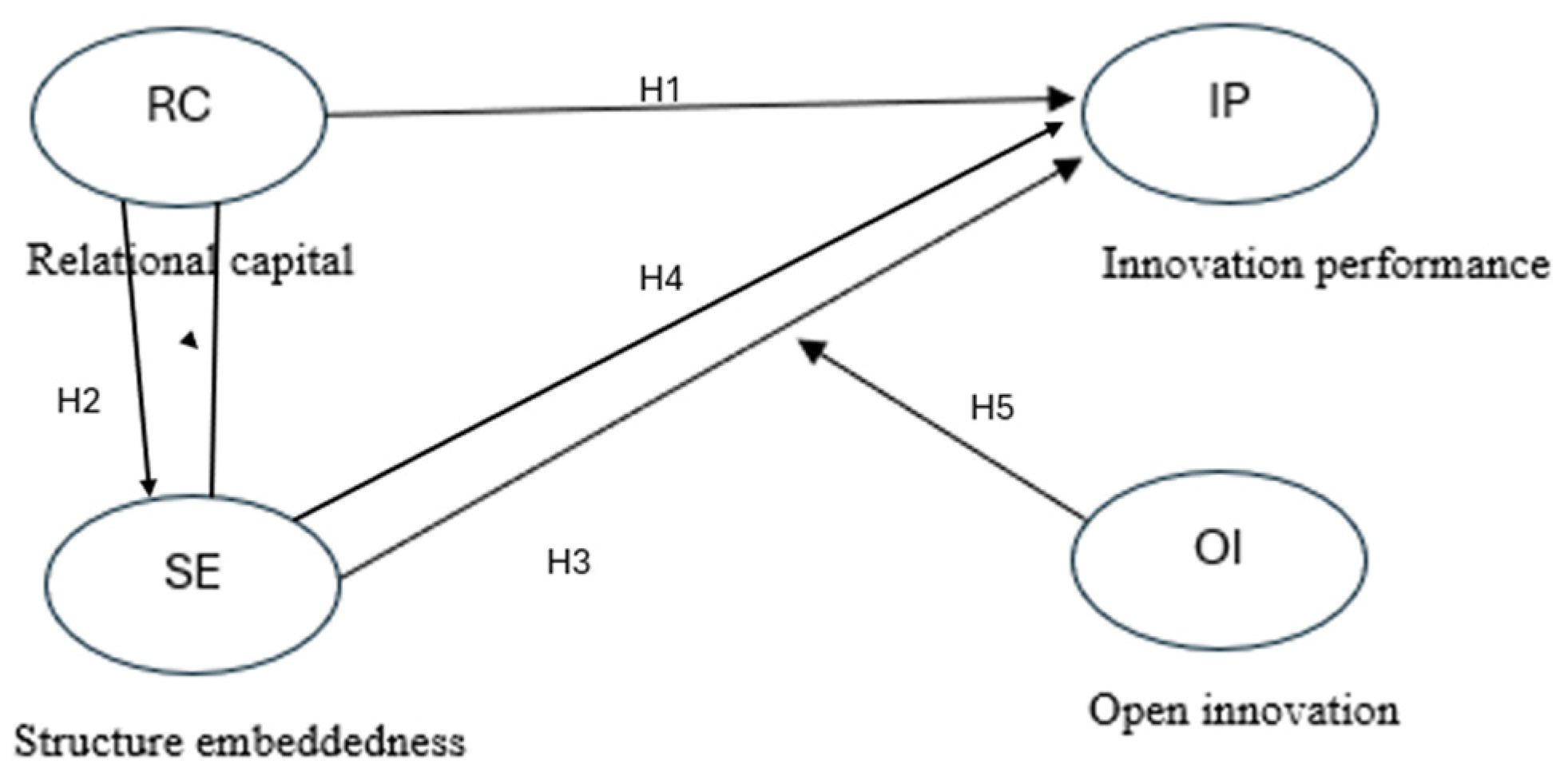
So, the importance of the interaction between collective social capital (from the incubator) and individual social capital (from tenants) is highlighted. Both play a role in increasing the graduation and success of tenants, proving that close relationships are vital for innovation and development (Zhang & Shih, 2023). This shows a significant impact on startup innovation performance that is seen from the development of strong social networks in incubators. From this perspective, the hypothesis can be stated as follows:
H1. 
The relational capital of the incubator positively influences startups’ innovation performance.

2.2. Structure Embeddedness

While relational capital represents the quality of relationships, structural embeddedness represents the configuration of these relationships within a network. In the context of firms, firms’ embeddedness in formal and informal relationships is strengthened by relational capital, which in turn influences the structure of the organization’s network (Osman, 2019). Embeddedness in the entrepreneurial ecosystem or its network is also another important aspect of an incubator organization. Network embeddedness is one of the most important network characteristics, describing the structure of a company’s relationships with other companies, in particular, the extent to which the company is connected to other companies and how these companies relate to each other (Granovetter, 1985; Nahapiet & Ghoshal, 1998; Pauget & Wald, 2018). In a network, the interconnectedness between individuals and organizations is understood as structural embeddedness (Song et al., 2020). Moreover, structural embeddedness, in the context of innovation networks, is defined as the determinant of social relationships from its specific position (Yao et al., 2020). In the context of business incubators, strong networks that develop from previous informal relationships prove crucial in forming effective partnerships within the incubator, enabling them to more easily reach out to various stakeholders and resources (Totojani, 2024). Indonesia’s business incubator ecosystem exhibits distinctive characteristics that shape how relational capital and structural embeddedness function. potentially amplifying the importance of relational capital. Simultaneously, the relatively young and rapidly evolving startup ecosystem means network structures are less institutionalized than in mature economies, creating both opportunities and challenges for structural embeddedness. From this, it can be assumed that the structural characteristics of an incubator on its network can be shaped by its relational capital. From this perspective, the hypothesis can be stated as follows:
H2. 
Incubator relational capital has a positive effect on the incubator’s structure embeddedness.
Innovation performance does not solely depend on relational capital. Although it is important, other key factors such as structural capital and market conditions also play a role in innovation success (Atan & Sofian, 2014). In general, in improving entrepreneurial outcomes, the interaction of structure embeddedness and relational capital is important because it fosters a collaborative environment and facilitates access to resources that ultimately have an impact on business success. This is emphasized in previous studies; in increasing the ability to connect with various stakeholders and resources, building effective partnerships in incubators, it is important to have a strong network through informal relationships (Bibeau et al., 2024). Firms with strong relational ties to suppliers and customers tend to perform better in innovation due to enhanced collaboration and resource sharing (Jian et al., 2011). In line with this study examining digital startups, a previous study also stated that network embeddedness positively influences high-tech enterprise innovation performance (Wang et al., 2023). From this, it can be assumed that the relational and structural embeddedness of incubators can positively affect the innovation performance of their tenants directly or through other relationships. From this perspective, the hypothesis can be stated as follows:
H3. 
The structure embeddedness of the incubator positively influences the startup’s innovation performance.

2.3. Structure Embeddedness Mediation

The literature on the impact of structural embeddedness on innovation performance has yielded mixed results, necessitating an understanding of the underlying mechanisms. On the one hand, structural embeddedness is recognized as a channel for accessing and mobilizing external resources that support innovation (Yang et al., 2022; Pomegbe et al., 2020). On the other hand, overly rigid and closed structures can actually limit innovation, ultimately hindering creativity and adaptability in dynamic markets (Yan et al., 2019). This contradiction implies that the value of structural embeddedness does not stand alone but rather depends on the ability to leverage it.
In this context, the incubator’s relational capital is a crucial determinant. A strong structural network provides the pipeline, but what flows through that pipeline and how its contents are transformed into innovation depends on the relational capital possessed. In other words, structural embeddedness provides access to markets and partners, but it is relational capital that provides the capacity to transform that access into competitive, innovative solutions. Therefore, we hypothesize that structural embeddedness serves as a mediator that translates the value of relational capital into tangible innovation performance:
H4. 
Structural embeddedness of the incubator mediates the relationship between incubator relational capital and start-up innovation performance.

2.4. Structure Embeddedness and Open Innovation

Structural embeddedness solely may have detrimental consequences on incremental innovation; open innovation counteracts these effects by giving businesses the chance to access outside resources and expertise, which lessens the rigidity or redundancy of dense networks (Han et al., 2020). This is confirmed by a previous study by Ge et al. (2023), which states that, especially in disruptive innovation driven by external knowledge exchange, structural embeddedness will be impactful when complemented by open innovation.
In the context of an entrepreneurial ecosystem, especially business incubators or accelerators, the increase in innovation capabilities and growth trajectories of startups within it can be moderated by the presence of open innovation and affect the incubator’s structure embeddedness. Business incubators or accelerators can take advantage of structural embeddedness by encouraging the entire network of diverse ecosystem stakeholders to share knowledge and collaborate with open innovation as a mechanism. Open innovation is described as how firms exchange ideas, knowledge, technology, and expertise through inbound and outbound communication flows to gain a competitive advantage (Chesbrough, 2003). This exchange is facilitated by both outbound and inbound open innovation activities, as proposed by Grant and Baden-Fuller (2004). Inbound open innovation involves access to external resources to strengthen internal resources, while outbound open innovation focuses on the transfer of knowledge both within and outside the organizational environment, as explained by Lichtenthaler (2015). Or as suggested by Diaz-Diaz and de Saá Pérez (2014) and Ferraris et al. (2017), who focus on coupled open innovation, which implements both inbound and outbound activities. Incubators offer networking services that enable innovative collaboration both within the incubator community and with external parties (Cirule, 2022). For incubators, especially those that accommodate startups with limited resources, open innovation serves as a crucial strategy in driving innovation. Previous studies stated that with open innovation, startups can grow faster and more effectively (Bereczki et al., 2022). Previous studies have also thoroughly explained how incubators use open innovation to build collaboration internally among entrepreneurs and externally with stakeholders (Yordanova et al., 2023). Access to abundant resources and knowledge is potentially provided by incubators’ structural embeddedness, which refers to deep and broad network connections with various stakeholders. However, this potential will not be fully realized without startup capabilities and open innovation that facilitate startups in shaping their innovations. This is where open innovation becomes crucial. With open innovation activities, tenant innovation performance will be better than relying only on the incubator’s structure embeddedness. From this perspective, the hypothesis can be stated as follows:
H5. 
Open innovation moderates the incubator’s structure embeddedness toward the tenant’s innovation performance.
Although previous literature has examined relational capital, structure embeddedness, and open innovation, studies integrating all three into a single conceptual model are still very limited, particularly in the context of digital startups in developing countries. Most previous research has focused on the manufacturing or high-tech sectors in developed countries, leaving the social and network mechanisms operating within digital incubation ecosystems in emerging markets poorly understood. This study offers a novel contribution by developing a mediation-moderation model that assesses how an incubator’s relational capital enhances structural embeddedness, which ultimately drives startup innovation performance, and how open innovation strengthens this relationship. By investigating the simultaneous role of incubator’s social capital and intellectual capital and collaboration-based innovation strategies, this research provides important empirical insights for strengthening incubation strategies in facilitating digital startup innovation in Indonesia. For a clearer concept of the research model, it can be described in Figure 1 below.

3. Materials and Methods

This paper uses the quantitative method. The purpose of this study is to gain insight into incubator factors that affect the innovation performance of digital startups for the quantitative analysis based on survey data.

3.1. Data Collection and Sampling Method

Data was gathered through an online and offline survey to startups that were categorized as digital technology-based startups that meet the following criteria: the age of the business is less than 2 years, has scalable business model on digital products or services and actively enrolled in the business incubation program at the time of the survey. To capture the diversity of development stages in the digital ecosystem, no restrictions were imposed on the duration of incubation participation. Using a purposive sampling method, the survey was conducted in 2024 on the startups that met the criteria. Purposive sampling was used to ensure that respondents were founders or managers of digital startups actively participating in incubation programs, a demographic that is not accessible through random sampling due to the large number of non-digital startup businesses within the incubator. The questionnaire was distributed to over 250 early-stage digital startups that have a business category profile in agritech, digital food ecosystem, content creator, ecommerce, fintech, digital tourism, edutech, media, healthtech, game developer, agrotech, digital logistics, and general categories. Digital-based startups with other categories were also collected in the survey conducted. Of these numbers, 201 startups provided complete and usable responses. The source of data or research information is collected through database sources obtained from the internet, based on incubator data that is based in the greater Jakarta area, Banten, and West Java province, Indonesia, from the official website of the Indonesian Ministry of Cooperatives and SMEs Indonesia, and other secondary data. This region was selected, referring to previous data that many incubators and technology-based startups have emerged and a good ecosystem has been formed in this area, especially in the Jakarta area, which has a good startup ecosystem and is one of the developing ecosystems in Asia (Startupgenome, 2023). Each participant filled out the questionnaire voluntarily after receiving a complete explanation of the purpose of the study, as well as a guarantee that their data and identity would be kept completely confidential. To maintain individual anonymity, all data collected was analyzed in aggregate.

3.2. Variable Measurement

All main constructs are measured as reflective latent variables using 5-point Likert scales, ranging from “strongly disagree” to “strongly agree.” No dummy variables were used. No control variables were included in the main model to maintain simplicity, though we acknowledge this limitation. The questionnaire was adapted from several previous studies; the instrument used to measure innovation performance was developed following previous studies by Abdallah et al. (2019) that define innovation performance as new product development speed, on-time product introduction, and new product innovativeness, and combined with the measurement by Paladino (2007) for measuring digital innovation. This combination of measurements was required because prior studies mostly focused on traditional or manufacturing sectors and did not sufficiently reflect digitally oriented outputs for early-stage digital startup in incubator. Another variable, the relational capital of the incubator defined as all forms of formal and informal interactions and relationships within and outside the incubator with all stakeholders. In this study, the measurement of incubator relational capital was adapted from previous studies by Indiran et al. (2017). And the structure embeddedness is measured by centrality, reach, and structural hole, adapted from previous research by Burt (2001). The original scales were adjusted and formulated to suit the collaboration structure between incubators, startups and ecosystem actors. The statements used in this questionnaire were chosen because they were appropriate to the context and objectives of the study. The complete questionnaire used in this study is openly accessible via Zenodo (Appendix B).

3.3. Data Analysis Approach

The collected data were analyzed using a combination of descriptive statistics and structural equation modeling to explore the relationship between the incubator’s relational capital and structural embeddedness, as well as the tenant’s innovation performance. The data was analyzed using partial least squares structural equation modeling with the SmartPLS software version 3.2.9. The analysis includes 201 complete observations. PLS-SEM with 5000 bootstrap samples was used for inference. This procedure effectively handles the complexity of simultaneous mediation and moderation without the need for manual residual extraction. The two reasons that partial least squares were used in this study are as follows: First, partial least squares are frequently utilized within current management research to test for accurate model fitting and to conduct confirmatory research. Second, partial least squares does not need an equal distribution of residuals. This study relies on partial least squares as a useful tool that does not require strict assumptions about the distribution of residuals and allows for accurate model fitting.

3.4. Model Specification

To test our hypotheses, we specify two main equations
Main Effects Model:
IP = β0 + β1(RC) + β2(SE) + β3(OI) + β4(SE × OI) + ε
Mediation Model:
SE = α0 + α1(RC) + ε
IP = γ0 + γ1(RC) + γ2(SE) + ε
where
IP = Innovation performance of startup
RC = Relational capital of the incubator
SE = Structure embeddedness of the incubator
OI = Open innovation of startup
SExOI = Interaction term for moderation
ε = Error term

4. Results

4.1. Descriptive Statistics

Descriptive statistics (Table 1) show that all constructs exhibit moderately high mean scores (3.93–4.09), indicating that respondents generally perceived strong incubator networking support and engagement in innovation activities.

4.2. Evaluation of the Measurement Model

4.2.1. Validity and Reliability Test

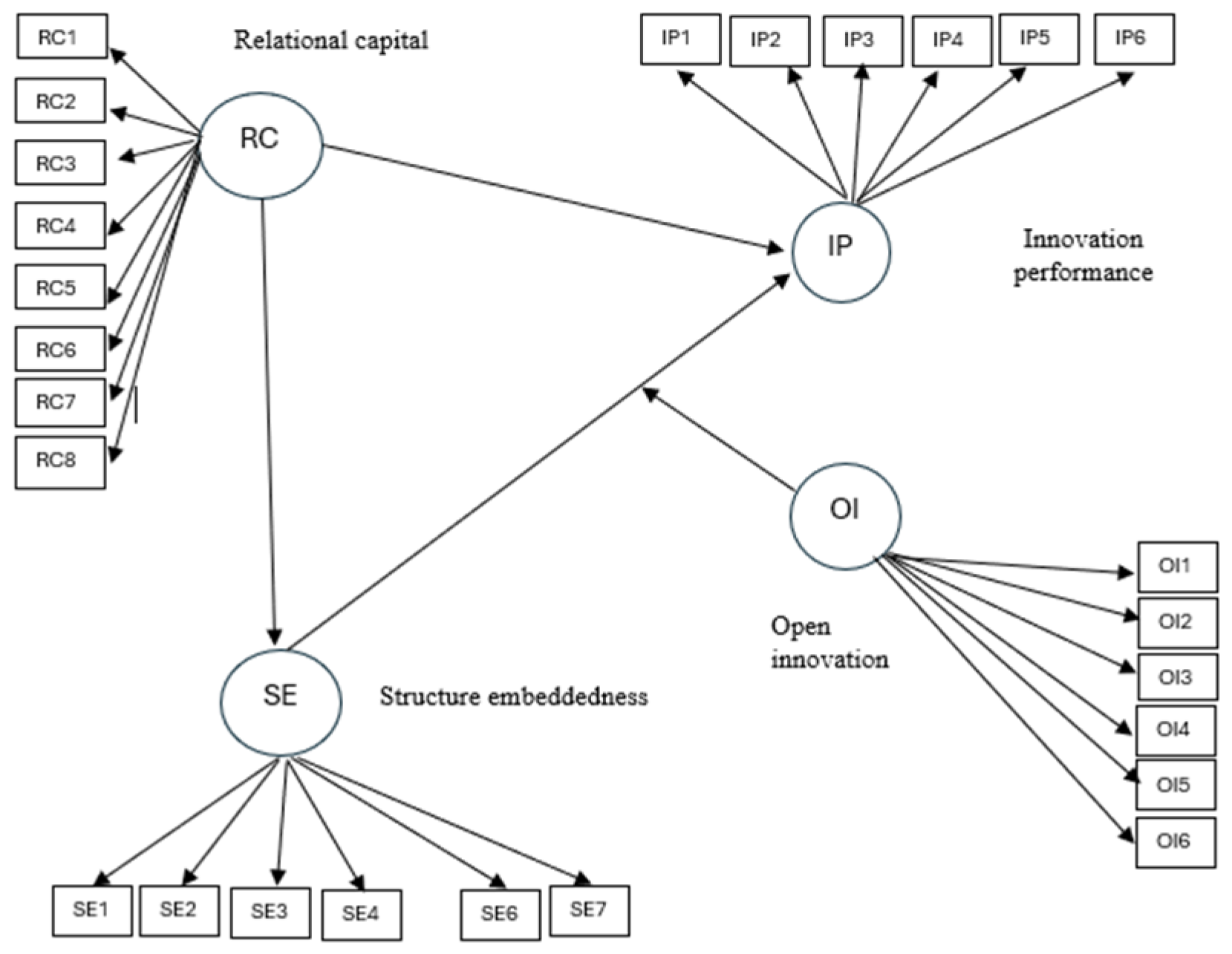
The Cronbach test was performed to determine the data’s reliability of the indicator data for each variable (see Figure 2). According to Nunnally and Bernstein (1994). Reliable findings are those with α values greater than 0.7. The results (see Table A1 in the Appendix A) show that the acquired data are reliable.
Confirmatory factor analysis (CFA) was conducted to test construct validity. According to Hair et al. (2019). Convergent validity can be assessed based on loading factors, composite reliability, and extracted variance. In this test, after the SE 5 indicator was deleted, the CFA results showed that all items had loading factors greater than 0.50, indicating that the items measured the same construct and supported the convergent validity of the measurement scale. Detailed results are presented in Table A1 in Appendix A.

4.2.2. Discriminant Validity

Discriminant validity is also calculated; the extent to which a latent construct is predominantly dissimilar from other latent constructs is signified by discriminant validity (Hair et al., 2019). The Fornell–Larcker criterion and heterotrait–monotrait (HTMT) ratio method were used to assess the discriminant validity of the construct. Based on the Fornell–Larcker criterion, all four constructs in your model (Open Innovation, Innovation Performance, Relational Capital, and Structure embeddedness) demonstrate discriminant validity (see Appendix A Table A2). This suggests that each construct is sufficiently distinct and measures a unique concept.
The heterotrait–monotrait (HTMT) ratio for the type A composite was also calculated. The HTMT ratio was used to assess the discriminant validity between indicators of the same composite and between indicators of different composites. For discriminant validity to apply, it is required that the HTMT ratio value be less than 0.9. The data demonstrate that all values are less than 0.9 (see Appendix A, Table A3).
The recommendations of Diamantopoulos et al. (2008) were followed to validate the variable. It was found that no collinearity issues with the indicators for any of the variables. When the variance inflation factor (VIF) is larger than or equal to 5, collinearity issues may occur. In this study, no problems of collinearity were observed (see Appendix A, Table A4).

4.3. Evaluation of the Structural Model

In PLS-SEM, R-squared values, representing the proportion of variance in endogenous constructs explained by exogenous constructs, are crucial for assessing the structural model. While the acceptable range varies depending on the research context, a general guideline is an R-squared value of at least 0.10 (Ozili, 2023). However, Chin (1998) provides a more specific categorization: substantial (0.67), moderate (0.33), and weak (0.19). Thus, from the results shown in Table 2, the model can be said to be moderate.
As shown in Table 3, this analysis explores the influence of an incubator’s relational capital (RC) and structural embeddedness (SE) on tenant innovation performance (IP). The findings provide strong support for all hypothesized relationships except Hypothesis 3 and Hypothesis 4.
Firstly, a positive and statistically significant relationship exists between relational capital and innovation performance (path coefficient = 0.354, p-value = 0.000), thus H1 is supported. This relationship has a moderate and positive effect. This suggests that when an incubator possesses strong relationships with external actors, its tenants are more likely to achieve higher levels of innovation. Therefore, the incubator’s relational capital can facilitate tenants to develop their innovation. On the other hand, the standardized path coefficient of the incubator’s relational capital to the structure embeddedness is 0.771, with p-value = 0.000, H2 supported. Hence, the relational capital of the incubator also positively and significantly impacts structural embeddedness. Although a correlation exists between Relational capital and structure embeddedness, the VIF values were below 5, signifying that multicollinearity does not significantly impair the model’s validity (Appendix A). This indicates that an incubator’s rich network connections contribute to its being well-integrated within the innovation ecosystem. The relational relationship to structure embeddedness stated in hypothesis 2 shows that the incubator’s relational capital influence positively correlated with the level of incubator structure embeddedness. Relational capital is a major driver of structure embeddedness; strong networks create stronger ecosystem embeddedness. This suggests that a strong relational network helps incubators build closer relationships with various relevant parties in the innovation and business ecosystem.
In hypothesis 3, structural embeddedness itself does not have a significant impact on tenant innovation performance (path coefficient = −0.013, p-value = 0.903). This implies that when an incubator is well-positioned in a wider innovation network, its tenants benefit from access to valuable resources and knowledge, but do not necessarily increase their innovation performance. The relationship between structure embeddedness and innovation performance was found to be insignificant; this result is somewhat surprising because higher structure embeddedness was expected to contribute to better innovation performance. Too many embedded tis may slow adaptation, a common issue in rapidly evolving digital sectors. Other factors may be more dominant in determining innovation performance; the structural position of the incubator does not affect the innovation of the incubator’s tenant.
Interestingly, the analysis also reveals an indirect effect of relational capital on innovation performance mediated by structural embeddedness (path coefficient = 0.010, p-value = 0.904); hypothesis 4 is rejected. Although the incubator’s structural position in the innovation network is connected in terms of centrality, reach, and good structural holes, it does not mediate the relationship between the incubator’s relational capital and the innovation performance of its tenants. Although embeddedness in the innovation ecosystem can provide easier access to resources, information, and market opportunities for startups in the incubator, this formal structural position does not mediate the incubator’s relational capital toward innovation performance. To verify the indirect effect (H4), we compared the total effect of Relational Capital (RC) on Innovation performance (IP) (path coeff = 0.344) with the direct effect (path coeff = 0.354). This means that the difference between total effect and direct effect is very small or almost non-existent. Moreover, the calculated indirect effect was found to statistically insignificant (p value = 0.904). This confirms that while RC has strong direct impact on IP, this relationship is not mediated by SE in this specific context.
In this study, the analysis of the moderating role of open innovation carried out by startups in an incubator on the relationship between the incubator’s structural embeddedness and the innovation performance of its tenants, as stated in Hypothesis 5, the statistical results show a path coefficient of 0.1 with a p-value of 0.017. This indicates that Hypothesis 5 is supported. Even it has a small effect, open innovation activates the value structural embeddedness for innovation.

5. Discussion

The finding shows that the incubator’s relational capital has a significant effect on the innovation performance of the tenant. The result is consistent with earlier studies that mention this relationship. Relational capital is one of the intellectual capitals that can improve innovation performance (Agostini et al., 2017; Ali et al., 2021). Higher strength of intellectual capital, in terms of human capital, innovation capital, and relational capital, exhibits a significantly higher radical and incremental innovation performance.
The absence of strong relational capital can hinder the success of new business start-ups. A set of intangible relational assets has an impact on the initial success of new business start-ups. (Hormiga et al., 2011). Without business incubators, start-up development faces significant hurdles. These challenges include overcoming organizational and financial difficulties, and a lack of relational capital can further hinder progress (Paoloni & Modaffari, 2022). The ability to innovate, satisfaction, and long-term stability of incubated companies are positively impacted by incubator intellectual capital, ultimately leading to increased competitive success (Rodrigues et al., 2022). Relational capital enhances innovation performance primarily through trust-based knowledge sharing, resource co-creation. In incubators, this manifests as informal mentorship, collaborative prototyping, and rapid feedback loops with ecosystem actors.
This study found that the higher the relational capital owned by the incubator, the higher its structural embeddedness. Incubators with high structural embeddedness provide a rich base for exploring new ideas. Although in this study, structural embeddedness does not affect innovation performance in contrast to previous studies (Yang et al., 2022), this may be due to excessive embeddedness, where tight ties hinder, rather than enable innovation. In the context of digital startups, agility and external knowledge sources may outweigh the benefits of deep structural ties. An incubator might be centrally positioned but connected to outdated or irrelevant knowledge sources for digital innovation.
On the other hand, open innovation allows start-ups to exploit these ideas more effectively, often through collaboration and external resources that are in line with previous studies related to network embeddedness by Dogbe et al. (2020) which stated that SMEs with high degrees of innovation openness performed much better when it comes to innovation.
The synergy between incubator-supported exploration and open innovation-driven exploitation results in superior innovation performance. In addition, open innovation activities in incubators can strengthen start-ups to innovate and strengthen the incubator structure with an innovation ecosystem that provides a conducive environment for start-ups to grow.

6. Conclusions

This study investigates the link between relational capital and the innovation performance of start-ups in business incubators located in Indonesia, especially in West Java and Jakarta areas with good entrepreneurial ecosystems. The study aims to examine how relational capital and the mediating role of incubator structure embeddedness affect the innovation of start-ups growing in them. The results show a positive effect of incubator relational capital on the incubator structure embeddedness and innovation performance of start-ups participating in the incubation program. Based on the analysis and discussion, the study has also concluded that the mediation role of the structure embeddedness of the incubator is not found. The incubator should strengthen its network ties to other actors in the entrepreneurial ecosystem. Besides that, the position and the centrality of the incubator should be noted as important factors to support the incubated firm’s innovation performance, with the moderation of open innovation activity in the incubator.
The method of measuring relational capital and structure embeddedness in this study has been a limitation. Each dimension can be established independently to evaluate its impact on innovation performance and to assess the moderating impact of each dimension of open innovation. The findings may be influenced by Indonesia’s culture and its rapidly evolving digital startup ecosystem, which may limit generalizability to countries with different cultural settings or a more mature innovation environment. Second, the study examines only digital-based startups in early growth phases within selected regions (Jakarta, Banten, and West Java), reducing applicability to non-digital sectors or more established startups. The internal influences that startups have in achieving their innovation performance have also been ignored in this study. Further research can be conducted by comparing different stages of startup development and industry types to examine the extent to which open innovation plays a role in driving change and growth. Future research should also investigate what specific skills startups need to succeed in developing innovations, given that each product or service requires different skills. Different areas and types of business incubators could also be the focus of further research to understand how they contribute to fostering sustainable innovation.

6.1. Theoretical Contribution

This study provides several major theoretical contributions. Previous studies on relational capital and innovation performance have mainly focused on the direct relationship, ignoring the potential influence of mediating variables. Although the mediating role examined in this study was not found, this study addresses this gap by showing the interaction of structural embeddedness variables in this relationship. A strong network position in the ecosystem is further strengthened by the presence of open innovation activities in incubators. This study extends relational capital and network theory by integrating open innovation as a boundary condition in incubator settings. This study on the mediating effect of structural embeddedness enhances and deepens the theory of relational capital by emphasizing the importance of external connections and the interaction of internal and external knowledge resources in driving innovation.

6.2. Practical Implications

The findings of the study can have practical implications for incubator managers. Besides cultivating strong relationships with external stakeholders to enhance tenant innovation, incubators should focus on open innovation activity that strengthens their strategic positioning themselves within the innovation ecosystem to maximize their impact. An incubator can create a more fertile environment for tenant growth and innovation by building a strong network. Incubator managers should foster trust-based ties and a collaborative network while encouraging startups to adopt open innovation practices.
Moreover, the indirect impact of relationships should not be ignored. Strong connections not only benefit tenants directly but also indirectly strengthen their innovation capabilities through better integration into the innovation landscape. Policy initiatives should focus on creating robust innovation ecosystems that facilitate collaboration and open innovation activities for knowledge exchange among various stakeholders.

Author Contributions

Conceptualization, A.B.; Methodology, A.B., I.G.S., A.F. and S.B.A.; Software, A.B.; Validation, A.F. and S.B.A.; Formal analysis, A.B., I.G.S., A.F. and S.B.A.; Investigation, A.B.; Resources, A.B.; Data curation, A.B., A.F. and S.B.A.; Writing—original draft, A.B.; Writing—review & editing, A.B.; Visualization, A.B.; Supervision, I.G.S., A.F. and S.B.A.; Project administration, A.B. All authors have read and agreed to the published version of the manuscript.

Funding

This research received no external funding.

Institutional Review Board Statement

This study was conducted in accordance with the Declaration of Committee: BINUS Business School Research Ethics and Publication, Bina Nusantara University Code: 220/HoP.DRM/XI/2025 Date: 20 August 2025.

Informed Consent Statement

Informed consent was obtained from all subjects involved in the study.

Data Availability Statement

The data presented in this study are openly available in [Survey data] [https://doi.org/10.5281/zenodo.17408142].

Conflicts of Interest

The authors declare no conflicts of interest. The funders had no role in the design of the study; in the collection, analyses, or interpretation of data; in the writing of the manuscript; or in the decision to publish the results.

Appendix A

Table A1. Confirmatory Factor Analysis.
VariableItemConvergent ValidityCronbach AlphaMulticollinearity
Cross LoadingComposite ReliabilityAVEVIF
Innovation
performance
IP10.8180.9130.601 **0.8902.653 ****
IP20.7952.653 ****
IP30.6452.479 ****
IP40.7722.944 ****
IP50.8052.354 ****
IP60.7472.177 ****
IP70.8282.696 ****
Relational
Capital
RC10.5880.9250.610 **0.9071.972 ****
RCI20.7942.520 ****
RCI30.8313.043 ****
RCI40.8242.595 ****
RCI50.7702.229 ****
RCE60.8333.119 ****
RCE70.7922.991 ****
RCE80.7902.788 ****
Structure
Embeddedness
SE10.8020.8700.537 **0.8102.819 ****
SE20.8373.543 ****
SE30.7971.998 ****
SE40.8142.477 ****
SE5−0.079 *1.020 ****
SE60.6792.108 ****
SE70.8072.151 ****
Open
Innovation
IOI10.8330.9240.671 **0.9022.406 ****
IOI20.8292.861 ****
IOI30.8092.427 ****
IOI40.8482.963 ****
IOI50.8573.092 ****
IOI60.7311.687 ****
Note: N = 201, * cross loading < 0.5; ** AVE—Average Variance Extracted > 0.5; **** VIF—Variance Inflation factor 1 < VIF < 5.
Table A2. Fornell–Larcker Criterion.
Open InnovationInnovation PerformanceRelational CapitalStructure
Embeddedness
Open innovation0.8190.656
Innovation performance0.6560.775
Relational capital0.6090.6390.781
Structure embeddedness0.5330.5260.7710.733
Note: N = 201. All diagonal values are higher than their corresponding inter-construct correlations, indicating adequate discriminant validity.
Table A3. HTMT ratio.
Open
Innovation
Innovation
Performance
Moderating Effect of OI on SE-IPRelational Capital
Open Innovation
Innovation performance0.693
Moderating Effect of Open Innovation on SE-IP0.3390.160
Relational capital0.6700.6920.130
Structure embeddedness0.5950.5570.0250.859
Note: N = 201; OI—Open Innovation; IP—Innovation Performance; SE—Structure embeddedness. All HTMT ratio < 0.90.
Table A4. VIF Values.
Open InnovationInnovation PerformanceStructure Embeddedness
Open innovation 1.909
Moderating Effect OI on SE-IP1.190
Relational capital 2.8651.000
Structure embeddedness 2.549
Note: N = 201. VIF < 5.

Appendix B

Questionnaire can be seen at https://doi.org/10.5281/zenodo.17873576 (accessed on 10 December 2025).

References

  1. Abdallah, A. B., Dahiyat, S. E., & Matsui, Y. (2019). Lean management and innovation performance: Evidence from international manufacturing companies. Management Research Review, 42(2), 239–262. [Google Scholar] [CrossRef]
  2. Agostini, L., Nosella, A., & Filippini, R. (2017). Does intellectual capital allow improving innovation performance? A quantitative analysis in the SME context. Journal of Intellectual Capital, 18(2), 400–418. [Google Scholar] [CrossRef]
  3. Ali, M. A., Hussin, N., Haddad, H., Al-Araj, R., & Abed, I. A. (2021). Intellectual capital and innovation performance: Systematic literature review. Risks, 9(9), 170. [Google Scholar] [CrossRef]
  4. Atan, N. M., & Sofian, S. (2014, December 1–2). Implication of relational capital and structural capital on product innovation. International Conference on Postgraduate Research 2014 (ICPR 2014), Kuala Lumpur, Malaysia. [Google Scholar]
  5. Bereczki, I., Füller, J., & Stănculescu, O. (2022). The perfect match! Open innovation platforms-assets for collaborative start-ups. International Journal of Entrepreneurship and Innovation Management, 26(3–4), 133–160. [Google Scholar] [CrossRef]
  6. Bibeau, J., Meilleur, R., & St-Jean, É. (2024). To formalize, or not to formalize, business incubators’ networks: That is not the question. Technovation, 130, 102904. [Google Scholar] [CrossRef]
  7. Blank, S. (2010). What’s a startup? First principles. Steve Blank. [Google Scholar]
  8. Bontis, N. (1998). Intellectual capital: An exploratory study that develops measures and models. Management Decision, 36(2), 63–76. [Google Scholar] [CrossRef]
  9. Burt, R. S. (2001). The social capital of structural holes. In The new economic sociology: Developments in an emerging field (pp. 148–190). Russell Sage Foundation. [Google Scholar]
  10. Calza, F., Dezi, L., Schiavone, F., & Simoni, M. (2014). The intellectual capital of business incubators. Journal of Intellectual Capital, 15(4), 597–610. [Google Scholar] [CrossRef]
  11. Chesbrough, H. W. (2003). Open innovation: The new imperative for creating and profiting from technology. Harvard Business Press. [Google Scholar]
  12. Chin, W. W. (1998). The partial least squares approach to structural equation modeling. In Modern methods for business research/lawrence. Erlbaum Associates. [Google Scholar]
  13. Chowdhury, F., & Audretsch, D. B. (2024). Paradoxes of accelerator programs and new venture performance: Do varieties of experiences make a difference? Small Business Economics, 62(1), 381–409. [Google Scholar] [CrossRef]
  14. Cirule, I. (2022, May 11–13). Business incubation guidelines and open innovation. 2022 International Conference “ECONOMIC SCIENCE FOR RURAL DEVELOPMENT” (No 56, Vol. 1, pp. 435–446), Jelgava, Latvia. [Google Scholar] [CrossRef]
  15. Diamantopoulos, A., Riefler, P., & Roth, K. P. (2008). Advancing formative measurement models. Journal of Business Research, 61(12), 1203–1218. [Google Scholar] [CrossRef]
  16. Diaz-Diaz, N. L., & de Saá Pérez, P. (2014). The interaction between external and internal knowledge sources: An open innovation view. Journal of Knowledge Management, 18(2), 430–446. [Google Scholar] [CrossRef]
  17. Ding, K., & Li, H. (2023). Exploring the mediating role of innovation behavior: Unraveling the impact of social capital on entrepreneurial performance in university business incubators. Journal of System and Management Sciences, 13(6), 647–666. Available online: https://api.semanticscholar.org/CorpusID:265448293 (accessed on 20 June 2024). [CrossRef]
  18. Dogbe, C. S. K., Tian, H., Pomegbe, W. W. K., Sarsah, S. A., & Otoo, C. O. A. (2020). Effect of network embeddedness on innovation performance of small and medium-sized enterprises: The moderating role of innovation openness. Journal of Strategy and Management, 13(2), 181–197. [Google Scholar] [CrossRef]
  19. Dorrego, P. F., Costa, R. V., & Fernández, C. F.-J. (2014). Product Innovation and Relational Capital: Evidence From Portugal. The Electronic Journal of Knowledge Management, 11(4), 295–308. [Google Scholar]
  20. Ferraris, A., Santoro, G., & Bresciani, S. (2017). Open innovation in multinational companies’ subsidiaries: The role of internal and external knowledge. European Journal of International Management, 11(4), 452–468. [Google Scholar] [CrossRef]
  21. Ge, C., Lv, W., & Wang, J. (2023). The Impact of Digital Technology Innovation Network Embedding on Firms’ Innovation Performance: The Role of Knowledge Acquisition and Digital Transformation. Sustainability, 15(8), 6938. [Google Scholar] [CrossRef]
  22. Granovetter, M. (1985). Economic Action and Social Structure: The Problem of Embeddedness. American Journal of Sociology, 91(3), 481–510. [Google Scholar] [CrossRef]
  23. Grant, R. M., & Baden-Fuller, C. (2004). A knowledge accessing theory of strategic alliances. Journal of Management Studies, 41(1), 61–84. [Google Scholar] [CrossRef]
  24. Hair, J. F., Risher, J. J., Sarstedt, M., & Ringle, C. M. (2019). When to use and how to report the results of PLS-SEM. European Business Review, 31(1), 2–24. [Google Scholar] [CrossRef]
  25. Han, S., Lyu, Y., Ji, R., Zhu, Y., Su, J., & Bao, L. (2020). Open innovation, network embeddedness and incremental innovation capability. Management Decision, 58(12), 2655–2680. [Google Scholar] [CrossRef]
  26. Hormiga, E., Batista-Canino, R. M., & Sánchez-Medina, A. (2011). The Impact of Relational Capital on the Success of New Business Start-Ups. Journal of Small Business Management, 49(4), 617–638. [Google Scholar] [CrossRef]
  27. Indiran, L., Khalifah, Z., & Ismail, K. (2017). A model for intellectual capital of business incubators. Advanced Science Letters, 23(9), 8450–8457. [Google Scholar] [CrossRef]
  28. Jian, Z., Wu, Z., & Liu, R. (2011). Impacts of Network Embeddedness Structure on Innovation Performance. Journal on Innovation and Sustainability RISUS, 2(2), 25. [Google Scholar] [CrossRef]
  29. Lichtenthaler, U. (2015). A note on outbound open innovation and firm performance. R and D Management, 45(5), 606–608. [Google Scholar] [CrossRef]
  30. Liu, H., & Li, L. (2010, November 26–28). Modeling and measuring intellectual capital of business incubator. Proceedings—3rd International Conference on Information Management, Innovation Management and Industrial Engineering, ICIII 2010 (Vol. 4, pp. 79–82), Washington, DC, USA. [Google Scholar] [CrossRef]
  31. Loganathan, M., & Bala Subrahmanya, M. H. (2021). Technological outcome achievements by start-ups at university-based incubators: An empirical analysis in the Indian context. Technology Analysis and Strategic Management, 34(9), 1004–1019. [Google Scholar] [CrossRef]
  32. Macchi, M., Rizzo, U., & Ramaciotti, L. (2014). From services dealers to innovation brokers: How open innovation paradigm affects incubator activities. Evidence from Italy. Journal of Intellectual Capital, 15(4), 554–575. [Google Scholar] [CrossRef]
  33. Nahapiet, J., & Ghoshal, S. (1998). Social Capital, Intellectual Capital, and the Organizational Advantage. The Academy of Management Review, 23(2), 242–266. [Google Scholar] [CrossRef]
  34. Nunnally, J. C., & Bernstein, I. H. (1994). Psychometric theory. McGraw-Hill. [Google Scholar]
  35. Osman, L. H. B. (2019). The Impact of Network Centralization on Relational Capital. Jurnal Ekonomi Bisnis Dan Kewirausahaan, 8(1), 50. [Google Scholar] [CrossRef]
  36. Ozili, P. K. (2023). The acceptable R-square in empirical modelling for social science research. In Social research methodology and publishing results: A guide to non-native english speakers (pp. 134–143). IGI Global. [Google Scholar] [CrossRef]
  37. Paladino, A. (2007). Investigating the drivers of innovation and new product success. Journal of Product Innovation Management, 24, 534–553. [Google Scholar] [CrossRef]
  38. Paoloni, P., & Modaffari, G. (2022). Business incubators vs start-ups: A sustainable way of sharing knowledge. Journal of Knowledge Management, 26(5), 1235–1261. [Google Scholar] [CrossRef]
  39. Pauget, B., & Wald, A. (2018). Creating and implementing organizational innovation. European Journal of Innovation Management, 21(3), 384–401. [Google Scholar] [CrossRef]
  40. Petrucci, F. (2018). The incubation process of mid-stage startup companies: A business network perspective. IMP Journal, 12(3), 544–566. [Google Scholar] [CrossRef]
  41. Pomegbe, W. W. K., Li, W., Dogbe, C. S. K., & Otoo, C. O. A. (2020). Enhancing the innovation performance of small and Medium-sized enterprises through network embeddedness. Journal of Competitiveness, 12(3), 156–171. [Google Scholar] [CrossRef]
  42. Ramírez-Solis, E. R., Llonch-Andreu, J., & Malpica-Romero, A. D. (2022). How beneficial are relational capital and technology orientation for innovation? Evidence from Mexican SMEs. International Journal of Innovation Studies, 6(1), 1–10. [Google Scholar] [CrossRef]
  43. Rank, O. N. (2014). The effect of structural embeddedness on start-up survival: A case study in the German biotech industry. Journal of Small Business and Entrepreneurship, 27(3), 275–299. [Google Scholar] [CrossRef]
  44. Rodrigues, M. C. M., Barbosa, R. P., Barbieri da Rosa, L. A., Sousa, M. J., & Zavatti Campos, W. Y. Y. (2022). Intellectual Capital of Technology-Based Incubators. Administrative Sciences, 12(4), 191. [Google Scholar] [CrossRef]
  45. Ruan, A., & Chen, J. (2017). Does formal knowledge search depth benefit Chinese firms’ innovation performance? Effects of network centrality, structural holes, and knowledge tacitness. Asian Journal of Technology Innovation, 25(1), 79–97. [Google Scholar] [CrossRef]
  46. Song, M., Jung, K., Ki, N., & Feiock, R. C. (2020). Testing structural and relational embeddedness in collaboration risk. Rationality and Society, 32(1), 67–92. [Google Scholar] [CrossRef]
  47. Startupgenome. (2023). The global startup ecosystem report. Available online: https://startupgenome.com/insights#reports (accessed on 10 June 2024).
  48. Totojani, A. (2024). Do the networks always reveal the truth? The case of tripartite business incubator in Kenya, Uganda and Zambia. Journal of Enterprising Communities: People and Places in the Global Economy, 18(3), 601–623. [Google Scholar] [CrossRef]
  49. Wang, C., Ren, X., Jiang, X., & Chen, G. (2023). In the context of mass entrepreneurship network embeddedness and entrepreneurial innovation performance of high-tech enterprises in Guangdong province. Management Decision, 62(8), 2532–2557. [Google Scholar] [CrossRef]
  50. Yan, Y., Zhang, J., & Guan, J. (2019). Network embeddedness and innovation: Evidence from the alternative energy field. IEEE Transactions on Engineering Management, 67(3), 769–782. [Google Scholar] [CrossRef]
  51. Yang, B., Li, X., & Kou, K. (2022). Research on the influence of network embeddedness on innovation performance: Evidence from China’s listed firms. Journal of Innovation and Knowledge, 7(3), 100210. [Google Scholar] [CrossRef]
  52. Yao, L., Li, J., & Li, J. (2020). Urban innovation and intercity patent collaboration: A network analysis of China’s national innovation system. Technological Forecasting and Social Change, 160, 120185. [Google Scholar] [CrossRef]
  53. Yordanova, Z., Charis, G., & Acheampong, P. (2023). Openness while incubating: How do incubators apply open innovation strategies for supporting startups? SSRN. Available online: https://ssrn.com/abstract=4659617 (accessed on 10 December 2025). [CrossRef]
  54. Zhang, L., & Shih, T. (2023). Collective and individual social capital and the impact on incubator tenants’ graduation. Journal of the Knowledge Economy, 14(3), 2692–2722. [Google Scholar] [CrossRef]
  55. Zheng, X., Feng, Y., Feng, Y., Yu, Y., Meng, Y., & Pan, Y. (2019, July 13–15). Research on influencing factors of incubating firms’ performance by incubators of large companies. 2019 16th International Conference on Service Systems and Service Management, ICSSSM 2019 (pp. 1–6), Shenzen, China. [Google Scholar] [CrossRef]
Figure 1. Conceptual research model.
Admsci 16 00035 g001
Figure 2. Variable and indicator.
Admsci 16 00035 g002
Table 1. Summary statistics of Latent Variables.
ConstructNo of ItemsMeanStandard DeviationScaleN
Innovation performance (IP)73.930.71Likert 1–5201
Relational capital (RC)84.080.63Likert 1–5201
Structure Embeddedness (SE)73.970.69Likert 1–5201
Open Innovation (OI)64.090.74Likert 1–5201
Note: Mean and Standard deviation are computed from item-level descriptive statistics.
Table 2. Structural model.
RR-Squared Adjusted
IP0.5390.530
SE0.5940.592
Note: N = 201. IP—Innovation Performance; SE—Structure Embeddedness. R2 values indicate moderate explanatory power (Chin, 1998).
Table 3. Relation between variables in the research model.
HypothesisProposed EffectPath CoefficientT Valuep ValueResult
RC → IP (H1)+0.3543.6450.000 *supported
RC → SE (H2)+0.77122.2900.000 *supported
SE → IP (H3)-0.0130.1210.903Not supported
RC → SE → IP(H4)-0.0100.1200.904Not supported
Moderation OI on
SE-IP (H5)
+0.1002.3980.017 *supported
OI → IP+0.4946.0750.000 *significant
Note: N = 201. p < 0.05 *; RC—Relational capital; SE—Structure Embeddedness; IP—Innovation performance; OI—Open innovation.
Disclaimer/Publisher’s Note: The statements, opinions and data contained in all publications are solely those of the individual author(s) and contributor(s) and not of MDPI and/or the editor(s). MDPI and/or the editor(s) disclaim responsibility for any injury to people or property resulting from any ideas, methods, instructions or products referred to in the content.