Review

From Buzzword to Framework: A Systematic Review of the Massive Transformative Purpose Concept


Les Roches Global Hospitality Education, Bluche, Rte des Moulinettes 2, 3975 Crans-Montana, Switzerland
Adm. Sci. 2025, 15(12), 472; https://doi.org/10.3390/admsci15120472 (registering DOI)
Submission received: 7 August 2025 / Revised: 16 September 2025 / Accepted: 22 September 2025 / Published: 30 November 2025

Abstract

In the current disruptive business landscape, there is a disconnect between the practical traction of digital revolution approaches and their academic rigour, exacerbated by a lack of collaboration between practitioners and academics. In this study, this issue is addressed by systematically analysing the Massive Transformative Purpose (MTP) concept for Exponential Organisations (ExOs). The significant success of the MTP among practitioners highlights an urgent need to translate this construct into management science to gain a deeper understanding. Through a systematic literature review guided by the PRISMA framework and Gioia methodology, this study synthesises available knowledge from the concept’s original authors and the practitioner community. The findings reveal that the MTP is central to an ExO’s brand core, profoundly influencing its internal and external dimensions and its competitive advantage. This study makes several theoretical contributions as follows: (i) refining the definition of the MTP; (ii) providing a data structure that links antecedents, dimensions, and outcomes; and (iii) offering a framework to guide both academic research and managerial practice.

1. Introduction

The so-called “AI World” (Birkinshaw, 2018) reveals traits of volatility, uncertainty, complexity, and ambiguity, making it a “VUCA world” (Bennett & Lemoine, 2014). Attempts to explain the spirit of the present time highlight the organisational need to frame the turbulence and complexity that characterised the past three decades (Thorén & Vendel, 2019) and a growing concern over adapting quickly enough (Hamel & Prahalad, 1994).
While these academic efforts have not fulfilled business needs and further research is needed (Millar et al., 2018), concepts and publications by practitioners have emerged over the last decade, offering fresh, hands-on perspectives and gaining awareness and attention. Examples like Chris Anderson’s Long Tail (Anderson, 2006), Linkedin founder Reid Hoffman’s release (Hoffman & Yeh, 2018), or the work of Peter Thiel (Thiel & Masters, 2014) have been received with great enthusiasm by the general public (Financial Times, 2006; D. Thompson, 2014) while provoking reactions and critique in academic circles (Elberse, 2008, 2010; Benghozi & Benhamou, 2010; Kuratko et al., 2020).
Difficulties in aligning organisational research and managerial practice are not new; executives are not engaged in applying academic findings (Briner et al., 2009; Lawler & Benson, 2022), and scholars are not keen to involve practitioners in defining research questions (Sackett & Larson, 1990) or in discussing research results (Rynes et al., 1999). This is the research–practice paradox (Bansal et al., 2012): a true gap affecting the way knowledge is produced, translated, and disseminated between parts (Bansal et al., 2012).
The Exponential Organisation (ExO) construct is another successful example of recent practitioner-based attempts to explain the fast growth of firms in times of disruption (Allen, 2020). It emerged from Singularity University, a practitioner-based, unaccredited institution backed by establishments like Google, NASA, and the Kauffman Foundation (Araya, 2013; Safaei, 2020). ExO is defined by Salim Ismail, SU’s Executive Dean, as “one whose impact (or output) is disproportionally large—at least 10× larger—compared to their peers because of the use of new organisational techniques that leverage accelerating technologies” (Ismail et al., 2014).
The ExO framework is characterised by ten attributes that operate in both internal and external dimensions of an organisation. The Massive Transformative Purpose, or MTP, is defined as “the higher, aspirational purpose of the organisation” (Ismail et al., 2014), and it plays a role in the implementation of each attribute to achieve exponential growth. The ExO construct is the result of an empirical analysis of the fast-growing Unicorn Club (Lee, 2013) of firms; it is not considered management science per se.
At the same time, management scholars consider organisational purpose a tool for orienting more effective innovation (Hamel, 2008; Birkinshaw, 2020) to achieve transformational change (Henderson, 2021) and achieving performance (Gartenberg et al., 2019). This perspective aligns with the conception of the MTP within Exponential Organisations as a means of addressing key global challenges (Ismail et al., 2018).
Finally, the MTP construct itself contains some gaps from both theoretical and practical perspectives, which are presented in Table 1. This work aims to address these gaps.
Considering these gaps, and with the aim of bridging the research–practice paradox (Bansal et al., 2012), the goal of this study is to explore the Massive Transformative Purpose construct by means of a structured and systematic approach to understand its genesis and to validate its existence from an academic perspective.
Therefore, the objectives of this study are (i) to sharpen the definition of the MTP, (ii) to develop a conceptual framework based on systematic evidence, and (iii) to outline a research agenda and offer useful tools for organisations. In particular, this analysis aims to answer the following research questions:
  • How can the MTP be distinguished from related concepts of organisational purpose? (RQ1)
  • What are the dimensions that distinguish the MTP? (RQ2)
  • How can the MTP be converted from a buzzword into an operational framework useful for research and managerial practice? (RQ3)

2. Theoretical Framework

In this section, we analyse the following main concepts of this study: corporate purpose and the Massive Transformative Purpose of Exponential Organisations. These concepts have some elements in common that inspire curiosity for research, engagement, and further exploration. First, empirical research on the subject is scarce, and scholars agree on the difficulty of conceptualising such topics due to their multi-disciplinary nature. This is the case for both corporate purpose (Van Ingen et al., 2021; Knowles et al., 2022; George et al., 2023) and ExOs (Pompa, 2019; Marchese et al., 2020). Second, although both domains have gained considerable interest and traction in recent years, the two concepts have simultaneously been met with strong critique and public debate. This is true for ExOs, at the intersection of exponential growth and technology (Meadows et al., 1972; Aghion et al., 2015), for Singularity University (Tucker, 2009), and for corporate purpose and its role in corporations (Bebchuk & Tallarita, 2020; Mayer, 2021). The academic Great Debate is also noteworthy (Bebchuk, 2020), proving the topic’s global relevance.

2.1. Reviewing Corporate Purpose

The concept of purpose associated with business is not new: in 1472, the Monte dei Paschi di Siena bank was instituted with the specific purpose of assisting underprivileged classes of the population during a hard time for the local economy (Monte Paschi di Siena, 2017). In early 1900s, two main perspectives inspired businesses and scholars. John Keynes, who stated, “If human nature felt no temptation to take a chance, no satisfaction (profit apart) in constructing a factory, a railway, a mine or a farm, there might not be much investment merely as a result of cold calculation” (Keynes, 1936, p. 50), considered purpose an essential component of the business motive. A few years later, in 1938, Barnard discussed the responsibility of general managers to create a work ethic, a “moral factor” (Barnard, 1938, p. 261) that would inspire employees; for instance, to believe in a “superior common purpose” (Barnard, 1938, p. 259). Despite various criticisms (Cyert & March, 1963), the topic of purpose has remained relevant among management scholars over time (Drucker, 1974; Logan, 1984; Campbell & Yeung, 1991; Collins & Porras, 1991), resulting in further development of the Keynesian perspective that the reason for an organisation’s existence is “purpose and not strategy” (Bartlett & Ghoshal, 1994, p. 88). More recently, although considering the firms’ purpose as a managerial drive for growth has been acknowledged (Gartenberg et al., 2019; Mayer, 2021), like in the case of ExOs (Ismail et al., 2014), less optimistic theories consider digital corporations like Google or Facebook too big and under too much linked pressure for good financial results to contradict the “shareholder value beats purpose” (Davis, 2021) perspective. This reveals the great interest and opportunity for development in the management literature (Henderson, 2021; George et al., 2023).
Scholars use different terms for the same concept. Organisations have a “Corporate Purpose” (Gartenberg et al., 2019; Mayer, 2021) or “Higher Purpose” (Thakor & Quinn, 2020). They are also “Purposeful” (Hollensbe et al., 2014; George et al., 2023), “Purpose-Driven” (Rey et al., 2019), “Purpose-Driving” (Gray et al., 2024), and “Purpose-Led” (White et al., 2017). There is also variety in the number of available definitions. Purpose is “a concrete goal or objective for the firm that reaches beyond profit maximization” (Henderson & Van den Steen, 2015, p. 327), the shared identity of the organisation (Hollensbe et al., 2014), while an organisation has a “higher purpose” when it “is perceived as producing a social benefit over and above the tangible pecuniary payoff that is shared by the principal and the agent” (Thakor & Quinn, 2013, p. 2). Overall, scholars agree on the importance of the intangible dimension. Mayer (2021) has a more prescriptive view that the purpose of a great company is its reason for being and what defines its existence and contribution to society and determines its goals and strategy. For Gartenberg et al. (2019), purpose provides a firm’s work with meaning “beyond quantitative measures of financial performance” (p. 3). Finally, for George et al., in for-profit firms, purpose is about capturing the essence of an organisation’s existence while explaining the value it seeks to create for its stakeholders (George et al., 2023). This is achieved by defining the firm’s intent, creating a sense of identification and participation for stakeholders (George et al., 2023). Ultimately, for Hollensbe et al., investigating the sense of purpose requires a “soul-searching focus” (Hollensbe et al., 2014, p. 1228).

A Multidisciplinary Approach to Corporate Purpose

Since the 1930s, debate on the nature of the business and its purpose has been multidisciplinary, ranging in field from philosophy to economics, corporate governance, and law. Two main perspectives can be identified (Clegg et al., 2021; Jimenez et al., 2021).
-
Friedman’s credo: A firm exists to maximise value for its shareholders (Friedman, 1970, 2007). Accordingly, any action that is not focused on profit maximisation could damage the business, leading to underperformance (Jensen, 2002; Henderson & Van den Steen, 2015; Gartenberg et al., 2019). Questions that remain are about the long- or short-term perspective to be applied for profit maximisation, as well as which elements should be considered when discussing long-term economic value (Jordi, 2010; Eccles et al., 2020).
-
Freeman’s (1984) perspective: Organisations exist in a civil society context (Clegg et al., 2021), and synergy is needed with every group of stakeholders (Freeman & Reed, 1983). Stakeholders are necessary for the existence of the organisation (Cennamo et al., 2009), and “stakeholderism” (Bebchuk & Tallarita, 2020) involves social and civil parts of the firm (Clegg et al., 2021), a concept moving toward new stakeholder theory (NST) (McGahan, 2021). More socially and legally prescriptive views about the purpose of the corporation (Mayer, 2021) should be considered according to this logic.
These perspectives strongly influence the way market trends are interpreted; the sharing economy movement (Botsman & Rogers, 2010; Schor & Fitzmaurice, 2015; Cheng, 2016), for instance, generated intense debates between parties with purpose-driven and profit-motivated perspectives (Sundararajan, 2017) due to its foundation in user participation.

2.2. Reviewing Exponential Organisations

The concept of Exponential Organisations emerged from Singularity University’s intellectual strand around 2013. Originally situated at the NASA Research Park in Moffett Field, California, the institution has attracted various influential innovators and scientists (Tucker, 2009; Araya, 2013), though not without criticism for their overly optimistic perspectives.
Published in 2014, the work was not intended to be a book about theory (Ismail et al., 2014). It was ultimately a description of how an organisation should compete when faced with rapid change in a technology-driven scenario (Ismail et al., 2014). In a study of the Unicorn Club (Lee, 2013), which comprises sixty companies in the market with the highest growth rate, which have reached the billion-dollar market cap, ExOs are defined for their “minimum 10x improvement in output over four to five years” (Ismail et al., 2014, p. 52), expressed over relative industry peers. This definition, however, is broad, applied along very different KPI types. Among the examples, we find Airbnb, which achieved 90× more listings per employee compared to industry players like Hyatt (Ismail et al., 2014, p. 52), or the mobile app Waze, which achieved a 50× increase in market capitalization between 2011 and 2013 due to the application of the ExO framework (Ismail et al., 2014). A list of the top ten ExOs includes Airbnb, GitHub, Google, Netflix, Quirky, Tesla, Uber, Waze, Valve, and Xiaomi (Ismail et al., 2014). More recently Kristóf and Nagpal (2024) aggregated evidence of ExOs’ superior performance among the Fortune 100 index using key ratios like profitability, revenue growth, shareholder returns, and asset turnover.
The ExO model can be summarised with the following formula: M.T.P. + S.C.A.L.E. + I.D.E.A.S. (Ismail et al., 2014). Massive Transformative Purpose provides an overview and guidance regarding the other ten attributes, which are split into five to address data abundance in the market—S.C.A.L.E.—and five to organise the information for internal management—I.D.E.A.S. (Ismail et al., 2014). References regarding ExOs can be found in the management literature; these publications range from acknowledging their existence (Oskam & Boswijk, 2016; Boswijk, 2017) to even studying the phenomenon (Lima et al., 2019; Pompa, 2019; Marchese et al., 2020; Díaz-Piloneta et al., 2021).

A Systematic Approach to Exponential Organisations

In 2020, with a systematic review of the ExO literature, Marchese et al. framed the concept in an academic context. Their work led to a new interpretation of the Exponential Organisations concept, framed around four pillars as follows: the first pillar, management innovation, addresses the intersection of organisational design and strategy and explains “Why ExOs can handle VUCA and grow exponentially” (Marchese et al., 2020, p. 468); the second pillar, the innovation ecosystem, addresses the question, “How do ExOs manage value creation” (p. 470); the third pillar, digital platforms, focuses on understanding, “What exactly do the ExOs” (p. 470); and the fourth pillar, continuous experimentation, addresses the question, “Where is the most likely to sprout the ExOs?” (p. 470). Accordingly, a new definition of Exponential Organisations was proposed: “An ExO is one that through the combination of digital technologies, experimentation and autonomy of organisational models, can enhance its dynamic capabilities, completely adapting to the context and achieving exponential results” (Marchese et al., 2020, p. 476).
The two perspectives are collected and compared in Table 2.
The success of the book quickly revealed the existence of a community of practitioners, who participated in its translation and global distribution. The OpenExO Community engages over 6500 people across 130 countries (Allen, 2020). Practitioners are now active in implementing the book’s principles for leading digital transformation in business: such initiatives of firms like P&G, HP, and Adecco are called ExO Transformation Sprints (Ismail et al., 2018, 2021; Díaz-Piloneta et al., 2021).
In conclusion, the ExO concept is an exemplary practitioner-led construct “revealed for the first time in a systematic way” (Pompa, 2019, p. 152). For Marchese et al. (2020), ExOs are considered a valid solution for organisations to overcome VUCA because they are “dramatically different from the reality we know” (Pompa et al., p. 152). The ExO model is expected to become increasingly visible in the coming years, warranting structured, systematic study.
Finally, Birkinshaw (2018) believes novelty to be one of the main characteristics of the firms emerging from the digital revolution. Among these companies are Airbnb, Facebook, and Uber (Birkinshaw, 2018), all of which are ExOs.

2.3. Reviewing Massive Transformative Purpose

ExOs are ambitious by definition (Ismail et al., 2014). The MTP is the “higher, aspirational purpose of the organisation” (p. 62) that enables fast-paced exponential growth by revealing the firm’s intentions and character no matter its age (Ismail et al., 2014). Most importantly, Ismail et al. (2014) consider the MTP a conditio sine qua for an organisation to be considered an ExO. There is an explicit link between corporate purpose and the MTP. Ismail et al.’s (2014) position aligns within the current debate about corporate purpose and business (Henderson, 2021; Mayer, 2021). Organisational purpose is seen as a cause to commit, a goal to achieve (Henisz, 2023), and a way for digital companies to achieve rapid growth (Kuratko et al., 2020), like in the case of ExOs (Ferrando, 2022; Derchi, 2022).
With its overarching role, an organisation’s MTP relates to and influences all its other attributes (Ismail et al., 2018) providing purpose and direction for growth (Ismail et al., 2014). Consider Airbnb’s MTP statement, “Belong Anywhere”, which conveys a meaning that enabled growth and scalability, even within the firm’s first five years (Author, year). The aim of having an MTP is to evolve a firm’s capabilities by linking its strategic values within a new, inspiring, and ambitious framework that makes targets “reasonable and possible” (Kreutzer et al., 2018, p. 64). According to Ismail et al. (2014), every ExO has one MTP that covers all the other attributes of the organisation (Ismail et al., 2018), resulting in powerful internal and external drive (Ismail et al., 2014).
An organisation’s MTP should have three main traits. Being “Massive” demonstrates dedication to the abundance of data and digitised information (Ismail et al., 2018; Mahto et al., 2020), such as the number of private homes available for rent on the market (Author, year). A “Transformative” state is a transition toward an almost impossible but ideal and highly desirable condition. It is not feasible to belong in every part of the world, but the energy generated by this thought can activate strong actions. For Younger et al. (2020), if purpose is placed at the centre of a firm’s strategy, it is considered to have transformative power. Finally, the MTP should reveal the “Purpose” of the organisation “beyond profit maximization” (Henderson & Van den Steen, 2015, p. 327), like in the case of Airbnb. Organisational purpose creates long-term business trustability (Hollensbe et al., 2014). This domain relates also to the concepts of a purposeful corporation (Younger et al., 2020) and purpose-led transformation (White et al., 2017).

Massive Transformative Purpose in the Literature

Research on the MTP is at an early stage and “still accumulating” (Dimitrov, 2022, p. 319) to its original meaning. The MTP’s presence in the literature is considered weak, mainly because the available resources are mainly blog platforms curated by SU accolades publishing practitioners’ perspectives. The concept exists as “Massive Transformative Purpose” (Ismail et al., 2014; Herrera & Palao, 2020) but also as “Massively” (Diamandis & Kotler, 2015), “Mass Transformative Purpose” (Fernandes et al., 2019), or “Transformative Purpose” (Jain et al., 2018). The topic is relevant to many industries, from healthcare (Barbazzeni et al., 2021; Fritzsche et al., 2021) to food (Naydenova et al., 2019), fashion and design (Fernandes et al., 2019), and finance (Freund, 2018). It is considered to have a key role in leadership (Kreutzer et al., 2018), in talent management (Mayer, 2016; Dimitrov, 2019), and when applying agile methodologies (Ferreira et al., 2018; Dubinsky & Hazzan, 2019; Moro Visconti, 2020). Most of the time, it is about implementing disruptive technologies (Medina et al., 2021) in early-stage projects (Reis et al., 2017) or established organisations (Saldanha, 2019).
In Dimitrov (2022), the MTP is analysed from both perspectives, as a concept and as a management tool. Defined as an element of “proclaimed corporate culture” (p. 339), executives leverage it when leading future development plans and determining a direction for strategic growth. This should “generate great impact inside and outside the “organisational setting” (p. 339). Similarly, in new business streams, the organisation’s MTP is used to define and achieve “deep change” through “operational excellence and business innovation” (Dimitrov, 2022, p. 340). These perspectives align with the previously noted concept of a “higher” and “aspirational” purpose (Ismail et al., 2014, 2018). The desired “great impact” affecting the organisation from “inside and outside” (p. 339) is the result of a Massive reach, while the “deep-change” (p. 340) aspect can be related to the Transformative component of the MTP. Ultimately, Purpose and organisational culture are tightly linked (Hurth et al., 2018; Khan et al., 2022; Torres et al., 2022) and associated with leadership (Kreutzer et al., 2018; Eden et al., 2019; Schneider & Kokshagina, 2021).
A summary of the definitions and dimensions of corporate purpose and the MTP are provided in Table 3.
Next, the process and the study methodology are explained.

3. Methodology

Due to a lack of available material for performing a systematic analysis, the subject was approached from an existing content perspective. First, we explored the official work by Ismail et al. (2014, 2018). In a thematic content analysis (Braun & Clarke, 2013), we analysed all material that referred explicitly to the MTP and its function vertically, identifying some specific, recurring themes. Semantic categorization (Miles et al., 2014) enabled us to associate the content to some purpose-related topics and four main areas of impact for the MTP. These related topics became the keywords used to conduct a literature review. This work allowed us to first understand Ismail et al.’s (2014) emphasis on MTP’s central role in defining an organisation’s identity and its management on every level . At the same time, the different areas of impact were defined and became the focus of systematic exploration. The process is explained in Table 4.
First, the MTP impacts the internal organisation dimension: employees, culture, and internal processes. It aligns with Collins and Porras (1991)’s idea that purpose is to be discovered inside the organisation, cannot be imposed, and must be meaningful only to the members of the organisation. This defined the first group of keywords as follows: “corporate purpose”, “organisational purpose”, “business purpose”, and “company purpose”.
The external dimension is about the organisation in the market. It involves the brand component: dealing with actual and potential customers. The MTP impacts brand management and market-related assets (Ismail et al., 2014). Williams et al. (2022) define brand purpose as the predominant component of a firm’s identity, meaning structure and strategy, while Cullinan et al. (2021) believe that corporate brand purpose is a key factor, representing the organisation when relating to stakeholders. Accordingly, the main keyword in this dimension is “brand purpose”.
The third dimension involves competitive strategy and how the organisation operates at a broader level in the world. Ismail et al. (2018, p. 40) discuss an MTP that creates a “sense of shared direction”. Here, the MTP impacts innovation, partnership, and growth strategies. For Henderson (2021, p. 5481), when purpose is shared, it “increases strategic alignment across an organisation, ensuring that the strategy of the firm is widely understood”, influencing the organisation’s structure and the processes of supporting it. The first keyword group also applies to this dimension.
Finally, the fourth and central dimension provides identity to the entire firm: the MTP contributes to defining “the core purpose of the organisations’ existence” (Ismail et al., 2018, p. 76). This is related to the MTP’s central dimension of impact situated “most closely with the organisation’s identity” (Ismail et al., 2018, p. 297). Following Buil et al. (2016), corporate brand identity defines not only the purpose and meaning of the brand but also the directions to follow, holding the organisation together through time, ultimately fostering connections with stakeholders and the surrounding environment (Balmer, 2008). As previously described, this dimension connects all the others and is a subject of systematic research on its own. The last keyword group is “corporate brand identity”.
The literature review described below was the result of this process.
The systematic literature review described herein involved a structured approach to identifying, selecting, evaluating, and synthesising existing research about the Massive Transformative Purpose in Exponential Organisations. Adhering to the PRISMA (Preferred Reporting Items of Systematic Reviews and Meta-Analyses) framework assured a wide-ranging and transparent review process (Page et al., 2021). After initially exploring the topic on Google Scholar, we turned to Scopus to ensure a sample of high-quality, peer-reviewed research and applied the search criteria outlined in Table 5.
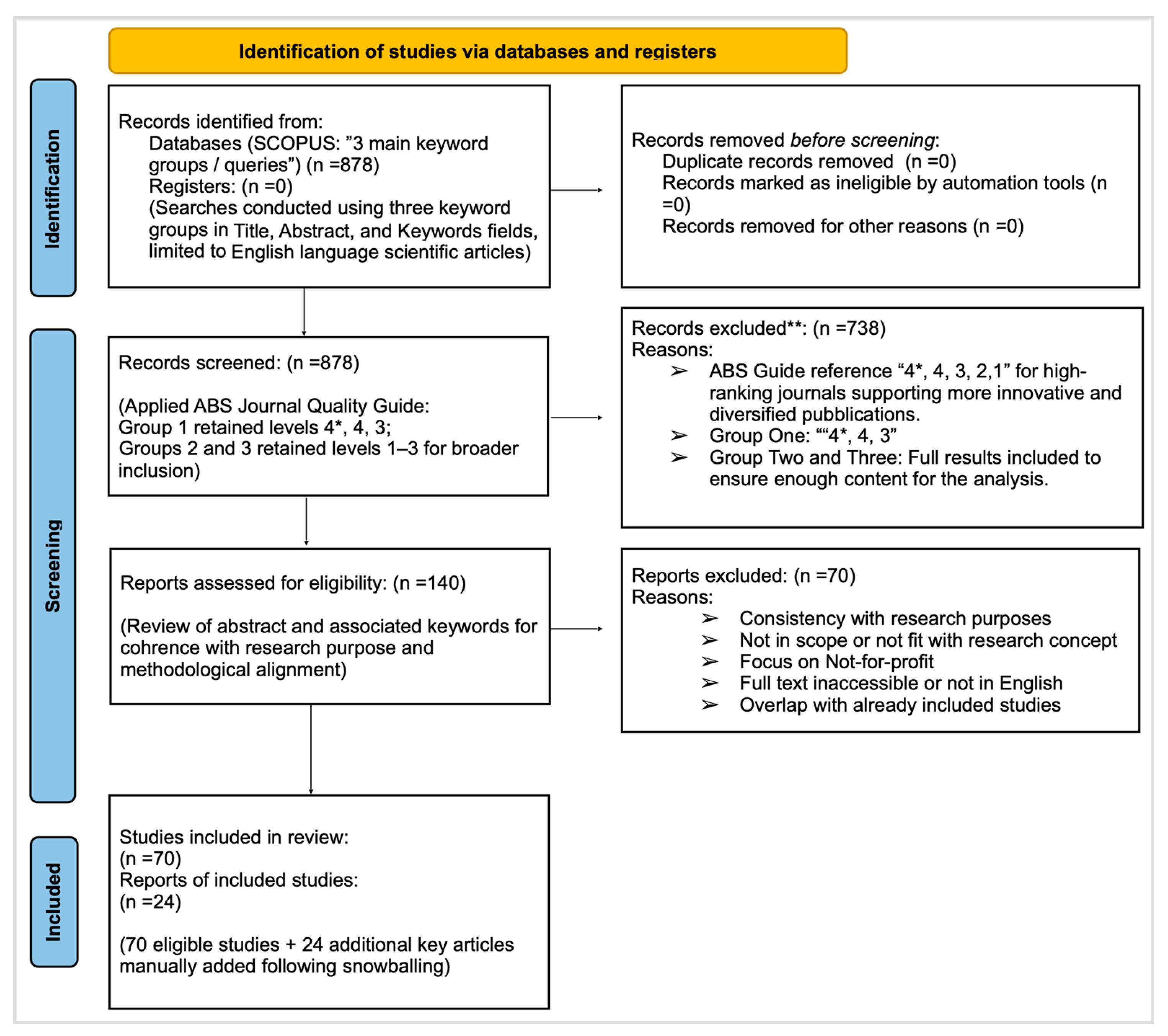
In accordance with the PRISMA methodology framework (Page et al., 2021) the work of review has been preregistered on 20 September 2025 and made available at the following link https://tinyurl.com/4hw736y3, accessed on 20 September 2025 at the unique registration number: “reviewregistry2048”-Further, the entire PRISMA workflow is illustrated in Figure 1.
The first records were identified based on the presence of a desired set within the title, abstract, and keywords provided by authors or journals, selecting only scientific articles in the English language. The final search was conducted in January 2025. Subsequently, to ensure the quality of the review, we used the ABS Guide to Academic Journals as a benchmark for journal classification and filtered the results based on the ABS guide, inspired by the idea that high-level journals are considered more innovative, interdisciplinary, and diverse (Vogel et al., 2017). This choice differentiates our approach from previous work (Dimitrov, 2022) which included more practitioners’ releases and not rigorous publications. This principle has been used in previous ExO studies (Marchese et al., 2020).
Although five rating levels were provided (Harvey et al., 2010), for the “corporate purpose”-related results, we limited the selection to the three highest levels “4*-4-3”. For the other keyword groups, to improve the analysis with a broad enough base of publications, we also included results in categories “1-2-3”. This offered a more homogeneous distribution of papers for the three different keyword groups.
We then proceeded to read abstracts to select only articles aligning with our subject of choice. Duplicates were identified and removed using manual screening. Other reasons for exclusion were a lack of consistency with our research purposes, inappropriate scope, or inaccessibility. The risk of possible publication bias was taken into account; the inclusion of papers in categories “1-2-3” mitigated this risk, along with the inclusion of selected articles following the snowballing effect in the literature review (Yin, 2014). Accordingly, several articles available on Google Scholar were added as they were considered relevant for their contribution to the subject. Eventually, 94 papers were identified for inclusion in the literature review.
The entire methodological process is summarised in Table 6.
Finally, a list of the analysed literature is available in Appendix A.

4. Results

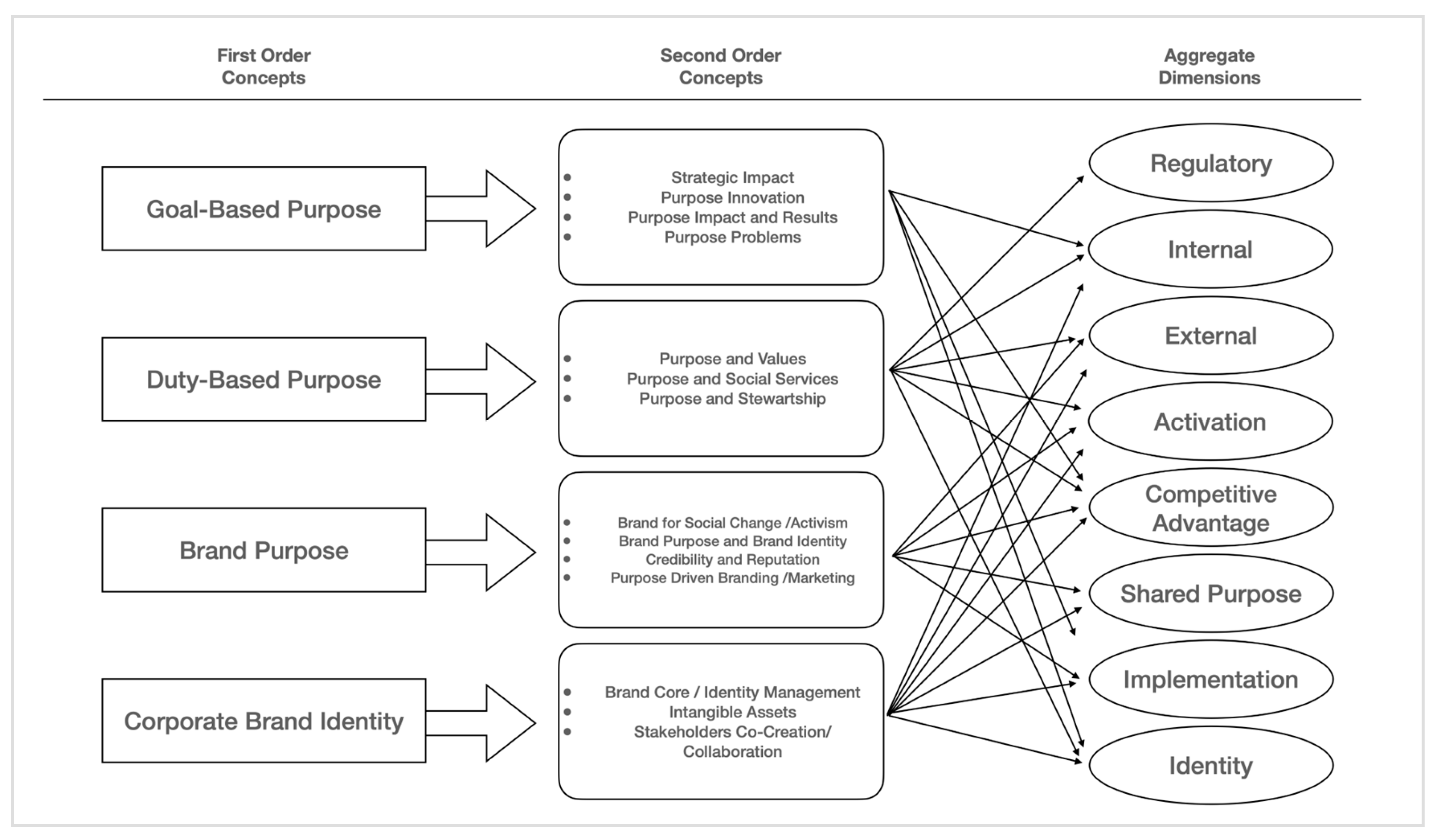
Following the above-mentioned analysis, conducted using the PRISMA integrative approach to literature reviews (Page et al., 2021), the following two main themes emerged: the MTP as a concept and a management tool. Furthermore, the different search results were analysed, leveraging Gioia’s systematic methodology (D. A. Gioia et al., 2013). This process allowed for the identification of a first order of the following purpose-related concepts: Goal-Based, Duty-Based, Brand Purpose, and Corporate Brand Identity. Next, from the analysis of each concept, we identified specific second-order concepts. The final step involved the identification of eight aggregate dimensions.
In this study, coding was performed by a single researcher. To enhance rigour, we ensured transparency by maintaining a coding process that allowed for replicability. The process was iterative to achieve coherence between results without additional information, indicating the saturation point (Rahimi & Khatooni, 2024).
Finally, the codes and aggregate dimensions were compared with the existing literature on purpose and organisational identity in a theoretical triangulation aligned with the research of D. A. Gioia et al. (2013).
The results are summarised in Figure 2 and explained in detail in the following text.
The final step allowed for the identification of eight aggregate dimensions.

4.1. The MTP as Concept

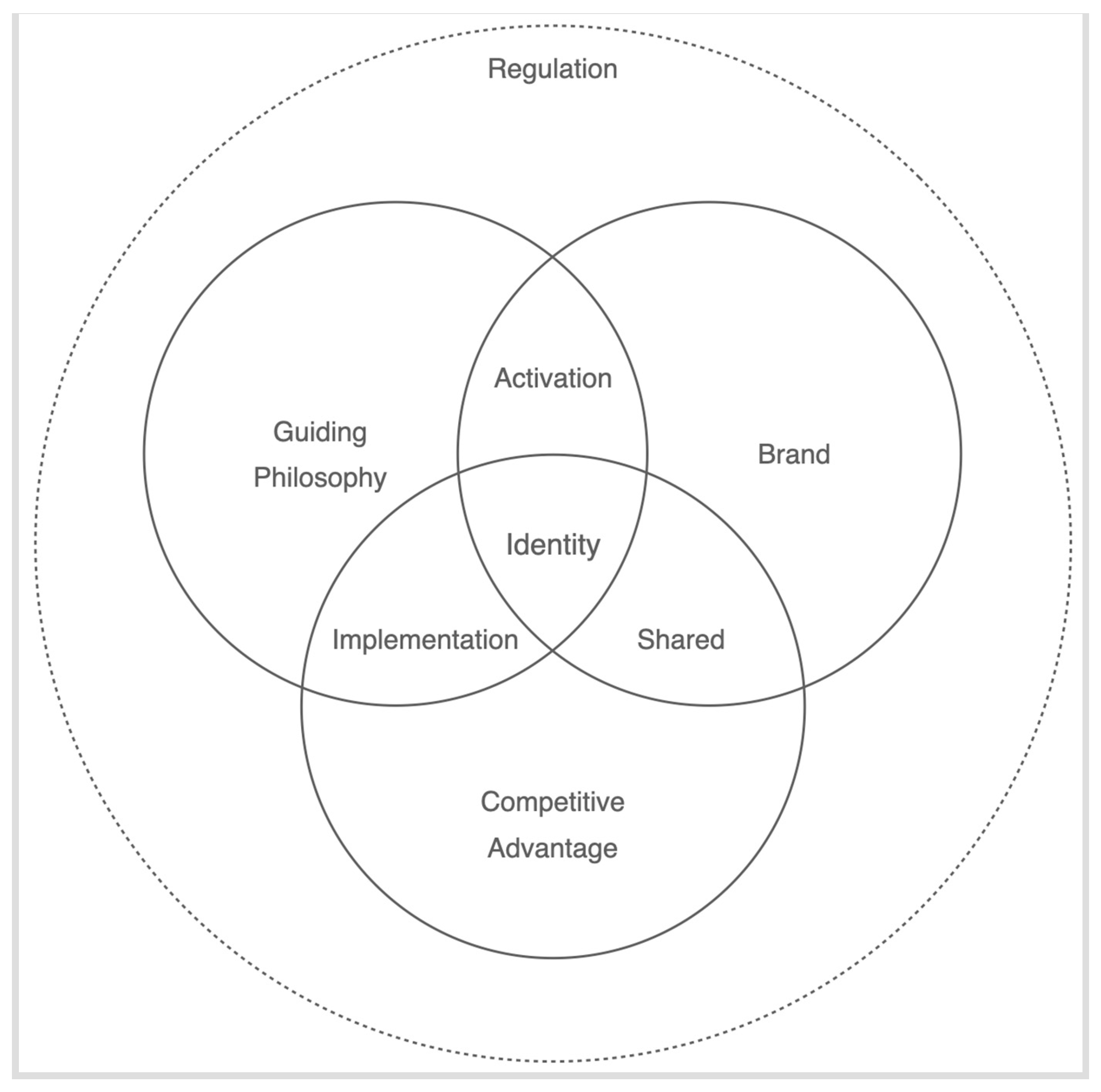
The material collected allowed us to identify various areas of impact and definitions of purpose. Purpose is defined as public policy, at an organisational level, in relation to branding, as competitive advantage, and as the centre of the organisation. While the first dimension operates at a higher regulatory level, the other three are firm-related and interlinked. Four sub-dimensions were identified in the analysis of the literature. There is a purpose-related dimension where the organisation and the brand converge, a second dimension bridging the strategic and the external, and another bridging the competitive advantage space and the previously mentioned organisational interior. The MTP concept can be explained by analysing these dimensions.
The results are shown in Figure 3 and Table 7.

4.2. The Public Policy Dimension

The public policy level is about purpose and regulation. This dimension includes all the others because of its regulatory nature. It includes references that addressed the nature of purpose (Mayer, 2021; Ferrarini, 2020; Davis, 2021; Patriotta, 2021) and how the legal framework influences how corporations evolve (Mallette, 1992). This is visible in different countries (Cadbury, 1999; Segrestin et al., 2021), where alignment between firms’ operations and purpose statements is required, pushing for tighter norms (Hollensbe et al., 2014; Ferrarini, 2020) to more democratic reforms (Davis, 2021), allowing the law to define the nature of the corporation (Mayer, 2021).

4.3. The Internal Dimension

In the internal dimension, purpose is considered the genetic code of the firm and part of its guiding philosophy (Collins & Porras, 1991). It relates to organisational culture (Henderson, 2021) and the values of the firm (Espedal & Carlsen, 2021), enabling better financial performance (Thakor & Quinn, 2013; Gartenberg et al., 2019). This dimension is about the organisation’s “Sense of Purpose” (Hollensbe et al., 2014), attracting individuals whose personal purpose fits well with the company’s while repelling those with a contradictory purpose (Collins & Porras, 1991). This is particularly true in the case of digital firms (Kreutzer et al., 2018), which leverage an “intrinsic approach to motivation” (Birkinshaw, 2018, p. 199). For Sciarelli (1999), it is an entrepreneurial theory: threats are related to the trap of managerialism (Krantz & Gilmore, 1990) due to a lack of clear indications or when personal drivers are missing (Greig, 1984). On the contrary, for Molyneaux, conflicts can be solved through meekness (Molyneaux, 2003).

4.4. The External Dimension

The external dimension involves brand purpose. It is about leveraging purpose to sell products (Hsu, 2017). Due to its creative and powerful influence beyond its functional and symbolic benefits (Bertoli et al., 2018), it is a priority for practitioners (Veloutsou, 2023). Scholars call this activity “social purpose branding” (Gray et al., 2024), purpose-driven “branding” (Hajdas & Kłeczek, 2021), or “marketing” (Gray et al., 2024). Brands are driven by a moral compass “articulated through a corporate brand purpose and a set of core values” (Iglesias et al., 2023, p. 2). This is a core practice of branding (Annweiler, 2018) involving B2B markets (Kapitan et al., 2022). Here, we found that brand perspectives on activism (Vredenburg et al., 2020) regarding social and political issues (Kotler, 2011) involve community implementation (Calder, 2022), outreach (Hsu, 2017), and innovation (Narayanan & Das, 2022). Ultimately, it relates to the brand’s reputation (Urde & Greyser, 2015) because it drives everything an organisation does (Hsu, 2017). Finally, for von Ahsen and Gauch (2021), customers’ willingness to buy from CRS-related brands has an impact on loyalty. Practices of “purpose washing” (von Ahsen & Gauch, 2021) or “woke washing” (Vredenburg et al., 2020) involve leveraging purpose to influence customers’ impressions despite a lack of true foundation in the espoused values. For this reason, brands should maintain credibility when it comes to purpose; otherwise, they will not be able to satisfy their customers (Mañas-Viniegra et al., 2020).

4.5. The Strategic Dimension

The competitive advantage dimension defines purpose as a strategic asset for the organisation. It involves strategy, culture, and value creation (White et al., 2017) for competitive advantage (Cullinan et al., 2021) toward reinventing capitalism (Porter & Kramer, 2011). This is due to changes in consumers’ and investors’ expectations, which ultimately encourage firms to evolve their business models for better value creation (George & Schillebeeckx, 2022). Management should first and foremost match purpose and organisational philosophy (Langley, 1988) to avoid staff disengagement and overcomplicated processes (Bartlett & Ghoshal, 1994). Shaping organisational purpose will provide ambition, define values, and inspire action to transform the organisation into a social institution (Langley, 1988) driven by a moral purpose (Porter & Kramer, 2006) and associated with a profound and positive influence on society. This will ultimately provide a sustainable competitive advantage (Cullinan et al., 2021) and enable growth (von Ahsen & Gauch, 2021). Finally, scholars believe innovation efforts should address sustainability (Vrontis et al., 2021), ESG (Larcker et al., 2021), or CSR (Al-Amad & Balmer, 2023), which are strongly linked to corporate purpose (Trahan & Jantz, 2023).

4.6. The Internal/External Dimension

The purpose activation dimension is defined at the interface of the company’s internal and external aspects. The space in which customers and employees meet is where the service brand is created (Dall’Olmo Riley & De Chernatony, 2000), and it determines purpose strength (Jasinenko & Steuber, 2022) according to how employees and other stakeholders perceive and believe in it (van Tuin et al., 2020). Corporate purpose development creates value for employees, customers, and shareholders (Reyes & Kleiner, 1990). This was confirmed by Van Ingen et al.’s (2021) work, which provided evidence of purpose positively impacting employees and people outside the organisation at the same time. This is also the case for corporate brand identity management initiatives, which require companies to address and engage customers and their employees’ needs simultaneously (Buil et al., 2016). Iglesias and Bonet (2012) call it persuasive brand management: the brand is a meaning creator for internal and external stakeholders. However, when purpose-related initiatives are perceived as “just marketing”, it could affect the employees’ mood (von Ahsen & Gauch, 2021). Leveraging the firm’s purpose to connect people via a win–win approach is a critical task. For Annweiler (2018), firms should differentiate their methods of interacting with customers and employees.

4.7. The Strategic/External Dimension

In the shared purpose dimension, the key perspective is to consider purpose not just as a static element inside organisations but as something generated in and with society (Biraghi et al., 2020) to find solutions to humanity’s great challenges (Kim & Scheller-Wolf, 2022). This requires deep thinking, engagement, and alignment on a cultural level (Kramer, 2017). Consumers see brands as instruments for advocating social change, and firms are evolving their approach, engaging social movements for improved relevance (Gray et al., 2024). For Biraghi et al. (2020), this is societal corporate branding, a key success factor of competitiveness. Corporations should participate in their community, contributing according to the principle of subsidiarity at social and political levels (Aßländer & Curbach, 2014). Brands should engage in co-creation initiatives (Kristal et al., 2020) because brand communities are places of aggregation and alignment of values and practices (Muniz & O’Guinn, 2001) and partnership (von Ahsen & Gauch, 2021). For Kristal et al. (2020), corporate brand identity is a dynamic entity in constant evolution due to the relationships within different ecosystem types (Törmälä & Gyrd-Jones, 2017; Dahlmann et al., 2020). For Bhattacharya et al., exchanges between business and society metaphorically shape rights, duties, and, most of all, purpose (Bhattacharya et al., 2009), which is considered an ecosystem type (Lankoski & Smith, 2018). This space includes studies on organisation stewardship of the future (Bebbington & Rubin, 2022). For Iglesias et al. (2023), Conscientious Corporate Brands are created by engaging with business partners, while Temporary Organisations must acquire the right organisational level capabilities to strategically align internal and external partners and achieve good performance (Ford & Friesl, 2019). Among them, inclusive decision making refers to the firm’s ability to engage stakeholders in the firm’s strategic process (Bernstein et al., 2020). This type of collaboration creates different identity meanings from various interactions between managers and the community (Essamri et al., 2019).

4.8. The Strategic/Internal Dimension

The purpose implementation dimension involves activation initiatives and their related impact on the firms’ internal team. Despite the ambiguity of purpose management research, this concept has been confirmed by George et al., for whom employee satisfaction is just one of many outcomes, including business growth, innovation, and superior stock market performance (George et al., 2023). For Van Ingen et al. (2021) this list also includes resilience. Purpose is a driver of innovation and a change-maker in the macro scenario when it enables organisational alignment, generating trust and intrinsic motivation (Henderson, 2021). However, to achieve results, organisations must have clear metrics of success and structures and processes for supporting employees in the long term (Jensen, 2002). Gartenberg et al. (2019) define two different types of purpose in relation to organisations. “Purpose camaraderie” relates to inconsequential, cheap talk (Guiso et al., 2015), while “purpose clarity” is associated with better financial results (Gartenberg et al., 2019). Studies on employee engagement focus on organisations supporting employee volunteering (Gatignon-Turnau & Mignonac, 2015), the role of meaningful work, and different purpose types according to different the life stages of CSR practitioners (Fontana et al., 2023). Finally, the implementation of sustainable behaviours by employees relates to perceived autonomy, sustainable principles, and moral identity ownership (Bhattacharya et al., 2023), as observed by Lourenção and Giraldi (2017) in the application of the corporate brand identity model in the Brazilian fashion industry.

4.9. The Core Dimension

When it comes to purpose in the identity dimension, scholars agree that purpose can be considered part of the core dimension of an organisation (Bartlett & Ghoshal, 1994; Stone & Heany, 1984; Aßländer, 2013; Hollensbe et al., 2014; Gümüsay et al., 2020; George et al., 2023). This space combines and involves all the other dimensions described. Purpose is “the reason an organisation exists” (Bartlett & Ghoshal, 1994) and its “raison d’être” (Collins & Porras, 1996). It is considered the north star of the organisation (Bhattacharya et al., 2023; Iglesias et al., 2023). Although it should not be seen as a goal, it is also more than business strategy (Bartlett & Ghoshal, 1994; Collins & Porras, 1996). According to Balmer (2008), corporate brand identity informs and guides the organisation regarding its core philosophy and culture. Collins and Porras (1996) describe core ideology as composed of core beliefs and values and aligned with the existence of the brand core (Urde & Greyser, 2015). It is at the heart of corporate brand identity (Urde & Greyser, 2015) and linked to a specific promise (Balmer & Thomson, 2009). The concept of an organisational core refers to Urde’s work within the framework of brand orientation (Urde, 1999, 2013, 2016). The brand core is “an entity of core values supporting and leading up to a promise” (Urde, 2013, p. 758); it is where a brand’s meaning is created. Although the management of corporate brand identity involves marketing capabilities leveraging cultural intangible assets (Brown et al., 2019), for Balmer and Podnar (2021), corporate identity is about delivering the corporate brand promise, including the organisation’s purpose.
To frame the MTP from an academic perspective, we proceed to connecting the results of our review with Ismail et al.’s perspective (Ismail et al., 2014, 2018).

4.10. The MTP as a Management Tool

From our analysis of the collected materials, the MTP emerges as part of the organisational core, together with core ideology (Collins & Porras, 1996), core philosophy and culture (Balmer, 2013), and core values and promise (Urde & Greyser, 2015). It is the brand core (Urde, 2013), the heart of the firm’s corporate brand identity (Urde & Greyser, 2015; Balmer & Podnar, 2021).
To confirm and validate the idea of the MTP as identity provider at the core of the organisation, we identified three main traits demonstrating coherence and alignment with our observations from the literature. This provides evidence of the role and relevance of the MTP in organisations.
First, according to Ismail et al. (2018), the MTP is meant to be a north star for the ExO and its community. This aligns with Greyser and Urde’s conception, for whom serving as north star is the purpose of corporate identity (Greyser & Urde, 2019). Second, the MTP provides direction when decision making is required (Ismail et al., 2018). This also agrees with Urde and Greyser (2015), who believe that “a clear corporate identity provides direction and purpose”. Finally, the MTP is considered a competitive edge for its organisation (Ismail et al., 2014), while for Urde and Greyser, corporate brand identity is critical to competitive strategy (Urde & Greyser, 2015).

5. Discussion

This study contributes to the creation of systematic knowledge related to Exponential Organisations and, in particular, to the Massive Transformative Purpose concept. The need for this type of contribution has been defined by scholars (Marchese et al., 2020; Dimitrov, 2022), and this work is a step forward in validating the MTP concept and addressing the research–practice gap (Bansal et al., 2012).

5.1. Theoretical Contribution

From a theoretical perspective, this offers a better understanding of the MTP construct. Framing Ismail et al. (2014)’s and practitioners’ perspective using a systematic approach is important to providing theoretical pillars for better addressing the research–practice gap (Bansal et al., 2012).
This study’s first theoretical contribution is the application of specific methodological frameworks to a practitioner-based concept like the MTP. The vertical implementation of semantic analysis to Ismail et al.’s (2014, 2018) work and the use of the PRISMA model are meaningful contributions to the development of knowledge related to the construct.
Furthermore, this work provides two different theoretical perspectives of the MTP. First, it defines four different dimensions of impact. This is an original contribution to the topic, as it offers a structured approach to studying the MTP itself. Second, this study provides a thorough conceptual map of the MTP. The various dimensions define specific nuances in a rich and detailed way, systematically explaining the MTP for the first time.
Another contribution is related to the creation of a link between the MTP and current management theory. In particular, this work associates the MTP with the concept of corporate brand identity and related studies. This is important because it allows us to not only consider the construct as a new idea, detached from current knowledge, but to bridge and connect it with existing knowledge. The MTP can be understood and considered as part of the brand core, the central component of corporate brand identity. Finally, this work does not weaken the MTP concept at all—it strengthens it by connecting the concept to existing management theory.
As a result of this work, a new definition of Massive Transformative Purpose is proposed. The Massive Transformative Purpose is an intangible asset of an Exponential Organisation. As part of the company’s brand core, it provides identity and sense of direction, inspiring and challenging the organisation by simultaneously impacting the firm’s culture and its internal dimension, the brand and its external activities, and the ExO’s competitive strategy.
A clear and systematic definition for the MTP construct was needed. It provides inspiration for researchers to investigate and extend their work toward Exponential Organisations and MTP-related issues. At the same time, it is impactful for the broad production, translation, and dissemination of MTP-related knowledge.
The main concepts are collected and reviewed in Table 8.

5.2. Addressing the Research Questions

This study reveals that research on the MTP is still in its infancy, fragmented, and largely driven by practitioner sources. The concept originated in the context of Exponential Organisations (Ismail et al., 2014) and has found empirical applications; however, its academic dissemination has remained rather limited (Dimitrov, 2022).
To answer RQ1, the analysis showed that the term “MTP” rarely appears and is often implicitly included in broader arguments related to purpose-driven strategies. This emphasises how the literature recognises the potential of purpose-driven organisations (Gray et al., 2024) but has not yet developed a theoretical framework to distinguish the MTP from related concepts. Our mapping allows us to position the MTP as a concept at the intersection of brand purpose and corporate purpose while maintaining the concept of exponential ambition as its distinctive feature.
This study answers RQ2 by theorising four dimensions of the MTP, which reflect its theoretical framework. This is an innovative approach that yields an equally innovative contribution because it elevates the MTP from a buzzword to a systematic and scientifically based construct. With this foundation, the concept takes on a dual value and dual applicability.
Finally, the conceptual distinction clarified in RQ1 and the dimensional structuring proposed in RQ2 provide a basis for answering RQ3. Thanks to a systematic review and the use of the Gioia methodology, our work shows that the MTP has a theoretical basis, a definition, and is characterised by four dimensions (identity, internal, external, and strategic–competitive). These dimensions are connected to concrete implications as follows: for research, they offer a basis for developing empirical tests; and for managerial practice, they become levers for strengthening identity, internal engagement, stakeholder relations, and strategic innovation.
With this approach, the MTP is not just a buzzword; it becomes a structured model that can guide both future studies and business decisions, provided that it is accompanied by accountability and measurement tools to verify its actual impact.
To support the discussion in Table 9, we collected key findings and contributions in response to the different research questions.

5.3. Implications for Practitioners

Like with the ExO perspective, the MTP is originally a practitioner’s construct, and its global adoption demonstrates its relevance in both start-up and transformational contexts. As an important contribution for practitioners, this work provides a strategic map for the application of the MTP. Instead of discussing a more general “aspirational purpose”, managers can use this framework to orient their approach for a real impact in each different dimension.
This structured collection of knowledge about the MTP can increase managers’ and entrepreneurs’ awareness while strategizing in this field. Accordingly, it could also act a stimulus for a more mature implementation of the concept and even stronger adoption.
Third, the MTP is considered part of an organisation’s brand core. It provides the organisation’s identity and is extension of the perspective offered in Ismail et al.’s (2014, 2018) work. This premise could allow practitioners to align with their MTP and include broader reflections and exploration about managing the corporate brand identity of their organisations for better impact.
On another level, the new MTP definition should be considered the tip of the iceberg regarding better knowledge and understanding. Practitioners could leverage this work to achieve more coherent and aligned management of their MTP, bringing their firms’ culture, brand, and market presence into alignment with the competitive strategy. Ultimately, this work challenges practitioners to align with their firm’s identity.
Finally, this work enables the establishment of stronger collaborative links between practitioners and researchers in this field. Executives can tap into academia with more confidence to extend knowledge in the MTP and ExO domains, demanding collaboration in the production of new knowledge about this highly relevant yet immature concept.

6. Conclusions

The challenges experienced by management in times of disruption are becoming increasingly intense (Kaivo-oja & Lauraeus, 2018). Despite perspectives characterising the current business context as a “VUCA world” (Bennett & Lemoine, 2014) or “AI World” (Birkinshaw, 2018), academic efforts have not fulfilled business needs, and further research is required (Millar et al., 2018).
At the same time, scholars agree on the importance of bridging the existing difficulties in aligning organisational research and managerial practices. Although the research–practice paradox (Bansal et al., 2012) limits collaboration between industry and academics, new ideas and fresh perspectives from practitioners have emerged in the last decade, gaining awareness and attention (D. Thompson, 2014). Their contributions relate to understanding and leveraging the digital revolution (Anderson, 2006) and management in digital times (Hoffman & Yeh, 2018), with Exponential Organisations (Ismail et al., 2014) being one such example.
The ExO concept responds to contemporary management challenges (Millar et al., 2018), and scholars consider it a good perspective for “taming VUCA” (Marchese et al., 2020) that requires dedicated study to build new analytical perspectives (Pompa, 2019). According to Ismail et al. (2014), the Massive Transformative Purpose is a conditio sine qua for a firm to be considered an ExO, taking priority over any other attribute. Defined as the organisational north star, the MTP is a very new concept that requires a structured approach to study it (Dimitrov, 2022). The goal of this study was to provide systematic logic to understand and define the MTP concept, addressing the research–practice gap (Bansal et al., 2012). A definition of the Massive Transformative Purpose is presented.
In summary, this research answers the three central questions and shows that the MTP differs from related concepts in terms of its transformative and identity-based nature and its exponentiality (RQ1). We also identified four constituent dimensions—identity, internal, external, and strategic–competitive—that represent its theoretical structure (RQ2). Finally, this study shows how, thanks to these dimensions, the MTP is elevated from a simple buzzword to an operational framework (RQ3).

6.1. Limitations

Despite its vast potential and wide range of applications, the concept of Massive Transformative Purpose (MTP) has several limitations.
First, the concept is still in its infancy, has been little theorised, and is considered developing (Dimitrov, 2022). Its visibility derives largely from articles of a practical and informative nature (e.g., Ismail et al., 2014). This means that the concept is viewed as an overlap of theories already established in the literature, such as corporate purpose or brand purpose.
Second, the MTP is described in aspirational terms, with the ambition of exponential impacts, which makes it difficult to measure. The idea of an exponential impact that serves the collective system is undoubtedly intriguing, but there is still little evidence to support it.
The third limitation is the resources and methodology used to investigate the topic, especially because no exact “MTP-related” keywords could be used in the search. This situation could eventually change in the future. Taking into account its growing adoption, relevant articles may have been published after the search, and eventually new research will be needed.
A fourth limitation relates to the fact that the analysis excluded non-academic publications. As the MTP is a practitioners’ concept, it was described in many business publications, which can be more pragmatic, ultimately describing more edge and up-to-date concept applications.
Similarly, this analysis excluded non-English-language publications. This is a possible limitation, considering the global reach of the concept.
From a practical application perspective, the use of language of “massive” and “transformative” risks encouraging companies to make grandiose statements that are not matched by their actions, thus paving the way for purpose-washing.
Finally, there is still too much emphasis on the concept of MTP in connection to ExOs, which could be a limitation for organisations with a broad purpose that are also oriented toward a transformative impact in the social sphere but do not reflect the ExO definition rooted in Unicorn theory. This is particularly true for mission-driven organisations that pursue goals beyond profit through incremental paths rather than radical transformations.
Overall, this work provides valuable insights regarding the Massive Transformative Purpose construct. It identifies a plausible means of exploring the topic through a systematic approach, providing an analysis of the literature. While this work has some limitations, it is a useful to bridging the research–practice gap (Bansal et al., 2012) providing value for interested practitioners and academics.

6.2. Future Research

The ExO concept is relevant to addressing VUCA-related management challenges. For this reason, this work should be considered a starting point for a dedicated investigation of the ExO topic (Pompa, 2019). There are a few areas that could be exploited by leveraging the current work, two of which can be identified as priorities.
First, this study anticipates the perception of the MTP as a management tool. It would be interesting to apply the same logic to specific MTP management cases and explore different areas of application.
Second, according to Ismail et al. (2014), ExOs can be either native or mature organisations committed to an ExO transformation process (Ismail et al., 2018). Future studies could explore various differences regarding the role of the MTP in these two cases, providing a critical review of the model.
Next, taking into consideration the definition of the MTP, future studies should explore and detail the role of the MTP as a management tool for each of the different dimensions identified. This would create knowledge about best practices and challenges in managing an organisation’s culture, employees, brand, different forms of external expression, and competitive strategy.
Other possible areas involve considering the MTP as part of the brand core for an ExO. As it is a practitioners’ concept, future research on the MTP will need to focus on its application and explore ExO management and the role of the MTP in practice.
In conclusion, having demonstrated that the MTP is at the core of the corporate brand identity, our hope is that our findings will encourage leaders of organisations to be more conscious in their decision making and more impactful in their actions. The MTP statement can be a useful tool to consider on a daily basis, especially when making difficult decisions. Considering that it is a relatively young concept, further adoption of the ExO model and MTP concept is expected in the future.
Hopefully, this work inspires further research in which the exploration or implementation of this model are continued.

Funding

This research received no external funding.

Institutional Review Board Statement

Not applicable.

Informed Consent Statement

Not applicable.

Data Availability Statement

No data were created in the development of this work.

Acknowledgments

The author extends their sincere gratitude to Roberto Mario De Stefano for its valuable exchanges and support in conceptualising this work. The author also thanks Nicoletta Buratti for her assistance in the early stages of study design, particularly in conceptualising the MTP construct. Finally, the author acknowledges Francesco Vitellaro for his support in designing a solid approach to the literature review.

Conflicts of Interest

The authors declare no conflicts of interest.

Abbreviations

The following abbreviations are used in this manuscript:
ExO(s)Exponential Organisation(s)
MTPMassive Transformative Purpose

Appendix A

Table A1. References in systematic literature per topics reviewed.
Goal-Based Purpose Perspective Table A2
Duty-Based Purpose Perspective Table A3
Brand PurposeTable A4
Corporate Brand IdentityTable A5
Table A2. Goal-based purpose perspective.
Table A3. The duty-based purpose perspective.
Table A4. Brand purpose.
Brand Purpose
Brand for Social Change/ActivismBrand Purpose and Brand IdentityCredibility and ReputationPurpose Driven Branding/Marketing
Holt (2002)Kramer (2017)Winston (2019)Hsu (2017)
Kotler (2011)Annweiler (2018)de Jong et al. (2020)Mañas-Viniegra et al. (2020)
Vredenburg et al. (2020)Boukis (2022)von Ahsen and Gauch (2021)Hajdas and Kłeczek (2021)
Kapitan et al. (2022)Narayanan and Das (2022) Calder (2022)
Iglesias et al. (2023)Veloutsou (2023) Gray et al. (2024)
Gray et al. (2024)
Table A5. Corporate brand identity.

References

  1. Aghion, P., Akcigit, U., & Howitt, P. (2015). The schumpeterian growth paradigm. Annual Review of Economics, 7(1), 557–575. [Google Scholar] [CrossRef]
  2. Al-Amad, A. H., & Balmer, J. M. T. (2023). Augmented role identity saliency of CSR in corporate heritage organisations. Journal of Business Research, 155, 113418. [Google Scholar] [CrossRef]
  3. Allen, K. (2020, October 16). Exponential organisations 2nd edition: Your chance to participate. Prnewswire. Available online: https://www.prnewswire.com/news-releases/exponential-organizations-2nd-edition--your-chance-to-participate-301153953.html (accessed on 25 July 2025).
  4. Anderson, C. (2006). The long tail: Why the future of business is selling less of more. Hachette. [Google Scholar]
  5. Annweiler, B. (2018). Purpose is at the core of branding. Journal of Brand Strategy, 7(3), 214–224. [Google Scholar] [CrossRef]
  6. Anson, W. (2000). Corporate identity—Value and valuation. Corporate Reputation Review, 3, 164–168. [Google Scholar] [CrossRef]
  7. Araya, D. (2013). Thinking forward: Vivek wadhwa on singularity university. E-Learning and Digital Media, 10(3), 320–323. [Google Scholar] [CrossRef]
  8. Aßländer, M. S. (2013). Honorableness or beneficialness? Cicero on natural law, virtues, glory, and (corporate) reputation. Journal of Business Ethics, 116, 751–767. [Google Scholar] [CrossRef]
  9. Aßländer, M. S., & Curbach, J. (2014). The corporation as citoyen? Towards a new understanding of corporate citizenship. Journal of Business Ethics, 120, 541–554. [Google Scholar] [CrossRef]
  10. Baier, V. E., March, J. G., & Saetren, H. (1989). Implementation and ambiguity. In J. G. March (Ed.), Decisions and organizations (pp. 150–164). Basil Blackwell. [Google Scholar]
  11. Balmer, J. M. T. (2008). Identity based view of the corporation: Insights from corporate identity, organisational identity, social identity, visual identity, corporate brand identity and corporate image. European Journal of Marketing, 42(9–10), 879–906. [Google Scholar] [CrossRef]
  12. Balmer, J. M. T. (2013). Corporate brand orientation: What is it? What of it? Journal of Brand Management, 20(9), 723–741. [Google Scholar] [CrossRef]
  13. Balmer, J. M. T., & Podnar, K. (2021). Corporate brand orientation: Identity, internal images, and corporate identification matters. Journal of Business Research, 134, 729–737. [Google Scholar] [CrossRef]
  14. Balmer, J. M. T., & Thomson, I. (2009). The shared management and ownership of corporate brands: The case of Hilton. Journal of General Management, 34(4), 15–37. [Google Scholar] [CrossRef]
  15. Bansal, P., Bertels, S., Ewart, T., MacConnachie, P., & O’Brien, J. (2012). Bridging the research-practice gap. Academy of Management Perspectives, 26, 73–92. [Google Scholar] [CrossRef]
  16. Barbazzeni, B., Fritzsche, H., & Friebe, M. (2021). Forecasting the future of healthcare democratization. Current Directions in Biomedical Engineering, 7(2), 155–158. [Google Scholar] [CrossRef]
  17. Barnard, C. I. (1938). The functions of the executive. Harvard University Press. [Google Scholar]
  18. Bartlett, C. A., & Ghoshal, S. (1994). Changing the role of top management: Beyond strategy to purpose. Harvard Business Review, 72, 79–88. [Google Scholar]
  19. Bartlett, C. A., & Ghoshal, S. (2002). Building competitive advantage through people. MIT Sloan Management Review, 43(2). Available online: https://sloanreview.mit.edu/article/building-competitive-advantage-through-people/ (accessed on 24 July 2025).
  20. Bebbington, J., & Rubin, A. (2022). Accounting in the Anthropocene: A roadmap for stewardship. Accounting and Business Research, 52(5), 582–596. [Google Scholar] [CrossRef]
  21. Bebchuk, L. (2020). Capitalism the great debate—Stakeholder V shareholder—Lucian bebchuk. Harvard Kennedy School. Available online: https://www.hks.harvard.edu/centers/mrcbg/programs/growthpolicy/capitalism-great-debate-stakeholder-v-shareholder-lucian (accessed on 24 July 2025).
  22. Bebchuk, L., & Tallarita, R. (2020). The illusory promise of ‘stakeholderism’: Why embracing stakeholder governance would fail stakeholders. In L. Zingales, J. Kasperkevic, & A. Schecter (Eds.), Milton Friedman 50 years later (pp. 26–29). Stigle Center at the University of Chicago Booth School of Business. [Google Scholar]
  23. Benghozi, P. J., & Benhamou, F. (2010). The long tail: Myth or reality? International Journal of Arts Management, 12, 43–53. [Google Scholar]
  24. Bennett, N., & Lemoine, J. (2014). What a difference a word makes: Understanding threats to performance in a VUCA world. Business Horizons, 57(3), 311–317. [Google Scholar] [CrossRef]
  25. Bernstein, R. S., Bulger, M., Salipante, P., & Weisinger, J. Y. (2020). From diversity to inclusion to equity: A theory of generative interactions. Journal of Business Ethics, 167(3), 395–410. [Google Scholar] [CrossRef]
  26. Bertoli, G., Busacca, B., & Macciani, A. (2018). Brand purpose: L’esperienza di sunlight in Indonesia. Micro & Macro Marketing, 27(3), 481–502. [Google Scholar]
  27. Bhattacharya, C. B., Korschun, D., & Sen, S. (2009). Strengthening stakeholder–company relationships through mutually beneficial corporate social responsibility initiatives. Journal of Business Ethics, 85(2), 257–272. [Google Scholar] [CrossRef]
  28. Bhattacharya, C. B., Sen, S., Edinger-Schons, L. M., & Neureiter, M. (2023). Corporate purpose and employee sustainability behaviors. Journal of Business Ethics, 183(4), 963–981. [Google Scholar] [CrossRef]
  29. Biraghi, S., Gambetti, R. C., & Quigley, S. (2020). Brand purpose as a cultural entity between business and society. In Social entrepreneurship and corporate social responsibility (pp. 401–422). Springer. [Google Scholar]
  30. Birkinshaw, J. (2018). How is technological change affecting the nature of the corporation? Journal of the British Academy, 6(s1), 185–214. [Google Scholar] [CrossRef]
  31. Birkinshaw, J. (2020). What is the value of firms in an AI world? In J. Canals, & F. Heukamp (Eds.), The future of management in an AI world. IESE Business Collection. Palgrave Macmillan. [Google Scholar]
  32. Boswijk, A. (2017). Transforming business value through digitalized networks: A case study on the value drivers of Airbnb. Journal of Creating Value, 3(1), 104–114. [Google Scholar] [CrossRef]
  33. Botsman, R., & Rogers, R. (2010). What’s mine is yours. The rise of collaborative consumption. Harper Business. [Google Scholar]
  34. Boukis, A. (2022). Exploring the sources of consumer-based brand equity in the cryptocurrency market. Review of Marketing Science, 20(1), 233–255. [Google Scholar] [CrossRef]
  35. Bower, J. L., & Weinberg, M. W. (1988). Statecraft, strategy, and corporate leadership. California Management Review, 30(2), 39–56. [Google Scholar] [CrossRef]
  36. Braun, V., & Clarke, V. (2013). Successful qualitative research: A practical guide for beginners. Sage. [Google Scholar]
  37. Bravo, R., De Chernatony, L., Matute, J., & Pina, J. M. (2013). Projecting banks’ identities through corporate websites: A comparative analysis of Spain and the United Kingdom. Journal of Brand Management, 20, 533–557. [Google Scholar] [CrossRef]
  38. Briner, R. B., Denyer, D., & Rousseau, D. M. (2009). Evidence-based management: Concept cleanup time? Academy of Management Perspectives, 23(4), 19–32. [Google Scholar] [CrossRef]
  39. Brown, D., Foroudi, P., & Hafeez, K. (2019). Marketing management capability: The construct and its dimensions: An examination of managers’ and entrepreneurs’ perceptions in a retail setting. Qualitative Market Research: An International Journal, 22(5), 609–637. [Google Scholar] [CrossRef]
  40. Buil, I., Catalán, S., & Martínez, E. (2016). The importance of corporate brand identity in business management: An application to the UK banking sector. BRQ Business Research Quarterly, 19(1), 3–12. [Google Scholar] [CrossRef]
  41. Cadbury, A. (1999). What are the trends in corporate governance? How will they impact your company? Long Range Planning, 32(1), 12–19. [Google Scholar]
  42. Calder, B. J. (2022). Customer interaction strategy, brand purpose and brand communities. Journal of Service Management, 33(4/5), 747–757. [Google Scholar] [CrossRef]
  43. Campbell, A., & Yeung, S. (1991). Creating a sense of mission. Long Range Planning, 24(4), 10–20. [Google Scholar] [CrossRef] [PubMed]
  44. Cennamo, C., Berrone, P., & Gomez-Mejia, L. R. (2009). Does stakeholder management have a dark side? Journal of Business Ethics, 89, 491–507. [Google Scholar] [CrossRef]
  45. Cheng, M. (2016). Sharing economy: A review and agenda for future research. International Journal of Hospitality Management, 57, 60–70. [Google Scholar] [CrossRef]
  46. Clegg, S., Cunha, M. P. E., Rego, A., & Santos, F. (2021). Open purpose: Embracing organisations as expressive systems. Organisation Theory, 2(4), 26317877211054860. [Google Scholar] [CrossRef]
  47. Collins, J. C., & Porras, J. I. (1991). Organisational vision and visionary organisations. California Management Review, 34(1), 30–52. [Google Scholar] [CrossRef]
  48. Collins, J. C., & Porras, J. I. (1996). Building your company’s vision. Harvard Business Review, 74(5), 65–77. [Google Scholar]
  49. Cullinan, J. A., Abratt, R., & Mingione, M. (2021). Challenges of corporate brand building and management in a state-owned enterprise. Journal of Product & Brand Management, 30(2), 293–305. [Google Scholar]
  50. Cyert, R. M., & March, J. G. (1963). A behavioral theory of the firm. Prentice-Hall. [Google Scholar]
  51. Dacin, M. T., Harrison, J. S., Hess, D., Killian, S., & Roloff, J. (2022). Business versus ethics? Thoughts on the future of business ethics. Journal of Business Ethics, 180(3), 863–877. [Google Scholar] [CrossRef]
  52. Dahlmann, F., Stubbs, W., Raven, R., & de Albuquerque, J. P. (2020). The ‘purpose ecosystem’: Emerging private sector actors in earth system governance. Earth System Governance, 4, 100053. [Google Scholar] [CrossRef]
  53. Dall’Olmo Riley, F., & De Chernatony, L. (2000). The service brand as relationships builder. British Journal of Management, 11(2), 137–150. [Google Scholar] [CrossRef]
  54. Davis, G. F. (2021). Corporate purpose needs democracy. Journal of Management Studies, 58(3), 902–913. [Google Scholar] [CrossRef]
  55. de Jong, M. D., Huluba, G., & Beldad, A. D. (2020). Different shades of greenwashing: Consumers’ reactions to environmental lies, half-lies, and organizations taking credit for following legal obligations. Journal of Business and Technical Communication, 34, 38–76. [Google Scholar] [CrossRef]
  56. Derchi, F. (2022). Tales from the disruption world. Impresa Progetto. Electronic Journal of Management, (1). [Google Scholar] [CrossRef]
  57. Diamandis, P. H., & Kotler, S. (2015). Bold: How to go big, create wealth, and impact the world. Simon and Schuster. [Google Scholar]
  58. Dimitrov, K. (2019). Human resource management in business organisations under exponential growth conditions. Vanguard Scientific Instruments in Management, 15(1), 1–32. [Google Scholar]
  59. Dimitrov, K. (2022). Organisational leadership through the massive transformative purpose. Economic Alternatives, 28(2), 318–344. [Google Scholar]
  60. Díaz-Piloneta, M., Ortega-Fernández, F., Morán-Palacios, H., & Rodríguez-Montequín, V. (2021). Monitoring the implementation of exponential organisations through the assessment of their project portfolio: Case study. Sustainability, 13(2), 464. [Google Scholar] [CrossRef]
  61. Drucker, P. F. (1974). Management: Tasks, responsibilities, practices. Harper & Row. [Google Scholar]
  62. Dubinsky, Y., & Hazzan, O. (2019, May 27–28). Agile exponential software organisations. 2019 IEEE/ACM 41st International Conference on Software Engineering: Software Engineering in Practice (ICSE-SEIP), Montreal, QC, Canada. [Google Scholar]
  63. Eccles, R. G., Strine, L. E., & Youmans, T. (2020, May 14). 3 ways to put your corporate purpose into action. Harvard Business Review. Available online: https://hbr.org/2020/05/3-ways-to-put-your-corporate-purpose-into-action (accessed on 25 July 2025).
  64. Eden, R., Burton-Jones, A., Casey, V., & Draheim, M. (2019). Digital transformation requires workforce transformation. MIS Quarterly Executive, 18(1), 1–17. [Google Scholar] [CrossRef]
  65. Elberse, A. (2008). Should you invest in the long tail? Harvard Business Review, 86(7/8), 88. [Google Scholar]
  66. Elberse, A. (2010). Bye-bye bundles: The unbundling of music in digital channels. Journal of Marketing, 74(3), 107–123. [Google Scholar] [CrossRef]
  67. Espedal, G., & Carlsen, A. (2021). Don’t pass them by: Figuring the sacred in organisational values work. Journal of Business Ethics, 169(4), 767–784. [Google Scholar] [CrossRef]
  68. Essamri, A., McKechnie, S., & Winklhofer, H. (2019). Co-creating corporate brand identity with online brand communities: A managerial perspective. Journal of Business Research, 96, 366–375. [Google Scholar] [CrossRef]
  69. Fernandes, S., Lucas, J., Madeira, M. J., & Cruchinho, A. (2019). Exponential system strategy for sustainability in fashion design. Procedia CIRP Design Conference, 84, 447–450. [Google Scholar] [CrossRef]
  70. Ferrando, P. M. (2022). Il purpose. Ovvero: Quale impresa per uno sviluppos sostenibile ed inclusivo? Impresa Progetto. Electronic Journal of Management, (1). [Google Scholar] [CrossRef]
  71. Ferrarini, G. (2020). Corporate purpose and sustainability. Working Paper, 559. European Corporate Governance Institute-Law. [Google Scholar]
  72. Ferreira, L. G. A., Viegas, P. B., & Trento, D. (2018). An agile approach applied in enterprise project management office. In V. Santos, G. Pinto, & A. Serra Seca Neto (Eds.), Agile methods, 8th Brazilian workshop, WBMA 2017 (Vol. 802, pp. 95–102). Revised Selected Papers 8. Communications in Computer and Information Science. Springer. [Google Scholar]
  73. Financial Times. (2006, September 18). Award shortlist announced. Financial Times. Available online: https://www.ft.com/content/62bd09a6-4734-11db-83df-0000779e2340#axzz1wN6ZbWuA (accessed on 24 July 2025).
  74. Fontana, E., Frandsen, S., & Morsing, M. (2023). Saving the world? How CSR practitioners live their calling by constructing different types of purpose in three occupational stages. Journal of Business Ethics, 185(4), 741–766. [Google Scholar] [CrossRef]
  75. Ford, C. J., & Friesl, M. (2019). Abseiling from the shard: The cognitive foundations of capability development in temporary organisations. European Management Review, 16(3), 507–523. [Google Scholar] [CrossRef]
  76. Foroudi, P. (2023). Conceptualizing, measuring, and managing marketing assets: Developing the marketing assets, communication focus, and capability nexus. Corporate Reputation Review, 26(3), 203–222. [Google Scholar] [CrossRef]
  77. Freeman, R. E. (1984). Strategic management: A stakeholder approach. Pitman. [Google Scholar]
  78. Freeman, R. E., & Reed, D. L. (1983). Stockholders and stakeholders: A new perspective on corporate governance. California Management Review, 25(3), 88–106. [Google Scholar] [CrossRef]
  79. Freund, A. (2018). Automated, decentralized trust: A path to financial inclusion. In Handbook of blockchain, digital finance, and inclusion, volume 1 (pp. 431–450). Academic Press. [Google Scholar]
  80. Friedman, M. (1970, September 13). A Friedman doctrine—The social responsibility of business is to increase its profits. The New York Times. Available online: https://www.nytimes.com/1970/09/13/archives/a-friedman-doctrine-the-social-responsibility-of-business-is-to.html (accessed on 25 July 2025).
  81. Friedman, M. (2007). The social responsibility of business is to increase its profits. In W. C. Zimmerli, M. Holzinger, & K. Richter (Eds.), Corporate ethics and corporate governance. Springer. [Google Scholar]
  82. Fritzsche, H., Barbazzeni, B., Mahmeen, M., Haider, S., & Friebe, M. (2021). A structured pathway toward disruption: A novel healthtec innovation design curriculum with entrepreneurship in mind. Frontiers in Public Health, 9, 715768. [Google Scholar] [CrossRef]
  83. Gartenberg, C., Prat, A., & Serafeim, G. (2019). Corporate purpose and financial performance. Organisation Science, 30(1), 1–18. [Google Scholar] [CrossRef]
  84. Gatignon-Turnau, A. L., & Mignonac, K. (2015). (Mis) Using employee volunteering for public relations: Implications for corporate volunteers’ organisational commitment. Journal of Business Research, 68(1), 7–18. [Google Scholar] [CrossRef]
  85. George, G., Haas, M. R., McGahan, A. M., Schillebeeckx, S. J., & Tracey, P. (2023). Purpose in the for-profit firm: A review and framework for management research. Journal of Management, 49(6), 1841–1869. [Google Scholar] [CrossRef]
  86. George, G., & Schillebeeckx, S. J. (2022). Digital transformation, sustainability, and purpose in the multinational enterprise. Journal of World Business, 57(3), 101326. [Google Scholar] [CrossRef]
  87. Gioia, D. (2021). A systematic methodology for doing qualitative research. The Journal of Applied Behavioral Science, 57(1), 20–29. [Google Scholar] [CrossRef]
  88. Gioia, D. A., Corley, K. G., & Hamilton, A. L. (2013). Seeking qualitative rigor in inductive research: Notes on the Gioia methodology. Organisational Research Methods, 16(1), 15–31. [Google Scholar] [CrossRef]
  89. Gray, H., Dolan, R., Wilkie, D. C. H., Conduit, J., & Burgess, A. (2024). Social purpose branding approaches: A typology of how brands engage with a social purpose. European Journal of Marketing, 58(5), 1207–1240. [Google Scholar] [CrossRef]
  90. Greig, I. (1984). Basic motivation and decision style in organisation management. Omega, 12(1), 31–41. [Google Scholar] [CrossRef]
  91. Greyser, S. A., & Urde, M. (2019). What does your corporate brand stand for? Harvard Business Review, 82–89. Available online: https://icc.se/wp-content/uploads/2022/03/Urde-Greyser-2019-HBR-What-Does-Your-Corporate-Brand-Stand-For.pdf (accessed on 24 July 2025).
  92. Guiso, L., Sapienza, P., & Zingales, L. (2015). The value of corporate culture. Journal of Financial Economics, 117(1), 60–76. [Google Scholar] [CrossRef]
  93. Gümüsay, A. A., Smets, M., & Morris, T. (2020). “God at work”: Engaging central and incompatible institutional logics through elastic hybridity. Academy of Management Journal, 63(1), 124–154. [Google Scholar] [CrossRef]
  94. Hajdas, M., & Kłeczek, R. (2021). The real purpose of purpose-driven branding: Consumer empowerment and social transformations. Journal of Brand Management, 28, 359–373. [Google Scholar] [CrossRef]
  95. Hamel, G. (2008). The future of management. Human Resource Management International Digest, 16(6). [Google Scholar] [CrossRef]
  96. Hamel, G., & Prahalad, C. K. (1994). Competing for the future. Harvard Business Review, 72(4), 122–128. [Google Scholar]
  97. Harris, S., & Carr, C. (2008). National cultural values and the purpose of businesses. International Business Review, 17(1), 103–117. [Google Scholar] [CrossRef]
  98. Harrison, J. S., Phillips, R. A., & Freeman, R. E. (2019). On the 2019 Business Roundtable “Statement on the Purpose of a Corporation”. Journal of Management, 46(7), 1223–1237. [Google Scholar] [CrossRef]
  99. Harvey, C., Kelly, A., Morris, H., & Rowlinson, M. (2010). The association of business schools. Academic Journal Quality Guide. Version 4. Available online: https://www.kimep.kz/files/downloads/The_Association_of_Business_Schools.pdf (accessed on 24 July 2025).
  100. Henderson, R. M. (2021). Innovation in the 21st century: Architectural change, purpose, and the challenges of our time. Management Science, 67(9), 5479–5488. [Google Scholar] [CrossRef]
  101. Henderson, R. M., & Van den Steen, E. (2015). Why do firms have “Purpose”? The firm’s role as carrier of identity and reputation. American Economic Review, 105(5), 326–330. [Google Scholar] [CrossRef]
  102. Henisz, W. J. (2023). The value of organisational purpose. Strategy Science, 8(2), 159–169. [Google Scholar] [CrossRef]
  103. Herrera, Á. M., & Palao, F. (2020). Propósito transformador masivo. Bubok. [Google Scholar]
  104. Hoffman, R., & Yeh, C. (2018). Blitzscaling: The lightning-fast path to building massively valuable companies. Crown Currency. [Google Scholar]
  105. Hollensbe, E., Wookey, C., Hickey, L., George, G., & Nichols, C. V. (2014). Organisations with purpose. Academy of Management Journal, 57(5), 1227–1234. [Google Scholar] [CrossRef]
  106. Holt, D. B. (2002). Why do brands cause trouble? A dialectical theory of consumer culture and branding. Journal of Consumer Research, 29(1), 70–90. [Google Scholar] [CrossRef]
  107. Hsu, C. K. J. (2017). Selling products by selling brand purpose. Journal of Brand Strategy, 5(4), 373–394. [Google Scholar] [CrossRef]
  108. Hurth, V., Ebert, C., & Prabhu, J. (2018). Organisational purpose: The construct and its antecedents and consequences. Cambridge Judge Business School, Working Papers 201802. University of Cambridge. [Google Scholar]
  109. Iglesias, O., & Bonet, E. (2012). Persuasive brand management: How managers can influence brand meaning when they are losing control over it. Journal of Organisational Change Management, 25(2), 251–264. [Google Scholar] [CrossRef]
  110. Iglesias, O., Landgraf, P., Ind, N., Markovic, S., & Koporcic, N. (2020). Corporate brand identity co-creation in business-to-business contexts. Industrial Marketing Management, 85, 32–43. [Google Scholar] [CrossRef]
  111. Iglesias, O., Mingione, M., Ind, N., & Markovic, S. (2023). How to build a conscientious corporate brand together with business partners: A case study of Unilever. Industrial Marketing Management, 109, 1–13. [Google Scholar] [CrossRef]
  112. Ismail, S., Lapierre, M., & Palao, F. (2018). Exponential transformation: The ultimate playbook to evolve your business and change the world for the better. Diversion Books—Wiley. [Google Scholar]
  113. Ismail, S., Malone, M. S., & Van Geest, Y. (2014). Exponential organisations: Why new Organisations are ten times better faster and cheaper than yours (and what to do about it). Diversion Books. [Google Scholar]
  114. Ismail, S., Palao, F., & Lapierre, M. (2021). Trasformazione esponenziale: La guida definitiva per trasformare la propria impresa in una organizzazione esponenziale. Ulrico Hoepli Editore. [Google Scholar]
  115. Jain, N., Schroeter, J., & Branson, R. (2018). Moonshots. Creating a world of abundance. Moonshots Press TM. John August Media, LLC. [Google Scholar]
  116. Jasinenko, A., & Steuber, J. (2022). Perceived organisational purpose: Systematic literature review, construct definition, measurement and potential employee outcomes. Journal of Management Studies, 60(6), 1415–1447. [Google Scholar] [CrossRef]
  117. Jensen, M. C. (2002). Value maximization, stakeholder theory, and the corporate objective function. Business Ethics Quarterly, 12(2), 235–256. [Google Scholar] [CrossRef]
  118. Jimenez, D., Franco, I. B., & Smith, T. (2021). A review of corporate purpose: An approach to actioning the sustainable development goals (SDGs). Sustainability, 13(7), 3899. [Google Scholar] [CrossRef]
  119. Johnson, L. P. Q. (1990). Delaware judiciary and the meaning of corporate life and corporate law. Texas Law Review, 68, 865. [Google Scholar]
  120. Jordi, C. L. (2010). Rethinking the firm’s mission and purpose. European Management Review, 7(4), 195–204. [Google Scholar] [CrossRef]
  121. Kaivo-oja, J. R. L., & Lauraeus, I. T. (2018). The VUCA approach as a solution concept to corporate foresight challenges and global technological disruption. Foresight, 20(1), 27–49. [Google Scholar] [CrossRef]
  122. Kapitan, S., Kemper, J. A., Vredenburg, J., & Spry, A. (2022). Strategic B2B brand activism: Building conscientious purpose for social impact. Industrial Marketing Management, 107, 14–28. [Google Scholar] [CrossRef]
  123. Keynes, J. M. (1936). The general theory of employment, interest and money. Macmillan. [Google Scholar] [CrossRef]
  124. Khan, M. S., Khan, A. W., Khan, F., Khan, M. A., & Whangbo, T. K. (2022). Critical challenges to adopt Devops culture in software organisations: A systematic review. IEEE Access, 10, 14339–14349. [Google Scholar] [CrossRef]
  125. Kim, T. W., & Scheller-Wolf, A. (2022). Technological unemployment, meaning in life, purpose of business, and the future of stakeholders. In K. Martin, K. Shilton, & J. Smith (Eds.), Business and the ethical implications of technology. Springer. [Google Scholar]
  126. Knowles, J., Hunsaker, B. T., Grove, H., & James, A. (2022). What is the purpose of your purpose? Harvard Business Review, 100(2), 36–43. [Google Scholar]
  127. Kolk, A., & Van Tulder, R. (2004). Ethics in international business: Multinational approaches to child labor. Journal of World Business, 39(1), 49–60. [Google Scholar] [CrossRef]
  128. Kotler, P. (2011). Reinventing marketing to manage the environmental imperative. Journal of Marketing, 75(4), 132–135. [Google Scholar] [CrossRef]
  129. Kramer, M. (2017). Brand purpose: The navigational code for growth. Journal of Brand Strategy, 6(1), 46–54. [Google Scholar] [CrossRef]
  130. Krantz, J., & Gilmore, T. N. (1990). The splitting of leadership and management as a social defense. Human Relations, 43(2), 183–204. [Google Scholar] [CrossRef]
  131. Kreutzer, R. T., Neugebauer, T., & Pattloch, A. (2018). Digital business leadership. Management for professionals. Springer. [Google Scholar]
  132. Kristal, S., Baumgarth, C., & Henseler, J. (2020). Performative corporate brand identity in industrial markets: The case of German prosthetics manufacturer ottobock. Journal of Business Research, 114, 240–253. [Google Scholar] [CrossRef]
  133. Kristóf, P., & Nagpal, C. (2024). How exponential organisations outcompete (d) their traditional counterparts (in the past eight years)? International Journal of Organisational Analysis, 32(10), 2668–2682. [Google Scholar] [CrossRef]
  134. Kuratko, D. F., Holt, H. L., & Neubert, E. (2020). Blitzscaling: The good, the bad, and the ugly. Business Horizons, 63(1), 109–119. [Google Scholar] [CrossRef]
  135. Langley, A. (1988). The roles of formal strategic planning. Long Range Planning, 21(3), 40–50. [Google Scholar] [CrossRef]
  136. Lankoski, L., & Smith, N. C. (2018). Alternative objective functions for firms. Organisation & Environment, 31(3), 242–262. [Google Scholar]
  137. Larcker, D. F., Tayan, B., & Watts, E. (2021). Seven Myths of ESG. Rock Center for Corporate Governance at Stanford University Working Paper Forthcoming. Available online: https://ssrn.com/abstract=3956044 (accessed on 24 July 2025).
  138. Lawler, E. E., & Benson, G. S. (2022). The practitioner-academic gap: A view from the middle. Human Resource Management Review, 32(1), 100748. [Google Scholar] [CrossRef]
  139. Lawton, T. C., Dorobantu, S., Rajwani, T. S., & Sun, P. (2020). The implications of COVID-19 for nonmarket strategy research. Journal of Management Studies, 57, 1732–1736. [Google Scholar] [CrossRef]
  140. Lee, A. (2013). Welcome to the unicorn club: Learning from billion-dollar startups. Techcrunch.com. Available online: https://techcrunch.com/2013/11/02/welcome-to-the-unicorn-club/ (accessed on 24 July 2025).
  141. Lewis, S. L., & Maslin, M. A. (2015). Defining the anthropocene. Nature, 519(7542), 171–180. [Google Scholar] [CrossRef]
  142. Lima, F., Rainatto, G., de Almeida, N. A., & Rodrigues da silva, F. (2019). Exponential organisations and digital transformation: Two sides of the same coin. International Journal for Innovation Education and Research, 7(10), 385–404. [Google Scholar] [CrossRef]
  143. Logan, G. M. (1984). Loyalty and a sense of purpose. California Management Review, 27(1), 149–156. [Google Scholar] [CrossRef]
  144. Lourenção, M. T. D. A., & Giraldi, J. D. M. E. (2017). Development of an identity model for sector brands. Journal of Fashion Marketing and Management: An International Journal, 21(3), 317–340. [Google Scholar] [CrossRef]
  145. Lysova, E. I., Allan, B. A., Dik, B. J., Duffy, R. D., & Steger, M. F. (2019). Fostering meaningful work in organizations: A multi-level review and integration. Journal of Vocational Behavior, 110, 374–389. [Google Scholar] [CrossRef]
  146. Mahto, R. V., Belousova, O., & Ahluwalia, S. (2020). Abundance—A new window on how disruptive innovation occurs. Technological Forecasting and Social Change, 155, 119064. [Google Scholar] [CrossRef]
  147. Mallette, P. (1992). Takeover legislation and corporate purpose: Implications for corporate governance. Journal of Management Inquiry, 1(3), 193–204. [Google Scholar] [CrossRef]
  148. Mañas-Viniegra, L., González-Villa, I.-A., & Llorente-Barroso, C. (2020). The corporate purpose of spanish listed companies: Neurocommunication research applied to organisational intangibles. Frontiers in Psychology, 11, 2108. [Google Scholar] [CrossRef]
  149. Marchese, S., Gastaldi, L., & Corso, M. (2020, September 20–22). Taming VUCA with exponential organisational models: A literature review. 21st International Continuous Innovation Network (CINet) Conference “Practicing Continuous Innovation in Digital Ecosystems” (pp. 466–479), Milan, Italy. [Google Scholar]
  150. Matten, D., & Crane, A. (2005). Corporate citizenship: Toward an extended theoretical conceptualization. Academy of Management Review, 30(1), 166–179. [Google Scholar] [CrossRef]
  151. Mayer, C. (2016). Sustaining innovation in the midst of success. Journal of Leadership Studies, 10(1), 73–75. [Google Scholar] [CrossRef]
  152. Mayer, C. (2021). The future of the corporation and the economics of purpose. Journal of Management Studies, 58(3), 887–901. [Google Scholar] [CrossRef]
  153. McGahan, A. M. (2021). Integrating insights from the resource-based view of the firm into the new stakeholder theory. Journal of Management, 47(7), 1734–1756. [Google Scholar] [CrossRef]
  154. Meadows, D. H., Meadows, D. L., Randers, J., & Behrens, W. W., III. (1972). The limits to growth. A report to the Club of Rome (1972). Available online: http://www.donellameadows.org/wp-content/userfiles/Limits-to-Growth-digital-scan-version.pdf (accessed on 24 July 2025).
  155. Medina, J., Gapp, R., & Stewart, H. (2021). The importance of soft systems in managing disruptive technologies: An organisation development view. Organisation Development Journal, 39(2), 53–66. [Google Scholar]
  156. Miles, M. B., Huberman, A. M., & Saldaña, J. (2014). Qualitative data analysis: A methods sourcebook (3rd ed.). Sage Publications. [Google Scholar]
  157. Millar, C., Groth, O., & Mahon, J. (2018). Management innovation in a VUCA world: Challenges and recommendations. California Management Review, 61(1), 5–14. [Google Scholar] [CrossRef]
  158. Molyneaux, D. (2003). “Blessed are the meek, for they shall inherit the earth”—An aspiration applicable to business? Journal of Business Ethics, 48, 347–363. [Google Scholar] [CrossRef]
  159. Monte Paschi di Siena. (2017). History. Banca MPS—ENG. Available online: https://www.gruppomps.it/gruppo/storia.html (accessed on 24 July 2025).
  160. Montgomery, C. A. (2008). Putting leadership back into strategy. Harvard Business Review, 86(1), 54. [Google Scholar]
  161. Moore, G. (2012). Virtue in business: Alliance Boots and an empirical exploration of MacIntyre’s conceptual framework. Organization Studies, 33(3), 363–387. [Google Scholar] [CrossRef]
  162. Moro Visconti, R. (2020). Digital scalability and growth options of intangible assets. SSRN Electronic Journal. [Google Scholar] [CrossRef]
  163. Muniz, A. M., Jr., & O’Guinn, T. C. (2001). Brand community. Journal of Consumer Research, 27(4), 412–432. [Google Scholar] [CrossRef]
  164. Narayanan, S., & Das, J. R. (2022). Can the marketing innovation of purpose branding make brands meaningful and relevant? International Journal of Innovation Science, 14(3/4), 519–536. [Google Scholar] [CrossRef]
  165. Naydenova, S., de Luca, L., & Yamadjako, S. (2019). Envisioning the expertise of the future. Efsa Journal, 17, e170721. [Google Scholar] [CrossRef] [PubMed]
  166. Oskam, J., & Boswijk, A. (2016). Airbnb: The future of networked hospitality businesses. Journal of Tourism Futures, 2(1), 22–42. [Google Scholar] [CrossRef]
  167. Page, M. J., Moher, D., Bossuyt, P. M., Boutron, I., Hoffmann, T. C., Mulrow, C. D., Shamseer, L., Tetzlaff, J. M., Akl, E. A., Brennan, S. E., & Chou, R. (2021). PRISMA 2020 explanation and elaboration: Updated guidance and exemplars for reporting systematic reviews. BMJ, 372, n160. [Google Scholar] [CrossRef]
  168. Patriotta, G. (2021). The future of the corporation. Journal of Management Studies, 58(3), 879–886. [Google Scholar] [CrossRef]
  169. Pompa, L. (2019). Exponential atlases: A metaphysical approach to the organisational rapid growth. International Journal of Business and Management, 14(4), 143–156. [Google Scholar] [CrossRef]
  170. Porter, M. E., & Kramer, M. R. (2006). Strategy and society: The link between competitive advantage and corporate social responsibility. Harvard Business Review, 84(12), 78–163. [Google Scholar]
  171. Porter, M. E., & Kramer, M. R. (2011). Creating shared value. Redefining capitalism and the role of the corporation in society. Harvard Business Review, 89(1/2), 62–77. [Google Scholar]
  172. Pratt, M. G., & Ashforth, B. E. (2003). Fostering meaningfulness in working and at work. In K. S. Cameron, J. E. Dutton, & R. E. Quinn (Eds.), Positive organizational scholarship: Foundations of a new discipline (pp. 309–327). Berret-Kohler. [Google Scholar]
  173. Rahimi, S., & Khatooni, M. (2024). Saturation in qualitative research: An evolutionary concept analysis. International Journal of Nursing Studies Advances, 6, 100174. [Google Scholar] [CrossRef]
  174. Reis, R., Salmon, A., Binah-Pollak, A., Dubinsky, Y., StepAhead, I., Harari, T., Effect-Tiv, I., Hazan, T., Hazzan, O., Lis-Hacohen, R., & Mike, K. (2017). LinkedResearch-LR: A suggested platform to make research exponential. Available online: https://omnisol-socrates.s3.amazonaws.com/investigation-faf5dd48-46c4-4b57-918d-3386731c67da/document-files/full-text-51ac124a-007a-4903-8899-52aae67b21c1.pdf (accessed on 24 July 2025).
  175. Rey, C., Bastons, M., & Sotok, P. (2019). Purpose-driven organisations: Management ideas for a better world (p. 138). Springer Nature. [Google Scholar]
  176. Reyes, J. R., & Kleiner, B. H. (1990). How to establish an organisational purpose. Management Decision, 28(7). [Google Scholar] [CrossRef]
  177. Rynes, S. L., McNatt, D. B., & Bretz, R. D. (1999). Academic research inside organisations: Inputs, processes, and outcomes. Personnel Psychology, 52(4), 869–898. [Google Scholar] [CrossRef]
  178. Sackett, P. R., & Larson, J. R. (1990). Research strategies and tactics in industrial and organisational psychology. In M. D. Dunnett, & L. M. Hough (Eds.), Handbook of industrial and organisational psychology (pp. 419–489). Consulting Psychologists Press. [Google Scholar]
  179. Safaei, M. (2020). Investigating the structure of strategies in developed countries to expand entrepreneurship and technology. A case study: “US singularity university”. Journal of Advanced Research in Dynamical and Control Systems, 12(3), 571–578. [Google Scholar] [CrossRef]
  180. Saldanha, T. (2019). Why digital transformations fail: The surprising disciplines of how to take off and stay ahead. Berrett-Koehler Publishers. [Google Scholar]
  181. Schneider, S., & Kokshagina, O. (2021). Digital transformation: What we have learned (thus far) and what is next. Creativity and Innovation Management, 30(2), 384–411. [Google Scholar] [CrossRef]
  182. Schor, J. B., & Fitzmaurice, C. J. (2015). Collaborating and connecting: The emergence of the sharing economy. In Handbook of research on sustainable consumption. Edward Elgar Publishing. [Google Scholar]
  183. Sciarelli, S. (1999). Corporate ethics and the entrepreneurial theory of “social success”. Business Ethics Quarterly, 9, 639–649. [Google Scholar] [CrossRef]
  184. Segrestin, B., Hatchuel, A., & Levillain, K. (2021). When the law distinguishes between the enterprise and the corporation: The case of the new french law on corporate purpose. Journal of Business Ethics, 171(1), 1–13. [Google Scholar] [CrossRef]
  185. Stone, W. R., & Heany, D. F. (1984). Dealing with a corporate identity crisis. Long Range Planning, 17(1), 10–18. [Google Scholar] [CrossRef]
  186. Sundararajan, A. (2017). The sharing economy: The end of employment and the rise of crowd-based capitalism. The MIT Press. [Google Scholar]
  187. Thakor, A. V., & Quinn, R. E. (2013). The economics of higher purpose. Working Paper Series in Finance 395. European Corporate Governance Institute. [Google Scholar]
  188. Thakor, A. V., & Quinn, R. E. (2020). Higher purpose, incentives, and economic performance. Working Paper Series in Finance 706. European Corporate Governance Institute. [Google Scholar]
  189. Thiel, P., & Masters, B. (2014). Zero to one: Notes on startups, or how to build the future. Currency. [Google Scholar]
  190. Thompson, D. (2014, September 25). Peter Thiel’s zero to one might be the best business book I’ve read. The Atlantic. Available online: https://www.theatlantic.com/business/archive/2014/09/peter-thiel-zero-to-one-review/380738/ (accessed on 24 July 2025).
  191. Thompson, R. J., Payne, S. C., & Taylor, A. B. (2015). Applicant attraction to flexible work arrangements: Separating the influence of flextime and flexplace. Journal of Occupational and Organizational Psychology, 88(4), 726–749. [Google Scholar] [CrossRef]
  192. Thorén, K., & Vendel, M. (2019). Backcasting as a strategic management tool for meeting VUCA challenges. Journal of Strategy and Management, 12(2), 298–312. [Google Scholar] [CrossRef]
  193. Torres, C. V., Neiva, E. R., & Glazer, S. (2022). Values in organisations: Theory, measurement, and theoretical reflections. In Assessing organisational behaviors (pp. 191–221). Springer. [Google Scholar]
  194. Törmälä, M., & Gyrd-Jones, R. I. (2017). Development of new B2B venture corporate brand identity: A narrative performance approach. Industrial Marketing Management, 65, 76–85. [Google Scholar] [CrossRef]
  195. Trahan, R. T., & Jantz, B. (2023). What is ESG? Rethinking the “E” pillar. Business Strategy and the Environment, 32(7), 4382–4391. [Google Scholar] [CrossRef]
  196. Tucker, P. (2009). Singularity university set to open. The Futurist, 43(3), 6. [Google Scholar]
  197. Urde, M. (1999). Brand orientation: A mindset for building brands into strategic resources. Journal of Marketing Management, 15(1–3), 117–133. [Google Scholar] [CrossRef]
  198. Urde, M. (2013). The corporate brand identity matrix. Journal of Brand Management, 20(9), 742–761. [Google Scholar] [CrossRef]
  199. Urde, M. (2016). The brand core and its management over time. Journal of Product & Brand Management, 25(1), 26–42. [Google Scholar] [CrossRef]
  200. Urde, M., & Greyser, S. A. (2015). The Nobel Prize: The identity of a corporate heritage brand. Journal of Product & Brand Management, 24(4), 318–332. [Google Scholar]
  201. Van Ingen, R., Peters, P., De Ruiter, M., & Robben, H. (2021). Exploring the meaning of organisational purpose at a New Dawn: The development of a conceptual model through expert interviews. Frontiers in Psychology, 12, 675543. [Google Scholar] [CrossRef]
  202. van Tuin, L., Schaufeli, W. B., van den Broeck, A., & van Rhenen, W. (2020). A corporate purpose as an antecedent to employee motivation and work engagement. Frontiers in Psychology, 11, 572343. [Google Scholar] [CrossRef]
  203. Veloutsou, C. (2023). Enlightening the brand building–audience response link. Journal of Brand Management, 30(6), 550–566. [Google Scholar] [CrossRef]
  204. Vogel, R., Hattke, F., & Petersen, J. (2017). Journal rankings in management and business studies: What rules do we play by? Research Policy, 46(10), 1707–1722. [Google Scholar] [CrossRef]
  205. von Ahsen, A., & Gauch, K. (2021). Opportunities and challenges of purpose-led companies: An empirical study through expert interviews. Corporate Reputation Review, 25(3), 198–211. [Google Scholar] [CrossRef]
  206. Vredenburg, J., Kapitan, S., Spry, A., & Kemper, J. A. (2020). Brands taking a stand: Authentic brand activism or woke washing? Journal of Public Policy & Marketing, 39(4), 444–460. [Google Scholar]
  207. Vrontis, D., Morea, D., Basile, G., Bonacci, I., & Mazzitelli, A. (2021). Consequences of technology and social innovation on traditional business model. Technological Forecasting and Social Change, 170, 120877. [Google Scholar] [CrossRef]
  208. White, A., Yakis-Douglas, B., Helanummi-Cole, H., & Ventresca, M. (2017). Purpose-led organisation: “Saint antony” reflects on the idea of organisational purpose, in principle and practice. Journal of Management Inquiry, 26(1), 101–107. [Google Scholar] [CrossRef]
  209. Williams, P., Escalas, J. E., & Morningstar, A. (2022). Conceptualizing brand purpose and considering its implications for consumer eudaimonic well-being. Journal of Consumer Psychology, 32(4), 699–723. [Google Scholar] [CrossRef]
  210. Wilmers, N., & Zhang, L. (2022). Values and inequality: Prosocial jobs and the college wage premium. American Sociological Review, 87(3). [Google Scholar] [CrossRef]
  211. Winston, A. (2019, August 30). Is the Business Roundtable Statement just empty rhetoric? Harvard Business Review. [Google Scholar]
  212. Yin, R. K. (2014). Case study research: Design and methods. Sage Publications. [Google Scholar]
  213. Younger, R., Mayer, C., & Eccles, R. G. (2020, September). Enacting purpose within the modern corporation. Harvard Law School Forum on Corporate Governance. Available online: https://corpgov.law.harvard.edu/2020/09/02/enacting-purpose-within-the-modern-corporation/ (accessed on 24 July 2025).
  214. Zattoni, A., & Pugliese, A. (2021). Corporate governance research in the wake of a systemic crisis: Lessons and opportunities from the COVID-19 pandemic. Journal of Management Studies, 58(5), 1405–1410. [Google Scholar] [CrossRef]
Figure 1. PRISMA flow diagram chart. Source: Author’s elaboration based on the guidelines and tool provided by Page et al. (2021).
Admsci 15 00472 g001
Figure 2. Gioia’s framework data elaboration. Source: Author’s elaboration, following D. Gioia’s (2021) guidelines.
Admsci 15 00472 g002
Figure 3. The conceptual dimensions of Massive Transformative Purpose. Source: Author’s elaboration.
Admsci 15 00472 g003
Table 1. Gaps in the Massive Transformative Purpose construct.
ConstructSourceTheoretical GapPractical Gap
Massive Transformative PurposeIsmail et al. (2014)The construct is not considered management science per se.
It lacks a systematic and rigorous approach.
The MTP construct lacks guidelines for applying it in a structured way.
Source: Author’s elaboration.
Table 2. Definitions of Exponential Organisations.
Admsci 15 00472 i001Admsci 15 00472 i002
An Exponential Organisation (ExO) is one whose impact or output is disproportionately large—at least ten times larger—than that of its peers because of new organisational techniques that leverage accelerating technologies.An ExO is one that combines digital technologies, experimentation, and autonomy of organisational models to enhance its dynamic capabilities, completely adapting to its context and achieving exponential results.
Ismail et al. (2014, p. 61)Marchese et al. (2020, p. 468)
Source: Author’s elaboration.
Table 3. Comparing corporate purpose and Massive Transformative Purpose.
AspectCorporate PurposeMassive Transformative Purpose
Historical Roots
  • Keynes (1936) considers purpose to be the “motive” of business;
  • Barnard (1938) considers it a “moral factor” that inspires employees.
  • Introduced by Ismail et al. (2014) in the Exponential Organisations (ExOs) framework.
  • It is a necessary condition for being an ExO.
Key Definitions
  • Ismail et al. (2014): “higher, aspirational purpose” (p. 62) that gives character and direction to the company.
  • Dimitrov (2022): elements of “proclaimed corporate culture” (p. 339) are levers for profound change and innovation.
Pivotal Dimensions
  • Shared organisational identity.
  • Intangibility (soul, meaning; soul-searching)
  • Creation of social value beyond profit and Stakeholder orientation (Freeman, 1984).
  • Massive: broad reach towards abundance, use of data, and digital technologies.
  • Transformative: striving for change that is almost impossible but inspirational.
  • Purpose: beyond profit, with strong links to culture and leadership.
Theoretical Perspectives
  • Friedman (1970): purpose = maximising value for shareholders (profit)
  • Freeman (1984): purpose = relationship with stakeholders; creation of social synergies.
  • Seen as a “higher aspirational purpose” that guides all choices; linked to leadership, innovation, talent, and disruptive technologies.
Examples
  • Stakeholder-oriented models;
  • Companies with a strong social mission.
  • Airbnb’s “Belong Anywhere” statement mobilises global communities and scales quickly.
Critiques
  • Theory at an early stage, and many practitioners have contributed.
Source: Author’s elaboration.
Table 4. The Massive Transformative Purpose’s dimensions of impact.
DetailKeywords Relevant to Literature Review
Internal Dimension: Inside the Organisation
“(It) binds collective aspirations”Ismail et al. (2014, p. 66)“Corporate purpose”,
“Organisational Purpose”,
“Business Purpose”,
“Company Purpose”
“(It serves as)… an excellent recruiter… magnet for retaining top talents… in today’s hyper competitive talent marketplace”Ismail et al. (2014, p. 64)
“Supports a cooperative/non political culture”Ismail et al. (2014, p. 66)
External dimension: The Organisation in the Market
“Brand management (MTP!)”Ismail et al. (2014, p. 68)“Brand Purpose”
“(The MTP) will not only establish the right image… for the company’s stakeholders...”Ismail et al. (2014, p. 266)
“A community forms around the ExO and spontaneously begins operating on its own...”Ismail et al. (2014, p. 63)
Competitive Strategy Dimension: The Organisation in the World
“(It)… creates sense of shared direction”Ismail et al. (2018, p. 40)“Corporate purpose”,
“Organisational Purpose”,
“Business Purpose”,
“Company Purpose”
“...allows you to explore disruptive solutions for a variety of problems”Ismail et al. (2018, p. 166)
“...enables organisations to scale with less turbulence”Ismail et al. (2014, p. 64)
Central Dimension: The Identity of the Organisation
“An overarching MTP… defines the core purpose of the organisations’ existence”Ismail et al. (2018, p. 76)“Corporate Brand Identity”
“(MTP) aligns most closely with the organisation’s identity”Ismail et al. (2018, p. 297)
“(MTP) …Inspires action… (drives you toward),… meaningful, positive change”Ismail et al. (2018, p. 40)
Source: Author’s elaboration.
Table 5. Boolean indicators.
GroupBoolean Indicators
Corporate
Purpose
TITLE-ABS-KEY (“corporate purpose” OR “organisational purpose” OR “business purpose” OR “company purpose”) AND (LIMIT-TO (DOCTYPE, “ar”)) AND (LIMIT-TO (LANGUAGE, “English”))
Brand PurposeTITLE-ABS-KEY (“brand purpose”) AND (LIMIT-TO (DOCTYPE, “ar”)) AND (LIMIT-TO (LANGUAGE, “English”))
Corporate Brand IdentityTITLE-ABS-KEY (“corporate brand identity”) AND (LIMIT-TO (DOCTYPE, “ar”)) AND (LIMIT-TO (LANGUAGE, “English”))
Source: Author’s elaboration.
Table 6. The methodological process.
StepDescriptionCriteria/Decisions
DatabasesDatabases consultedGoogle Scholar (exploratory phase);
Scopus (main source)
Search StringsBoolean combinations appliedSee Table 5 (e.g., “corporate purpose” OR “organisational purpose” AND “brand purpose”)
TimeframeYears coveredAll years available up to 2024
LanguageLanguage choiceEnglish only
Type of SourceInclusion criteriaPeer-reviewed journal articles in management, business, and related fields
Exclusion CriteriaFilters appliedEditorials, non-scientific works, practitioner-only sources
Quality FilterJournal rankingABS Journal Guide: Levels 3-4-4* for corporate purpose keywords. Levels 1–3 included for brand/identity keywords to ensure broader coverage
Screening ProcedureSelection approachTitles, abstracts, and keywords screened; snowballing strategy applied (Yin, 2014)
Final DatasetOutcome94 articles included (See Appendix A)
Source: Author’s elaboration.
Table 7. Explaining the Massive Transformative Purpose dimensions.
DimensionsPurpose
Public PolicyRegulation
InternalOrganisational/Guiding Philosophy
ExternalBrand Purpose
StrategicCompetitive Advantage
Internal/ExternalActivation
Strategic/ExternalShared Purpose
Strategic/InternalImplementation
CoreIdentity of the Organisation
Source: Author’s elaboration.
Table 8. Review of main concepts.
ConceptDefinitionMain GoalLimitationReferences
Corporate PurposeA statement that defines the purpose of the company beyond profit, guiding strategy and stakeholder relations.Create shared value by integrating profit, social responsibility, and sustainability.Risk of remaining confined to a CSR approach.Mayer (2021), Porter and Kramer (2011).
Brand PurposeA purpose that guides the brand and defines its role in consumers’ lives, strengthening its identity and positioning.Establish emotional connections, trust, and loyalty with customers and other stakeholders.Risk of purpose-washing or becoming mere storytelling.Hsu (2017);
Kotler (2011);
Gray et al. (2024).
Massive Transformative Purpose (MTP)An identity-defining and transformative “guiding star” that directs the company toward systemic and exponential impacts.Drive radical and transformative change on a social and systemic scale.Early-stage concept; lack of published studies and professional evidence.Ismail et al. (2014); Dimitrov (2022).
Source: Author’s elaboration.
Table 9. Reviewing key research outputs.
Research QuestionKey FindingsKey Contribution
RQ 1MTP differs from corporate/brand purpose by (i) transformative orientation, (ii) exponential ambition, and (iii) identity-based positioningClarifies conceptual boundaries; establishes MTP’s unique role
RQ 2Four dimensions identified: Identity, Internal, External, and Strategic/CompetitiveProvides first systematic analytical framework for MTP
RQ 3Framework enables both (i) research metrics and empirical testing and (ii) managerial levers (identity, engagement, stakeholder trust, and innovation)Converts MTP into an operational tool; highlights risks and accountability needs
Source: Author’s elaboration.
Disclaimer/Publisher’s Note: The statements, opinions and data contained in all publications are solely those of the individual author(s) and contributor(s) and not of MDPI and/or the editor(s). MDPI and/or the editor(s) disclaim responsibility for any injury to people or property resulting from any ideas, methods, instructions or products referred to in the content.