1. Introduction
Entrepreneurship is widely regarded as a conduit for economic development in many global regions; however, women remain significantly underrepresented in technology entrepreneurship which limits both global innovation and social equity, especially in contexts governed by strong institutionalized gender norms. Globally, women constitute 15% of tech founders despite evidence that gender diversity accelerates innovation and economic growth (
Startup Genome, 2023). Only 2.7% of women compared to 4.7% of men are starting businesses in Information, Computers, and Technology (ICT), the sector that draws the majority of venture capital worldwide. In the Middle East, socio-cultural norms actively restrict women’s access to venture capital, professional networks, and market opportunities (
OECD, 2021;
Itani et al., 2011).
Oman presents a striking manifestation of this global challenge. The country exhibits a pronounced paradox: while women outnumber men in IT higher education, their transition into tech workforce and tech entrepreneurship remains limited (
World Bank, 2023;
ASMED, 2024). This underrepresentation of women in innovation-driven business startups highlights existing gender biases and systemic disadvantages in social structures, making visible the double masculinity that exists at the intersection of ICT and entrepreneurship. This disparity persists despite Oman Vision 2040’s explicit focus on women’s economic empowerment and technology driven innovation (
Sultanate of Oman, 2020). Thus, bridging this gap is critical for national competitiveness, making the Sultanate a critical case for investigating the barriers women face.
Prior research identifies education (
Anwar et al., 2023), self-efficacy (
Udayanan, 2019), and institutional support (
Shabbir et al., 2023) as key antecedents of entrepreneurial intention (EI) among women. However, studies focusing on Oman reveal a significant disconnect where high EI rarely translates to venture creation (VC). For instance, (
Sanyal & Hisam, 2015) found that 67% of Omani youth intend to start businesses; however, they face perceptions of risk and lack of knowledge about government support and opportunities. While
Muthuraman et al. (
2022) confirm that, despite high EI, structural and cultural barriers prevent venture creation. This intention-action gap requires further theorization as most frameworks treat EI and VC as linear or discrete phenomena (
Kautonen et al., 2015).
To understand this paradox, we examine how socio-cultural and institutional mechanisms jointly structure the pathways from EI to VC. Therefore, we define the visibility gap as the disconnect between policy awareness and practical accessibility, where women know policies exist, such as Riyada loans, but cannot practically utilize them due to bureaucratic or cultural barriers (
Naguib & Barbar, 2025). This reflects
Mair and Martí’s (
2009) institutional void framework, specifically highlighting the visibility-to-enactment disconnect in a conservative context like Oman, where family influences and Islamic values create multi-layered institutional constraints (
Ghouse et al., 2021). In this context, spousal endorsement functions as a fundamental legitimacy mechanism, particularly within marital relationships (
Ghouse et al., 2019).
Spousal endorsement operates not merely as social capital but as a culturally salient legitimacy signal in Oman’s male guardianship system. It operates as a binary condition: spousal approval unlocks access to funding, networks, and legal registration, while its absence triggers institutional exclusion. This distinct role warrants discrete empirical testing (
Abd El Basset et al., 2024). Therefore, we position spousal endorsement as a distinct cultural legitimacy mechanism that women must navigate to overcome patriarchal barriers. Prior work has yet to fully examine how socio-cultural resources such as spousal endorsement and institutional forces interact to enable VC, particularly where formal policies lack implementation legitimacy.
We address two key gaps in the literature on women’s entrepreneurship. Firstly, while institutional theory explains normative barriers such as gender roles, and the resource-based view identifies resource dependencies, their integration is essential to understand how legitimacy claims and resource mobilization interact to enable VC in conservative settings. Current models neglect this interaction regarding technology ventures demanding DSE and the culturally contingent role of WLBR (
Jennings & Brush, 2013). Second, quantitative studies dominate women’s entrepreneurship research, overlooking equifinal pathways to venture creation where familial support may compensate for weak state support (
Fiss, 2011). Although fsQCA has been applied to uncover causal complexity in women’s entrepreneurship across diverse global contexts including emerging economies (
Wu et al., 2019;
Maharana et al., 2025), its application to technology ventures in the Gulf region remains unexplored.
To address these gaps, this study pursues three objectives: (1) to analyze how FIS, IIS, DSE, and WLBR collectively shape the EI-to-VC transition; (2) to identify sufficient configurational pathways enabling VC; and (3) to uncover the specific barriers inhibit VC among women with high EI in Oman’s conservative context. To achieve this, we develop an integrated theoretical framework and employ an explanatory sequential mixed methods design with fsQCA to capture the causal complexity of venture creation.
The paper is organized as follows:
Section 2 provides theoretical integration;
Section 3 outlines the mixed-methods design.
Section 4 presents quantitative, configurational, and qualitative findings.
Section 5 discusses the findings,
Section 6 presents implications for theory and policy, and
Section 7 concludes with limitations and future research.
2. Theoretical Framework
The study integrates institutional theory (
DiMaggio & Powell, 1983) and the resource-based view (
Barney, 1991) through a configurational lens to explain technology venture creation in Oman’s gendered institutional context. Institutional theory explains how women navigate patriarchal constraints by leveraging spousal endorsement as a cultural legitimacy signal to access legitimacy resources (
Lawrence & Suddaby, 2006). Women gain family and community approval, which in turn unlocks access to informal support (IIS) and time infrastructure (WLBR) necessary for venture creation. The resource-based view complements this by identifying WLBR as a contextually critical enabler that determines whether DSE translates to venture creation. In Oman’s caregiving-intensive context, substantial discretionary time constitutes a non-substitutable resource that enables women to activate their digital self-efficacy. Without sufficient time and infrastructure, even high confidence in digital ability remains latent potential rather than venture-creating capacity.
These theories are mutually informative because institutional legitimacy and resource mobilization represent sequential, interdependent processes in conservative contexts like Oman (
Aljarodi et al., 2023). Institutional theory explains the legitimacy gatekeeping that determines whether women access resources at all (
DiMaggio & Powell, 1983), while RBV explains how accessed resources are orchestrated to lead to venture creation (
Sirmon et al., 2011). Without legitimacy, resources are inaccessible; without resource orchestration, the accessed resources remain inert. This integration extends recent GCC scholarship showing that Omani women entrepreneurs must first secure family legitimacy before mobilizing business resources (
Al Boinin, 2023). fsQCA is methodologically warranted here because linear models fail to capture this sequential causal complexity where resources interact non-additively (
Fiss, 2011).
Institutional voids further shape these dynamics through what we term a visibility gap, a disconnect between policy existence and perceived accessibility. Unlike implementation gaps, where policies exist but execution fails, or pure institutional voids (where no relevant policies exist), the visibility gap characterizes situations where formal support like Riyada loans is technically available but socially inaccessible to women without spousal endorsement or kinship networks to navigate bureaucratic barriers (
Mair & Martí, 2009). This gap represents a specific manifestation of the institutional-RBV integration, where formal resources exist but remain inaccessible without the legitimizing function of informal institutions.
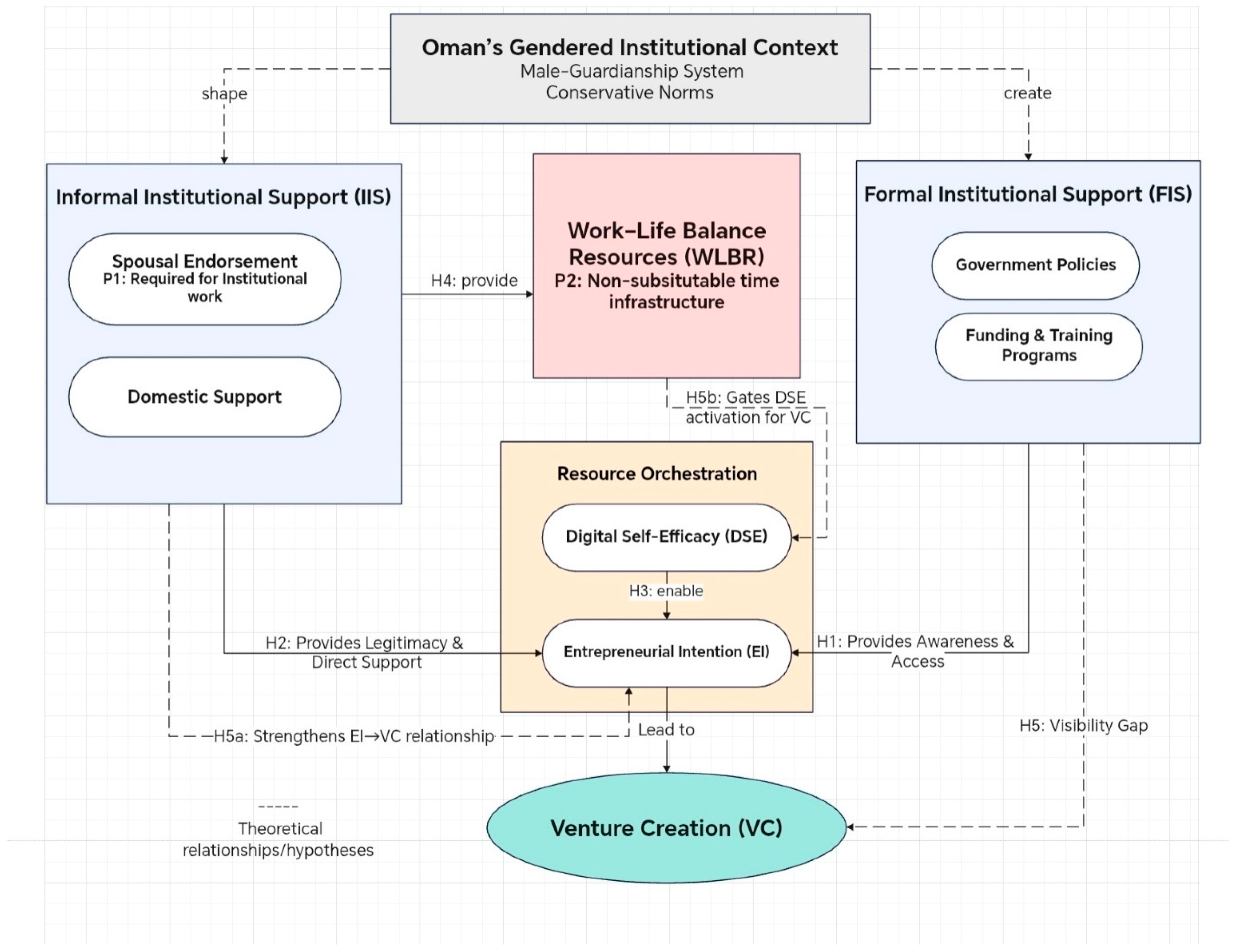
This theoretical integration addresses three key puzzles evident in our context: (1) why FIS predicts EI but not VC, (2) why DSE alone fails to predict VC, and (3) why spousal endorsement appears theoretically necessary but not sufficient for VC. Our proposed conceptual model for this process is presented in
Figure 1.
We formalize these insights in the following propositions: P1: Spousal endorsement is a required mechanism for institutional work that allows women to navigate patriarchal constraints and access legitimacy resources. In Oman’s male-guardianship context (
Ghouse et al., 2023), spousal approval serves as a culturally specific legitimacy signal that activates three institutional work mechanisms, such as advocacy through mobilizing kinship support, theorization by reframing ventures as culturally congruent, and identity repair, which counters community skepticism. This aligns with GCC evidence, where family endorsement creates a moral space for culturally grounded entrepreneurship (
Alkhaled, 2021;
Al Boinin, 2023). Oman’s institutional heterogeneity necessitates analyzing spousal endorsement both as an IIS component and discrete mechanism.
P2: Work–life balance resources (WLBR) gate digital self-efficacy activation, constituting a non-substitutable time infrastructure that enables the activation of DSE. Aligning with resource-orchestration logic (
Sirmon et al., 2011), we posit that substantial discretionary time constitutes a critical threshold below which digital self-efficacy remains latent for venture creation. Below critical time thresholds, caregiving duties constrain women’s capacity to orchestrate resources for technology ventures (
Parasuraman & Simmers, 2001). In Oman’s context, our empirical analysis identifies this threshold as ≥4.2 h per day of discretionary time, extending resource orchestration theory by quantifying a critical resource threshold in caregiving-intensive environments.
3. Methodology
This study employs an explanatory sequential mixed-methods design (
Creswell & Clark, 2017) to examine how socio-cultural norms, institutional support, and DSE shape Omani women’s progression from EI to VC. The design resolves contradictions in linear entrepreneurship models by integrating a quantitative phase that tests hypothesized structural relationships using PLS-SEM, logistic regression, and fsQCA to capture both linear and configurational causality. The qualitative phase provides explanatory depth through semi-structured interviews. Data integration occurs at three levels: sampling continuity (shared participant frame), joint-display tables juxtaposing quantitative coefficients with qualitative insights, and triangulation of fsQCA pathways with interview narratives.
3.1. Hypothesis Development
Guided by the theoretical framework and propositions above, we develop the following testable hypotheses. These hypotheses focus on the core linear relationships that will be tested using PLS-SEM, providing the foundation for the subsequent configurational analysis using fsQCA.
H1. Formal Institutional Support (FIS) is positively related to Entrepreneurial Intention (EI).
H2. Informal Institutional Support (IIS) is positively related to Entrepreneurial Intention (EI).
H3. Digital Self-Efficacy (DSE) is positively related to Entrepreneurial Intention (EI).
H4. Work–Life Balance Resources (WLBR) mediate the relationship between (a) IIS and EI, and (b) DSE and EI.
H5. The relationship between Entrepreneurial Intention (EI) and Venture Creation (VC) is moderated by (a) IIS and (b) WLBR, such that EI is more likely to translate to VC when both IIS and WLBR are high.
3.2. Quantitative Phase
The sampling frame included female graduates from Omani universities (2021–2024 cohort;
N = 6641), identified through the Ministry of Labour ID list. A two-stage sampling strategy was used: (1) regional stratification across eight governorates, then (2) a simple random sample of 664 graduates (10% of the frame), with slight oversampling of Dhofar and Al-Batinah South to capture rural–urban heterogeneity. After listwise deletion for incomplete responses, 418 valid surveys remained, exceeding
Cohen’s (
1988) threshold for 95% power detecting medium effects (
f2 = 0.15, α = 0.05). The survey design incorporated temporal ordering to mitigate concerns of reverse causality between spousal endorsement and venture creation. Spousal endorsement is measured as current state perception, whereas venture creation is measured as a historical, binary outcome (founder/non-founder). Moreover, this inference was robustly triangulated through qualitative interviews, where founders consistently reported that spousal support was sought and obtained before launching their ventures.
Data analysis proceeded in three stages: First, PLS-SEM is used to test the hypothesized relationships (H1–H4) between the latent and composite variables. The model was assessed using 5000 bootstrapped subsamples. The measurement model fit was evaluated via composite reliability (CR ≥ 0.70), AVE (≥0.50) for reflective constructs, and Heterotrait-Monotrait (HTMT) ratios (<0.85). Second, logistic regression is employed to test H5, examining the main effects of independent variables on binary outcome of venture creation. Third, a multi-group analysis in PLS-SEM was conducted as exploratory check to investigate potential differences between rural and urban respondents.
3.3. fsQCA Phase
Fuzzy-set Qualitative Comparative Analysis (fsQCA) is used to identify equifinal pathways to venture creation that address causal complexity beyond regression limitations (
Ragin, 2008). Prior work confirms entrepreneurial intention operates linearly in conservative contexts (
Kautonen et al., 2015), whereas venture creation (VC) requires causal complexity where resources interact non-additively (
Fiss, 2011); Oman’s policy gap manifests specifically at the VC stage (
ASMED, 2024), making configurational analysis of VC empirically urgent. This approach aligns with recent calls in gender entrepreneurship research for methods that capture how institutional, resource, and individual factors combine in complex, non-linear ways to shape women’s entrepreneurial outcomes (
Mezei et al., 2025). This approach was theoretically justified by the distinct, non-redundant nature of components within constructs such as informal support (spousal endorsement and domestic support) and Digital Self-Efficacy.
Calibration protocols respected the discrete structure of our measures. The WLBR variable features four distinct categories (0, 3, 5.5, and 7 h), which represent culturally meaningful caregiving thresholds in Oman. These thresholds reflect the particular caregiving demands in GCC contexts where women bear disproportionate domestic responsibilities (
Tayah & Assaf, 2018). Following
Ragin’s (
2008) guidelines for discrete variables in fsQCA, we directly mapped these categories to fuzzy set scores: values of ≤1.8 h were assigned 0.0 for full non-membership, the value of 3.0 h was set as 0.5 for the crossover point, and values of ≥4.2 h were assigned 1.0 for full membership. The 4.2-h threshold functions as a practical boundary separating the 3-h category, which is insufficient for sustained technical work, from higher categories, which are sufficient for venture development, consistent with qualitative narratives like ID-5’s “Maid enabled 3 am Python sessions”.
Spousal endorsement was calibrated as a fuzzy set (0 ≤ 2.0, 0.5 = 3.0, 1 ≥ 4.0) to capture varying degrees of legitimacy support, while recognizing that scores ≥ 4.0 represent the threshold for active endorsement that serves as a cultural gatekeeping role in Oman’s context. Non-Spousal Informal Support (NSIS) (Q31) was calibrated as a fuzzy set (0 ≤ 2.1, 0.5 = 3.5, 1 ≥ 4.8), representing varying degrees of family-provided childcare and household assistance. Digital Self-Efficacy (DSE) dimensions were calibrated based on theoretical expectations (0 ≤ 3.2, 0.5 = 4.0, 1 ≥ 4.7). A sensitivity analysis adjusting these anchors (±0.2 points) confirmed robustness of our core sufficient configurations, with consistency remaining > 0.90 as detailed in
Appendix A.
3.4. Qualitative Phase
Twenty semi-structured interviews were conducted with participants purposively selected using maximum variation sampling across region, age, and venture stage: 10 founders and 10 non-founders with high entrepreneurial intention but no venture creation. Interviews, conducted in Arabic (45–60 min), were recorded with consent, transcribed verbatim, and translated into English where necessary. Thematic saturation was determined to be achieved when no new themes emerged (
Patton, 2014). A hybrid deductive-inductive coding in NVivo 14, beginning with deductive codes based on theoretical constructs (P1, P2) and expanding with inductive codes for emergent themes. This process yielded inter-coder reliability of κ = 0.84 after iterative refinement.
The primary objective of the qualitative analysis was to provide explanatory depth and mechanistic insight into the quantitative patterns. Themes were iteratively refined to explain anomalies, such as the non-significance of FIS and the contingent role of DSE, the pivotal role of WLBR, and the operation of spousal endorsement in Oman’s conservative context.
3.5. Construct Measurement
Formal Institutional Support (FIS) draws from institutional theory (
DiMaggio & Powell, 1983) and measures of perceived government support (
Estrin et al., 2013). Informal Institutional Support (IIS) integrates components of informal institutions (
North, 1990), with spousal endorsement informed by family embeddedness literature (
Aldrich & Cliff, 2003) and domestic support by social network theory. Digital Self-Efficacy (DSE) builds on self-efficacy theory (
Bandura, 1997) and technology-specific capability measures (
Compeau & Higgins, 1995). Work–Life Balance Resources (WLBR) is theorized through resource orchestration (
Sirmon et al., 2011) and work–life boundary literature (
Parasuraman & Simmers, 2001). Entrepreneurial Intention (EI) follows the Theory of Planned Behavior (
Ajzen, 1991) and established entrepreneurship scales (
Liñán & Chen, 2009). All constructs were adapted for cultural relevance to Oman’s context, with detailed operationalization shown in
Table 1.
To ensure all constructs are culturally relevant to Oman’s conservative context, we operationalized them through methodological triangulation of survey and interview data. This approach addressed limitations of standardized Western scales by adapting items through pilot testing with five Omani women entrepreneurs and removing culturally insensitive items such as risk-taking.
For the quantitative phase, which utilized PLS-SEM and logistic regression, constructs were modeled as reflective measures or composite indices to ensure parsimony and alignment with net-effects modeling. FIS, WLBR, and EI were treated as reflective latent variables. While IIS and DSE were operationalized as composite indices (summated scales), created by averaging their respective indicator scores. This approach provides a parsimonious representation of these complex constructs for testing linear hypotheses.
The IIS composite combines spousal endorsement (Q30) and non-spousal informal support (NSIS, Q31) into a single score representing overall informal support. The low correlation between components (r = 0.11) indicates theoretical distinctiveness while justifying equal weighting for regression analysis. These components were disaggregated for fsQCA analysis to model their distinct institutional roles: spousal endorsement operates as a discrete cultural legitimacy mechanism, while domestic support (NSIS) provides instrumental resource access.
The DSE composite combines four dimensions of digital self-efficacy: confidence in digital abilities (Q19), innovative solutions (Q20), perseverance (Q22), and working under pressure (Q23) into a single score representing overall digital confidence. These items were culturally adapted from
Bandura’s (
1997) self-efficacy framework to measure concrete digital capabilities rather than generic confidence, which align with Oman Vision 2040’s digital transformation priorities. The moderate correlation between dimensions (
r = 0.28) confirms they represent complementary aspects of digital self-efficacy. For regression analyses testing net effects, DSE was used as a single composite index. In fsQCA, DSE was also treated as a single composite condition (calibrated threshold ≥ 4.7), consistent with its theoretical role as an integrated capability enabler that requires WLBR for activation
For the configurational fsQCA phase, a different operationalization was required to capture causal complexity. Components of informal support were treated as distinct conditions: spousal endorsement functioned as a discrete legitimacy mechanism and domestic support (NSIS) represented as instrumental resource access. DSE dimensions were analyzed separately to model their combinatorial effects on venture creation. This dual approach is methodologically appropriate because net-effects models require composite indices to test linear relationships, while set-theoretic methods require disaggregated conditions to capture causal complexity and equifinality (
Fiss, 2011). Theoretical integration in
Section 2 informs this measurement strategy, with detailed calibration protocols provided in
Section 3.3 and operationalization details shown in
Table 1. The complete survey instrument, with all items and scales, is provided in
Appendix B.
3.6. Data Integration Protocol
Data Integration was achieved through four strategies: (1) sampling continuity between quantitative and qualitative phases. Interview participants were selected from the quantitative survey respondents based on key criteria, including 10 founders and 10 non-founders, high EI scores, and regional location, to explicitly follow up on quantitative patterns. (2) building joint-display tables (
Fetters et al., 2013) that juxtaposed quantitative results with qualitative themes and illustrative quotes; (3) triangulation to confirm or explain findings across methods; and (4) following up on anomalies using interviews to explain why FIS predicted intention but not venture creation, and to validate fsQCA pathway mechanisms. This integrative process was designed to provide explanatory depth and elucidate the causal mechanisms underlying the quantitative patterns, directly addressing the study’s propositions.
4. Results
4.1. Quantitative Findings
A two-stage analysis was conducted on the full analytic sample (
N = 418).
Table 2 presents the descriptive statistics and zero-order correlations. Means ranged from moderate to high: Entrepreneurial Intention (EI) (
M = 4.05,
SD = 0.61), the Informal Institutional Support (IIS) composite (
M = 3.74,
SD = 0.93), and the Digital Self-Efficacy (DSE) composite (
M = 4.24,
SD = 0.52). Notably, the DSE composite showed a very weak and non-significant correlation with EI (
r = 0.08,
p > 0.05), providing an initial indication that digital confidence alone may be insufficient to drive entrepreneurial intention in Oman’s conservative context. This was confirmed in the PLS-SEM model (β = −0.01,
p = 0.889). In contrast, EI demonstrated a strong correlation with venture creation (
r = 0.45,
p < 0.001).
PLS-SEM results presented in
Table 3 support H1, H2, and H4. The structural model demonstrated good explanatory power (
R2 = 0.41), indicating that predictors account for 41% of the variance in entrepreneurial intention. The positive Q
2 value (0.33) confirms the model’s predictive relevance through the Stone-Geisser test. Contrary to H3, no significant direct relationship was found between DSE composite and EI (β = −0.01,
p = 0.889). The influence of IIS composite on EI was assessed via the mediation of WLBR (H4). The indirect effect of IIS on EI through WLBR was significant (β = 0.09,
p = 0.002).
Logistic regression, as shown in
Table 4, was used to test H5. Only IIS composite (
OR = 1.43, 95% CI [1.03, 1.97],
p = 0.033) and prior family-business exposure (
OR = 2.10, 95% CI [1.25, 3.52],
p = 0.005) significantly predict venture creation. FIS (
OR = 0.85,
p = 0.298) and DSE composite (
OR = 1.00,
p = 1.000) were non-significant. WLBR showed a non-significant association with venture creation (
OR = 0.60,
p = 0.069) in logistic regression. This apparent contradiction with its necessary role in fsQCA (consistency = 0.96), reflects the limitations of linear models to capture necessary but insufficient conditions that only enable venture creation when combined with other resources. Finally, the moderate correlation between the IIS composite and FIS (
r = 0.48) highlights the complex interdependencies between these variables, a nuance that linear models cannot fully unravel and that our configurational fsQCA approach is designed to address.
4.2. fsQCA Findings
fsQCA reveals the configurational pathways leading to technology venture creation. WLBR emerged as a necessary condition for venture creation in Oman’s institutional setting (necessity consistency = 0.96, PRI = 0.89), appearing in all sufficient configurations. This high PRI value indicates a robust empirical pattern. WLBR’s necessity (consistency = 0.96) maps to our calibration threshold of ≥4.2 h/day discretionary time, a context-specific care infrastructure threshold identified in our qualitative data.
Analysis of the sufficient pathways shown in
Table 5 confirms that no single condition is sufficient alone; venture creation requires a combination of resources. The primary pathway (
demonstrates high consistency (0.93) and raw coverage (0.78), explaining the majority of venture cases. Its high unique coverage (0.42) indicates substantial explanatory distinctiveness.
The pathway characterized by the absence of spousal endorsement but the presence of IIS, DSE, and WLBR demonstrates that the necessity of WLBR operates within configurational boundaries.
The low-consistency solution which lacks spousal endorsement, NSIS, and WLBR, but retains DSE, represents outlier cases rather than robust pathways. This confirms that the absence of WLBR consistently derails ventures regardless of other advantages.
4.3. Qualitative Insights
Hybrid deductive-inductive coding of 20 interviews (κ = 0.84) produced three meta-themes that explain quantitative anomalies and validate our configurational findings presented in
Table 6. These narratives provide crucial context for understanding the null effects of FIS and DSE, corroborate the fsQCA necessity threshold of WLBR (≥4.2), and validate the causal mechanisms within the sufficient pathway of the
.
The qualitative data directly explain key quantitative patterns. ID-7’s narrative elucidates why IIS-EI relationship is stronger for married women: “My husband’s encouragement was the tipping point; my parents finally agreed,” demonstrating how spousal functions as a cultural legitimacy signal in Oman’s conservative context. Similarly, ID-9’s discovery of Riyada loans through Instagram, “I only knew about Riyada loans after my cousin tagged me on Instagram,” validates the visibility gap interpretation of FIS’s non-significant effect on venture creation.
The WLBR-DSE relationship is particularly illuminating. ID-5’s ability to learn Python with domestic help, “With domestic help, I could spend nights learning Python,” versus ID-12’s “After caring for my parents, I had zero bandwidth for my startup”, directly explains why DSE alone fails to predict venture creation. As ID-16 succinctly stated: “No childcare, no venture, simple as that,” confirming WLBR’s necessity threshold (consistency = 0.96).
Spousal endorsement differs from marital status. Twenty-two percent of married participants reported low spousal endorsement despite high domestic support (Q30 < 3 while Q31 ≥ 4), confirming that marriage alone does not guarantee the specific spousal endorsement needed for venture creation. This distinction explains why some women succeed with strong kinship-based support networks despite moderate spousal endorsement, while others with similar marital status face barriers. For example, ID-18’s success with mother-in-law support demonstrates how robust domestic support (Q31) can compensate for less-than-ideal spousal endorsement levels, while ID-12’s experience “After caring for my parents, I had zero bandwidth for my startup” reflects the challenge of insufficient work–life balance resources despite adequate spousal endorsement.
4.4. Integration of Findings
The joint analysis of quantitative and qualitative data reveals three critical empirical patterns regarding Omani women’s technology entrepreneurship.
First, spousal endorsement emerged as a critical, yet double-edged component of informal institutional support for venture creation. It operates as a culturally specific legitimacy mechanism that women must navigate within Oman’s male-guardianship system. Among the married founders in our qualitative interview sample (n = 5), spousal endorsement was critical for securing approval, while single founders (n = 5) relied on alternative social support mechanisms to establish legitimacy. Notably, spousal endorsement (Q30) differs from general family support (Q31), as 22% of participants with high family support (Q31 ≥ 4) reported low spousal endorsement (Q30 < 3), confirming that family support alone does not guarantee spousal endorsement. This distinction explains why ID-18 succeeded with mother-in-law support despite lacking spousal endorsement, while ID-10 failed despite being married, stating “لا اتلق فرصة حقيقية لأثبت مهاراتي” (“I do not get a real opportunity to prove my skills”).
Second, the fsQCA findings indicate that WLBR is a necessary condition across all venture creation pathways, with high necessity consistency of 0.96. This finding explains DSE’s null effect in regression analysis (OR = 1.00, p = 1.000) reflecting the ≥4.2 h/day threshold identified in our calibration. Below this threshold, caregiving duties constrain venture development capacity, as evidenced by qualitative accounts. The negative association observed in regression (OR = 0.60, p = 0.069) reflects that women with high WLBR but low DSE tend to pursue non-technology ventures rather than technology entrepreneurship.
Third, Formal Institutional Support shows no significant relationship with venture creation (
OR = 0.85,
p = 0.298), revealing a visibility gap between policy awareness and implementation. This finding is further contextualized by the measure’s psychometric properties (
AVE = 0.43, see
Appendix C), which suggest that perceptions of formal support are themselves fragmented, a quantitative reflection of the implementation barriers qualitatively described as a visibility gap. Implementation barriers were consistently identified in qualitative data, including ID-9 discovering policy support only through Instagram (“I only knew about Riyada loans after my cousin tagged me on Instagram”) and ID-16 citing complex permit processes despite policy awareness. Women bridge this gap by leveraging spousal endorsement as a legitimacy mechanism; among the 10 founder interviewees, eight reported securing spousal endorsement before venture launch, with a median timeframe of 4.2 months.
5. Discussion
Our study demonstrates that technology venture creation for Omani women is not merely a function of individual agency or isolated institutional factors, but rather emerges from the precise convergence of cultural legitimacy, institutional support infrastructure, digital self-efficacy, and resource orchestration. This configurational logic explains why high entrepreneurial intention (M = 4.05) rarely translates into action (VC = 18%). The fsQCA analysis identifies the pathway as highly consistent for venture creation (consistency = 0.93), while WLBR is a necessary condition (consistency = 0.96), appearing in all robust pathways to venture creation.
5.1. Institutional Logics and Cultural Transformation (P1)
Our findings show how Omani women entrepreneurs actively engage in institutional work to navigate patriarchal constraints, supporting Proposition 1. Without dismissing their fundamentally constraining nature, we demonstrate that in Oman’s male-guardianship context, spousal endorsement functions as a double-edged, structurally mandated gatekeeping mechanism. While it provides a pathway to access, it also reinforces the patriarchal system that makes it necessary. This mechanism converts cultural legitimacy into actionable resource access only when paired with sufficient WLBR (≥4.2 h/day), which reveals a critical interdependence between cultural legitimacy and material conditions. The institutional work is theoretically interdependent with resource mobilization (
Barney, 1991). While spousal endorsement provides cultural legitimacy, it only becomes actionable when converted into resource access through WLBR. Positioned within distinctive GCC patterns, Oman represents an intermediate case. Unlike Saudi Arabia’s pronounced intention-action gap (68% vs. 12%) within robust formal support (
Aljarodi et al., 2023), Oman faces dual challenges of weak formal support and constraining informal institutions. This configuration creates a sequential mechanism that extends GCC scholarship (
Abd El Basset et al., 2024): institutional legitimacy through spousal endorsement unlocks resource access, which then requires WLBR orchestration to activate digital capabilities for venture creation.
This interplay resolves a central paradox presented in both our fsQCA and qualitative data: why spousal endorsement is crucial yet sometimes insufficient alone. Consider ID-10, “لا اتلق فرصة حقيقية لأثبت مهاراتي” (“I do not get a real opportunity to prove my skills”), which shows that spousal endorsement without sufficient WLBR cannot activate resource orchestration. In Oman’s caregiving-intensive context, WLBR functions as a non-substitutable resource enabler, for which institutional work remains theoretical rather than actionable.
The institutional work undertaken by women entrepreneurs’ manifests through three interrelated mechanisms of advocacy, theorization, and identity repair. The form of advocacy, which involves mobilizing spousal support to gain approval from extended family and community as exemplified by ID-7: “My husband’s encouragement was the tipping point; my parents finally agreed.”. Moreover, through theorization, they reframe technology ventures as culturally congruent and socially beneficial, as ID-19 articulated: “التحديات الجديدة هي بحد ذاتها تعتبر فرص” (“New challenges are themselves opportunities”), and through identity repair, they counter community skepticism through strategic narrative construction. These mechanisms convert socio-cultural constraints into actionable resources, but only when sufficient WLBR exists to enable their deployment. ID-12’s struggle demonstrates that a deficiency in WLBR creates a resource barrier to legitimacy work; women may know what steps are required to gain approval but lack the time and energy to perform the necessary institutional work. This explains why spousal endorsement alone is insufficient without the WLBR threshold (≥4.2 h/day), establishing a critical boundary condition for institutional work theory in conservative contexts.
5.2. Institutional Voids and the Visibility Paradox (P2)
Our findings show a striking disconnect despite well-designed policies and a significant positive effect of formal institutional support (FIS) on entrepreneurial intention (β = 0.34,
p < 0.001), FIS fails to predict venture creation (
OR = 0.85,
p = 0.298). This disconnect reveals what we conceptualize as a visibility gap, a specific manifestation of institutional voids (
Mair & Martí, 2009), where policies exist but lack the implementation infrastructure needed to reach and empower women entrepreneurs in Oman. Unlike general implementation gaps, the visibility gap is structurally gendered, rooted in male guardianship norms that create distinctive barriers for women. Our study extends institutional void theory by identifying a gendered visibility gap, a specific form of institutional decoupling where policies exist but remain inaccessible due to male guardianship norms that restrict women’s mobility and information access. This contrasts with Saudi Arabia’s state-led legitimacy programs that compress visibility gaps through centralized authority (
Naguib & Barbar, 2025), Oman’s tribal-state hybrid governance (
Weiner, 2022) creates fragmented implementation reliant on kinship-network activation. This explains the causal asymmetry where FIS drives intention (β = 0.34) but not action (
OR = 0.85), directly aligns with H1 and highlights the limitation of linear models.
The 4.2-h WLBR threshold (necessity consistency = 0.96) functions as a material boundary condition for institutional void theory. While
Mair and Martí (
2009) identify policy absence as voids, our findings reveal that in caregiving-intensive contexts, time poverty creates implementation voids regardless of policy existence. This threshold represents the minimum time infrastructure required to convert institutional resources that include both symbolic legitimacy (spousal endorsement) and formal support, into venture creation. This explains why digital self-efficacy alone remains latent without WLBR activation, extending
Bandura’s (
1997) agency assumptions are structurally constrained in conservative institutional environments.
We identify three interlocking mechanisms generating this gap: First, information asymmetry creates barriers to policy awareness as
Rogers’s (
2003) diffusion theory. We observe that innovation adoption depends critically on accessible communication channels. For Omani women, informal networks, especially Instagram, serve as critical conduits for policy information. ID-9’s experience, “I only knew about Riyada loans after my cousin tagged me on Instagram,” illustrates how women circumvent institutional voids through digitally enabled kinship networks. Without such informal activation, formal channels remain invisible or irrelevant. Moreover, the visibility gap extends beyond mere awareness to encompass actionability. As ID-16 notes: “صعوبة استخراج التصاريح والملكية الفكرية” (“Difficulty obtaining permits and intellectual property rights”), highlighting that policies lack operational support. This reflects
Mair and Martí’s (
2009) framework, where policies exist on paper without enforcement, guidance, or accessible procedures. Finally, the cultural translation failure creates a disconnect between policy designers, often male technocrats, and female entrepreneurs. Policy language, application processes, and outreach methods fail to resonate culturally.
Our fsQCA analysis resolves the apparent paradox between DSE’s null effect in EI regression and interviewees’ emphasis on technical skills by demonstrating that DSE only translates to venture creation when paired with WLBR. This pattern represents institutional decoupling (
Meyer & Rowan, 1977), and extension of
Bandura’s (
1997) self-efficacy theory: in conservative contexts, digital capabilities remain latent without enabling material conditions. Bandura assumes individual agency drives capability deployment, but our findings show DSE requires institutional enablers. This explains why ID-10 succeeds with moderate digital self-efficacy (score = 4.0) when WLBR liberates time for skills deployment, while ID-12 with higher digital self-efficacy (score = 4.5) but lacking sufficient WLBR fails, when caregiving duties block activation.
5.3. Work–Life Balance Resources (WLBR) as Critical Enabler
Our configurational analysis establishes that WLBR is the critical enabler that unlocks digital self-efficacy in Oman’s caregiving-intensive context. The fsQCA pathway
and the high necessity consistency of WLBR (0.96) show that digital skills remain an inert resource without the time infrastructure to activate them. These findings challenge Western entrepreneurship models by demonstrating that in conservative contexts, time infrastructure is not merely a resource but a prerequisite for capability actualization, which extended GCC work–life balance research by providing a specific operationalization of regional “time poverty”. While studies across the GCC identify work–life balance as important for entrepreneurial success, our configurational analysis reveals it as a necessary condition (consistency = 0.96) in Oman’s conservative context, not merely a strategic advantage. This necessity aligns with
Abd El Basset et al. (
2024) finding that Oman’s primary barriers concern institutional implementation rather than formal gender restrictions and extends
Hatoum et al.’s (
2023) documentation of time poverty effects in Bahrain by quantifying the specific threshold (≥4.2 h) required for venture creation. Unlike the UAE context where work–life balance enhances well-being and efficiency, in Oman it represents one of the few viable pathways to navigate patriarchal constraints.
Theoretical integration reveals why WLBR assumes this critical role. Following
Acker’s (
2006) theory of gendered organizations, WLBR represents the material infrastructure required to overcome ‘time poverty’, a systematic barrier created by patriarchal caregiving expectations. This extends
Bandura’s (
1997) self-efficacy theory by demonstrating that capability activation requires structural conditions in addition to personal belief. The “bandwidth tax“ (
Mullainathan & Shafir, 2013) of caregiving duties depletes cognitive resources essential for digital work, as evidenced by ID-5’s ability to learn Python with domestic help, while ID-12’s experience of having “zero bandwidth“ despite technical skills. Resource orchestration theory (
Sirmon et al., 2011) complements this by showing that WLBR provides the foundational capacity that allows women to transform legitimacy signals and capabilities into venture creation. This theoretical integration resolves the paradoxical regression findings where DSE alone showed no significant effect. The absence of WLBR creates a structural barrier that prevents digital capabilities from translating to action, regardless of skill level. Consequently, policy interventions must address both capability development and the resource infrastructure that enables their application. Without closing this time infrastructure gap, investments in digital training will remain underutilized despite strong entrepreneurial intention.
5.4. fsQCA’s Added Value: Capturing Contextual Dynamics
Our study demonstrates that methodological choice fundamentally shapes theoretical understanding. Regression models assume linear and additive effects identified only isolated predictors like IIS (OR = 1.43) and family business exposure (OR = 2.10), but could not explain why these factors only worked in specific combinations.
FsQCA revealed venture creation as a configurational phenomenon and resolved central puzzles that regression could not address. It explains why high entrepreneurial intention only translates to venture creation within specific resource configurations. The three sufficient pathways reveal equifinality, multiple pathways can lead to venture creation, aligns with
Fiss’s (
2011) causal complexity framework while extending it to conservative contexts. The legitimized pathway (
), which represents the dominant route for married women. The compensatory pathway (
), demonstrates how strong support can compensate for technical skill gaps. The autonomous pathway (
) provides a viable but narrower route for single women.
The causal asymmetry revealed by WLBR’s necessity (0.96 consistency) but non-sufficiency demonstrates that resource conditions create boundary conditions for institutional work. While WLBR is required across all pathways, its presence alone is insufficient, it must combine with specific institutional and capability conditions. This explains the causal asymmetry where formal policies drive intention but not action, a pattern distinct from GCC neighbors like the UAE where state legitimacy programs reduce kinship dependency. This integration of institutional theory and RBV explains why regression models showed limited explanatory power (R2 = 0.28) while fsQCA succeeded: linear approaches cannot capture the sequential interdependence where legitimacy enables resource access, which in turn enables capability activation. ID-14’s experience of high intention but no opportunity is the direct result of a missing configuration, particularly the absence of WLBR.
6. Implications
6.1. Theoretical Implications
Our study offers three principal theoretical contributions: First, we extend institutional theory by uncovering a critical temporal sequence and boundary condition, demonstrating that legitimacy acquisition must precede resource activation in strongly patriarchal contexts. While
Lawrence and Suddaby (
2006) theorized institutional work mechanisms, our findings demonstrate how Omani women tactically navigate rather than simply reposition patriarchal constraints, a distinction central to feminist institutional analysis (
Mackay et al., 2010). Specifically, we identify spousal endorsement as a double-edged legitimacy mechanism that provides access while simultaneously reinforcing the patriarchal system that makes it necessary. This work creates the cultural legitimacy necessary to gain family and community acceptance, which in turn enables access to informal support (IIS) and time infrastructure (WLBR) needed for venture creation. Our findings establish that women can only effectively orchestrate their digital capabilities after securing this foundational legitimacy. This causal sequence resolves prior ambiguity about how these frameworks interact in pre-venture settings and establishes a novel boundary condition for institutional theory in conservative societies.
Second, we extend the resource-based view and resource orchestration theory (
Sirmon et al., 2011) into the pre-venture phase of women’s entrepreneurship. We identify WLBR as a necessary enabling resource that determines whether other valuable capabilities, such as digital self-efficacy, can be activated. The traditional resource-based view focuses on existing firms’ resource management. However, our findings reveal that for nascent entrepreneurs in patriarchal contexts, resource activation precedes deployment. Without sufficient work–life balance resources (≥4.2 h/day discretionary time), DSE remains inert, regardless of technical proficiency. Thus, WLBR functions as a pivotal resource that conditions whether DSE can be effectively activated, advancing Sirmon et al.’s model by applying it to contexts were structural constraints, not managerial choice can determine resource utilization.
Third, we demonstrate the value of fsQCA for theorizing causal complexity in gendered institutional fields. Regression models obscure WLBR’s necessity (consistency = 0.96) and misrepresent DSE and FIS as irrelevant due to their configurational nature. fsQCA reveals that venture creation is conjunctural: legitimacy, capability, and time must align in specific combinations. It also uncovers causal asymmetry. Although WLBR is necessary for success in the vast majority of cases, our low-consistency outlier pathway demonstrates that its absence can sometimes be overcome through unforeseen factors. This demonstrates that fsQCA is particularly well-suited for studying contexts of marginalization and interdependence, where outcomes depend on specific resource combinations, not isolated advantages.
6.2. Practical Implications
The theoretical insights suggest three culturally informed interventions for policymakers and support organizations. First, investing in care infrastructure is essential, as WLBR emerged as a necessary condition for venture creation. Targeted initiatives such as subsidized childcare, domestic help grants, and flexible incubator hours would free up the cognitive bandwidth and time women need to develop and apply digital capabilities. As ID-5 reflected, “With domestic help, I could spend nights learning Python,” underscoring the direct link between WLBR and the application of entrepreneurial skills. Second, addressing the visibility gap requires hybrid policy delivery that strategically leverages informal networks alongside formal programs. We therefore recommend deploying Female Tech Legitimacy Ambassadors: successful women entrepreneurs who can co-design outreach, translate policy into culturally resonant formats, and bridge the gap between technocrats and grassroots innovators. Such a role would institutionalize cultural translation and transform visibility into actionable legitimacy. Building on the findings, formal initiatives such as Riyada loans are often inaccessible or unknown to women, but social media and family-based networks act as trusted channels. As illustrated by ID-9’s discovery of funding opportunities via Instagram. Finally, legitimacy must be co-created through kinship engagement and state-backed alternatives. While mentorship was frequently requested in interviews, its weak statistical effect suggests that conventional programs do not carry the cultural legitimacy provided by spousal or family endorsement. As ID-7 emphasized, “My husband’s encouragement was the tipping point,” highlighting the need for policies that engage with, rather than bypass, these critical kinship structures.
7. Conclusions, Limitations and Future Research
7.1. Conclusions
This study demonstrates that venture creation for Omani women is not linear but a configurational outcome, shaped by the interplay of cultural legitimacy, institutional support, digital self-efficacy, and resource orchestration. Our findings reveal that women tactically navigate rather than transform, patriarchal constraints through institutional work wherein spousal endorsement acts as a double-edged legitimacy mechanism, it provides access to essential resources while simultaneously reinforcing the underlying patriarchal structures. The fsQCA findings establish that work–life balance resources are a near-universal prerequisite, with a calibrated threshold of ≥4.2 h per day representing the minimum required time infrastructure necessary to convert digital self-efficacy into venture creation. These findings highlight the importance of policy approaches that address contextual barriers women face rather than focusing primarily on individual constraints. Effective interventions might invest in care infrastructure, leverage informal networks to bridge the visibility gap in formal support, and co-create legitimacy by working with kinship structures while developing state-backed alternatives to reduce dependency on familial approval.
7.2. Limitations and Future Research
Despite the research contributions, this study has limitations that suggest directions for future research. First, the cross-sectional design limits causal inference regarding the WLBR and DSE relationship. Longitudinal studies tracking women from entrepreneurial intention to venture creation are needed to confirm the temporal dynamics of resource orchestration and legitimacy acquisition. Second, although our sample captures regional diversity, it focuses on university graduates potentially excluding non-graduates who may face distinct barriers. Given that 32.04% of Oman’s IT workforce lacks a university degree, future research should explore entrepreneurship pathways across educational backgrounds to ensure inclusive policy design. Third, a methodological limitation concerns our measurement of the FIS construct, which demonstrates acceptable reliability (CR = 0.77) but sub-threshold AVE (0.43), suggesting that the items capture heterogeneous policy perceptions rather than unified construct. This measurement issue may partially explain the visibility gap where FIS predicts intention but not action. Future research should develop context-specific FIS measures that distinguish between policy awareness, accessibility, and actionability to better capture the visibility gap phenomenon. Fourth, while our use of composite indices for IIS and DSE provide parsimony for testing net-effects, future research could develop and validate culturally specific reflective scales for these constructs in conservative contexts. Fifth, our study is context-specific to Oman; comparative research across GCC countries with varying degrees of kinship dependence, legal frameworks, and gender norms would illuminate how institutional heterogeneity shapes women’s technology entrepreneurship. Sixth, our fsQCA results should be interpreted considering the limited diversity in our data. With 75 venture cases against 16 logically possible configurations, the unique coverage for secondary pathways is based on a smaller number of cases, warranting cautious interpretation of these specific combinations. However, confidence in the overall model is bolstered by two factors: (1) the primary pathway demonstrates high consistency (0.93) and explains a large share of cases (raw coverage = 0.78), and (2) the qualitative data provide robust mechanistic evidence supporting the configurational patterns.