Workplace Bullying and Turnover Intention Among Boundary-Spanning Bank Workers: The Emotional Mechanism and the Amplifying Role of Workplace Unfairness

 ,
,  , , and
Abstract
1. Introduction
2. Theoretical Frameworks and Hypothesis Development
2.1. Workplace Bullying and Turnover Intention
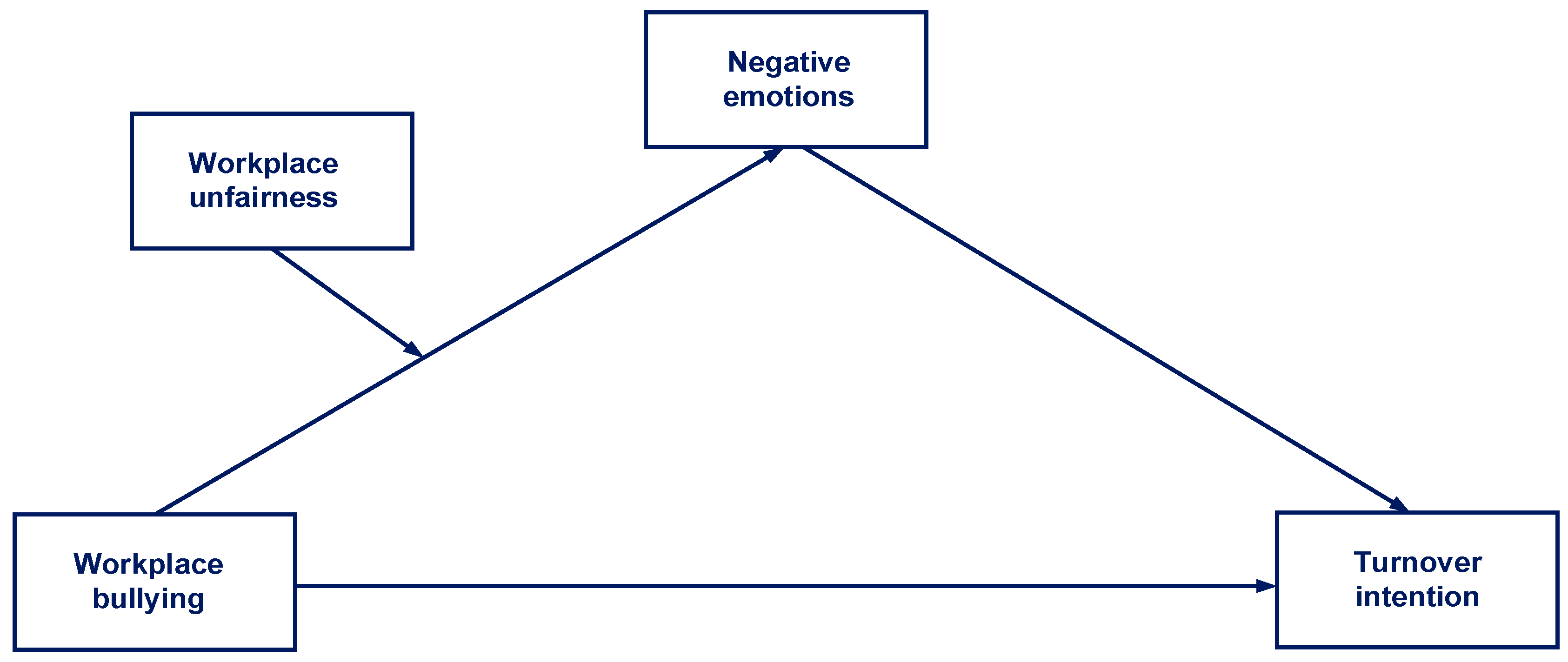
2.2. Mediating Role of Negative Emotions
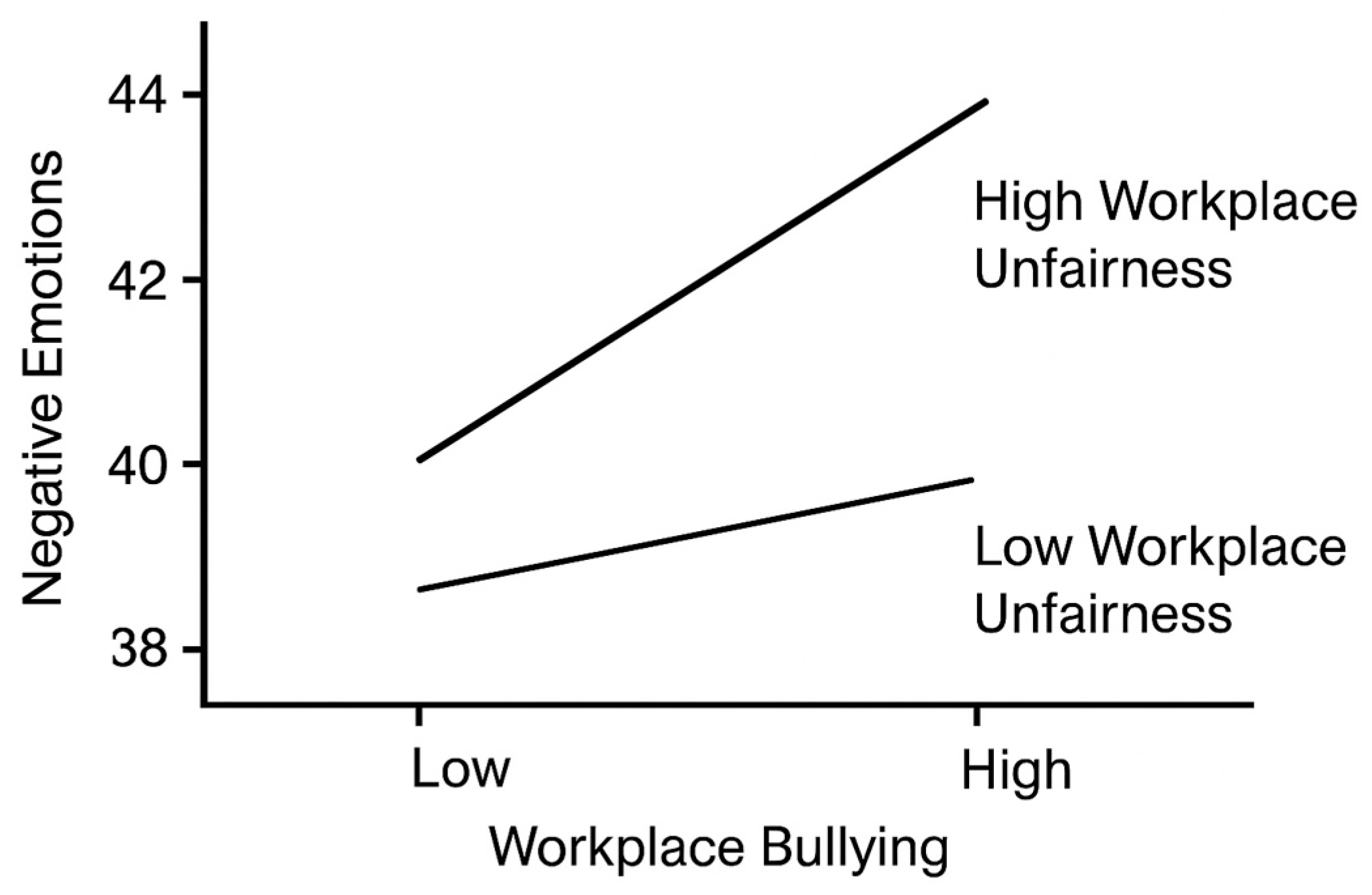
2.3. Moderating Role of Workplace Unfairness
3. Method
3.1. Sample and Data Collection
3.2. Measurement
- (i)
- Exposure to workplace bullying (self-labeling): Exposure to bullying was assessed using the single-item self-labeling format proposed by S. Einarsen and Skogstad (1996). Respondents were presented with the formal definition of bullying (see Theoretical Framework) and asked: “Have you been subjected to bullying at work during the past six months?” Responses ranged from 1 (never) to 5 (daily). This self-labeling approach is widely used in bullying research because it directly captures the subjective appraisal associated with bullying experiences. Previous research in the Turkish context has demonstrated strong test–retest reliability (r = 0.77; Minibas-Poussard et al., 2025b).
- (ii)
- Workplace bullying scale: To obtain an overall workplace bullying score, a 30-item behavioral scale was used, based on instruments developed by Leymann (1996a, 1996b) by Neuman and Keashly (2004). The scale comprises five subdimensions:
- Target’s communication: assessing instances where the target is prevented from expressing themselves (e.g., being interrupted or not listened to).
- Target’s maintaining social contacts: evaluating experiences of social isolation (e.g., not being talked to or excluded from meetings).
- Target’s personal reputation: examining occurrences of gossip or defamatory remarks about the target.
- Target’s professional reputation: exploring experiences such as task deprivation or withholding of assignments.
- Target’s physical well-being: evaluating threats of physical harm, such as injury or assault.
- (iii)
- Negative emotions: Negative emotions were measured using the 10-item negative affect subscale of the Job-Related Affective Well-being Scale (Spector, 1988), rated from 1 to 5. Sample items: My job made me feel angry; My job made me feel discouraged. Very satisfactory psychometric properties were obtained (Cronbach’s α = 0.94 and factor load > 0.40).
- (iv)
- Turnover intention: One item scale from Spector (1991). Turnover intention was assessed using a single item from Spector (1991): “How often have you seriously considered quitting your current job over the past six months?” The single-item turnover intention measure has been widely employed in organizational research, and studies indicated that it provides reliable and valid assessments comparable to multi-item scales (Michaels & Spector, 1982; Spector, 1991). In a preliminary pilot study, 30 bilingual participants completed the English version of the scale and followed by the Turkish version one week later. The correlation between the two administrations was r = 0.81, signifying adequate test–retest reliability.
- (v)
- Workplace unfairness: Workplace unfairness was measured using an 8-item scale inspired by Ambrose and Schminke (2009), rated from 1 to 5. Example items include: “Most of the people who work here would say they are often treated unfairly” and “Usually, the procedures in this workplace are not fair.” Good psychometric properties were obtained (Cronbach’s α = 0.92 and factor load > 0.40).
4. Results
5. Discussion
5.1. Theoretical Implications
5.2. Practical Implications
5.3. Limitations and Future Directions
6. Conclusions
Author Contributions
Funding
Institutional Review Board Statement
Informed Consent Statement
Data Availability Statement
Conflicts of Interest
References
- Adams, J. S. (1965). Inequity in social exchange. Advances in Experimental Social Psychology, 2, 267–299. [Google Scholar] [CrossRef]
- Aguinis, H., & Glavas, A. (2012). What we know and don’t know about corporate social responsibility: A review and research agenda. Journal of Management, 38(4), 932–968. [Google Scholar] [CrossRef]
- Ahmad, S., & Kaleem, A. (2020). Zooming in on the workplace bullying and turnover intentions pathway: The role of well-being and a cultural boundary condition. Personnel Review, 49(2), 425–444. [Google Scholar] [CrossRef]
- Akinyomi, O. J. (2016). Labour turnover: Causes, consequences and prevention. Fountain University Journal of Management and Social Sciences, 5(1), 105–112. [Google Scholar]
- Ambrose, M. L., & Schminke, M. (2009). The role of overall justice judgments in organizational justice research: A test of mediation. Journal of Applied Psychology, 94(2), 491–500. [Google Scholar] [CrossRef]
- Barling, J., Dupre, K. E., & Kelloway, E. K. (2009). Predicting workplace aggression and violence. Annual Review of Psychology, 60, 671–692. [Google Scholar] [CrossRef]
- Bayode, O. T., & Duarte, A. P. (2022). Examining the mediating role of work engagement in the relationship between corporate social responsibility and turnover intention: Evidence from Nigeria. Administrative Sciences, 12(4), 150. [Google Scholar] [CrossRef]
- Bies, R. J., & Moag, J. F. (1986). Interactional justice: Communication criteria of fairness. In R. J. Lewicki, B. H. Sheppard, & M. H. Bazerman (Eds.), Research on negotiations in organizations (Vol. 1, pp. 43–55). JAI Press. [Google Scholar]
- Blau, P. M. (1964). Exchange and power in social life. Wiley. [Google Scholar]
- Boudrias, V., Trépanier, S. G., & Salin, D. (2021). A systematic review of research on the longitudinal consequences of workplace bullying and the mechanisms involved. Aggression and Violent Behavior, 56, 101508. [Google Scholar] [CrossRef]
- Bowen, D. E., & Ostroff, C. (2004). Understanding HRM–firm performance linkages: The role of the “strength” of the HRM system. Academy of Management Review, 29(2), 203–221. [Google Scholar] [CrossRef]
- Brislin, R. W. (1986). The wording and translation of research instruments. In W. J. Lonner, & J. W. Berry (Eds.), Field methods in cross-cultural research: Cross-cultural research and methodology series (Vol. 8, pp. 137–164). Sage. [Google Scholar]
- Cascio, W. F. (2006). Managing human resources: Productivity, quality of work life, profits. Mc-Graw Hill. [Google Scholar]
- Ciby, M. A., Sahai, S., & Raya, R. P. (2021). Workplace bullying and turnover intention: Serial multiple mediation model of negative emotions and affective commitment. International Journal of Management Practice, 14(6), 736–750. [Google Scholar] [CrossRef]
- Coetzee, M., & Van Dyk, J. (2018). Workplace bullying and turnover intention: Exploring work engagement as a potential mediator. Psychological Reports, 121(2), 348–362. [Google Scholar] [CrossRef]
- Cohen-Charash, Y., & Spector, P. E. (2001). The role of justice in organizations: A meta-analysis. Organizational Behavior and Human Decision Processes, 86(2), 278–321. [Google Scholar] [CrossRef]
- Colquitt, J. A. (2001). On the dimensionality of organizational justice: A construct validation of a measure. Journal of Applied Psychology, 86(3), 386–400. [Google Scholar] [CrossRef]
- Cowan, R. L., Clayton, E., & Bochantin, J. (2021). Human resources as an important actor in workplace bullying situations: Where we have been and where we should go. In P. D’Cruz, E. Noronha, E. Baillien, B. Catley, K. Harlos, A. Hogh, & E. G. Mikkelsen (Eds.), Pathways of job-related negative behaviour (pp. 477–494). Springer. [Google Scholar]
- Cropanzano, R., Anthony, E. L., Daniels, S. R., & Hall, A. V. (2017). Social exchange theory: A critical review with theoretical remedies. Academy of Management Annals, 11(1), 479–516. [Google Scholar] [CrossRef]
- Cropanzano, R., & Mitchell, M. S. (2005). Social exchange theory: An interdisciplinary review. Journal of Management, 31(6), 874–900. [Google Scholar] [CrossRef]
- D’Cruz, P., & Noronha, E. (2010). The exit coping response to workplace bullying: The contribution of inclusivist and exclusivist HRM strategies. Employee Relations, 32(2), 102–120. [Google Scholar] [CrossRef]
- Desrumaux, P., Hellemans, C., Malola, P., & Jeoffrion, C. (2021). How do cyber-and traditional workplace bullying, organizational justice and social support, affect psychological distress among civil servants? Le Travail Humain, 84(3), 233–256. [Google Scholar] [CrossRef]
- Diener, E., & Suh, E. (1997). Measuring quality of life: Economic, social, and subjective indicators. Social Indicators Research, 40(1–2), 189–216. [Google Scholar] [CrossRef]
- Djurkovic, N., McCormack, D., & Casimir, G. (2008). Workplace bullying and intention to leave: The moderating effect of perceived organizational support. Human Resource Management Journal, 18(4), 405–422. [Google Scholar] [CrossRef]
- Ehnert, I., Parsa, S., Roper, I., Wagner, M., & Muller-Camen, M. (2016). Reporting on sustainability and HRM: A comparative study of sustainability reporting practices by the world’s largest companies. The International Journal of Human Resource Management, 27(1), 88–108. [Google Scholar] [CrossRef]
- Einarsen, K., Mykletun, R. J., Einarsen, S. V., Skogstad, A., & Salin, D. (2017). Ethical infrastructure and successful handling of workplace bullying. Nordic Journal of Working Life Studies, 7(1), 37–54. [Google Scholar] [CrossRef]
- Einarsen, S., Hoel, H., Zapf, D., & Cooper, C. L. (2011). The concept of bullying and harassment at work: The European tradition. In S. Einarsen, H. Hoel, D. Zapf, & C. L. Cooper (Eds.), Bullying and harassment in the workplace: Developments in theory, research, and practice (2nd ed., pp. 3–30). CRC Press. [Google Scholar]
- Einarsen, S., Hoel, H., Zapf, D., & Cooper, C. L. (2020). The concept of bullying and harassment at work: The European tradition. In S. Einarsen, H. Hoel, D. Zapf, & C. L. Cooper (Eds.), Bullying and harassment in the workplace: Developments in theory, research, and practice (3rd ed., pp. 1–51). CRC Press. [Google Scholar]
- Einarsen, S., & Skogstad, A. (1996). Bullying at work: Epidemiological findings in public and private organizations. European Journal of Work and Organizational Psychology, 5, 185–201. [Google Scholar] [CrossRef]
- Elkington, J., & Rowlands, I. H. (1999). Cannibals with forks: The triple bottom line of 21st century business. Alternatives Journal, 25(4), 42–43. [Google Scholar] [CrossRef]
- Gardner, D., & Cooper-Thomas, H. D. (2021). Addressing workplace bullying: The role of training. In D. Gardner, & H. D. Cooper-Thomas (Eds.), Handbooks of workplace bullying, emotional abuse and harassment (Vol. 3, pp. 85–107). Springer. [Google Scholar]
- Glambek, M., Einarsen, S. V., Gjerstad, J., & Nielsen, M. B. (2024). Last in, first out? Length of service as a moderator of the relationship between exposure to bullying behaviors and work-related outcomes. Current Psychology, 43(2), 1296–1308. [Google Scholar] [CrossRef]
- Glasø, L., & Notelaers, G. (2012). Workplace bullying, emotions, and outcomes. Violence and Victims, 27(3), 360–377. [Google Scholar] [CrossRef] [PubMed]
- Glasø, L., Vie, T. L., Holmdal, G. R., & Einarsen, S. (2011). An application of affective events theory to workplace bullying: The role of emotions, trait anxiety, and trait anger. European Psychologist, 16(3), 198–208. [Google Scholar] [CrossRef]
- Glavas, A. (2016). Corporate social responsibility and employee engagement: Enabling employees to employ more of their whole selves at work. Frontiers in Psychology, 7, 796–806. [Google Scholar] [CrossRef]
- Grawitch, M. J., Gottschalk, M., & Munz, D. C. (2006). The path to a healthy workplace: A critical review linking healthy workplace practices, employee well-being, and organizational improvements. Consulting Psychology Journal: Practice and Research, 58(3), 129–147. [Google Scholar] [CrossRef]
- Greenberg, J. (1987). A taxonomy of organizational justice theories. Academy of Management Review, 12, 9–22. [Google Scholar] [CrossRef]
- Greenberg, J. (2006). Losing sleep over organizational injustice: Attenuating insomniac reactions to underpayment inequity with supervisory training in interactional justice. Journal of Applied Psychology, 91(1), 58–69. [Google Scholar] [CrossRef]
- Gunasekara, A., Alqhaiwi, Z. O., Luu, T. T., & Djurkovic, N. (2025). Workplace bullying and the enacted incivility of those targeted: The roles of anger, shame and fear. Journal of Service Theory and Practice, 35(7), 61–82. [Google Scholar] [CrossRef]
- Gustafsson, A., Caruelle, D., & Bowen, D. E. (2024). Customer experience (CX), employee experience (EX) and human experience (HX): Introductions, interactions and interdisciplinary implications. Journal of Service Management, 35(3), 333–356. [Google Scholar] [CrossRef]
- Hausknecht, J. P., Rodda, J., & Howard, M. J. (2009). Targeted employee retention: Performance-based and job-related differences in reported reasons for staying. Human Resource Management, 48(2), 269–288. [Google Scholar] [CrossRef]
- Hayes, A. F. (2018). Partial, conditional, and moderated mediation: Quantification, inference, and interpretation. Communication Monographs, 85(1), 4–40. [Google Scholar] [CrossRef]
- Hershcovis, M. S. (2011). “Incivility, social undermining, bullying… oh my!”: A call to reconcile constructs within workplace aggression research. Journal of Organizational Behavior, 32(3), 499–519. [Google Scholar] [CrossRef]
- Hobfoll, S. E. (2001). The influence of culture, community, and the nested-self in the stress process: Advancing conservation of resources theory. Applied Psychology, 50(3), 337–421. [Google Scholar] [CrossRef]
- Hobfoll, S. E., Halbesleben, J., Neveu, J.-P., & Westman, M. (2018). Conservation of resources in the organizational context: The reality of resources and their consequences. Annual Review of Organizational Psychology and Organizational Behavior, 5(1), 103–128. [Google Scholar] [CrossRef]
- Hoel, H., Cooper, C. L., & Einarsen, S. V. (2020). Organizational effects of workplace bullying. In S. Einarsen, H. Hoel, D. Zapf, & C. L. Cooper (Eds.), Bullying and harassment in the workplace. Developments in theory, research, and practice (3rd ed., pp. 209–234). CRC Press. [Google Scholar]
- Hogh, A., Hoel, H., & Carneiro, I. G. (2011). Bullying and employee turnover among healthcare workers: A three-wave prospective study. Journal of Nursing Management, 19(6), 742–751. [Google Scholar] [CrossRef] [PubMed]
- Hsu, F. S., Liu, Y. A., & Tsaur, S. H. (2019). The impact of workplace bullying on hotel employees’ well-being. International Journal of Contemporary Hospitality Management, 31(4), 1702–1719. [Google Scholar] [CrossRef]
- Jahanzeb, S., Fatima, T., & De Clercq, D. (2021). When workplace bullying spreads workplace deviance through anger and neuroticism. International Journal of Organizational Analysis, 29(4), 1074–1090. [Google Scholar] [CrossRef]
- Kacmar, K. M., Andrews, M. C., Van Rooy, D. L., Steilberg, R. C., & Cerrone, S. (2006). Sure everyone can be replaced… but at what cost? Turnover as a predictor of unit-level performance. Academy of Management Journal, 49(1), 133–144. [Google Scholar] [CrossRef]
- Kim, L., Maijan, P., & Yeo, S. F. (2024). Developing customer service quality: Influences of job stress and management process alignment in banking industry. Sustainable Futures, 8, 100311. [Google Scholar] [CrossRef]
- Kim, L., & Yeo, S. F. (2025). From side effects to work attitudes influencing customer service quality: Moderating impacts of work experience in banking industry. International Journal of Quality and Service Sciences, 17(5), 1–19. [Google Scholar] [CrossRef]
- Kira, M., & Balkin, D. B. (2014). Interactions between work and identities: Thriving, withering, or redefining the self? Human Resource Management Review, 24(2), 131–143. [Google Scholar] [CrossRef]
- Lawson, K. J., Noblet, A. J., & Rodwell, J. J. (2009). Promoting employee wellbeing: The relevance of work characteristics and organizational justice. Health Promotion International, 24(3), 223–233. [Google Scholar] [CrossRef]
- Leymann, H. (1996a). La persécution au travail. Editions du Seuil. [Google Scholar]
- Leymann, H. (1996b). The content and development of mobbing at work. European Journal of Work and Organizational Psychology, 5, 165–184. [Google Scholar] [CrossRef]
- Li, Q., Lourie, B., Nekrasov, A., & Shevlin, T. (2022). Employee turnover and firm performance: Large-sample archival evidence. Management Science, 68(8), 5667–5683. [Google Scholar] [CrossRef]
- Lu, Y., Zhang, M. M., Yang, M. M., & Wang, Y. (2023). Sustainable human resource management practices, employee resilience, and employee outcomes: Toward common good values. Human Resource Management, 62(3), 331–353. [Google Scholar] [CrossRef]
- Malhotra, N., & Mukherjee, A. (2004). The relative influence of organisational commitment and job satisfaction on service quality of customer-contact employees in banking call centres. Journal of Services Marketing, 18(3), 162–174. [Google Scholar] [CrossRef]
- Malola, P., Desrumaux, P., & Ndobo, A. (2025). Effects of workplace bullying, organizational justice on turnover intentions and affective commitment: Need satisfaction as explanatory mechanism. International Journal of Bullying Prevention, 1–15. [Google Scholar] [CrossRef]
- Michaels, C. E., & Spector, P. E. (1982). Causes of employee turnover: A test of the Mobley, Griffeth, Hand, and Meglino model. Journal of Applied Psychology, 67(1), 53. [Google Scholar] [CrossRef]
- Mikkelsen, E. G., Hansen, Å. M., Persson, R., Fosgrau, M., & Høgh, A. (2020). Individual consequences of being exposed to workplace bullying. In S. Einarsen, H. Hoel, D. Zapf, & C. L. Cooper (Eds.), Bullying and harassment in the workplace. Developments in theory, research, and practice (3rd ed., pp. 163–208). CRC Press. [Google Scholar]
- Minibas-Poussard, J., Idig-Camuroglu, M., Seckin, T., & Bingöl, H. B. (2022). Workplace bullying and post-traumatic stress disorder symptoms: A double mediation model. International Journal of Contemporary Economics and Administrative Sciences, 12, 58–74. [Google Scholar] [CrossRef]
- Minibas-Poussard, J., Roland-Levy, C., & Bingöl, H. B. (2025a). Social representations of workplace aggression: A comparison between bullied and non-bullied bank workers. Journal of Aggression, Conflict and Peace Research. [Google Scholar] [CrossRef]
- Minibas-Poussard, J., Seckin, T., & Bingöl, H. B. (2025b). From bystander silence to burnout: Serial mediation mechanisms in workplace bullying. Social Sciences, 14, 540. [Google Scholar] [CrossRef]
- Neuman, J. H., & Keashly, L. (2004). Development of the workplace aggression research questionnaire (WAR-Q): Preliminary data from the workplace stress and aggression project. In Theoretical advancements in the study of anti-social behavior at work. Society for Industrial and Organizational Psychology. [Google Scholar]
- Ocel, H., & Aydin, O. (2012). The moderating role of belief in a just world on the relationship between workplace bullying and turnover intentions. Procedia—Social and Behavioral Sciences, 58, 432–441. [Google Scholar]
- Park, J., & Min, H. K. (2020). Turnover intention in the hospitality industry: A meta-analysis. International Journal of Hospitality Management, 90, 102599. [Google Scholar] [CrossRef]
- Peng, Y. C., Chen, L. J., Chang, C. C., & Zhuang, W. L. (2016). Workplace bullying and workplace deviance: The mediating effect of emotional exhaustion and the moderating effect of core self-evaluations. Employee Relations, 38(5), 755–769. [Google Scholar] [CrossRef]
- Pfeffer, J. (2010). Building sustainable organizations: The human factor. Academy of Management Perspectives, 24(1), 34–45. [Google Scholar]
- Pfeffer, J. (2018). Dying for a paycheck: How modern management harms employee health and company performance—And what we can do about it. Harper Business. [Google Scholar]
- Poirot, M. (in press). Les dettes psychologiques au travail: Une approche innovante pour reguler les tensions psychosociales dans les organizations. L’Harmattan.
- Ramdeo, S., Balwant, P., Cowell, N., & Persadie, N. (2020). A moderated mediation model of bullying, support, justice, and organizational outcomes. International Journal of Employment Studies, 28(1), 48–81. [Google Scholar]
- Rayner, C., Hoel, H., & Cooper, C. L. (2002). Workplace bullying: What we know, who is to blame, and what can we do? Taylor & Francis. [Google Scholar]
- Reknes, I., Glambek, M., & Einarsen, S. V. (2021). Injustice perceptions, workplace bullying and intention to leave. Employee Relations, 43(1), 1–13. [Google Scholar] [CrossRef]
- Rodríguez-Muñoz, A., Baillien, E., De Witte, H., Moreno-Jiménez, B., & Pastor, J. C. (2009). Cross-lagged relationships between workplace bullying, job satisfaction and engagement: Two longitudinal studies. Work & Stress, 23(3), 225–243. [Google Scholar] [CrossRef]
- Rosario-Hernández, E., & Millán, L. V. R. (2018). Effect of the exposure to workplace bullying on turnover intention and the mediating role of job satisfaction, work engagement, and burnout. Revista Interamericana de Psicología Ocupacional, 37(1), 26–51. [Google Scholar] [CrossRef]
- Salancik, G. R., & Pfeffer, J. (1978). A social information processing approach to job attitudes and task design. Administrative Science Quarterly, 23(2), 224–253. [Google Scholar] [CrossRef] [PubMed]
- Salin, D., & Hoel, H. (2020). Organizational risk factors of workplace bullying. In S. Einarsen, H. Hoel, D. Zapf, & C. L. Cooper (Eds.), Bullying and harassment in the workplace. Developments in theory, research, and practice (3rd ed., pp. 305–329). CRC Press. [Google Scholar]
- Schotter, A. P. J., Mudambi, R., Doz, Y. L., & Gaur, A. (2017). Boundary spanning in global organizations. Journal of Management Studies, 54(4), 403–421. [Google Scholar] [CrossRef]
- Shore, L. M., Cleveland, J. N., & Sanchez, D. (2011). Inclusive workplaces: A review and model. Human Resource Management Review, 21(4), 311–326. [Google Scholar] [CrossRef]
- Spector, P. E. (1988). Development of the work locus of control scale. Journal of Occupational Psychology, 61(4), 335–340. [Google Scholar] [CrossRef]
- Spector, P. E. (1991). Confirmatory test of a turnover model utilizing multiple data sources. Human Performance, 4(3), 221–230. [Google Scholar] [CrossRef]
- Spector, P. E., & Goh, A. (2001). The role of emotions in the occupational stress process. In P. L. Perrewe, & D. C. Ganster (Eds.), Exploring theoretical mechanisms and perspectives: Research in occupational stress and well-being (Vol. 1, pp. 195–232). JAI. [Google Scholar]
- Tehrani, N. (2001). Building a culture of respect (pp. 239–242). CRC Press. [Google Scholar]
- Thibaut, J., & Walker, L. (1975). Procedural justice: A psychological analysis. Lawrence Erlbaum Associates. [Google Scholar]
- Trépanier, S. G., Fernet, C., & Austin, S. (2024). Workplace bullying and emotional exhaustion: The role of job resources. Journal of Occupational Health Psychology, 29(1), 53–65. [Google Scholar] [CrossRef]
- Tuckey, M. R., & Neall, A. M. (2014). Workplace bullying erodes job and personal resources: Between- and within-person perspectives. Journal of Occupational Health Psychology, 19(4), 413–424. [Google Scholar] [CrossRef]
- Van den Brande, W., Baillien, E., Hans De Witte, T., Vander, E., & Godderis, L. (2016). The role of work stressors, coping strategies, and coping resources in the process of workplace bullying: A systematic review and development of a comprehensive model. Aggression and Violent Behavior, 29, 61–71. [Google Scholar] [CrossRef]
- Weiss, H. M., & Cropanzano, R. (1996). Affective events theory: A theoretical discussion of the structure, causes and consequences of affective experiences at work. Research in Organizational Behavior, 18, 34–74. [Google Scholar]
- Weiss, H. M., Nicholas, J., & Daus, C. S. (1999). An examination of the relationship between job-related stressors and affective experiences at work. Journal of Organizational Behavior, 20(2), 217–239. [Google Scholar]
- Wickham, S., Shryane, N., Lyons, M., Dickins, T., & Bentall, R. (2014). Why does relative deprivation affect mental health? The role of justice, trust and social rank in psychological well-being and paranoid ideation. Journal of Public Mental Health, 3(2), 114–126. [Google Scholar] [CrossRef]
- Yating, L., bin Arshad, M. A., & Mengjiao, Z. (2024). A review of the impact of motivational factors on employee performance. International Journal of Academic Research in Economics and Management Sciences, 13(1), 184–193. [Google Scholar] [CrossRef] [PubMed]



| M | SD | 1 | 2 | 3 | |
|---|---|---|---|---|---|
| 1. Workplace bullying | 88.38 | 14.60 | |||
| 2. Turnover intention | 4.33 | 0.90 | 0.24 ** | ||
| 3. Negative emotions | 35.38 | 6.35 | 0.63 ** | 0.41 ** | |
| 4. Workplace unfairness | 33.03 | 5.30 | 0.72 ** | 0.17 ** | 0.71 ** |
| In the Last Six Months | A Few Times a Month | A Few Times a Week | Almost Every Day |
|---|---|---|---|
| 24.47% | 32.3% | 34.3% |
| 43.4% | 27.4% | 22% |
| 11% | 17.7% | 31.7% |
| 21.3% | 29.2% | 14.6% |
| 12.9% | 12.5% | 26.5% |
Disclaimer/Publisher’s Note: The statements, opinions and data contained in all publications are solely those of the individual author(s) and contributor(s) and not of MDPI and/or the editor(s). MDPI and/or the editor(s) disclaim responsibility for any injury to people or property resulting from any ideas, methods, instructions or products referred to in the content. |
© 2025 by the authors. Licensee MDPI, Basel, Switzerland. This article is an open access article distributed under the terms and conditions of the Creative Commons Attribution (CC BY) license (https://creativecommons.org/licenses/by/4.0/).
Share and Cite
Minibas-Poussard, J.; Tuger, A.T.; Seckin, T.; Bingöl, H.B.; Poirot, M. Workplace Bullying and Turnover Intention Among Boundary-Spanning Bank Workers: The Emotional Mechanism and the Amplifying Role of Workplace Unfairness. Adm. Sci. 2025, 15, 496. https://doi.org/10.3390/admsci15120496
Minibas-Poussard J, Tuger AT, Seckin T, Bingöl HB, Poirot M. Workplace Bullying and Turnover Intention Among Boundary-Spanning Bank Workers: The Emotional Mechanism and the Amplifying Role of Workplace Unfairness. Administrative Sciences. 2025; 15(12):496. https://doi.org/10.3390/admsci15120496
Chicago/Turabian StyleMinibas-Poussard, Jale, Ahmet Tugrul Tuger, Tutku Seckin, Haluk Baran Bingöl, and Matthieu Poirot. 2025. "Workplace Bullying and Turnover Intention Among Boundary-Spanning Bank Workers: The Emotional Mechanism and the Amplifying Role of Workplace Unfairness" Administrative Sciences 15, no. 12: 496. https://doi.org/10.3390/admsci15120496
APA StyleMinibas-Poussard, J., Tuger, A. T., Seckin, T., Bingöl, H. B., & Poirot, M. (2025). Workplace Bullying and Turnover Intention Among Boundary-Spanning Bank Workers: The Emotional Mechanism and the Amplifying Role of Workplace Unfairness. Administrative Sciences, 15(12), 496. https://doi.org/10.3390/admsci15120496