Article

Material Deprivation, Institutional Trust, and Mental Well-Being: Evidence from Self-Employed Europeans


by
Inna Majoor-Kozlinska
1,2
1
Innovation Management & Strategy Department, Faculty of Economics & Business, University of Groningen, 9747 AD Groningen, The Netherlands
2
Faculty of Business & Economics, RISEBA University of Applied Sciences, LV-1048 Riga, Latvia
Adm. Sci. 2025, 15(12), 489; https://doi.org/10.3390/admsci15120489
Submission received: 24 October 2025 / Revised: 5 December 2025 / Accepted: 9 December 2025 / Published: 15 December 2025

Abstract

Material deprivation, defined as the inability to afford essential goods and services, is a key determinant of psychological well-being across Europe. While prior research links deprivation to lower well-being and diminished institutional trust, few or no studies to date have examined how trust itself might operate as a mechanism connecting these phenomena in an entrepreneurial context. The current study investigates whether institutional trust mediates the relationship between material deprivation and mental well-being among self-employed individuals across Europe. Drawing on data from the 2016 European Quality of Life Survey (N = 2373), the analysis focuses on the self-employed, a group particularly vulnerable to material insecurity due to limited access to welfare protections. Mental well-being is measured through positive emotions, energy levels, restfulness, and a sense of fulfilment, while institutional trust refers to confidence in government, parliament, the legal system, and local authorities. The results of structural equation modelling show that material deprivation is negatively associated with both institutional trust and mental well-being and that trust partially mediates this link. The findings suggest that when self-employed individuals face material deprivation, reduced trust in public institutions partly explains their lower well-being. This study contributes to entrepreneurial well-being research by highlighting the role of institutional trust as a cognitive belief-based mechanism through which economic insecurity affects mental well-being.

1. Introduction

Mental well-being is defined as optimal psychological functioning rooted in positive affect, vigour, and a sense of fulfilment (Ryan & Deci, 2001; Stephan, 2018). It is a key component of socioeconomic progress susceptible to the influence of various factors beyond our direct control (Eurofound, 2022a; OECD, 2021). For example, adverse market conditions and institutional contexts can profoundly shape mental well-being, where some professional groups are more vulnerable to such influences than others (e.g., Zhuang et al., 2025). Self-employed individuals such as freelancers, small business owners, and independent professionals occupy a unique position in the European economy, representing a significant segment of the workforce (about one in seven workers) (Eurofound, 2017). Self-employment is associated with greater autonomy and job satisfaction compared to salaried employment (Stephan et al., 2020). At the same time, this professional group tends to face unstable incomes, elevated poverty risks, and a lack of formal safety nets (Sorgner et al., 2014). This suggests that the mental well-being of self-employed individuals may be particularly sensitive to their material conditions and the reliability of the institutions around them (Spasova & Regazzoni, 2022; ETUI, 2021).
Research on mental well-being and self-employment yields mixed findings and some unresolved questions, despite the importance of this professional group for local economies. On the one hand, the demands and uncertainties inherent to this occupation can significantly increase the levels of stress, depression, and anxiety compared to those that salaried employees experience (Stephan et al., 2023). On the other hand, many self-employed individuals also report high job satisfaction and well-being, even in the case of lower earnings (Cribb & Xu, 2020). This paradox suggests that their mental well-being is volatile and contingent on contextual factors. One such factor in this is material deprivation, defined as the inability to afford basic necessities (Eurofound, 2022a; OECD, 2021). While economic hardship erodes mental health in the general population (Zhuang et al., 2025), its impact among the self-employed remains unclear. Interestingly, self-employed Europeans show a discrepancy between income poverty and actual deprivation—they face higher poverty risk yet often report lower material deprivation than employees, possibly drawing on personal savings (Horemans & Marx, 2024; Spasova & Regazzoni, 2022). This nuance complicates our understanding of how material deprivation translates into psychological outcomes for the self-employed.
Institutional trust—one’s confidence in institutions such as the government, legal systems, and welfare services—is a potential factor that can help explain the volatility of mental well-being among the self-employed (e.g., Harris & Sandal, 2021; Kim, 2023). Trust in institutions might shape how the self-employed deal with hardships (Egamberdiev et al., 2025; Zmerli, 2024) or can act as a cognitive mechanism through which individuals evaluate the fairness and stability of their socioeconomic environment (Estrin et al., 2013; van der Meer & Zmerli, 2017). During the COVID-19 crisis, for example, self-employed Europeans experienced sharper declines in income, life satisfaction, and institutional trust than employees (Eurofound, 2022b; Nordenmark et al., 2023). This suggests that for this group, institutional trust may serve as a channel through which deprivation influences well-being. However, little is known about whether and how institutional trust intervenes in the relationship between material deprivation and the mental well-being of the self-employed.
Addressing these limitations in the current knowledge is important for both theoretical and practical reasons. Self-employed individuals constitute a large and growing share of the workforce in Europe; hence, their material deprivation may have ripple effects on mental well-being and beyond, including on entrepreneurial sustainability, economic productivity, and public health (e.g., due to increased burnout or venture exit). Institutional trust as such might have become more fragile recently due to economic and geopolitical disruptions, leaving potentially more vulnerable groups like the self-employed unsupported. Diminished trust in institutions could exacerbate the mental health toll of deprivation by eroding the sense of security and fairness among the self-employed (Kim, 2023). In contrast, strong institutional trust might serve as a psychological safety net, even when material conditions are harsh (Harris & Sandal, 2021; Lee, 2022). Clarifying the mechanisms linking material deprivation to mental well-being among the self-employed can inform policies—for example, reinforcing social protections or trust-building measures—to safeguard this group’s well-being and welfare. From a theoretical perspective, there is a need to advance current knowledge by identifying how deprivation impacts well-being in this context.
The current study investigates how material deprivation impacts the mental well-being of self-employed Europeans and whether institutional trust functions as a key mediating mechanism in this relationship. Drawing on data from the European Quality of Life Survey (EQLS) 2016 (N = 2373), we measure institutional trust as perceived trust in the government, parliament, legal system, and local authorities; material deprivation as the inability to afford basic necessities; and mental well-being as the frequency of feeling cheerful, calm, vigorous, rested, and fulfilled. Following the prior literature, this study conceptualises institutional trust as a belief-based cognitive mechanism that links the economic circumstances of the self-employed with their psychological evaluations of life (van der Meer & Zmerli, 2017; Marien & Hooghe, 2011; OECD, 2022). The research model tests whether higher deprivation is linked to a lower level of perceived institutional trust, which, in turn, conditions better mental well-being on its own, and whether the direct negative effect of deprivation on well-being diminishes when trust is included as a mediating variable.
The findings of this study show that material deprivation is directly associated with lower well-being among self-employed Europeans and that this link is partially mediated by institutional trust. Consistent with previous research, self-employed individuals with higher perceived deprivation also report significantly less positive affect and vitality (McElroy & Walsh, 2023; Terraneo, 2021). They also display lower trust in public institutions (Bobzien, 2023; Bornand & Klein, 2022). Mediation analysis confirms that part of deprivation’s effect on mental well-being operates through trust. Put another way, deprivation undermines well-being even in the presence of institutional trust. This mediation is partial rather than full because even when trust enters the model, deprivation retains its direct negative effect on the outcome variable. This means that material deprivation influences mental well-being both directly and through the loss of institutional trust. In general, these results highlight the crucial role of perceived institutional trust that functions as a bridge between economic insecurity and mental well-being.
This study extends and advances the current knowledge on the well-being of entrepreneurs. First, it enriches the understanding of entrepreneurial well-being by revealing institutional trust as a mechanism through which material deprivation translates into psychological outcomes. Prior studies have documented notable differences between entrepreneurs and employees such as the higher stress and higher job satisfaction of the former (e.g., Cribb & Xu, 2020; Stephan et al., 2023; Stephan et al., 2020) but have only started unpacking the processes underlying these patterns. By demonstrating the mediating role of institutional trust, we offer a novel explanation why material deprivation can be particularly damaging to the well-being of self-employed individuals. Second, this study advances the conversation about material deprivation and mental well-being by applying an interdisciplinary approach and integrating an institutional trust perspective with the concepts of material insecurity and moral economy, adding theoretical depth and a new lens through which to explain the mental well-being of the self-employed (e.g., Marien & Hooghe, 2011; van der Meer & Zmerli, 2017). Third, this study underscores the importance of entrepreneurial vulnerability by positioning it as an essential piece of the “well-being puzzle” (e.g., Stephan et al., 2020; Ryan & Deci, 2001). Finally, this study has practical implications as it provides new evidence for policy makers. To sum up, this study adds to both theoretical and practical knowledge by clarifying how material deprivation undermines mental well-being among self-employed Europeans and by identifying institutional trust as a pivotal mechanism in this process.

2. Theoretical Background

2.1. Evidence on Material Deprivation, Trust, and Well-Being in General Population

Numerous studies in sociology and public health have examined the impact of material deprivation (or related financial strain or poverty) on mental well-being in the general population. The evidence is fairly consistent—material deprivation is related to poorer mental health outcomes and lower life satisfaction (e.g., McElroy & Walsh, 2023; Tang & Chou, 2024; Terraneo, 2021). Moreover, lacking basic necessities correlates strongly with health problems, anxiety, and sleeplessness—even more so than low income (Halleröd & Larsson, 2008). Large-scale European studies have shown that material deprivation explains the variation in depression rates, where more deprived regions suffer the most (McElroy & Walsh, 2023; Sánchez-Moreno & Gallardo-Peralta, 2022). This evidence suggests that deprivation remains a major risk for mental well-being. In the current paper, we define mental well-being from a positive angle as optimal psychological functioning rooted in positive affect, vigour, and a sense of fulfilment (Ryan & Deci, 2001; Stephan, 2018) and material deprivation as an individual’s inability to afford basic necessities, like being able to warm up their homes or buy new clothes, or maintain financial security (Eurofound, 2022a; OECD, 2021).
The broad literature on political sciences and economics has demonstrated a positive relationship between institutional trust (trust in government, legal systems, etc.) and subjective well-being or signposted trust as a buffer against hardships like unemployment (e.g., Helliwell et al., 2016; Hudson, 2006). The most recent comprehensive meta-analysis by Bi et al. (2025) confirmed that across all ages and societies, people who have more trust in others and in institutions report significantly greater happiness and life satisfaction. Furthermore, Lee (2022), in a study among adults aged 50+, found that perceived insecurity in employment and housing, worsening finances, and difficulty paying for basic necessities were strongly related to life satisfaction, happiness, psychological distress, and mental health. Their study also revealed a partially mediating role of institutional trust between perceived adversities, subjective well-being, and mental health. Yet, it did not control for occupational groups and was contextualised solely within the COVID-19 pandemic outbreak.
To sum up, evidence from the general population suggests that material deprivation tends to undermine mental well-being, while high institutional or social trust is associated with better subjective well-being. However, these phenomena have most often been studied independently, i.e., poverty’s effects on mental health versus trust’s effects on well-being, rather than within an integrated framework, with the exception of one study that was conducted in exceptionally adverse conditions and among an ageing population.

2.2. Evidence from Studies on Self-Employed Individuals

Fewer studies have focused specifically on self-employed individuals when examining the linkages between material deprivation, trust, and well-being. There is clear evidence that income poverty risk is higher among the self-employed, even if material deprivation rates are somewhat low due to previously accumulated assets (Horemans & Marx, 2024; Spasova & Regazzoni, 2022). While the studies that bring this evidence do not focus on mental well-being, they highlight that many self-employed people experience economic strain, a known risk factor for mental distress. Another line of evidence is clear from the well-being perspective in that self-employment is associated with higher job/life satisfaction and happiness and simultaneously with greater stress due to higher uncertainty and risk exposure (Stephan et al., 2023; Nikolaev et al., 2019). This paradox indicates that the mental well-being of the self-employed might be more volatile and susceptible to the influence of contextual factors, and it also complicates our understanding of how material deprivation relates to mental well-being in this occupational group.
In relation to the evidence on institutional trust, a recent study based on data from self-employed individuals across 34 countries shows that the belief that others and institutions are trustworthy contributes to the feeling of being happier and more satisfied with life (Gashi et al., 2024). In adverse conditions, however, like the COVID-19 crisis, the self-employed tend to experience sharper declines in income, life satisfaction, and institutional trust than salaried employees (Eurofound, 2022b; Nordenmark et al., 2023). The entrepreneurship research literature also highlights that vulnerabilities like being more susceptible to material deprivation and its psychological consequences (Spasova & Regazzoni, 2022; ETUI, 2021) shape both economic and well-being outcomes, because entrepreneurs/self-employed individuals operate under heightened uncertainty and risk exposure (Stephan et al., 2023; Nikolaev et al., 2019). Moreover, the relationship of the self-employed with the state differs from that of salaried employees, because the former tend to engage with public institutions as tax payers and beneficiaries at the same time, which can shape trust differently. Overall, despite the existing insights, the current scholarship lacks an understanding of how deprivation impacts well-being and what the potential role of institutional trust is in this relationship among the self-employed.

2.3. Research Model

Building on the limitations in the current knowledge emphasised in the above paragraphs, this section provides the core argumentation of the relationships put forward in the theoretical model of this study.
Prior comparative entrepreneurship research on self-employed individuals and employees increasingly acknowledges that institutional context affects not only business performance but also the well-being of the self-employed (e.g., Stephan et al., 2023). This group of individuals, including freelancers, small business owners, and independent professionals, face heightened exposure to irregular incomes and limited social guarantees (Spasova & Regazzoni, 2022). Such conditions can have profound psychological consequences. A large body of Europe-wide research suggests that deprivation conditions poorer mental well-being, e.g., it is associated with greater levels of stress, depressive symptoms, and reduced positive affect (Eurofound, 2022a; McElroy & Walsh, 2023; Terraneo, 2021). Unlike salaried employees, self-employed individuals often bear full responsibility for the financial risks undertaken, which may also have a negative impact on their mental health (Nikolaev et al., 2019). In addition, typical (median) earnings are lower and more volatile for the self-employed than for salaried employees (driven mainly by the large group of solo self-employed individuals), which makes the material base of their life unstable (Sorgner et al., 2014). Hence, material deprivation is likely to be perceived not only as an economic constraint but also as a source of diminished mental well-being among the self-employed.
H1: 
Material deprivation is negatively associated with the mental well-being of self-employed individuals.
In the entrepreneurial context, the institutional environment sets rules in terms of how the self-employed might perceive fairness, stability, and opportunities. Empirical studies show that individuals who experience economic hardship often perceive the state as unjust or uncaring, which erodes institutional trust (Bobzien, 2023; Bornand & Klein, 2022). In the field of entrepreneurship, Estrin et al. (2013) argue that trust in public institutions reduces the transaction costs of self-employment and underpins perceptions of legitimacy. Conversely, a lack of trust may discourage entrepreneurial engagement or reinforce a sense of institutional alienation. For self-employed individuals in conditions of uncertainty, low institutional trust might reflect unmet expectations of welfare support or procedural fairness. Similar patterns can be found in broader European populations, where economically deprived regions exhibit lower trust in the government and legal systems (Hooghe & Dassonneville, 2018; McKay et al., 2021). In a nutshell, material deprivation is likely to undermine institutional trust among the self-employed.
H2: 
Material deprivation is negatively associated with institutional trust.
One way of conceptualising trust among entrepreneurship scholars is as a mechanism that mitigates uncertainty and stress in volatile economic conditions (Shir et al., 2019). When the self-employed perceive institutions as fair and competent, trust can provide a sense of stability and legitimacy, supporting confidence in the institutional environment and thereby enhancing mental well-being. Therefore, conceptually, trust operates as a cognitive mechanism focused on the reasoned belief in institutional reliability and fairness (Marien & Hooghe, 2011; OECD, 2022; van der Meer & Zmerli, 2017). Conversely, a lack of trust results in frustration and anxiety (Kim, 2023). For the self-employed whose lives and performance partly depend on a predictable institutional environment, trust may serve a crucial psychological function, supporting mental well-being in the face of material uncertainty. Hence, we propose the following hypothesis.
H3: 
Institutional trust is positively associated with mental well-being.
Weaving the lines of argumentation for H1–H3 together—material deprivation lowers mental well-being and institutional trust, while the latter enhances mental well-being—trust becomes a mechanism through which material conditions translate into psychological outcomes, i.e., into mental well-being. When self-employed individuals are not able to meet their basic needs despite contributing to the state through taxes or social participation, they can perceive this condition as a sign that institutions fail in terms of caring about them and that the state lacks fairness in treating its citizens well. Such perceptions undermine cognitive trust—reducing beliefs that institutions are reliable, competent, and just, that is, cognitive beliefs in the reliability of public authorities (Marien & Hooghe, 2011; van der Meer & Zmerli, 2017). Therefore, institutional trust that would otherwise provide a sense of predictability, stability, and belonging (OECD, 2022) becomes less able to promote mental well-being. Eroded trust heightens perceived uncertainty, frustration, and powerlessness, implying poorer mental well-being. For the self-employed who face heightened financial risks and lower social security, institutional trust becomes even more important as it potentially substitutes for the formal security that salaried employees have (Nikolaev et al., 2019; Stephan et al., 2023).
Overall, trust is likely to mediate the relationship between deprivation and well-being among the self-employed, acting as a belief-based cognitive mechanism through which economic insecurities translate into individual psychological experiences. Deprivation makes the self-employed feel that institutions are failing, which indicates eroded trust that in turn negatively affects mental well-being.
H4: 
Institutional trust mediates the relationship between material deprivation and mental well-being.
Figure 1 presents the research model of this study.

3. Methodology

Data and Sample

This study uses data from the European Quality of Life Survey (EQLS) 2016 provided by the UK Data Service (Eurofound, 2018a). The survey examines objective life circumstances and the perceptions of them among adult European citizens (18 and over) living in private households. The EQLS 2016 dataset includes 33 countries (EU28 and 5 candidate countries at the time, including the former Yugoslav Republic of Macedonia, Montenegro, Serbia, and Turkey). The data were collected using face-to-face interviews using multi-stage stratified random sampling between September 2016 and March 2017. The total sample of the EQLS consisted of 36,908 responses, of which 2373 were used in the analysis, given the focus on self-employed individuals and following data cleaning procedures (removing outliers, duplicates, missing values).
While the EQLS data were collected in multiple ways (2003, 2007, 2011, 2016), this study relies on the 2016 wave only because of inconsistencies in survey questions, particularly with regard to deprivation and well-being variables, across the waves. Therefore, a cross-section design is used, building on the theoretically supported directionality of hypothesised relationships (Bollen & Pearl, 2013; Slimmen et al., 2022). A number of other studies across different disciplines relied on such a design while testing causal pathways (Billah et al., 2023; Egamberdiev et al., 2025; Lee, 2022).

4. Measures

The dependent variable, mental well-being, was measured using a five-item composite variable capturing the frequency at which respondents felt cheerful and in good spirits, calm and relaxed, and active and vigorous, feeling fresh and rested, and at which their daily life was fulfilled with things that interested them. The respective question items were assessed on a six-point Likert scale ranging from ‘at no time’ to ‘all of the time’. The measure is based on the World Health Organisation’s approach to measuring mental health (Eurofound, 2018b).
The independent variable, material deprivation, was measured using a six-item composite variable capturing whether or not the respondents could afford to keep their home adequately warm, to pay for holidays, to buy new clothes, and to replace old furniture. The respective question items were measured on a binary scale. This measurement approach aligned well with theoretical standpoints on what material deprivation is and was comparable to the ones applied in other studies (e.g., McElroy & Walsh, 2023; Terraneo, 2021).
The mediator variable, institutional trust, was measured using a four-item composite variable comprising trust in parliament, the legal system, the government, and local authorities. The respective question items were assessed on a 10-point scale ranging from ‘Do not at all trust’ to ‘Trust completely’. This measure aligns with the conceptualisation of cognitive trust in the fairness and justice of public institutions, which views it as rooted in citizens’ expectations that institutions will act ethically and effectively in the interests of citizens (Marien & Hooghe, 2011; Eurofound, 2018b; OECD, 2022).
A set of control variables that could potentially influence the theorised model consisted of the age, gender, education level, marital status, and geographical region of the self-employed (Hooghe & Dassonneville, 2018; McKay et al., 2021; Nikolaev et al., 2019).
Appendix A provides more detailed information on the original scales and scale item selection for this study’s measures.

Method of Analysis

Structural equation modelling (SEM) was used to test the study hypotheses. First, this method allowed the available survey items to be refined per composite variable (Obadia & Vida, 2011). Second, it is generally considered suitable for cross-sectional models with theoretically driven directional paths (Bollen & Pearl, 2013) and when mediators are not temporarily separated from outcome variables (Shrout & Bolger, 2002). Specifically, the mediation model was estimated using SmartPLS 4, which is appropriate for testing multi-path models focusing on prediction and theory development rather than model fit alone (Sarstedt et al., 2019).1
Before testing the theoretical model, a confirmatory factory analysis was conducted to validate the measurement constructs, i.e., composite variables, using the commonly assessed convergent and discriminant validity based on composite reliability (rho_c), average variance extracted (AVE), and Heterotrait–Monotrait Ratio of Correlations (HTMT) (Hair et al., 2019; Obadia & Vida, 2011). The overall model fit was assessed using the NFI (normed fit index), SRMR (standardised root mean square residual), and the fit measures d_ULS (unweighted least squares discrepancy) and d_G (geodesic discrepancy), with the Bollen–Stine bootstrap, in line with recent PLS-SEM studies (e.g., Sisu et al., 2023) and related methodological recommendations (Hair et al., 2019; Ringle et al., 2024). The NFI, the normed fit index, showed the extent to which the model improved the fit over a baseline where all variables are uncorrelated. The SRMR measured the average discrepancy between the observed correlations and the model-implied correlations. d_ULS measured the difference between the observed and model-implied correlation matrices, using unweighted least squares. d_G was based on the geodesic distance between the observed and model-implied correlation matrices.

5. Results

5.1. Model Validation

Table 1 displays the results of the measurement models’ validation for the mental well-being construct (the dependent variable), the material deprivation construct (the independent variable), and the institutional trust construct (the mediator variable). All AVE values exceeded 0.50. Reliability indicators, Cronbach’s alpha and composite reliability, Rho_c, were both well above the commonly accepted threshold of 0.7 (Hair et al., 2019).
The standardised root mean square residual was below the threshold of 0.08, SRMR = 0.045, suggesting a good model fit (Henseler & Sarstedt, 2013; Hu & Bentler, 1999). However, the unweighted least squares (d_ULS = 0.608, 95% CI [0.114; 0.146]) and geodesic discrepancy (d_G = 0.385, 95% CI [0.088; 0.145]) values were above their bootstrapped upper bounds, suggesting that some residual correlations were not fully captured by the model. The NFI value of 0.886, although slightly below the conventional 0.90 threshold, remained within an acceptable range (Hair et al., 2019; Obadia & Vida, 2011).
Table 2 displays the convergent and discriminant validity test results. Discriminant validity was confirmed as each construct’s AVE exceeded the squared correlations with other constructs (Fornell & Larcker, 1981) and all HTMT values were below 0.85 (as Table 1 shows) (Henseler & Sarstedt, 2013). This means that the latent variables accounted for more variance in its observed variables (items) than measurement error or other constructs within the structural model (Obadia & Vida, 2011).
Given the satisfactory SRMR, acceptable NFI, good convergent and discriminant validity, and theoretical grounding of the model, the overall fit was considered sufficient.

5.2. Descriptive Statistics

Table 3 presents the descriptive statistics and the correlation table for all variables. None of the variable pairs had a correlation value above 0.3. Coupled with the Variance Inflation Factor (VIF) values ranging from 1.04 to 1.75, this indicated that multicollinearity was not a concern in model testing (Gokmen et al., 2020).
A total of 62% of self-employed individuals in the sample were male, 45% had upper secondary or post-secondary education, and 64% were married. They worked on average 36 h per week. The equivalised monthly household income based on the reported data was EUR 1588 (SD = 1409), adjusted for household size and purchasing power parity (PPP). Moreover, 67% of the self-employed respondents also did not feel materially deprived. The sample distribution across European regions ranged from N = 346 in Northern Europe to N = 669 in Southern Europe. The distribution of income was quite even in the regions, with 35–45% of respondents belonging to the highest income group (top 25% or 75th–100th percentile) (e.g., 44% in Northern Europe, 36% in Western Europe).

5.3. Hypothesis Testing

Table 4 presents the results of research model testing. All the hypothesised paths, including direct, indirect, and total effects, were statistically significant at the 0.01–0.001 levels.
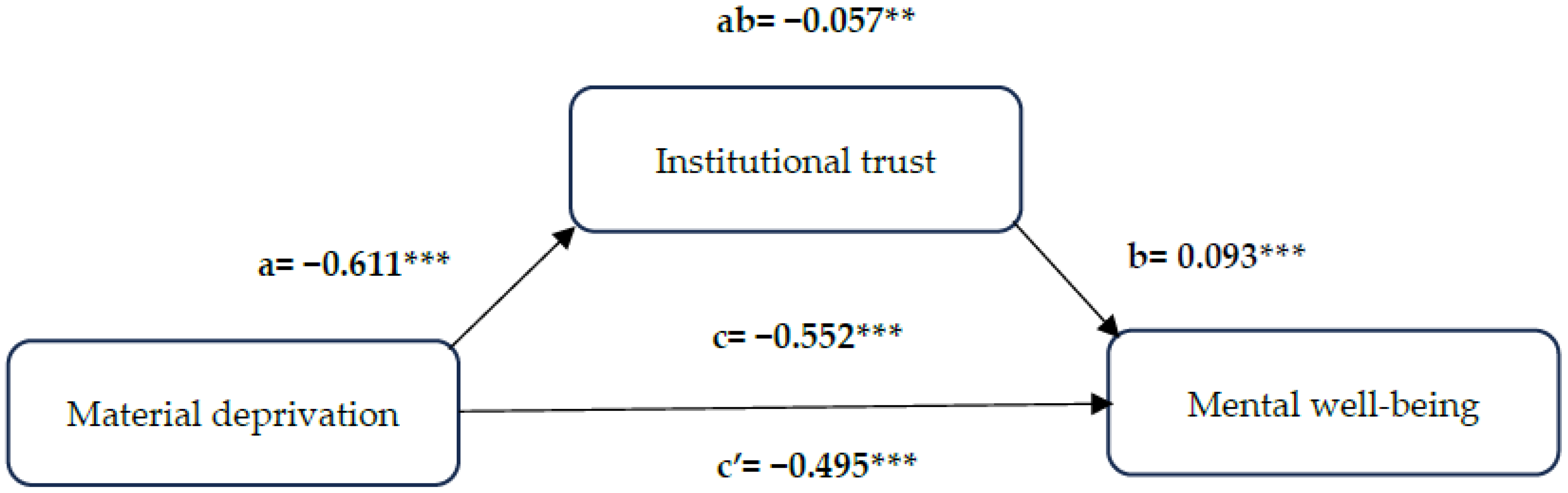
First, self-employed respondents who felt more materially deprived tended to have lower mental well-being (c’ = −0.495; SE = 0.074; 95% CI [−0.633; −0.345]). Second, feeling more materially deprived was associated with lower institutional trust (a = −0.611; SE = 0.061; 95% CI [−0.729; −0.490]). Third, institutional trust was positively associated with mental well-being (b = 0.093; SE = 0.027; 95% CI [0.041; 0.146]). These results support hypotheses H1–H3.
Further, the indirect effect of material deprivation on mental well-being was partially mediated by institutional trust (ab = −0.057; SE = 0.017; 95% CI [−0.094; −0.025]). This mediation is partial because the direct effect of deprivation on the outcome variable remained significant even in the presence of the mediator, denoting a total effect (c = −0.552; SE = 0.072; 95% CI [−0.685; −0.406]). Therefore, H4 can be partially supported.
Overall, 8.4% of the variance in mental well-being was explained by the model. This represents a modest level of explanatory power, yet it is acceptable given that the model captures only a small fraction of possible antecedents of well-being (Hair et al., 2019). The results suggest that the included predictors do contribute meaningfully to explaining individual differences in mental well-being.
Notably, two control variables offered alternative explanations for the observed results. First, self-employed individuals from Southern Europe reported significantly lower levels of mental well-being compared to those from Western Europe (p < 0.05). Second, marital status also showed an effect: being divorced was marginally associated with lower mental well-being compared to being married (p = 0.05).
Figure 2 presents this study’s results.
To test the robustness of the obtained results, we re-estimated the model using an alternative operationalisation of institutional trust, retaining only the item measuring trust in national government. The mediation pathway and main effects remained consistent. In this specification, one additional control variable became significant: self-employed individuals from Northern Europe reported higher levels of mental well-being compared to those from Western Europe (p < 0.05).
To further replicate the results, we re-tested the research model using an alternative software, PROCESS Macro in SPSS 28. The indirect effect of material deprivation on mental well-being through institutional trust, accounting for the set of previously tested controls, showed a point estimate of −0.044 (95% CI = −0.07 to −0.19), while the direct effect was measured as B = −0.514, p < 0.001. These estimates were very similar to the estimates obtained in Smart PLS.
As a final robustness check, we added one more control variable, namely, the autonomy2 of the self-employed. While the model testing results were fully replicated, autonomy did also serve as an alternative explanation for the variance in mental well-being (B = 0.298, p < 0.001). Interestingly, in this constellation of results, regional control variables “lost their significance”, while marital status (separated and divorced vs. married) played a more prominent role (p < 0.05). Overall, the robustness checks question the stability of regional controls, suggesting more stable and stronger predictors of mental well-being, including those confirmed in this study.

6. Discussion and Conclusions

This study investigated the relationship between material deprivation and mental well-being among self-employed Europeans and what role institutional trust plays in it. The results show that institutional trust partially mediates this relationship: material deprivation negatively affects both institutional trust and mental well-being, and diminished trust exacerbates the psychological toll of economic hardship. These findings extend the current understanding of well-being among the self-employed by incorporating institutional trust (phenomenon originating from political science and sociology) as a cognitive mechanism linking adverse material conditions with psychological outcomes. Below we expand on the theoretical contributions of this study, contrast the empirical findings with the prior literature, and elaborate on potential practical implications. We conclude by addressing study limitations and future research.

6.1. Theoretical Contributions

Our study refines theoretical knowledge on how institutional trust functions in the context of entrepreneurship. First, it repositions trust as a cognitive mediator, a belief-based psychological mechanism, through which self-employed individuals interpret their material conditions. This repositioning goes beyond viewing trust merely as a contextual feature (e.g., Estrin et al., 2013). Prior work in entrepreneurship has highlighted institutional quality as a driver of new venture creation or growth aspirations (Corradini, 2022; Estrin et al., 2013) but rarely as a factor influencing mental well-being. Borrowing the notion of trust from political science and sociology and bringing it into the entrepreneurship literature (Bornand & Klein, 2022; Helliwell et al., 2016; Hudson, 2006), the current study shows that institutional trust translates deprivation into poorer mental well-being outcomes. This finding potentially helps explain why even modest levels of material hardship can significantly impair mental health among entrepreneurs.
Second, the study findings engage with the conversation about material deprivation, institutional trust, and mental well-being from an interdisciplinary perspective such as that of the moral economy. Building on anthropological insights (Hann, 2010; Narotzky & Besnier, 2014), we suggest that material deprivation may function not only as a lack of resources but also as a moral appraisal of institutional fairness. When trust is low, the self-employed interpret deprivation as a sign of systemic failure that fuels the decline in their mental well-being. This interpretation is consistent with Kumlin and Haugsgjerd’s (2017), who argued that trust reflects perceived distributive and procedural justice. Therefore, by linking trust-based appraisals to mental well-being outcomes, the current study also adds to the discourse on institutional legitimacy from a psychological perspective.
Third, this study adds to entrepreneurial vulnerability research. Prior works have emphasised the paradox of higher autonomy and satisfaction versus elevated stress among self-employed individuals (Nikolaev et al., 2019; Stephan et al., 2023). The findings help clarify that autonomy alone (also tested as a control variable in one of the robustness checks) does not affect mental well-being, while institutional trust conditions how the experience of material deprivation is internalised in terms of the outcome variable. Therefore, the well-being of entrepreneurs is not just a function of their personal agency/autonomy (Ryan & Deci, 2001) but also a consequence of institutional and material vulnerabilities (Eurofound, 2017; Nikolaev et al., 2019; Spasova & Regazzoni, 2022). Substantial variance in the income of the surveyed self-employed individuals suggests that some might be more financially balanced than others, but it also means that the commonly known positive drivers of entrepreneurial well-being (such as autonomy and relatedness) might not be able to offset the eroding effects on mental well-being among the self-employed (Deci & Ryan, 2008; Ryan & Deci, 2001). Our study underscores the importance of entrepreneurial vulnerability and sees it as an essential piece of the “well-being puzzle”. Recognising this implies that entrepreneurial well-being should also be understood in terms of risk, insecurity, and social conditions that can make this professional group vulnerable.

6.2. Comparison with Prior Research

The current findings align with previous evidence from the general population that economic hardship erodes mental well-being (e.g., Terraneo, 2021; McElroy & Walsh, 2023) and that trust in public institutions supports psychological resilience and well-being (e.g., Lee, 2022; Harris & Sandal, 2021). However, this study goes further by focusing specifically on self-employed individuals. Prior research has tended to treat deprivation, trust, and well-being in isolation or within general population samples, overlooking the vulnerabilities of entrepreneurs. As such, the very fact that this professional group experiences deprivation aligns with the assumption that the self-employed are subject to greater vulnerabilities due to increased financial responsibilities and the fact that they operate in a context characterised by heightened uncertainty (Nikolaev et al., 2019; Sorgner et al., 2014). In contrast to viewing entrepreneurs as heroic opportunity-seekers (regardless of whether they act out of a material need or a recognised market potential) (McMullen, 2017; Foss & Klein, 2020), our discussion shifts the focus on the lens of vulnerability associated with material deprivation.
Moreover, while some studies have suggested that trust may moderate the effect of deprivation (e.g., Helliwell et al., 2016), our findings highlight a likely mediation pathway. That is, material deprivation lowers institutional trust, which then partially explains diminished well-being. This challenges the view of trust just as a buffer in prior work and points toward trust as an intermediate psychological mechanism. In doing so, our study contributes to a theoretical space that explores how institutional trust affects well-being in the context of entrepreneurship.
Contrasting and complementing our findings with the earlier mentioned anthropological insights, Hann (2010) argued that individuals tend to evaluate economic conditions based on the norms of fairness, beyond calculative self-interest. The self-employed who work hard but hardly make ends meet might similarly frame their appraisal of the state system—the system is not treating its citizens fairly. Narotzky and Besnier’s (2014) research on communities in economic crisis further illustrates this dynamic. They describe how a breakdown of economic expectations during a crisis forces individuals to re-evaluate their values and the social contract, altering what they expect from the state and each other. In times of economic austerity or recession, citizens often re-appraise how institutions operate, which directly affects trust (Bobzien, 2023; Bornand & Klein, 2022). The finding that institutional trust mediates the association between deprivation and well-being can thus be seen as an empirical illustration of this anthropological insight. Economic hardships lead to a ‘’breakdown of expectations” in that trust gets shaken, and the loss of trust results in poorer mental well-being.
In the context of our study, this suggests that the psychological harm of material deprivation is not just about the lack of material resources; it is about what the lack means in a given context whereby trust encapsulates that meaning, acting as a cognitive barometer for whether the state organises the life of society justly. When the evaluation is negative, the self-employed experience injustice from the state, which further manifests as a decline in mental well-being. In contrast, if they maintain trust, believing that the state institutions are fair, this may foster positive attitudes and emotions even in hard times. This potentially adds to prior discussions on entrepreneurial well-being in that it may depend on moral interpretations of the economic situation, beyond the situation itself (Nordenmark et al., 2023; Stephan et al., 2023). In summary, applying the anthropological lens, we suggest that institutional trust may operate as a barometer of fairness through which material conditions affect mental well-being.

6.3. Practical Implications

From a policy perspective, the findings underscore the importance of institutional reliability and fairness in supporting entrepreneurs’ mental well-being. Specifically, institutional trust acting as a barometer of fairness can be a meaningful signal for public authorities. If entrepreneurs perceive institutions as fair and dependable, they may maintain a sense of positivity and inclusion even in times of economic hardship. First, this might mean that entrepreneurship policy should go beyond material aid to include trust-building measures. For example, expanding access to affordable health insurance or implementing responsive and transparent administrative procedures could improve the perceptions of institutional fairness. Second, during economic downturns, governments should prioritise clear and inclusive communication with self-employed citizens to preserve institutional legitimacy and emotional stability. Third, mental well-being support for entrepreneurs should be integrated with broader institutional reforms, perhaps aimed at reducing bureaucratic barriers and enhancing procedural justice.
These measures alone are not likely to alleviate negative well-being outcomes but may strengthen entrepreneurial sustainability by supporting mental well-being in the face of material insecurity.

6.4. Limitations and Further Research

This study has several limitations that we must acknowledge. First, the use of cross-section survey data prevents us from making strong causal claims. While this choice was forced by the availability of secondary data, this type of design limits the ability to draw strong causal conclusions. The tested mediation model is theoretically grounded, but we cannot exclude reverse causation or the influence of unobserved factors. Other prominent research on entrepreneurial well-being employed a cross-section design with substantial theoretical reasoning (e.g., Stephan et al., 2020), yet future studies should apply a longitudinal research design, tracking the self-employed over time to observe how economic circumstances lead to changes in trust and well-being.
Second, this study relied on self-reported measures. While measuring perceptions is very common in entrepreneurship research, the use of self-reports may raise concerns about common method variance and subjectivity bias (Podsakoff et al., 2024). Respondents’ moods or personality characteristics could interfere with well-being measures, for example. Although the results obtained are consistent with theory, future research could make use of more objective and diverse measures. An experimental design would be best-fitting in this case to complement the survey findings (Hsu et al., 2017). Manipulating institutional trust by exposing entrepreneurs to positive vs. negative information about government and then observing the effect on mental well-being would provide more robust evidence. Additionally, including objective indicators of deprivation like income drops over time or financial insecurity metrics alongside self-reports could help clarify the impact of material conditions on the mental well-being of entrepreneurs.
The third limitation is the age of the dataset, which was collected in 2016 and therefore predates the COVID-19 pandemic. While the European Quality of Life Survey (EQLS) remains the most recent wave with comprehensive and comparable measures of material deprivation, institutional trust, and mental well-being, the post-pandemic context may have intensified these dynamics. As such, the findings may offer conservative estimates of current conditions. Future studies should revisit this model with newer data once available to assess whether the relationships have shifted in the aftermath of the recent pandemic and crises (e.g., geopolitical instability).
There are also some limitations in the scope of the measurements of institutional trust and well-being as long as they were fully rooted in the pre-designed EQLS. We treated institutional trust in general terms expressed as trust in government or the state at large. However, institutional trust is a more nuanced construct; it can be moral, cognitive, affective, etc. (OECD, 2017). We focused only on the cognitive aspects. Furthermore, there are more diverse types of institutions, some of which entrepreneurs might trust more, e.g., courts or local authorities, or trust less, e.g., national government or banks. Future research could add more nuance to how institutional trust is measured and capture a more diverse pool of institution types across Europe. Future studies could also integrate objective institutional indicators, such as welfare regime types or self-employment protections, to explore how institutional design shapes trust perceptions. A multi-level approach combining individual attitudes with country-level frameworks would further illuminate the contextual variation in how trust and deprivation interact across Europe. Along the same lines, the measure of mental well-being could include more aspects of mental health, such as anxiety and depression, to capture both the positive and negative ends of the well-being spectrum (Stephan, 2018).
Furthermore, while the sample includes a meaningful proportion of materially deprived self-employed individuals, the majority of respondents reported no deprivation. This distribution may have constrained variance in the key constructs and potentially led to conservative estimates of the observed relationships. Future research could address this limitation by focusing specifically on self-employed individuals facing material hardship or by conducting sub-group analyses to unpack how deprivation operates within sub-populations that are more exposed to it.
Finally, while this study focuses on perceived institutional trust as a mediating mechanism at the individual level, we acknowledge that national institutional frameworks likely influence how such trust is formed and maintained (Eurofound, 2018b). Although we controlled for broad regional groups, their significance varied across models. For instance, Southern Europe initially showed lower well-being levels, but this effect diminished in robustness checks. This suggests that institutional context may shape baseline trust perceptions but not necessarily moderate its psychological effects in a stable way. Future research could extend our model by treating institutional frameworks (e.g., welfare regimes or self-employment protections) as higher-level moderators and examining how they condition the strength of the deprivation–trust or trust–well-being pathways. Alternatively, such frameworks could be modelled as predictors of institutional trust itself, especially in multi-level or cross-national designs. This would help integrate objective institutional design with subjective perceptions, enriching our understanding of how institutional context influences entrepreneurial well-being. That said, incorporating institutional indicators and testing moderation effects would require a different dataset structure and modelling strategy than employed in the current study. As such, we view this as a valuable but distinct extension that future studies could pursue.

6.5. Conclusions

This study offers a deeper understanding of how economic hardships affect the mental well-being of self-employed individuals in Europe by testing institutional trust as a key psychological mechanism between the two phenomena. It bridges insights from entrepreneurship, political science, and moral economy studies to show that trust in state institutions plays a vital role in how material deprivation translates into diminished well-being. This view of trust, as a cognitive appraisal beyond a structural condition, adds important nuance to the ongoing discourses on entrepreneurial vulnerability and mental health.
This study’s findings suggest that personal autonomy and economic conditions shape not only the well-being of the self-employed but also how fair and reliable individuals perceive state institutions to be. This perspective suggests a path for future research to investigate the moral and institutional aspects of entrepreneurship more systematically and rigorously. Longitudinal, multi-level, and experimental designs could build on this work to trace how shifts in institutional trust, especially in times of crises, reshape the entrepreneurial experience and performance.
More broadly, this study emphasises that the psychological consequences of material deprivation are not only personal but also political. Perceived fairness, institutional legitimacy, and trust in governance are central to sustaining entrepreneurial life. In the current era of growing public distrust, cultivating trustworthy institutions may prove critical to entrepreneurship as a form of operational and moral support.

Funding

This research received no external funding.

Institutional Review Board Statement

This study was approved by the Institutional Review Board of the Faculty of Economics and Business, University of Groningen (Data Management Plan ID: FEB-20251027-01616), on 27 October 2025.

Informed Consent Statement

Not applicable. The author used publicly available data, no consent collection had to be included.

Data Availability Statement

This study used the European Quality of Life Survey (EQLS 2016), provided by the UK Data Service. The EQLS data are publicly available via http://doi.org/10.5255/UKDA-Series-200013. The survey was conducted by the European Foundation for the Improvement of Living and Working Conditions.

Acknowledgments

I thank anonymous reviewers for their valuable input and feedback in revising the paper. I also express gratitude to the UK Data Service for granting access to the EQLS. During the preparation of this manuscript/study, the author used ChatGPT 5.0 for brainstorming, sentence structure editing, and checking grammar. The author has reviewed and edited the output and takes full responsibility for the content of this publication.

Conflicts of Interest

The author declares no conflict of interests.

Appendix A. EQLS Items and Scale Item Selection for the Measures of Mental Well-Being, Material Deprivation, and Institutional Trust

(1)
The independent variable, material deprivation, originally contained six items as follows:
(a)
‘Affording keeping home adequately warm’.
(b)
‘Affording paying for holiday’.
(c)
‘Affording replacing old furniture’.
(d)
‘Affording meal with meat, chicken, fish if wanted’.
(e)
‘Affording buying new clothes’.
(f)
‘Affording having friends or family for a drink or meal once a month’.
While in the exploratory factor analysis, all the items were loaded into one factor, the average variance extracted (AVE) of the measure remained below 0.5 until two items with the lowest loadings were eliminated in Smart PLS estimations (items d and f).
(2)
The dependent variable, mental well-being, made use of all the available items focused on positive affect, vigour, and energy, in line with our conceptualisation of the concept.
(a)
I have felt cheerful and in good spirits.
(b)
I have felt calm and relaxed.
(c)
I have felt active and vigorous.
(d)
I woke up feeling fresh and rested.
(e)
My daily life has been filled with things that interest me.
The scale featured very good composite reliability and AVE.
(3)
Mediator variable, institutional trust.
The question about trust contained eight statements related to trust, as follows:
(a)
Trust in parliament.
(b)
Trust in the legal system.
(c)
Trust in the news media.
(d)
Trust in the police.
(e)
Trust in the government.
(f)
Trust in the local (municipal) authorities.
(g)
Trust in banks.
(h)
Trust in humanitarian or charitable organisations.
Items a, b, d, e, and f are commonly included in cross-national measures of institutional trust (e.g., OECD, Eurobarometer), as they represent state-anchored, formal institutions involved in democratic governance, legal justice, or public service delivery. However, the AVE of a 5-item institutional trust variable was extremely low, meaning that most of the variance in the indicators was due to error. Eliminating item d significantly improved the AVE to an acceptable value of 0.681.

Notes

1
The methodological focus of this study was to explain and predict the variance in endogenous constructs rather than optimise global covariance-based model fit, which an alternative SEM analysis package, SPSS AMOS, is concerned with (Hair et al., 2019). In addition, SmartPLS adequately handles different Likert-type and potentially non-normally distributed indicators and offers a straightforward bootstrapping procedure for estimating indirect (mediated) effects and their bias-corrected confidence intervals. The relatively large sample size can further increase the precision and stability of the PLS-SEM estimates as well as the bootstrapped mediation results.
2
The autonomy measure was based on the respondents’ assessment of their agreement with the statement ‘I feel I am free to decide how to live my life’ using a 5-point Likert scale.

References

  1. Bi, S., Maes, M., Stevens, G. W., de Heer, C., Li, J. B., Sun, Y., & Finkenauer, C. (2025). Trust and subjective well-being across the lifespan: A multilevel meta-analysis of cross-sectional and longitudinal associations. Psychological Bulletin, 151, 737–766. [Google Scholar] [CrossRef] [PubMed]
  2. Billah, M. A., Akhtar, S., & Khan, M. N. (2023). Loneliness and trust issues reshape mental stress of expatriates during early COVID-19: A structural equation modelling approach. BMC Psychology, 11(1), 140. [Google Scholar] [CrossRef]
  3. Bobzien, L. (2023). Income inequality and political trust: Do fairness perceptions matter? Social Indicators Research, 169(1), 505–528. [Google Scholar] [CrossRef]
  4. Bollen, K. A., & Pearl, J. (2013). Eight myths about causality and structural equation models. In Handbook of causal analysis for social research (pp. 301–328). Springer. [Google Scholar]
  5. Bornand, T., & Klein, O. (2022). Political trust by individuals of low socioeconomic status: The key role of anomie. Social Psychological Bulletin, 17, 1–22. [Google Scholar] [CrossRef]
  6. Corradini, C. (2022). Social trust and new firm formation: A regional perspective. Small Business Economics, 58(1), 169–184. [Google Scholar] [CrossRef]
  7. Cribb, J., & Xu, X. (2020). Going solo: How starting solo self-employment affects incomes and well-being (IFS working paper No. W20/23). Institute for Fiscal Studies (IFS).
  8. Deci, E. L., & Ryan, R. M. (2008). Self-determination theory: A macrotheory of human motivation, development, and health. Canadian Psychology/Psychologie Canadienne, 49(3), 182–185. [Google Scholar] [CrossRef]
  9. Egamberdiev, B., Bobojonov, I., & Kuhn, L. (2025). Institutional trust and subjective well-being in post-soviet countries. Comparative Economic Studies, 1–27. [Google Scholar] [CrossRef]
  10. Estrin, S., Mickiewicz, T., & Stephan, U. (2013). Entrepreneurship, social capital, and institutions: Social and commercial entrepreneurship across nations. Entrepreneurship Theory and Practice, 37(3), 479–504. [Google Scholar] [CrossRef]
  11. Eurofound. (2017). Exploring self-employment in the European Union. Publications Office of the European Union. Available online: https://www.eurofound.europa.eu/en/publications/all/exploring-self-employment-european-union (accessed on 1 October 2025).
  12. Eurofound (European Foundation for the Improvement of Living and Working Conditions). (2018a). European quality of life survey integrated data file, 2003–2016 (3rd Release, SN: 7348) [data collection]. UK Data Service. [Google Scholar] [CrossRef]
  13. Eurofound (European Foundation for the Improvement of Living and Working Conditions). (2018b). Societal change and trust in institutions. Publications Office of the European Union. Available online: https://www.eurofound.europa.eu/en/publications/all/societal-change-and-trust-institutions (accessed on 1 October 2025).
  14. Eurofound (European Foundation for the Improvement of Living and Working Conditions). (2022a). European quality of life survey 2020: Living, working and COVID-19. Publications Office of the European Union. [Google Scholar]
  15. Eurofound (European Foundation for the Improvement of Living and Working Conditions). (2022b). Maintaining trust during the COVID-19 pandemic. Publications Office of the European Union. Available online: https://www.eurofound.europa.eu/en/publications/all/maintaining-trust-during-covid-19-pandemic (accessed on 1 October 2025).
  16. European Trade Union Institute (ETUI). (2021). Social protection of non-standard workers and the self-employed during the pandemic (country chapters). ETUI. [Google Scholar]
  17. Fornell, C., & Larcker, D. (1981). Evaluating structural equation models with unobservable variables and measurement error. Journal of Marketing Research, 18(1), 39–50. [Google Scholar] [CrossRef]
  18. Foss, N. J., & Klein, P. G. (2020). Entrepreneurial opportunities: Who needs them? Academy of Management Perspectives, 34(3), 366–377. [Google Scholar] [CrossRef]
  19. Gashi, A., Krasniqi, B., Ramadani, V., & Berisha, G. (2024). Evaluating the impact of individual and country-level institutional factors on subjective well-being among entrepreneurs. Journal of Innovation & Knowledge, 9(2), 100486. [Google Scholar]
  20. Gokmen, S., Dagalp, R., & Kilickaplan, S. (2020). Multicollinearity in measurement error models. Communication in Statistics—Theory and Methods, 51(2), 474–485. [Google Scholar] [CrossRef]
  21. Hair, J. F., Risher, J. J., Sarstedt, M., & Ringle, C. M. (2019). When to use and how to report the results of PLS-SEM. European Business Review, 31(1), 2–24. [Google Scholar] [CrossRef]
  22. Halleröd, B., & Larsson, D. (2008). Poverty, welfare problems and social exclusion. International Journal of Social Welfare, 17(1), 15–25. [Google Scholar] [CrossRef]
  23. Hann, C. (2010). Moral economy. In K. Hart, J. L. Laville, & A. D. Cattani (Eds.), The human economy: A citizen’s guide (pp. 187–198). Polity Press. [Google Scholar]
  24. Harris, S. M., & Sandal, G. M. (2021). COVID-19 and psychological distress in Norway: The role of trust in the healthcare system. Scandinavian Journal of Public Health, 49(1), 96–103. [Google Scholar] [CrossRef] [PubMed]
  25. Helliwell, J. F., Huang, H., & Wang, S. (2016). New evidence on trust and well-being (No. w22450). National Bureau of Economic Research.
  26. Henseler, J., & Sarstedt, M. (2013). Goodness-of-fit indices for partial least squares path modeling. Computational Statistics, 28(2), 565–580. [Google Scholar] [CrossRef]
  27. Hooghe, M., & Dassonneville, R. (2018). A spiral of distrust: A Panel study on the relation between political distrust and protest voting in Belgium. Government and Opposition, 53(1), 104–130. [Google Scholar] [CrossRef]
  28. Horemans, J., & Marx, I. (2024). Poverty, inequality and material deprivation among the self-employed in Europe. In Research handbook on self-employment and public policy (pp. 80–98). Edward Elgar Publishing. [Google Scholar]
  29. Hsu, D. K., Simmons, S. A., & Wieland, A. M. (2017). Designing entrepreneurship experiments: A review, typology, and research agenda. Organizational Research Methods, 20(3), 379–412. [Google Scholar] [CrossRef]
  30. Hu, L.-T., & Bentler, P. M. (1999). Cutoff criteria for fit indexes in covariance structure analysis: Conventional criteria versus new alternatives. Structural Equation Modeling: A Multidisciplinary Journal, 6(1), 1–55. [Google Scholar] [CrossRef]
  31. Hudson, J. (2006). Institutional trust and subjective well-being across the EU. Kyklos, 59(1), 43–62. [Google Scholar] [CrossRef]
  32. Kim, H. H.-S. (2023). Psychological distress and political distrust during a global health crisis: Evidence from a cross-national survey. Political Studies Review, 21(4), 639–661. [Google Scholar] [CrossRef]
  33. Kumlin, S., & Haugsgjerd, A. (2017). The welfare state and political trust: Bringing performance back in. In Handbook on political trust (pp. 285–301). Edward Elgar Publishing. [Google Scholar]
  34. Lee, S. (2022). Subjective well-being and mental health during the pandemic outbreak: Exploring the role of institutional trust. Research on Aging, 44(1), 10–21. [Google Scholar] [CrossRef] [PubMed]
  35. Marien, S., & Hooghe, M. (2011). Does political trust matter? An empirical investigation of the relation between political trust and support for democracy. European Journal of Political Research, 50(2), 267–291. [Google Scholar] [CrossRef]
  36. McElroy, B., & Walsh, E. (2023). A happy home? Socio-economic inequalities in depressive symptoms and the role of housing quality in nine European countries. BMC Public Health, 23(1), 2203. [Google Scholar] [CrossRef] [PubMed]
  37. McKay, L., Jennings, W., & Stoker, G. (2021). Political trust in the “places that don’t matter”. Frontiers in Political Science, 3, 642236. [Google Scholar] [CrossRef]
  38. McMullen, J. (2017). Are we confounding heroism and individualism? Entrepreneurs may not be lone rangers, but they are heroic nonetheless. Business Horizons, 60(1), 257–259. [Google Scholar] [CrossRef]
  39. Narotzky, S., & Besnier, N. (2014). Crisis, value, and hope: Rethinking the economy: An introduction to supplement 9. Current Anthropology, 55(S9), S4–S16. [Google Scholar] [CrossRef]
  40. Nikolaev, B. N., Boudreaux, C. J., & Palich, L. (2019). Cross-country determinants of early-stage necessity and opportunity-motivated entrepreneurship: Accounting for model uncertainty. Journal of Small Business Management, 56, 243–280. [Google Scholar] [CrossRef]
  41. Nordenmark, M., Landstad, B. J., Tjulin, Å., & Vinberg, S. (2023). Life satisfaction among self-employed people in different welfare regimes during the COVID-19 pandemic: Significance of household finances and concerns about work. International Journal of Environmental Research and Public Health, 20(6), 5141. [Google Scholar] [CrossRef]
  42. Obadia, C., & Vida, I. (2011). Cross-border relationships and performance: Revisiting a complex linkage. Journal of Business Research, 64, 467–475. [Google Scholar] [CrossRef]
  43. OECD. (2017). Trust and public policy: How better governance can help rebuild public trust. OECD Public Governance Reviews. OECD Publishing. [Google Scholar] [CrossRef]
  44. OECD. (2021). How’s life? Measuring well-being (2021 ed.). OECD Publishing. [Google Scholar]
  45. OECD. (2022). Building trust to reinforce democracy: Main findings from the 2021 OECD survey on drivers of trust in public institutions. OECD Publishing. [Google Scholar] [CrossRef]
  46. Podsakoff, P. M., Podsakoff, N. P., Williams, L. J., Huang, C., & Yang, J. (2024). Common method bias: It’s bad, it’s complex, it’s widespread, and it’s not easy to fix. Annual Review of Organizational Psychology and Organizational Behavior, 11(1), 17–61. [Google Scholar] [CrossRef]
  47. Ringle, C. M., Wende, S., & Becker, J. -M. (2024). SmartPLS 4. SmartPLS. Available online: https://www.smartpls.com (accessed on 1 July 2025).
  48. Ryan, R. M., & Deci, E. L. (2001). On happiness and human potentials: A review of research on hedonic and eudaimonic well-being. Annual Review of Psychology, 52(1), 141–166. [Google Scholar] [CrossRef]
  49. Sarstedt, M., Ringle, C. M., & Hair, J. F. (2019). Partial least squares structural equation modeling. In C. Homburg, M. Klarmann, & A. Vomberg (Eds.), Handbook of market research (pp. 1–40). Springer. [Google Scholar]
  50. Sánchez-Moreno, E., & Gallardo-Peralta, L. P. (2022). Income inequalities, social support and depressive symptoms among older adults in Europe: A multilevel cross-sectional study. European Journal of Ageing, 19(3), 663–675. [Google Scholar] [CrossRef] [PubMed]
  51. Shir, N., Nikolaev, B. N., & Wincent, J. (2019). Entrepreneurship and well-being: The role of psychological autonomy, competence, and relatedness. Journal of Business Venturing, 34(5), 105875. [Google Scholar] [CrossRef]
  52. Shrout, P. E., & Bolger, N. (2002). Mediation in experimental and nonexperimental studies: New procedures and recommendations. Psychological Methods, 7(4), 422–445. [Google Scholar] [CrossRef]
  53. Sisu, J. A., Tirnovanu, A. C., Patriche, C.-C., Nastase, M., & Schin, G. C. (2023). Enablers of students’ entrepreneurial intentions: Findings from PLS-SEM and fsQCA. International Journal of Entrepreneurial Behavior & Research, 30(4), 856–884. [Google Scholar]
  54. Slimmen, S., Timmermans, O., Mikolajczak-Degrauwe, K., & Oenema, A. (2022). How stress-related factors affect mental wellbeing of university students A cross-sectional study to explore the associations between stressors, perceived stress, and mental wellbeing. PLoS ONE, 17(11), e0275925. [Google Scholar] [CrossRef] [PubMed]
  55. Sorgner, A., Fritsch, M., & Kritikos, A. (2014). Do entrepreneurs really earn less? Available online: https://www.econstor.eu/bitstream/10419/100449/1/VfS_2014_pid_399.pdf (accessed on 1 October 2025).
  56. Spasova, S., & Regazzoni, P. (2022). Income protection for self-employed and non-standard workers during the COVID-19 pandemic. International Social Security Review, 75(2), 3–24. [Google Scholar] [CrossRef] [PubMed]
  57. Stephan, U. (2018). Entrepreneurs’ mental health and well-being: A review and research agenda. Academy of Management Perspectives, 32(3), 290–322. [Google Scholar] [CrossRef]
  58. Stephan, U., Rauch, A., & Hatak, I. (2023). Happy entrepreneurs? Everywhere? A meta-analysis of entrepreneurship and wellbeing. Entrepreneurship Theory and Practice, 47(2), 553–593. [Google Scholar] [CrossRef]
  59. Stephan, U., Tavares, S. M., Carvalho, H., Ramalho, J. J. S., Santos, S. C., & van Veldhoven, M. (2020). Self-employment and eudaimonic well-being: Energized by meaning, enabled by societal legitimacy. Journal of Business Venturing, 35(6), 106047. [Google Scholar] [CrossRef]
  60. Tang, V. F. Y., & Chou, K. L. (2024). An exploratory study on material deprivation and loneliness among older adults in Hong Kong. BMC Geriatrics, 24(1), 400. [Google Scholar] [CrossRef] [PubMed]
  61. Terraneo, M. (2021). Material and social deprivation and well-being among the elderly in Europe. International Journal of Health Services, 51(2), 167–181. [Google Scholar] [CrossRef] [PubMed]
  62. van der Meer, T. W. G., & Zmerli, S. (2017). The deeply rooted concern with political trust. In S. Zmerli, & T. W. G. van der Meer (Eds.), Handbook on political trust (pp. 1–18). Edward Elgar. [Google Scholar]
  63. Zhuang, Z., Xie, X., Huang, L., Yan, J., Cheng, S., & Xu, A. (2025). The impact of relative deprivation on mental health among middle-aged and older adults in China: A multiple chain mediation model. Scientific Reports, 15(1), 34105. [Google Scholar] [CrossRef] [PubMed]
  64. Zmerli, S. (2024). Institutions, political attitudes or personal values? A multilevel investigation into the origins of police legitimacy in Europe. In Comparing police organizations (pp. 86–122). Routledge. [Google Scholar]
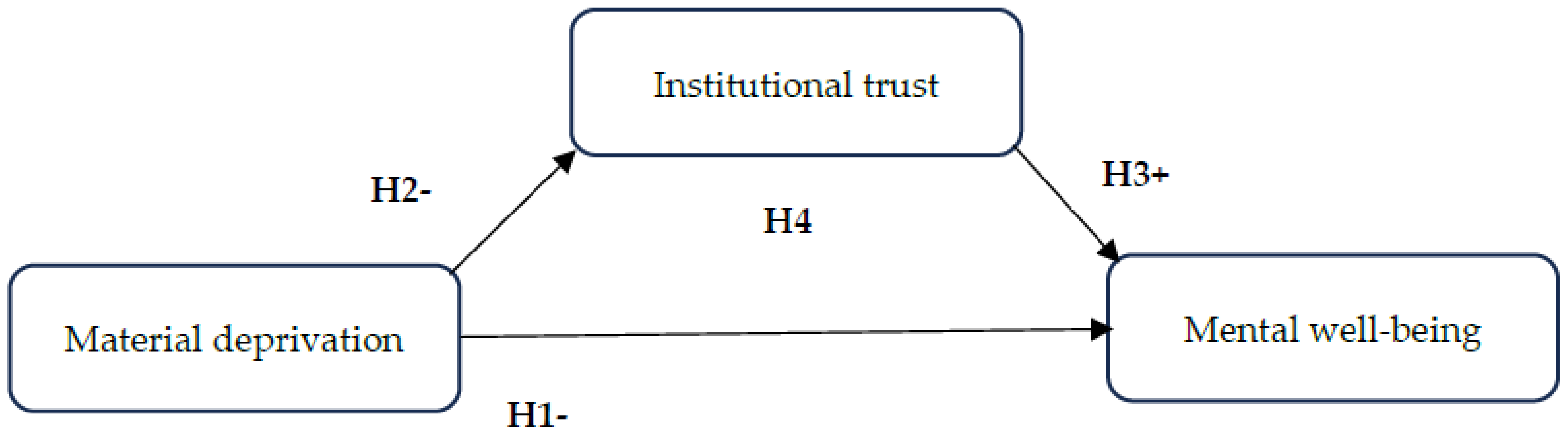
Figure 1. The research model: the mediating role of institutional trust in the relationship between material deprivation and mental well-being among self-employed individuals.
Admsci 15 00489 g001
Figure 2. Results of this study. Notes: ** p < 0.01, *** p < 0.001.
Admsci 15 00489 g002
Table 1. Item loadings and model fit indicators *.
Mental Well-BeingMaterial DeprivationInstitutional Trust
Item Loading Item Loading Item Loading
Item 10.951Item 10.485Item 10.798
Item 20.808Item 20.921Item 20.864
Item 30.494Item 30.804Item 30.746
Item 40.523Item 40.522Item 40.887
Item 50.912
Fit indicators:
Cronbach’s alpha = 0.880
AVE = 0.581
Rho_c = 0.867
HTMT (inst.trust) = 0.165
Fit indicators:
Cronbach’s alpha = 0.788
AVE = 0.501
Rho_c = 0.789
HTMT (mental well-being) = 0.230
Fit indicators:
Cronbach’s alpha = 0.897
AVE = 0.681
Rho_c = 0.895
HTMT (deprivation) = 0.226
* Overall model fit: SRMR = 0.045 [0.020; 0.022]; d_ULS = 0.608 [0.114; 0.146]; d_G = 0.385 [0.088; 0.145]; NFI = 0.886.
Table 2. Convergent validity and discriminant validity.
Mental Well-BeingMaterial DeprivationInstitutional Trust
Mental well-being0.581
Material deprivation0.0580.501
Institutional trust0.0300.0580.681
Notes: The values of convergent validity are on the diagonal. The other values correspond to the squared correlations of each construct with the others.
Table 3. Descriptive statistics, correlation table.
MeanSD123456789101112131415
1. Material deprivation0.1770.291
2. Institutional trust4.8472.228−0.198 **
3. Mental well-being4.3200.967−0.196 **0.146 **
4. Gender0.3760.4840.045 *−0.020−0.029
5. Respondent age46.96911.720−0.0230.021−0.013−0.030
6. Education level2.1830.719−0.256 **0.141 **0.107 **0.086 **−0.074 **
7. Marital status: never married0.1990.399−0.039−0.0110.039−0.029−0.372 **0.096 **
8. Marital status: married (ref.)0.6360.4810.0280.0320.009−0.050 *0.163 **−0.087 **−0.659 **
9. Marital status: separated0.0480.2140.043 *−0.068 **−0.054 **0.0130.029−0.035−0.112 **−0.297 **
10. Marital status: widowed0.0210.1420.0240.0300.0000.077 **0.155 **−0.029−0.072 **−0.192 **−0.033
11. Marital status: divorced0.0960.295−0.036−0.002−0.0270.075 **0.141 **0.050 *−0.162 **−0.431 **−0.073 **−0.047 *
12. EU region: west (ref.)0.2230.416−0.140 **0.124 **0.047 *−0.0070.085 **0.081 **0.033−0.053 *0.0170.0220.018
13. EU region: centre0.1760.381−0.100 **−0.0130.0180.060 **−0.058 **0.049 *−0.0140.006−0.047 *0.0110.037−0.247 **
14. EU region: east0.1740.3790.276 **−0.024−0.054 **−0.081 **−0.151 **−0.126 **−0.042 *0.088 **−0.004−0.012−0.078 **−0.246 **−0.212 **
15. EU region: south0.2820.4500.061 **−0.233 **−0.085 **0.0400.016−0.085 **0.016−0.0110.052 *−0.019−0.033−0.335 **−0.289 **−0.288 **
16. EU region: north0.1460.353−0.102 **0.190 **0.092 **−0.0200.104 **0.096 **0.001−0.025−0.031−0.0010.064 **−0.221 **−0.191 **−0.190 **−0.259 **
** Correlation is significant at the 0.01 level (2-tailed). * Correlation is significant at the 0.05 level (2-tailed).
Table 4. Results of analysis.
BC 95% CI
EffectLabelEstimateSELowerUpper
Indirectab−0.057 **0.017−0.094−0.025
Directc’−0.495 ***0.074−0.633−0.345
Totalc−0.552 ***0.072−0.685−0.406
Path estimates
Deprivation → Institutional trusta−0.611 ***0.061−0.729−0.490
Institutional trust → Mental well-beingb0.093 ***0.0270.0410.146
Deprivation → Mental well-beingc’−0.495 ***0.074−0.633−0.345
Notes: (1) ** p < 0.01, *** p < 0.001; (2) BC—bias-corrected; (3) the results account for the effects of control variables (age, education, gender, marital status, geographical region).
Disclaimer/Publisher’s Note: The statements, opinions and data contained in all publications are solely those of the individual author(s) and contributor(s) and not of MDPI and/or the editor(s). MDPI and/or the editor(s) disclaim responsibility for any injury to people or property resulting from any ideas, methods, instructions or products referred to in the content.