Article

Workplace Bullying and Turnover Intention Among Boundary-Spanning Bank Workers: The Emotional Mechanism and the Amplifying Role of Workplace Unfairness


by
Jale Minibas-Poussard
1,*,
Ahmet Tugrul Tuger
2,
Tutku Seckin
3,
Haluk Baran Bingöl
4 and
Matthieu Poirot
5
1
Institute of Management Research (IRG, EA2354), Université Paris-Est, UPEC, UPEM, 94010 Paris, France
2
Faculty of Applied Sciences, Istanbul Bilgi University, 34440 Istanbul, Türkiye
3
Management Department, Istanbul Medeniyet University, 34000 Istanbul, Türkiye
4
Global South Research Consortium, Atlanta, GA 30144, USA
5
Midori Consulting, 35000 Rennes, France
*
Author to whom correspondence should be addressed.
Adm. Sci. 2025, 15(12), 496; https://doi.org/10.3390/admsci15120496
Submission received: 26 October 2025 / Revised: 7 December 2025 / Accepted: 9 December 2025 / Published: 17 December 2025

Abstract

Background: Emotions play a central role in how employees respond to workplace bullying, influencing both their well-being and organizational outcomes. The purpose of the current study was to examine how workplace bullying and turnover intention are related to negative emotions and workplace unfairness. Methods: The research involved collecting data from 269 boundary-spanning bank workers (call center workers, frontline office staff, and customer service representatives) who experienced bullying. A moderated mediation was tested using Model 7 of the Process macro. The relationship between workplace bullying and turnover intention was analyzed, emphasizing the moderating effect of workplace unfairness and the mediating role of negative emotions. Results: The results validated the model, showing that an increase in negative emotions and workplace unfairness promotes the link between workplace bullying and the intention to leave. Increased negative emotions and perceived workplace unfairness amplified the relationship between workplace bullying and turnover intention. Conclusions: The findings underscored the cumulative risk of bullying environments for employee well-being and retention, providing practical recommendations for HRM and leadership strategies to cultivate healthier, more inclusive workplace settings. This study adds to the bullying–turnover literature by examining the joint role of negative emotions and workplace unfairness in a moderated mediation framework. The study connects these findings to sustainable labor management, emphasizing both theoretical and practical implications for organizations.

1. Introduction

The notion of sustainability in business is widely recognized to be founded on three pillars: economic, environmental, and social (Elkington & Rowlands, 1999). Employee sustainability—the capacity of employees to maintain productivity and engagement over time—is crucial for organizational performance and long-term viability (Kira & Balkin, 2014). Corporate social responsibility (CSR) efforts substantially enhance a conducive work environment that promotes employee well-being and retention (Aguinis & Glavas, 2012). Moreover, emphasizing the human factor is essential to building truly sustainable organizations (Pfeffer, 2010). Successful CSR implementation, which is accomplished by cultivating a positive work environment, improving employee satisfaction, and fostering sustained employee retention, has been shown to significantly reduce employee turnover intention (Yating et al., 2024). Research has also shown that ethical work environments reduce the risk of employees quitting the company (Li et al., 2022), and such environments often result from organizations with a strong sense of social responsibility (Bayode & Duarte, 2022).
Employee turnover is a recurring problem that has a detrimental effect on an organization’s revenue and performance (Park & Min, 2020). Employee turnover’s financial cost includes, but is not limited to, advertising job openings, conducting interviews, hiring and training new employees, losing productivity, and paying for ineffective new hires (Akinyomi, 2016; Cascio, 2006). Furthermore, elevated turnover adversely affects team performance and overall organizational productivity (Hausknecht et al., 2009; Kacmar et al., 2006).
Recent research has repeatedly demonstrated a robust positive relationship between workplace bullying and employee turnover intention (Ahmad & Kaleem, 2020; Coetzee & Van Dyk, 2018; Glambek et al., 2024; Rosario-Hernández & Millán, 2018; Trépanier et al., 2024). Several studies have investigated the psychological mechanisms that underpin this link, emphasizing that workplace bullying undermines employee well-being and job satisfaction, thereby promoting turnover intentions (Hershcovis, 2011; Rayner et al., 2002). Mediating factors, such as job dissatisfaction (Glambek et al., 2024), low work engagement (Coetzee & Van Dyk, 2018), frustration of fundamental psychological needs (Trépanier et al., 2024), and psychological stress reactions (K. Einarsen et al., 2017), clarify the mechanisms by which bullying induces turnover intention. Nonetheless, moderating factors such as organizational support (Djurkovic et al., 2008) and belief in a just world (Ocel & Aydin, 2012) affect the strength and direction of this relationship. Work engagement is identified by Coetzee and Van Dyk (2018) as a moderator that reduces the effect of bullying on turnover.
Drawing from Affective Events Theory, Conservation of Resources Theory, and Social Exchange Theory, this study examines how workplace bullying affects turnover intention through negative emotions and how perceived workplace unfairness moderates this indirect pathway among boundary-spanning bank workers. Unlike prior research that often examines mediation or moderation separately, the present study incorporates both emotional mechanisms and organizational context, highlighting that perceptions of unfairness can considerably intensify the emotional burden triggered by bullying. By focusing on boundary-spanning roles, this study contributes to a deeper understanding of how emotional and fairness-related processes operate in high-interpersonal-exposure positions and provides practical guidance for HRM on how fairness-oriented interventions can mitigate the negative effect of workplace bullying.
Despite extensive research on bullying and turnover, the combined role of negative emotions and workplace unfairness in shaping turnover intention remains underexplored. This issue is particularly important in the Turkish banking industry, where high rates of workplace bullying have been reported (Minibas-Poussard et al., 2025a) and where boundary-spanning employees such as call center representatives, frontline office staff, and customer service workers are especially vulnerable. Boundary-spanning positions play a critical role in sustaining organizational performance (Schotter et al., 2017) and strongly influence customer perceptions of service quality, trust, and loyalty (Malhotra & Mukherjee, 2004). Yet bullying directed at these employees can provoke negative emotions and unfairness perceptions that undermine their well-being and jeopardize both service sustainability and organizational reputation. Thus, workplace bullying should be viewed not only as an interpersonal concern but also as a broader sustainability challenge, as it harms employee well-being, violates CSR-driven fairness principles, and ultimately increases turnover intention. Accordingly, the present study explicitly links these gaps to its aim by examining how emotional reactions and fairness perceptions jointly shape the bullying–turnover process. Addressing this gaps, the present study proposes a moderated mediation model that integrates emotional mechanisms with fairness perceptions to clarify why and when bullying leads employees to consider leaving.

2. Theoretical Frameworks and Hypothesis Development

2.1. Workplace Bullying and Turnover Intention

Workplace bullying can lead to emotional problems and psychological trauma, impacting workers’ mental health and general well-being. The workplace bullying phenomenon is described as “harassing, offending, and socially excluding someone or negatively affecting someone’s work tasks. To label a particular activity as bullying (or mobbing), interaction or process has to occur repeatedly and regularly (e.g., weekly) and over a period of time (e.g., about six months). Bullying is an escalated process in which a person exposed ends up in an inferior position and becomes the target of systematic negative social acts” (S. Einarsen et al., 2011, p. 22).
Workplace bullying can incur significant costs to firms in several manners, such as reduced productivity, declined work quality, absenteeism, and turnover (Hoel et al., 2020). Three significant reasons for leaving emerged from the bullied respondents: inadequate leadership, exposure to detrimental behavior, and health issues (Hogh et al., 2011). Workplace bullying, defined by repeated exposure to adverse behaviors in an imbalanced power dynamic (S. Einarsen et al., 2020), has become a notable predictor of employees’ intention to leave. Trépanier et al. (2024) conducted a meta-analysis that confirms bullying as a strong predictor of turnover intentions, influenced by both individual and contextual factors. Hogh et al.’s (2011) longitudinal research highlights the effects of bullying on turnover rates among healthcare workers, therefore highlighting the ongoing nature of these consequences over time. Rosario-Hernández and Millán (2018) demonstrate that workplace bullying reduces job satisfaction and work engagement while increasing burnout, which in turn elevates employees’ turnover intentions. This mediation elucidates the psychological mechanisms via which bullying manifests into withdrawal behaviors. However, Rodríguez-Muñoz et al. (2009) further demonstrate that bullying diminishes job satisfaction and overall well-being, thereby heightening turnover intentions. Given this consistent evidence that bullying is a strong precursor of withdrawal-related outcomes, it is reasonable to expect that employees exposed to persistent bullying will show higher turnover intention.
H1. 
Exposure to bullying at work is related to turnover intention.
Workplace bullying represents a persistent negative experience that disrupts employees’ emotional and psychological balance. As Affective Events Theory (Weiss & Cropanzano, 1996) suggests, such repeated hostile events naturally shape how people feel and think about their jobs. With time, this strain can make leaving the organization feel like the most protective option.

2.2. Mediating Role of Negative Emotions

According to Diener and Suh (1997), affect, both positive and negative, is a major factor in determining psychological adjustment and subjective well-being. The Affective Events Theory (Weiss & Cropanzano, 1996) states that emotions are a fundamental mechanism that mediates the connection between behavioral reactions and threatening events. This theory asserts that workplace events trigger employees’ emotional reactions, which in turn influence their attitudes and behaviors. Brief emotional responses can have long-lasting effects on workplace results, according to the theory, which also emphasizes the significance of situational elements in influencing employees’ everyday experiences (Weiss et al., 1999). Within this perspective, adverse interpersonal experiences (e.g., workplace bullying) are regarded as events that disturb emotional homeostasis.
Expanded upon Affective Events Theory, Glasø et al. (2011) illustrate that workplace bullying provokes strong emotional reactions, such as increased anxiety and anger, among employees. These negative emotions function as a psychological mechanism through which bullying affects work-related outcomes, including job dissatisfaction and turnover intentions. This study emphasizes the crucial role of emotional responses in mediating the effects of negative workplace events on employees’ behavioral intentions.
Studies consistently support the idea that emotions play a pivotal role in shaping behavioral intentions. The targets’ positive/negative emotions have been found to partially mediate the relationship between workplace bullying and occupational outcomes such as job satisfaction, organizational commitment, and turnover intention (Glasø & Notelaers, 2012). Affective well-being is identified by Ahmad and Kaleem (2020) as a mediator reducing the negative impact of bullying on employees’ intention to leave.
Moreover, negative emotions are often associated with a perceived loss of control and violation of personal dignity (Barling et al., 2009). Spector and Goh (2001) highlighted that negative emotions can carve the path for physical and psychological breakdown in employees’ well-being. Emotional responses help individuals appraise their work environment and consider whether continued employment is psychologically sustainable. Affective Events Theory (Weiss & Cropanzano, 1996) explains that emotions are often the primary channel through which difficult workplace events influence attitudes. When bullying generates strong negative emotions, Conservation of Resources Theory (Hobfoll, 2001) reminds us that employees may begin looking for ways to protect their remaining energy and well-being. Considering this, it is reasonable to expect that negative emotions serve as the pathway linking bullying to turnover intentions.
H2. 
Negative emotions mediate the relationship between workplace bullying and turnover intention.

2.3. Moderating Role of Workplace Unfairness

Several studies have examined the connections between justice and well-being in organizational settings (Hsu et al., 2019; Lawson et al., 2009; Wickham et al., 2014). Organizational justice, as first conceptualized by Greenberg (1987), is the way in which employees see the acts, choices, and behaviors of the organization and how these affect their attitudes and conduct at work. Employee perceptions of the fairness of results (as defined by Adams, 1965) and the processes used to distribute them (as defined by Thibaut & Walker, 1975), as well as the quality of the relationships between the levels of organizational hierarchy (as defined by Bies & Moag, 1986), are all considered to be components of organizational justice.
Although negative emotions are a common consequence of bullying, not all employees react to the same degree. Individual interpretations of the organizational context—particularly the perception of fairness—can influence the intensity of emotional responses. Workplace unfairness, which reflects the extent to which employees believe that organizational procedures, distributions, and interpersonal treatment are unjust (Colquitt, 2001), may amplify the emotional toll of bullying. Prior research suggests that low justice perceptions exacerbate stress and emotional strain in the face of negative workplace events (Greenberg, 2006). Cohen-Charash and Spector (2001) identified a correlation between organizational justice and turnover intentions, as well as negative emotions at work. Through workplace bullying, perceptions of injustice were indirectly linked to the intention to leave (Reknes et al., 2021).
Drawing on Social Exchange Theory (Blau, 1964), low fairness weakens the sense of mutual respect and makes negative experiences feel even more harmful. Because unfair environments heighten the emotional impact of negative events, bullying is likely to evoke stronger negative emotions when employees perceive low fairness.
H3. 
Workplace unfairness moderates the relationship between workplace bullying and negative emotions.
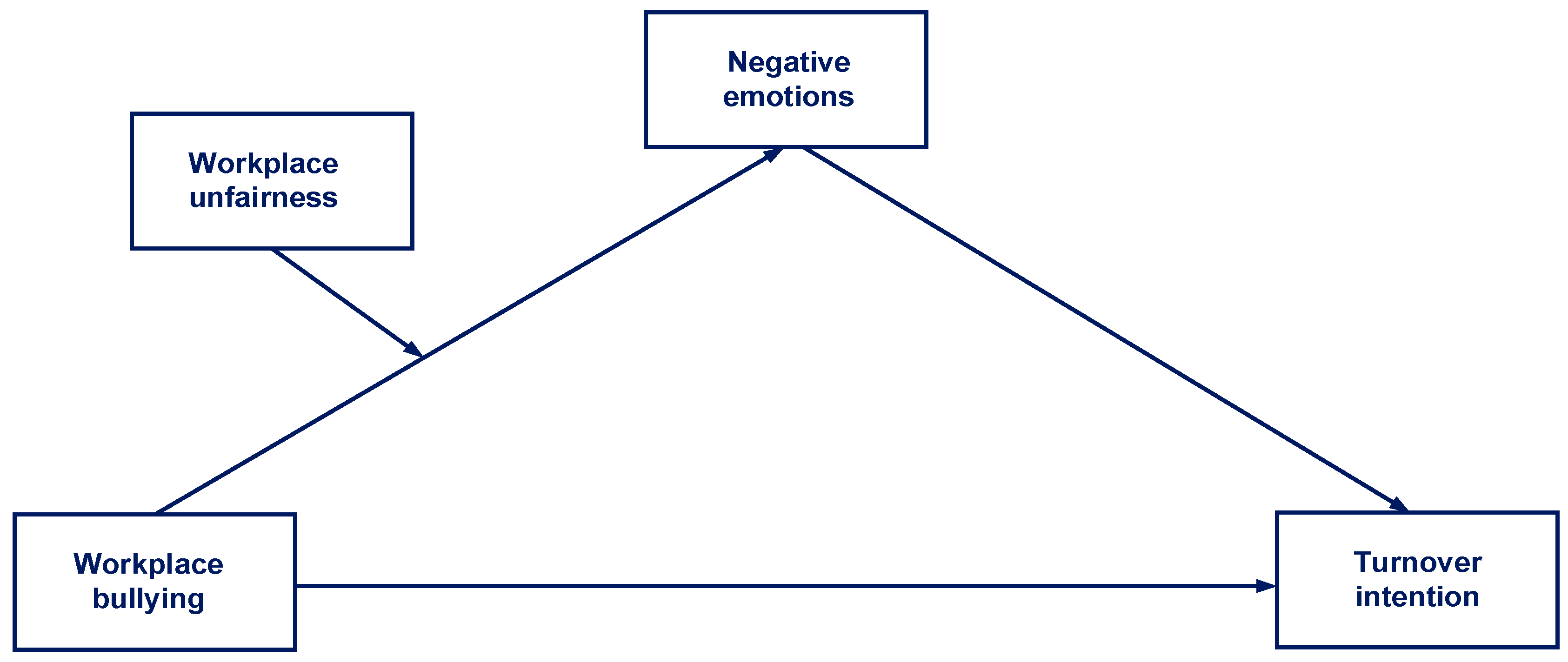
The conceptual model of the study (see Figure 1) brings together three complementary perspectives to explain why workplace bullying can ultimately lead employees to consider leaving. Affective Events Theory (Weiss & Cropanzano, 1996) helps us understand that bullying is not just a routine inconvenience but a meaningful workplace event that naturally triggers strong emotional reactions. Conservation of Resources Theory (Hobfoll, 2001) adds that these emotional reactions often reflect an ongoing loss of psychological energy, pushing employees to protect themselves by withdrawing from the situation. Social Exchange Theory (Blau, 1964) further shows that when employees feel they are treated unfairly, their emotional responses to bullying become even heavier because the basic sense of mutual respect is disrupted. When these three perspectives are brought together, a clear picture emerges: bullying triggers negative emotions, these emotions push employees toward withdrawal, and unfairness magnifies this emotional burden. The hypothesis and the conceptual model of the present study are outlined below.
H4. 
The relationship between workplace bullying and turnover intention is mediated by negative emotions, which increase by the interaction between workplace bullying and workplace unfairness.
The model illustrates the hypothesized relationships linking workplace bullying (X) to turnover intention (Y) through negative emotions (M), with workplace unfairness (W) moderating the bullying–emotion pathway (H1–H4). The diagram displays unstandardized regression coefficients estimated through PROCESS Model 7.

3. Method

3.1. Sample and Data Collection

The data for this study were collected from employees of 12 private banks in Istanbul, Türkiye. Due to confidentiality, we do not have the right to disclose the names of these institutions. Convenience sampling was used to reach them. Of 983 surveys distributed, 269 surveys were used in this research. The participants were initially advised that a study was being done for academic purposes to further the knowledge of certain human behaviors in the workplace. Participation was wholly voluntary, and respondents were guaranteed the anonymity of their answers to promote candid and unrestricted involvement. Explicit consent was obtained from respondents.
To test our hypotheses, we selected the data of the employees (N = 269) who were exposed to bullying since the aim of this study was to demonstrate the vicious cycle the bullying victims get in through negative emotions increasing with workplace unfairness. A single-item self-labeled measure proposed by S. Einarsen and Skogstad (1996) is used for the inclusion selection (exposure to bullying at least once a week and at least a six-month duration). Only participants were included in the study who perceive themselves as subjected to workplace bullying weekly or daily. This focus allows us to specifically examine the emotional and fairness-related mechanisms that are uniquely activated among individuals who experience bullying, which is central to the study’s aim of understanding how negative emotions and perceived unfairness escalate turnover intention.
The average age was 32 (SD: 3.48). The female rate is 58%, and the male rate is 42%. All of the participants had university degrees. Looking at the distribution of their experience and professional positions, 86% of them had more than five years of banking experience. The sample is composed of frontline office workers (29.6%), customer service representatives (34.9%), and call center workers (35%).

3.2. Measurement

All research instruments were first translated into Turkish and then back-translated into English by two bilingual scholars, following Brislin’s (1986) recommended procedure to ensure conceptual and linguistic equivalence. Minor wording adjustments were made to ensure clarity and suitability for the banking context. All scales demonstrated satisfactory psychometric properties, as detailed below.
(i)
Exposure to workplace bullying (self-labeling): Exposure to bullying was assessed using the single-item self-labeling format proposed by S. Einarsen and Skogstad (1996). Respondents were presented with the formal definition of bullying (see Theoretical Framework) and asked: “Have you been subjected to bullying at work during the past six months?” Responses ranged from 1 (never) to 5 (daily). This self-labeling approach is widely used in bullying research because it directly captures the subjective appraisal associated with bullying experiences. Previous research in the Turkish context has demonstrated strong test–retest reliability (r = 0.77; Minibas-Poussard et al., 2025b).
(ii)
Workplace bullying scale: To obtain an overall workplace bullying score, a 30-item behavioral scale was used, based on instruments developed by Leymann (1996a, 1996b) by Neuman and Keashly (2004). The scale comprises five subdimensions:
  • Target’s communication: assessing instances where the target is prevented from expressing themselves (e.g., being interrupted or not listened to).
  • Target’s maintaining social contacts: evaluating experiences of social isolation (e.g., not being talked to or excluded from meetings).
  • Target’s personal reputation: examining occurrences of gossip or defamatory remarks about the target.
  • Target’s professional reputation: exploring experiences such as task deprivation or withholding of assignments.
  • Target’s physical well-being: evaluating threats of physical harm, such as injury or assault.
Example items include: “How often have you been prevented from expressing yourself (interrupting your speech, not being listened to)?” and “How often have you been ostracized from your work environment (not being talked to, not being invited to meetings)?”
The scale demonstrated high internal consistency, with a Cronbach’s alpha coefficient of 0.86, indicating its reliability. Previous research (e.g., Minibas-Poussard et al., 2022) has validated the scale through factor analysis, with all subscales exhibiting factor loadings ≥ 0.30 and the Cronbach’s alpha being 0.85.
(iii)
Negative emotions: Negative emotions were measured using the 10-item negative affect subscale of the Job-Related Affective Well-being Scale (Spector, 1988), rated from 1 to 5. Sample items: My job made me feel angry; My job made me feel discouraged. Very satisfactory psychometric properties were obtained (Cronbach’s α = 0.94 and factor load > 0.40).
(iv)
Turnover intention: One item scale from Spector (1991). Turnover intention was assessed using a single item from Spector (1991): “How often have you seriously considered quitting your current job over the past six months?” The single-item turnover intention measure has been widely employed in organizational research, and studies indicated that it provides reliable and valid assessments comparable to multi-item scales (Michaels & Spector, 1982; Spector, 1991). In a preliminary pilot study, 30 bilingual participants completed the English version of the scale and followed by the Turkish version one week later. The correlation between the two administrations was r = 0.81, signifying adequate test–retest reliability.
(v)
Workplace unfairness: Workplace unfairness was measured using an 8-item scale inspired by Ambrose and Schminke (2009), rated from 1 to 5. Example items include: “Most of the people who work here would say they are often treated unfairly” and “Usually, the procedures in this workplace are not fair.” Good psychometric properties were obtained (Cronbach’s α = 0.92 and factor load > 0.40).
In sum, the measurement tools were organized to provide clarity and coherence in line with the study’s aims. In addition, to assess the potential impact of common method bias, Harman’s single-factor test was conducted. An unrotated exploratory factor analysis encompassing all items indicated that the first factor accounted for only 18.98% of the total variance, well below the suggested 50% threshold, suggesting that common method bias is unlikely to threaten the validity of the results.

4. Results

Data analysis was accomplished by using SPSS 22 and PROCESS macro for SPSS, Version 3.5 (Hayes, 2018). To test moderated mediation model (Model 7), a bootstrapping procedure with 5000 resamples and 95% confidence intervals was employed. Table 1 illustrates the examination of means, standard deviations, and correlation coefficients among the variables, offering preliminary insights into their linkages.
Table 1 shows that workplace bullying is strongly correlated with negative emotions (r = 0.63) and workplace unfairness (r = 0.72), indicating close conceptual linkages among these constructs. The moderate correlation with turnover intention (r = 0.24) also suggests that additional mechanisms—such as emotional reactions—may be involved, aligning with the study’s mediation focus.
A separate regression analysis showed that workplace bullying significantly predicted turnover intention (R = 0.24, R2 = 0.06, F = 17.37, p ≤ 0.001) supporting H1 at the bivariate level. However, when negative emotions were included in the PROCESS model, the direct effect became non-significant, indicating full mediation. This pattern suggests that although bullying is associated with turnover intention, its effect operates mainly through intermediate psychological mechanisms rather than a direct attitudinal shift.
According to H2, negative emotions mediated the relationship between workplace bullying and turnover intention (R = 0.41, R2 = 0.16, F = 26.89, p ≤ 0.001). The pathway coefficients were as follows: workplace bullying positively predicted negative emotions (a = 0.28, SE = 0.02, t = 13.48, p < 0.001), and negative emotions positively predicted turnover intention (b = 0.06, SE = 0.01, t = 5.85, p < 0.001). The direct effect of workplace bullying on turnover intention was not significant (c’ = −0.001, SE = 0.004, t = −0.32, p > 0.05). There is no direct effect (t = −31.50, p > 0.05) but indirect effect is confirmed (Effect = 0.0167, SE = 0.0036, 95% CI [0.0109, 0.0249]). This finding supports H2 by demonstrating a full mediation pattern: bullying predicts higher negative emotions, which in turn predict stronger turnover intention. The nonsignificant direct effect, together with the significant indirect effect, indicates that employees’ emotional responses constitute the primary route through which bullying shapes withdrawal intentions. In practical terms, this means that employees consider leaving not simply because they are bullied, but because bullying triggers strong emotional strain that makes continued employment feel unsustainable.
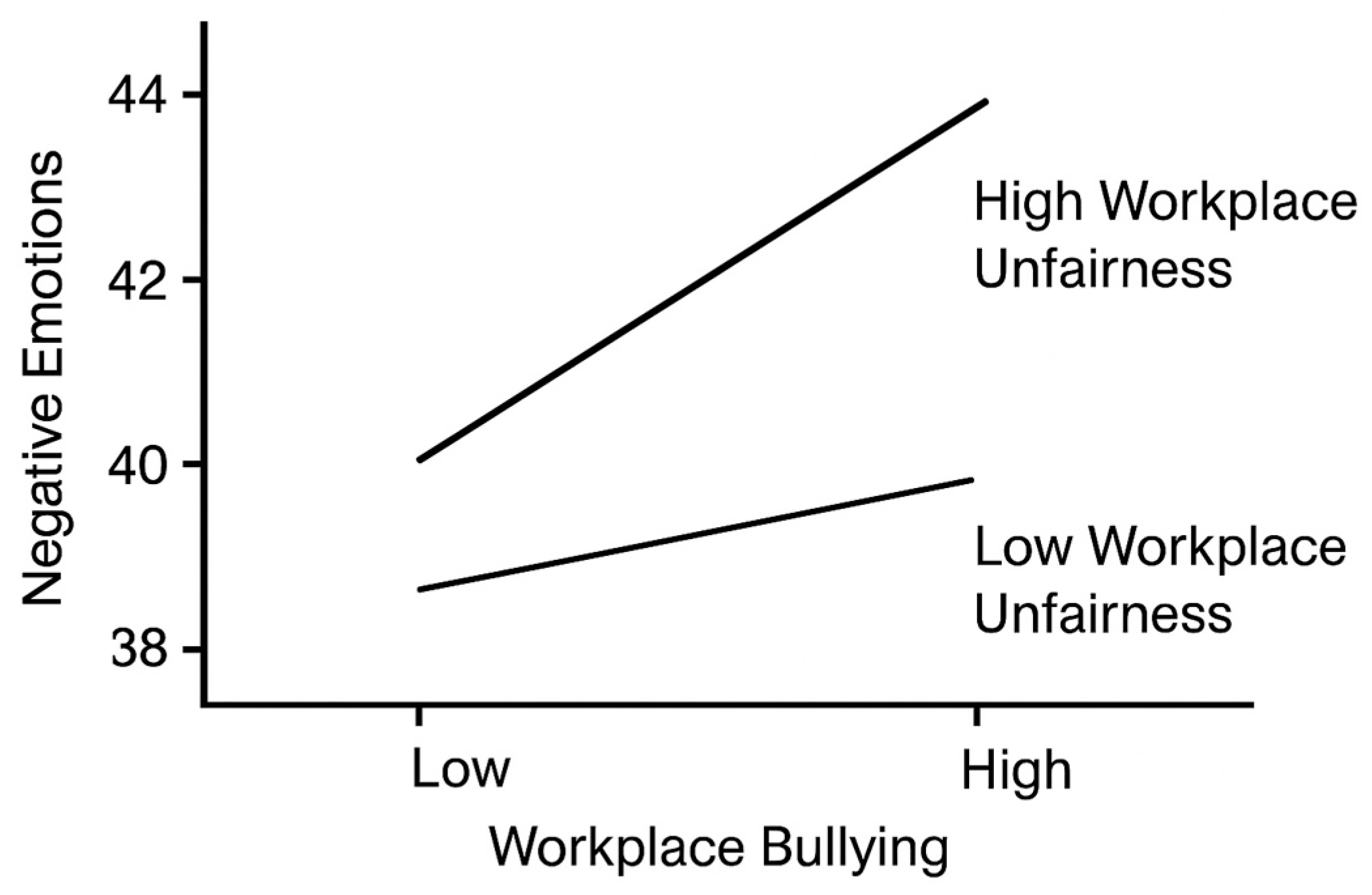
As indicated in H3, workplace unfairness moderates the association between workplace bullying and negative emotions (R = 0.73, R2 = 0.54, F = 104.78, p ≤ 0.001). The interaction term between workplace bullying and workplace unfairness was significant (b = 0.015, SE = 0.006, t = 2.42, p ≤ 0.01), indicating a moderation effect (ΔR2 = 0.010; F = 5.82; p ≤ 0.01). Conditional effects analysis (see Figure 2) revealed that when workplace unfairness was high, the effect of workplace bullying on negative emotions was positive and significant (b = 0.11, SE = 0.03, t = 3.52, p ≤ 0.001, 95% CI [0.05, 0.17]). However, when workplace unfairness was low, this effect was not significant (b = −0.08, SE = 0.08, t = −1.12, p > 0.05, 95% CI [−0.23, 0.06]).
These results support H3 by showing that the strength of the bullying–emotion link depends on fairness perceptions. When workplace unfairness is high, bullying elicits significantly stronger negative emotions, whereas under low unfairness this association disappears. This pattern indicates that fairness perceptions have an exacerbating effect: in unfair environments, employees react more intensely to bullying, while in fairer settings the emotional impact is considerably weaker.
A moderated mediation model is accomplished by using PROCESS macro (Hayes, 2018). This model shows how the relationship between exposure to bullying at work and turnover intention is affected by the moderation of workplace unfairness on the relationship between workplace bullying and negative emotions (H4). The results indicated that the interaction between workplace bullying and workplace unfairness significantly predicted negative emotions (b = 0.015, SE = 0.006, t = 2.42, p ≤ 0.01, ΔR2 = 0.010). Specifically, workplace bullying significantly increased negative emotions when workplace unfairness was high (b = 0.11, SE = 0.03, t = 3.52, p ≤ 0.001, 95% CI [0.05, 0.17]), but not when it was low (b = −0.08, SE = 0.08, t = −1.12, p > 0.05, 95% CI [−0.23, 0.06]). The direct effect of workplace bullying on turnover intention was not significant (b = −0.001, SE = 0.004, t = −0.32, p > 0.05). Negative emotions, in turn, were positively associated with turnover intention (b = 0.06, SE = 0.01, t = 5.85, p ≤ 0.001) indirectly. The conditional indirect effects of workplace bullying on turnover intention through negative emotions varied across levels of workplace unfairness: at high unfairness these effects are significant (Effect = 0.0064, SE = 0.0021, 95% CI [0.0032, 0.0116] but not at low unfairness (Effect = −0.0051, SE = 0.0079, 95%CI [−0.0197, 0.0112]). This finding implies that unfairness strengthens the emotional pathway from bullying to turnover intention, but only under conditions of elevated perceived unfairness.
The findings together illustrate a consistent pattern among the presented hypotheses. Initially, workplace bullying indirectly elevated turnover intention by intensifying negative emotions (H2). Secondly, workplace inequity exacerbated this emotional reaction, reinforcing the correlation between workplace bullying and adverse emotions (H3). The moderated mediation model (H4) demonstrated that the indirect effect of workplace bullying on turnover intention through negative emotions was amplified under elevated levels of workplace unfairness. These findings underscore the important influence of perceived organizational justice on employees’ emotional and behavioral responses to workplace bullying.
In addition to these data, which corroborate our model, we sought to ascertain the types of bullying behaviors to which the participants were subjected and the identities of their aggressors. Table 2 enumerates the five most prevalent bullying actions. These behaviors adversely affect the target’s professional reputation and are displayed by over 70–80% of superiors. The prevalence of colleague bullying is rather low (about 10–15%), and no instances of customer bullying were detected.

5. Discussion

This study sought to investigate the mechanisms connecting workplace bullying to turnover intention, emphasizing the mediating influence of negative emotions and the moderating effect of workplace unfairness.
Consistent with earlier work, negative emotions emerged as a crucial psychological mechanism linking workplace bullying to turnover intention. Previous studies have demonstrated that negative emotions mediate the relationship between bullying and work outcomes (Ciby et al., 2021; Glasø & Notelaers, 2012; Glasø et al., 2011). Recent research further shows that bullying-related emotional exhaustion and anger explain how exposure to bullying translates into deviant or withdrawal-oriented behaviors (Peng et al., 2016; Jahanzeb et al., 2021; Gunasekara et al., 2025). Affective Events Theory (Weiss & Cropanzano, 1996) helps explain this process by suggesting that specific workplace events, such as bullying, evoke strong emotional responses that influence subsequent attitudes and behaviors. Our findings align with this view: employees exposed to bullying reported elevated negative emotions, which in turn heightened their intention to leave.
Furthermore, the results showed that perceptions of workplace unfairness intensified the emotional effects of bullying. An unfair environment can intensify anger, frustration, and feelings of helplessness (Ambrose & Schminke, 2009; Colquitt, 2001), creating a compounding effect where negative emotions become more severe. Empirical studies similarly suggest that justice perceptions condition how strongly bullying affects emotional and attitudinal outcomes (Desrumaux et al., 2021; Malola et al., 2025). In addition, research on bullying has begun to document justice-sensitive indirect pathways, in which the presence or absence of fairness shapes the strength of bullying’s effects on key organizational outcomes (Ramdeo et al., 2020). Our findings follow this pattern by showing that under conditions of perceived unfairness, the emotional reactions associated with bullying become more pronounced.
The findings also revealed that managers are the source of bullying. This finding represents a particularly strong threat to employee well-being, especially among boundary-spanning workers whose roles require constant interaction with customers. Negative emotions and perceptions of unfairness resulting from managerial bullying can impair employees’ capacity to maintain high-quality interactions, jeopardizing service quality, customer trust, and long-term organizational performance (Kim et al., 2024; Kim & Yeo, 2025). Longitudinal and resource-based studies indicate that bullying gradually erodes both job-related and personal resources, contributing to sustained emotional strain and impaired functioning (Tuckey & Neall, 2014; Boudrias et al., 2021). Thus, workplace bullying should not be regarded solely as an interpersonal issue but as a broader organizational concern that directly threatens employee sustainability and service quality.

5.1. Theoretical Implications

The study offers several theoretical contributions to the workplace bullying and turnover literature. First, by integrating Affective Events Theory (Weiss & Cropanzano, 1996), Conservation of Resources Theory (Hobfoll, 2001), and Social Exchange Theory (Blau, 1964), the findings provide a consolidated explanation of how bullying triggers negative emotions that translate into withdrawal intentions. Affective Events Theory explains how bullying, as a negative workplace event, elicits emotional reactions that shape subsequent attitudes and behaviors. Conservation of Resources Theory complements this view by framing bullying and unfair treatment as threats to essential personal resources such as emotional stability and self-esteem; as these resources become depleted, negative emotions intensify and employees move toward withdrawal to protect what remains (Hobfoll et al., 2018). Social Exchange Theory adds a relational dimension by emphasizing that bullying and unfairness violate expectations of reciprocity and respect, damaging organizational trust and increasing intentions to leave (Cropanzano & Mitchell, 2005).
Second, the study extends the bullying literature by highlighting the combined role of emotional reactions and fairness perceptions, an area that has received limited empirical attention despite extensive research on organizational antecedents of bullying. Although numerous organizational factors—such as work organization, job design, organizational change, and leadership—have been extensively examined (Salin & Hoel, 2020), justice-related mechanisms remain surprisingly underdeveloped in this stream of research. The present findings therefore advance this literature by demonstrating that workplace unfairness magnifies the emotional impact of bullying, amplifying employees’ negative affective responses. This dynamic is theoretically aligned with Social Information Processing Theory (Salancik & Pfeffer, 1978), which proposes that employees interpret interpersonal mistreatment through environmental cues. When fairness cues are weak, bullying is more readily interpreted as intentional and illegitimate, intensifying its emotional and behavioral consequences.
Third, from a sustainability perspective, the study highlights that workplace bullying and unfairness threaten the long-term viability of a healthy workforce. Workforce sustainability is defined as employees’ ability to maintain health, motivation, and commitment over time (Pfeffer, 2018). An unsafe or unfair work environment undermines psychological safety, reduces engagement, and increases emotional exhaustion, jeopardizing sustainable performance (Ehnert et al., 2016; Glavas, 2016). By integrating the sustainability lens, this study emphasizes that organizational well-being and fairness are essential theoretical considerations for understanding turnover processes, particularly in boundary-spanning employees where employee interactions directly influence broader service outcomes. This sustainability perspective is especially relevant for boundary-spanning employees, whose emotional well-being directly influences service continuity and customer outcomes (Gustafsson et al., 2024).
Overall, these insights strengthen the theoretical understanding of how emotional and fairness-related processes jointly explain the turnover consequences of workplace bullying.

5.2. Practical Implications

The findings offer several practical implications for organizations aiming to enhance employee sustainability and reduce turnover related to workplace bullying. Workplace bullying exacerbates issues of employee well-being, with research indicating that sustainable human resource management (HRM) practices—such as resilience-building, mental health support, and equitable policies—can effectively reduce turnover and bolster long-term performance (Lu et al., 2023).
Workplace bullying is identified as a serious threat to sustainability, as it compromises psychological safety, damages interpersonal trust, and results in absenteeism, disengagement, and increased turnover (S. Einarsen et al., 2020). From a sustainability perspective, the repercussions of bullying extend beyond individual health to damage the workplace’s social infrastructure, hinder inclusion, and disrupt organizational cohesion (Grawitch et al., 2006; Shore et al., 2011). Workplace bullying significantly impacts mental health; thus organizations committed to social sustainability should take proactive measures, such as developing fair labor standards, involving employees in decision-making, and ensuring ethical leadership behavior. Implementing clear anti-bullying policies and promoting a culture of respect can prevent bullying from occurring in the first place (Tehrani, 2001). Furthermore, training programs to raise awareness about bullying and its detrimental effects can empower supervisors and staff to recognize and address such issues quickly.
According to Cowan et al. (2021), HR management is tasked with the formulation and execution of policies, as well as addressing bullying incidents. Strategic HR approaches to bullying must encompass the environment, culture, incentives, policies, and training design, as the dynamics of bullying are often more complex than mere facts or self-perceptions (Gardner & Cooper-Thomas, 2021). Research by D’Cruz and Noronha (2010) demonstrated that individuals targeted by bullying often turned to organizational resources along with their personal support systems to cope with their experiences. Hence, HRM plays a crucial role in shaping how these experiences are handled.
Consistent implementation of organizational policies is another practical lever for reducing bullying-related harm. Clear and transparent procedures strengthen employees’ perceptions of procedural and informational justice (Colquitt, 2001). Moreover, well-designed and consistently communicated HR systems foster a predictable and fair organizational climate (Bowen & Ostroff, 2004). From a psychosocial safety climate perspective, the existence and visibility of formal policies themselves serve as signals that the organization is committed to fairness and psychological safety—an aspect employees may use as a direct basis for fairness judgments.
To address the emotional fallout caused by bullying, organizations should establish support systems, such as counseling services, stress management workshops, and emotional regulation training (Van den Brande et al., 2016).
Collectively, the findings highlight that preventing bullying is not only an ethical responsibility but a strategic necessity. Strengthening fairness cues, supporting employees’ emotional well-being, and ensuring transparent and consistent policy communication can help organizations protect boundary-spanning employees—who are central to customer experience—and enhance long-term workforce sustainability.

5.3. Limitations and Future Directions

Notwithstanding its contributions, this study has some limitations that should be acknowledged. The cross-sectional design restricts the ability to deduce causality between workplace bullying, negative emotions, workplace unfairness, and turnover intention. Mikkelsen et al. (2020) accentuated the importance of cross-sectional research in understanding causality, despite its limitations in clarifying the cause-and-effect direction.
The sample consisted of bank workers from private banks located in Istanbul, constraining the generalizability of the findings to other sectors or cultural contexts. Broadening the scope to encompass other industries and countries may yield a more thorough comprehension of these phenomena.
Another limitation concerns the use of a single-item measure for turnover intention. While some scholars argue that single-item measures may restrict internal consistency assessment, prior studies have demonstrated that they can perform comparably to multi-item scales when measuring defined constructs such as turnover intention (Michaels & Spector, 1982; Spector, 1991). Nevertheless, future research could employ multi-item measures to further validate these results.
This study focuses exclusively on employees who reported experiencing workplace bullying. While this selection limits the generalizability of the findings to the broader employee population, it allows for a focused examination of the vicious cycle linking bullying, negative emotions, perceived unfairness, and turnover intention.
Additional mediators and moderators, such as organizational support, bystander effect, emotion regulation, affective commitment, and leadership, could be explored in the future to deepen the understanding of the mechanisms linking workplace bullying. Examining these factors may provide further insight into the mechanisms underlying workplace bullying and turnover and help organizations design more effective interventions to promote employee well-being and retention.
Finally, future studies could employ qualitative approaches to explore how employees in boundary-spanning roles experience negative emotions arising from both customer-related work overload and organization-initiated workplace bullying. Furthermore, negative emotions in the workplace bullying–turnover relationship could be examined more closely, particularly as they intensify under perceived unfairness. Perceptions of unfairness also weaken the reciprocity principle, which is the foundation of social exchange. A balanced trade breaks down when workers believe their contributions are routinely treated disrespectfully or exploitatively (Cropanzano et al., 2017). Future studies could closely examine negative emotions in the workplace bullying–turnover relationship, especially as they intensify under perceived unfairness. Employees’ perception that the organization owes them unmet obligations (Poirot, in press) may shed light on both the intensity and nature of these emotions, providing a deeper understanding of withdrawal intentions.

6. Conclusions

The current study aims to clarify the critical role of negative emotions in linking workplace bullying to turnover intention. It depicts and evaluates an integrated moderated mediation model that delineates the complex impact of workplace bullying on turnover intention. This research significantly enhances the literature by amalgamating emotional and organizational factors into a unified moderated mediation framework. The findings show that bullying not only provokes negative emotions but also interacts with perceptions of unfairness to exacerbate these effects. By integrating Affective Events Theory, Conservation of Resources Theory, and Social Exchange Theory, a multi-faceted understanding of how emotional, relational, and resource-based mechanisms contribute to withdrawal behaviors is provided.
Beyond these contributions to the literature, this study offers practical relevance to foster sustainable workforce management and enhance the emotional well-being of employees. Regarding work settings, specifically unfair practices and hostile work settings, organizations are required to provide a clear authority and leadership. Aiming to create healthier, inclusive workplaces, human resource managers and leaders may move beyond addressing individual bullying issues to solve general systematic problems within the organizations. In this vein, the findings of the study suggest integrating emotions and fairness into organizational sustainability policies. Some preventive applications, such as fairness and antibullying policies and trainings for leadership positions on these issues, need to be introduced. Addressing these issues strategically can enhance a genuinely positive, sustainable workplace, employee commitment, and retention by reducing the costs associated with turnover.

Author Contributions

Conceptualization, J.M.-P. Methodology, J.M.-P., A.T.T. and T.S.; Formal analysis, J.M.-P.; Investigation, J.M.-P.; Writing—original draft, J.M.-P., A.T.T., T.S., H.B.B. and M.P.; Writing—review & editing, J.M.-P., A.T.T., T.S., H.B.B. and M.P.; Project administration, J.M.-P. All authors have read and agreed to the published version of the manuscript.

Funding

This research received no external funding.

Institutional Review Board Statement

The data were collected in 2019 in Turkey. At that time, according to national guidelines, formal ethics committee approval was not required for this type of research, which was non-interventional, observational, anonymous, and based on voluntary participation. The French Code of Ethics for Psychologists (2012) and the American Psychological Association’s Ethical Principles of Psychologists and Code of Conduct (2017) were both embraced by the authors.

Informed Consent Statement

The goal of the study was explained to the participants, who were also given the assurance that their personal information would be kept private. Explicit consent was required for participation in the study.

Data Availability Statement

The data presented in this study are available from the corresponding author upon reasonable request (restrictions due to confidentiality agreements with banks).

Conflicts of Interest

The authors declare no conflicts of interest. Author Mathieu Poirot, owner of Midori Consulting. The remaining authors declare that the research was conducted in the absence of any commercial or financial relationships that could be construed as a potential conflict of interest.

References

  1. Adams, J. S. (1965). Inequity in social exchange. Advances in Experimental Social Psychology, 2, 267–299. [Google Scholar] [CrossRef]
  2. Aguinis, H., & Glavas, A. (2012). What we know and don’t know about corporate social responsibility: A review and research agenda. Journal of Management, 38(4), 932–968. [Google Scholar] [CrossRef]
  3. Ahmad, S., & Kaleem, A. (2020). Zooming in on the workplace bullying and turnover intentions pathway: The role of well-being and a cultural boundary condition. Personnel Review, 49(2), 425–444. [Google Scholar] [CrossRef]
  4. Akinyomi, O. J. (2016). Labour turnover: Causes, consequences and prevention. Fountain University Journal of Management and Social Sciences, 5(1), 105–112. [Google Scholar]
  5. Ambrose, M. L., & Schminke, M. (2009). The role of overall justice judgments in organizational justice research: A test of mediation. Journal of Applied Psychology, 94(2), 491–500. [Google Scholar] [CrossRef]
  6. Barling, J., Dupre, K. E., & Kelloway, E. K. (2009). Predicting workplace aggression and violence. Annual Review of Psychology, 60, 671–692. [Google Scholar] [CrossRef]
  7. Bayode, O. T., & Duarte, A. P. (2022). Examining the mediating role of work engagement in the relationship between corporate social responsibility and turnover intention: Evidence from Nigeria. Administrative Sciences, 12(4), 150. [Google Scholar] [CrossRef]
  8. Bies, R. J., & Moag, J. F. (1986). Interactional justice: Communication criteria of fairness. In R. J. Lewicki, B. H. Sheppard, & M. H. Bazerman (Eds.), Research on negotiations in organizations (Vol. 1, pp. 43–55). JAI Press. [Google Scholar]
  9. Blau, P. M. (1964). Exchange and power in social life. Wiley. [Google Scholar]
  10. Boudrias, V., Trépanier, S. G., & Salin, D. (2021). A systematic review of research on the longitudinal consequences of workplace bullying and the mechanisms involved. Aggression and Violent Behavior, 56, 101508. [Google Scholar] [CrossRef]
  11. Bowen, D. E., & Ostroff, C. (2004). Understanding HRM–firm performance linkages: The role of the “strength” of the HRM system. Academy of Management Review, 29(2), 203–221. [Google Scholar] [CrossRef]
  12. Brislin, R. W. (1986). The wording and translation of research instruments. In W. J. Lonner, & J. W. Berry (Eds.), Field methods in cross-cultural research: Cross-cultural research and methodology series (Vol. 8, pp. 137–164). Sage. [Google Scholar]
  13. Cascio, W. F. (2006). Managing human resources: Productivity, quality of work life, profits. Mc-Graw Hill. [Google Scholar]
  14. Ciby, M. A., Sahai, S., & Raya, R. P. (2021). Workplace bullying and turnover intention: Serial multiple mediation model of negative emotions and affective commitment. International Journal of Management Practice, 14(6), 736–750. [Google Scholar] [CrossRef]
  15. Coetzee, M., & Van Dyk, J. (2018). Workplace bullying and turnover intention: Exploring work engagement as a potential mediator. Psychological Reports, 121(2), 348–362. [Google Scholar] [CrossRef]
  16. Cohen-Charash, Y., & Spector, P. E. (2001). The role of justice in organizations: A meta-analysis. Organizational Behavior and Human Decision Processes, 86(2), 278–321. [Google Scholar] [CrossRef]
  17. Colquitt, J. A. (2001). On the dimensionality of organizational justice: A construct validation of a measure. Journal of Applied Psychology, 86(3), 386–400. [Google Scholar] [CrossRef]
  18. Cowan, R. L., Clayton, E., & Bochantin, J. (2021). Human resources as an important actor in workplace bullying situations: Where we have been and where we should go. In P. D’Cruz, E. Noronha, E. Baillien, B. Catley, K. Harlos, A. Hogh, & E. G. Mikkelsen (Eds.), Pathways of job-related negative behaviour (pp. 477–494). Springer. [Google Scholar]
  19. Cropanzano, R., Anthony, E. L., Daniels, S. R., & Hall, A. V. (2017). Social exchange theory: A critical review with theoretical remedies. Academy of Management Annals, 11(1), 479–516. [Google Scholar] [CrossRef]
  20. Cropanzano, R., & Mitchell, M. S. (2005). Social exchange theory: An interdisciplinary review. Journal of Management, 31(6), 874–900. [Google Scholar] [CrossRef]
  21. D’Cruz, P., & Noronha, E. (2010). The exit coping response to workplace bullying: The contribution of inclusivist and exclusivist HRM strategies. Employee Relations, 32(2), 102–120. [Google Scholar] [CrossRef]
  22. Desrumaux, P., Hellemans, C., Malola, P., & Jeoffrion, C. (2021). How do cyber-and traditional workplace bullying, organizational justice and social support, affect psychological distress among civil servants? Le Travail Humain, 84(3), 233–256. [Google Scholar] [CrossRef]
  23. Diener, E., & Suh, E. (1997). Measuring quality of life: Economic, social, and subjective indicators. Social Indicators Research, 40(1–2), 189–216. [Google Scholar] [CrossRef]
  24. Djurkovic, N., McCormack, D., & Casimir, G. (2008). Workplace bullying and intention to leave: The moderating effect of perceived organizational support. Human Resource Management Journal, 18(4), 405–422. [Google Scholar] [CrossRef]
  25. Ehnert, I., Parsa, S., Roper, I., Wagner, M., & Muller-Camen, M. (2016). Reporting on sustainability and HRM: A comparative study of sustainability reporting practices by the world’s largest companies. The International Journal of Human Resource Management, 27(1), 88–108. [Google Scholar] [CrossRef]
  26. Einarsen, K., Mykletun, R. J., Einarsen, S. V., Skogstad, A., & Salin, D. (2017). Ethical infrastructure and successful handling of workplace bullying. Nordic Journal of Working Life Studies, 7(1), 37–54. [Google Scholar] [CrossRef]
  27. Einarsen, S., Hoel, H., Zapf, D., & Cooper, C. L. (2011). The concept of bullying and harassment at work: The European tradition. In S. Einarsen, H. Hoel, D. Zapf, & C. L. Cooper (Eds.), Bullying and harassment in the workplace: Developments in theory, research, and practice (2nd ed., pp. 3–30). CRC Press. [Google Scholar]
  28. Einarsen, S., Hoel, H., Zapf, D., & Cooper, C. L. (2020). The concept of bullying and harassment at work: The European tradition. In S. Einarsen, H. Hoel, D. Zapf, & C. L. Cooper (Eds.), Bullying and harassment in the workplace: Developments in theory, research, and practice (3rd ed., pp. 1–51). CRC Press. [Google Scholar]
  29. Einarsen, S., & Skogstad, A. (1996). Bullying at work: Epidemiological findings in public and private organizations. European Journal of Work and Organizational Psychology, 5, 185–201. [Google Scholar] [CrossRef]
  30. Elkington, J., & Rowlands, I. H. (1999). Cannibals with forks: The triple bottom line of 21st century business. Alternatives Journal, 25(4), 42–43. [Google Scholar] [CrossRef]
  31. Gardner, D., & Cooper-Thomas, H. D. (2021). Addressing workplace bullying: The role of training. In D. Gardner, & H. D. Cooper-Thomas (Eds.), Handbooks of workplace bullying, emotional abuse and harassment (Vol. 3, pp. 85–107). Springer. [Google Scholar]
  32. Glambek, M., Einarsen, S. V., Gjerstad, J., & Nielsen, M. B. (2024). Last in, first out? Length of service as a moderator of the relationship between exposure to bullying behaviors and work-related outcomes. Current Psychology, 43(2), 1296–1308. [Google Scholar] [CrossRef]
  33. Glasø, L., & Notelaers, G. (2012). Workplace bullying, emotions, and outcomes. Violence and Victims, 27(3), 360–377. [Google Scholar] [CrossRef] [PubMed]
  34. Glasø, L., Vie, T. L., Holmdal, G. R., & Einarsen, S. (2011). An application of affective events theory to workplace bullying: The role of emotions, trait anxiety, and trait anger. European Psychologist, 16(3), 198–208. [Google Scholar] [CrossRef]
  35. Glavas, A. (2016). Corporate social responsibility and employee engagement: Enabling employees to employ more of their whole selves at work. Frontiers in Psychology, 7, 796–806. [Google Scholar] [CrossRef]
  36. Grawitch, M. J., Gottschalk, M., & Munz, D. C. (2006). The path to a healthy workplace: A critical review linking healthy workplace practices, employee well-being, and organizational improvements. Consulting Psychology Journal: Practice and Research, 58(3), 129–147. [Google Scholar] [CrossRef]
  37. Greenberg, J. (1987). A taxonomy of organizational justice theories. Academy of Management Review, 12, 9–22. [Google Scholar] [CrossRef]
  38. Greenberg, J. (2006). Losing sleep over organizational injustice: Attenuating insomniac reactions to underpayment inequity with supervisory training in interactional justice. Journal of Applied Psychology, 91(1), 58–69. [Google Scholar] [CrossRef]
  39. Gunasekara, A., Alqhaiwi, Z. O., Luu, T. T., & Djurkovic, N. (2025). Workplace bullying and the enacted incivility of those targeted: The roles of anger, shame and fear. Journal of Service Theory and Practice, 35(7), 61–82. [Google Scholar] [CrossRef]
  40. Gustafsson, A., Caruelle, D., & Bowen, D. E. (2024). Customer experience (CX), employee experience (EX) and human experience (HX): Introductions, interactions and interdisciplinary implications. Journal of Service Management, 35(3), 333–356. [Google Scholar] [CrossRef]
  41. Hausknecht, J. P., Rodda, J., & Howard, M. J. (2009). Targeted employee retention: Performance-based and job-related differences in reported reasons for staying. Human Resource Management, 48(2), 269–288. [Google Scholar] [CrossRef]
  42. Hayes, A. F. (2018). Partial, conditional, and moderated mediation: Quantification, inference, and interpretation. Communication Monographs, 85(1), 4–40. [Google Scholar] [CrossRef]
  43. Hershcovis, M. S. (2011). “Incivility, social undermining, bullying… oh my!”: A call to reconcile constructs within workplace aggression research. Journal of Organizational Behavior, 32(3), 499–519. [Google Scholar] [CrossRef]
  44. Hobfoll, S. E. (2001). The influence of culture, community, and the nested-self in the stress process: Advancing conservation of resources theory. Applied Psychology, 50(3), 337–421. [Google Scholar] [CrossRef]
  45. Hobfoll, S. E., Halbesleben, J., Neveu, J.-P., & Westman, M. (2018). Conservation of resources in the organizational context: The reality of resources and their consequences. Annual Review of Organizational Psychology and Organizational Behavior, 5(1), 103–128. [Google Scholar] [CrossRef]
  46. Hoel, H., Cooper, C. L., & Einarsen, S. V. (2020). Organizational effects of workplace bullying. In S. Einarsen, H. Hoel, D. Zapf, & C. L. Cooper (Eds.), Bullying and harassment in the workplace. Developments in theory, research, and practice (3rd ed., pp. 209–234). CRC Press. [Google Scholar]
  47. Hogh, A., Hoel, H., & Carneiro, I. G. (2011). Bullying and employee turnover among healthcare workers: A three-wave prospective study. Journal of Nursing Management, 19(6), 742–751. [Google Scholar] [CrossRef] [PubMed]
  48. Hsu, F. S., Liu, Y. A., & Tsaur, S. H. (2019). The impact of workplace bullying on hotel employees’ well-being. International Journal of Contemporary Hospitality Management, 31(4), 1702–1719. [Google Scholar] [CrossRef]
  49. Jahanzeb, S., Fatima, T., & De Clercq, D. (2021). When workplace bullying spreads workplace deviance through anger and neuroticism. International Journal of Organizational Analysis, 29(4), 1074–1090. [Google Scholar] [CrossRef]
  50. Kacmar, K. M., Andrews, M. C., Van Rooy, D. L., Steilberg, R. C., & Cerrone, S. (2006). Sure everyone can be replaced… but at what cost? Turnover as a predictor of unit-level performance. Academy of Management Journal, 49(1), 133–144. [Google Scholar] [CrossRef]
  51. Kim, L., Maijan, P., & Yeo, S. F. (2024). Developing customer service quality: Influences of job stress and management process alignment in banking industry. Sustainable Futures, 8, 100311. [Google Scholar] [CrossRef]
  52. Kim, L., & Yeo, S. F. (2025). From side effects to work attitudes influencing customer service quality: Moderating impacts of work experience in banking industry. International Journal of Quality and Service Sciences, 17(5), 1–19. [Google Scholar] [CrossRef]
  53. Kira, M., & Balkin, D. B. (2014). Interactions between work and identities: Thriving, withering, or redefining the self? Human Resource Management Review, 24(2), 131–143. [Google Scholar] [CrossRef]
  54. Lawson, K. J., Noblet, A. J., & Rodwell, J. J. (2009). Promoting employee wellbeing: The relevance of work characteristics and organizational justice. Health Promotion International, 24(3), 223–233. [Google Scholar] [CrossRef]
  55. Leymann, H. (1996a). La persécution au travail. Editions du Seuil. [Google Scholar]
  56. Leymann, H. (1996b). The content and development of mobbing at work. European Journal of Work and Organizational Psychology, 5, 165–184. [Google Scholar] [CrossRef]
  57. Li, Q., Lourie, B., Nekrasov, A., & Shevlin, T. (2022). Employee turnover and firm performance: Large-sample archival evidence. Management Science, 68(8), 5667–5683. [Google Scholar] [CrossRef]
  58. Lu, Y., Zhang, M. M., Yang, M. M., & Wang, Y. (2023). Sustainable human resource management practices, employee resilience, and employee outcomes: Toward common good values. Human Resource Management, 62(3), 331–353. [Google Scholar] [CrossRef]
  59. Malhotra, N., & Mukherjee, A. (2004). The relative influence of organisational commitment and job satisfaction on service quality of customer-contact employees in banking call centres. Journal of Services Marketing, 18(3), 162–174. [Google Scholar] [CrossRef]
  60. Malola, P., Desrumaux, P., & Ndobo, A. (2025). Effects of workplace bullying, organizational justice on turnover intentions and affective commitment: Need satisfaction as explanatory mechanism. International Journal of Bullying Prevention, 1–15. [Google Scholar] [CrossRef]
  61. Michaels, C. E., & Spector, P. E. (1982). Causes of employee turnover: A test of the Mobley, Griffeth, Hand, and Meglino model. Journal of Applied Psychology, 67(1), 53. [Google Scholar] [CrossRef]
  62. Mikkelsen, E. G., Hansen, Å. M., Persson, R., Fosgrau, M., & Høgh, A. (2020). Individual consequences of being exposed to workplace bullying. In S. Einarsen, H. Hoel, D. Zapf, & C. L. Cooper (Eds.), Bullying and harassment in the workplace. Developments in theory, research, and practice (3rd ed., pp. 163–208). CRC Press. [Google Scholar]
  63. Minibas-Poussard, J., Idig-Camuroglu, M., Seckin, T., & Bingöl, H. B. (2022). Workplace bullying and post-traumatic stress disorder symptoms: A double mediation model. International Journal of Contemporary Economics and Administrative Sciences, 12, 58–74. [Google Scholar] [CrossRef]
  64. Minibas-Poussard, J., Roland-Levy, C., & Bingöl, H. B. (2025a). Social representations of workplace aggression: A comparison between bullied and non-bullied bank workers. Journal of Aggression, Conflict and Peace Research. [Google Scholar] [CrossRef]
  65. Minibas-Poussard, J., Seckin, T., & Bingöl, H. B. (2025b). From bystander silence to burnout: Serial mediation mechanisms in workplace bullying. Social Sciences, 14, 540. [Google Scholar] [CrossRef]
  66. Neuman, J. H., & Keashly, L. (2004). Development of the workplace aggression research questionnaire (WAR-Q): Preliminary data from the workplace stress and aggression project. In Theoretical advancements in the study of anti-social behavior at work. Society for Industrial and Organizational Psychology. [Google Scholar]
  67. Ocel, H., & Aydin, O. (2012). The moderating role of belief in a just world on the relationship between workplace bullying and turnover intentions. Procedia—Social and Behavioral Sciences, 58, 432–441. [Google Scholar]
  68. Park, J., & Min, H. K. (2020). Turnover intention in the hospitality industry: A meta-analysis. International Journal of Hospitality Management, 90, 102599. [Google Scholar] [CrossRef]
  69. Peng, Y. C., Chen, L. J., Chang, C. C., & Zhuang, W. L. (2016). Workplace bullying and workplace deviance: The mediating effect of emotional exhaustion and the moderating effect of core self-evaluations. Employee Relations, 38(5), 755–769. [Google Scholar] [CrossRef]
  70. Pfeffer, J. (2010). Building sustainable organizations: The human factor. Academy of Management Perspectives, 24(1), 34–45. [Google Scholar]
  71. Pfeffer, J. (2018). Dying for a paycheck: How modern management harms employee health and company performance—And what we can do about it. Harper Business. [Google Scholar]
  72. Poirot, M. (in press). Les dettes psychologiques au travail: Une approche innovante pour reguler les tensions psychosociales dans les organizations. L’Harmattan.
  73. Ramdeo, S., Balwant, P., Cowell, N., & Persadie, N. (2020). A moderated mediation model of bullying, support, justice, and organizational outcomes. International Journal of Employment Studies, 28(1), 48–81. [Google Scholar]
  74. Rayner, C., Hoel, H., & Cooper, C. L. (2002). Workplace bullying: What we know, who is to blame, and what can we do? Taylor & Francis. [Google Scholar]
  75. Reknes, I., Glambek, M., & Einarsen, S. V. (2021). Injustice perceptions, workplace bullying and intention to leave. Employee Relations, 43(1), 1–13. [Google Scholar] [CrossRef]
  76. Rodríguez-Muñoz, A., Baillien, E., De Witte, H., Moreno-Jiménez, B., & Pastor, J. C. (2009). Cross-lagged relationships between workplace bullying, job satisfaction and engagement: Two longitudinal studies. Work & Stress, 23(3), 225–243. [Google Scholar] [CrossRef]
  77. Rosario-Hernández, E., & Millán, L. V. R. (2018). Effect of the exposure to workplace bullying on turnover intention and the mediating role of job satisfaction, work engagement, and burnout. Revista Interamericana de Psicología Ocupacional, 37(1), 26–51. [Google Scholar] [CrossRef]
  78. Salancik, G. R., & Pfeffer, J. (1978). A social information processing approach to job attitudes and task design. Administrative Science Quarterly, 23(2), 224–253. [Google Scholar] [CrossRef] [PubMed]
  79. Salin, D., & Hoel, H. (2020). Organizational risk factors of workplace bullying. In S. Einarsen, H. Hoel, D. Zapf, & C. L. Cooper (Eds.), Bullying and harassment in the workplace. Developments in theory, research, and practice (3rd ed., pp. 305–329). CRC Press. [Google Scholar]
  80. Schotter, A. P. J., Mudambi, R., Doz, Y. L., & Gaur, A. (2017). Boundary spanning in global organizations. Journal of Management Studies, 54(4), 403–421. [Google Scholar] [CrossRef]
  81. Shore, L. M., Cleveland, J. N., & Sanchez, D. (2011). Inclusive workplaces: A review and model. Human Resource Management Review, 21(4), 311–326. [Google Scholar] [CrossRef]
  82. Spector, P. E. (1988). Development of the work locus of control scale. Journal of Occupational Psychology, 61(4), 335–340. [Google Scholar] [CrossRef]
  83. Spector, P. E. (1991). Confirmatory test of a turnover model utilizing multiple data sources. Human Performance, 4(3), 221–230. [Google Scholar] [CrossRef]
  84. Spector, P. E., & Goh, A. (2001). The role of emotions in the occupational stress process. In P. L. Perrewe, & D. C. Ganster (Eds.), Exploring theoretical mechanisms and perspectives: Research in occupational stress and well-being (Vol. 1, pp. 195–232). JAI. [Google Scholar]
  85. Tehrani, N. (2001). Building a culture of respect (pp. 239–242). CRC Press. [Google Scholar]
  86. Thibaut, J., & Walker, L. (1975). Procedural justice: A psychological analysis. Lawrence Erlbaum Associates. [Google Scholar]
  87. Trépanier, S. G., Fernet, C., & Austin, S. (2024). Workplace bullying and emotional exhaustion: The role of job resources. Journal of Occupational Health Psychology, 29(1), 53–65. [Google Scholar] [CrossRef]
  88. Tuckey, M. R., & Neall, A. M. (2014). Workplace bullying erodes job and personal resources: Between- and within-person perspectives. Journal of Occupational Health Psychology, 19(4), 413–424. [Google Scholar] [CrossRef]
  89. Van den Brande, W., Baillien, E., Hans De Witte, T., Vander, E., & Godderis, L. (2016). The role of work stressors, coping strategies, and coping resources in the process of workplace bullying: A systematic review and development of a comprehensive model. Aggression and Violent Behavior, 29, 61–71. [Google Scholar] [CrossRef]
  90. Weiss, H. M., & Cropanzano, R. (1996). Affective events theory: A theoretical discussion of the structure, causes and consequences of affective experiences at work. Research in Organizational Behavior, 18, 34–74. [Google Scholar]
  91. Weiss, H. M., Nicholas, J., & Daus, C. S. (1999). An examination of the relationship between job-related stressors and affective experiences at work. Journal of Organizational Behavior, 20(2), 217–239. [Google Scholar]
  92. Wickham, S., Shryane, N., Lyons, M., Dickins, T., & Bentall, R. (2014). Why does relative deprivation affect mental health? The role of justice, trust and social rank in psychological well-being and paranoid ideation. Journal of Public Mental Health, 3(2), 114–126. [Google Scholar] [CrossRef]
  93. Yating, L., bin Arshad, M. A., & Mengjiao, Z. (2024). A review of the impact of motivational factors on employee performance. International Journal of Academic Research in Economics and Management Sciences, 13(1), 184–193. [Google Scholar] [CrossRef] [PubMed]
Figure 1. The conceptual model of the study.
Admsci 15 00496 g001
Figure 2. Slope analysis for the moderating effect of workplace unfairness on the relationship between workplace bullying and negative emotions.
Admsci 15 00496 g002
Table 1. Means, Standard Deviations, and Correlation Coefficients.
MSD123
1. Workplace bullying88.3814.60
2. Turnover intention4.330.900.24 **
3. Negative emotions35.386.350.63 **0.41 **
4. Workplace unfairness33.035.300.72 **0.17 **0.71 **
* Correlation is significant at the 0.05 level (2-tailed). ** Correlation is significant at the 0.01 level (2-tailed).
Table 2. The five most frequent bullying behaviors.
In the Last Six MonthsA Few Times a MonthA Few Times a WeekAlmost Every Day
  • Disregarding one’s contributions
24.47%32.3%34.3%
2.
Assignment of tasks that are unnecessarily simple or below one’s capabilities
43.4%27.4%22%
3.
Unfair evaluation or lack of evaluation of one’s work
11%17.7%31.7%
4.
Withholding of essential work-related information
21.3%29.2%14.6%
5.
Persistent and harsh criticism of one’s work
12.9%12.5%26.5%
Disclaimer/Publisher’s Note: The statements, opinions and data contained in all publications are solely those of the individual author(s) and contributor(s) and not of MDPI and/or the editor(s). MDPI and/or the editor(s) disclaim responsibility for any injury to people or property resulting from any ideas, methods, instructions or products referred to in the content.