Article

Towards a Model of Muslim Women’s Management Empowerment: Philosophical and Historical Evidence and Critical Approaches


1
School of Education, University of Strathclyde, Glasgow G4 0LT, UK
2
Admissions and Registration Department, Zayed University, Dubai P.O. Box 19282, United Arab Emirates
*
Author to whom correspondence should be addressed.
Adm. Sci. 2021, 11(2), 47; https://doi.org/10.3390/admsci11020047

Submission received: 15 February 2021 / Revised: 15 April 2021 / Accepted: 17 April 2021 / Published: 29 April 2021

Abstract

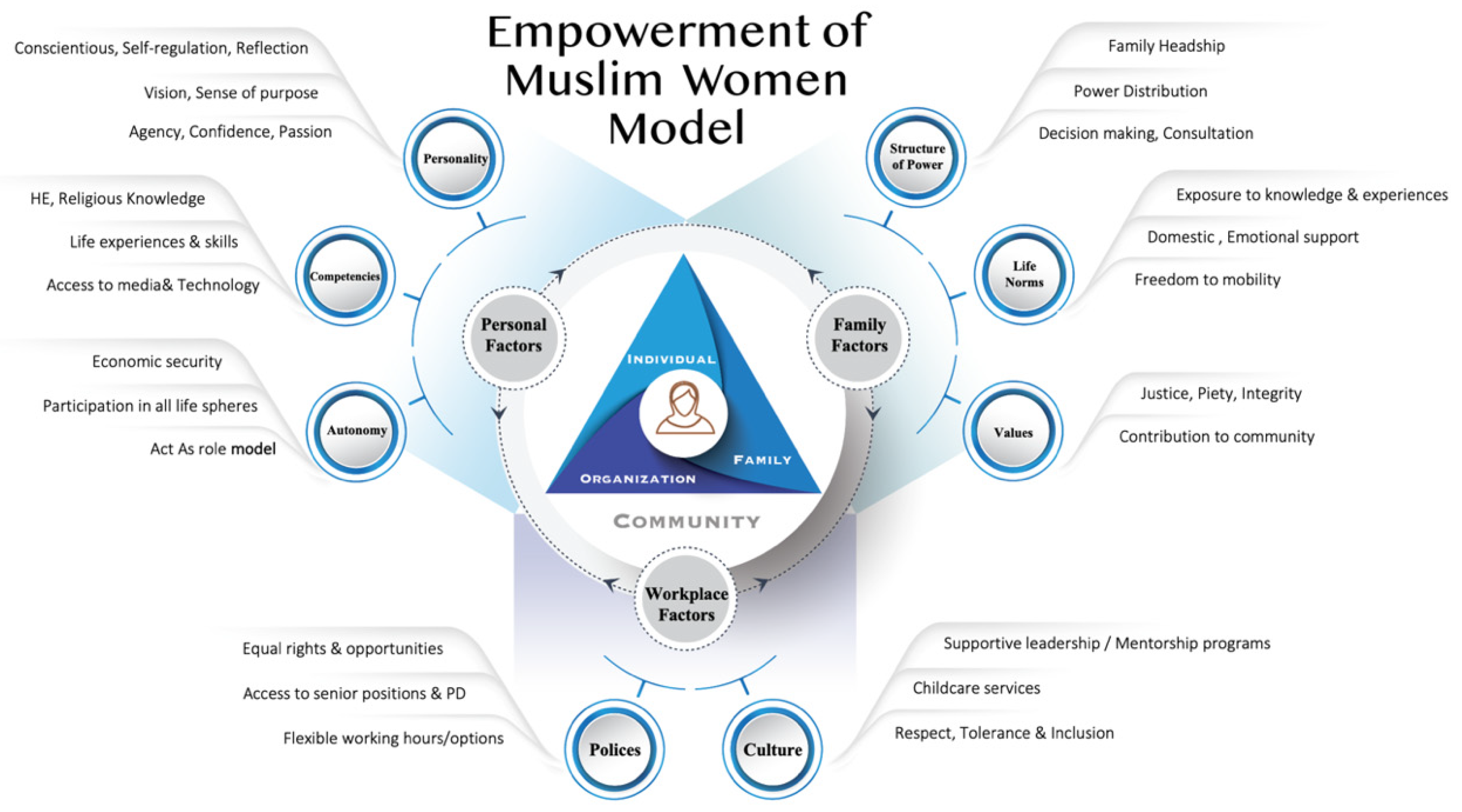
This paper constructs a culturally appropriate model for Muslim women’s empowerment in management and leadership positions that addresses sustainability goals of quality education, gender equality, economic growth and reducing inequalities, as well as national and cultural differences from Western women’s empowerment models. The approach to model building begins with two sources of evidence for women’s empowerment—first, the empowerment of women recognised in the Qur’an and Sunnah, and in the historical-biographical record, particularly in the early Islamic period that draws to some extent on hermeneutics. This is followed by identifying four approaches that can be used in constructing a comprehensive model of Muslim women’s empowerment: Bourdieu’s social, cultural and intellectual capital theory; multiple modernities theory that recognises societal diversity; cultural security arguments for the preservation of cultures; and postcolonial critiques that argue for diversity through decolonising. The main argument of this paper is that sustainability goals cannot be achieved without a model appropriate to the valuational, cultural and societal context in which women are educated and work. The final section of this paper proposes a multidimensional and multilevel model that can be used as a guidance for empowering Muslim women in management and leadership positions. The model construction is based partly on Côté and Levine’s psychosocial cultural model that identifies multiple levels and dimensions of identity, role and social institution construction. This article contributes to the current literature by proposing a theoretical foundation and a multidimensional model that can inform and shape the empowerment of Muslim women in management and leadership positions in different societies.
Keywords: empowerment of women; empowerment model; Muslim women; women in management and leadership empowerment of women; empowerment model; Muslim women; women in management and leadership