


Industrial Symbiosis and Waste Management Under a Circular Economy Management Standard in the Water Sector

 ,
,  ,
,  and
and
Abstract
1. Introduction
2. Theoretical Frameworks
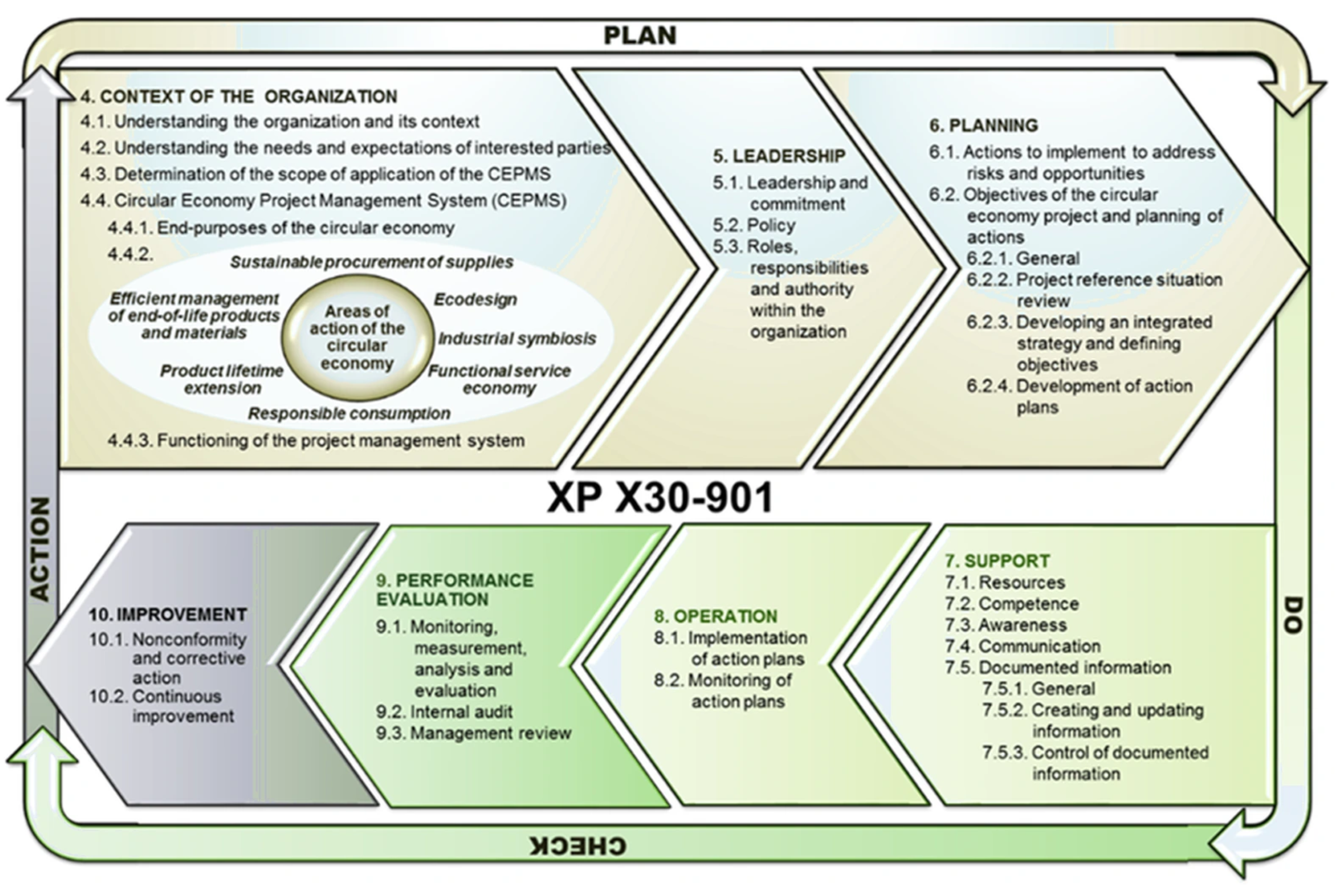
2.1. CE Management Standards
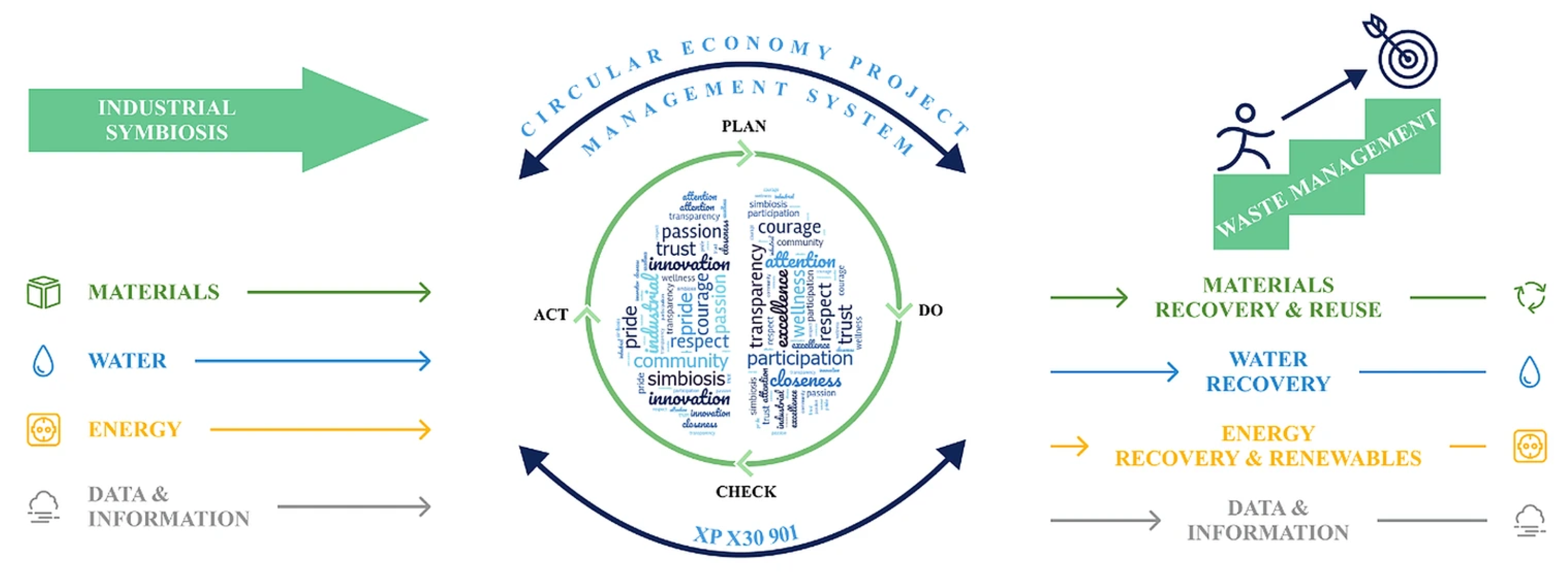
2.2. IS: Application to Waste and Energy Management Processes
2.2.1. First Category: Economic and Financial Challenges
2.2.2. Second Category: Human Resources and Technological Barriers
2.2.3. Third Category: Challenges in the Management of Material and Energy Resources
3. Methodology
3.1. Research Design and Case Selection
3.2. Data Collection
3.3. Data Analysis
3.4. Research Quality
4. Results
4.1. Context of the Case
4.2. The Situation Before the Adoption of the CEPMS
4.3. Motivations for Undertaking IS Projects
4.4. Implementation of IS Projects
- •
- Sludge Treatment Line: Processes sewage sludge, recovering thermal energy and phosphorus for use in fertiliser. Its design capacity is 65,000 t of wet sludge a year, equivalent to 14,100 t of dry sludge, and 11,120 MWh of heat a year for the district heating network.
- •
- Anaerobic Digestion Line: Recovers the organic fraction of municipal solid waste, producing biomethane from wet waste. Its design capacity is 30,000 t a year, and it serves six municipalities.
4.5. Material, Energy, and Environmental Results
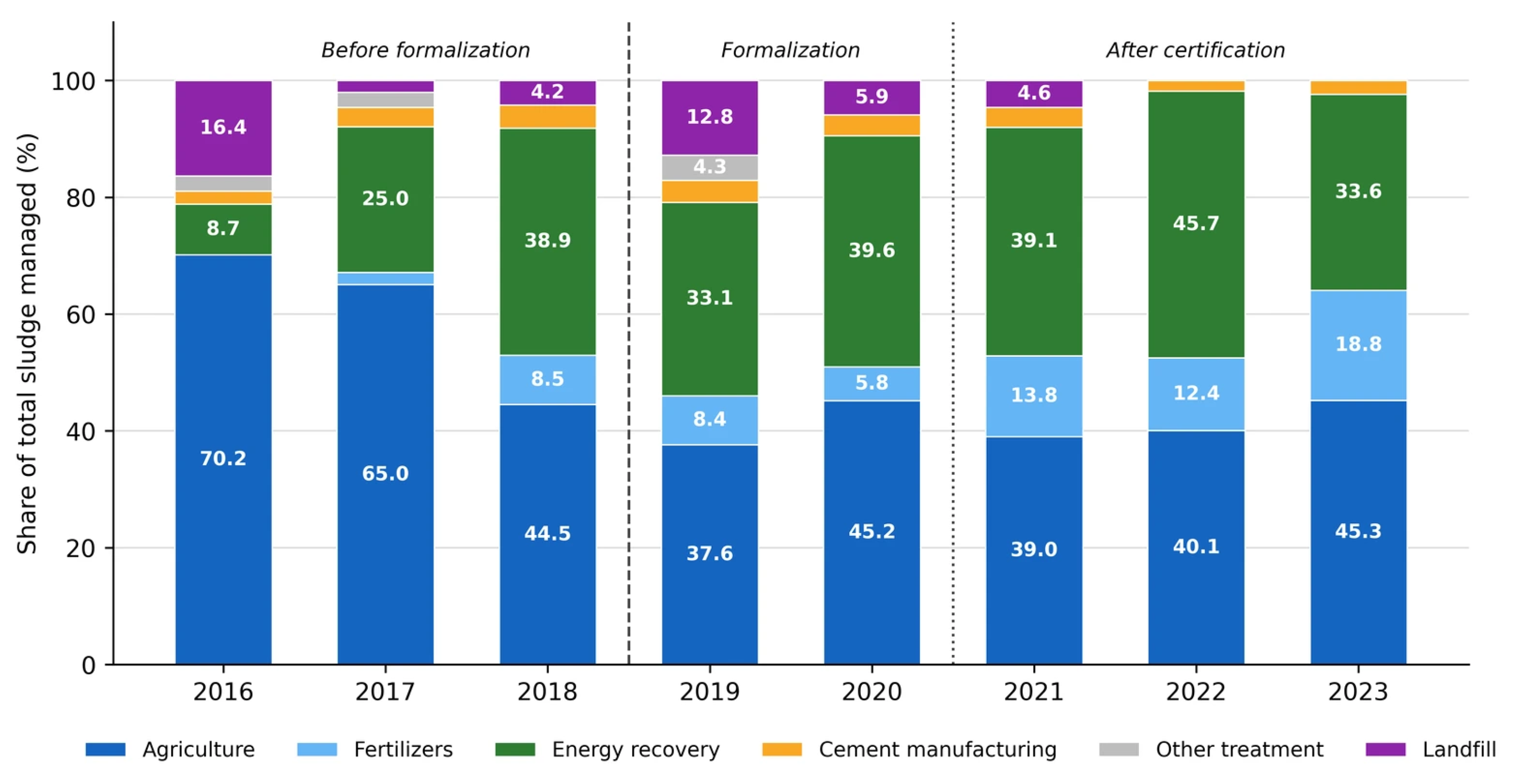
4.5.1. Sludge Destination
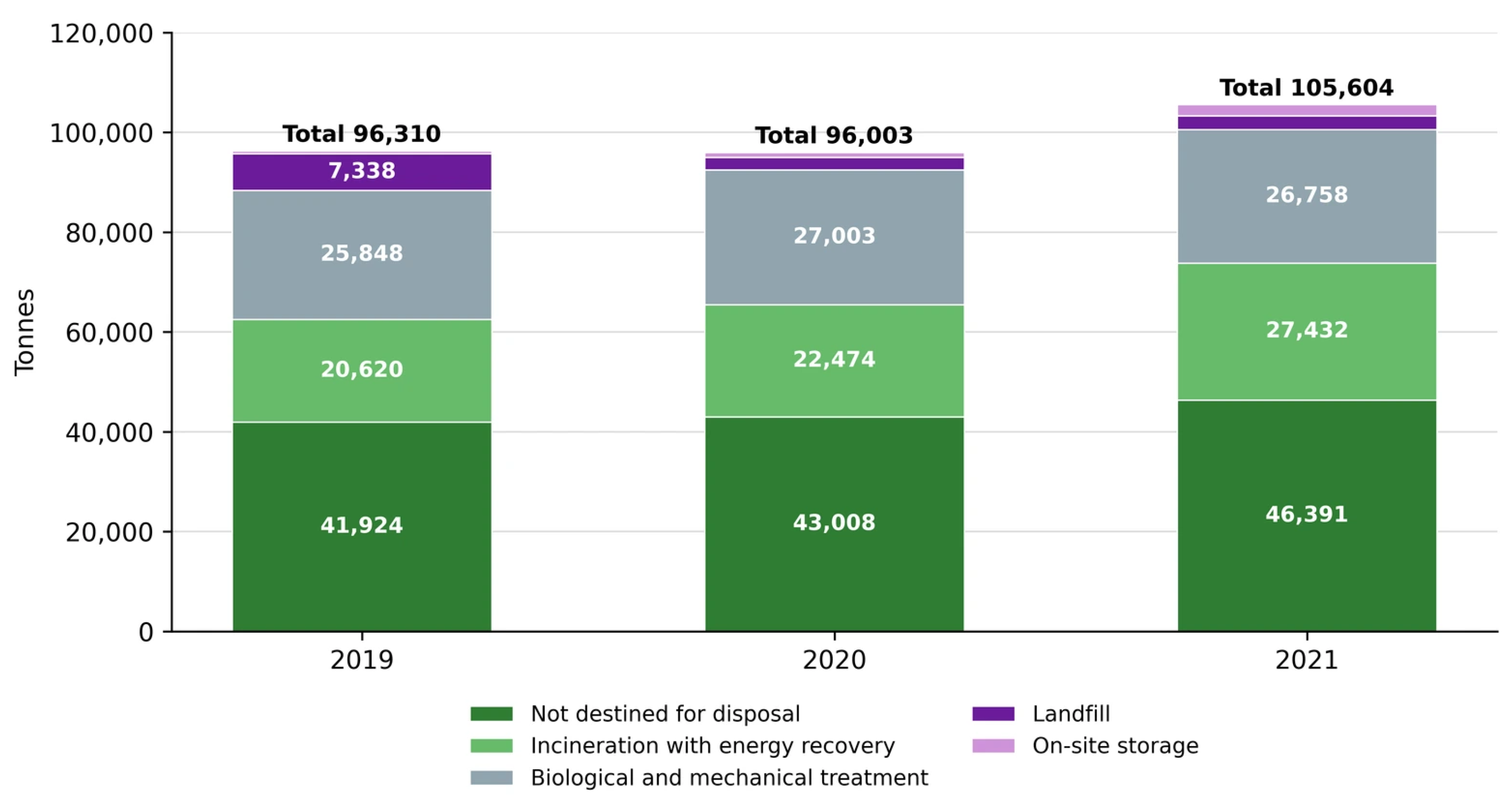
4.5.2. Waste Generated and Its Destination
4.5.3. Water Reuse
4.5.4. Energy Recovery
4.5.5. Nutrient Recovery
4.6. The Economic Dimension of the Valorisation Routes
4.7. New Sustainability Actions
4.8. Contribution to the Sustainable Development Goals
5. Discussion
5.1. Which Outcomes the Management System Stabilises, and Which It Does Not
5.2. Circularity and Cost: A Comparison with the Economics of Waste Management
6. Conclusions
Author Contributions
Funding
Data Availability Statement
Acknowledgments
Conflicts of Interest
Abbreviations
| Abbreviation | Meaning |
| CE | Circular Economy |
| DEA | Data Envelopment Analysis |
| ESRS | European Sustainability Reporting Standards |
| GRI | Global Reporting Initiative |
| IS | Industrial Symbiosis |
| CEPMS | Circular Economy Project Management System |
| KPI | Key Performance Indicator |
| PDCA | Plan–Do–Check–Act |
| PFAS | Per- and Polyfluoroalkyl Substances |
| SDG | Sustainable Development Goal |
References
- Khan, M.I.; Yasmeen, T.; Khan, M.; Hadi, N.U.; Asif, M.; Farooq, M.; Al-Ghamdi, S.G. Integrating industry 4.0 for enhanced sustainability: Pathways and prospects. Sustain. Prod. Consum. 2025, 54, 149–189. [Google Scholar] [CrossRef] [Scilit]
- Konyannik, B.Y.; Lavie, J.D. Valorization techniques for biomass waste in energy generation: A systematic review. Bioresour. Technol. 2025, 435, 132973. [Google Scholar] [CrossRef] [Scilit] [PubMed]
- Neves, F.; Soares, A.A.; Rouboa, A. Systematic review of biomass supercritical water gasification for energy production. Energies 2025, 18, 5374. [Google Scholar] [CrossRef] [Scilit]
- Bjørnbet, M.M.; Skaar, C.; Fet, A.M.; Schulte, K.Ø. Circular economy in manufacturing companies: A review of case study literature. J. Clean. Prod. 2021, 294, 126268. [Google Scholar] [CrossRef] [Scilit]
- Sarquah, K.; Narra, S.; Beck, G.; Derkyi, N.S.A.; Awafo, E.; Hartmann, M.; Nelles, M. Evaluating opportunities of refuse-derived fuel for energy-based industrial symbiosis towards a circular economy-a case study. J. Environ. Manag. 2025, 380, 125126. [Google Scholar] [CrossRef] [Scilit] [PubMed]
- Laskurain-Iturbe, I.; Arana-Landín, G.; Landeta-Manzano, B.; Uriarte-Gallastegi, N. Exploring the influence of Industry 4.0 technologies on the circular economy. J. Clean. Prod. 2021, 321, 128944. [Google Scholar] [CrossRef] [Scilit]
- Uriarte-Gallastegi, N.; Arana-Landín, G.; Landeta-Manzano, B.; Laskurain-Iturbe, I. The role of AI in improving environmental sustainability: A focus on energy management. Energies 2024, 17, 649. [Google Scholar] [CrossRef] [Scilit]
- Chandrawansa, A. From practice to standard: Exploring Finnish companies’ circular economy practices and their relation to ISO 59010 through the lens of new institutional theory. Master’s Thesis, University of Eastern Finland, Kuopio, Finland, May 2026. [Google Scholar]
- Heras-Saizarbitoria, I.; Boiral, O.; Testa, F. ISO 59000 standards for the Circular Economy: A call for accuracy. SSRN Electron. J. 2023. [Google Scholar] [CrossRef] [Scilit]
- ISO 14001:2026; Environmental Management Systems—Requirements with Guidance for Use. International Organization for Standardization: Geneva, Switzerland, 2026.
- ISO 50001:2018; Energy Management Systems—Requirements with Guidance for Use. International Organization for Standardization: Geneva, Switzerland, 2018.
- ISO 14006:2020; Environmental Management Systems—Guidelines for Incorporating Ecodesign. International Organization for Standardization: Geneva, Switzerland, 2020.
- XP X30-901:2018; Circular Economy—Circular Economy Project Management System—Requirements and Guidelines. Association Française de Normalisation (AFNOR): Saint-Denis, France, 2018.
- Arana-Landín, G.; Sigüenza, W.; Landeta-Manzano, B.; Laskurain-Iturbe, I. Circular economy: On the road to ISO 59000 family of standards. Corp. Soc. Responsib. Environ. Manag. 2024, 31, 1977–2009. [Google Scholar] [CrossRef] [Scilit]
- Fraccascia, L.; Yazdanpanah, V.; van Capelleveen, G.; Yazan, D.M. Energy-based industrial symbiosis: A literature review for circular energy transition. Environ. Dev. Sustain. 2021, 23, 4791–4825. [Google Scholar] [CrossRef] [Scilit]
- Cárcamo, E.A.B.; Peñabaena-Niebles, R. Opportunities and challenges for the waste management in emerging and frontier countries through industrial symbiosis. J. Clean. Prod. 2022, 363, 132607. [Google Scholar] [CrossRef] [Scilit]
- Wang, S.; Wan, Z.; Han, Y.; Jiao, Y.; Li, Z.; Fu, P.; Li, N.; Zhang, A.; Yi, W. A review on lignin waste valorization by catalytic pyrolysis: Catalyst, reaction system, and industrial symbiosis mode. J. Environ. Chem. Eng. 2023, 11, 109113. [Google Scholar] [CrossRef] [Scilit]
- Namany, S.; Al-Ansari, T.; Govindan, R. Sustainable energy, water and food nexus systems: A focused review of decision-making tools for efficient resource management and governance. J. Clean. Prod. 2019, 225, 610–626. [Google Scholar] [CrossRef] [Scilit]
- Doménech, T.; Davies, M. The role of embeddedness in industrial symbiosis networks: Phases in the evolution of industrial symbiosis networks. Bus. Strategy Environ. 2011, 20, 281–296. [Google Scholar] [CrossRef] [Scilit]
- Herczeg, G.; Akkerman, R.; Hauschild, M.Z. Supply chain collaboration in industrial symbiosis networks. J. Clean. Prod. 2018, 171, 1058–1067. [Google Scholar] [CrossRef] [Scilit]
- ISO 59010:2024; Circular Economy—Guidance on the Transition of Business Models and Value Networks. International Organization for Standardization: Geneva, Switzerland, 2024. Available online: https://www.iso.org/standard/80649.html (accessed on 1 June 2026).
- Abu-Bakar, H.; Charnley, F. Developing a strategic methodology for circular economy roadmapping: A theoretical framework. Sustainability 2024, 16, 6682. [Google Scholar] [CrossRef] [Scilit]
- European Commission; Directorate-General for Environment. Tools Making Value Chains More Circular and Resource Efficient: Voluntary Agreements, Standardisation & Non-Financial Reporting—Summary Report; Publications Office of the European Union: Luxembourg, 2019. [Google Scholar] [CrossRef] [PubMed]
- Deutsches Institut für Normung (DIN). Standards Research on the Circular Economy. Available online: https://www.din.de/en/innovation-and-research/circular-economy/standards-research-on-the-circular-economy (accessed on 30 June 2026).
- Morris, K.C.; Ferrero, V.; Hapuwatte, B.; Last, N.; Mathur, N. Standards as Enablers for a Circular Economy. In Technology Innovation for the Circular Economy: Recycling, Remanufacturing, Design, Systems Analysis and Logistics; Nasr, N., Ed.; Scrivener Publishing: Beverly, MA, USA, 2024; pp. 1–16. [Google Scholar] [CrossRef] [Scilit]
- Asia-Pacific Economic Cooperation. Implementing Circular Economy Standards in the APEC Region—Guidance and Recommendations Report; APEC Secretariat: Singapore, 2024; Available online: https://research.csiro.au/circulareconomy/wp-content/uploads/sites/303/2024/05/APEC-Circular-Economy-Final-Report-30.4.24.pdf (accessed on 3 June 2026).
- United Nations. Transforming Our World: The 2030 Agenda for Sustainable Development; A/RES/70/1; United Nations: New York, NY, USA, 2015; Available online: https://sdgs.un.org/2030agenda (accessed on 3 June 2026).
- European Commission. Communication from the Commission to the European Parliament, the Council, the European Economic and Social Committee and the Committee of the Regions: Closing the Loop—An EU Action Plan for the Circular Economy; COM(2015) 614 Final; European Commission: Brussels, Belgium, 2015; Available online: https://eur-lex.europa.eu/legal-content/EN/TXT/?uri=CELEX:52015DC0614 (accessed on 5 June 2026).
- BS 8001:2017; Framework for Implementing the Principles of the Circular Economy in Organizations—Guide. British Standards Institution (BSI): London, UK, 2017.
- Pomponi, F.; Moncaster, A. Briefing: BS 8001 and the built environment: A review and critique. Proc. Inst. Civ. Eng. Eng. Sustain. 2019, 172, 111–114. [Google Scholar] [CrossRef] [Scilit]
- Muradin, M.; Foltynowicz, Z. The circular economy in the standardized management system. Amfiteatru Econ. 2019, 21, 871–883. [Google Scholar] [CrossRef] [Scilit]
- ISO 59020:2024; Circular Economy—Measuring and Assessing Circularity Performance. International Organization for Standardization (ISO): Geneva, Switzerland, 2024. Available online: https://www.iso.org/standard/80650.html (accessed on 1 June 2026).
- ISO 59004:2024; Circular Economy—Vocabulary, Principles and Guidance for Implementation. International Organization for Standardization (ISO): Geneva, Switzerland, 2024. Available online: https://www.iso.org/standard/80648.html (accessed on 1 June 2026).
- Kirchherr, J.; Yang, N.-H.N.; Schulze-Spüntrup, F.; Heerink, M.J.; Hartley, K. Conceptualizing the circular economy (revisited): An analysis of 221 definitions. Resour. Conserv. Recycl. 2023, 194, 107001. [Google Scholar] [CrossRef] [Scilit]
- Ghisellini, P.; Cialani, C.; Ulgiati, S. A review on circular economy: The expected transition to a balanced interplay of environmental and economic systems. J. Clean. Prod. 2016, 114, 11–32. [Google Scholar] [CrossRef] [Scilit]
- Teixeira, N. Green innovation and national competitiveness: Rethinking economic resilience in the sustainability transition. Sustainability 2025, 17, 7660. [Google Scholar] [CrossRef] [Scilit]
- Ababio, B.K.; Lu, W. Barriers and enablers of circular economy in construction: A multi-system perspective towards the development of a practical framework. Constr. Manag. Econ. 2023, 41, 3–21. [Google Scholar] [CrossRef] [Scilit]
- Khadim, N.; van Marrewijk, A. Circles of profit: A conceptual framework for economic and financial aspects in circular construction. Sustain. Prod. Consum. 2025, 55, 444–457. [Google Scholar] [CrossRef] [Scilit]
- Vallecha, H.; Bhola, P. Prioritization of challenges and enablers associated with community energy projects in Indian context. Energy Procedia 2019, 158, 3886–3892. [Google Scholar] [CrossRef] [Scilit]
- Urbinati, A.; Franzò, S.; Chiaroni, D. Enablers and barriers for circular business models: An empirical analysis in the Italian automotive industry. Sustain. Prod. Consum. 2021, 27, 551–566. [Google Scholar] [CrossRef] [Scilit]
- Eikelenboom, M.; de Jong, G. The impact of managers and network interactions on the integration of circularity in business strategy. Organ. Environ. 2022, 35, 365–393. [Google Scholar] [CrossRef] [Scilit]
- Mazutis, D.; Nubi, A.; Segal, E. Advancing circularity: The dynamic capabilities to drive transformative change. Calif. Manag. Rev. 2026, 68, 63–88. [Google Scholar] [CrossRef] [Scilit]
- Victar, H.C.; Waidyasekara, A.S. Optimising construction waste management in Sri Lanka through circular economy strategies: A focus on construction and renovation and use and operate stages. Eng. Constr. Archit. Manag. 2025, 32, 4275–4309. [Google Scholar] [CrossRef] [Scilit]
- Simioni, F.J.; Soares, J.F.; Rosário, J.d.A.d.; Sell, L.G.; Bertol, E.; Souza, F.M.P.; Santos Júnior, E.P.; Coelho Junior, L.M. Industrial Symbiosis and Circular Economy Practices Towards Sustainability in Forest-Based Clusters: Case Studies in Southern Brazil. Sustainability 2024, 16, 9258. [Google Scholar] [CrossRef] [Scilit]
- Smol, M. Circular Economy in Wastewater Treatment Plant—Water, Energy and Raw Materials Recovery. Energies 2023, 16, 3911. [Google Scholar] [CrossRef] [Scilit]
- Ramin, E.; Faria, L.; Gargalo, C.L.; Ramin, P.; Flores-Alsina, X.; Andersen, M.M.; Gernaey, K.V. Water innovation in industrial symbiosis: A global review. J. Environ. Manag. 2024, 350, 119578. [Google Scholar] [CrossRef] [Scilit] [PubMed]
- Javan, K.; Altaee, A.; BaniHashemi, S.; Darestani, M.; Zhou, J.; Pignatta, G. A review of interconnected challenges in the water–energy–food nexus: Urban pollution perspective towards sustainable development. Sci. Total Environ. 2024, 912, 169319. [Google Scholar] [CrossRef] [Scilit] [PubMed]
- Adom, R.K.; Simatele, M.D. Overcoming systemic and institutional challenges in policy implementation in South Africa’s water sector. Sustain. Water Resour. Manag. 2024, 10, 69. [Google Scholar] [CrossRef] [Scilit]
- Alakaş, H.M.; Gür, Ş.; Özcan, E.; Eren, T. Ranking of sustainability criteria for industrial symbiosis applications based on ANP. J. Environ. Eng. Landsc. Manag. 2020, 28, 192–201. [Google Scholar] [CrossRef] [Scilit]
- Wang, D.; Zhu, W.; Zhang, C.; Li, H.; Wu, Y. Stakeholder symbiosis in the context of corporate social responsibility. Symmetry 2020, 12, 1897. [Google Scholar] [CrossRef] [Scilit]
- Donner, M.; de Vries, H. How to innovate business models for a circular bio-economy? Bus. Strategy Environ. 2021, 30, 1932–1947. [Google Scholar] [CrossRef] [Scilit]
- Sitadewi, D.; Yudoko, G.; Okdinawati, L. Bibliographic mapping of post-consumer plastic waste based on hierarchical circular principles across the system perspective. Heliyon 2021, 7, e07154. [Google Scholar] [CrossRef] [Scilit] [PubMed]
- Czaplicka-Kotas, A.; Kulczycka, J.; Iwaszczuk, N. Energy clusters as a new urban symbiosis concept for increasing renewable energy production-A case study of Zakopane City. Sustainability 2020, 12, 5634. [Google Scholar] [CrossRef] [Scilit]
- Che, C.; Zhang, X.; Chen, Y.; Zhao, L.; Zhang, Z. A model of waste price in a symbiotic supply chain based on Stackelberg algorithm. Sustainability 2021, 13, 1740. [Google Scholar] [CrossRef] [Scilit]
- Cioca, L.-I.; Ciomoş, A.-O.; Șeitoar, D.; Druță, R.M.; David, G.M. Industrial Symbiosis through the Use of Biosolids as Fertilizer in Romanian Agriculture. Recycling 2021, 6, 59. [Google Scholar] [CrossRef] [Scilit]
- Cáceres, C.R.; Törnroth, S.; Vesterlund, M.; Johansson, A.; Sandberg, M. Data-Center Farming: Exploring the Potential of Industrial Symbiosis in a Subarctic Region. Sustainability 2022, 14, 2774. [Google Scholar] [CrossRef] [Scilit]
- Huang, L.; Zhen, L.; Yin, L. Waste material recycling and exchanging decisions for industrial symbiosis network optimization. J. Clean. Prod. 2020, 276, 124073. [Google Scholar] [CrossRef] [Scilit]
- Leiva, H.; Julian, I.; Ventura, L.; Wallin, E.; Vendt, M.; Fornell, R.; Galindo Paniagua, F.; Ascaso, S.; Gomez-Perez, M. Advancing Sustainability Through Industrial Symbiosis: A Technoeconomic Approach Using Material Flow Cost Accounting and Cost–Benefit Analysis. Sustainability 2025, 17, 2730. [Google Scholar] [CrossRef] [Scilit]
- Vermunt, D.A.; Negro, S.O.; Verweij, P.A.; Kuppens, D.V.; Hekkert, M.P. Exploring barriers to implementing different circular business models. J. Clean. Prod. 2019, 222, 891–902. [Google Scholar] [CrossRef] [Scilit]
- Wrålsen, B.; Prieto-Sandoval, V.; Mejia-Villa, A.; O’Born, R.; Hellström, M.; Faessler, B. Circular business models for lithium-ion batteries-Stakeholders, barriers, and drivers. J. Clean. Prod. 2021, 317, 128393. [Google Scholar] [CrossRef] [Scilit]
- Kristoffersen, E.; Mikalef, P.; Blomsma, F.; Li, J. The effects of business analytics capability on circular economy implementation, resource orchestration capability, and firm performance. Int. J. Prod. Econ. 2021, 239, 108205. [Google Scholar] [CrossRef] [Scilit]
- Yu, H.; Yang, B.; Wang, S.; Wang, Y.; Wang, S.; Wang, Z.; Wang, Z. An effective multi-part dedicated flow-line reconfiguration model considering the optimal selection of machining process path and machines. Proc. Inst. Mech. Eng. B 2023, 237, 154–170. [Google Scholar] [CrossRef] [Scilit]
- Kazancoglu, I.; Kazancoglu, Y.; Yarimoglu, E.; Kahraman, A. A conceptual framework for barriers of circular supply chains for sustainability in the textile industry. Sustain. Dev. 2020, 28, 1477–1492. [Google Scholar] [CrossRef] [Scilit]
- Pathak, R.; Endayilalu, A. Circular economy: A perspective of Ethiopian textile sector. Int. J. All Res. Writ. 2019, 1, 101–109. [Google Scholar]
- Kirchherr, J.; Piscicelli, L.; Bour, R.; Kostense-Smit, E.; Muller, J.; Huibrechtse-Truijens, A.; Hekkert, M. Barriers to the circular economy: Evidence from the European Union (EU). Ecol. Econ. 2018, 150, 264–272. [Google Scholar] [CrossRef] [Scilit]
- Munonye, W.C.; Ajonye, G.O.; Akinloye, O.A. Industrial symbiosis in circular economies through policy and practice for waste to resource innovation. Discov. Sustain. 2025, 6, 1371. [Google Scholar] [CrossRef] [Scilit]
- Santhappan, J.S.; Winsly, B.W.; Mathimani, T. Integration of bioenergy in industrial symbiosis and the assessment of its environmental and life cycle impact for circular energy transition. Energy Convers. Manag. 2025, 345, 120376. [Google Scholar] [CrossRef] [Scilit]
- Hernández-Arzaba, J.C.; Nazir, S.; Leyva-Hernández, S.N.; Muhyaddin, S. Stakeholder pressure engaged with circular economy principles and economic and environmental performance. Sustainability 2022, 14, 16302. [Google Scholar] [CrossRef] [Scilit]
- Ellen MacArthur Foundation. Artificial Intelligence and the Circular Economy—AI as a Tool to Accelerate the Transition; Ellen MacArthur Foundation: Cowes, UK, 2019. [Google Scholar]
- Cioffi, R.; Travaglioni, M.; Piscitelli, G.; Petrillo, A.; Parmentola, A. Smart Manufacturing Systems and Applied Industrial Technologies for a Sustainable Industry: A Systematic Literature Review. Appl. Sci. 2020, 10, 2897. [Google Scholar] [CrossRef] [Scilit]
- Dantas, T.E.T.; de-Souza, E.D.; Destro, I.R.; Hammes, G.; Rodriguez, C.M.T.; Soares, S.R. How the combination of Circular Economy and Industry 4.0 can contribute towards achieving the Sustainable Development Goals. Sustain. Prod. Consum. 2021, 26, 213–227. [Google Scholar] [CrossRef] [Scilit]
- Pathan, M.S.; Richardson, E.; Galvan, E.; Mooney, P. The Role of Artificial Intelligence within Circular Economy Activities-A View from Ireland. Sustainability 2023, 15, 9451. [Google Scholar] [CrossRef] [Scilit]
- Barathi, A.; Kundu, D.; Pooja, K.; Surya, M.; Jacob, S.; Samanta, P.; Kumar, V.; Kuila, A. Toward sustainable industry: Integrating industrial symbiosis, biorefineries, and circular economy for SDG alignment. Sustain. Energy Fuels 2026, 10, 1816–1844. [Google Scholar] [CrossRef] [Scilit]
- Chiappetta Jabbour, C.J.; Seuring, S.; Lopes de Sousa Jabbour, A.B.; Jugend, D.; de Camargo Fiorini, P.; Latan, H.; Izeppi, W.C. Stakeholders, innovative business models for the circular economy and sustainable performance of firms in an emerging economy facing institutional voids. J. Environ. Manag. 2020, 264, 110416. [Google Scholar] [CrossRef] [Scilit] [PubMed]
- Cantú, A.; Aguiñaga, E.; Scheel, C. Learning from Failure and Success: The Challenges for Circular Economy Implementation in SMEs in an Emerging Economy. Sustainability 2021, 13, 1529. [Google Scholar] [CrossRef] [Scilit]
- Khan, S.; Ali, S.S.; Singh, R. Determinants of Remanufacturing Adoption for Circular Economy: A Causal Relationship Evaluation Framework. Appl. Syst. Innov. 2022, 5, 62. [Google Scholar] [CrossRef] [Scilit]
- Tabassum, Z.; Mohan, A.; Mamidi, N.; Khosla, A.; Kumar, A.; Solanki, P.R.; Malik, T.; Girdhar, M. Recent trends in nanocomposite packaging films utilising waste generated biopolymers: Industrial symbiosis and its implication in sustainability. IET Nanobiotechnol. 2023, 17, 127–153. [Google Scholar] [CrossRef] [Scilit] [PubMed]
- Bosco, C.; Raspati, G.S.; Maurin, N.; Helness, H. A systematic literature review on resource recovery toward symbiotic circular economy solutions in the water sector. J. Environ. Manag. 2025, 393, 127298. [Google Scholar] [CrossRef] [Scilit] [PubMed]
- Yin, R.K. Case Study Research and Applications: Design and Methods, 6th ed.; SAGE Publications: Thousand Oaks, CA, USA, 2018. [Google Scholar]
- Eisenhardt, K.M. Building theories from case study research. Acad. Manag. Rev. 1989, 14, 532–550. [Google Scholar] [CrossRef] [Scilit]
- Miles, M.B.; Huberman, A.M.; Saldaña, J. Qualitative Data Analysis: A Methods Sourcebook, 4th ed.; SAGE Publications: Thousand Oaks, CA, USA, 2018. [Google Scholar]
- Boiral, O.; Baron, C.; Gunnlaugson, O. Environmental leadership and consciousness development: A case study among Canadian SMEs. J. Bus. Ethics 2014, 123, 363–383. [Google Scholar] [CrossRef] [Scilit]
- Fatimah, Y.A.; Govindan, K.; Murniningsih, R.; Setiawan, A. Industry 4.0 based sustainable circular economy approach for smart waste management system to achieve sustainable development goals: A case study of Indonesia. J. Clean. Prod. 2020, 269, 122263. [Google Scholar] [CrossRef] [Scilit]
- Zafra-Gómez, J.L.; López-Pérez, G.; Garrido-Montañés, M.; Zafra-Gómez, E. Cost efficiency in municipal solid waste (MSW): Different alternatives in service delivery for small and medium sized Spanish local governments. Sustainability 2023, 15, 6198. [Google Scholar] [CrossRef] [Scilit]
- Lo Storto, C. Evaluating the eco-efficiency of municipal solid waste management: Determinants, paradoxes, and trade-offs. Urban Sci. 2025, 9, 395. [Google Scholar] [CrossRef] [Scilit]
- Beccarello, M.; Di Foggia, G. Defining the organization of municipal solid waste management based on production costs. Urban Sci. 2023, 7, 34. [Google Scholar] [CrossRef] [Scilit]
- Di Foggia, G.; Arrigo, U.; Beccarello, M. Policy insights from a single-operator model for municipal solid waste management. Urban Sci. 2025, 9, 145. [Google Scholar] [CrossRef] [Scilit]
- Lo Storto, C. Eco-productivity analysis of the municipal solid waste service in the Apulia region from 2010 to 2017. Sustainability 2021, 13, 12008. [Google Scholar] [CrossRef] [Scilit]
- Sánchez-Ortiz, J.; Rodríguez-Cornejo, V.; Del Río-Sánchez, R.; García-Valderrama, T. Indicators to measure efficiency in circular economies. Sustainability 2020, 12, 4483. [Google Scholar] [CrossRef] [Scilit]
- Jin, B.; Li, W. Spatial effects and driving factors of consumption upgrades on municipal solid waste eco-efficiency, considering emission outputs. Sustainability 2025, 17, 2356. [Google Scholar] [CrossRef] [Scilit]



| Dimension | BS 8001:2017 | XP X30-901:2018 | ISO 59004:2024 | ISO 59010:2024 | ISO 59020:2024 |
|---|---|---|---|---|---|
| Nature and scope | Applying CE principles in organisations of different sectors and sizes. | Managing CE projects through a structured project framework. | Provides international terminology, principles, and guidance for implementing the CE. | Provides international guidance on moving business models and value networks towards the CE. | Sets requirements and guidance for measuring and assessing circularity performance. |
| Methodological structure | Offers a flexible, non-prescriptive framework adaptable to different organisations. | Follows an operational structure based on the PDCA cycle for CE projects. | Sets out principles and guidance for embedding the CE across the organisation. | Maps current value networks and designs the transition to circular models. | Defines indicators, measures circularity, and evaluates performance. |
| Resource and energy efficiency | Covers resource efficiency, life-cycle thinking, waste reduction, reuse, and recycling, with indirect implications for energy use. | Covers the optimisation of material, water, infrastructure, and energy flows within specific CE projects. | Emphasises resource traceability, value retention, and efficient resource use, supporting the energy transition. | Guides the redesign of value networks to cut resource and energy consumption. | Measures resource and energy efficiency through circularity indicators. |
| Performance measurement | Does not prescribe specific circularity metrics. | Encourages project-level monitoring through KPIs. | Supplemented by ISO 59020:2024. | Supplemented by ISO 59020:2024. | Provides guidance for measuring and assessing circularity. |
| Industrial symbiosis and collaboration | Highlights collaboration and shared value creation among stakeholders and business networks. | Treats IS as a specific area of action, enabling synergies through exchange. | Promotes IS as a circular strategy for sharing the value of resources. | Guides the creation of IS through collaborative value networks. | Measures the circularity gains achieved through IS initiatives. |
| End-of-life and value recovery | Introduces life-cycle thinking and strategies to minimise waste and retain value. | Addresses effective end-of-life management explicitly, as one of the CE areas of action. | Uses life-cycle approaches to retain and recover value from materials and resources. | Guides recovery loops, reuse, remanufacturing, and recycling in value networks. | Measures end-of-life recovery performance and retained material value. |
| Relevance for energy-oriented CE research | Useful as a general conceptual framework linking circularity, resource efficiency, and sustainability. | Shows how a standardised CEPMS can support IS, energy recovery, and waste valorisation. | Provides a global framework connecting the CE with resource efficiency and the energy transition. | Guides business model transitions that improve energy and resource efficiency. | Measures improvements in energy and resource efficiency through circularity indicators. |
| Data Source | Description | Analytical Purpose |
|---|---|---|
| Semi-structured interviews | Technician (two interviews) and manager (one interview), 2022–2023 | Establish motivations, implementation process, and perceived outcomes |
| Internal documents | Six project-related documents, January 2023–December 2025 | Reconstruct project design, indicators, and operational results |
| External documents | Annual reports of the organisation, 2016–2025 | Triangulate the evidence, build the pre-adoption baseline, and set the case in context |
| Quantitative indicators | Waste, sludge, water reuse, biomethane, thermal energy, and unit cost data, 2016–2025 | Assess material, environmental, economic, and energy-related outcomes |
| Annual Input Flow to the Valorisation Route (2019) | New Valorised Resource | User or Local Agent | Contribution to the CE | Sustainable Impact |
|---|---|---|---|---|
| Municipal organic waste 1 (≈30,000 t, design capacity of the dedicated line) | Biomethane | Urban services (transport and cleaning) | Energy recovery from organic waste | Less use of fossil fuels and better use of local resources |
| Sewage sludge (≈20,300 t to energy recovery in 2019) | Thermal energy | Public buildings and local administrations | Energy recovery from sludge | Less landfill disposal and a local supply of heat |
| Sludge to agriculture and fertiliser (≈28,200 t in 2019) and treated water (≈109 M m3 reused in 2019) | Reused water and nutrients | Local agricultural associations, urban services, non-potable uses | Nutrient recovery, partial substitution of conventional raw materials, water circularity and reuse | Closing water cycles and easing pressure on water resources |
| Water treatment by-products | Recovered materials and resources | Local companies, administration and local stakeholders | IS and collaboration between organisations | Shared value creation and stronger territorial networks |
| Destination | 2020 | 2021 | 2022 | 2023 | 2024 | 2025 |
|---|---|---|---|---|---|---|
| Sludge to agriculture | 104.32 | 105.37 | 112.28 | 118.04 | 88.69 | 82.06 |
| Sludge to landfill | – | 202.00 | – | – | – | – |
| Dried sludge to energy recovery or cement | 157.34 | 132.08 | 184.93 | 146.67 | 134.30 | 112.17 |
| Semi-solid sludge to energy recovery | 160.34 | 158.57 | 159.68 | 161.70 | 172.17 | 174.11 |
| Fertilisers | 75.30 | 95.22 | 117.32 | 117.48 | 112.05 | 86.39 |
| Bio-dried sludge to energy recovery | 140.00 | 140.00 | 140.00 | 144.90 | 144.90 | 144.90 |
| Average cost | 114.22 | 120.98 | 134.34 | 127.49 | 110.81 | 107.15 |
| Indicator | Degree of Organisational Control | Identified Drivers of Variation | Behaviour Observed |
|---|---|---|---|
| Sludge sent to landfill | High: depends on contracted destinations and internal treatment capacity | Availability of alternative outlets; commissioning of internal capacity | Volatile until 2019; zero and stable from 2022 |
| Sludge to agriculture and fertilisers | Medium: depends on demand for the agricultural outlet and its price | Relative prices of destinations; sludge quality; agronomic regulation | Falls to 46.0% in 2019; recovers to 64.1% in 2023 |
| Waste to non-disposal and energy-recovery pathways | High: depends on internal routing decisions | Composition of the waste generated; contracted capacity | Rises 18.0% between 2019 and 2021 |
| Treated water reused | Low: depends on downstream demand | Rainfall; irrigation demand; authorisations | Fluctuates markedly; indicator discontinued from 2024 |
| Thermal energy produced | Medium: depends on biogas availability and plant operation | Sludge volume and quality; plant availability | Rises to 2021; declines to 2023 |
| Unit sludge transfer cost | Low: set by the market | Prices in the destination markets; sludge quality | Rises to 2022; falls to 2025 |
| Recovered phosphorus | High but immature: at pilot stage | Technological readiness; regulatory admissibility | Not quantified in the period examined |
Disclaimer/Publisher’s Note: The statements, opinions and data contained in all publications are solely those of the individual author(s) and contributor(s) and not of MDPI and/or the editor(s). MDPI and/or the editor(s) disclaim responsibility for any injury to people or property resulting from any ideas, methods, instructions or products referred to in the content. |
© 2026 by the authors. Licensee MDPI, Basel, Switzerland. This article is an open access article distributed under the terms and conditions of the Creative Commons Attribution (CC BY) license.
Share and Cite
Arana-Landin, G.; Uriarte-Gallastegi, N.; Landeta-Manzano, B.; Sigüenza-Tamayo, W. Industrial Symbiosis and Waste Management Under a Circular Economy Management Standard in the Water Sector. Environments 2026, 13, 472. https://doi.org/10.3390/environments13090472
Arana-Landin G, Uriarte-Gallastegi N, Landeta-Manzano B, Sigüenza-Tamayo W. Industrial Symbiosis and Waste Management Under a Circular Economy Management Standard in the Water Sector. Environments. 2026; 13(9):472. https://doi.org/10.3390/environments13090472
Chicago/Turabian StyleArana-Landin, Germán, Naiara Uriarte-Gallastegi, Beñat Landeta-Manzano, and Waleska Sigüenza-Tamayo. 2026. "Industrial Symbiosis and Waste Management Under a Circular Economy Management Standard in the Water Sector" Environments 13, no. 9: 472. https://doi.org/10.3390/environments13090472
APA StyleArana-Landin, G., Uriarte-Gallastegi, N., Landeta-Manzano, B., & Sigüenza-Tamayo, W. (2026). Industrial Symbiosis and Waste Management Under a Circular Economy Management Standard in the Water Sector. Environments, 13(9), 472. https://doi.org/10.3390/environments13090472