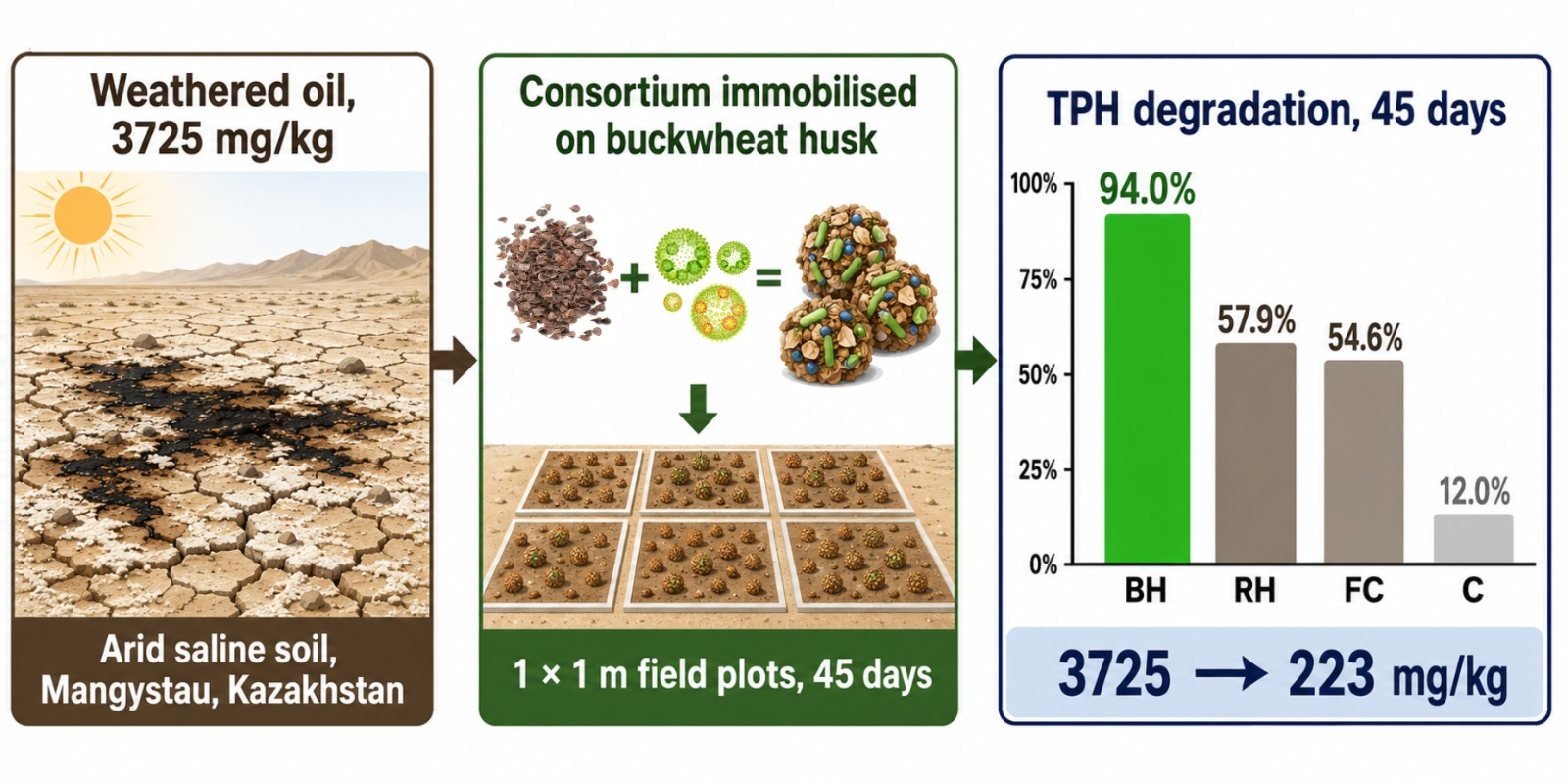

Pilot-Scale Evaluation of an Immobilised Rhodococcus–Dietzia Consortium on Agricultural Carriers for Petroleum-Contaminated Soil Remediation Under Arid Field Conditions in Kazakhstan


Abstract
1. Introduction
2. Materials and Methods
2.1. Characteristics of the Study Site
2.1.1. Field Trial Site
2.1.2. Characteristics of the Contaminated Soil
2.2. Microorganisms and Biological Preparation
2.2.1. Microorganism Strains
2.2.2. Preparation of Organic Carriers
Characterisation of the Carriers
2.2.3. Immobilisation of Microorganisms
2.3. Field Experiment Design
2.3.1. Experimental Treatments
2.3.2. Preparation of Experimental Plots
2.3.3. Application of the Biological Agent
2.3.4. Experimental Conditions
2.4. Analytical Methods
2.4.1. Determination of Petroleum Product Content
2.4.2. Microbiological Analysis
2.4.3. Soil Biochemical Parameters
2.4.4. Kinetic Analysis
2.5. Statistical Analysis
3. Results
3.1. Dynamics of Petroleum Hydrocarbon Degradation Under Field Conditions
Bioremediation Efficiency by Treatment
3.2. Biodegradation Kinetics
3.3. Microbiological Parameters
3.4. Biochemical Parameters of Soil
3.4.1. Enzymatic Activity
3.4.2. Water-Holding Capacity
4. Discussion
4.1. Mechanisms Underlying the Higher Performance of Buckwheat Husks over Rice Husks
4.1.1. Structural and Nutrient Properties of the Carriers
4.1.2. Possible Contribution of Phenolic Compounds
4.2. Advantages of Immobilisation over Free Cells
4.3. Factors Contributing to High Field Efficiency and Comparison with Laboratory Data
4.3.1. Synergy with the Indigenous Microflora
4.3.2. Temperature Cycles
4.3.3. Pollution Characteristics
4.4. Economic Aspects and Prospects for Application
4.5. Adaptation to an Arid Climate
4.6. Limitations and Directions for Further Research
5. Conclusions
6. Patents
Author Contributions
Funding
Institutional Review Board Statement
Informed Consent Statement
Data Availability Statement
Acknowledgments
Conflicts of Interest
Abbreviations
| ANOVA | Analysis of Variance |
| BTEX | Benzene, Toluene, Ethylbenzene, Xylenes |
| CFU | Colony Forming Unit |
| FTIR | Fourier Transform Infrared Spectroscopy |
| GC-MS | Gas Chromatography–Mass Spectrometry |
| HOM | Hydrocarbon-Oxidising Microorganisms |
| HPLC | High-Performance Liquid Chromatography |
| PAH | Polycyclic Aromatic Hydrocarbon |
| ROS | Reactive Oxygen Species |
| TFF | Triphenylformazan |
| TPH | Total Petroleum Hydrocarbons |
| TTC | 2,3,5-Triphenyltetrazolium Chloride |
References
- Saeed, M.; Ilyas, N.; Bibi, F.; Shabir, S.; Jayachandran, K.; Sayyed, R.Z.; Shati, A.A.; Alfaifi, M.Y.; Show, P.L.; Rizvi, Z.F. Development of novel kinetic model based on microbiome and biochar for in-situ remediation of total petroleum hydrocarbons (TPHs) contaminated soil. Chemosphere 2023, 324, 138311. [Google Scholar] [CrossRef] [Scilit] [PubMed]
- Chen, W.; Li, J.; Sun, X.; Min, J.; Hu, X. High efficiency degradation of alkanes and crude oil by a salt-tolerant bacterium Dietzia species CN-3. Int. Biodeterior. Biodegrad. 2017, 118, 110–118. [Google Scholar] [CrossRef] [Scilit]
- National Statistics Bureau of the Republic of Kazakhstan. Agriculture, Forestry and Fisheries of Kazakhstan: Statistical Yearbook; National Statistics Bureau: Nur-Sultan, Kazakhstan, 2020. Available online: https://stat.gov.kz/en/industries/business-statistics/stat-forrest-village-hunt-fish/ (accessed on 15 February 2026).
- Funtikova, T.V.; Akhmetov, L.I.; Puntus, I.F.; Mikhailov, P.A.; Appazov, N.O.; Narmanova, R.A.; Filonov, A.E.; Solyanikova, I.P. Bioremediation of Oil-Contaminated Soil of the Republic of Kazakhstan Using a New Biopreparation. Microorganisms 2023, 11, 522. [Google Scholar] [CrossRef] [Scilit] [PubMed]
- Stepanova, A.Y.; Gladkov, E.A.; Osipova, E.S.; Gladkova, O.V.; Tereshonok, D.V. Bioremediation of Soil from Petroleum Contamination. Processes 2022, 10, 1224. [Google Scholar] [CrossRef] [Scilit]
- Ebadi, A.; Khoshkholgh Sima, N.A.; Olamaee, M.; Hashemi, M.; Ghorbani Nasrabadi, R. Effective bioremediation of a petroleum-polluted saline soil by a surfactant-producing Pseudomonas aeruginosa consortium. J. Adv. Res. 2017, 8, 627–633. [Google Scholar] [CrossRef] [Scilit] [PubMed]
- Li, Z.; Rosenzweig, R.; Chen, F.; Qin, J.; Li, T.; Han, J.; Paula, S.; Diaz-Reck, D.; Gelman, F.; Arye, G.; et al. Bioremediation of Petroleum-Contaminated Soils with Biosurfactant-Producing Degraders Isolated from the Native Desert Soils. Microorganisms 2022, 10, 2267. [Google Scholar] [CrossRef] [Scilit] [PubMed]
- Han, T.; Zhao, Z.; Bartlam, M.; Wang, Y. Combination of biochar amendment and phytoremediation for hydrocarbon removal. Environ. Sci. Pollut. Res. 2016, 23, 21219–21228. [Google Scholar] [CrossRef] [Scilit] [PubMed]
- Huesemann, M.H.; Hausmann, T.S.; Fortman, T.J. Does Bioavailability Limit Biodegradation? A Comparison of Hydrocarbon Biodegradation and Desorption Rates in Aged Soils. Bioremediation J. 2002, 6, 261–274. [Google Scholar] [CrossRef] [Scilit]
- Dadrasnia, A.; Usman, M.M.; Alinejad, T.; Motesharezadeh, B.; Mousavi, S.M. Hydrocarbon Degradation Assessment: Biotechnical Approaches Involved. In Microbial Action on Hydrocarbons; Springer: Singapore, 2019. [Google Scholar] [CrossRef] [Scilit]
- Strizhenok, A.V.; Korelskiy, D.S.; Choi, Y. Assessment of the Efficiency of Using Organic Waste from the Brewing Industry for Bioremediation of Oil-Contaminated Soils. J. Ecol. Eng. 2021, 22, 66–77. [Google Scholar] [CrossRef] [Scilit]
- Wu, M.; Wu, J.; Zhang, X.; Ye, X. Effect of bioaugmentation and biostimulation on hydrocarbon degradation and microbial community composition in petroleum-contaminated loessal soil. Chemosphere 2019, 237, 124456. [Google Scholar] [CrossRef] [Scilit] [PubMed]
- Hamoudi-Belarbi, L.; Hamoudi, S.; Belkacemi, K.; Nouri, L.; Bendifallah, L.; Khodja, M. Bioremediation of Polluted Soil Sites with Crude Oil Hydrocarbons Using Carrot Peel Waste. Environments 2018, 5, 124. [Google Scholar] [CrossRef] [Scilit]
- Zhang, C.; Wu, D.; Ren, H. Bioremediation of oil-contaminated soil using agricultural wastes via microbial consortium. Sci. Rep. 2020, 10, 9188. [Google Scholar] [CrossRef] [Scilit] [PubMed]
- Azubuike, C.C.; Chikere, C.B.; Okpokwasili, G.C. Bioremediation techniques—Classification based on site of application: Principles, advantages, limitations and prospects. World J. Microbiol. Biotechnol. 2016, 32, 180. [Google Scholar] [CrossRef] [Scilit] [PubMed]
- Kuppusamy, S.; Maddela, N.R.; Megharaj, M.; Venkateswarlu, K. Total Petroleum Hydrocarbons: Environmental Fate, Toxicity, and Remediation; Springer: Cham, Switzerland, 2020. [Google Scholar] [CrossRef] [Scilit]
- Valizadeh, S.; Enayatizamir, N.; Nadian Ghomsheh, H.; Motamedi, H.; Khalili Moghadam, B.; Bogard, M. Bioremediation of Crude Oil Contaminated Saline Soil Using a Bacterial Consortium and Different Carriers. J. Geophys. Res. Biogeosci. 2024, 129, e2023JG007874. [Google Scholar] [CrossRef] [Scilit]
- Xu, X.; Liu, W.; Tian, S.; Wang, W.; Qi, Q.; Jiang, P.; Gao, X.; Li, F.; Li, H.; Yu, H. Petroleum hydrocarbon-degrading bacteria for the remediation of oil pollution under aerobic conditions: A perspective analysis. Front. Microbiol. 2018, 9, 2885. [Google Scholar] [CrossRef] [Scilit] [PubMed]
- Su, D.; Liu, Y.; Liu, F.; Dong, Y.; Pu, Y. Enhancing polycyclic aromatic hydrocarbon soil remediation in cold climates using immobilized low-temperature-resistant mixed microorganisms. Sci. Total Environ. 2024, 939, 173414. [Google Scholar] [CrossRef] [Scilit] [PubMed]
- Li, P.; Sun, T.; Stagnitti, F.; Zhang, C.; Zhang, H.; Xiong, X.; Allinson, G.; Ma, X.; Allinson, M. Field-Scale Bioremediation of Soil Contaminated with Crude Oil. Environ. Eng. Sci. 2002, 19, 277–289. [Google Scholar] [CrossRef] [Scilit]
- Roy, A.; Dutta, A.; Pal, S.; Gupta, A.; Sarkar, J.; Chatterjee, A.; Saha, A.; Sarkar, P.; Sar, P.; Kazy, S.K. Biostimulation and bioaugmentation of native microbial community accelerated bioremediation of oil refinery sludge. Bioresour. Technol. 2018, 253, 22–32. [Google Scholar] [CrossRef] [Scilit] [PubMed]
- Podorozhko, E.A.; Lozinsky, V.I.; Ivshina, I.B.; Kuyukina, M.S.; Krivorutchko, A.B.; Philp, J.C.; Cunningham, C.J. Hydrophobised sawdust as a carrier for immobilisation of the hydrocarbon-oxidizing bacterium Rhodococcus ruber. Bioresour. Technol. 2008, 99, 2001–2008. [Google Scholar] [CrossRef] [Scilit] [PubMed]
- Shukla, A.; Kumar, D.; Girdhar, M.; Kumar, A.; Goyal, A.; Malik, T.; Mohan, A. Strategies of pretreatment of feedstocks for optimized bioethanol production: Distinct and integrated approaches. Biotechnol. Biofuels Bioprod. 2023, 16, 44. [Google Scholar] [CrossRef] [Scilit] [PubMed]
- Hassan, N.S.; Alqudsi, A.M.; Alhani, M.F.; Mohammad, M.F. Remediation of Contaminated Soil with Oil Sludge Through Activated Biological Treatment and Conversion into Environmentally Safe Soil. Remediat. J. 2025, 35, e70036. [Google Scholar] [CrossRef] [Scilit]
- Rodriguez-Otero, A.; Galarneau, A.; Drané, M.; Vargas, V.; Sebastian, V.; Wilson, A.; Grégoire, D.; Radji, S.; Marias, F.; Christensen, J.H.; et al. Towards Achieving Circular Economy in the Production of Silica from Rice Husk as a Sustainable Adsorbent. Processes 2024, 12, 2420. [Google Scholar] [CrossRef] [Scilit]
- Wang, T.-J.; Ding, Z.-Y.; Hua, Z.-W.; Yuan, Z.-W.; Niu, Q.-H.; Zhang, H. Investigation into the Enhancement Effects of Combined Bioremediation of Petroleum-Contaminated Soil Utilizing Immobilized Microbial Consortium and Sudan Grass. Toxics 2025, 13, 599. [Google Scholar] [CrossRef] [Scilit] [PubMed]
- Khozhanepessova, F.; Serikbayeva, A.; Amankeshuly, D.; Koibakova, S.; Sagindykova, E.; Dadrasnia, A.; Myrzabekova, A. Preliminary Laboratory Assessment of Agricultural Waste-Based Microbial Immobilization for Oil Degradation: A Screening Study. Ecol. Montenegrina 2025, 85, 141–149. [Google Scholar] [CrossRef] [Scilit]
- Akhmetzyanova, L.G.; Kuritsyn, I.N.; Selivanovskaya, S.Y. Comparative analysis of the effectiveness of oil-contaminated soil remediation by microbial isolates of Pseudomonas aeruginosa and commercial preparation “Devoroil”. Res. J. Pharm. Biol. Chem. Sci. 2014, 5, 1555–1559. [Google Scholar]
- Hosseini, S.; Sharifi, R.; Habibi, A. Efficient bioremediation of crude oil contaminated soil by a consortium of in-situ biosurfactant producing hydrocarbon-degraders. Sci. Rep. 2025, 15, 19852. [Google Scholar] [CrossRef] [Scilit] [PubMed]
- Maletić, S.; Dalmacija, B.; Rončević, S. Petroleum Hydrocarbon Biodegradability in Soil—Implications for Bioremediation. In Hydrocarbon; InTech: Rijeka, Croatia, 2013; pp. 43–64. [Google Scholar] [CrossRef] [Scilit] [PubMed]
- Akhmetov, L.I.; Puntus, I.F.; Narmanova, R.A.; Appazov, N.O.; Funtikova, T.V.; Rakhimbaev, A.A.; Filonov, A.E.; Solyanikova, I.P. Recent Advances in Creating Biopreparations to Fight Oil Spills in Soil Ecosystems in Sharply Continental Climate of Republic of Kazakhstan. Processes 2022, 10, 549. [Google Scholar] [CrossRef] [Scilit]
- Diplock, E.E.; Mardlin, D.P.; Killham, K.S.; Paton, G.I. Predicting bioremediation of hydrocarbons: Laboratory to field scale. Environ. Pollut. 2009, 157, 1831–1840. [Google Scholar] [CrossRef] [Scilit] [PubMed]
- Pelaez, A.I.; Lores, I.; Sotres, A.; Mendez-Garcia, C.; Fernandez-Velarde, C.; Santos, J.A.; Gallego, J.L.R.; Sanchez, J. Design and field-scale implementation of an “on site” bioremediation treatment in PAH-polluted soil. Environ. Pollut. 2013, 181, 190–199. [Google Scholar] [CrossRef] [Scilit] [PubMed]
- Guarino, C.; Spada, V.; Sciarrillo, R. Assessment of three approaches of bioremediation (Natural Attenuation, Landfarming and Bioagumentation—Assisted Landfarming) for a petroleum hydrocarbons contaminated soil. Chemosphere 2017, 170, 10–16. [Google Scholar] [CrossRef] [Scilit] [PubMed]
- Sarfaraz, A.; Sajid, S.; Qin, Y.; Faqir, Y.; Zveushe, O.K.; Zhou, L.; Zhang, W.; Li, J.; Lv, Z.; Han, Y.; et al. Bioaugmentation-assisted phytoremediation of petroleum hydrocarbon-contaminated soils. J. Environ. Chem. Eng. 2025, 13, 115895. [Google Scholar] [CrossRef] [Scilit]
- Li, J.; Ma, N.; Hao, B.; Qin, F.; Zhang, X. Coupling Biostimulation and Phytoremediation for the Restoration of Petroleum Hydrocarbon-Contaminated Soil. Int. J. Phytoremediation 2023, 25, 706–716. [Google Scholar] [CrossRef] [Scilit] [PubMed]
- Bekins, B.A.; Warren, E.; Godsy, E.M. A comparison of zero-order, first-order, and Monod biotransformation models. Ground Water 1998, 36, 261–268. [Google Scholar] [CrossRef] [Scilit]
- Huang, X.D.; El-Alawi, Y.; Gurska, J.; Glick, B.R.; Greenberg, B.M. A multi-process phytoremediation system for decontamination of persistent total petroleum hydrocarbons (TPHs) from soils. Microchem. J. 2005, 81, 139–147. [Google Scholar] [CrossRef] [Scilit]
- Rivelli, V.; Franzetti, A.; Gandolfi, I.; Cordoni, S.; Bestetti, G. Persistence and degrading activity of free and immobilised allochthonous bacteria during bioremediation of hydrocarbon-contaminated soils. Biodegradation 2013, 24, 1–11. [Google Scholar] [CrossRef] [Scilit] [PubMed]
- Moldagulova, N.B.; Sarsenova, A.S.; Ayupova, A.Z.; Khassenova, E.Z.; Berdimuratova, K.T.; Bayakenov, D.A.; Nurlybekov, A.N. Biological Method for the Remediation of Oil-Contaminated Soils. Patent of the Republic of Kazakhstan for Utility Model No. 3721, 1 March 2019. [Google Scholar]
- Khozhanepessova, F.; Serikbayeva, A.; Dadrasnia, A.; Myrzabekova, A. Enhanced oil biodegradation using immobilised Rhodococcus–Dietzia consortium on agricultural waste. Ecol. Chem. Eng. S 2025, 32, 387–402. [Google Scholar] [CrossRef] [Scilit]
- Johnson, J.L.; Temple, K.L. Some Variables Affecting the Measurement of “Catalase Activity” in Soil. Soil Sci. Soc. Am. J. 1964, 28, 207–209. [Google Scholar] [CrossRef] [Scilit]
- Casida, L.E., Jr.; Klein, D.A.; Santoro, T. Soil Dehydrogenase Activity. Soil Sci. 1964, 98, 371–376. [Google Scholar] [CrossRef] [Scilit]
- Zhou, Y.-Q.; Li, F.-Y.; Wang, W.; Zhou, C.-L.; Jiang, R.-J. Effects of seed carrier-immobilized microorganisms on the growth of rapeseed and the remediation of petroleum hydrocarbon contaminated soil. Ying Yong Sheng Tai Xue Bao 2024, 35, 2897–2906. [Google Scholar] [CrossRef] [Scilit] [PubMed]
- Rojo, F. Degradation of Alkanes by Bacteria. Environ. Microbiol. 2009, 11, 2477–2490. [Google Scholar] [CrossRef] [Scilit] [PubMed]
- Sazykin, I.S.; Sazykina, M.A.; Khmelevtsova, L.E.; Seliverstova, E.Y.; Karchava, K.S.; Zhuravleva, M.V. Antioxidant Enzymes and Reactive Oxygen Species Level of the Achromobacter xylosoxidans Bacteria during Hydrocarbons Biotransformation. Arch. Microbiol. 2018, 200, 1057–1065. [Google Scholar] [CrossRef] [Scilit] [PubMed]
- Ponce, B.L.; Latorre, V.K.; González, M.; Seeger, M. Antioxidant Compounds Improved PCB-Degradation by Burkholderia xenovorans Strain LB400. Enzym. Microb. Technol. 2011, 49, 509–516. [Google Scholar] [CrossRef] [Scilit] [PubMed]
- Kang, Y.-S.; Lee, Y.; Jung, H.; Jeon, C.O.; Madsen, E.L.; Park, W. Overexpressing Antioxidant Enzymes Enhances Naphthalene Biodegradation in Pseudomonas sp. Strain As1. Microbiology 2007, 153, 3246–3254. [Google Scholar] [CrossRef] [Scilit] [PubMed]
- Zhang, S.; Zuo, X.; Wei, G.; Wang, H.; Gao, Y.; Ling, W. Immobilized Pseudomonas spp. for bioremediation of soils contaminated with emerging organic pollutants. Appl. Soil Ecol. 2024, 204, 105717. [Google Scholar] [CrossRef] [Scilit]
- Ikeura, H.; Kawasaki, Y.; Kaimi, E.; Nishiwaki, J.; Noborio, K.; Tamaki, M. Screening of plants for phytoremediation of oil-contaminated soil. Int. J. Phytoremediation 2016, 18, 460–466. [Google Scholar] [CrossRef] [Scilit] [PubMed]



| Study | System | Soil | Scale | Key Result | Main Limitations |
|---|---|---|---|---|---|
| Pelaez et al., 2013 [33] | Autochthonous PAH degraders; biostimulation with slow/fast-release fertiliser + commercial surfactants | PAH-polluted soil, naphthalene-dominated | Field, 900 m3, 161 d (three-step: lab → pilot → field) | 94.4% PAH reduction; concomitant selection of autochthonous PAH degraders (Bacillus, Pseudomonas dominant) | Biostimulation only—no immobilisation or bioaugmentation; PAH, not TPH |
| Li et al., 2002 [7] | Indigenous fungi immobilised on rice husk–bran carrier; windrow composting | Crude-oil soil, Liaohe field, 25,800–77,200 mg/kg | Field, 8 m3 windrows, 53 d | 38–57% TPH; inoculation added only +0.8–5.2 pp over the paired uninoculated control | n = 1 per soil type; biopiles under cover; TPH gravimetric; no carrier-only arm |
| Hosseini et al., 2025 [29] | Free-cell consortium, in situ biosurfactant producers; arid-region strains | Sterilised soil spiked at 100,000 mg/kg | Greenhouse pots, 2 kg, 120 d | 64.7%; control ≈ 12%; GC-MS: 100% for C5–C9 but 28–46% for C17–C21 | Autoclaved, freshly spiked soil; pot scale; no immobilisation; no field trial |
| Guarino et al., 2017 [34] | Indigenous free-cell consortium (108 CFU g−1) vs. natural attenuation vs. landfarming | Aged diesel soil, refinery (Italy), 863–12,818 mg/kg | Tray mesocosms, 1 kg, n = 3, 90 d | 89.2% from 3821 mg/kg initial; natural attenuation alone 57%; removal falls as initial concentration rises | Not a field trial; no immobilisation; no dispersion or statistics reported |
| Rivelli et al., 2013 [39] | Pseudomonas/Rhodococcus, free vs. immobilised on corncob (carrier at 1% w/w); carrier-only control included | Garden soil spiked with six alkanes, 1000 mg/kg each | Microcosms, 60 g, n = 3, 30 d | Immobilisation helped Pseudomonas at day 15 only; no benefit for Rhodococcus, inferior by day 30; carrier-only control reached 28–65% | 60 g microcosms; spiked model hydrocarbons; cell loads not stated as matched |
| This study | R. erythropolis AT7 + D. maris 22K immobilised on buckwheat/rice husk | Aged arid saline soil, Karazhanbas, 3725 mg/kg | Pilot field, 3 × 1 m2 plots, 45 d | 94.0% (buckwheat husk); free cells 54.6%; control 12.0% | n = 3; no CFU-matched or carrier-only arm; 32–48× higher cell load than the free-cell arm; TPH by FTIR only |
| Component | Buckwheat Husks | Rice Husks |
|---|---|---|
| Moisture content, % by mass | 8.0–14.0 | 3.75–24.08 |
| Ash content, % by mass | 2.7–4.0 | 11.86–31.78 |
| Pentosans, % by mass | 12.5 | 4.52–37.00 |
| Cellulose, % by mass | 20.0–27.0 | 34.32–43.12 |
| Lignin, % by mass | 8.0–15.0 | 19.20–46.97 |
| Protein, % by mass | 3.3–7.0 | 1.21–8.75 |
| Fat, % by mass | 2.2 | 0.30–6.62 |
| Starch, % by mass | 0.6 | 9.76 |
| Vitamin A, mg/100 g | 0.003 | 0.04 |
| Vitamin B1, mg/100 g | 0.16 | 0.45 |
| Vitamin B2, mg/100 g | 0.084 | 0.1 |
| Vitamin P (rutin), mg/100 g * | 28.8 | 15.0 |
| Vitamin E, mg/100 g | 2.3 | 1.6 |
| Treatment | Description | Sample Reg. No. |
|---|---|---|
| 1 | Biopreparation on buckwheat husks | 976-1, 976-2, 976-3 |
| 2 | Biopreparation on rice husks | 977-1, 977-2, 977-3 |
| 3 | Control (untreated) | 978-1, 978-2, 978-3 |
| 4 | Free cells (without immobilisation) | 979-1, 979-2, 979-3 |
| Treatment | Number of Plots | Initial Concentration, mg/kg | Residual Concentration (45 Days), mg/kg | Efficiency, % |
|---|---|---|---|---|
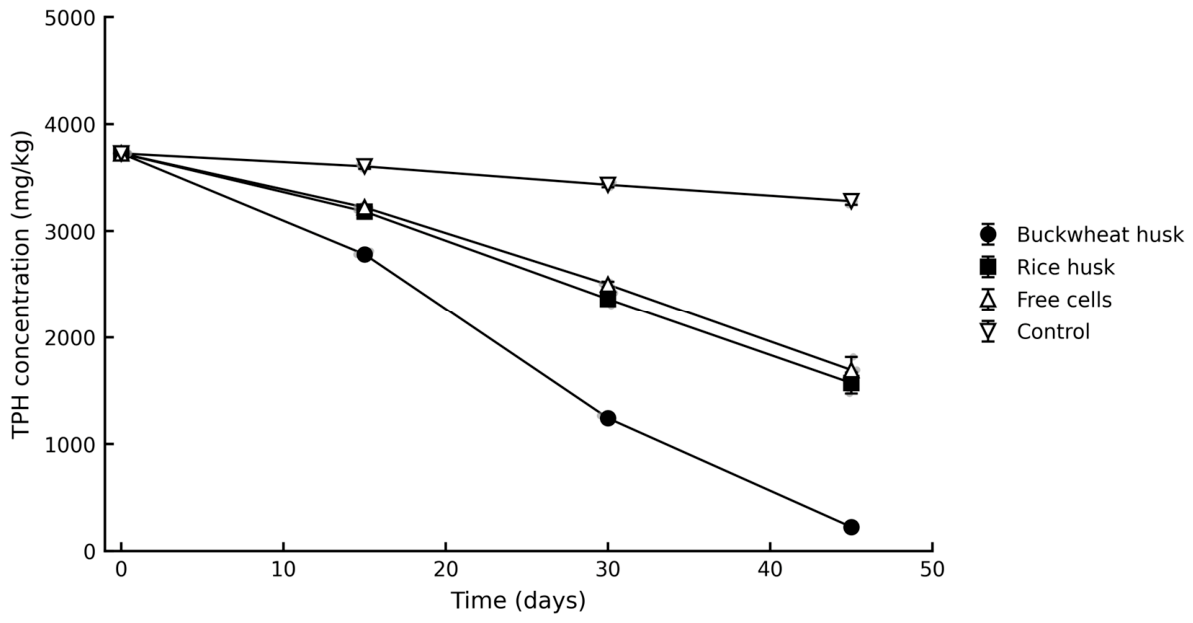
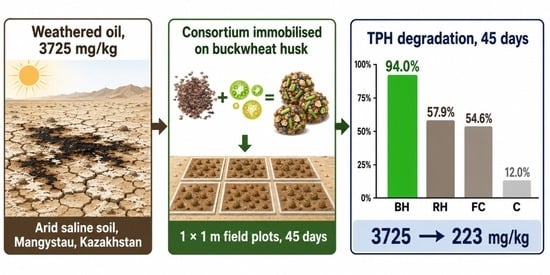
| Buckwheat husks | 3 | 3725 ± 12 | 223 ± 18 a | 94.0 ± 0.5 a |
| Rice husks | 3 | 3725 ± 12 | 1570 ± 124 b | 57.9 ± 3.3 b |
| Free cells | 3 | 3725 ± 12 | 1692 ± 156 b | 54.6 ± 4.2 b |
| Control | 3 | 3725 ± 12 | 3278 ± 89 c | 12.0 ± 3.2 c |
| Treatment | k (Day−1) | t1/2 (Days) | R2 |
|---|---|---|---|
| Buckwheat husk | 0.0355 (0.0268–0.0443) | 19.5 | 0.913 |
| Rice husk | 0.0164 (0.0142–0.0185) | 42.4 | 0.950 |
| Free cells | 0.0148 (0.0129–0.0168) | 46.7 | 0.946 |
| Control | 0.0028 (0.0026–0.0029) | 251.6 | 0.979 |
Disclaimer/Publisher’s Note: The statements, opinions and data contained in all publications are solely those of the individual author(s) and contributor(s) and not of MDPI and/or the editor(s). MDPI and/or the editor(s) disclaim responsibility for any injury to people or property resulting from any ideas, methods, instructions or products referred to in the content. |
© 2026 by the authors. Licensee MDPI, Basel, Switzerland. This article is an open access article distributed under the terms and conditions of the Creative Commons Attribution (CC BY) license.
Share and Cite
Khozhanepessova, F.; Serikbayeva, A.; Dadrasnia, A.; Moldagulova, N. Pilot-Scale Evaluation of an Immobilised Rhodococcus–Dietzia Consortium on Agricultural Carriers for Petroleum-Contaminated Soil Remediation Under Arid Field Conditions in Kazakhstan. Environments 2026, 13, 424. https://doi.org/10.3390/environments13080424
Khozhanepessova F, Serikbayeva A, Dadrasnia A, Moldagulova N. Pilot-Scale Evaluation of an Immobilised Rhodococcus–Dietzia Consortium on Agricultural Carriers for Petroleum-Contaminated Soil Remediation Under Arid Field Conditions in Kazakhstan. Environments. 2026; 13(8):424. https://doi.org/10.3390/environments13080424
Chicago/Turabian StyleKhozhanepessova, Fariza, Akmaral Serikbayeva, Arezoo Dadrasnia, and Nazira Moldagulova. 2026. "Pilot-Scale Evaluation of an Immobilised Rhodococcus–Dietzia Consortium on Agricultural Carriers for Petroleum-Contaminated Soil Remediation Under Arid Field Conditions in Kazakhstan" Environments 13, no. 8: 424. https://doi.org/10.3390/environments13080424
APA StyleKhozhanepessova, F., Serikbayeva, A., Dadrasnia, A., & Moldagulova, N. (2026). Pilot-Scale Evaluation of an Immobilised Rhodococcus–Dietzia Consortium on Agricultural Carriers for Petroleum-Contaminated Soil Remediation Under Arid Field Conditions in Kazakhstan. Environments, 13(8), 424. https://doi.org/10.3390/environments13080424