
Article

Thermal-Alkaline-Activated Persulfate for Remediation of PAH-Contaminated Soils: Natural Organic Matter Regulation, Degradation Mechanisms, and Toxicity Assessment
1
School of Environmental and Chemical Engineering, Shanghai University, 99 Shangda Road, Shanghai 200444, China
2
Key Laboratory of Organic Compound Pollution Control Engineering, Ministry of Education, Shanghai 200444, China
*
Author to whom correspondence should be addressed.
Environments 2026, 13(7), 409; https://doi.org/10.3390/environments13070409
Submission received: 28 May 2026 / Revised: 8 July 2026 / Accepted: 10 July 2026 / Published: 20 July 2026
(This article belongs to the Section Environmental Pollution, Toxicology and Restoration)

Abstract

Polycyclic aromatic hydrocarbons (PAHs), characterized by their high stability, are typical persistent organic pollutants that pose irreversible risks to human health. Conventional chemical oxidation methods exhibit limitations that hinder effective remediation in practice. In contrast, sulfate-radical-based advanced oxidation processes have emerged as promising alternatives, among which the heat-alkaline activation system for persulfate (PS) demonstrates distinct advantages. In this study, a heat-alkaline-activated PS system was established to investigate the degradation of PAHs in both simulated contaminated soils and coal chemical industrial site soils, as well as the modulatory effects of natural organic matter (NOM). Response surface methodology optimized critical experimental parameters to 12.53 mmol PS dosage, 60.31 °C reaction temperature, and a 1.55 CaO/PS molar ratio. Under these conditions, degradation efficiencies of 98.32% and 82.26% were achieved in simulated and field soils, respectively. Radical test experiments revealed a cooperative mechanism dominated by SO4• > •OH > O2• radicals, accompanied by auxiliary involvement of non-radical 1O2. Low concentrations of NOM plausibly facilitate degradation via a hypothesized electron transfer protective effect and boosted radical generation, whereas excessive NOM inhibits degradation through competitive consumption of reactive radicals. Density functional theory calculations identified preferred radical attack sites on the aromatic rings of PAHs and corroborated the degradation pathway involving aromatic ring oxidation, functional group addition, ring cleavage, and mineralization. QSAR-based theoretical toxicity predictions via T.E.S.T. suggested that the ultimate degradation products exhibit lower potential toxicity than parent PAHs. Experiments fill the knowledge gap regarding NOM-mediated regulation in heat-alkaline activated PS systems, and elucidate degradation mechanisms and toxicity evolution.

1. Introduction

Contaminated sites refer to areas where pollutants accumulate in soil and groundwater environments through migration and transformation processes, posing potential risks to regional ecosystems and human health via multi-media exposure pathways [1]. Among these pollutants, polycyclic aromatic hydrocarbons (PAHs) have been identified as the predominant organic contaminants present in such sites [2]. PAHs are typical persistent organic pollutants characterized by high chemical stability and significant environmental toxicity, enabling them to persist stably within soil matrices [3]. In the environment, accumulated PAHs in soil can be transferred through food chains and accumulate in humans via ingestion or dermal contact, ultimately causing irreversible health damage [4]. Therefore, achieving efficient and environmentally friendly remediation of PAH-contaminated soils presents a critical challenge in the field of environmental management.
Currently, chemical oxidation methods represent the mainstream remediation strategy for PAH-contaminated soils [5]. Chemical oxidation involves the direct introduction of oxidants into the soil, triggering chemical reactions between the oxidants and pollutants to facilitate degradation. Common oxidizing agents include Fenton reagents [6], potassium permanganate (KMnO4), and others [7]. Although conventional chemical oxidation can effectively promote the degradation of PAHs, it still faces considerable limitations in practical applications. For example, excessive use of potassium permanganate results in the formation of abundant manganese dioxide (MnO2), which decreases soil permeability, impedes oxidant diffusion, and thus reduces oxidation efficiency [8].
In recent years, sulfate-radical-based advanced oxidation processes (AOPs) have gained prominence in environmental research due to their outstanding efficacy in degrading emerging contaminants and their excellent environmental adaptability [9]. Persulfate (PS, S2O82−) and peroxymonosulfate (PMS, HSO5) can be activated under external stimuli to generate sulfate radicals (SO4•, E0 = 2.5–3.1 V) with high redox potential, enabling effective chemical degradation of PAHs [10]. Among these, thermal-alkaline combined activation of persulfate systems has demonstrated unique advantages for soil remediation in recent years [11]. This technique achieves targeted cleavage of the peroxide bond via controlled temperature elevation (40–60 °C) during thermal activation, while alkaline activation neutralizes H+ produced during persulfate decomposition, thereby mitigating excessive soil acidification which could otherwise impair microbial activity and induce heavy metal mobilization, mitigating ecological risks [12,13,14].
It is important to note that for the remediation of PAH contamination in coal mine sites, soils in such areas contain abundant natural organic matter (NOM), which plays a critical role during the PAH remediation processes [15]. Previous studies on thermal/alkaline-activated persulfate for PAH removal mostly focused on single activation pathways or artificial humic acid only, and rarely integrated multiple characterization and theoretical calculation tools [16]. Most existing work ignored the differentiated regulatory effects of humic substances from distinct origins (mineral-derived vs. biogenic fulvic acid), lacked combined radical quenching–EPR evidence to interpret NOM-mediated radical transformation, and seldom coupled DFT molecular simulation, QSAR toxicity prediction, and field soil validation within one integrated framework. The interactive relationship between variable natural organic matter and thermal-alkaline persulfate systems, as well as the full evolution chain of PAH degradation and ecological risk, remain incompletely clarified for coal chemical contaminated sites.
Against this research gap, the present study delivers an integrated, multi-dimensional investigation that collectively combines six core research components rarely reported in tandem, as follows: (1) systematic exploration of the thermal-alkaline co-activated persulfate degradation system for PAHs; (2) comparative analysis of three typical NOM fractions (humic acid, mineral fulvic acid, biogenic fulvic acid) to reveal source-dependent dual promotion/inhibition effects; (3) combined radical scavenging experiments and EPR spectroscopy to trace dynamic reactive oxygen species evolution modulated by NOM; (4) DFT Fukui function calculation to identify preferential radical attack sites on PAH aromatic rings and deduce full mineralization pathways; (5) T.E.S.T. QSAR theoretical toxicity prediction to track the changing ecological hazard of degradation intermediates and end products; (6) cross-verification using both lab-simulated spiked soil and authentic coal chemical field contaminated soil to test practical remediation performance. This integrated multi-tool framework fills the incomplete understanding of NOM regulatory mechanisms and toxicity evolution in thermal-alkaline persulfate soil remediation, and provides systematic theoretical support for site-adaptive in situ oxidation remediation technology.

2. Methods and Materials

2.1. Field and Simulated Contaminated Soils

Experimental soil was procured from commercial garden soil sources. After removing debris, the soil was homogenized, air-dried at room temperature, and sieved through a 20-mesh screen. The sieved soil samples were stored in a cool, dark place for subsequent use. Analytical testing confirmed the absence of PAH contaminants in the soil. The commercial garden soil free of background PAHs provides a single-variable controlled platform. It eliminates interference from coexisting pollutants, aged bound-state PAHs, and complex native natural organic matter (NOM) in field soils, allowing us to quantitatively separate and clarify the independent regulatory effects of three core variables (persulfate dosage, temperature, CaO/PS molar ratio) and NOM (humic acid, mineral-derived fulvic acid, biogenic fulvic acid) on PAH degradation efficiency, radical generation pathways, and DFT-calculated preferential oxidation sites of PAHs. Basic soil properties are listed in Table S1.
Standard solutions of naphthalene (Nap), fluoranthene (FLR), phenanthrene (PHE), and fluoranthene (FLT) (each 100 mg) were dissolved in acetone and then thoroughly mixed with 1 kg of soil. After acetone evaporation, the soil was aged at room temperature for two weeks to prepare a simulated PAH-contaminated soil sample, which was stored in brown bottles at 4 °C. The initial concentrations of PAHs in the prepared contaminated soil samples were determined as follows: Nap, 58.732 ± 1.645 mg/kg; FLR, 76.624 ± 2.537 mg/kg; PHE, 82.427 ± 1.361 mg/kg; FLT, 81.865 ± 1.763 mg/kg.

2.2. Degradation Experiments for PAHs in Soil

Precisely 10.00 g of PAH-contaminated soil was placed into a 100 mL glass conical flask. Predetermined volumes of PS solution (1 mol/L), CaO powder (≥97% purity, analytical grade), and deionized water were sequentially added. The mixture was homogenized using vortex stirring. At the designated reaction time, an appropriate amount of sodium thiosulfate solution was added promptly to quench radicals and terminate oxidation. Post-centrifugation, soil samples were freeze-dried, followed by accelerated solvent extraction to isolate residual PAHs. Extracts were concentrated, purified, and adjusted to volume for analysis. All experiments were conducted in triplicate, and mean values were reported.

2.3. Analysis of PAHs and Degradation Products

After reaction completion, soil slurry was pretreated for accelerated solvent extraction (specific parameters detailed in Table S2). Extracts collected in concentrator tubes were analyzed for PAH concentrations and degradation products using a Shimadzu GC-MS QP2030 instrument (Kyoto, Japan) (detailed standard curves shown in Figure S1).

2.4. Reagents

Reagents employed in this work are summarized in Table S3.

2.5. Instruments

The instruments and equipment used are listed in Table S4.

2.6. Theoretical Calculations and Toxicity Analysis

Density functional theory (DFT) calculations were performed to analyze reactive sites of PAHs [17]. Using Gaussian16 software at the B3LYP-D3/TZVP level, Fukui functions and electrostatic potentials of PAHs were computed. Theoretical toxicity predictions of parent PAHs and their degradation intermediates were performed using the Toxicity Estimation Software Tool (T.E.S.T., Version 5.2.1) based on the ECOSAR quantitative structure–activity relationship (QSAR) model. It should be noted that all acquired toxicity indices are computational theoretical estimates, rather than data obtained from biological toxicity experiments.

3. Results and Discussion

3.1. Screening of Reaction Systems and Analysis of Influencing Factors

We compared the degradation efficiencies of PAHs in soil under ten different reaction conditions to identify the optimal reaction system. As shown in Figure 1a, the degradation rates in single-treatment groups—CaO alone, heat alone, and persulfate (PS) alone—were 10.65 ± 1.51%, 29.44 ± 2.03%, and 30.68 ± 2.21%, respectively, significantly lower than those observed in compound treatment systems. These findings confirm that basic treatments alone cannot achieve effective PAH degradation. Among the composite activation systems, degradation efficiencies for CaO + PS (72.62 ± 1.83%), NaOH + PS (77.14 ± 2.13%), Fe2+ + PS (76.12 ± 1.41%), Fe0 + PS (79.61 ± 1.74%), and H2O2 + PS (82.41 ± 3.5%) were all lower than that of the heat-activated PS system (87.13 ± 2.1%). This is attributed to the thermal activation process at 60 °C, which facilitates extensive cleavage of persulfate peroxyl bonds, generating abundant sulfate radicals (SO4•) that accelerate PAH degradation [18]. Notably, the combined heat and alkaline activation system (CaO + Heat + PS) exhibited superior performance, enhancing PAH degradation to 94.5 ± 1.8%, which is a 7.4% increase over the heat-only system. The introduction of CaO imparts a dual effect, as follows: it adjusts the pH to around 11.2 ± 0.3, promoting the transformation of SO4• to hydroxyl radicals (HO•) (Equation (1)), and simultaneously lowers the activation energy of the reaction [19]. Based on these results, the alkali-heat co-activated PS system was identified as the optimal reaction system.
SO4• + OH → HO• + SO42−
Figure 1b examines the impact of different persulfate dosages on PAH degradation. In the absence of PS, the PAH degradation rate was only 10.65%, significantly lower than PS-containing systems, highlighting the necessity of an oxidant to generate radicals capable of degrading PAHs. Increasing PS concentration from 0 to 10 mmol raised PAH degradation from 10.65% to 95.77%, attributed to enhanced SO4• radical generation. Beyond 10 mmol, degradation plateaued, with only a marginal increase to 97.37% at 20 mmol. This plateau is due to excess SO4• radicals triggering radical quenching reactions (Equations (2) and (3)) [20]. Therefore, 10 mmol was determined as the optimal PS dosage.
SO4• + S2O82− → S2O8• + SO42−
SO4• + SO4• → S2O82−
Figure 1c illustrates the effect of varying CaO/PS molar ratios on PAH degradation. Increasing the ratio from 0:1 to 1:1 improved degradation from 90.39% to 96.52%. The results demonstrated that higher CaO concentrations activate PS to generate more SO4• and facilitate its conversion to HO•, both of which participate in degradation [21]. However, further increasing the CaO/PS ratio from 2:1 to 5:1 yielded negligible changes in degradation efficiency, due to Ca(OH)2 saturation limiting pH variation and diminishing positive effects on PAHs degradation. Consequently, a CaO/PS molar ratio of 1:1 was deemed optimal.
Figure 1d shows the influence of reaction temperature on PAH degradation. Raising the temperature from 40 °C to 60 °C significantly enhanced degradation efficiency from 77.99% to 95.29%, correlating with increased PS bond homolysis and SO4• radical production [22]. Further temperature increases resulted in marginal changes over the same reaction time. Moreover, moderately elevated temperatures can substantially reduce oxidant consumption. However, excessively high temperatures accelerate radical generation excessively, leading to radical recombination and accelerated oxidant depletion [23]. Therefore, 60 °C was established as the optimal degradation temperature.
Figure 1e presents the effect of water-to-soil ratios on PAH degradation. Increasing the ratio from 1:1 to 2:1 enhanced degradation from 92.57% to 96.06%, attributed to improvements in mass transfer efficiency and enhanced oxidant–pollutant contact. However, at higher water-to-soil ratios of 3:1, 4:1, and 5:1, degradation rates declined to 94.73%, 93.8%, and 93.78%, respectively. This decrease arises because excessive moisture quenches active oxygen species before interacting with PAHs. Hence, a water-to-soil ratio of 2:1 was identified as optimal. The high-water slurry system was adopted for laboratory mechanistic research. It ensures full homogenization of reagents and eliminates mass transfer limitations, allowing us to accurately quantify the intrinsic oxidation performance, radical transformation, and NOM regulation effects of the thermal-alkaline activated persulfate system, which is the core objective of this mechanistic study. When dealing with actual soil, a combination of spraying and adding diluted persulfate, along with mechanical tillage, segmented heating, appropriate increases in oxidant dosage, and auxiliary dispersant addition, can be selected to achieve the goal of efficient remediation without excessive water addition.

3.2. Response Surface Optimization

Based on univariate experiments, three reaction parameters significantly influencing PAH degradation were selected, as follows: (A) persulfate dosage (mmol), (B) reaction temperature (°C), and (C) CaO/PS molar ratio. Using a Box–Behnken design with three factors at three levels (specific data in Table S5), soil PAHs degradation (%) was set as the response variable (Y) [24]. Multiple regression analysis yielded the following quadratic model:
Y = 94.30 + 8.71A + 4.01B + 10.14C − 9.10AB + 1.94AC + 3.00BC − 16.80A2 − 13.86B2 − 3.97C2
Analysis of variance (Table S6) indicated the model’s high significance (p < 0.0001) with non-significant lack-of-fit (p > 0.05), confirming model adequacy. Single factors A, B, and C had significant effects, as did quadratic terms A2 and B2. The coefficient of determination (R2) was 0.9759, adjusted R2 was 0.9449, and predicted R2 was 0.6405, demonstrating strong explanatory power. Notably, a clear gap exists between the adjusted R2 (0.9449) and predicted R2 (0.6405). The high R2 and adjusted R2 values demonstrate that the quadratic regression model can adequately fit the experimental data obtained under the limited Box–Behnken design points within the test factor range, and the main terms, quadratic terms, and interaction terms selected in the model can well explain the variation in PAH degradation efficiency. The relatively low predicted R2 mainly arises from two factors, as follows: (1) The experimental design only contains 17 limited Box–Behnken test runs for three variables with three levels, resulting in a small sample size for cross-validation calculation of predicted R2; (2) The response (PAH degradation rate) exhibits nonlinear coupling responses to persulfate dosage, temperature, and CaO/PS ratio, and the quadratic polynomial equation cannot perfectly capture all subtle nonlinear interactions beyond the central design region. Despite the moderate predicted R2 value of 0.6405, the signal-to-noise ratio (Adeq Precision = 17.812, far greater than the threshold of 4) and non-significant lack-of-fit (p > 0.05) jointly confirm that the model still possesses reliable predictive robustness within the experimental factor scope set in this study. The validation experiment using the optimized parameter combination yielded an actual degradation efficiency of 97.48%, only deviating 0.84% from the model-predicted 98.32%, which directly verifies that the model can provide accurate predictions for parameter combinations near the optimal point inside the experimental domain. For factor levels far outside the tested range, however, extrapolation predictions from this model will carry large uncertainty and are not recommended. The coefficient of variation (C.V.%) was 4.92% (<10%), and signal-to-noise ratio (Adeq Precision) was 17.812 (>4), indicating model reliability and low experimental error.
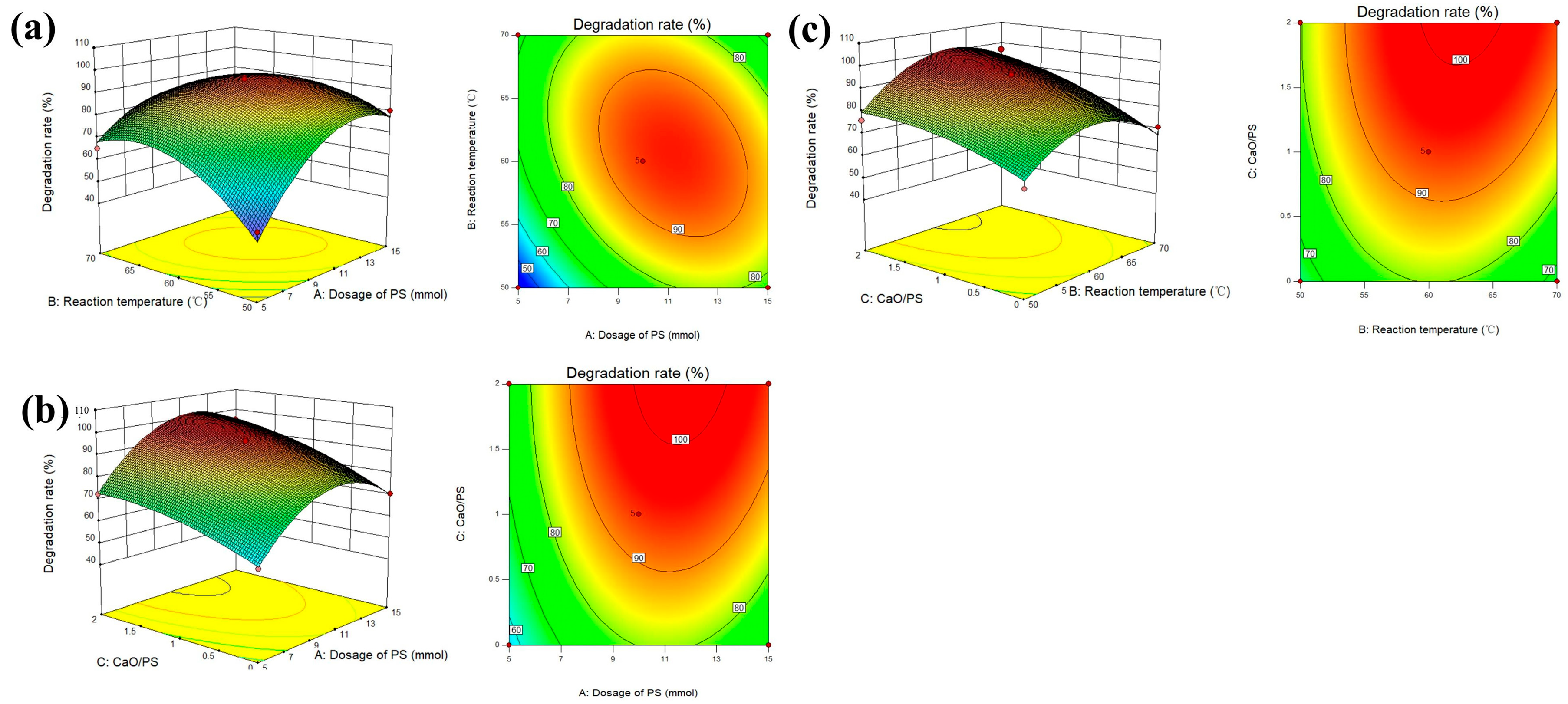
Figure 2a depicts that at a fixed CaO/PS ratio, PAH degradation monotonically increased with persulfate dosage and temperature, with persulfate dosage exerting the dominant influence, as shown by the steeper slope. The elliptical contour and pronounced response surface curvature confirm significant interaction between these factors. Figure 2b shows that at a fixed temperature, degradation increased linearly with CaO/PS ratio and displayed a rise-then-fall trend with persulfate dosage, peaking at 10 mmol. The surface incline along the PS axis exceeds that along the CaO/PS axis, indicating a stronger main effect of PS dosage and moderate interaction effects. Figure 2c indicates that at fixed PS dosage, degradation varied parabolically with temperature, peaking near 60 °C, and rose linearly with CaO/PS ratio. Notably, the response surface intensified coloration at higher temperatures suggests synergistic effects between elevated temperature and optimal CaO/PS ratios, consistent with the significant BC interaction term from ANOVA.
In summary, the factor impact order on PAH degradation was as follows: persulfate dosage > temperature > CaO/PS ratio. Optimization predicted optimal conditions as 12.53 mmol PS, 60.31 °C, and 1.55 CaO/PS ratio, with a predicted degradation efficiency of 98.32%. Validation experiments averaged 97.48% degradation, with a minimal 0.84% absolute deviation, confirming model accuracy and robustness.

3.3. Radical Generation Mechanisms and Influences of NOM on PAH Degradation

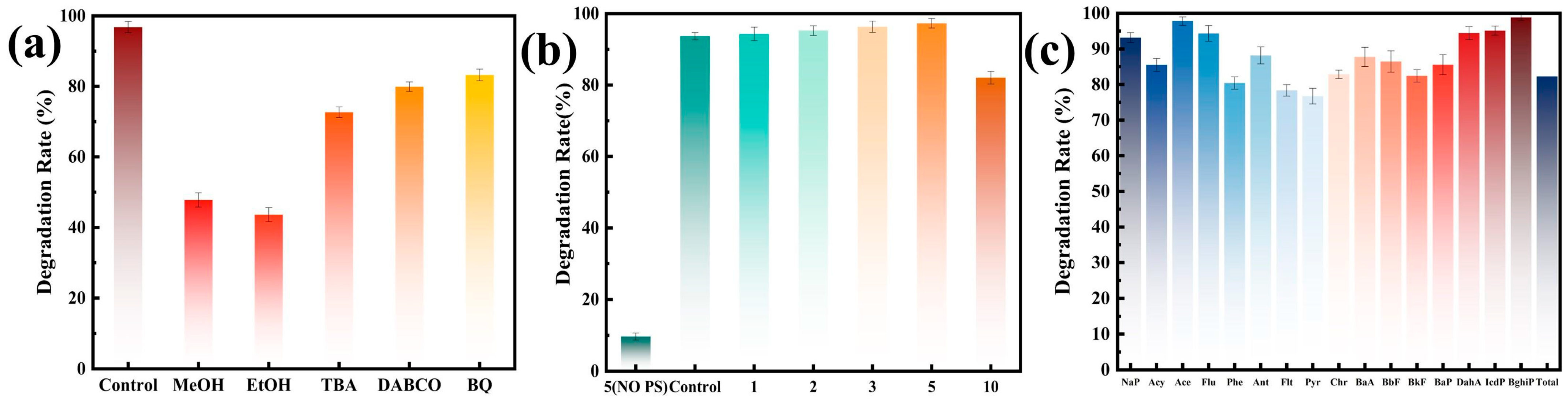
Considering different scavengers’ selective reactivity toward radicals (kinetic data in Table S7), methanol, ethanol, tert-butanol, p-benzoquinone, and triethylenetetramine (TETA) were utilized for quenching experiments [25]. As shown in Figure 3a, methanol addition reduced PAH degradation from 96.81% to 47.79%, and ethanol decreased it further to 43.63%, indicating that both SO4• and HO• radicals are active participants. The variance between these decreases is attributed to differing reaction rate constants, as ethanol more effectively scavenges HO• than methanol [26]. Addition of tert-butanol lowered degradation by 24.14%, confirming SO4• as the dominant oxidant species. Despite high concentrations of alcohol scavengers, residual PAH degradation was observed, suggesting the presence of other reactive oxygen species. p-Benzoquinone addition caused a 13.57% decrease, verifying the oxidative role of superoxide radicals (O2•) (Equations (4)–(6)) [27]. TETA caused 16.89% inhibition, confirming singlet oxygen (1O2) as a secondary contributor (Equations (5) and (6)) [28]. Collectively, these results reveal a composite mechanism dominated by radicals in descending order of significance, as follows: SO4• > HO• > O2•, with non-radical assistance from 1O2.
2S2O82− + 2OH → 3SO42− + SO4• + O2• + 2H+
O2• + SO4• → 1O2 + SO42−
O2• + HO• → 1O2 + OH
We also investigated the impact of NOM on the degradation process by adding varying concentrations of humic acid (HA) to systematically examine the degradation efficiency of PAHs in the presence of HA. Figure 3b presents the effects of HA addition (1–5 g/kg) on PAH degradation [29]. The gradient dosing test of HA revealed a universal dual regulatory pattern, as follows: low HA concentrations facilitated PAH removal, while excessive HA exerted an inhibitory effect [30]. Detailed mechanistic comparisons among three typical humic substances (HA, mineral-derived FAK, biogenic FAS) and their differentiated regulatory behaviors are elaborated in Section 3.4.
The optimal degradation system parameters identified in previous studies were applied to the degradation of PAHs in actual soil samples. As shown in Figure 3c, the degradation efficiencies decreased upon application to real soil, with some PAHs reaching only up to 80% degradation efficiency. Specifically, the combined activation of the PS system achieved a degradation rate of 82.26% for native PAHs, which is approximately 15.22% lower than that observed in simulated contaminated soil. This discrepancy may be attributed to the greater matrix complexity inherent to field industrial soils [31,32]. Such sites potentially contain heavy metals, benzene derivatives, halogenated hydrocarbons, and other co-existing pollutants, which could compete for reactive radicals and thereby suppress PAH oxidation efficiency. Furthermore, native aged PAHs in field soil tend to form stable complexes bound to soil organic-mineral matrices, which may hinder pollutant desorption and reduce contact opportunities with oxidants. Additionally, PAHs in field soils are often tightly bound within organic matter matrices forming stable complexes, hindering desorption and accessibility to oxidants. Contrastingly, laboratory simulations involve short-term spiking with contaminants predominantly residing near the soil surface or large pores, facilitating oxidant contact and higher degradation efficiencies. It is noteworthy that even when applied to real soil, our oxidation system still achieves high removal efficiencies for various polycyclic aromatic hydrocarbons, clearly demonstrating its strong potential for application in real-world contaminated sites.

3.4. Mechanistic Investigation of the Influence of Organic Matter

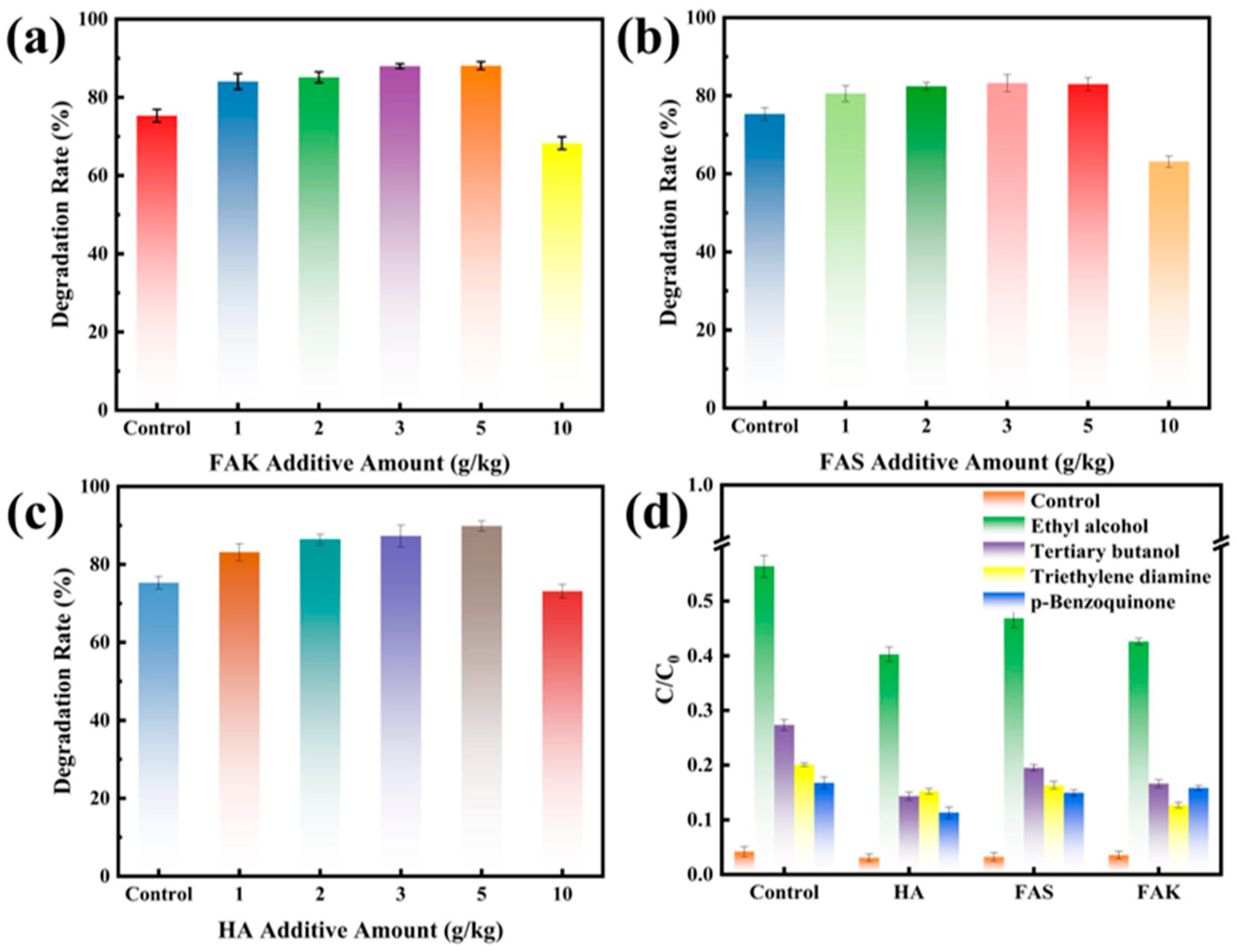
This chapter selects three humic substances of different origins—HA, mineral-derived fulvic acid (FAK), and biogenic fulvic acid (FAS)—to systematically evaluate the effects of their varying dosages on PAHs degradation [33]. Three types of humic substances from different sources were selected to investigate the effects of their origins on the degradation process. The SEM images of the three humic substances are presented in Figure S2. The study aims to elucidate how differences in NOM sources and concentration gradients regulate the PS activation process. As shown in Figure 4a–c, when HA, FAK, and FAS were each applied at 1 g/kg, the degradation efficiencies of PAHs reached 83.14%, 84.07%, and 80.58%, respectively, representing improvements of 7.83%, 8.76%, and 5.27% over the control without humic amendments. These results confirm that low dosages of humic materials can significantly enhance PS-based oxidative degradation of PAHs [34]. Quantitative comparison revealed that all three humic substances achieved the maximum degradation enhancement at the dosage of 1 g/kg, with the promotion magnitude ranked as FAK (8.76%) > HA (7.83%) > FAS (5.27%). The critical inhibitory thresholds differed markedly, as follows: degradation efficiency began to decline above 3 g/kg for FAS, while inhibitory effects emerged above 5 g/kg for HA and FAK. Radical quenching and EPR results further verified that HA exhibited the strongest capacity to boost the production of SO4•, •OH and 1O2, followed by FAK and FAS in sequence. Overall, obvious discrepancies in promotion efficiency, inhibitory threshold, and radical modulation capacity are observed among HA, FAK, and FAS, demonstrating that the source and structural properties of NOM are key determinants of its regulatory role in thermal-alkaline-activated persulfate systems.
Radical quenching experiments were conducted to investigate changes in radical species following humic substance addition. Figure 4d showed that in the control group without HA/FA addition, introduction of ethanol lowered PAH degradation from 95.81% to 43.63%, indicating that radical pathways dominate the degradation mechanism. After adding 5 g/kg of HA, FAK, or FAS, PAH degradation efficiencies in the presence of ethanol remained at 59.74%, 57.37%, and 53.14%, respectively, implying that humic substances potentially promote the generation of superoxide radicals (O2•) and singlet oxygen (1O2). Upon introducing tert-butanol, PAH degradation efficiencies increased by 13.01%, 7.81%, and 10.70%, respectively, with HA, FAK, and FAS addition, suggesting that humic materials facilitate the transformation among SO4•, O2•, and 1O2. Additional quenchers, p-benzoquinone and triethylenetetramine, targeting O2• and 1O2, respectively, also showed increased PAH degradation upon humic substance addition. Collectively, these findings indicate that the presence of humic substances enhances radical generation within the jointly activated PS system, where SO4•, HO•, and 1O2 are the primary reactive oxygen species.
As shown in Figure S3a,b, the jointly activated system without humic substances exhibited distinct electron paramagnetic resonance (EPR) signals corresponding to DMPO-HO• (characteristic intensity ratio 1:2:2:1), DMPO-SO4• (1:1:1:1:1:1), and TEMP-1O2 (1:1:1), albeit with relatively weak DMPO-O2• (1:1:1:1) peaks. Upon addition of humic substances from different sources, signal intensities for SO4•, HO•, O2•, and 1O2 increased compared to the control, with the highest intensities observed in HA-amended systems. This confirms that humic material addition catalyzes the enhanced formation of these radicals in the activated PS system. The above co-variation trends of radical signal intensity and PAH removal efficiency indirectly imply a potential electron transfer protective effect exerted by humic substances, though direct characterization evidence for this pathway remains absent in the present study.
Figure S2d demonstrates that when humic substances were introduced without PS, PAH degradation did not increase significantly, indicating that physical adsorption or complexation by organic matter alone contributes minimally to PAH oxidation [35,36]. Conversely, integrating humic substances into the PS system led to notable increases in degradation efficiencies compared to PS alone. Specifically, adding 5 g/kg of humic materials improved PAH degradation by 11.50%, 10.54%, and 11.72% over the non-humic control.

3.5. Degradation Mechanism of PAHs Under Organic Matter

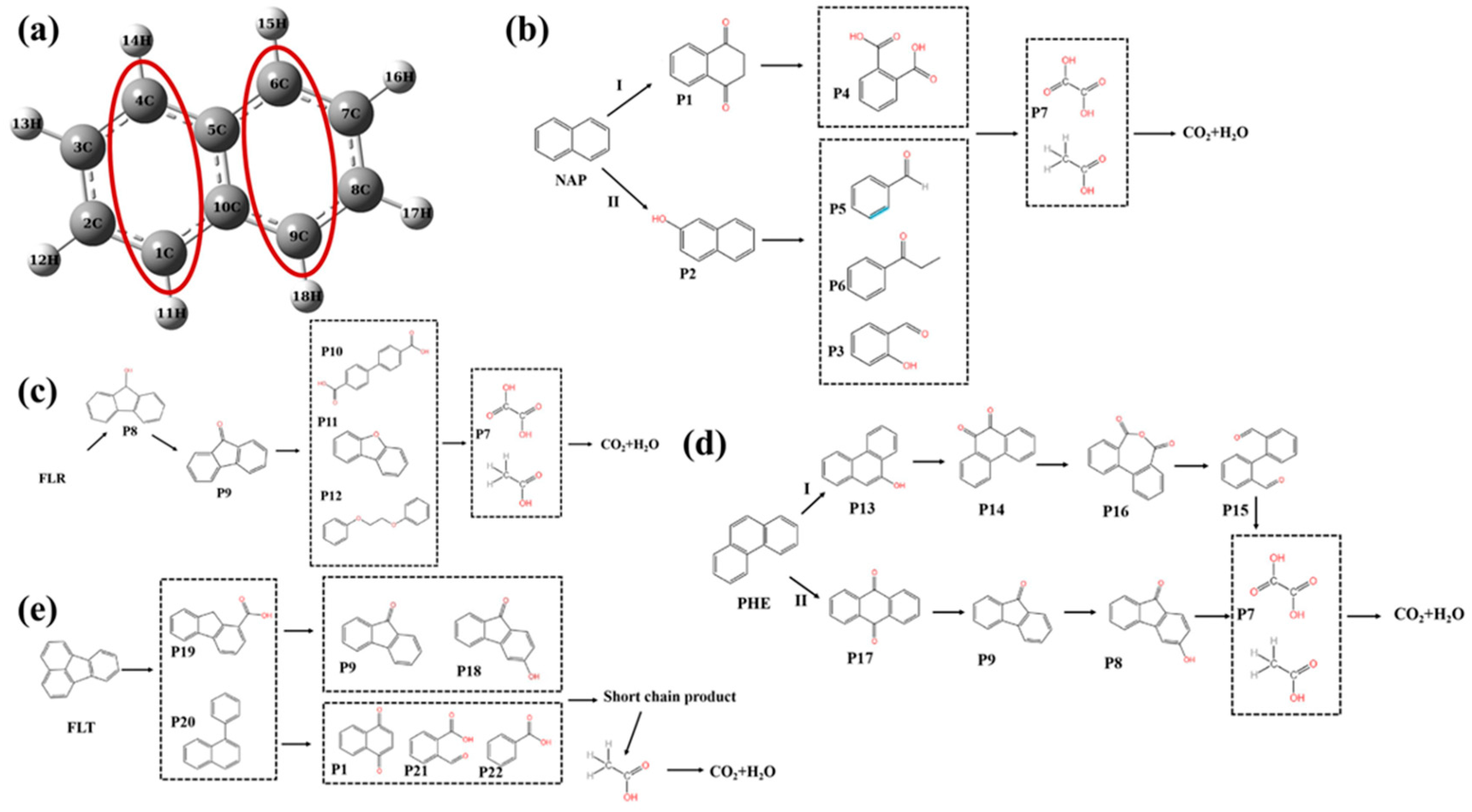
Taking naphthalene (NAP) as an example, based on the calculated Fukui functions of the NAP molecule (as shown in Table S8), it can be observed that the carbon atoms at positions 1, 4, 6, and 9 exhibit the highest f0 (radical attack) and f (electrophilic attack) values in the molecular structure of NAP (depicted in Figure 5a) [37,38,39]. This confirms these sites as the preferential attack locations for reactive oxygen species in the combined activated PS system. This indicates that the degradation of PAHs primarily occurs through the attack of reactive free radicals on the aromatic rings, which initiates ring-opening and continuous oxidative breakdown.
Qualitative analysis of NAP degradation intermediates at different reaction times (20 min, 40 min, 1 h, 1.5 h, 2 h, 4 h, 8 h, and 12 h) under the combined activated PS system was performed using GC-MS, identifying seven major products (as listed in Table S9) [40]. Combining experimental data with theoretical insights, the proposed degradation pathway (Figure 5b) includes the following: Pathway 1, wherein oxidation preferentially occurs at 2C and 5C sites generating α-naphthoquinone (P1), a critical initial intermediate; P1 undergoes subsequent oxidative ring-opening yielding phthalic acid (P4), which is progressively mineralized to oxalic acid (P7), acetic acid, and ultimately CO2 and H2O. Pathway 2 involves reactive oxygen species attacking 10C/11C sites, triggering epoxidation to form 2-naphthol (P2) and naphthalene epoxides (P3, P5, P6). These epoxides undergo hydrolysis and oxidative cleavage, producing low-molecular-weight organic acids and complete mineralization [41]. The degradation sequence inherently follows “aromatic ring oxidation → functional group addition → ring cleavage → mineralization.” Based on this framework and GC-MS analysis results, degradation mechanisms for fluorene (FLR), phenanthrene (PHE), and fluoranthene (FLT) are also proposed, as presented in Figure 5c–e. For all four PAHs mentioned above, it can be observed that during the degradation process, the aromatic rings are progressively opened, leading to the formation of various oxygen-containing free radicals, including hydroxyl, carbonyl, and ether groups. This provides strong evidence that the thermal alkali-activated PS system is a prolific source of oxidative free radicals.

3.6. Toxicity Analysis of PAHs and Their Degradation Products

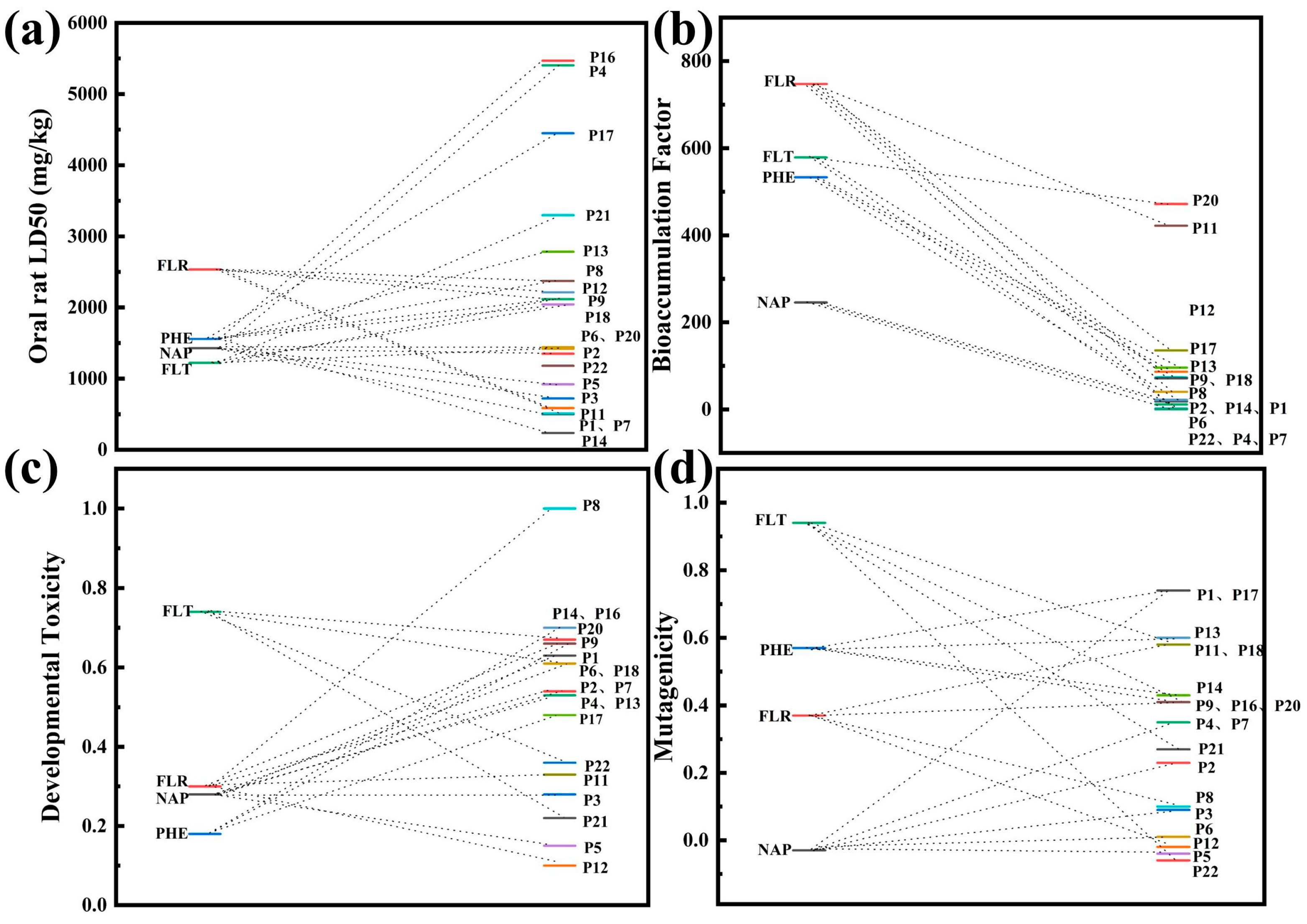
Ecotoxicity assessments were performed using the T.E.S.T. ecological toxicity prediction software, which is based on the ECOSAR quantitative structure–activity relationship (QSAR) model [42,43]. Figure 6a presents the oral rate LD50 data of the parent PAHs and their degradation intermediates in rats, where a higher LD50 value indicates greater toxicity. As shown in Figure 6a, although the toxicity of some intermediate degradation products increases during the degradation process and exceeds that of the four parent PAHs, the toxicity of the final degradation products still demonstrates a decreasing trend. This indicates the effectiveness of the heat-alkaline combined activation system in removing PAHs [44]. Figure 6b indicates that bioaccumulation potential of all intermediates is lower than their respective parent compounds [45]. The toxicity of the intermediate and final degradation products of polycyclic aromatic hydrocarbons is significantly reduced, effectively decreasing their bioaccumulation within organisms and substantially mitigating their harmful effects on biological systems. Although Figure 6c,d show elevated developmental toxicity predictions for certain intermediates (e.g., epoxides and quinones), likely due to the activity of functional groups such as epoxide moieties, these highly toxic intermediates are transient and rapidly converted into low-toxicity carboxylic acids according to the degradation pathways. QSAR theoretical predictions indicated that although certain transient epoxide and quinone intermediates showed elevated predicted toxicity values, the fully mineralized end products possessed lower predicted acute toxicity, bioaccumulation potential, developmental toxicity, and mutagenicity relative to raw PAHs. These computational results implied that thermal-alkaline-activated persulfate oxidation may lower the theoretical ecological risk of PAH-contaminated soil.

4. Conclusions

We developed a combined activation technique employing PS for the degradation of PAHs in contaminated soils. The results indicate that the degradation efficiency of PAHs is primarily influenced by the PS dosage, reaction temperature, and the molar ratio of CaO to PS, whereas the soil-to-water ratio has a negligible effect. Moreover, the presence of low concentrations of HA exhibited a promotive effect on PAH degradation. Optimization via response surface methodology identified the optimal reaction parameters as follows: PS dosage of 12.53 mmol, reaction temperature of 60.31 °C, and CaO/PS molar ratio of 1.55, resulting in a PAH degradation rate of 98.32%. The combined activated persulfate system was also effective for the remediation of PAH-contaminated soils from actual field sites, achieving a degradation efficiency of 82.26% under the optimized conditions.
Radical quenching experiments and electron paramagnetic resonance (EPR) analysis revealed that the combined PS activation system operates via a synergistic mechanism dominated by free radicals (SO4• > HO• > O2•) alongside non-radical assistance (1O2). Coupled with additional radical quenching and EPR studies involving humic substance addition, three plausible synergistic hypotheses for NOM-facilitated oxidation are proposed based on integrated indirect experimental evidence, as follows: (I) Hypothesized electron transfer protection: HA/FA with abundant reductive functional groups may preferentially channel radical oxidative capacity toward PAH substrates instead of undergoing self-consumption; (II) Humic substances act as electron donors to accelerate radical formation; (III) Humic substances participate in persulfate activation to generate singlet oxygen (1O2).
Finally, based on density functional theory (DFT) calculations and identification of degradation intermediates, we proposed the PAH degradation pathway, as follows: initially, radical addition/hydroxylation occurs whereby radicals attack the aromatic rings yielding hydroxylated or quinone intermediates; subsequently, oxidation and dehydrogenation convert hydroxylated compounds into quinones; this is followed by ring-opening cleavage, wherein quinones or epoxides undergo oxidative cleavage of the aromatic ring to form carboxylic acid intermediates; and ultimately, mineralization processes degrade these carboxylic acids to CO2 and H2O. QSAR-based theoretical toxicity predictions suggested that complete mineralization of PAHs yields low-toxicity end products, implying this persulfate oxidation approach could mitigate the theoretical ecological hazard potential of PAH-polluted soil.
It should be noted that the degradation laws and optimized reaction parameters obtained from laboratory batch experiments based on simulated contaminated soil cannot be directly copied to full-scale on-site remediation projects, and there are inherent gaps between laboratory simulation and practical field engineering. Laboratory soil features uniform pollutant distribution, single pollution components, and controllable soil matrix conditions, while actual coal chemical site soils contain aged PAHs tightly bound to soil organic-mineral complexes, variable natural organic matter content, and various coexisting pollutants that will compete for reactive radicals and reduce oxidation efficiency. To bridge this lab-to-field gap and guide subsequent field pilot trials, targeted soil pre-treatment and operational adjustment strategies are proposed as follows: (1) Pre-regulate the soil water–soil ratio to the optimal range of 2:1 before reagent addition to guarantee sufficient mass transfer between oxidants and PAHs without excessive moisture-induced radical quenching; (2) Implement graded dosing of persulfate and CaO based on the measured in situ NOM concentration of site soils, as follows: low-NOM sites adopt the baseline dosage optimized by response surface methodology, while high-NOM sites appropriately increase persulfate addition to offset radical consumption by humic substances; (3) Adopt segmented temperature heating instead of constant high-temperature operation, which can slow the instantaneous massive generation of free radicals and alleviate invalid radical recombination quenching, improving the effective utilization rate of persulfate oxidant.

Supplementary Materials

The following supporting information can be downloaded at: https://www.mdpi.com/article/10.3390/environments13070409/s1, Figure S1: The standard curves of (a) NAP, (b) FLR, (c) PHE, and (d) FLT; Figure S2: SEM images of different humus (a,b) Humic acid; (c,d) Mineral source fulvic acid; (e,f) Biogenic fulvic acid; Figure S3: The electron paramagnetic resonance spectra of (a) SO4• and HO•, (b) O2•, (c) 1O2 and The co-degradation of humus materials in the contaminated site (d); Table S1: The basic properties of the tested soil; Table S2: Parameter Settings for Accelerated Solvent Extraction; Table S3: Reagents used in this study; Table S4: The instruments and equipment used in this research; Table S5: Experimental Design and Results of Response Surface; Table S6: Analysis of Variance for Quadratic Multiple Regression Equations; Table S7: Reaction rate constants of different types of quenchers with free radicals; Table S8: Calculation Results of Fukui Functions for NAP molecules; Table S9: The combined activation of the PS system removes the degradation intermediate products of NAP in the soil.

Author Contributions

J.L.: Validation, Investigation, Writing–original draft, Visualization, Conceptualization. S.J.: Investigation, Conceptualization, Data curation, Visualization, Writing—original draft. H.W.: Methodology, Resources, Funding acquisition, Supervision, Conceptualization, Writing—review & editing. G.X.: Conceptualization, Writing—review & editing, Resources, Supervision, Funding acquisition. All authors have read and agreed to the published version of the manuscript.

Funding

This work was financially supported by the National Key Research and Development Project (No. 2024YFC3712502), National Natural Science Foundation of China (No. 12575366) and the Guizhou Provincial Key Technology R&D Program (No. QKHZC-2024-152).

Data Availability Statement

The data that support the findings are available from the corresponding author upon reasonable request.

Conflicts of Interest

The authors declare that they have no known competing financial interests or personal relationships that could have appeared to influence the work reported in this paper.

References

  1. You, Q.; Yan, K.; Yuan, Z.H.; Feng, D.Y.; Wang, H.Z.; Wu, L.S.; Xu, J.M. Polycyclic aromatic hydrocarbons (PAHs) pollution and risk assessment of soils at contaminated sites in China over the past two decades. J. Clean. Prod. 2024, 450, 141876. [Google Scholar] [CrossRef] [Scilit]
  2. Li, Y.Q.; Chen, H.M.; Li, W.; Xi, B.D.; Huang, C.H. A novel immobilized bacteria consortium enhanced remediation efficiency of PAHs in soil: Insights into key removal mechanism and main driving factor. J. Hazard. Mater. 2025, 486, 137144. [Google Scholar] [CrossRef] [Scilit] [PubMed]
  3. Jiang, L.; Lv, J.T.; Jones, K.C.; Yu, S.Y.; Wang, Y.W.; Gao, Y.; Wu, J.; Luo, L.; Shi, J.B.; Li, Y.M.; et al. Soil’s Hidden Power: The Stable Soil Organic Carbon Pool Controls the Burden of Persistent Organic Pollutants in Background Soils. Environ. Sci. Technol. 2024, 58, 8490–8500. [Google Scholar] [CrossRef] [Scilit] [PubMed]
  4. Singh, R.K.; Singh, S.K. Persistent polycyclic aromatic hydrocarbons (PAHs) in the soil, its bioremediation, and health effects. Environ. Sci. Eur. 2025, 37, 187. [Google Scholar] [CrossRef] [Scilit]
  5. Gibaldi, M.; Kapeliukha, A.; White, A.; Luo, J.; Mayo, R.A.; Burner, J.; Woo, T.K. MOSAEC-DB: A comprehensive database of experimental metal-organic frameworks with verified chemical accuracy suitable for molecular simulations. Chem. Sci. 2025, 16, 4085–4100. [Google Scholar] [CrossRef] [Scilit] [PubMed]
  6. Kwarciak-Kozlowska, A.; Fijalkowski, K.L. Efficiency assessment of municipal landfill leachate treatment during advanced oxidation process (AOP) with biochar adsorption (BC). J. Environ. Manag. 2021, 287. [Google Scholar] [CrossRef] [Scilit] [PubMed]
  7. Jafari, H.R.; Malek, R.M.A.; Montazer, M. In situ deposition of MnO2 nanoparticles on cellulosic denim via KMnO4 reduction: Parametric optimization and functional assessment. Carbohydr. Polym. Technol. Appl. 2025, 10, 100846. [Google Scholar] [CrossRef] [Scilit]
  8. Yang, Z.Y.; Jiang, Z.J.; Li, X.D.; Du, M.J.; Zhang, Z.T. Optimization of Persulfate Dosage for Enhanced Remediation of Soil Contaminated with Polycyclic Aromatic Hydrocarbons. J. Environ. Eng. 2026, 152, 04025094. [Google Scholar] [CrossRef] [Scilit]
  9. Kim, C.; Park, C.; Song, J.; Jeong, Y.; Senthamaraikannan, T.G.; Lim, D.H.; Hong, H.J. Mechanistic investigation of NiAl-layered double hydroxide activated peroxymonosulfate for tetracycline degradation: Feasibility of an integrated ultrafiltration system. Environ. Res. 2025, 284, 122218. [Google Scholar] [CrossRef] [Scilit] [PubMed]
  10. Ramirez, L.A.; Alvarez, M.; Gutierrez, V.S. From agro-alimentary residue to catalyst: Transforming sunflower seed husk waste into modified biochar for efficient ibuprofen degradation in water. J. Water Process Eng. 2025, 72, 107458. [Google Scholar] [CrossRef] [Scilit]
  11. Chin, Y.T.; Bashir, M.J.K.; Abu Amr, S.S.; Alazaiza, M.Y.D. Factorial design and optimization of thermal activation of persulfate for stabilized leachate treatment. Desalin. Water Treat. 2022, 250, 211–220. [Google Scholar] [CrossRef] [Scilit]
  12. Ding, Q.H.; Wang, B.; Zhan, Z.X.; Jangili, P.; Chen, J.Y.; Mengji, R.; Rha, H.; Li, Y.; Tian, J.; Kim, J.S. MitoSiege-Driven Catalase Collapse: A GSH-Responsive, Mitochondria-Targeted COF Prodrug for Amplified Chemodynamic Therapy. Angew. Chem.-Int. Ed. 2025, 64, e202509183. [Google Scholar] [CrossRef] [Scilit] [PubMed]
  13. Wang, Q.Q.; Cao, Z.C.; Li, Q.Q.; Song, B. Advances in concurrent CO2 sequestration and heavy metal mobilization during fly ash carbonation: A review. Carbon Capture Sci. Technol. 2025, 17, 100519. [Google Scholar] [CrossRef] [Scilit]
  14. Xu, D.H.; Ros, G.H.; Zhu, Q.C.; Xu, M.G.; Wen, S.L.; Cai, Z.J.; Zhang, F.S.; de Vries, W. Major drivers of soil acidification over 30 years differ in paddy and upland soils in China. Sci. Total Environ. 2024, 916, 170189. [Google Scholar] [CrossRef] [Scilit] [PubMed]
  15. Liu, M.J.; Graham, N.; Gregory, J.; Elimelech, M.; Yu, W.Z. Towards a molecular-scale theory for the removal of natural organic matter by coagulation with trivalent metals. Nat. Water 2024, 2, 285–294. [Google Scholar] [CrossRef] [Scilit]
  16. Wu, L.X.; Lu, X.B.; Wu, Y.; Huang, C.A.; Gu, C.T.; Tian, Y.; Ma, J.P. An electrochemical sensor based on synergistic enhancement effects between nitrogen-doped carbon nanotubes and copper ions for ultrasensitive determination of anti-diabetic metformin. Sci. Total Environ. 2023, 878, 163120. [Google Scholar] [CrossRef] [Scilit] [PubMed]
  17. Huang, X.; Wu, K.Y.; Su, C.; Yang, L.; Xiao, B.B. Metal-organic framework Cu-BTC for overall water splitting: A density functional theory study. Chin. Chem. Lett. 2025, 36, 109720. [Google Scholar] [CrossRef] [Scilit]
  18. Li, Z.C.; Liang, J.; Li, J.M.; Ma, X.Y.; Lang, Y.; Li, H.W.; Qiu, H.; Cao, X.D.; Zhao, L. Thermal desorption coupled with persulfate oxidation for removing soil organic pollutants: Key role of soil organic matter passivation. J. Hazard. Mater. 2025, 500, 140382. [Google Scholar] [CrossRef] [Scilit] [PubMed]
  19. Xu, Z.M.; Liu, Z.P.; Li, S.L.; Li, F.F.; Gao, P.; Wang, S.Y.; Lin, Y.C.; Xiong, G.M.; Li, Z.Q.; Peng, H.B. Degradation of triclosan by peroxydisulfate/peroxomonosulfate binary oxidants activation under thermal conditions: Efficiency and mechanism. J. Environ. Manag. 2024, 354, 120211. [Google Scholar] [CrossRef] [Scilit] [PubMed]
  20. Chen, L.; Wang, Y.; Shao, H.Y.; Wang, J.; Wu, M.H.; Xu, G. Electron beam-persulfate system effectively reduces polycyclic aromatic hydrocarbons and Cr(VI) emissions: Environmental matrix impact and mechanism analysis. J. Contam. Hydrol. 2026, 276, 104738. [Google Scholar] [CrossRef] [Scilit] [PubMed]
  21. Cao, B.; Qu, J.H.; Bian, W.H.; Hu, Q.Q.; Fu, X.Y.; Zhang, G.S.; Zhang, Y.Z.; Tao, Y.; Jiang, Z.; Zhang, Y. Porous hydrochar loaded nZVI as an efficient catalyst to activate persulfate for phenol degradation: Performance and mechanism. J. Clean. Prod. 2024, 444, 141221. [Google Scholar] [CrossRef] [Scilit]
  22. Wang, Y.; Tian, H.F.; Zhang, C.C.; Xu, J.Y.; Liu, X.S.; Ma, F.J.; Wei, X.Q.; Sun, Y.F. Degradation and mechanism of PAHs by Fe-based activated persulfate: Effect of temperature and noble metal. Sci. Total Environ. 2024, 931, 172768. [Google Scholar] [CrossRef] [Scilit] [PubMed]
  23. Lee, Y.J.; Jeong, Y.J.; Cho, I.S.; Park, S.J.; Lee, C.G.; Alvarez, P.J.J. Facile synthesis of N vacancy g-C3N4 using Mg-induced defect on the amine groups for enhanced photocatalytic •OH generation. J. Hazard. Mater. 2023, 449, 131046. [Google Scholar] [CrossRef] [Scilit] [PubMed]
  24. Al-Hazmi, G.; Alayyafi, A.A.; El-Desouky, M.G.; El-Bindary, A.A. Chitosan-nano CuO composite for removal of mercury (II): Box-Behnken design optimization and adsorption mechanism. Int. J. Biol. Macromol. 2024, 261, 129769. [Google Scholar] [CrossRef] [Scilit] [PubMed]
  25. Feijoo, S.; Yu, X.B.; Kamali, M.; Appels, L.; Dewil, R. Generation of oxidative radicals by advanced oxidation processes (AOPs) in wastewater treatment: A mechanistic, environmental and economic review. Rev. Environ. Sci. Bio-Technol. 2023, 22, 205–248. [Google Scholar] [CrossRef] [Scilit]
  26. Cui, X.; Yu, H.B.; Gong, Y.H.; Wang, X.H.; Lu, Y.; Zhang, G. Promotion of Fe3+/Fe2+cycling by a novel MnxOy-loaded iron-tantalum-based catalyst for efficient persulfate activation: New insights into pollutant degradation via radical and non-radical pathways. Appl. Catal. B-Environ. Energy 2025, 377, 125512. [Google Scholar] [CrossRef] [Scilit]
  27. Wang, Y.H.; Ning, X.; Liang, J.S.; Wang, A.J.; Qu, J.H. Enhancing microbial superoxide generation and conversion to hydroxyl radicals for enhanced bioremediation using iron-binding ligands. J. Environ. Sci. 2025, 147, 597–606. [Google Scholar] [CrossRef] [Scilit] [PubMed]
  28. He, Y.Q.; Tang, J.H. Anthracene-Based Endoperoxides as Self-Sensitized Singlet Oxygen Carriers for Hypoxic-Tumor Photodynamic Therapy. Adv. Healthc. Mater. 2025, 14, e2403009. [Google Scholar] [CrossRef] [Scilit] [PubMed]
  29. Liu, G.; Jiang, R.F.; You, J.; Muir, D.C.G.; Zeng, E.Y. Microplastic Impacts on Microalgae Growth: Effects of Size and Humic Acid. Environ. Sci. Technol. 2020, 54, 1782–1789. [Google Scholar] [CrossRef] [Scilit] [PubMed]
  30. Cao, H.Z.; Bu, F.Y.; Li, X.D.; Liu, W.X.; Sun, Z.Q.; Shen, J.L.; Ma, F.J.; Gu, Q.B. Unravelling structure evolution of dissolved organic matter during oxidation by persulfate: Insights from aromaticity and fluorescence analysis. Environ. Res. 2024, 259, 119518. [Google Scholar] [CrossRef] [Scilit] [PubMed]
  31. Hsieh, J.B.; Chen, Y.C. The role of the Terminal Benzene Derivatives in Triphenylamine-Based Oxime Esters for Free Radical Photopolymerization. Chemphotochem 2024, 8, e202400082. [Google Scholar] [CrossRef] [Scilit]
  32. Meng, L.N.; Gao, S.; Zhang, S.W.; Che, X.; Jiao, Z.; Ren, Y.; Wang, C.G. Identification of atmospheric emerging contaminants from industrial emissions: A case study of halogenated hydrocarbons emitted by the pharmaceutical industry. Environ. Int. 2024, 192, 109027. [Google Scholar] [CrossRef] [Scilit] [PubMed]
  33. Zhang, Y.F.; Li, Y.; Cheng, M.Z.; Yao, A.H.; Jing, Z.Z. A novel approach to return sludge to nature: Hydrothermal conversion of full sludge components into humic acid and functional minerals. J. Clean. Prod. 2025, 508, 145562. [Google Scholar] [CrossRef] [Scilit]
  34. Xu, Y.; Jiang, Y.; Huang, X.; Lu, Q.; Shen, G.; Chen, X. Humic acid activated persulfate combined with electrokinetic delivery for remediation of 2, 4-dichlorophenol contaminated soil. Sci. Total Environ. 2024, 957, 177585. [Google Scholar] [CrossRef] [Scilit] [PubMed]
  35. Jiang, Z.Y.; Ma, Y.K.; Ke, Q.F.; Chu, L.F.; Guo, C.X.; Guo, Y.P. Hydrothermal deposition of CoFe2O4 nanoparticles on activated carbon fibers promotes atrazine removal via physical adsorption and photo-Fenton degradation. J. Environ. Chem. Eng. 2021, 9, 105940. [Google Scholar] [CrossRef] [Scilit]
  36. Chen, K.; Guo, C.L.; Wang, C.P.; Zhao, S.S.; Xiong, B.Y.; Lu, G.N.; Reinfelder, J.R.; Dang, Z. Prediction of Cr(VI) and As(V) adsorption on goethite using hybrid surface complexation-machine learning model. Water Res. 2024, 256, 121580. [Google Scholar] [CrossRef] [Scilit] [PubMed]
  37. Liu, X.; Zhang, H.; Liu, C.J.; Wang, Z.R.; Zhang, X.R.; Yu, H.Y.; Zhao, Y.J.; Li, M.J.; Li, Y.S.; He, Y.L.; et al. Commercializable Naphthalene Diimide Anolytes for Neutral Aqueous Organic Redox Flow Batteries. Angew. Chem.-Int. Ed. 2024, 63, e202405427. [Google Scholar] [CrossRef] [Scilit] [PubMed]
  38. Wang, C.; Tian, X.G.; Wang, Y.D.; Li, G.Y. Asphalt aging and its anti-aging mechanism based on quantum chemistry. Case Stud. Constr. Mater. 2024, 20, e02802. [Google Scholar] [CrossRef] [Scilit]
  39. Liu, C.; He, X.X.; Li, J.L.; Ma, J.; Yue, J.P.; Wang, Z.W.; Chen, M. Selective electrophilic attack towards organic micropollutants with superior Fenton-like activity by biochar-supported cobalt single-atom catalyst. J. Colloid Interface Sci. 2024, 657, 155–168. [Google Scholar] [CrossRef] [Scilit] [PubMed]
  40. Vilas-Boas, A.C.M.; Tarelho, L.A.C.; Moura, J.M.O.; Gomes, H.; Marques, C.C.; Pio, D.T.; Nunes, M.I.S.; Silvestre, A.J.D. Methodologies for bio-oil characterization from biomass pyrolysis: A review focused on GC-MS. J. Anal. Appl. Pyrolysis 2025, 185, 106850. [Google Scholar] [CrossRef] [Scilit]
  41. Orbach, N.; Sercel, Z.P.; Suresh, R.; Marek, I. Methods and applications for epoxide C-C bond cleavage reactions. Nat. Rev. Chem. 2025, 10, 31–49. [Google Scholar] [CrossRef] [Scilit] [PubMed]
  42. Zhang, S.; Lu, C.F.; Wang, Y.L.; Tian, C.; Chen, P.; Yang, M.Y.; Zhang, M.; Xu, R.; He, Y.Y.; Li, Z.L. LED-driven photocatalytic degradation of tetracycline by chromite ore processing residue (COPR): Mechanism, pathway, toxicity assessment. J. Clean. Prod. 2024, 434, 140384. [Google Scholar] [CrossRef] [Scilit]
  43. Li, F.F.; Sun, G.H.; Fan, T.J.; Zhang, N.; Zhao, L.J.; Zhong, R.G.; Peng, Y.Z. Ecotoxicological QSAR modelling of the acute toxicity of fused and non-fused polycyclic aromatic hydrocarbons (FNFPAHs) against two aquatic organisms: Consensus modelling and comparison with ECOSAR. Aquat. Toxicol. 2023, 255, 106393. [Google Scholar] [CrossRef] [Scilit] [PubMed]
  44. van Rossum, P.S.N.; Wolfhagen, N.; van Bockel, L.W.; Coremans, I.E.M.; van Es, C.A.; van der Geest, A.M.; De Jaeger, K.E.A.; Wachters, B.; Knol, H.P.; Koppe, F.L.A.; et al. Real-World Acute Toxicity and 90-Day Mortality in Patients With Stage I NSCLC Treated with Stereotactic Body Radiotherapy. J. Thorac. Oncol. 2024, 19, 1550–1563. [Google Scholar] [CrossRef] [Scilit] [PubMed]
  45. He, B.; Song, L.X.; Zhao, Z.X.; Liu, W.B.; Zhou, Y.T.; Shang, J.W.; Cheng, X.W. CuFe2O4/CuO magnetic nano-composite activates PMS to remove ciprofloxacin: Ecotoxicity and DFT calculation. Chem. Eng. J. 2022, 446, 137183. [Google Scholar] [CrossRef] [Scilit]
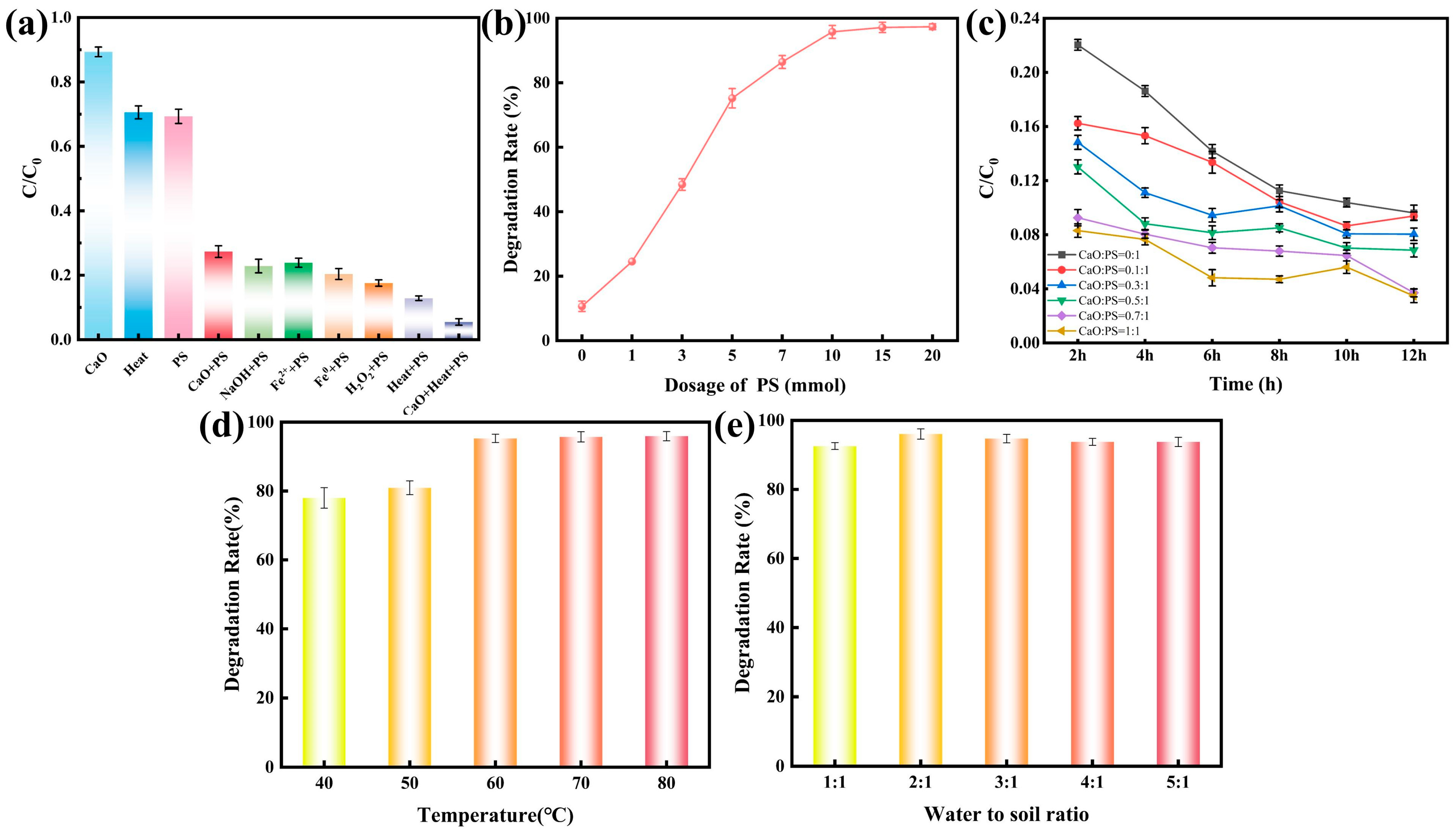
Figure 1. Screening of reaction systems and analysis of influencing factors. (a) Screening of the reaction system; (b) The influence of PS dosage on the degradation of PAHs; (c) The influence of the CaO/PS molar ratio on the degradation of PAHs; (d) Influence of Reaction temperature on the degradation of PAHs; (e) The influence of water-soil ratio on the degradation of PAHs.
Environments 13 00409 g001
Figure 2. Response surface maps and contour maps of different interaction.
Environments 13 00409 g002
Figure 3. (a) Degradation rate of PAHs under different quenchers; (b) Effects of different HA dosages on the degradation of PAHs; (c) Degradation of PAHs in the contaminated soil.
Environments 13 00409 g003
Figure 4. The mechanism of the influence of organic matter presence on the degradation of polycyclic aromatic hydrocarbons by combined activation of persulfate at the site. (a) The influence of HA on the degradation of PAHs; (b) The influence of FAK on the degradation of PAHs; (c) The influence of FAS on the degradation of PAHs; (d) Free radical quenching experiments after adding three kinds of humus.
Environments 13 00409 g004
Figure 5. (a) Molecule structure of NAP molecules; (b) The degradation path diagram of NAP; (c) The degradation path diagram of FLR; (d) The degradation path diagram of PHE; (e) The degradation path diagram of FLT.
Environments 13 00409 g005
Figure 6. Theoretical calculation results of the toxicity of PAHs and their degradation intermediate products. (a) LD50(Acute toxicity); (b) Bioaccumulation factor; (c) Developmental toxicity; (d) Mutagenicity.
Environments 13 00409 g006
Disclaimer/Publisher’s Note: The statements, opinions and data contained in all publications are solely those of the individual author(s) and contributor(s) and not of MDPI and/or the editor(s). MDPI and/or the editor(s) disclaim responsibility for any injury to people or property resulting from any ideas, methods, instructions or products referred to in the content.