1. Introduction
Surface water pollution—particularly in rivers, lakes, and lagoons—is a serious environmental issue that endangers both ecosystems and human health. Among these, river pollution stands out as one of the most urgent concerns today. Rivers, historically vital sources of water for human consumption, agriculture, industry, and biodiversity, are increasingly threatened by various forms of pollution. The primary causes include the discharge of untreated wastewater, industrial effluents, agricultural runoff containing fertilizers and pesticides, and household waste, which ultimately accumulate in riverbeds [
1,
2]. These pollutants degrade water quality and pose significant risks to both human health and aquatic ecosystems. Numerous species of fish, amphibians, aquatic plants, and other organisms are affected by the progressive deterioration of their habitats, which can lead to population declines and, in some cases, local or complete extinction. Moreover, the use of contaminated water for drinking, cooking, or irrigation can cause serious health issues in humans, including gastrointestinal infections, skin conditions, and chronic diseases [
3,
4].
Around the world, extensive evidence highlights the issue of river pollution. In densely populated regions such as Asia, iconic rivers like the Ganges and the Mekong face immense pressure from urban and industrial waste [
5]. In Latin America, illegal mining and inadequate infrastructure worsen pollution in water bodies such as the Amazon and the Riachuelo [
6]. Africa encounters similar challenges, particularly due to limited access to basic sanitation [
7]. Even developed countries like the United States are not exempt; intensive agriculture has significantly contributed to the contamination of rivers such as the Mississippi [
8]. In Mexico, several polluted rivers have been identified [
9,
10,
11,
12,
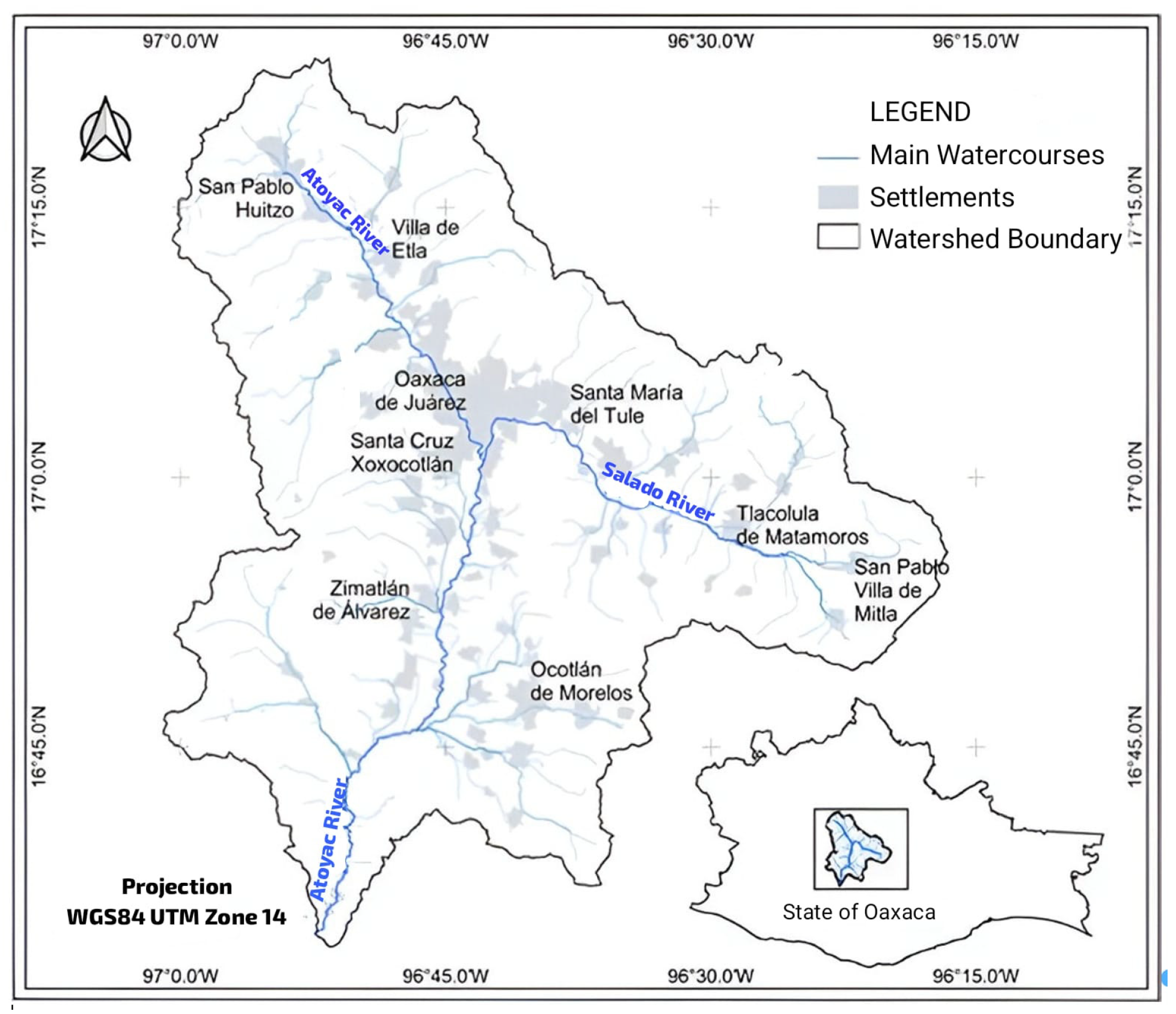
13], with the Atoyac and Salado rivers in Oaxaca State standing out among the most affected (
Figure 1). Pollution of the Atoyac and Salado rivers is one of the most significant environmental challenges in the State of Oaxaca. This problem is associated with the anthropogenic activities across the Central Valleys of the Oaxaca State, including urban expansion, industrial discharges, agricultural practices, and insufficient wastewater treatment. The area influenced by these rivers encompasses 38 municipalities, home to more than 820,000 people, underscoring the potential scale of human exposure to environmental degradation associated with river pollution [
11]. Consequently, this study critically evaluates the current condition of the Atoyac and Salado rivers in Oaxaca State, Mexico, aiming to provide a comprehensive and academically robust understanding of their environmental status. Initially, the water quality of both rivers was assessed based on data reported in the literature, complemented by updated field measurements to deliver a current and site-specific evaluation. Subsequently, water recharge processes and the biophysical vulnerability of the rivers are analyzed. In addition, a socio-environmental perspective is incorporated to better understand the human–environment interactions affecting these water bodies. Finally, this study presents its main conclusions and outlines future research directions.
2. Water Quality
2.1. Data Reported in the Literature
The quality of river water depends on natural factors such as rock erosion, temperature, and organic composition. However, it is increasingly affected by anthropogenic activities, particularly the discharge of industrial and domestic wastewater [
15,
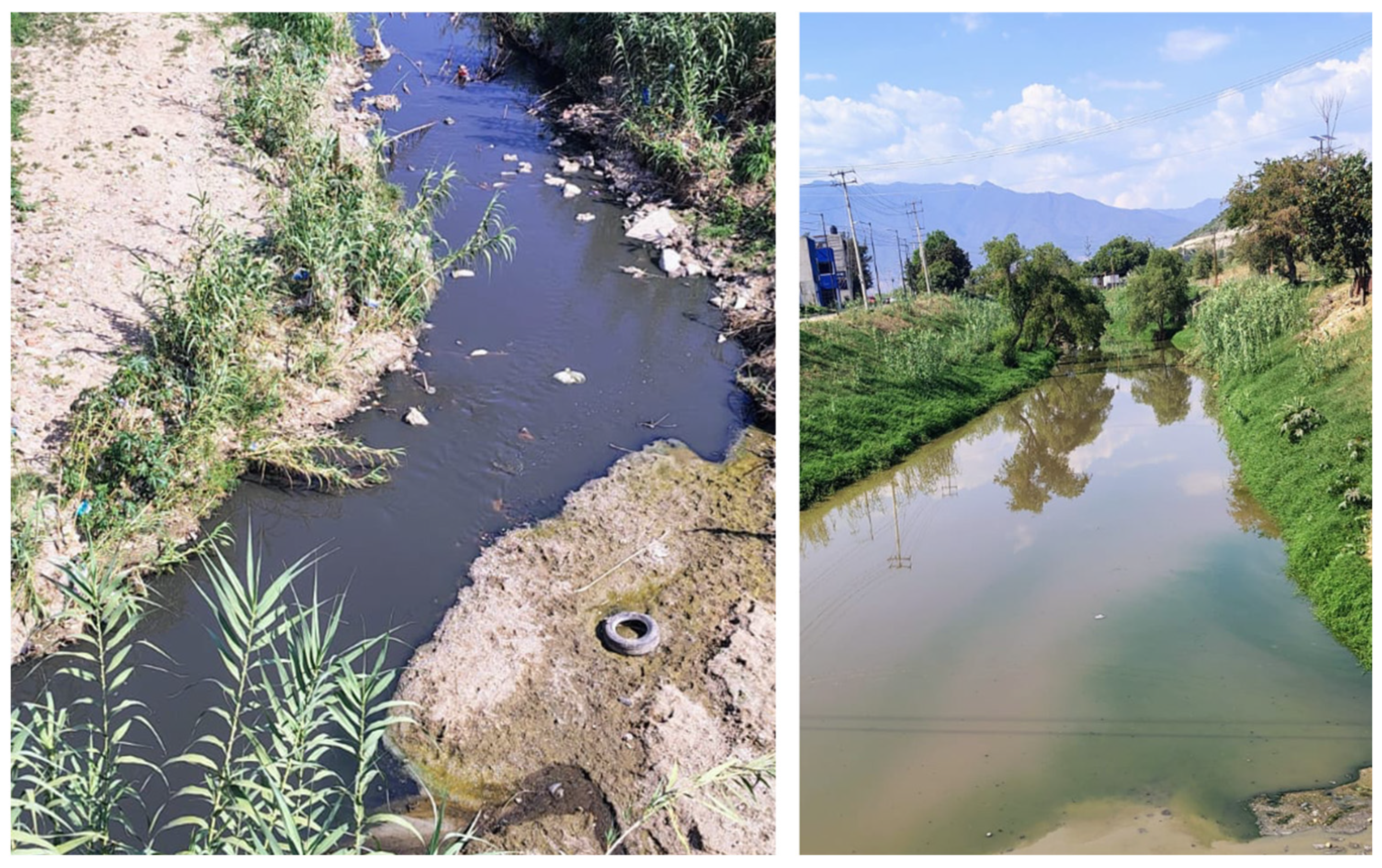
16], as is the case with the Atoyac and Salado rivers, which are considered the most polluted in the State of Oaxaca, Mexico (
Figure 2). This problem has been documented in several studies. For instance, Sánchez-Bernal et al. evaluated the chemical composition of the Atoyac river [
15]. Their analysis revealed a predominance of the bicarbonate anion (HCO
3−) and the sodium (Na
+) and magnesium (Mg
2+) cations. This composition results from the interaction of river water with ferromagnesian, granitic, and metamorphic rocks and explains the river’s characteristic turquoise-green color [
15]. However, in the high-relief areas of Atoyac–Zaachila and Atoyac–Zimatlán, the high sodium (Na
+) concentration could also be explained by the discharge of urban industrial wastewater and runoff from diffuse sources that the river receives as it passes through the Central Valleys of the Oaxaca State [
15]. Particularly in Zimatlán, the disturbances are attributed to the presence of open-air waste disposal sites [
16]. In addition, Soriano-Hernández et al. reported that NH
3 concentrations exceeded the permissible limits established by NOM-127-SSA1-2021 in 80% of the sampling points along the Atoyac river sub-basin in the Central Valleys of Oaxaca, with the highest values recorded in Zimatlán. Also, this site showed the highest concentrations of organic nitrogen, and total nitrogen [
16]. The authors also found that total dissolved solids (TDS) surpassed the permissible limits at two sampling points located in the municipality of Oaxaca de Juárez [
16]. Telixtlahuaca represents another critical site, which, together with Zimatlán, receives wastewater with phosphorus concentrations reaching 6.38 mg L
−1. These concentrations exceed recommended levels for agricultural use and may compromise the water quality of the Atoyac river [
17].
The pH in the basin ranges from 6.8 to 8.9, with the highest values occurring in areas with elevated concentrations of HCO
3− and Na
+, which combine to form sodium bicarbonate (NaHCO
3) [
15]. This compound is responsible for the alkaline hydrolysis commonly observed in surface waters worldwide. Camacho-Ballesteros et al. reported that, in addition, the tendency toward alkalinity in the waters of Oaxaca is due to the presence of magnesium bicarbonates and sodium chlorides, which are easily hydrolyzed [
17]. The electrical conductivity (EC) of the water samples averaged 328.80 µS cm
−1, a value typical of non-saline waters. Only 5 samples (9.61% of the total) exhibited intermediate EC values (819.6 µS cm
−1), indicating slightly saline conditions. Two samples in the high relief (“Atoyac–Zimatlán river” and “Atoyac-Zaachila”) and two in the low relief (“San Cristóbal” and “El Azufre”), comprising 7.69% of the total samples, presented an average EC of 2320 µS cm
−1 (the former) and 1199 µS cm
−1 (the latter), which are moderately saline waters, indicating a potential risk for both human consumption and agricultural use [
15]. According to the same authors, these waters also exhibit a marked decrease in osmotic potential due to salinity. They should therefore be restricted for irrigation and domestic purposes, as they may induce physiological drought [
15].
In addition to the studies mentioned above, research conducted by the Secretariat of Environment, Energy, and Sustainable Development of the State of Oaxaca analyzed data from the Atoyac and Salado rivers collected by the National Monitoring Network between 2012 and 2019 and proposed a water quality traffic-light system [
11]. The study identified 12 municipalities as polluted or severely polluted.
2.2. Actual Data of Water Quality
In addition to data compiled from the literature [
11,
15,
16,
17], this study conducted updated field measurements to provide a current, site-specific assessment of the studied rivers. The samples were collected from 25 to 27 January 2024. All measurements, analytical procedures, instrumentation, calibrations, and detection limits were established and conducted in accordance with the requirements specified in the Mexican Official Standard NOM-001-SEMARNAT-2021 [
18]. These measurements are essential to capture recent variations in water quality and environmental conditions that may not be reflected in previously reported data. For each river, 5 representative samples were selected. The inclusion of these updated measurements strengthens the reliability of the analysis and provides a more comprehensive understanding of the current state of the studied environments. All sampling points are reported in
Table 1.
Table 2 and
Table 3 present the results of physicochemical parameters, cyanide and metals obtained from 5 sampling points along the Atoyac river. Based on the data presented in
Table 2, a clear difference is observed between the measured concentrations at the 5 sampling points of the Atoyac river and the permissible limits established by standard NOM-001-SEMARNAT-2021 [
18]. First, temperature values (20–22 °C) remain within the permissible limit (35 °C), indicating no significant thermal alteration in the water body. However, Total suspended solids (TSS) exceeded (398–1520 mg/L) the permissible limit of 84 mg/L at all sampling points, indicating a high suspended matter load, likely associated with urban and industrial discharges. Similarly, chemical oxygen demand (COD) shows extremely high values (441.6–2112 mg/L), exceeding the limit of 210 mg/L, indicating a significant presence of organic matter and other oxidizable compounds. Total nitrogen (65.0–209.0 mg/L) considerably exceeds the permissible limit of 35 mg/L at all sites, suggesting substantial inputs from domestic, agricultural, or industrial sources. Total phosphorus also exceeds the limit (21 mg/L) at least at one sampling point (27.1 mg/L), while at the remaining points it is close to or slightly below the threshold, still posing a risk of eutrophication. Additionally, fats and oils (69.1–94.1 mg/L) far exceed the permissible limit of 21 mg/L across all sampling points, indicating direct discharges of organic waste, likely linked to domestic, commercial, or industrial activities. Finally, pH values (6.7–6.9) fall within the acceptable range (6–9), indicating relatively stable chemical conditions for this parameter.
The data presented in
Table 3 show the concentrations of selected hazardous elements in water from 5 sampling points of the upper Atoyac river, compared with the permissible limits established by standard NOM-001-SEMARNAT-2021 [
18]. Overall, the results indicate that none of the analyzed parameters exceed regulatory limits, suggesting that the water quality complies with the Mexican environmental standard for these specific contaminants. Cyanide concentrations were consistently below the detection limit (<0.020 mg/L) at all sampling points, remaining below the permissible limit of 3.0 mg/L, indicating negligible risk from this compound. Similarly, Cd, Cr, Hg, Ni, and Pb were all below their respective detection limits in all sampling points, which are significantly lower than the maximum allowable values. This suggests minimal contamination by these toxic metals in the analyzed sites. Arsenic concentrations ranged from 0.002 to 0.006 mg/L, below the permissible limit of 0.4 mg/L. Although detectable, these values are relatively low and do not pose an immediate environmental or health concern based on the standard. However, it is important to note that quantifying As in river water is crucial, as this toxic metalloid can cause long-term chronic damage to human health [
19]. Cu showed slightly higher variability, with measurable concentrations at points 2 (0.106 mg/L) and 5 (0.117 mg/L), but these values are below the permissible limit of 6.0 mg/L. In summary, the concentrations of all evaluated parameters are within regulatory limits, indicating compliance with standard NOM-001-SEMARNAT-2021 for these specific pollutants. However, detectable levels of arsenic and copper at some sampling points suggest localized inputs that should be monitored over time to prevent potential accumulation or future exceedances.
Table 4 and
Table 5 report the physicochemical parameters, cyanides, and metals obtained from 5 sampling points of the Salado river.
Table 4 presents the concentrations of key physicochemical parameters measured at 5 discharge points in the upper Salado river, compared with the maximum permissible limits established by standard NOM-001-SEMARNAT-2021 [
18]. The results reveal significant deterioration in water quality, primarily due to the high concentration of organic compounds and nutrients. Temperature values (19.0–22.0 °C) at all sampling points remain below the permissible limit (35 °C), indicating the absence of thermal pollution. Similarly, pH values (6.4–7.1) fall within the acceptable range (6–9), reflecting relatively stable acid–base conditions. In contrast, TSS shows substantially elevated concentrations (243.0–960.0 mg/L), exceeding the regulatory limit (84 mg/L) at all sampling points. This suggests a high load of suspended inorganic matter, likely associated with untreated wastewater discharges. COD also exceeds the permissible limit (210 mg/L) by a wide margin, with values ranging from 633.6 to 1920.0 mg/L. These high concentrations indicate a significant presence of oxidizable organic matter, reflecting strong contamination from domestic and/or industrial sources. Total nitrogen concentrations (85.1–146.7 mg/L) are consistently above the allowable limit (35 mg/L), indicating excessive nutrient loading. This condition may promote eutrophication processes and is commonly linked to agricultural runoff and wastewater inputs [
19]. Total phosphorus values (9.1–20.6 mg/L) are generally close to the regulatory limit (21 mg/L), with some sampling points approaching the threshold. Although not consistently exceeding the limit, these values indicate a critical condition that may contribute to nutrient enrichment and algal growth, causing eutrophication. Fats and oils are among the most critical parameters, with concentrations ranging from 73.0 to 140.3 mg/L, far exceeding the permissible limit of 21 mg/L in all cases. This reflects significant contamination from industrial, commercial, or domestic effluents, which can adversely affect oxygen transfer and aquatic life.
Table 5 shows the concentrations of cyanides and selected heavy metals measured at 5 sampling points in the Salado river, compared with the maximum permissible limits established by standard NOM-001-SEMARNAT-2021 [
18]. Overall, the results indicate low concentrations for most analyzed elements, with some considerations regarding detection limits and potential risks. Cyanide concentrations at all sampling points are reported as <0.020 mg/L, which is significantly lower than the permissible limit of 3.0 mg/L. This indicates no evidence of cyanide contamination in the areas studied in this work. As concentrations range from <0.002 to 0.003 mg/L, remaining below the regulatory limit of 0.4 mg/L. These values suggest minimal contamination and no immediate environmental concern associated with As. Cd is consistently reported as <0.020 mg/L across all sampling points, also below the permissible limit of 0.4 mg/L. This indicates that cadmium pollution is not significant in the analyzed sampling points. Cu shows a slightly higher concentration at point 1 (0.106 mg/L), while in the remaining points the values are lower than 0.100 mg/L. In general, all values of Cu concentration remain far below the limit of 6.0 mg/L, suggesting no regulatory exceedance. Cr concentrations are consistently below 0.250 mg/L, well under the limit of 1.5 mg/L, indicating no significant chromium contamination. Hg was not detected in any of the samples; consequently, its concentration was below the permissible limit established in Mexican regulations. Ni concentrations (<0.200 mg/L) are far below the limit of 4.0 mg/L, while Pb concentrations (<0.100 mg/L) are also below the permissible limit of 0.4 mg/L, indicating no significant contamination from these metals.
3. Water Recharge
River water resources are influenced by both natural factors, such as bedrock geology, and anthropogenic drivers, including climate change and land-use change, which affect groundwater recharge rates [
20]. These changes will likely continue, potentially compromising the availability of this essential resource [
21]. Although Oaxaca has significant water reserves, its recharge areas are at increasing risk. Across the Atoyac river basin, urban areas reportedly increased by 255 km
2 between 1990 and 2005, while forests decreased by 410 km
2 [
22], altering hydrological processes by reducing infiltration and increasing surface runoff. Furthermore, Ojeda Olivares et al. investigated groundwater recharge dynamics in the Upper Atoyac sub-basin, using historical data (1979–2013) from 5 weather stations located in the districts of Etla, Oaxaca, and Ejutla [
23]. They estimated that, during this period in the Upper Atoyac sub-basin, land-use changes resulted in a net loss of 135 km
2 of recharge area, corresponding to a reduction of 2.65 × 10
6 m
3 in groundwater recharge [
23]. The same study projected that groundwater recharge, which averaged 45.2 mm yr
−1 during the reference period (1951–2010), could decrease to 17.9% in a near-term climate horizon (2015–2039) and to 65.0% in a long-term climate horizon (2075–2099) under the Representative Concentration Pathway 8.5 climate scenario, primarily due to projected changes in precipitation and temperature patterns [
23]. These reports suggest that the combined effects of land-use change and climate change could substantially reduce groundwater recharge, threatening the long-term sustainability of water resources in the Atoyac river basin [
22,
23].
Furthermore, Suárez-Mota et al., using Geographic Information Systems (GISs), evaluated water recharge and aquifer vulnerability in the Atoyac river sub-basin of the Central Valleys [
24]. Their study identified that areas with high and very high recharge potential are primarily located in the southern Tlacolula Valley and throughout the Etla Valley. Conversely, zones with low and very low recharge potential are concentrated in the center of Oaxaca City, the northern Tlacolula Valley, and the eastern Zimatlán Valley. The remaining areas exhibit moderate recharge potential.
4. Vulnerability to Contamination
The aquifer of the Central Valleys of Oaxaca exhibits three levels of vulnerability to contamination, defined as the likelihood of infiltration and diffusion of contaminants into the aquifer [
24]. Areas with low vulnerability cover 32.58% of the sub-basin (1227.94 km
2), moderate vulnerability covers 58.05% (2188.24 km
2), and high vulnerability covers 9.35% (352.40 km
2). The most vulnerable areas are located in the northwest of San Lucas Quiavini, northwest of San Miguel Tlanichico, farmland between Guadalupe and San Sebastián Etla, and the urban area of San Francisco Telixtlahuaca [
24]. These zones pose a significant risk to becoming contaminated and may compromise local water quality as well as wells and communities located at considerable distances due to contaminant transport, highlighting the need for targeted protection measures.
Chávez-Cortés et al. also assessed biophysical vulnerability to flooding in the Central Valleys sub-basin using GISs [
25]. Their findings indicate that highly vulnerable areas cover 38.39% of the sub-basin, spanning 57 municipalities, including Asunción Ocotlán, Ciénega de Zimatlán, Guadalupe Etla, Santa Cruz Papalutla, San Antonino Castillo Velasco, San Jacinto Amilpas, San Pedro Apóstol, Santiago Apóstol, Santiago Matatlán, San Raymundo Jalpan, Santa Inés Yatzeche, and Santa Lucía Ocotlán. Physiographic factors such as proximity to water bodies, land cover, soil types, and geology largely explain this vulnerability.
Finally, García-Santos et al. analyzed 30 years of climate data from the Verde-Atoyac river basin and projected conditions for 2075–2099 [
26]. Historical data revealed an increase in consecutive dry days, higher daily rainfall intensity, and more extreme minimum and maximum temperatures. Future projections suggest an approximate 4% decrease in precipitation across most months. Identifying these vulnerable areas is essential for developing effective land-use planning and environmental management policies.
5. Socio-Environmental Perspective
Most existing studies have focused solely on technical or environmental aspects, leaving a significant gap in comprehensive socio-environmental analysis. Currently, there is limited scientific evidence to systematically document the social impacts of this pollution, including effects on public health, such as skin infections, gastrointestinal diseases, respiratory disorders, and exposure to pollutants associated with long-term health risks [
27], as well as impacts on economic activities, quality of life, and the violation of fundamental human rights.
Various social sectors have called for urgent action to address this issue. Through media campaigns, protests, and grassroots complaints, both civil organizations and residents have demanded thorough investigations to produce a comprehensive diagnosis and to implement immediate sanitation measures. They have also emphasized that access to clean water and a healthy environment must be guaranteed as fundamental human rights. According to the National Human Rights Commission [
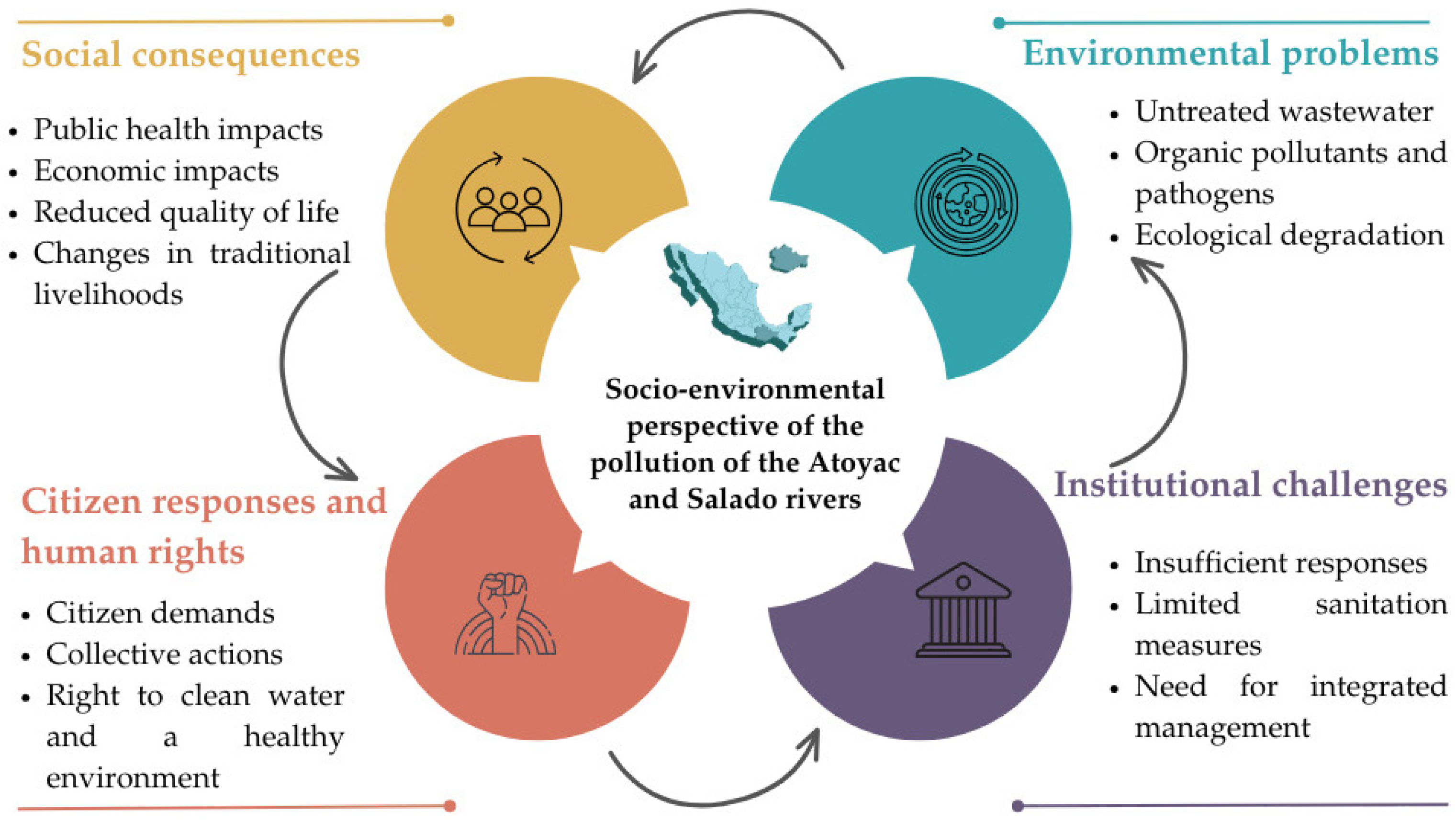
28], between 2013 and 2017, multiple formal complaints were submitted to authorities, along with citizen petitions that prompted precautionary measures to protect the Atoyac and Salado rivers. However, institutional responses have remained insufficient, and environmental degradation continues to affect hundreds of thousands of residents across the study area. This situation is summarized schematically in
Figure 3, which highlights the relationships among environmental problems, social consequences, citizen responses, human rights concerns, and institutional challenges associated with the pollution of the Atoyac and Salado rivers in Oaxaca.
What is currently lacking is a truly comprehensive social assessment of the affected populations, including the identification of residents by location, age, and economic activity, as well as an understanding of how they perceive the problem in their daily lives. Systematic evidence is also needed regarding public health impacts; economic effects on commerce, agriculture, and tourism; changes in traditional livelihoods; and other dimensions of social vulnerability. Additionally, it is essential to document citizen demands, collective actions, and concerns related to the right to clean water and a healthy environment.
Although most available studies focus primarily on the Atoyac river in Puebla, Mexico, their findings allow us to anticipate similar effects in Oaxaca. For example, Montero-Montoya et al. documented health damage in children exposed to industrial pollution, observing increases in oxidative stress and early risk biomarkers [
27]. Similarly, the Secretariat of Environment, Energy, and Sustainable Development of the State of Oaxaca identified high levels of organic pollutants that pose serious risks to public health [
11]. This evidence underscores the urgent need for systematic studies in Oaxaca that consider both the environmental and social impacts of pollution in the Atoyac and Salado rivers. The situation is further exacerbated by severe river contamination resulting from untreated sewage discharges, persistent foul odors, elevated health risks, and a decline in quality of life in both rural and urban communities. The lack of sanitation not only threatens public health but also generates negative economic consequences, disrupting commercial activity, limiting social and economic development, and deepening the marginalization of nearby populations.
6. Conclusions
This study provides a comprehensive analysis of the current environmental condition of the Atoyac and Salado rivers in Oaxaca, Mexico, based on both literature review and updated field and laboratory measurements. The results confirm that these rivers are significantly impacted by anthropogenic activities, particularly the discharge of untreated domestic and industrial wastewater, as well as agricultural runoff. The physicochemical analysis revealed severe deterioration in water quality in both rivers. Key parameters such as TSS, COD, total nitrogen, and fats and oils consistently exceeded the permissible limits established by NOM-001-SEMARNAT-2021, indicating high levels of organic and inorganic pollution. These findings reflect intense contamination associated with urbanization, industrial activities, and inadequate wastewater management. In contrast, temperature and pH values remained within acceptable ranges, suggesting that not all water quality indicators are equally affected.
Regarding hazardous elements, most heavy metals and cyanides were found below regulatory limits in both rivers, indicating no immediate risk from these contaminants. However, continuous monitoring of heavy metals and cyanides is necessary, as they could represent a public health problem in the future.
Additionally, this study highlights critical environmental challenges beyond water quality, including reduced water recharge due to land-use changes, increased vulnerability of aquifers to contamination, and high susceptibility to flooding in the region. These factors, combined with climate change projections, suggest that water availability and quality may further deteriorate in the future.
From a socio-environmental perspective, the pollution of these rivers represents a major public concern, affecting human health, economic activities, and quality of life. Despite the severity of the problem, there is still a lack of comprehensive studies addressing the social impacts of pollution, as well as insufficient institutional responses to mitigate environmental degradation. Overall, this work emphasizes that the Atoyac and Salado rivers in Oaxaca State, Mexico are under critical environmental stress and require urgent, coordinated, and multidisciplinary actions for their restoration and sustainable management.
7. Future Directions
Future research should focus on developing a more comprehensive and integrated understanding of the environmental and socio-economic impacts of pollution in the Atoyac and Salado rivers. First, it is essential to expand monitoring programs by increasing the number of sampling sites and incorporating long-term studies to capture seasonal and temporal variations in water quality. In addition, studies should evaluate the bioaccumulation of contaminants in aquatic organisms and their potential transfer through the food chain.
Another key research direction involves the assessment of water recharge dynamics and the impact of land-use changes and climate variability on hydrological processes. Integrating hydrological modeling with GISs would allow for better prediction of future scenarios and identification of critical zones for conservation and intervention.
Importantly, future studies must incorporate a socio-environmental approach, including systematic evaluation of public health impacts, economic losses, and social vulnerability in affected communities. This includes identifying exposed populations, assessing disease prevalence, and understanding community perceptions and responses to pollution.
From a practical management perspective, future research should move beyond environmental diagnosis and promote the implementation of pilot remediation projects in the most polluted sections of the Atoyac and Salado rivers. Particular attention should be given to decentralized wastewater treatment systems, constructed wetlands, nature-based solutions, and other low-cost treatment technologies suitable for municipalities with limited financial and technical resources. Evaluating the performance, economic viability, social acceptance, and long-term sustainability of these pilot facilities would provide critical information for designing effective restoration programs.
Finally, interdisciplinary collaboration among scientists, policymakers, and local stakeholders will be essential to generate evidence-based solutions and to address the complex environmental challenges facing these river systems.
Author Contributions
Conceptualization, F.M.-J., E.A.Z.-B. and V.A.F.-L.; formal analysis, V.H.-M., M.S.-S. and H.C.-M.; investigation, F.M.-J., E.A.Z.-B., V.A.F.-L., V.H.-M., M.S.-S. and H.C.-M.; writing—original draft preparation, F.M.-J., E.A.Z.-B. and V.A.F.-L.; writing—review and editing, V.H.-M., M.S.-S. and H.C.-M. All authors have read and agreed to the published version of the manuscript.
Funding
This research was funded by Tecnológico Nacional de México of Mexico for the project “CONTINUATION OF: Electrochemically Assisted Wetlands as an Emerging Technology for Wastewater Treatment”, grant number 26571.26-P. They also thank the Secretaría de Ciencia, Humanidades, Tecnología e Innovación project “Study of Water Quality and Sanitation Alternatives for Selected Polluted Rivers in Mexico: Environmental and Social Impact Assessment”, grant number ApoyoLN-2025-C-19.
Data Availability Statement
The original contributions presented in this study are included in the article. Further inquiries can be directed to the corresponding author.
Conflicts of Interest
The authors declare no conflicts of interest.
References
- Wang, J.; Liu, X.D.; Lu, J. Urban River Pollution Control and Remediation. Procedia Environ. Sci. 2012, 13, 1856–1862. [Google Scholar] [CrossRef]
- Xu, Z.; Xu, J.; Yin, H.; Jin, W.; Li, H.; He, Z. Urban River Pollution Control in Developing Countries. Nat. Sustain. 2019, 2, 158–160. [Google Scholar] [CrossRef]
- Dickin, S.K.; Schuster-Wallace, C.J.; Qadir, M.; Pizzacalla, K. A Review of Health Risks and Pathways for Exposure to Wastewater Use in Agriculture. Environ. Health Perspect. 2016, 124, 900–909. [Google Scholar] [CrossRef] [PubMed]
- Malakar, A.; Snow, D.D.; Ray, C. Irrigation Water Quality—A Contemporary Perspective. Water 2019, 11, 1482. [Google Scholar] [CrossRef]
- Roman, L.; Hardesty, B.D.; Schuyler, Q. A Systematic Review and Risk Matrix of Plastic Litter Impacts on Aquatic Wildlife: A Case Study of the Mekong and Ganges River Basins. Sci. Total Environ. 2022, 843, 156858. [Google Scholar] [CrossRef] [PubMed]
- Silva-Forsberg, M.C.; Forsberg, B.R.; Zeidemann, V.K. Mercury contamination in humans linked to river chemistry in the Amazon Basin. Ambio 1999, 28, 519–521. Available online: https://www.jstor.org/stable/4314944 (accessed on 10 January 2026).
- Armah, F.A.; Ekumah, B.; Yawson, D.O.; Odoi, J.O.; Afitiri, A.-R.; Nyieku, F.E. Access to Improved Water and Sanitation in Sub-Saharan Africa in a Quarter Century. Heliyon 2018, 4, e00931. [Google Scholar] [CrossRef] [PubMed]
- Van Meter, K.J.; Basu, N.B.; Van Cappellen, P. Two Centuries of Nitrogen Dynamics: Legacy Sources and Sinks in the Mississippi and Susquehanna River Basins. Glob. Biogeochem. Cycles 2017, 31, 2–23. [Google Scholar] [CrossRef]
- Castillo-Ferat, M.A.; Galaviz-Villa, I.; Cazarín-Luna, E.M.; Salcedo-Garduño, M.G.; Alcántara-Méndez, V. Pollution by Total Suspended Solids and Its Relationship with the Liquid-Solid Flow of the Lower Basin of Usumacinta River in Tabasco, Mexico. J. S. Am. Earth Sci. 2024, 140, 104928. [Google Scholar] [CrossRef]
- Dueñas-Moreno, J.; Mora, A.; Narvaez-Montoya, C.; Mahlknecht, J. Trace Elements and Heavy Metal(Loid)s Triggering Ecological Risks in a Heavily Polluted River-Reservoir System of Central Mexico: Probabilistic Approaches. Environ. Res. 2024, 262, 119937. [Google Scholar] [CrossRef] [PubMed]
- Secretaría del Medio Ambiente, Energías y Desarrollo Sustentable (SEMAEDESO). Diagnóstico de la Subcuenca Atoyac-El Salado. Oaxaca, Mexico, 2022. Available online: https://www.oaxaca.gob.mx/semaedeso/wp-content/uploads/sites/59/2022/01/V.-Diagnostico.pdf (accessed on 10 January 2026).
- Mora, A.; García-Gamboa, M.; Sánchez-Luna, M.S.; Gloria-García, L.; Cervantes-Avilés, P.; Mahlknecht, J. A Review of the Current Environmental Status and Human Health Implications of One of the Most Polluted Rivers of Mexico: The Atoyac River, Puebla. Sci. Total Environ. 2021, 782, 146788. [Google Scholar] [CrossRef] [PubMed]
- Rodríguez, A.G.P.; López, M.I.R.; Casillas, Á.D.; León, J.A.A.; Banik, S.D. Impact of Pesticides in Karst Groundwater. Review of Recent Trends in Yucatan, Mexico. Groundw. Sustain. Dev. 2018, 7, 20–29. [Google Scholar] [CrossRef]
- Montiel González, R.; Bolaños González, M.A.; Macedo Cruz, A.; Rodríguez González, A.; López Pérez, A. Clasificación de Uso Del Suelo y Vegetación Con Redes Neuronales Convolucionales. Rev. Mex. Cienc. For. 2022, 13, 97–119. [Google Scholar] [CrossRef]
- Sánchez-Bernal, E.I.; Ortega-Escobar, H.M.; Can-Chulim, Á.; Ortega-Baranda, V.; Camacho-Escobar, M.A.; Mancilla-Villa, O.R. Chemical Quality of Waters of the Atoyac-Verde River as It Passes Through Forest Ecosystems of Oaxaca, Mexico. Water Air Soil Pollut. 2022, 233, 93. [Google Scholar] [CrossRef]
- Soriano-Hernández, X.Y.; Velasco-Velasco, V.A.; Ruiz-Luna, J.; Caballero-Gutiérrez, P.U.; Ramírez-Santiago, E.; Enríquez del-Valle, J.R. Análisis de nitrógeno, sólidos suspendidos y disueltos totales en el río Atoyac, Oaxaca. Rev. Mex. Agroecosistemas 2017, 4, 152–163. [Google Scholar]
- Camacho-Ballesteros, A.; Ortega-Escobar, H.M.; Sánchez-Bernal, E.I.; Can-Chulim, Á. Indicadores de Calidad Físico-Química de Las Aguas Residuales Del Estado de Oaxaca, México. Terra 2020, 38, 361–375. [Google Scholar] [CrossRef]
- Secretaría de Medio Ambiente y Recursos Naturales (SEMARNAT). Norma Oficial Mexicana NOM-001-SEMARNAT-2021, Que Establece Los Límites Permisibles de Contaminantes En Las Descargas de Aguas Residuales En Cuerpos Receptores Propiedad de La Nación. Ciudad de México, México, 2022. Available online: https://dof.gob.mx/nota_detalle.php?codigo=5645374&fecha=11/03/2022 (accessed on 10 January 2026).
- Sultan, M.W.; Qureshi, F.; Ahmed, S.; Kamyab, H.; Rajendran, S.; Ibrahim, H.; Yusuf, M. A Comprehensive Review on Arsenic Contamination in Groundwater: Sources, Detection, Mitigation Strategies and Cost Analysis. Environ. Res. 2025, 265, 120457. [Google Scholar] [CrossRef] [PubMed]
- Adeyeri, O.E.; Zhou, W.; Ndehedehe, C.E.; Wang, X.; Ishola, K.A.; Laux, P. Minimizing Uncertainties in Climate Projections and Water Budget Reveals the Vulnerability of Freshwater to Climate Change. One Earth 2024, 7, 72–87. [Google Scholar] [CrossRef]
- DeNicola, E.; Aburizaiza, O.S.; Siddique, A.; Siddique, A.; Khwaja, H.; Carpenter, D.O. Climate Change and Water Scarcity: The Case of Saudi Arabia. Ann. Glob. Health 2015, 81, 342. [Google Scholar] [CrossRef] [PubMed]
- Villareal Hernández, D.R. Estimación del Escurrimiento Hídrico Debido al Cambio de Uso del Suelo en la Subcuenca Atoyac del Estado de Oaxaca a Través de Un SIG; Tesis de maestria, Instituto Politécnico Nacional: Oaxaca, Mexico, 2011. [Google Scholar]
- Ojeda Olivares, E.A.; Belmonte Jimenez, S.I.; Takaro, T.K.; Campos Enriquez, J.O.; Ladrón De Guevara Torres, M. Decrease of the Water Recharge and Identification of Water Recharge Zones in the Alto Atoyac Sub-Basin, Oaxaca, as a Result of Climate Change. J. Water Clim. Change 2018, 9, 37–57. [Google Scholar] [CrossRef]
- Suárez, M.E.; Martínez Hernández, F.H.; Pedro Pérez, A.A.; Belmonte Jiménez, S.I. Simulación Del Movimiento de Partículas Contaminantes Sobre Zonas de Vulnerabilidad En El Acuífero de Los Valles Centrales de Oaxaca. GeoFocus 2020, 25, 3–25. [Google Scholar] [CrossRef]
- Chávez-Cortés, M.M.; Binnqüist-Cervantes, G.; Salas-Flores, A.C. Evaluación Multicriterio de La Vulnerabilidad Biofísica Ante Inundaciones En La Subcuenca Río Atoyac-Oaxaca de Juárez. Ecosist. Recur. Agropec. 2016, 4, 97. [Google Scholar] [CrossRef]
- García-Santos, J.; Ibañez Castillo, L.A.; Arteaga-Ramírez, R.; Carrillo-García, M. Tendencias de Los Valores de Temperatura y Lluvia En La Cuenca Del Río Atoyac, Oaxaca. Agric. Soc. Desarro. 2024, 21, 536–552. [Google Scholar] [CrossRef]
- Montero-Montoya, R.D.; López-Vargas, R.; Méndez-Serrano, A.; Galicia-Alonso, I.; García-Vargas, G.; Serrano-García, L.; Beltrán-Portugal, R.; Rosado-Zaidi, S.; Albores-Medina, A.; Oropeza-Hernández, L.; et al. Increased Micronucleus Frequencies in Reticulocytes of Children Exposed to Industrial Pollution: Oxidative Stress and the OGG1 S326C Polymorphism. Mutat. Res./Genet. Toxicol. Environ. Mutagen. 2020, 853, 503170. [Google Scholar] [CrossRef] [PubMed]
- Comisión Nacional de Derechos Humanos (CNDH). Recomendación No. 57/2020. Ciudad de México, México, 2022. Available online: https://www.cndh.org.mx/sites/default/files/documentos/2020-12/REC_2020_057.pdf (accessed on 10 January 2026).
| Disclaimer/Publisher’s Note: The statements, opinions and data contained in all publications are solely those of the individual author(s) and contributor(s) and not of MDPI and/or the editor(s). MDPI and/or the editor(s) disclaim responsibility for any injury to people or property resulting from any ideas, methods, instructions or products referred to in the content. |




 ,
,