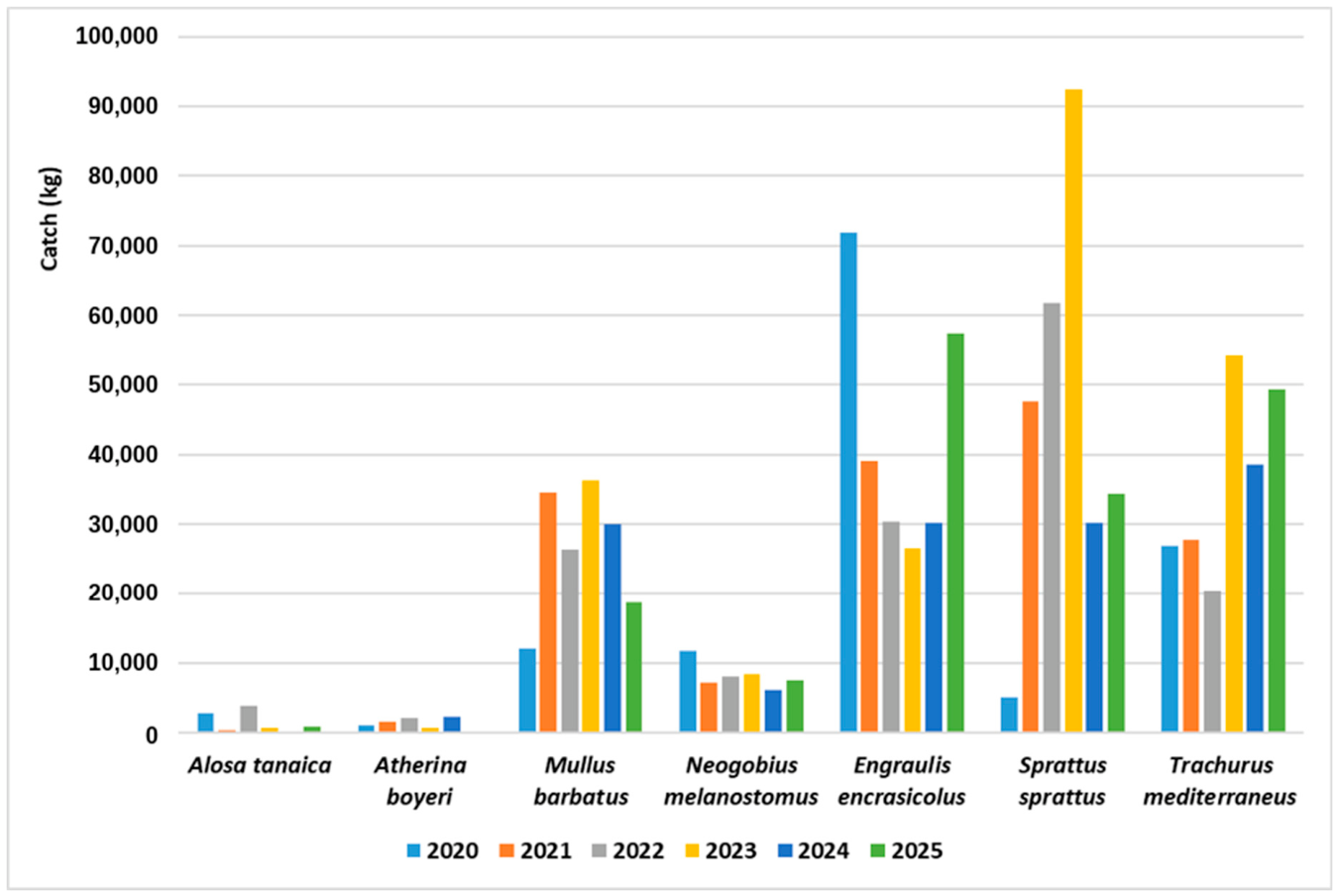


Environmental Exposure and Bioaccumulation of Potentially Toxic Elements in Fishery Resources from the Romanian Black Sea and Implications for Seafood Safety



Abstract
1. Introduction
2. Materials and Methods
2.1. Study Area
2.2. Sampling Design
2.3. Sample Processing and Preparation
2.4. PTE Determination
2.5. Bioconcentration Factor (BCF)
2.6. Biota–Sediment Accumulation Factor (BSAF)
2.7. Human Health Risk Assessment
2.8. Data Structure and Grouping Strategy
2.9. Statistical Analysis
3. Results
3.1. PTE Concentrations and Environmental Transfer Factors in Marine Biota
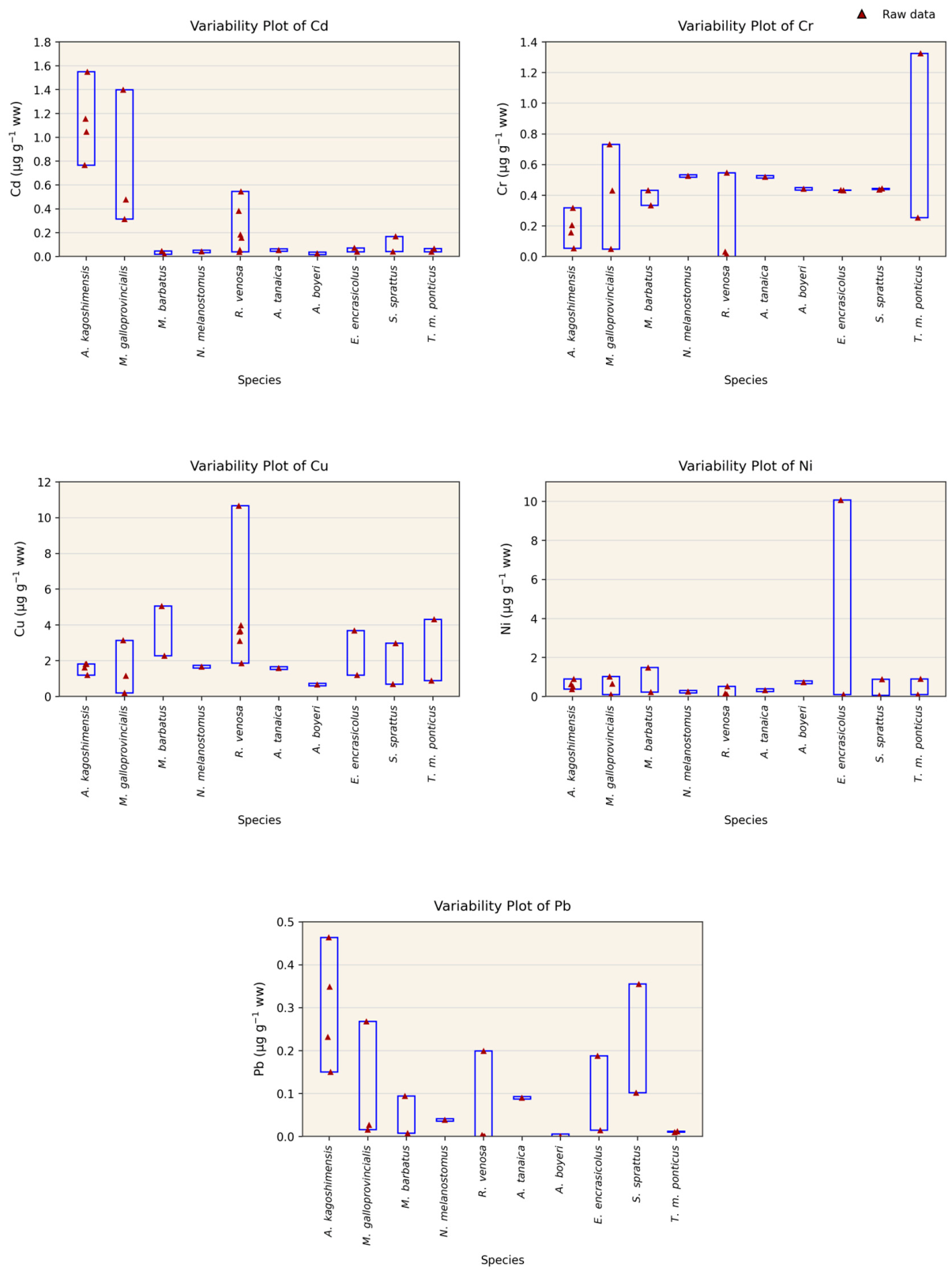
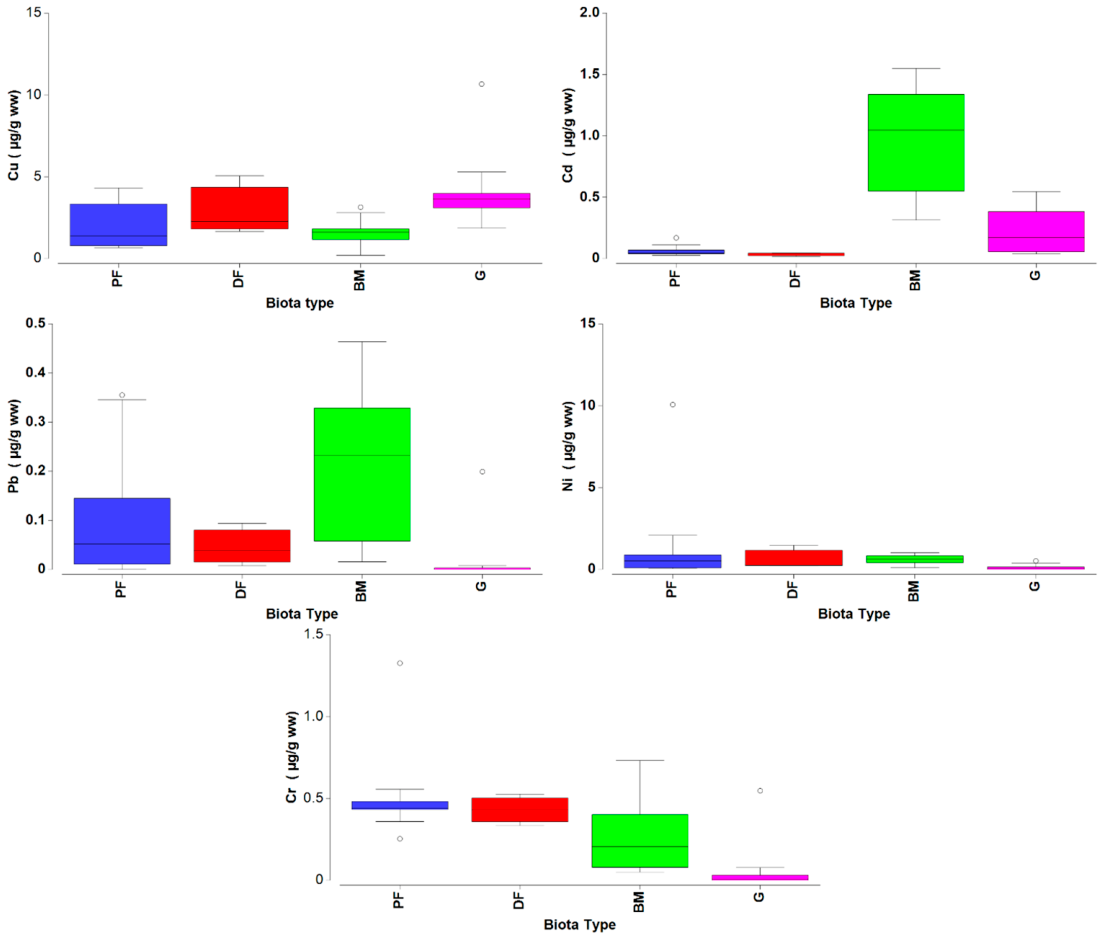
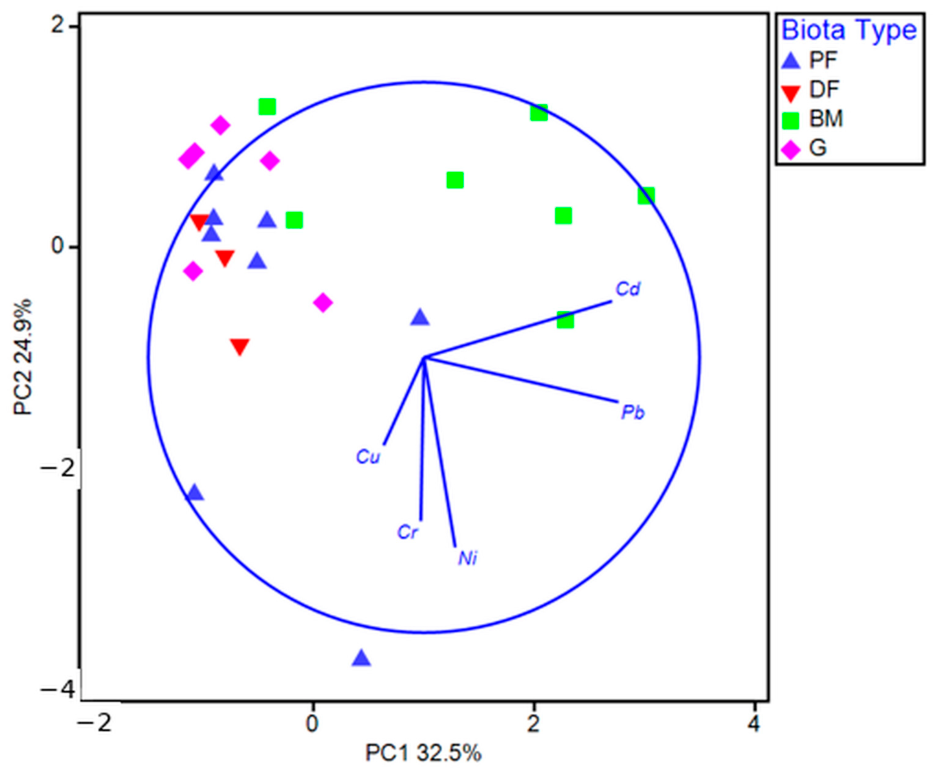
3.1.1. Tissue Burdens in Seafood Taxa
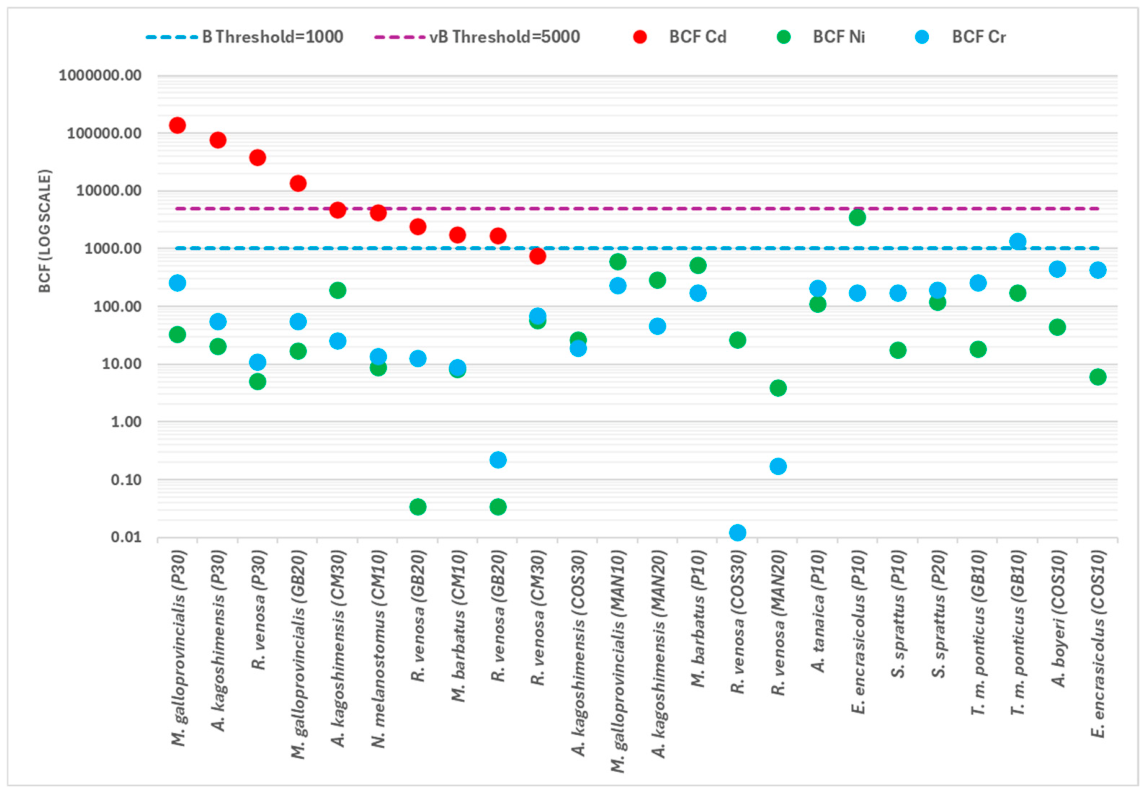
3.1.2. Bioconcentration Factors (BCF)
3.1.3. Biota–Sediment Accumulation Factors (BSAF)
3.2. Human Health Risk Indices
4. Discussion
4.1. Tissue Concentrations and Regulatory Relevance
4.2. BCF as a Descriptive Tissue–Water Ratio
4.3. BSAF as a Descriptive Tissue–Sediment Ratio
4.4. Dietary Exposure and Seafood Safety Interpretation
4.5. Monitoring Implications and Study Limitations
5. Conclusions
Supplementary Materials
Author Contributions
Funding
Institutional Review Board Statement
Data Availability Statement
Conflicts of Interest
Abbreviations
| BCF | Bioconcentration factor |
| BM | Bivalves |
| BSAF | Biota–sediment accumulation factor |
| BW | Body weight |
| C | Coastal stations, up to 20 m depth |
| Cd | Cadmium |
| Cr | Chromium |
| Cu | Copper |
| DF | Demersal fish |
| DIR | Daily ingestion rate |
| d.w. | Dry weight |
| ECHA | European Chemicals Agency |
| EDI | Estimated daily intake |
| EEA | European Environment Agency |
| EFSA | European Food Safety Authority |
| FAOSTAT | Food and Agriculture Organization Corporate Statistical Database |
| FIR | Food ingestion rate |
| G | Gastropods |
| GF-AAS | Graphite furnace atomic absorption spectrometry |
| HBGV | Health-based guidance value |
| HR-CS AAS | High-resolution continuum-source atomic absorption spectrometry |
| IQR | Interquartile range |
| LOD | Limit of detection |
| LOQ | Limit of quantification |
| M | Marine stations, deeper than 20 m |
| MSFD | Marine Strategy Framework Directive |
| NAFA | National Agency for Fisheries and Aquaculture |
| Ni | Nickel |
| ODV | Ocean Data View |
| P25 | 25th percentile |
| P75 | 75th percentile |
| PAHs | Polycyclic aromatic hydrocarbons |
| Pb | Lead |
| PCA | Principal component analysis |
| PF | Pelagic fish |
| POPs | Persistent organic pollutants |
| PRIMER | Plymouth Routines in Multivariate Ecological Research |
| PTE | Potentially toxic elements |
| RAIS | Risk Assessment Information System |
| REACH | Registration, Evaluation, Authorisation and Restriction of Chemicals |
| RfD | Reference dose |
| RL | Reporting limit |
| RoBS | Romanian Black Sea |
| RSD | Relative standard deviation |
| SD | Standard deviation |
| T | Transitional stations |
| TDI | Tolerable daily intake |
| THQ | Target hazard quotient |
| TTHQ | Total target hazard quotient |
| USEPA | United States Environmental Protection Agency |
| WISE | Water Information System for Europe |
| ww | Wet weight |
Appendix A

| Species | Common Name | Ecological Group | Habitat and Seasonal Occurrence | Main Feeding Traits | Relevance for PTE Exposure Context and Seafood-Safety Assessment |
|---|---|---|---|---|---|
| Alosa tanaica (Grimm, 1901) | Azov shad | Migratory clupeid; anadromous/coastal pelagic | Native to the Ponto–Caspian basin, including the Black Sea, Sea of Azov, and adjacent river systems. Adults spend most of the life cycle in marine coastal waters and migrate toward freshwater or slightly brackish areas during the reproductive period, mainly in spring. | Feeds mainly on crustaceans; insect larvae and small fish may also be consumed seasonally. | Relevant as a migratory fish linking coastal marine and estuarine/freshwater-influenced habitats. Its trophic position may provide information on contamination in coastal and estuarine/freshwater-influenced habitats from planktonic and small nektonic prey. |
| Atherina boyeri (Risso, 1810) | Big-scale sand smelt | Small pelagic/coastal schooling species | Lives in schools near the shore and may enter coastal lakes in spring for feeding and spawning. It is highly tolerant of salinity variation and can occur in marine, brackish, and freshwater environments. | Feeds mainly on small planktonic and benthic organisms, depending on habitat and life stage. | Relevant for assessing contamination in shallow coastal and brackish environments, especially because of its tolerance to variable salinity and frequent occurrence near shore. |
| Engraulis encrasicolus (Linnaeus, 1758) | European anchovy | Small pelagic schooling species | Common in the Black Sea, forming large schools. It approaches coastal waters mainly from April to September. In autumn, adults migrate offshore and descend to deeper waters, approximately 60–70 m, for overwintering. Spawning occurs from June to September, both offshore and near the coast. | Feeds mainly on planktonic organisms, especially zooplankton, with diet varying according to season and prey availability. | Important commercial small pelagic fish and relevant seafood item. Its plankton-based feeding and seasonal coastal occurrence make it useful for evaluating PTE occurrence in pelagic resources. |
| Sprattus sprattus (Linnaeus, 1758) | European sprat | Small pelagic schooling species | Lives in large schools and does not enter rivers or coastal lakes. It approaches the shore when water temperature reaches approximately 7–8 °C and remains nearshore until water warms to about 18 °C. Spawning occurs during the cold season, with peak intensity between December and March. | Feeds mainly on zooplankton, especially copepods and cladocerans, but may also consume small larvae, mollusks, and phytoplankton. | High economic and dietary relevance, being among the main small pelagic resources in the Black Sea. Its planktonic feeding and schooling behavior make it suitable for assessing pelagic exposure to bioavailable metals. |
| Trachurus mediterraneus ponticus (Aleev, 1956) | Mediterranean/Black Sea horse mackerel | Pelagic schooling predator | Pelagic species forming large schools. It appears along the Romanian coast mainly in April–May, when water temperature reaches approximately 13–16 °C. Its arrival is often associated with the presence of anchovy and sand smelt schools near shore. | Feeds mainly on small fish, including anchovy, sand smelt, sprat, and juvenile fish; crustaceans, polychaetes, diatoms, and algae may also occur in the diet. | Relevant from both fishery and PTE exposure-context perspective because it occupies a higher trophic position among the small pelagic species analyzed and may integrate dietary exposure from prey fish. |
| Mullus barbatus (Linnaeus, 1758) | Red mullet | Demersal/benthic-associated species | Occurs in small schools, mainly over muddy, clayey, or mussel-associated substrates. It appears near the shore in spring when water temperature reaches approximately 7–8 °C, then retreats to deeper bottom habitats as waters warm. It is commonly fished from May to autumn. | Feeds on benthic organisms, including crustaceans, worms, and detritus. | Relevant for assessing sediment-associated and near-bottom exposure pathways, because its feeding ecology and demersal habitat use increase interaction with benthic prey and seabed substrate. |
| Neogobius melanostomus (Pallas, 1814) | Round goby | Demersal/benthic-associated Ponto–Caspian goby | Ponto–Caspian demersal species adapted to marine and brackish coastal waters. Gobies are common along the Romanian coast, especially in sheltered bays, coastal lakes, and shallow areas with rocky or algae-covered substrates. Spawning generally occurs from late spring to summer, depending on temperature. | Feeds on benthic and nektonic prey, including mollusks, crustaceans, shrimps, crabs, insects, small fish, and other gobies. | Relevant for benthic food-web exposure because of its close association with substrate and consumption of benthic prey, including mollusks and crustaceans. It can help provide information on PTE occurrence in demersal resources. |

References
- El-Sharkawy, M.; Alotaibi, M.O.; Li, J.; Du, D.; Mahmoud, E. Heavy Metal Pollution in Coastal Environments: Ecological Implications and Management Strategies: A Review. Sustainability 2025, 17, 701. [Google Scholar] [CrossRef]
- Zaynab, M.; Al-Yahyai, R.; Ameen, A.; Sharif, Y.; Ali, L.; Fatima, M.; Khan, K.A.; Li, S. Health and Environmental Effects of Heavy Metals. J. King Saud Univ. Sci. 2022, 34, 101653. [Google Scholar] [CrossRef]
- Zhao, J.; Yang, K.; Chu, F.; Ge, Q.; Xu, D.; Han, X.; Ye, L. Sources and Spatial Variations of Heavy Metals in Offshore Sediments of the Western Pearl River Estuary. Mar. Pollut. Bull. 2023, 188, 114599. [Google Scholar] [CrossRef] [PubMed]
- Rainbow, P.S.; Kriefman, S.; Smith, B.D.; Luoma, S.N. Have the Bioavailabilities of Trace Metals to a Suite of Biomonitors Changed over Three Decades in SW England Estuaries Historically Affected by Mining? Sci. Total Environ. 2011, 409, 1589–1602. [Google Scholar] [CrossRef] [PubMed]
- Nawrot, N.; Wojciechowska, E.; Mohsin, M.; Kuittinen, S.; Pappinen, A.; Rezania, S. Trace Metal Contamination of Bottom Sediments: A Review of Assessment Measures and Geochemical Background Determination Methods. Minerals 2021, 11, 872. [Google Scholar] [CrossRef]
- Birch, G.F. A Review and Critical Assessment of Sedimentary Metal Indices Used in Determining the Magnitude of Anthropogenic Change in Coastal Environments. Sci. Total Environ. 2023, 854, 158129. [Google Scholar] [CrossRef] [PubMed]
- Dey, S.; Rajak, P.; Sen, K. Bioaccumulation of Metals and Metalloids in Seafood: A Comprehensive Overview of Mobilization, Interactive Effects in Eutrophic Environments, and Implications for Public Health Risks. J. Trace Elem. Miner. 2024, 8, 100141. [Google Scholar] [CrossRef]
- Phaenark, C.; Phankamolsil, Y.; Sawangproh, W. Ecological and Health Implications of Heavy Metal Bioaccumulation in Thai Fauna: A Systematic Review. Ecotoxicol. Environ. Saf. 2024, 285, 117086. [Google Scholar] [CrossRef]
- Anatoly, K. (Ed.) State of the Environment of the Black Sea (2009-2014/5); Black Sea Commission: Istanbul, Türkiye, 2019. [Google Scholar]
- Lazăr, L.; Boicenco, L.; Moncheva, S.; Denga, Y.; Atabay, H.L.; Abaza, V.; Bişinicu, E.; Coatu, V.; Coatu, V.; Harcotă, G.; et al. ANEMONE Deliverable 2.1. In Impact of the Rivers on the Black Sea Ecosystem; Lazar, L., Ed.; Editura CD Press: Bucharest, Romania, 2021; ISBN 978-606-528-528-6. [Google Scholar]
- Lazăr, L.; Boicenco, L.; Moncheva, S.; Denga, Y.; Tolun, L.; Kurt, G.; Bişinicu, E.; Coatu, V.; Coatu, V.; Marin, O.; et al. ANEMONE Deliverable 2.2. In Anthropogenic Pressures and Impacts on the Black Sea Coastal Ecosystem; Lazar, L., Ed.; Editura CD Press: Bucharest, Romania, 2021; ISBN 978-606-528-529-3. [Google Scholar]
- Oros, A.; Coatu, V.; Damir, N.; Danilov, D.; Ristea, E. Recent Findings on the Pollution Levels in the Romanian Black Sea Ecosystem: Implications for Achieving Good Environmental Status (GES) Under the Marine Strategy Framework Directive (Directive 2008/56/EC). Sustainability 2024, 16, 9785. [Google Scholar] [CrossRef]
- Lazar, L.; Spanu, A.; Boicenco, L.; Oros, A.; Damir, N.; Bisinicu, E.; Abaza, V.; Filimon, A.; Harcota, G.; Marin, O.; et al. Methodology for Prioritizing Marine Environmental Pressures under Various Management Scenarios in the Black Sea. Front. Mar. Sci. 2024, 11, 1388877. [Google Scholar] [CrossRef]
- Spinu, A.-D.; Mihailov, M.-E.; Marin, D.; Cindescu, A.-C.; Nenita, R.-D. Assessment of Coastal Vulnerability to Hydro-Geo-Morphological Factors and Anthropogenic Pressures: A Case Study of the Romanian Black Sea Coast Using a Tailored Coastal Vulnerability Index. Earth 2025, 6, 158. [Google Scholar] [CrossRef]
- Ene, A.; Teodorof, L.; Chiţescu, C.L.; Burada, A.; Despina, C.; Bahrim, G.E.; Vasile, A.M.; Seceleanu-Odor, D.; Enachi, E. Surface Water Contaminants (Metals, Nutrients, Pharmaceutics, Endocrine Disruptors, Bacteria) in the Danube River and Black Sea Basins, SE Romania. Appl. Sci. 2025, 15, 5009. [Google Scholar] [CrossRef]
- Simionov, I.-A.; Cristea, D.S.; Petrea, Ș.-M.; Mogodan, A.; Jijie, R.; Ciornea, E.; Nicoară, M.; Turek Rahoveanu, M.M.; Cristea, V. Predictive Innovative Methods for Aquatic Heavy Metals Pollution Based on Bioindicators in Support of Blue Economy in the Danube River Basin. Sustainability 2021, 13, 8936. [Google Scholar] [CrossRef]
- Xu, H.; Newton, R.; Love, D.C.; Zhao, Y.; Toppe, J.; Zhang, W. Heavy Metal Risks in Aquatic Foods. Environ. Int. 2025, 205, 109831. [Google Scholar] [CrossRef] [PubMed]
- Abdallah, M.A.M. Bioaccumulation of Heavy Metals in Mollusca Species and Assessment of Potential Risks to Human Health. Bull. Environ. Contam. Toxicol. 2013, 90, 552–557. [Google Scholar] [CrossRef] [PubMed]
- Jitar, O.; Teodosiu, C.; Oros, A.; Plavan, G.; Nicoara, M. Bioaccumulation of Heavy Metals in Marine Organisms from the Romanian Sector of the Black Sea. New Biotechnol. 2015, 32, 369–378. [Google Scholar] [CrossRef]
- Patchaiyappan, A.; Arulkumar, A.; Shynshiang, K.; Anandkumar, A.; Prabakaran, K.; Basu, A.; Sivasankar, R.; Devipriya, S. Bioaccumulation of Heavy Metals in Commercially Important Marine Species from Puducherry Coast, Southeast India. Reg. Stud. Mar. Sci. 2023, 65, 103080. [Google Scholar] [CrossRef]
- Krishnakumar, P.K.; Qurban, M.A.; Sasikumar, G. Biomonitoring of Trace Metals in the Coastal Waters Using Bivalve Molluscs. In Trace Elements-Human Health and Environment; InTech: Silverwater, NSW, Australia, 2018. [Google Scholar]
- Strehse, J.S.; Maser, E. Marine Bivalves as Bioindicators for Environmental Pollutants with Focus on Dumped Munitions in the Sea: A Review. Mar. Environ. Res. 2020, 158, 105006. [Google Scholar] [CrossRef]
- Riisgård, H.U.; Kamermans, P. Switching Between Deposit and Suspension Feeding in Coastal Zoobenthos. In Ecological Comparisons of Sedimentary Shores. Ecological Studies; Reise, K., Ed.; Springer: Berlin/Heidelberg, Germany, 2001; Volume 151, pp. 73–101. [Google Scholar]
- Foote, M.; Edie, S.M.; Jablonski, D. Ecological Structure of Diversity-Dependent Diversification in Phanerozoic Marine Bivalves. Biol. Lett. 2024, 20, 20230475. [Google Scholar] [CrossRef]
- Moncheva, S.; Namiesnik, J.; Apak, R.; Arancibia-Avila, P.; Toledo, F.; Kang, S.-G.; Jung, S.-T.; Gorinstein, S. Rapana Venosa as a Bioindicator of Environmental Pollution. Chem. Ecol. 2011, 27, 31–41. [Google Scholar] [CrossRef]
- Delgado-Suárez, I.; Gutiérrez, Á.J.; Hardisson, A.; Thorne-Bazarra, T.; Paz, S.; Revert, C.; González-Weller, D.; Lozano-Bilbao, E. Metals in Intertidal Gastropods: Relationship between Species and Feeding Habits. Mar. Pollut. Bull. 2025, 220, 118366. [Google Scholar] [CrossRef] [PubMed]
- Longo, P.A.d.S.; Mansur, K.F.R.; Siqueira, S.G.L.; Passos, F.D.; Leite, F.P.P. Sargassum-Associated Gastropod and Amphipod Assemblages in Relation to Metal Pollution in a Semi-Enclosed Bay. Aquat. Ecol. 2021, 55, 623–646. [Google Scholar] [CrossRef]
- Naccari, C.; Cicero, N.; Ferrantelli, V.; Giangrosso, G.; Vella, A.; Macaluso, A.; Naccari, F.; Dugo, G. Toxic Metals in Pelagic, Benthic and Demersal Fish Species from Mediterranean FAO Zone 37. Bull. Environ. Contam. Toxicol. 2015, 95, 567–573. [Google Scholar] [CrossRef]
- Maity, S.; Prabhadevi, L.; Jayanthi, G.; Karthikeyan, K.; Rupak, D. Bioaccumulation Patterns of Heavy Metals in Pelagic and Demersal Fishes of the Gulf of Kachchh. Int. J. Fish. Aquat. Stud. 2025, 13, 01–07. [Google Scholar] [CrossRef]
- Visciano, P. Environmental Contaminants in Fish Products: Food Safety Issues and Remediation Strategies. Foods 2024, 13, 3511. [Google Scholar] [CrossRef]
- Copat, C.; Bella, F.; Castaing, M.; Fallico, R.; Sciacca, S.; Ferrante, M. Heavy Metals Concentrations in Fish from Sicily (Mediterranean Sea) and Evaluation of Possible Health Risks to Consumers. Bull. Environ. Contam. Toxicol. 2012, 88, 78–83. [Google Scholar] [CrossRef] [PubMed]
- Kapranov, S.V.; Karavantseva, N.V.; Bobko, N.I.; Ryabushko, V.I.; Kapranova, L.L. Element Contents in Three Commercially Important Edible Mollusks Harvested off the Southwestern Coast of Crimea (Black Sea) and Assessment of Human Health Risks from Their Consumption. Foods 2021, 10, 2313. [Google Scholar] [CrossRef]
- Singhato, A.; Rueangsri, N.; Thanaratsotornkun, P.; Boonyingsathit, K.; Sridonpai, P.; Laitip, N.; Ornthai, N.; Judprasong, K. Risk Assessment of Toxic Heavy Metal Exposure in Selected Seafood Species from Thailand. Foods 2025, 14, 3725. [Google Scholar] [CrossRef]
- Khan, M.S.; Rana, S.; Mamun, A.l.; Shimul, S.A.; Sarkar, A.; Ahmad Al Nahid, S.K. Seafood Safety Concerns: Human Health Risks from Heavy Metal Bioaccumulation in Crustaceans from Cox’s Bazar, Bangladesh. J. Food Compos. Anal. 2026, 151, 108928. [Google Scholar] [CrossRef]
- Ekiz, Ö.N.; Karabulut, G. Tissue-Specific Accumulation of Heavy Metals and Oxidative Stress in Atlantic Bonito (Sarda sarda, Bloch 1793) Marketed in Kütahya. Biology 2026, 15, 341. [Google Scholar] [CrossRef] [PubMed]
- Bat, L.; Yardim, Ö.; Öztekin, A. Metal Levels in Trachurus Mediterraneus Ponticus Aleev, 1956 and Their Health Risk Appraisal For Consumers. Sinop Üniversitesi Fen Bilim. Derg. 2023, 8, 19–29. [Google Scholar] [CrossRef]
- Bat, L.; Yardım, Ö.; Öztekin, A.; Arıcı, E. Assessing Health Risks from Metal Contamination in Engraulis encrasicolus (Linnaeus, 1758) along the Black Sea. J. Food Compos. Anal. 2024, 132, 106309. [Google Scholar] [CrossRef]
- Bat, L.; Arici, E.; Öztekin, A. Metal Levels in Commercial Pelagic Fishes and Their Contribution to Their Exposure in Turkish People of the Black Sea. J. Fish. Res. 2017, 1, 1–4. [Google Scholar] [CrossRef]
- Bat, L.; Öztekin, A.; Arici, E. Mytilus galloprovincialis and Metal Contaminants: Health Risk Assessment from Sinop Coasts. Korean J. Food Health Converg. 2021, 7, 13–21. Available online: https://koreascience.or.kr/article/JAKO202128051037726.page (accessed on 11 March 2026).
- Melake, B.A.; Endalew, S.M.; Alamirew, T.S.; Temesegen, L.M. Bioaccumulation and Biota-Sediment Accumulation Factor of Metals and Metalloids in Edible Fish: A Systematic Review in Ethiopian Surface Waters. Environ. Health Insights 2023, 17, 11786302231159349. [Google Scholar] [CrossRef] [PubMed]
- Police, S.; Maity, S.; Chaudhary, D.K.; Dusane, C.K.; Sahu, S.K.; Kumar, A.V. Estimation of Trace and Toxic Metals in Marine Biota and Associated Health Risk Assessment in Thane Creek, Mumbai, India. Environ. Chem. Ecotoxicol. 2021, 3, 234–240. [Google Scholar] [CrossRef]
- Ashong, G.W.; Adu Ababio, B.; Kwaansa-Ansah, E.E.; Appiah-Kubi, J.A. Occurrence, Metallo-Toxicological Interactions, and Health Risks of Selected Potentially Toxic Elements in the River Offin, Ghana. Sci. Rep. 2025, 15, 42636. [Google Scholar] [CrossRef]
- Qin, L.; Zhang, R.; Liang, Y.; Wu, L.; Zhang, Y.; Mu, Z.; Deng, P.; Yang, L.; Zhou, Z.; Yu, Z. Concentrations and Health Risks of Heavy Metals in Five Major Marketed Marine Bivalves from Three Coastal Cities in Guangxi, China. Ecotoxicol. Environ. Saf. 2021, 223, 112562. [Google Scholar] [CrossRef]
- Oros, A.; Pantea, E.-D.; Ristea, E. Heavy Metal Concentrations in Wild Mussels Mytilus galloprovincialis (Lamarck, 1819) during 2001–2023 and Potential Risks for Consumers: A Study on the Romanian Black Sea Coast. Sci 2024, 6, 45. [Google Scholar] [CrossRef]
- Oros, A.; Galatchi, M. Long-Term Heavy Metal Bioaccumulation in Sprat (Sprattus sprattus) from the Romanian Black Sea: Ecological and Human Health Risks in the Context of Sustainable Fisheries. Fishes 2025, 10, 178. [Google Scholar] [CrossRef]
- Bucşe, A.; Pârvulescu, O.C.; Vasiliu, D.; Mureșan, M. The Contents of Some Trace Elements (As, Br, Cu, Hg, Se, and Zn) in Mytilus galloprovincialis Mussels from Agigea Port, Romania. Front. Mar. Sci. 2022, 9, 899555. [Google Scholar] [CrossRef]
- Bucse, A.; Parvulescu, O.; Vasiliu, D.; Lupascu, N.; Voica, C. Levels of Heavy Metal Concentration in M. Galloprovincialis mollusc Species from NW Black Sea (Romania). UPB Sci. Bull. Ser. B 2021, 83, 51–60. [Google Scholar]
- Oros, A.; Galaţchi, M.; Akkuş, G. Long-Term Monitoring and Bioaccumulation of Heavy Metals in European Anchovy (Engraulis encrasicolus, Linnaeus, 1758) from the Romanian Black Sea Area: A Risk Assessment Perspective. Ovidius Univ. Ann. Chem. 2025, 36, 58–65. [Google Scholar] [CrossRef]
- Boicenco, L.; Abaza, V.; Anton, E.; Bisinicu, E.; Buga, L.; Coatu, V.; Damir, N.; Diaconeasa, D.; Dumitrache, C.; Filimon, A.; et al. Studiu Privind Elaborarea Raportului Privind Starea Ecologică a Ecosistemului Marin Marea Neagră Conform Cerintelor Art. 17 Ale Directivei Cadru Strategia Pentru Mediul Marin (2008/56/EC); Ministerul Mediului, Apelor și Pădurilor: București, România, 2018.
- Kolyuchkina, G.A.; Budko, D.F.; Chasovnikov, V.K.; Chzhu, V.P. Influence of the Bottom Sediment Characteristics on the Bivalve Mollusk Anadara kagoshimensis Histopathology’s Variability in the Northeastern Coast of the Black Sea. Oceanology 2017, 57, 828–840. [Google Scholar] [CrossRef]
- Dağtekin, M. The Invasive Mollusk Rapana Venosa (Mollusca: Neogastropoda: Muricidae) in the Mid-Southern Black Sea: Distribution, Growth, and Stock Structure. Acta Ichthyol. Piscat. 2023, 53, 191–199. [Google Scholar] [CrossRef]
- Galimany, E.; Ramón, M.; Ibarrola, I. Feeding Behavior of the Mussel Mytilus galloprovincialis (L.) in a Mediterranean Estuary: A Field Study. Aquaculture 2011, 314, 236–243. [Google Scholar] [CrossRef]
- Bișinicu, E.; Harcotă, G.-E.; Lazăr, L.; Niță, V.; Țoțoiu, A.; Țiganov, G. Fish Abundance and Mesozooplankton Resource: A Study on Sprattus sprattus (Linnaeus, 1758) (Actinopterygii: Clupeidae) in the Romanian Black Sea Waters. Acta Zool. Bulg. 2024, 76, 215–224. [Google Scholar] [CrossRef]
- Nita, V.; Nenciu, M.; Galatchi, M.; Diaconu, D. Fish Species of the Romanian Coast: Updated Atlas; CD Press: Luxembourg, 2024; ISBN 978-606-528-757-0. [Google Scholar]
- Tiganov, G.; Grigoras, D.; Nastase, A.; Paun, C.; Galatchi, M. Assessing of Pontic Shad (Alosa Immaculata, Bennett 1835) Stock Status from Romanian Black Sea Coast. Turk. J. Fish. Aquat. Sci. 2023, 23, TRJFAS23217. [Google Scholar] [CrossRef]
- Păun, C.; Țoțoiu, A.; Țiganov, G.; Galațchi, M.; Nenciu, M.; Niță, V. Overview of a Keystone Small Pelagic Fish in the North-Western Black Sea: Biometry, Age and Stock Status of Horse Mackerel Trachurus mediterraneus (Steindachner, 1868). Fishes 2025, 10, 390. [Google Scholar] [CrossRef]
- Galatchi, M.; Radu, G.; Zaharia, T.; Totoiu, A.; Coprean, D. Studies Regarding Biological Aspects of Anchovy (Engraulis encrasicolus Linnaeus, 1758) from the Romanian Black Sea Coast. J. Environ. Prot. Ecol. 2015, 16, 1041–1048. [Google Scholar]
- Kumar, K. Aquatic Foods in Human Health, Nutrition, and Overall Welfare. Clin. Nutr. Open Sci. 2025, 64, 332–342. [Google Scholar] [CrossRef]
- FAO. The State of World Fisheries and Aquaculture 2024; FAO: Rome, Italy, 2024; ISBN 978-92-5-138763-4. [Google Scholar]
- FAO. The State of Mediterranean and Black Sea Fisheries 2025; General Fisheries Commission for the Mediterranean, Ed.; FAO: Rome, Italy, 2025; ISBN 978-92-5-140318-1. [Google Scholar]
- Lazar, L.; Vlas, O.; Pantea, E.; Boicenco, L.; Marin, O.; Abaza, V.; Filimon, A.; Bisinicu, E. Black Sea Eutrophication Comparative Analysis of Intensity between Coastal and Offshore Waters. Sustainability 2024, 16, 5146. [Google Scholar] [CrossRef]
- Vasiliu, D.; Bucșe, A.; Rădulescu, F.; Fediuc, F.; Balan, S. Surface and Vertical Nutrient Profiles in the Northwestern Black Sea: Trends, Comparisons, and Sample Preservation Assessment. J. Mar. Sci. Eng. 2025, 13, 2178. [Google Scholar] [CrossRef]
- Bucşe, A.; Pârvulescu, O.C.; Vasiliu, D.; Rădulescu, F.; Lupaşcu, N.; Ispas, B.A. Spatial Distribution of Trace Elements and Potential Contamination Sources for Surface Sediments of the North-Western Black Sea, Romania. Front. Mar. Sci. 2024, 10, 1310164. [Google Scholar] [CrossRef]
- Tabarcea, C.; Bisinicu, E.; Harcota, G.-E.; Pantea, E.-D.; Totoiu, A.; Filimon, A.; Abaza, V.; Lazar, L. Environmental Drivers and Multi-Trophic Assemblages in the Romanian Black Sea: Insights into Food-Web Structure. J. Mar. Sci. Eng. 2026, 14, 730. [Google Scholar] [CrossRef]
- Oros, A.; Marin, D.; Reiz, G.; Nenita, R.D. Tracing Heavy Metal Pollution in the Romanian Black Sea: A Multi-Matrix Study of Contaminant Profiles and Ecological Risk Across the Continental Shelf and Beyond. Water 2025, 17, 2406. [Google Scholar] [CrossRef]
- Chen, S.; Chen, S.; Tao, Z.; Li, Y.; Magni, P.; Zhang, L.; Zheng, X.; Pan, K. The Importance of Organic Matter in Controlling the Metal Variability and Mobility in Seagrass Sediments. Environ. Pollut. 2025, 366, 125542. [Google Scholar] [CrossRef]
- Chen, Y.-M.; Gao, J.; Yuan, Y.-Q.; Ma, J.; Yu, S. Relationship between Heavy Metal Contents and Clay Mineral Properties in Surface Sediments: Implications for Metal Pollution Assessment. Cont. Shelf Res. 2016, 124, 125–133. [Google Scholar] [CrossRef]
- UNEP/FAO/IOC/IAEA. Guidelines for Monitoring Chemical Contaminants in the Sea Using Marine Organisms; References Methods for Marine Pollution Studies No 6; UNEP: Nairobi, Kenya; FAO: Rome, Italy; IOC: Lausanne, Switzerland; IAEA: Vienna, Austria, 1993. [Google Scholar]
- U.S. Environmental Protection Agency (USEPA). Bioaccumulation Testing and Interpretation for the Purpose of Sediment Quality Assessment: Status and Needs; EPA-823-R-00-001; USEPA: Washington, DC, USA, 2000.
- IAEA-MEL. Training Manual on the Measurement of Heavy Metals in Environmental Samples; IAEA-MEL: Monaco, 1999. [Google Scholar]
- UNEP/IOC/IAEA. Manual for the Geochemical Analysis of Marine Sediments and Suspended Particulate Matter; Reference Methods for Marine Pollution Studies No. 63; United Nations Environment Programme: Nairobi, Kenya, 1995. [Google Scholar]
- Grasshoff, K.; Kremling, K.; Ehrhardt, M. (Eds.) Methods of Seawater Analysis, 3rd ed.; Willey-VCH: Weinheim, Germany, 1999; ISBN 978-3-527-61399-1. [Google Scholar]
- European Parliament and Council of the European Union. Regulation (EC) No 1907/2006 of 18 December 2006 concerning the Registration, Evaluation, Authorisation and Restriction of Chemicals (REACH). In Official Journal of the European Union; European Parliament: Strasbourg, France, 2006; Volume L 396, pp. 1–849. [Google Scholar]
- European Chemicals Agency (ECHA). Guidance on Information Requirements and Chemical Safety Assessment, Chapter R.11: PBT/VPvB Assessment; Version 4.0, ECHA-23-H-10-EN; ECHA: Helsinki, Finland, 2023.
- Pipoyan, D.; Stepanyan, S.; Beglaryan, M.; Stepanyan, S.; Mendelsohn, R.; Deziel, N.C. Health Risks of Heavy Metals in Food and Their Economic Burden in Armenia. Environ. Int. 2023, 172, 107794. [Google Scholar] [CrossRef]
- FAOSTAT. Available online: https://www.fao.org/faostat/en/#home (accessed on 4 March 2026).
- Ullah, A.K.M.A.; Maksud, M.A.; Khan, S.R.; Lutfa, L.N.; Quraishi, S.B. Dietary Intake of Heavy Metals from Eight Highly Consumed Species of Cultured Fish and Possible Human Health Risk Implications in Bangladesh. Toxicol. Rep. 2017, 4, 574–579. [Google Scholar] [CrossRef]
- Regional Screening Levels (RSLs)-Generic Tables|US EPA. Available online: https://www.epa.gov/risk/regional-screening-levels-rsls-generic-tables (accessed on 28 March 2024).
- The Risk Assessment Information System. Available online: https://rais.ornl.gov/cgi-bin/tools/TOX_search (accessed on 4 March 2026).
- Li, J.; Miao, X.; Hao, Y.; Xie, Z.; Zou, S.; Zhou, C. Health Risk Assessment of Metals (Cu, Pb, Zn, Cr, Cd, As, Hg, Se) in Angling Fish with Different Lengths Collected from Liuzhou, China. Int. J. Environ. Res. Public Health 2020, 17, 2192. [Google Scholar] [CrossRef]
- Jiang, Z.; Xu, N.; Liu, B.; Zhou, L.; Wang, J.; Wang, C.; Dai, B.; Xiong, W. Metal Concentrations and Risk Assessment in Water, Sediment and Economic Fish Species with Various Habitat Preferences and Trophic Guilds from Lake Caizi, Southeast China. Ecotoxicol. Environ. Saf. 2018, 157, 1–8. [Google Scholar] [CrossRef]
- Agusa, T.; Kunito, T.; Sudaryanto, A.; Monirith, I.; Kan-Atireklap, S.; Iwata, H.; Ismail, A.; Sanguansin, J.; Muchtar, M.; Tana, T.S.; et al. Exposure Assessment for Trace Elements from Consumption of Marine Fish in Southeast Asia. Environ. Pollut. 2007, 145, 766–777. [Google Scholar] [CrossRef]
- Bat, L.; Şahin, F.; Öztekin, A.; Arici, E. Toxic Metals in Seven Commercial Fish from the Southern Black Sea: Toxic Risk Assessment of Eleven-Year Data Between 2009 and 2019. Biol. Trace Elem. Res. 2022, 200, 832–843. [Google Scholar] [CrossRef]
- Vandenberg, L.N.; Rayasam, S.D.G.; Axelrad, D.A.; Bennett, D.H.; Brown, P.; Carignan, C.C.; Chartres, N.; Diamond, M.L.; Joglekar, R.; Shamasunder, B.; et al. Addressing Systemic Problems with Exposure Assessments to Protect the Public’s Health. Environ. Health 2023, 21, 121. [Google Scholar] [CrossRef]
- Nag, R.; Cummins, E. Human Health Risk Assessment of Lead (Pb) through the Environmental-Food Pathway. Sci. Total Environ. 2022, 810, 151168. [Google Scholar] [CrossRef]
- Shetty, B.R.; Pai, B.J.; Salmataj, S.A.; Naik, N. Assessment of Carcinogenic and Non-Carcinogenic Risk Indices of Heavy Metal Exposure in Different Age Groups Using Monte Carlo Simulation Approach. Sci. Rep. 2024, 14, 30319. [Google Scholar] [CrossRef]
- TIBCO Software Inc. TIBCO Statistica, version 14.0.1.25; TIBCO Software Inc.: Palo Alto, CA, USA, 2023.
- Clarke, K.R.; Gorley, R.N. Getting Started with PRIMER V7; PRIMER-E Ltd.: Auckland, New Zealand, 2015. [Google Scholar]
- Schlitzer, R. Ocean Data View. Available online: https://odv.awi.de (accessed on 11 March 2026).
- European Commission (EC). Commission Regulation (EU) 2023/915 of 25 April 2023 on Maximum Levels for Certain Contaminants in Food and Repealing Regulation (EC) No 1881/2006. In Official Journal of the European Union; EC: Luxembourg, 2023; Volume L 119, p. 103. [Google Scholar]
- Alexander, J.; Benford, D.; Raymond Boobis, A.; Ceccatelli, S.; Cravedi, J.-P.; Di Domenico, A.; Doerge, D.; Dogliotti, E.; Edler, L.; Farmer, P.; et al. Statement on Tolerable Weekly Intake for Cadmium. EFSA J. 2011, 9, 1975. [Google Scholar] [CrossRef]
- Alexander, J.; Benford, D.; Boobis, A.; Ceccatelli, S.; Cravedi, J.-P.; Di Domenico, A.; Doerge, D.; Dogliotti, E.; Edler, L.; Farmer, P.; et al. Scientific Opinion on Lead in Food. EFSA J. 2010, 8, 1570. [Google Scholar] [CrossRef]
- Schrenk, D.; Bignami, M.; Bodin, L.; Chipman, J.K.; del Mazo, J.; Grasl-Kraupp, B.; Hogstrand, C.; Hoogenboom, L.; Leblanc, J.C.; Nebbia, C.S.; et al. Update of the Risk Assessment of Nickel in Food and Drinking Water. EFSA J. 2020, 18, 6268. [Google Scholar] [CrossRef]
- Jebali, J.; Chouba, L.; Banni, M.; Boussetta, H. Comparative Study of the Bioaccumulation and Elimination of Trace Metals (Cd, Pb, Zn, Mn and Fe) in the Digestive Gland, Gills and Muscle of Bivalve Pinna Nobilis during a Field Transplant Experiment. J. Trace Elem. Med. Biol. 2014, 28, 212–217. [Google Scholar] [CrossRef]
- Pan, X.-D.; Han, J.-L. Heavy Metals Accumulation in Bivalve Mollusks Collected from Coastal Areas of Southeast China. Mar. Pollut. Bull. 2023, 189, 114808. [Google Scholar] [CrossRef]
- Primost, M.A.; Gil, M.N.; Bigatti, G. High Bioaccumulation of Cadmium and Other Metals in Patagonian Edible Gastropods. Mar. Biol. Res. 2017, 13, 774–781. [Google Scholar] [CrossRef]
- Lee, J.-W.; Jo, A.-H.; Kang, Y.-J.; Lee, D.; Choi, C.-Y.; Kang, J.-C.; Kim, J.-H. Review of Cadmium Bioaccumulation in Fish Exposed to Cadmium. Toxics 2024, 13, 7. [Google Scholar] [CrossRef]
- Damir, N.; Coatu, V.; Danilov, D.; Lazăr, L.; Oros, A. From Waters to Fish: A Multi-Faceted Analysis of Contaminants’ Pollution Sources, Distribution Patterns, and Ecological and Human Health Consequences. Fishes 2024, 9, 274. [Google Scholar] [CrossRef]
- Ristea, E.; Lavric, V.; Oros, A. Inter-Species Variability of Heavy Metals in Marine Mollusks from the Romanian Black Sea: Bioaccumulation and Ecotoxicological Implications. Bull. Ser. B 2025, 87, 148–166. [Google Scholar]
- Bat, L.; Öztekin, A.; Şahin, F.; Arıcı, E.; Özsandıkçı, U. An Overview of the Black Sea Pollution in Turkey. MedFAR 2018, 1, 67–86. [Google Scholar]
- Çevik, U.; Damla, N.; Kobya, A.I.; Bulut, V.N.; Duran, C.; Dalgıc, G.; Bozacı, R. Assessment of Metal Element Concentrations in Mussel (M. galloprovincialis) in Eastern Black Sea, Turkey. J. Hazard. Mater. 2008, 160, 396–401. [Google Scholar] [CrossRef] [PubMed]
- Zhelyazkov, G.; Yankovska-Stefanova, T.; Mineva, E.; Stratev, D.; Vashin, I.; Dospatliev, L.; Valkova, E.; Popova, T. Risk Assessment of Some Heavy Metals in Mussels (Mytilus galloprovincialis) and Veined Rapa Whelks (Rapana venosa) for Human Health. Mar. Pollut. Bull. 2018, 128, 197–201. [Google Scholar] [CrossRef] [PubMed]
- Peycheva, K.; Panayotova, V.; Stancheva, R.; Makedonski, L.; Merdzhanova, A.; Cicero, N.; Parrino, V.; Fazio, F. Trace Elements and Omega-3 Fatty Acids of Wild and Farmed Mussels (Mytilus galloprovincialis) Consumed in Bulgaria: Human Health Risks. Int. J. Environ. Res. Public Health 2021, 18, 10023. [Google Scholar] [CrossRef] [PubMed]
- Xu, S.; Yu, T. Sources, Determination, and Safety Assessment of Cadmium in Bivalves. Cogent Food Agric. 2024, 10, 2436135. [Google Scholar] [CrossRef]
- Apeti, D.A.; Lauenstein, G.G.; Riedel, G.F. Cadmium Distribution in Coastal Sediments and Mollusks of the US. Mar. Pollut. Bull. 2009, 58, 1016–1024. [Google Scholar] [CrossRef]
- Shi, W.; Zhao, X.; Han, Y.; Che, Z.; Chai, X.; Liu, G. Ocean Acidification Increases Cadmium Accumulation in Marine Bivalves: A Potential Threat to Seafood Safety. Sci. Rep. 2016, 6, 20197. [Google Scholar] [CrossRef] [PubMed]
- Chen, X.; Liu, H.; Huang, H.; Liber, K.; Jiang, T.; Yang, J. Cadmium Bioaccumulation and Distribution in the Freshwater Bivalve Anodonta Woodiana Exposed to Environmentally Relevant Cd Levels. Sci. Total Environ. 2021, 791, 148289. [Google Scholar] [CrossRef]
- Pan, F.; Wang, B.; Zhang, Y.; Zhang, X.; Cai, Y.; Liu, H.; Guo, Z.; Wang, X. Bioavailability, (Im)Mobilization Kinetics, and Spatiotemporal Patterns of Arsenic and Cadmium in Surficial Sediments of a River–Estuary–Coast System. J. Hydrol. 2022, 612, 128140. [Google Scholar] [CrossRef]
- Ren, Y.; Wang, X.; Zhang, C.; Liu, J.; Shi, X.; Li, L. The Distribution and Speciation of Dissolved Cd and Pb in the Bohai Sea and Yellow Sea, China. Mar. Pollut. Bull. 2023, 186, 114437. [Google Scholar] [CrossRef]
- Ramteke, D.; Chakraborty, P.; Chennuri, K.; Sarkar, A. Geochemical Fractionation Study in Combination with Equilibrium Based Chemical Speciation Modelling of Cd in Finer Sediments Provide a Better Description of Cd Bioavailability in Tropical Estuarine Systems. Sci. Total Environ. 2021, 764, 143798. [Google Scholar] [CrossRef]
- Bhandari, U.; Arulkumar, A.; Ganeshkumar, A.; Paramasivam, S.; Rajaram, R.; Miranda, J.M. Metal Accumulation and Biomineralisation of Coastal and Mangrove-Associated Molluscs of Palk Bay, Southeastern India. Mar. Pollut. Bull. 2021, 167, 112259. [Google Scholar] [CrossRef] [PubMed]
- Wei, L.; Li, Q.; Li, H.; Ye, H.; Han, D.; Guo, Z.; Lek, S. Speciation-Specific Cr Bioaccumulation, Morphologic and Transcriptomic Response in Liver of Plectropomus Leopardus Exposed to Dietary Cr(III) and Cr(VI). Ecotoxicol. Environ. Saf. 2022, 241, 113744. [Google Scholar] [CrossRef]
- Önel, E.S.; Turkmen, M.; Kalipci, E. Ecotoxicological Health Risk Analysis of Different Fish Species from the Black Sea Coast of Türkiye. Sci. Rep. 2025, 15, 30883. [Google Scholar] [CrossRef] [PubMed]
- Ao, M.; Zhou, R.; Meng, R.; Bonaventure, L.A.; Luo, B.; Qian, X.; Xu, X.; Wang, S.; Wu, P. Chromium Transformations and Biological Impacts in Aquatic Systems: From Sediment-Water Interfaces to Food Web Complexity. Ecotoxicol. Environ. Saf. 2025, 303, 118850. [Google Scholar] [CrossRef] [PubMed]
- Kamila, S.; Shaw, P.; Islam, S.; Chattopadhyay, A. Ecotoxicology of Hexavalent Chromium in Fish: An Updated Review. Sci. Total Environ. 2023, 890, 164395. [Google Scholar] [CrossRef] [PubMed]
- Mountouris, A.; Voutsas, E.; Tassios, D. Bioconcentration of Heavy Metals in Aquatic Environments: The Importance of Bioavailability. Mar. Pollut. Bull. 2002, 44, 1136–1141. [Google Scholar] [CrossRef]
- da Silva Acioly, T.M.; Iannacone, J.; da Silva Araújo, K.S.; de Oliveira, J.M.; Ilyas, M.; Orlanda, J.F.F.; Viana, D.C. Bioaccumulation of Toxic and Essential Elements and Enzymatic Responses in Native Fish from the Middle Tocantins River. Sci. Rep. 2026, 16, 12569. [Google Scholar] [CrossRef]
- Garofalo, L.; Sala, M.; Focardi, C.; Pasqualetti, P.; Delfino, D.; D’Onofrio, F.; Droghei, B.; Pasquali, F.; Nicolini, V.; Galli, F.S.; et al. Monitoring of Cadmium, Lead, and Mercury Levels in Seafood Products: A Ten-Year Analysis. Foods 2025, 14, 451. [Google Scholar] [CrossRef] [PubMed]
- Sanou, A.; Coulibaly, S.; Coulibaly, M.; N’Goran N’dri, S.; Célestin Atse, B. Assessment of Heavy Metal Contamination of Fish from a Fish Farm by Bioconcentration and Bioaccumulation Factors. Egypt. J. Aquat. Biol. Fish. 2021, 25, 821–841. [Google Scholar] [CrossRef]
- Tan, R.H.; Ng, C.C.; Gu, T.; Tek, P.P.Y. Evaluation of Potentially Toxic Elements (PTEs) Contamination in Seawater, Sediment, and Sea Snails (Nerita articulata and Cerithidea obtusa) from Kukup Fishing Village, Johor, Malaysia. Environ. Monit. Assess. 2025, 197, 565. [Google Scholar] [CrossRef]
- Chalkiadaki, O.; Dassenakis, M.; Lydakis-Simantiris, N. Bioconcentration of Cd and Ni in Various Tissues of Two Marine Bivalves Living in Different Habitats and Exposed to Heavily Polluted Seawater. Chem. Ecol. 2014, 30, 726–742. [Google Scholar] [CrossRef]
- Yuvka, İ.; Kosker, A.R.; Durmus, M.; Ucar, Y.; Ozogul, Y. Seasonal Changes in the Elemental Composition of Five Valuable Fish Species (Sparidae) from Bozcaada, North Aegean Sea: A Health Risk and Nutritional Benefit Assessment. Foods 2025, 14, 324. [Google Scholar] [CrossRef]
- Lin, Y.; Lu, J.; Wu, J. Heavy Metals Pollution and Health Risk Assessment in Farmed Scallops: Low Level of Cd in Coastal Water Could Lead to High Risk of Seafood. Ecotoxicol. Environ. Saf. 2021, 208, 111768. [Google Scholar] [CrossRef]
- Yuan, Y.; Sun, T.; Wang, H.; Liu, Y.; Pan, Y.; Xie, Y.; Huang, H.; Fan, Z. Bioaccumulation and Health Risk Assessment of Heavy Metals to Bivalve Species in Daya Bay (South China Sea): Consumption Advisory. Mar. Pollut. Bull. 2020, 150, 110717. [Google Scholar] [CrossRef] [PubMed]
- Nenciu, M.; Oros, A.; Roşioru, D.; Galaţchi, M.; Filimon, A.; Ţiganov, G.; Danilov, C.; Roşoiu, N. Heavy Metal Bioaccumulation in Marine Organisms from the Romanian Black Sea Coast. Acad. Rom. Sci. Ann.-Ser. Biol. Sci. 2016, 5, 38–52. [Google Scholar]
- Simionov, I.-A.; Cristea, V.; Petrea, S.-M.; Mogodan, A.; Nicoara, M.; Baltag, E.S.; Strungaru, S.-A.; Faggio, C. Bioconcentration of Essential and Nonessential Elements in Black Sea Turbot (Psetta maxima maeotica Linnaeus, 1758) in Relation to Fish Gender. J. Mar. Sci. Eng. 2019, 7, 466. [Google Scholar] [CrossRef]
- Thomann, R.V.; Mahony, J.D.; Mueller, R. Steady-State Model of Biota Sediment Accumulation Factor for Metals in Two Marine Bivalves. Environ. Toxicol. Chem. 1995, 14, 1989–1998. [Google Scholar] [CrossRef]
- Griscom, S.B.; Fisher, N.S. Bioavailability of Sediment-Bound Metals to Marine Bivalve Molluscs: An Overview. Estuaries 2004, 27, 826–838. [Google Scholar] [CrossRef]
- Bonnail, E.; Cruz-Hernández, P.; Antón-Martín, R.; Riba, I.; DelValls, T.Á. Contamination Assessment of Sediments and Bivalves in Estuaries of the Southern Iberian Peninsula. J. Mar. Sci. Eng. 2024, 12, 1841. [Google Scholar] [CrossRef]
- Rzymski, P.; Niedzielski, P.; Klimaszyk, P.; Poniedziałek, B. Bioaccumulation of Selected Metals in Bivalves (Unionidae) and Phragmites Australis Inhabiting a Municipal Water Reservoir. Environ. Monit. Assess. 2014, 186, 3199–3212. [Google Scholar] [CrossRef]
- Pantea, E.-D.; Oros, A.; Rosioru, D.M.; Rosoiu, N. Condition Index of Mussel Mytilus galloprovincialis (Lamarck, 1819) as a Physiological Indicator of Heavy Metals Contamination. Ann. Acad. Rom. Sci. Ser. Biol. Sci. 2020, 9, 20–36. [Google Scholar] [CrossRef]
- Nakhlé, K.F.; Cossa, D.; Khalaf, G.; Beliaeff, B. Brachidontes Variabilis and Patella Sp. as Quantitative Biological Indicators for Cadmium, Lead and Mercury in the Lebanese Coastal Waters. Environ. Pollut. 2006, 142, 73–82. [Google Scholar] [CrossRef] [PubMed]
- McGeer, J.C.; Brix, K.V.; Skeaff, J.M.; DeForest, D.K.; Brigham, S.I.; Adams, W.J.; Green, A. Inverse Relationship between Bioconcentration Factor and Exposure Concentration for Metals: Implications for Hazard Assessment of Metals in the Aquatic Environment. Environ. Toxicol. Chem. 2003, 22, 1017–1037. [Google Scholar] [CrossRef]
- Gagnon, C.; Fisher, N.S. Bioavailability of Sediment-Bound Methyl and Inorganic Mercury to a Marine Bivalve. Environ. Sci. Technol. 1997, 31, 993–998. [Google Scholar] [CrossRef]
- Zhang, S.; Fu, K.; Gao, S.; Liang, B.; Lu, J.; Fu, G. Bioaccumulation of Heavy Metals in the Water, Sediment, and Organisms from The Sea Ranching Areas of Haizhou Bay in China. Water 2023, 15, 2218. [Google Scholar] [CrossRef]
- Le, S.X.; Van Nguyen, B.; Bui, H.T.M.; Van Le, N.; Van Dinh, H.; Le, K.D.; Cao, S.T.; Nguyen, K. Bioaccumulation of Selected Heavy Metals in Bivalve Molluscs from Northeastern Vietnam: Implications for Safe Seafood Utilization. Res. Ecol. 2025, 7, 115–134. [Google Scholar] [CrossRef]
- Sekar, S.; Perumal, M. Geochemical Variation and Ecological Risk Assessment of Heavy Metals and Their Bioaccumulation in Fish Species from Two Estuaries in Southern India. Geosci. Front. 2026, 17, 102300. [Google Scholar] [CrossRef]
- Burkhard, L.P.; Cook, P.M.; Lukasewycz, M.T. Direct Application of Biota-Sediment Accumulation Factors. Environ. Toxicol. Chem. 2010, 29, 230–236. [Google Scholar] [CrossRef]
- Zaharieva, Z. Bioaccumulation of Heavy Metals in Cetaceans and Fish from the Bulgarian Black Sea Coast. Turk. J. Fish. Aquat. Sci. 2024, 24, TRJFAS25820. [Google Scholar] [CrossRef]
- Ju, Y.-R.; Chen, C.-W.; Chen, C.-F.; Chuang, X.-Y.; Dong, C.-D. Assessment of Heavy Metals in Aquaculture Fishes Collected from Southwest Coast of Taiwan and Human Consumption Risk. Int. Biodeterior. Biodegrad. 2017, 124, 314–325. [Google Scholar] [CrossRef]
- Park, D.; Mai, T.T.H.; Choi, J.; Kim, J.; Hong, D.; Kim, H. Distribution and Risk Assessment of Metals in the Aquatic Environment Following the Installation of a Low-Lying Bridge in Yeongrang Lake, Sokcho, Gangwon State, South Korea. Environ. Anal. Health Toxicol. 2024, 39, e2024028. [Google Scholar] [CrossRef]
- Karsli, B. Determination of Metal Content in Anchovy (Engraulis encrasicolus) from Turkey, Georgia and Abkhazia Coasts of the Black Sea: Evaluation of Potential Risks Associated with Human Consumption. Mar. Pollut. Bull. 2021, 165, 112108. [Google Scholar] [CrossRef]
- Mutlu, T. Heavy Metal Concentrations in the Edible Tissues of Some Commercial Fishes Caught along the Eastern Black Sea Coast of Turkey and the Health Risk Assessment. Spectrosc. Lett. 2021, 54, 437–445. [Google Scholar] [CrossRef]
- Szefer, P. Safety Assessment of Seafood with Respect to Chemical Pollutants in European Seas. Oceanol. Hydrobiol. Stud. 2013, 42, 110–118. [Google Scholar] [CrossRef]
- Tuomisto, J.T.; Asikainen, A.; Meriläinen, P.; Haapasaari, P. Health Effects of Nutrients and Environmental Pollutants in Baltic Herring and Salmon: A Quantitative Benefit-Risk Assessment. BMC Public Health 2020, 20, 64, Correction in BMC Public Health 2020, 20, 389. https://doi.org/10.1186/s12889-020-08501-2. [Google Scholar] [CrossRef]
- Tkachenko, H.; Kasiyan, O.; Kamiński, P.; Kurhaluk, N. Assessing the Human Health Risk of Baltic Sea Sea Trout (Salmo trutta L.) Consumption. Fish. Aquat. Life 2022, 30, 27–43. [Google Scholar] [CrossRef]
- Lin, H.; Luo, X.; Yu, D.; He, C.; Cao, W.; He, L.; Liang, Z.; Zhou, J.; Fang, G. Risk Assessment of As, Cd, Cr, and Pb via the Consumption of Seafood in Haikou. Sci. Rep. 2024, 14, 19549. [Google Scholar] [CrossRef]
- Zhuzzhassarova, G.; Azarbayjani, F.; Zamaratskaia, G. Fish and Seafood Safety: Human Exposure to Toxic Metals from the Aquatic Environment and Fish in Central Asia. Int. J. Mol. Sci. 2024, 25, 1590. [Google Scholar] [CrossRef]
- Radomyski, A.; Lei, K.; Giubilato, E.; Critto, A.; Lin, C.; Marcomini, A. Bioaccumulation of Trace Metals in Aquatic Food Web. A Case Study, Liaodong Bay, NE China. Mar. Pollut. Bull. 2018, 137, 555–565. [Google Scholar] [CrossRef] [PubMed]
- Vignati, D.A.L.; Secrieru, D.; Bogatova, Y.I.; Dominik, J.; Céréghino, R.; Berlinsky, N.A.; Oaie, G.; Szobotka, S.; Stanica, A. Trace Element Contamination in the Arms of the Danube Delta (Romania/Ukraine): Current State of Knowledge and Future Needs. J. Environ. Manag. 2013, 125, 169–178. [Google Scholar] [CrossRef] [PubMed]
- Alkan, N.; Alkan, A.; Akbaş, U.; Fisher, A. Metal Pollution Assessment in Sediments of the Southeastern Black Sea Coast of Turkey. Soil Sediment Contam. Int. J. 2015, 24, 290–305. [Google Scholar] [CrossRef]
- Doncheva, V.; Hristova, O.; Slavova, K. Metal Pollution Assessment in Sediments of the Bulgarian Black Sea Coastal Zone. Ecol. Balk. 2020, 12, 179–189. [Google Scholar]
- Atabay, H.; Aslan, E.; Tan, İ.; Tolun, L.; Çağlar Balkıs, N. Spatial and Temporal Assessment of Heavy Metal Contamination in the Black Sea Surface Waters. Int. J. Environ. Geoinform. 2024, 11, 17–28. [Google Scholar] [CrossRef]
- Radakovitch, O.; Roussiez, V.; Ollivier, P.; Ludwig, W.; Grenz, C.; Probst, J.-L. Input of Particulate Heavy Metals from Rivers and Associated Sedimentary Deposits on the Gulf of Lion Continental Shelf. Estuar. Coast. Shelf Sci. 2008, 77, 285–295. [Google Scholar] [CrossRef]
- Preisner, M.; Smol, M.; Szołdrowska, D. A Toxic-Free Environment Ambition in the Light of the Polish Baltic Sea Coastal Zone Pollution by Heavy Metals. Desalin. Water Treat. 2021, 232, 225–235. [Google Scholar] [CrossRef]
- Robledo Ardila, P.A.; Álvarez-Alonso, R.; Árcega-Cabrera, F.; Durán Valsero, J.J.; Morales García, R.; Lamas-Cosío, E.; Oceguera-Vargas, I.; DelValls, A. Assessment and Review of Heavy Metals Pollution in Sediments of the Mediterranean Sea. Appl. Sci. 2024, 14, 1435. [Google Scholar] [CrossRef]
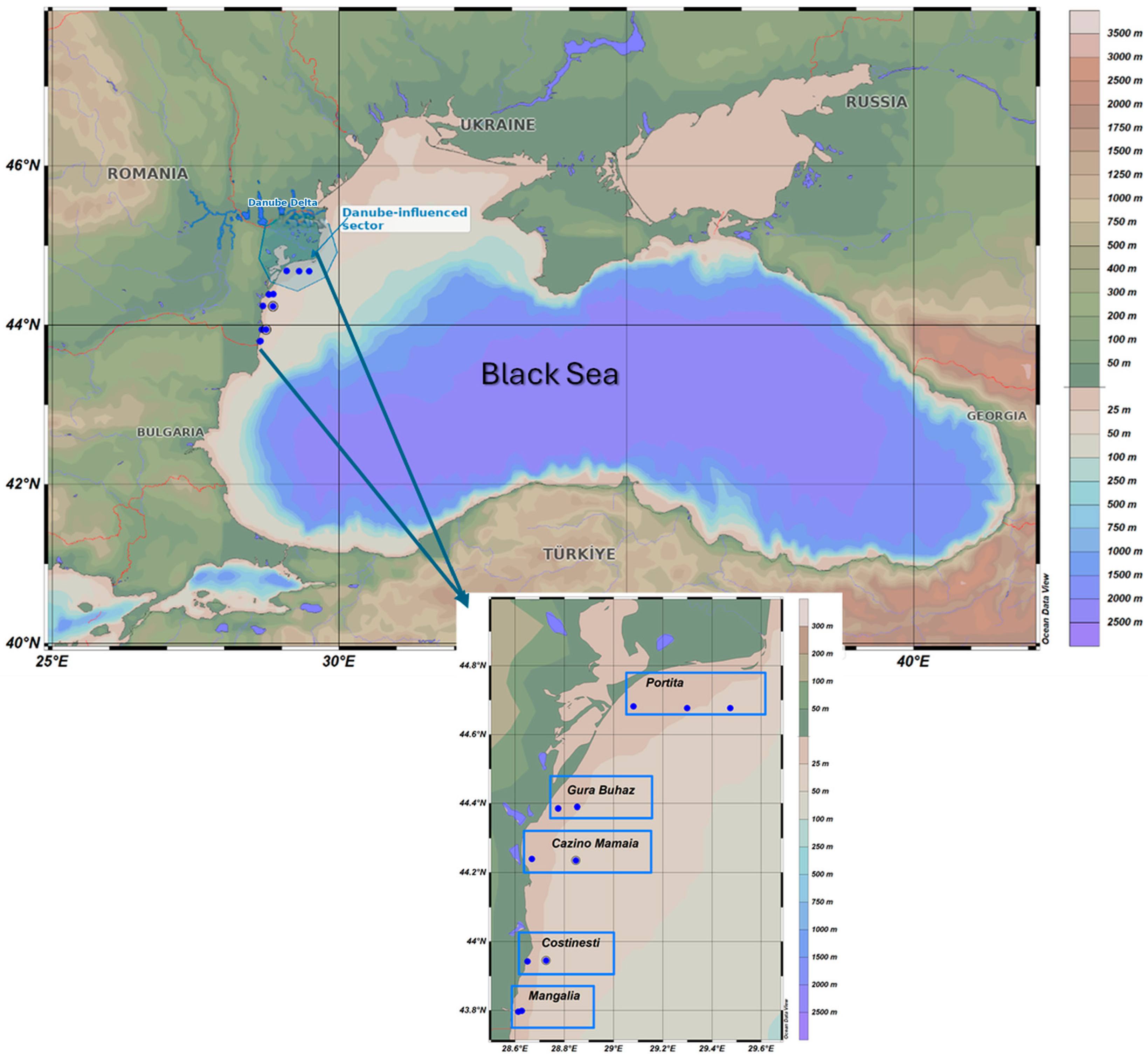


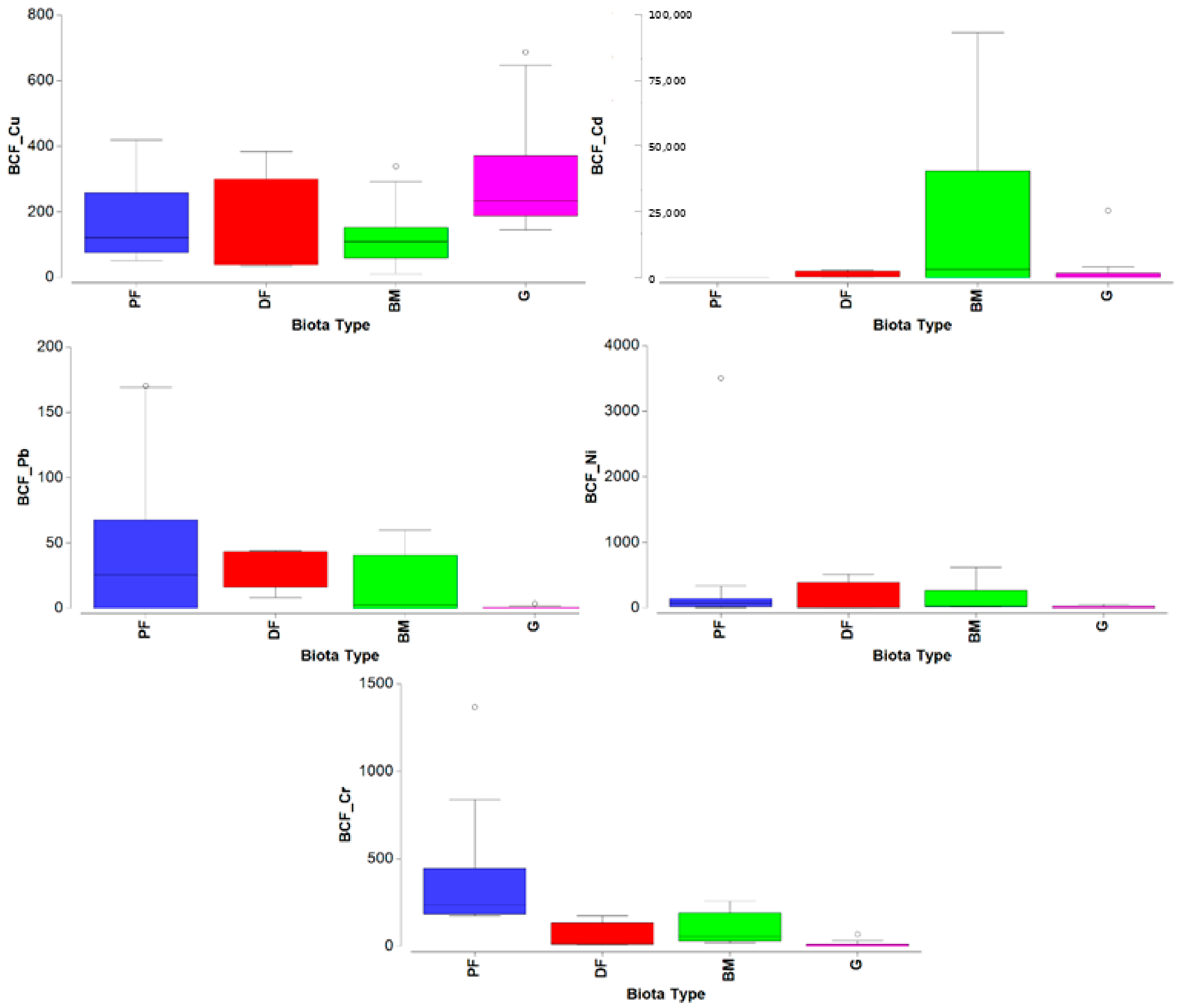


| No. | Species | Transect | Station Code | Station Type | Biota Type | Sampling Date | Bottom Depth (m) |
|---|---|---|---|---|---|---|---|
| 1 | Mullus barbatus (Linnaeus, 1758) | Portița | P10 | T | DF | 23/7/2024 | 10 |
| 2 | Alosa tanaica (Grimm, 1901) | Portița | P10 | T | PF | 23/7/2024 | 10 |
| 3 | Engraulis encrasicolus (Linnaeus, 1758) | Portița | P10 | T | PF | 23/7/2024 | 10 |
| 4 | Sprattus sprattus (Linnaeus, 1758) | Portița | P10 | T | PF | 23/7/2024 | 10 |
| 5 | Sprattus sprattus (Linnaeus, 1758) | Portița | P20 | T | PF | 22/7/2024 | 20 |
| 6 | Trachurus mediterraneus ponticus (Aleev, 1956) | Gura Buhaz | GB10 | C | PF | 8/8/2024 | 10 |
| 7 | Trachurus mediterraneus ponticus (Aleev, 1956) | Gura Buhaz | GB10 | C | PF | 27/9/2024 | 10 |
| 8 | Mytilus galloprovincialis (Lamarck, 1819) | Gura Buhaz | GB20 | C | BM | 1/6/2024 | 20 |
| 9 | Rapana venosa (Valenciennes, 1846) | Gura Buhaz | GB20 | C | G | 1/6/2024 | 20 |
| 10 | Rapana venosa (Valenciennes, 1846) | Gura Buhaz | GB20 | C | G | 28/6/2024 | 20 |
| 11 | Mullus barbatus (Linnaeus, 1758) | Cazino Mamaia | CM10 | C | DF | 10/10/2024 | 10 |
| 12 | Neogobius melanostomus (Pallas, 1814) | Cazino Mamaia | CM10 | C | DF | 12/7/2024 | 10 |
| 13 | Atherina boyeri (Risso, 1810) | Costinești | COS10 | C | PF | 28/6/2024 | 10 |
| 14 | Engraulis encrasicolus (Linnaeus, 1758) | Costinești | COS10 | C | PF | 7/8/2024 | 10 |
| 15 | Mytilus galloprovincialis (Lamarck, 1819) | Mangalia | MAN10 | C | BM | 25/7/2024 | 10 |
| 16 | Rapana venosa (Valenciennes, 1846) | Mangalia | MAN20 | C | G | 1/6/2024 | 20 |
| 17 | Anadara kagoshimensis (Tokunaga, 1906) | Mangalia | MAN20 | C | BM | 1/6/2024 | 20 |
| 18 | Anadara kagoshimensis (Tokunaga, 1906) | Portița | P30 | M | BM | 1/6/2024 | 30 |
| 19 | Mytilus galloprovincialis (Lamarck, 1819) | Portița | P30 | M | BM | 24/7/2024 | 30 |
| 20 | Rapana venosa (Valenciennes, 1846) | Portița | P30 | M | G | 1/6/2024 | 30 |
| 21 | Anadara kagoshimensis (Tokunaga, 1906) | Cazino Mamaia | CM30 | M | BM | 1/6/2024 | 30 |
| 22 | Rapana venosa (Valenciennes, 1846) | Cazino Mamaia | CM30 | M | G | 1/6/2024 | 30 |
| 23 | Anadara kagoshimensis (Tokunaga, 1906) | Costinești | COS30 | M | BM | 1/6/2024 | 30 |
| 24 | Rapana venosa (Valenciennes, 1846) | Costinești | COS30 | M | G | 1/6/2024 | 30 |
| Metal | BM | G | PF | DF | H | p | ε2 | Significant Dunn–Holm Pairs |
|---|---|---|---|---|---|---|---|---|
| Cd | 1.046 [0.655] | 0.171 [0.252] | 0.048 [0.028] | 0.043 [0.014] | 15.638 | 0.0013 | 0.632 | BM vs. PF (BM higher) (pHolm = 0.0031); BM vs. DF (BM higher) (pHolm = 0.0090) |
| Cr | 0.205 [0.269] | 0.006 [0.026] | 0.439 [0.030] | 0.432 [0.096] | 9.490 | 0.0234 | 0.324 | PF vs. G (PF higher) (pHolm = 0.0220) |
| Cu | 1.619 [0.638] | 3.645 [0.666] | 1.394 [2.317] | 2.276 [1.693] | 7.780 | 0.0508 | 0.239 | Not performed (overall p > 0.05) |
| Ni | 0.631 [0.332] | 0.061 [0.139] | 0.527 [0.790] | 0.248 [0.628] | 6.371 | 0.0949 | 0.169 | Not performed (overall p > 0.05) |
| Pb | 0.232 [0.220] | 0.001 [0.002] | 0.052 [0.112] | 0.039 [0.043] | 9.898 | 0.0194 | 0.345 | BM vs. G (BM higher) (pHolm = 0.0103) |
| Transect | Station Code | Bottom Depth [m] | Cu (µg/L) | Cd (µg/L) | Pb (µg/L) | Ni (µg/L) | Cr (µg/L) |
|---|---|---|---|---|---|---|---|
| Portita | P10 | 10 | 13.159 | <LOQ * | 2.135 | 2.873 | 2.491 |
| Portita | P20 | 20 | 12.498 | <LOQ * | 2.084 | 7.446 | 2.303 |
| Portita | P30 | 30 | 28.674 | 0.010 | 4.491 | 30.235 | 2.844 |
| Gura Buhaz | GB10 | 10 | 10.305 | <LOQ * | <LOD * | 5.202 | 0.970 |
| Gura Buhaz | GB20 | 20 | 16.472 | 0.023 | 6.322 | 5.903 | 0.893 |
| Cazino Mamaia | CM10 | 10 | 46.908 | 0.010 | 0.942 | 27.658 | 37.678 |
| Cazino Mamaia | CM30 | 30 | 5.335 | 0.241 | 25.067 | 1.907 | 7.955 |
| Costinesti | COS10 | 10 | 9.883 | <LOQ * | 1.573 | 16.204 | 0.979 |
| Costinesti | COS30 | 30 | 27.371 | <LOQ * | <LOD * | 19.235 | 16.506 |
| Mangalia | MAN10 | 10 | 9.059 | <LOQ * | <LOD * | 1.055 | 1.822 |
| Mangalia | MAN20 | 20 | 7.479 | <LOD * | <LOD * | 3.086 | 1.138 |
| Metal | BM | G | PF | DF | H | p | ε2 | Significant Dunn–Holm Pairs |
|---|---|---|---|---|---|---|---|---|
| Cu | 109.56 [61.52–143.94] | 234.27 [196.45–341.01] | 121.00 [81.24–248.65] | 48.53 [42.02–216.24] | 5.352 | 0.1478 | 0.118 | None |
| Cd * | 45,166.09 [11,437.89–92,473.50] | 2056.52 [1449.15–11,396.09] | — | 3031.25 [2403.12–3659.38] | 4.555 | 0.1026 | 0.365 | None |
| Pb | 30.02 [6.94–53.63] | 0.37 [0.03–1.44] | 44.92 [17.40–77.87] | 40.95 [24.56–42.54] | 7.071 | 0.0697 | 0.313 | None |
| Ni | 33.75 [23.68–243.48] | 4.51 [1.01–21.61] | 78.97 [18.21–132.33] | 8.98 [8.54–261.97] | 6.408 | 0.0934 | 0.170 | None |
| Cr | 55.06 [36.32–145.74] | 5.60 [0.19–12.32] | 234.97 [188.28–443.14] | 13.96 [11.41–93.64] | 15.638 | 0.001345 | 0.632 | G vs. PF (PF higher), pHolm = 0.000879 |
| Transect | Station Code | Bottom Depth [m] | Cu (µg/g dw) | Cd (µg/g dw) | Pb (µg/g dw) | Ni (µg/g dw) | Cr (µg/g dw) |
|---|---|---|---|---|---|---|---|
| Portita | P10 | 10 | 4.488 | 0.018 | 3.674 | 10.662 | 16.699 |
| Portita | P20 | 20 | 18.044 | 0.088 | 14.027 | 23.594 | 27.815 |
| Portita | P30 | 30 | 29.587 | 0.093 | 22.463 | 46.232 | 42.317 |
| Gura Buhaz | GB10 | 10 | 12.736 | 0.033 | 4.934 | 10.226 | 14.966 |
| Gura Buhaz | GB20 | 20 | 16.490 | 0.051 | 12.024 | 16.454 | 20.973 |
| Cazino Mamaia | CM10 | 10 | 8.310 | 0.214 | 38.673 | 11.544 | 18.030 |
| Cazino Mamaia | CM30 | 30 | 26.996 | 0.100 | 22.296 | 42.967 | 163.854 |
| Costinesti | COS10 | 10 | 6.738 | 0.021 | 5.273 | <LOD ** | 13.682 |
| Costinesti | COS30 | 30 | 4.066 | <LOD * | 2.321 | 3.750 | 11.622 |
| Mangalia | MAN10 | 10 | 6.488 | 0.015 | 4.397 | 10.150 | 13.773 |
| Mangalia | MAN20 | 20 | 7.383 | 0.077 | 14.863 | 12.448 | 19.758 |
| Metal | BM | G | PF | DF | H | p | ε2 | Significant Dunn–Holm Pairs |
|---|---|---|---|---|---|---|---|---|
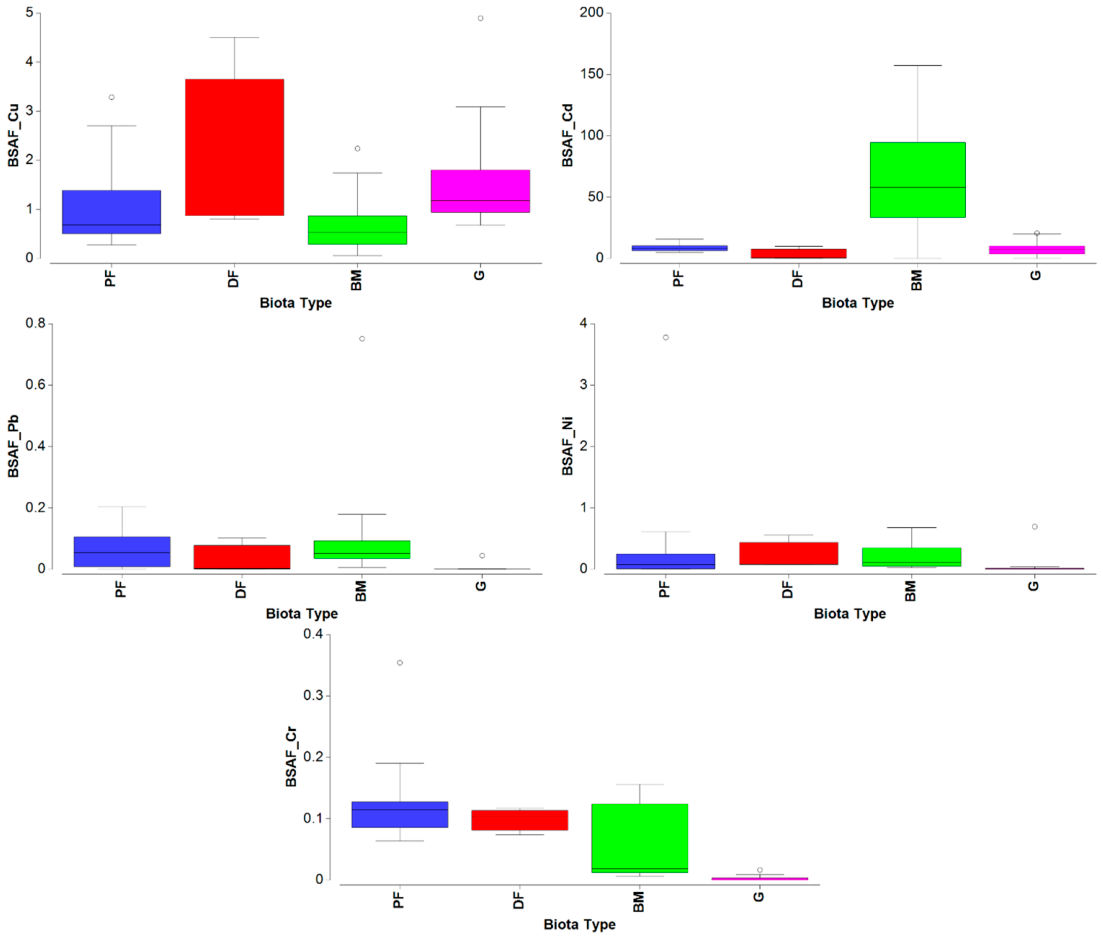
| Cu | 0.5309 [0.3044–0.8512] | 1.1788 [0.9812–1.6661] | 0.6857 [0.5621–1.3706] | 1.0957 [0.9489–2.7994] | 5.446 | 0.1419 | 0.122 | None |
| Cd | 66.7463 [45.5604–94.5340] | 9.1984 [5.4902–10.2474] | 8.0252 [7.0689–9.7063] | 0.8014 [0.5666–5.3734] | 13.641 | 0.0034 | 0.591 | BM vs. DF (BM higher), pHolm = 0.0095; BM vs. PF (BM higher), pHolm = 0.0138 |
| Pb | 0.0516 [0.0405–0.0818] | 0.000257 [0.000083–0.000642] | 0.0545 [0.00927–0.1036] | 0.00399 [0.00239–0.0533] | 9.562 | 0.0227 | 0.328 | BM vs. G (BM higher), pHolm = 0.0252 |
| Ni | 0.1104 [0.0560–0.3405] | 0.00886 [0.00127–0.0156] | 0.1357 [0.0583–0.3021] | 0.0860 [0.0818–0.3205] | 5.950 | 0.1141 | 0.164 | None |
| Cr | 0.0185 [0.0126–0.1114] | 0.00140 [0.000059–0.00344] | 0.1145 [0.0948–0.1268] | 0.1034 [0.0887–0.1100] | 13.170 | 0.0043 | 0.508 | G vs. PF (PF higher), pHolm = 0.0024 |
Disclaimer/Publisher’s Note: The statements, opinions and data contained in all publications are solely those of the individual author(s) and contributor(s) and not of MDPI and/or the editor(s). MDPI and/or the editor(s) disclaim responsibility for any injury to people or property resulting from any ideas, methods, instructions or products referred to in the content. |
© 2026 by the authors. Licensee MDPI, Basel, Switzerland. This article is an open access article distributed under the terms and conditions of the Creative Commons Attribution (CC BY) license.
Share and Cite
Oros, A.; Galațchi, M.; Țiganov, G. Environmental Exposure and Bioaccumulation of Potentially Toxic Elements in Fishery Resources from the Romanian Black Sea and Implications for Seafood Safety. Environments 2026, 13, 336. https://doi.org/10.3390/environments13060336
Oros A, Galațchi M, Țiganov G. Environmental Exposure and Bioaccumulation of Potentially Toxic Elements in Fishery Resources from the Romanian Black Sea and Implications for Seafood Safety. Environments. 2026; 13(6):336. https://doi.org/10.3390/environments13060336
Chicago/Turabian StyleOros, Andra, Mădălina Galațchi, and George Țiganov. 2026. "Environmental Exposure and Bioaccumulation of Potentially Toxic Elements in Fishery Resources from the Romanian Black Sea and Implications for Seafood Safety" Environments 13, no. 6: 336. https://doi.org/10.3390/environments13060336
APA StyleOros, A., Galațchi, M., & Țiganov, G. (2026). Environmental Exposure and Bioaccumulation of Potentially Toxic Elements in Fishery Resources from the Romanian Black Sea and Implications for Seafood Safety. Environments, 13(6), 336. https://doi.org/10.3390/environments13060336