

Atmospheric Fourier Transform Infrared Monitoring of Ammonia and Ethylene near the Saint Petersburg Agglomeration (Russia)

 ,
,  ,
,
Abstract
1. Introduction
- -
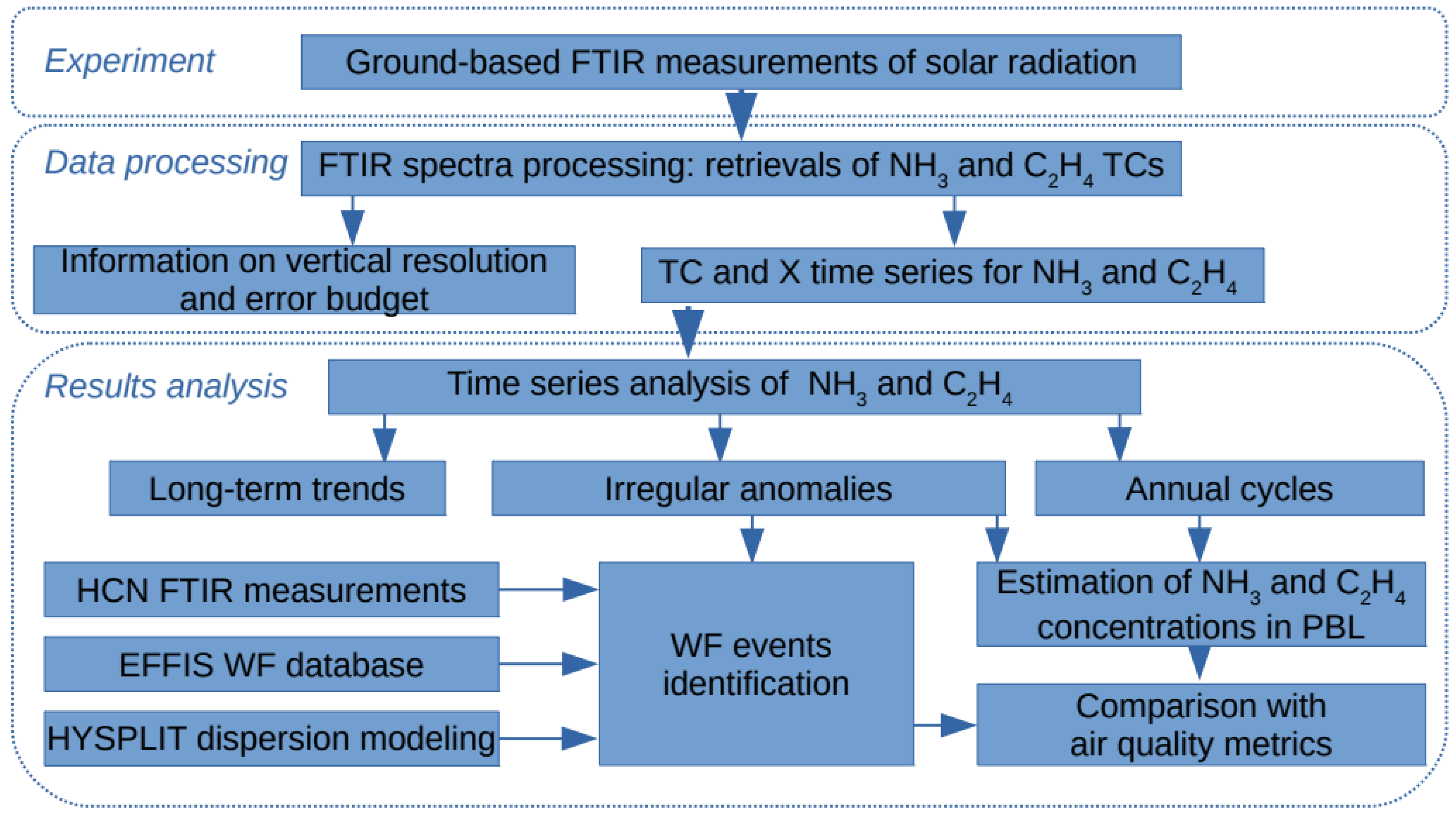
- to present the strategies that are used to retrieve the NH3 and C2H4 total column (TC) in the atmosphere from high-resolution Fourier Transform Infrared (FTIR) spectra of direct solar radiation recorded at the St. Petersburg State University (SPbU) atmospheric monitoring station;
- -
- to analyze the uncertainty budget of the retrieved NH3 and C2H4 TCs;
- -
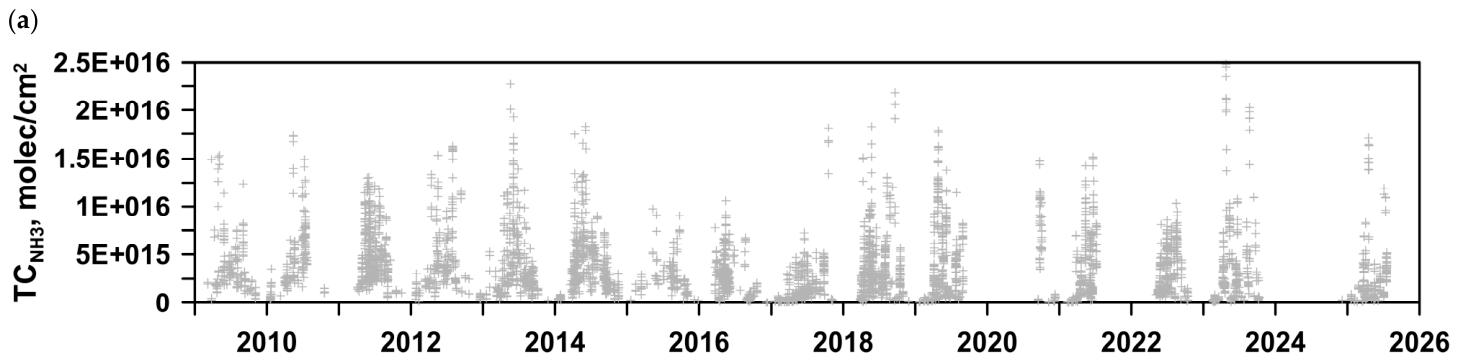
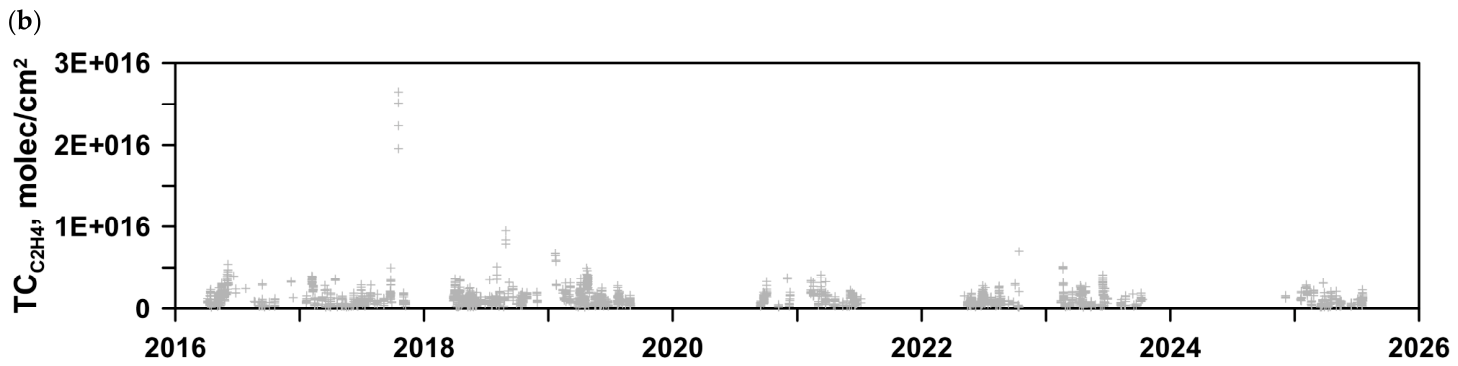
- to analyze the long-term trend, annual cycle and anomalies of NH3 and C2H4 using results of the long-term atmospheric FTIR monitoring of ammonia and ethylene (2009–2025) conducted in the suburbs of St. Petersburg which is the fourth-largest city in Europe with the population ~5.7 million people;
- -
- to compare results of NH3 and C2H4 FTIR monitoring at the SPbU site with air quality standards and metrics applied for human health (national) and sensitive ecosystem state (international).
2. Materials and Methods
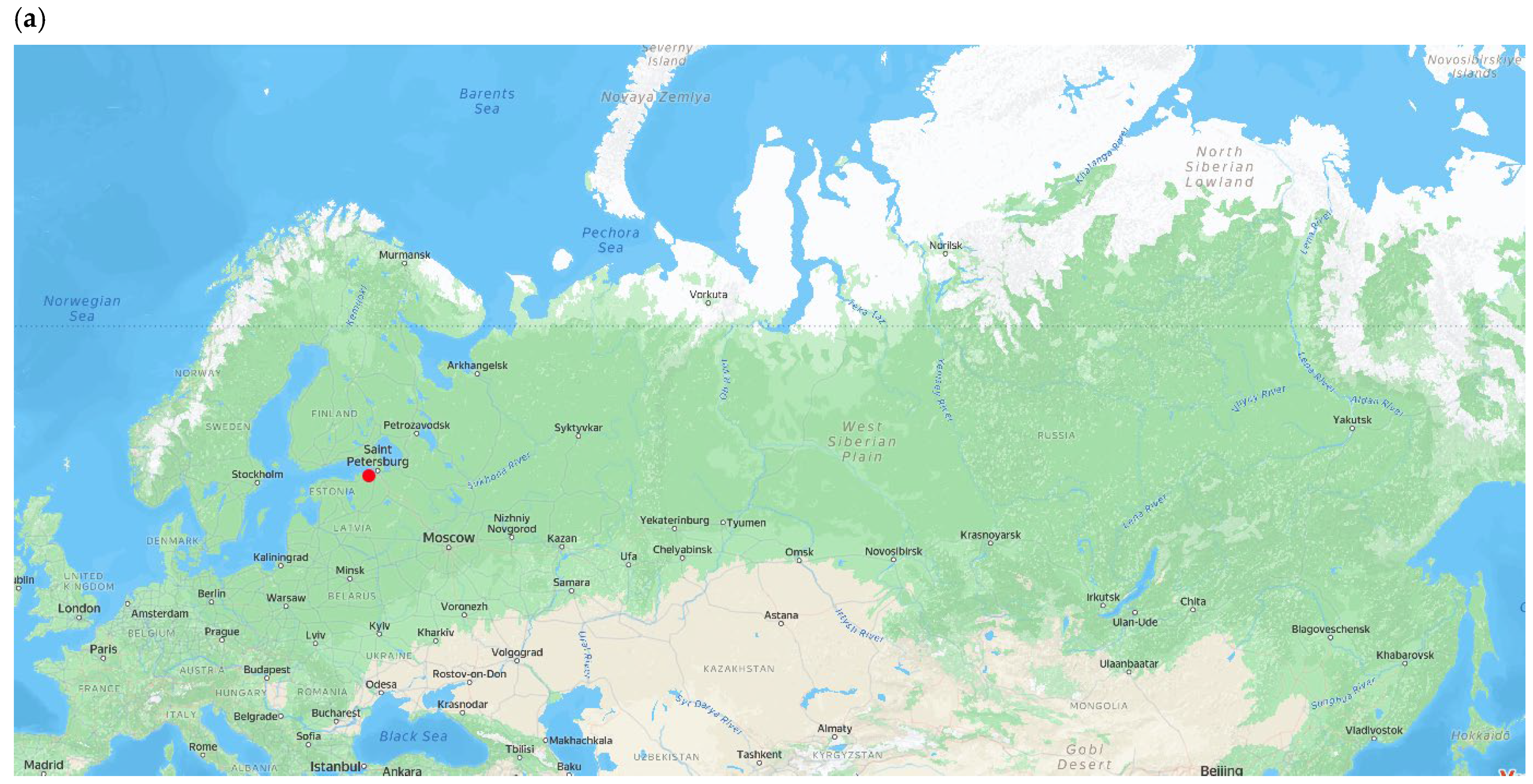
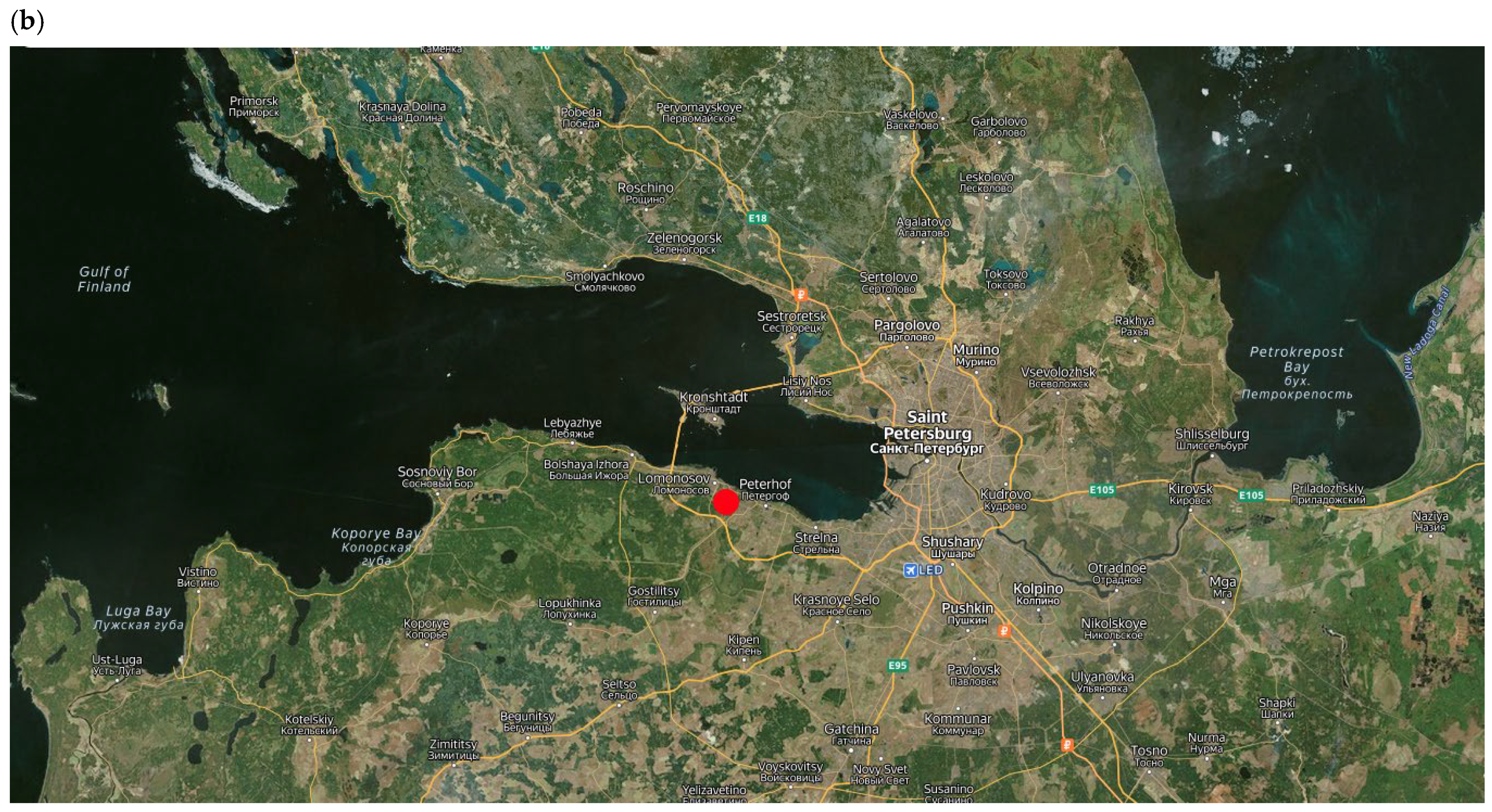
2.1. Description of SPbU Observational Site
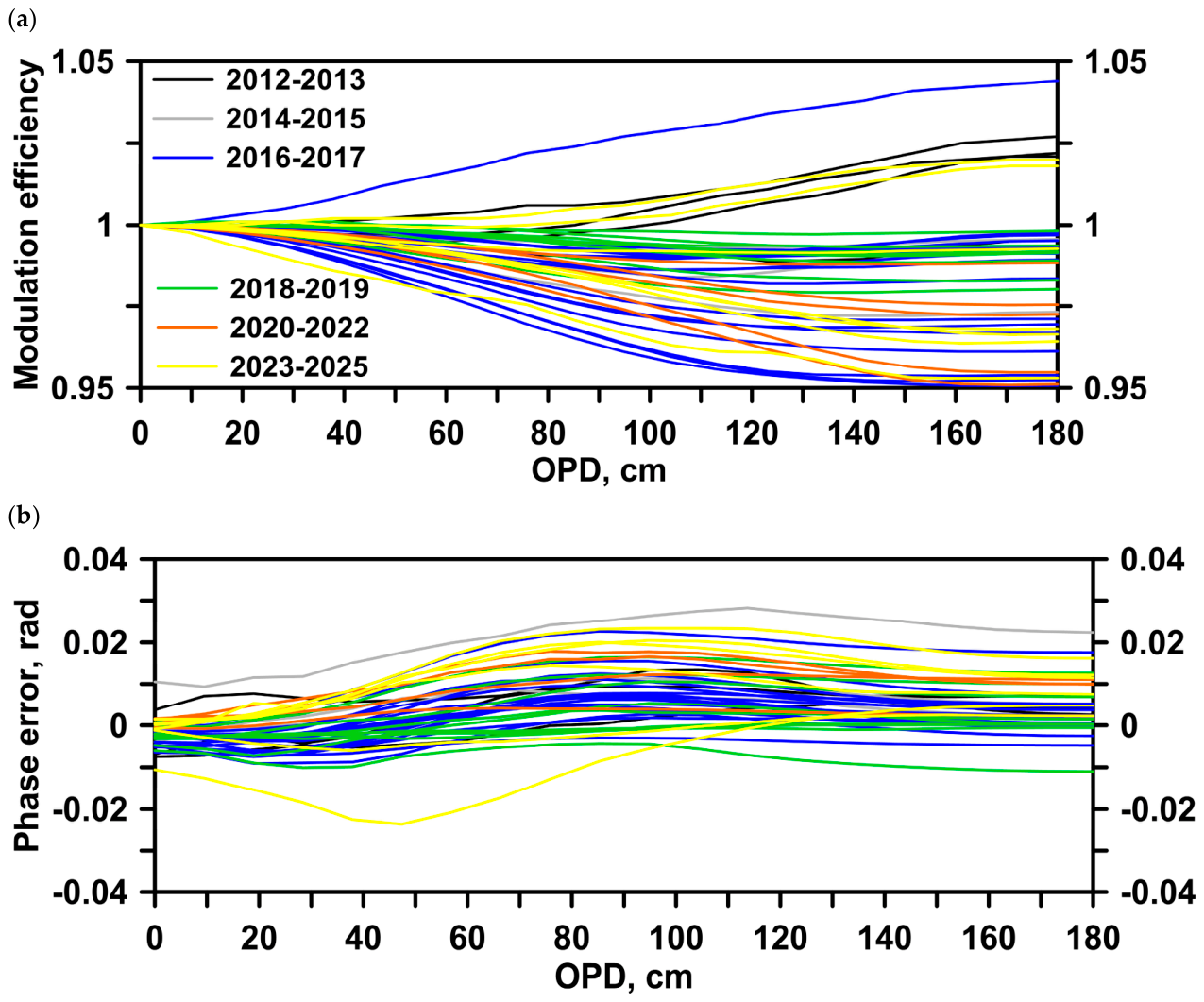
2.2. FTIR System
- -
- the Bruker IFS125 HR high-resolution Fourier transform spectrometer (FTS) (Bruker, Billerica, MA, USA) installed in a thermostatted room. The highest spectral resolution of the Bruker IFS 125HR is Δν = 0.0019 cm−1;
- -
- the original solar tracking system developed at the Dept. of Atmospheric Physics of St. Petersburg State University.
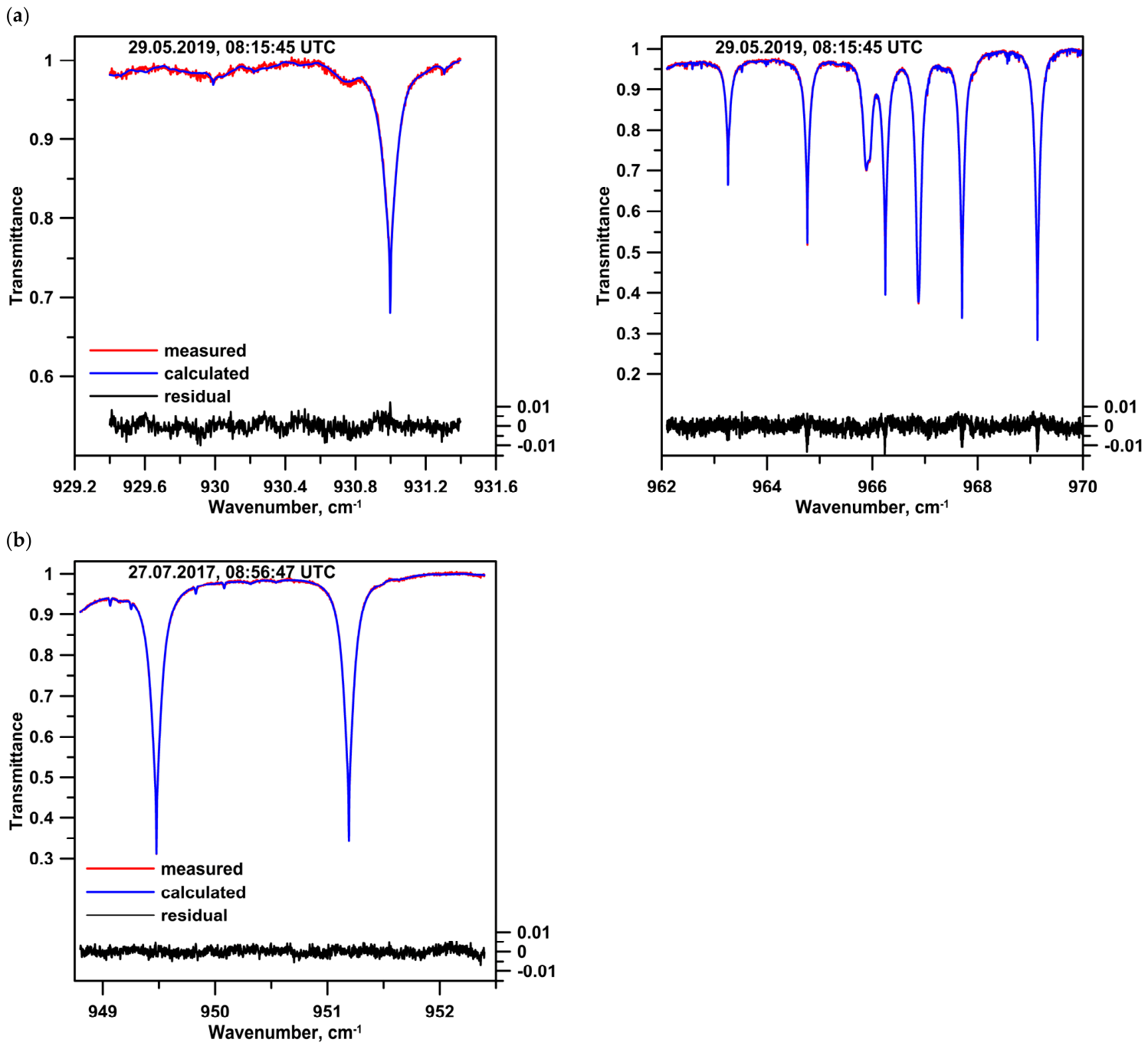
2.3. Processing FTIR Spectra
- (1)
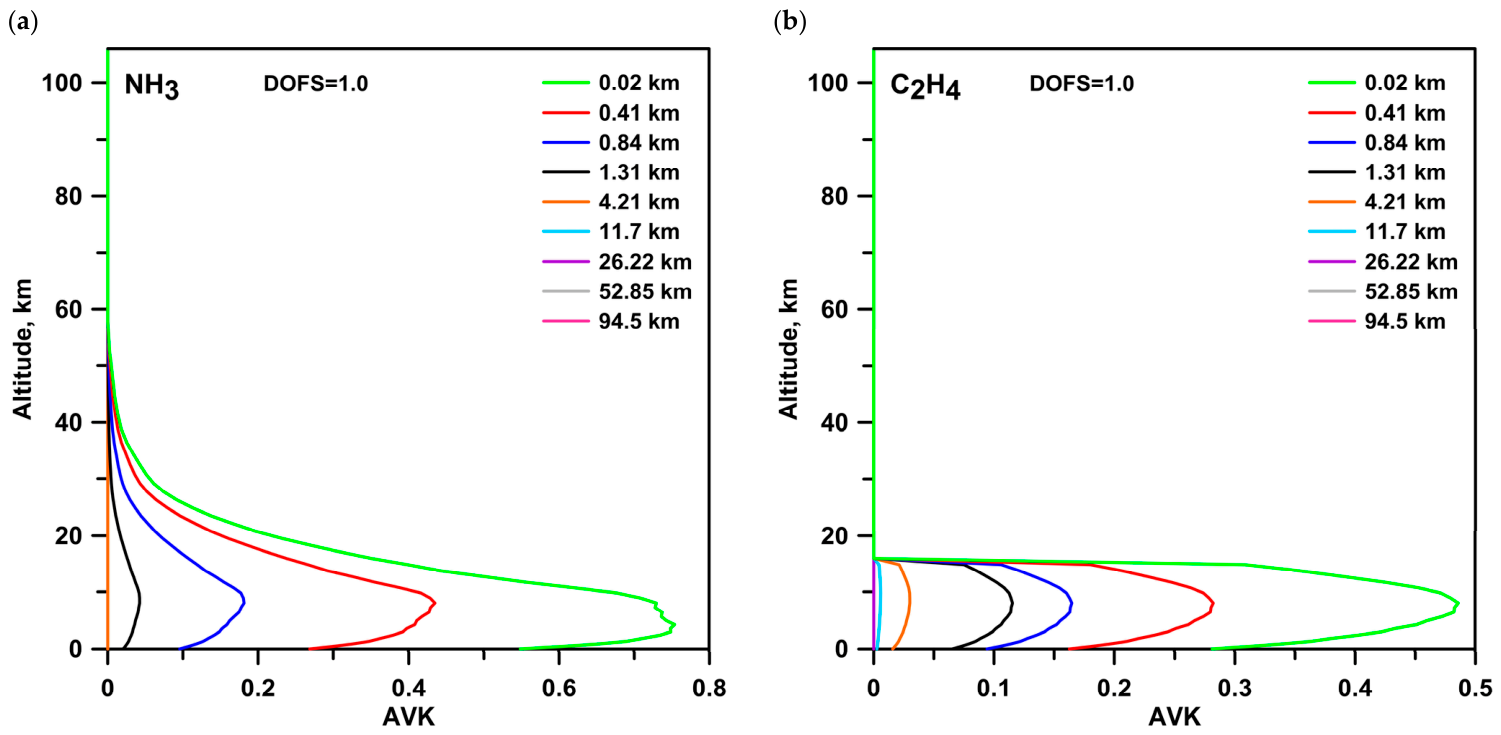
- A priori vertical distributions of NH3 and the corresponding a priori covariance matrices were formed based on simulations of the GEOS-CHEM model [10]. For C2H4, as well as interfering components (indicated in column 4 of Table 3), we used the data from the global chemical-transport atmospheric model WACCM v.6 (Whole Atmosphere Community Climate Model) [29].
- (2)
- The NOAA/NWS/National Centers for Environmental Prediction (NCEP) data on temperature profiles and geopotential heights at 18 levels from 1000 mb to 0.4 mb were used as input information on atmospheric temperature and pressure (https://www-air.larc.nasa.gov/missions/ndacc/data.html?NCE12.00UTCP=ncep-list data access up to 10 April 2026 and https://www-air.larc.nasa.gov/missions/ndacc/data.html?NCEP_GFS=gfs-list data access after April 2025; accessed on 10 April 2026).
- (3)
2.4. Primary Data Analysis and Error Budget
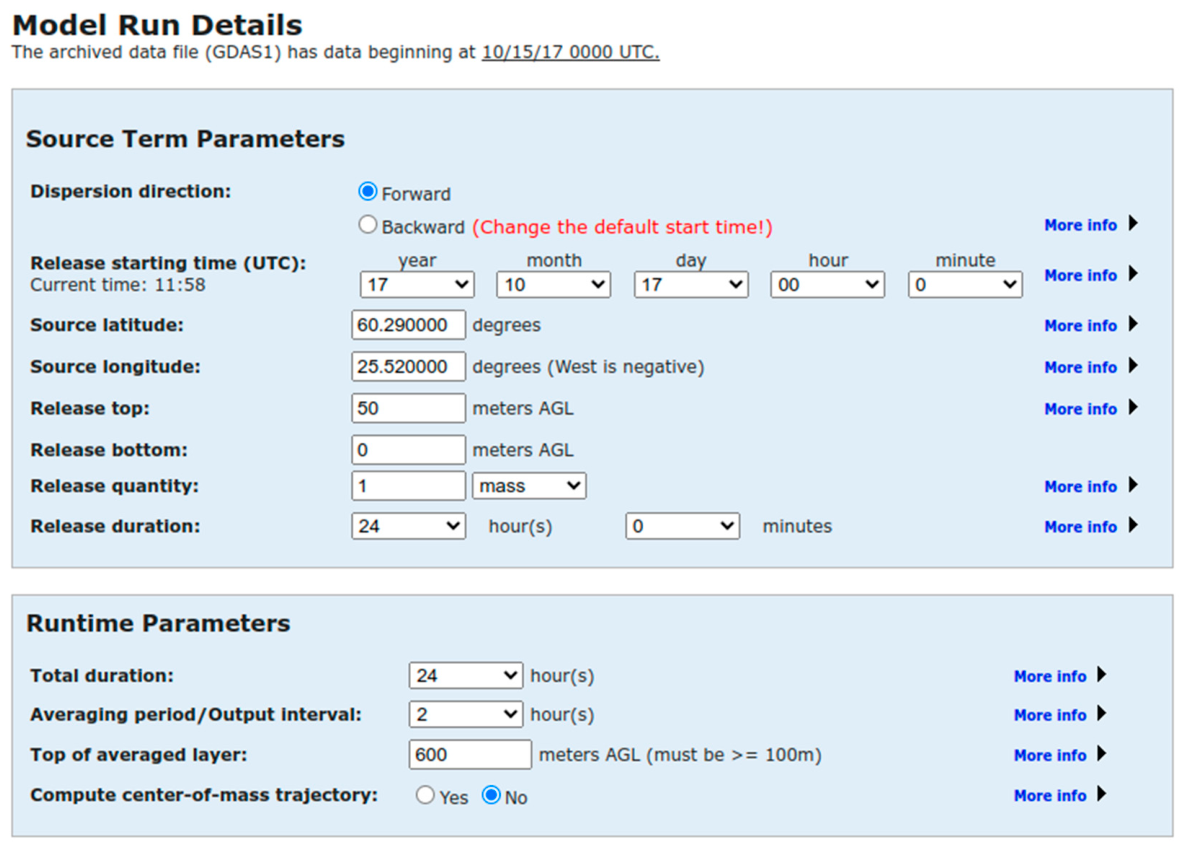
2.5. Atmospheric Dispersion Modeling
- -
- Trajectory analysis: model computes forward air mass trajectories to determine/forecast the path of pollutant, and backward trajectories to track an air mass back in time to establish its source-receptor relationship;
- -
- Atmospheric dispersion modeling: the model simulates pollutant mass distribution by releasing it as point-mass particles, growing 3D cylindrical puffs, or a hybrid combination of both;
- -
- Advanced Physics: the model incorporates horizontal and vertical complex wind shear, vertical diffusivity profiles, chemical transformation, radioactive decay, and dry or wet deposition;
- -
- Meteorological flexibility: the model utilizes previously gridded, pre-processed regional or global binary meteorological data from agencies like NCEP, utilizing either historical archives or future forecast fields.
3. Results Analysis and Discussion
3.1. Long-Term Trends
- -
- preliminary analysis of the XGAS time series including filtering of outliers;
- -
- harmonic analysis of the roughly detrended non-even XGAS time series using the Lomb–Scargle technique followed by estimation of the optimal number of harmonics (N) using the cross-validation method. Here we assume that XGAS time series can be approximated as a model function FX = “linear trend + N harmonics”:
- -
- estimation of the XGAS linear trend and its uncertainty using bootstrapping technique.
3.2. Annual Cycle
- (1)
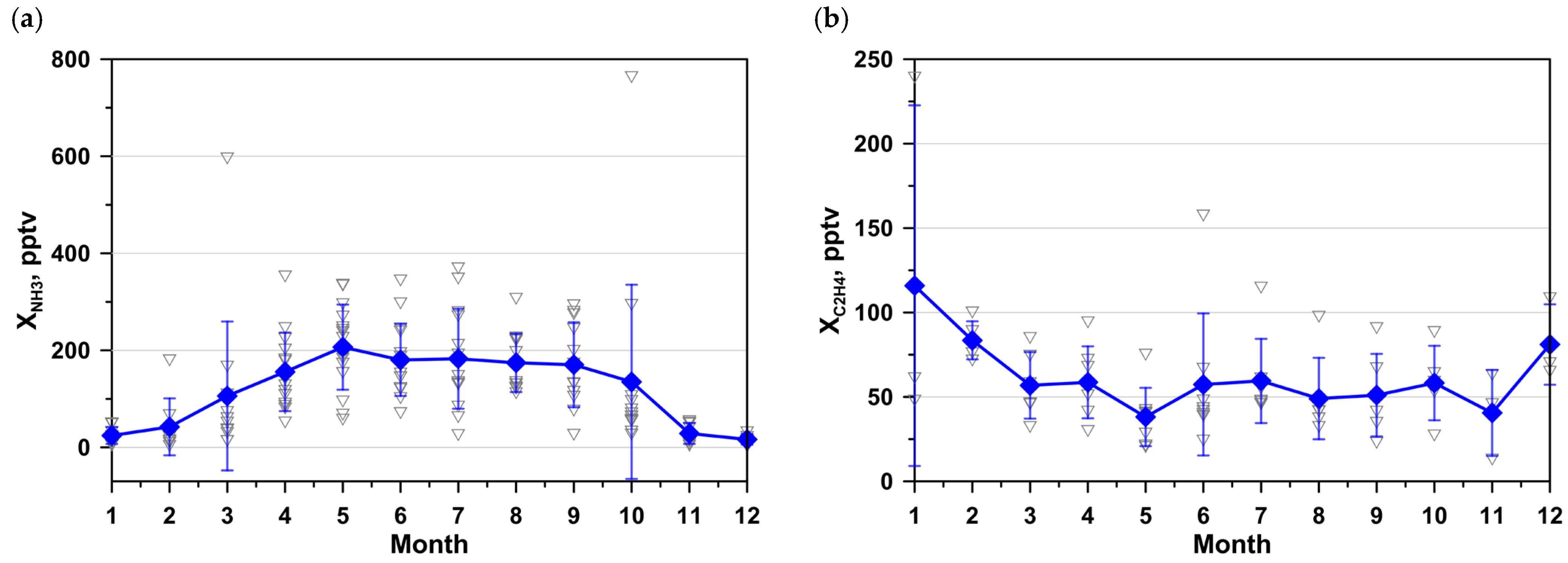
- The average amplitude of the XNH3 annual cycle is ~95 pptv; the maximum of XNH3 is observed in the warm season with a peak ~207 pptv in May, the minimum—in winter (~16 pptv in December). On average, the relative monthly variability of XNH3 is 30–70% and the most significant variations in XNH3 were observed in March and October. This nature of the XNH3 annual cycle is due to the influence of spring-summer emissions from agricultural production in the nearby region, since livestock and crop production are responsible for ~70–80% of the total ammonia input into the atmosphere, as well as emissions from wildfires [3].
- (2)
- The average amplitude of the XC2H4 annual cycle is ~40 pptv; the peak of XC2H4 occurs in January (~116 pptv), while the minimum can be observed in different months of the warm season. In our case, the minimum was usually registered in May (~38 pptv). The highest variability of XC2H4 was observed in June. Such ethylene variability throughout the year is caused by the seasonal dependence of the main mechanism for removing C2H4 from the troposphere, which is the reaction of C2H4 with the hydroxyl radical OH.
3.3. Anomalies Analysis
- -
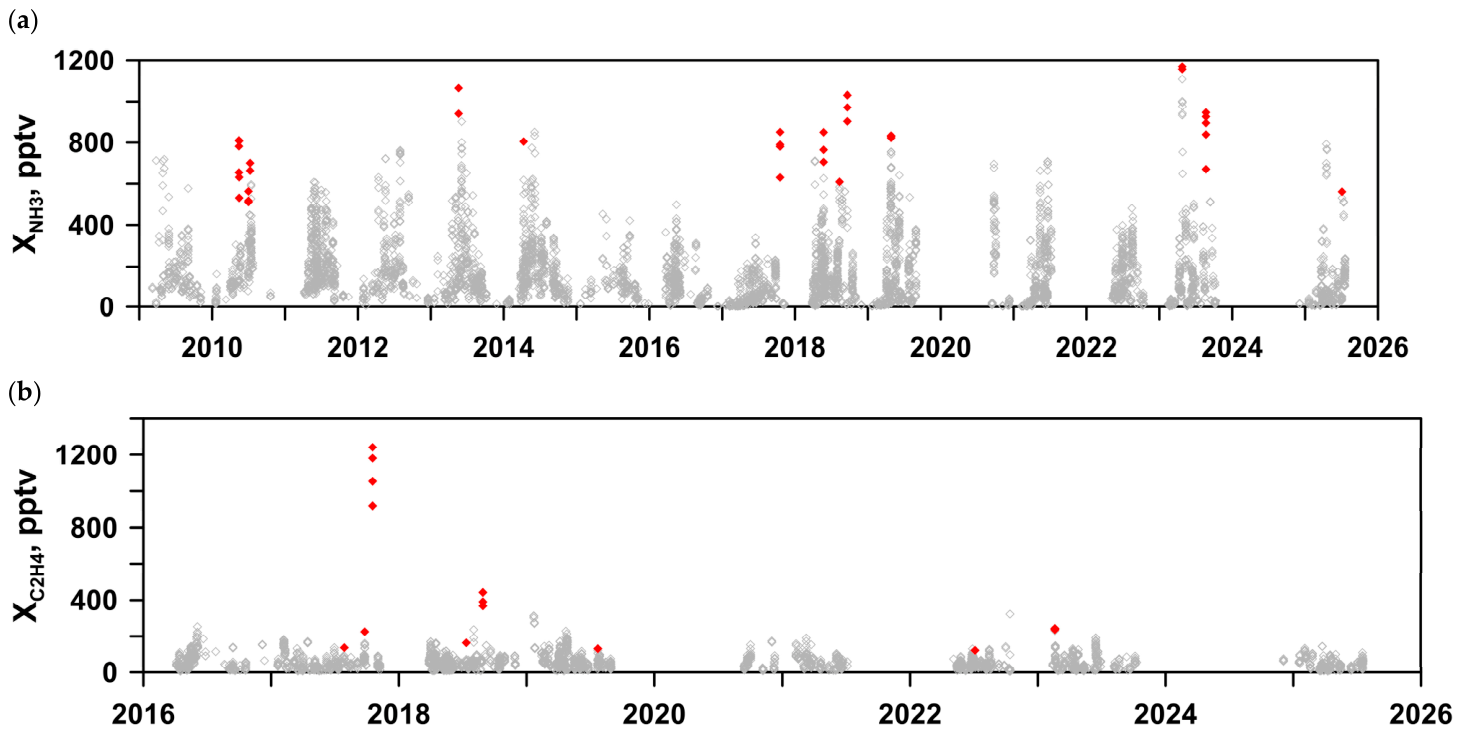
- the XGAS value must exceed the “monthly mean XGAS value + 3σ” level, where σ is the standard deviation (for the corresponding monthly period);
- -
- during the measurement day, anomalously high XGAS values must be observed at least twice (we did not consider isolated anomaly of XGAS as it may be an outlier), or high XGAS values must be observed on nearby dates.
- -
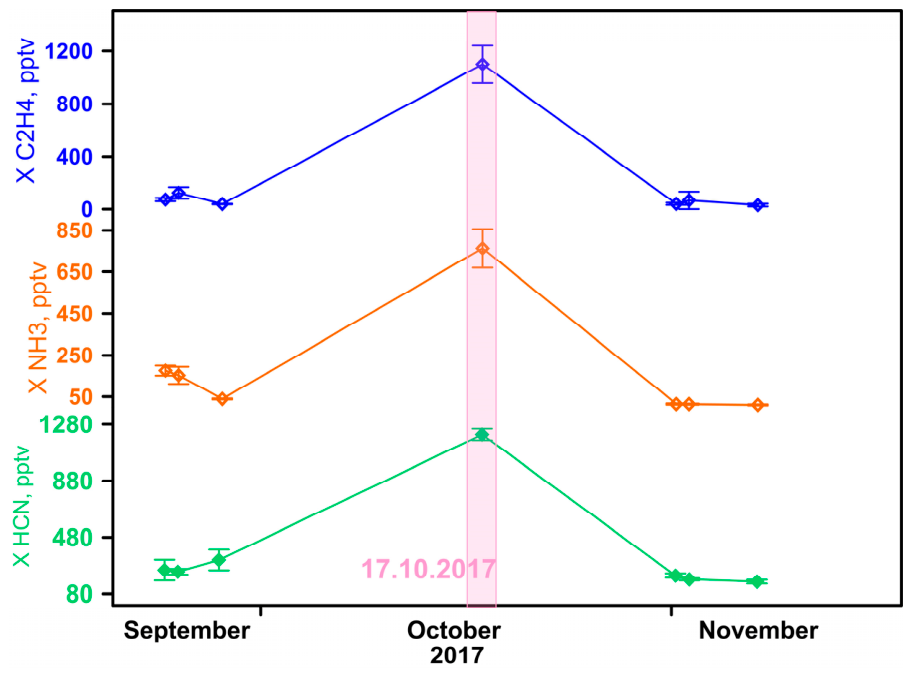
- Only one event was recorded during the cold season (November–March), this case is exclusively XC2H4 anomalies;
- -
- A total of 20 events, 14 of which were XNH3 anomalies, were recorded during the warm season from April to October;
- -
- About 30% (7 events) of the total number of NH3 anomalies were detected in April–May.
- -
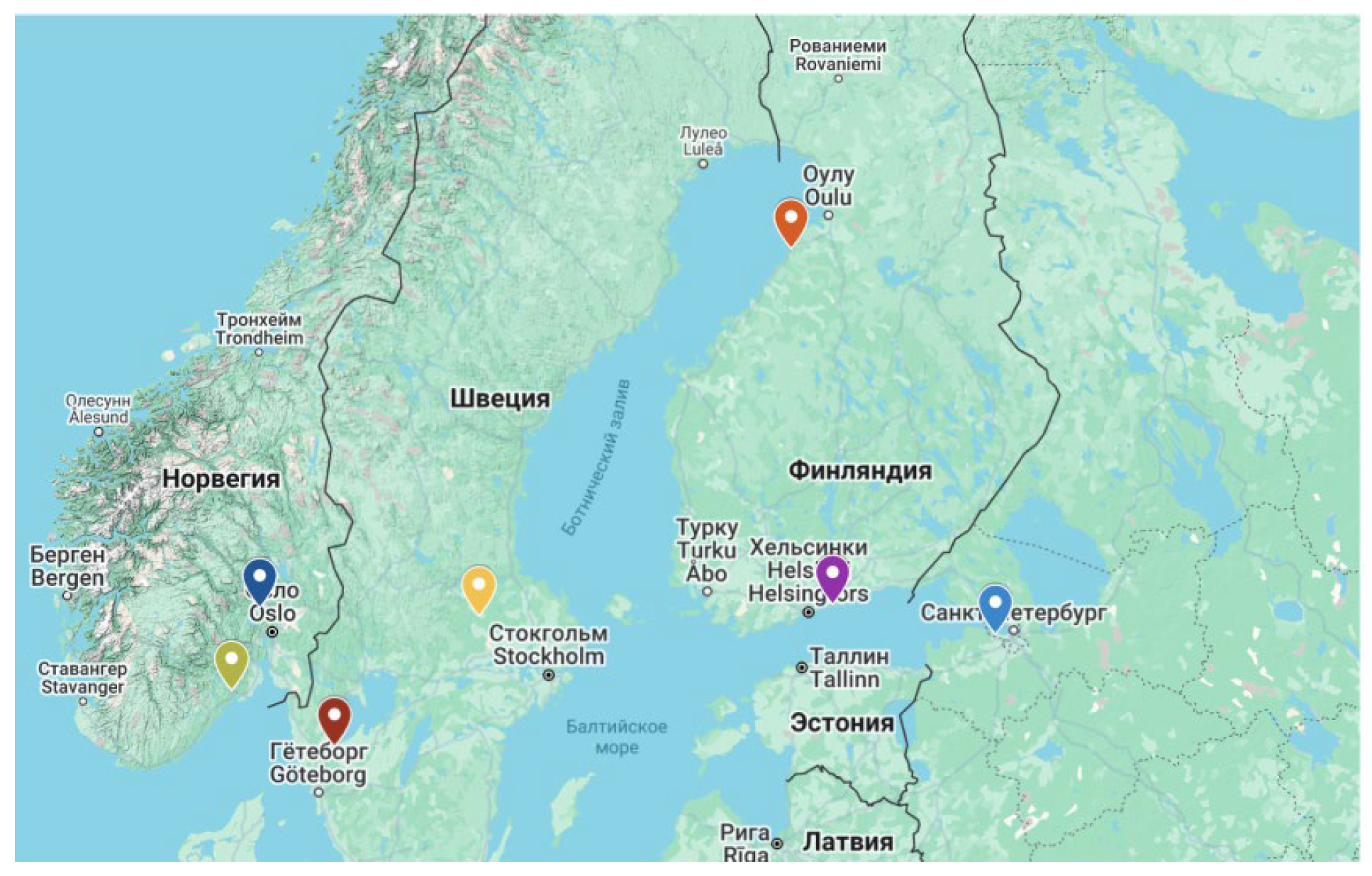
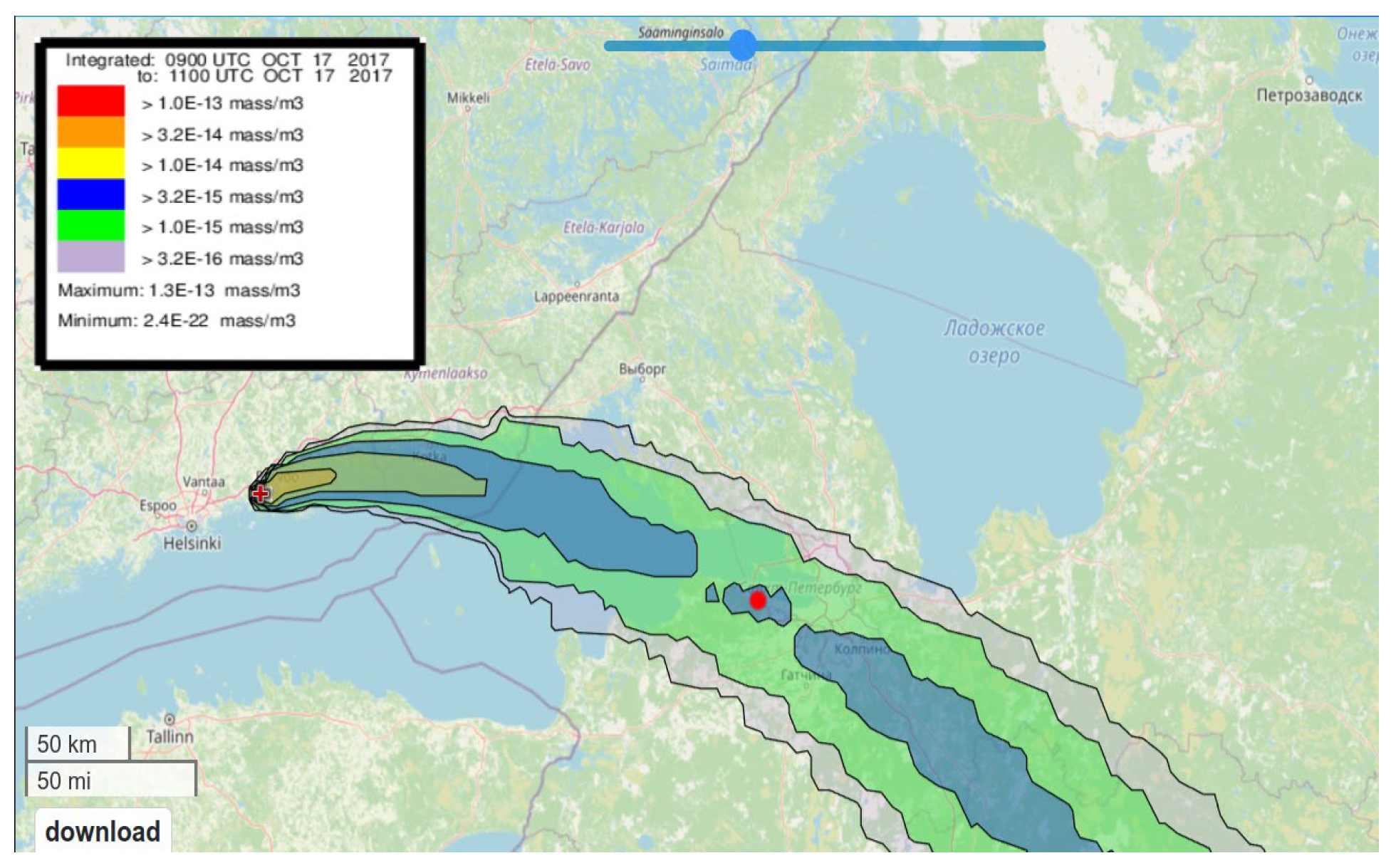
- In Sweden, 14 fires were recorded, including three of them near 58.35° N, 12.37° E and four of them near 60.13° N, 16.17° E;
- -
- In Finland, 10 fires were recorded, localized in the areas of 60.29° N, 25.52° E and 64.64° N, 24.42° E;
- -
- In Norway, 2 fires were recorded: at 60.23° N, 10.35° E and 59.12° N, 9.61° E, with the peak of fires occurring on 16–17 October.
3.4. Air Quality Metrics in Comparison with the Results of NH3 and C2H4 FTIR Monitoring
- (1)
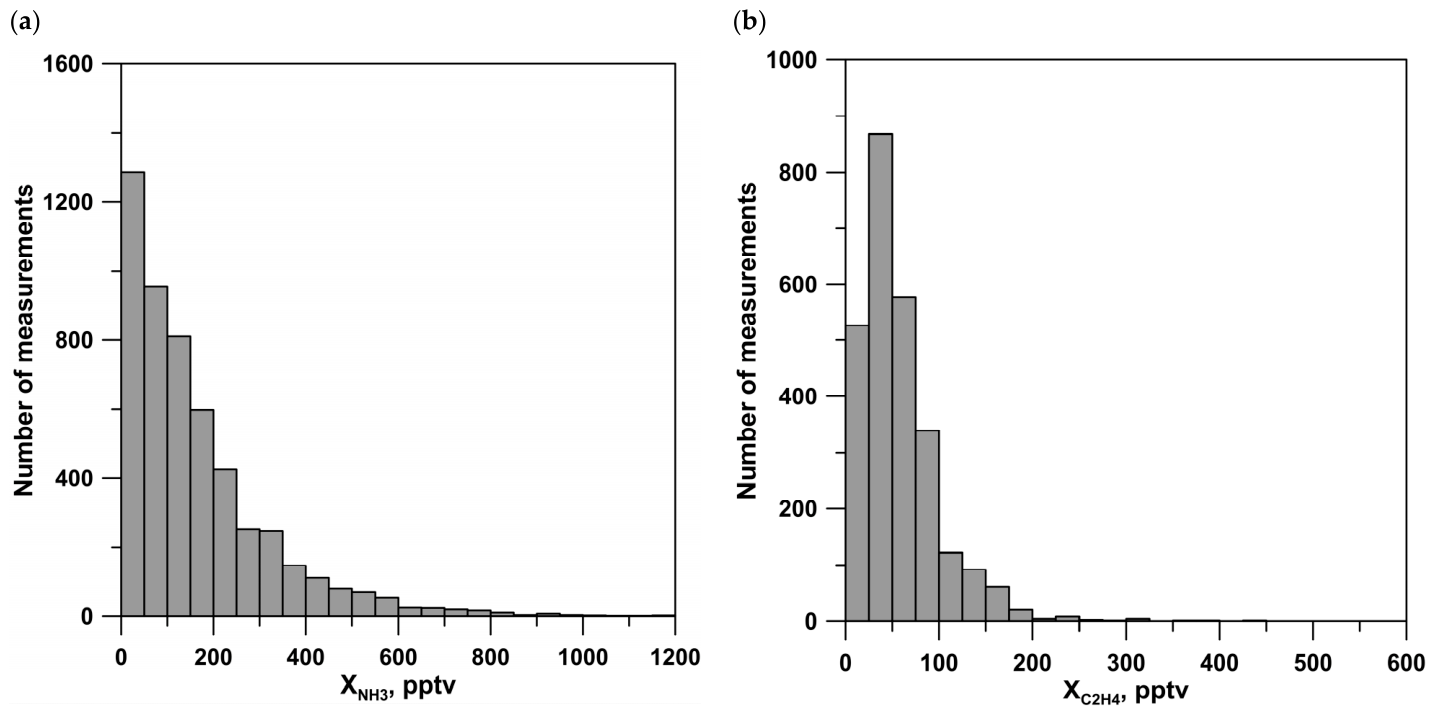
- For the NH3 MPC, the maximum one-time value (exposure up to 30 min) is 0.2 mg/m3 (287 ppbv), and the daily average value (exposure for 24 h) is 0.1 mg/m3 (143 ppbv);
- (2)
- For the C2H4 MPC, the maximum one-time value (exposure up to 30 min) is 3.0 mg/m3 (2.6 ppmv).
4. Conclusions
Author Contributions
Funding
Data Availability Statement
Acknowledgments
Conflicts of Interest
Abbreviations
| AVK | averaging kernel; |
| CLE | critical concentration level; |
| DOFS | degrees of freedom for signal; |
| EFFIS | European Forest Fire Information System; |
| FTIR | Fourier Transform Infrared; |
| FTS | Fourier-transform spectrometer; |
| HYSPLIT | Hybrid Single-Particle Lagrangian Integrated Trajectory model; |
| InSb | Indium Antimonide; |
| LN | liquid nitrogen-cooled; |
| MCT | Mercury-Cadmiun-Telluride; |
| MPC | maximum permissible concentration; |
| OE | optimal estimation; |
| OPD | optical path difference; |
| PBL | planetary boundary layer; |
| SNR | signal-to-noise ratio; |
| SOA | secondary organic aerosols; |
| SZA | solar zenith angle; |
| TC | total column; |
| T-P | Tikhonov–Phillips; |
| VOC | volatile organic compound; |
| WF | wildfire. |
Appendix A

References
- Seinfeld, J.H. Air Pollution: Physical and Chemical Fundamentals; Kingsport Press, Inc.: Kingsport, YN, USA, 1975; pp. 16–17. [Google Scholar]
- Wyer, K.E.; Kelleghan, D.B.; Blanes-Vidal, V.; Schauberger, G.; Curran, T.P. Ammonia emissions from agriculture and their contribution to fine particulate matter: A review of implications for human health. J. Environ. Manag. 2022, 323, 116285. [Google Scholar] [CrossRef] [Scilit]
- Kakareka, S.V.; Malchikhina, A.V. Ammonia in Atmospheric Air: Sources, Levels, and Regulation; Belaruskaya navuka: Minsk, Belarus, 2016; p. 253. (In Russian) [Google Scholar]
- Galloway, J.N.; Townsend, A.R.; Erisman, J.W.; Bekunda, M.; Cai, Z.; Freney, J.R.; Martinelli, L.A.; Seitzinger, S.P.; Sutton, M.A. Transformation of the Nitrogen Cycle: Recent Trends, Questions, and Potential Solutions. Science 2008, 320, 889–892. [Google Scholar] [CrossRef] [Scilit]
- Pogány, A.; Mohácsi, Á.; Varga, A.; Bozóki, Z.; Galbács, Z.; Horváth, L.; Szabó, G. A compact ammonia detector with sub-ppb accuracy using near-infrared photoacoustic spectroscopy and preconcentration sampling. Environ. Sci. Technol. 2009, 43, 826–830. [Google Scholar] [CrossRef] [Scilit] [PubMed]
- Amdur, M.O. Aerosols Formed by Oxidation of Sulfur Dioxide. Arch. Environ. Health Int. J. 1971, 23, 459–468. [Google Scholar] [CrossRef] [Scilit] [PubMed]
- Wizenberg, T.; Strong, K.; Jones, D.B.A.; Lutsch, E.; Mahieu, E.; Franco, B.; Clarisse, L. Exceptional wildfire enhancements of PAN, C2H4, CH3OH, and HCOOH over the Canadian high Arctic during August 2017. J. Geophys. Res. Atmos. 2023, 128, e2022JD038052. [Google Scholar] [CrossRef] [Scilit]
- Dammers, E.; Vigouroux, C.; Palm, M.; Mahieu, E.; Warneke, T.; Smale, D.; Langerock, B.; Franco, B.; Van Damme, M.; Schaap, M.; et al. Retrieval of ammonia from ground-based FTIR solar spectra. Atmos. Chem. Phys. 2015, 15, 12789–12803. [Google Scholar] [CrossRef] [Scilit]
- Tournadre, B.; Chelin, P.; Ray, M.; Cuesta, J.; Kutzner, R.D.; Landsheere, X.; Fortems-Cheiney, A.; Flaud, J.-M.; Hase, F.; Blumenstock, T.; et al. Atmospheric ammonia (NH3) over the Paris megacity: 9 years of total column observations from ground-based infrared remote sensing. Atmos. Meas. Tech. 2020, 13, 3923–3937. [Google Scholar] [CrossRef] [Scilit]
- Herrera, B.; Strong, K.; Dammers, E.; Grutter, M.; Hannigan, J.W.; Jones, N.; Marakova, M.; Poberovskii, A.; Morino, I.; Murata, I. Ammonia temporal variability from urban ground-based FTIR measurements. In Proceedings of the Abstract Booklet, 16th IGAC Scientific Conference, Online, 12–20 September 2021; Available online: https://igacproject.org/sites/default/files/2021-09/16th%20IGAC%20Conference%20Guide.pdf (accessed on 10 April 2026).
- Rhew, R.C.; Deventer, M.J.; Turnipseed, A.A.; Warneke, C.; Ortega, J.; Shen, S.; Martinez, L.; Koss, A.; Lerner, B.M.; Gilman, J.B.; et al. Ethene, propene, butene and isoprene emissions from a ponderosa pine forest measured by relaxed eddy accumulation. Atmos. Chem. Phys. 2017, 17, 13417–13438. [Google Scholar] [CrossRef] [Scilit]
- Zhao, Q.Y.; Bi, J.; Liu, Q.; Ling, Z.H.; Shen, G.F.; Chen, F.; Qiao, Y.Z.; Li, C.Y.; Ma, Z.W. Sources of volatile organic compounds and policy implications for regional ozone pollution control in an urban location of Nanjing, East China. Atmos. Chem. Phys. 2020, 20, 3905–3919. [Google Scholar] [CrossRef] [Scilit]
- Huang, X.H.H.; Ip, H.S.S.; Yu, J.Z. Secondary organic aerosol formation from ethylene in the urban atmosphere of Hong Kong: A multiphase chemical modeling study. J. Geophys. Res.-Atmos. 2011, 116, D03206. [Google Scholar] [CrossRef] [Scilit]
- Folberth, G.A.; Hauglustaine, D.A.; Lathière, J.; Brocheton, F. Interactive chemistry in the Laboratoire de Météorologie Dynamique General Circulation Model: Model description and impact analysis of biogenic hydrocarbons on tropospheric chemistry. Atmos. Chem. Phys. 2006, 6, 2273–2319. [Google Scholar] [CrossRef] [Scilit]
- Herbin, H.; Hurtmans, D.; Clarisse, L.; Turquety, S.; Clerbaux, C.; Rinsland, C.P.; Boone, C.; Bernath, P.F.; Coheur, P.F. Distributions and seasonal variations of tropospheric ethene (C2H4) from Atmospheric Chemistry Experiment (ACE-FTS) solar occultation spectra. Geophys. Res. Lett. 2009, 36, L04801. [Google Scholar] [CrossRef] [Scilit]
- Dolan, W.; Payne, V.H.; Kualwik, S.S.; Bowman, K.W. Satellite observations of ethylene (C2H4) from the Aura Tropospheric Emission Spectrometer: A scoping study. Atmos. Environ. 2016, 141, 388–393. [Google Scholar] [CrossRef] [Scilit]
- The State of the Environment in the Leningrad Region in 2022. Available online: https://kpr.lenobl.ru/media/uploads/userfiles/2023/12/21/Сбoрник.Сoстoчние_oкружающей_среды_ЛО_в_2022_гoду_2023.pdf (accessed on 31 March 2026). (In Russian)
- Environmental Report for Saint Petersburg for 2024. Available online: https://www.gov.spb.ru/static/writable/ckeditor/uploads/2025/06/30/59/Дoклад_Спб_за_2024.pdf (accessed on 31 March 2026). (In Russian)
- The State of the Environment in the Leningrad Region. Available online: https://kpr.lenobl.ru/media/uploads/userfiles/2024/12/24/Сoстoяние_oкружающей_среды_ЛО_в_2023.pdf (accessed on 31 March 2026). (In Russian)
- von Schneidemesser, E.; McDonald, B.C.; Denier van der Gon, H.; Crippa, M.; Guizzardi, D.; Borbon, A.; Dominutti, P.; Huang, G.; Jansens-Maenhout, G.; Li, M.; et al. Comparing urban anthropogenic NMVOC measurements with representation in emission inventories—A global perspective. J. Geophys. Res. Atmos. 2023, 128, e2022JD037906. [Google Scholar] [CrossRef] [Scilit]
- Makarova, M.; Poberovskii, A.; Polyakov, A.; Imkhasin, K.H.; Ionov, D.; Makarov, B.; Kostsov, V.; Foka, S.; Abakumov, E. Trends of Key Greenhouse Gases as Measured in 2009–2022 at the FTIR Station of St. Petersburg State University. Remote Sens. 2024, 16, 1996. [Google Scholar] [CrossRef] [Scilit]
- Hase, F.; Blumenstock, T.; Paton-Walsh, C. Analysis of the instrumental line shape of high-resolution Fourier transform IR spectrometers with gas cell measurements and new retrieval software. Appl. Opt. 1999, 38, 3417–3422. [Google Scholar] [CrossRef] [Scilit]
- Tikhonov, A. On the solution of incorrectly stated problems and a method of regularization. Dokl. Acad. Nauk SSSR 1963, 151, 501–504. [Google Scholar]
- Rodgers, C.D. Retrieval of atmospheric temperature and composition from remote measurements of thermal radiation. Rev. Geophys. 1976, 14, 609–624. [Google Scholar] [CrossRef] [Scilit]
- Infrared Working Group Retrieval Code, SFIT. Available online: https://wiki.ucar.edu/display/sfit4 (accessed on 31 March 2026).
- Hase, F.; Hannigan, J.W.; Coffey, M.T.; Goldman, A.; Höpfner, M.; Jones, N.B.; Rinsland, C.P.; Wood, S.W. Intercomparison of retrieval codes used for the analysis of high-resolution, ground-based FTIR measurements. J. Quant. Spectros. Radiat. Transf. 2004, 87, 25–52. [Google Scholar] [CrossRef] [Scilit]
- Wells, K.C.; Millet, D.B.; Brewer, J.F.; Payne, V.H.; Cady-Pereira, K.E.; Pernak, R.; Kulawik, S.; Vigouroux, C.; Jones, N.; Mahieu, E.; et al. Global decadal measurements of methanol, ethene, ethyne, and HCN from the Cross-track Infrared Sounder. Atmos. Meas. Tech. 2025, 18, 695–716. [Google Scholar] [CrossRef] [Scilit]
- Toon, G.C.; Blavier, J.-F.L.; Sung, K. Measurements of atmospheric ethene by solar absorption FTIR spectrometry. Atmos. Chem. Phys. 2018, 18, 5075–5088. [Google Scholar] [CrossRef] [Scilit]
- Garcia, R.R.; Marsh, D.R.; Kinnison, D.E.; Boville, B.A.; Sassi, F. Simulation of secular trends in the middle atmosphere, 1950–2003. J. Geophys. Res. 2007, 112, D09301. [Google Scholar] [CrossRef] [Scilit]
- HITRANonline. Available online: https://hitran.org/ (accessed on 31 March 2026).
- Gordon, I.E.; Rothman, L.S.; Hargreaves, R.J.; Gomez, F.M.; Bertin, T.; Hill, C.; Kochanov, R.V.; Tan, Y.; Wcisło, P.; Makhnev, V.Y.; et al. The HITRAN2024 molecular spectroscopic database. J. Quant. Spectrosc. Radiat. Transf. 2026, 353, 109807. [Google Scholar] [CrossRef] [Scilit]
- Toon, G.C.; Blavier, J.F.; Sung, K.; Rothman, L.S.; Gordon, I.E. HITRAN spectroscopy evaluation using solar occultation FTIR spectra. J. Quant. Spectrosc. Radiat. Transf. 2016, 182, 324–336. [Google Scholar] [CrossRef] [Scilit]
- Hase, F.; Wallace, L.; McLeod, S.D.; Harrison, J.J.; Bernath, P.F. The ACE-FTS atlas of the infrared solar spectrum. J. Quant. Spectrosc. Radiat. Transf. 2010, 111, 521–528. [Google Scholar] [CrossRef] [Scilit]
- Kostsov, V.S. General approach to the formulation and solution of the multi-parameter inverse problems of atmospheric remote sensing with measurements and constraints of different types. Int. J. Remote Sens. 2015, 36, 2973–3004. [Google Scholar] [CrossRef] [Scilit]
- Vigouroux, C.; De Mazière, M.; Demoulin, P.; Servais, C.; Hase, F.; Blumenstock, T.; Kramer, I.; Schneider, M.; Mellqvist, J.; Strandberg, A.; et al. Evaluation of tropospheric and stratospheric ozone trends over Western Europe from ground-based FTIR network observations. Atmos. Chem. Phys. 2008, 8, 6865–6886. [Google Scholar] [CrossRef] [Scilit]
- Barthlott, S.; Schneider, M.; Hase, F.; Wiegele, A.; Christner, E.; González, Y.; Blumenstock, T.; Dohe, S.; García, O.E.; Sepúlveda, E.; et al. Using XCO 2 retrievals for assessing the long-term consistency of NDACC/FTIR data sets. Atmos. Meas. Tech. 2015, 8, 1555–1573. [Google Scholar] [CrossRef] [Scilit]
- Wang, W.; Liu, C.; Clarisse, L.; van Damme, M.; Coheur, P.-F.; Xie, Y.; Shan, C.; Hu, Q.; Sun, Y.; Jones, N. Ground-based measurements of atmospheric NH3 by Fourier transform infrared spectrometry at Hefei and comparisons with IASI data. Atmos. Environ. 2022, 287, 119256. [Google Scholar] [CrossRef] [Scilit]
- HYSPLIT Air Resources Laboratory. Available online: https://www.ready.noaa.gov/HYSPLIT.php (accessed on 31 March 2026).
- Stein, A.F.; Draxler, R.R.; Rolph, G.D.; Stunder, B.J.B.; Cohen, M.D.; Ngan, F. NOAA’s HYSPLIT atmospheric transport and dispersion modeling system. Bull. Amer. Meteor. Soc. 2015, 96, 2059–2077. [Google Scholar] [CrossRef] [Scilit]
- Makarova, M.V.; Kirner, O.; Timofeev, Y.M.; Poberovskii, A.V.; Imkhasin, K.K.; Osipov, S.I.; Makarov, B.K. Analysis of methane total column variations in the atmosphere near St. Petersburg using ground-based measurements and simulations. Izv. Atmos. Ocean. Phys. 2015, 51, 177–185. [Google Scholar] [CrossRef] [Scilit]
- Van Damme, M.; Clarisse, L.; Franco, B.; Sutton, M.A.; Erisman, J.W.; Wichink Kruit, R.; van Zanten, M.; Whitburn, S.; Hadji-Lazaro, J.; Hurtmans, D.; et al. Global, regional and national trends of atmospheric ammonia derived from a decadal (2008–2018) satellite record. Environ. Res. Lett. 2021, 16, 055017. [Google Scholar] [CrossRef] [Scilit]
- Hersbach, H.; Bell, B.; Berrisford, P.; Biavati, G.; Horányi, A.; Muñoz Sabater, J.; Nicolas, J.; Peubey, C.; Radu, R.; Rozum, I.; et al. ERA5 hourly data on single levels from 1940 to present. Copernic. Clim. Change Serv. (C3S) Clim. Data Store (CDS) 2023. [Google Scholar] [CrossRef]
- Lutsch, E.; Strong, K.; Jones, D.B.A.; Blumenstock, T.; Conway, S.; Fisher, J.A.; Hannigan, J.W.; Hase, F.; Kasai, Y.; Mahieu, E.; et al. Detection and attribution of wildfire pollution in the Arctic and northern midlatitudes using a network of Fourier-transform infrared spectrometers and GEOS-Chem. Atmos. Chem. Phys. 2020, 20, 12813–12851. [Google Scholar] [CrossRef] [Scilit]
- Vigouroux, C.; Stavrakou, T.; Whaley, C.; Dils, B.; Duflot, V.; Hermans, C.; Kumps, N.; Metzger, J.-M.; Scolas, F.; Vanhaelewyn, G.; et al. FTIR time-series of biomass burning products (HCN, C2H6, C2H2, CH3OH, and HCOOH) at Reunion Island (21° S, 55° E) and comparisons with model data. Atmos. Chem. Phys. 2012, 12, 10367–10385. [Google Scholar] [CrossRef] [Scilit]
- Viatte, C.; Strong, K.; Walker, K.A.; Drummond, J.R. Five years of CO, HCN, C2H6, C2H2, CH3OH, HCOOH and H2CO total columns measured in the Canadian high Arctic. Atmos. Meas. Tech. 2014, 7, 1547–1570. [Google Scholar] [CrossRef] [Scilit]
- European Forest Fire Information System. Available online: https://forest-fire.emergency.copernicus.eu/ (accessed on 31 March 2026).
- EKAN. Available online: https://ekan.ru/sites/docs/PDK_A_Atm.pdf (accessed on 31 March 2026). (In Russian)
- Pinho, P.; Llop, E.; Ribeiro, M.C.; Cruz, C.; Soares, A.; Pereira, M.J.; Branquinho, C. Tools for determining critical levels of atmospheric ammonia under the influence of multiple disturbances. Environ. Pollut. 2014, 188, 88–93. [Google Scholar] [CrossRef] [Scilit]
- Cape, J.N.; van der Eerden, L.J.; Sheppard, L.J.; Leith, I.D.; Sutton, M.A. Evidence for changing the critical level for ammonia. Environ. Pollut. 2009, 157, 1033–1037. [Google Scholar] [CrossRef] [Scilit]
- Sutton, M.A.; Dragosits, U.; Simmons, I.; Tang, Y.S.; Hellsten, S.; Love, L.; Vieno, M.; Skiba, U.; di Marco, C.; Storeton-West, R.L.; et al. Monitoring and modelling trace-gas changes following the 2001 outbreak of Foot and Mouth Disease to reduce the uncertainties in agricultural emissions abatement. Environ. Sci. Policy 2006, 9, 407–422. [Google Scholar] [CrossRef] [Scilit]
- Hallsworth, S.; Dore, A.J.; Bealey, W.J.; Dragosits, U.; Vieno, M.; Hellsten, S.; Tang, Y.S.; Sutton, M.A. The role of indicator choice in quantifying the threat of atmospheric ammonia to the ‘Natura 2000’ network. Environ. Sci. Policy 2010, 13, 671–687. [Google Scholar] [CrossRef] [Scilit]
- Ethylene in the Greenhouse: Symptoms, Detection & Prevention. College of Agriculture and Life Sciences. Available online: https://greenhouse.cornell.edu/crops-culture/ethylene-in-the-greenhouse-symptoms-detection-prevention/ (accessed on 31 March 2026).





| Land Category | Percent of Total Area |
|---|---|
| Forest | 57 |
| Agricultural lands | 20 |
| Lands of populated areas | 3 |
| Lands for industry, transport, communications, etc. | 5 |
| Lands of specially protected territories and objects | <1 |
| Water bodies | 13 |
| Reserve lands | 2 |
| Detector | LN-Cooled MCT |
| Beamsplitter | KBr |
| Fieldstop, mm | 2.0–2.5 |
| Δν, cm−1 (OPD, cm) | 0.005 (180) |
| Registered spectral range, cm−1 | 650–1400 (optical filters F3 and F3*) |
| Number of scans | 6–10 |
| Target Gas | Spectral Intervals, cm−1 | Spectroscopic Linelist | Retrieved Interfering Gases | Regularization Type |
|---|---|---|---|---|
| NH3 | 929.40–931.40 962.10–970.00 | ATM 20 | H2O, O3, CO2, CO2636, N2O, CO2628, HNO3 | OE |
| C2H4 | 948.80–952.40 | ATM 20 | CO2, H2O, COF2, N2O, NH3, O3, SF6 | T-P |
| Target Gas (Measurement Period, Optical Filter) | TCGAS, 1015 molec/cm2 | XGAS, pptv | RMS, % | DOFS |
|---|---|---|---|---|
| NH3 (2009–2025) | 3.50 ± 3.30 | 163 ± 156 | 0.32± 0.26 | 1.02± 0.08 |
| NH3 (2009–March 2016, F3*) | 4.38 ± 3.25 | 210 ± 160 | 0.49± 0.27 | 1.01± 0.08 |
| NH3 (April 2016–2025, F3) | 2.95 ± 3.29 | 140 ± 150 | 0.21± 0.19 | 1.03± 0.07 |
| C2H4 (April 2016–2025, F3) | 1.27 ± 1.25 | 59 ± 58 | 0.21± 0.07 | 1.1± 0.1 |
| Target Gas (Measurement Period, Optical Filter) | Relative Error, % | ||
|---|---|---|---|
| δrand | δsm | δsys | |
| NH3 (2009–2025) | 6.7 | 0.2 | 23 |
| NH3 (2009–March 2016, F3*) | 9.5 | 0.1 | 27 |
| NH3 (April 2016–2025, F3) | 5.1 | 0.3 | 20.3 |
| C2H4 (April 2016–2025, F3) | 26 | 0.8 | 15 |
| Date | PBL Height, m | NH3 | C2H4 | ||||
|---|---|---|---|---|---|---|---|
| TCNH3_MAX, 1015 molec./cm2 | XNH3_MAX, pptv | qBL_NH3, ppbv | TCC2H4_MAX, 1015 molec./cm2 | XC2H4, pptv | qBL_C2H4, ppbv | ||
| 13 May 2010 | 168 | 14.0 | 810 | 31 | - | - | - |
| 14 May 2010 | 167 | 17.2 | 807 | 31 | - | - | - |
| 30 June 2010 | 137 | 12.1 | 563 | 24 | - | - | - |
| 8 July 2010 | 81 | 14.9 | 701 | 55 | - | - | - |
| 19 May 2013 | 170 | 22.7 | 1064 | 43 | - | - | - |
| 10 April 2014 | 1017 | 17.4 | 804 | 6 | - | - | - |
| 27 July 2017 | 507 | - | - | - | 2.89 | 137 | 1.2 |
| 25 September 2017 | 202 | - | - | - | 4.95 | 226 | 7.9 |
| 17 October 2017 | 881 | 18.1 | 851 | 10 | 26.4 | 1243 | 12 |
| 22 May 2018 | 302 | 18.3 | 849 | 18 | - | - | - |
| 11 July 2018 | 574 | - | - | - | 3.51 | 164 | 1.5 |
| 10 August 2018 | 901 | 13.1 | 609 | 4 | - | - | - |
| 28 August 2018 | 486 | - | - | - | 9.48 | 442 | 7.1 |
| 19 September 2018 | 681 | 21.8 | 1030 | 11 | - | - | - |
| 26 April 2019 | 251 | 17.9 | 833 | 23 | - | - | - |
| 22 July 2019 | 587 | - | - | - | 2.79 | 130 | 1.0 |
| 5 July 2022 | 657 | - | - | - | 2.58 | 121 | 0.7 |
| 20 February 2023 | 257 | - | - | - | 5.14 | 244 | 5.4 |
| 24 April 2023 | 413 | 24.8 | 1169 | 21 | - | - | - |
| 21 August 2023 | 763 | 20.2 | 946 | 9 | - | - | - |
| 3 July 2025 | 476 | 11.9 | 562 | 7 | - | - | - |
Disclaimer/Publisher’s Note: The statements, opinions and data contained in all publications are solely those of the individual author(s) and contributor(s) and not of MDPI and/or the editor(s). MDPI and/or the editor(s) disclaim responsibility for any injury to people or property resulting from any ideas, methods, instructions or products referred to in the content. |
© 2026 by the authors. Licensee MDPI, Basel, Switzerland. This article is an open access article distributed under the terms and conditions of the Creative Commons Attribution (CC BY) license.
Share and Cite
Makarova, M.V.; Kostsov, V.S.; Kuznetsova, A.A.; Mikhailov, E.F.; Ionov, D.V. Atmospheric Fourier Transform Infrared Monitoring of Ammonia and Ethylene near the Saint Petersburg Agglomeration (Russia). Environments 2026, 13, 317. https://doi.org/10.3390/environments13060317
Makarova MV, Kostsov VS, Kuznetsova AA, Mikhailov EF, Ionov DV. Atmospheric Fourier Transform Infrared Monitoring of Ammonia and Ethylene near the Saint Petersburg Agglomeration (Russia). Environments. 2026; 13(6):317. https://doi.org/10.3390/environments13060317
Chicago/Turabian StyleMakarova, Maria V., Vladimir S. Kostsov, Anastasia A. Kuznetsova, Eugene F. Mikhailov, and Dmitry V. Ionov. 2026. "Atmospheric Fourier Transform Infrared Monitoring of Ammonia and Ethylene near the Saint Petersburg Agglomeration (Russia)" Environments 13, no. 6: 317. https://doi.org/10.3390/environments13060317
APA StyleMakarova, M. V., Kostsov, V. S., Kuznetsova, A. A., Mikhailov, E. F., & Ionov, D. V. (2026). Atmospheric Fourier Transform Infrared Monitoring of Ammonia and Ethylene near the Saint Petersburg Agglomeration (Russia). Environments, 13(6), 317. https://doi.org/10.3390/environments13060317