Article

Microplastic and Car Tire Particles: A Genotoxicity Evaluation in European Perch Perca fluviatilis (Linnaeus, 1758)


by
Patrizia Guidi
1,*,†,
Joachim Sturve
2,†,
Mara Palumbo
1,
Marta Gabriele
3,
Margherita Bernardeschi
1,4,
Bethanie Carney Almroth
2 and
Giada Frenzilli
1,*
1
Department of Clinical and Experimental Medicine, University of Pisa, 56126 Pisa, Italy
2
Department of Biological and Environmental Sciences, University of Gothenburg, 405 30 Gothenburg, Sweden
3
Institut de Recherche sur les Forêts, Université du Québec en Abitibi-Témiscamingue, Amos, QC J9T2LB, Canada
4
IIT Center for Materials Interfaces, Smart Bio-Interfaces, 56025 Pontedera, Italy
*
Authors to whom correspondence should be addressed.
These authors contributed equally to this work.
Environments 2026, 13(6), 318; https://doi.org/10.3390/environments13060318 (registering DOI)
Submission received: 24 April 2026 / Revised: 29 May 2026 / Accepted: 2 June 2026 / Published: 5 June 2026
(This article belongs to the Special Issue Ecotoxicity of Microplastics and Associated Chemicals)

Abstract

The potential effects of microplastics (MPs) on humans and ecosystems are of great concern, and it has been reported that the ingestion of contaminated food is the main route of exposure. In the present study, Perca fluviatilis was selected as a vertebrate model to evaluate the possible cellular effects induced by five different plastic polymers and car tire debris (CT) after 4- and 7-month exposure periods. The Cytome assay was chosen to check chromatin alteration in perch’s peripheral blood. The results indicated an increase in micronuclei and cytotoxic effect in specimens co-exposed to MPs + CT for 7 months. Increases in dicentric chromosomes were observed in specimens exposed both to MPs alone and to the mixture of MPs + CT, indicating for the first time a genotoxic effect induced by CT debris in fish in terms of structural aberrations. Increases in micronucleated erythrocyte frequency assessed after 7 months only after the addition of CT debris to the mixture of MPs might suggest an aneugenic action of CT in fish. In the same groups, the higher values of frequency in 8-shaped erythrocytes also indicate possible cell cycle toxicity exerted by CT exposure. An association between total erythrocyte nuclear morphology abnormalities (ENA) and glutathione reductase activity was also found, indicating a potential involvement of oxidative processes in modulating the genotoxicity observed. The present experimental model is a useful tool to study cellular mechanisms related to both MP- and CT-induced chromatin structure alterations indicating possible interference with human health as well.

1. Introduction

The growing production and release of plastics into the environment is a global concern. Plastic production has increased 200-fold since 1950 [1], and due to its very slow degradation rates under environmental conditions, plastic litter is expected to increase and accumulate in aquatic environments [2]. There is evidence of plastic litter contamination of both marine and freshwater environments on a global scale [3,4,5,6,7,8,9]. Approximately 19 to 23 million metric tons, representing 11% of plastic waste produced globally, entered the aquatic ecosystems in 2016, and yearly disposals could potentially rise to 53 million metric tons annually by 2030 [10].
Microplastics (MPs) are estimated to represent about 90% of total plastic waste [11], driving concern about the potential effects on biota. Microplastics can originate from different sources, though the major sources include fragmentation of larger products and car tires [12]. Each year, 50–70% of annual rubber production is used by the tire industry, and road traffic generates tire particles by mechanical abrasion. Overall, tire particles are expected to constitute 93% of the MP contamination in aquatic systems in terms of mass by 2040 [13]. Freshwater environments act as important sinks for microplastic contamination. A recent structured review on tire wear emissions emphasized that higher MP concentrations are generally reported in sediments compared to the water column, indicating that sediments constitute a major accumulation compartment for car tire debris (CT) and other MPs [14]. This distribution pattern suggests that benthic and sediment-dwelling organisms may be particularly exposed to both CT-derived MPs and MPs from other polymeric materials [15].
MPs and CT may impact organisms via their physical or chemical properties per se; moreover, they can also transport thousands of hazardous chemicals, through leaching processes, potentially contributing to their toxicity [16]. These particles are transported into aquatic systems through atmospheric deposition and surface runoff and are proven to be toxic to aquatic organisms.
The ecotoxicological effects of microplastics on aquatic fauna have been investigated by an increasing number of laboratory studies [17]. Exposure to MPs induces various biological harms in aquatic organisms, and, among these, particular emphasis must be given to genotoxicity. Misrepaired DNA damage can lead to the accumulation of detrimental genetic changes including the potential onset of cancer and other chronic effects [18]. In natural environmental matrices, CT-derived particles coexist with other MPs. This co-exposure reflects the complexity of plastic contamination, in which particles of different chemical composition and origin are simultaneously present.
Despite their recognized environmental prevalence, relatively few studies have investigated the toxicological effects of CT and MPs, particularly with respect to genotoxicity. Recent in vitro studies on macrophage cell lines have shown that exposure to CT can induce cellular stress responses and alterations in the expression of genes related to apoptosis and cell cycle regulation, although direct DNA damage was not always observed [19]. In addition, leachates from tire wear particles contain complex mixtures of organic compounds and metals, some of which have been demonstrated to display genotoxic and endocrine-disrupting potential in bioassays [20,21].
A response to MP ingestion could be induced chromosomal damage combined with genetic instability, both of which can be studied by the evaluation of micronucleated cells [22].
Increased micronucleus frequencies in freshwater fish exposed to MPs invoke the need for studies considering long exposure durations in experimental designs [23]. In regard to this, perch was shown to be particularly susceptible to expressing MP-induced genotoxic effects [24].
The European perch Perca fluviatilis (Linnaeus, 1758) is native to central-northern Europe and Asia and is generally found in streams, rivers and lakes. It does not show a particular preference for substrate choice but stays in contact with the substrate most of the time.

The aim of the present work was to evaluate the possible chronic effects of chemical leachates from five different plastic MP types originating from consumer products and car tires, mixed with a coarse sediment, in the freshwater fish Perca fluviatilis, after four- and seven-month exposure periods. Car tire fragments were selected since they are known to be one of the most important sources of MPs in the aquatic environment [25].
Potential genotoxic effects induced by the selected MPs alone or with added CT were evaluated by the Cytome assay, chosen to assess chromosomal damage in the perch’s peripheral blood erythrocytes. In fact, the Cytome assay allows the quantification of numerical (frequency of micronuclei) and structural (frequency of micronuclei, bridges and other nuclear anomalies) chromosomal mutations.

2. Materials and Methods

2.1. Exposure Polymer Mixture Preparation

In this study, five different plastic polymers were used: polystyrene (PS), polyethylene (PE), polycarbonate (PC), polyvinyl chloride (PVC) and polyurethane foam (PU). The plastic particles used for the experiments were obtained from consumer products and other materials, like flooring and/or medical equipment, which were then mechanically ground into small particles. In addition, car tire debris (CT) was collected from Ragn-Sells Recycling Center, Sollentuna, Sweden, then ground in the same way and added to the second mixture, as it is known to be one of the most important sources of MPs in the aquatic environment [25]. MPs and CT were mechanically ground into small particles at the RISE Institute (Research Institutes of Sweden, Gothenburg) according to standardized protocols, using a Retch CryoMill (Retsch, Västra Frölunda, Sweden). In designing the exposure, a first analysis was performed to have an estimate of the number of particles/weight ratio for each material. The MPs and CT were laid on an adhesive surface divided into sections, weighed and then photographed under an optical microscope (Leica EZ4HD stereomicroscope, Leica, Wetzlar, Germany). The pictures obtained were then used to count the particles and obtain an approximation of their density. A more accurate analysis was then performed, using a Particle Size Analysis System (Camsizer XT® (Microtrac MRB, Haan, Germany), using Microtrac MRB CAMSIZER XT Control and Evaluation Software), which also gave us a physical characterization of the particles (shape, size, transparency) (Table S1). These last results were then used for obtaining the concentrations of debris used for the experiments.

2.2. In Vivo Exposure and Sampling

European perch specimens (average length 94.0 ± 1.6 mm and weight 8.1 ± 0.5) were acquired from a farm and acclimated to system water for at least two weeks before the start of the chronic exposure. A long-term experiment was designed to be run by exposing fish to selected MPs mixed with sediment. The experimental design consisted of 12 tanks, with 4 controls (sediment without MPs), 4 with all the polymers except CT (MPs), and 4 with all the available materials (MPs + CT).
A concentration of ~10,000 particles/kg dry weight of sediment was chosen for this experiment, based on the actual quantity and the highest concentrations found in the environment [26]. The different polymers were distributed among the tanks partially based on the data reviewed by Burns and Boxall [27] (Table 1).
After the particle mixtures were distributed evenly on the bottom of the aquaria, the particles were covered with ~5.5 kg of standard aquarium sand in each tank (2 cm layer). Low-density particles were encased in a stainless steel mesh and buried within the sediment layer to prevent floating. The plastic particles were added to randomly chosen tanks, 4 for each particle mixture (MPs and MPs + CT), while in the 4 control tanks only gravel was added. The tanks were then filled with water (20 L each) and left without recirculation for 4 days, after which 96 fish were equally distributed into the experimental tanks (8 per tank) and water recirculation was started. Fish were kept in the recirculating filtered and aerated water at 12 °C and under a 12 h light/12 h dark light regime. After four months, four fish per aquarium were sacrificed, and blood and tissue samples were collected (forty-eight fish sampled per condition). After seven months the remaining four fish per aquarium were sacrificed, and blood and tissue was collected (forty-eight sampled per condition). Blood was collected with a heparinized syringe from the caudal vein. A drop of blood was smeared on a glass slide for micronucleus analysis. Fish were dissected and liver tissues extracted and shock frozen on liquid nitrogen for glutathione reductase (GR) analysis. This study was performed under an ethical permit (5.8.1-054185/2024) issued by the Regional Committee for Animal Experiments following national and European ethical guides and issued legislation on animal experimentation under EU Directive 2010/63/EU.

2.3. Cytome Assay

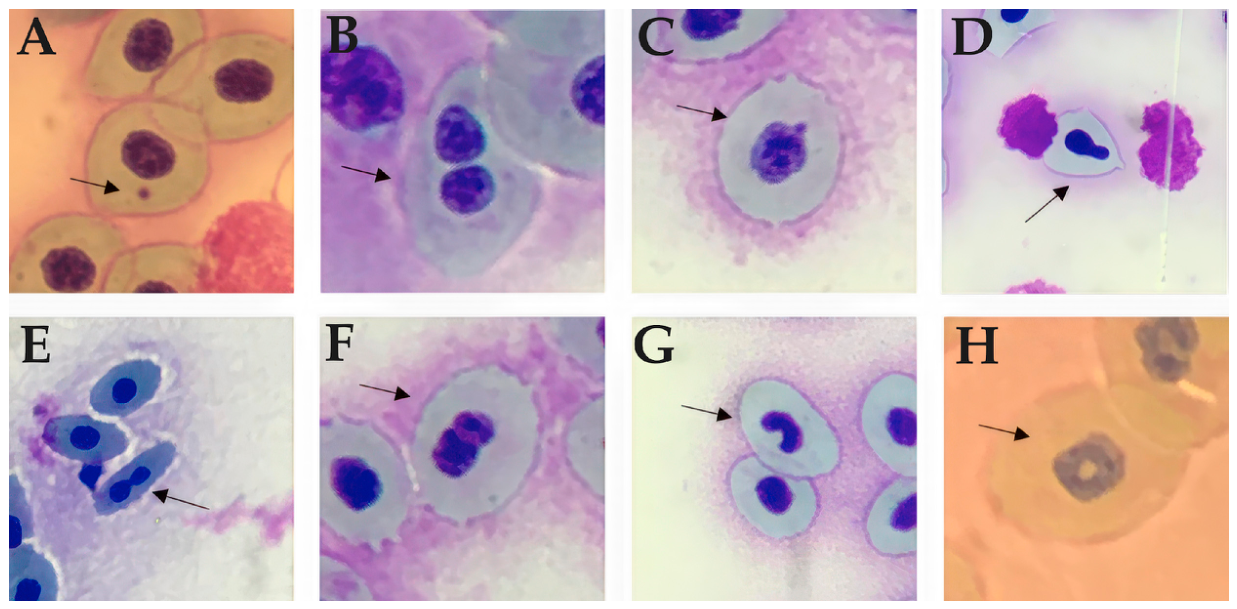
In the present investigation the Cytome assay was performed on peripheral blood erythrocytes from exposed perch. Briefly, peripheral blood samples were smeared onto slides, air-dried for 24 h at room temperature, fixed with ethanol and stained with 6% Giemsa for 20 min according to Frenzilli and colleagues [28]. For chromosomal damage evaluations, a total of 4000 erythrocytes per specimen were scored under a light microscope in coded slides (at least two slides per specimen), as suggested by Fenech [29], to determine the frequency of micronucleated cells. Micronuclei were defined as round structures smaller than one-third of the main nucleus diameter; they had to be on the same optical plane as the main nucleus but with clearly distinguishable boundaries. In addition to MN, other erythrocyte nuclear morphology alterations (ENA) were detected. Nuclear blebs (BL), nuclear buds (NBUD), notched nuclei (NT), circular nuclei (CIR), lobed nuclei (LB) and nucleoplasmic bridges (NPB) were also considered as indices of genotoxicity, while 8-shaped nuclei (8-SN) and binucleated cells (BN) were used as indicators of cytotoxicity [30] (Figure 1).

2.4. Glutathione Reductase (GR)

Liver samples were homogenized (glass/Teflon) in 4 volumes (w/v) in ice-cold buffer saline (0.1 M Na/K-PO4) containing 0.15 M KCl at pH 7.4. Homogenates were centrifuged at 10,000× g for 20 min at 4 °C. The supernatant was recentrifuged at 105,000× g for 1 h to obtain the cytosolic fraction. Cytosol samples were aliquoted and stored at −80 °C until analysis. GR activity was measured in the cytosolic fraction according to the method described by Cribb and co-workers [31] adapted for a microplate reader. The reaction mixture contained 0.08 mM DTNB and 0.63 mM NADPH in 0.1 M sodium phosphate buffer (pH 7.5) containing 1 mM EDTA. The addition of 10 μL of 3.25 mM oxidized glutathione started the reaction. GR activity was calculated using the extinction coefficient of TNB (ϵ  =  14,151/M/cm).

2.5. Statistical Analysis

The genotoxicity endpoints detected by the Cytome assay are biomarkers of effect, which can be influenced by experimental variables. For this reason, multifactor analysis of variance (MANOVA) or Multiple Regression Analysis (MRA) was used in order to take into consideration all parameters (independent variables) able to influence the mean and standard deviation (SD) of genotoxicity endpoints and make the statistical approach more rigorous. Micronuclei, nucleoplasmic bridges, 8-shaped nuclei and binucleated cells were considered as dependent variables, with the dose, experimental time, treatment, slide, and scorer as independent variables. The Multiple Range Test (MRT) was performed in order to detect differences among the experimental groups. For all data analyses, statistical significance was set at p-value < 0.05. The data were then plotted as bar plots with the mean and standard deviation for each treatment.

3. Results

Chromosomal Damage

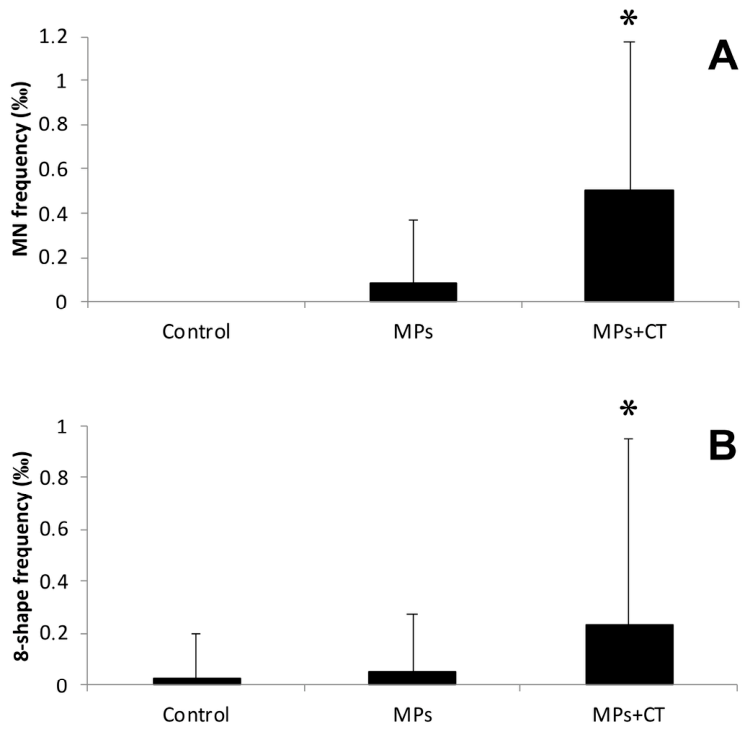
The genotoxic effects associated with exposure to plastic debris and evaluated by the Cytome assay revealed a statistically significant increase in comparison to the control (p < 0.05) regarding micronuclei (MN) in erythrocytes from specimens co-exposed to microplastics and car tire debris (MPs + CT) for seven months (Figure 2A). MANOVA revealed that this increase was modulated by GR activity (p < 0.001 and R-squared 47.89). Moreover, higher (p < 0.05) frequencies of 8-shaped nuclei were observed after seven months in the same group (Figure 2B). No significant differences were observed after 4 months of exposure for the MN frequency (values expressed as mean ± SD, p = 0.54: control 0.42 ± 0.67; MPs 0.79 ± 1.12; MPs + CT 0.57 ± 0.65) or for 8-shaped nuclei (values expressed as mean ± SD, p = 0.15: control 0 ± 0; MPs 0.14 ± 0.36; MPs + CT 0 ± 0).
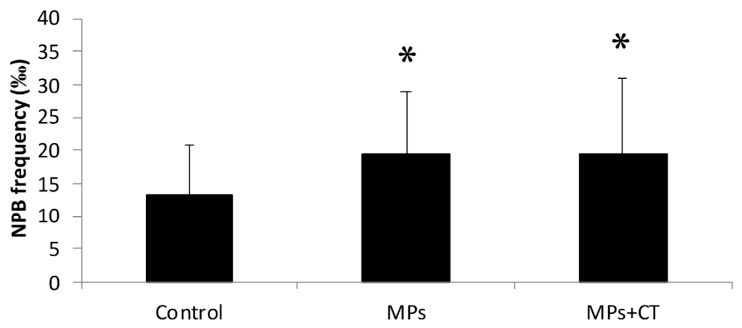
Both microplastics (MPs) and the mixture of microplastics and car tire particles (MPs + CT) induced a statistically significant increase (p < 0.05) in nucleoplasmic bridges (NPB) after 7 months of exposure, suggesting the presence of dicentric chromosomes (Figure 3). No increases in NPB were found after 4 months of exposure (p = 0.49). The MRT did not reveal any statistically significant difference between the effects of MPs alone and co-exposure (MPs + CT). The onset of dicentric chromosomes was found to be weakly associated (p < 0.02 and coefficient of correlation = 0.38; R squared 14.7) with MN frequencies in MPs + CT group.
It is interesting to underline that, taking into consideration the total amount of erythrocyte nuclear abnormalities, a positive correlation was observed between the ENA and GR activity detected after seven months of exposure in the MPs + CT group (p < 0.001, R-squared 21.20).
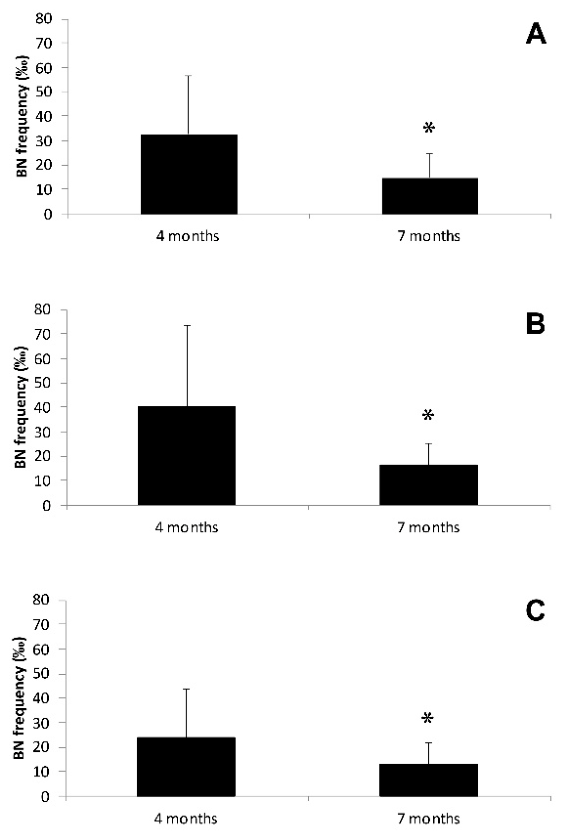
Regarding cell proliferation, a general decrease in binucleated cell frequency was observed after the longest exposure time in both the control group and the exposed groups (MPs and MPs + CT) (Figure 4).

4. Discussion

The purpose of this work was to evaluate the effects of microplastic contamination on a freshwater vertebrate model exposed to contaminated substrate. The route of exposure of plastic particles and their main associated additives (Table S2) in aquatic organisms can differ based on ecological and geographical factors [32]. In the present experimental approach, a mixture of five different types of microplastics, with or without car tire particles, was added to a coarse sediment to which the fish Perca fluviatilis was exposed, to mimic more realistic environmental scenarios involving the simultaneous presence of CT-derived MPs and other MPs. To date, few studies have specifically addressed the potential genotoxic effects associated with their combined exposure, despite their high likelihood of co-occurrence in aquatic ecosystems. It is relevant to note that, although the recent literature is focused on toxic effects related to car tire additives [33,34], the few toxicity studies are mainly based on results obtained in cell culture and invertebrate models [35,36,37]; to the best of our knowledge, no data about CT particles’ genotoxic potential have been published.
In order to explore the potential genotoxic effects induced by MPs and car tire exposure, chromosomal damage was studied by evaluating micronuclei and other nuclear abnormalities in fish erythrocytes, as this approach is known to be responsive to genotoxic insult in aquatic organisms exposed to chemicals, metals and plastic-related contaminants [28,38,39].
Here, we found a general decrease in binucleated cells at the longest exposure time in the control group and both exposed groups (MPs and MPs + CT), thus indicating a general cytostatic response of the organisms to laboratory conditions. The potential to regenerate, as well as fish activity, has been reported to decline with time in a wide range of organisms in laboratory conditions [40].
The genotoxic effects revealed by the Cytome assay indicated an increase in micronucleated erythrocytes in specimens co-exposed to microplastics and car tires after seven months in comparison to the control. Some studies have shown chromosomal damage induced by polystyrene nanoplastics in fish erythrocytes. Exposure of the gilthead bream Carassius aurata to low doses of polystyrene nanoplastics resulted in DNA damage, as evidenced by increased erythrocyte nuclear abnormalities [41]. Genotoxicity induction was also observed after chronic exposure to microplastics of different polymer types in early life stages of the sea trout Salmo trutta, associated with the formation of micronuclei and other nuclear abnormalities [42], while virgin PE-MPs were found to increase chromosomal damage, as assessed by the Cytome assay, in P. fluviatilis exposed for 120 days [43]. In the present study, the increased frequencies of micronucleated cells observed in the co-exposed group after seven months were found to be modulated by GR activity, and a positive correlation was also observed between the total amount of erythrocyte nuclear abnormalities (ENA) and GR activity detected after seven months of exposure in the MPs + CT group. Such results could indicate that the involvement of oxidative processes might at least partially be responsible for the chromosomal damage observed; this was also suggested by Neha and Gudivada [44], who noticed an increase in MN frequencies after 60 days of PE-MP exposure, paralleled by a decrease in antioxidant (SOD, CAT, GST) enzyme activities, in the freshwater carp Labeo rohita. Although GR activity plays a central role in maintaining cellular redox homeostasis, the assessment of GR alone provides only a partial overview of oxidative status. Considering that oxidative stress involves multiple interconnected antioxidant pathways, future investigations should include integrating GR analysis with additional antioxidants and oxidative stress biomarkers, in order to provide a more comprehensive evaluation of the possible involvement of oxidative processes in the modulation of genotoxic effects associated with MP and CT exposure. Moreover, higher frequencies of 8-shaped nuclei were observed in the present work for the same exposure time and treatment group, also indicating a cytotoxic effect. Eight-shaped erythrocytes have also been taken into consideration to expand the toxicity spectrum [30] because they are considered a reliable indicator in assessing the cytotoxicity of contaminants in aquatic organisms [45,46], reflecting a failure in erythropoiesis at the mitotic spindle level [47].
Interestingly, based on our data, significant increases in nucleoplasmic bridge frequencies were observed in fish exposed for 7 months to both MPs and MPs + CT, as compared to the negative control. Studies performed in human blood [48,49] showed how the formation of nucleoplasmic bridges can be induced by exposure to microplastics and pesticides in human lymphocytes. The formation of NPBs between daughter nuclei has also been noted in studies on oxidative stress in human neutrophils [50]. Nucleoplasmic bridges are formed where dicentric chromosomes, an index of structural chromosomal mutations, take place, thus indicating a clastogenic mechanism of action mainly related with the misrepair of double-strand DNA breaks or telomere end fusions [51]. As micronuclei are, instead, considered biomarkers of both aneugenic and clastogenic processes, it is possible to speculate that while exposure to MPs alone is mainly associated with clastogenic damage, the addition of car tire particles may have added an aneugenic effect, as suggested by the high frequency of MN observed in the co-exposed group.
There is a range of molecular mechanisms potentially suggested for chromosomal abnormality formation in response to MPs. However, based on what we have observed we can hypothesize that the interactive effect within co-exposure to MPs and CT may be modulated by oxidative processes. Increased toxicity was reported in fish co-exposed to MPs and pollutants or pharmaceuticals, and recent works suggest that MPs and co-contaminants display a synergistic health effect on aquatic organisms [52,53,54].
Based on our data, a shorter exposure time (4 months of exposure) did not affect the investigated endpoint; current evidence indicates that microplastic-induced genotoxicity in fish is generally exposure-time-dependent, with shorter or sub-chronic exposures often producing limited or non-significant DNA damage, whereas chronic exposures are more consistently associated with increased DNA fragmentation, micronucleus formation, and nuclear abnormalities [23,43].
Similarly, recent experimental work on freshwater fish demonstrated that the micronucleus frequency and other genotoxic biomarkers increase with a longer exposure duration to environmentally relevant microplastic concentrations [23].
Although the present study did not directly assess the uptake and bioaccumulation of plastic fragments added to sediments, the previous literature has demonstrated that fish exposed to plastic particles dispersed in the water column can ingest and accumulate microplastics [55]. These findings raise concerns regarding the potential transfer of microplastics through the food web to humans, as seafood consumption has been identified as one of the main routes of human exposure to MPs [56,57], with potential health implications [58]. Some in vitro studies have demonstrated the potential effects of microplastics on human-derived cells [59,60]. Such effects range from inflammation to DNA damage, involving pathways related to inflammatory and cell proliferation processes. Moreover, chromosomal aberration increases have been reported in tire plant workers [61], while transgenerational impacts of microplastics were recently observed on fish [62]. Taken together, all this information underlines the role of genotoxicity studies from a One Health perspective.

5. Conclusions

In the present study, exposure to microplastics and, for the first time, car tire fragments mixed with aquarium sediments resulted in a genotoxic effect in fish erythrocytes, filling a significant knowledge gap in the scientific literature. A range of molecular mechanisms are potentially suggested for chromosomal abnormality formation in response to MPs and CT. Although it remains challenging to distinguish the adverse effects of microplastics on aquatic organisms from those caused by their associated leachates, based on our data, both MP and CT exposure were associated with an increase in nucleoplasmic bridge frequency in fish erythrocytes, suggesting the possible involvement of clastogenic events. In addition, CT exposure was associated with increased micronucleus frequencies, which may indicate the additional contribution of aneugenic mechanisms. However, since the Cytome assay alone does not allow definitive discrimination between these genotoxic pathways, further mechanistic investigations would be necessary to clarify the underlying modes of action, and fluorescence in situ hybridization experiments with centromeric probes are being set up. Moreover, we can hypothesize that the interactive effect within the co-exposure may mainly be modulated by oxidative processes. Perca fluviatilis is therefore proven to be a useful tool for understanding the cellular mechanisms related to MP-induced oxidative stress and chromatin structure alterations. Further investigations are needed to discriminate whether the effects observed are specifically due to chemical leachates, particles per se, or both. Moreover, in-depth studies are needed to understand the effects of microplastics and car tire debris on these ecologically important organisms and possible consequences for their predators, including humans; this would likely contribute to clarifying the effects of plastic materials on human health, too.

Supplementary Materials

The following supporting information can be downloaded at: https://www.mdpi.com/article/10.3390/environments13060318/s1, Table S1: Physicochemical and morphological characteristics of the analyzed particles. Values are reported as mean ± standard deviation (SD). Abbreviations: PE, polyethylene; PC, polycarbonate; PVC, polyvinyl chloride; PS, polystyrene; CT, car tire particles; Table S2: List of source products of particles produced mechanical grinding for exposure, and the possible associated chemicals. Adapted from Landeg-Cox et al. [63].

Author Contributions

Conceptualization, B.C.A. and J.S.; methodology, B.C.A., J.S. and G.F.; formal analysis, P.G., J.S. and G.F.; investigation, P.G., M.P., M.B., M.G., J.S. and G.F.; resources, G.F.; data curation, P.G., J.S. and G.F.; writing—original draft preparation, P.G. and G.F.; writing—review and editing, P.G., M.P., M.B., M.G., B.C.A., J.S. and G.F.; supervision, G.F. All authors have read and agreed to the published version of the manuscript.

Funding

This research received no external funding.

Institutional Review Board Statement

All animal experiments were conducted according to the conditions outlined in ethical permit number 5.8.1-054185/2024 issued by the Regional Committee for Animal Experiments following national and European ethical guidelines and legislation on animal experimentation under EU Directive 2010/63/EU.

Data Availability Statement

The raw data supporting the conclusions of this article will be made available by the Authors on request.

Acknowledgments

The authors thank Paola Iacopetti and Claudio Ghezzani for their technical support in the preparation of the figures.

Conflicts of Interest

The authors declare no conflict of interest.

Abbreviations

The following abbreviations are used in this manuscript:
MPsMicroplastics
CTCar tire debris
MNMicronuclei
NPBNucleoplasmatic bridge
GRGlutathione reductase
PEPolyethylene
PCPolycarbonate
PVCPolyvinyl chloride
PSPolystyrene
PUPolyurethane

References

  1. Plastics Europe. Plastics-the Facts 2022; Plastics Europe: Bruxelles, Belgium, 2022. [Google Scholar]
  2. Barnes, D.; Galgani, F.; Thompson, R.; Barlaz, M. Accumulation and Fragmentation of Plastic Debris in Global Environments. Philos. Trans. R. Soc. Lond. B Biol. Sci. 2009, 364, 1985–1998. [Google Scholar] [CrossRef]
  3. Derraik, J.G.B. The Pollution of the Marine Environment by Plastic Debris: A Review. Mar. Pollut. Bull. 2002, 44, 842–852. [Google Scholar] [CrossRef]
  4. Eriksen, M.; Mason, S.; Wilson, S.; Box, C.; Zellers, A.; Edwards, W.; Farley, H.; Amato, S. Microplastic Pollution in the Surface Waters of the Laurentian Great Lakes. Mar. Pollut. Bull. 2013, 77, 177–182. [Google Scholar] [CrossRef] [PubMed]
  5. Cózar, A.; Echevarría, F.; González-Gordillo, J.I.; Irigoien, X.; Ubeda, B.; Hernández-León, S.; Palma, A.T.; Navarro, S.; García-de-Lomas, J.; Ruiz, A.; et al. Plastic Debris in the Open Ocean. Proc. Natl. Acad. Sci. USA 2014, 111, 10239–10244. [Google Scholar] [CrossRef]
  6. Ivar do Sul, J.A.; Costa, M.F. The Present and Future of Microplastic Pollution in the Marine Environment. Environ. Pollut. 2014, 185, 352–364. [Google Scholar] [CrossRef]
  7. Lusher, A.L.; Tirelli, V.; O’Connor, I.; Officer, R. Microplastics in Arctic Polar Waters: The First Reported Values of Particles in Surface and Sub-Surface Samples. Sci. Rep. 2015, 5, 14947. [Google Scholar] [CrossRef] [PubMed]
  8. Jia, T.; Kapelan, Z.; de Vries, R.; Vriend, P.; Peereboom, E.C.; Okkerman, I.; Taormina, R. Deep Learning for Detecting Macroplastic Litter in Water Bodies: A Review. Water Res. 2023, 231, 119632. [Google Scholar] [CrossRef] [PubMed]
  9. Cyvin, J.; Nixon, F. Plastic Litter Affected by Heat or Pressure: A Review of Current Research on Remoulded Plastic Litter. Sci. Total Environ. 2024, 924, 171498. [Google Scholar] [CrossRef]
  10. Borrelle, S.B.; Ringma, J.; Law, K.L.; Monnahan, C.C.; Lebreton, L.; McGivern, A.; Murphy, E.; Jambeck, J.; Leonard, G.H.; Hilleary, M.A.; et al. Predicted Growth in Plastic Waste Exceeds Efforts to Mitigate Plastic Pollution. Science 2020, 369, 1515–1518. [Google Scholar] [CrossRef]
  11. Eriksen, M.; Lebreton, L.C.M.; Carson, H.S.; Thiel, M.; Moore, C.J.; Borerro, J.C.; Galgani, F.; Ryan, P.G.; Reisser, J. Plastic Pollution in the World’s Oceans: More than 5 Trillion Plastic Pieces Weighing over 250,000 Tons Afloat at Sea. PLoS ONE 2014, 9, e111913. [Google Scholar] [CrossRef] [PubMed]
  12. Thompson, R.C.; Courtene-Jones, W.; Boucher, J.; Pahl, S.; Raubenheimer, K.; Koelmans, A.A. Twenty Years of Microplastic Pollution Research-What Have We Learned? Science 2024, 386, eadl2746. [Google Scholar] [CrossRef]
  13. Lau, W.W.Y.; Shiran, Y.; Bailey, R.M.; Cook, E.; Stuchtey, M.R.; Koskella, J.; Velis, C.A.; Godfrey, L.; Boucher, J.; Murphy, M.B.; et al. Evaluating Scenarios toward Zero Plastic Pollution. Science 2020, 369, 1455–1461. [Google Scholar] [CrossRef]
  14. Müller, K.; Unice, K.; Panko, J.; Ferrari, B.J.D.; Breider, F.; Wagner, S. Risk Assessment of Tire Wear in the Environment—A Literature Review. Environ. Sci. Process. Impacts 2025, 27, 2212–2232. [Google Scholar] [CrossRef]
  15. Duis, K.; Coors, A. Microplastics in the Aquatic and Terrestrial Environment: Sources (with a Specific Focus on Personal Care Products), Fate and Effects. Environ. Sci. Eur. 2016, 28, 2. [Google Scholar] [CrossRef]
  16. Tallec, K.; Gabriele, M.; Paul-Pont, I.; Alunno-Bruscia, M.; Huvet, A. Tire Rubber Chemicals Reduce Juvenile Oyster (Crassostrea gigas) Filtration and Respiration under Experimental Conditions. Mar. Pollut. Bull. 2022, 181, 113936. [Google Scholar] [CrossRef] [PubMed]
  17. Southern California Coastal Water Research Project (SCCWRP). SCCWRP Microplastics Portal; Southern California Coastal Water Research Project (SCCWRP): Costa Mesa, CA, USA; Available online: https://microplastics.sccwrp.org/ (accessed on 1 June 2026).
  18. Jiang, Y.; Zhang, F.; Xia, S.; Chen, J.; Yue, L.; Xu, X.; Dong, W.; Pan, Y.; Fan, W.; Qu, M.; et al. Evaluating Microplastics and Antibiotics Induced Genotoxicity in Marine Mussels through Deep Learning-Based Processing Images of Comet Assay. Ecotoxicol. Environ. Saf. 2025, 305, 119295. [Google Scholar] [CrossRef] [PubMed]
  19. Poma, A.; Aloisi, M.; Bonfigli, A.; Colafarina, S.; Zarivi, O.; Aimola, P.; Vecchiotti, G.; Arrizza, L.; Di Cola, A.; Cesare, P. Particle Debris Generated from Passenger Tires Induces Morphological and Gene Expression Alterations in the Macrophages Cell Line RAW 264.7. Nanomaterials 2023, 13, 756. [Google Scholar] [CrossRef] [PubMed]
  20. Tang, K.H.D.; Li, R.; Li, Z.; Wang, D. Health Risk of Human Exposure to Microplastics: A Review. Environ. Chem. Lett. 2024, 22, 1155–1183. [Google Scholar] [CrossRef]
  21. Bergmann, A.J.; Masset, T.; Breider, F.; Dudefoi, W.; Schirmer, K.; Ferrari, B.J.D.; Vermeirssen, E.L.M. Estrogenic, Genotoxic, and Antibacterial Effects of Chemicals from Cryogenically Milled Tire Tread. Environ. Toxicol. Chem. 2024, 43, 1962–1972. [Google Scholar] [CrossRef]
  22. Santovito, A.; Lambertini, M.; Nota, A. In Vitro and In Vivo Genotoxicity of Polystyrene Microplastics: Evaluation of a Possible Synergistic Action with Bisphenol A. J. Xenobiot. 2024, 14, 1415–1431. [Google Scholar] [CrossRef]
  23. Menezes, M.; Teixeira de Mello, F.; Ziegler, L.; Wanderley, B.; Gutiérrez, J.M.; Dias, J.D. Revealing the Hidden Threats: Genotoxic Effects of Microplastics on Freshwater Fish. Aquat. Toxicol. 2024, 276, 107089. [Google Scholar] [CrossRef]
  24. Kaloyianni, M.; Bobori, D.C.; Xanthopoulou, D.; Malioufa, G.; Sampsonidis, I.; Kalogiannis, S.; Feidantsis, K.; Kastrinaki, G.; Dimitriadi, A.; Koumoundouros, G.; et al. Toxicity and Functional Tissue Responses of Two Freshwater Fish after Exposure to Polystyrene Microplastics. Toxics 2021, 9, 289. [Google Scholar] [CrossRef]
  25. Sommer, F.; Dietze, V.; Baum, A.; Sauer, J.; Gilge, S.; Maschowski, C.; Gieré, R. Tire Abrasion as a Major Source of Microplastics in the Environment. Aerosol Air Qual. Res. 2018, 18, 2014–2028. [Google Scholar] [CrossRef]
  26. Anderson, J.C.; Park, B.J.; Palace, V.P. Microplastics in Aquatic Environments: Implications for Canadian Ecosystems. Environ. Pollut. 2016, 218, 269–280. [Google Scholar] [CrossRef]
  27. Burns, E.E.; Boxall, A.B.A. Microplastics in the Aquatic Environment: Evidence for or against Adverse Impacts and Major Knowledge Gaps. Environ. Toxicol. Chem. 2018, 37, 2776–2796. [Google Scholar] [CrossRef] [PubMed]
  28. Frenzilli, G.; Martorell-Ribera, J.; Bernardeschi, M.; Scarcelli, V.; Jönsson, E.; Diano, N.; Moggio, M.; Guidi, P.; Sturve, J.; Asker, N. Bisphenol A and Bisphenol S Induce Endocrine and Chromosomal Alterations in Brown Trout. Front. Endocrinol. 2021, 12, 645519. [Google Scholar] [CrossRef]
  29. Fenech, M. Cytokinesis-Block Micronucleus Cytome Assay. Nat. Protoc. 2007, 2, 1084–1104. [Google Scholar] [CrossRef] [PubMed]
  30. Stankevičiūtė, M.; Jakubowska, M.; Pažusienė, J.; Makaras, T.; Otremba, Z.; Urban-Malinga, B.; Fey, D.P.; Greszkiewicz, M.; Sauliutė, G.; Baršienė, J.; et al. Genotoxic and Cytotoxic Effects of 50 Hz 1 mT Electromagnetic Field on Larval Rainbow Trout (Oncorhynchus mykiss), Baltic Clam (Limecola balthica) and Common Ragworm (Hediste diversicolor). Aquat. Toxicol. 2019, 208, 109–117. [Google Scholar] [CrossRef]
  31. Cribb, A.E.; Leeder, J.S.; Spielberg, S.P. Use of a Microplate Reader in an Assay of Glutathione Reductase Using 5,5′-Dithiobis(2-Nitrobenzoic Acid). Anal. Biochem. 1989, 183, 195–196. [Google Scholar] [CrossRef] [PubMed]
  32. Enyoh, C.E.; Shafea, L.; Verla, A.W.; Verla, E.N.; Qingyue, W.; Chowdhury, T.; Paredes, M. Microplastics Exposure Routes and Toxicity Studies to Ecosystems: An Overview. Environ. Anal. Health Toxicol. 2020, 35, e2020004. [Google Scholar] [CrossRef]
  33. Tian, Z.; Zhao, H.; Peter, K.T.; Gonzalez, M.; Wetzel, J.; Wu, C.; Hu, X.; Prat, J.; Mudrock, E.; Hettinger, R.; et al. A Ubiquitous Tire Rubber–Derived Chemical Induces Acute Mortality in Coho Salmon. Science 2021, 371, 185–189. [Google Scholar] [CrossRef] [PubMed]
  34. Li, K.; Su, H.; Xiu, X.; Liu, C.; Hao, W. Tire Wear Particles in Different Water Environments: Occurrence, Behavior, and Biological Effects—A Review and Perspectives. Environ. Sci. Pollut. Res. 2023, 30, 90574–90594. [Google Scholar] [CrossRef]
  35. Song, Q.; Meng, Q.; Meng, X.; Wang, X.; Zhang, Y.; Zhao, T.; Cong, J. Size- and Duration-Dependent Toxicity of Heavy Vehicle Tire Wear Particles in Zebrafish. J. Hazard. Mater. 2025, 493, 138299. [Google Scholar] [CrossRef]
  36. Christou, A.; Giechaskiel, B.; Olofsson, U.; Grigoratos, T. Review of Health Effects of Automotive Brake and Tyre Wear Particles. Toxics 2025, 13, 301. [Google Scholar] [CrossRef]
  37. Pantaleoni, S.; Melzi, G.; Rigotti, D.; Galbiati, V.; Corsini, E.; Gialanella, S. P09-32 In Vitro study of Toxicity of Tire Mixtures: Genotoxicity and Oxidative Stress. Toxicol. Lett. 2025, 411, S125–S126. [Google Scholar] [CrossRef]
  38. Selvi, M.; Cavaş, T.; Cağlan Karasu Benli, A.; Koçak Memmi, B.; Cinkılıç, N.; Dinçel, A.S.; Vatan, O.; Yılmaz, D.; Sarıkaya, R.; Zorlu, T.; et al. Sublethal Toxicity of Esbiothrin Relationship with Total Antioxidant Status and in Vivo Genotoxicity Assessment in Fish (Cyprinus carpio L., 1758) Using the Micronucleus Test and Comet Assay. Environ. Toxicol. 2013, 28, 644–651. [Google Scholar] [CrossRef] [PubMed]
  39. de Lemos, C.T.; Rödel, P.M.; Terra, N.R.; Erdtmann, B. Evaluation of Basal Micronucleus Frequency and Hexavalent Chromium Effects in Fish Erythrocytes. Environ. Toxicol. Chem. 2001, 20, 1320–1324. [Google Scholar] [CrossRef] [PubMed]
  40. Wendler, S.; Hartmann, N.; Hoppe, B.; Englert, C. Age-Dependent Decline in Fin Regenerative Capacity in the Short-Lived Fish Nothobranchius furzeri. Aging Cell 2015, 14, 857–866. [Google Scholar] [CrossRef]
  41. Brandts, I.; Cánovas, M.; Tvarijonaviciute, A.; Llorca, M.; Vega, A.; Farré, M.; Pastor, J.; Roher, N.; Teles, M. Nanoplastics Are Bioaccumulated in Fish Liver and Muscle and Cause DNA Damage after a Chronic Exposure. Environ. Res. 2022, 212, 113433. [Google Scholar] [CrossRef]
  42. Jakubowska, M.; Białowąs, M.; Stankevičiūtė, M.; Chomiczewska, A.; Jonko-Sobuś, K.; Pažusienė, J.; Hallmann, A.; Bučaitė, A.; Urban-Malinga, B. Effects of Different Types of Primary Microplastics on Early Life Stages of Rainbow Trout (Oncorhynchus mykiss). Sci. Total Environ. 2022, 808, 151909. [Google Scholar] [CrossRef]
  43. Sampsonidis, I.; Michailidou, K.; Spritinoudi, K.; Dimitriadi, A.; Ainali, N.M.; Bobori, D.C.; Lambropoulou, D.A.; Kyzas, G.Z.; Bikiaris, D.N.; Kalogiannis, S. Genotoxicity and Metabolic Changes Induced via Ingestion of Virgin and UV-Aged Polyethylene Microplastics by the Freshwater Fish Perca fluviatilis. Chemosphere 2024, 362, 142619. [Google Scholar] [CrossRef]
  44. Neha, K.; Gudivada, M. Microplastic Bioaccumulation and Its Systemic Effects in Labeo rohita: From Cellular Damage to Behavioural Disruption. Bull. Environ. Contam. Toxicol. 2025, 115, 58. [Google Scholar] [CrossRef] [PubMed]
  45. Fatima, M.; Usmani, N.; Mobarak Hossain, M.; Siddiqui, M.F.; Zafeer, M.F.; Firdaus, F.; Ahmad, S. Assessment of Genotoxic Induction and Deterioration of Fish Quality in Commercial Species Due to Heavy-Metal Exposure in an Urban Reservoir. Arch. Environ. Contam. Toxicol. 2014, 67, 203–213. [Google Scholar] [CrossRef]
  46. Baršienė, J.; Butrimavičienė, L.; Michailovas, A.; Grygiel, W. Assessing the Environmental Genotoxicity Risk in the Baltic Sea: Frequencies of Nuclear Buds in Blood Erythrocytes of Three Native Fish Species. Environ. Monit. Assess. 2015, 187, 4078. [Google Scholar] [CrossRef]
  47. Baršienė, J.; Butrimavičienė, L.; Grygiel, W.; Lang, T.; Michailovas, A.; Jackūnas, T. Environmental Genotoxicity and Cytotoxicity in Flounder (Platichthys flesus), Herring (Clupea harengus) and Atlantic Cod (Gadus morhua) from Chemical Munitions Dumping Zones in the Southern Baltic Sea. Mar. Environ. Res. 2014, 96, 56–67. [Google Scholar] [CrossRef]
  48. Çobanoğlu, H.; Belivermiş, M.; Sıkdokur, E.; Kılıç, Ö.; Çayır, A. Genotoxic and Cytotoxic Effects of Polyethylene Microplastics on Human Peripheral Blood Lymphocytes. Chemosphere 2021, 272, 129805. [Google Scholar] [CrossRef]
  49. Zeljezic, D.; Bjelis, M.; Mladinic, M. Evaluation of the Mechanism of Nucleoplasmic Bridge Formation Due to Premature Telomere Shortening in Agricultural Workers Exposed to Mixed Pesticides: Indication for Further Studies. Chemosphere 2015, 120, 45–51. [Google Scholar] [CrossRef] [PubMed][Green Version]
  50. Umegaki, K.; Fenech, M. Cytokinesis-Block Micronucleus Assay in WIL2-NS Cells: A Sensitive System to Detect Chromosomal Damage Induced by Reactive Oxygen Species and Activated Human Neutrophils. Mutagenesis 2000, 15, 261–269. [Google Scholar] [CrossRef] [PubMed]
  51. Fenech, M.; Kirsch-Volders, M.; Natarajan, A.T.; Surralles, J.; Crott, J.W.; Parry, J.; Norppa, H.; Eastmond, D.A.; Tucker, J.D.; Thomas, P. Molecular Mechanisms of Micronucleus, Nucleoplasmic Bridge and Nuclear Bud Formation in Mammalian and Human Cells. Mutagenesis 2011, 26, 125–132. [Google Scholar] [CrossRef]
  52. Yuan, B.; Gan, W.; Sun, J.; Lin, B.; Chen, Z. Depth Profiles of Microplastics in Sediments from Inland Water to Coast and Their Influential Factors. Sci. Total Environ. 2023, 903, 166151. [Google Scholar] [CrossRef]
  53. Banaee, M.; Faraji, J.; Amini, M.; Multisanti, C.R.; Faggio, C. Rainbow Trout (Oncorhynchus mykiss) Physiological Response to Microplastics and Enrofloxacin: Novel Pathways to Investigate Microplastic Synergistic Effects on Pharmaceuticals. Aquat. Toxicol. 2023, 261, 106627. [Google Scholar] [CrossRef]
  54. Sun, T.; Wang, S.; Ji, C.; Li, F.; Wu, H. Microplastics Aggravate the Bioaccumulation and Toxicity of Coexisting Contaminants in Aquatic Organisms: A Synergistic Health Hazard. J. Hazard. Mater. 2022, 424, 127533. [Google Scholar] [CrossRef]
  55. Gao, J.; Shen, T.; Wang, L.; Yang, Q.; Wang, J.; Zhang, D. Exposure Pathway Derived Accumulation of Microplastics in Freshwater Fish: A Critical Review. J. Hazard. Mater. 2025, 500, 140270. [Google Scholar] [CrossRef] [PubMed]
  56. Carbery, M.; O’Connor, W.; Palanisami, T. Trophic Transfer of Microplastics and Mixed Contaminants in the Marine Food Web and Implications for Human Health. Environ. Int. 2018, 115, 400–409. [Google Scholar] [CrossRef] [PubMed]
  57. Smith, M.; Love, D.C.; Rochman, C.M.; Neff, R.A. Microplastics in Seafood and the Implications for Human Health. Curr. Environ. Health Rep. 2018, 5, 375–386. [Google Scholar] [CrossRef] [PubMed]
  58. Toussaint, B.; Raffael, B.; Angers-Loustau, A.; Gilliland, D.; Kestens, V.; Petrillo, M.; Rio-Echevarria, I.M.; Van den Eede, G. Review of Micro- and Nanoplastic Contamination in the Food Chain. Food Addit. Contam. Part A Chem. Anal. Control Expo. Risk Assess. 2019, 36, 639–673. [Google Scholar] [CrossRef]
  59. Poma, A.; Vecchiotti, G.; Colafarina, S.; Zarivi, O.; Aloisi, M.; Arrizza, L.; Chichiriccò, G.; Di Carlo, P. In Vitro Genotoxicity of Polystyrene Nanoparticles on the Human Fibroblast Hs27 Cell Line. Nanomaterials 2019, 9, 1299. [Google Scholar] [CrossRef]
  60. Wu, P.; Huang, J.; Zheng, Y.; Yang, Y.; Zhang, Y.; He, F.; Chen, H.; Quan, G.; Yan, J.; Li, T.; et al. Environmental Occurrences, Fate, and Impacts of Microplastics. Ecotoxicol. Environ. Saf. 2019, 184, 109612. [Google Scholar] [CrossRef]
  61. Musak, L.; Soucek, P.; Vodickova, L.; Naccarati, A.; Halasova, E.; Polakova, V.; Slyskova, J.; Susova, S.; Buchancova, J.; Smerhovsky, Z.; et al. Chromosomal Aberrations in Tire Plant Workers and Interaction with Polymorphisms of Biotransformation and DNA Repair Genes. Mutat. Res. 2008, 641, 36–42. [Google Scholar] [CrossRef]
  62. Yi, J.; Ma, Y.; Ruan, J.; You, S.; Ma, J.; Yu, H.; Zhao, J.; Zhang, K.; Yang, Q.; Jin, L.; et al. The Invisible Threat: Assessing the Reproductive and Transgenerational Impacts of Micro- and Nanoplastics on Fish. Environ. Int. 2024, 183, 108432. [Google Scholar] [CrossRef]
  63. Landeg-Cox, C.; Middleton, A.; Halios, C.; Marczylo, T.; Dimitroulopoulou, S. Chemicals in European residences—Part II: A review of emissions, concentrations, and health effects of semi-volatile organic compounds. Environments 2025, 12, 40. [Google Scholar] [CrossRef]
Figure 1. Nuclear abnormalities observed in freshwater P. fluviatilis (stained with 6% Giemsa): (A) erythrocyte with micronucleus; (B) binucleated erythrocyte; (C) bleb; (D) bud; (E) nuclear bridge; (F) 8-shaped nucleus; (G) notched nucleus; (H) circular nucleus.
Environments 13 00318 g001
Figure 2. (A) Micronucleus frequency (‰) after 7 months in P. fluviatilis erythrocytes exposed to different treatments (control; MPs: microplastics; MPs + CT: microplastics + car tire debris). (B) Eight-shaped nucleus frequency (‰) after 7 months in P. fluviatilis erythrocytes exposed to different treatments (control; MPs: microplastics; MPs + CT: microplastics + car tire debris). Each treatment group included 4 tanks, and 4 fish from each tank were sacrificed for analysis (n = 16 per treatment group). Results are expressed as mean ± SD. * p < 0.05.
Environments 13 00318 g002
Figure 3. Nucleoplasmic bridge frequency (‰) after 7 months in P. fluviatilis erythrocytes exposed to different treatments (control; MPs: microplastics; MPs + CT: microplastics + car tire debris). Each treatment group included 4 tanks, and 4 fish from each tank were sacrificed for analysis (n = 16 per treatment group). Results are expressed as mean ± SD. * p < 0.05.
Environments 13 00318 g003
Figure 4. Binucleated cell frequency in P. fluviatilis erythrocytes at two different exposure times in control group (A), in MP-exposed group (B), and in MPs + CT-exposed group (C). For each exposure time, 3 treatment groups were included, each consisting of 4 tanks, and 4 fish per tank were sacrificed for analysis (n = 48 per experimental time point). Results are expressed as mean ± SD. * p < 0.05.
Environments 13 00318 g004
Table 1. Modified percentages from Burns & Boxall [27] for the selected polymers. PE  =  polyethylene; PC = polycarbonate; PVC  =  polyvinyl chloride; PS  =  polystyrene; PU = polyurethane; CT = car tire. The column “% without CT” expresses the 5 polymer type percentages introduced in the tanks where CT fragments were not present; the column “% with CT” expresses the CT percentage and the 5 polymer type percentages referring to the tanks where MPs and CT were present.
Polymer Type% Without CT
(MPs)
% with CT
(MPs + CT)
PE33.229.2
PC16.212.2
PVC13.29.2
PS23.219.2
PU14.210.2
CT-20
Disclaimer/Publisher’s Note: The statements, opinions and data contained in all publications are solely those of the individual author(s) and contributor(s) and not of MDPI and/or the editor(s). MDPI and/or the editor(s) disclaim responsibility for any injury to people or property resulting from any ideas, methods, instructions or products referred to in the content.