
Review

Sources, Solubility, and Impact of Aerosol Iron on Marine Biogeochemistry

Guangzhou Marine Geological Survey, China Geological Survey, Guangzhou 511458, China
*
Author to whom correspondence should be addressed.
Environments 2026, 13(6), 302; https://doi.org/10.3390/environments13060302
Submission received: 14 April 2026 / Revised: 26 May 2026 / Accepted: 26 May 2026 / Published: 28 May 2026
(This article belongs to the Special Issue Aerosols, Health, and Environmental Interactions)

Abstract

Iron (Fe) is an essential micronutrient that constrains primary productivity across approximately 50% of the global ocean, thereby regulating ocean–atmosphere carbon exchange and climate. Atmospheric deposition dominates the external supply of Fe to the open ocean, directly impacting marine biogeochemical cycles. This review systematically synthesizes current knowledge on the sources of total and soluble aerosol Fe and on the key factors and mechanisms governing Fe solubility, including proton- and ligand-promoted dissolution, photoreduction, cloud processing, and their spatiotemporal variability. We critically evaluate the methodologies used to measure Fe solubility across studies, highlighting persistent uncertainties that arise from inconsistent extraction solutions, filter pore sizes, and leaching protocols. By identifying these challenges and integrating field observations, laboratory experiments, and model results, we aim to clarify the controls on atmospheric Fe solubility and provide a more robust assessment of its contribution to marine primary productivity and biogeochemistry.

1. Biogeochemistry of Fe

1.1. Impact of Fe on Marine Primary Productivity

Iron (Fe) is an essential trace nutrient for marine plankton, driving photosynthesis and nitrogen fixation [1,2,3] and thereby regulating energy flow and carbon fixation in marine ecosystems [4,5,6]. The deposition of long-range-transported aerosols supplies Fe that sustains phytoplankton nitrogen assimilation, chlorophyll synthesis, and diazotrophic nitrogen fixation [5,7,8,9]. This process promotes the growth of marine flora and fauna, thereby enhancing primary productivity in the ocean and the absorption of CO2. Therefore, studying the Fe content in the surface ocean is crucial for understanding marine biogeochemical cycles and their climate-related effects.
Approximately 50% of the world’s ocean areas experience limited primary productivity due to low concentrations of dissolved Fe (dFe), particularly in high-nitrate, low-chlorophyll regions (HNLC) and oligotrophic areas where nitrogen fixation is crucial [8,10]. “Iron fertilization” experiments have demonstrated that enriching surface waters in these regions with bioavailable Fe significantly enhances primary productivity [7]. In the oligotrophic waters of the North Pacific, aerosols deposited via atmospheric transport deliver nitrogen-rich nutrients that directly promote phytoplankton growth [11,12]. Additionally, aerosol Fe stimulates the proliferation of marine diazotrophic bacteria, converting atmospheric nitrogen (N2) into inorganic nitrogen salts, thereby increasing primary productivity and carbon dioxide (CO2) uptake in these waters.
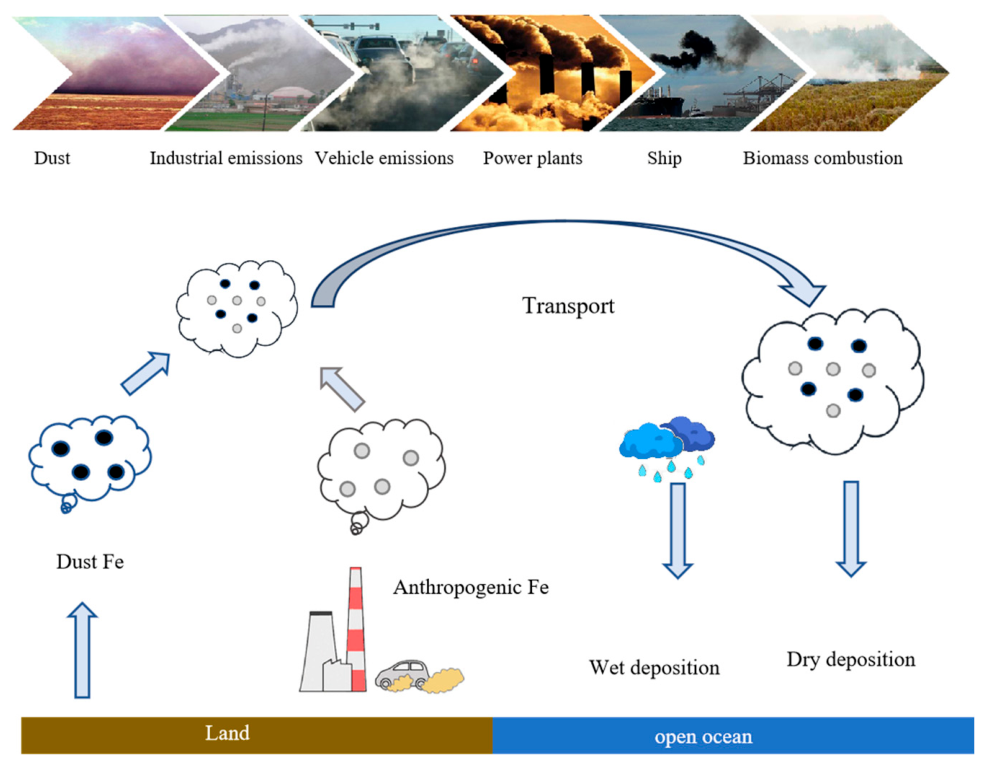
Dust aerosols originating from East Asia and Australia can transport substantial amounts of Fe over long distances, alleviating Fe limitation and stimulating marine phytoplankton growth in downwind regions. A schematic diagram illustrating the major emission sources and transport processes of aerosol Fe to the open ocean is presented in Figure 1. A synthesis of global observational and modeling data on Fe-limited regions [13] and soluble Fe sources, shows that Fe concentrations in the Southern Ocean, equatorial Pacific, North Pacific, and Indian Ocean are low enough to restrict phytoplankton growth [14,15,16]. Ice core records further reveal a significant negative correlation between dust-derived Fe flux and atmospheric CO2 during glacial–interglacial cycles [17], indicating that higher aerosol Fe input during glacial periods intensified the biological pump and drove down CO2. Consequently, in these Fe-limited regions, the atmospheric deposition flux of soluble Fe exerts an indirect but critical control on marine primary productivity and the biogeochemical cycling of carbon.

1.2. Bioavailability of Fe

Before examining the factors that control Fe solubility and its biogeochemical impacts, it is essential to first consider how Fe is quantified in both seawater and aerosol samples. The reliability and comparability of such data directly influence our ability to assess deposition fluxes, evaluate bioavailability, and constrain biogeochemical models. This section provides an overview of the commonly used operational definitions, extraction protocols, and detection techniques, highlighting how methodological variability creates challenges when comparing solubility and flux estimates across different studies.
In seawater, dFe is operationally defined as the fraction passing through 0.2 μm or 0.45 μm filters. Based on reactivity, Fe species can be categorized into three pools: Fe′ (labile inorganic complexes), FeL (organic ligand complexes exchangeable on timescales of <1 day), and Feinert (Fe bound in essentially non-labile matrices); Fe′ and FeL together are considered bioavailable Fe [18]. In terms of particle size, Fe is further divided into particulate (>0.45 or 0.2 μm), colloidal (passing through 0.45/0.2 μm but retained by 0.02 μm filters), and soluble (<0.02 μm) fractions.
Because bioavailable Fe cannot be measured directly in the ocean, many studies use dFe as a practical proxy, yet comparisons are complicated by methodological differences. In aerosol research, dFe (or soluble Fe) is typically defined as the fraction that passes through a 0.22 or 0.45 μm filter after extraction, and the ratio of soluble Fe to total Fe is referred to as Fe solubility [19]. The measured solubility depends strongly on the choice of extraction solution, leaching protocol, digestion method, and detection technique.
Common extraction solutions include ultrapure water, ammonium acetate, formate buffer, and seawater. Ultrapure water can approximate conditions in non-acidified cloud water, but its very low buffering capacity causes pH to vary with the dust sample, hampering inter-study comparison. To control pH, buffered solutions such as ammonium acetate (pH ≈ 4.7) or formate buffer (pH ≈ 4.5) have been used [20,21], enabling more consistent comparisons. However, some buffers may themselves modify Fe solubility. Seawater, with its high buffering capacity at pH ≈ 8.2, provides the most representative medium for simulating the release of dFe from dust entering the ocean. Notably, Fe solubility in seawater is generally low, and several studies have found that seawater extracts consistently less Fe than ultrapure water [22].
Experimental approaches include continuous flow leaching, static extraction, ultrasonic extraction, and oscillatory shaking extraction [23]. Continuous flow leaching reduces saturation effects but cannot account for the equilibrium between adsorption and dissolution during particle settling [24]. Static extraction in ultrapure water may require long equilibration times (e.g., >1000 h at low pH), leading to strong time dependence in measured solubility [25]. Ultrasonic and oscillatory shaking extraction substantially shorten processing times, although quantitative differences in extraction efficiency between these two techniques remain to be fully resolved.
Therefore, when discussing Fe solubility across studies, it is essential to explicitly state the extraction solution, method, and filter pore size employed. Aerosol Fe solubility is a key indicator for evaluating Fe bioavailability and currently constitutes the largest source of uncertainty in model-based estimates of soluble Fe deposition flux.

2. Sources and Deposition Fluxes of Fe in Marine Aerosols

2.1. Concentration and Sources of Marine Aerosol Fe

As shown in Table 1, the main sources of Fe to surface seawater include aerosol deposition, riverine input, coastal erosion, and hydrothermal activity [5,26]. Riverine and glacial particulate Fe are largely retained in coastal and nearshore environments, where they serve as a major source of Fe to regional surface waters. Although riverine inputs dominate the total global Fe flux, they are mainly confined to coastal zones; in the open ocean, away from coastal and benthic sources, atmospheric aerosol deposition is the primary supply of Fe to surface waters. In contrast, hydrothermal and sedimentary Fe inputs are released predominantly in the deep ocean, although a fraction may eventually reach the surface through upwelling and mixing. However, only a portion of the deposited Fe is directly usable by marine organisms; the bioavailable fraction is often assumed to correspond largely to dFe [27,28].
Atmospheric deposition dominates the external supply of bioavailable Fe to the open ocean. Fung et al. [29] estimated a total phytoplankton Fe requirement of ~0.67 Tg yr−1, whereas the total Fe input from atmospheric deposition is ~5.37 Tg yr−1, with the bioavailable fraction ranging from 0.05 to 0.53 Tg yr−1 (equivalent to roughly 1–10% dFe in total deposition). By comparison, the upward flux of bioavailable Fe from the base of the mixed layer supplies only ~0.04 Tg yr−1, highlighting the critical role of aeolian input.
The solubility and bioavailability of aerosol Fe are controlled by both source characteristics and atmospheric processing. Anthropogenic SO2 in Yellow Sea aerosols can acidify dust particles during transport, increasing Fe solubility and thereby alleviating Fe limitation in HNLC regions of the Pacific [30]. Combustion aerosols can dominate the supply of dFe, contributing up to 70% and 85% at Bermuda and Ireland, respectively [31]. At the process level, total Fe content has been observed to decline with transport time, while Fe solubility tends to increase [32]. Seasonal and regional variability are also large: in the tropical and subtropical North Atlantic, higher wintertime solubility and greater solubility in the subtropics than in the tropics have been reported [33]. Observations from the Southern Ocean and Antarctica report total Fe concentrations ranging from 0.1 to 150 ng m−3 and solubilities spanning 0.01–90% [34], underscoring the complexity of bioavailable Fe formation.
Stable Fe isotopes (δ56Fe) have recently been used to fingerprint anthropogenic vs. natural sources and to trace their impacts on marine Fe cycles. Wei et al. [35] compiled a global dataset of aerosol δ56Fe and, using an MixSIAR model, identified coal combustion as the dominant anthropogenic Fe source on a hemispheric scale. Chen et al. [36] applied δ56Fe in deep-sea sediments to assess how human-derived Fe influences the deep Fe cycle in the North and South Pacific. Together, these studies demonstrate that atmospheric Fe solubility varies significantly with particle size, season, and region, and that future model-based assessments of dFe deposition flux will require both expanded field observations and a deeper mechanistic understanding of aerosol Fe solubility.

2.2. Deposition Flux and Internal Circulation Process

Fe is an essential component of electron-transport proteins such as cytochromes and ferredoxin, which are central to phytoplankton photosynthesis. Extremely low dFe concentrations (typically <0.2 nmol L−1) can constrain chlorophyll synthesis and reduce carbon fixation efficiency [18,37,38]. Iron fertilization experiments have repeatedly shown that Fe addition enhances primary productivity in the surface ocean. For instance, during the IronEx II experiment in the equatorial Pacific, the addition of Fe led to a 27-fold increase in phytoplankton chlorophyll, a more than four-fold rise in primary productivity, and a notable decrease of ~90 μatm in surface-water CO2 partial pressure [39]. Fe is also required for the nitrogenase of nitrogen-fixing cyanobacteria (e.g., Trichodesmium) and thereby modulates community structure through its effects on N2 fixation. In tropical regions such as the North Atlantic, Fe and P co-limit nitrogen fixation; atmospheric dust deposition, especially from the Sahara, can enhance fixation rates by 2-to 8-fold, increasing the supply of bioavailable nitrogen and stimulating primary productivity [40]. Moreover, Fe enrichment directly alters phytoplankton community composition, for example, by triggering diatom blooms in the subarctic Pacific [41] and by shifting Southern Ocean communities from small prokaryote-dominated assemblages toward larger diatoms [42]. Thus, as an essential micronutrient for marine phytoplankton, Fe exerts a critical control on surface-ocean primary productivity, particularly in HNLC regions such as the Southern Ocean and the equatorial Pacific.
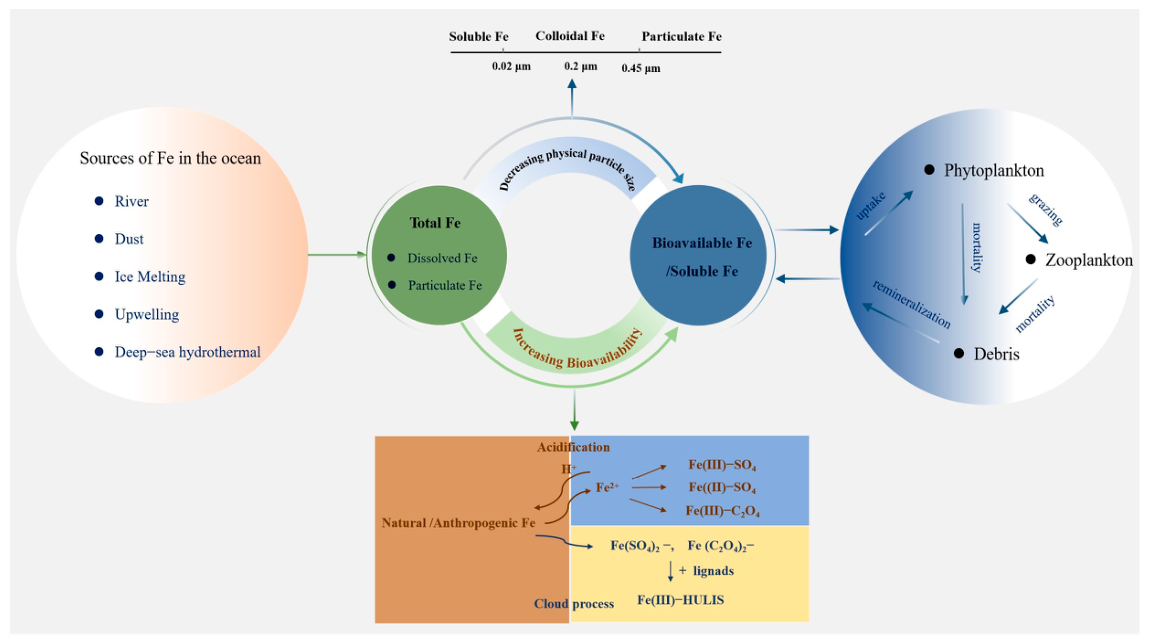
As shown in Figure 2, the bioavailability of Fe to marine primary producers varies greatly despite its complex chemical speciation. Fe(II) exhibits the highest bioavailability but is rapidly oxidized by O2 and H2O2 in oxygenated seawater to Fe(III), which forms highly insoluble hydroxides. Most dFe in seawater is complexed by organic ligands as FeL, accounting for >99% of total dFe [18]. These soluble Fe and some colloidal Fe pools can dissociate to release Fe′ (labile inorganic Fe) on timescales of <1 day and are therefore considered bioavailable [43]. In contrast, the remaining colloidal Fe, together with particulate Fe (>0.2 μm), contributes little to the bioavailable pool because it is not directly accessible to phytoplankton.
Globally, the concentration of Fe in atmospheric aerosols varies significantly by region, with higher mass concentrations observed near North Africa and East Asia, influenced by mineral dust and anthropogenic pollution. In contrast, remote areas such as the mid-latitude Atlantic, Southern Ocean, and eastern Pacific exhibit lower concentrations. The Southern Ocean, identified as an HNLC region, shows total Fe deposition fluxes ranging from 1.31 × 10⁻⁶ to −3 × 10⁻⁴ g·m−2·yr−1, with coastal zones near Antarctica experiencing markedly higher fluxes than open waters. This region is sensitive to atmospheric deposition, exemplified by the significant increase in soluble Fe following the 2019 Australian wildfires, which contributed to rapid phytoplankton growth and algal blooms [44]. In the North Pacific, total Fe fluxes are typically below 10 ng·m−2·d−1 but can rise to 50–200 ng·m−2·d−1 during spring dust storms [34]. In East Asia’s coastal waters, soluble Fe fluxes are typically higher than in the open ocean, with some impacted areas exhibiting 2 to 3 times greater fluxes than natural backgrounds, averaging 0.5 to 2.5 ng·m−2·d−1 [45].
In summary, the spatiotemporal distribution of aerosol Fe deposition is a key control on oceanic primary productivity, the carbon cycle, and ecosystem structure. Even small changes in deposition fluxes to HNLC regions can trigger significant biological responses. Accurate quantification of the regional variability in atmospheric Fe deposition and its solubility is therefore essential for assessing potential impacts on marine ecosystems and biogeochemical cycles.

3. Aerosol Fe Solubility During Transportation

3.1. Dissolution Mechanisms of Aerosol Fe

The dissolution of aerosol Fe is primarily controlled by three abiotic mechanisms: proton-promoted, ligand-promoted, and photoreductive dissolution [46,47]. Once deposited into seawater, bioreductive processes may also become significant. Laboratory and field studies have collectively elucidated how these mechanisms operate during atmospheric transport and at the ocean surface.
Proton-promoted dissolution occurs when high H+ concentrations weaken Fe–O bonds in acidic media. Mineral dust from arid regions is typically alkaline, and its surface pH remains buffered as long as the particles contain neutralizing components such as CaCO3. However, when acidic gases (e.g., SO2, NOx) accumulate beyond the buffering capacity, the surface pH drops sharply, accelerating Fe release [48,49,50,51]. Aerosol acidity is therefore considered a key factor in transforming insoluble Fe into labile and dissolved forms.
Ligand-promoted dissolution is particularly effective for Fe bound in aluminosilicates and oxides, with the latter dissolving markedly faster [52]. Small organic acids, such as oxalic, humic, and malonic acids, adsorb onto particle surfaces and form Fe–organic complexes, lowering the activation energy for dissolution and enhancing solubility [53]. Field studies have reported significant positive correlations between oxalic acid concentrations and soluble Fe [54,55], and laboratory experiments [56] confirm that Fe solubility increases with organic acid concentration, with the specific acid type also influencing the valence state of the dFe.
Photoreductive dissolution further amplifies Fe solubility. Organic ligands facilitate light-induced electron transfer that reduces Fe(III) to the more soluble Fe(II). Meskhidze et al. [30] observed that the dissolution rate of hematite increased 5- to 10-fold under illumination, and Fu et al. [57] confirmed that photoreduction measurably enhances Fe solubility in mineral dust. Field observations consistently detect organic acids in aerosols and at the ocean surface [58,59], where they associate with particulate matter and promote the formation of soluble Fe–organic complexes, thereby increasing the bioavailable Fe pool.

3.2. Emission Source on the Fe Solubility

Atmospheric Fe solubility is strongly source dependent. Mineral dust, the most abundant aerosol type globally [60,61], typically exhibits low initial solubility, generally below 0.5% [62,63,64,65]. Measurements near source regions confirm this: Fe solubility in total suspended particles from Dunhuang was <1% [66], and Qingdao dust averaged 0.27% [51]. Even after long-range transport, solubility often remains modest; for example, mineral aerosols reaching Hokkaido exhibit a solubility of just 0.52% [67] and Saharan dust arriving over the Atlantic shows a median solubility of only 1.7% [68]. Therefore, despite its overwhelming mass emission, dust likely supplies only a limited fraction of bioavailable Fe.
Anthropogenic aerosols from combustion and industrial processes exhibit considerably higher solubility, sometimes >80% [51,62,69]. For example, biomass-burning aerosols reach 56 ± 31% and residential coal-combustion particles 33 ± 28%, whereas industrial fly ash remains near zero [70]. Urban fine particles across Chinese cities show 2.7–5.0% solubility [71], and in the Sargasso Sea, Saharan dust solubility rose from 0.44% to 19% after mixing with North American industrial emissions [72]. Such observations clearly demonstrate that anthropogenic sources can disproportionately increase the bioavailable Fe input, despite their smaller total Fe emission fluxes.
However, the contribution of anthropogenic versus natural sources to surface-ocean bioavailable Fe remains highly uncertain, and this uncertainty is not only due to variable emission strengths. A critical but often overlooked issue is the lack of measurement standardization: studies employ different leaching solutions (ultrapure water, acetate buffer, seawater), filter pore sizes, and extraction times, rendering direct inter-comparisons of reported solubility values questionable. Furthermore, the concept of a fixed “initial solubility” linked to source type is an oversimplification because dynamic processes, such as acidification, organic acid coating, and photoreduction during transport, can profoundly alter Fe solubility downstream. For instance, Mahowald et al. [13] modeled high solubility over the Atlantic and central Africa, contrasting with high total Fe concentrations near East Asia, illustrating the spatial decoupling of Fe loading and bioavailability driven by transit chemistry. Southern Hemisphere wildfires add a further layer of complexity: their Fe contribution can rival that of dust, yet solubilities vary erratically from 0.5% to 46%, and the large interannual variability in fire activity makes it difficult to define a representative background for global models.
Therefore, reducing these uncertainties will require not only more field data but also a concerted effort toward harmonized solubility protocols and process-level parameterizations that capture the evolving bioavailability of aerosol Fe during transport. Such advances are essential for accurately assessing the impact of atmospheric deposition on marine productivity and carbon cycling.

3.3. Atmospheric Processes Affecting Fe Solubility

Gravitational settling causes coarser particles to be removed more rapidly than fine ones during atmospheric transport, producing a size differentiation that increases with distance [73]. Numerous field studies have reported a general negative correlation between Fe solubility and total Fe or total Al [31,33,49,74], which Baker et al. [49] attributed to the larger specific surface area of finer particles that favors chemical reactions. However, this inverse relationship is not universal: Buck et al. [75] found no significant trend between Fe solubility and particle size across nine size-segregated aerosol samples from the North Atlantic, indicating that size alone cannot reliably predict solubility.
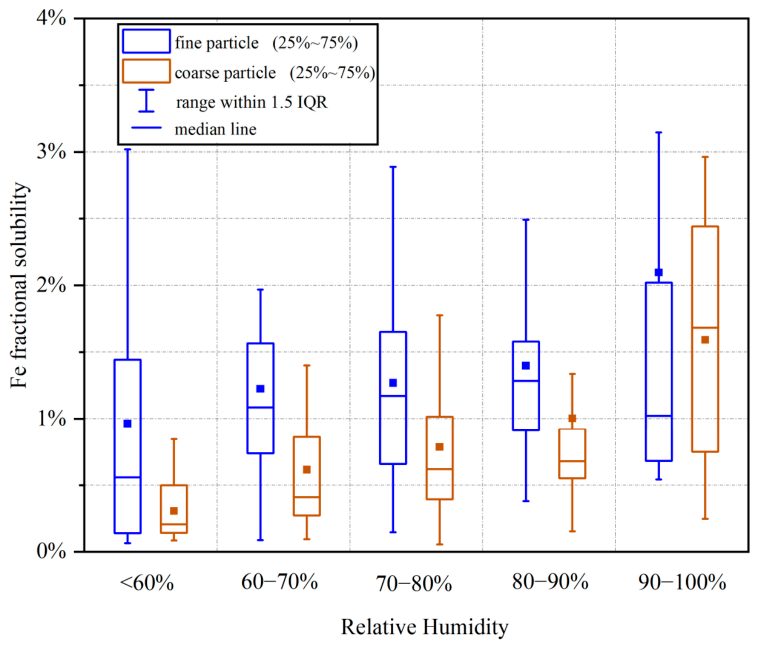
Fe solubility is strongly pH-dependent [76,77,78]. During transport, acidic gases such as SO2 and NOx are oxidized to sulfuric and nitric acids through heterogeneous reactions, altering aerosol acidity and the chemical forms of Fe [79,80]. Consequently, Fe solubility typically increases along transport pathways: Buck et al. [81] measured solubilities of 9.0% and 8.1% in TSP over the North Atlantic and Pacific, Hsu et al. [82] reported 7.7% in the East China Sea, and Chuang et al. [66] documented a range of 0.1–10% in Asian coastal aerosols that correlated with black carbon, linking solubility enhancement to anthropogenic emissions. The most striking demonstration is the contrast between fresh Saharan dust (~0.5% solubility) and the same dust after passing over North America, where solubility reached 19% [72]. Acidification by anthropogenic secondary species is central to this enhancement, as indicated by positive correlations between Fe solubility and sulfate or nitrate content [51,83,84] and by TEM observations of Fe-bearing particles from coal combustion and steel production encapsulated in secondary sulfates [85]. Relative humidity (RH) facilitates these acid-driven reactions [86,87]; accordingly, Fe solubility is highest on foggy or hazy days [51,88], and in Xi’an the median solubility rose from <1% at RH <90% to 1.68% when RH exceeded 90% [89] (Figure 3). In contrast, during dust events with limited chemical processing in Qingdao [51,88], Jeju Island [66], and Hokkaido [67], Fe solubility generally remains below 0.5%, confirming the importance of acidification and humidity. Nevertheless, it should be noted that the chemical environment experienced by individual particles is highly variable, and the statistical relationships with bulk aerosol sulfate or nitrate do not fully capture the micro-scale conditions that control dissolution.
Organic acids, ubiquitous in aerosols and at the ocean surface [58,59], can penetrate or adsorb onto particles and complex Fe, potentially enhancing its solubility. However, the role of oxalic acid remains debated: some studies observe a significant positive correlation between oxalate and soluble Fe [52,90], while others find no clear relationship [51,84]. This discrepancy may arise because oxalic acid can also be produced by atmospheric oxidation, so an observed correlation does not necessarily imply that oxalate directly drives Fe dissolution [91]. Resolving this ambiguity requires process-level studies that discriminate between primary emissions and secondary formation of organic acids and that quantify their true ligand-promoted dissolution rates.
Cloud processing adds further complexity. Insoluble Fe can dissolve during repeated condensation–evaporation cycles (typically 5–10 before reaching the ocean) [92] because evaporating droplets produce wet aerosols with pH values as low as 2 [93,94,95]. Laboratory simulations confirm that Fe solubility increases at low pH [96], and particles from biomass burning, due to their hygroscopicity, preferentially act as cloud condensation nuclei [97]. Single-particle measurements at Nanling showed that combustion-related Fe-rich particles comprised 84% of Fe-containing cloud residuals, and cloud processing increased nitrate, chloride, and oxalate in these residuals [98]. Yet, a counterpoint is provided by Shi et al. [99], who found that while acidic wet aerosols promote dissolution, the higher pH typical of actual cloud droplets can inhibit it. Thus, the net effect of cloud processing on Fe solubility depends on the droplet pH history, which itself is a function of aerosol composition and trace gas uptake, a complexity that current large-scale parameterizations rarely capture. Collectively, these uncertainties highlight the need for field-based, chemically resolved observations and for models that explicitly track aerosol acidity and organic ligand evolution along trajectories rather than relying on fixed solubility fractions assigned to source types.

4. Conclusions

Atmospheric deposition of aerosol Fe is a primary pathway supplying bioactive Fe to the open ocean, with dust and combustion sources dominating total Fe loading. This review has integrated field observations, laboratory experiments, and model evidence to show that Fe solubility is governed by a complex interplay of source characteristics, chemical aging during transport (acidification, ligand-promoted dissolution, and photoreduction), and cloud processing, all modulated by relative humidity and particle size. A consistent finding is that anthropogenic emissions and secondary acidification can elevate solubility by an order of magnitude above that of fresh mineral dust, while the net effect of cloud cycles is highly dependent on droplet pH history. These processes collectively decouple soluble Fe delivery from total Fe emission, challenging the common practice of assigning fixed solubility fractions to source types. However, it is important to acknowledge that the synthesis of existing data is complicated by inconsistent methodologies. Studies employ a wide range of leaching solutions, filter pore sizes, and extraction times, which introduces significant uncertainty into the comparability of reported solubility values and may partly mask or exaggerate the true environmental trends. Moreover, the widespread concept of a static initial solubility linked to a given source type is an oversimplification that ignores rapid dynamic alterations in Fe speciation during transit, and the high interannual variability of sources such as wildfires further renders static parameterizations unreliable.
Despite this progress, significant uncertainties persist. First, the relative contribution of anthropogenic versus natural soluble Fe remains poorly constrained in ambient samples, largely because most studies examine single-source aerosols and lack the chemical fingerprints needed to deconvolve mixed plumes. This mismatch between model parameterizations and observational realities undermines the accuracy of deposition flux estimates. Second, the ecosystem-scale impacts of altered Fe bioavailability, such as its interplay with nitrogen and phosphorus limitation and its long-term effects on community structure and carbon export, are still primarily inferred from short-term enrichment experiments. This leaves a critical gap in understanding ecological dynamics over seasonal to decadal timescales.
Addressing these challenges will require systematic field campaigns that resolve anthropogenic and natural iron fractions with chemical markers, process-level models that explicitly simulate aerosol acidity and ligand evolution along transport pathways, and sustained multidisciplinary studies linking atmospheric inputs to biogeochemical responses across trophic levels. A concerted effort to harmonize solubility measurement protocols is equally essential, as it is a prerequisite for synthesizing a globally representative database. Such integrated efforts will be indispensable for improving projections of marine productivity and carbon sequestration under changing emission and climate regimes.

Author Contributions

H.Z.: investigation, formal analysis, funding acquisition, writing—original draft; D.T.: conceptualization, writing—review and editing; S.M.: writing—review and editing. All authors have read and agreed to the published version of the manuscript.

Funding

This work was supported by the China Postdoctoral Science Foundation (2024M750629) and the National Natural Science Foundation of China Youth Science Fund Project (42407149).

Data Availability Statement

All relevant data used for the research described in this article are included in the manuscript.

Conflicts of Interest

The authors declare no conflict of interest.

References

  1. Bach, L.T.; Tamsitt, V.; Baldry, K.; McGee, J.; Laurenceau-Cornec, E.C.; Strzepek, R.F.; Xie, Y.; Boyd, P.W. Identifying the Most (Cost-)Efficient Regions for CO2 Removal with Iron Fertilization in the Southern Ocean. Glob. Biogeochem. Cycles 2023, 37, e2023GB007754. [Google Scholar] [CrossRef]
  2. Moore, C.M.; Mills, M.M.; Arrigo, K.R.; Berman-Frank, I.; Bopp, L.; Boyd, P.W.; Galbraith, E.D.; Geider, R.J.; Guieu, C.; Jaccard, S.L.; et al. Processes and patterns of oceanic nutrient limitation. Nat. Geosci. 2013, 6, 701–710. [Google Scholar] [CrossRef]
  3. Chen, Z.-L.; Shi, L.-L.; Peng, D.-M.; Chen, C.-L.; Zhang, J.-B.; Zhang, P. Spatial and Seasonal Variations in Iron and the Response of Chlorophyll-a in Zhanjiang Bay, China. Water 2024, 16, 2338. [Google Scholar] [CrossRef]
  4. Xiao, C.; Du, Z.; Handley, M.J.; Mayewski, P.A.; Cao, J.; Schüpbach, S.; Zhang, T.; Petit, J.-R.; Li, C.; Han, Y.; et al. Iron in the NEEM ice core relative to Asian loess records over the last glacial–interglacial cycle. Natl. Sci. Rev. 2021, 8, nwaa144. [Google Scholar] [CrossRef]
  5. Tagliabue, A.; Bowie, A.R.; Boyd, P.W.; Buck, K.N.; Johnson, K.S.; Saito, M.A. The integral role of iron in ocean biogeochemistry. Nature 2017, 543, 51–59. [Google Scholar] [CrossRef]
  6. Arnold, E.E.B.; Kindong, R.; Narcisse, E.N.; Achile, P.N.; Hu, S. The Influence of Submesoscale Motions on Upper-Ocean Chlorophyll: Case of Benguela Current Large Marine Ecosystem (BCLME). J. Mar. Sci. Eng. 2025, 13, 2409. [Google Scholar] [CrossRef]
  7. Jürchott, M.; Koeve, W.; Oschlies, A. The response of the ocean carbon cycle to artificial upwelling, ocean iron fertilization and the combination of both. Environ. Res. Lett. 2024, 19, 114088. [Google Scholar] [CrossRef]
  8. Planquette, H.; Sanders, R.R.; Statham, P.J.; Morris, P.J.; Fones, G.R. Fluxes of particulate iron from the upper ocean around the Crozet Islands: A naturally iron-fertilized environment in the Southern Ocean. Glob. Biogeochem. Cycles 2011, 25, 1029. [Google Scholar] [CrossRef]
  9. Lauderdale, J.M.; Braakman, R.; Forget, G.; Dutkiewicz, S.; Follows, M.J. Microbial feedbacks optimize ocean iron availability. Proc. Natl. Acad. Sci. USA 2020, 117, 4842–4849. [Google Scholar] [CrossRef]
  10. Jickells, T.; Boyd, P.; Hunter, K.A. Biogeochemical impacts of dust on the global carbon cycle. In Mineral Dust: A Key Player in the Earth System; Springer: Dordrecht, The Netherlands, 2014; pp. 359–384. [Google Scholar]
  11. Wen, C.; Huang, J.; Shan, Y.; Yang, D.; Mu, L.; Zhang, P.; Liu, X.; Chang, H.; Ye, R. Effects of Nitrogen and Water Addition on Ecosystem Carbon Fluxes in a Grazing Desert Steppe. Agronomy 2025, 15, 2016. [Google Scholar] [CrossRef]
  12. Sakata, K.; Takano, S.; Matsuki, A.; Takeichi, Y.; Tanimoto, H.; Sakaguchi, A.; Kurisu, M.; Takahashi, Y. Atmospheric chemistry in East Asia determines the iron solubility of aerosol particles supplied to the North Pacific Ocean. Atmos. Chem. Phys. 2025, 25, 11087–11107. [Google Scholar] [CrossRef]
  13. Mahowald, N.M.; Hamilton, D.S.; Mackey, K.R.M.; Moore, J.K.; Baker, A.R.; Scanza, R.A.; Zhang, Y. Aerosol trace metal leaching and impacts on marine microorganisms. Nat. Commun. 2018, 9, 2614. [Google Scholar] [CrossRef]
  14. Chaiwaree, S.; Georgieva, R.; Deckart, T.; Lenz, J.; Choonukoolphong, T.; Suriyaprom, S.; Prapan, A.; Cheepchirasuk, N.; Pruß, A.; Xiong, Y.; et al. Bioavailability of Functional Iron in Protein Microparticles. Nutrients 2026, 18, 1102. [Google Scholar] [CrossRef]
  15. De Baar, H.J.; Boyd, P.W.; Coale, K.H.; Landry, M.R.; Tsuda, A.; Assmy, P.; Bakker, D.C.; Bozec, Y.; Barber, R.T.; Brzezinski, M.A. Synthesis of iron fertilization experiments: From the iron age in the age of enlightenment. J. Geophys. Res. Ocean. 2005, 110, C09S16. [Google Scholar] [CrossRef]
  16. Boyd, P.W.; Mackie, D.S.; Hunter, K.A. Aerosol iron deposition to the surface ocean-Modes of iron supply and biological responses. Mar. Chem. 2010, 120, 128–143. [Google Scholar] [CrossRef]
  17. Jiang, H.B.; Hutchins, D.A.; Ma, W.; Zhang, R.; Wells, M.; Jiao, N.; Wang, Y.; Chai, F. Natural ocean iron fertilization and climate variability over geological periods. Glob. Change Biol. 2023, 29, 6778–6796. [Google Scholar] [CrossRef]
  18. Gledhill, M.; Buck, K.N. The Organic Complexation of Iron in the Marine Environment: A Review. Front. Microbiol. 2012, 3, 69. [Google Scholar] [CrossRef] [PubMed]
  19. Morton, P.L.; Landing, W.M.; Hsu, S.C.; Milne, A.; Aguilar-Islas, A.M.; Baker, A.R.; Bowie, A.R.; Buck, C.S.; Gao, Y.; Gichuki, S.; et al. Methods for the sampling and analysis of marine aerosols: Results from the 2008 GEOTRACES aerosol intercalibration experiment. Limnol. Oceanogr. Methods 2013, 11, 62–78. [Google Scholar] [CrossRef]
  20. Chen, Y.; Siefert, R.L. Determination of various types of labile atmospheric iron over remote oceans. J. Geophys. Res. Atmos. 2003, 108, D01309. [Google Scholar] [CrossRef]
  21. Baker, A.; Jickells, T. Mineral particle size as a control on aerosol iron solubility. Geophys. Res. Lett. 2006, 33, L17608. [Google Scholar] [CrossRef]
  22. Bonnet, S.; Guieu, C. Dissolution of atmospheric iron in seawater. Geophys. Res. Lett. 2004, 31, L03302. [Google Scholar] [CrossRef]
  23. Wang, Z.; Li, R.; Cui, L.; Fu, H.; Lin, J.; Chen, J. Characterization and acid-mobilization study for typical iron-bearing clay mineral. J. Environ. Sci. 2018, 71, 222–232. [Google Scholar] [CrossRef]
  24. Ooki, A.; Nishioka, J.; Ono, T.; Noriki, S. Size dependence of iron solubility of Asian mineral dust particles. J. Geophys. Res. Atmos. 2009, 114, D02212. [Google Scholar] [CrossRef]
  25. Trapp, J.M.; Millero, F.J.; Prospero, J.M. Trends in the solubility of iron in dust-dominated aerosols in the equatorial Atlantic trade winds: Importance of iron speciation and sources. Geochem. Geophys. Geosyst. 2010, 11, Q03014. [Google Scholar] [CrossRef]
  26. Jickells, T.D.; An, Z.S.; Andersen, K.K.; Baker, A.R.; Bergametti, C.; Brooks, N.; Cao, J.J.; Boyd, P.W.; Duce, R.A.; Hunter, K.A.; et al. Global iron connections between desert dust, ocean biogeochemistry, and climate. Science 2005, 308, 67–71. [Google Scholar] [CrossRef] [PubMed]
  27. Ito, A.; Xu, L. Response of acid mobilization of iron-containing mineral dust to improvement of air quality projected in the future. Atmos. Chem. Phys. 2014, 14, 3441–3459. [Google Scholar] [CrossRef]
  28. Luo, C.; Mahowald, N.; Bond, T.; Chuang, P.Y.; Artaxo, P.; Siefert, R.; Chen, Y.; Schauer, J. Combustion iron distribution and deposition. Glob. Biogeochem. Cycles 2008, 22, GB1012. [Google Scholar] [CrossRef]
  29. Fung, I.Y.; Meyn, S.K.; Tegen, I.; Doney, S.C.; John, J.G.; Bishop, J.K.B. Iron supply and demand in the upper ocean. Glob. Biogeochem. Cycles 2000, 14, 281–295. [Google Scholar] [CrossRef]
  30. Meskhidze, N.; Chameides, W.L.; Nenes, A.; Chen, G. Iron mobilization in mineral dust: Can anthropogenic SO2 emissions affect ocean productivity? Geophys. Res. Lett. 2003, 30, 2085. [Google Scholar] [CrossRef]
  31. Sholkovitz, E.R.; Sedwick, P.N.; Church, T.M.; Baker, A.R.; Powell, C.F. Fractional solubility of aerosol iron: Synthesis of a global-scale data set. Geochim. Cosmochim. Acta 2012, 89, 173–189. [Google Scholar] [CrossRef]
  32. Longo, A.F.; Feng, Y.; Lai, B.; Landing, W.M.; Shelley, R.U.; Nenes, A.; Mihalopoulos, N.; Violaki, K.; Ingall, E.D. Influence of Atmospheric Processes on the Solubility and Composition of Iron in Saharan Dust. Environ. Sci. Technol. 2016, 50, 6912–6920. [Google Scholar] [CrossRef]
  33. Chen, Y.; Siefert, R.L. Seasonal and spatial distributions and dry deposition fluxes of atmospheric total and labile iron over the tropical and subtropical North Atlantic Ocean. J. Geophys. Res. Atmos. 2004, 109, D09305. [Google Scholar] [CrossRef]
  34. Cao, Y.; Xu, G.; Chen, L. Research progress of atmospheric aerosol iron over the Southern Ocean and the Antarctic. J. Glaciol. Geocryol. 2024, 46, 1749–1766. [Google Scholar]
  35. Wei, T.; Dong, Z.; Zong, C.; Liu, X.; Kang, S.; Yan, Y.; Ren, J. Global-scale constraints on the origins of aerosol iron using stable iron isotopes: A review. Earth-Sci. Rev. 2024, 258, 104943. [Google Scholar] [CrossRef]
  36. Chen, T.; Li, W.; Guo, B.; Liu, R.; Li, G.; Zhao, L.; Ji, J. Reactive iron isotope signatures of the East Asian dust particles: Implications for iron cycling in the deep North Pacific. Chem. Geol. 2020, 531, 119342. [Google Scholar] [CrossRef]
  37. Jiang, H.-B.; Hutchins, D.A.; Zhang, H.-R.; Feng, Y.-Y.; Zhang, R.-F.; Sun, W.-W.; Ma, W.; Bai, Y.; Wells, M.; He, D.; et al. Complexities of regulating climate by promoting marine primary production with ocean iron fertilization. Earth-Sci. Rev. 2024, 249, 104675. [Google Scholar] [CrossRef]
  38. Woolf, D.K. Eight Categories of Air–Water Gas Transfer. Oceans 2025, 6, 27. [Google Scholar] [CrossRef]
  39. Boyd, P.W.; Watson, A.J.; Law, C.S.; Abraham, E.R.; Trull, T.; Murdoch, R.; Bakker, D.C.E.; Bowie, A.R.; Buesseler, K.O.; Chang, H.; et al. A mesoscale phytoplankton bloom in the polar Southern Ocean stimulated by iron fertilization. Nature 2000, 407, 695–702. [Google Scholar] [CrossRef] [PubMed]
  40. Mills, M.M.; Ridame, C.; Davey, M.; La Roche, J. Iron and phosphorus co-limit nitrogen fixation in the eastern tropical North Atlantic. Nature 2004, 429, 292–294. [Google Scholar] [CrossRef]
  41. Takeda, S.; Tsuda, A. An in situ iron-enrichment experiment in the western subarctic Pacific (SEEDS): Introduction and summary. Prog. Oceanogr. 2005, 64, 95–109. [Google Scholar] [CrossRef]
  42. Bakker, D.C.E.; Bozec, Y.; Nightingale, P.D.; Goldson, L.; Messias, M.-J.; de Baar, H.J.W.; Liddicoat, M.; Skjelvan, I.; Strass, V.; Watson, A.J. Iron and mixing affect biological carbon uptake in SOIREE and EisenEx, two Southern Ocean iron fertilisation experiments. Deep Sea Res. Part I 2005, 52, 1001–1019. [Google Scholar] [CrossRef][Green Version]
  43. Chai, F.; Zhang, H.-R.; Wang, Y.; Xiu, P. Modeling the seasonal variability of phytoplankton in the subarctic northeast Pacific Ocean. Mar. Ecol. Prog. Ser. 2021, 680, 33–50. [Google Scholar] [CrossRef]
  44. Wang, Y.; Chen, H.-H.; Tang, R.; He, D.; Lee, Z.; Xue, H.; Wells, M.; Boss, E.; Chai, F. Australian fire nourishes ocean phytoplankton bloom. Sci. Total Environ. 2022, 807, 150775. [Google Scholar] [CrossRef]
  45. Wu, J.; Rember, R.; Cahill, C. Dissolution of aerosol iron in the surface waters of the North Pacific and North Atlantic oceans as determined by a semicontinuous flow-through reactor method. Glob. Biogeochem. Cycles 2007, 21, GB4010. [Google Scholar] [CrossRef]
  46. Cornell, R.M.; Schwertmann, U. The Iron Oxides: Structure, Properties, Reactions, Occurrences, and Uses; Wiley-VCH: Weinheim, Germany, 2003; Volume 664. [Google Scholar]
  47. Sakata, K.; Kurisu, M.; Takahashi, Y. Assessment of aerosol iron (Fe) solubility using global dataset, Part I: Mechanisms underlying the inverse relationship between Fe solubility and Fe concentration. EGUsphere 2026, 1–36. [Google Scholar]
  48. Baker, A.R.; Li, M.; Chance, R. Trace Metal Fractional Solubility in Size-Segregated Aerosols from the Tropical Eastern Atlantic Ocean. Glob. Biogeochem. Cycles 2020, 34, e2019GB006510. [Google Scholar] [CrossRef]
  49. Baker, A.R.; Jickells, T.D.; Witt, M.; Linge, K.L. Trends in the solubility of iron, aluminium, manganese and phosphorus in aerosol collected over the Atlantic Ocean. Mar. Chem. 2006, 98, 43–58. [Google Scholar] [CrossRef]
  50. Shi, Z.; Krom, M.D.; Jickells, T.D.; Bonneville, S.; Carslaw, K.S.; Mihalopoulos, N.; Baker, A.R.; Benning, L.G. Impacts on iron solubility in the mineral dust by processes in the source region and the atmosphere: A review. Aeolian Res. 2012, 5, 21–42. [Google Scholar] [CrossRef]
  51. Shi, J.; Guan, Y.; Ito, A.; Gao, H.; Yao, X.; Baker, A.R.; Zhang, D. High Production of Soluble Iron Promoted by Aerosol Acidification in Fog. Geophys. Res. Lett. 2020, 47, e2019GL086124. [Google Scholar] [CrossRef]
  52. Chen, H.; Grassian, V.H. Iron dissolution of dust source materials during simulated acidic processing: The effect of sulfuric, acetic, and oxalic acids. Environ. Sci. Technol. 2013, 47, 10312–10321. [Google Scholar] [CrossRef]
  53. Luria, M.; Sievering, H. Heterogeneous and homogeneous oxidation of SO2 in the remote marine atmosphere. Atmos. Environ. Part A 1991, 25, 1489–1496. [Google Scholar] [CrossRef]
  54. Hand, J.L.; Mahowald, N.M.; Chen, Y.; Siefert, R.L.; Luo, C.; Subramaniam, A.; Fung, I. Estimates of atmospheric-processed soluble iron from observations and a global mineral aerosol model: Biogeochemical implications. J. Geophys. Res. Atmos. 2004, 109, D17205. [Google Scholar] [CrossRef]
  55. Barcan, R.; Kassis, Z.R.; Teaf, C.M.; Danley-Thomson, A.; Covert, D.J.; Missimer, T.M. Dry and Wet Atmospheric Deposition Composition in Southwest Florida: Environmental and Health Implications. Atmosphere 2023, 14, 102. [Google Scholar] [CrossRef]
  56. Paris, R.; Desboeufs, K.V.; Journet, E. Variability of dust iron solubility in atmospheric waters: Investigation of the role of oxalate organic complexation. Atmos. Environ. 2011, 45, 6510–6517. [Google Scholar] [CrossRef]
  57. Fu, H.; Cwiertny, D.M.; Carmichael, G.R.; Scherer, M.M.; Grassian, V.H. Photoreductive dissolution of Fe-containing mineral dust particles in acidic media. J. Geophys. Res. Atmos. 2010, 115, D11304. [Google Scholar] [CrossRef]
  58. Wei, J.; Yu, H.; Wang, Y.; Verma, V. Complexation of Iron and Copper in Ambient Particulate Matter and Its Effect on the Oxidative Potential Measured in a Surrogate Lung Fluid. Environ. Sci. Technol. 2019, 53, 1661–1671. [Google Scholar] [CrossRef]
  59. Zhang, G.; Lin, Q.; Peng, L.; Yang, Y.; Jiang, F.; Liu, F.; Song, W.; Chen, D.; Cai, Z.; Bi, X.; et al. Oxalate Formation Enhanced by Fe-Containing Particles and Environmental Implications. Environ. Sci. Technol. 2019, 53, 1269–1277. [Google Scholar] [CrossRef]
  60. Myriokefalitakis, S.; Daskalakis, N.; Mihalopoulos, N.; Baker, A.R.; Nenes, A.; Kanakidou, M. Changes in dissolved iron deposition to the oceans driven by human activity: A 3-D global modelling study. Biogeosciences 2015, 12, 3973–3992. [Google Scholar] [CrossRef]
  61. Mahowald, N.M.; Engelstaedter, S.; Luo, C.; Sealy, A.; Artaxo, P.; Benitez-Nelson, C.; Bonnet, S.; Chen, Y.; Chuang, P.Y.; Cohen, D.D.; et al. Atmospheric Iron Deposition: Global Distribution, Variability, and Human Perturbations. Annu. Rev. Mar. Sci. 2009, 1, 245–278. [Google Scholar] [CrossRef]
  62. Desboeufs, K.; Sofikitis, A.; Losno, R.; Colin, J.; Ausset, P. Dissolution and solubility of trace metals from natural and anthropogenic aerosol particulate matter. Chemosphere 2005, 58, 195–203. [Google Scholar] [CrossRef]
  63. Schroth, A.W.; Crusius, J.; Sholkovitz, E.R.; Bostick, B.C. Iron solubility driven by speciation in dust sources to the ocean. Nat. Geosci. 2009, 2, 337–340. [Google Scholar] [CrossRef]
  64. Oakes, M.; Ingall, E.D.; Lai, B.; Shafer, M.M.; Hays, M.D.; Liu, Z.G.; Russell, A.G.; Weber, R.J. Iron Solubility Related to Particle Sulfur Content in Source Emission and Ambient Fine Particles. Environ. Sci. Technol. 2012, 46, 6637–6644. [Google Scholar] [CrossRef]
  65. Chen, Y.; Zhang, T.; Wang, Z.; Zhu, Z.; Zhang, Y.; Liu, M.; Wang, F.; Ren, Y.; Shi, G.; Zhang, G.; et al. Sources of total and dissolved aerosol iron at Xi’an, Northwest China: Implications for solubility of aerosol iron from different sources. J. Environ. Sci. 2026, 165, 29–37. [Google Scholar] [CrossRef]
  66. Chuang, P.Y.; Duvall, R.M.; Shafer, M.M.; Schauer, J.J. The origin of water soluble particulate iron in the Asian atmospheric outflow. Geophys. Res. Lett. 2005, 32, L07813. [Google Scholar] [CrossRef]
  67. Ooki, A. Chemical interactions between mineral dust particles and acid gases during Asian dust events. J. Geophys. Res. 2005, 110, D03201. [Google Scholar] [CrossRef]
  68. Baker, A.R.; French, M.; Linge, K.L. Trends in aerosol nutrient solubility along a west–east transect of the Saharan dust plume. Geophys. Res. Lett. 2006, 33, L07805. [Google Scholar] [CrossRef]
  69. Salazar, J.R.; Cartledge, B.T.; Haynes, J.P.; York-Marini, R.; Robinson, A.L.; Drozd, G.T.; Goldstein, A.H.; Fakra, S.C.; Majestic, B.J. Water-soluble iron emitted from vehicle exhaust is linked to primary speciated organic compounds. Atmos. Chem. Phys. 2020, 20, 1849–1860. [Google Scholar] [CrossRef]
  70. Li, R.; Zhang, H.; Wang, F.; He, Y.; Huang, C.; Luo, L.; Dong, S.; Jia, X.; Tang, M. Mass fractions, solubility, speciation and isotopic compositions of iron in coal and municipal waste fly ash. Sci. Total Environ. 2022, 838, 155974. [Google Scholar] [CrossRef]
  71. Zhu, Y.; Li, W.; Lin, Q.; Yuan, Q.; Liu, L.; Zhang, J.; Zhang, Y.; Shao, L.; Niu, H.; Yang, S.; et al. Iron solubility in fine particles associated with secondary acidic aerosols in east China. Environ. Pollut. 2020, 264, 114769. [Google Scholar] [CrossRef]
  72. Sedwick, P.N.; Sholkovitz, E.R.; Church, T.M. Impact of anthropogenic combustion emissions on the fractional solubility of aerosol iron: Evidence from the Sargasso Sea. Geochem. Geophys. Geosyst. 2007, 8, Q10N06. [Google Scholar] [CrossRef]
  73. Baker, A.R.; Croot, P.L. Atmospheric and marine controls on aerosol iron solubility in seawater. Mar. Chem. 2010, 120, 4–13. [Google Scholar] [CrossRef]
  74. Hsu, S.C.; Lin, F.J.; Jeng, W.L. Seawater solubility of natural and anthropogenic metals within ambient aerosols collected from Taiwan coastal sites. Atmos. Environ. 2005, 39, 3989–4001. [Google Scholar] [CrossRef]
  75. Buck, C.S.; Landing, W.M.; Resing, J.A. Particle size and aerosol iron solubility: A high-resolution analysis of Atlantic aerosols. Mar. Chem. 2010, 120, 14–24. [Google Scholar] [CrossRef]
  76. Bonneville, S.; Behrends, T.; Van Cappellen, P. Solubility and dissimilatory reduction kinetics of iron(III) oxyhydroxides: A linear free energy relationship. Geochim. Cosmochim. Acta 2009, 73, 5273–5282. [Google Scholar] [CrossRef]
  77. Spokes, L.J.; Jickells, T.D.; Lim, B. Solubilisation of aerosol trace metals by cloud processing: A laboratory study. Geochim. Cosmochim. Acta 1994, 58, 3281–3287. [Google Scholar] [CrossRef]
  78. Spokes, L.; Jickells, T. Factors controlling the solubility of aerosol trace metals in the atmosphere and on mixing into seawater. Oceanogr. Lit. Rev. 1997, 2, 95. [Google Scholar] [CrossRef]
  79. Li, W.; Xu, L.; Liu, X.; Zhang, J.; Lin, Y.; Yao, X.; Gao, H.; Zhang, D.; Chen, J.; Wang, W.; et al. Air pollution–aerosol interactions produce more bioavailable iron for ocean ecosystems. Sci. Adv. 2017, 3, e1601749. [Google Scholar] [CrossRef]
  80. Ito, A.; Shi, Z. Delivery of anthropogenic bioavailable iron from mineral dust and combustion aerosols to the ocean. Atmos. Chem. Phys. 2016, 16, 85–99. [Google Scholar] [CrossRef]
  81. Buck, C.S.; Landing, W.M.; Resing, J. Pacific Ocean aerosols: Deposition and solubility of iron, aluminum, and other trace elements. Mar. Chem. 2013, 157, 117–130. [Google Scholar] [CrossRef]
  82. Hsu, S.C.; Wong, G.T.F.; Gong, G.C.; Shiah, F.K.; Huang, Y.T.; Kao, S.J.; Tsai, F.; Candice Lung, S.C.; Lin, F.J.; Lin, I.I.; et al. Sources, solubility, and dry deposition of aerosol trace elements over the East China Sea. Mar. Chem. 2010, 120, 116–127. [Google Scholar] [CrossRef]
  83. Hsu, S.C.; Gong, G.C.; Shiah, F.K.; Hung, C.C.; Kao, S.J.; Zhang, R.; Chen, W.N.; Chen, C.C.; Chou, C.C.K.; Lin, Y.C.; et al. Sources, solubility, and acid processing of aerosol iron and phosphorous over the South China Sea: East Asian dust and pollution outflows vs. Southeast Asian biomass burning. Atmos. Chem. Phys. Discuss. 2014, 14, 21433–21472. [Google Scholar]
  84. Yan, H.; Liu, P.; Dong, Y.; Li, C.; Xue, Z.; Xue, J.; Sun, J.; Xu, H. Changes in Metal Solubility in PM2.5 in Xi’an City Under Clean Heating Policies: Effects of Emission Source and Aerosol Acidity. Toxics 2026, 14, 168. [Google Scholar] [CrossRef]
  85. Zhu, Y.; Li, W.; Wang, Y.; Zhang, J.; Liu, L.; Xu, L.; Xu, J.; Shi, J.; Shao, L.; Fu, P.; et al. Sources and processes of iron aerosols in a megacity in Eastern China. Atmos. Chem. Phys. 2022, 22, 2191–2202. [Google Scholar] [CrossRef]
  86. Sun, J.; Liu, L.; Xu, L.; Wang, Y.; Wu, Z.; Hu, M.; Shi, Z.; Li, Y.; Zhang, X.; Chen, J.; et al. Key Role of Nitrate in Phase Transitions of Urban Particles: Implications of Important Reactive Surfaces for Secondary Aerosol Formation. J. Geophys. Res. Atmos. 2018, 123, 1234–1243. [Google Scholar] [CrossRef]
  87. Wu, Z.; Wang, Y.; Tan, T.; Zhu, Y.; Li, M.; Shang, D.; Wang, H.; Lu, K.; Guo, S.; Zeng, L.; et al. Aerosol Liquid Water Driven by Anthropogenic Inorganic Salts: Implying Its Key Role in Haze Formation over the North China Plain. Environ. Sci. Technol. Lett. 2018, 5, 160–166. [Google Scholar] [CrossRef]
  88. Zhang, H.; Li, R.; Dong, S.; Wang, F.; Zhu, Y.; Meng, H.; Huang, C.; Ren, Y.; Wang, X.; Hu, X.; et al. Abundance and Fractional Solubility of Aerosol Iron During Winter at a Coastal City in Northern China: Similarities and Contrasts Between Fine and Coarse Particles. J. Geophys. Res. Atmos. 2021, 127, e2021JD036070. [Google Scholar] [CrossRef]
  89. Zhang, H.; Li, R.; Huang, C.; Li, X.; Dong, S.; Wang, F.; Li, T.; Chen, Y.; Zhang, G.; Ren, Y.; et al. Seasonal variation of aerosol iron solubility in coarse and fine particles at an inland city in northwestern China. Atmos. Chem. Phys. 2023, 23, 3543–3559. [Google Scholar] [CrossRef]
  90. Takahashi, Y.; Furukawa, T.; Kanai, Y.; Uematsu, M.; Zheng, G.; Marcus, M.A. Seasonal changes in Fe species and soluble Fe concentration in the atmosphere in the Northwest Pacific region based on the analysis of aerosols collected in Tsukuba, Japan. Atmos. Chem. Phys. 2013, 13, 7695–7710. [Google Scholar] [CrossRef]
  91. Kundu, S.; Kawamura, K.; Andreae, T.; Hoffer, A.; Andreae, M.J. Molecular distributions of dicarboxylic acids, ketocarboxylic acids and α-dicarbonyls in biomass burning aerosols: Implications for photochemical production and degradation in smoke layers. Atmos. Chem. Phys. 2010, 10, 2209–2225. [Google Scholar] [CrossRef]
  92. Waza, A.; Schneiders, K.; Heuser, J.; Kandler, K. Analysis of Size Distribution, Chemical Composition, and Optical Properties of Mineral Dust Particles from Dry Deposition Measurement in Tenerife: Determined by Single-Particle Characterization. Atmosphere 2023, 14, 700. [Google Scholar] [CrossRef]
  93. Ito, A.; Feng, Y. Role of dust alkalinity in acid mobilization of iron. Atmos. Chem. Phys. 2010, 10, 9237–9250. [Google Scholar] [CrossRef]
  94. Tan, Y.; Carlton, A.G.; Seitzinger, S.P.; Turpin, B.J. SOA from methylglyoxal in clouds and wet aerosols: Measurement and prediction of key products. Atmos. Environ. 2010, 44, 5218–5226. [Google Scholar] [CrossRef]
  95. Mahowald, N.M.; Baker, A.R.; Bergametti, G.; Brooks, N.; Duce, R.A.; Jickells, T.D.; Kubilay, N.; Prospero, J.M.; Tegen, I. Atmospheric global dust cycle and iron inputs to the ocean. Glob. Biogeochem. Cycles 2005, 19, GB4025. [Google Scholar] [CrossRef]
  96. Wang, Z.; Wang, T.; Fu, H.; Zhang, L.; Tang, M.; George, C.; Grassian, V.H.; Chen, J. Enhanced heterogeneous uptake of sulfur dioxide on mineral particles through modification of iron speciation during simulated cloud processing. Atmos. Chem. Phys. 2019, 19, 12569–12585. [Google Scholar] [CrossRef]
  97. Petters, M.D.; Carrico, C.M.; Kreidenweis, S.M.; Prenni, A.J.; DeMott, P.J.; Collett, J.L., Jr.; Moosmüller, H.J. Cloud condensation nucleation activity of biomass burning aerosol. J. Geophys. Res. 2009, 114, D07205. [Google Scholar] [CrossRef]
  98. Lin, Q.; Bi, X.; Zhang, G.; Yang, Y.; Peng, L.; Lian, X.; Fu, Y.; Li, M.; Chen, D.; Miller, M.; et al. In-cloud formation of secondary species in iron-containing particles. Atmos. Chem. Phys. 2019, 19, 1195–1206. [Google Scholar] [CrossRef]
  99. Shi, Z.; Krom, M.D.; Bonneville, S.; Benning, L.G. Atmospheric processing outside clouds increases soluble iron in mineral dust. Environ. Sci. Technol. 2015, 49, 1472–1477. [Google Scholar] [CrossRef] [PubMed]
Figure 1. Schematic diagram of the atmospheric transport of aerosol Fe.
Environments 13 00302 g001
Figure 2. Schematic diagram illustrating the sources, chemical speciation, size, and bioavailability of Fe, and the biological cycle in seawater. (adapted from [37]).
Environments 13 00302 g002
Figure 3. Fe solubility in different RH ranges for fine and coarse particles (reported by Zhang et al. [89]).
Environments 13 00302 g003
Table 1. Global total iron fluxes to the ocean (Data source: [26]).
SourceFlux (Fe, Tg/yr)
Fluvial particulate total iron625–961
Fluvial dissolved iron1.5
Glacial sediments34–211
Atmospheric16
Coastal erosion8
Hydrothermal14
Authigenic5
Disclaimer/Publisher’s Note: The statements, opinions and data contained in all publications are solely those of the individual author(s) and contributor(s) and not of MDPI and/or the editor(s). MDPI and/or the editor(s) disclaim responsibility for any injury to people or property resulting from any ideas, methods, instructions or products referred to in the content.