
Article

Predicted Hydrologic Changes Due to Urban Green Infrastructure Implementation
by
Saeid Masoudiashtiani
1,* and
Richard C. Peralta
2
1
Department of Land, Air, and Water Resources, University of California, Davis, One Shields Avenue, Davis, CA 95616-5270, USA
2
Civil and Environmental Engineering Department, Utah State University, 4110 Old Main Hill, Logan, UT 84322-4110, USA
*
Author to whom correspondence should be addressed.
Environments 2026, 13(5), 279; https://doi.org/10.3390/environments13050279
Submission received: 8 December 2025 / Revised: 20 April 2026 / Accepted: 13 May 2026 / Published: 18 May 2026

Abstract

Numerical simulations quantify the transient impacts of implementing green infrastructure (GI) grass swales on unconfined aquifer storage and groundwater-surface water interactions around the Red Butte Creek (RBC) of Utah, USA. The Red Butte Creek Watershed (RBCW) transitions from undeveloped mountainous National Forest land to downstream urbanized areas within Salt Lake Valley (SLV). This reconnaissance-level study demonstrates that increasing stormwater infiltration in urbanized areas during the rainy months (April-June) can, until at least the subsequent March, (a) enhance aquifer recharge and support sustainable groundwater yields; and (b) improve surface water availability. Simulations predict hydrologic impacts of aquifer recharge resulting from hypothetical grass-swale implementation within a 704-acre area located around RBC. The employed model, HyperRBC, is an adaptation of a United States Geological Survey (USGS) transient numerical flow, MODFLOW, model implementation for SLV. Adaptations involved (a) uniformly refined horizontal discretization of seven aquifer layers within a sub-area encompassing parts of RBCW and an adjacent watershed; (b) updated input data; and (c) MODFLOW’s Streamflow-Routing (SFR) package to simulate RBC flow and aquifer-stream seepage. Model predictions indicated that by the end of next March: (a) about 3% of the GI-induced recharge would remain within the unconfined aquifer in the HyperRBC area; (b) 66.6% of the recharge would flow northward into the downgradient continuation of the unconfined aquifer; and (c) 30.3% would discharge to nearby stream and river. In summary, predicted hydrologic changes due to the short-term GI-induced recharge highlight increased groundwater availability within and outside the study area for at least the subsequent 12 months, including high-water-demand summer. These findings show the importance of GI in interim environmental management and in enhancing the effective use of water resources.

1. Introduction

Increasing environmental risks—such as reductions in green spaces—in urbanized areas could lead to adverse impacts on ecological systems and human well-being. Development of urban areas reduces the amount of water that percolates into aquifers and results in greater runoff being routed to drainage systems [1]. U.S. EPA [2] estimated that a city block produces five times more stormwater runoff than an equivalent forested area. Under such conditions, 15% of rainfall infiltrated and percolated through the groundwater [2]. Green infrastructure (GI) supports ecosystem services related to environmental health, runoff reduction, and temperature management in urban areas [3,4]. No definition of GI has been accepted universally. The concept is utilized for various scales and issues. Researchers agree that GI is multi-functional and covers ecological and social welfare [5]. GI embodies nature-based approaches to addressing climate and environmental challenges, as well as food security [3]. It uses natural processes for infiltration, evapotranspiration, and stormwater-runoff reduction [6]. GI is a strategic approach to control flooding and increase recharge to aquifers in urban areas [7]. In 2013, a Santa Cruz, California, GI project increased groundwater recharge and following its availability and freshwater supply [8,9]. In Florida, simulated GI reduced 26.8–29.1% runoff volume under the 5-year rainfall event [1]. Detailed methods for analyzing the effects of GI infiltration on aquifers include (a) laboratory monitoring; (b) in situ monitoring; (c) numerical modeling for greater efficiency; and (d) remote sensing [8]. The infiltrated water would cause (i) aquifer recharge, improving sustainable groundwater availability; and (ii) temporal variations in stream-aquifer seepage to support environmental protection during periods of high-water demand. Numerical simulations help quantify the infiltration into an aquifer and its subsequent seepage into nearby streams. Simulations also help assess the impacts of GI-induced recharge on water supply by modeling groundwater-surface water interactions.
MODFLOW, a widely used three-dimensional numerical groundwater flow simulator [10,11,12], includes multiple surface-water features, one of which is the Streamflow Routing (SFR) package [13,14,15]. SFR was used for: (1) simulating seepage between streams and aquifers to assess land subsidence [16]; (2) evaluating best management practices (BMPs) to reduce environmental impacts of inefficient irrigation in the alluvial Lower Arkansas River Basin of Colorado [17,18]; and (3) simulating surface water delivery for irrigation in the Sagehen Creek watershed, California [19]. In Belgium, MODFLOW-simulated Blue and Green Infrastructure (BGI) recharge increased groundwater recharge and enhanced monthly average and low groundwater levels under varying climate conditions [20].
For an Argentine coastal aquifer, simulation of BGI rain-garden implementation predicted improvement of urban stormwater management during low-intensity precipitation events, and increased groundwater recharge [21]. For a Pennsylvania, USA GI site, coupled surface-subsurface model simulations predicted (i) significant increases in peak winter infiltration rates; and (ii) enhancement of summer groundwater recharge [22].
This reconnaissance-level study presents a numerical flow, MODFLOW-2005, model implementation to simulate hypothetical GI-driven aquifer-stream impacts in the Salt Lake Valley (SLV) of Utah, USA.

2. Materials and Methods

2.1. Overview

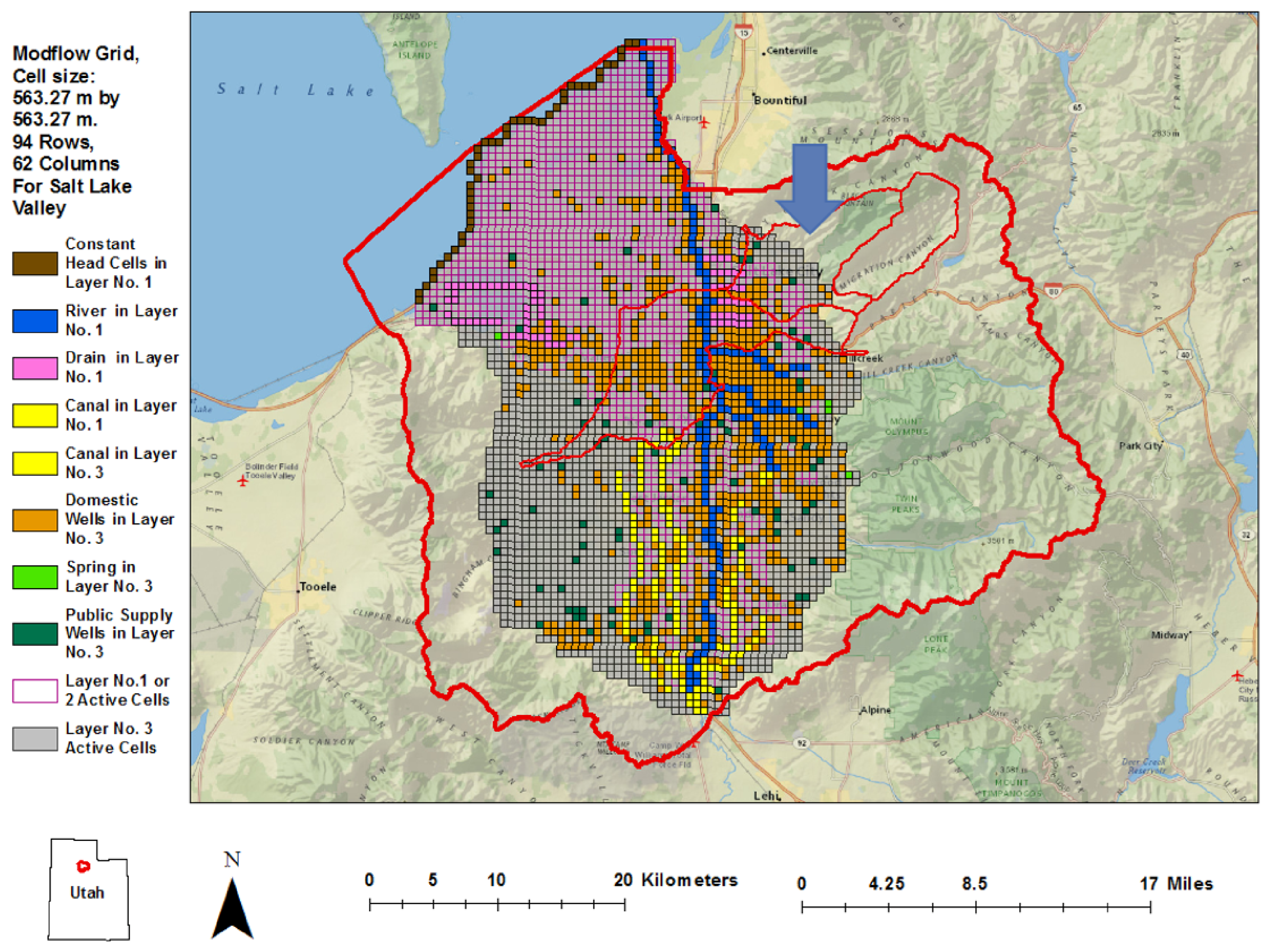
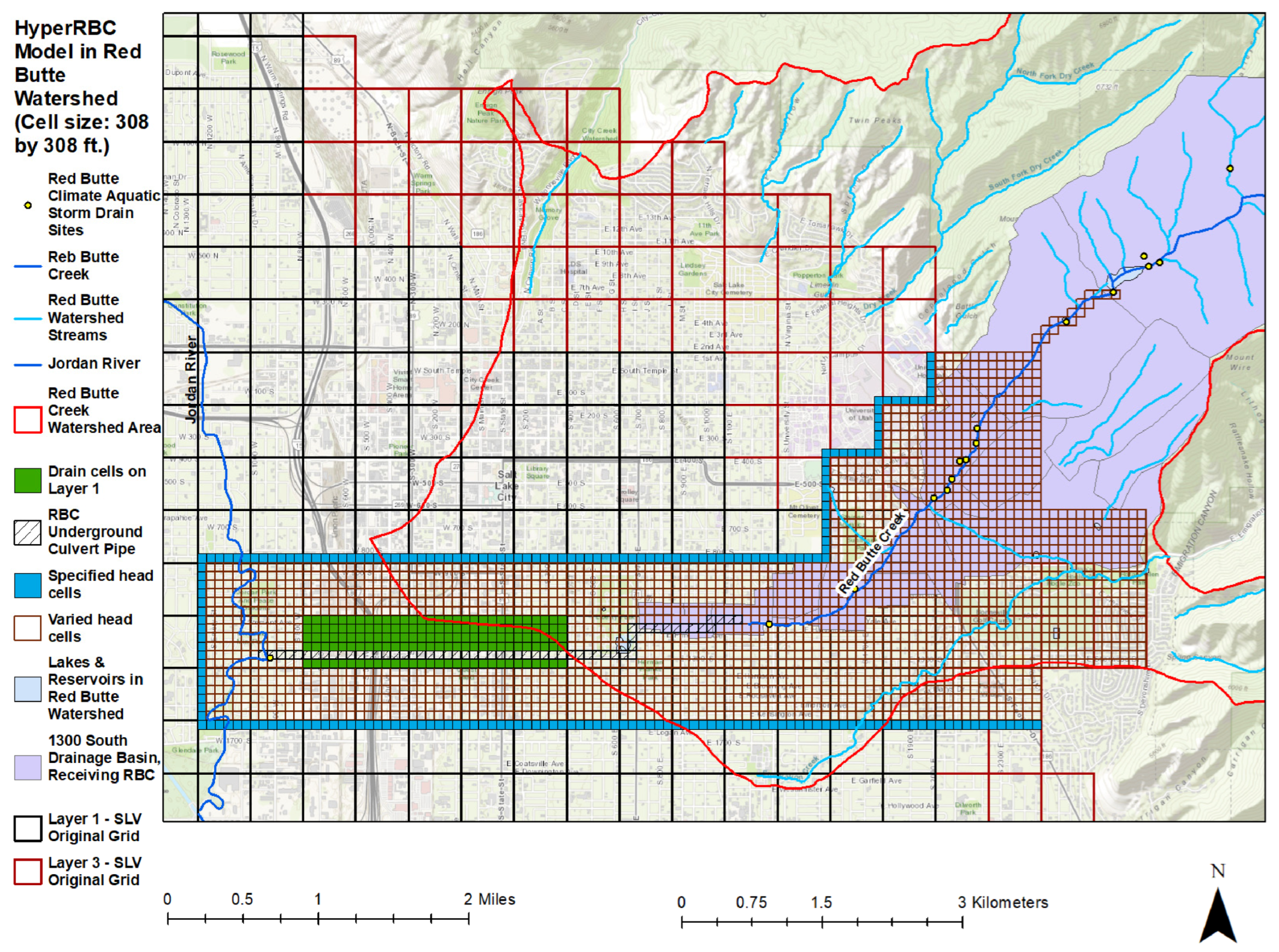
To promote environmental management, this reconnaissance-level study simulates potential hydrologic consequences of hypothetical GI-driven recharge. The modeled aquifer-stream system (Figure 1 and Figure 2) includes parts of the Red Butte Creek Watershed (RBCW) and other watersheds, and parts of SLV’s 1300 South Drainage Basin (Figure 3 and Figure A1). RBCW ranges from undeveloped mountainous National Forest land to urbanized downstream areas, increasing stormwater-runoff variability and stormwater management requirements. These and other factors affected the selection of RBCW for this study [23,24]. As a U. S. Forest Service Research Natural Area, headwater areas remain undeveloped. RBC flows into the Red Butte Reservoir (RBR), from which discharges are controlled and monitored. RBC then flows through the University of Utah campus, and the campus flows to RBC are monitored. For the downstream urbanized area, there was no appreciable real GI and related data.
Preparation of the HyperRBC model is described in the following subsections: (a) using the United States Geological Survey (USGS) SLV groundwater flow, MODFLOW, model [25,26]; (b) developing the HyperRBC numerical groundwater flow model for a portion of SLV, using MODFLOW-2005; and (c) modeling the consequences of hypothetical green infrastructure (GI)-driven recharge within HyperRBC.

2.2. Using the United States Geological Survey (USGS) Salt Lake Valley (SLV) Groundwater Flow MODFLOW Model

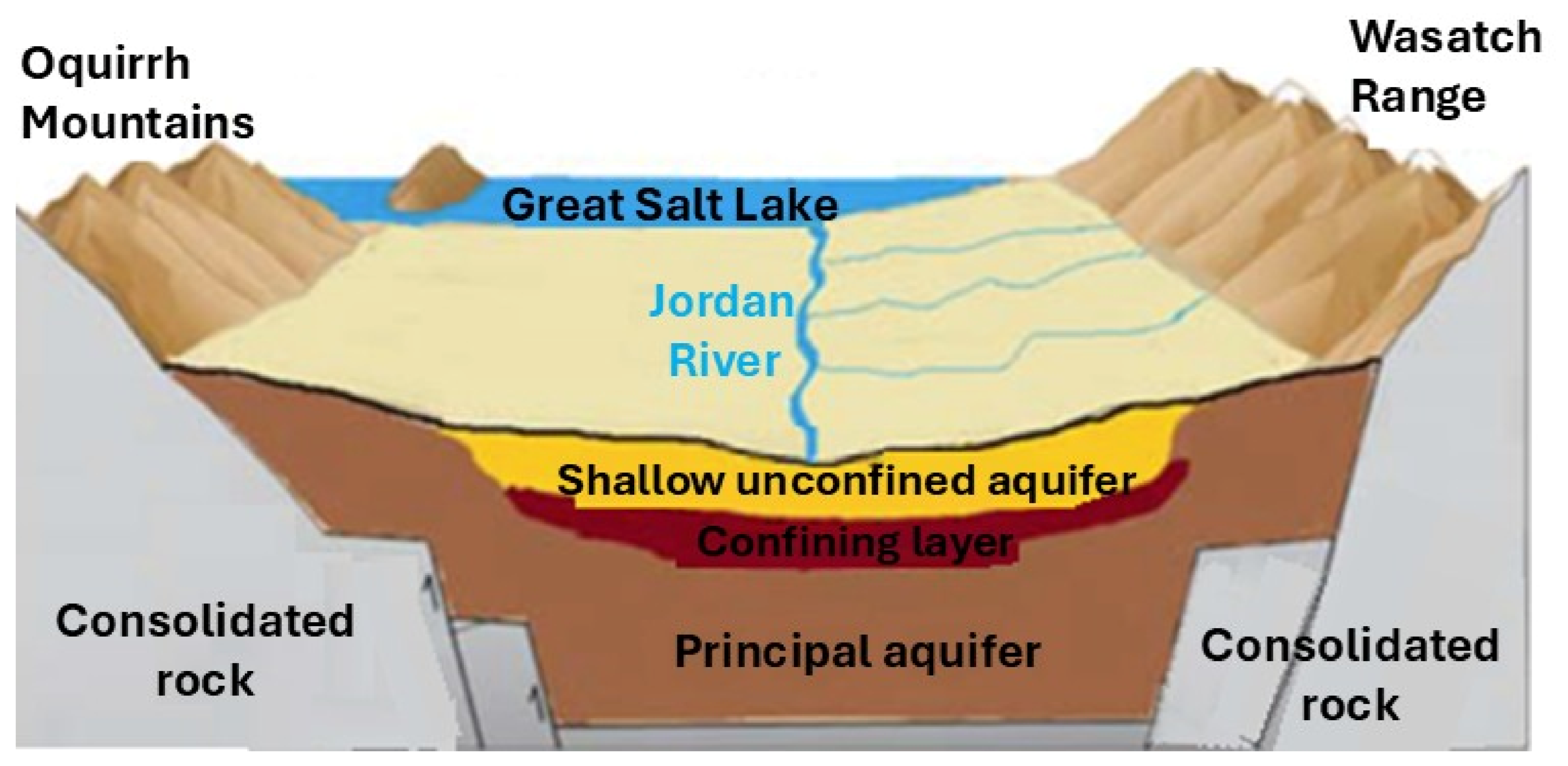
Some data for the monthly transient HyperRBC model came from the USGS SLV groundwater numerical model [25,26]. The USGS SLV model has a grid of 94 rows and 62 columns, and a uniform cell size of 1848 ft. (563.27 m) by 1848 ft. (563.27 m), and seven layers. Layers 1 and 2, respectively, represent the shallow unconfined aquifer and the underlying shallow semi-confining layer. These layers have spatially variable thicknesses (Figure 1 and Figure 2). The principal aquifer in SLV is represented by Layers 3 through 7, with Layer 3 covering the largest horizontal area. Layers 3 through 5 each have a uniform thickness of 150 ft. (45.72 m), while Layer 6 is 200 ft. (60.96 m). Layer 7 varies in thickness from 200 ft. (60.96 m) to over 1500 ft. (457.2 m). Effective porosities of Layers 1–2 and Layers 3–7 are 0.4 and 0.3, respectively [27,28].
Figure 1. Layers of the United States Geological Survey (USGS) Salt Lake Valley (SLV) groundwater flow model modified from Thiros et al. [29].
Environments 13 00279 g001
Figure 2. Uppermost aquifer Layers 1 and 3 of the Salt Lake Valley groundwater model modified from [25]; Blue arrow points to Red Butte Creek Watershed (RBCW); The thick red line indicates the Salt Lake County boundary.
Environments 13 00279 g002
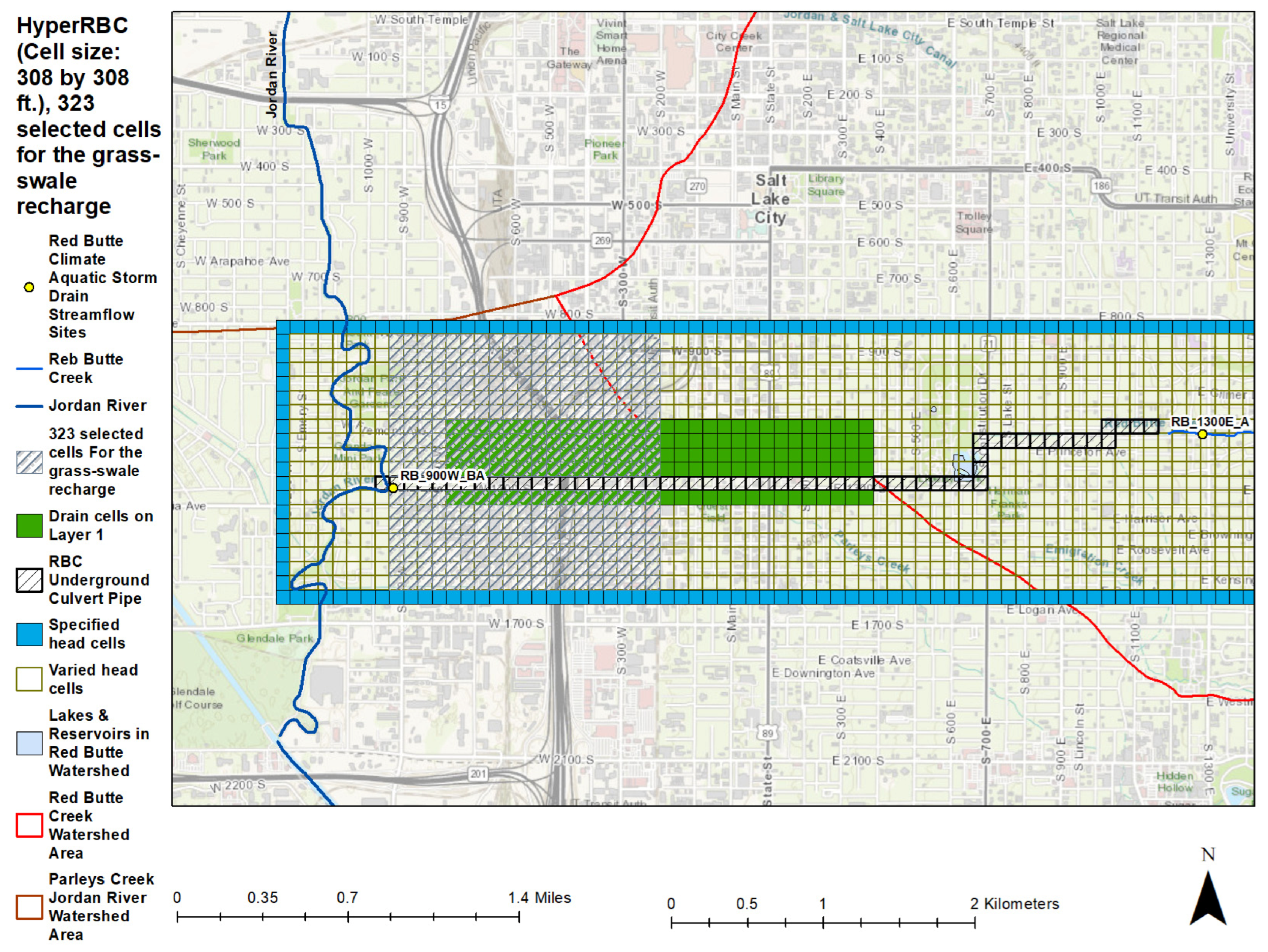
Figure 3. HyperRBC model grid (Layer 3) and hatched RBC underground culvert pipe, superimposed on USGS Salt Lake Valley groundwater model grid.
Environments 13 00279 g003
After calibrating the SLV model under steady-state assumptions, Lambert [25] used the resulting simulated steady-state groundwater heads as initial conditions for transient simulations. Transient calibration was then performed using annual time steps from 1960 to 1991 [25].
For SLV modeling, Forghani [30] utilized the Lambert model’s cell size and parameters but applied monthly periods to simulate hydrologic conditions from 1993 to 2014. Their comparison of simulated and observed heads confirmed acceptable model accuracy.
This study then applied the Forghani boundary conditions development procedure to generate monthly data for 2009–2016, enabling the USGS SLV groundwater model to perform monthly simulations for the 96 monthly stress periods. That USGS SLV numerical model represents RBC using the MODFLOW recharge and drain packages.
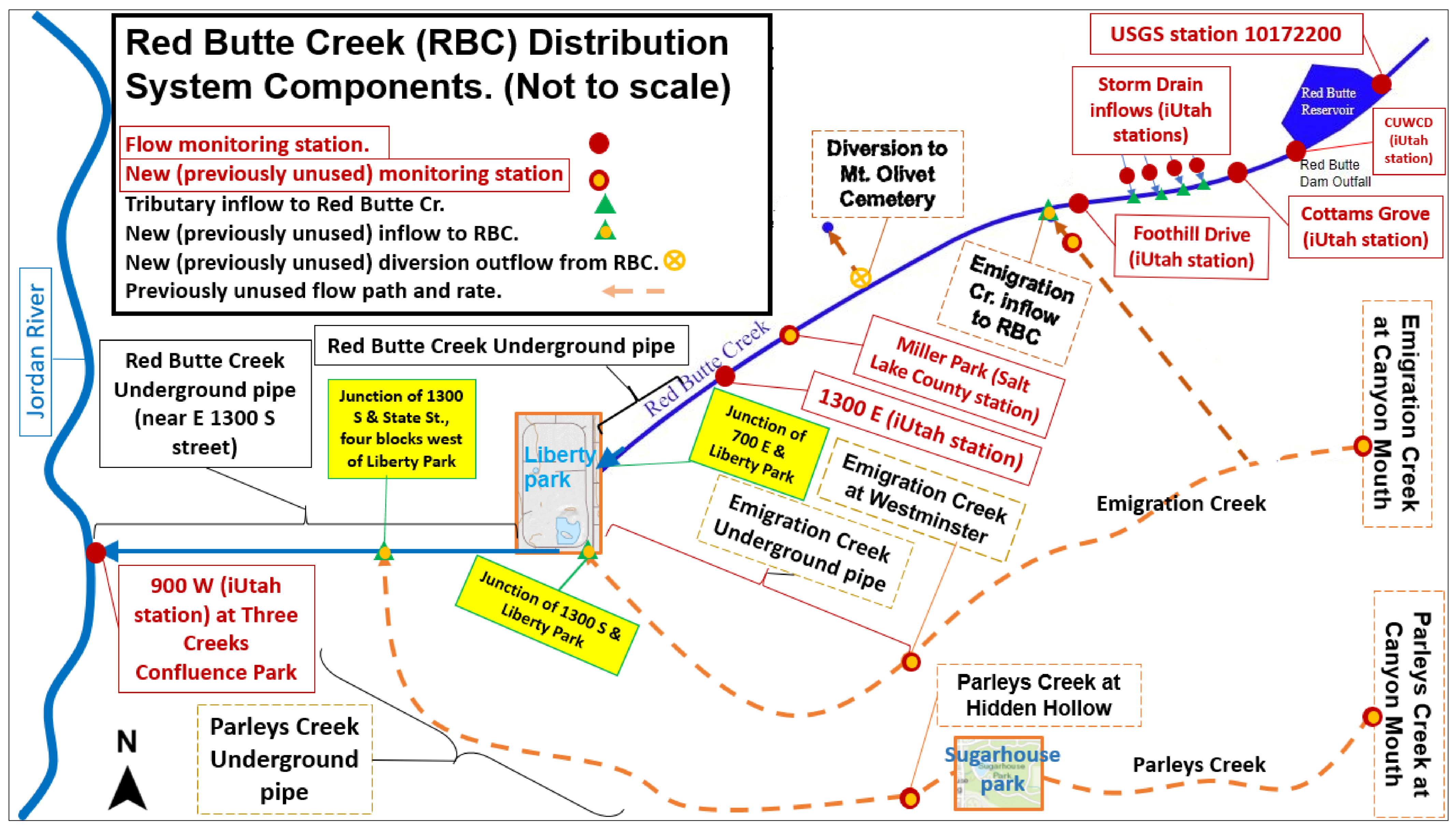
Figure A1 illustrates RBC inflows and outflows. To more accurately represent these within HyperRBC, tasks listed in Table A1 were performed. Especially included was the implementation of the MODFLOW SFR package to simulate RBC dynamic streamflow and aquifer-stream seepage. The SFR domain extended from the RBR discharge point, downstream to the Jordan River (JR). RBC inflow and outflow data [23,31] were used in two distinct transient HyperRBC two-day models, one each for May and June 2016. These MODFLOW models, coupled with Parameter Estimation (PEST 17.1) [32], were used to estimate streambed vertical hydraulic conductivities (Table A1). These calibrated streambed vertical hydraulic conductivity values, along with RBC domain inputs, were then applied to the HyperRBC model of 2009–2016.

2.3. Developing the HyperRBC Numerical Groundwater Flow Model Using MODFLOW-2005

The development of the HyperRBC model generally involved the following steps (Table A1):
  • Identifying an area within the USGS SLV groundwater flow, MODFLOW, model [25,26] sufficient to simulate the desired hydrologic impacts (Figure 3);
  • Updating stress packages of the USGS SLV model [25,26] following the procedure by Forghani [30];
  • Refining spatial discretization to a uniform 308-ft by 308-ft cell size across seven aquifer layers to increase model accuracy, as the USGS SLV model’s 1848 ft. by 1848 ft. discretization is too coarse for simulating temporal RBC aquifer-stream seepage. To simplify the transfer of coarse cell parameters to smaller cells, a whole number of small cells must replace each coarse cell. Thus, each SLV model (1848 ft.)2 cell was replaced by 36 (1848/6 ft.)2, or (308 ft.)2, cells within the refined USGS SLV model. That smaller cell size was selected to provide (i) sufficiently fine spatial resolution for simulating the GI-induced recharge and aquifer-stream seepage; and (ii) sufficiently large that an SFR stream reach within a cell can contain the 164.04 ft. maximum RBC bottom stream width (Table A2);
  • Identifying and obtaining all relevant boundary-condition data and physical system information from the USGS SLV model for use in HyperRBC, and integrating RBC-specific features into HyperRBC to characterize the coupled aquifer-stream system;
  • Calibrating the streambed vertical hydraulic conductivity values ranging from 0.0045 to 12.26 feet per day, ft/d (Table A2) as required to simulate aquifer-stream seepages (Table A2 and Table A3). All calibrated values lie within the range of infiltration rates of the local loam, silt-loam and clay-loam soils [24,33,34].
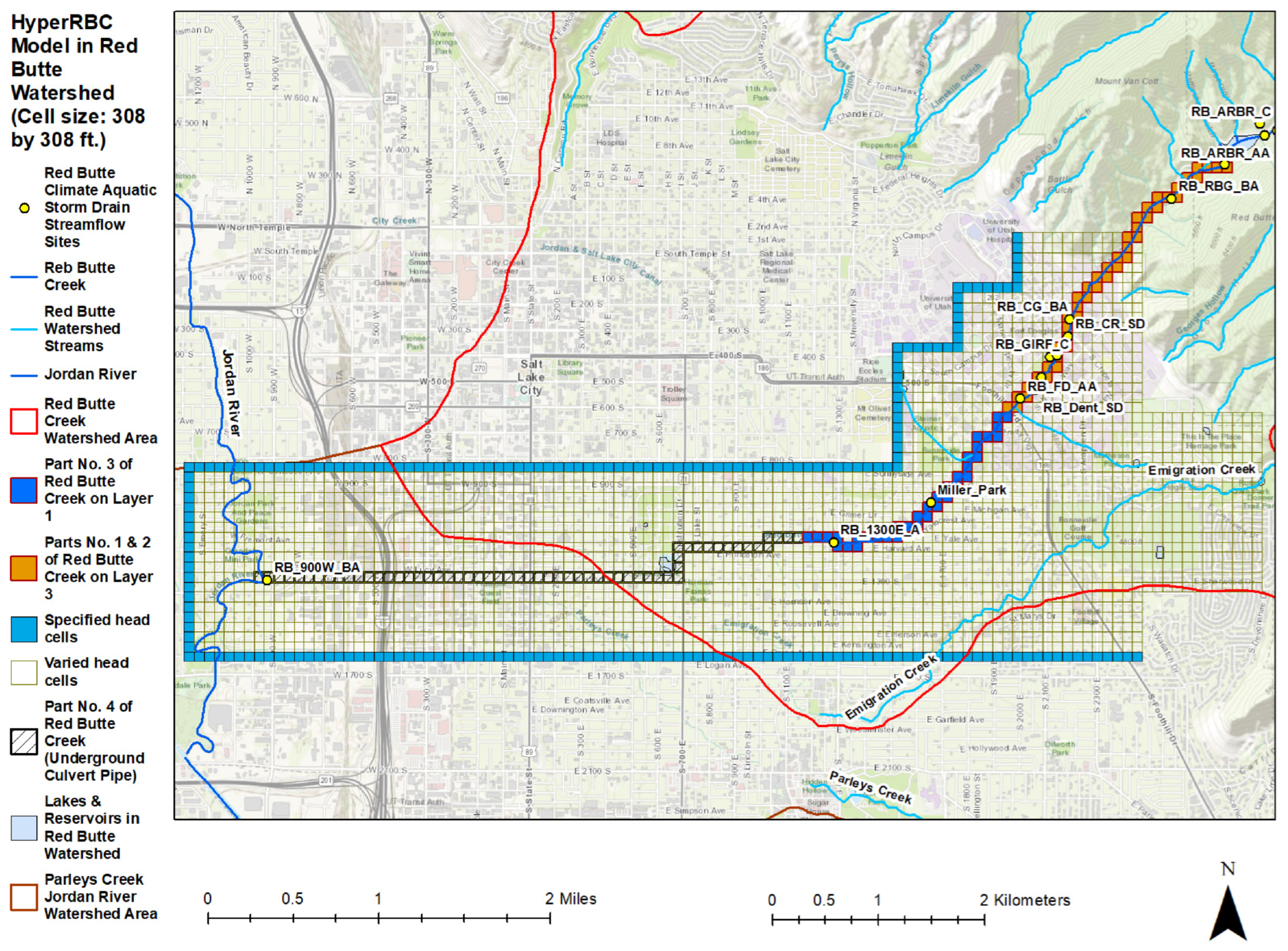
HyperRBC represents RBC as a 7.44 miles (11.97 km) long rectangular channel from the RBR discharge location, downstream to and including the point of discharge at the JR. Figure 3 and Figure 4 refer to Parts 1–4 of RBC in HyperRBC. The parts differ in data availability, material through which the stream flows, and the type of stream conduit [23,31]. From the RBC headwaters location downstream to where RBC discharges to the JR, the RBC parts differ as follows (Figure 4): (1) RBC is within aquifer model Layer 3 from the RBR outflow downstream to the edge of the USGS SLV groundwater model; (2) RBC is within aquifer model Layer 3; (3) RBC is within aquifer model Layer 1; and (4) RBC flow is within a leaky subsurface pipeline within aquifer model Layer 1. The 3.44-mile subsurface pipeline conveys RBC, Emigration Creek, and Parleys Creek water from Liberty Park to the JR.
In HyperRBC, SFR reaches, seepage rates depend on the aquifer head, stream stage, stream-bottom elevation, and the vertical hydraulic conductivity of the streambed (Table A2 and Table A3). Surface water flow in the SFR is modeled using the Manning equation, while aquifer heads are derived from a simultaneous solution of the MODFLOW-2005 groundwater flow equations.
HyperRBC, integrating the latest surface water feature (SFR), hydraulically simulates RBC flows, an aquifer-stream system, and groundwater movement. At its upstream end, it receives specified discharge from RBR (the headwater) as inflow into RBC. From there, it models flow and seepage downstream to the JR (Figure 3, Figure 4 and Figure A1).
To help environmental management during periods of high-water demand, this study models hypothetical GI-driven recharge within the aquifer-stream system of the RBCW. The following section details the process of estimating the GI recharge.

2.4. Modeling the Consequences of Hypothetical Green Infrastructure (GI)-Driven Recharge Within HyperRBC

This reconnaissance-level study simulates infiltration and percolation from rainfall for a hypothetical grass-swale GI with a density of 120 feet per acre (ft/ac) in a residential area of RBCW [35,36].
First, the WinSLAMM 10.4.1 software [37,38] was used to simulate stormwater runoff values from April to June 2016, resulting from rainfall and the application of the GI (grass-swale) in the area. WinSLAMM used the actual soil of this area only to provide guidance for water decisionmakers [34]. The software is not free or open-source code.
Second, infiltration rates for the same period were estimated using the proportional grass-swale infiltration values from Zhang and Peralta’s [35] study (Table 1).
Third, for the GI-recharge simulation around RBC and east of the JR, changes in HyperRBC included: (a) extending use of the December 2016 boundary conditions through March 2017; and (b) applying aquifer recharge rates from Table 2 to 323 model cells shown in Figure 5, covering 704 acres (17 rows by 19 columns). Notably, the selected model area did not include any recharge in the USGS SLV and HyperRBC models.
Four 12-month simulations were made to analyze the impacts of the GI recharge on the aquifer-stream system without and with using the detailed SFR representation of RBC (Table 3). The four simulations used the HyperRBC model. Simulation 1a did not include the GI-induced recharge, while Simulation 1b did. Simulations 2a and 2b represented RBC using the MODFLOW-2005 SFR package. Employed data was from April 2016 to March 2017. Simulation 2a omitted the GI-induced recharge and Simulation 2b included that recharge.
Simulation results included time-series changes in induced aquifer storage and seepage from the aquifer into nearby surface water bodies (RBC and the JR), with and without the GI-induced recharge. To demonstrate robustness of the modeling results, eight additional simulations modified Simulations 1b and 2b, using ±25–50% of the 54.30 acre-foot (ac-ft) recharge. The following section presents simulation results and discusses increases in groundwater availability and surface water during the 12 months.

3. Results and Discussion

To aid environmental management, this reconnaissance-level study predicts the potential hydrologic impacts of hypothetical green infrastructure (GI) recharge around Red Butte Creek (RBC), Utah. Such GI would increase groundwater availability, reduce stormwater runoff, delay downstream surface water peak flow, and could prevent flooding. The employed numerical flow models simulate temporal variations in aquifer storage and aquifer-river or aquifer-stream seepage.
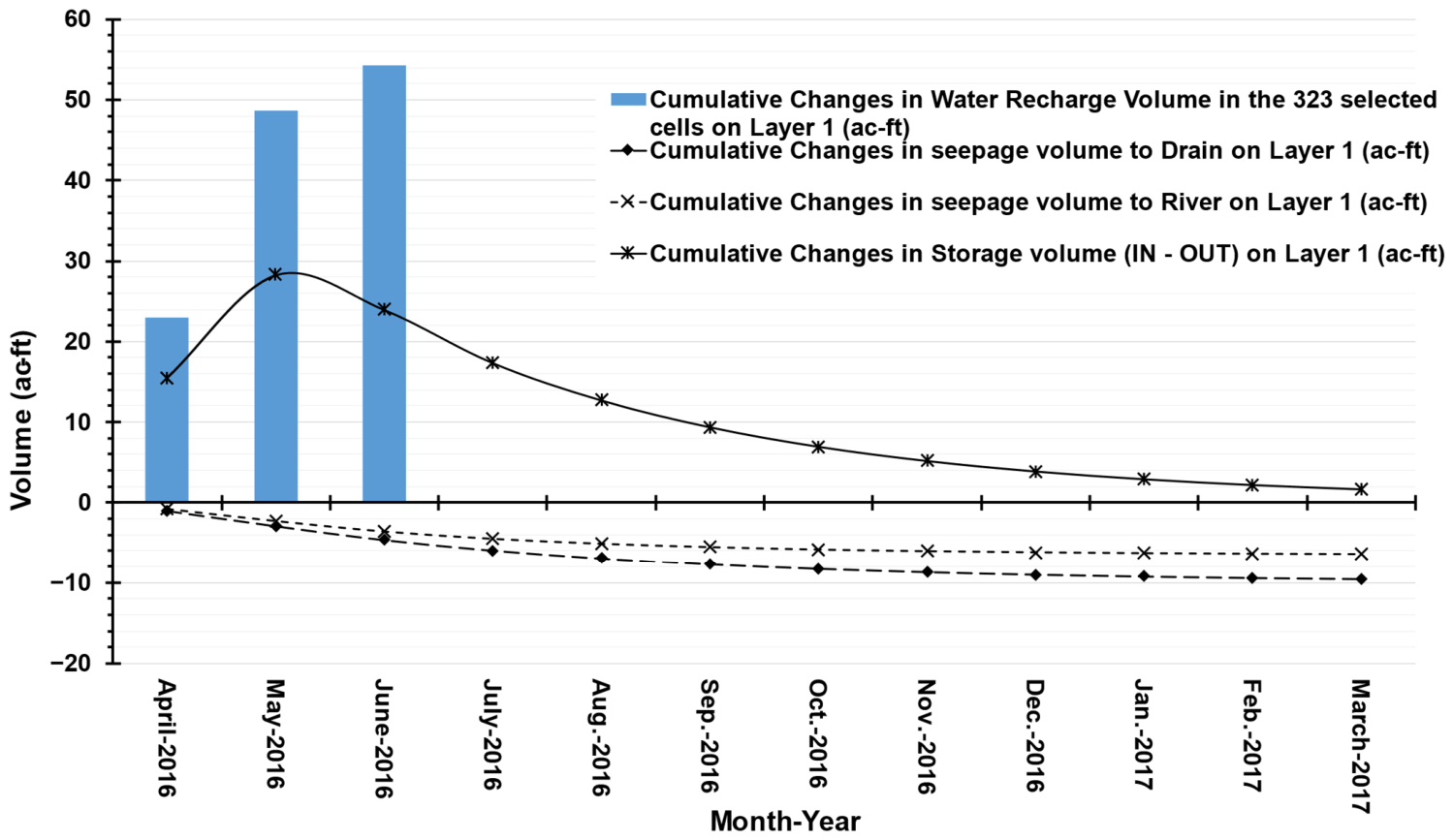
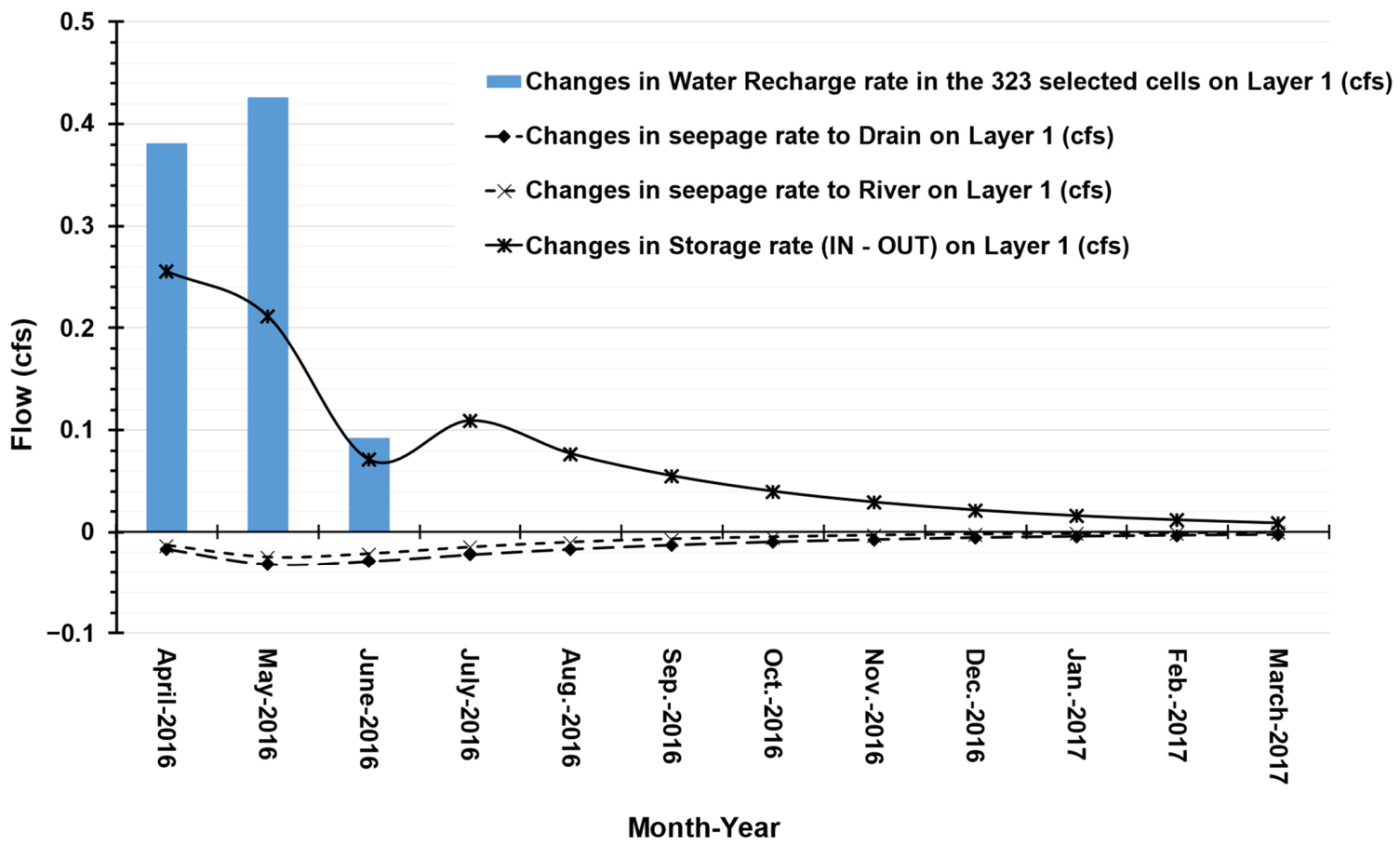
Results from Simulations 1a and 1b, which do not use the SFR package, are compared as: (i) changes in cumulative volumes (Figure 6); (ii) total volumes (Table 4); and transient flow rates (Figure A2). Figure 6 and Figure A2 show the stored volume and flow rate of the recharge into the unconfined aquifer as negative magnitudes of volume and flow rate. During the 12 months, of the 54.30 ac-ft recharge, 11.9% increased the seepage volume from the SLV aquifer to the JR, and 3.0% increased the groundwater stored within the study area (Table 4). A significant proportion of the recharge flowed northward, continuing within the unconfined aquifer as groundwater (Table 4), following the south-to-north groundwater flow path dictated by the SLV groundwater hydraulic gradient [25].
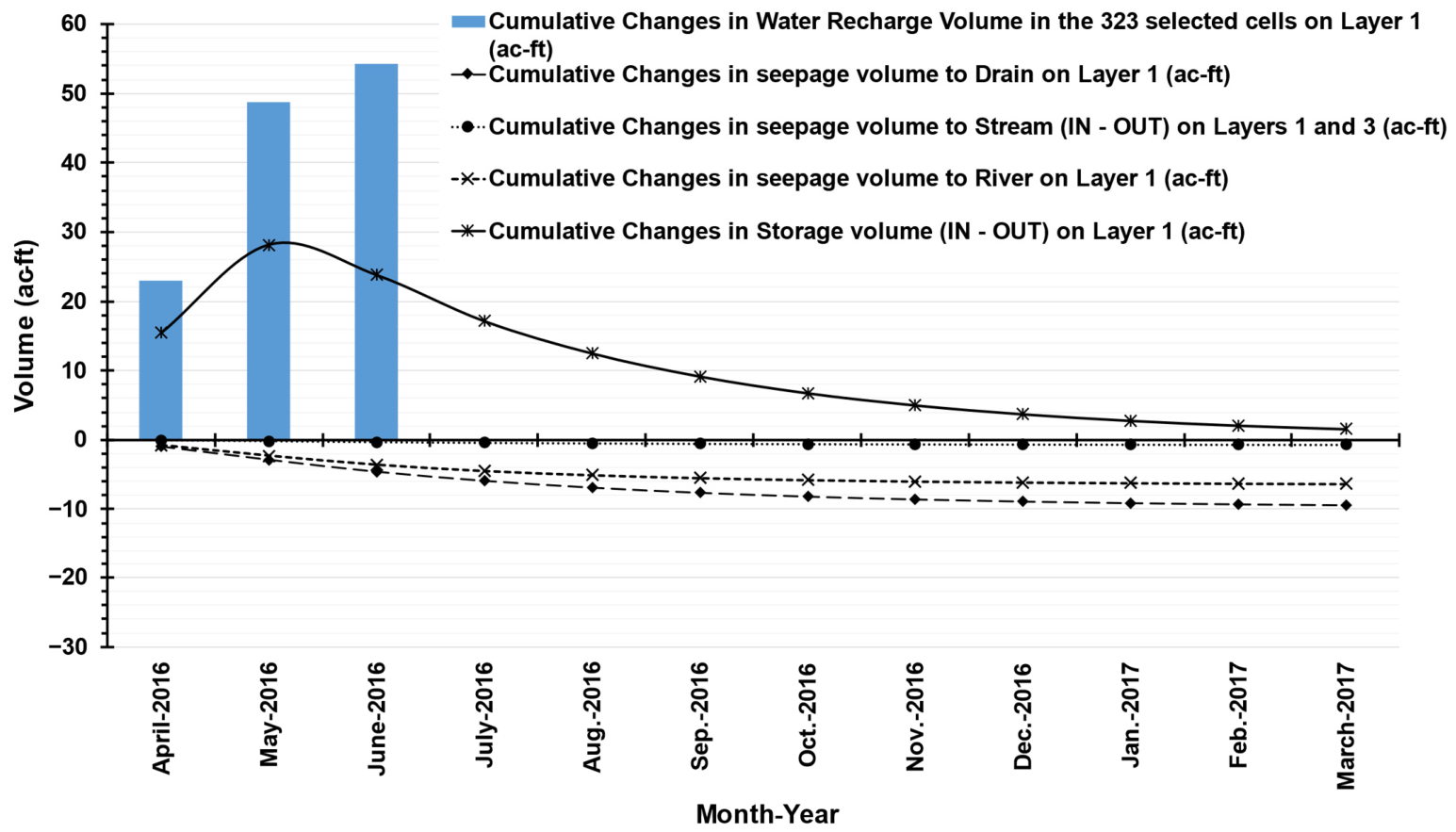
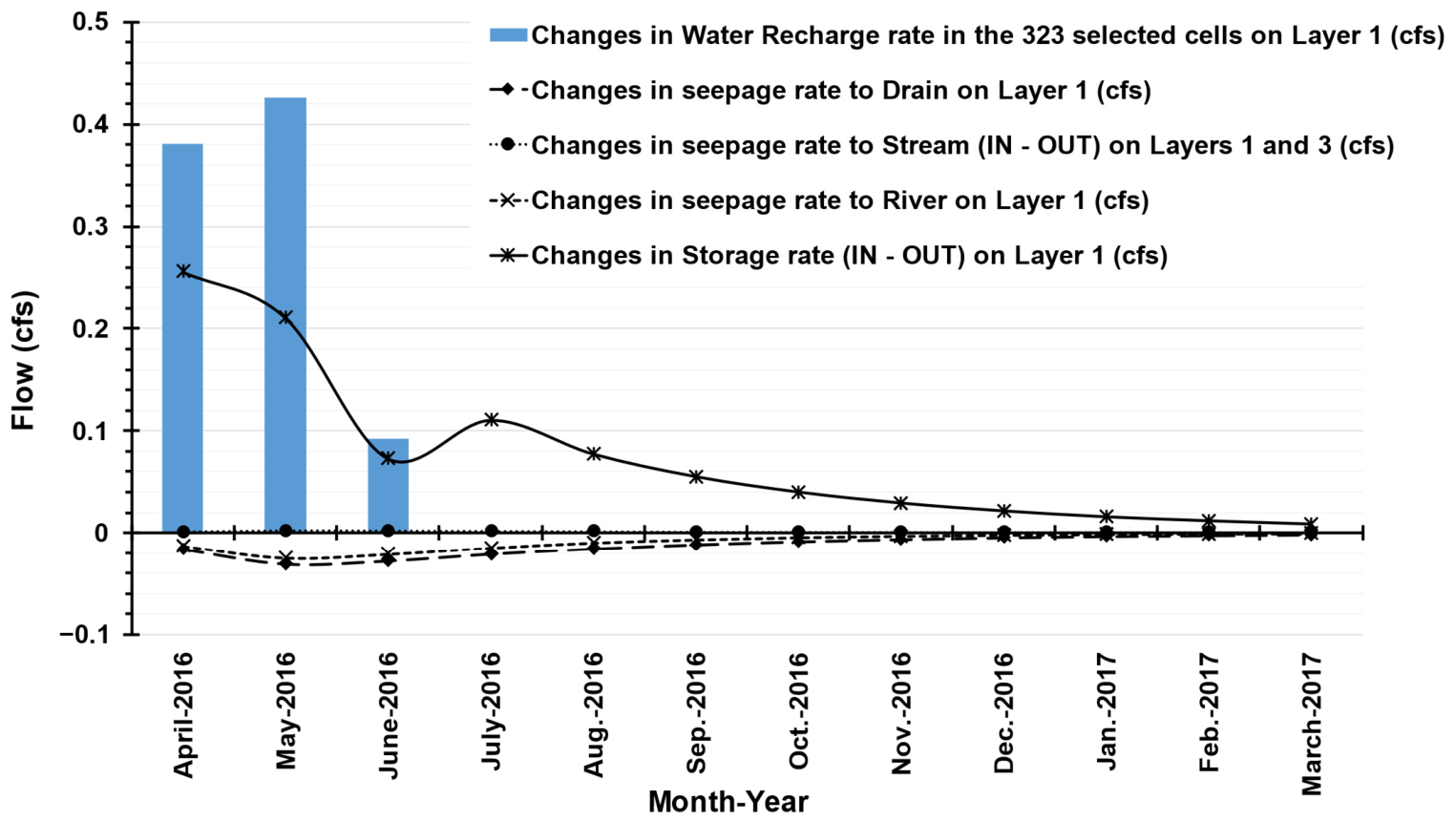
For the evaluation, incorporating both nearby surface water bodies, RBC and the JR, HyperRBC simulations 2a and 2b quantify the effects of the 54.30 ac-ft GI-induced recharge on seepage between the aquifer and RBC and the JR. Values of Simulation 2b minus Simulation 2a indicate that RBC receives 1.3% (0.69 ac-ft) of the recharge volume (Figure 7 and Table 5). This results from RBC seepage rates from 0.0011 to 0.0002 cubic feet per second (cfs) over the course of a year (Figure A3). As observed previously, a significant percentage of the recharge continues northward within the unconfined aquifer as groundwater (Table 5), following the south-to-north groundwater hydraulic gradient in SLV [25].
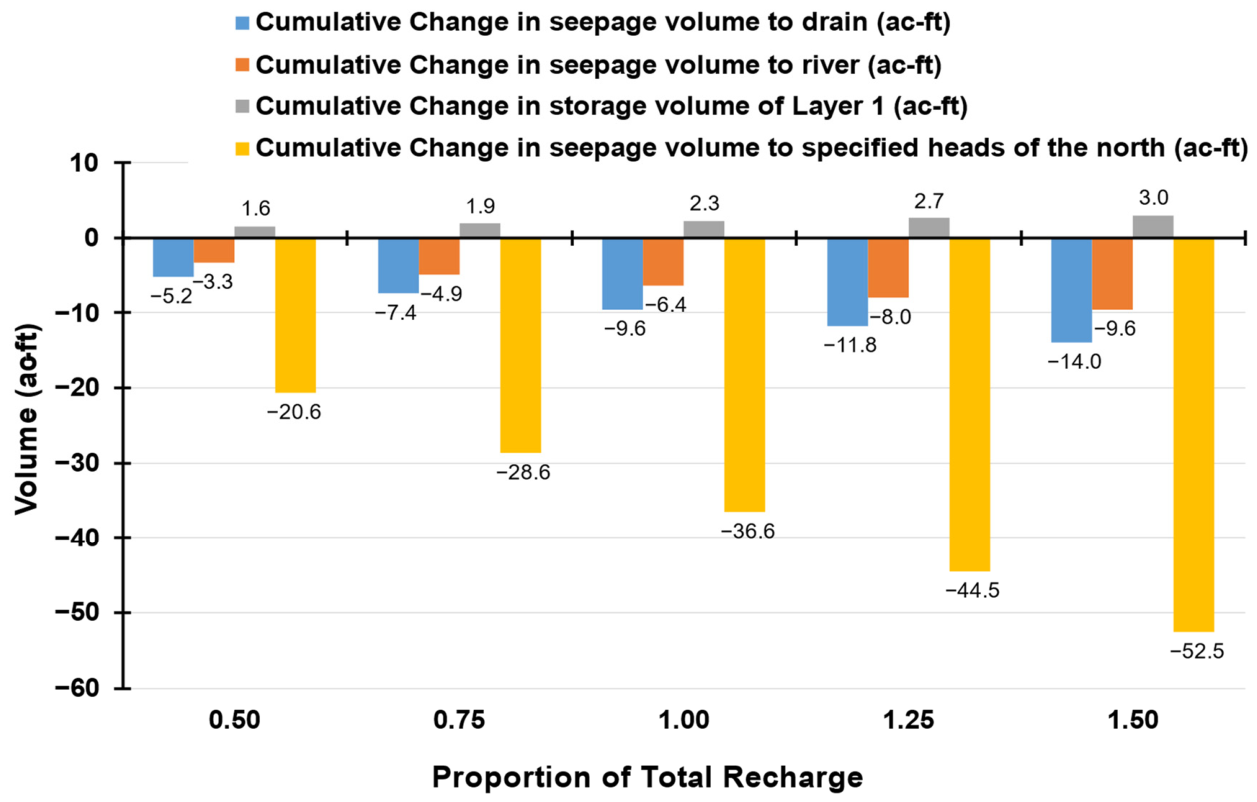
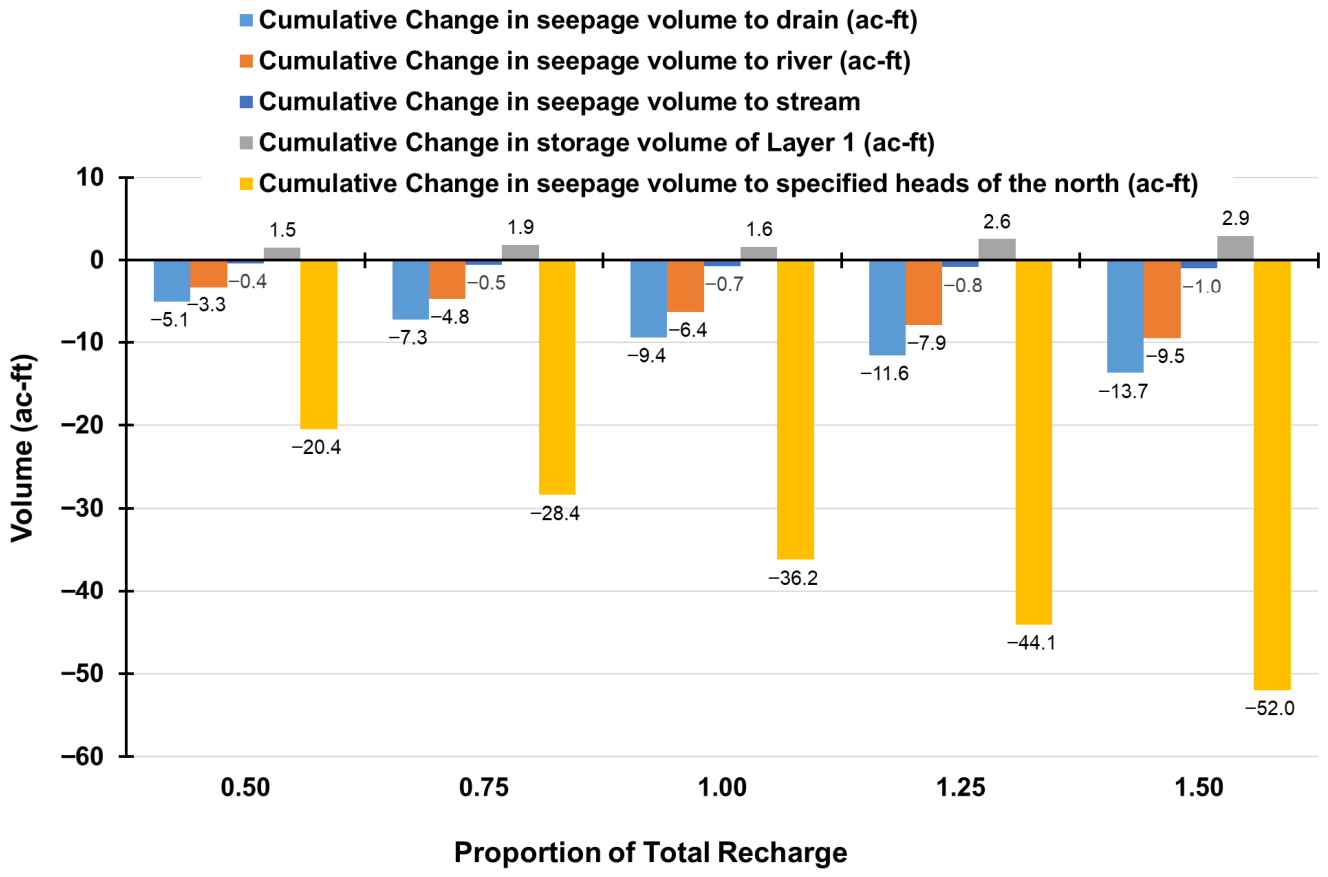
To demonstrate model robustness, eight simulations using 0.5, 0.75, 1.25 and 1.5 times the Simulations 2a-2b GI recharge were simulated (Table 3). The respective volume-change ranges in drain, river, and stream seepage, aquifer storage and specified-head cells were 16.8–18.8%, 11.7–12.0%, 1.2–1.4%, 2.9–5.5% and 63.8–75.3% (Figure A4 and Figure A5).
This reconnaissance-level study was applied to a small urban area to present the potential impact of grass swale GI-induced recharge, resulting in (a) mitigating stormwater runoff; (b) increasing stored groundwater within the study area and the downgradient extended aquifer; and (c) increasing aquifer to stream and river seepage and increasing surface water flow later in the year. Thus, the recharge improved groundwater availability within and outside the study area during the subsequent high-water-demand period. Also, the time-lagged surface water can be a less costly water supply than groundwater after the rainy period or can support downstream ecosystem needs.
Limitations and uncertainties in this study include:
(i)
Lacking measured stormwater runoff, the runoff was estimated using actual study area soil, land use, and hydrologic data within WinSLAMM [37,38]. And the proportional grass-swale infiltration values using the method of Zhang and Peralta’s [35] study were estimated for the area. The widely used WinSLAMM can employ general or site-specific data to provide general regional versus site-specific predictions.
(ii)
Lacking detailed RBC inflow data, reasonable assumptions were applied to estimate the spatiotemporal inflows. Error in the assumptions might increase uncertainty in our calibrated streambed vertical hydraulic conductivity values and the resulting model-computed aquifer-stream seepages. The model simulated sufficiently accurate responses for the addressed period. However, predicting hydrologic responses within and hydraulically downgradient of the study area for a longer period should entail updating the USGS SLV model [25,26] to represent the JR via the SRF package. An updated SLV model could be used to compute groundwater heads used as specified-head time series boundaries for HyperRBC (Table A1); and
(iii)
Although the water table is relatively close to the ground surface within the hypothetical GI area, this initial evaluation for managers did not evaluate long-term and large-scale GI infiltration. That might cause undesirably high groundwater levels, damage basements and other facilities, and leave insufficient vadose zone for plants in urban areas [39,40].
This reconnaissance-level study helps water decisionmakers determine whether to further evaluate GI. The study novelty lies in evaluating how GI-induced recharge changes groundwater and surface water conditions by modeling the conversion of stormwater runoff into groundwater recharge, storage, and subsequent streamflow increase.

4. Conclusions

Numerical simulations were used to evaluate the potential impacts of hypothetical green infrastructure (GI) grass swales in the Red Butte Creek Watershed (RBCW) on time-varying unconfined-aquifer storage and groundwater-surface water interactions. RBCW ranges from undeveloped mountainous National Forest land to downstream Salt Lake Valley (SLV) urbanized areas. This reconnaissance-level study shows that: (a) stormwater infiltration through the aquifer would have increased during April-June 2016; (b) within 12 months, the added recharge would have increased groundwater availability; and (c) some recharge would have subsequently seeped from the aquifer to the nearby stream and river, possibly benefiting downstream users. The HyperRBC transient groundwater flow implementation of MODFLOW-2005 developed for this study features: (i) a uniformly refined discretization across seven aquifer layers; and (ii) the Streamflow-Routing (SFR) package to simulate Red Butte Creek (RBC) monthly flows. Using simulated April-June GI-induced recharge, applied across a 704-acre area bifurcated by RBC, HyperRBC predicted that by the end of the next March: (a) approximately 3% of the recharge would remain within the unconfined aquifer in the HyperRBC area; (b) 66.6% of the recharge would follow the SLV hydraulic gradient northward into the continuation of the unconfined aquifer; and (c) 30.3% would discharge to the nearby stream and river, with 11.7% reaching the Jordan River (JR), 1.3% entering RBC, and 17.3% flowing into a drain connected to the JR.
In summary, the time-limited GI-induced recharge (a) enhances groundwater availability within and outside the study area during the subsequent high-water demand summer, and through at least the subsequent March; and (b) increases the streamflow during the months, supporting interim environmental management. Future research should explore long-term and large-scale GI infiltration modeling and evaluate monitoring data generated by real GI in the area.

Author Contributions

Conceptualization, S.M. and R.C.P.; methodology, S.M. and R.C.P.; software, S.M.; validation, S.M. and R.C.P.; formal analysis, S.M.; investigation, S.M. and R.C.P.; resources, S.M.; data curation, S.M.; writing—original draft preparation, S.M.; writing—review and editing, S.M. and R.C.P.; visualization, S.M.; supervision, R.C.P.; project administration, R.C.P.; funding acquisition, R.C.P. All authors have read and agreed to the published version of the manuscript.

Funding

This research was funded by the U.S. EPA-STAR project under grant number [83582401], the Civil and Environmental Engineering (CEE) Department, Utah Water Research Laboratory (UWRL), and the Utah Agricultural Experiment Station at Utah State University.

Data Availability Statement

All data generated and utilized during the study are included in the article. Additional information can be obtained from the corresponding author upon request.

Acknowledgments

The authors express their gratitude for the support provided by the Center for High Performance Computing (CHPC) at the University of Utah. This work was also supported by the Utah Agricultural Experiment Station at Utah State University. The authors extend their appreciation to R. Ryan Dupont for his leadership on the EPA-STAR project under grant number [83582401], as well as to Marvin Halling and David G. Tarboton, Bethany Neilson, the head of the Civil and Environmental Department, and former and current heads of the Utah Water Research Laboratory at Utah State University, respectively.

Conflicts of Interest

No conflict of interest.

Appendix A

Figure A1. Diagram of Red Butte Creek tributary and distributary system (not to scale).
Environments 13 00279 g0a1
Table A1. Steps to prepare the sub-system numerical (HyperRBC) model.
Step No.Description
1Identify an area within the United States Geological Survey (USGS) Salt Lake Valley (SLV) groundwater flow, MODFLOW, model [25,26] sufficient to simulate impacts of GI-induced recharge and Red Butte Creek interaction with groundwater and formulate a 3D groundwater model grid for the area (Figure 3).
2Update stress packages of USGS SLV model [25,26] for 2009–2016 following the procedure by Forghani [30].
3Refine the updated USGS SLV model from 1848 by 1848 ft. cell size to 308 by 308 ft. uniformly.
4Transfer values of aquifer properties and boundary conditions from the refined USGS SLV model into the area to make a sub-system groundwater model named HyperRBC 2009–2016 (96 month-long stress periods).
5From all layers of the refined USGS SLV model, copy appropriate time-series head values to HyperRBC boundary cells to create specified-head boundary conditions.
6Extend the model upstream to Red Butte Reservoir (RBR) by adding 16 cells (Figure 3), apply SFR package, and represent the reservoir outflow as headwater.
7Make HyperRBC two–day transient models for (a) May 2016; and (b) June 2016. Use the models, data from five monitoring RBC streamflow stations, and parameter estimation (PEST 17.1) software [32] to calibrate the vertical hydraulic conductivity of the streambed.
Table A2. Observed and Simulated RBC streamflow, bottom width, Manning n, assumed RBC streambed thickness of 0.4 ft., and calibrated streambed vertical hydraulic conductivity values at the five monitoring locations.
(1)(2)(3)(4)(5)(6)(7)(8)
Observed and Simulated Streamflow ValuesDistance from Upstream Red Butte Reservoir (ft.)Observed Streamflow at Monitoring Locations of iUTAH [23] and Salt Lake County [31] (cfs)Calibrated Vertical Hydraulic Conductivity (Kv) of Streambed (ft/d)Number of ReachesSimulated Streamflow (cfs)Stream Bottom Width (ft.)Manning n
Date/Monitoring Locations in Figure 4Avg. of 13–14 June 2016June, 2016
Headwater01.7992.608, 1.036, and 6.635321.79916.4040.1
Cottams Grove (RB_CG_BA)8425.431.1511.30516.4040.1
Foothill Drive (RB_FD_AA)11,847.171.7000.992, and 0.050131.72516.4040.09
Miller Park (around 1600 E), (Miller_Park)17,062.821.17512.260, and 0.027201.1759.8430.09, and 0.05
1300 E (RB_1300E_A)20,274.351.3390.018141.3399.843, and 11.4830.03
0.011
900 W (RB_900W_BA)38,961.8412.3970.2725, 4.215, 0.00528, and 0.00456112.39711.483, 164.042, and 11.4830.011
Table A3. Statistical indices comparing calibrated HyperRBC-computed flows with measured flows from May and June 2016.
Statistical Index
\
Streamflow Station in Figure 4
Mean Error, ME (cfs)Root Mean Squared Error, RMSE (cfs)R2Data Used Simultaneously for Calibration
Cottams Grove (RB_CG_BA)−0.0230.1331.000May and June, 2016
Cottams Grove to Foothill Drive (RB_CG_BA to RB_FD_AA)−0.0120.0950.9977May and June, 2016
Cottams Grove to Miller Park (RB_CG_BA to Miller_Park)−0.0600.0900.9303June, 2016
Cottams Grove to 1300 E (RB_CG_BA to RB_1300E_A)−0.0450.0780.9154June, 2016
Cottams Grove to 900 West (RB_CG_BA to RB_900W_BA)−0.0360.0700.9998June, 2016
Figure A2. Simulated changes in water recharge, seepage, and storage (i.e., into aquifer storage—IN minus from aquifer storage—OUT) rates (cfs) on Layer 1 between the HyperRBC models with versus without the GI (grass swale), performing Simulations 1a and 1b. Note, flow rates from aquifer through drain and the Jordan River (JR) are negative.
Environments 13 00279 g0a2
Figure A3. Simulated changes in water recharge, seepage, and storage (i.e., into aquifer storage—IN minus from aquifer storage—OUT) rates (cfs) between HyperRBC models with versus without the GI (grass swale), performing Simulations 2a and 2b. Note, flow from aquifer through stream, drain and the Jordan River (JR) includes negative rates.
Environments 13 00279 g0a3
Figure A4. Simulated cumulative changes in seepage, specified head, and storage (i.e., into aquifer storage—IN minus from aquifer storage—OUT) volumes (ac-ft) on Layer 1 between the HyperRBC models with versus without the GI (grass swale) for applied various proportions of water recharges, using Simulation 1a and performing modified Simulation 1b.
Environments 13 00279 g0a4
Figure A5. Simulated cumulative changes in seepage, specified head, and storage (i.e., into aquifer storage—IN minus from aquifer storage—OUT) volumes (ac-ft) on Layer 1 between the HyperRBC models with versus without the GI (grass swale) for applied various proportions of water recharges, using Simulation 2a and performing modified Simulation 2b.
Environments 13 00279 g0a5

References

  1. Kamali, M.; Tansar, H.; Ahmadisharaf, E.; Alamdari, N. Evaluating the impacts of green infrastructure on urban runoff attributes using detailed fine-scale hydrologic modeling. J. Hydrol. Reg. Stud. 2026, 64, 103128. [Google Scholar] [CrossRef]
  2. U.S. Environmental Protection Agency. Protecting Water Quality from Urban Runoff; EPA 841-F-03-002; U.S. Environmental Protection Agency: Washington, DC, USA, 2003; 2p. Available online: https://www.epa.gov/sites/default/files/2015-10/documents/nps_urban-facts_final.pdf (accessed on 1 February 2003).
  3. Tzoulas, K.; Korpela, K.; Venn, S.; Tli-Pelkonen, V.; Kazmierczek, A.; Niemmela, J.; James, P. Promoting ecosystem and human health in urban areas using Green Infrastructure: A literature review. Landsc. Urban Plan. 2007, 81, 167–178. [Google Scholar] [CrossRef]
  4. Naumann, S.; Davis, M.; Kaphengst, T.; Pieterse, M.; Rayment, M. Design, Implementation and Cost Elements of Green Infrastructure Projects; Final Report to the European Commission, DG Environment, Contract no. 070307/2010/577182/ETU/F.1; Ecologic Institute and GHK Consulting: London, UK, 2011; Available online: https://www.ecologic.eu/sites/default/files/project/2014/documents/design-implementation-cost-elements-of-green-infrastructure-projects-2011-naumann_0.pdf (accessed on 16 December 2011).
  5. Caparrós-Martínez, J.L.; Milán-García, J.; Rueda-López, N.; de Pablo-Valenciano, J. Green Infrastructure and Water: An Analysis of Global Research. Water 2020, 12, 1760. [Google Scholar] [CrossRef]
  6. Copeland, C. Green Infrastructure and Issues in Managing Urban Stormwater; Congressional Research Service 7-5700, R43131; Congressional Research Service: Washington, DC, USA, 2014. Available online: https://www.congress.gov/crs-product/R43131 (accessed on 2 May 2016).
  7. Granados-Olivas, A.; Alatorre-Cejudo, L.C.; Adams, D.; Serra, Y.L.; Esquivel-Ceballos, V.H.; Vázquez-Gálvez, F.A.; Giner, M.E.; Eastoe, C. Runoff Modeling to Inform Policy Regarding Development of Green Infrastructure for Flood Risk Management and Groundwater Recharge Augmentation along an Urban Subcatchment, Ciudad Juarez, Mexico. J. Contemp. Water Res. Educ. 2016, 159, 50–61. [Google Scholar] [CrossRef]
  8. Zhang, K.; Chui, T.F.M. A review on implementing infiltration-based green infrastructure in shallow groundwater environments: Challenges, approaches, and progress. J. Hydrol. 2019, 579, 124089. [Google Scholar] [CrossRef]
  9. Myer, P.E.; Cooper, R.L.; Haase, P.H.; Coburn, C.H. Santa Cruz County LID Groundwater Recharge Project, Santa Cruz, California, USA. In International Low Impact Development Conference 2015: LID: It Works in All Climates and Soils; ASCE Library: Reston, VA, USA, 2015; pp. 115–122. [Google Scholar] [CrossRef]
  10. McDonald, M.G.; Harbaugh, A.W. A Modular Three-Dimensional Finite-Difference Ground-Water Flow Model; U.S. Geological Survey Report Techniques of Water-Resources Investigations 06-A1; United States Geological Survey: Reston, VA, USA, 1988. [CrossRef]
  11. Harbaugh, A.W. MODFLOW-2005, the U.S. Geological Survey Modular Groundwater Model, the Ground-Water Flow Process; U.S. Geological Survey Techniques and Methods 6-A16; United States Geological Survey: Reston, VA, USA, 2005. [CrossRef]
  12. Harbaugh, A.W.; Langevin, C.D.; Hughes, J.D.; Niswonger, R.N.; Konikow, L.F. MODFLOW-2005; version 1.12.00; the U.S. Geological Survey modular groundwater model: U.S. Geological Survey Software Release; United States Geological Survey: Reston, VA, USA, 2017. [CrossRef]
  13. Prudic, D.E.; Konikow, L.F.; Banta, E.R. A New Stream Flow-Routing (SFR1) Package to Simulate Stream-Aquifer Interaction with MODFLOW-2000; U.S. Geological Survey Technical Report 2004-1042; United States Geological Survey: Reston, VA, USA, 2004. [CrossRef]
  14. Niswonger, R.G.; Prudic, D.E. Documentation of the Streamflow-Routing (SFR2) Package to Include Unsaturated Flow Beneath Streams—A modification to SFR1; U.S. Geological Survey Techniques and Methods 6-A13; United States Geological Survey: Reston, VA, USA, 2005. [CrossRef]
  15. Ou, G.; Chen, X.; Kilic, A.; Bartelt-Hunt, S.; Li, Y.; Samal, A. Development of a cross-section based streamflow routing package for MODFLOW. Environ. Model. Softw. 2013, 50, 132–143. [Google Scholar] [CrossRef]
  16. Schmid, W.; Hanson, R.T.; Leake, S.A.; Hughes, J.D.; Niswonger, R.G. Feedback of land subsidence on the movement and conjunctive use of water resources. Environ. Model. Softw. 2014, 62, 253–270. [Google Scholar] [CrossRef]
  17. Shultz, C.D.; Gates, T.K.; Bailey, R.T. Evaluating best management practices to lower selenium and nitrate in groundwater and streams in an irrigated river valley using a calibrated fate and reactive transport model. J. Hydrol. 2018, 566, 299–312. [Google Scholar] [CrossRef]
  18. Rohmat, F.I.W.; Labadie, J.W.; Gates, T.K. Deep learning for compute-efficient modeling of BMP impacts on stream-aquifer exchange and water law compliance in an irrigated river basin. Environ. Model. Softw. 2019, 122, 104529. [Google Scholar] [CrossRef]
  19. Niswonger, R.G. An Agricultural Water Use Package for MODFLOW and GSFLOW. Environ. Model. Softw. 2020, 125, 104617. [Google Scholar] [CrossRef]
  20. Wu, X.; Willems, P. Assessing blue-green infrastructures for urban flood and drought mitigation under changing climate scenarios. J. Hydrol. Reg. Stud. 2025, 62, 102798. [Google Scholar] [CrossRef]
  21. Capítulo, L.R.; Carretero, S.C.; Anguiano, S.M.; Dalto, C.E.; Kruse, E.E. Analysis of the implementation of green-blue infrastructure for optimising recharge in coastal aquifers. Groundw. Sustain. Dev. 2025, 30, 101483. [Google Scholar] [CrossRef]
  22. Barnes, M.L.; Welty, C. Quantifying Water Balance Components at Permeable Pavement Site Using a Coupled Groundwater–Surface Water Model. J. Hydrol. Eng. 2019, 24, 05019013. [Google Scholar] [CrossRef]
  23. iUTAH, Innovate Urban Transitions and Arid Region Hydro-Sustainability. 2012. Available online: https://iutahepscor.org/ (accessed on 13 July 2012).
  24. Limbu, S.B. Estimating Upper Red Butte Watershed Contribution to Salt Lake Valley Water Resources. Master’s Thesis, Utah State University, Logan, UT, USA, 2019. [Google Scholar] [CrossRef]
  25. Lambert, P.M. Numerical Simulation of Ground-Water Flow in Basin-Fill Material in Salt Lake Valley, Utah; U.S. Geological Survey Technical Publication No. 110-B; United States Geological Survey: Reston, VA, USA, 1995. Available online: https://pubs.er.usgs.gov/publication/70179464 (accessed on 24 August 2007).
  26. Utah Division of Water Rights. 2023. Available online: https://waterrights.utah.gov/groundwater/gwmodelsview.asp#SaltLake (accessed on 1 January 2023).
  27. Stolp, B.J. Hydrogeologic setting and ground-water flow simulations of the Salt Lake Valley Regional Study Area, Utah. In Hydrogeologic Settings and Ground-Water Flow Simulations for Regional Studies of the Transport of Anthropogenic and Natural Contaminants to Public-Supply Wells—Studies Begun in 2001; Paschke, S.S., Ed.; section 2; U.S. Geological Survey Professional Paper 1737–A; United States Geological Survey: Reston, VA, USA, 2007; pp. 2–1–2–22. Available online: https://pubs.usgs.gov/pp/2007/1737a/Section2.pdf (accessed on 1 December 2016).
  28. Lambert, P.M. Particle–Tracking Analysis of Time-Related Capture Zones for Selected Public-Supply Wells in Salt Lake Valley, Utah; Utah Department of Natural Resources Technical Publication no. 110–C; Utah Water Rights: Cedar, UT, USA, 1995; 36p. Available online: https://pubs.usgs.gov/publication/70179465 (accessed on 24 August 2007).
  29. Thiros, S.A.; Bexfield, L.M.; Anning, D.W.; Huntington, J.M. Conceptual Understanding and Groundwater Quality of Selected Basin-Fill Aquifers in the Southwestern United States; U.S. Geological Survey Professional Paper 1781; United States Geological Survey: Reston, VA, USA, 2010. Available online: https://pubs.usgs.gov/pp/1781/ (accessed on 17 December 2010).
  30. Forghani, A. Simulation and Optimization Models to Evaluate Performance of Aquifer Storage and Recovery Wells in Fresh Water Aquifers. Ph.D. Thesis, Utah State University, Logan, UT, USA, 2018. [Google Scholar] [CrossRef]
  31. Salt Lake County. 2004. Available online: https://rain-flow.slco.org/ (accessed on 1 January 2004).
  32. Doherty, J. Calibration and Uncertainty Analysis for Complex Environmental Models; Watermark Numerical Computing: Brisbane, Australia, 2015; ISBN 978-0-9943786-0-6. [Google Scholar]
  33. Bond, H.W. Nutrient concentration patterns in a stream draining a montane ecosystem in Utah. Ecology 1979, 60, 1184–1196. [Google Scholar] [CrossRef]
  34. Jenning, D.S.; Fletcher, J.E.; Wallace, M.H.; Wilson, L.; Zobell, I.D.; Youngs, F.O.; Bartholomew, O.F. Soil Survey of Salt Lake Area, Utah; United States Department of Agriculture Soil Conservation Service: Salt Lake City, UT, USA, 1946. Available online: https://geodata.geology.utah.gov/pages/view.php?ref=24696&search=&offset=36266&order_by=field84&sort=ASC&archive=0&k=& (accessed on 1 January 1997).
  35. Zhang, J.; Peralta, R.C. Estimating infiltration increase and runoff reduction due to green infrastructure. J. Water Clim. Change 2019, 10, 237–242. [Google Scholar] [CrossRef]
  36. Masoudiashtiani, S.; Peralta, R.C. Comparing Recovery Volumes of Steady and Unsteady Injections into an Aquifer Storage and Recovery Well. Earth 2024, 5, 990–1004. [Google Scholar] [CrossRef]
  37. PV and Associates, LLC. WinSLAMM Model Algorithms. 2013. Available online: https://www.winslamm.net/ (accessed on 1 January 1996).
  38. Pitt, R.E. Unique Features of the Source Loading and Management Model (SLAMM). In Advances in Modeling the Management of Stormwater Impacts; Journal of Water Management Modeling R200-02; Computational Hydraulics International: Guelph, Ontario, 1998. [Google Scholar] [CrossRef]
  39. Wang, L. Challenges to Green Infrastructure in Cities with High Water Tables: Appropriate Solutions and Suitable Locations in Richmond, BC; LWS 548 Major Project; The University of British Columbia: Vancouver, BC, Canada, 2024; Available online: https://lfs-mlws-2020.sites.olt.ubc.ca/files/2024/09/PDF-wanglihao_472447_34265336_Major-Project-Lihao-1.pdf (accessed on 21 August 2024).
  40. Kebede, M.M.; Kumar, M.; Mekonnen, M.M.; Clement, T.P. Enhancing Groundwater Recharge Through Nature-Based Solutions: Benefits and Barriers. Hydrology 2024, 11, 195. [Google Scholar] [CrossRef]
Figure 4. HyperRBC model grid showing uppermost aquifer layer with specified-head cells along with Parts 1–4 of the RBC cells having Streamflow-Routing (SFR) reaches.
Environments 13 00279 g004
Figure 5. The 323 selected cells (shaded area) representing GI (grass swale) recharge applied to Layer 1 (top layer) of HyperRBC during April-June 2016.
Environments 13 00279 g005
Figure 6. Simulated cumulative changes in seepage volumes (ac-ft) to drain, to Jordan River (JR), and aquifer storage volume (i.e., into aquifer storage—IN minus from aquifer storage—OUT) of Layer 1 between the HyperRBC models with versus without the GI (grass swale), performing Simulations 1a and 1b. Note, seepage volumes from the aquifer to drain and the JR are negative.
Environments 13 00279 g006
Figure 7. Simulated cumulative changes in seepage volumes (ac-ft) to stream of Layers 1 and 3, to drain, Jordan River (JR), and aquifer storage volume (i.e., into aquifer storage—IN minus from aquifer storage—OUT) of Layer 1, between HyperRBC models with versus without the GI (grass swale), performing Simulations 2a and 2b. Note, seepage volumes from aquifer to stream, drain and the JR are negative.
Environments 13 00279 g007
Table 1. Estimated runoff and infiltration volumes of a hypothetical 120-ft/ac grass swale during April through June of 2016 within the residential area.
Date
(Month, Year)
Rainfall (Inch)Land Area (Acre)Land Area (ft2)Volume of Rainfall Upon the Area (ft3)Volume of Infiltration for the Area (ft3)Proportion of Infiltration Within the AreaVolume of Runoff from the Area (ft3)Proportion of Runoff from the Area
April, 20161.4015.27665,204.7677,607.1921,437.680.2827,931.630.36
May, 20161.6515.27665,204.7691,465.6224,770.140.2731,158.180.34
June, 20160.5415.27665,204.7629,934.205205.440.177345.270.24
Total3.59
Table 2. Runoff and infiltration rates of a 120-ft/ac grass swale during April through June of 2016 in the residential area.
Date
(Month, Year)
Rainfall (Inch)Infiltration Rate (ft/s)Infiltration Rate (ft/d)Runoff Rate (ft/s)Runoff Rate (ft/d)
April, 20161.401.243 × 10 −80.0010741.62 × 10 −80.001400
May, 20161.651.39 × 10 −80.0012011.807 × 10 −80.001561
June, 20160.543.019 × 10 −90.0002614.26 × 10 −90.000368
Table 3. Simulations for the GI recharge without and with the SFR representation of RBC.
Simulation NumberIncludes RBC via SFR PackageIncludes GI Grass Swales via Recharge Package
1aNoNo
1bNoYes
2aYesNo
2bYesYes
Table 4. Simulated total volumetric changes (ac-ft) by the end of March 2017 between models with versus without the GI (grass swale), performing Simulations 1a and 1b.
Simulated Total Volumetric ChangesSimulated RechargeVolume (ac-ft)% of Total Recharge ChangeWater Resource Volume (ac-ft)% of Total Water Resource Recharge Change
Applied recharge to regional unconfined aquifer 54.30100.0%54.30100.0%
Groundwaterstored in regional unconfined aquifer1.643.0%38.1970.3%
departed from modeled area36.5567.3%
Surface watersflowed through river6.4411.9%16.0229.5%
flowed through drain that is connected to river9.5817.6%
Note. Minor differences in volume and percentage between the total simulated recharge changes and the applied recharge show numerical errors in the model.
Table 5. Simulated total volumetric changes by the end of March 2017 between the HyperRBC models with versus without the GI (grass swale), performing Simulations 2a and 2b.
Simulated Total Volumetric ChangesSimulated RechargeVolume (ac-ft)% of Total Recharge ChangeWater Resource Volume (ac-ft)% of Total Water Resource Recharge Change
Applied recharge to regional unconfined aquifer 54.30100.0%54.30100.0%
Groundwaterstored in regional unconfined aquifer1.572.9%37.7569.5%
departed from modeled area36.1866.6%
Surface watersflowed through Stream0.691.3%16.4530.3%
flowed through river6.3611.7%
flowed through drain that is connected to river9.4017.3%
Note. Minor differences in volume and percentage between the total simulated recharge changes and the applied recharge show numerical errors in the model.
Disclaimer/Publisher’s Note: The statements, opinions and data contained in all publications are solely those of the individual author(s) and contributor(s) and not of MDPI and/or the editor(s). MDPI and/or the editor(s) disclaim responsibility for any injury to people or property resulting from any ideas, methods, instructions or products referred to in the content.