Article

Resolving Resistome and Mobilome Dynamics in Wastewater Treatment Plants Using Long—Read Metagenomics


1
Institute of Molecular Biology, Slovak Academy of Sciences, Dúbravská Cesta 21, 845 51 Bratislava, Slovakia
2
Department of Environmental Engineering, National Ilan University, Shennong Road 1, Yilan 26047, Taiwan
3
Department of Environmental Engineering, National Cheng Kung University, University Road 1, East District, Tainan 701, Taiwan
4
Department of Biology, Institute of Biology and Biotechnology, Faculty of Natural Sciences, University of Ss. Cyril and Methodius in Trnava, 91701 Trnava, Slovakia
*
Author to whom correspondence should be addressed.
These authors contributed equally to this work.
Environments 2026, 13(5), 255; https://doi.org/10.3390/environments13050255
Submission received: 4 March 2026 / Revised: 15 April 2026 / Accepted: 24 April 2026 / Published: 1 May 2026

Abstract

Wastewater treatment plants (WWTPs) are key reservoirs for antibiotic resistance genes (ARGs), particularly when linked to mobile genetic elements (MGEs) and specific microbial hosts. We applied Oxford Nanopore long-read sequencing using complementary contig- and read-based approaches to profile the resistome, mobilome, and host taxonomy in influent and effluent samples from WWTPs in Slovakia and Taiwan. Multidrug resistance was the dominant class in all samples, reaching 40.29–60.06% in Taiwanese and 20.00–35.56% in Slovak WWTPs, followed by MLS and tetracycline resistance. These differences reflect country-specific inputs: Taiwanese WWTPs receiving hospital effluent showed higher multidrug resistance, while Slovak WWTPs, fed by municipal and agricultural wastewater, were dominated by tetracycline resistance and Aliarcobacter cryaerophilus. In Taiwan, Acinetobacter baumannii carried multiple ARGs, including msrE and the regulatory gene ompR, co-localized with MGEs on plasmid- and chromosome-associated contigs. Clinically important Enterococcus faecium (Taiwan) and Staphylococcus pseudintermedius (Slovakia), both WHO-priority pathogens, were identified as hosts for MLS and multidrug resistance genes co-localized with MGEs. These findings suggest that integrating contig- and read-based long-read analyses improves ARG compartmentalization, MGE co-localization, and host assignment in wastewater environments beyond either approach alone.

1. Introduction

The global rise in antibiotic resistance poses a critical public health threat, exacerbated by the proliferation of ARGs in wastewater environments. WWTPs act as convergence points for human, animal, and environmental microbiomes, creating hotspots for horizontal gene transfer and resistance dissemination. Recent studies have highlighted the substantial diversity of ARGs in wastewater, revealing that municipal and hospital wastewater can harbor distinct resistome profiles, with hospital effluents often exhibiting higher concentrations of clinically relevant resistance determinants [1,2].
ARG dissemination is closely linked to MGEs such as plasmids, integrons, and transposons, which facilitate horizontal transfer among bacterial populations [3,4]. Metagenomic approaches have proven invaluable in elucidating the complex interactions between these elements, allowing for a comprehensive understanding of how wastewater treatment processes influence resistome and microbiome dynamics [5,6]. For instance, studies have demonstrated that treatment processes can selectively enrich certain ARGs while reducing others, thereby shaping the resistome of the effluent released into receiving waters [7,8].
The microbiome, comprising diverse bacterial taxa, is also significantly affected by the presence of ARGs and MGEs. Wastewater microbiomes exhibit distinct community structures compared to natural water bodies, often dominated by specific phyla such as Firmicutes and Proteobacteria, which are known to harbor various resistance genes [9,10]. The interplay between the resistome and microbiome is further complicated by environmental factors, including seasonal variations and geographical differences, which can influence the composition and abundance of both microbial communities and their associated resistance genes [7,11]. Understanding these interactions is crucial for developing effective strategies to mitigate the spread of antibiotic resistance from wastewater into broader ecosystems. Recent metagenomic studies have highlighted WWTPs as critical reservoirs of ARGs and opportunistic pathogens, demonstrating hospital-derived ARG enrichment, regional variability in transfer potential, and treatment-dependent removal efficiencies [12,13,14]. However, these studies mainly relied on short-read Illumina sequencing, which effectively profiles ARG diversity but mostly cannot resolve ARG–MGE co-localization, plasmid vs. chromosome localization, or precise host attribution due to fragmented assemblies. Short-read platforms also suffer from high fragmentation rates when assembling complex, repeat-rich genomic regions, limiting the recovery of complete plasmid sequences and integron structures [15]. This fragmentation impedes the reliable co-localization of ARGs with MGEs, and makes it difficult to distinguish plasmid-borne from chromosomal resistance elements, ultimately underestimating the horizontal gene transfer potential in environmental samples. In contrast, long-read sequencing enables reconstruction of complete ARG genomic contexts, providing deeper insights into mobility, host association, and dissemination risk.
In the present work, Slovakia and Taiwan were selected as geographically and epidemiologically contrasting case studies. Taiwan has higher overall antibiotic consumption, particularly of fluoroquinolones and carbapenems [16], driven by a dense healthcare network and hospital-community interfaces. In contrast, Slovakia reflects a central European pattern of moderate antibiotic use [17,18], with a large agricultural contribution to wastewater inputs. Additionally, the two countries differ substantially in climate (subtropical vs. temperate continental) and wastewater infrastructure: Taiwanese WWTPs in this study received hospital effluent, while Slovak WWTPs primarily treated municipal and agricultural wastewater. These contrasts make this pair an informative comparative model for studying how regional and systemic factors shape WWTP resistomes.
Advances in long-read sequencing, particularly Oxford Nanopore Technology (ONT), have enabled high-resolution metagenomic analysis of microbial communities and ARG–MGE associations. Unlike short-read platforms, ONT allows the assembly of complex genomic regions, improving the detection of complete resistance gene clusters and their genetic context, including linkage with MGEs and localization to plasmids or chromosomes [19,20].
Based on these premises, we tested the following hypotheses: (i) long—read, contig—based analysis enables more complete ARG—MGE—hots linkage than read—based analysis alone; (ii) Slovak and Taiwanese WWTPs harbor distinct resistome profiles shaped by country—specific antibiotic usage patterns and wastewater inputs; and (iii) hospital wastewater inflows elevate the abundance of clinically relevant ARGs and multidrug—resistant taxa in Taiwanese WWTPs compared to Slovak WWTPs. Assembly-based contig annotation enabled the reconstruction of genomic contexts, allowing identification of ARG-MGE co-localization, host association, and plasmid–chromosome distinction. To address assembly-related limitations, such as truncated ARG regions and loss of low-abundance ARGs, we further applied ARGO, a read-based tool that analyzes unassembled, raw long reads and preserves native sequence structure, enabling independent validation of ARG host assignments and chromosomal/plasmid localization. Together, these complementary approaches provided a more robust picture of ARG mobility, persistence, and host dissemination potential across treatment stages and regional wastewater inputs.

2. Materials and Methods

2.1. Sample Collection and Preparation

Influent and effluent samples from six urban WWTPs distributed in different regions of two globally distanced countries were obtained (Table S1). Sampling was conducted in three areas in Taiwan: Northern (ZN), Central (WS), and Southern (FS) in July 2021 and three places in Slovakia: Liptovský Mikuláš (SVLI), Kysucké Nové Mesto (SVKY), and Komárno (SVKO) in June or September 2021. The selection of WWTPs was based primarily on accessibility, as obtaining permission to sample was challenging. The influent and effluent samples were collected at the points before and after the microbial treatment facilities. Four 500 mL grab samples were collected using a stainless-steel sampling device at 5–10 min intervals, then transferred into 2 L sterile plastic containers and transported under refrigerated conditions at 4 °C to ensure sample integrity. Samples were filtered through a 0.2-pore nitrocellulose membrane (Sartorius, Goettingen, Germany) using a Millipore filtration apparatus (Merck Millipore, Burlington, MA, USA). This filtration protocol was applied consistently at both sampling sites in Taiwan and Slovakia. The filter membranes were then freeze-dried and stored at −20 °C until further analysis. Samples collected in Taiwan were transported to Bratislava, Slovakia via air express for subsequent study.

2.2. Extraction of the DNA and Metagenomic Sequencing

Nitrocellulose membrane filters of water samples were used for the extraction of genomic DNA. The DNA was extracted using DNeasy PowerSoil kit (Qiagen, Hilden, Germany) according to the manufacturer’s instructions. The extracted DNA was subjected to quantification using the DeNovix dsDNA Broad Range Kit (DeNovix) on the DeNovix QFX Fluorometer (DeNovix Inc., Wilmington, DE, USA). The sequencing libraries were prepared according to the instructions provided in the protocol for Ligation sequencing gDNA—PCR barcoding kit using Expansion kit PBC001 (SQK-LSK109 with EXP-PBC001, Oxford Nanopore Technologies, ONT, Oxford, UK, version: PBGE96_9068_v109_revT_14Aug2019), downloaded from the ONT website. Twelve barcoded libraries were pooled in desired ratios to a total concentration of 1 µg in 49 µL and ligated with AMX adapter included in the SQK-LSK109 kit (ONT). The final sequencing library was scaled to the recommended molar concentration of 50 fmol and loaded onto a primed FLO-MIN106D R9.4.1 flow cell on a MinION Mk1B device for a 48 h run. The sequencing device control and data acquisition were performed using the MinKNOW software (version 25.09.16).

2.3. Metagenomic Data Analysis

Raw ONT signal data were base-called using the high accuracy model by Guppy Basecalling Software Version 6.5.0. Demultiplexed FASTQ reads were quality-filtered using Chopper [21] with a minimum read length of 1000 bp and a minimum quality score of 12. Filtered reads were assembled using Flye v2.9 [22] in metagenomic mode, with five polishing iterations. The resulting assemblies were polished through four rounds of Racon v1.4.20 [23], followed by final consensus correction using Medaka v1.7.3 (model r941_min_hac_g507) (https://github.com/nanoporetech/medaka, accessed on 23 April 2026). The quality of the polished contigs was assessed using BUSCO v5.7.1 with the bacteria_odb10 lineage to estimate completeness, contamination, and genome statistics [24].
Open reading frames (ORFs) were predicted from polished assemblies using Prodigal v2.6.3 [25] in metagenomic mode. ARGs were annotated using DeepARG v2.0 [26] with the long sequence model (LS) and protein input. Predictions were filtered based on a minimum probability of 0.8, identity threshold of 60%, and e-value ≤ 1 × 10⁻⁵. MGEs were identified using DIAMOND blastp (v2.1.8) [27] against the mobileOG-db [28], with filtering thresholds adapted to each sample’s quality, ranging from 60 to 80% identity and 40 to 60% coverage. Detected MGEs were assigned to one of the following functional classes: integration/excision, replication/recombination/repair, stability/transfer/defense, transfer, phage, and unknown. Metal resistance genes (MRGs) were annotated against the BacMet v2.0 [29] database using DIAMOND blastp with identity thresholds between 40 and 65% and minimum coverage of 40%. Abovementioned thresholds were selected based on assembly quality parameters, including BUSCO completeness, N50, number of contigs, and sequencing depth (Tables S2 and S3), as these parameters together determine the preservation of gene structures. The most permissive thresholds were applied to the sample SKKYS_I, which showed the lowest sequencing depth and the poorest assembly metrics (Tables S2 and S3), resulting in highly fragmented contigs. Contigs were classified as plasmid- or chromosome-derived using PlasmidHunter v1.0.1 with default settings. The abundance of contigs carrying ARGs, MGEs, and MRGs was calculated by CoverM (v0.6.1) [30] using the following parameters: contig -m count -min-read-aligned-percent 0.60 min-read-percent-identity 0.90. Read counts were summarized per contig and normalized by contig (annotated gene located on the contig) length and total sequencing depth (in Gpb) to obtain the relative abundance (coverage, ×/Gb) [31].
Taxonomic classification of reads was performed using Kraken2 v2.1.1 [32] (https://galaxy20.embnet.sk/) with the PlusPF database (accessed on 6 May 2024), and reports were merged using kraken-biom. Kraken2 was also run on assembled contigs to assign taxonomy to ARG-carrying sequences and explore host associations.
Additionally, read-based profiling of ARGs was conducted using ARGO (https://github.com/xinehc/argo, accessed on 23 April 2026), which identifies ARGs directly from raw reads and assigns taxonomic labels to ARG-carrying sequences. The analysis was run with plasmid detection enabled (-plasmid -z 0) [33]. ARGO reports ARG abundance as copies per genome (cpg), a normalized metric calculated by dividing ARG copy counts by estimated genome copies derived from host-specific read coverage, without requiring MAG reconstruction.

2.4. Statistical Analysis

Data analysis was conducted in R (v4.3.1). Principal coordinates analysis (PCoA) based on Bray–Curtis distance was performed to visualize differences in resistome and bacterial community structure between treatment groups. Significant differences were subsequently tested using permutational multivariate analysis of variance (PERMANOVA). The richness and evenness of the microbiome and ARG composition were assessed using α-diversity, indicated by the Shannon index, Observed, Sobs, and Chao1 estimates, applying the vegan package for ARG composition and phyloseq for the microbial community. Differences were considered statistically significant at a p-value of <0.05. Significance levels are indicated by asterisks in the figures, corresponding to the following thresholds: * p < 0.05; ** p < 0.01; *** p < 0.001; **** p < 0.0001. Linear discriminant analysis effect size (LEfSe) was performed using the microbiomeMarker R package to identify bacterial genera that were differentially abundant between influent and effluent samples within each country. The analysis was conducted at the genus level using log10-transformed counts per million (CPM) data, with a Wilcoxon p-value cutoff of 0.05 and an LDA score threshold of 3.0 to define significant features.

3. Results

This study explored resistome, mobilome, metalome and microbiome composition of 12 samples derived from influent and effluent wastewater samples collected from three WWTPs in Slovakia and Taiwan. ONT sequencing generated an average of 356 263 reads per sample, with average read lengths ranging from 1072 to 2032 bp (mean: 1706 bp, Table S2). To enhance assembly quality and minimize the influence of short, low-complexity reads, only sequences exceeding 1000 bp were retained for metagenomic assembly using the metaFlye assembler. The resulting assemblies were further polished with four rounds of Racon and one round of Medaka. On average, Slovak influent and effluent samples contained 2399 and 7958 contigs, respectively, while Taiwanese influent and effluent samples had 5020 and 4542 contigs, respectively. The quality metrics of these polished assemblies, including completeness, contamination, total assembled base pairs, and contig counts, are presented in Table S3.

3.1. Args Composition in Influent and Effluent Wwtps Samples and Their Genetic Context

We identified 95 ARG unique subtypes in Slovak influent (64 chromosomal and 31 plasmid), 56 in Slovak effluent samples (39 chromosomal and 17 plasmid), 115 in Taiwanese influent (96 chromosomal and 19 plasmid), and 121 in Taiwanese effluent samples (105 chromosomal and 16 plasmid) within the metagenomic assemblies.
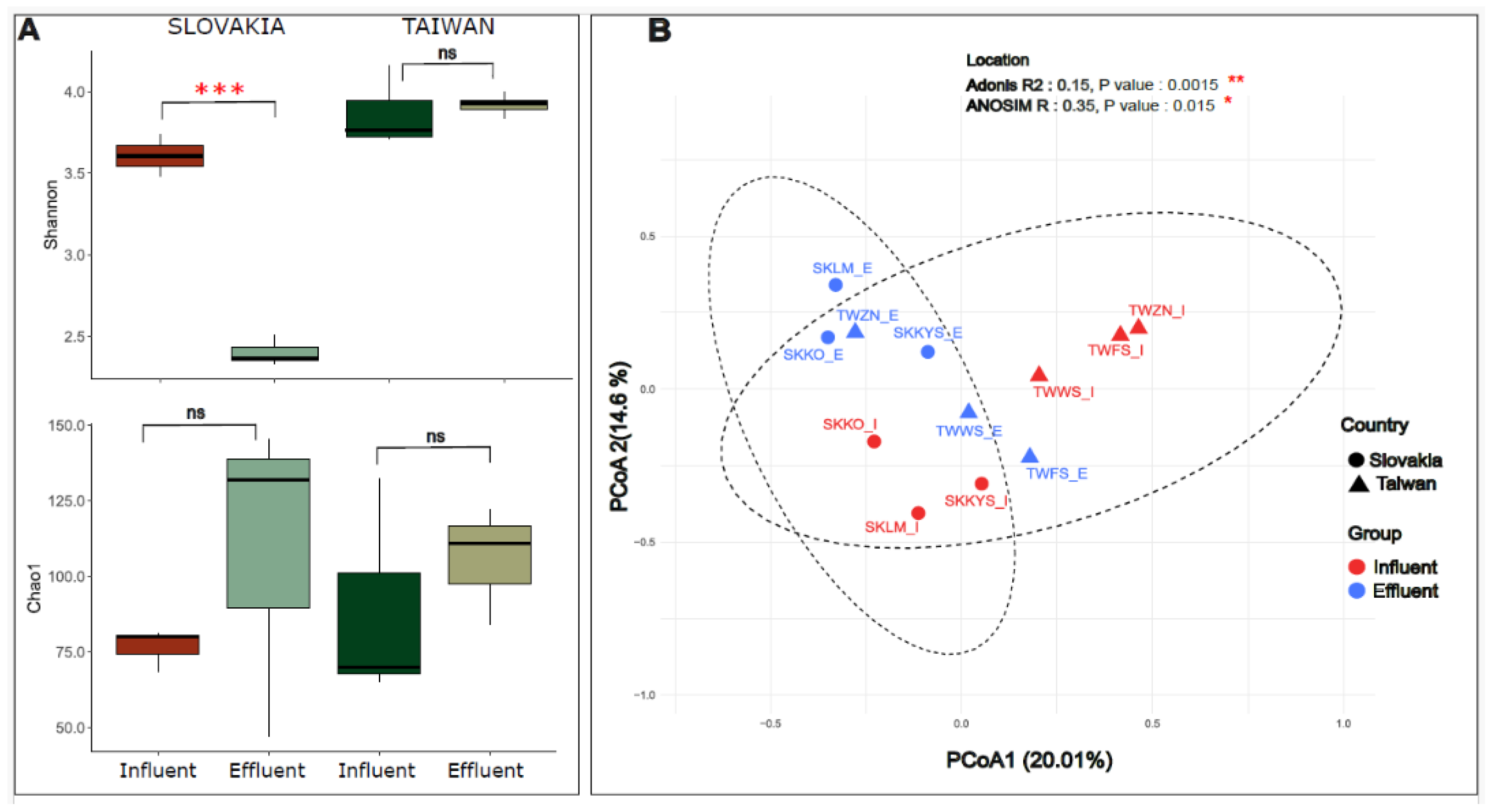
To examine the diversity of ARGs, we analyzed Shannon and Chao1 indices (Figure 1A). Significant differences were found in the Shannon measures between the influent and effluent samples in Slovakia (p < 0.001), suggesting greater diversity and evenness of ARGs in the influent. No significant differences were observed in diversity measures between influent and effluent samples in Taiwan. The Chao1 index estimated a higher number of unique ARGs, including those less abundant, in effluent samples in both countries.
The beta diversity of antibiotic resistance genes across wastewater samples from Slovakia and Taiwan was visualized by the PCoA plot (Figure 1B). The significant separation by country was shown by the clustering of each country’s samples into two distinct groups (Adonis R2 = 0.15, p = 0.001; ANOSIM R = 0.35, p = 0.01). Within each country, the distribution of ARGs displayed a distinct trend, where influent and effluent samples were positioned somewhat apart but remained in proximity to each other in the ordination space. Microbial diversity (Shannon) and the influence of the inflow of the hospital wastewater showed a marginal effect (Adonis R2 = 0.11, p = 0.048 and Adonis R2 = 0.10, p = 0.061, respectively), while pH and temperature showed no significance.
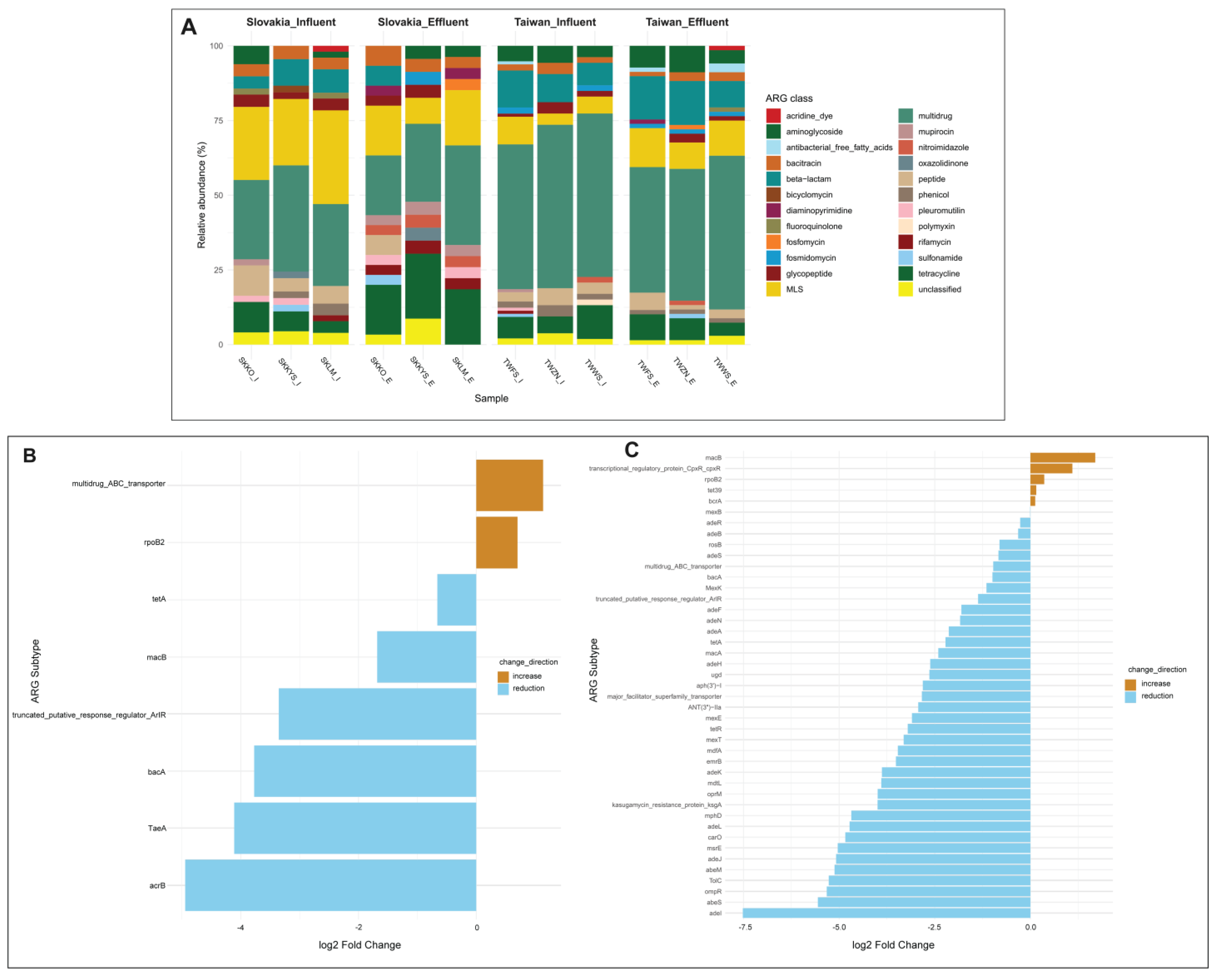
Figure 2A provides an overview of the resistome composition across influent and effluent samples from both countries. The most prevalent resistance mechanism in all samples was multidrug resistance, ranging from 20.00% to 35.56% in Slovak samples and 40.29% to 60.06% in Taiwanese samples. Correspondingly, core multidrug resistance genes identified across samples included acrB, mexB, and ompR (a response regulator associated with multidrug resistance through porin downregulation, rather than a canonical resistance determinant) in Slovakia, and mexK, adeF, abeM, and TolC in Taiwan (Figure S1). Other abundant resistance classes included macrolide-lincosamide-streptogramin (MLS), ranging from 8.70% to 31.37% in Slovak and 10.93% to 24.16% in Taiwanese samples, and tetracycline resistance, ranging from 3.92% to 21.74% in Slovak and 3.67% to 12.45% in Taiwanese samples. Representative MLS genes such as ermB, lsaE, and macB, and tetracycline genes tetA, tetQ, and tetR were among the most consistently detected across samples in both countries. In addition, beta-lactam resistance was observed at 4.08% to 8.89% in Slovak and 2.70% to 9.38% in Taiwanese samples, while aminoglycoside resistance ranged from 4.08% to 7.84% and 2.10% to 6.25%, respectively.
To assess the overall trend of increment or reduction in ARGs of WWTPs in each country, we performed a differential abundance analysis. In Slovakia, 6 genes showed a reduction and 2 genes showed an increment in the relative abundance of genes in effluent samples (Figure 2B). Genes that showed marked reductions in effluent samples were acrB (log2FC = −4.94, p = 0.037), bacA (−3.77), TaeA (−4.11), and ArlR (−3.35). MacB and tetA also declined modestly. In contrast, multidrug_ABC_transporter and rpoB2 increased slightly (+1.14 and +0.70, respectively), though not significantly. Overall, most core ARGs declined post-treatment, while some multidrug and rifamycin-associated genes persisted or rose.
In Taiwan, 38 ARGs showed a reduction and 5 ARGs showed an increment in relative abundances (Figure 2C). Several genes showed significant reductions in effluent samples, including abeS (log2FC = −5.56, p = 0.027), ompR (−5.32, p = 0.008), TolC (−5.27, p = 0.033), msrE (−5.04, p = 0.005), oprM (−3.99, p = 0.031), and ugd (−2.64, p = 0.002). These genes, many of which are associated with multidrug efflux systems, were notably depleted following treatment. In contrast, some genes, such as macB, tet39, rpoB2, and CpxR, exhibited slight increases in effluent samples, although most of these changes were not statistically significant.
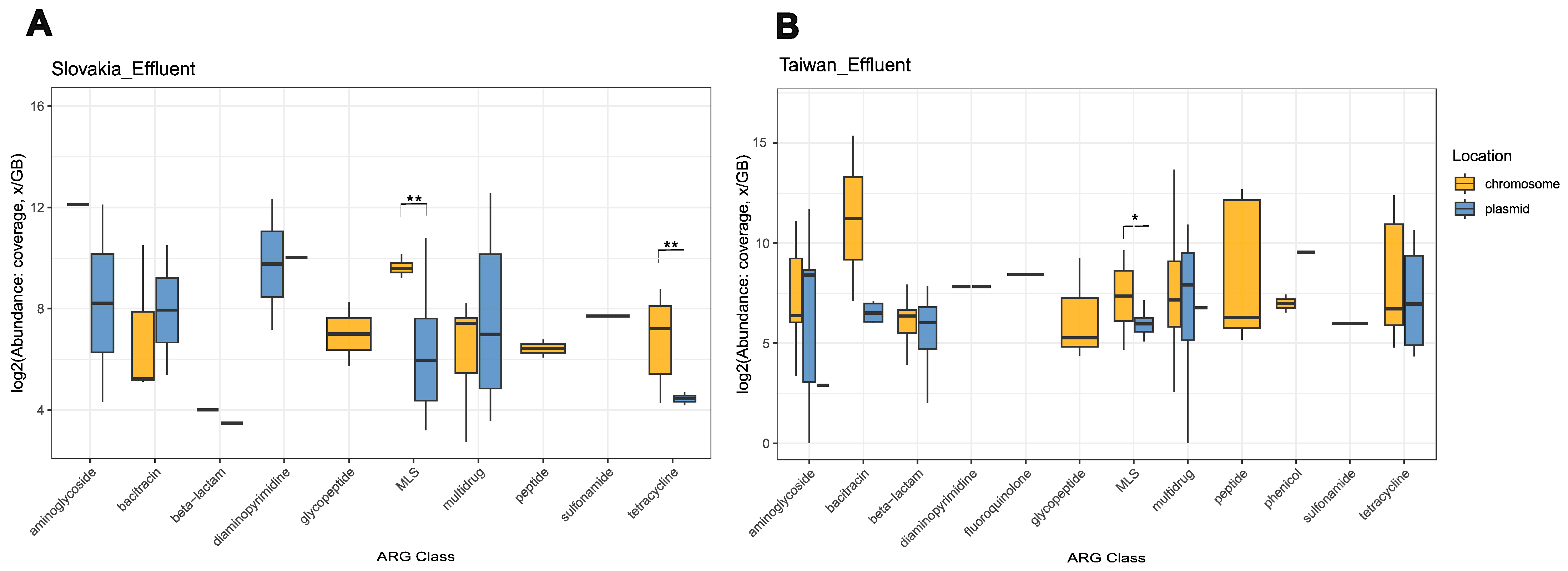
To evaluate the genetic context of ARG classes, we examined their distribution on chromosomal and plasmid contigs across treatment groups in Slovakia and Taiwan (Figure 3 and Figure S2). In Slovak influent samples, no statistically significant differences were observed between plasmid- and chromosome-associated ARGs across the major classes (p > 0.05 for all comparisons, t-test). However, in Slovak effluent samples, plasmid-associated MLS (p = 0.0016) and chromosomal tetracycline resistance genes (p = 0.0045) were significantly more abundant, suggesting selective retention or enrichment of these ARG classes post-treatment (Figure 3A). In Taiwan, a significant difference in plasmid-associated MLS genes was detected in effluent samples (p = 0.0335), with higher abundances compared to chromosomal counterparts (Figure 3B). Other resistance classes, such as aminoglycosides, beta-lactams, and tetracyclines, did not differ significantly in their distribution between compartments (p > 0.05), though trends suggest varied compartmentalization patterns.

3.2. Wastewater Mobilome Analysis

To assess the potential WW mobilome, we analyzed the abundance of MGEs using the mobileOG-db across all wastewater samples. MGEs were classified into five functional categories based on their associated molecular mechanisms: integration/excision, phage, replication/recombination/repair, stability/transfer/defense, and transfer. In Slovakia, influent samples showed high abundance of integration/excision MGEs (mean log2 = 7.40) (Figure S3A), which was significantly reduced in effluent samples (mean log2 = 3.94; p = 8.13 × 10⁻⁷, Wilcoxon test). Phage-associated MGEs also had high abundance in influent (mean log2 = 8.34), and they dropped in effluent (mean log2 = 6.50), though the change was not significant. Other groups, replication/recombination/repair, stability/transfer/defense, and transfer exhibited moderate declines in effluent samples, but none reached statistical significance (Figure S3A). In Taiwan, influent samples were dominated by integration/excision (mean log2 = 7.36), replication/recombination/repair (mean log2 = 7.01), and phage (mean log2 = 7.89) MGEs (Figure S3B). Notably, phage-related MGEs increased in effluent (mean log2 = 8.17), though this change was not statistically significant. In contrast, transfer-related MGEs were significantly reduced post-treatment, from a mean log2 of 8.01 in the influent to 6.28 in the effluent (p = 0.02). Despite treatment, integration/excision (mean log2 = 6.81) and replication/recombination/repair (mean log2 = 6.19) MGEs remained abundant in effluent samples.

3.3. Colocalization of Args, Mges, Mrgs, and Microbiome

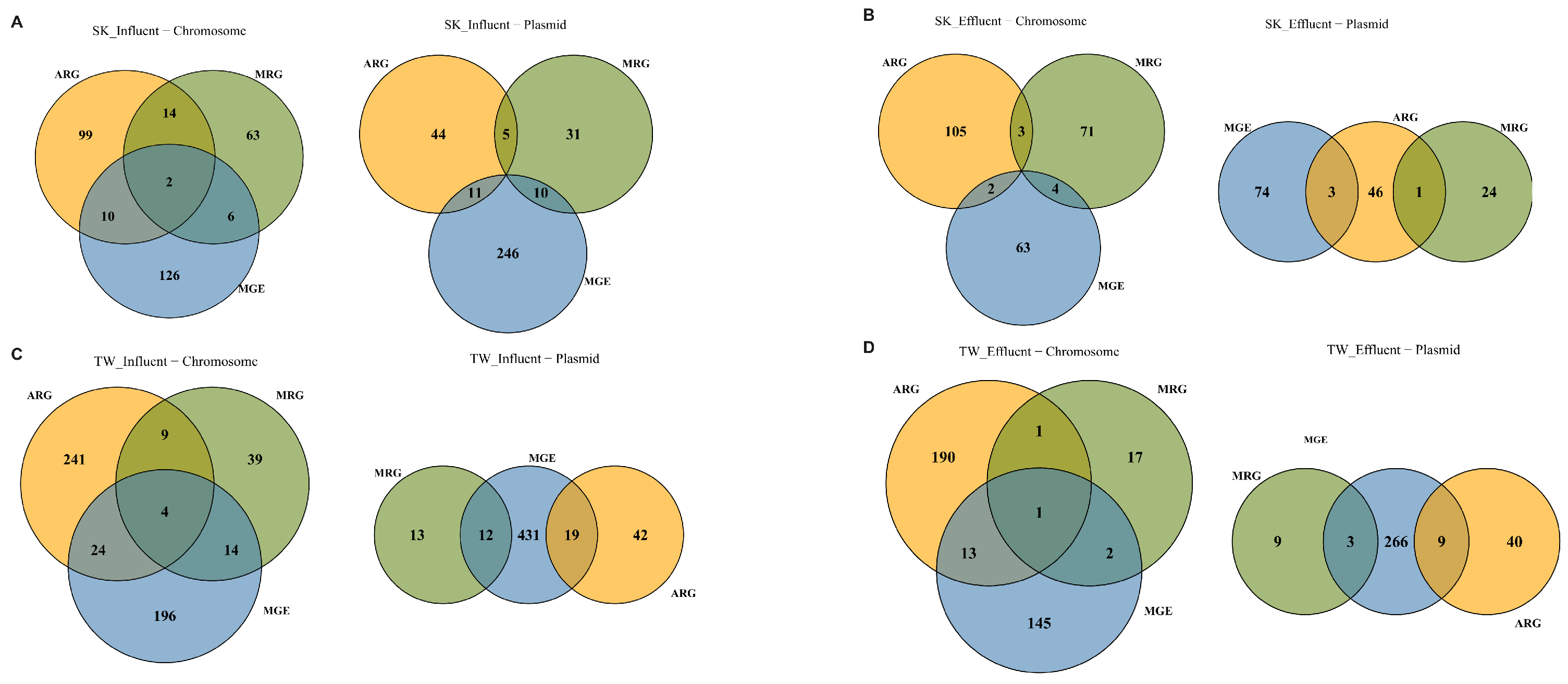
We investigated the genetic compartments and co-localization patterns of ARGs, MGEs, and MRGs across plasmid and chromosomal contigs. In Slovakia, the influent samples contained 11 plasmid contigs carrying both ARGs and MGEs, 4 with ARGs and MRGs, and 7 with MRG + MGE combinations. On chromosomal contigs, 9 carried ARG + MGE, 13 carried ARG + MRG, and 1 carried all three (ARG + MRG + MGE) (Figure 4A). In effluent samples, the number of co-localized contigs decreased, with 3 plasmids and 1 chromosome retaining ARG + MGE associations (Figure 4B).
Taiwanese samples exhibited higher numbers of co-localized elements. In influent samples, 14 plasmid contigs carried ARG + MGEs and 12 had MRG + MGEs, while 18 chromosomes carried ARG + MGEs and 4 contained ARG + MRG + MGE combinations (Figure 4C). In effluent samples, 6 plasmids and 8 chromosomes still carried ARG + MGEs, and one chromosomal contig retained all three categories (Figure 4D). The complete summary of ARGs co-localized with MGEs and MRGs, including their genomic location and taxonomic assignments, is presented in Supplementary Data S1.
To further explore the taxonomic context of ARGs in the assembled contigs, we generated chord diagrams linking ARG classes to their microbial hosts (Figures S4 and S5). In total, 1149 ARG-carrying contigs were assigned to taxonomically classified bacterial hosts across all wastewater samples. Species from the genus Acinetobacter dominated the host landscape, particularly in Taiwanese influent and effluent samples. In Slovak influent samples, Acinetobacter johnsonii, Aliarcobater cryaerophilus, and Moraxella osloensis were among the top ARG carriers, collectively contributing to over 30% of ARG-associated contigs in that group (Figure S4A). After treatment, Slovak effluent samples showed a shift in host composition, with Flavobacterium sp., being a notable ARG host, followed by Streptococcus dysgalactiae, Acinetobacter species, and Acliarcobater cryaerophilus (Figure S4B). In Taiwan influent samples, Acinetobacter baumannii was the most prevalent ARG host, accounting for over 18% of all ARG-associated contigs within that group, followed by A. pittii, A. towneri, and A. junii (Figure S5A). In effluent samples from Taiwan, A. baumannii remained the most dominant host (15%), alongside A. pittii and Moraxella osloensis (Figure S5B). In both groups, Enterococcus faecium was detected.

3.4. Bacterial Composition in the Influent and Effluent Wwtps

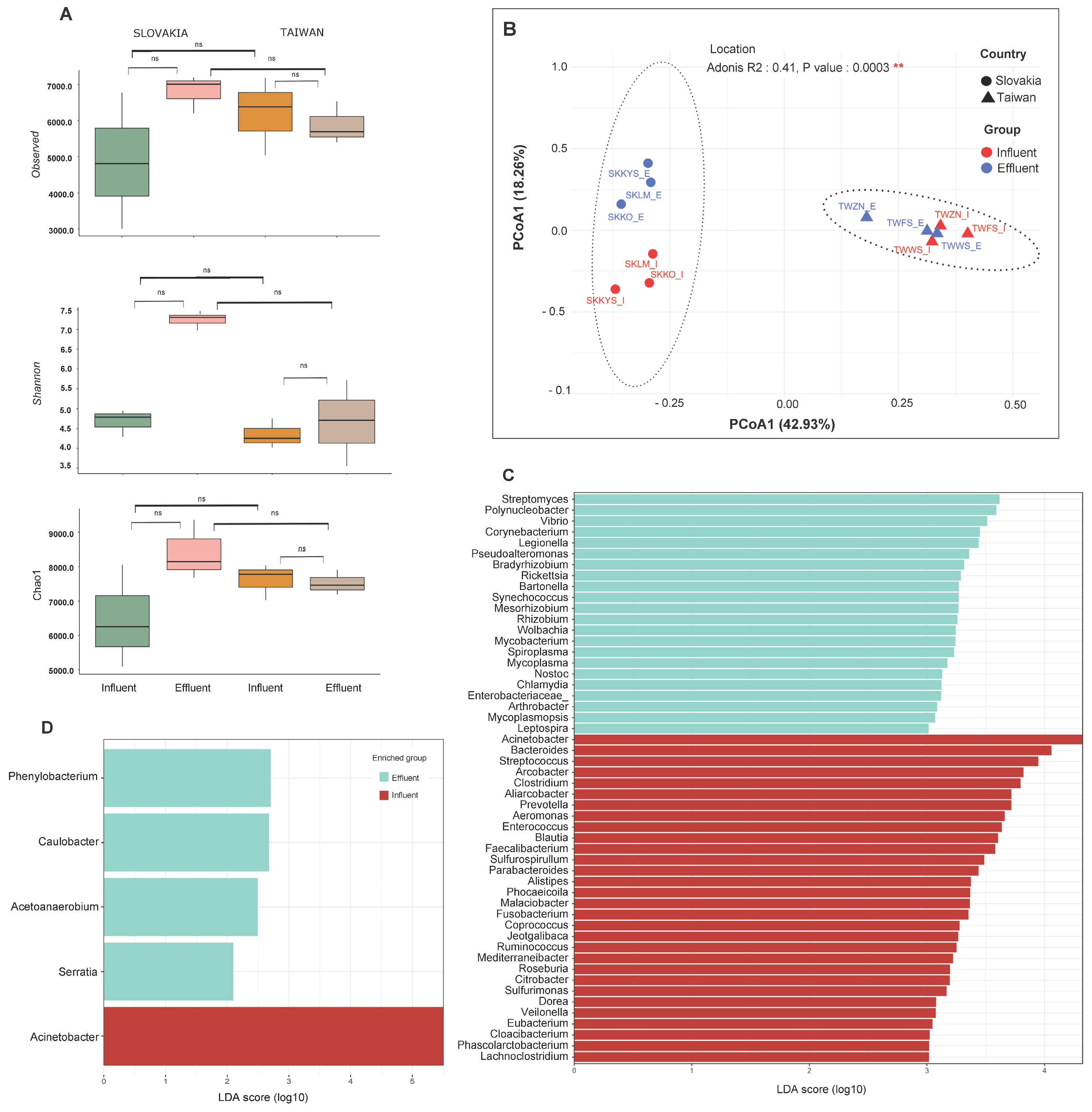
A total of 52,714 to 335,791 reads for Slovak samples and 151,227 to 265,091 reads for Taiwanese samples were analyzed to characterize microbial diversity in the wastewater treatment plants (WWTPs). The alpha diversity of microbial communities was evaluated using Observed species richness, the Chao1 estimator, and the Shannon diversity index (Figure 5A).
In Slovak samples, the average Observed richness for influent samples was 4866.33, with a Chao1 estimate of 6465.66 and a Shannon index of 4.68. Effluent samples showed an increase in diversity, with an average Observed richness of 6804.33, a Chao1 estimate of 8431.57, and a Shannon index of 7.23. For Taiwanese samples, the average Observed richness in the influent was 6203.67, with a Chao1 value of 7612.31 and a Shannon index of 4.34. Effluent samples exhibited a slight decrease in species richness, with an average Observed value of 5544.33 and a Chao1 estimate of 7518.20. However, the Shannon index slightly increased to 4.66, indicating that while some species richness was reduced during treatment, community evenness improved. Although there were differences in the bacterial composition between influent and effluent samples, no significant differences in alpha diversity or species richness were observed across the groups.
The PCoA analysis using the Bray–Curtis dissimilarity indicated that, in Slovak WWTPs, microbial communities in the effluent were distinctly separated from those in the influent (Figure 5B). In contrast, Taiwanese samples showed a closer clustering between influent and effluent communities, suggesting more similar microbial compositions. Overall, Slovak and Taiwanese samples displayed a clear divergence in the ordination space. To assess how geographic location and wastewater treatment stage shape the bacterial community structure, we performed a PERMANOVA analysis. The analysis revealed that both factors significantly influenced community composition (geographic location: R2 = 0.41, p = 0.0003; wastewater treatment stage: R2 = 0.12, p = 0.0337), with geographic location exerting a more pronounced effect than the differences between influent and effluent samples.
To identify significant differences in bacterial communities across wastewater samples from Slovakia and Taiwan, as well as between influent and effluent samples within each country, we used LEfSe with criteria of LDA > 3 and p < 0.05. This analysis revealed 88 bacterial genera as significant biomarkers distinguishing the microbial profiles of Slovak and Taiwanese influent samples (Figure S6). In Slovak influent samples, Bacteroides, Arcobacter, Clostridium and Campylobacter had the highest LDA scores, with values of 4.22, 3.99, 3.99, and 3.54, respectively, indicating their strong enrichment. In contrast, Taiwanese influent samples were characterized by the predominance of Microbacterium (LDA = 4.32), Streptomyces (4.31), and Mycolicibacterium (3.92), indicating a distinct microbial composition. Additional genera, including Mycobacterium and Nocardioides, were also significantly enriched in Taiwanese samples.
To examine the impact of wastewater treatment on microbial diversity within each country more closely, we compared the microbial communities in influent and effluent samples separately. In the Slovak influent, Acinetobacter, Bacteroides, and Streptococcus exhibited the highest LDA scores (4.32, 4.06, and 3.95, respectively), indicating their prevalence in untreated wastewater (Figure 5C). Other genera, such as Clostridium, Aliarcobacter, as well as Enterococcus were also prominent, reflecting a diverse pre-treatment community. In Taiwanese samples, Acinetobacter exhibited the highest LDA score in influent (5.50), indicating a strong enrichment before treatment (Figure 5D). Post-treatment, the Taiwanese effluent community showed an increased prevalence of Phenylobacterium (LDA = 2.71), Caulobacter (2.68), and Acetoanaerobium (2.49), which were less prominent in influent samples.
In addition to total microbiome composition, we also used ARGO to profile ARG-carrying reads and their associated taxa. Taxonomic classification of reads revealed dominant ARG hosts, including Acinetobacter, Enterococcus, and Klebsiella species, across samples, though many reads remained unclassified (Supplementary Data S2). While these results provide useful insight into ARG-host associations, they are limited by read length and lack of contextual linkage. Therefore, we complemented this with contig-based analysis to resolve ARG-host connections with higher confidence. In Slovak influent samples, the most abundant ARG-carrying species was Streptococcus suis_AA (Phylum: Firmicutes, Family: Streptococcaceae), with a total ARG abundance of 55.62 copies per genome (cpg). Although multidrug resistance genes were present (0.31 cpg, 1 gene), most of its resistance was attributed to other classes. Enterococcus faecalis (Phylum: Firmicutes, Family: Enterococcaceae) followed with 33.70 cpg, primarily due to streptothricin resistance genes (3.81 cpg, 1 gene). Aliarcobacter suis (Phylum: Campylobacterota, Family: Campylobacteraceae) also ranked highly with 16.65 cpg, contributing notably to the ARG load in the influent.
In Slovak effluent samples, A. johnsonii (Phylum: Proteobacteria, Family: Moraxellaceae) was the dominant ARG host with 29.28 copies per genome (cpg), primarily due to MLS resistance (13.32 cpg, 1 gene) and biocide resistance (10.67 cpg, 2 genes). Aliarcobacter cryaerophilus_A contributed 16.36 cpg, largely from beta-lactam (8.44 cpg, 1 gene), bacitracin (4.55 cpg, 1 gene), and biocide resistance (3.37 cpg, 1 gene). Lactococcus_A raffinolactis (Firmicutes, Streptococcaceae) exhibited 9.18 cpg, driven by defensin resistance (6.53 cpg, 5 genes) and bacitracin resistance (2.66 cpg, 1 gene).
In Taiwan influent samples, A. baumannii led with 39.03 cpg, carrying multidrug (18.04 cpg, 16 genes) and MLS resistance (7.30 cpg, 4 genes), along with contributions from beta-lactam, bacitracin, aminoglycoside, phenicol, fosfomycin, tetracycline, and sulfonamide classes. Acinetobacter nosocomialis followed with 46.95 cpg, dominated by multidrug (31.02 cpg, 5 genes) and phenicol resistance (11.93 cpg, 2 genes). E. faecalis contributed 15.32 cpg, with bacitracin (5.32 cpg, 1 gene), defensin (5.07 cpg, 1 gene), phenicol, and tetracycline resistance. In Taiwan effluent samples, Acinetobacter sp013417555 was the top carrier with 20.93 cpg, associated with MLS (5.00 cpg, 1 gene), phenicol (4.00 cpg, 1 gene), trimethoprim (4.00 cpg, 1 gene), and bacitracin resistance (3.99 cpg, 1 gene). Bacillus_A thuringiensis (Firmicutes, Bacillaceae) followed closely with 15.92 cpg, harboring ARGs from bacitracin, phenicol, MLS, and beta-lactam classes (~4.00 cpg each).

4. Discussion

4.1. Overview of Arg Diversity and Impact of Wastewater Treatment on Arg and Mge Profiles

The observed differences in ARG diversity between influent and effluent samples suggest that the wastewater treatment processes employed altered, to a certain extent, the composition and abundance of ARGs. This is supported by the decline in Shannon diversity in Slovak effluent samples (Figure 1A), indicating reduced ARG evenness and complexity after treatment. In contrast, Chao1 richness increased. Shannon diversity index considers both richness and evenness [34], and is therefore strongly influenced by dominant ARGs, whereas Chao1 is a non-parametric richness estimator that is particularly sensitive to rare, low-abundance taxa [35,36]. Wastewater treatment most likely reduced the dominant, highly abundant ARGs, which lowered evenness and consequently Shannon. On the other hand, some of the low-abundance ARGs, including the ones potentially associated with MGEs or located on plasmids, persisted in effluents, increasing the richness as reflected by Chao1. These findings align with previous studies demonstrating how influent composition and treatment processes can shape microbial and resistance gene profiles in wastewater systems [37,38,39].
Consistent with our second hypothesis, the clear separation of ARG profiles between Slovakia and Taiwan in the PCoA plot (Figure 1B) indicates distinct resistome compositions likely shaped by country-specific factors. These differences likely arise from discrepancies in antibiotic consumption patterns, as wastewater treatment configurations were largely comparable across sites [39,40]. Beyond antibiotic consumption, differences in climate, agriculture, and healthcare practices are likely to have contributed to the distinct resistome signatures. Slovak WWTPs primarily receive municipal and agricultural wastewater, explaining the prominence of agriculturally associated taxa such as A. cryaerophilus and the dominance of tetracycline resistance. In contrast, Taiwanese WWTPs, all of which received hospital wastewater in this study, showed higher multidrug resistance and Acinetobacter abundance. These country-level differences suggest that the local wastewater input profile, rather than treatment process alone, is the dominant determinant of effluent resistome composition. Temperature and pH did not affect the ARG composition, likely because these parameters varied only modestly across sites and remained within relatively narrow ranges.
To further contextualize resistome differences, we analyzed the dominant ARG classes. The higher prevalence of the multidrug resistance class in Taiwanese WWTPs compared to Slovak WWTPs can be attributed primarily to the presence of hospital wastewater inflows, supporting our third hypothesis. Hospital effluents are significant reservoirs of multidrug-resistant bacteria and their associated genes due to the extensive use of antibiotics in healthcare settings. Prior studies confirm that genera such as Acinetobacter and members of Enterobacteriaceae, often multidrug-resistant, are abundant in hospital wastewater and can persist after treatment [41,42]. In our study, all Taiwanese WWTPs received hospital wastewater, increasing selective pressure for resistant bacteria, unlike in Slovakia, where such inflows are not consistently present. Elevated aminoglycoside resistance in Taiwanese effluent samples may also be attributed to their intensive use in clinical settings worldwide [43], which contributes to their persistence in wastewater. WWTPs commonly reflect the clinical resistome, discharging ARGs linked to healthcare environments [44].
Beyond this country-specific difference, the overall prevalence of multidrug, MLS, and tetracycline resistance classes across influent and effluent samples in both countries appears to be shaped by several common and interrelated factors. These include the widespread use of corresponding antibiotics, their persistence in the environment, and treatment conditions that may favor the survival of ARG-carrying bacteria. National pharmaceutical consumption data (Table S4) confirm high usage of tetracyclines and MLS antibiotics during the sampling period in both Slovakia and Taiwan. Multidrug antibiotics, due to their broad-spectrum efficacy, are, besides the hospital settings, particularly prevalent in sewage systems [45,46].
To further understand these dynamics, we examined how different wastewater treatment configurations influenced the removal, persistence, or enrichment of specific ARGs in effluent groups. Slovak WWTPs applied biological nitrogen and phosphorus removal, while two out of three Taiwanese WWTPs used the Modified Ludzack–Ettinger (MLE) process. Despite these efforts, biological treatments inconsistently eliminate ARGs. For instance, secondary settling tanks can reduce bacterial biomass but not necessarily ARGs [47]. In contrast, membrane bioreactor treatment showed better removal efficiencies for ARB but still struggled to eliminate key ARGs such as sul1, sul2, and intI1. Thus, wastewater treatment processes can lower the bacterial load, but they do not necessarily eliminate resistance genes. Improper disposal of unused or expired medications [48] and their resistance to degradation [49] help explain the persistence of ARGs. These conditions contribute to the high abundance of certain ARGs, including tetracycline resistance genes, whose presence, in terms of total concentrations, was found to be positively correlated with tetracycline resistance genes in urban wastewater [50]. This underscores a broader challenge in using conventional treatment methods to fully eliminate ARGs and antibiotic-resistant bacteria from effluents.
While treatment markedly reduced several high-abundance ARGs, a subset of multidrug and macrolide-associated genes, although significantly depleted, remained detectable in effluent samples, particularly on MGEs. This limited reduction in ARG abundance aligns with Illumina-based studies showing that conventional A/O treatment significantly impacts fewer than 1% of ARGs [51].

4.2. Wastewater Mobilome and Its Treatment Resilience

The observed dominance of integration/excision MGEs in influent samples from both Slovakia and Taiwan highlights the widespread presence of integrases and associated recombination systems that facilitate the incorporation of resistance genes into host genomes. This aligns with findings that highlight the importance of integrases in wastewater treatment systems [52].
In Taiwan, the observed stability or increase in phage-associated MGEs across treatment suggests these elements are less impacted by biological processes and may serve as persistent vectors for ARG dissemination. The significant reduction in transfer-related MGEs post-treatment indicates that conjugative mechanisms may be more susceptible to treatment disruption compared to transduction-related ones. Nevertheless, the high residual abundance of integration/excision and recombination-related MGEs in effluent samples suggests that the overall mobilome potential remains substantial even after conventional treatment. These findings emphasize the complexity of the wastewater mobilome and the resilience of specific MGE categories to treatment processes. The persistence of phage and integrase-associated elements is especially concerning, given their established roles in facilitating the horizontal transfer of antibiotic resistance genes in microbial communities [53].

4.3. Chromosomal and Plasmid-Associated Args: Mobility Implications

The localization of ARGs to plasmids or chromosomes shapes their persistence and transfer potential. In our study, MLS resistance genes were significantly more abundant on plasmids in Slovak and Taiwanese effluent samples, suggesting their potential for horizontal gene transfer (HGT) and downstream dissemination. This aligns with prior findings that MLS, tetracycline, aminoglycoside, beta-lactam, and multidrug resistance genes are frequently plasmid-borne [19,31,54]. Although the efflux mechanisms underlying MLS resistance are typically chromosomal, involving major facilitator or ATP-binding transporters [55], enhanced efflux activity has also been linked to mobile elements [56,57], supporting the observed plasmid association.
Chromosomal ARGs, such as those conferring aminoglycoside and bacitracin resistance, may persist due to their role in increasing minimum inhibitory concentrations through higher expression of drug-modifying enzymes [58]. Their persistence is supported by the capacity for adaptive mutations in chromosomal efflux- or impermeability-related genes [59], as well as by the acquisition of foreign ARGs via horizontal gene transfer, including uptake of free chromosomal DNA from the environment [60]. The significant enrichment of chromosomal tetracycline genes in Slovak effluents supports this notion, potentially reflecting selective pressures favoring intrinsic resistance mechanisms during treatment. Collectively, our findings highlight distinct patterns of ARG compartmentalization that may influence both environmental persistence and transmission potential.

4.4. Genetic Context and Host Taxonomy of Co-Localized Args, Mges, and Mrgs in Assembled Contigs and Reads

The genetic context of ARGs, particularly their localization on plasmids versus chromosomes, revealed important patterns with implications for horizontal gene transfer. Although plasmid-borne ARGs are less abundant than chromosomal ARGs, they are more likely to be transferred horizontally [61]. The reductions in plasmid contigs carrying ARGs in effluent samples indicate a decreasing trend of the overall potential horizontal gene transfer [62].
When comparing effluent samples to influent ones, the number of contigs exhibiting ARG–MGE or ARG–MRG co-localization decreased post-treatment, suggesting a partial filtration or degradation effect likely facilitated by the wastewater treatment processes. Nevertheless, specific plasmid and chromosomal contigs in effluents retained dual resistance profiles (e.g., ARG + MGE), indicating that resistant populations can persist despite treatment. In Taiwanese effluents, multiple ARG–MGE–host linkages were identified, particularly involving msrE and ompR (a two-component regulator linked to multidrug resistance through modulation of outer membrane porins) in Acinetobacter species. Although their abundance decreased after treatment, these genes persisted on plasmids or contigs co-localized with MGEs, especially in A.baumannii, A. portensis, and A. towneri (Supplementary Data S1). ARGO read-based analysis further confirmed the presence of msrE on Acinetobacter reads in Taiwanese effluent samples (Supplementary Data S2). Notably, msrE occurred on plasmids together with integration, excision, and transfer modules, while ompR was detected on both plasmid- and chromosome-associated contigs, including in A.pittii and Acinetobacter sp. The detection of ompR on plasmid-associated contigs is noteworthy, though its regulatory rather than enzymatic mechanism of resistance should be interpreted with caution in the context of horizontal ARG transfer. These findings are consistent with previous reports showing that msrE co-occurs with other ARGs on transferable plasmids such as pS30-1 [63] and pDETAB2 [64], and are highly abundant in wastewater systems [65]. This highlights the persistence of clinically relevant mobile ARG–MGE linkages under selective pressure even after the treatment.
Although relatively few contigs in our dataset exhibited co-localization of ARGs and MRGs, their presence, particularly on plasmids, raises concern due to the potential for co-selection and horizontal gene transfer [66]. Such genetic linkage, though limited in frequency, may contribute disproportionately to the environmental persistence of resistance traits. The detection of ARG–MRG co-localization aligns with previous reports suggesting that metal contamination can act as a co-selective pressure, maintaining ARGs even in the absence of antibiotics [66].
Zhang et al. (2025) further demonstrated that antibiotic exposure, particularly chloramphenicol, can induce the expression of several MRGs (e.g., pstB, dmeF, czcP) and lead to significant co-expression patterns between ARGs and MRGs in bacterial communities, hence suggesting that environmental stressors such as metals and antibiotics can jointly drive resistance dynamics [67]. Consistent with these findings, we detected genes such as pstB, pstC, czcR, and czcD—in both Slovak and Taiwanese samples (Figure S7). While the frequency of ARG–MRG co-localization was modest, these occurrences highlight the ecological risk posed by wastewater environments.
Consistent with the host distributions identified in assembled contigs, among the dominant ARG-carrying taxa in Slovak influent and effluent samples, A. cryaerophilus was notable for its high representation. This Gram-negative, zoonotic pathogen—formerly classified under Arcobacter—has been frequently detected in wastewater systems worldwide [68,69,70,71]. Its presence in the Slovak WWTP influent likely reflects inputs from agricultural sources, as Aliarcobacter spp. are common in livestock and can enter sewage through fecal contamination or runoff [72,73,74]. Previous studies have confirmed the high abundance and metabolic activity of A. cryaerophilus in influent using metagenomics, culturing, and FISH [69,75]. Both contig-based and ARGO-based analysis (Supplementary Data S1 and S2) identified this species as a key ARG reservoir in Slovak wastewater samples, carrying ARGs on both plasmids and chromosomes, in a few cases co-localized with MGEs, highlighting its role in ARG dissemination. A. cryaerophilus exhibits resistance to various antibiotics, including tetracyclines, aminoglycosides, and macrolides, with resistance rates varying significantly across studies [76,77]. Its persistence in effluent samples may be explained by its limited ability to aggregate with activated sludge flocs, which allows a significant portion of cells to remain dispersed in the water column after treatment [69].
The presence of Acinetobacter in wastewater is not merely incidental; it reflects broader ecological trends. This genus is commonly associated with the spread of ARGs making its presence in wastewater a public health concern [78,79]. Research indicates that these species are prevalent in both influent and effluent samples from WWTPs, often exhibiting higher relative abundances post-treatment [80,81]. This suggests that while wastewater treatment processes may reduce the overall microbial load, certain bacteria, including Acinetobacter, can survive and even proliferate, potentially due to their ability to adapt to the stressful conditions of wastewater [80,81,82]. In our case, A. baumannii was among the most abundant taxa in Taiwanese influent and effluent samples, supporting the predominance of these resistance genes in the resistome. Similarly, contig-based analysis revealed multiple ARGs co-localized on contigs classified as Acinetobacter, particularly A. baumannii, located on both plasmid- and chromosome-associated contigs, in several cases alongside MGEs. ARGO read-based validation further confirmed plasmid-linked ARG signatures. Similar genes have also been detected in river systems downstream of WWTPs, further implicating effluent discharge in the dissemination of ARGs into natural environments [45,65].
Across both countries, several ARG hosts identified, including A. baumannii, E. faecium, and Staphylococcus pseudintermedius are known human pathogens. A. baumannii is listed by the World Health Organization (WHO) as a critical priority pathogen due to its multidrug resistance and high prevalence in clinical and environmental reservoirs. In all Taiwanese effluent samples, contigs classified as E. faecium carried ARGs conferring resistance to multiple antibiotic classes, including multidrug, diaminopyrimidine, MLS, tetracycline, beta-lactam, and bacitracin. Several plasmid-associated contigs harbored MLS resistance genes co-localized with MGEs related to integration/excision and transfer, indicating their potential mobility. ARGO read-based analysis further corroborated these findings, confirming the presence of MLS resistance genes in E. faecium reads and supporting their plasmid association. On the other hand, in Slovak effluent samples, Staphylococcus pseudintermedius contigs were identified as both plasmid and chromosome contigs carrying MLS, multidrug, and tetracycline resistance genes. Both E. faecium and S. pseudintermedius are recognized for their roles in healthcare-associated infections and resistance to glycopeptides, beta-lactams, and multidrug antibiotic classes [83,84]. These results underscore the value of long-read metagenomic sequencing, which enables the resolution of ARG–MGE–host linkages, and reveal critical limitations of current WWTP designs in curbing the environmental spread of mobile, clinically important resistance genes.
Consistent with our first hypothesis, contig-based analysis provided a unique ability to reconstruct ARG–MGE–host contexts and to distinguish plasmid- from chromosome-associated ARGs, which cannot be fully captured by read-based methods alone. Although we performed long-read sequencing and retained only reads longer than 1 kb, contig assembly was still necessary because it allowed us to recover extended genomic context, resolve ARG co-localization with MGEs, and link ARGs to specific bacterial hosts. Assembled contigs enable reliable identification and subtype-level screening of ARGs, but at the same time, they may miss rare ARGs due to insufficient coverage. Moreover, metagenomic assembly and polishing come with certain limitations. While assembly pipelines typically produce high-quality contigs, studies have shown that the assembly process can yield truncated ARG contigs [85]. It has also been demonstrated that assembly and polishing steps may lead to the removal of short or potentially erroneous reads and contigs, which may inadvertently filter out true ARG-containing sequences. Additionally, in environmental microbiomes, uneven species abundance results in uneven read coverage, leading to fragmented contigs and potential loss of genomic context [85].
For these reasons, combining contig- and read-based approaches was essential to overcome limitations associated with long-read metagenomic assembly and polishing. ARGO, which is specifically designed for long-read data, enables the identification of ARGs directly from raw reads, preserves native base-level accuracy, and facilitates the assignment of ARGs to bacterial hosts and to chromosomes or plasmids. However, because ARGO does not profile MGEs and is limited by read-length constraints, it cannot reliably resolve detailed ARG–MGE co-localization patterns. Thus, integrating contig-based and ARGO read-level analyses directly improved the characterization of ARG genomic compartmentalization, identification of clinically relevant co-localizations, and validation of host assignments. This combined approach enhances the interpretation of ARG dissemination pathways in wastewater microbiomes and supports the novelty claim that integrating contig- and read-based long-read analyses improves characterization beyond either method alone. A notable limitation shared by both approaches is the potential underrepresentation of low-abundance ARGs. In contig-based analysis, rare ARG-carrying sequences may fall below the coverage threshold required for assembly, while in ARGO read-based analysis, species with less than 1× genome coverage are classified as unclassified, leading to missed host–ARG linkages for rare taxa. Altogether, this means that the true diversity of ARGs, particularly those associated with low-abundance or transient bacteria, is likely underestimated in our dataset. Future studies employing deeper sequencing or targeted enrichment may help recover these rare but potentially mobile resistance elements. This integrative strategy aligns with previous findings that read-based and assembly-based approaches are complementary, and their combined use provides a more complete and reliable representation of ARG profiles [85].

4.5. Microbial Community Structure in Influent and Effluent Wwtp Samples

The microbial community analysis revealed an increase in alpha diversity metrics in Slovak effluent samples, which is indicative of a more complex and resilient microbial community post-treatment. This trend may reflect microbial succession, where specific populations thrive under altered effluent conditions, leading to greater species richness and evenness [86,87]. The rise in Shannon diversity suggests that although some species may have been lost, the remaining community became more balanced and stable [87]. In contrast, Taiwanese effluent samples showed a decrease in species richness but a modest rise in the Shannon index, suggesting reduced richness but greater evenness. This pattern may reflect selective removal of specific bacterial taxa, including ARG carriers, by the MLE process used in Taiwanese WWTPs.
PCoA analysis revealed a marked divergence in microbial structures between Slovak and Taiwanese WWTPs. Slovak influent and effluent samples differed more strongly, while Taiwanese samples clustered more closely, suggesting a smaller shift in community composition. PERMANOVA confirmed that geographic location exerted a stronger influence than treatment process [88]. Despite methodological differences where Slovak WWTPs employed nitrification and anaerobic sludge stabilization, while Taiwanese plants used the Modified Ludzack–Ettinger (MLE) process, our results indicate that geographic factors play a dominant role in shaping microbial communities. The pronounced effect of geographic location on the wastewater treatment process aligns with previous studies that have documented similar influences on microbial communities across various environments, emphasizing the importance of local factors and treatment processes [7,89].
LEfSe-based biomarker analysis revealed distinct microbial profiles in Slovak and Taiwanese influent samples. Slovak influent was dominated by Bacteroides, Arcobacter, Clostridium, and Campylobacter, genera commonly linked to fecal contamination and known for their environmental adaptability [69,90,91]. Several of these taxa carry clinically relevant resistance traits. Arcobacter species show resistance to tetracyclines, aminoglycosides, and macrolides [76,77], while Clostridium harbors ARGs against tetracyclines, macrolides, fluoroquinolones, and lincosamides, contributing to healthcare-associated infections [92,93]. Campylobacter similarly displays resistance to beta-lactams, tetracyclines, and aminoglycosides [94,95]. Other enriched genera included Prevotella and Aliarcobacter, reflecting the taxonomic complexity of untreated wastewater.
In contrast, Taiwanese influent samples were dominated by Microbacterium, Streptomyces, and Mycolicibacterium, suggesting a distinct microbial structure. While Microbacterium is less studied in wastewater contexts, our ARGO results showed that several species—including M. esteraromaticum_E, M. paraoxydans_B, and M. sp001866135—carried bacA and helR, indicating potential roles in ARG dissemination (Supplementary Data S2). Streptomyces, commonly used in antibiotic production [96], are likely present due to environmental exposure to antibiotics, though their enrichment may not indicate a major resistome shift. In contrast, Mycolicibacterium, enriched in Taiwanese influent and effluent, has been reported to carry multidrug, peptide, beta-lactam, and aminoglycoside resistance genes [97,98].
The enrichment of Clostridium and Aliarcobacter in Slovak influent samples reflects the fecally contaminated and taxonomically diverse nature of untreated wastewater. Clostridium, commonly found in soil, feces, and surface water, is known to carry ARGs against tetracyclines, macrolides, fluoroquinolones, and lincosamides, and is a notable contributor to healthcare-associated infections [92,93]. Enterococcus was also enriched in influent samples. As an opportunistic pathogen, Enterococcus spp. readily acquire and disseminate ARGs via MGEs such as conjugative plasmids and transposons. ARGO-based analysis showed that E. faecalis harbored a diverse array of plasmid-associated ARGs, including erm(B) and erm* (MLS resistance), sat4 (streptothricin), and aph(3′)-III (aminoglycoside) (Supplementary Data S2). These findings emphasize Enterococcus as a key ARG reservoir in wastewater, facilitated by its mobility potential and association with fecal sources [99]. In Slovak effluent samples, genera such as Streptomyces, Polynucleobacter, and Vibrio became more prominent, likely reflecting selective pressures exerted by treatment. These conditions can reduce overall diversity while enabling the survival of taxa well adapted to post-treatment environments. The enrichment of Corynebacterium and Legionella suggests that treatment may inadvertently support the persistence, or even a proliferation of opportunistic pathogens that tolerate or evade conventional removal processes.
In Taiwanese samples, Acinetobacter remained dominant in both influent and effluent, contrasting with the shift seen in Slovak samples. This likely reflects the influence of hospital wastewater, which is a known hotspot for antibiotic-resistant bacteria (ARB) and is rich in antimicrobials and pharmaceuticals [100]. Urban WWTPs receiving hospital inputs often harbor more multidrug-resistant Acinetobacter strains than rural facilities [101], and all sampled Taiwanese WWTPs received hospital effluents. The persistence of Acinetobacter after treatment aligns with reports that, while WWTPs reduce total microbial loads, they often fail to eliminate clinically relevant resistant bacteria [101,102]. Consistently, our ARGO analysis revealed that several Acinetobacter species in Taiwanese influent and effluent samples carried diverse ARGs. In influent, A. baumannii and A. nosocomialis dominated, harboring resistance genes from multidrug, MLS, and phenicol classes. In effluent, A. baumannii, A. johnsonii, and Acinetobacter sp013417555 remained prevalent, with ARGs conferring resistance to MLS, trimethoprim, beta-lactams, and biocides. These findings underscore the resilience and resistance potential of Acinetobacter across treatment stages. We also observed an increase in genera such as Phenylobacterium, Caulobacter, and Acetoanaerobium in Taiwanese effluents, despite their low abundance in influents. These shifts may reflect the metabolic adaptability of these taxa, enabling them to thrive under the altered ecological and chemical conditions of treated wastewater. Treatment processes degrade or modify a wide range of organic and inorganic compounds, creating new niches that favor certain microbial groups while suppressing others [103]. Additionally, effluent communities may include bacteria introduced during the treatment process itself, originating from biofilms or activated sludge, rather than being present in the raw influent. This aligns with our observations, as all Slovak and Taiwanese plants employed treatment systems (e.g., activated sludge and anaerobic–oxic configurations) known to support dense microbial assemblages that can contribute new taxa to the final effluent.

5. Conclusions

This study used long-read metagenomics to comprehensively characterize the resistome, mobilome, and microbial community dynamics in wastewater from Slovak and Taiwanese WWTPs. Despite reductions in microbial biomass post-treatment, clinically relevant ARGs, particularly those conferring multidrug, MLS, and tetracycline resistance, persisted in effluent samples, often carried by genera such as Acinetobacter, Enterococcus, and Aliarcobacter. Hospital wastewater inflows, especially in Taiwan, were linked to elevated multidrug resistance signatures and the enrichment of ARG-carrying Acinetobacter species. Chromosomal ARGs dominated, likely driven by adaptive mutations and intrinsic resistance mechanisms. Plasmid-associated ARGs, such as msrE and ompR (a regulatory gene associated with porin-mediated multidrug resistance), were co-localized with mobile elements, highlighting the potential for horizontal gene transfer and environmental dissemination. While wastewater treatment reduced the abundance of several resistance elements, co-localized ARG–MGE and ARG–MRG signatures remained detectable, underscoring the treatment resilience of mobile and metal-associated resistance traits. Overall, the findings of this study suggest that integrating contig-based and read-based analyses enables ARG localization (plasmid vs. chromosome), host assignment, and detection of clinically relevant co-localizations with MGEs, improving contextual characterization beyond either approach alone.
Recent advances in Nanopore sequencing, such as R10.4.1 flow cells and Q20+ chemistry have significantly improved read accuracy and structural integrity, enhancing the recovery of complete ARG-MGE-host architectures while reducing assembly fragmentation. These improvements can make long-read-only approaches increasingly capable of resolving ARG mobility, plasmid–chromosome localization, and host linkage, without assembly, including the hybrid assembly methods.
From a practical standpoint, these findings highlight several implications for wastewater surveillance and management. First, the persistence of clinically relevant ARGs, particularly those co-localized with MGEs in Acinetobacter, E. faecium, and S. pseudintermedius, in treated effluents underscores the need for post-treatment monitoring protocols targeting mobile resistance elements, not only total microbial load. Second, the strong influence of hospital wastewater on WWTP resistome composition in Taiwan suggests that source control through pre-treatment of clinical effluents before entering municipal systems may be a more effective strategy than relying on WWTP treatment alone. Third, integrating long-read metagenomics into routine environmental surveillance programs would provide higher-resolution risk assessments of ARG dissemination into receiving water bodies.

Supplementary Materials

The following supporting information can be downloaded at: https://www.mdpi.com/article/10.3390/environments13050255/s1, Figure S1. Normalized log2-transformed abundance (coverage per Gbp) of individual ARGs detected in influent and effluent samples from wastewater treatment plants in Slovakia and Taiwan; Figure S2. Distribution of major ARG classes across plasmid and chromosomal contigs in influent samples from Slovakia and Taiwan. Values represent log2-transformed abundance (coverage per Gbp of assembled contigs); Figure S3. Normalized log2-transformed abundance (coverage per Gbp) of MGEs detected in Slovak (A) and Taiwanese (B) influent and effluent samples from wastewater treatment plants. MGEs are grouped into five functional categories: integration/excision, phage, replication/recombination/repair, stability/transfer/defense, and transfer. Statistical comparisons between influent and effluent samples were performed using the Wilcoxon test; Figure S4. A,B—Chord diagrams showing taxonomic distribution of ARG-carrying contigs in Slovak influent (A) and effluent (B) samples. Connections represent associations between bacterial species and detected ARG subtypes based on contig-level taxonomic classification. Only contigs carrying at least one ARG and assigned to the species level are included; Figure S5. A,B—Chord diagrams showing taxonomic distribution of ARG-carrying contigs in Taiwanese influent (A) and effluent (B) samples. Connections represent associations between bacterial species and detected ARG subtypes based on contig-level taxonomic classification. Only contigs carrying at least one ARG and assigned to the species level are included; Figure S6. Linear discriminant analysis (LDA) effect size (LEfSe) analysis identifying enriched genera (LDA score > 3) from WWTPs in Slovakia and Taiwan in influent samples; Figure S7. Normalized log2-transformed abundance (coverage per Gbp) of MRGs detected in influent and effluent samples from wastewater treatment plants in Slovakia and Taiwan; TableS1. Key features of sampled WWTPs; Table S2. Reads number and length of each sample; Table S3. Genome assembly statistics and BUSCO completeness results for metagenome assemblies. Assemblies were evaluated using BUSCO (lineage: bacteria_odb10). Completeness and duplication (reported as contamination) reflect the presence of complete and duplicated single-copy orthologs in the assembled metagenomes; TableS4. Community consumption of antibacterials for systemic use expressed as defined daily doses (DDD) per 1000 inhabitants in 2020 and 2021 in Slovakia and Taiwan [16,17,18].

Author Contributions

J.P.: Investigation, Conceptualization, Data curation, Visualization, Writing—original draft. Z.F.: Investigation, Methodology, Data curation, Conceptualization. D.G.: Methodology, Investigation. A.P.: Investigation, Formal analysis. M.B.; Methodology, Formal analysis. L.K.: Resources, Data curation. W.-Y.C.: Investigation, Data curation. J.-H.W.: Writing—review and editing, Project administration, Funding acquisition, Conceptualization. D.P.: Supervision, Investigation, Data curation, Formal analysis, Writing—review and editing. All authors have read and agreed to the published version of the manuscript.

Funding

This study was supported by the bilateral SAS (Slovak Academy of Sciences)–MOST (Taiwan) Joint Research Project (SAS–MOST/JRP/2020/1122/PathogenTracker), by the Slovak Research and Development Agency with the project number APVV-23-0382, by the Ministry of Education, Research, Development and Youth of the Slovak Republic with the project number VEGA 2/0097/25 and by the Early Stage Scheme Grants of the Slovak Academy of Sciences with the project number APD0058.

Data Availability Statement

The whole-genome shotgun metagenomic sequencing data presented in the study are openly available in NCBI SRA at accession number PRJNA1201170.

Conflicts of Interest

The authors declare that they have no competing interests.

References

  1. Rolbiecki, D.; Paukszto, Ł.; Krawczyk, K.; Korzeniewska, E.; Sawicki, J.; Harnisz, M. Chlorine Disinfection Modifies the Microbiome, Resistome and Mobilome of Hospital Wastewater—A Nanopore Long-Read Metagenomic Approach. J. Hazard. Mater. 2023, 459, 132298. [Google Scholar] [CrossRef]
  2. Zhang, D.; Peng, Y.; Chan, C.-L.; On, H.; Wai, H.K.-F.; Shekhawat, S.S.; Gupta, A.B.; Varshney, A.K.; Chuanchuen, R.; Zhou, X.; et al. Metagenomic Survey Reveals More Diverse and Abundant Antibiotic Resistance Genes in Municipal Wastewater Than Hospital Wastewater. Front. Microbiol. 2021, 12, 712843. [Google Scholar] [CrossRef]
  3. Ju, F.; Beck, K.; Yin, X.; Maccagnan, A.; McArdell, C.S.; Singer, H.P.; Johnson, D.R.; Zhang, T.; Bürgmann, H. Wastewater Treatment Plant Resistomes Are Shaped by Bacterial Composition, Genetic Exchange, and Upregulated Expression in the Effluent Microbiomes. ISME J. 2019, 13, 346–360. [Google Scholar] [CrossRef] [PubMed]
  4. Maestre-Carballa, L.; Lluesma Gomez, M.; Angla Navarro, A.; Garcia-Heredia, I.; Martinez-Hernandez, F.; Martinez-Garcia, M. Insights into the Antibiotic Resistance Dissemination in a Wastewater Effluent Microbiome: Bacteria, Viruses and Vesicles Matter. Environ. Microbiol. 2019, 21, 4582–4596. [Google Scholar] [CrossRef] [PubMed]
  5. Majeed, H.J.; Riquelme, M.V.; Davis, B.C.; Gupta, S.; Angeles, L.; Aga, D.S.; Garner, E.; Pruden, A.; Vikesland, P.J. Evaluation of Metagenomic-Enabled Antibiotic Resistance Surveillance at a Conventional Wastewater Treatment Plant. Front. Microbiol. 2021, 12, 657954. [Google Scholar] [CrossRef] [PubMed]
  6. Munck, C.; Albertsen, M.; Telke, A.; Ellabaan, M.; Nielsen, P.H.; Sommer, M.O.A. Limited Dissemination of the Wastewater Treatment Plant Core Resistome. Nat. Commun. 2015, 6, 8452. [Google Scholar] [CrossRef]
  7. Honda, R.; Matsuura, N.; Sorn, S.; Asakura, S.; Morinaga, Y.; Van Huy, T.; Sabar, M.A.; Masakke, Y.; Hara-Yamamura, H.; Watanabe, T. Transition of Antimicrobial Resistome in Wastewater Treatment Plants: Impact of Process Configuration, Geographical Location and Season. npj Clean. Water 2023, 6, 46. [Google Scholar] [CrossRef]
  8. Ju, F.; Lee, J.; Beck, K.; Zhang, G.; Gekenidis, M.-T.; Hummerjohann, J.; Bürgmann, H. Phenotypic Metagenomics Tracks Wastewater-Associated Clinically Important Beta-Lactam Resistant Bacteria Invading River Habitats; Research Square: Durham, NC, USA, 2022. [Google Scholar]
  9. Matviichuk, O.; Mondamert, L.; Geffroy, C.; Gaschet, M.; Dagot, C.; Labanowski, J. River Biofilms Microbiome and Resistome Responses to Wastewater Treatment Plant Effluents Containing Antibiotics. Front. Microbiol. 2022, 13, 795206. [Google Scholar] [CrossRef]
  10. Sánchez-Baena, A.M.; Caicedo-Bejarano, L.D.; Chávez-Vivas, M. Structure of Bacterial Community with Resistance to Antibiotics in Aquatic Environments. A Systematic Review. Int. J. Environ. Res. Public Health 2021, 18, 2348. [Google Scholar] [CrossRef]
  11. Lee, J.; Ju, F.; Beck, K.; Bürgmann, H. Differential Effects of Wastewater Treatment Plant Effluents on the Antibiotic Resistomes of Diverse River Habitats. ISME J. 2023, 17, 1993–2002. [Google Scholar] [CrossRef]
  12. Begmatov, S.; Beletsky, A.V.; Dorofeev, A.G.; Pimenov, N.V.; Mardanov, A.V.; Ravin, N.V. Metagenomic Insights into the Wastewater Resistome before and after Purification at Large-scale Wastewater Treatment Plants in the Moscow City. Sci. Rep. 2024, 14, 6349. [Google Scholar] [CrossRef]
  13. Ma, J.; Sun, H.; Li, B.; Wu, B.; Zhang, X.; Ye, L. Horizontal Transfer Potential of Antibiotic Resistance Genes in Wastewater Treatment Plants Unraveled by Microfluidic-Based Mini-Metagenomics. J. Hazard. Mater. 2024, 465, 133493. [Google Scholar] [CrossRef]
  14. Silvester, R.; Perry, W.B.; Webster, G.; Rushton, L.; Baldwin, A.; Pass, D.A.; Healey, N.; Farkas, K.; Craine, N.; Cross, G.; et al. Metagenomics Unveils the Role of Hospitals and Wastewater Treatment Plants on the Environmental Burden of Antibiotic Resistance Genes and Opportunistic Pathogens. Sci. Total Environ. 2025, 961, 178403. [Google Scholar] [CrossRef]
  15. de Toro, M.; Garcilláon-Barcia, M.P.; De La Cruz, F. Plasmid Diversity and Adaptation Analyzed by Massive Sequencing of Escherichia Coli Plasmids. Microbiol. Spectr. 2014, 2, 219–235. [Google Scholar] [CrossRef]
  16. Taiwan Healthcare-Associated Infection and Antimicrobial Resistance Surveillance System. Available online: https://www.cdc.gov.tw/En/Category/Page/J63NmsvevBg2u3I2qYBenw (accessed on 8 April 2026).
  17. Antimicrobial Consumption in the EU/EEA (ESAC-Net)—Annual Epidemiological Report for 2021. Available online: https://www.ecdc.europa.eu/en/publications-data/surveillance-antimicrobial-consumption-europe-2021 (accessed on 21 February 2025).
  18. Antimicrobial Consumption in the EU/EEA (ESAC-Net)—Annual Epidemiological Report for 2020. Available online: https://www.ecdc.europa.eu/en/publications-data/surveillance-antimicrobial-consumption-europe-2020 (accessed on 21 February 2025).
  19. Dai, D.; Brown, C.; Bürgmann, H.; Larsson, D.G.J.; Nambi, I.; Zhang, T.; Flach, C.-F.; Pruden, A.; Vikesland, P.J. Long-Read Metagenomic Sequencing Reveals Shifts in Associations of Antibiotic Resistance Genes with Mobile Genetic Elements from Sewage to Activated Sludge. Microbiome 2022, 10, 20. [Google Scholar] [CrossRef]
  20. Lou, E.G.; Fu, Y.; Wang, Q.; Treangen, T.J.; Stadler, L.B. Sensitivity and Consistency of Long- and Short-Read Metagenomics and epicPCR for the Detection of Antibiotic Resistance Genes and Their Bacterial Hosts in Wastewater. J. Hazard. Mater. 2024, 469, 133939. [Google Scholar] [CrossRef] [PubMed]
  21. De Coster, W.; Rademakers, R. NanoPack2: Population-Scale Evaluation of Long-Read Sequencing Data. Bioinformatics 2023, 39, btad311. [Google Scholar] [CrossRef]
  22. Kolmogorov, M.; Bickhart, D.M.; Behsaz, B.; Gurevich, A.; Rayko, M.; Shin, S.B.; Kuhn, K.; Yuan, J.; Polevikov, E.; Smith, T.P.L.; et al. metaFlye: Scalable Long-Read Metagenome Assembly Using Repeat Graphs. Nat. Methods 2020, 17, 1103–1110. [Google Scholar] [CrossRef] [PubMed]
  23. Vaser, R.; Sović, I.; Nagarajan, N.; Šikić, M. Fast and Accurate de Novo Genome Assembly from Long Uncorrected Reads. Genome Res. 2017, 27, 737. [Google Scholar] [CrossRef] [PubMed]
  24. Manni, M.; Berkeley, M.R.; Seppey, M.; Simão, F.A.; Zdobnov, E.M. BUSCO Update: Novel and Streamlined Workflows along with Broader and Deeper Phylogenetic Coverage for Scoring of Eukaryotic, Prokaryotic, and Viral Genomes. Mol. Biol. Evol. 2021, 38, 4647–4654. [Google Scholar] [CrossRef]
  25. Hyatt, D.; Chen, G.-L.; LoCascio, P.F.; Land, M.L.; Larimer, F.W.; Hauser, L.J. Prodigal: Prokaryotic Gene Recognition and Translation Initiation Site Identification. BMC Bioinform. 2010, 11, 119. [Google Scholar] [CrossRef]
  26. Arango-Argoty, G.; Garner, E.; Pruden, A.; Heath, L.S.; Vikesland, P.; Zhang, L. DeepARG: A Deep Learning Approach for Predicting Antibiotic Resistance Genes from Metagenomic Data. Microbiome 2018, 6, 23. [Google Scholar] [CrossRef] [PubMed]
  27. Buchfink, B.; Reuter, K.; Drost, H.-G. Sensitive Protein Alignments at Tree-of-Life Scale Using DIAMOND. Nat. Methods 2021, 18, 366–368. [Google Scholar] [CrossRef] [PubMed]
  28. Brown, C.L.; Mullet, J.; Hindi, F.; Stoll, J.E.; Gupta, S.; Choi, M.; Keenum, I.; Vikesland, P.; Pruden, A.; Zhang, L. mobileOG-Db: A Manually Curated Database of Protein Families Mediating the Life Cycle of Bacterial Mobile Genetic Elements. Appl. Environ. Microbiol. 2022, 88, e00991-22. [Google Scholar] [CrossRef]
  29. Pal, C.; Bengtsson-Palme, J.; Rensing, C.; Kristiansson, E.; Larsson, D.G.J. BacMet: Antibacterial Biocide and Metal Resistance Genes Database. Nucleic Acids Res. 2014, 42, D737–D743. [Google Scholar] [CrossRef]
  30. Aroney, S.T.N.; Newell, R.J.P.; Nissen, J.N.; Camargo, A.P.; Tyson, G.W.; Woodcroft, B.J. CoverM: Read Alignment Statistics for Metagenomics. Bioinformatics 2025, 41, btaf147. [Google Scholar] [CrossRef]
  31. Zhao, R.; Yu, K.; Zhang, J.; Zhang, G.; Huang, J.; Ma, L.; Deng, C.; Li, X.; Li, B. Deciphering the Mobility and Bacterial Hosts of Antibiotic Resistance Genes under Antibiotic Selection Pressure by Metagenomic Assembly and Binning Approaches. Water Res. 2020, 186, 116318. [Google Scholar] [CrossRef] [PubMed]
  32. Wood, D.E.; Lu, J.; Langmead, B. Improved Metagenomic Analysis with Kraken 2. Genome Biol. 2019, 20, 257. [Google Scholar] [CrossRef]
  33. Chen, X.; Yin, X.; Xu, X.; Zhang, T. Species-Resolved Profiling of Antibiotic Resistance Genes in Complex Metagenomes through Long-Read Overlapping with Argo. Nat. Commun. 2025, 16, 1744. [Google Scholar] [CrossRef]
  34. Kim, B.-R.; Shin, J.; Guevarra, R.B.; Lee, J.H.; Kim, D.W.; Seol, K.-H.; Lee, J.-H.; Kim, H.B.; Isaacson, R.E. Deciphering Diversity Indices for a Better Understanding of Microbial Communities. J. Microbiol. Biotechnol. 2017, 27, 2089–2093. [Google Scholar] [CrossRef]
  35. Chao, A. Nonparametric Estimation of the Number of Classes in a Population. Scand. J. Stat. 1984, 11, 265–270. [Google Scholar]
  36. Hughes, J.B.; Hellmann, J.J.; Ricketts, T.H.; Bohannan, B.J.M. Counting the Uncountable: Statistical Approaches to Estimating Microbial Diversity. Appl. Environ. Microbiol. 2001, 67, 4399–4406. [Google Scholar] [CrossRef] [PubMed]
  37. Marín, I.; Goñi, P.; Lasheras, A.M.; Ormad, M.P. Efficiency of a Spanish Wastewater Treatment Plant for Removal Potentially Pathogens: Characterization of Bacteria and Protozoa along Water and Sludge Treatment Lines. Ecol. Eng. 2015, 74, 28–32. [Google Scholar] [CrossRef]
  38. Pallares-Vega, R.; Blaak, H.; van der Plaats, R.; de Roda Husman, A.M.; Hernandez Leal, L.; van Loosdrecht, M.C.M.; Weissbrodt, D.G.; Schmitt, H. Determinants of Presence and Removal of Antibiotic Resistance Genes during WWTP Treatment: A Cross-Sectional Study. Water Res. 2019, 161, 319–328. [Google Scholar] [CrossRef] [PubMed]
  39. Zhang, J.; Yang, M.; Zhong, H.; Liu, M.; Sui, Q.; Zheng, L.; Tong, J.; Wei, Y. Deciphering the Factors Influencing the Discrepant Fate of Antibiotic Resistance Genes in Sludge and Water Phases during Municipal Wastewater Treatment. Bioresour. Technol. 2018, 265, 310–319. [Google Scholar] [CrossRef]
  40. Klein, E.Y.; Tseng, K.K.; Pant, S.; Laxminarayan, R. Tracking Global Trends in the Effectiveness of Antibiotic Therapy Using the Drug Resistance Index. BMJ Glob. Health 2019, 4, e001315. [Google Scholar] [CrossRef] [PubMed]
  41. Lépesová, K.; Olejníková, P.; Mackuľak, T.; Cverenkárová, K.; Krahulcová, M.; Bírošová, L. Hospital Wastewater—Important Source of Multidrug Resistant Coliform Bacteria with ESBL-Production. Int. J. Environ. Res. Public Health 2020, 17, 7827. [Google Scholar] [CrossRef]
  42. Zhang, L.; Ma, X.; Luo, L.; Hu, N.; Duan, J.; Tang, Z.; Zhong, R.; Li, Y. The Prevalence and Characterization of Extended-Spectrum β-Lactamase- and Carbapenemase-Producing Bacteria from Hospital Sewage, Treated Effluents and Receiving Rivers. Int. J. Environ. Res. Public Health 2020, 17, 1183. [Google Scholar] [CrossRef]
  43. Qiu, Q.; Wang, J.; Yan, Y.; Roy, B.; Chen, Y.; Shang, X.; Dou, T.; Han, L. Metagenomic Analysis Reveals the Distribution of Antibiotic Resistance Genes in a Large-Scale Population of Healthy Individuals and Patients With Varied Diseases. Front. Mol. Biosci. 2020, 7, 590018. [Google Scholar] [CrossRef]
  44. Pärnänen, K.M.M.; Narciso-da-Rocha, C.; Kneis, D.; Berendonk, T.U.; Cacace, D.; Do, T.T.; Elpers, C.; Fatta-Kassinos, D.; Henriques, I.; Jaeger, T.; et al. Antibiotic Resistance in European Wastewater Treatment Plants Mirrors the Pattern of Clinical Antibiotic Resistance Prevalence. Sci. Adv. 2019, 5, eaau9124. [Google Scholar] [CrossRef]
  45. Murphy, A.; Barich, D.; Fennessy, M.S.; Slonczewski, J.L. An Ohio State Scenic River Shows Elevated Antibiotic Resistance Genes, Including Acinetobacter Tetracycline and Macrolide Resistance, Downstream of Wastewater Treatment Plant Effluent. Microbiol. Spectr. 2021, 9, e00941-21. [Google Scholar] [CrossRef]
  46. Rizzo, L.; Manaia, C.; Merlin, C.; Schwartz, T.; Dagot, C.; Ploy, M.C.; Michael, I.; Fatta-Kassinos, D. Urban Wastewater Treatment Plants as Hotspots for Antibiotic Resistant Bacteria and Genes Spread into the Environment: A Review. Sci. Total Environ. 2013, 447, 345–360. [Google Scholar] [CrossRef] [PubMed]
  47. Chen, H.; Ng, C.; Tran, N.H.; Haller, L.; Goh, S.G.; Charles, F.R.; Wu, Z.; Lim, J.X.; Gin, K.Y.-H. Removal Efficiency of Antibiotic Residues, Antibiotic Resistant Bacteria, and Genes across Parallel Secondary Settling Tank and Membrane Bioreactor Treatment Trains in a Water Reclamation Plant. Sci. Total Environ. 2024, 924, 171723. [Google Scholar] [CrossRef]
  48. Pazda, M.; Kumirska, J.; Stepnowski, P.; Mulkiewicz, E. Antibiotic Resistance Genes Identified in Wastewater Treatment Plant Systems—A Review. Sci. Total Environ. 2019, 697, 134023. [Google Scholar] [CrossRef] [PubMed]
  49. Singer, A.C.; Järhult, J.D.; Grabic, R.; Khan, G.A.; Lindberg, R.H.; Fedorova, G.; Fick, J.; Bowes, M.J.; Olsen, B.; Söderström, H. Intra- and Inter-Pandemic Variations of Antiviral, Antibiotics and Decongestants in Wastewater Treatment Plants and Receiving Rivers. PLoS ONE 2014, 9, e108621. [Google Scholar] [CrossRef]
  50. Zhang, Y.; Hu, Y.; Li, X.; Gao, L.; Wang, S.; Jia, S.; Shi, P.; Li, A. Prevalence of Antibiotics, Antibiotic Resistance Genes, and Their Associations in Municipal Wastewater Treatment Plants along the Yangtze River Basin, China. Environ. Pollut. 2024, 348, 123800. [Google Scholar] [CrossRef] [PubMed]
  51. Chen, W.-Y.; Lee, C.-P.; Pavlović, J.; Pangallo, D.; Wu, J.-H. Characterization of Microbiome, Resistome, Mobilome, and Virulome in Anoxic and Oxic Wastewater Treatment Processes in Slovakia and Taiwan. Heliyon 2024, 10, e38723. [Google Scholar] [CrossRef]
  52. Buta, M.; Hubeny, J.; Zieliński, W.; Korzeniewska, E.; Harnisz, M.; Nowrotek, M.; Płaza, G. The Occurrence of Integrase Genes in Different Stages of Wastewater Treatment. J. Ecol. Eng. 2019, 20, 39–45. [Google Scholar] [CrossRef]
  53. de Nies, L.; Busi, S.B.; Kunath, B.J.; May, P.; Wilmes, P. Mobilome-Driven Segregation of the Resistome in Biological Wastewater Treatment. eLife 2022, 11, e81196. [Google Scholar] [CrossRef]
  54. Che, Y.; Xia, Y.; Liu, L.; Li, A.-D.; Yang, Y.; Zhang, T. Mobile Antibiotic Resistome in Wastewater Treatment Plants Revealed by Nanopore Metagenomic Sequencing. Microbiome 2019, 7, 44. [Google Scholar] [CrossRef]
  55. Roberts, M.C. Environmental Macrolide–Lincosamide–Streptogramin and Tetracycline Resistant Bacteria. Front. Microbiol. 2011, 2. [Google Scholar] [CrossRef]
  56. Portillo, A.; Ruiz-Larrea, F.; Zarazaga, M.; Alonso, A.; Martinez, J.L.; Torres, C. Macrolide Resistance Genes in Enterococcus spp. Antimicrob. Agents Chemother. 2000, 44, 967–971. [Google Scholar] [CrossRef]
  57. Schmitz, F.-J.; Sadurski, R.; Kray, A.; Boos, M.; Geisel, R.; Köhrer, K.; Verhoef, J.; Fluit, A.C. Prevalence of Macrolide-Resistance Genes in Staphylococcus Aureus and Enterococcus Faecium Isolates from 24 European University Hospitals. J. Antimicrob. Chemother. 2000, 45, 891–894. [Google Scholar] [CrossRef]
  58. Islam, S.; Oh, H.; Jalal, S.; Karpati, F.; Ciofu, O.; Høiby, N.; Wretlind, B. Chromosomal Mechanisms of Aminoglycoside Resistance in Pseudomonas Aeruginosa Isolates from Cystic Fibrosis Patients. Clin. Microbiol. Infect. 2009, 15, 60–66. [Google Scholar] [CrossRef]
  59. Westbrock-Wadman, S.; Sherman, D.R.; Hickey, M.J.; Coulter, S.N.; Zhu, Y.Q.; Warrener, P.; Nguyen, L.Y.; Shawar, R.M.; Folger, K.R.; Stover, C.K. Characterization of a Pseudomonas Aeruginosa Efflux Pump Contributing to Aminoglycoside Impermeability. Antimicrob. Agents Chemother. 1999, 43, 2975–2983. [Google Scholar] [CrossRef] [PubMed]
  60. Croucher, N.J.; Mostowy, R.; Wymant, C.; Turner, P.; Bentley, S.D.; Fraser, C. Horizontal DNA Transfer Mechanisms of Bacteria as Weapons of Intragenomic Conflict. PLoS Biol. 2016, 14, e1002394. [Google Scholar] [CrossRef]
  61. Manson, J.M.; Hancock, L.E.; Gilmore, M.S. Mechanism of Chromosomal Transfer of Enterococcus Faecalis Pathogenicity Island, Capsule, Antimicrobial Resistance, and Other Traits. Proc. Natl. Acad. Sci. USA 2010, 107, 12269–12274. [Google Scholar] [CrossRef]
  62. Qiu, Y.; Zhang, J.; Li, B.; Wen, X.; Liang, P.; Huang, X. A Novel Microfluidic System Enables Visualization and Analysis of Antibiotic Resistance Gene Transfer to Activated Sludge Bacteria in Biofilm. Sci. Total Environ. 2018, 642, 582–590. [Google Scholar] [CrossRef] [PubMed]
  63. Blackwell, G.A.; Hall, R.M. The Tet39 Determinant and the msrE-mphE Genes in Acinetobacter Plasmids Are Each Part of Discrete Modules Flanked by Inversely Oriented Pdif (XerC-XerD) Sites. Antimicrob. Agents Chemother. 2017, 61, 10-1128. [Google Scholar] [CrossRef]
  64. Liu, H.; Moran, R.A.; Chen, Y.; Doughty, E.L.; Hua, X.; Jiang, Y.; Xu, Q.; Zhang, L.; Blair, J.M.A.; McNally, A.; et al. Transferable Acinetobacter Baumannii Plasmid pDETAB2 Encodes OXA-58 and NDM-1 and Represents a New Class of Antibiotic Resistance Plasmids. J. Antimicrob. Chemother. 2021, 76, 1130–1134. [Google Scholar] [CrossRef] [PubMed]
  65. Spurbeck, R.R.; Catlin, L.A.; Mukherjee, C.; Smith, A.K.; Minard-Smith, A. Analysis of Metatranscriptomic Methods to Enable Wastewater-Based Biosurveillance of All Infectious Diseases. Front. Public Health 2023, 11, 1145275. [Google Scholar] [CrossRef]
  66. Hesse, E.; O’Brien, S.; Tromas, N.; Bayer, F.; Luján, A.M.; van Veen, E.M.; Hodgson, D.J.; Buckling, A. Ecological Selection of Siderophore-Producing Microbial Taxa in Response to Heavy Metal Contamination. Ecol. Lett. 2018, 21, 117–127. [Google Scholar] [CrossRef] [PubMed]
  67. Zhang, J.; Lei, H.; Huang, J.; Wong, J.W.C.; Li, B. Co-Occurrence and Co-Expression of Antibiotic, Biocide, and Metal Resistance Genes with Mobile Genetic Elements in Microbial Communities Subjected to Long-Term Antibiotic Pressure: Novel Insights from Metagenomics and Metatranscriptomics. J. Hazard. Mater. 2025, 489, 137559. [Google Scholar] [CrossRef] [PubMed]
  68. Barboza, K.; Cubillo, Z.; Castro, E.; Redondo-Solano, M.; Fernández-Jaramillo, H.; Echandi, M.L.A. First Isolation Report of Arcobacter Cryaerophilus from a Human Diarrhea Sample in Costa Rica. Rev. Inst. Med. Trop. Sao Paulo 2017, 59, e72. [Google Scholar] [CrossRef]
  69. Kristensen, J.M.; Nierychlo, M.; Albertsen, M.; Nielsen, P.H. Bacteria from the Genus Arcobacter Are Abundant in Effluent from Wastewater Treatment Plants. Appl. Environ. Microbiol. 2020, 86, e03044-19. [Google Scholar] [CrossRef]
  70. Lu, X.; Zhang, X.-X.; Wang, Z.; Huang, K.; Wang, Y.; Liang, W.; Tan, Y.; Liu, B.; Tang, J. Bacterial Pathogens and Community Composition in Advanced Sewage Treatment Systems Revealed by Metagenomics Analysis Based on High-Throughput Sequencing. PLoS ONE 2015, 10, e0125549. [Google Scholar] [CrossRef]
  71. Saunders, A.M.; Albertsen, M.; Vollertsen, J.; Nielsen, P.H. The Activated Sludge Ecosystem Contains a Core Community of Abundant Organisms. ISME J. 2016, 10, 11–20. [Google Scholar] [CrossRef]
  72. Millar, J.A.; Raghavan, R. Accumulation and Expression of Horizontally Acquired Genes in Arcobacter Cryaerophilus That Thrives in Sewage. PeerJ 2017, 5, e3269. [Google Scholar] [CrossRef] [PubMed]
  73. Müller, E.; Hotzel, H.; Ahlers, C.; Hänel, I.; Tomaso, H.; Abdel-Glil, M.Y. Genomic Analysis and Antimicrobial Resistance of Aliarcobacter Cryaerophilus Strains From German Water Poultry. Front. Microbiol. 2020, 11, 1549. [Google Scholar] [CrossRef]
  74. Pérez-Cataluña, A.; Collado, L.; Salgado, O.; Lefiñanco, V.; Figueras, M.J. A Polyphasic and Taxogenomic Evaluation Uncovers Arcobacter Cryaerophilus as a Species Complex That Embraces Four Genomovars. Front. Microbiol. 2018, 9, 805. [Google Scholar] [CrossRef]
  75. Yuan, L.; Wang, Y.; Zhang, L.; Palomo, A.; Zhou, J.; Smets, B.F.; Bürgmann, H.; Ju, F. Pathogenic and Indigenous Denitrifying Bacteria Are Transcriptionally Active and Key Multi-Antibiotic-Resistant Players in Wastewater Treatment Plants. Environ. Sci. Technol. 2021, 55, 10862–10874. [Google Scholar] [CrossRef]
  76. Gabucci, C.; Baldelli, G.; Amagliani, G.; Schiavano, G.F.; Savelli, D.; Russo, I.; Di Lullo, S.; Blasi, G.; Napoleoni, M.; Leoni, F.; et al. Widespread Multidrug Resistance of Arcobacter Butzleri Isolated from Clinical and Food Sources in Central Italy. Antibiotics 2023, 12, 1292. [Google Scholar] [CrossRef] [PubMed]
  77. Roguet, A.; Newton, R.J.; Eren, A.M.; McLellan, S.L. Guts of the Urban Ecosystem: Microbial Ecology of Sewer Infrastructure. mSystems 2022, 7, e00118-22. [Google Scholar] [CrossRef] [PubMed]
  78. Marutescu, L.G.; Popa, M.; Gheorghe-Barbu, I.; Barbu, I.C.; Rodríguez-Molina, D.; Berglund, F.; Blaak, H.; Flach, C.-F.; Kemper, M.A.; Spießberger, B.; et al. Wastewater Treatment Plants, an “Escape Gate” for ESCAPE Pathogens. Front. Microbiol. 2023, 14, 1193907. [Google Scholar] [CrossRef] [PubMed]
  79. Wang, X.; Gu, J.; Gao, H.; Qian, X.; Li, H. Abundances of Clinically Relevant Antibiotic Resistance Genes and Bacterial Community Diversity in the Weihe River, China. Int. J. Environ. Res. Public Health 2018, 15, 708. [Google Scholar] [CrossRef]
  80. Jumat, M.R.; Haroon, M.F.; Al-Jassim, N.; Cheng, H.; Hong, P.-Y. An Increase of Abundance and Transcriptional Activity for Acinetobacter Junii Post Wastewater Treatment. Water 2018, 10, 436. [Google Scholar] [CrossRef]
  81. Kisková, J.; Juhás, A.; Galušková, S.; Maliničová, L.; Kolesárová, M.; Piknová, M.; Pristaš, P. Antibiotic Resistance and Genetic Variability of Acinetobacter Spp. from Wastewater Treatment Plant in Kokšov-Bakša (Košice, Slovakia). Microorganisms 2023, 11, 840. [Google Scholar] [CrossRef]
  82. Gerrity, D.; Neyestani, M. Impacts of Solids Retention Time and Antibiotic Loading in Activated Sludge Systems on Secondary Effluent Water Quality and Microbial Community Structure. Water Environ. Res. 2019, 91, 546–560. [Google Scholar] [CrossRef]
  83. Santajit, S.; Indrawattana, N. Mechanisms of Antimicrobial Resistance in ESKAPE Pathogens. BioMed Res. Int. 2016, 2016, 2475067. [Google Scholar] [CrossRef]
  84. Stefanetti, V.; Bietta, A.; Pascucci, L.; Marenzoni, M.L.; Coletti, M.; Franciosini, M.P.; Passamonti, F.; Casagrande Proietti, P. Investigation of the Antibiotic Resistance and Biofilm Formation of Staphylococcus Pseudintermedius Strains Isolated from Canine Pyoderma. Vet. Ital. 2017, 53, 289–296. [Google Scholar] [CrossRef]
  85. Abramova, A.; Karkman, A.; Bengtsson-Palme, J. Metagenomic Assemblies Tend to Break around Antibiotic Resistance Genes. BMC Genom. 2024, 25, 959. [Google Scholar] [CrossRef] [PubMed]
  86. Cydzik-Kwiatkowska, A.; Zielińska, M. Bacterial Communities in Full-Scale Wastewater Treatment Systems. World J. Microbiol. Biotechnol. 2016, 32, 66. [Google Scholar] [CrossRef]
  87. Gad, M.; Yosri, M.; Alqhtani, A.H.; Temraz, T.A.; Mohamed, O.A.; Hu, A. PacBio Sequencing Reveals Microbial Community Diversity in Man-Made and Natural Habitats. Pol. J. Environ. Stud. 2024, 33, 1659–1668. [Google Scholar] [CrossRef]
  88. Wen, Y.; Jin, Y.; Wang, J.; Cai, L. MiSeq Sequencing Analysis of Bacterial Community Structures in Wastewater Treatment Plants. Pol. J. Environ. Stud. 2015, 24, 1809–1815. [Google Scholar] [CrossRef]
  89. Wang, X.; Hu, M.; Xia, Y.; Wen, X.; Ding, K. Pyrosequencing Analysis of Bacterial Diversity in 14 Wastewater Treatment Systems in China. Appl. Environ. Microbiol. 2012, 78, 7042–7047. [Google Scholar] [CrossRef]
  90. Aoki, M.; Takemura, Y.; Kawakami, S.; Yoochatchaval, W.; Tran, P.T.; Tomioka, N.; Ebie, Y.; Syutsubo, K. Quantitative Detection and Reduction of Potentially Pathogenic Bacterial Groups of Aeromonas, Arcobacter, Klebsiella Pneumoniae Species Complex, and Mycobacterium in Wastewater Treatment Facilities. PLoS ONE 2023, 18, e0291742. [Google Scholar] [CrossRef]
  91. Li, D.; Qi, R.; Yang, M.; Zhang, Y.; Yu, T. Bacterial Community Characteristics under Long-Term Antibiotic Selection Pressures. Water Res. 2011, 45, 6063–6073. [Google Scholar] [CrossRef]
  92. Huang, H.; Fang, H.; Weintraub, A.; Nord, C.E. Distinct Ribotypes and Rates of Antimicrobial Drug Resistance in Clostridium Difficile from Shanghai and Stockholm. Clin. Microbiol. Infect. 2009, 15, 1170–1173. [Google Scholar] [CrossRef] [PubMed]
  93. Zidaric, V.; Beigot, S.; Lapajne, S.; Rupnik, M. The Occurrence and High Diversity of Clostridium Difficile Genotypes in Rivers. Anaerobe 2010, 16, 371–375. [Google Scholar] [CrossRef] [PubMed]
  94. Aleksić, E.; Miljković-Selimović, B.; Tambur, Z.; Aleksić, N.; Biočanin, V.; Avramov, S. Resistance to Antibiotics in Thermophilic Campylobacters. Front. Med. 2021, 8, 763434. [Google Scholar] [CrossRef]
  95. Oluwakoya, O.M.; Okoh, A.I. Prevalence of Multidrug-Resistant Campylobacter Species in Wastewater Effluents: A Menace of Environmental and Public Health Concern. Helicobacter 2024, 29, e13095. [Google Scholar] [CrossRef]
  96. Chater, K.F.; Biró, S.; Lee, K.J.; Palmer, T.; Schrempf, H. The Complex Extracellular Biology of Streptomyces. FEMS Microbiol. Rev. 2010, 34, 171–198. [Google Scholar] [CrossRef]
  97. Morgado, S.; Ramos, N.V.; Freitas, F.; da Fonseca, É.L.; Vicente, A.C. Mycolicibacterium Fortuitum Genomic Epidemiology, Resistome and Virulome. Mem. Inst. Oswaldo Cruz 2022, 116, e210247. [Google Scholar] [CrossRef] [PubMed]
  98. Wu, Y.; Gong, Z.; Wang, S.; Song, L. Occurrence and Prevalence of Antibiotic Resistance Genes and Pathogens in an Industrial Park Wastewater Treatment Plant. Sci. Total Environ. 2023, 880, 163278. [Google Scholar] [CrossRef] [PubMed]
  99. Sirichoat, A.; Flórez, A.B.; Vázquez, L.; Buppasiri, P.; Panya, M.; Lulitanond, V.; Mayo, B. Antibiotic Resistance-Susceptibility Profiles of Enterococcus Faecalis and Streptococcus Spp. From the Human Vagina, and Genome Analysis of the Genetic Basis of Intrinsic and Acquired Resistances. Front. Microbiol. 2020, 11, 1438. [Google Scholar] [CrossRef] [PubMed]
  100. Mackuľak, T.; Cverenkárová, K.; Vojs Staňová, A.; Fehér, M.; Tamáš, M.; Škulcová, A.B.; Gál, M.; Naumowicz, M.; Špalková, V.; Bírošová, L. Hospital Wastewater—Source of Specific Micropollutants, Antibiotic-Resistant Microorganisms, Viruses, and Their Elimination. Antibiotics 2021, 10, 1070. [Google Scholar] [CrossRef]
  101. Pulami, D.; Kämpfer, P.; Glaeser, S.P. High Diversity of the Emerging Pathogen Acinetobacter baumannii and Other Acinetobacter spp. in Raw Manure, Biogas Plants Digestates, and Rural and Urban Wastewater Treatment Plants with System Specific Antimicrobial Resistance Profiles. Sci. Total Environ. 2023, 859, 160182. [Google Scholar] [CrossRef]
  102. Dekic, S.; Hrenovic, J.; van Wilpe, E.; Venter, C.; Goic-Barisic, I. Survival of Emerging Pathogen Acinetobacter Baumannii in Water Environment Exposed to Different Oxygen Conditions. Water Sci. Technol. 2019, 80, 1581–1590. [Google Scholar] [CrossRef]
  103. Wang, M.; Shen, W.; Yan, L.; Wang, X.-H.; Xu, H. Stepwise Impact of Urban Wastewater Treatment on the Bacterial Community Structure, Antibiotic Contents, and Prevalence of Antimicrobial Resistance. Environ. Pollut. 2017, 231, 1578–1585. [Google Scholar] [CrossRef]
Figure 1. (A)—Analysis of alpha diversity metrics (Shannon and Chao1 indices) for ARGs detected in influent and effluent wastewater samples from Slovakia and Taiwan. Statistical differences between groups were evaluated using t-tests. (B) Principal coordinate analysis (PCoA) based on the Bray–Curtis dissimilarity matrix of ARG profiles across all samples, with 95% confidence ellipses. Group differences were assessed using PERMANOVA (Adonis) and ANOSIM. Asterisks indicate statistical significance levels: * p < 0.05$, ** p < 0.01$, and *** p < 0.001. (n.s. = non-significant).
Environments 13 00255 g001
Figure 2. (A)—Relative abundance (%) of ARG classes detected in influent and effluent samples from WWTPs in Slovakia and Taiwan, grouped by resistance mechanism; (B)—differential abundance analysis of ARGs between influent and effluent samples in Slovakia, shown as log2 fold change; (C)—differential abundance analysis of ARGs between influent and effluent samples in Taiwan, shown as log2 fold change. significance was assessed using a t-test.
Environments 13 00255 g002
Figure 3. (A)—Distribution of major ARG classes across plasmid and chromosomal contigs in effluent samples from Slovakia; (B)—distribution of major ARG classes across plasmid and chromosomal contigs in effluent samples from Taiwan. Values represent log2-transformed abundance (coverage per Gbp of assembled contigs). Statistical comparisons between compartments were conducted using t-tests. * p < 0.05$, ** p < 0.01$.
Environments 13 00255 g003
Figure 4. (A,B)—Co-localization of ARGs, MGEs, and MRGs on plasmid and chromosomal contigs in influent (A) and effluent (B) samples from Slovakia; (C,D)—co-localization of ARGs, MGEs, and MRGs on plasmid and chromosomal contigs in influent (C) and effluent (D) samples from Taiwan. The contigs were categorized based on the presence of two or more resistance and mobility gene types (e.g., ARG + MGE, ARG + MRG, or ARG + MRG + MGE) and stratified by genetic compartment.
Environments 13 00255 g004
Figure 5. (A)—Alpha diversity metrics (Observed, Shannon, and Chao1) of bacterial communities at the species level; (B)—principal coordinate analysis (PCoA) based on the Bray–Curtis dissimilarity matrix of the microbiome at all sampling sites, with 95% confidence ellipses. Statistical significance was assessed using PERMANOVA (Adonis); (C,D)—LEfSe analysis identifying enriched genera (LDA score > 3) between influent and effluent samples within Slovak and Taiwanese WWTPs, respectively. Asterisks indicate statistical significance levels: ** p < 0.01$. (n.s. = non-significant).
Environments 13 00255 g005
Disclaimer/Publisher’s Note: The statements, opinions and data contained in all publications are solely those of the individual author(s) and contributor(s) and not of MDPI and/or the editor(s). MDPI and/or the editor(s) disclaim responsibility for any injury to people or property resulting from any ideas, methods, instructions or products referred to in the content.