
Valorization of Fruit and Nut Agricultural Residues for Sustainable Biomaterials and Biotextiles: A Qualitative Review with Strategic Insights for Greece

 ,
,  ,
,  , ,
, ,  and
and
Abstract
1. Introduction
2. Literature Review Methodology
2.1. Literature Search Strategy
2.2. Screening and Selection Procedure
- Peer-reviewed journal papers: 80;
- Books/edited volumes: 6;
- Policy & standards (EU, ISO, FAO, EEA, EC, etc.): 14;
- Industry/market/NGO/reports (Statista, Fortune Business Insights, Vogue Business): 3.
- Relevance to agricultural residue valorization;
- Documented material or processing pathways;
- Environmental, technical, or economic assessment.
2.3. Data Sources
2.4. Mapping and Visualization Methods
2.5. Conceptual Structure of the Review
- Material science perspective: extraction and processing routes for cellulose, lignin, pectin, and polyphenols.
- Environmental sustainability synthesis: comparative LCA evidence.
- Economic and market evaluation: bio-based material market growth and IoT-enabled value chains.
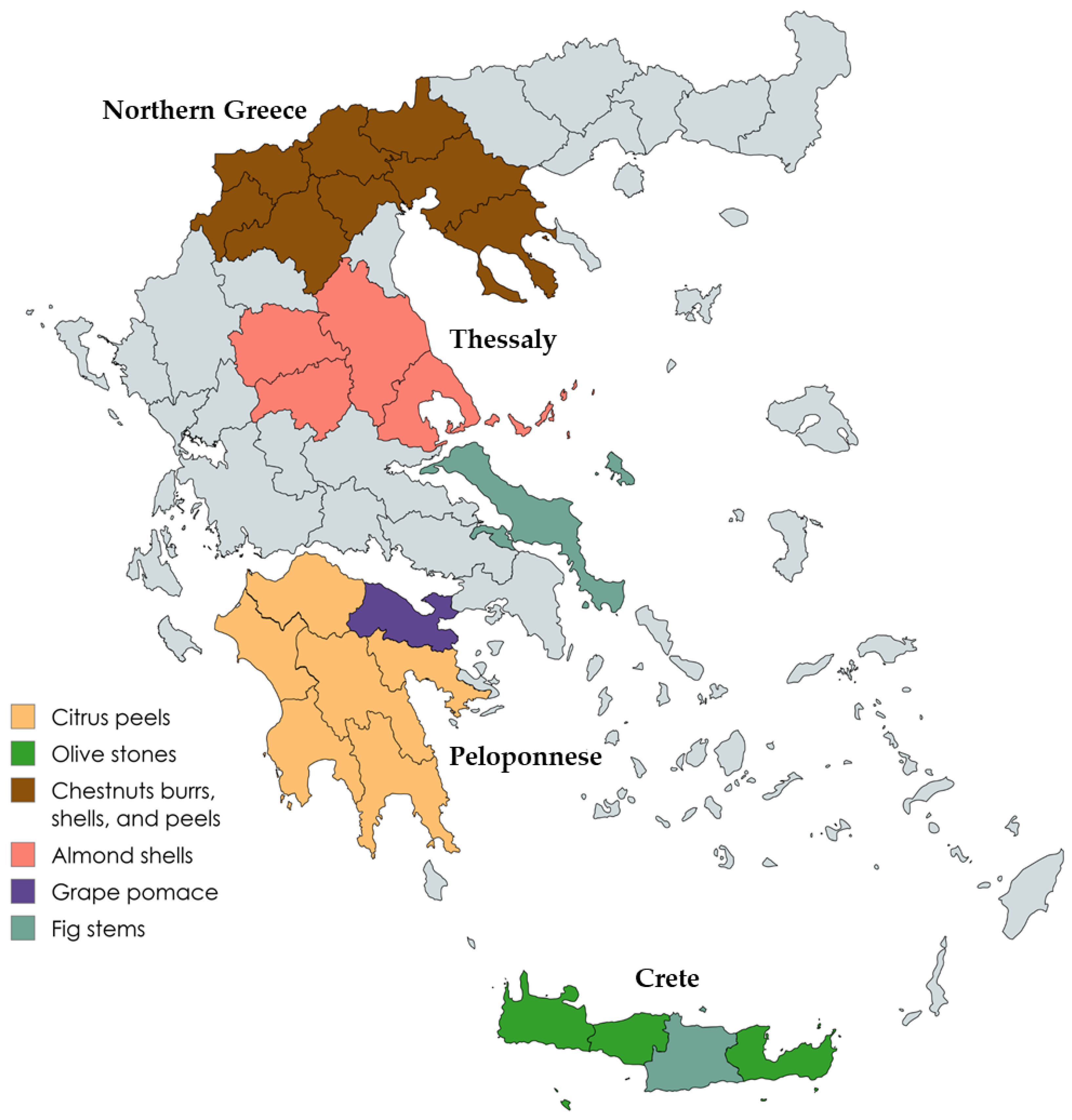
- Regional biomass mapping: distribution of Greek agricultural residues.
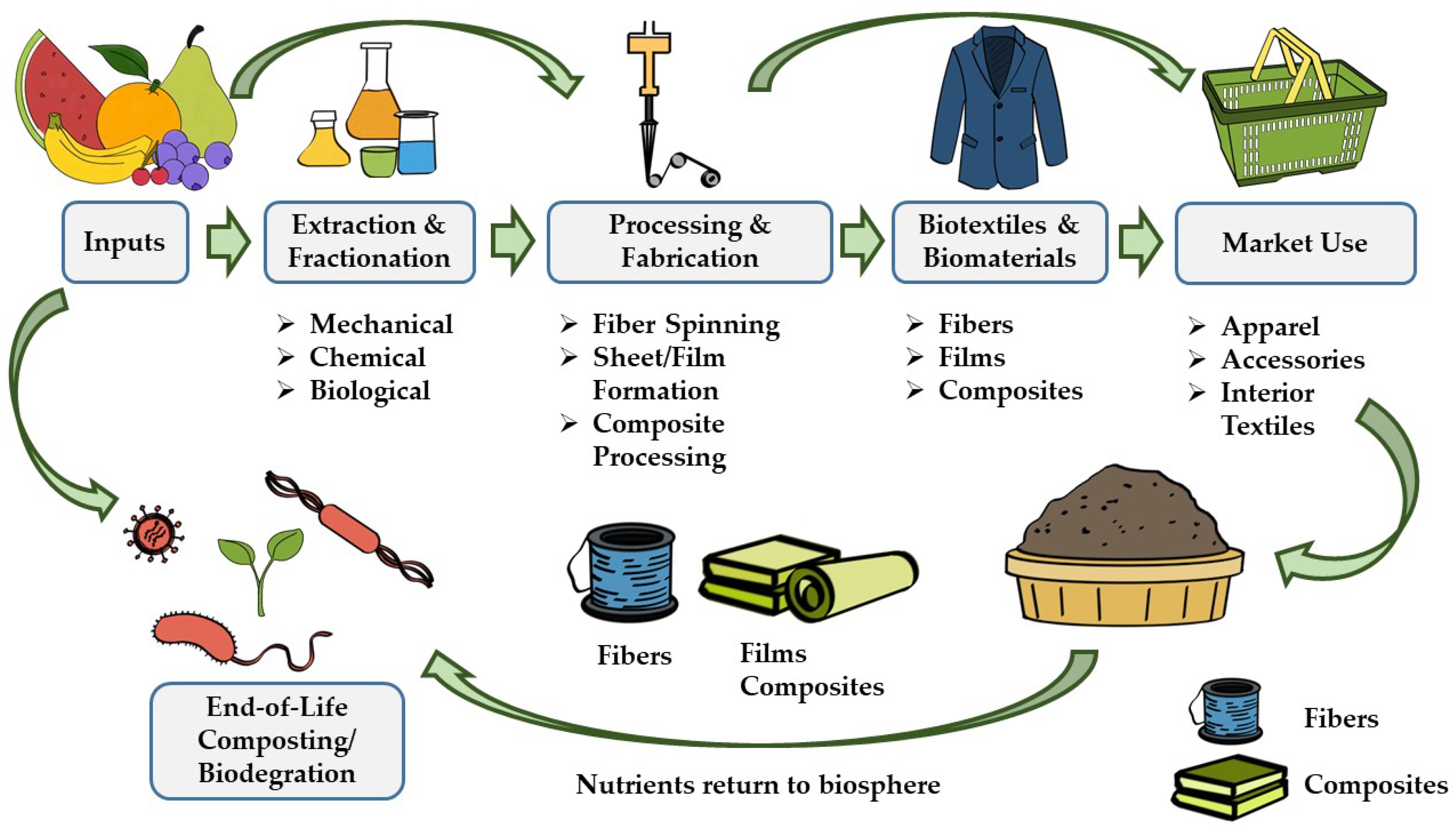
- Circular bioeconomy systems approach: cascading biomass utilization and end-of-life pathways.
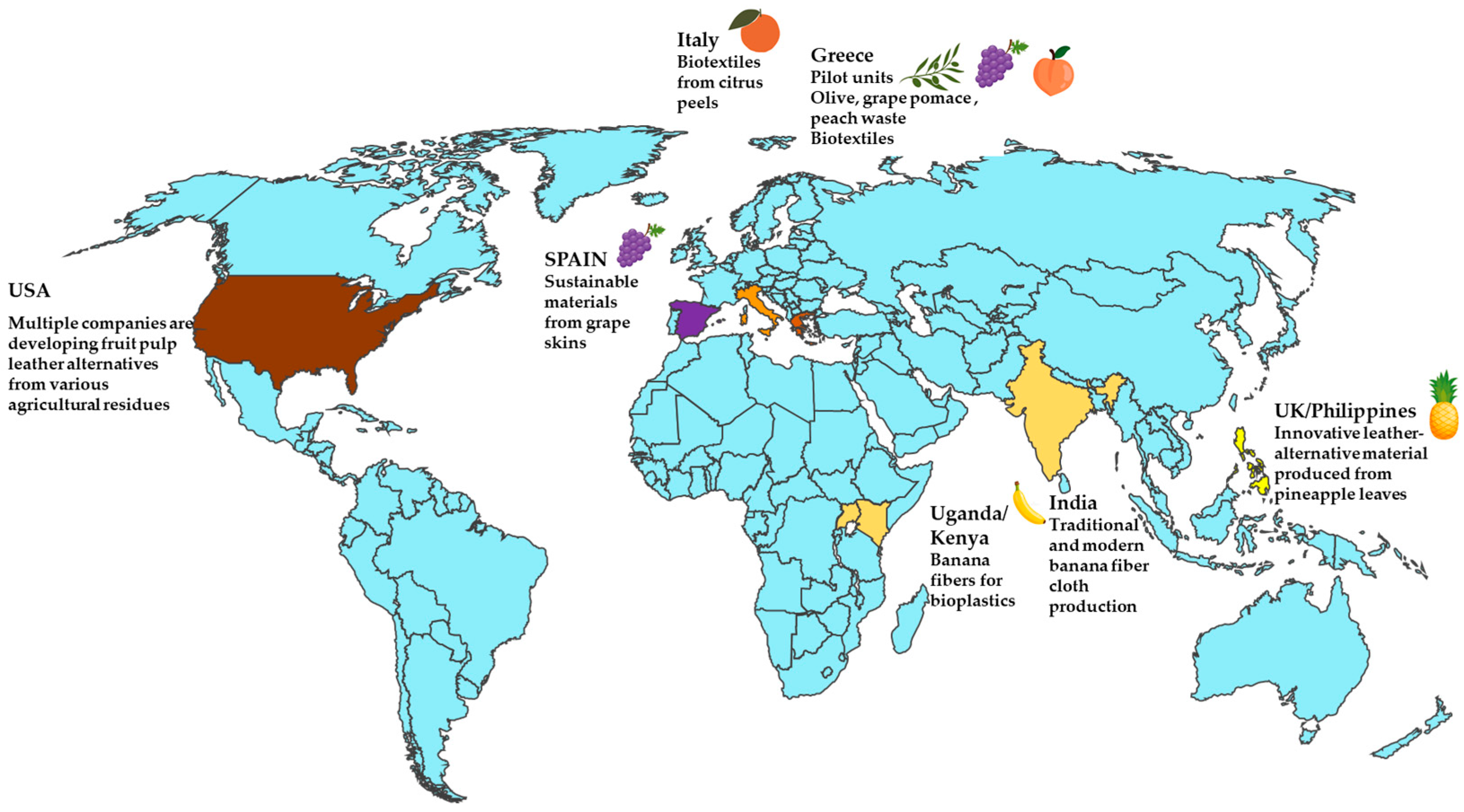
3. Global and Greek Context of Fruit and Nut Agricultural Residues
4. Protocols, Techniques, and Technologies for Biomaterial and Biotextile Creation
4.1. Raw Material Preprocessing
4.2. Fiber and Polymer Isolation
4.3. Conversion to Biotextiles
4.4. Textile Properties Enhancement
4.5. Research Gaps and Technological Bottlenecks
5. Economic Impact Assessment and Market Opportunities
5.1. Cost and Value Chain Integration
5.2. Global Market Trends
5.3. Potential for Greece
6. Environmental Sustainability and LCA
6.1. Water Footprint Reduction
6.2. Greenhouse Gas Emissions and Energy Demand
6.3. Land Use and Circular Resource Efficiency
6.4. End-of-Life Performance and Biodegradability
7. Internet of Things (IoT) Market Overview and Relevance to Biomaterials
7.1. Global IoT Market Trends
7.2. Relevance of IoT to Biomaterials and Biotextiles
8. Acceptability of Environmentally Friendly Materials
9. Policy Recommendations and Strategic Roadmap for Greece
9.1. Incentivizing Circular Bioeconomy Hubs
9.2. Regulatory and R&D Support
9.3. Farmer and Cooperative Engagement
10. Conclusions
11. Limitations
12. Future Research Directions
Author Contributions
Funding
Data Availability Statement
Acknowledgments
Conflicts of Interest
Abbreviations
| AI | Artificial Intelligence |
| AGPHF | Advanced Graph-Physics Hybrid Framework |
| CAGR | Compound Annual Growth Rate |
| CBE JU | Circular Bio-based Europe Joint Undertaking |
| CC BY | Creative Commons Attribution license |
| CO2 | Carbon Dioxide |
| CO2-eq | Carbon Dioxide Equivalent |
| EoL | End-of-Life |
| EU | European Union |
| GHG | Greenhouse Gas |
| ICT | Information and Communication Technologies |
| IIoT | Industrial Internet of Things |
| IoT | Internet of Things |
| ISO | International Organization for Standardization |
| LCA | Life Cycle Assessment |
| LCI | Life Cycle Inventory |
| MFA | Material Flow Analysis |
| ML | Machine Learning |
| NSRF | National Strategic Reference Framework |
| OWML | Open World Machine Learning |
| PBS | Polybutylene Succinate |
| PHA | Polyhydroxyalkanoate |
| PLA | Polylactic Acid |
| SME | Small and Medium-sized Enterprise |
| UNIDO | United Nations Industrial Development Organization |
| USD | United States Dollar |
| UV | Ultraviolet |
References
- European Environment Agency. Textiles and the Environment: The Role of Design in a Circular Economy; EEA: Copenhagen, Denmark, 2022; Available online: https://www.eea.europa.eu/en/analysis/publications/textiles-and-the-environment-the-role-of-design-in-europes-circular-economy-1 (accessed on 10 January 2026).
- McKinsey&Company. Fashion on Climate: How the Fashion Industry Can Urgently Act to Reduce Its Greenhouse Gas Emissions. Available online: https://www.mckinsey.com/featured-insights/mckinsey-live/webinars/sustainable-fashion-how-the-fashion-industry-can-urgently-act-to-reduce-its-greenhouse-gas-emission (accessed on 10 April 2026).
- Ellen MacArthur Foundation. A New Textiles Economy: Redesigning Fashion’s Future. Available online: https://www.ellenmacarthurfoundation.org/a-new-textiles-economy (accessed on 10 April 2026).
- Sillanpää, M.; Ncibi, C. The Circular Economy: Case Studies About the Transition from the Linear Economy; Academic Press: Cambridge, MA, USA, 2019. [Google Scholar] [CrossRef] [Scilit]
- FAO. Agricultural Waste Management; Food and Agriculture Organization of the United Nations: Rome, Italy, 2021; Available online: https://www.fao.org/sustainable-development-goals/indicators/1231/en/ (accessed on 10 January 2026).
- Bhardwaj, A.K.; Thakur, B.; Tripathi, S.K.; Turabayev, M.E.; Aljulaih, A.A.; Kharlamova, T.S.; Kulinich, S.A. Recent Advances in Valorizing Agricultural Waste: A Sustainable Approach. Waste Biomass Valor. 2025. [Google Scholar] [CrossRef] [Scilit]
- Ellen MacArthur Foundation. Completing the Picture: How the Circular Economy Tackles Climate Change; EMF: Cowes, UK, 2021; Available online: https://www.ellenmacarthurfoundation.org/completing-the-picture (accessed on 10 December 2025).
- Allied Market Research. Biomaterials Market Size, Share & Trends Analysis Report by Material, Application, and Region—Global Opportunity Analysis and Industry Forecast, 2021–2030; Allied Market Research: Portland, OR, USA; Available online: https://www.alliedmarketresearch.com/biomaterials-market (accessed on 10 April 2026).
- Siqueira, M.U.; Contin, B.; Fernandes, P.R.B.; Ruschel-Soares, R.; Baruque-Ramos, J. Brazilian agro-industrial wastes as potential textile and other raw materials. Mater. Circ. Econ. 2022, 4, 9. [Google Scholar] [CrossRef] [Scilit]
- Hildebrandt, J.; Thrän, D.; Bezama, A. The circularity of potential bio-textile production routes: Comparing life cycle impacts of bio-based materials used within the manufacturing of selected leather substitutes. J. Clean. Prod. 2021, 287, 125470. [Google Scholar] [CrossRef] [Scilit]
- Sholokhova, A.; Varžinskas, V.; Rutkaitė, R. Valorization of agro-waste in bio-based and biodegradable polymer composites: A European perspective. Waste Biomass Valor. 2025, 16, 1537–1571. [Google Scholar] [CrossRef] [Scilit]
- Orange Fiber S.r.l. Citrus-Based Sustainable Textiles; Orange Fiber S.r.l.: Catania, Italy, 2020. [Google Scholar]
- Taymaz, E.R.; Uslu, M.E. Innovations in biocompatible materials: Exploring the potential of cellulose nanocrystals from grape pomace. Chem. Pap. 2024, 78, 5445–5455. [Google Scholar] [CrossRef] [Scilit]
- Waithaka, A.; Plakantonaki, S.; Kiskira, K.; Mburu, A.W.; Chronis, I.; Zakynthinos, G.; Githaiga, J.; Priniotakis, G. Cellulose-Based Biopolymers from Banana Pseudostem Waste: Innovations for Sustainable Bioplastics. Waste 2025, 3, 37. [Google Scholar] [CrossRef] [Scilit]
- Dantas, M.P.; Oliveira, C.R.S.; Yamaguchi, N.U.; Júnior, A.H.d.S.; Peralta, R.M.; Bracht, A.; Corrêa, R.C.G. Pathways in agro-industrial waste upcycling for sustainable textiles. Plants 2025, 14, 3574. [Google Scholar] [CrossRef] [Scilit]
- Silva, S.B.; Freitas, O.M.; Vieira, E.F.; Delerue-Matos, C.; Domingues, V.F. A comprehensive review on valorization of chestnut processing wastes into bio-based composites and bioplastics. Polym. Compos. 2025, 46, 7838–7857. [Google Scholar] [CrossRef] [Scilit]
- Carnaval, L.S.C.; Jaiswal, A.K.; Jaiswal, S. Agro-Food Waste Valorization for Sustainable Bio-Based Packaging. J. Compos. Sci. 2024, 8, 41. [Google Scholar] [CrossRef] [Scilit]
- Plakantonaki, S.; Zacharopoulos, N.; Christopoulos, M.; Kiskira, K.; Markou, G.; Tsakanika, L.-A.; Priniotakis, G. Upcycling industrial peach waste to produce dissolving pulp. Environ. Sci. Pollut. Res. 2025, 32, 4636–4655. [Google Scholar] [CrossRef] [Scilit] [PubMed]
- Baseri, S. Management of agricultural waste in green multifunctional finishing of wool yarns using ultrasonic environment. Fibers Polym. 2025, 26, 5159–5172. [Google Scholar] [CrossRef] [Scilit]
- Choudhury, A.K.R. Sustainable and Nonconventional Textiles; Springer: Singapore, 2020. [Google Scholar]
- Walawska, A.; Olak-Kucharczyk, M.; Kaczmarek, A.; Kudzin, M.H. Environmentally friendly bleaching process of the cellulose fibres materials using ozone and hydrogen peroxide in the gas phase. Materials 2024, 17, 1355. [Google Scholar] [CrossRef] [Scilit]
- European Commission. A New Circular Economy Action Plan; EC: Brussels, Belgium, 2020; Available online: https://eur-lex.europa.eu/legal-content/EN/TXT/HTML/?uri=CELEX:52020DC0098 (accessed on 15 January 2026).
- European Environment Agency. Bio-Waste in Europe; EEA: Copenhagen, Denmark, 2021; Available online: https://www.eea.europa.eu/en/analysis/publications/bio-waste-in-europe (accessed on 15 January 2026).
- Food and Agriculture Organization of the United Nations (FAO). Agricultural Production Statistics 2010–2023: FAOSTAT Analytical Brief No. 96. Rome, Italy, 2024. Available online: https://openknowledge.fao.org/items/ab36b259-d641-4ded-8832-32f579685be7 (accessed on 17 January 2026).
- MapChart Platform. Available online: https://www.mapchart.net/ (accessed on 15 January 2026).
- Plakantonaki, S.; Kiskira, K.; Zacharopoulos, N.; Belessi, V.; Sfyroera, E.; Priniotakis, G.; Athanasekou, C. Investigating the routes to produce cellulose fibers from agro-waste: An upcycling process. ChemEngineering 2024, 8, 112. [Google Scholar] [CrossRef] [Scilit]
- Kiskira, K.; Plakantonaki, S.; Gerolimos, N.; Kalkanis, K.; Sfyroera, E.; Coelho, F.; Priniotakis, G. Life Cycle Optimization of Circular Industrial Processes: Advances in By-Product Recovery for Renewable Energy Applications. Clean Technol. 2026, 8, 5. [Google Scholar] [CrossRef] [Scilit]
- Plakantonaki, S.; Stergiou, M.; Panagiotatos, G.; Kiskira, K.; Priniotakis, G. Regenerated Cellulosic Fibers from Agricultural Waste. AIP Conf. Proc. 2022, 2430, 080006. [Google Scholar] [CrossRef] [Scilit]
- Blasi, A.; Verardi, A.; Lopresto, C.G.; Siciliano, S.; Sangiorgio, P. Lignocellulosic Agricultural Waste Valorization to Obtain Valuable Products: An Overview. Recycling 2023, 8, 61. [Google Scholar] [CrossRef] [Scilit]
- Kiskira, K.; Gerolimos, N.; Priniotakis, G.; Nikolopoulos, D. Life-Cycle Assessment of Innovative Industrial Processes for Photovoltaic Production: Process-Level LCIs, Scale-Up Dynamics, and Recycling Implications. Appl. Sci. 2026, 16, 501. [Google Scholar] [CrossRef] [Scilit]
- Makaveckas, T.; Šimonėlienė, A.; Šipailaitė-Ramoškienė, V. Lignin Valorization from Lignocellulosic Biomass: Extraction, Depolymerization, and Applications in the Circular Bioeconomy. Sustainability 2025, 17, 9913. [Google Scholar] [CrossRef] [Scilit]
- Matei, E.; Râpă, M.; Predescu, A.M.; Turcanu, A.A.; Vidu, R.; Predescu, C.; Bobirica, C.; Bobirica, L.; Orbeci, C. Valorization of agri-food wastes as sustainable eco-materials for wastewater treatment: Current state and new perspectives. Materials 2021, 14, 4581. [Google Scholar] [CrossRef] [Scilit]
- Castagna, A.; Aboudia, A.; Guendouz, A.; Scieuzo, C.; Falabella, P.; Matthes, J.; Schmid, M.; Drissner, D.; Allais, F.; Chadni, M.; et al. Transforming agricultural waste from Mediterranean fruits into renewable materials and products with a circular and digital approach. Materials 2025, 18, 1464. [Google Scholar] [CrossRef] [Scilit]
- Kiskira, K.; Lalopoulou, A.; Kalkanis, K.; Vokas, G. Closing the Loop on Solar: A Sustainability Assessment of Photovoltaic Recycling in Greece. Energies 2025, 18, 6314. [Google Scholar] [CrossRef] [Scilit]
- Tu, H.; Zhu, M.; Duan, B.; Zhang, L. Recent progress in high-strength and robust regenerated cellulose materials. Adv. Mater. 2021, 33, 2000682. [Google Scholar] [CrossRef] [Scilit]
- Popa, V.I. Pulp Production and Processing: High-Tech Applications; Walter de Gruyter GmbH & Co. KG: Berlin, Germany, 2020. [Google Scholar]
- Xiang, T.; Yang, R.; Li, L.; Lin, H.; Kai, G. Research progress and application of pectin: A review. J. Food Sci. 2024, 89, 6985–7007. [Google Scholar] [CrossRef] [Scilit]
- Spizzirri, U.G. (Ed.) Nutraceutics from Agri-Food By-Products; John Wiley & Sons: Hoboken, NJ, USA, 2023. [Google Scholar]
- Statista. Internet of Things (IoT)—Worldwide. Available online: https://www.statista.com/outlook/tmo/internet-of-things/worldwide (accessed on 17 January 2026).
- Kalkanis, K.; Kiskira, K.; Papageorgas, P.; Kaminaris, S.D.; Piromalis, D.; Banis, G.; Mpelesis, D.; Batagiannis, A. Advanced manufacturing design of an emergency mechanical ventilator via 3D printing—Effective crisis response. Sustainability 2023, 15, 2857. [Google Scholar] [CrossRef] [Scilit]
- Liu, K.; Du, H.; Xu, T.; Xiang, H.; Si, C. Cellulosic Fibers for Sustainable Functional Textiles and Devices. Adv. Fiber Mater. 2026. [Google Scholar] [CrossRef] [Scilit]
- Azimi, B.; Maleki, H.; Gigante, V.; Bagherzadeh, R.; Mezzetta, A.; Milazzo, M.; Guazzelli, L.; Cinelli, P.; Lazzeri, A.; Danti, S. Cellulose-Based Fiber Spinning Processes Using Ionic Liquids. Cellulose 2022, 29, 3079–3129. [Google Scholar] [CrossRef] [Scilit]
- Jayaprakash, K.; Osama, A.; Rajagopal, R.; Goyette, B.; Karthikeyan, O.P. Agriculture Waste Biomass Repurposed into Natural Fibers: A Circular Bioeconomy Perspective. Bioengineering 2022, 9, 296. [Google Scholar] [CrossRef] [Scilit] [PubMed]
- Fortune Business Insights. Internet of Things (IoT) Market Size, Share & COVID-19 Impact Analysis. Available online: https://www.fortunebusinessinsights.com/industry-reports/internet-of-things-iot-market-100307 (accessed on 10 January 2026).
- Janowicz, M.; Galus, S.; Ciurzyńska, A.; Nowacka, M. The Potential of Edible Films, Sheets, and Coatings Based on Fruits and Vegetables in the Context of Sustainable Food Packaging Development. Polymers 2023, 15, 4231. [Google Scholar] [CrossRef] [Scilit]
- Kalkanis, K.; Vokas, G.; Kiskira, K.; Psomopoulos, C.S. Investigating the sustainability of wind turbine recycling: A case study—Greece. Mater. Circ. Econ. 2024, 6, 52. [Google Scholar] [CrossRef] [Scilit]
- Maurya, A.K.; de Souza, F.M.; Dawsey, T.; Gupta, R.K. Biodegradable Polymers and Composites: Recent Development and Challenges. Polym. Compos. 2024, 45, 2896–2918. [Google Scholar] [CrossRef] [Scilit]
- da Silva Fernandes, F.A.; Serra, J.C.V.; de Oliveira Costa, D.d.S.; Martin, C.A.G. Production of Biodegradable Polymeric Composites with the Addition ofWaste. Materials 2023, 16, 6305. [Google Scholar] [CrossRef] [Scilit]
- Amiandamhen, S.O.; Meincken, M.; Tyhoda, L. Natural Fibre Modification and Its Influence on Fibre–Matrix Interfacial Properties in Biocomposite Materials. Fibers Polym. 2020, 21, 677–689. [Google Scholar] [CrossRef] [Scilit]
- Ramachandran, A.; Rangappa, S.M.; Kushvaha, V.; Khan, A.; Seingchin, S.; Dhakal, H.N. Modification of Fibers and Matrices in Natural Fiber Reinforced Polymer Composites: A Comprehensive Review. Macromol. Rapid Commun. 2022, 43, 2100862. [Google Scholar] [CrossRef] [Scilit]
- Md Nor, S.S.; Abdul Patah, M.F.; Mat Salleh, M. Surface Modification of Bio-Based Composites via Silane Treatment: A Short Review. J. Adhes. Sci. Technol. 2023, 37, 801–816. [Google Scholar] [CrossRef] [Scilit]
- Suriani, M.J.; Ilyas, R.A.; Zuhri, M.Y.M.; Khalina, A.; Sultan, M.T.H.; Sapuan, S.M.; Ruzaidi, C.M.; Wan, F.N.; Zulkifli, F.; Harussani, M.M.; et al. Critical Review of Natural Fiber Reinforced Hybrid Composites: Processing, Properties, Applications and Cost. Polymers 2021, 13, 3514. [Google Scholar] [CrossRef] [Scilit]
- Suresh, S.; Sudhakara, D.; Vinod, B. Investigation on Industrial Waste Eco-Friendly Natural Fiber-Reinforced Polymer Composites. J. Bio Tribo-Corros. 2020, 6, 40. [Google Scholar] [CrossRef] [Scilit]
- Pamakštys, K.; Sholokhova, A.; Gurauskienė, I.; Varžinskas, V. Environmental Assessment Strategies for Biodegradable Polymer Composites: A Review of Life Cycle Perspectives on Agro-Waste Reinforced Materials. Polymers 2026, 18, 700. [Google Scholar] [CrossRef] [Scilit]
- Zare, A. Citric acid as environment-friendly crease-resistance finishing agent for silk fabric combined with β-cyclodextrin. Res. J. Text. Appar. 2022, 26, 238–254. [Google Scholar] [CrossRef] [Scilit]
- Sarwar, A.; Jabbar, A.; Riaz, S.; Malik, M.I. Enhancement in the dyeability of bamboo fabric by using an isocyanate-based crosslinking agent. Cellulose 2024, 31, 6501–6516. [Google Scholar] [CrossRef] [Scilit]
- Olonisakin, K.; Mohanty, A.K.; Thimmanagari, M.; Misra, M. Recent advances in biodegradable polymer blends and their biocomposites: A comprehensive review. Green Chem. 2025, 27, 11656–11704. [Google Scholar] [CrossRef] [Scilit]
- European Commission. Circular Bio-Based Europe Joint Undertaking (CBE JU). Circular Bio-Based Europe Joint Undertaking (Factsheet/Overview); Horizon Europe: Brussels, Belgium, 2020; Available online: https://www.horizonteeuropa.es/sites/default/files/inline-files/Circular%20Bio-based%20Europe%20Joint%20Undertaking.pdf (accessed on 17 January 2026).
- Vogue Business. H&M Group Inks Multi-Year Deal with Circulose; Vogue Business: London, UK, 2025; Available online: https://www.vogue.com/article/handm-group-inks-multi-year-deal-with-circulose (accessed on 16 January 2026).
- Stella McCartney. Sustainability. Available online: https://www.stellamccartney.com/us/en/sustainability (accessed on 10 January 2026).
- The Guardian. G7 and Fashion Houses Join Forces to Make Clothes More Sustainable; The Guardian: London, UK, 2019; Available online: www.theguardian.com/world/2019/aug/21/fashion-g7-summit-sustainability-kering-inditex-macron (accessed on 17 January 2026).
- H&M Group. Annual and Sustainability Report 2024; H&M Group: Stockholm, Sweden, 2025; Available online: https://hmgroup.com/wp-content/uploads/2025/03/HM-Group-Annual-and-sustainability-report-2024.pdf (accessed on 20 January 2026).
- ISO 14040; Environmental Management—Life Cycle Assessment—Principles and Framework, Requirements and Guidelines. International Organization for Standardization: Geneva, Switzerland, 2006.
- Almeida, P.V.; Déda, D.; Gervásio, H.; Gando-Ferreira, L.M.; Quina, M.J. Life cycle assessment and eco-efficiency of biorefineries and conventional management strategies for agro-industrial residues. J. Clean. Prod. 2025, 517, 145895. [Google Scholar] [CrossRef] [Scilit]
- Kiskira, K.; Kalkanis, K.; Coelho, F.; Plakantonaki, S.; D’Onofrio, C.; Psomopoulos, C.S.; Priniotakis, G.; Ioannidis, G.C. Life cycle assessment of organic solar cells: Structure, analytical framework, and future product concepts. Electronics 2025, 14, 2426. [Google Scholar] [CrossRef] [Scilit]
- Roy, M.; Majumdar, A.; Ghasemi, P.; Sheikh, W.; Ali, S.M. Investigating the Environmental Losses in the Textile Industry of an Emerging Economy: Implications for a Sustainable and Circular Economy. Comput. Ind. Eng. 2025, 209, 111353. [Google Scholar] [CrossRef] [Scilit]
- Water Footprint Network. Water Footprint of Cotton. Available online: https://waterfootprint.org/en/water-footprint/product-water-footprint/water-footprint-cotton/ (accessed on 5 January 2026).
- Mikucionienė, D.; Mínguez-García, D.; Repon, M.R.; Milašius, R.; Priniotakis, G.; Chronis, I.; Kiskira, K.; Hogeboom, R.; Belda-Anaya, R.; Díaz-García, P. Understanding and addressing the water footprint in the textile sector: A review. AUTEX Res. J. 2024, 24, 20240004. [Google Scholar] [CrossRef] [Scilit]
- European Bioplastics. Bioplastics Facts and Figures. Available online: https://www.european-bioplastics.org/bioplastics/materials/ (accessed on 10 December 2025).
- Rana, P.; Sethi, S. Utilising agro-waste in textile industry: Advancing sustainability with a year-round waste cycle. Mater. Circ. Econ. 2025, 7, 30. [Google Scholar] [CrossRef] [Scilit]
- Hammar, T.; Peñaloza, D.; Hanning, A.-C. Life cycle assessment of a circular textile value chain: The case of a garment made from chemically recycled cotton. Int. J. Life Cycle Assess. 2024, 29, 1880–1898. [Google Scholar] [CrossRef] [Scilit]
- Burnstine, A.; Camargo, A. Bio-based textiles, circular innovation, and sustainability in emerging markets. Cloth. Cult. Body 2025, 12, 100194. [Google Scholar] [CrossRef] [Scilit]
- Parnell, K. Circular economy in the textile industry: A review of material value retention and waste avoidance strategies. Recycling 2025, 10, 225. [Google Scholar] [CrossRef] [Scilit]
- Zambrano, M.C.; Pawlak, J.J.; Daystar, J.; Ankeny, M.; Venditti, R.A. Microfibers generated from the laundering of cotton, rayon and polyester based fabrics and their aquatic biodegradation. Mar. Pollut. Bull. 2019, 142, 394–407. [Google Scholar] [CrossRef] [Scilit] [PubMed]
- De Falco, F.; Di Pace, E.; Cocca, M.; Avella, M. The contribution of washing processes of synthetic clothes to microplastic pollution. Sci. Rep. 2019, 9, 6633. [Google Scholar] [CrossRef] [Scilit]
- Shen, L.; Patel, M.K. Life cycle assessment of polysaccharide materials: A review. J. Polym. Environ. 2008, 16, 154–167. [Google Scholar] [CrossRef] [Scilit]
- Patel, M.; Bastioli, C.; Marini, L.; Würdinger, E. Life-Cycle Assessment of Bio-Based Polymers and Natural Fiber Composites. In Biopolymers Online; Steinbüchel, A., Ed.; Wiley-VCH: Weinheim, Germany, 2005. [Google Scholar] [CrossRef] [Scilit]
- Mestre, A.; Cooper, T. Circular product design: A multiple loops life cycle design approach for the circular economy. Des. J. 2017, 20, S1620–S1635. [Google Scholar] [CrossRef] [Scilit]
- Bourtsalas, A.C.; Papadatos, P.E.; Kiskira, K.; Kalkanis, K.; Psomopoulos, C.S. Ecodesign for industrial furnaces and ovens: A review of the current environmental legislation. Sustainability 2023, 15, 9436. [Google Scholar] [CrossRef] [Scilit]
- Kouhizadeh, M.; Sarkis, J.; Zhu, Q. At the nexus of blockchain technology, the circular economy, and product deletion. Appl. Sci. 2019, 9, 1712. [Google Scholar] [CrossRef] [Scilit]
- McKinsey Global Institute. The Internet of Things: Catching Up to an Accelerating Opportunity; McKinsey & Company: New York, NY, USA, 2023; Available online: https://www.mckinsey.com/capabilities/tech-and-ai/our-insights/the-internet-of-things (accessed on 19 January 2026).
- Digitalisation and Energy; IEA Publications: Paris, France, 2022; Available online: https://www.iea.org/reports/digitalisation-and-energy (accessed on 15 January 2026).
- Ramaiah, G.B. Theoretical Analysis on Application Aspects of Smart Materials and Internet of Things (IoT) in Textile Technology. Mater. Today Proc. 2021, 45, 4633–4638. [Google Scholar] [CrossRef] [Scilit]
- Khan, M.; Parvaiz, G.S.; Dedahanov, A.T.; Abdurazzakov, O.S.; Rakhmonov, D.A. The Impact of Technologies of Traceability and Transparency in Supply Chains. Sustainability 2022, 14, 16336. [Google Scholar] [CrossRef] [Scilit]
- Gerolimos, N.; Alevizos, V.; Edralin, S.; Xu, C.; Priniotakis, G.; Papakostas, G.A.; Yue, Z. Autonomous Decision-Making Enhancing Natural Disaster Management through Open World Machine Learning: A Systematic Review. Hum.-Centered Intell. Syst. 2025, 5, 269–284. [Google Scholar] [CrossRef] [Scilit]
- Atalla, S.; Tarapiah, S.; Gawanmeh, A.; Daradkeh, M.; Mukhtar, H.; Himeur, Y.; Mansoor, W.; Hashim, K.F.B.; Daadoo, M. IoT-Enabled Precision Agriculture: Developing an Ecosystem for Optimized Crop Management. Information 2023, 14, 205. [Google Scholar] [CrossRef] [Scilit]
- Lombardi, P.; Todella, E. Multi-Criteria Decision Analysis to Evaluate Sustainability and Circularity in Agricultural Waste Management. Sustainability 2023, 15, 14878. [Google Scholar] [CrossRef] [Scilit]
- Chaudhary, S.; Juneja, S. Survey on Consumer Preference of Sustainable Textiles and Fashion. Int. J. Res. Appl. Sci. Eng. Technol. 2024, 12, 675–685. [Google Scholar] [CrossRef] [Scilit]
- Sigaard, A.S.; Laitala, K. Natural and Sustainable? Consumers’ Textile Fiber Preferences. Fibers 2023, 11, 12. [Google Scholar] [CrossRef] [Scilit]
- Li, M.; Choe, Y.H.; Gu, C. How perceived sustainability influences consumers’ clothing preferences. Sci. Rep. 2024, 14, 28672. [Google Scholar] [CrossRef] [Scilit]
- Survey: Consumer Sentiment on Sustainability in Fashion. McKinsey Insights. 2020. Available online: https://www.mckinsey.com/industries/retail/our-insights/survey-consumer-sentiment-on-sustainability-in-fashion (accessed on 3 January 2026).
- Erzen, B.; Karataş, M.; Orhan, R.; Aydoğmuş, E. Advancements and challenges in biomaterials: Innovations, sustainability, and future prospects. J. Macromol. Sci. Part B 2025, 1–27. [Google Scholar] [CrossRef] [Scilit]
- Lindenwood University. Sustainable Fashion: Exploring Eco-Friendly Practices in the Industry. 2024. Available online: https://online.lindenwood.edu/blog/sustainable-fashion-exploring-eco-friendly-practices-in-the-industry/ (accessed on 4 January 2026).
- 4Ocean. Sustainable Fashion: Innovations in Eco-Friendly Textiles. 2024. Available online: https://www.4ocean.com/blogs/industry-news/sustainable-fashion-innovations-in-eco-friendly-textiles (accessed on 19 January 2026).
- Plakantonaki, S.; Kiskira, K.; Zacharopoulos, N.; Chronis, I.; Coelho, F.; Togiani, A.; Kalkanis, K.; Priniotakis, G. A review of sustainability standards and ecolabeling in the textile industry. Sustainability 2023, 15, 11589. [Google Scholar] [CrossRef] [Scilit]
- European Commission. Regional Policy. Available online: https://ec.europa.eu/regional_policy/index_en.cfm (accessed on 19 January 2026).
- European Structural and Investment Funds (ESIF). NSRF 2014–2020. Available online: https://www.espa.gr/en/Pages/default.aspx (accessed on 14 January 2026).
- European Commission. SME Policy. Available online: https://single-market-economy.ec.europa.eu/smes_en (accessed on 19 January 2026).
- European Commission. Research and Innovation. Available online: https://ec.europa.eu/info/research-and-innovation_en (accessed on 19 January 2026).
- Psomopoulos, C.S.; Kalkanis, K.; Chatzistamou, E.D.; Kiskira, K.; Ioannidis, G.C.; Kaminaris, S.D. End of Life Treatment of Photovoltaic Panels: Expected Volumes up to 2045 in the EU. AIP Conf. Proc. 2022, 2437, 020084. [Google Scholar] [CrossRef] [Scilit]
- European Network for Rural Development (ENRD). Co-Operatives. Available online: https://enrd.ec.europa.eu/thematic-work/smart-and-competitive-rural-areas/co-operatives_en (accessed on 19 January 2026).
- de Priall, O.; Gogulancea, V.; Brandoni, C.; Hewitt, N.; Johnston, C.; Onofrei, G.; Huang, Y. Modelling and experimental investigation of small-scale gasification CHP units for enhancing the use of local biowaste. Waste Manag. 2021, 136, 174–183. [Google Scholar] [CrossRef] [Scilit]
- Mehdizadeh, M.; Omidi, A.; Matindike, R.; Nigussie, Z.G.; Ikegwu, T.M.; Agu, H.O.; Onen, P.; Gumula, I.; Ezzat, S.M.; Merghany, R.M. Agri-waste valorization: Pathways to sustainable bioenergy and biochemical innovation. Circ. Econ. Sustain. 2025, 5, 5247–5277. [Google Scholar] [CrossRef] [Scilit]



| Data Category | Source Type |
|---|---|
| Agricultural production volumes | FAOSTAT, national statistics |
| Residue characteristics & composition | Peer-reviewed literature |
| Biomaterial processing routes | Peer-reviewed scientific literature |
| Environmental performance (LCA) | Published LCA research |
| Market forecasts | Statista, Fortune Business Insights |
| Policy framework | EU Circular Economy Action Plan, CBE JU |
| Crop | Region | Production (tons) | Residues (tons) |
|---|---|---|---|
| Olives | Crete | 1,100,000 | 250,000 |
| Grapes | Peloponnese | 720,000 | 180,000 |
| Citrus | Peloponnese | 420,000 | 130,000 |
| Almonds | Thessaly | 85,000 | 25,000 |
| Figs | Evia, Crete | 70,000 | 20,000 |
| Chestnuts | Northern Greece | 30,000 | 8000 |
| Total (Greece) | 2,425,000 | 613,000 | |
| Biomass Type | Main Polymer Target | Pretreatment Route | Typical Yield (%) | Reported TRL | LCA Advantage | Representative Sources |
|---|---|---|---|---|---|---|
| Grape pomace | Cellulose/polyphenols | Alkaline pulping + bleaching | 35–50 | 4–6 | 70–80% lower GHG vs. polyester | [13,15] |
| Citrus peels | Cellulose/pectin | Acid extraction + pulping | 30–45 | 6–8 | 80–95% lower water use vs. cotton | [12,37] |
| Olive pomace | Cellulose/lignin | Organosolv/alkaline | 25–40 | 3–5 | Reduced land-use intensity due to secondary biomass sourcing | [28,36] |
| Nut shells | Lignin/reinforcement fibers | Mechanical + alkaline treatment | 20–35 | 4–6 | Lower embodied energy in composite applications | [6,16,45] |
| Banana pseudostem | Cellulose fibers | Mechanical + enzymatic extraction | 40–60 | 5–7 | Reduced cumulative energy demand compared with synthetic fibers | [14,26] |
| Peach processing waste (pomace & peel) | Dissolving-grade cellulose | NaOH + organic acids + H2O2 bleaching | 9.7–12.3 | 4–5 | Avoided upstream cultivation burden; waste valorization benefit | [18] |
| Indicator | Polyester | Cotton | Biotextile |
|---|---|---|---|
| Water Use (L/kg) | ~60 | ~10,000 | ~500 |
| CO2 Emissions (kg) | ~9.5 | ~5.4 | ~1.6 |
| Land Use (m2/kg) | ~0.3 | ~2.6 | ~0.1 |
| Biodegradability | No | Yes | Yes |
| Source | Year | Market Size (USD Billion) |
|---|---|---|
| Statista | 2025 | 1060 |
| Statista (Projected) | 2029 | 1560 |
| Fortune Business Insights | 2023 | 595.73 |
| Fortune Business Insights (Projected) | 2024 | 714.48 |
| Fortune Business Insights (Projected) | 2032 | 4062.34 |
Disclaimer/Publisher’s Note: The statements, opinions and data contained in all publications are solely those of the individual author(s) and contributor(s) and not of MDPI and/or the editor(s). MDPI and/or the editor(s) disclaim responsibility for any injury to people or property resulting from any ideas, methods, instructions or products referred to in the content. |
© 2026 by the authors. Licensee MDPI, Basel, Switzerland. This article is an open access article distributed under the terms and conditions of the Creative Commons Attribution (CC BY) license.
Share and Cite
Kiskira, K.; Plakantonaki, S.; Nikolopoulos, D.; Sfyroera, E.; Gerolimos, N.; Priniotakis, G.; Zakynthinos, G. Valorization of Fruit and Nut Agricultural Residues for Sustainable Biomaterials and Biotextiles: A Qualitative Review with Strategic Insights for Greece. Environments 2026, 13, 221. https://doi.org/10.3390/environments13040221
Kiskira K, Plakantonaki S, Nikolopoulos D, Sfyroera E, Gerolimos N, Priniotakis G, Zakynthinos G. Valorization of Fruit and Nut Agricultural Residues for Sustainable Biomaterials and Biotextiles: A Qualitative Review with Strategic Insights for Greece. Environments. 2026; 13(4):221. https://doi.org/10.3390/environments13040221
Chicago/Turabian StyleKiskira, Kyriaki, Sofia Plakantonaki, Dimitrios Nikolopoulos, Emmanouela Sfyroera, Nikitas Gerolimos, Georgios Priniotakis, and Georgios Zakynthinos. 2026. "Valorization of Fruit and Nut Agricultural Residues for Sustainable Biomaterials and Biotextiles: A Qualitative Review with Strategic Insights for Greece" Environments 13, no. 4: 221. https://doi.org/10.3390/environments13040221
APA StyleKiskira, K., Plakantonaki, S., Nikolopoulos, D., Sfyroera, E., Gerolimos, N., Priniotakis, G., & Zakynthinos, G. (2026). Valorization of Fruit and Nut Agricultural Residues for Sustainable Biomaterials and Biotextiles: A Qualitative Review with Strategic Insights for Greece. Environments, 13(4), 221. https://doi.org/10.3390/environments13040221