2.1. The Indonesian Context and Urban Importance of Surabaya
Indonesia is currently one of the largest producers of electronic waste in Southeast Asia [
33]. At the regulatory level, Indonesia lacks a comprehensive and specific law governing e-waste management. The general legislation addressing waste management is Law No.18 of 2008 on Waste Management, which does not explicitly regulate e-waste treatment. Nearly two decades after the enactment, roughly 25% to 40% of waste in Indonesia remains unmanaged [
34]. Although various programs and initiatives, such as the 3R (reduce, reuse, and recycle) framework, have become widely recognized within communities, weak enforcement and the absence of strict monitoring have undermined their effectiveness [
35,
36]. The situation also leaves households to rely heavily on informal recycling and private opportunities [
37].
Surabaya, the second-largest city in Indonesia, represents an important urban case for examining e-waste management behavior due to its large population, rapid economic growth, and proactive environmental policies. Yet research on household-level behavioral drivers of e-waste recycling in this city remains scarce [
13]. Most local studies have focused on technical or institutional aspects of waste management rather than micro-level psychological and behavioral factors. Furthermore, the municipal government has also initiated several waste management initiatives, including waste banks, recycling centers, and community-based waste sorting programs aimed at promoting household participation in waste reduction and recycling through behavior change. These initiatives are supported by the Surabaya Environmental Agency (
Dinas Lingkungan Hidup, DLH), which coordinates waste management programs, environmental education, and partnerships with private recycling actors.
A temporary waste disposal site or Tempat Penampungan Sementara (TPS) is the most reliable waste collection location for people in Indonesia. Unlike waste banks, which are community-based systems that offer incentives to encourage recycling participation through the collection of valuable waste, TPS functions as a temporary storage site where all unsorted mixed waste is dropped off in one place before being transported to a final landfill. In contrast, TPS-3R (reduce, reuse, and recycle) refers to waste processing facilities that focus on sorting and managing waste to generate economic value. Across the city, there are approximately 173 official TPS transfer points that function as neighborhood-level sorting and consolidation facilities before waste is transported to larger treatment sites. In addition, the municipal system includes around 190 TPS locations, among which 9 facilities operate as TPS-3R centers, where waste is sorted and partially processed for recycling [
38].
At the downstream level, residual waste from these collection points is transported to centralized facilities such as the Benowo landfill, the main disposal and waste-to-energy site in Surabaya. The city processes approximately 1600 tons of municipal waste per day, with a significant portion managed through waste-to-energy technology and recycling initiatives. Despite the presence of formal infrastructure, recycling activities in Surabaya remain strongly influenced by informal actors, including waste pickers and small-scale recyclers, who play a critical role in recovering recyclable materials from the waste stream [
39,
40].
Despite these initiatives, formal e-waste recycling infrastructure accessible to households remains limited. Unlike general recyclable waste that can be handled through community waste banks, e-waste requires specialized treatment due to the presence of hazardous materials. As a result, formal collection typically occurs through specific programs organized by government agencies, licensed waste management companies, or temporary collection initiatives conducted in collaboration with retailers and environmental organizations [
41,
42].
2.2. Theoretical Background and Hypotheses Development
This study employs the Theory of Planned Behavior (TPB) because of the importance of psychological factors in governing recycling behaviors. The Theory of Planned Behavior (TPB) is a widely used socio-psychological theory that explains social behavior [
33]. TPB is also the preferred framework for assessing influences on recycling behavior [
8]. Currently, only a few studies on consumer e-waste management behavior in Indonesia have employed a multi-theoretical approach [
43,
44,
45]. This indicates a lack of a behavioral model to explain both recycling intention and actual behavior, highlighting the need for further investigation in Indonesia.
These variables are selected based on their consistent relevance in e-waste studies and their importance for understanding household decision-making in contexts where recycling infrastructure is limited. By narrowing the scope to essential behavioral and situational factors, the model aims to offer clearer explanations and more practical insights for policymakers and urban waste managers. Existing studies show mixed findings regarding recycling cost and recycling convenience factors. For instance, Juliana et al. [
46] suggested that the cost of recycling significantly influences household recycling behavior in Malaysia, whereas Waheed et al. [
47] reported a negative effect on e-waste recycling behavior among UAE residents, noting that residents hold negative perceptions when the costs are high. For convenience, Khan et al. [
48] highlighted that the ease of convenience is a crucial contributor to recycling practices. Meanwhile, Waheed et al. [
47] found that the proper recycling facilities moderate the relationship between recycling intentions and behavior. The availability of nearby recycling facilities can motivate individuals to participate in e-waste recycling [
49].
The hypothesis development in this study is guided by several key theoretical interpretations that reflect both the TPB framework and the specific Indonesian context. These interpretations shape how each construct is expected to operate and inform the policy implications that follow. Four key theoretical interpretations guide the hypothesis development in this study. First, consequence awareness (CA) is interpreted as a foundational cognitive driver that may operate through dual pathways: directly by influencing behavior through internalized norms or habits and indirectly by shaping recycling intention [
50,
51]. This interpretation acknowledges that awareness may need to compensate for infrastructure deficits in contexts where structural supports are weak. Second, structural barriers, which are the cost of recycling (CR) and convenience of recycling (COR), are interpreted as conditional constraints whose influence depends on contextual conditions and prior participation. Among active recyclers who have already overcome initial barriers, these factors may show different patterns of significance for intention versus behavior [
25,
27].
Third, the intention–behavior relationship is interpreted as contextually variable, with the intention–behavior gap potentially widening in settings with significant structural barriers [
51,
52]. Among active recyclers, however, this gap may narrow as individuals have demonstrated the ability to translate motivation into action. Fourth, mediation pathways are interpreted differently, in which intention is expected to serve as a more effective mediator for psychological factors like awareness than for structural factors like cost and convenience, which may influence behavior through direct pathways that bypass conscious intention formation [
22]. These interpretations collectively inform the study’s hypotheses and shape expectations about which relationships will achieve statistical significance in the Indonesian context. Below, this study will elaborate on each aspect of the behavioral determinants of e-waste recycling before moving on to the methodology.
Consequence awareness refers to an individual’s cognitive recognition of the negative environmental, social, and health impacts associated with improper e-waste disposal [
52]. It represents the knowledge-based and ethical dimension of environmental responsibility. Higher awareness of environmental consequences has been consistently linked to stronger pro-environmental attitudes [
46].
In the realm of e-waste management, numerous studies report that individuals who are aware of the toxicity and environmental risks of electronic waste are more likely to express intentions to recycle. A study by Ramayah et al. [
23] found that environmental awareness significantly predicted recycling intention for electronic products. Similarly, Roy et al. [
5] confirmed that knowledge about hazardous components in e-waste increases households’ motivation to seek responsible disposal methods.
Nevertheless, awareness alone does not guarantee behavioral implementation. Several studies have observed what is known as the “awareness–action gap,” where individuals acknowledge the problem but fail to act accordingly [
50]. It is expected that consequence awareness could significantly affect students’ recycling intention toward e-waste. However, evidence on the role of awareness regarding the “awareness–action gap” requires further study to explore the role of consequence awareness on recycling behavior directly. The following hypotheses are formulated:
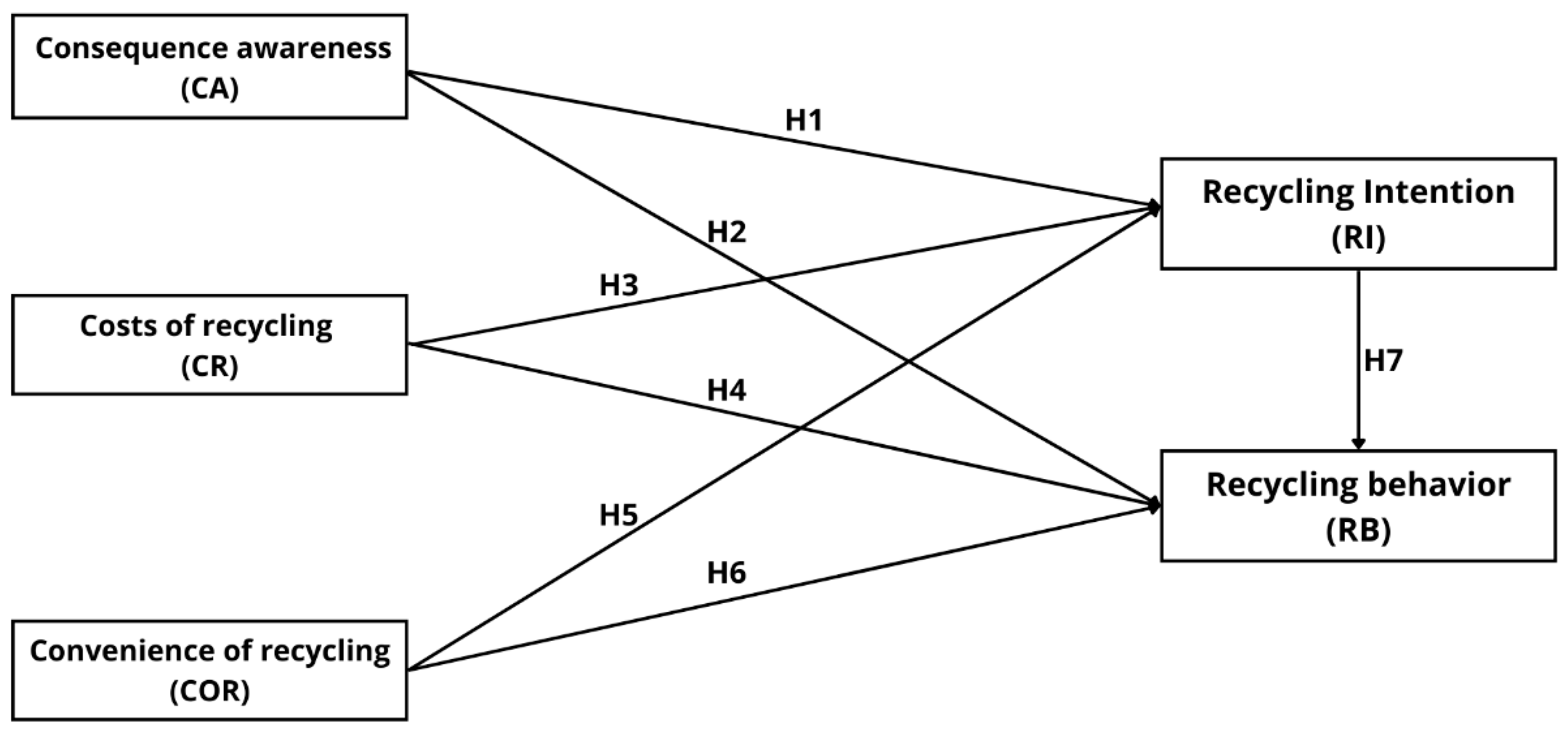
H1: Consequence awareness (CA) significantly influences recycling intention (RI).
H2: Consequence awareness (CA) significantly influences recycling behavior (RB).
- 2.
Cost of Recycling (CR)
Perceived cost refers to the perceived net economic costs or benefits associated with household e-waste disposal activities, as reflected in respondents’ own experiences and expectations. In e-waste recycling contexts, these perceived costs often act as a significant deterrent [
53].
Empirical findings indicate that households are less likely to participate in recycling when the perceived effort outweighs the perceived benefit. For instance, a study by Ahmad et al. [
27] found that transaction costs, such as travel distance to recycling centers and uncertainty about procedures, significantly reduce the probability of e-waste recycling behavior. Even when environmental concern is high, households may avoid recycling due to perceived inconvenience and inefficiency. These findings reinforce the need to minimize perceived cost in order to strengthen behavioral outcomes. Thus, with higher perceived costs, individuals would be less likely to recycle their e-waste. Hence, this study proposed the following hypotheses:
H3: Cost of recycling (CR) significantly influences recycling intention (RI).
H4: Cost of recycling (CR) significantly influences recycling behavior (RB).
- 3.
Convenience of Recycling (COR)
Convenience is regarded as one of the most powerful predictors of recycling behavior [
24]. In the context of e-waste, convenience refers to the accessibility, simplicity, and user-friendliness of disposal or recycling systems. Factors such as proximity of drop-off points, availability of collection services, and clarity of procedures play crucial roles in determining participation.
Several studies demonstrate that increased convenience significantly boosts recycling rates. For example, Zhang et al. [
52] found that households living within close proximity to collection facilities exhibited significantly higher recycling intention and behavior. Similarly, Nguyen et al. [
54] reported that the availability of scheduled pickup services dramatically increased the likelihood of household participation in formal e-waste recycling programs.
Convenience also interacts with awareness and cost. While a household may possess high environmental awareness, limited convenience can undermine the translation of intention into actual behavior. This makes convenience a potential leverage point for practical policy implementation. Therefore, it is predicted that recycling convenience could substantially influence recycling behavior. This proposition will be examined in this study through the hypotheses proposed below:
H5: Convenience of recycling (COR) significantly influences recycling intention (RI).
H6: Convenience of recycling (COR) significantly influences recycling behavior (RB).
- 4.
Recycling Intention and Recycling Behavior
Recycling intention refers to the motivational readiness of an individual to engage in recycling behavior [
22]. It captures the degree to which a person is inclined, planned, or determined to perform recycling in the near future. Therefore, if individuals have a positive intention toward e-waste recycling, they are more likely to perform such behavior. This suggests that recycling intention has a significant positive influence on recycling behavior and is supported by the literature. However, research highlights an intention–behavior gap, where psychological commitment fails to translate into execution due to barriers [
51,
52]. Despite this gap, intention remains a primary antecedent. Thus, the following hypothesis is formulated:
H7: Recycling intention (RI) significantly influences recycling behavior (RB).
Existing research on e-waste behavior found that, although intention is positively correlated with actual recycling behavior, the relationship is often weakened by situational barriers [
52]. This is described as the intention–behavior gap, in which psychological commitment fails to translate into practical execution due to environmental, infrastructural, or economic constraints [
51].
In urban e-waste contexts, this gap is often widened by poor accessibility to recycling facilities, a lack of time or competing priorities, the complexity of e-waste handling and data security concerns, and low perceived immediate benefit.
Additionally, this study further explored the indirect relationships of the three independent constructs (CA, CR, and COR) with RB via RI. RI is the motivational readiness and anticipated outcome of the valuation of external factors. Thus, this outcome is anticipated to mediate the association between stimuli (awareness, cost, and convenience) and response (behavior). The theoretical reason is that these stimuli may directly and/or indirectly influence RB through RI. The mediation function of intention has been documented in behavioral research. Interpreting how CA, CR, and COR influence RI, and subsequently RB, allows the model to capture both psychological and structural influences. Therefore, the following hypotheses were proposed:
H8: RI significantly mediates the association between CA and RB.
H9: RI significantly mediates the association between CR and RB.
H10: RI significantly mediates the association between COR and RB.
Figure 1 presents the research framework based on the proposed hypotheses.



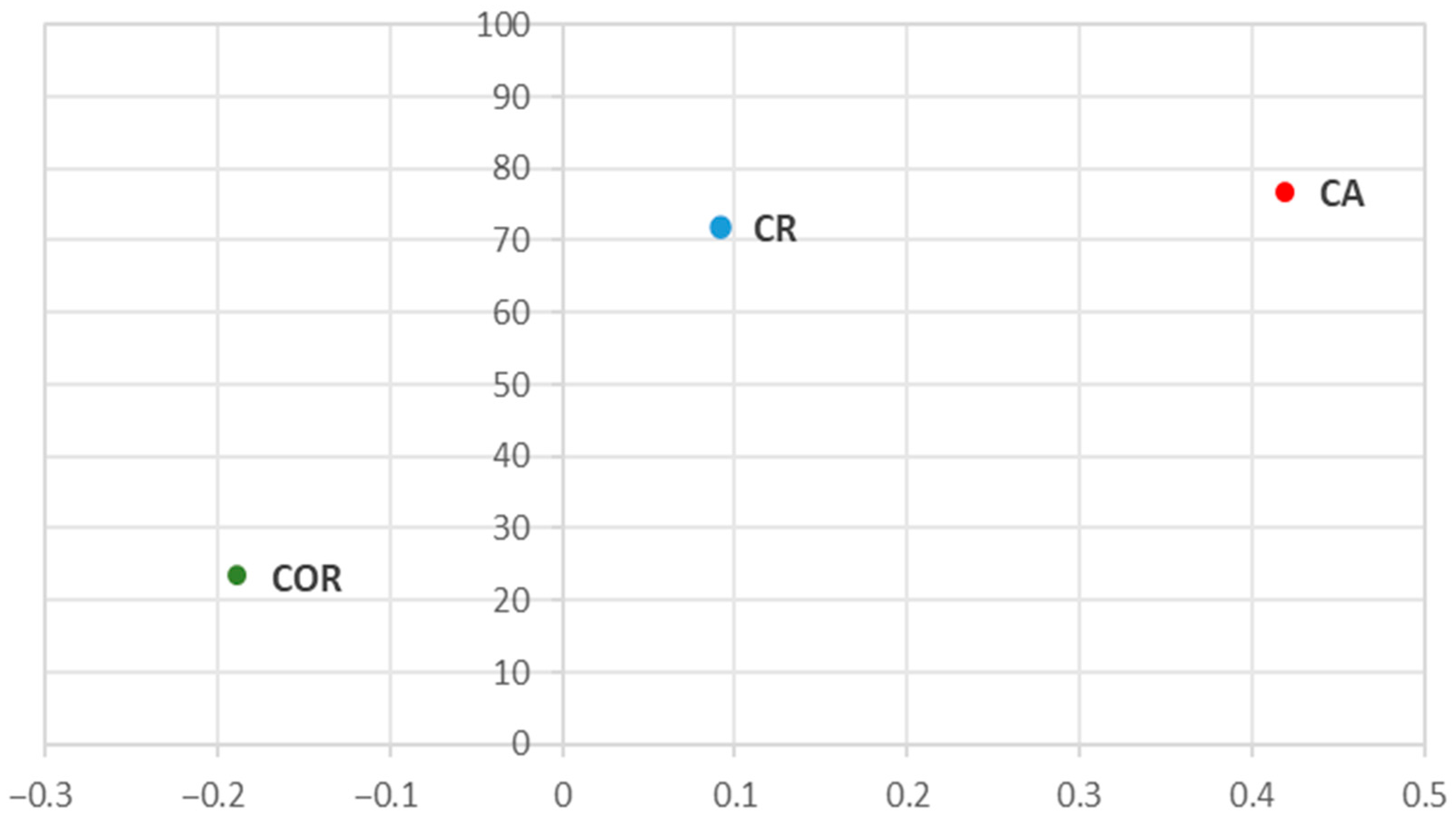
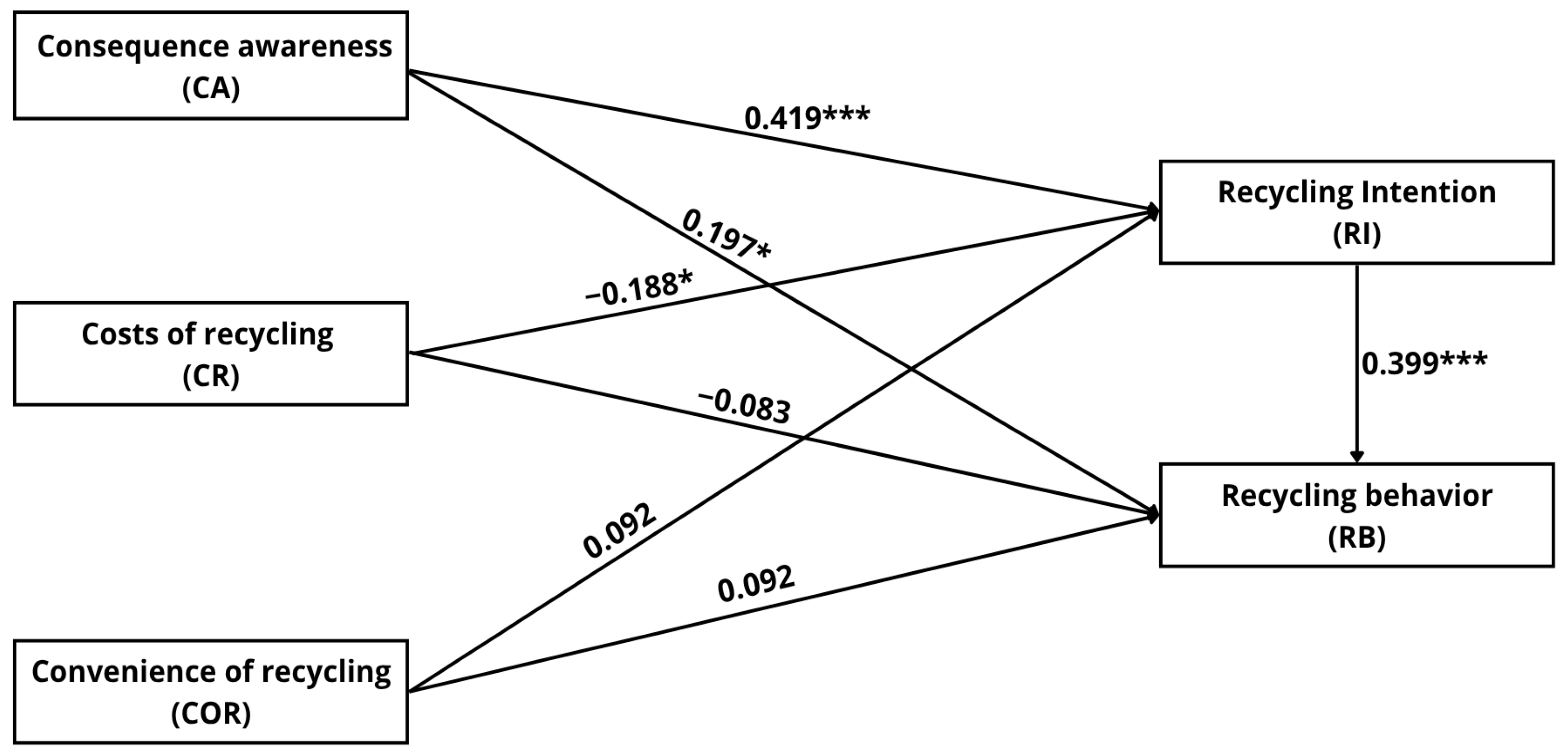
 and
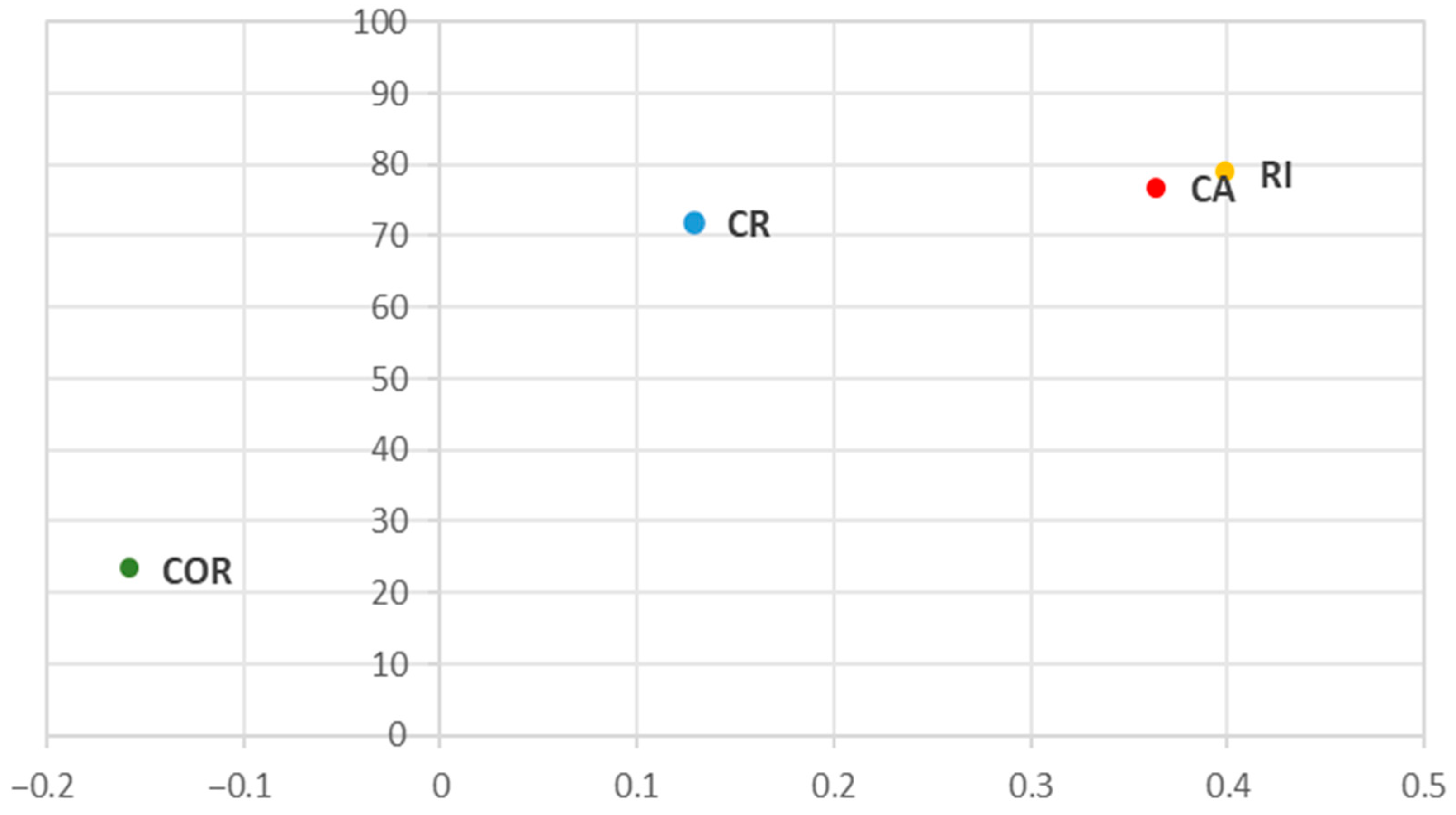
and