1. Introduction
Wastewater treatment is accomplished by physical methods such as filtration, settling, adsorption, and membrane filtration; chemical methods such as electrochemical, coagulation, oxidation, ion exchange, and disinfection; and biological methods such as microbial biodegradation, phytoremediation, constructed wetlands, and bioreactor digestion [
1]. Coagulation and flocculation (CF) are a simple, dependable, and energy-efficient water treatment method. Natural green coagulant is an environmentally friendly treatment that leads to the recovery of materials [
2]. There are various advanced physical, chemical, and biological treatment methods to remove pollutants from water. Coagulation–flocculation, electrocoagulation, adsorption, advanced oxidation processes, and bio-membrane technology are advanced methods adopted in water and wastewater treatment [
3]. The coagulation–flocculation method is a suitable treatment technology for wastewater from aquatic waste due to its high removal efficiency, simplicity, and economic savings [
4]. Coagulation involves chemical and physical processes that destabilize pollutants when natural coagulants are added, and flocculation then stimulates the aggregation of destabilized particles, forming large flakes that can settle [
5]. The coagulants are classified by chemical composition into inorganic (aluminum sulfate), synthetic polymeric (polyaluminum chloride), and natural coagulants (plant leaves and seeds) [
5].
Treatment by coagulation–flocculation involves a physico–chemical process that uses a coagulant to neutralize the negative charges in contaminated water, thereby reducing electrostatic repulsion within the electric double layer; this is known as the destabilization process [
6]. The destabilization begins with an increase in ionic strength, which helps to promote double-layer compression, and/or with the adsorption of anions through the neutralization process of the particle’s surface charge. During low mixing, destabilized particles aggregate to form flocs, then undergo free precipitation, and are finally separated from the contaminated water. Choong Lek et al. [
7] reported the use of chickpea (
Cicer arietinum) for the treatment of palm oil mill effluent and obtained a maximum turbidity removal of 86%. Some other researchers also reported the use of chitosan [
8] and
Moringa oleifera [
9] for the treatment of palm oil mill effluent, achieving 95% and 99.5% turbidity reductions, respectively. Gaayda et al. [
10] showed that the use of grape seed and
Austrocylindropuntia mucilage can remove Congo red and turbidity from synthetic wastewater. According to response surface methodology, Box-Behnken design (RSM-BBD) results reached highest removal efficiency with 99.36 and 95.74% under optimum conditions of 0.45 mg/L of grape seed powder coagulant, 6 mL/L of
Austrocylindropuntia mucilage flocculant, at pH of 10, initial Congo red concentration of 5 mg/L, initial turbidity of 250 NTU, and after settling time of 120 min [
11]. Several findings have examined the role of natural coagulants/flocculants for the treatment of wastewater, such as Aleppo pine seeds for the removal of Congo red dye [
12], grape seed for the removal of chromium (VI) ions [
10], and a mix of
Acanthus sennii C.,
Moringa stenopetala B., and
Aloe vera L. to remove chemical oxygen demand (COD) from wet coffee processing wastewater [
13].
While many studies have investigated coagulation–flocculation for the removal of colloidal particles, dyes, and turbidity in various industrial wastewaters, there is a notable scarcity of research focusing on the simultaneous high-efficiency recovery of macronutrients (PO
4 and NO
3) specifically from aquaculture effluent [
14,
15]. Furthermore, most existing literature focuses on purification without exploring the agricultural valorization of the resulting sludge within a circular bioeconomy framework. This study addresses this research gap by evaluating the dual-purpose efficacy of
A. graecorum leaves and apricot seeds, locally available, low-cost biomass in Iraq, as both treatment agents and nutrient-capture vehicles. To address this gap, research was conducted using coagulants extracted from the leaves of
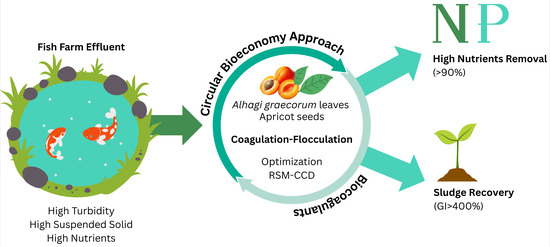
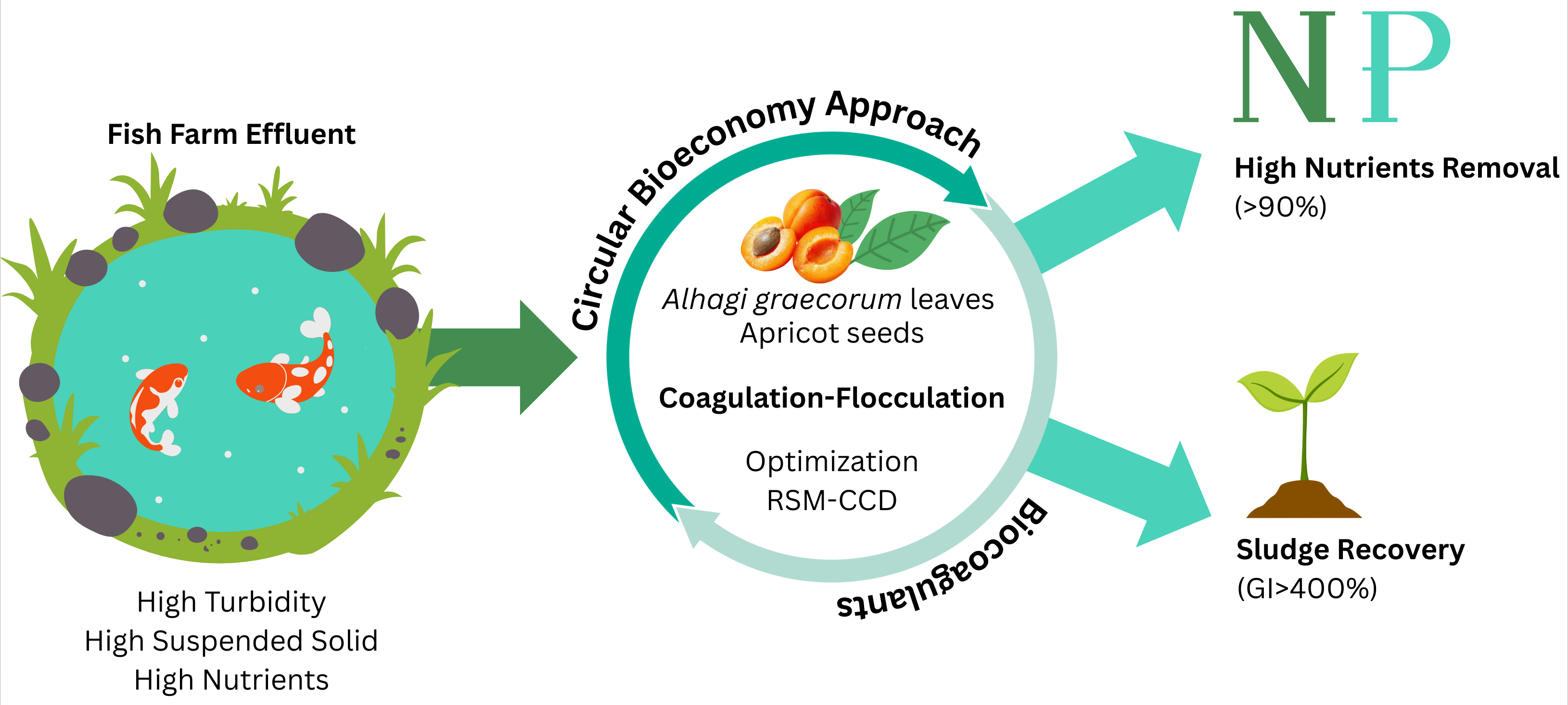
A. graecorum and from apricot seeds. The innovation of this study is to adopt a sustainable environmental approach to wastewater treatment and recovery in the fish farm industry, providing eco-friendly clarification. The use of natural coagulants was explored and optimized using a central composite design (CCD) to achieve optimal treatment and recovery with selected leaves of
A. graecorum and apricot seeds. This study aimed to investigate the ability of locally user-friendly leaves of
A. graecorum and apricot seeds as a low-cost coagulant for the treatment and recovery of nutrients from fish farm wastewater, in order to protect the ecosystem.
2. Materials and Methods
2.1. Preparation of Natural Coagulants and Wastewater
The leaves of the
A. graecorum and apricot seeds were collected in the region of Basrah, Iraq. The selection of
A. graecorum leaves and apricot seeds as green coagulants was based on their high abundance in Iraq and their distinct biochemical profiles, as reported in the previous literature.
A. graecorum leaves were previously reported to contain tannins and polyphenols [
16,
17]. In contrast, apricot seeds were characterized by high protein, peptides, and pectin [
18,
19] which may function as a coagulant.
Wastewater used in the coagulation–flocculation tests was collected from a semi-intensive polyculture local fish farm in Basrah, Iraq, via grab sampling (
n = 3) conducted during the fish grow-out period. This period was selected to capture the peak concentrations of organic and nutrient pollutants. This fish farm utilizes large earthen open basins for the simultaneous rearing of
Cyprinus carpio (Common Carp) and
Mesopotamichthys sharpeyi (Bunni). These basins operate on a semi-static water exchange basis. The aim of using natural coagulants to treat fish farm effluent was to recover nutrients (N and P) in settled sludges as fertilizer.
Table 1 shows the initial characteristics of wastewater used in this optimization study.
The leaves of the
A. graecorum and apricot seeds were previously dried in the oven (BINDER, Tuttlingen, Germany) at 80 °C for 48 h. The dried leaves and seeds were then crushed with a grinder (Mxbaoheng, Chicago, IL, USA), sieved with a 60 μm porous filter (Porex, Ningbo, China), and kept in a Duran bottle [
20]. The preparation of the natural coagulant was performed by extraction with distilled water at a weight of green powder to volume of water (1000, 4000, and 7000 mg/L). After 1 h of stirring (Vitlab, Grossostheim, Germany), the solution was filtered through a cloth and then used for the coagulation experiment.
For initial fish farm effluent characterization, turbidity was measured with a turbidity meter (UPM GmbH, Augsburg, Germany), total suspended solids (TSS) were analyzed gravimetrically, and pH was measured with a portable pH meter (Mettler Toledo, Albstadt, Germany). As for the main parameter, NO3 and PO4 concentrations were analyzed using HACH DR6000 (HACH, Loveland, Colorado, USA) following the HACH kit protocol.
2.2. Coagulation–Flocculation Process for Pollutant Removal
The test of the green coagulant was conducted using jar tests to investigate the removal efficiency of nutrients from fish farm effluent. For each experiment, 500 mL of the fish farm effluent was put in 1000 mL beakers. The coagulant concentration, wastewater pH, and settling time were varied according to the experimental design, as shown in
Table 2, for the two tested green coagulants. At the end of the coagulation–flocculation experiments, the final NO
3 and PO
4 were measured using a HACH DR6000 instrument.
2.3. Optimization Conditions
The CCD was used to investigate the effects of three independent variables: coagulant concentration (1000–7000 mg/L) of
A. graecorum leaves and apricot seeds, wastewater treatment pH (5–9), and settling time (15–35 min).
Table 2 shows the ranges and levels of the variables as outputs from Design-Expert software (version 13, Stat-Ease, Inc., Minneapolis, MN, USA). The 3-level 3-factor CCD is applied to analyze and validate coagulation–flocculation parameters affecting the removal of nutrients by
A. graecorum leaves and apricot seeds.
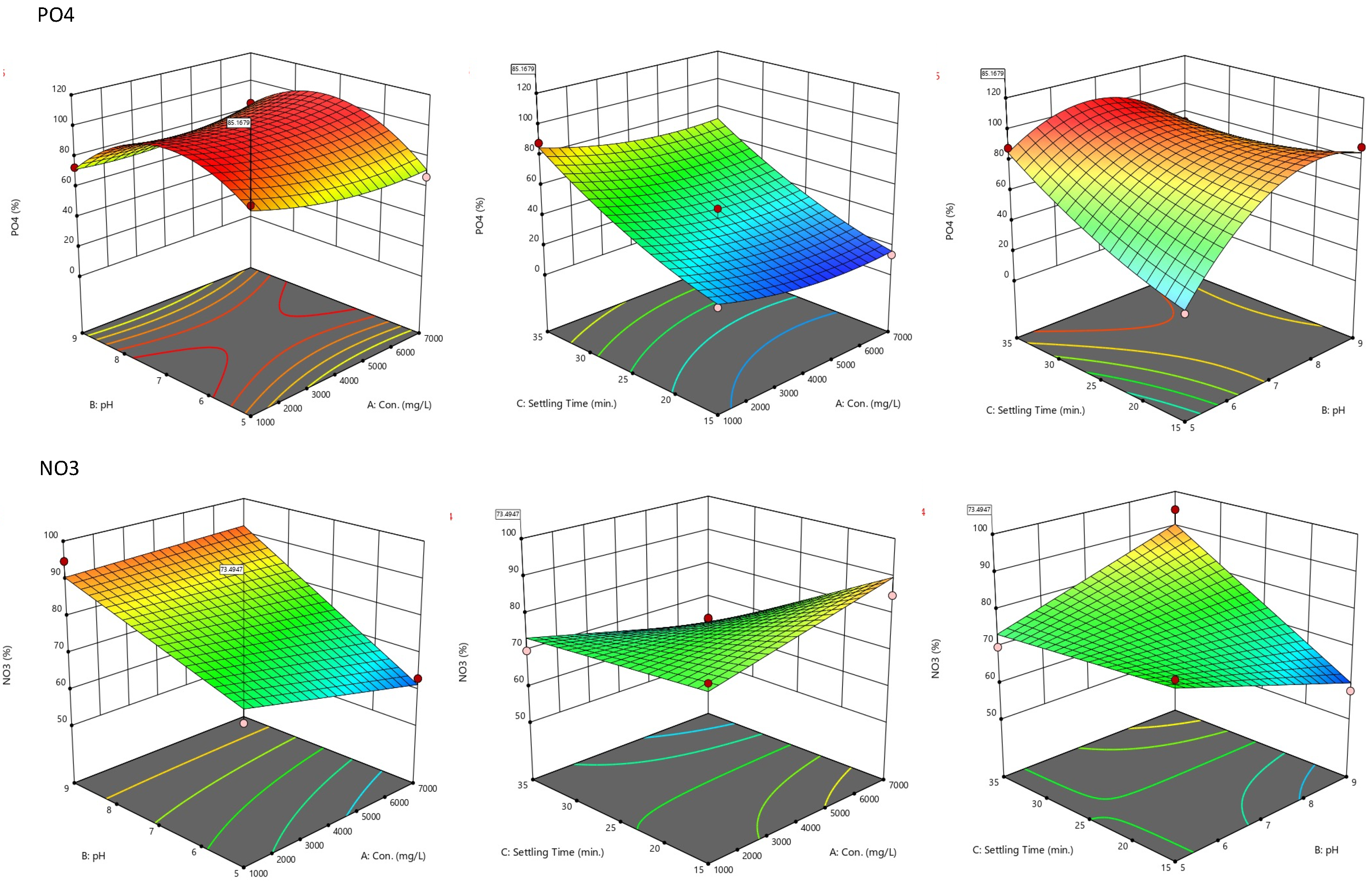
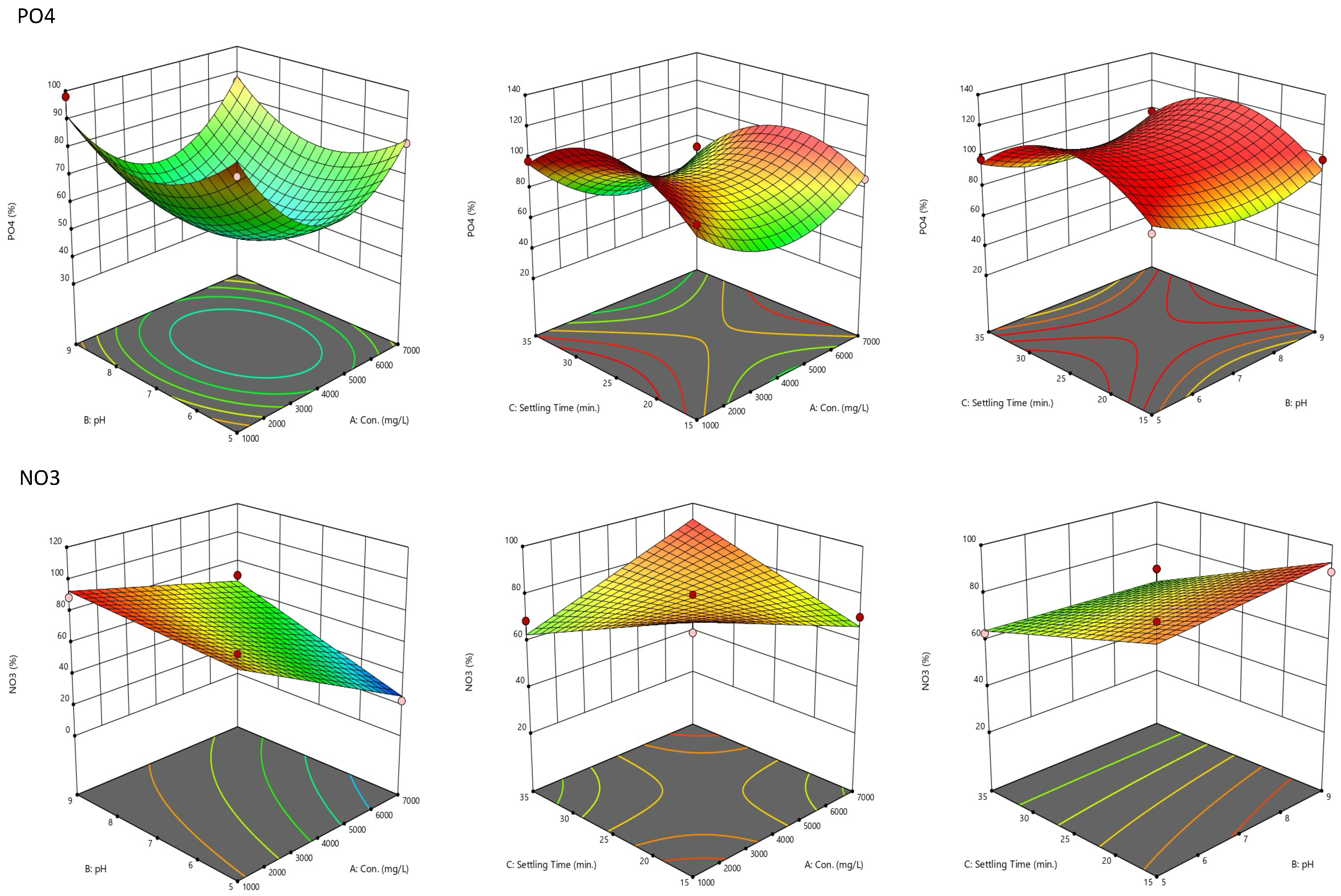
The CCD optimization yields a total of 15 experiments for factors A, B, and C at the levels, minimum −1, central 0, and maximum +1, as shown in
Table 3 for both tested green coagulants. In this study, factors A (coagulant concentration), B (pH), and C (settling time) with two responses (PO
4 and NO
3 removals) and a face-centered CCD were selected for experimentation to obtain a natural number of factors [
13]. Analysis of Variance (ANOVA) was performed to validate the accuracy of RSM Models. The significance of the quadratic models was confirmed by high F-values and low
p-values (
p < 0.05) [
21], indicating that the selected parameters have a statistically significant effect on nutrient recovery. Furthermore, the Lack of Fit for each model was found to be non-significant relative to the pure error, which implies that the models are highly reliable for predicting PO
4 and NO
3 removal within the space of the experimental design [
22].
2.4. Fertilizer Preparation
The residual sludge was used to cultivate
Raphanus sativus L. seeds for a week, the period during which plant seed growth was observed. The seed growth observation aimed to determine the germination index (GI) of recovered sludge after treatment with green coagulant for fish farm effluent. The choice of
R. sativus L. for the GI test was based on its established role as a model bioindicator in environmental research, as it is susceptible to external chemical environments and on its recommendation by international guidelines (the US EPA and OECD) for terrestrial plant growth and toxicity tests [
23].
The fertilizer was prepared at a 1:10 (g/v) ratio, with 10 g of recovered sludge and 100 mL of distilled water. The mixture was left for 3 h, then filtered through filter paper No. 1 (Whatman, Kent, UK). Six different fertilizer concentrations were prepared: 0, 2, 4, 6, 8, and 10%. The 0% treatment serves as a control, using sterile distilled water only to compare the effect of fertilizer on the growth of R. sativus L. seeds.
Sterile 15 cm Petri dishes were used, and sterile filter paper was placed at the bottom of each dish. Then, 5 mL of each fertilizer solution was added, with 2 replicates per concentration, and 8 Raphanus sativus L. seeds were placed in each dish and incubated in the incubator at 25 °C for 5 days.
2.5. Germination Index (GI)
Germination experiments using fish farm sludge were conducted to examine nutrient recovery as fertilizer through seed germination and growth [
24]. A germination rate of 90% or higher was adopted for
A. graecorum and apricot seeds, as it indicates better seed root growth. The recovery of sludge as fertilizer will accelerate seed growth and elongate roots [
25]. The proportion of the number of growing seeds and the percentage of increasing root lengths were calculated using Equations (1) and (2), while the germination index was measured by following Equation (3) [
26].





 ,
,