Article

Sediment Transport and Silting Rate in a Microtidal Estuary: Case Study of Osellino Canal (Venice Lagoon, Italy)


1
Istituto di Scienze Marine, Consiglio Nazionale delle Ricerche (ISMAR CNR), Castello 2737/F, 30122 Venezia, Italy
2
Department F.-A. Forel for Environmental and Aquatic Sciences, Institute for Environmental Sciences, University of Geneva, Boulevard Carl-Vogt 66, 1211 Geneva, Switzerland
3
Istituto di Geoscienze e Georisorse, Consiglio Nazionale delle Ricerche (IGG CNR), Corso Stati Uniti 4, 35127 Padova, Italy
*
Author to whom correspondence should be addressed.
Environments 2026, 13(2), 112; https://doi.org/10.3390/environments13020112
Submission received: 18 December 2025 / Revised: 2 February 2026 / Accepted: 12 February 2026 / Published: 17 February 2026

Abstract

Riverbed siltation in estuaries affects ecosystem functioning, water quality, and navigation. This study investigates the flow-regulated Osellino Canal, a freshwater tributary of the Venice Lagoon that crosses a largely urbanized area and is undergoing progressive siltation. High-resolution measurements of discharge (Q) and suspended sediment concentration (SSC) were performed using hydroacoustic instrumentation from September 2019 to December 2021. The analysis examined discharge dynamics, sediment transport, and rainfall-runoff relationships. Results indicate a mean annual discharge of 2.1 m3 s−1 and an average annual suspended sediment load of ~2900 ± 330 t. Discharge patterns were strongly influenced by water management, resulting in anomalous runoff coefficients (δ > 1) during dry periods. Sediment export proved to be strongly event-driven: episodic high-flow events accounted for about 23% of the total load despite representing only a small fraction of the study period. Furthermore, a strong linear relationship between runoff and sediment load (R2 = 0.94) confirms an advection-dominated regime, where net export is regulated primarily by hydrodynamic volume rather than fluctuations in sediment supply. Bathymetric comparisons (2011–2019) reveal a mean annual sediment retention of 400 ± 100 t yr−1, corresponding to a trapping efficiency of approximately 12 ± 3% relative to the gross sediment input. These findings, supported by SSL–runoff regression residuals, consistently indicate net sediment accumulation associated with the long-term malfunction of a miter-gate system that impedes efficient sediment export. This study provides a critical pre-rehabilitation baseline, establishing a benchmark to evaluate the effectiveness of ongoing restoration efforts initiated in March 2022 and the future hydromorphological recovery of the canal.

1. Introduction

Estuaries and coastal lagoons are highly productive, biologically diverse environments that serve as transitional zones between terrestrial and marine ecosystems, providing substantial environmental and economic value [1,2,3]. These systems support a wide range of species, regulate biogeochemical cycles [4] and create specialized habitats [5].
Despite their importance, estuaries and lagoons face increasing anthropogenic pressures from urban development and land-use changes in their drainage basins [6,7,8]. Key stressors include altered freshwater inflows and sediment dynamics [9], contamination from organic and inorganic pollutants [10,11], habitat fragmentation from land reclamation [12], and reduced morphodiversity with associated biodiversity loss [13]. Climate change further threatens these environments through sea-level rise and altered hydrological regimes [14,15].
Of particular concern among these stressors is estuarine siltation, which results from altered freshwater inflows and sediment transport regimes [16]. This process has significant implications for both ecosystem functioning, e.g., [17] and socio-economic activities such as navigation and recreation, e.g., [18,19] within these transitional ecosystems.
Effective management of these complex systems requires a comprehensive understanding of their key hydrological drivers. Freshwater discharge (Q) influences salinity gradients, species distribution, and ecosystem balance, e.g., [20], whereas suspended sediment load (SSL) shapes morphodiversity, sustains habitats, and supports biogeochemical processes, e.g., [21,22,23]. Continuous monitoring of Q and suspended sediment concentration (SSC) from drainage basins to coastal systems is crucial for protecting and managing these sensitive environments [9,24,25]. Tracking changes in Q and SSC allows for early detection of environmental stressors and supports the implementation of adaptive management strategies [26]. For instance, climate-driven hydrological shifts can alter flow regimes, degrade habitats, and reduce the effectiveness of natural buffers, e.g., [27,28,29,30,31].
Monitoring also provides essential information for maintaining the environmental flows (e-flows) at levels adequate to sustain aquatic biodiversity and provides essential data for understanding erosion, sedimentation, and siltation processes [32,33]. Finally, high-resolution data acquisition is essential to effectively measure suspended sediment loads during storm events and to accurately describe the sediment transport dynamics, e.g., [26,34].
These monitoring needs are increasingly recognized in environmental policy frameworks. Foundational legislation, including the Clean Water Act (CWA, 1972) and the Coastal Zone Management Act (CZMA, 1972) in the United States, and the Water Framework Directive (WFD, 2000) in the European Union, has highlighted the importance of monitoring and studying SSL from land through estuaries and lagoons to safeguard the health and sustainability of these ecosystems. More recent European efforts, such as the European Green Deal (2019) and the EU Biodiversity Strategy for 2030 (2020), further underscore the significance of tracking sediment fluxes for promoting sustainability, protecting biodiversity, and controlling pollution within an integrated watershed management context. Despite these policy drivers, many systems remain vulnerable to continued habitat degradation, excessive sedimentation, and water quality deterioration due to inadequately implemented or enforced protective measures, highlighting the need for localized studies to effectively inform policy development and practical action [2,31].
This study focuses on the characterization of the interplay between natural estuarine dynamics and the functionality of hydraulic works. It specifically provides a detailed, high-resolution assessment of how the failure of engineered infrastructures can affect the hydrosedimentary dynamics of a microtidal estuary causing persistent siltation.
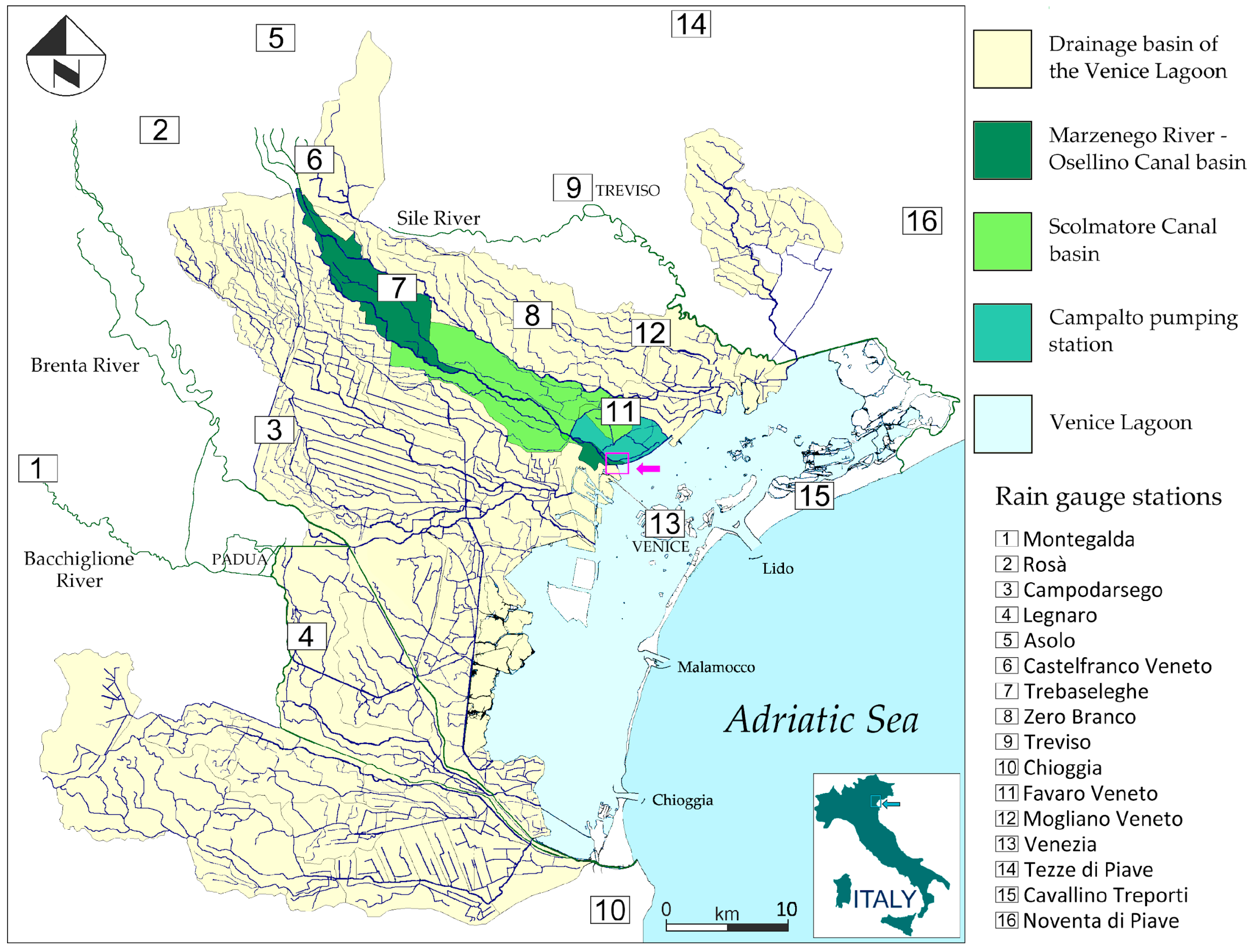
To investigate these dynamics, this paper presents findings from an investigation of the Osellino Canal, a freshwater tributary of the Venice Lagoon (Figure 1), which experienced progressive siltation in its shallow water estuary. While accounting for only 2.5% of the lagoon drainage basin, the Osellino represents one of the few shallow estuarine environments among the lagoon tributaries where tidal-freshwater mixing occurs under relatively natural conditions.
High-resolution measurements of Q and SSC were simultaneously conducted at a tidal monitoring cross-section using hydroacoustic instrumentation. The analysis includes discharge patterns, rainfall-runoff relationships, suspended sediment dynamics, and the influence of flood events on the annual flow and sediment delivery. A regression model using monthly runoff predicted suspended sediment loads, with residuals analysed to characterize the temporal variability of sediment transport efficiency. Additionally, from bathymetric surveys (November 2011 vs. June 2019), sediment accumulation over approximately 7.5 years was estimated, providing an independent comparison with the regression-based estimates and quantifying the cumulative retention within the estuarine system.
The acquired data enabled an assessment of annual Q and SSL from the Osellino Canal basin to the lagoon and the establishment of a comprehensive baseline of the hydrological, sediment transport and bathymetric conditions of the system prior to morphological and hydraulic rehabilitation works that began in March 2022 and are now nearing completion. The collected data provide a critical reference for evaluating the effectiveness of these interventions in mitigating hydrodynamic alterations and associated siltation processes. Moreover, they establish a monitoring framework to support ongoing sediment management efforts and the preservation of the environmental quality and functioning of this ecologically and recreationally significant estuarine zone.

2. Materials and Methods

2.1. Study Site

The Venice Lagoon (Figure 1), the largest in the Mediterranean, spans approximately 550 km2 along the north-eastern coast of Italy on the Adriatic Sea. Well-characterized in terms of its ecosystem structure and functionality, e.g., [35], it is a shallow and enclosed body of water connected to the open sea via three main inlets (Lido, Malamocco, Chioggia) that permit water exchange driven by a semi-diurnal tide. The mean tidal range is 55 cm, with 30 cm and 110 cm during neap and spring tides, respectively [36]. With a mean depth close to 1 m, the lagoon is a diverse environment comprising islands, salt marshes, mudflats, and an intricate network of tidal channels, some of which reach depths exceeding 10 m. About 75% of the lagoon surface is classified as shallow water (<2 m depth) [37].
The Venice Lagoon is subject to erosive processes documented since 1927, with enhanced erosion reported from 1970 onwards, leading to a loss of sediment to the Adriatic Sea through its inlets [38], causing the lagoon bed to deepen and the surface area of salt marshes to reduce [39].
The total sediment contribution from the drainage basin via the twelve main freshwater tributaries [40] represents only 6% of the estimated sediment loss occurring through the inlets [34]. However, this input may play a crucial role in maintaining morphodiversity and ecological habitats in the estuarine areas of the lagoon [34], where characteristic tidal and intertidal landforms—such as salt marshes and tidal creeks—persist but are becoming increasingly vulnerable to relative sea level rise (RSLR) and the frequency of the operations of the MoSE flood barriers [41,42]. Despite its potential significance for marshland morphodynamics, a systematic, high-resolution understanding of the SSL delivered to the lagoon from its tributaries is still lacking. A recent investigation of the main lagoon tributary, the Dese River [34], highlighted this critical point and proposed a reliable methodology for quantifying SSL; however, data for the whole drainage network are missing, preventing a comprehensive basin-wide assessment.
To protect the lagoon and the city of Venice from rising sea levels, the MoSE flood barriers [43] have been activated 122 times (as of 15 December 2025 [44]) since they became operational in October 2020. These barriers close the three inlets during storm surges, and are activated before the peak of high tide when the predicted tide level exceeds 1.10 m relative to the local datum (ZMPS, Zero Mareografico of Punta della Salute), which currently lies approximately 0.34 m below the mean sea level [45].
The catchment area of the Venice Lagoon (Figure 1) spans 2068 km2 and encompasses notable urban centres (with a total population of about one million), extensive agricultural and livestock activities (covering around 70% of the territory), and several small to medium-sized industrial zones. The basin comprises multiple freshwater sub-catchments, each with distinct morphological characteristics and varying in size [40]. Most of the water discharge (~90%) into the lagoon is conveyed by twelve main tributaries, each characterised by different hydraulic regimes (natural, mechanical, or mixed), all subjected to different degrees of flow regulation.
The majority of the catchment consists of a gently sloping alluvial plain, while the northern section extends into the foothills of the Veneto region. Here, an alignment of springs originates several rivers, one of which, the Marzenego River, feeds the studied system. This watercourse is 47 km long and drains an area of 50.4 km2 (Figure 1). Its catchment mainly extends in the upper river reaches and in its central course does not receive natural runoff from the surrounding land, which is instead drained by an artificial canal (Scolmatore Canal) that covers a basin area of 73.3 km2.
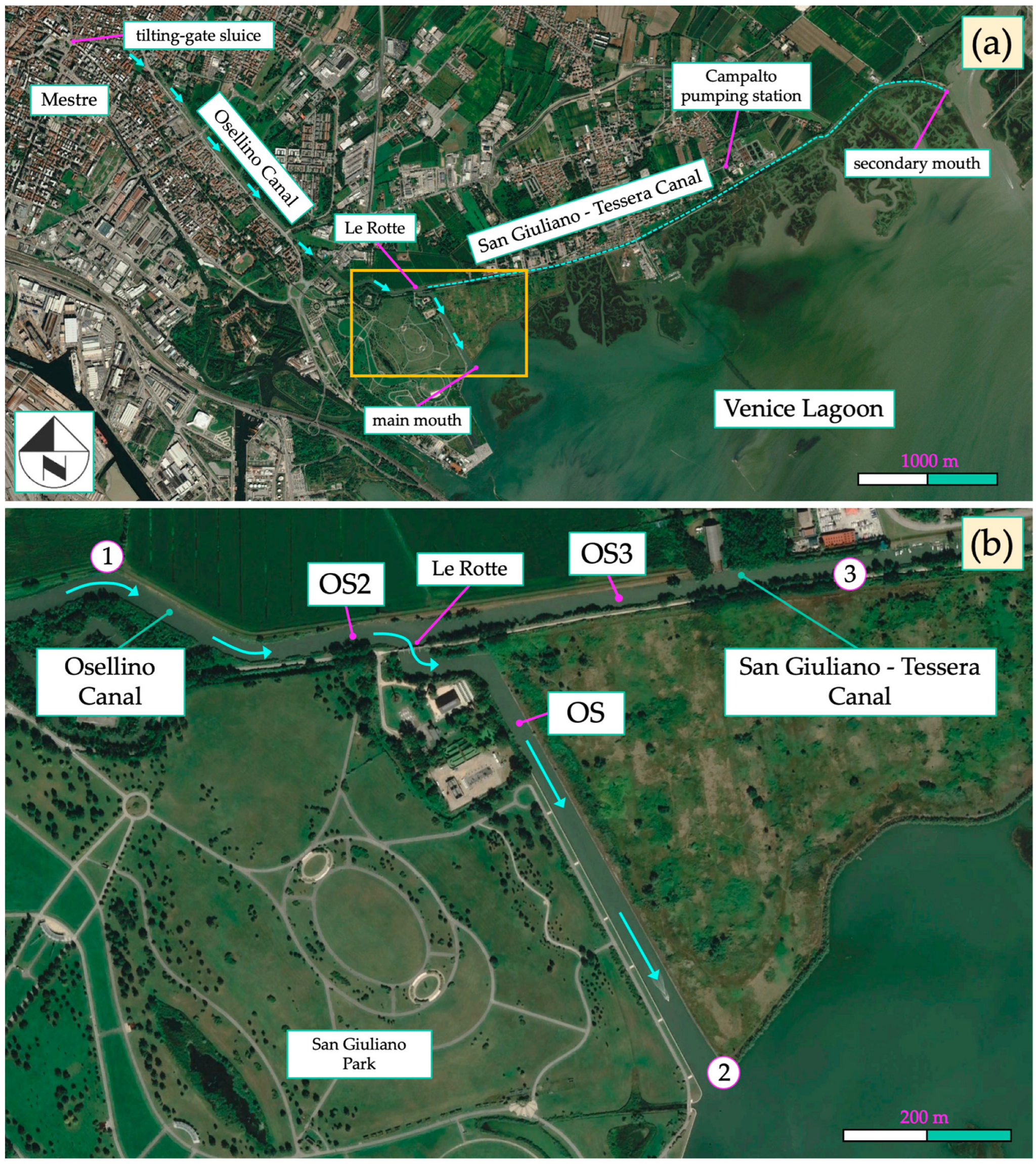
The Marzenego River flows through the urban centre of Mestre (population ~100,000, Figure 2a), where it takes the name Osellino Canal. Near the lagoon margin, land drainage is managed primarily by the Campalto pumping station (16.5 km2, Figure 2a), although a small area (3.7 km2) still contributes to the tributary flow.
Multiple factors related to the hydraulic management of the system—such as continuous and intermittent diversions, as well as interconnections with nearby tributaries—result in a complex and variable configuration of the hydraulic network and flow regime. This variability makes it difficult to define the contributing area for both inflow and outflow under different situations. In particular, during low-flow conditions and irrigation periods, the basin receives additional inflow [46] from an external area (part of the Asolo Hills) via the Castelfranco hydraulic node indicated in Figure 1. Additionally, in the early 2000s, a tilting-gate system was installed in the city of Mestre (Figure 2a), approximately 3.6 km upstream from the OS measurement cross-section. This structure allows for effective hydraulic regulation and prevents the upstream intrusion of brackish water from the lagoon along the Osellino Canal during flood tidal phases.
The study area within the Osellino Canal estuary is shown in Figure 2b, including the location of the main observation station OS, where high-resolution measurements of Q and SSC were conducted.
The canal diverts at Le Rotte toward its main outlet into the lagoon through a malfunctioning hydraulic infrastructure, a system of 5 miter gates installed across the canal about 170 m upstream of station OS. A branch of the main channel, the San Giuliano-Tessera Canal, extends ~4 km eastward of Le Rotte reaching its secondary mouth, which is also affected by tidal forcing from the lagoon at its far end.
The original purpose of the miter-gate system was to prevent brackish water intrusion during flood tides, thereby forcing the Osellino Canal flow entirely through the San Giuliano-Tessera Canal to its secondary lagoon mouth. However, the system has remained non-functional for decades with the two left-side gates remaining permanently open, the central one semi-open and the other two nearly closed, resulting in an asymmetric flow pattern.

2.2. Measuring Stations

An automatic monitoring station equipped with an acoustic Doppler current meter SLD (Side-Looking Doppler Sensor, 1 MHz, 25 m, OTT HydroMet, Kempten, Germany) was installed on the left bank of a straight reach of the Osellino Canal, at 480 m from its main mouth. The measurement cross-section has a width of 21.9 m, a maximum depth of ~1 m (referred to the ZMPS) and a cross-sectional area of about 15.5 m2 (OS, Figure 2b). Since September 2019, the station has acquired high-resolution time-series of Q and SSC. Tidal levels were continuously recorded using a ceramic pressure sensor (PLS, OTT HydroMet, Germany).
The setup consists of two horizontal ultrasonic transducers that emit sound waves which are reflected by particles in the water. The system measures the frequency shift of the returning echoes to determine the water speed, profiling with measurements taken perpendicular to the flow. Additionally, the intensity of the acoustic backscatter, which is directly proportional to the concentration of suspended particles, provides an indirect estimate of SSC [47,48]. The sampling intervals were set to 1 min for Q and 5 min for backscatter. Spatially, the measurement range was divided into nine contiguous cells, each 1.70 m wide, extending along the acoustic beam. A blanking zone exists near the instrument where velocity and backscatter data cannot be collected due to intrinsic limitations of the acoustic technique [49]. A solar-powered control unit continuously logged the data and transmitted them via GSM to a central workstation at CNR ISMAR. A strict cleaning and maintenance protocol prevented interference from biofouling throughout the deployment period.
Data with averages computed every 15 min were used for analytical purposes. Fifteen-minute averaged Q and SSC values, collected from September 2019 to December 2021, were used to characterize the hydrology of the investigated estuary. Two periods of data loss occurred due to a system malfunction: SSC data were unavailable during January 2020, and both Q and SSC were missing from 12 August to 10 November 2021.
Between September 2019 and May 2021, seven field campaigns were conducted to characterize flow distribution patterns under varying tidal conditions. During these campaigns, 37 direct measurements (snapshots) of Q and concurrent vertical profiles of physicochemical variables (salinity, temperature, turbidity) were acquired at the three cross-sections (OS, OS2, and OS3). The measurements were conducted using a vessel-mounted Acoustic Doppler Current Profiler (ADCP; StreamPro, 2 MHz, Teledyne Technologies, Thousand Oaks, CA, USA) and a multiparameter probe (Ocean Seven 316 Plus, Idronaut, Brugherio, Italy). These surveys aimed to evaluate flow distribution between the main and secondary branches under different tidal conditions.

2.3. Instrument Calibration Procedure

To calibrate the time series of discharge collected by the SLD instrument at cross-section OS, 150 in situ measurements were conducted under various hydrodynamic and tidal conditions using the vessel-mounted ADCP [50] described in Section 2.2. These data were used to iteratively refine the instrument algorithms, specifically the parameters for calculating the wetted cross-section as a function of tidal stage and section morphology. Since the fixed instrument measures velocities across nine contiguous cells covering a portion of the total cross-section, the algorithm was required to extrapolate from these point measurements to estimate total discharge. The initial algorithm, developed using an early subset of direct measurements, was progressively refined as additional measurements were collected. Once all 150 calibration measurements were acquired, the final algorithm was applied retroactively to the entire time series of acoustic data to generate a continuous discharge record. Discharge calculations were performed using specialized software associated with the self-recording instrument (OTT Prodis 2, OTT HydroMet, Germany), as described in [51].
To estimate instantaneous SSC from the acoustic backscatter recorded by the SLD and to assess potential water stratification, 41 water samples were collected at OS within the area sensed by the instrument. Physico-chemical parameters (temperature, turbidity, and salinity) were measured along the vertical profile using a multiparametric probe (Ocean Seven 316 Plus, Idronaut, Brugherio, Italy) to identify water stratification and detect vertical gradients in physico-chemical parameters. Suspended sediment concentration was determined in the laboratory by filtering 200 mL aliquots through polycarbonate membrane filters (Millipore Isopore™, 0.4 μm pore size, 47 mm diameter). The retained sediment was dried at 105 °C to obtain its dry weight [52]. Water samples were treated in an ultrasonic bath before measuring the grain-size distribution of suspended particles using a laser diffraction particle-size analyser (LISST 100X, Sequoia Scientific Inc., Bellevue, WA, USA). Additionally, 37 and 33 water samples were collected at stations OS2 and OS3, respectively, and subjected to the same analyses to better understand the dynamics of SSC in the system.
The acoustic backscatter data from the SLD were converted into SSC values using the Surrogate Analysis and Index Developer (SAID) tool (version 1.0), developed by the U.S. Geological Survey [53] and implemented in MATLAB (version R2014a). This tool constructs a linear regression model by comparing the instantaneous SSC values (log10 SSC) from water samples with the average backscatter values recorded by the instrument in the corresponding sampling cells (corrected for particle-induced signal attenuation: mean SCB, sediment-corrected backscatter), thereby generating a time series of SSC values. The time series of SSL was then calculated by directly multiplying instantaneous values of Q and SSC.
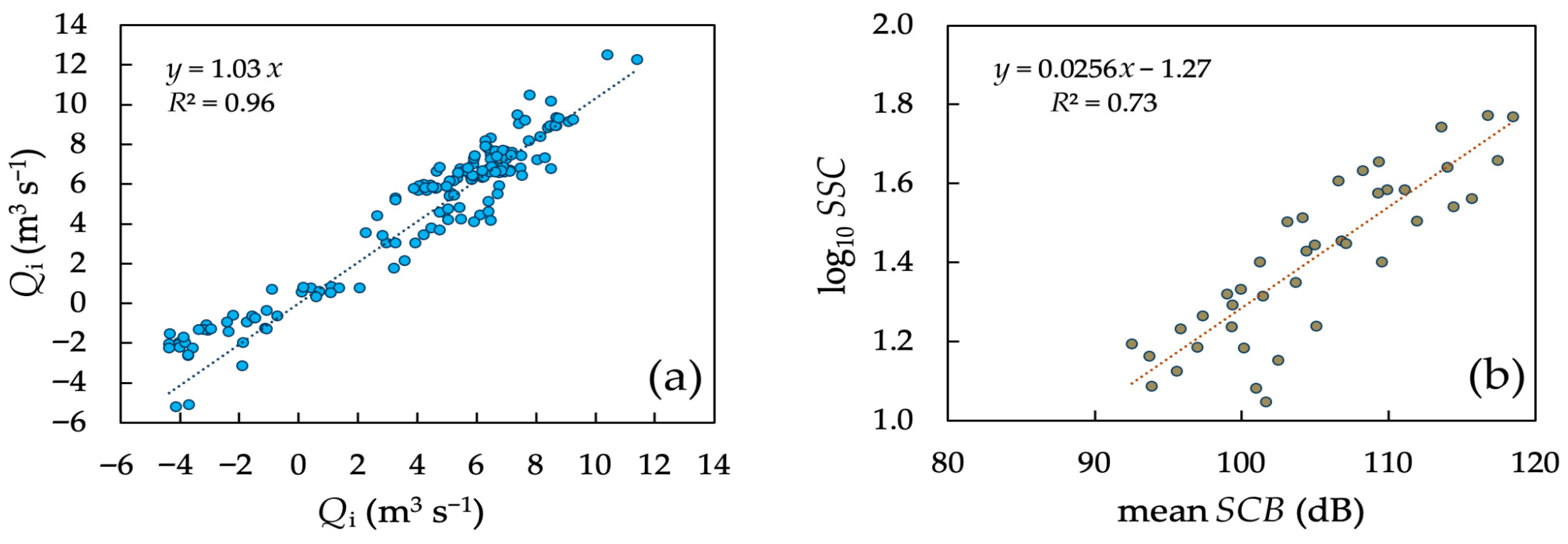
The calibration procedure for Q yielded strong agreement (R2 = 0.96) between the reference instrument (ADCP, StreamPro) and the fixed SLD. A satisfactory agreement was also achieved for the SSC calibration (R2 = 0.73) comparing SLD data against the filtration method, thereby supporting the reliability of these time series for use in the present study (see Appendix A).

2.4. Bathymetric Surveys

A bathymetric survey along the Osellino Canal and its shallow-water mouth zone was conducted in June 2019 using a single-beam echo sounder mounted on an autonomous surface vehicle (OpenSWAP, ISMAR-CNR and Proambiente SCRL, Bologna, Italy) [54]. The survey involved zigzag transects to ensure sufficient data coverage, generating a bathymetric map of the canal final stretch up to its lagoon mouth, an initial portion of the San Giuliano-Tessera Canal. Detailed cross-sectional bathymetry at three specific cross-sections (OS, OS2, and OS3) was also acquired using single-beam measurements along each transect.
The acquired data set was integrated in a GIS environment (QGIS software version 3.26) for filtering and processing. Outliers, predominantly caused by suspended aquatic vegetation interfering with the acoustic signal, were excluded from the analysis. Data processing involved converting the point vector data into a raster format with a 5 × 5 m pixel resolution. Vertical elevation was referenced using the EGM96 global geoid model, which provides a suitable approximation for the study area.
For comparison with our 2019 bathymetric survey, we used an unpublished data set from a November 2011 survey, which was collected using a SEA Swathplus 468 kHz multibeam system (ITER Systems SARL, La Motte-Servolex, France).

2.5. Precipitation Data and Flood Event Identification

Hourly precipitation data from 16 rainfall stations surrounding the basin (Figure 1), provided by ARPAV (the Environmental Protection Agency of the Veneto Region), were processed using a GIS platform (QGIS 3.26) to calculate monthly rainfall over the catchment and to analyze hourly rainfall trends during flood events.
Flood events were identified when the 25-h moving average discharge consistently exceeded a threshold defined as 1.5 times the mean annual discharge. Individual events were delineated through visual inspection of discharge time series, merging flood periods separated by brief transitions and excluding isolated peaks. Precipitation data, along with SSC and tidal level measurements, were used to characterize the hydrological and sediment dynamics of each identified event.

3. Results and Discussion

3.1. Sediment Retention in the Estuarine System

Bathymetric surveys from 2011 and 2019 were analysed to assess sediment retention within the estuarine system. Longitudinal and cross-sectional comparisons reveal substantial morphological changes along the canal network (Section 3.1.1), from which annual sediment accumulation rates and associated volumetric uncertainties are estimated using volumetric analysis (Section 3.1.2).

3.1.1. Bathymetric Evolution and Siltation Patterns

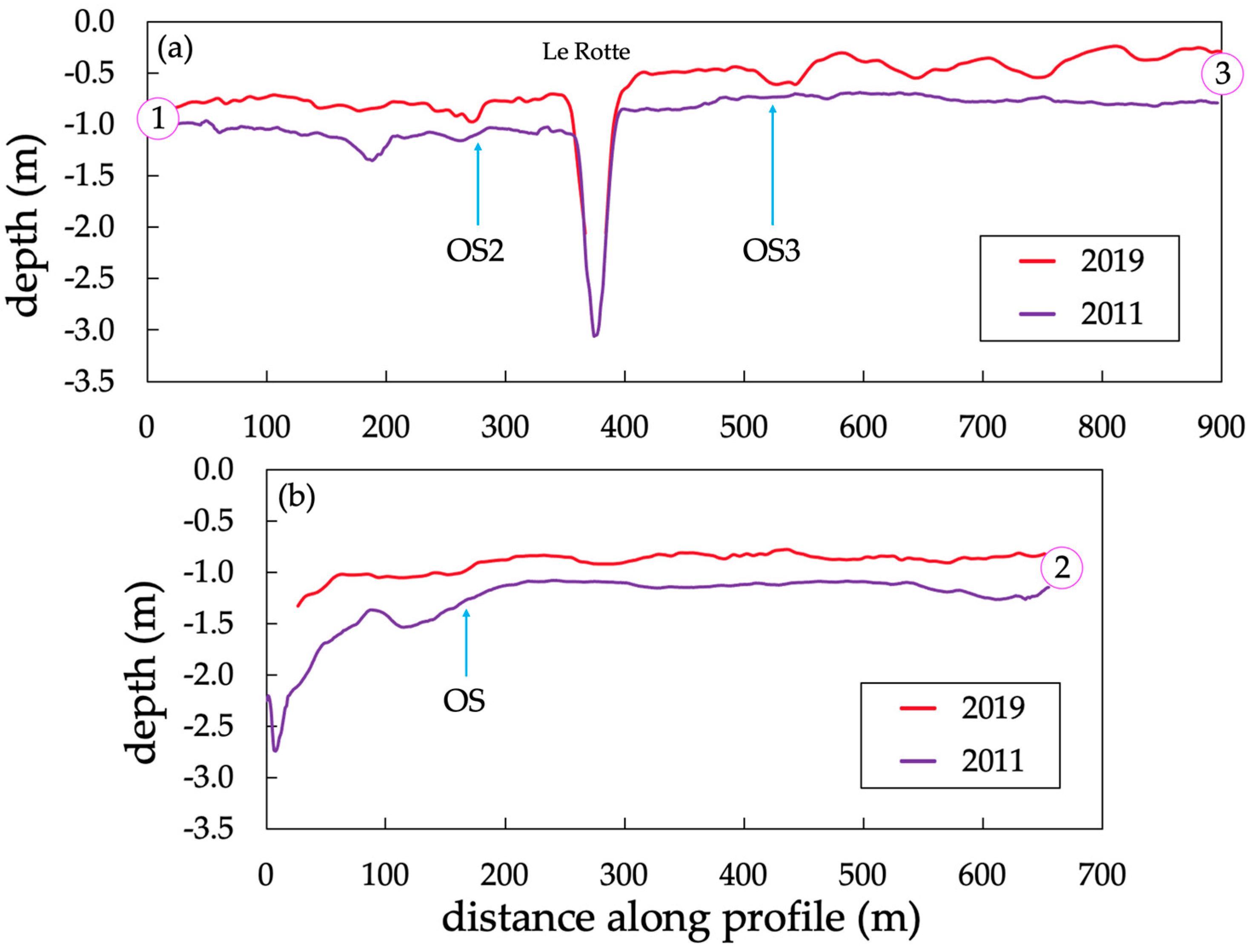
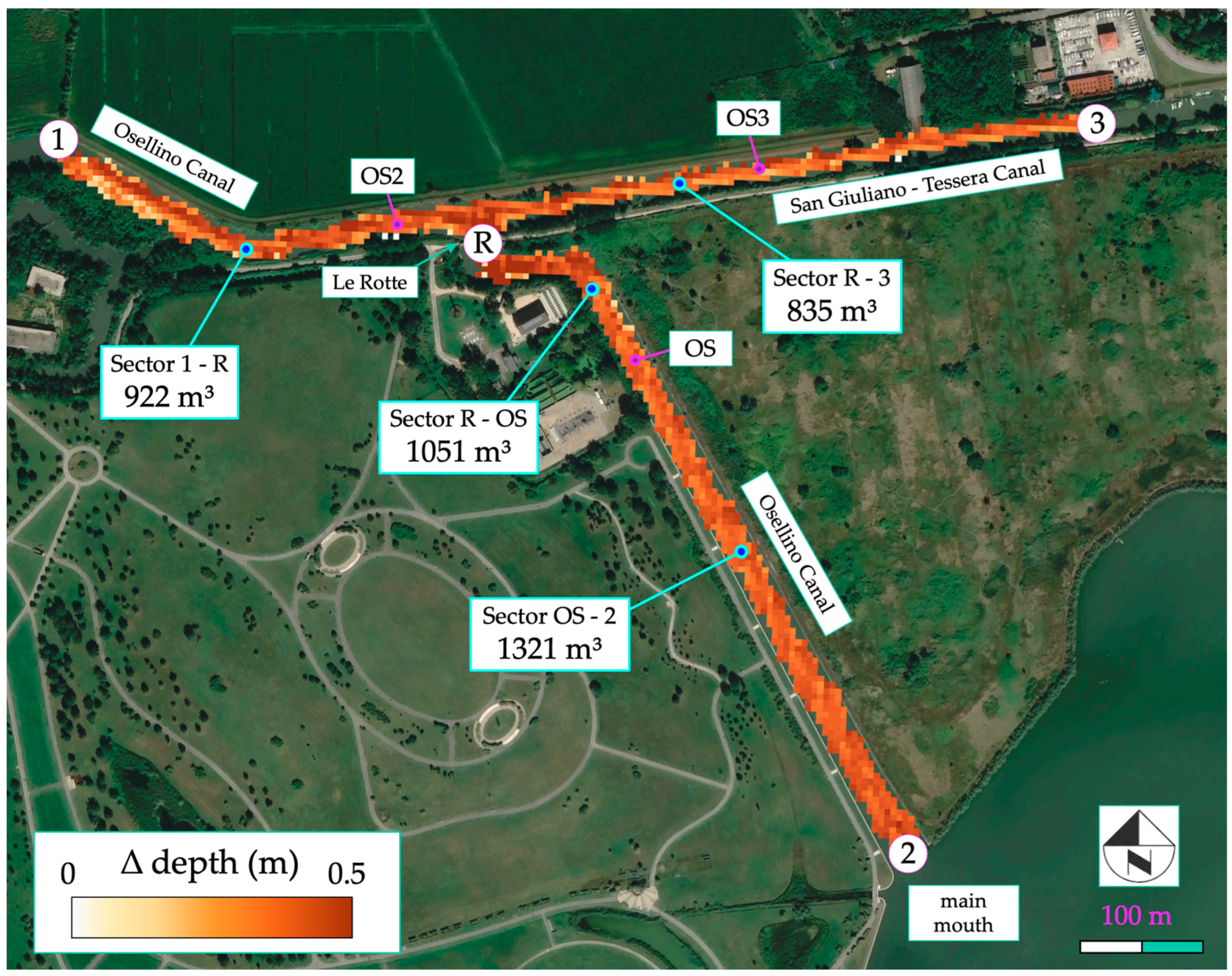
The longitudinal profiles along the canal thalweg, extracted from the bathymetric survey raster datasets (2011 and 2019), are presented in Figure 3. The first profile (Figure 3a) extends from reference point 1 (Figure 2b), located 370 m upstream of Le Rotte, and continues along the San Giuliano-Tessera Canal for 500 m to point 3. The second profile (Figure 3b) pertains to the terminal reach of the Osellino Canal from just downstream of Le Rotte to the main mouth (point 2).
The comparison between the bathymetric surveys conducted approximately 7.5 years apart (2788 days) reveals significant siltation throughout the system, with bed elevation increments significantly exceeding the 2.8 cm limit of detection (LoD95) calculated for the difference surface (see Appendix A). In the surveyed reach of the Osellino Canal upstream of Le Rotte, bed elevation along the thalweg increased by an average of ~29 cm (equivalent to an aggradation rate of ~3.8 cm yr−1). Compared to this stretch, the initial segment of the San Giuliano-Tessera Canal already exhibited a bed elevation about 30 cm higher during the 2011 survey. Over the subsequent years, up to 2019, this reach underwent additional siltation, with an average increase of ~34 cm in bed elevation along the thalweg, corresponding to an aggradation rate of ~4.5 cm yr−1.
Direct discharge measurements at the three cross-sections (see Appendix B) indicate that freshwater from OS2 flows predominantly toward OS during ebb tide, with negligible flux observed toward OS3. During flood tide, OS3 receives only brackish water intrusion from both OS and the secondary mouth. This hydraulic pattern prevents direct freshwater flushing of OS3, promoting sediment deposition and confirming that the San Giuliano-Tessera Canal has progressively ceased to function as an active secondary mouth. This interpretation is further supported by the salinity profiles presented in Appendix B (Figure A3), which confirm that OS3 primarily drains residual brackish water during the ebb phase. In the Osellino Canal reach from downstream of Le Rotte to the mouth, mean bed elevation along the thalweg increased by ~32 cm (~4.2 cm yr−1).
By considerably restricting the flow, the non-functional miter-gate system generated two distinct scour holes on both sides of the structure. The upstream scour hole reaches a minimum bed elevation of ~−3 m, and form a depression approximately 25 m wide, consistent with contraction scour morphology [55,56]. The downstream scour hole extends along the thalweg for 90–100 m with a minimum bed elevation of about −2.6 m, exhibiting the characteristics of jet scour mechanisms [57,58,59].
The long-term inoperability of the miter-gate system at Le Rotte appears to be a key factor contributing to the general siltation of the canal system. The gates were originally designed to close during the flood tide, preventing the intrusion of brackish water in the upstream reaches and directing freshwater flow to the secondary mouth. The failure of this hydraulic infrastructure likely directed the canal to discharge predominantly through the main mouth, while flow in the San Giuliano-Tessera Canal progressively lost its transport capacity, resulting in the documented aggradation. At the same time, the open gates have allowed saltwater intrusion during flood tide, which inhibited freshwater flow and reduced the efficiency of the system to convey SSL to the lagoon [60,61].
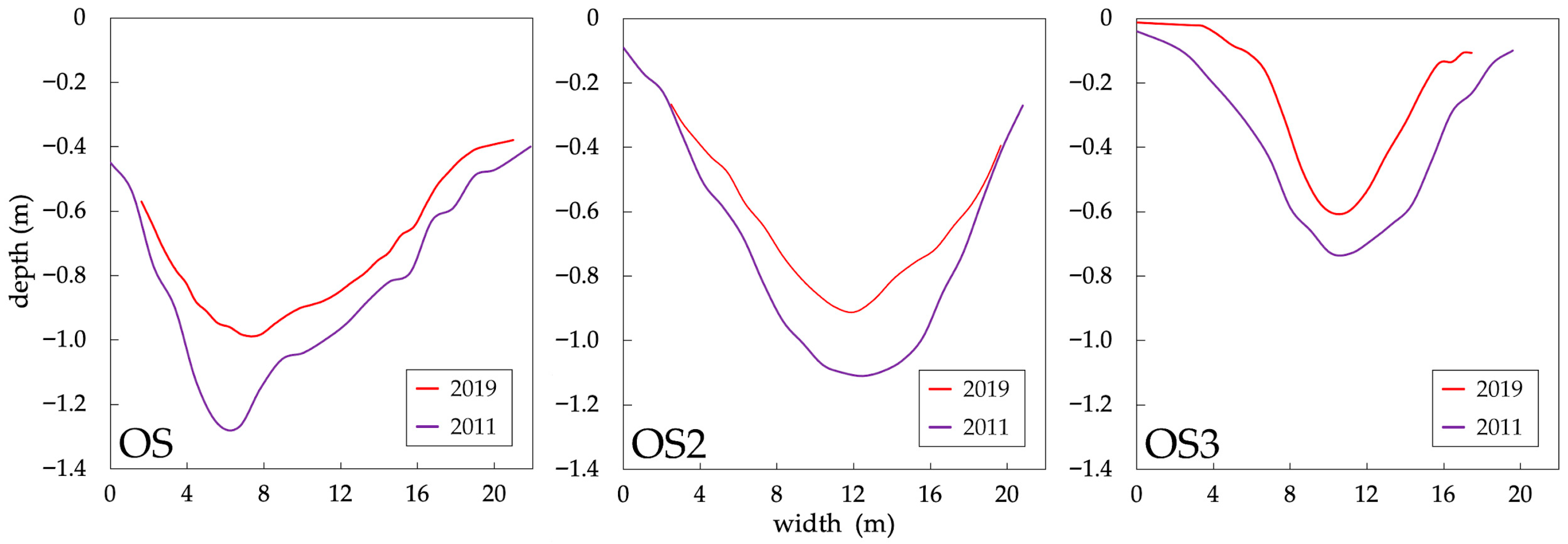
The cross-section profiles acquired during the two bathymetric surveys at sections OS, OS2, and OS3 are presented in Figure 4. In the period between the two surveys, the wetted cross-section areas decreased by 15.5%, 18.5%, and 40.7%, respectively, corresponding to mean annual reductions of approximately 2.0%, 2.4%, and 5.3%.

3.1.2. Bathymetry-Based Annual Sediment Retention Estimate

The volume of sediment accumulated in the system was quantified by analysing bathymetric changes that occurred between the 2011 and 2019 surveys using GIS overlay techniques. A difference raster was computed from the two bathymetric datasets, both resampled to a common spatial resolution of 5 m per pixel to ensure a consistent spatial analysis.
The total net deposition volume over the 30,275 m2 surveyed area was estimated at 4100 ± 800 m3, where the uncertainty represents a conservative 95% confidence bound (see Appendix A).
Based on the total net deposition volume, we derived the mean annual estimated sediment retention rate (maESRR) by dividing it by the time interval between surveys. The method was applied to estuarine sectors upstream of the cross-section OS where bathymetric data were available (Figure 5), covering the Osellino and San Giuliano-Tessera channels. The surveyed reach was divided into four contiguous sectors, with estimated sediment deposition volumes of 920 m3 (Sector 1-R), 1050 m3 (Sector R-OS), 840 m3 (Sector R-3), and 1300 m3 (Sector OS-2) in approximately 7.5 years.
Spatial integration of bathymetric differences revealed an estimated total sediment deposition volume of 2800 m3 in the three upstream sectors (1-R, R-OS, and R-3). To convert this value into mass, the sediment dry bulk density (ρDB) was estimated using data acquired from three sediment cores collected in 2019 at the main measurement cross-section OS and the two secondary cross-sections (OS2 and OS3—Figure 2). For each core, water content () and loss on ignition (LOI) were measured and averaged over the top 20 cm of the core (details in Appendix C). The ρDB across the three cores was 0.73 ± 0.11 t m−3 (mean ± SD). Propagating both the volumetric and ρDB errors, the total mass of deposited sediment in the upstream sector corresponded to 2100 ± 500 t (95% confidence). Averaged over the 2788-day survey interval, this yielded a maESRR of ~270 t yr−1.
Bathymetric analysis of Sector OS-2, extending from cross-section OS to the main mouth, revealed additional sediment accumulation. The estimated deposition volume in this reach was 1300 m3 over the survey period. Using the same ρDB, this corresponded to 960 ± 250 t, yielding a mean annual sediment accumulation rate of 130 t yr−1. Combining these estimates, the total sediment retention amounts to 400 ± 100 t yr−1, representing a cumulative mass of 3000 ± 800 t accumulated throughout the system. The upstream sectors (1-R, R-OS, R-3) accounted for 68% of the total sediment volume, while Sector OS-2 accounted for the remaining 32%.
This retention corresponds to a trapping efficiency of approximately 12% relative to the gross sediment input from the catchment (as calculated in Section 3.2.2). These results provide evidence of severe siltation occurred throughout the estuary, highlighting a reduced efficiency of the sediment export to the lagoon.

3.2. Water and Sediment Fluxes: Patterns and Variability

This section presents the analysis of water discharge (Q) and suspended sediment load (SSL) recorded continuously at the OS cross-section over the study period. Section 3.2.1 provides descriptive statistics of the hydrological and sediment transport parameters, characterizing the typical conditions and variability observed in the system. Section 3.2.2 examines the monthly patterns of runoff and SSL, and estimates their annual totals. Finally, Section 3.2.3 analyses the contribution of flood events to total annual water and sediment fluxes, quantifying the role of extreme hydrological conditions in the estuarine sediment budget.

3.2.1. Descriptive Statistics of Hydrological and Sediment Transport Parameters

Statistical parameters for the Q, SSC, and SSL distributions at cross-section OS are summarized in Table 1, distinguishing between downstream (Q > 0) and upstream (Q < 0) flow conditions. The mean SSC (mSSC) is similar in the downstream (35 mg L−1) and upstream (28 mg L−1) flow directions, differing by 7 mg L−1, with large standard deviations indicating substantial variability. Excluding the 16 flood events recorded during the study period (see Section 3.2.3), downstream mSSC decreases to 34 ± 20 mg L−1, reducing the difference between flow directions to 6 mg L−1.
These comparable concentrations in both flow directions suggest tidal reworking of a common particulate pool within the estuary, e.g., [62,63], with sediment repeatedly exchanged between the estuary and the lagoon.
In contrast, Q shows a strong asymmetry: mean downstream flow (4.7 m3 s−1) is 68% greater than mean upstream flow (2.8 m3 s−1), and maximum values under typical conditions are substantially higher downstream (28.6 vs. 14.0 m3 s−1). This disparity is mirrored in suspended sediment load, with downstream mSSL (170 kg 15 min−1) doubling the upstream value (80 kg 15 min−1). These patterns indicate that, in this small microtidal estuary, tidal and sediment transport asymmetry, e.g., [64,65] is governed primarily by Q rather than SSC (see Section 3.2.2). This discharge-driven imbalance results in net sediment export toward the lagoon and is further amplified during flood events (see Section 3.2.3).
The exceptionally high maximum values of Q and SSL during incoming tide (Q < 0) correspond to the major storm surge event (acqua alta) that affected the Venice Lagoon on 12 November 2019 [66]. This event reached a peak tide level of 189 cm above the ZMPS, the second highest on record after the catastrophic flood of 4 November 1966, which attained 194 cm [67]. With the MoSE flood barrier system now fully operational, extreme tidal intrusions of comparable magnitude are no longer expected to occur in the lagoon.
Grain-size analysis of 111 suspended sediment samples yielded consistent mean median grain diameters (D50) across the three measurement cross-sections (OS: 24.2 ± 18.6; OS2: 26.2 ± 18.9; OS3: 22.4 ± 16.3 μm; mean ± SD). These results indicate that suspended particulate matter is highly variable, ranging from clay and very fine silt to medium silt, with an overall average D50 of approximately 25 μm. Such fine-grained material readily settles under the predominantly low-energy flow conditions, consistent with the widespread siltation patterns described in Section 3.1.2.

3.2.2. Q and SSL Temporal Patterns

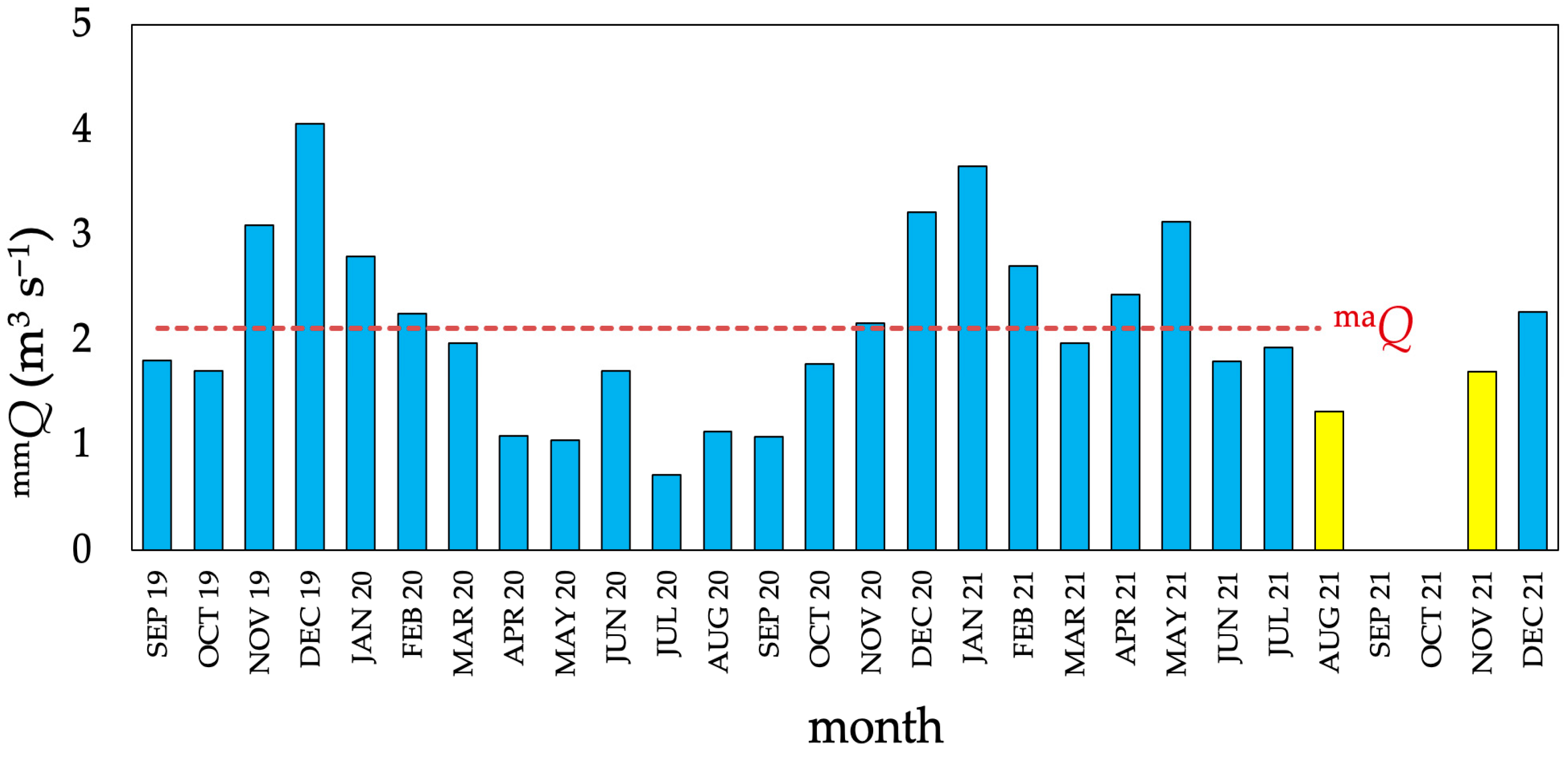
Figure 6 illustrates the trend of monthly mean discharge calculated from the Q time series measured at cross-section OS. The dataset includes partial data for August 2021 (until the 12th) and November 2021 (from the 11th) due to the instrument malfunction between 13 August and 10 November 2021.
The data exhibit a clear seasonal pattern, with higher discharges in colder months (peaking at 4.1 m3 s−1 in December 2019) and lower discharges in warmer months (dropping to a minimum of 0.7 m3 s−1 in July 2020). This seasonal variability reflects the typical Csb Mediterranean climate (Köppen–Geiger classification [68]), characterized by a hydrological regime with enhanced precipitation and reduced evapotranspiration during the winter season [69].
Two water years (WY) were defined: WY1 (September 2019–August 2020, 366 days) and WY2 (September 2020–12 August 2021, 335 days). Mean annual discharge (maQ), calculated as total runoff divided by measurement duration, was 1.9 m3 s−1 for WY1 and 2.3 m3 s−1 for WY2, with a two-year average of 2.1 ± 0.2 m3 s−1 (mean ± SD), shown by the red dashed line in Figure 6.
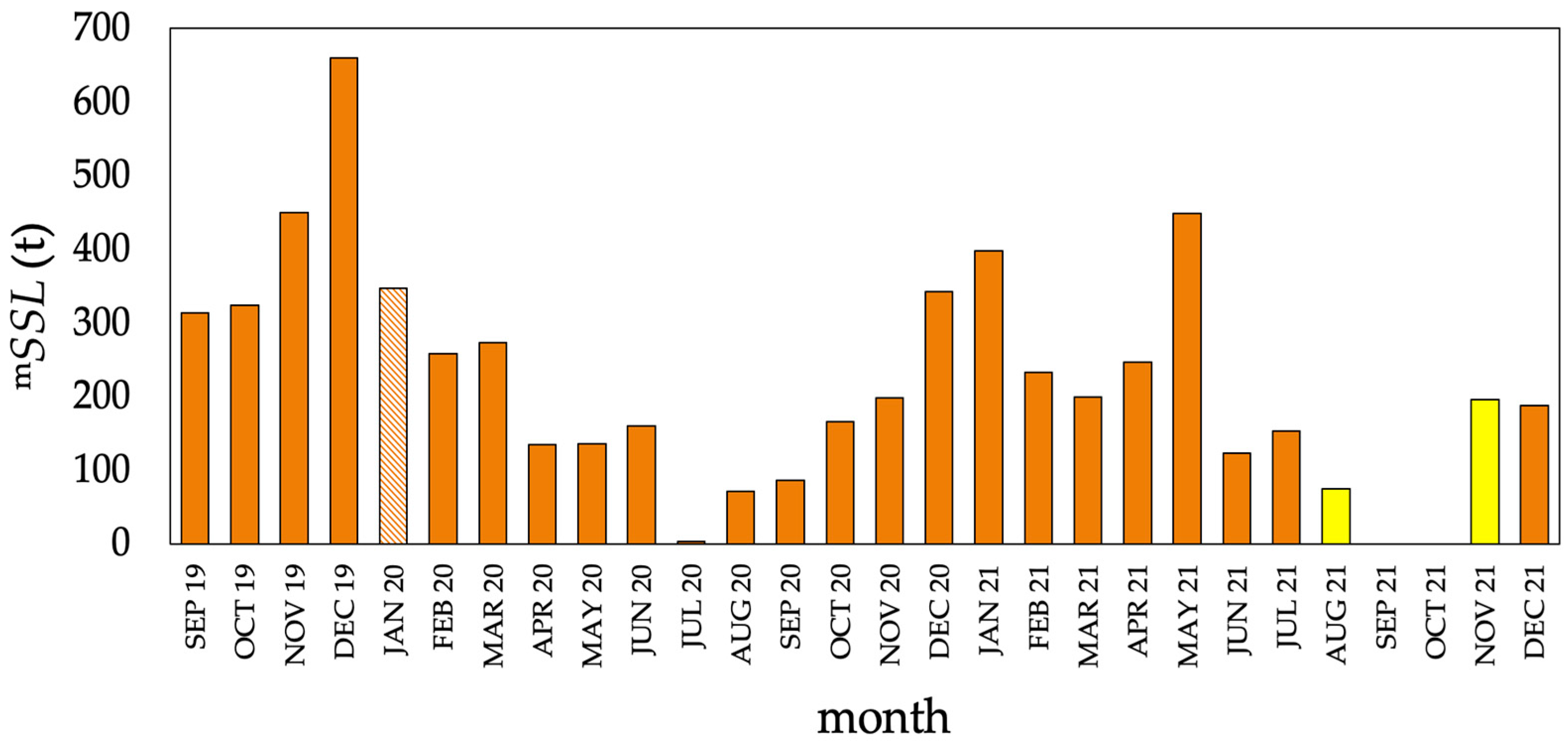
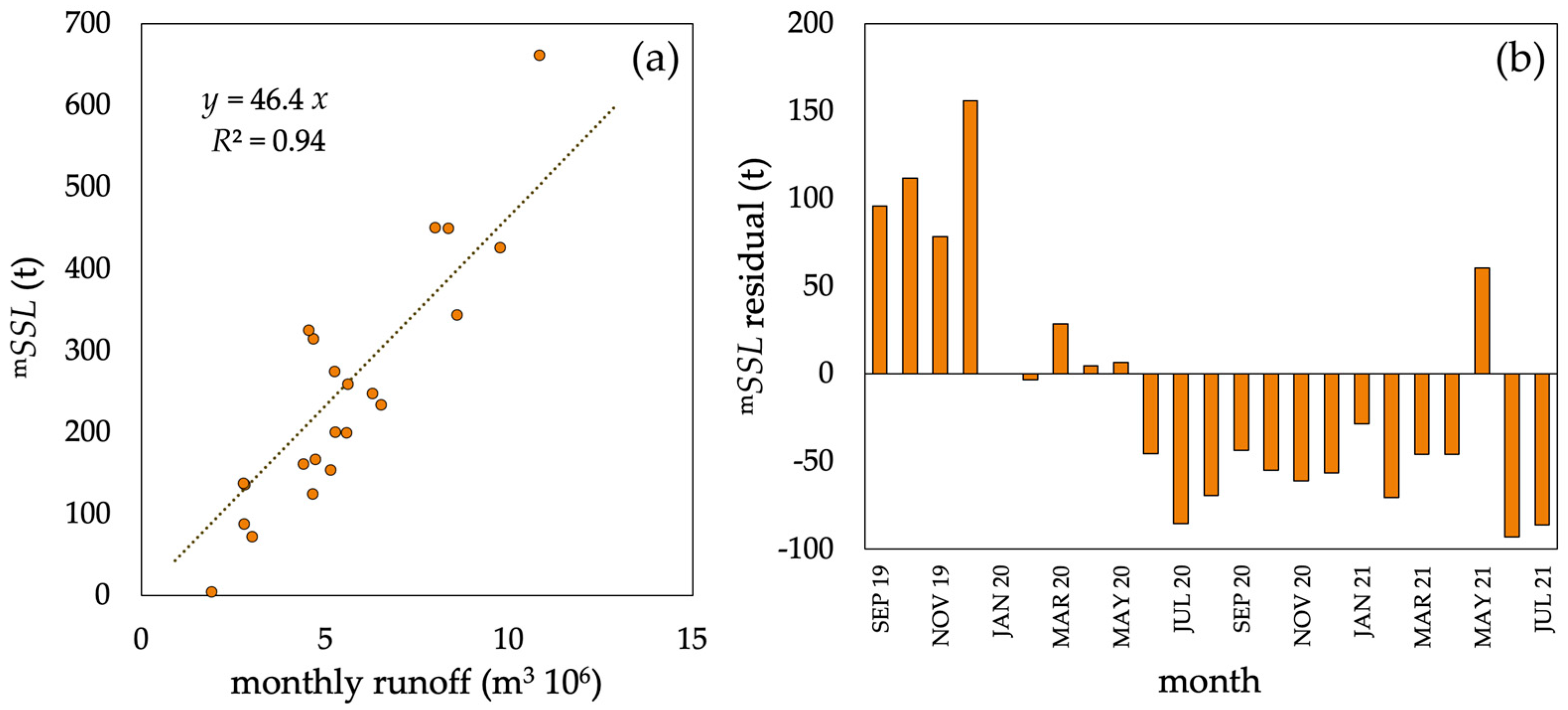
The SSL time series at cross-section OS covers the entire study period at a 15-min resolution. Monthly SSL (mSSL) trends are presented in Figure 7, which includes partial data for August and November 2021. For WY1, missing SSL for January 2020 was estimated using a linear regression between monthly runoff and SSL (see Figure 8a), derived from the longest continuous period available (September 2019–July 2021, excluding January 2020). With a monthly runoff of 7490 × 103 m3, the regression estimated a load of 350 t. Total SSL for WY1 was therefore 3100 t (2800 t from the eleven measured months plus 350 t estimated).
For WY2, total SSL over the 335-day period was ~2700 t (2600 t for eleven complete months plus 75 t for the first 12 days of August 2021). This value underestimates the true annual load because sediment export continued during the subsequent observation gap. Although hydraulic regulation (typically active in summer—see Section 3.3) prevents accurate discharge reconstruction, the rainfall pattern during the gap [70] did not resemble conditions associated with flood-generating events in the basin (based on the analysis of 16 flood events, see Section 3.2.3). The unmeasured interval therefore likely reflects ordinary low-flow conditions, implying only a minor underestimation of the annual load.
Based on these estimates, the mean annual suspended sediment load for the monitored period was calculated at 2900 ± 330 t (mean ± SD).
Despite the higher mean discharge in WY2 (2.3 vs. 1.9 m3 s−1), WY1 produced a substantially greater sediment load (3100 vs. 2700 t), primarily due to the higher frequency and magnitude of flood events in WY1 (see Section 3.2.3).
Integrating the monitoring data with the bathymetric estimates allows for an approximation of the trapping efficiency of the system. As detailed in Section 3.1.2, the total sediment retention within the surveyed area is 400 t yr−1, composed of 270 t yr−1 deposited upstream of cross-section OS and 130 t yr−1 deposited downstream (up to the channel mouth). To reconstruct the gross sediment input entering from the catchment, the mean annual load measured at cross-section OS (~2900 t) must be added to the upstream retention (~270 t), yielding a total influx of ~3200 t yr−1. Conversely, subtracting the downstream deposition (130 t yr−1) from the measured load indicates that the effective net export to the lagoon is ~2800 t yr−1. Consequently, the estuarine systems traps approximately 12% of the incoming suspended sediment load, with an estimated uncertainty of ±3% based on the propagation of volumetric and ρDB errors (as detailed in Appendix C).
To further investigate the discharge-driven mechanism, a zero-intercept linear regression was performed using mSSL as the dependent variable and monthly runoff as the predictor (Figure 8a). The analysis yields excellent predictive performance (R2 = 0.94, root mean square error, RMSE = 70 mg L−1, p < 0.001). This strong linearity confirms that the system is advection-dominated, where sediment export is regulated primarily by the hydrodynamic volume exchanged rather than by uncoupled fluctuations in sediment supply, e.g., [71,72].
The regression slope (46.4 ± 2.4 mg L−1; 85% CI: 41.4–51.4 mg L−1) represents the effective export concentration of the system, mathematically equivalent to the flow-weighted mean SSC [24,73]. This value is higher than the time-averaged mean of the continuous data series (35 mg L−1) because the regression intrinsically gives more weight to high-discharge periods, which transport the vast majority of the cumulative sediment load. This distinction highlights that the effective export concentration is controlled by flow magnitude.
Analysis of the regression residuals (Figure 8b)—defined as the difference between observed and predicted SSL—highlights temporal deviations from this mean trend. Positive residuals in late 2019 indicate a phase of “surplus export,” likely resulting from a combination of elevated upstream sediment supply and internal flushing of antecedent storage.
In contrast, the subsequent period (2020–2021) is characterized by almost systematic negative residuals. These values indicate months where the actual sediment export fell below the hydrodynamic potential, suggesting that depositional processes such as settling lag and tidal trapping became prevalent [64]. The resulting algebraic sum of residuals is negative (−250 t, corresponding to ~−130 t yr−1). This deficit aligns qualitatively with bathymetric evidence of net siltation, confirming the tendency of the estuary to function as a sediment trap during average hydrometeorological conditions.

3.2.3. Impact of Flood Events on Annual Q and SSL

The analysis of flood events is fundamental for understanding the dynamics of freshwater and suspended-sediment transport, as floods typically mobilize and export a disproportionately large share of the annual suspended and particulate load, e.g., [74,75,76].
Flood events were identified using a numerical threshold approach. In this study, a flood condition was defined when the 25-h moving average of Q consistently exceeded a reference threshold of 3 m3 s−1 (corresponding to ~1.5 times the mean annual discharge, maQ, of 2.1 m3 s−1).
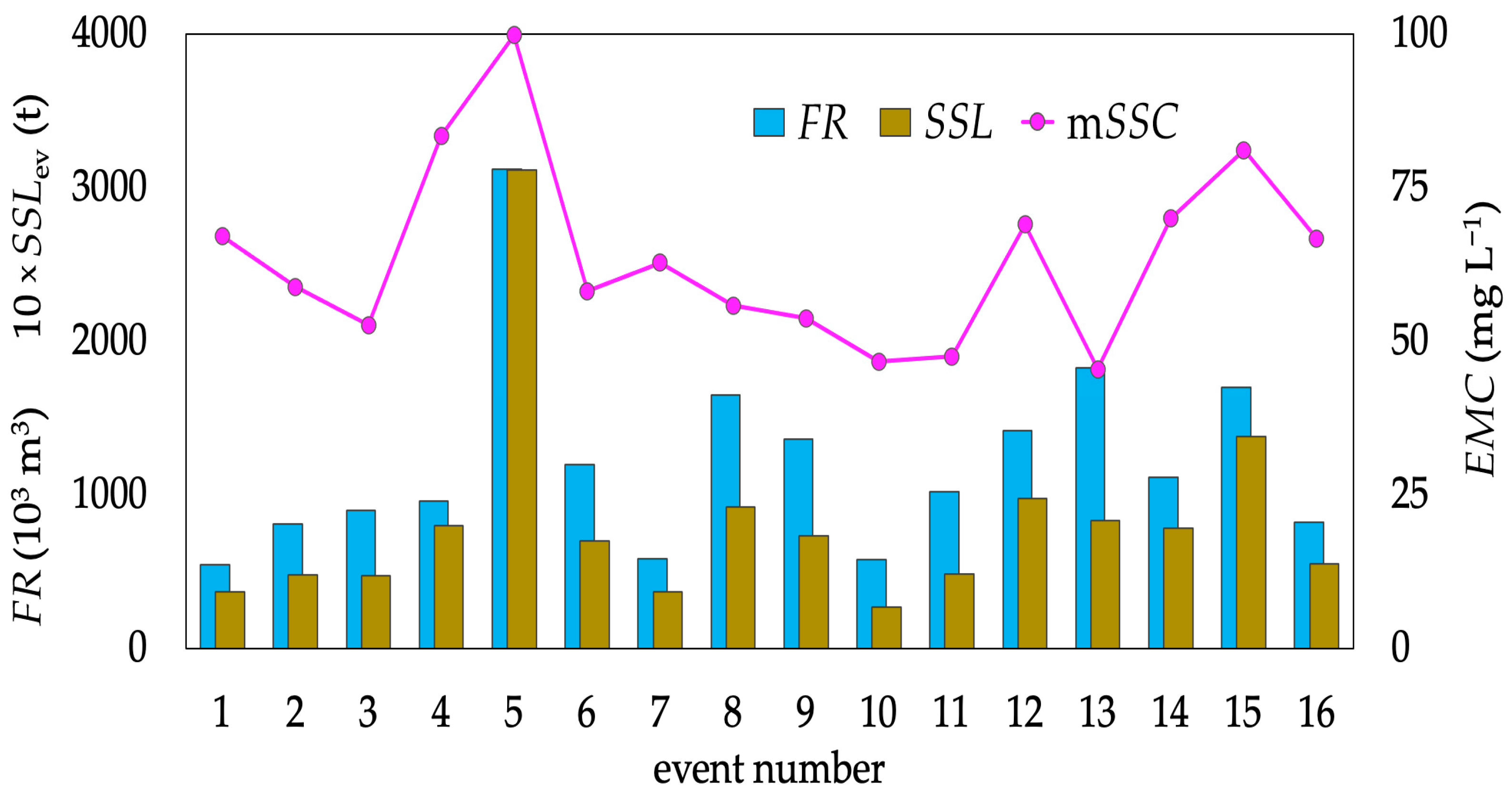
Table 2 summarizes the main hydrological and sediment transport characteristics of the 16 flood events identified between September 2019 and December 2021. For each event, the meteorological forcing is described by rainfall duration (RD) and total rainfall volume (TR), while the maximum hourly rainfall intensity (MR) captures peak precipitation. The hydrological response of the catchment is characterized by flood duration (FD) and maximum discharge (Qpeak), with flood runoff (FR) representing the overall water volume discharged during each event. Average discharge (Qavg), calculated as FR/FD, represents the flow rate sustained throughout the flood and is considered a proxy of the average hydraulic energy available for potential sediment mobilization.
Regarding sediment transport, the total export was quantified using the event suspended sediment load (SSLev), defined as the cumulative mass of particulate matter transported during each flood event. Two additional metrics were derived to further characterize sediment dynamics. The first is the event mean concentration (EMC), calculated as SSLev/FR, which represents the flow-weighted average suspended sediment concentration, and thus reflects sediment availability independently of flood duration, e.g., [77,78]. The second is the mean suspended sediment load rate (SSLrate), calculated as SSLev/FD, which expresses the temporal intensity of sediment export and represents the average suspended sediment flux maintained over the course of the event, e.g., [73].
The cumulative suspended sediment load transported during the 16 identified events (Figure 9) totals 1300 t. When compared with the combined load estimated for the two hydrological years (WY1 and WY2; 5800 t), these events contribute to ∼23% of the total sediment export. This highlights the disproportionate influence of high-magnitude flow episodes: although they represent only ~4% of the total study period (cumulative FD of 714 h), they are responsible for nearly one quarter of the catchment sediment yield.
In this context, the flood event of 22 December 2019 (event 5) emerges as an outlier owing to its exceptional magnitude in both peak discharge (Qpeak of 28.5 m3 s−1) and transported sediment load (SSL of 310 t). This single event accounted for ~10% of the mean annual SSL of WY1 (3100 t).
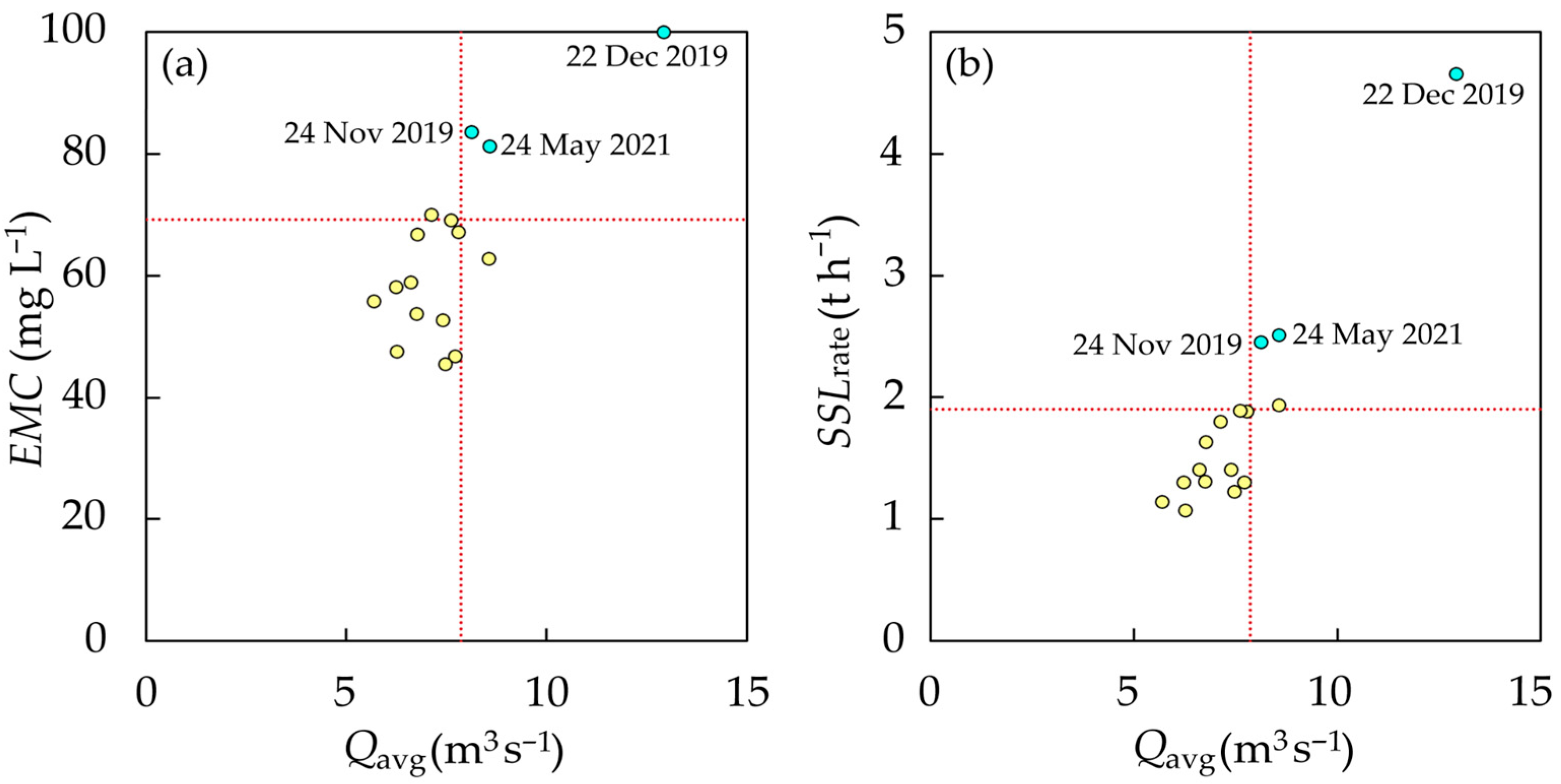
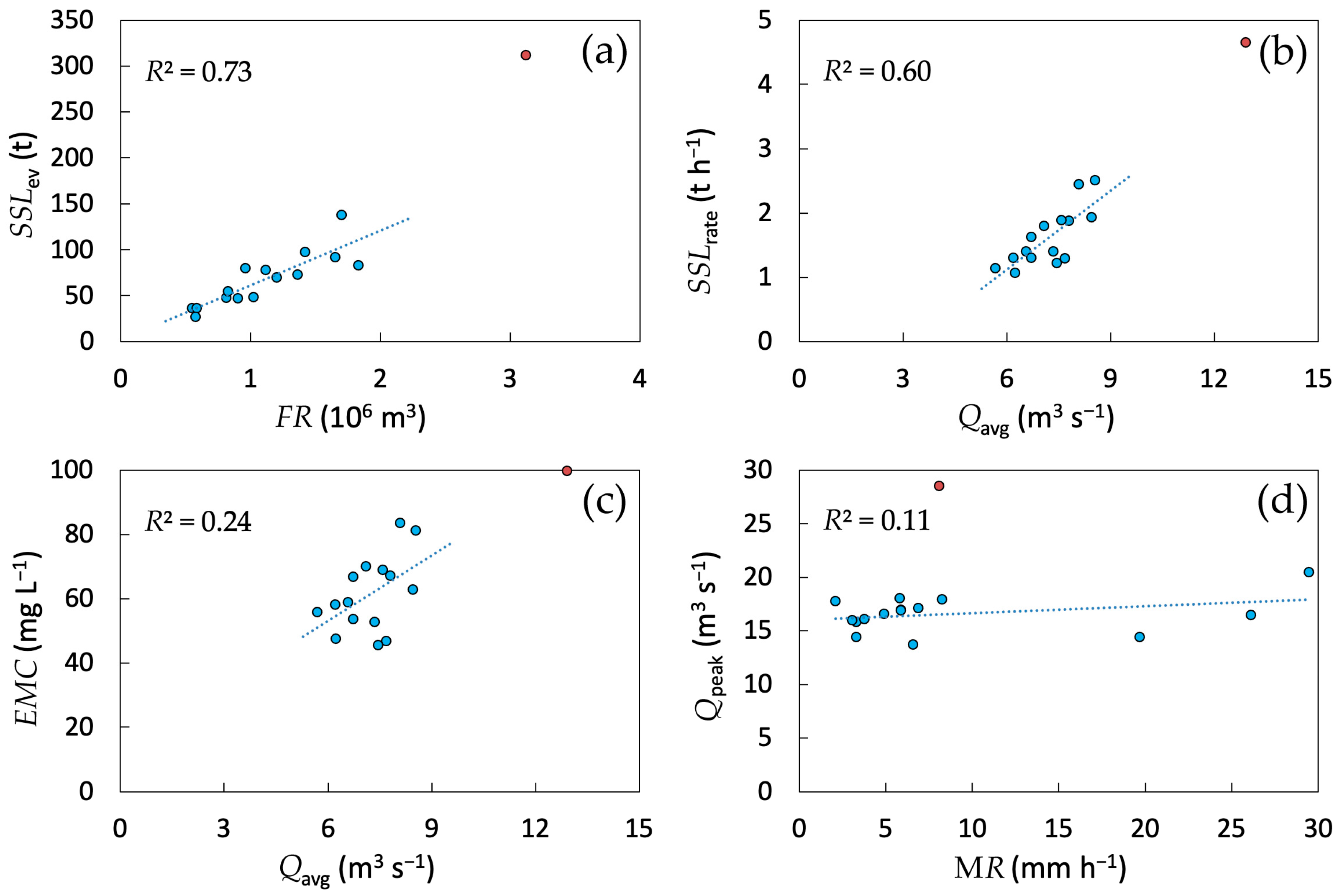
To explore broader controls on sediment export, correlation and linear regression analyses were applied to the flood metrics summarized in Table 2 (see Appendix D for methodological details). The December 2019 event was excluded from the regression models because it acts as a high-leverage outlier. Its inclusion would numerically dominate the slope, masking the transport dynamics of ordinary events. However, the event is still shown in Figure 10 and Figure A4 to provide a full context for the observed extremes.
In the resulting dataset (n = 15), a moderate correlation was found between TR and FR (R2 = 0.41, p < 0.05), suggesting that runoff generation is controlled by factors beyond direct precipitation. This pattern likely reflects the strongly regulated regime of the catchment. Moreover, MR showed no significant correlation with Qpeak (R2 = 0.11, p > 0.05), further highlighting the substantial hydraulic buffering capacity of the basin.
In contrast, flood runoff (FR) emerged as the primary driver of the total sediment yield (SSLev, R2 = 0.73, p < 0.001). The correlation between Qavg and SSLrate was also significant (R2 = 0.60, p < 0.01), supporting the interpretation of a predominant transport-limited system, in which sediment export rate is largely governed by the available hydraulic energy. Conversely, the weak correlation between Qavg and EMC (R2 = 0.24, p > 0.05), reflects the inherently high variability in suspended sediment availability, likely driven by complex processes such as hysteresis or source exhaustion.
In estuarine systems, flood events are known to remobilize previously deposited sediment from the channel bed and banks, although the intensity of this process can vary significantly among events, e.g., [79,80]. These dynamics have recently been documented in another tributary of the Venice Lagoon [34].
To identify floods with enhanced capacity to remobilize in-channel sediment deposits, the subsequent analysis focused on three key metrics used as proxies for mobilization intensity: average discharge (Qavg), representing hydrodynamic energy; event mean concentration (EMC), reflecting suspended sediment availability; and sediment export rate (SSLrate), indicating the intensity of sediment transport. Because total event load (SSLev) is cumulative and thus dependent on event duration, these metrics provide more direct indicators of the erosive power and sediment mobilization potential of individual floods.
Thresholds were defined using the 75th percentile of each parameter, calculated from the 15 ordinary flood events after excluding the extreme December 2019 event. This exclusion allows characterization of the upper range of the standard hydrological regime without distortion from an anomalously large outlier. Indeed, a comparison between event 5 and the second-largest event (event 15) reveals a clear discontinuity in hydrological scale: Qavg is ~50% higher (12.9 vs. 8.5 m3 s−1), while SSLrate increases by ~85% (4.7 vs. 2.5 t h−1) underscoring the exceptional nature of the December 2019 event.
Such disproportionate increase suggests that the extreme event likely activated non-linear physical processes—such as the entrainment of partly consolidated bed deposits or mobilisation of more distant sediment sources—that do not occur during ordinary floods, e.g., [81,82]. A sensitivity analysis confirmed the robustness of the threshold-selection approach: including the outlier in the percentile calculation produced only minor changes (<2%) and would not affect the identification of high-magnitude events.
The resulting thresholds were: Qavg = 7.9 m3 s−1, EMC = 68 mg L−1, and SSLrate = 1.9 t h−1. Figure 10 visualizes the relationship between hydrodynamic forcing and sediment transport response using two quadrant plots (EMC vs. Qavg and SSLrate vs. Qavg), with the defined thresholds delineating four distinct sectors. The extreme event of 22 December 2019 is included in these visualizations to highlight its magnitude relative to the ordinary hydrological regime.
Events located in the upper-right quadrant exceed both hydrodynamic and sediment transport thresholds, indicating high erosive capacity and efficient sediment mobilization. In addition to the extreme flood of December 2019, two other events fall into this category: 24 November 2019 (event 4) and 24 May 2021 (event 15). These three events alone account for approximately 40% of the total SSLev recorded across the 16 monitored floods, with the December 2019 event alone contributing ~24%.
These high-magnitude events correspond to the three months that exhibited positive residuals in the regression between monthly SSL and runoff (Figure 8b). This consistency indicates a surplus of sediment export relative to what would be expected from runoff alone. The positive residuals suggest that during these events the system operated with higher transport efficiency, contributing to monthly sediment load that exceeded the regression-based predictions.
The remaining two instances of positive residuals, namely September and October 2019, occurred under markedly different conditions. Despite moderate monthly rainfall totals (55 and 47 mm [68], respectively; recorded at the rainfall station 6, Trebaseleghe, in Figure 1) and runoff values below the study period average (Figure 6), suspended sediment transport rates were notably elevated. This pattern is consistent with a “first flush” effect [83,84], in which fine sediment stocks—accumulated or prepared by soil weathering and agricultural activity during the preceding dry summer—are rapidly mobilized by the early autumn rainfall events.

3.3. Rainfall-Runoff Analysis

The monthly comparison between rainfall volumes over the basin and runoff volumes transferred to the lagoon by the Osellino Canal provides insights into regional hydrological dynamics and reveals the combined influence of land management practices and hydraulic regulation on water balance [85,86].
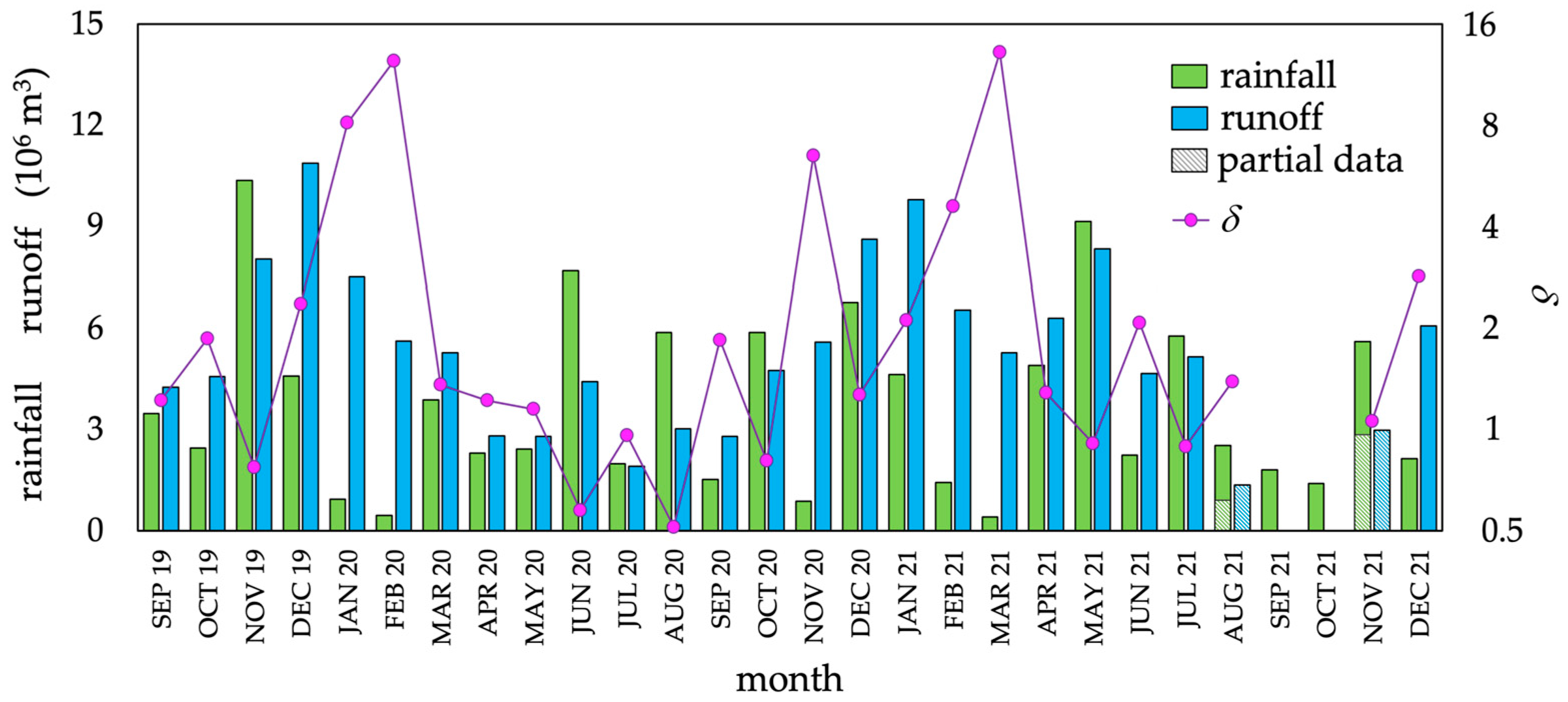
Monthly rainfall and runoff data for the monitoring period are presented in Table 3, which also includes data from 1999 [87] for comparative purposes and reports the runoff coefficient (δ), defined as the ratio of runoff to rainfall volumes [88,89]. It should be noted that complete runoff data for August–November 2021 are unavailable due to an instrumentation malfunction; partial data corresponding only to the operational days in these two months are reported in parentheses.
The temporal patterns of the rainfall-runoff relationship and the runoff coefficient are graphically represented in Figure 11.
The analysis of these trends highlights the complex interactions between meteorological forcing and anthropogenic water regulation within this managed basin. In 1999, the system exhibited a near-balanced regime, with a mean δ of 1.05 (±0.44), typically exceeding 1 during colder months and dropping below 1 in warmer periods.
Although a direct comparison of absolute runoff volumes is limited by the relocation of the monitoring station (from OS2 in 1999 to OS in the current study), δ provides a consistent dimensionless proxy for basin behaviour.
In contrast, the current study period shows both a higher mean value and significant variability in δ (3.04 ± 3.80 in 2020 and 3.47 ± 4.06 in 2021). The coefficient peaked at 13.1 in March 2021 and 12.3 in February 2020, coinciding with periods of particularly low rainfall. Analogous dynamics were recently reported for the neighbouring Dese River basin by [34], who documented a similarly elevated runoff coefficient (8.4) This response was attributed to persistent river discharge maintained by spring-fed inputs and other external contributions despite precipitation only amounting to about 10% of the long-term monthly average.
In the Osellino basin, the persistence of significant runoff during dry spells similarly indicates that the water balance is not solely driven by precipitation. It is plausible that modern runoff management practices play a significant role, leveraging external water sources and adjustable hydraulic structures to maintain adequate flow levels regardless of natural rainfall patterns [46]. A pivotal component is likely the tilting-gate weir installed in the early 2000s, located ~3.6 km upstream from the measurement cross-section. Designed to regulate flow and prevent saltwater intrusion, this infrastructure facilitates controlled releases from external sources during dry winter months. Such operational strategies would explain the anomalously high runoff coefficients observed in months such as February 2020 and March 2021.
Conversely, during summer months, management strategies prioritize minimum environmental flow requirements while accounting for high evapotranspiration rates and irrigation demands. This results in lower, yet relatively stable, runoff coefficients. Furthermore, the system may receive diverted water from upstream catchments to enhance flow circulation and maintain water quality, a factor that could further contribute to the complex rainfall-runoff dynamics and the significant variability of the coefficient documented in this study.

4. Conclusions

This study provides a comprehensive assessment of the hydrosedimentary dynamics of the Osellino Canal prior to the restoration of hydraulic infrastructures in its estuary. The integration of high-resolution monitoring and bathymetric analysis leads to the following conclusions:
  • Hydrological Shift: The system has transitioned from a near-balanced rainfall-runoff regime (as observed in 1999) to a highly regulated state. The current anomalous runoff coefficients (δ ≫ 1, peaking near 13 during dry periods) demonstrate that hydrodynamics is now primarily sustained by anthropogenic water management and external inputs rather than precipitation.
  • Advection-Dominated Export: A strong linearity between monthly runoff and suspended sediment load confirms an advection-dominated regime. Sediment export is regulated primarily by the hydrodynamic volume exchanged (averaging 2.1 m3 s−1) rather than by fluctuations in sediment supply. While tidal forces continuously rework an internal sediment pool, the net export to the lagoon remains constrained by the system’s hydraulic capacity.
  • Event-Driven Transport: Analysis of regression residuals for the monthly runoff-load relationship highlights a dual pattern: a systematic sediment deficit during average conditions—where settling and tidal trapping prevail—and episodic “surplus” export during flood events. Despite representing only 4% of the study period, these events account for 23% of the total annual sediment load (~2900 t).
  • Siltation and Trapping Efficiency: The estuarine system acts as a significant sediment trap, retaining approximately 12% of the gross annual sediment input. This has resulted in a net accumulation of 400 t yr−1 and aggradation rates exceeding 4 cm yr−1 in key sectors, markedly reducing the channel hydraulic efficiency.
  • Infrastructural Drivers: The long-term malfunction of the miter gates at Le Rotte is identified as a primary driver of this evolution. The inability to regulate tidal fluxes has forced freshwater discharge exclusively through the main mouth while causing stagnation and unregulated tidal intrusion in the secondary branch.
These results establish a critical baseline for evaluating the effectiveness of ongoing morphological and hydraulic rehabilitation. With increasing relative sea-level, estuaries and wetlands in urbanized areas will require continued interventions to ensure efficient drainage of the mainland while preserving their ecological functions and services. It is therefore fundamental to learn from real-world experience how engineered protection structures and their management impact on natural sediment transport processes and morphohydrodynamics. While sedimentary budgets are subjected to methodological uncertainties, they provide a reliable assessment of the order-of-magnitude of the system response that is essential for evaluating the success of the anthropogenic interventions and their future management.

Author Contributions

Conceptualization, L.Z. and R.Z.; methodology (data analysis design), J.D., J.-L.L. and R.Z.; methodology (experimental data acquisition), G.L., G.M., G.M.S.; validation, G.L., G.M. and R.Z.; formal analysis, G.L., G.M., G.M.S. and R.Z.; investigation, D.C., S.L., G.L., G.M. and G.M.S.; resources, D.C., G.L. and G.M.; data curation, S.L., G.L., G.M. and G.M.S.; writing—original draft preparation, R.Z.; writing—review and editing, J.D., J.-L.L., L.Z. and R.Z.; visualization, G.M.S., S.L. and R.Z.; supervision, L.Z. and R.Z.; project administration, R.Z.; funding acquisition, R.Z. All authors have read and agreed to the published version of the manuscript.

Funding

The research is part of the research programme Venezia2021 (Scientific research program for a “regulated” lagoon), coordinated by CORILA (Consortium for coordination of research activities concerning the Venice Lagoon system) and funded by the Ministero delle Infrastrutture e dei Trasporti (Provveditorato Interregionale per le Opere Pubbliche del Veneto—Trentino Alto Adige—Friuli Venezia Giulia), grant number 21/18/AC_AR02 (4 December 2018).

Data Availability Statement

The datasets presented in this article are not readily available because dissemination requires authorization from the funding authority. Requests to access the datasets should be directed to the corresponding author.

Acknowledgments

We thank Loris Dametto (ISMAR CNR) and Daniele Curiel and Emiliano Checchin (SELC, Venice, Italy) for their support during fieldwork. Caterina Dabalà (CORILA) provided assistance in adhering to the project plan, and Paola Focaccia (ISMAR CNR) handled the administrative aspects of the project. Alessandro Zonta provided assistance in managing the large dataset. The authors also gratefully acknowledge the staff of the Consorzio di Bonifica Acque Risorgive for their valuable insights and discussions regarding the study findings, particularly Director Carlo Bendoricchio and Martino Cerni. Roberto Chiarlo (Corr-Tek Idrometria, San Giovanni Lupatoto, VR, Italy) assisted in the installation and calibration of the measuring station in the main river section OS. Precipitation data were kindly provided by the Meteorological Center of Teolo (Padua, Italy) of the Agenzia Regionale per la Prevenzione e Protezione Ambientale del Veneto (ARPAV). Te.Ma. (Faenza, RA—Italy) conducted the bathymetric surveys in 2011. Claude (Anthropic) and Gemini (Google) were used for literature search support, language editing, and manuscript refinement. All content, data analysis, and scientific conclusions are the sole responsibility of the authors.

Conflicts of Interest

The authors declare no conflicts of interest. The funders had no role in the design of the study; in the collection, analyses, or interpretation of data; in the writing of the manuscript; or in the decision to publish the results.

Appendix A. Calibration Performance and Uncertainty Assessment

This appendix provides technical details regarding the validation of the monitoring data and the estimation of uncertainties for the volumetric budget. Appendix A.1 evaluates the calibration of discharge (Q) and suspended sediment concentration (SSC) measurements at the reference cross-section. Appendix A.2 and Appendix A.3 focus on the bathymetric surveys, describing the estimation of vertical uncertainty and the evaluation of different approaches to propagate this error into the final volumetric calculations.

Appendix A.1. Performance of Q and SSC Calibration

This appendix evaluates the discharge (Q) and suspended sediment concentration (SSC) measurements at cross-section OS, by comparing field data from the fixed SLD instruments to the corresponding reference measurements. These results summarize the performance of the calibration procedures described in Section 2.3.
Calibration diagrams for Q and SSC are shown in Figure A1. The relationship between instantaneous discharge (Qi) measured in the field and continuous discharge (Q) recorded by the automatic station, calculated using 150 data pairs (Figure A1a), was fitted with zero intercept (physically justified as zero discharge must yield zero measurement) and showed strong agreement (R2 = 0.96, p < 0.001), with a RMSE of 1.2 m3 s−1. The regression slope of 1.03 ± 0.02 (95% CI: 1.00–1.07) indicates a slight systematic offset of ~3%, which falls within the overall uncertainty of both measurement systems.
The relationship between log10 SSC and mean acoustic backscatter (mean SCB), calibrated using 41 water samples collected during the vessel surveys (Figure A1b), yielded R2 = 0.73 (p < 0.001) with a slope of 0.0256 ± 0.0025 (95% CI: 0.0206–0.0306) and an intercept of −1.27 ± 0.26. The model showed a RMSE of 0.11 in log10 units, corresponding to 7.1 mg L−1 in linear scale (25% of mean concentration). This R2 value is consistent with those reported in comparable acoustic calibration studies for fine suspended sediment, e.g., [90]: R2 = 0.65; [91]: R2 = 0.74. The SSC calibration range, spanning from 11 to 59 mg L−1, covered 90% of all measurements recorded during the study period.
Figure A1. Calibration diagrams for discharge and suspended sediment concentration at the OS cross-section. (a) Performance of the discharge algorithm: regression between 150 pairs of instantaneous discharge measurements (Qi) obtained by a vessel-mounted ADCP and corresponding continuous discharge (Q) recorded by the fixed SLD instrument. (b) SSC calibration: regression between 41 pairs of log-transformed suspended sediment concentration (log10 SSC) and mean acoustic backscatter (mean SCB) from the SLD, averaged over nine cells and corrected for signal attenuation.
Environments 13 00112 g0a1

Appendix A.2. Vertical Uncertainty and DoD Limit of Detection

The vertical uncertainty for the 2011 (multibeam) and 2019 (singlebeam) surveys was estimated using the Total Vertical Uncertainty (TVU) formulation [92,93]:
T V U = ± ( a 2 + ( b × d ) 2 )
where a is the constant depth-independent error and b is the coefficient for the depth-dependent component. In this study, we set a = 1 cm and b = 0.1%, where the latter represents the nominal instrument error relative to the local depth d. This choice is justified by the use of RTK-derived instantaneous vertical positioning, which avoids the uncertainties associated with external tide gauge corrections and water-level interpolation [94].
Furthermore, the surveys were conducted under ideal environmental conditions within a sheltered estuarine reach, characterized by the absence of wind-waves, significant currents, or vessel-induced motion (pitch, roll, and heave) during acquisitions.
Given the shallow depth of the system (mean depths of 0.96 m in 2011 and 0.82 m in 2019), the depth-dependent component remains negligible for both surveys, and the constant component a dominates the error budget, resulting in a TVU ≈ 1 cm for both datasets.
The uncertainty of the bathymetric difference (Difference of DEMs-DoD) was calculated via error propagation [95,96] as:
σ DoD = T V U 2011 2 + T V U 2019 2 1.4   cm
To align with international hydrographic standards, we adopted a 95% confidence interval for the Limit of Detection (LoD95), calculated as 1.96⋅σDoD = 2.8 cm.

Appendix A.3. Volumetric Uncertainty Comparison and Method Selection

Two different approaches were evaluated to propagate the vertical LoD95 into the final volumetric budget (V = 4129 m3 over a raster surface area A = 30,275 m2, discretized into 1211 cells of 5 × 5 m).
Method A (the “contour-band” or thresholded-volume approach): Following Byrnes et al. [92], the uncertainty is derived from the volume of sediment within the “uncertainty band”, where the vertical change (Δz) falls below the detection threshold (0 ≤ Δz < 2.8 cm). In our reach, only 118 cells out of 1211 (9.7% of the area) fall below this threshold. Even assuming a conservative upper bound for these cells (calculated as cell area × LoD95), this method yields a very low volumetric uncertainty of approximately ± 83 m3 (about 2% of the resulting total volume).
Method B (conservative area-wide bound): This approach applies the LoD95 uniformly across the entire surveyed surface (EV = A × LoD95), resulting in a significantly higher uncertainty estimate of ±848 m3 (approximately 20.5% of the resulting total volume).
While Method A reflects the high precision of the RTK measurements and shows that the observed deposition is overwhelmingly significant, we opted for the more rigorous Method B for the data discussion. This choice provides a conservative upper bound that accounts for both measurement precision and the fact that, while random errors tend to cancel out over large areas, systematic surface representation errors do not [92,97]. In our case, such errors may arise from the interpolation of the 2019 singlebeam data into a continuous surface. Furthermore, this approach is consistent with the observation that thresholding at 95% can exclude a significant fraction of the volumetric change when deposition is shallow and widespread [98], ensuring that our estimate of 4129 m3 remains robust even under conservative assumptions.

Appendix B. Flow Partitioning at Le Rotte Based on Field Measurements

Direct discharge measurements were performed at three cross-sections (OS, OS2, OS3) during seven field campaigns conducted between September 2019 and May 2021, yielding 37 measurement sets (snapshots) across a range of tidal stages. The objective was to characterize the drainage patterns from OS2 towards the main canal mouth (OS) and the San Giuliano-Tessera Canal (OS3) during ebb tide, and to quantify the partitioning of tidal flux from OS towards the upstream channels (OS2 and OS3) during flood tides. Concurrent vertical profiles of salinity, temperature, and turbidity (FTU) were also acquired along the water column at each cross-section.
Measurements at the three cross-sections were acquired sequentially and completed within approximately 30 min, which introduces some temporal variability in the observed flow partitioning.
Field campaigns primarily targeted the characterization of ebb-tide flow toward the lagoon, as this is the phase relevant for evaluating sediment loads exported from the watershed. Of the 37 collected snapshots, two were discarded during a preliminary screening due to evident flow reversal occurring during the sampling sequence. The remaining 35 snapshots included 28 collected during ebb tide and 7 during flood tide.
To ensure data quality, measurement sets were screened based on mass balance closure between the three sections. Only snapshots with a relative discharge balance error below 30% were retained, a threshold chosen to account for both non-simultaneity of the measurements and the natural tidal variability during the total 30-min acquisition window. Applying this criterion resulted in 18 acceptable ebb-tide measurements and 5 acceptable flood-tide measurements.
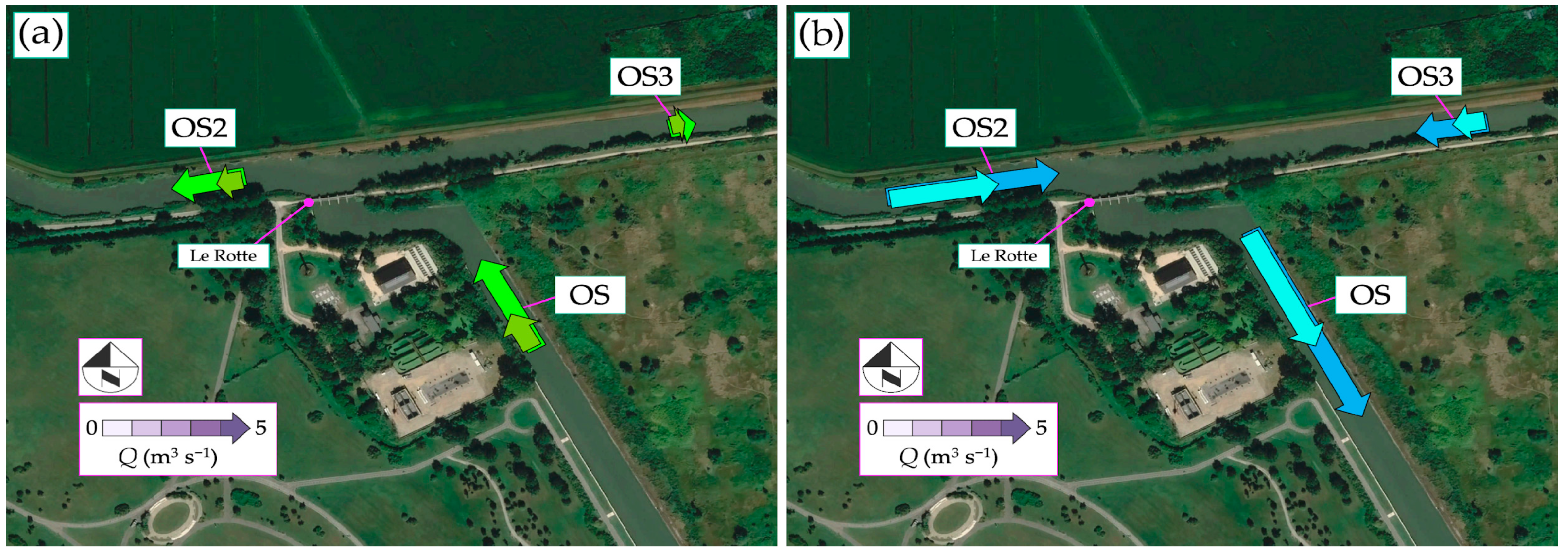
Figure A2 presents a schematic summary of flow partitioning during the measurement campaigns. During flood tide (Figure A2a), tidal intrusion through OS is divided between the upstream Osellino Canal (OS2) and the San Giuliano-Tessera Canal (OS3). Based on the 5 validated flood-tide measurement sets, mean flow partitioning is 56% ± 11% (standard deviation, SD) toward OS2 and 27% ± 3% (SD) toward OS3. The sum of these fractions (≈83%) does not equal 100% because measurements at the three cross-sections were not performed simultaneously; thus, the evolving tidal field during the acquisition window introduces inconsistency among the instantaneous snapshots. Since Q can vary rapidly with time, each sequential measurement may capture a different hydrodynamic state. These estimates should therefore be interpreted as indicative of the order of magnitude of the partitioning, which is influenced by specific tidal conditions (e.g., tidal range, water levels within the system) and by the fixed hydraulic configuration imposed by the malfunctioning miter gates at Le Rotte.
Figure A2. Flow partitioning during (a) flood tide and (b) ebb tide based on field measurements (background imagery: Google Earth ©Google, image date: 1 September 2020). Arrows indicate discharge magnitude and direction for two representative snapshots per tidal phase, with arrow length proportional to discharge according to the scale shown. (a) During flood tide, tidal intrusion entering through OS from the lagoon (green arrows) is partitioned between the upstream Osellino Canal (OS2) and San Giuliano-Tessera Canal (OS3). Snapshots shown: 28 September 2020, 08:30 (light green) and 12 September 2019, 09:40 (dark green). (b) During ebb, freshwater from OS2 flows exclusively toward the main mouth (OS), while return flow from OS3 drains residual brackish water. Snapshots shown: 28 September 2020, 09:50 (light blue) and 29 October 2020, 11:49 (dark blue).
Environments 13 00112 g0a2
During ebb tide (Figure A2b), no flow from OS2 toward the San Giuliano-Tessera Canal (OS3) was observed in any of the 18 retained field campaigns. Freshwater from the Osellino Canal (OS2) flowed exclusively toward the main mouth (OS). Among these 18 validated measurements, two cases recorded substantially zero flow at OS3, whereas the remaining 16 showed flow from OS3 toward OS, corresponding to a mean of 17% ± 9% (SE) of discharge at OS. These observations confirm that during ebb tide, the San Giuliano-Tessera Canal primarily drains the residual brackish water that intruded during the preceding flood tide, which then returns toward OS and contributes to the net discharge to the lagoon.
A singular exception was observed at the onset of the ebb phase, immediately following an elevated high tide peak, under weak flow conditions (Q at OS = 0.84 m3 s−1, Q at OS2 = 0.93 m3 s−1). In this instance, a small flow of 0.8 m3/s was recorded at OS3 toward the secondary mouth—opposite to the usual return flow—indicating a temporary hydraulic reversal induced by the elevated tidal level. However, this isolated event, occurring under atypical hydrodynamic conditions does not alter the overall conclusion that freshwater discharge usually does not reach the San Giuliano-Tessera Canal during ebb tide.
This flow pattern, driven by the malfunctioning miter-gate system at Le Rotte (with two of five gates permanently closed, one semi-open, and two permanently open), highlights the hydraulic disconnection of the San Giuliano-Tessera Canal from direct freshwater input during ebb tide. The ineffective operation of the gate system results in canal discharge occurring predominantly through the Osellino main mouth, while tidal influence propagates upstream past Le Rotte during flood tide. This configuration prevents effective flushing of the San Giuliano-Tessera Canal and contributes to the progressive sediment accumulation documented by the bathymetric analyses presented in the main text.
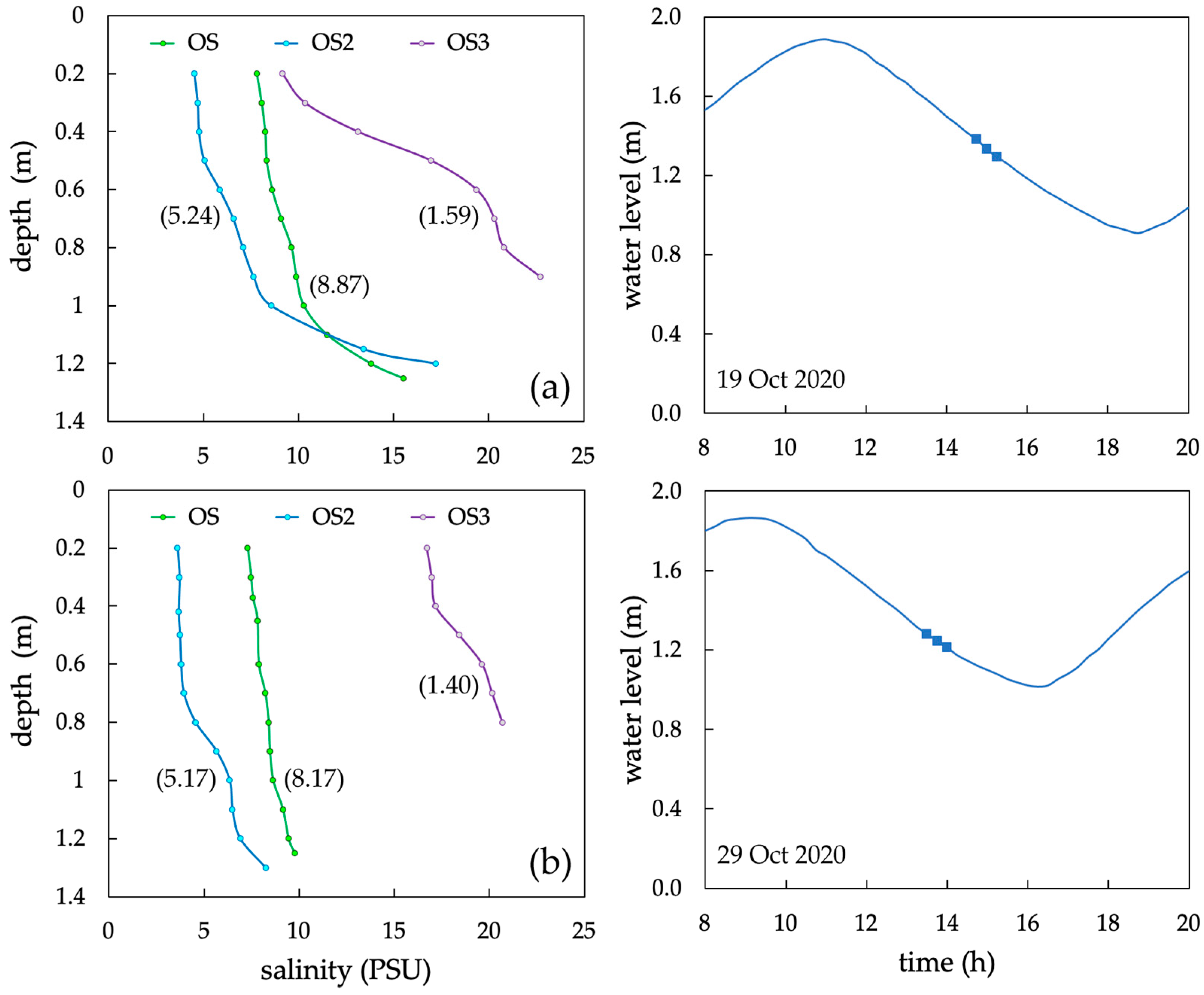
Representative salinity profiles for OS2 and OS3 are shown in Figure A3 to illustrate characteristic differences in water mass during ebb tide. Owing to the inherent variability of this shallow tidal system, these patterns are not uniformly observed across all field campaigns; however, they qualitatively support the distinct hydrodynamic behaviour of the two branches. Detailed measurements at cross-sections OS, OS2, and OS3 during various tidal stages are reported in [99].
Figure A3 presents two salinity profiles acquired on 19 October 2020 and 29 October 2020 during mid-ebb tide. For reference, salinity in the Venice Lagoon typically varies from marine values (~36 PSU) at the inlets to brackish conditions (<15 PSU) along the landward margin [100]. Instantaneous discharge values (Q) measured simultaneously with the profiles, are positive at all cross-sections, indicating flow directed toward the main mouth. In the first case (Figure A3a), the water column at OS2 shows a strong freshwater influence, with salinity increasing from 5 at the surface to 17 PSU near the bottom. In contrast, the flow through OS3 drains residual brackish water originating from OS and retained from the previous flood, with salinity ranging from 10 at the surface to 23 PSU at depth. The water column at OS shows intermediate salinities (8–16 PSU) reflecting the mixing of these two water masses, with a dominant contribution from the freshwater flux through OS2 (Q = 5.24 m3 s−1).
Under similar outflow conditions in the second case (Figure A3b), the water column at OS2 again shows predominantly fresh conditions (4–8 PSU), whereas the salinity at OS3 remains consistently higher (17–21 PSU). The salinity at OS is again intermediate (8–10 PSU), indicative of mixing of these two water masses, with freshwater from OS2 (Q = 5.17 m3 s−1) providing the primary contribution.
The distinct salinity contrast between the waters at OS2 and OS3 together with a discharge at OS3 (Q = 1.59 and 1.40 m3 s−1, respectively) directed toward OS, confirms the drainage of residual water from the lagoon during ebb tide and the absence of direct fluvial input from OS2 to the San Giuliano-Tessera Canal during ebb-tide conditions.
Figure A3. Vertical salinity profiles at cross-sections OS, OS2, and OS3 during mid-ebb tide on (a) 19 October 2020 and (b) 29 October 2020. Discharge values (m3 s−1) are reported in parentheses along each profile; all flows are directed toward the main mouth through OS. The right-hand panel shows the water level at OS (referred to ZMPS), with markers indicating the timing of measurements (local time).
Environments 13 00112 g0a3

Appendix C. Dry Bulk Density and Sediment Mass Assessment

This appendix details the laboratory procedures used to estimate the dry bulk density of the sediment and describes the methodology for calculating the total accumulated mass, including the propagation of uncertainties from both volumetric and densitometric measurements.

Appendix C.1. Dry Bulk Density Estimation from Sediment Core Analysis

To convert volumetric bathymetric changes to sediment mass, the dry bulk density of the sediment (ρDB) was estimated from three sediment cores collected in 2019 at cross-section OS, OS2, and OS3. Analysis was performed on the top 20 cm of each core. Water content (ω) was determined from an aliquot of sample dried in an oven at 105 °C until it reached constant weight [101]. Organic matter content was estimated by loss on ignition (LOI) after heating the sample at 550 °C for two hours [102]. The dry bulk density was then calculated from these measurements using standard procedures:
  • Density of solid particles (ρs):
    ρ s = ρ m i n e r a l × ( 1 L O I 100 ) + ρ o r g a n i c × ( L O I 100 )
    where LOI is expressed as a percentage, assuming ρmineral = 2.65 g cm−3 (quartz/silicates) and ρorganic = 1.25 g cm−3 (organic matter) [103,104];
  • Porosity (Φ) from ω:
    Φ = ω × ρ s 1 + ω × ρ s ω
    where ω is expressed as a mass fraction (0–1);
  • Dry bulk density (ρDB):
    ρ D B = ρ s × ( 1 Φ )
The measured organic matter content was generally low (8.3 ± 1.4%). Given this low LOI and the observed homogeneity of the mineral silt/clay fraction, the estimation of ρDB is primarily driven by ω, which was measured with high reproducibility (coefficient of variation, CV = 0.65%). The influence of the assumed densities for the solid phases (ρmineral and ρorganic) is negligible, as variations in these constants affect the final ρDB by less than 1.2%.
To account for vertical compaction over the survey period, the cumulative dry mass per unit area was plotted against depth of each core. Using a second-degree polynomial fit to represent ρDB at the mean deposited thickness (13.6 cm), we obtained a representative value of 0.73 ± 0.11 t m−3 (mean ± SD).

Appendix C.2. Total Sediment Mass and Uncertainty Propagation

The total mass of the accumulated sediment was estimated by multiplying the net deposition volume V by the average ρDB measured from the three sediment cores (0.73 ± 0.11 t m−3). Propagating both the conservative volumetric uncertainty (±800 m3; 20.5%) and the standard deviation of ρDB (0.11 t m−3; 15.9%), the total sediment mass was calculated as 3000 ± 800 t (at 95% confidence). The final uncertainty of approximately 26% reflects the combination of the conservative bathymetric error budget and the inherent spatial variability of the estuarine sediment properties.

Appendix D. Supplementary Statistical Analyses

This appendix provides supplementary statistical evidence supporting the analysis of flood dynamics and sediment transport drivers discussed in Section 3.2.3.
To characterize the relationships among meteorological forcing (e.g., TR, RD), hydrological response (e.g., FR, Qavg), and sediment export (e.g., SSLev, EMC), Pearson correlation analysis and linear regression models were applied. The results reported here refer to the subset of 15 flood events, excluding the extreme 22 December 2019 event, to ensure robust statistical inference and avoid leverage effects associated with this outlier.
Table A1 presents the triangular correlation matrix for the flood metrics defined in Table 2 of the main text. Figure A4 illustrates the linear regression plots for the most significant relationships. Notably, panel (b) supports the interpretation of a predominantly transport-limited regime, whereas panel (d) highlights the absence of a direct relationship between rainfall intensity and peak discharge, an effect consistent with the hydraulic buffering capacity of the catchment.
Table A1. Pearson correlation matrix for the flood event metrics defined in Table 2 of the main text (n = 15). Significant correlations (p < 0.05) are shown in bold.
RDTRMRmRFDQpeakQavgFRSSLevEMCSSLrate
h103 m3mm h−1103 m3 h−1hm3 s−1m3 s−1103 m3tmg L−1t h−1
RD1.00
TR0.691.00
MR0.100.651.00
mR−0.500.160.521.00
FD0.780.610.26−0.441.00
Qpeak0.070.340.330.55−0.081.00
Qavg−0.19−0.13−0.330.11−0.490.211.00
FR0.790.640.18−0.440.940.03−0.191.00
SSLev0.500.520.21−0.260.710.140.100.851.00
EMC−0.220.070.190.26−0.160.340.490.000.491.00
SSLrate−0.24−0.02−0.020.20−0.310.310.77−0.060.420.931.00
Figure A4. Linear regression analysis of flood events (n = 15). The regression lines and coefficients of determination (R2) are calculated excluding the extreme event of 22 December 2019 (indicated by the red circle). The light blue circles represent the flood events included in the regression. (a) Relationship between flood runoff (FR) and event suspended sediment load (SSLev); (b) average discharge (Qavg) and mean suspended sediment load rate (SSLrate); (c) Qavg and event mean concentration (EMC); (d) maximum rainfall intensity (MR) and peak discharge (Qpeak).
Environments 13 00112 g0a4

References

  1. Barbier, E.B.; Hacker, S.D.; Kennedy, C.; Koch, E.W.; Stier, A.C.; Silliman, B.R. The value of estuarine and coastal ecosystem services. Ecol. Monogr. 2011, 81, 169–193. [Google Scholar] [CrossRef]
  2. Newton, A.; Brito, A.C.; Icely, J.D.; Derolez, V.; Clara, I.; Angus, S.; Schernewski, G.; Inácio, M.; Lillebø, A.I.; Sousa, A.I.; et al. Assessing, quantifying and valuing the ecosystem services of coastal lagoons. J. Nat. Conserv. 2018, 44, 50–65. [Google Scholar] [CrossRef]
  3. Rodrigues-Filho, S.; Smith, J.A.; Turner, R.E. Economic valuation of coastal lagoon services: A global synthesis. Mar. Policy 2023, 137, 104934. [Google Scholar] [CrossRef]
  4. Howarth, R.; Chan, F.; Conley, D.J.; Garnier, J.; Doney, S.C.; Marino, R.; Billen, G. Coupled biogeochemical cycles: Eutrophication and hypoxia in temperate estuaries and coastal marine ecosystems. Front. Ecol. Environ. 2011, 9, 18–26. [Google Scholar] [CrossRef]
  5. Elliott, M.; Whitfield, A.K. Challenging paradigms in estuarine ecology and management. Estuar. Coast. Shelf Sci. 2011, 94, 306–314. [Google Scholar] [CrossRef]
  6. Kennish, M.J. Environmental threats and environmental future of estuaries. Environ. Conserv. 2002, 29, 78–107. [Google Scholar] [CrossRef]
  7. Lotze, H.K.; Lenihan, H.S.; Bourque, B.J.; Bradbury, R.H.; Cooke, R.G.; Kay, M.C.; Kidwell, S.M.; Kirby, M.X.; Peterson, C.H.; Jackson, J.B.C. Depletion, degradation, and recovery potential of estuaries and coastal seas. Science 2006, 312, 1806–1809. [Google Scholar] [CrossRef]
  8. Chilton, S.M.; Jones, N.; Reid, S. Human pressures on estuarine ecosystems: An overview. Estuar. Coast. Shelf Sci. 2021, 248, 107159. [Google Scholar] [CrossRef]
  9. Syvitski, J.P.M.; Vörösmarty, C.J.; Kettner, A.J.; Green, P. Impact of Humans on the Flux of Terrestrial Sediment to the Global Coastal Ocean. Science 2005, 308, 376–380. [Google Scholar] [CrossRef]
  10. Islam, M.S.; Tanaka, M. Impacts of pollution on coastal and marine ecosystems including coastal and marine fisheries and approach for management: A review and synthesis. Mar. Pollut. Bull. 2004, 48, 624–649. [Google Scholar] [CrossRef]
  11. Garcés-Ordóñez, O.; Saldarriaga-Vélez, J.F.; Espinosa-Díaz, L.F.; Canals, M.; Sánchez-Vidal, A.; Thiel, M. A systematic review on microplastic pollution in water, sediments, and organisms from 50 coastal lagoons across the globe. Environ. Pollut. 2022, 315, 120366. [Google Scholar] [CrossRef] [PubMed]
  12. Chee, S.Y.; Othman, A.G.; Sim, Y.K.; Adam, A.N.M.; Firth, L.B. Land reclamation and artificial islands: Walking the tightrope between development and conservation. Glob. Ecol. Conserv. 2017, 12, 80–95. [Google Scholar] [CrossRef]
  13. Anthony, E.J.; Marriner, N.; Morhange, C. Human Influence and the Changing Geomorphology of Mediterranean Deltas and Coasts over the Last 6000 Years: From Progradation to Destruction Phase? Earth-Sci. Rev. 2014, 139, 336–361. [Google Scholar] [CrossRef]
  14. Day, J.W.; Christian, R.R.; Boesch, D.M.; Yáñez-Arancibia, A.; Morris, J.; Twilley, R.R.; Naylor, L.; Schaffner, L.; Stevenson, C. Consequences of Climate Change on the Ecogeomorphology of Coastal Wetlands. Estuaries Coasts 2008, 31, 477–491. [Google Scholar] [CrossRef]
  15. Khojasteh, D.; Glamore, W.; Heimhuber, V.; Felder, S. Sea-level rise impacts on estuarine dynamics: A review. Sci. Total Environ. 2021, 780, 146470. [Google Scholar] [CrossRef]
  16. Wolanski, E.; Moore, K.; Spagnol, S.; D’Adamo, N.; Pattiaratchi, C. Rapid, Human-Induced Siltation of the Macro-Tidal Ord River Estuary, Western Australia. Estuar. Coast. Shelf Sci. 2001, 53, 717–732. [Google Scholar] [CrossRef]
  17. Hinchey, E.K.; Schaffner, L.C.; Hoar, C.C.; Vogt, B.W.; Batte, L.P. Responses of estuarine benthic invertebrates to sediment burial: The importance of mobility and adaptation. Hydrobiologia 2006, 556, 85–98. [Google Scholar] [CrossRef]
  18. Restrepo, J.C.; Schrottke, K.; Traini, C.; Ortíz, J.C.; Orejarena, A.; Otero, L.; Higgins, A.; Marriaga, L. Siltation on a highly regulated estuarine system: The Magdalena River mouth case (Northwestern South America). Estuar. Coast. Shelf Sci. 2020, 245, 107020. [Google Scholar] [CrossRef]
  19. da Silva, M.J.B.; Correa, I.C.S.; Fontoura, J.A.S.; Serpa, C.G. Morphology and sedimentology of the Tramandaí Lagoon, Rio Grande do Sul State, Brazil. J. S. Am. Earth Sci. 2016, 66, 74–86. [Google Scholar] [CrossRef]
  20. Marshall, D.A.; La Peyre, M.K.; Palmer, T.A.; Guillou, G.; Sterba-Boatwright, B.; Pollack, J.B.; Lebreton, B. Freshwater inflow and responses from estuaries across a climatic gradient: An assessment of northwestern Gulf of Mexico estuaries based on stable isotopes. Limnol. Oceanogr. 2021, 66, 3568–3581. [Google Scholar] [CrossRef]
  21. Balata, D.; Piazzi, L.; Cinelli, F. Increase of sedimentation in a subtidal system: Effects on the structure and diversity of macroalgal assemblages. J. Exp. Mar. Biol. Ecol. 2007, 351, 73–82. [Google Scholar] [CrossRef]
  22. Montaño-Ley, Y.; Carbajal, N.; Páez-Osuna, F. Bed load transport of sediments and morphodynamics in the Topolobampo coastal lagoon system, Mexico. J. Coast. Conserv. 2014, 18, 55–67. [Google Scholar] [CrossRef]
  23. Mestdagh, S.; Bagaço, L.; Braeckman, U.; Ysebaert, T.; De Smet, B.; Moens, T.; Van Colen, C. Functional trait responses to sediment deposition reduce macrofauna-mediated ecosystem functioning in an estuarine mudflat. Biogeosciences 2018, 15, 2587–2599. [Google Scholar] [CrossRef]
  24. Horowitz, A.J. An evaluation of sediment rating curves for estimating suspended sediment concentrations for subsequent flux calculations. Hydrol. Process. 2003, 17, 3387–3409. [Google Scholar] [CrossRef]
  25. Walling, D.E.; Fang, D. Recent trends in the suspended sediment loads of the world’s rivers. Glob. Planet. Change 2003, 39, 111–126. [Google Scholar] [CrossRef]
  26. Zhou, Q.; Tian, L.; Wai, O.W.H.; Li, J.; Sun, Z.; Li, W. High-Frequency Monitoring of Suspended Sediment Variations for Water Quality Evaluation at Deep Bay, Pearl River Estuary, China: Influence Factors and Implications for Sampling Strategy. Water 2018, 10, 323. [Google Scholar] [CrossRef]
  27. Schneider, C.; Laizé, C.L.R.; Acreman, M.C.; Flörke, M. How will climate change modify river flow regimes in Europe? Hydrol. Earth Syst. Sci. 2013, 17, 325–339. [Google Scholar] [CrossRef]
  28. Stagl, J.C.; Hattermann, F.F. Impacts of Climate Change on Riverine Ecosystems: Alterations of Ecologically Relevant Flow Dynamics in the Danube River and Its Major Tributaries. Water 2016, 8, 566. [Google Scholar] [CrossRef]
  29. Montagna, P.A.; Hu, X.; Palmer, T.A.; Wetz, M. Effect of hydrological variability on the biogeochemistry of estuaries across a regional climatic gradient. Limnol. Oceanogr. 2018, 63, 2465–2478. [Google Scholar] [CrossRef]
  30. Depetris, P.J. The Importance of Monitoring River Water Discharge. Front. Water 2021, 3, 745912. [Google Scholar] [CrossRef]
  31. Leal Filho, W.; Nagy, G.J.; Martinho, F.; Saroar, M.; Erache, M.G.; Primo, A.L.; Pardal, M.A.; Li, C. Influences of Climate Change and Variability on Estuarine Ecosystems: An Impact Study in Selected European, South American and Asian Countries. Int. J. Environ. Res. Public Health 2022, 19, 585. [Google Scholar] [CrossRef] [PubMed]
  32. García de Jalón, D.; Bussettini, M.; Rinaldi, M.; Grant, G.; Friberg, N.; Cowx, I.G.; Magdaleno, F.; Buijse, T. Linking environmental flows to sediment dynamics. Water Policy 2017, 19, 358–375. [Google Scholar] [CrossRef]
  33. Van Niekerk, L.; Taljaard, S.; Adams, J.B.; Lamberth, S.J.; Huizinga, P.; Turpie, J.K.; Wooldridge, T.H. An environmental flow determination method for integrating multiple scale ecohydrological and complex ecosystem processes in estuaries. Sci. Total Environ. 2019, 656, 482–494. [Google Scholar] [CrossRef] [PubMed]
  34. Zonta, R.; Lorenzetti, G.; Manfè, G.; Leoni, S.; Scarpa, G.M.; Zaggia, L.; Bendoricchio, C.; Cerni, M.; Dominik, J. Water Discharge and Sediment Transport from the Dese River Estuary to the Venice Lagoon (Italy): Annual Dynamics and the Influence of Floods. Environments 2024, 11, 294. [Google Scholar] [CrossRef]
  35. Zonta, R.; Botter, M.; Cassin, D.; Bellucci, L.G.; Pini, R.; Dominik, J. Sediment texture and metal contamination in the Venice Lagoon (Italy): A snapshot before the installation of the MOSE system. Estuar. Coast. Shelf Sci. 2018, 205, 131–151. [Google Scholar] [CrossRef]
  36. Cappucci, S.; Amos, C.L.; Hosoe, T.; Umgiesser, G. SLIM: A numerical model to evaluate the factors controlling the evolution of intertidal mudflats in Venice Lagoon, Italy. J. Mar. Syst. 2004, 51, 257–280. [Google Scholar] [CrossRef]
  37. Molinaroli, E.; Guerzoni, S.; Sarretta, A.; Cucco, A.; Umgiesser, G. Link between hydrology and sedimentology in the Lagoon of Venice, Italy. J. Mar. Syst. 2007, 68, 303–317. [Google Scholar] [CrossRef]
  38. Defendi, V.; Kovačević, V.; Arena, F.; Zaggia, L. Estimating sediment transport from acoustic measurements in the Venice Lagoon inlets. Cont. Shelf Res. 2010, 30, 883–893. [Google Scholar] [CrossRef]
  39. Sarretta, A.; Pillon, S.; Molinaroli, E.; Guerzoni, S.; Fontolan, G. Sediment budget in the lagoon of Venice, Italy. Cont. Shelf Res. 2010, 30, 934–949. [Google Scholar] [CrossRef]
  40. Zonta, R.; Costa, F.; Collavini, F.; Zaggia, L. Objectives and structure of the DRAIN project: An extensive study of the delivery from the drainage basin of the Venice Lagoon (Italy). Environ. Int. 2005, 31, 923–928. [Google Scholar] [CrossRef]
  41. Tosi, L.; Da Lio, C.; Cosma, M.; Donnici, S. Vulnerability of tidal morphologies to relative sea-level rise in the Venice Lagoon. Sci. Total Environ. 2024, 931, 173006. [Google Scholar] [CrossRef]
  42. Tognin, D.; Finotello, A.; D’Alpaos, A.; Carniello, L. Marsh resilience to sea-level rise reduced by storm-surge barriers in the Venice Lagoon. Nat. Geosci. 2021, 14, 906–911. [Google Scholar] [CrossRef]
  43. Trincardi, F.; Barbanti, A.; Bastianini, M.; Cavaleri, L.; Chiggiato, J.; Papa, A.; Pomaro, A.; Sclavo, M.; Tosi, L.; Umgiesser, G. The 1966 flooding of Venice: What time taught us for the future. Oceanography 2016, 29, 178–186. [Google Scholar] [CrossRef]
  44. Autorità per la Laguna di Venezia. Operatività, M.O.S.E. Available online: https://www.autoritalaguna.it/operativita-m-o-s-e/ (accessed on 10 December 2025). (In Italian)
  45. Cavaleri, L.; Bajo, M.; Barbariol, F.; Bastianini, M.; Benetazzo, A.; Bertotti, L.; Chiggiato, J.; Ferrarin, C.; Trincardi, F.; Umgiesser, G. The 2019 flooding of Venice and its implications for future predictions. Oceanography 2020, 33, 42–49. [Google Scholar] [CrossRef]
  46. Nordest Ingegneria S.R.L. Piano delle Acque del Comune di Castelfranco Veneto—Relazione Generale; Franco Angeli: Castelfranco Veneto, Italy, 2018; pp. 62–71. [Google Scholar]
  47. Landers, M.N.; Straub, T.D.; Wood, M.S.; Domanski, M.M. Sediment Acoustic Index Method for Computing Continuous Suspended-Sediment Concentrations; USGS Techniques and Methods, Book 3, Chapter C5; U.S. Geological Survey: Reston, VA, USA, 2016. [CrossRef]
  48. Moskalski, S.; Floc’h, F.; Verney, R. Suspended sediment fluxes in a shallow macrotidal estuary. Mar. Geol. 2020, 419, 106050. [Google Scholar] [CrossRef]
  49. Mueller, D.S.; Abad, J.D.; García, C.M.; Gartner, J.W.; García, M.H.; Oberg, K.A. Errors in Acoustic Doppler Profiler Velocity Measurements Caused by Flow Disturbance. J. Hydraul. Eng. 2007, 133, 1411–1423. [Google Scholar] [CrossRef]
  50. Levesque, V.A.; Oberg, K.A. Computing Discharge Using the Index Velocity Method; Techniques and Methods 3-A23; U.S. Geological Survey: Reston, VA, USA, 2012. [CrossRef]
  51. WMO. Manual on Stream Gauging, Vol. II: Computation of Discharge; WMO-No. 1044; World Meteorological Organization: Geneva, Switzerland, 2010. [Google Scholar]
  52. APAT—Agenzia per la Protezione dell'Ambiente e per i Servizi Tecnici); IRSA-CNR—Istituto di Ricerca Sulle Acque—Consiglio Nazionale delle Ricerche. Parametri fisici, chimici e chimico-fisici. In Metodi Analitici per le Acque; APAT, Ed.; IGER SRL: Roma, Italy, 2003; Volume 1, pp. 164–166. [Google Scholar]
  53. Domanski, M.M.; Straub, T.D.; Landers, M.N. Surrogate Analysis and Index Developer (SAID) Tool; USGS Open-File Report 2015-1177; U.S. Geological Survey: Reston, VA, USA, 2015. [CrossRef]
  54. Stanghellini, G.; Del Bianco, F.; Gasperini, L. OpenSWAP, an Open Architecture, Low Cost Class of Autonomous Surface Vehicles for Geophysical Surveys in the Shallow Water Environment. Remote Sens. 2020, 12, 2575. [Google Scholar] [CrossRef]
  55. Hong, S.H.; Abid, I. Physical Model Study of Bridge Contraction Scour. KSCE J. Civ. Eng. 2016, 20, 2578–2585. [Google Scholar] [CrossRef]
  56. Lagasse, P.F.; Ettema, R.; DeRosset, W.M.; Clopper, P. Revised contraction scour analysis. In Revised Clear-Water and Live-Bed Contraction Scour Analysis; National Academies Press: Washington, DC, USA, 2021; pp. 114–138. [Google Scholar] [CrossRef]
  57. Broekema, Y.; Labeur, R.J.; Uijttewaal, W. Observations and analysis of the horizontal structure of a tidal jet at deep scour holes. J. Geophys. Res. Earth Surf. 2018, 123, 3162–3189. [Google Scholar] [CrossRef]
  58. Abdelmoaty, M.S.; Zayed, M. Using side flow jets as a scour countermeasure downstream of a sluice gate. Beni-Suef Univ. J. Basic Appl. Sci. 2021, 10, 88. [Google Scholar] [CrossRef]
  59. Ghzayel, A.; Beaudoin, A. Three-dimensional numerical study of local scour downstream of a submerged sluice gate using SedFoam and FLOW-3D. Comptes Rendus Mec. 2023, 351, 525–550. [Google Scholar] [CrossRef]
  60. Dyer, K.R. Sediment Transport Processes in Estuaries. In Developments in Sedimentology; Perillo, G.M.E., Ed.; Elsevier: Amsterdam, The Netherlands, 1995; Volume 53, pp. 423–449. [Google Scholar] [CrossRef]
  61. Uncles, R.J. Estuarine Physical Processes Research: Some Recent Studies and Progress. Estuar. Coast. Shelf Sci. 2002, 55, 829–856. [Google Scholar] [CrossRef]
  62. Pritchard, M.; Green, M. Trapping and episodic flushing of suspended sediment from a tidal river. Cont. Shelf Res. 2017, 143, 286–294. [Google Scholar] [CrossRef]
  63. Schoellhamer, D.H. Sudden Clearing of Estuarine Waters upon Crossing the Threshold from Transport to Supply Regulation of Sediment Transport as an Erodible Sediment Pool is Depleted: San Francisco Bay, 1999. Estuaries Coasts 2011, 34, 885–899. [Google Scholar] [CrossRef]
  64. Dronkers, J. Tidal Asymmetry and Estuarine Morphology. Neth. J. Sea Res. 1986, 20, 117–131. [Google Scholar] [CrossRef]
  65. Guo, L.; van der Wegen, M.; Roelvink, J.A.; He, Q. The role of river flow and tidal asymmetry on 1-D estuarine morphodynamics. J. Geophys. Res. Earth Surf. 2014, 119, 2315–2334. [Google Scholar] [CrossRef]
  66. Ferrarin, C.; Bajo, M.; Benetazzo, A.; Cavaleri, L.; Chiggiato, J.; Davison, S.; Davolio, S.; Lionello, P.; Orlić, M.; Umgiesser, G. Local and large-scale controls of the exceptional Venice floods of November 2019. Prog. Oceanogr. 2021, 197, 102628. [Google Scholar] [CrossRef]
  67. Ferrarin, C.; Orlić, M.; Umgiesser, G.; Lionello, P.; Bajo, M.; Davolio, S. The contribution of a mesoscale cyclone and associated meteotsunami to the exceptional flood in Venice on November 12, 2019. Q. J. R. Meteorol. Soc. 2023, 149, 2929–2942. [Google Scholar] [CrossRef]
  68. Peel, M.C.; Finlayson, B.L.; McMahon, T.A. Updated world map of the Köppen-Geiger climate classification. Hydrol. Earth Syst. Sci. 2007, 11, 1633–1644. [Google Scholar] [CrossRef]
  69. Beck, H.E.; McVicar, T.R.; Vergopolan, N.; Berg, A.; Lutsko, N.J.; Dufour, A.; Miralles, D.G. High-resolution (1 km) Köppen-Geiger maps for 1901–2099 based on constrained CMIP6 projections. Sci. Data 2023, 10, 724. [Google Scholar] [CrossRef]
  70. ARPA Veneto. Dati Storici Meteo-Idro-Nivo. Available online: https://www.arpa.veneto.it/dati-ambientali/dati-storici/meteo-idro-nivo/ultimi_anni (accessed on 10 December 2025). (In Italian)
  71. Ganju, N.K.; Schoellhamer, D.H. Annual sediment flux estimates in a tidal strait using surrogate measurements. Estuar. Coast. Shelf Sci. 2006, 69, 165–178. [Google Scholar] [CrossRef]
  72. Ralston, D.K.; Geyer, W.R.; Warner, J.C. Bathymetric controls on sediment transport in the Hudson River estuary: Lateral asymmetry and frontal trapping. J. Geophys. Res. Oceans 2012, 117, C10013. [Google Scholar] [CrossRef]
  73. Walling, D.E.; Webb, B.W. Estimating the discharge of suspended sediment. In Dissolved Loads of Rivers and Surface Water Quantity/Quality Relationships; IAHS Publication No. 145; IAHS Press: Wallingford, UK, 1985; pp. 3–20. [Google Scholar]
  74. Church, M. Geomorphic thresholds in riverine landscapes. Geomorphology 2002, 42, 135–151. [Google Scholar] [CrossRef]
  75. Collavini, F.; Bettiol, C.; Zaggia, L.; Zonta, R. Pollutant loads from the drainage basin to the Venice Lagoon (Italy). Environ. Int. 2005, 31, 939–947. [Google Scholar] [CrossRef]
  76. Peraza-Castro, M.; Sauvage, S.; Sánchez-Pérez, J.M.; Ruiz-Romera, E. Effect of flood events on transport of suspended sediments, organic matter and particulate metals in a forest watershed in the Basque Country (Northern Spain). Sci. Total Environ. 2016, 569–570, 784–797. [Google Scholar] [CrossRef]
  77. Charbeneau, R.J.; Barrett, M.E. Evaluation of methods for estimating stormwater pollutant loads. Water Environ. Res. 1998, 70, 1295–1302. [Google Scholar] [CrossRef]
  78. Kim, L.-H.; Kayhanian, M.; Zoh, K.-D.; Stenstrom, M.K. Modeling of highway stormwater runoff pollutant concentrations and analysis of their correlations. Water Sci. Technol. 2005, 52, 143–150. [Google Scholar] [CrossRef]
  79. Meade, R.H. Transport and deposition of sediments in estuaries. In Environmental Framework of Coastal Plain Estuaries; Nelson, B.W., Ed.; Geological Society of America: Boulder, CO, USA, 1972; Memoir 133; pp. 91–120. [Google Scholar] [CrossRef]
  80. Estrany, J.; Garcia, C.; Batalla, R.J. Suspended sediment transport during flood events in a small Mediterranean agricultural catchment. Earth Surf. Process. Landf. 2009, 34, 929–940. [Google Scholar] [CrossRef]
  81. Knighton, D. Fluvial Forms and Processes: A New Perspective; Arnold: London, UK, 1998; pp. 95–160. [Google Scholar]
  82. Walling, D.E.; Webb, B.W. Sediment availability and the prediction of storm-period sediment yields. IAHS Publ. 1982, 137, 327–337. [Google Scholar]
  83. Obermann, M.; Rosenwinkel, K.-H.; Tournoud, M.-G. Investigation of first flushes in a medium-sized mediterranean catchment. J. Hydrol. 2009, 373, 405–415. [Google Scholar] [CrossRef]
  84. Yang, X.-L.; Li, T.-K.; Hua, K.-K.; Zhang, Y.-L. Investigation of first flushes in a small rural-agricultural catchment. Pol. J. Environ. Stud. 2015, 24, 381–389. [Google Scholar] [CrossRef]
  85. Zabaleta, A.; Martínez, M.; Uriarte, J.A.; Antigüedad, I. Factors controlling suspended sediment yield during runoff events in small headwater catchments of the Basque Country. Catena 2007, 71, 179–190. [Google Scholar] [CrossRef]
  86. Nadal-Romero, E.; Regüés, D.; Latron, J. Relationships among rainfall, runoff, and suspended sediment in a small catchment with badlands. Catena 2008, 74, 127–136. [Google Scholar] [CrossRef]
  87. Zuliani, A.; Zaggia, L.; Collavini, F.; Zonta, R. Freshwater discharge from the drainage basin to the Venice Lagoon (Italy). Environ. Int. 2005, 31, 929–938. [Google Scholar] [CrossRef] [PubMed]
  88. Merz, R.; Blöschl, G. A process typology of regional floods. Water Resour. Res. 2003, 39, 1340. [Google Scholar] [CrossRef]
  89. Blume, T.; Zehe, E.; Bronstert, A. Rainfall-runoff response, event-based runoff coefficients and hydrograph separation. Hydrol. Sci. J. 2007, 52, 843–862. [Google Scholar] [CrossRef]
  90. Medalie, L.; Chalmers, A.T.; Kiah, R.G.; Copans, B. Use of Acoustic Backscatter to Estimate Continuous Suspended Sediment and Phosphorus Concentrations in the Barton River, Northern Vermont, 2010–2013; U.S. Geological Survey Open-File Report 2014-1184; U.S. Geological Survey: Reston, VA, USA, 2014. [CrossRef]
  91. Dwinovantyo, A.; Manik, H.M.; Prartono, T.; Susilohadi; Ilahude, D. Measurement of acoustic backscattering strength of seabed sediment in Tidung Island waters. IOP Conf. Ser. Earth Environ. Sci. 2017, 54, 012082. [Google Scholar] [CrossRef]
  92. Byrnes, M.R.; Baker, J.L.; Li, F. Quantifying potential measurement errors and uncertainties associated with bathymetric change analysis. J. Coast. Res. 2002, 18, 391–406. [Google Scholar]
  93. International Hydrographic Organization (IHO). IHO Standards for Hydrographic Surveys (S-44), 6th ed.; Special Publication No. 44; IHO: Monaco City, Monaco, 2020. [Google Scholar]
  94. Higginson, S.; Brasington, J.; Vericat, D.; Williams, R. The effect of vertical datum uncertainty on the determination of river-bed changes. J. Hydraul. Eng. 2015, 141, 04015024. [Google Scholar] [CrossRef]
  95. Lane, S.N.; Westaway, R.M.; Hicks, D.M. Estimation of erosion and deposition volumes in a large, gravel-bed river using airborne digital photogrammetry. Earth Surf. Process. Landf. 2003, 28, 249–271. [Google Scholar] [CrossRef]
  96. Wheaton, J.M.; Brasington, J.; Williams, R.; Vericat, D. Geomorphic change detection in river channels: A uncertainty-based approach for condition monitoring and sediment budgeting. Geomorphology 2010, 114, 453–471. [Google Scholar] [CrossRef]
  97. Milan, D.J.; Heritage, G.L.; Large, A.R.G.; Fuller, I.C. Filtering airborne LiDAR data in a gravel-bed river with anabranching channels. Geomorphology 2011, 129, 13–23. [Google Scholar] [CrossRef]
  98. Brasington, J.; Langham, J.; Rumsby, B. Methodological sensitivity of morphometric estimates of coarse fluvial sediment transport. Geomorphology 2003, 53, 299–316. [Google Scholar] [CrossRef]
  99. Zonta, R.; Cassin, D.; Dametto, L.; Leoni, S.; Lorenzetti, G.; Manfè, G.; Scarpa, G.M.; Zaggia, L. Rapporto Tecnico-Scientifico n.3 Sulle Attività di Campo; Project Report D1.2.1.3; Project Venezia2021; CORILA (Consortium for the Coordination of Research Related to the Venice Lagoon System): Venice, Italy, 2021. (In Italian) [Google Scholar]
  100. Solidoro, C.; Pastres, R.; Cossarini, G.; Ciavatta, S. Seasonal and spatial variability of water quality parameters in the lagoon of Venice. J. Mar. Syst. 2004, 51, 7–18. [Google Scholar] [CrossRef]
  101. Percival, J.B.; Lindsay, P.J. Measurement of physical properties of sediments. In Manual of Physico-Chemical Analysis of Aquatic Sediments; Mudrock, A., Azcue, J.M., Mudrock, P., Eds.; CRC Press: Boca Raton, FL, USA, 1997; pp. 7–45. [Google Scholar] [CrossRef]
  102. Bengtsson, L.; Enell, M. Chemical analysis. In Handbook of Holocene Palaeoecology and Palaeohydrology; Berglund, B.E., Ed.; John Wiley & Sons Ltd.: Chichester, UK, 1986; pp. 423–451. [Google Scholar]
  103. Boyd, C.E. Bottom Soils, Sediment, and Pond Aquaculture; Chapman & Hall: New York, NY, USA, 1995. [Google Scholar] [CrossRef]
  104. Avnimelech, Y.; Ritvo, G.; Meijer, L.E.; Kochba, M. Water content, organic carbon and dry bulk density in flooded sediments. Aquac. Eng. 2001, 25, 25–33. [Google Scholar] [CrossRef]
Figure 1. Map of the Venice Lagoon and its catchment area. The basins of the Marzenego River—Osellino Canal system, the Scolmatore Canal, and the Campalto pumping station are highlighted. The study area is indicated by the magenta rectangle. The locations of the 16 rainfall stations used for monthly rainfall calculation are indicated.
Environments 13 00112 g001
Figure 2. Overview of the Osellino Canal estuary (background imagery: Google Earth ©Google, image date: 1 September 2020). (a) The light blue arrows indicate the flow of the Osellino Canal toward the main mouth. The course of the San Giuliano-Tessera Canal, leading to the secondary mouth, is highlighted with a light blue dashed line. The location of the miter-gate system at Le Rotte is indicated. (b) Close-up of the study area (outlined in golden yellow in panel (a), showing the locations of the main (OS) and secondary (OS2, OS3) measurement stations. The circled numbers 1–3 indicate reference points delimiting the areas where bathymetric surveys were conducted for temporal comparison (see Figures 3 and 5).
Environments 13 00112 g002
Figure 3. Longitudinal bathymetric profiles along the canal thalweg from surveys in November 2011 and June 2019 (reference points 1–3, shown in Figure 2b and marked on the profiles, indicate the spatial extent of the surveys). (a) Profile extending from point 1 (upstream of Le Rotte) downstream through the Osellino Canal and continuing along the San Giuliano-Tessera Canal to point 3; (b) Profile of the terminal reach from downstream of Le Rotte to the main mouth (point 2). Bed elevations are referenced to the mareographic zero (ZMPS) of Punta della Salute tide gauge. Measurement cross-sections (OS, OS2, OS3) and the location of Le Rotte are indicated on the profiles. The 2019 profile in (b) is omitted for the first 25 m as the singlebeam spatial resolution was insufficient to accurately resolve the steep morphology of the localized downstream erosion.
Environments 13 00112 g003
Figure 4. Cross-section profiles of the channel at OS, OS2, and OS3 (downstream looking) based on bathymetric measurements from November 2011 and June 2019. The lateral portions of the 2019 sections are not shown due to measurement limitations near the banks.
Environments 13 00112 g004
Figure 5. Map of bathymetric differences (2011–2019) showing sediment deposition patterns in the surveyed estuarine reach at a 5 m pixel resolution (background imagery: Google Earth ©Google, image date: 1 September 2020). The color scale denotes depth changes (Δ), where positive values from 0 to 0.5 m (cream to dark brown) indicate deposition. Isolated pixels with negative values (Δ < 0), shown in white, indicate negligible erosion. The survey area was subdivided into four contiguous sectors for volumetric analysis, with deposition volumes (m3) reported for each sector. Circled numbers 1–3 indicate the reference points delimiting the survey boundaries (see also Figure 2b). Measurement cross-sections (OS, OS2, OS3) and the location of Le Rotte (R) are marked for reference.
Environments 13 00112 g005
Figure 6. Mean monthly discharge (mmQ) recorded at cross-section OS from September 2019 to December 2021. Missing bars indicate the data gap (September–October 2021), while yellow bars (August and November 2021) denote partial monthly records. The red dashed line represents the mean annual discharge (maQ = 2.1 m3 s−1) calculated over the two water years (September 2019–August 2021).
Environments 13 00112 g006
Figure 7. Monthly suspended sediment load (mSSL) recorded from September 2019 to December 2021. Missing bars indicate the data gap (September–October 2021), while yellow bars (August and November 2021) denote partial monthly records. The value for January 2020 (hatched bar) was estimated via linear regression between monthly runoff and SSL (see text).
Environments 13 00112 g007
Figure 8. Linear regression analysis of monthly suspended sediment load (mSSL) versus monthly runoff using a zero-intercept model. The orange circles represent the monthly data points. (a) Relationship between mSSL and monthly runoff with the fitted regression line; (b) Time series of mSSL residuals. Note: The residual for January 2020 is zero because the missing value was reconstructed using the regression model.
Environments 13 00112 g008
Figure 9. Flood runoff volume (FR) and suspended sediment load (SSLev) for the 16 flood events, numbered chronologically as in Table 2. SSLev values are multiplied by 10 for visualization. The secondary y-axis displays the event mean suspended sediment concentration (EMC).
Environments 13 00112 g009
Figure 10. Relationship between hydrodynamic forcing and sediment transport response. The scatter plots relate average discharge (Qavg) to (a) Event Mean Concentration (EMC) and (b) mean Suspended Sediment Load rate (SSLrate). The red dotted lines indicate the thresholds defined by the 75th percentile of the 15 ordinary events (Qavg = 7.9 m3 s−1, EMC = 68 mg L−1, and SSLrate = 1.9 t h−1). Light yellow circles represent ordinary events, whereas cyan circles highlight the three events in the upper-right quadrant, indicative of high erosive capacity. The extreme event of 22 December 2019—excluded from the threshold calculation to avoid statistical bias—is included in the plots to illustrate its magnitude relative to the other events.
Environments 13 00112 g010
Figure 11. Monthly rainfall and runoff volumes from September 2019 to December 2021, overlaid by the runoff coefficient (δ) plotted on a logarithmic scale. Hatched bars indicate data corresponding to the partial monitoring periods (1–12 August and 12–30 November 2021). Rainfall bars for these months are subdivided to distinguish precipitation recorded during system operation (hatched) from that occurring during the unmonitored interval (solid).
Environments 13 00112 g011
Table 1. Mean (m) and maximum (M) values of discharge (Q), suspended sediment concentration (SSC) and suspended sediment load (SSL) at cross-section OS from September 2019 to December 2021. Data are presented separately for downstream (Q > 0) and upstream (Q < 0) flow conditions; h denotes the measurement duration (hours). Mean values are reported ± SD. Values in parentheses indicate the peak Q and SSL recorded during the 12 November 2019, storm surge (acqua alta), which sustained extreme upstream flow for ~1 h.
VariableUnitsQ > 0hQ < 0h
(Q > 0) (Q < 0)
mQm3 s−14.7 ± 3.011,9002.8 ± 2.06320
MQm3 s−128.614.0 (21.3)
mSSCmg L−135 ± 22 a11,00028 ± 256300
MSSCmg L−1340290
mSSLkg 15 min −1 b170 ± 19011,00080 ± 1006100
MSSLkg 15 min −1 b29001500 (2300)
a Excluding the 16 observed flood events (see Section 3.2.3): 34 ± 20 mg L−1. b values reported at the original 15-min resolution to preserve the temporal resolution of the acquired data. Values in parentheses for Q < 0 indicate the exceptional peak flows recorded during the flood tide of 12 November 2019 event.
Table 2. Characteristics of the 16 flood events identified during the study period. Timestamp refers to the peak flood discharge. Variables are defined as follows: RD: rainfall duration; TR: total rainfall over the basin; MR: maximum hourly rainfall intensity (peak value of hourly averages from Castelfranco Veneto and Trebaseleghe rain gauges); mR: mean volumetric rainfall rate over the basin (TR/RD); FD: flood duration; Qpeak: peak discharge; Qavg: average discharge over the flood event (FR/FD); FR: total runoff; SSLev: event suspended sediment load; EMC: event mean suspended sediment concentration (SSLev/FR); SSLrate: mean suspended sediment load rate (SSLev/FD).
EventTimestampRDTRMRmRFDQpeakQavgFRSSLevEMCSSLrate
No.--h103 m3mm h−1103 m3 h−1hm3 s−1m3 s−1103 m3tmg L−1t h−1
113/11/19 12:15618202.130319.517.87.854737671.9
216/11/19 02:302212603.357.334.015.86.681048591.4
317/11/19 19:4578716.612433.813.77.489947531.4
424/11/19 11:151915005.978.932.817.08.195980842.5
522/12/19 11:304730608.165.167.028.512.931203101004.7
603/03/20 03:151314804.911453.516.66.2120070581.3
706/03/20 08:3099443.810519.016.18.558637631.9
808/06/20 00:3046356019.777.480.514.45.7165092561.1
910/12/20 04:153017505.858.356.018.16.7136073541.3
1028/12/20 23:45711303.116120.816.07.757727471.3
1106/01/21 05:00116713.361.045.314.46.2102049481.1
1223/01/21 02:303920305.952.151.816.97.6142098691.9
1313/04/21 00:156844708.365.768.017.97.6183083461.2
1411/05/21 23:3019401026.121143.516.57.1112078701.8
1524/05/21 23:151724106.914255.017.18.51700140812.5
1604/07/21 18:457263029.537633.820.56.782355671.6
Table 3. Monthly rainfall and runoff volumes measured from September 2019 to December 2021 with runoff coefficients (δ). For comparison, data from 1999 are also provided. Monthly means, standard deviation of monthly values (SD), and period totals are included. 1 Data in parentheses refer to partial monthly measurements (1–12 August and 12–30 November 2021). 2 Values calculated using only months with complete measurements. 3 Runoff coefficient calculated from period totals.
2019202020211999
MontdRunoffRainfallδRunoffRainfallδRunoffRainfallδRunoffRainfallδ
106 m3106 m3 106 m3106 m3 106 m3106 m3 106 m3106 m3
January---7.490.938.079.774.632.112.571.891.36
February---5.630.4612.36.541.444.552.221.062.09
March---5.283.881.365.280.4013.12.832.930.97
April---2.822.311.226.314.911.295.235.161.01
May---2.792.431.158.369.180.911.893.230.58
June---4.427.670.584.672.252.085.128.190.62
July---1.911.990.965.165.780.892.894.360.66
August---3.035.880.51(1.36) 12.53 (0.98) 1(1.39) 12.743.290.83
September4.253.481.222.811.521.85-1.81-2.342.500.94
October4.572.451.864.755.880.81-1.40-5.036.770.74
November8.0110.40.775.590.876.43(2.99) 15.61 (2.81) 1(1.06) 18.997.161.26
December10.94.602.368.616.781.276.082.132.854.362.951.48
Monthly mean 6.925.221.564.603.383.04(6.52) 23.51 (3.84) 2(3.47) 23.854.121.05
SD3.133.530.702.052.543.80(1.73) 22.54 (2.86) 2(4.06) 22.032.240.44
Period
total
27.720.91.33 355.140.61.36 3(52.2) 242.1 (30.7) 2(1.70) 2, 346.249.50.93 3
Disclaimer/Publisher’s Note: The statements, opinions and data contained in all publications are solely those of the individual author(s) and contributor(s) and not of MDPI and/or the editor(s). MDPI and/or the editor(s) disclaim responsibility for any injury to people or property resulting from any ideas, methods, instructions or products referred to in the content.