
Article

Modelling NO2 Emissions at Eskom’s Coal-Fired Power Station: Application of Statistical Distributions at Arnot

by
Mpendulo Wiseman Mamba
1,* and
Delson Chikobvu
2
1
Department of Mathematical and Physical Sciences, Central University of Technology, Bloemfontein 9301, Free State, South Africa
2
Department of Mathematical Statistics and Actuarial Science, University of the Free State, Bloemfontein 9301, Free State, South Africa
*
Author to whom correspondence should be addressed.
Environments 2026, 13(2), 111; https://doi.org/10.3390/environments13020111

Submission received: 29 December 2025 / Revised: 10 February 2026 / Accepted: 11 February 2026 / Published: 17 February 2026
(This article belongs to the Special Issue Air Pollution in Urban and Industrial Areas, 4th Edition)

Abstract

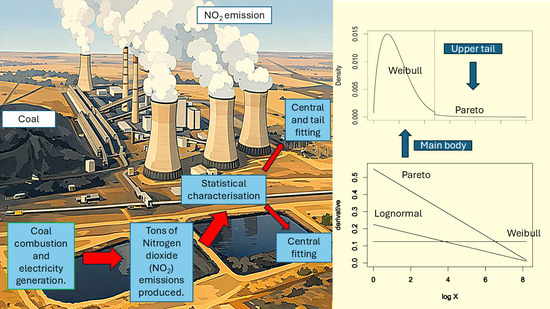
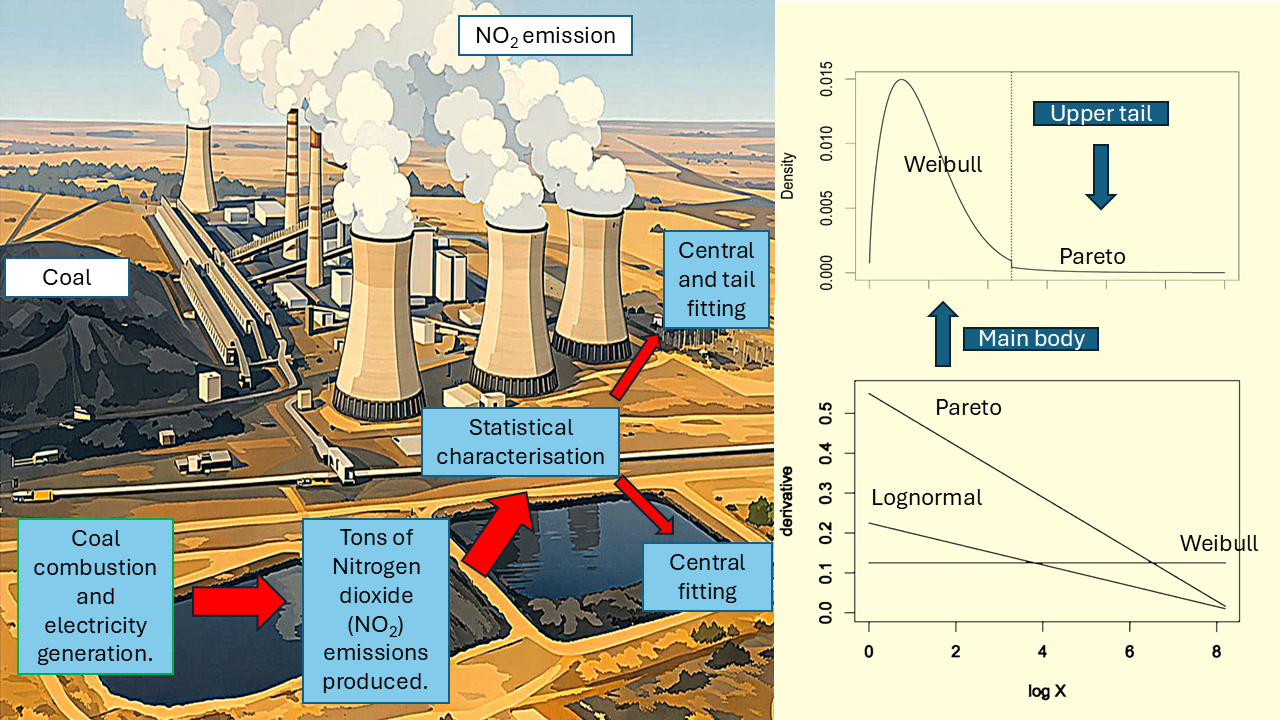
The combustion of coal comes with a heavy price of pollutant emissions. To assist in the planning and management of these emissions and to protect human health, the current study uses the relatively heavy-tailed distributions, namely, the Weibull, Lognormal and Pareto distributions to analyse and characterise the distribution of NO2 emission (in tons) from Arnot, a coal-fired power station of South Africa’s power utility, Eskom. Quantile–quantile (QQ) plots and their corresponding derivative plots for the three distributions are used to characterise the statistical distribution of NO2 emissions. The strength and advantage of using derivative plots of the three distributions, in particular, for characterising NO2 emissions from a coal-fuelled power station, is that they are able to better capture and explain the behaviour of the data across different components of this data. Although this method possesses flexible ways of characterisation of data, it is not commonly applied to emissions data, especially NO2 emissions from a coal-fuelled power station belonging to Eskom, such as Arnot. The choice of the distributions of this study is motivated by their ability to cater to varied tails relative to the exponential distribution. Thus, the tail heaviness ranks of the distributions from lighter to heavier tail, that is, Weibull, Lognormal and Pareto, are taken into consideration in order to arrive at the best-fitting distribution(s). The Weibull distribution with a lighter tail than the Exponential distribution gave the best-fitting distribution over the Lognormal and Pareto distributions for the main body of the data. The Pareto distribution, however, captures the extreme emission tail behaviour much better than the other two distributions. The Kolmogorov–Smirnov and Vasicek–Song (VS) goodness of fit statistics were used to further assess the appropriateness of the fitted distributions. The selection of the Weibull distribution implies that milder high values and less frequent very high NO2 emission data are expected, showing the weakness of such criteria when extremes are present. For authorities to plan and draw policies for the reduction and management of emissions, these findings may be of interest to them and can assist in better understanding their behaviour and the planning to reduce the impact on humans and the environment. This may also assist practitioners in air quality modelling before other, more sophisticated methods can be explored.

Graphical Abstract

1. Introduction

Since coal is in abundance in South Africa (SA), it is not surprising that this fossil fuel is the main source of electricity generation in the country. Coal is responsible for generating 93% of the SA’s electricity [1]. The energy crisis in a number of developing countries persists, and is characterised by the unmet electricity demand due to poor infrastructure, among other reasons [2,3]. Consequently, it is expected that more effort be made to meet this demand to ensure economic growth and development of a country such as SA [3]. However, this cheap method of power generation comes at a price of emissions produced during the combustion of coal. This places coal-fired power stations among the major sources of emission pollutants in the atmosphere [1]. Air pollution, in general, is one of the main role players responsible for diseases and early deaths in the world and continues to cause harm to human health [4,5].
Modelling emissions is one useful instrument for providing early emission-related information behaviour [6]. For authorities to plan and draw policies for the reduction and management of emissions, emissions quantification and prediction can assist in better understanding their behaviour and reduce the impact on humans and the environment. It is important to understand the characteristics and statistical distributions of pollutant emissions for a better characterisation and representation of the data. Probability distributions offer such capabilities to model area-specific air pollutant concentrations. This presents support for the development of methods to combat and control this environmental challenge [7].
Air pollutant concentrations can be considered as statistical random variables and can thus be well described and characterised by means of probability distributions [8]. Although the type of probability distribution used is a special case in every area [9] and is dependent on local characteristics such as proximity to emission source, topology and climate [7], the choice of a proper statistical distribution function to represent the data is very important [8]. It is common to have a right-skewed distribution of air pollutant concentration, such that we have more frequent low concentrations compared to higher (extreme) concentrations that are less frequent or rare in nature [7].

1.1. Statement of the Problem

Coal-fired power stations in South Africa are among the main sources of emissions and pose a big threat to human health and the environment. To understand, explain and predict emissions behaviour, probability distributions are a good option. The aim of the current study is to find a model for NO2 emission, given in tons, from Eskom’s Arnot coal-fired power station. This will be done by fitting and comparing three probability distribution functions, namely, the Weibull, Lognormal and Pareto. This will involve analysing the quantile–quantile (QQ) plots and their associated derivative plots for these distributions. The derivative plot will allow the analysis to be done piece wise from the largest values to the lowest values. The derivative plot uses the very highest values and uses the whole data set upon arriving at the lowest values.

1.2. Justification of the Study

The three parent distributions provide the benefit of modelling data that may be heavier or lighter-tailed than the Exponential distribution. Although some distributions are common in pollutant modelling, the use of derivative plots is not as common, especially for modelling emission data from a coal-fired power station such as Arnot. Modelling by means of graphical display of the quantile–quantile (QQ) plots and their corresponding derivative plots offers the benefit of exploring different components of the data and finding an appropriate distribution for each component, since different components of a dataset, including emissions data, may not always have the same distribution throughout the length of the data [10,11]. For example, the central observations of the data may have a different statistical distribution from the tail or the extreme observations [12,13]. The aim is to also capture this tail behaviour accurately, not just the main body.
The Exponential distribution is central to tail modelling, mostly due to its memoryless property, see reference [10] for details. Statistical distributions can be classified into two general categories according to their asymptotic tail behaviour, namely, the sub-exponential and super-exponential (or hyper-exponential) classes. The sub-exponential class has tails that tend to zero less rapidly than the tail of the Exponential distribution. This means that this class has distributions that are heavier-tailed than the Exponential tail. Conversely, the super-exponential class has tails that tend to zero more rapidly than those of the Exponential distribution, meaning that they are lighter-tailed than those of the Exponential distribution [10,14]. The selected distributions cater for all types of tail shapes relative to the Exponential distribution, for example, the Weibull with shape parameter τ > 1 is lighter tailed than the Exponential distribution, the Weibull with τ = 1 is the Exponential, the Weibull with τ < 1 is heavier tailed than the Exponential distribution but lighter than the Lognormal distribution, and the Pareto. The Pareto distribution has the heaviest tail of the three distributions. The appropriateness of a heavy-tailed distribution, compared to a lighter-tailed distribution, implies that more frequent, larger-sized NO2 emissions are predicted. Thus, fitting a lighter tailed distribution to a heavy tailed NO2 emissions data may lead to underestimation of risk and this may result in serious or severe implications on human lives and the environment, especially in the upper tail [14]. Consideration of the tail heaviness ranks assists in properly selecting an appropriate distribution to represent the whole length of the data.

1.3. Objectives of the Study

To analyse and compare the distribution fit of the Weibull, Lognormal and Pareto distributions, QQ plots and derivative plots of each of the three relatively heavy-tailed distributions are represented graphically. The distributions are listed according to their ranks of tail heaviness in order to determine the best-fitting distribution for modelling NO2 emission data (in tons) from Eskom’s Arnot coal-fired power station.

1.4. Contribution of the Study

Characterising the data by considering both the central and upper tail behaviour of the data is very important in the emissions behaviour. This will assist in determining the best models to further explain and predict patterns in the NO2 emissions data.
For authorities to plan and draw policies for the reduction and management of emissions, statistical modelling of emissions will help to better understand their future behaviour and therefore reduce the impact on humans and the environment. Thus, the modelling technique employed in this study for NO2 emissions data from Arnot power station will assist in explaining and understanding such behaviours in the data.

2. Literature Review

The current section considers some studies where several probability distributions were used to model pollutant concentration data, including NO2, from different sources and areas.
One air pollutant that has received attention is particulate matter (PM10 and PM2.5). In one of earlier studies, Karaca et al. [15] used and compared 11 frequency distribution functions, namely, Beta, Erlang, Exponential, Gamma, Weibull, Inverse Gaussian, Lognormal, Pearson V, Pearson VI and Log-logistic, to model 86 daily samples of PM10 (particulate matter of size 10 micrometres or less) and PM2.5 (particulate matter of size 2.5 micrometres or less) in Istanbul Municipality, Turkey, from July 2002 to July 2003. The Kolmogorov–Smirnov and Chi-squared tests were used to assess the goodness of fit of the distribution models. The fitting for PM10 and PM2.5 proved the Log-Logistic model as the best-fitting distribution.
Lu [9] compared three distributions, namely the Lognormal, Weibull and type V Pearson distribution in the modelling of PM10 from three monitoring stations (Hsin-Chu, Sha-Lu and Gian-Jin) in Taiwan over a period of five years. The method of moments and the method of least squares were used for parameter estimation. The Lognormal distributiongave the best fit for the PM10 data. The method of least squares gave accurate results compared to the method of moments in parameter estimation. The probabilities of exceeding the air quality limits were successfully determined for the three monitoring stations.
For the PM10 from the Belgrade, Serbia urban area over the period 2003–2013, Perišić et al. [12] fitted the Pearson V, the Lognormal and the Weibull methods for the general distribution, and the two-parameter Exponential and Gumbel probability distributions for extreme values in the determination of a distribution of best fit and estimation of exceedances. To evaluate the goodness of fit, the Kolmogorov– Smirnov and Anderson–Darling tests were used. The Pearson V and Lognormal distributions captured the concentrations observed and the number of exceedances, while at the extremes, the two-parameter Exponential and Gumbel distributions gave satisfactory results for the prediction of critical pollutant loads and for the estimation of required reduction from identified strong sources of emission.
Tharu et al. [16] compared the modelling performance of the Weibull, Gamma and Lognormal distributions in modelling daily average PM2.5 and total suspended particles (TSP) concentrations in the urban areas of Kathmandu, Nepal, over the period March–October 2024. The Kolmogorov–Smirnov test was used to test how well the distributions fit the data. The Weibull and Lognormal distributions outperformed the Gamma distribution in modelling PM2.5 and TSP. Another study analysed the statistical distribution of atmospheric PM10 and PM2.5 concentrations and found the Gamma and Lognormal distributions as the best-fitting distributions, respectively. The study was conducted in Faial Island in the Azores archipelago during 2024 [17]. Choopradit et al. [18] demonstrated that the inverse Gaussian and Pearson type V distributions outperformed the gamma, Lognormal, Log-Logistic and Weibull in representing daily average PM2.5 concentrations at quality monitoring locations in Bangkok, Thailand.
Other air pollutants that have been considered in the past include carbon monoxide (CO), NO2, ozone (O3) and sulphur dioxide (SO2), among others. In their study in Lagos, Nigeria, to model CO concentrations, Oguntunde et al. [19] applied three theoretical distributions, namely the Weibull, Gamma and the Lognormal. The Gamma distribution gave the best fit for the data based on the Anderson–Darling and Kolmogorov–Smirnov tests. The characteristics of the pollutant were determined, and the probability of exceeding the set limits was also predicted.
Xue Jiang et al. [8] applied several probability distributions, namely, Lognormal, Gamma, Inverse Gaussian, Log-logistic, Pearson V, Beta, Pearson VI, Weibull, Extreme value distributions, to model the three-year (from 2006 to 2008) daily average concentration data of SO2, NO2 and PM10 in Xi’an, China. The Kolmogorov–Smirnov statistic, Anderson–Darling statistic, Chi-squared goodness of fit tests and the ML parameter estimation method were used in this study. SO2, NO2 and PM10 were most represented by the Pearson VI, Extreme Value and Log-Logistic distribution, respectively.
Aydin [20] investigated the statistical characteristics of six-hourly air pollutants data (SO2, PM10, CO, NOx, NO and NO2) from two monitoring stations in Sinop, Turkey, collected over the period January–March 2017. They fitted and compared seven distributions, namely, the Gumbel, Weibull, generalised Pareto, Lognormal, Gamma, Rayleigh, and the inverse Weibull distributions to determine the best performing for the pollutants. The Kolmogorov–Smirnov goodness of fit, root mean square error and coefficient of determination criteria were used to determine the best-fitting distributions. The generalised Pareto distribution gave the overall best-fitting distribution, followed by the Lognormal, then the inverse Weibull.
In another study, six probability distribution functions, namely Normal, Gamma, Pearson V, Weibull, Gumbel and Lognormal, were used to characterise the variability of PM10 and O3 concentrations by considering the daily maximum moving average concentrations from the Metropolitan Area of São Paulo in Brazil. Goodness of fit metrics used include the Kolmogorov–Sminirnov, Anderson–Darling, and root mean square error. The Lognormal and Gamma distributions gave a good fit for PM10 and O3, respectively [7].
Although statistical modelling using probability distributions on the NO2 pollutant has received some attention in the past, it is underrepresented in the South African literature. This is especially true for NO2 emissions from SA’s coal-fired power stations. The current study aims to compare the three distributions (Weibull, Lognormal and Pareto distributions) according to their tail heaviness ranks in order to arrive at the best fitting for the NO2 emissions data. This will be done by employing the QQ and derivative plots of the distributions of NO2 emissions, given in tons, from one of Eskom’s coal-fired power stations, Arnot. Characterisation of data using the derivative plots of the Weibull, Lognormal and Pareto distributions is not common in emission modelling, more so in modelling NO2 emissions from a power station owned and operated by Eskom’s such as Arnot. This is despite their flexibility of being able to capture a dataset’s behaviour across all of its components, and can thus indicate if more than one distribution for a single dataset would be appropriate for the components or not. This is particularly important since Osatohanmwen et al. [21] indicated that, if it is possible to partition a dataset into multiple components, the use of parametric distributions, such as those used in this paper, may be of benefit and offer robust and flexible modelling techniques. Common modelling techniques, such as modelling using composite distributions, have fitted a different distribution to each component of a single dataset. For example, Deng et al. [22] fitted a composite model with a Weibull distribution for the bulk of the insurance data and a Pareto distribution for the tail. Akhundjanova [13] used the Lognormal and Pareto distributions for the bulk and tail of the size of national CO2 emissions data, respectively. Cooray [23], similarly, applied the Lognormal distribution for the bulk and the Pareto distribution for the tail of the insurance data. However, Nadarajah [24] showed that the Burr distribution was better fitted compared to the Pareto for the tail of the loss data, while the Lognormal distribution gave the best fit for the bulk. These studies ([13,22,23,24]) all employed composite distributions of pairs of parametric distributions. Compared to the assumption of a Pareto type for extreme values and a light-tailed distribution in the main body, Albrecher et al. [25] demonstrated that a dataset can have a distribution that is heavier-tailed, i.e., the Pareto, in the bulk, while the upper tail has a lighter-tailed distribution, such as the Weibull. They used a Weibull-tempered Pareto distribution. The appropriateness of these fitted distributions to multiple components of a single dataset, including emissions data, indicate that indeed a random variable can be partitioned into more than one component and splicing distributions do give a good modelling framework. Thus, incorporating derivative plots can serve as an alternative.
Derivative plots can determine if the full body or a component of the data is likely to be best fitted by a lighter or heavier-tailed distribution than the one being investigated. Thus, as an additional benefit, they can be very useful as graphical diagnosis tools for quantifying and explaining the body and tail behaviour of the data before more sophisticated modelling techniques like composite and mixture models can be fitted [10,11,25].

3. Methodology [10]

The current section firstly presents the extreme value index estimators for determining the tail heaviness of the NO2 emissions data. The probability distribution functions, QQ plots and corresponding derivative plots of the three distributions, namely, the Weibull, Lognormal and Pareto distributions, ordered in increasing tail heaviness, used in the current study are then presented.

3.1. Extreme Value Index ( γ ) Estimates

In this study, the extreme value index (EVI) estimate γ is used to identify the shape of the upper tail [11]. A negative value indicates a lighter-tailed than the extremal Exponential distribution, a positive value indicates a heavier-tailed distribution than the extremal Exponential distribution, while a value of zero indicates that the upper tail is Exponentially distributed. This will assist in identifying potential candidate distribution(s) for the upper tail of NO2 emissions from Arnot power station.
The Hill and EPD estimators are limited to estimating the extreme value index, EVI ( γ ), for cases with γ > 0 only. When γ 0 is the case, other methods of estimation may be considered. As a result, for this paper, the generalised Hill, moment estimators and the generalised Pareto distribution estimators will be used to estimate the EVI [10].
Table 1 presents the EVI and quantile estimators of the distributions used in this study:

3.2. Weibull Distribution

The Weibull distribution function is
F x = 1 exp λ x τ , x > 0 ,
where λ and τ are scale and shape parameters, respectively. F x is sub-Exponential for 0 < τ < 1 . The Weibull distribution is a first Box–Cox transformation of the exponential distribution. That is, if τ = 1 , the Weibull distribution is the Exponential distribution, and if τ > 1 , the Weibull distribution is lighter-tailed than the Exponential distribution. Conversely, if τ < 1 , the Weibull distribution is heavier-tailed than the Exponential distribution.
The Weibull distribution has a QQ plot that is given by
log log 1 i n + 1 , log X i , n , i = 1 , , n .
and the derivative plot is given by
log x n k , n , H k , n W k , n   o r k , H k , n W k , n
with W k , n = 1 k j = 1 k log log n + 1 j log log n + 1 k + 1 .

3.3. Lognormal Distribution

Transforming the data and fitting the normal distribution to the data yields the lognormal distribution. This distribution is heavier-tailed than any Weibull and has two parameters, given by
F x = 1 1 σ 2 π x exp log u μ 2 2 σ 2 d u u = Φ log x μ σ , μ R , σ > 0 .
The Lognormal distribution has a tail that is heavier than that of the Weibull and the Exponential distribution, and is given by
F ¯ x ~ σ log x 2 π exp log x μ 2 2 σ 2 , x
The QQ plot is given as
Φ 1 i n + 1 , l o g X i , n , i = 1 , , n ,
where
Φ 1 is the standard normal quantile function. The derivative plot is given by
log x n k , n , H k , n N k , n   o r k , H k , n N k , n ,
with N k , n = n + 1 k + 1 φ Φ 1 1 k + 1 n + 1 Φ 1 1 k + 1 n + 1 ,
since
1 k j = 1 k Φ 1 1 j n + 1 Φ 1 1 k + 1 n + 1 = 0 1 Φ 1 1 u k + 1 n + 1 d u Φ 1 1 k + 1 n + 1 = N k , n
where φ denotes the standard normal density.

3.4. Pareto Distribution

The Pareto distribution is the prime example of a heavy-tailed distribution. The strict Pareto is a sub-exponential for a   α and is given by
F x = 1 x β α , α > 0 , 0 < x 0 < x ,
where β and α are the scale and shape parameters. Let l o g X be exponentially distributed with λ = α when X is strict Pareto ( α )-distributed, then the Pareto QQ plot is given as
l o g 1 i n + 1 , l o g X i , n , i = 1 , , n ,
with a derivative plot
log x n k , n , H k , n   o r k , H k , n ,
where H k , n = 1 k j = 1 k log X n j + 1 log X n k , n is the estimator of γ = 1 / α [28]. A linear QQ plot and horizontal derivative plot (at the level) 1 / α indicates that the data follows a Pareto distribution.

3.5. Assessing the Goodness of Fit, and Parameter Estimation

Two goodness-of-fit tests, namely, the Kolmogorov–Smirnov test and the Vasicek–Song (VS), are used to assess if a distribution fits the data or not. The drawback with these measures is that they concentrate on evaluating the average fit, unlike the derivative plot, which does a good job of assessing the fit of the extreme emissions. The Akaike Information Criteria (AIC) and Schwarz’s Bayesian Information Criterion (BIC) [29], with formulae, are given as
A I C = 2 l θ ^ ; y + 2 p ,
and
B I C = 2 l θ ^ ; y + 2 p log n ,
will be used to select the best-fitting distribution from the Exponential, Weibull, Lognormal and Pareto distributions.
Parameters are estimated by employing the maximum likelihood (ML) method for the three distributions in this study. The method has the advantage of producing a minimum variance estimate of the parameter [9]. Let f x j | θ denote a known probability distribution function (i.e., the Weibull, Lognormal and Pareto distributions) with a pair of parameters given as θ = θ 1 , θ 2 . If L θ ; x is the likelihood function of the joint density function of the n = 108 independent and identically distributed NO2 emissions observations from Arnot power station, x 1 , x 2 ,   x 3 , ,   x 108 , given as
  L θ 1 , θ 2 ; x = j = 1 n f x j | θ 1 , θ 2 ,
then the log-likelihood function l θ 1 , θ 2 is given by the equation
l θ = log L θ 1 , θ 2 ; x = log j = 1 n f x j | θ 1 , θ 2 = j = 1 n log f x j | θ 1 , θ 2 ,
The optimal values of θ ^ = ( θ ^ 1 , θ ^ 2 ) are then obtained by maximising l θ in Equation (15). This is done by solving for θ 1 and θ 2 in the equations l ( θ ) θ 1 = l θ 1 , θ 2 θ 1 = 0 and l ( θ ) θ 2 = l θ 1 , θ 2 θ 2 = 0 , respectively.

4. Results

The following sections provide the results and the discussion.

4.1. Description of the Data

The data used in this paper were obtained from Eskom’s Arnot power station located in Middleburg, in the Mpumalanga province in South Africa. It is actual monthly NO2 emissions data, given in tons, collected from April 2005 to March 2014 (108 months). This data is just one of the emissions datasets collected from the Arnot power station and is selected because NO2 emissions are one of the statistically understudied dangerous pollutants from coal-fired power stations in South Africa. The monthly NO2 emissions data used in this study are presented in Table A1 of Appendix A.
The analysis was performed using the R statistical programming packages ReIns and fitdistrplus.

4.2. Data Exploration

Table 2 shows the descriptive statistics, as well as stationarity and normality tests for the NO2 emissions data from Arnot power station.
The coefficient of skewness is less than zero for the NO2 emission data. This indicates that the data is spread more to the left of their means. Kurtosis is a measure of whether the data is heavier or lighter compared to the normal distribution. Since the value of the kurtosis is less than 0, the data has an upper tail that is thinner and shorter than the normal distribution. The skewness may somewhat seem to be closer to 0, suggesting some Normality in the distribution. However, this observation can be dismissed since the kurtosis is less than 0, and the KS and AD tests have p-values smaller than 0.05.
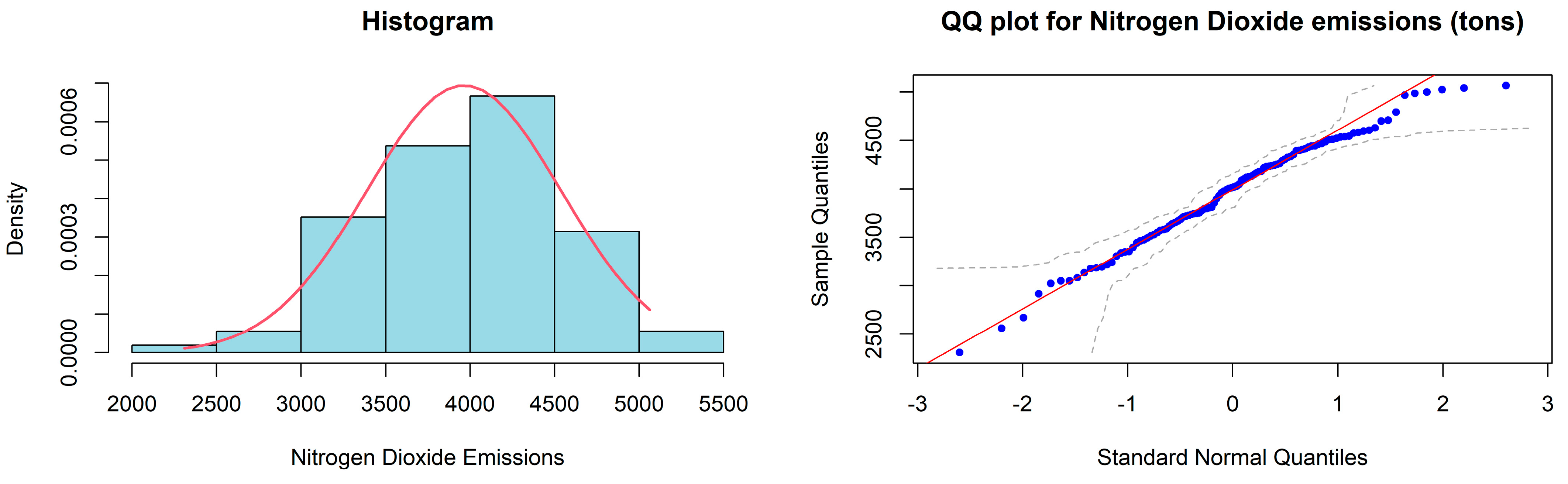
In Figure 1, the histogram of the NO2 emissions data is displayed. One can see that the data is not exactly symmetric. Additionally, the QQ plot shows that the upper-tail data is lighter-tailed than the normal distribution.
Since the Augmented Dickey–Fuller and Phillips-Perron stationarity tests in Table 2 have p-values that are less than 5%, the NO2 emissions from Arnot power station are stationary.

4.3. Shape of the Tail

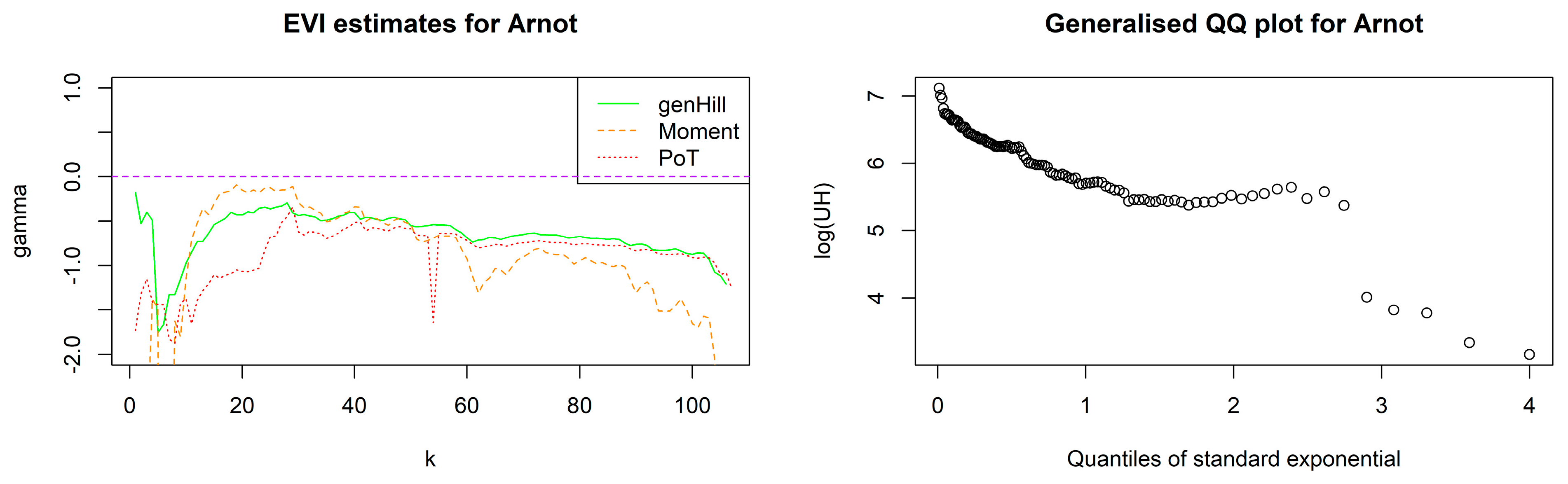
To determine the extreme value index, γ , the generalised Hill (genHill) and moment estimators are used. These estimators are selected since they allow for γ 0 . Figure 2 presents the EVI estimates γ ^ using the generalised Hill and moment estimators, together with the PoT-based estimates for comparison purposes. Also included in Figure 2 is the generalised QQ plot. These plots will assist in describing and determining the shape of the tail.
Figure 2 shows the EVI estimates γ ^ plotted against their corresponding number of exceedances k . The values of γ ^ are either negative or around zero for all values of k . Additionally, the generalised QQ plot has a somewhat or approximately horizontal tail pattern. This suggests that a distribution from the Gumbel domain may be a good candidate for the data. This thus supports our selection of the Weibull, Exponential and Lognormal distributions for representing the NO2 emissions data from Arnot power station. The Pareto distribution is included for comparison purposes.

4.4. The Distribution of the Data

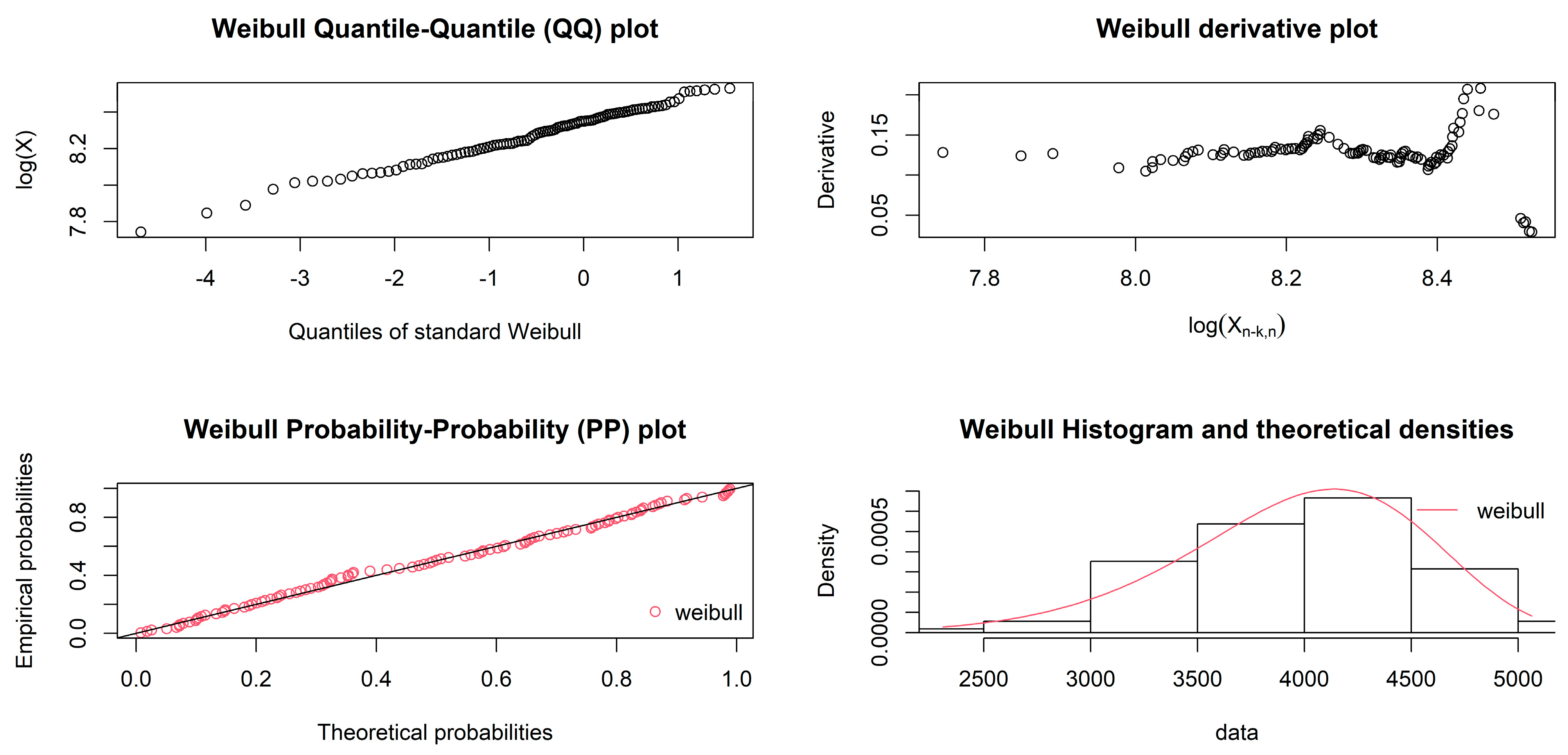
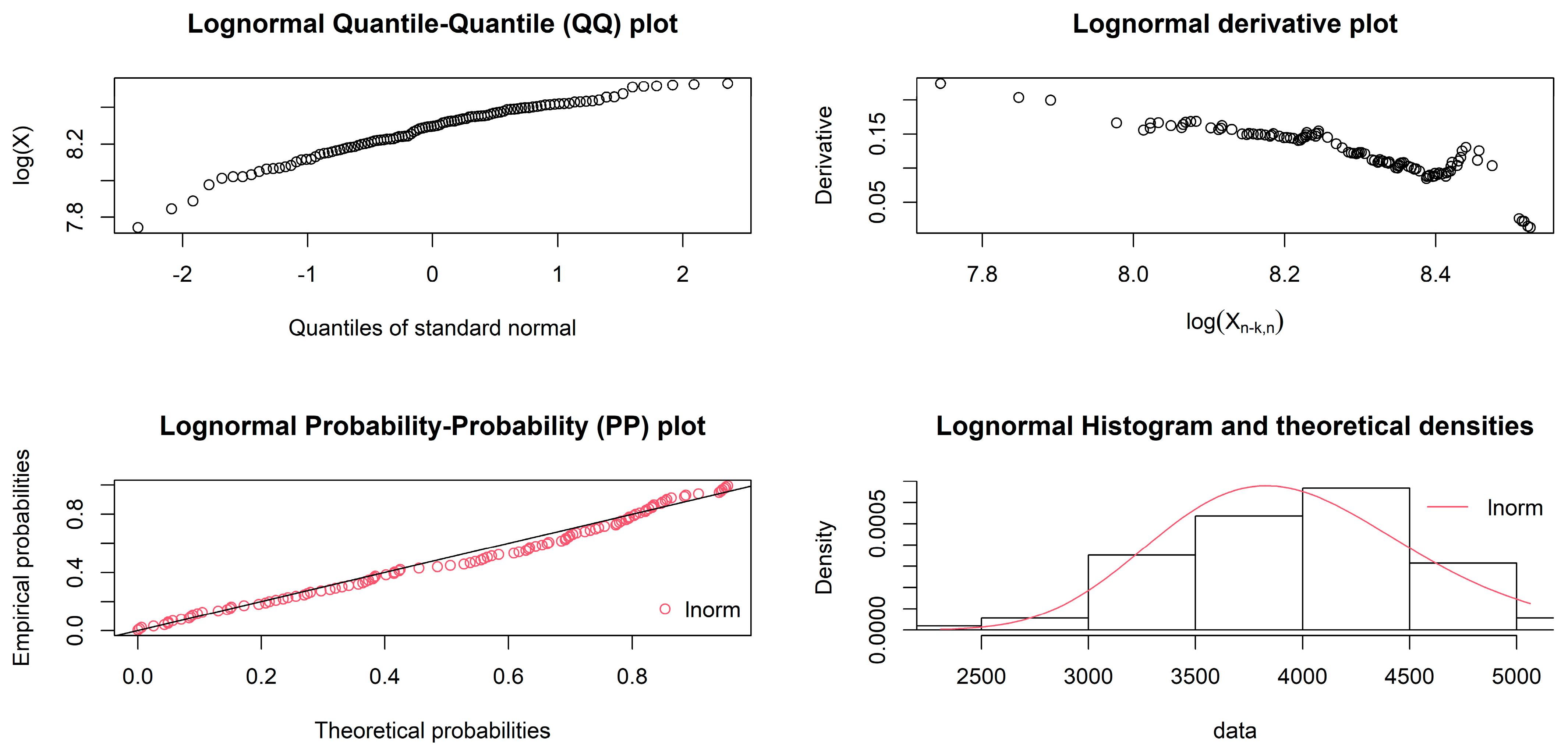
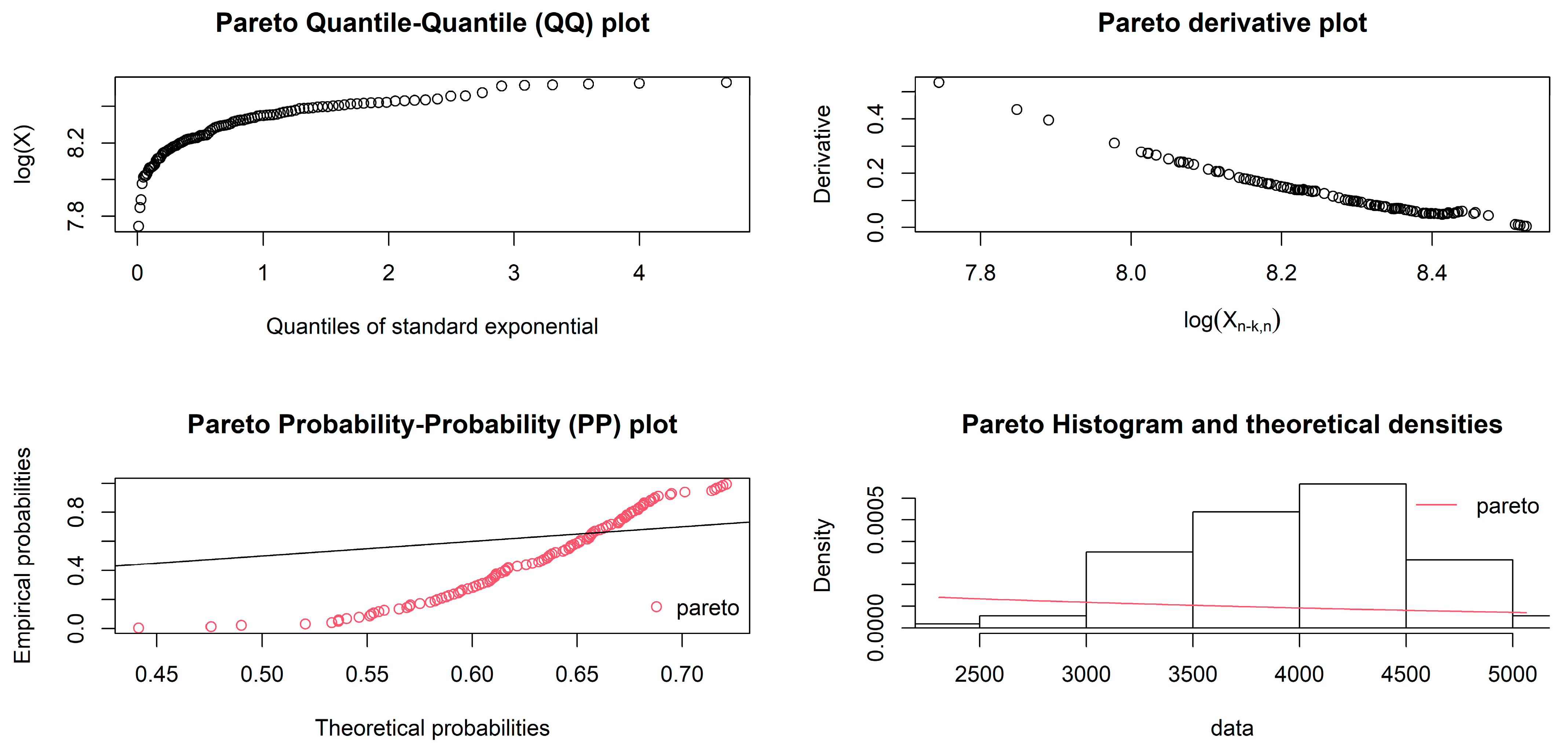
Figure 3 below shows the quantile and derivative plots, together with the PP and density plots of the three distributions (Weibull, Lognormal and Pareto) fitted in this study.
In Figure 3, the Weibull distribution produced QQ and PP plots that do not show significant deviation from the 45° line, a density plot that shows minimal deviation from the fitted line, and a derivative plot that is approximately constant except at the tail end, where it increases before decreasing. This indicates that the Weibull distribution is a good fit for the NO2 emissions data for the greater part of the body of the data, while towards the tail end, a heavier-tailed distribution like the Lognormal or Pareto distribution may be more appropriate.
Considering the plots in Figure 4, an overall good fit is obtained from the Lognormal distribution since minimal deviation from the Lognormal is observed from the expected on the QQ, PP and density plots. However, taking a closer look at the derivative plot, an overall somewhat decreasing pattern is observed, suggesting that a lighter-tailed distribution than the Lognormal distribution may be a better fit for the NO2 emissions data. The slightly upward kink in the derivative suggests very extreme emissions near the tail end of the data. This implies that a heavier-tailed distribution than the Lognormal distribution, like the Pareto, may be more appropriate in this region of the data. The QQ plot shows some deviations with values below the fitted line in the tails, thus supporting the decision of a lighter-tailed distribution for the data in some sections of the data.
The rapidly decreasing Pareto distribution derivative plot and the downward curving QQ plot in Figure 5 indicate that the Pareto distribution is not a good fit and that a lighter-tailed distribution than the Pareto distribution may be a good fit. However, it seems to capture the very extreme observations at the very tail end. In this region, the Pareto derivative plot is approximately constant.

4.5. Goodness of Fit Tests

The KS goodness of fit test for each of the three distributions (Weibull, Lognormal and Pareto distributions) is performed. It tests the null hypothesis H0: The data follows the specified distribution. The Vasicek–Song (VS) goodness-of-fit test is also included to assess how well the selected distributions fit the data. This test has more power compared to other goodness-of-fit tests like the KS test [30]. Table 3 presents the results of the test and the maximum likelihood (ML) parameter estimates for the three distributions.
The data in Table 3 are divided into two components as suggested by the derivative plots above, with the first component representing the bulk of the data ( x 4506 ) and the second component representing the upper tail ( x > 4506 ), that is, the extremely high NO2 emissions. This is to verify the suitability of the distributions, as a single dataset may be represented by multiple distributions [10].
Table 3 shows that both the Weibull and Lognormal distributions produced p-values > 0.05 for the KS goodness of fit test in the bulk of the NO2 emissions data. This indicates that we fail to reject the null hypothesis and thus conclude that there is sufficient evidence to support that the data belongs to the Weibull and Lognormal distributions on average. The Pareto distribution, however, produced p-values < 0.05, indicating rejection of the null hypothesis for this component of the NO2 emissions data. This goodness-of-fit test shows that the Weibull distribution is an overall best fit for the bulk of the data since it produced the smallest test statistic values with the KS statistic = 0.07. Parameter estimates are obtained by the maximum likelihood method of estimation as τ ^ = 9.7914 and λ ^ = 4003.8568 for the shape and scale parameters. Since the Weibull distribution produced a shape parameter estimate that is greater than one, that is, τ ^ = 9.7914 > 1 , the tail is lighter than that of an Exponential distribution [10]. In the upper tail, the Pareto distribution with the smallest KS test statistic (=0.1857) estimates the very extreme emissions better than the Weibull and the Lognormal distributions. The ML parameters of the Pareto distribution were estimated and given as α ^ = 21.1226 and β ^ = 4509 for the shape and scale, parameters.
In Table 3, the more powerful VS test explicitly demonstrates the Weibull with τ > 1 and Pareto distributions as the only and best-fitting distributions for the bulk of the data ( x 4506 ) and the upper tail ( x > 4506 ), respectively. These distributions have p-values greater than 0.05 and the smallest test statistic for the VS test.
Table 4 presents the Akaike Information Criteria (AIC) and Schwarz Bayesian Information Criterion (BIC) for the three distributions within each component. A lower value of the AIC and BIC is preferred, indicating the best fit for each component. The Weibull distribution provides the best fit for the bulk of the NO2 emissions data, whereas the Pareto distribution produces the best fit in the upper tail, as indicated by the lowest AIC and BIC values in their respective analyses. This confirms the findings of the diagnostic plots (QQ, derivative, PP, and density plots) and the goodness of fit statistics (the KS and VS tests) mentioned above.

5. Discussion

The study’s aim was to compare and determine the best-fitting parent probability distributions by comparing the QQ and derivative plots of the Weibull, Lognormal and Pareto distributions, while also considering their tail heaviness rank. These probability distributions cater for varied tail heaviness relative to the Exponential distribution, with the Weibull distribution with τ > 1 being the lightest-tailed distribution and the Pareto the heaviest. The QQ and derivative plots possess the power of demonstrating the appropriateness of a distribution not just in the bulk of the data but also in the tail, and thus give information of a possible candidate distribution for the data in extremities; see Albrecher et al. [10].
The extreme value index (EVI) was estimated by utilising the generalised Hill, moment, and generalised QQ plot. These estimators showed that the NO2 emissions data were likely to follow a distribution in the Gumbel domain with either a lighter-tailed distribution than the Exponential distribution, like the Weibull with τ > 1 , or a heavier-tailed distribution than the Exponential distribution, like the Weibull with τ < 1 or the Lognormal distribution and Pareto. The generalised QQ plot clearly demonstrated this with a constant horizontal pattern at the largest values, the upper tail, indicating the appropriateness of a distribution from the Gumbel domain. These results demonstrate the justification of the selected distribution for the NO2 emissions data. However, often the worry is in the extreme upper tail. The Pareto seems to capture some heavy-tail behaviour in this dataset.
The Weibull and Lognormal distributions are common in pollutant emission modelling studies [31,32,33,34,35,36,37,38]. However, their use in modelling pollutant emissions does not usually make a distinction between their tail heaviness ranking to arrive at the best-fitting probability distribution for the upper tail as well. Thus, for the Weibull distribution fitting in particular, it is seldom, if ever, highlighted whether the distribution of the data is lighter (with τ > 1 ) or heavier-tailed (with τ < 1 ) than the Exponential distribution. Additionally, there is little evidence, if any at all, of the application of the very powerful joint use of the QQ and derivative plots [10] in the modelling of pollutant emissions, especially the application in NO2 emissions from coal-fired power stations. The current study then employs the three distributions that cater for varied tails’ heaviness and shapes by jointly utilising the distributions’ QQ and derivative plots to close the gap and explain NO2 emissions data behaviour more fully with results showing that the Weibull distribution is the model of best fit for the main body of data and the Pareto distribution being a better model for the very extreme emissions.
The energy crisis in several emerging nations continues to be marked by unmet electrical demand resulting from inadequate infrastructure, among other factors. Therefore, increased efforts are anticipated to meet this demand and ensure economic growth and development in a country like South Africa. This coal-fired type of electricity generates emissions resulting from coal combustion. Authorities can utilise statistical models, such as the Weibull, Lognormal and Pareto distribution models, to formulate policies aimed at the reduction and management of emissions, thereby enhancing understanding of their behaviour and mitigating their impact on humans and the environment. Understanding the tail heaviness of the data is very important, particularly the upper tail, that is, the very large values of NO2 emissions, since they are associated with exacerbated health risks and even death within a short period. This region of a dataset controls both the frequency and size of the extremely large NO2 emissions [14]. If the data has a Weibull distribution with τ > 1 , the tail of the data is lighter than if it were to follow an Exponential distribution, suggesting that lesser extremely large NO2 emissions observations produced from Arnot power station can be expected in the future and/or future NO2 emissions extremes may be small in size. Conversely, if the data follows a Weibull with τ < 1 or Lognormal distribution, the tail of the data is heavier than if it were to follow an Exponential distribution, suggesting that moderately large NO2 emissions observations can be expected in the future and/or the chances of experiencing very large NO2 observations are moderate. If the Pareto fits the data well, then the chances of observing very large NO2 emissions are higher and/or future extremes may be larger in size [14]. Therefore, modelling a heavy upper tail of NO2 emissions using a lighter-tailed distribution, like the Weibull or Lognormal, may lead to underestimation of risk with potential implications on human lives and the environment [14]. The results demonstrate that NO2 emissions can be characterised and explained by the Weibull and Pareto distributions. The Weibull distribution has a lighter tail than the Exponential distribution for the main body of data, but the Pareto distribution suggests a heavier tail or the possibility of very extreme emissions. These results are consistent with those by [22,39], where the data were best represented by the Weibull and Pareto, for the bulk and tail components, respectively. The modelling technique employed herein should guide authorities and power utilities, such as Eskom, in the planning and policymaking for air quality management.

6. Conclusions

Three distributions, namely, the Weibull, Lognormal and the Pareto distributions, are fitted and compared by making use of the QQ and derivative plots of the distributions. These distributions have varied tails compared to the Exponential tail. The results of the study showed that NO2 emission data, in tons, from Arnot power station show that the main body of data is best represented by the light-tailed Weibull distribution, and the Pareto is more applicable at the very extreme emissions, as evidenced by the QQ and derivative plots, KS and VS tests, AIC and BIC values, and EVI estimates. The appropriateness of the Pareto in the upper tail indicates that very high and more frequent NO2 emissions are expected, compared to those that would have been generated by the Weibull and Lognormal distributions.
The findings demonstrate the significance of employing the QQ together with the derivative plots in emissions monitoring, in particular NO2 emissions from Arnot, a coal-fired power station operated by Eskom. The derivative plots’ flexibility of capturing the NO2 emissions behaviour using the two distributions for the bulk and upper tail of the data is demonstrated in this study. They can also identify if the full emission dataset or its components can be best represented by a lighter or heavier-tailed distribution compared to the one investigated. This facilitates the statistical and air quality analysis of NO2 emissions by enabling the practitioner to depend on the graphical plotting of the QQ plot and its derivatives, and parametric methods (Weibull and Pareto distributions). Using this modelling approach for the NO2 emissions, the emissions can be explained and predicted.
This study contributes to the methodology that can be used to analyse and model NO2 emissions from coal-fuelled power stations, a practical atmospheric global challenge with an impact on human lives and the environment.
Pollutant emissions data is rarely modelled by jointly using the QQ and derivative plots while taking into account the tail heaviness ranking of the distributions used. The current study uses these plots to close the gap and better explain NO2 emission data patterns. It also provides references for researchers, policy makers, regulatory bodies, and power utilities, such as Eskom, looking to understand or reproduce the methods applied in this study for similar emissions to the environment. The utilisation of these modelling methods across various pollutants, geographic regions, and other coal-fuelled power stations operated by Eskom or otherwise can yield significant insights into the results’ applicability and generalisability.

7. Further Studies and Limitations

Further studies may explore modelling the NO2 emissions from Arnot data using extreme value models such as the generalised extreme value distribution (GEVD) and the generalised Pareto distribution (GPD) in the modelling of very high values. These distributions, compared to parent distributions, only focus on extremely high (or low) values of the data and discard the bulk of the data. Thus, providing a more sophisticated approach to understanding the behaviour of the data in the tails compared to parent distributions. The methods applied in this study may also be applied to other Eskom coal-fired power stations.
One major drawback of the derivative plots and the current version of software available for their implementation is that they are limited to only four distributions, namely, the Exponential, Weibull, Lognormal and the Pareto. Thus, developments in that regard would enable further comparisons of other statistical distributions such as the Gamma, Burr and similar distributions frequently used to model emissions.

Author Contributions

Writing the original draft of this manuscript, M.W.M.; review, editing, and supervision, D.C. All authors have read and agreed to the published version of the manuscript.

Funding

This research received no external funding.

Data Availability Statement

The original contributions presented in this study are included in the article. Further inquiries can be directed to the corresponding author.

Conflicts of Interest

The authors declare no conflicts of interest.

Abbreviations

The following abbreviations are used in this manuscript:
EVIextreme value index
SASouth Africa
NO2nitrogen dioxide
MLEmaximum likelihood estimation
BICSchwarz’s Bayesian Information Criterion
AICAkaike Information Criteria
COcarbon monoxide
O3ozone
SO2sulphur dioxide
GEVDgeneralised extreme value distribution
GPDgeneralised Pareto distribution
PM10particulate matter of size 10 micrometres or less
PM2.5particulate matter of size 2.5 micrometres or less
PPprobability-probability
EPDextended Pareto distribution
PoTpeaks over threshold
QQquantile–quantile
Nnumber of observations
genHillgeneralised Hill

Appendix A

Table A1. Monthly nitrogen dioxide (NO2) emissions data, given in tons.
Nitrogen Dioxide (NO2) Emission (in Tons)Month of Emission
3462April 2005
3021May 2005
2309June 2005
2561July 2005
3718August 2005
4238September 2005
4003October 2005
3303November 2005
3048December 2005
4288January 2006
3707February 2006
3667March 2006
3742April 2006
4605May 2006
4119June 2006
3492July 2006
3473August 2006
3184September 2006
4439October 2006
3732November 2006
3526December 2006
4966January 2007
3441February 2007
4332March 2007
3216April 2007
3513May 2007
4597June 2007
4509July 2007
4506August 2007
3337September 2007
3133October 2007
3578November 2007
3808December 2007
3352January 2008
3748February 2008
3928March 2008
3194.496565April 2008
4230.084644May 2008
4708.410787June 2008
4466.214804July 2008
4543.381095August 2008
3081.554301September 2008
3724.211074October 2008
3745.350429November 2008
4010December 2008
4250.626883January 2009
3570.002285February 2009
3049.098874March 2009
3896.844898April 2009
3773.618573May 2009
4483.672838June 2009
4100.335240July 2009
4145.246646August 2009
4627.092120September 2009
3683.758421October 2009
3805.282085November 2009
4394.895518December 2009
4411.757832January 2010
4391.796378February 2010
5022.998042March 2010
4126.136522April 2010
4176.738399May 2010
4534.364329June 2010
5039.382416July 2010
3614.121097August 2010
3852.732547September 2010
4163.229131October 2010
4181.204149November 2010
3394.769128December 2010
4086.758762January 2011
3586.296039February 2011
3976.728056March 2011
3650.302634April 2011
4791.368994May 2011
4261.699668June 2011
4998July 2011
4537August 2011
4322September 2011
4441.629070October 2011
4458.775161November 2011
4984.964488December 2011
4242.134007January 2012
3547.665060February 2012
4304.482749March 2012
4129April 2012
4700May 2012
4583June 2012
4404July 2012
4429August 2012
4575September 2012
5063October 2012
3989November 2012
3177December 2012
3239January 2013
3794February 2013
4228March 2013
3348April 2013
3637May 2013
2671June 2013
4048July 2013
4352August 2013
4521September 2013
4217October 2013
3793November 2013
2915December 2013
3961January 2014
4030February 2014
4019March 2014

References

  1. Riekert, J.W.; Koch, S.F. Projecting the external health costs of a coal-fired power plant: The case of Kusile. J. Energy S. Afr. 2012, 23, 52–66. [Google Scholar] [CrossRef]
  2. Ateba, B.B.; Prinsloo, J.J. Strategic management for electricity supply sustainability in South Africa. Util. Policy 2019, 56, 92–103. [Google Scholar] [CrossRef]
  3. Pollet, B.G.; Staffell, I.; Adamson, K.-A. Current energy landscape in the Republic of South Africa. Int. J. Hydrogen Energy 2015, 40, 16685–16701. [Google Scholar] [CrossRef]
  4. He, H.; Schäfer, B.; Beck, C. Spatial heterogeneity of air pollution statistics in Europe. Sci. Rep. 2022, 12, 12215. [Google Scholar] [CrossRef]
  5. Shah, A.S.V.; Lee, K.K.; A McAllister, D.; Hunter, A.; Nair, H.; Whiteley, W.; Langrish, J.P.; E Newby, D.; Mills, N.L. Short term exposure to air pollution and stroke: Systematic review and meta-analysis. BMJ 2015, 350, h1295. [Google Scholar] [CrossRef]
  6. Jaffar, M.I.; Hamid, H.A.; Yunus, R.; Raffee, A.F. Fitting Statistical Distribution Functions of Air Pollutant Concentration in Different Urban Locations in Malaysia. J. Eng. Sci. Res. 2023, 7, 7–11. [Google Scholar] [CrossRef]
  7. Dário, M.S.; Novais, D.G.; Pauliquevis, T.; Rizzo, L.V. Long-term trends and probability distribution functions of air pollutant concentrations in the megacity of São Paulo. Derbyana 2024, 45. [Google Scholar] [CrossRef]
  8. Jiang, X.; Deng, S.; Liu, N.; Shen, B. The statistical distributions of SO2, NO2 and PM10 concentrations in Xi’an, China. In Proceedings of the 2011 International Symposium on Water Resource and Environmental Protection, Xi’an, China, 20–22 May 2011; pp. 2206–2212. [Google Scholar] [CrossRef]
  9. Lu, H.-C. The statistical characters of PM10 concentration in Taiwan area. Atmos. Environ. 2002, 36, 491–502. [Google Scholar] [CrossRef]
  10. Albrecher, H.; Beirlant, J.; Teugels, J.L. Reinsurance: Actuarial and Statistical Aspects; John Wiley & Sons: Hoboken, NJ, USA, 2017. [Google Scholar]
  11. Beirlant, J.; Bladt, M. Tail classification using non-linear regression on model plots. Extremes 2025, 28, 345–369. [Google Scholar] [CrossRef]
  12. Perišić, M.; Stojić, A.; Stojić, S.S.; Šoštarić, A.; Mijić, Z.; Rajšić, S. Estimation of required PM10 emission source reduction on the basis of a 10-year period data. Air Qual. Atmos. Health 2015, 8, 379–389. [Google Scholar] [CrossRef]
  13. Akhundjanov, S.B.; Devadoss, S.; Luckstead, J. Size distribution of national CO2 emissions. Energy Econ. 2017, 66, 182–193. [Google Scholar] [CrossRef]
  14. Papalexiou, S.M.; Koutsoyiannis, D.; Makropoulos, C. How extreme is extreme? An assessment of daily rainfall distribution tails. Hydrol. Earth Syst. Sci. 2013, 17, 851–862. [Google Scholar] [CrossRef]
  15. Karaca, F.; Alagha, O.; Ertürk, F. Statistical characterization of atmospheric PM10 and PM2.5 concentrations at a non-impacted suburban site of Istanbul, Turkey. Chemosphere 2005, 59, 1183–1190. [Google Scholar] [CrossRef] [PubMed]
  16. Tharu, N.K.; Baidhya, S. Modeling PM2.5 and TSP Concentrations: A Comparison of Weibull, Lognormal, and Gamma Distributions. Patan Prospect. J. 2024, 4, 69–78. [Google Scholar] [CrossRef]
  17. Meirelles, M.G.; Vasconcelos, H.C. Physical–Statistical Characterization of PM10 and PM2.5 Concentrations and Atmospheric Transport Events in the Azores During 2024. Earth 2025, 6, 54. [Google Scholar] [CrossRef]
  18. Choopradit, B.; Paitoon, R.; Srinuan, N.; Kwankaew, S. Application of the Parametric Bootstrap Method for Confidence Interval Estimation and Statistical Analysis of PM2.5 in Bangkok. WSEAS Trans. Environ. Dev. 2024, 20, 215–225. [Google Scholar] [CrossRef]
  19. Oguntunde, P.E.; Odetunmibi, O.A.; Adejumo, A.O. A Study of Probability Models in Monitoring Environmental Pollution in Nigeria. J. Probab. Stat. 2014, 2014, 864965. [Google Scholar] [CrossRef]
  20. Aydin, D. A comparison of the statistical distributions of air pollution concentrations in Sinop, Turkey. Environ. Prot. Eng. 2024, 50, 47. [Google Scholar] [CrossRef]
  21. Osatohanmwen, P.; Oyegue, F.O.; Ogbonmwan, S.M.; Muhwava, W. A General Framework for Generating Three-Components Heavy-Tailed Distributions with Application. J. Stat. Theory Appl. 2024, 23, 290–314. [Google Scholar] [CrossRef]
  22. Deng, M.; Aminzadeh, M.S. Bayesian predictive analysis for Weibull-Pareto composite model with an application to insurance data. Commun. Stat.-Simul. Comput. 2022, 51, 2683–2709. [Google Scholar] [CrossRef]
  23. Cooray, K.; Cheng, C.-I. Bayesian estimators of the lognormal–Pareto composite distribution. Scand. Actuar. J. 2015, 2015, 500–515. [Google Scholar] [CrossRef]
  24. Nadarajah, S.; Bakar, S.A.A. New composite models for the Danish fire insurance data. Scand. Actuar. J. 2014, 2014, 180–187. [Google Scholar] [CrossRef]
  25. Albrecher, H.; Araujo-Acuna, J.C.; Beirlant, J. TEMPERED PARETO-TYPE MODELLING USING WEIBULL DISTRIBUTIONS. ASTIN Bull. 2021, 51, 509–538. [Google Scholar] [CrossRef]
  26. Dekkers, A.L.M.; Einmahl, J.H.J.; De Haan, L. A Moment Estimator for the Index of an Extreme-Value Distribution. Ann. Stat. 1989, 17, 1833–1855. [Google Scholar] [CrossRef]
  27. Coles, S. An Introduction to Statistical Modeling of Extreme Values; Springer: London, UK, 2001. [Google Scholar]
  28. Hill, B.M. A Simple General Approach to Inference About the Tail of a Distribution. Ann. Stat. 1975, 3, 1163–1174. [Google Scholar] [CrossRef]
  29. Dobson, A.J.; Barnett, A.G. An Introduction to Generalized Linear Models, 3rd ed.; Texts in Statistical Science Series; Chapman & Hall/CRC: Boca Raton, FL, USA, 2008. [Google Scholar]
  30. Lequesne, J.; Regnault, P. vsgoftest: An R Package for Goodness-of-Fit Testing Based on Kullback-Leibler Divergence. Code Snippet 1. J. Stat. Softw. 2020, 96, 1–26. [Google Scholar] [CrossRef]
  31. Aleksandropoulou, V.; Eleftheriadis, K.; Diapouli, E.; Torseth, K.; Lazaridis, M. Assessing PM 10 source reduction in urban agglomerations for air quality compliance. J. Environ. Monit. 2012, 14, 266–278. [Google Scholar] [CrossRef]
  32. Sharma, P.; Sharma, P.; Jain, S.; Kumar, P. An integrated statistical approach for evaluating the exceedence of criteria pollutants in the ambient air of megacity Delhi. Atmos. Environ. 2013, 70, 7–17. [Google Scholar] [CrossRef]
  33. Mishra, G.; Ghosh, K.; Dwivedi, A.K.; Kumar, M.; Kumar, S.; Chintalapati, S.; Tripathi, S. An application of probability density function for the analysis of PM2.5 concentration during the COVID-19 lockdown period. Sci. Total Environ. 2021, 782, 146681. [Google Scholar] [CrossRef]
  34. Nwaigwe, C.C.; Ogbonna, C.J.; Achem, O. On the Modeling of Carbon Monoxide Flaring in Nigeria. Int. J. Stat. Probab. 2018, 7, 94. [Google Scholar] [CrossRef]
  35. Gao, C.; Deng, S.; Jiang, X.; Guo, Y. Analysis for the Relationship Between Concentrations of Air Pollutants and Meteorological Parameters in Xi’an, China. J. Test. Eval. 2016, 44, 1064–1076. [Google Scholar] [CrossRef]
  36. De Souza, A.; Olaofe, Z.O.; Kodicherla, S.P.K.; Ikefuti, P.; Nobrega, L.; Sabbah, I. Probability distributions assessment for modeling gas concentration in Campo Grande, MS, Brazil. Eur. Chem. Bull. 2018, 6, 569. [Google Scholar] [CrossRef][Green Version]
  37. Gulia, S.; Nagendra, S.M.S.; Khare, M. Extreme Events of Reactive Ambient Air Pollutants and their Distribution Pattern at Urban Hotspots. Aerosol Air Qual. Res. 2017, 17, 394–405. [Google Scholar] [CrossRef]
  38. Hrishikesh, C.G.; Nagendra, S.M.S. Study of meteorological impact on air quality in a humid tropical urban area. J. Earth Syst. Sci. 2019, 128, 118. [Google Scholar] [CrossRef]
  39. Scollnik, D.P.M.; Sun, C. Modeling with Weibull-Pareto Models. N. Am. Actuar. J. 2012, 16, 260–272. [Google Scholar] [CrossRef]
Figure 1. Histogram and QQ plot for NO2 emissions (tons) from Arnot power station. The red line in both plots indicates the fitted normal line (theoretical). The blue dotted line in the QQ plot indicates the data points while the dotted grey line indicates the 95% confidence interval.
Environments 13 00111 g001
Figure 2. Estimates of the EVI (first) and generalised QQ plot (second). The purple dotted line indicates a value of the EVI estimate equal to zero ( γ ^ = 0 ).
Environments 13 00111 g002
Figure 3. QQ plot (top left), derivative plot (top right), and PP plot (bottom left) and density plot (bottom right) for the Weibull distribution.
Environments 13 00111 g003
Figure 4. QQ plot (top left), derivative plot (top right), and PP plot (bottom left) and density plot (bottom right) for the Lognormal distribution.
Environments 13 00111 g004
Figure 5. QQ plot (top left), derivative plot (top right), and PP plot (bottom left) and density plot (bottom right) for the Pareto distribution.
Environments 13 00111 g005
Table 1. Estimators of the extreme value index (EVI), γ .
MethodEquation
Moment [26] γ ^ k , n M = H k , n + 1 0.5 H k , n 2 H k , n 2 1 ,
where   H k , n 2 = 1 k j = 1 k ( l o g X n j + 1 , n l o g X n k , n ) 2 ,   H k , n 2 = ( H k , n ) 2 = 1 k j = 1 k log X n j + 1 log X n k , n 2 ,   l o g is   the   natural   logarithm   and   X n k , n is the threshold.
Generalised Hill γ ^ k , n G H = 1 k j = 1 k l o g U H j , n l o g U H k + 1 , n = H k + 1 , n + 1 k j = 1 k l o g H j , n l o g H k + 1 , n ,
Generalised QQ plot l o g n + 1 k + 1 , l o g X n k , n H k , n ,   k = 1 , , n 1 ,
If   the   plot   is   increasing ,   then   γ > 0 .
If   the   plot   is   decreasing ,   then   γ < 0 .
If   the   plot   is   horizontal ,   then   γ = 0 .
Generalised Pareto Distribution Suppose   X 1 ,   X 2 ,   X 3 , , X n   is   the   random   sample   from   a   GPD   with   distribution   function :  
F X = 1 1 + γ x μ σ 1 γ ,     i f   γ 0 1 exp [ x μ σ ] ,                                                       i f   γ = 0 .
γ ^ is produced by maximising the following log-likelihood function of F X :
l γ , σ x i u = n log σ 1 + γ γ i = 1 n log 1 + γ x i μ σ ,       i f   γ 0 n log σ 1 σ i = 1 n x i μ ,                           i f   γ = 0 ,
where   ( 1 +   γ x i μ σ ) > 0 for   i = 1 , , n ,   μ   is   the   chosen   threshold ,   and   σ is the scale parameter estimator.
Taking   the   partial   derivatives   with   respect   to   the   parameters   γ ,   and   equating   them   to   0 ,   the   γ ^ estimate is obtained [27].
Table 2. Descriptive statistics, as well as stationarity and normality tests for the NO2 emissions, in tons, from the Arnot power station.
N108
Minimum2309.00
Mean3963.02
Median4014.5
Standard Deviation574.44
Maximum5063.00
Kurtosis−0.23
Skewness−0.33
Phillips–Perron Unit Root Test<0.01
Augmented Dickey–Fuller (ADF) test p-value0.03772
Kolmogorov–Smirnov (KS) test for normality of data<2.2 × 10⁻¹⁶
Anderson–Darling (AD) test for normality of data5.556 × 10−6
Table 3. Kolmogorov–Smirnov (KS) goodness of fit test and maximum likelihood (ML) parameter estimates for the Weibull, Lognormal and Pareto distributions.
ComponentSample Size (n)Test and Parameter EstimatesDistribution
WeibullLognormalPareto
Bulk ( x 4506 )n = 89 Statisticp-valueStatisticp-valueStatisticp-value
KS0.07000.7489 ***0.09470.37850.3781<0.0001
VS0.16930.4053 ***0.25321.043 × 10−71.11502.2 × 10−16
Parameter estimates τ ^ λ ^ μ ^ σ ^ α ^ β ^
9.79144003.85688.23360.13592.04472309
Tail
( x > 4506 )
n = 19 Statisticp-valueStatisticp-valueStatisticp-value
KS0.23110.22450.22000.27420.18570.4734 ***
VS0.89950.00560.74380.00140.43400.105 ***
Parameter estimates τ ^ λ ^ μ ^ σ ^ α ^ β ^
24.09774833.22118.46120.042421.12264509
x is NO2 emissions from the Arnot power station. *** The best-fitting distribution.
Table 4. Akaike Information Criteria (AIC) and Schwarz’s Bayesian Information Criterion (BIC) for the Weibull, Lognormal and Pareto distributions.
ComponentSample Size (n)Model AdequacyDistribution
WeibullLognormalPareto
Bulk
( x 4506 )
n = 89AIC1348.3970 ***1366.86801520.2720
BIC1353.3740 ***1371.84501525.2490
Tail
( x > 4506 )
n = 19AIC262.8421259.3847247.6116 ***
BIC264.7310261.2736249.5005 ***
x is NO2 emissions from the Arnot power station. *** The best-fitting distribution.
Disclaimer/Publisher’s Note: The statements, opinions and data contained in all publications are solely those of the individual author(s) and contributor(s) and not of MDPI and/or the editor(s). MDPI and/or the editor(s) disclaim responsibility for any injury to people or property resulting from any ideas, methods, instructions or products referred to in the content.