6.2. Uncertainty Management and Comparative Methodology
The treatment of uncertainty through deviation variables and Monte Carlo simulation connects to a growing body of research on uncertainty-based water allocation optimization. We situate our findings within this methodological landscape through explicit comparisons.
Comparing with Bayesian Network approaches, Wang et al. [
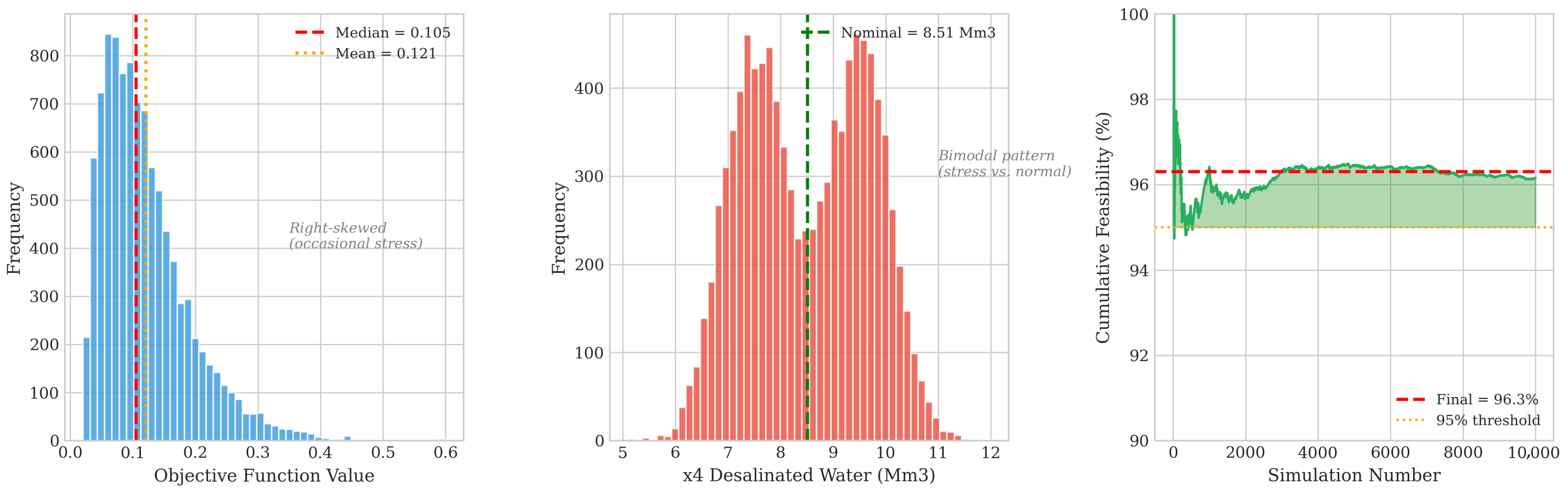
35] achieved 95.7% systemic resilience in agricultural contexts using Bayesian networks coupled with bi-level multi-objective programming. Our Monte Carlo analysis (
Section 5.5) achieved comparable 96.3% feasibility under simultaneous demand and prediction uncertainty. A key methodological distinction is that their bi-level approach requires explicit stakeholder preference elicitation for the upper-level objectives, whereas our regression-informed targets derive directly from historical efficiency patterns embedded in SONEDE operational data, reducing implementation complexity for centralized utilities.
Comparing with Deep Learning Forecasting, Liu et al. [
36] pioneered Non-stationary Transformers for urban water demand forecasting, demonstrating that accounting for multiple uncertainty sources simultaneously improves allocation schemes by 12–18%. Our benchmark comparison (
Table 5) shows 73% improvement over fixed-proportion allocation and 45% improvement over GP-without-regression, comparable in magnitude. Their approach requires substantially more data (N > 100 observations) than our regression-based method (N = 13), making our framework more suitable for data-limited Mediterranean tourism contexts.
Comparing with Market-Based Mechanisms, Vahedizade et al. [
37] demonstrated 45% increases in total user benefits through real-time ANFIS-based streamflow forecasts and option contracts applied to the Gorganrood River basin. Our framework similarly leverages forecasted allocations to guide optimization, though we target utility-controlled systems rather than water markets. A market mechanism is optimal for competitive multi-user basins, whereas the one herein proposed is better suited to centralized management structures where inter-source trade-offs (not inter-user competition) drive allocation decisions.
Comparing with Risk-Sensitive Programming, Yue et al. [
38] developed Copula-based interval programming incorporating decision-maker risk tolerance, while Li et al. [
39] combined Two-Stage Stochastic Programming with Conditional Value-at-Risk (CVaR) for agricultural water management. Our deviation variables (Equations (
5) and (
6)) provide analogous risk control by penalizing shortfalls more heavily than surpluses. Their CVaR approach explicitly quantifies tail risks; our sensitivity analysis (
Table 8) demonstrates how feasibility degrades linearly with uncertainty magnitude (
), providing similar operational guidance for risk-aware planning.
Table 9 frames our regression-informed Goal Programming against established uncertainty frameworks. We focus on a specific friction point, the trade-off between data-heavy complexity and the need for agile, low-latency solutions.
Collectively, these comparisons situate our regression-informed Goal Programming as a middle-ground methodology more data-efficient than deep learning approaches [
36], less stakeholder-intensive than Bayesian network methods [
35], and better suited to centralized utilities than market mechanisms [
37]. The 96.3% Monte Carlo feasibility and 73% benchmark improvement demonstrate comparable performance with reduced implementation requirements, a practical advantage for water-scarce regions with limited technical capacity.
6.3. Contextual Interpretation and Implementation Boundaries
Our methodology demonstrates context-specific advantages for Tunisia’s coastal tourism water system (2010–2022), but critical assumptions apply.
First, regarding the temporal validity window, the regression models capture historical allocation patterns during a period characterized by stable centralized governance, significant tourism growth, and rapid desalination expansion. Consequently, any substantial future deviation, such as a geopolitical crisis or plateauing desalination capacity, determines a risk of extrapolation that necessitates model recalibration every 3–5 years.
Second, regarding geographic transferability boundaries, the framework is directly applicable to Mediterranean coastal tourism regions that share key characteristics: multi-source portfolios, high seasonal demand variability, and centralized utility governance. Compatible contexts include coastal Spain, Southern Italy, and Greek islands, whereas monsoon-driven systems or unregulated markets require methodological adaptation.
Monsoon-driven systems (India, Southeast Asia) require seasonal regression models; single-source dominance (>80% from one source) makes optimization overhead unjustified; unregulated markets require different frameworks assuming utility-controlled allocation.
Third, regarding integration with existing planning tools, for operational implementation in Tunisia, we propose a three-tier decision architecture. For operational implementation, we propose a three-tier decision architecture. Strategic Planning (5-year horizon) uses regression models to set infrastructure investment targets, such as desalination capacity expansion based on growth trajectory. Tactical Allocation (annual) involves running GP optimization with updated demand forecasts to determine source-level allocations for the upcoming tourism season. Finally, Operational Adjustment (monthly) requires monitoring actual vs. predicted allocations and triggering re-optimization if deviations exceed control limits, for example, when |actual − predicted| > 2 × RMSE.
This hierarchical approach ensures the framework complements rather than replaces existing SONEDE planning processes.
In terms of spatiotemporal and environmental boundary conditions, the framework’s current specification conditions on annual total demand () as the primary contextual variable. This choice reflects several operational and statistical factors, including SONEDE’s annual reporting cycle for tourism water allocation, the annual cycles of strategic infrastructure decisions such as desalination capacity expansion, and the need for model parsimony given the sample size, where incorporating additional contextual dimensions like season, location, or climate would risk overfitting. Regarding applicability boundaries, the proposed methodology is particularly suited for Mediterranean coastal tourism regions sharing characteristics such as multi-source portfolios, centralized utility governance, and high seasonal demand variability, as seen in coastal Spain, Southern Italy, and Greek islands. However, several contexts require substantial adaptation; for example, monsoon-driven systems in India or Southeast Asia require seasonal regression models to capture radical hydrological shifts, while decentralized water markets relying on inter-user competition necessitate a game-theoretic formulation. Furthermore, high-altitude regions where elevation affects pumping were not modeled in this coastal-centric framework, and areas with strong spatial heterogeneity require full GIS integration. Tunisia’s coastal tourism zone itself is characterized by a subtropical Mediterranean latitude (– N) and a coastal plain elevation (0–200m) with minimal pumping costs. The climate is arid to semi-arid (annual –400 mm), and the geology involves coastal aquifers alongside deep Saharan groundwater. Since these specific conditions are embedded in the historical data (2010–2022), transferability to regions with substantially different physical characteristics requires rigorous model recalibration to maintain reliability.
The integration of regression-based predictions as target values in Goal Programming represents an innovative approach combining learning from historical efficiencies with optimization under constraints. Unlike classical approaches where targets are set exogenously, our method uses patterns learned from data to inform allocation objectives while allowing optimal deviations when physical constraints require it.
The current implementation’s use of annual aggregated data inherently limits the granular integration of spatiotemporal and environmental variables. We acknowledge these limitations and provide a roadmap for future extensions.
Annual aggregation can mask intra-annual dynamics such as seasonal tourism peaks (June, September) and Julian day effects. Similarly, the current model aggregates across Tunisia’s coastal zone, averaging over latitude gradients and local microclimates. Future research with monthly datasets () should employ seasonal sub-models where coefficients and vary by month.
Future iterations could explicitly model temperature-driven evapotranspiration rates and groundwater recharge dynamics. We recommend incorporating specific constraints derived from the Tunisian Water Code (Law 75-16), such as minimum environmental flows for wadis (), sustainable aquifer yields (), and brine discharge limits for desalination plants ().
Tunisia’s centralized governance simplifies implementation, but inter-regional transfers are subject to physical capacity limits (e.g., Mm3/year for the Nord pipeline). While these constraints are implicit in the 2010–2022 historical data, they should be explicitly modeled in multi-period extensions to enhance prescriptive reliability.
The optimization framework operates within Tunisia’s regulatory environment as defined by the Water Code (Law 75-16 of 1975, amended 2001). This legal structure establishes several allocation priority hierarchies that should inform the priority weights in the goal programming formulation.
The regulatory allocation priority stack begins with drinking water supply, designated as the first priority and receiving the highest weight . Agricultural irrigation constitutes the second priority, followed by industrial and tourism uses at the third priority tier. Environmental flows for wadi ecosystems represent the fourth priority tier, with the caveat that they are mandatory minimum thresholds during critical periods.
The regulatory parameters that can be directly integrated into the optimization constraints include maximum sustainable yield for each aquifer, which constrains groundwater extraction such that . Desalination plants must comply with brine discharge limits set by the National Agency for Environmental Protection, imposing the constraint . Inter-regional transfer quotas governed by bilateral agreements between governorates impose constraints of the form and . Finally, Law 75-16 mandates minimum flow maintenance in surface water courses during drought periods through the constraint .
Institutional coordination involves three key entities. SONEDE (Société Nationale d’Exploitation et de Distribution des Eaux) serves as the national utility for production and distribution, providing operational data and implementing allocation decisions. The Ministry of Agriculture oversees agricultural water rights and manages the inter-sectoral balance between agriculture and tourism through the CRDA. ANPE (Agence Nationale de Protection de l’Environnement) enforces environmental constraints including brine discharge limits and groundwater extraction caps.
The current model implementation treats regulatory constraints as implicit bounds captured by historical allocation patterns rather than as explicit inequality constraints. This approach is valid when historical allocations have respected legal limits, but becomes inadequate if future scenarios require testing allocations that approach or exceed these boundaries. It is recommended that future extensions explicitly encode regulatory parameters as hard constraints, with values obtained through formal data-sharing agreements with SONEDE and the Ministry of Agriculture.
While the present study contributes methodologically, several limitations should be acknowledged. There are data-related limitations, as there is a limited temporal extent that constrains the robustness of regression models, an aggregation at annual level masks intra-annual dynamics, and a lack of quality parameters in the optimization. In terms of methodological assumptions, linear aggregation assumption ignores potential synergies, the static regression relationships may not hold under future changes, and single-objective formulation does not explicitly address cost, energy, or environmental objectives. As for transferability considerations, the framework developed for Tunisia’s context may require adaptation for other regions with different governance structures.






 and
and