
Article

Towards a Single Eutrophication Assessment: Identifying Drivers for an Integrated WFD-MSFD Eutrophication Framework in Portuguese Coastal Waters
1
IPMA, I.P.Instituto Português do Mar e da Atmosfera, I.P., Av. Alfredo Magalhães Ramalho 6, 1495-165 Algés, Portugal
2
CIIMAR/CIMAR LA, Centro Interdisciplinar de Investigação Marinha e Ambiental, Universidade do Porto, Terminal de Cruzeiros do Porto de Leixões, 4450-208 Matosinhos, Portugal
*
Authors to whom correspondence should be addressed.
Environments 2026, 13(2), 100; https://doi.org/10.3390/environments13020100
Submission received: 4 December 2025 / Revised: 3 February 2026 / Accepted: 7 February 2026 / Published: 12 February 2026

Abstract

The Water Framework Directive (WFD) and the Marine Strategy Framework Directive (MSFD) are the two main European policy instruments for assessing eutrophication in coastal waters, yet their differing assessment architectures often lead to inconsistent classification outcomes. This study provides a scientific comparison of WFD Ecological Status and MSFD Good Environmental Status (GES) classifications for Portuguese coastal waters across three assessment cycles. This is achieved by quantifying the coherence between Eutrophication assessments, by identifying the main drivers of divergence beyond chance, and evaluating where harmonization improved agreement, providing an evidence-based guidance to decision-making and policy regulation. Using officially validated national classifications, we analyzed the methodological drivers of divergence (without reprocessing raw monitoring data) and harmonized both outcomes into a common three-class scheme. Coherence was evaluated using a Discordance Index and Cohen’s kappa coefficient. Results showed that divergence was systematic rather than random, primarily driven by structural (spatial and temporal) misalignment, methodological differences in indicator integration, and contrasting statistical metrics. Both Directives consistently identify eutrophication hotspots associated with major river plumes but differ in how these signals are aggregated and translated into status classes. The study demonstrated that WFD and MSFD provide complementary but only partially aligned assessments, and that coherence improved with methodological harmonization.

1. Introduction

Eutrophication remains one of the most prevalent pressures on coastal ecosystems worldwide, driven primarily by excessive nitrogen and phosphorus inputs from agricultural runoff, urban wastewater, and atmospheric deposition [1,2]. Coastal and transitional zones are particularly vulnerable due to their location at the interface of riverine, estuarine and marine systems, where high nutrient loads, long water residence times and intense human activities converge [3].
Within the European Union, eutrophication has been a regulatory priority with the introduction of two major ecosystem-based legislative instruments: the Water Framework Directive (WFD, 2000/60/EC) [4] and the EU Marine Strategy Framework Directive (MSFD, 2008/56/EC) [5]. Under the WFD, eutrophication is not defined as a standalone descriptor but is addressed implicitly through nutrient enrichment, which contributes to less than good on the Ecological Status. The Directive focuses on the assessment of “ecological and chemical status” of surface waters and “chemical status” of underground waters, covering rivers, transitional and coastal waters at relatively fine spatial scales. Eutrophication pressures are evaluated within the “Ecological status” which is determined using a five-class system based on typology-specific reference conditions and integrates biological elements (phytoplankton, macrophytes and phytobenthos as well as fish and macroinvertebrates) with supporting physicochemical indicators including nutrient levels. Assessments are conducted at the scale of individual water bodies integrating multiple quality elements using a precautionary One-Out-All-Out (OOAO) rule [6,7].
In contrast, the MSFD explicitly addresses eutrophication under Descriptor 5 (D5), where it is treated as a pressure affecting marine ecosystems. The Directive aims to achieve Good Environmental Status (GES), expressed as a binary outcome, and applies assessments at broader subregional scales. Eutrophication is evaluated through a set of criteria and indicators, integrated synergistically, that include primary elements (nutrients, chlorophyll a, dissolved oxygen) and secondary elements (transparency, harmful algae, opportunistic macroalgae, macrophyte communities and macrofaunal communities) [8,9].
These conceptual and operational differences create challenges for coherence at the land–sea interface, particularly in eutrophication assessments. Structural factors (spatial units and temporal alignment), methodological choices (indicator selection and integration rules) and statistical metrics (means, percentiles, class boundaries) can lead to divergent classifications in overlapping coastal waters. The same coastal area may be classified as achieving GES under the MSFD while failing to achieve Good Ecological Status under the WFD, or vice versa. Such inconsistencies complicate management decisions that may be conflicting, hinder communication with stakeholders, and may reduce the overall effectiveness of nutrient reduction strategies.
Portugal provides a particularly suitable case study to examine these issues. The Portuguese temperate Atlantic coast extends over nearly 1000 km and includes diverse hydrodynamic settings, from open exposed coastlines to estuarine-influenced and semi-enclosed systems such as Ria Formosa. Major rivers (e.g., Minho, Douro, Tagus and Guadiana) deliver substantial nutrient loads (mainly in winter but may persist during summer), creating strong spatial gradients and transient eutrophication hotspots [10,11,12,13]. Hydrodynamics and nutrient enrichment are also strongly influenced by seasonal upwelling (late spring and summer) [14,15,16,17]. This coastal system is characterized by urban-estuarine pressures, seasonal upwelling and other anthropogenic influences comparable to other western European coastal regions, supporting the broader transferability of the proposed methodological framework. This study is also applicable to countries where the delimitation of terrestrial waters according to the coastal baseline is high (e.g., in Portugal extends 30 km beyond the coastal baseline). Institutionally, each Directive is assigned to a different governmental body, reinforcing methodological separation. WFD is under the Portuguese Environmental Agency (APA, I.P.) responsibility while for MSFD, the Directorate-General for Natural Resources, Safety and Maritime Services (DGRM) is the national competent authority.
Although Eutrophication is assessed under both Directives, limited attention has been given to discordance in classifications and its underlying drivers. Research often treats Directives independently, leaving a critical gap in understanding how regulatory, temporal and methodological differences shape different Ecological Status outcomes. This study addresses this gap by quantifying discordance, identifying its main regulatory and methodological drivers and evaluation outcomes, and proposing a pathway toward improved framework coherence. By analyzing Portuguese coastal waters across multiple reporting cycles, the research seeks to provide evidence-based recommendations to support improved policy coherence and environmental decision-making in Portugal and across EU. Our three research questions were:
  • How coherent are WFD and MSFD eutrophication classifications in overlapping coastal waters?
  • Which structural, methodological, and statistical factors drive divergence between the two frameworks?
  • To what extent do WFD and MSFD classifications agree beyond chance?
We hypothesize that (i) divergence is systematic, not random; (ii) spatial and temporal misalignment constitute the primary structural drivers of discordance; and (iii) agreement increases with methodological harmonization across assessment cycles.

2. Materials and Methods

2.1. Study Scope

This study carried out an integrated scientific assessment of eutrophication classifications under the WFD and MSFD for Portuguese coastal waters.
The objective was not to reassess Ecological Status, but to identify structural factors, methodological choices, and statistical metrics that lead the two Directives to produce divergent outcomes when evaluating the same coastal environment with respect to nutrient enrichment, biomass (Chl-a) and oxygen conditions. Particular attention was given to spatial units, temporal alignment, indicator aggregation, statistical metrics, and decision rules, as these elements may be key to explaining the divergence between WFD Ecological Status and MSFD GES outcomes, rather than the differences in ecological diagnosis. MSFD GES was compared with the component of WFD Ecological Status associated with eutrophication assessments. In brief, the analytical workflow started by the analysis of official reports and identification of common drivers (Section 2.2 Data sources), followed by the discordance quantification (comparison of divergent outcomes and statistical analysis (Section 2.2 and Section 2.3)) and a synthesis of regulatory and management implications.

2.2. Data Sources and Harmonization Procedure

Both frameworks operate on six-year cycles and three cycles from each Directive (WFD 1st–3rd; MSFD 1st–3rd) were analyzed covering the period from 2009 to 2027. The WFD 1st, 2nd and 3rd cycles covered 2010–2015, 2016–2021 and 2022–2027, respectively [18,19]. The MSFD cycles covered 2012–2017, 2018–2023 and began their 3rd cycle in 2024 [20].
Official national classification outputs [10,21,22,23,24,25,26,27,28,29,30,31,32,33,34,35,36,37,38,39,40,41,42,43,44,45,46], supporting technical reports, and indicator definitions were systematically reviewed for each cycle to extract comparable eutrophication indicators and minimize structural bias, namely, dissolved nutrients (DIN, DIP), chlorophyll-a and dissolved oxygen. The analysis relied exclusively on legally validated classifications, without reprocessing raw monitoring data. Therefore, the analysis addresses the coherence of policy assessment outcomes, not the verification of the underlying Ecological Status data. Harmonization was required because the two Directives employ non-equivalent class structures, methodological frameworks, and statistical metrics, despite addressing similar eutrophication pressures. (Supplementary Materials)
To enable categorical comparison, all original classification codes were consolidated into a three-class “traffic light” system (Good—green, Moderate—yellow, Poor—red) (Table 1). This harmonized scheme provided a common categorical structure for the Index of Discordance and Cohen’s kappa calculations, reduced ambiguity arising from non-equivalent class labels and color schemes, and facilitated transparent comparison of outcomes across Directives and assessment cycles.

2.3. Spatial and Temporal Correspondence

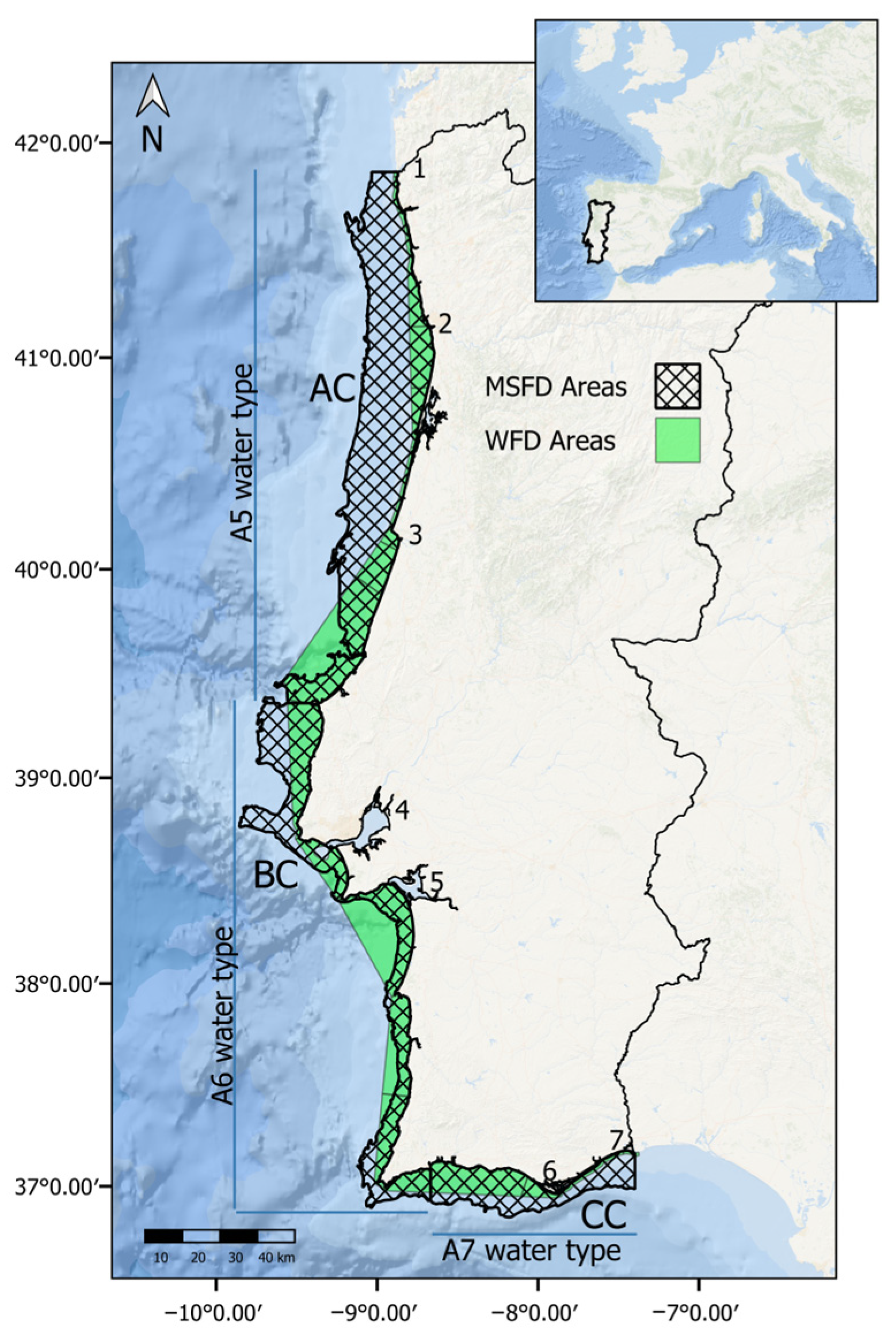
Spatial correspondence between Directives was evaluated using GIS (QGIS v3.42) and overlap percentages were calculated. The Portuguese Atlantic coastal zone extends approximately 987 km from the Minho river in the north to the Guadiana river in the south (Figure 1, river 7). WFD boundaries, extended nationally beyond the mandatory one nautical mile, substantially overlapping MSFD regions, but the degree of overlapping varies spatially (Figure 1). WFD overlaps eight coastal hydrographic regions (RH1-8) and respective defined coastal water bodies with three MSFD subareas (AC, BC, CC) [47].
Temporal correspondence was examined by comparing the assessment windows underlying each reporting cycle. Differences in reporting years and data aggregation periods were documented, recognizing that even concurrent cycles often rely on non-identical monitoring datasets.

2.4. Coherence Metrics: Index of Discordance and Cohen Kappa Coefficient

To quantify the frequency of mismatch between WFD Ecological Status (ES) and MSFD GES, an Index of Discordance (ID) was calculated as the proportion of discordant classifications (D) relative to the total number of matched comparisons in that cycle (N), as defined by the equation: ID% = (D/N) × 100. This metric reflects how often the two systems diverge in classification outcomes when evaluating overlapping areas.
To complement this frequency-based metric, Cohen’s kappa (κ) [48] was applied to distinguish systematic structural disagreement from random coincidence, between WFD and MSFD outcomes, under the harmonized three-class scheme. Kappa values were interpreted following Landis and Koch [49]. In addition to comparing WFD Ecological Status with the final MSFD GES outcome, supplementary kappa analyses compared WFD status with MSFD Category I (nutrient enrichment) classifications. This allowed an evaluation of whether pressure-based nutrient information, which has limited weight in the MSFD’s final binary GES decision, improves coherence.

3. Results

Three principal patterns emerged from this analysis: (i) the divergence classifications between Directives were primarily driven by differences in spatial resolution, coastal delineation and assessment timeframes; (ii) the progressive changes in indicators, statistical metrics and classification thresholds increased sensitivity to short-term extreme events (e.g., fifth percentile); and (iii) both Directives consistently identified eutrophication hotspots, yet final status classifications diverge due to methodological structure. Overall, the improved coherence in the last cycle reflected greater technical alignment.

3.1. Structural Drivers: Spatial and Temporal Misalignment

Structural misalignment was the dominant driver of divergence between Directives classifications. Spatially, the WFD coastal assessment area (7859 km2) overlaps 57.95% of the MSFD coastal assessment area (13,562 km2), but resolution differs markedly. WFD applies fine-scale coastal water bodies aligned with anthropogenic pressures (e.g., estuaries), whereas the MSFD aggregates broad coastal subregional areas. As a result, WFD captures strong spatial gradients near river plumes (Douro, Tagus, Guadiana) that the MSFD often smooths through regional averaging. Temporal misalignment further contributed to divergence. For example, the WFD second cycle used 2010–2013 data, while the MSFD second cycle used 2013–2017 data. As a result, even when assessing the same indicators, WFD and MSFD often evaluate different environmental conditions. This explains why observed discrepancies are systematic rather than random.

3.2. Methodological Evolution: Indicators and Statistical Metrics

Across cycles, both Directives exhibited adaptive methodological evolution, progressively incorporating lessons from previous assessments. Under the WFD, a shift from median-based to percentile-based statistical metrics increased sensitivity to short-duration, high-nutrient and low-oxygen events (Supplemental Materials, Table S2). Under the MSFD, progressive alignment with OSPAR guidance led to revised biomass and oxygen metrics and the introduction of normalized Ecological Quality Ratios (EQRs) with equidistant class boundaries, in the third cycle, improving sensitivity and comparability [50] (Supplementary Materials, Tables S3 and S4).

3.3. Classification Outcomes and Coherence

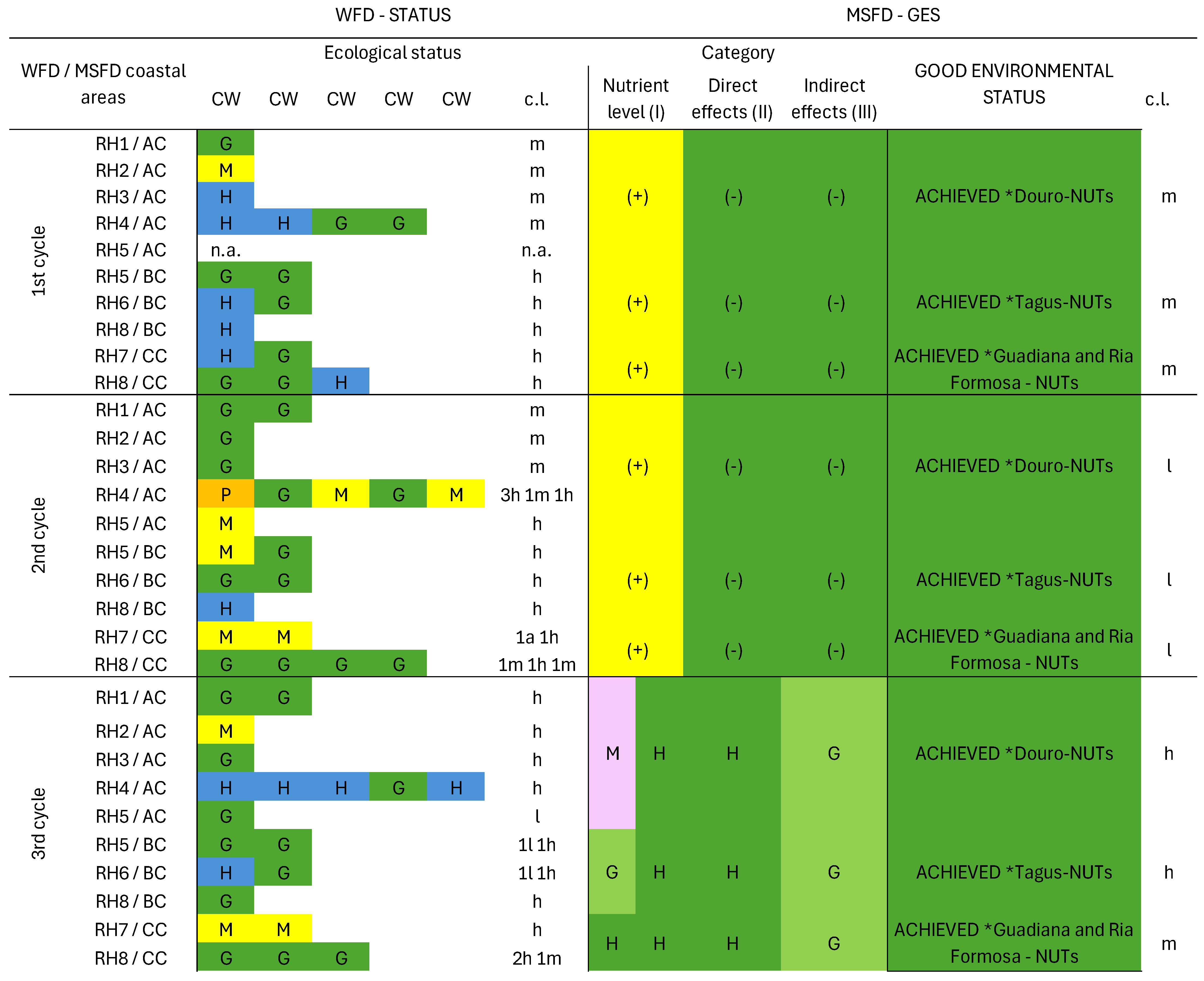
Both Directives identified the same eutrophication hotspots near major river plumes, demonstrating convergent ecological recognition, but showed divergent scoring due to methodological structure. Figure 2 summarizes and contrasts the final classification status for both Directives across the three cycles, as reported by national authorities.
WFD classifications varied across cycles, showing deterioration in the second cycle and partial recovery in cycle three, while MSFD consistently reported GES achieved at the national scale. Confidence levels were generally high in the WFD and average in the MSFD.
The Index of Discordance (ID) revealed that cycle one had the lowest discordance (11%, n = 18), reflecting a primarily qualitative assessment basis and fewer revised thresholds. The second cycle showed the highest discordance (~35%, n = 20), coinciding with major methodological revisions (revised nutrient boundaries, new statistical metrics) and temporal misalignment. Cycle three showed improved coherence (15%, n = 20), suggesting increasing methodological alignment. These patterns support the hypothesis that classification divergence is structurally driven by methodological inconsistencies.
Cohen’s kappa values showed low agreement in all cycles when comparing WFD ES with MSFD GES; kappa values were close to zero, indicating a slight agreement no better than chance (Table 2). When MSFD Category I (nutrients) was compared directly with WFD Ecological Status, kappa values showed low agreement in cycles one and two, confirming that divergence was structural rather than noise. In contrast, the third cycle showed a substantial increase in kappa (0.8—almost perfect agreement [49]), reflecting improved methodological alignment between WFD and MSFD assessments. When all cycles were aggregated, overall kappa remained low, masking the temporal improvement observed in the most recent cycle. This showed that nutrient pressures (central in WFD) carry ecologically coherent information that would improve cross-Directive coherence if more strongly weighted in MSFD-GES determination.

4. Discussion

The comparison between WFD and MSFD eutrophication assessments demonstrated that divergence arises primarily from structural and methodological architecture, rather than from contrasting ecological interpretations, directly addressing research questions one and two (Table 2).
From an ecological perspective, results consistently showed that both Directives identified the most pristine and most degraded coastal regions in Portugal. Divergence was most pronounced in transitional and plume-influenced systems (hotspots), where strong gradients in nutrients, turbidity, and oxygen interact with Directive-specific spatial scales (Figure 2). Major rivers such as the Douro, Tagus and Guadiana generate dynamic plumes that propagate offshore and along the shelf under favorable discharge and wind conditions [12,13]. These areas act as transient eutrophication hotspots, captured by both Directives but aggregated differently. A key conceptual distinction lies in the pressure-versus-effect logic embedded in each Directive. WFD classifications respond sensitively to local nutrient enrichment alone, functioning as an early-warning system for anthropogenic pressure even when biological effects are not yet pronounced, while MSFD regional averaging dilutes these signals, and nutrients are downweighed if no biological effect is observed, frequently resulting in GES being maintained despite Moderate or Poor WFD Ecological Status (Figure 2). The consistent identification of the same spatial patterns of pressure confirms that the underlying ecological signal is coherent even when classifications diverge. At the spatial level, divergence is driven by differences in assessment units.
Structural temporal factors further amplified divergence, providing a mechanistic explanation for research question two. Although both Directives apply ecologically meaningful seasonal windows, differences in temporal alignment remain substantial (Figure S1, Supplementary Material). In practice, assessment periods and reporting years often did not coincide, resulting in non-identical monitoring datasets being compared across frameworks. Temporal and spatial misalignments make it inherently difficult to direct compare results, as environmental conditions are constantly changing. Our work aimed to highlight which indicators are more sensitive to these changes, regardless of reporting periods. This becomes clearer in the third cycle where methodologies were harmonized (threshold recalibration; improved monitoring resolution; partial convergence of assessment criteria, EQR), and temporal coverage was partially coincident for both Directives. Consequently, part of the observed divergence reflects temporal misalignment rather than contrasting diagnoses of ecosystem state.
Beyond these temporal effects, methodological differences in statistical metrics further contributed to divergence. The MSFD primarily relies on winter means concentrations to characterize long-term background enrichment, whereas WFD relies on multi-season percentile metrics (e.g., 5th percentile) which are intentionally sensitive to episodic peaks and short-duration events. These contrasting statistical descriptors translate the same environmental variability into different classification outcomes, reinforcing divergence even when underlying ecological conditions are similar.
Metrics evolved through cycles towards increasing sensitivity to ecological changes and improving comparability (Tables S2–S4, Supplementary Material). This adaptive evolution across cycles, where each cycle incorporated methodological refinements from previous assessments, explains the improved coherence observed in the third cycle and explicitly supports the hypothesis that agreement increases with methodological harmonization.
The observed trends in coherence metrics, ID and Cohen’s kappa, directly supported the hypothesis that divergence was structurally/methodologically driven. The Index of Discordance (ID) showed that mismatches were highest in the second cycle, correlating with a period of substantial methodological revisions and temporal misalignment between the two Directives.
The application of Cohen’s kappa (Table 2) showed that agreement in all cycles was no better than chance, directly addressing research question three. Conversely, additional analyses showed that treating MSFD nutrient enrichment (Category I) as a binding criterion substantially increases agreement with WFD classifications, effectively reducing ID and increasing kappa values. The significant increase in Cohen’s kappa to 0.8 in the third cycle demonstrated that the improved coherence represented a genuine methodological alignment rather than chance agreement. This finding indicated that nutrient information contains ecologically meaningful signals that are partially lost in the final MSFD binary outcome and suggested that stronger integration of pressure information could improve cross-Directive coherence.
The findings of this work enable a comprehensive framework-level evaluation of both Directives that possess significant strengths, namely a legal foundation and complementary ecological perspectives. However, inherent weaknesses persist, driven by non-alignment temporal windows, threshold inconsistency, and the precautionary effect of the WFD’s OOAO rule. Clear opportunities for enhanced coherence may include harmonization of indicators, coordinated EU reporting, and the operational application of the Index of Discordance as a routine tracking metric. These advancements are critical to mitigate threats such as limiting flexibility to align thresholds, classification rules and assessment cycles; infeasibility of a practical application of measures if final classifications are divergent; and inconsistent funding cycles and resource allocation, leading to uneven data quality and monitoring intensity.
Cross-Directive coherence can be strengthened through harmonization without compromising the distinct management objectives and complementary roles of either framework. This complementarity means that WFD’s pressure-sensitive, local-scale detection can trigger early-warning management actions, while MSFD’s regional, effect-oriented perspective supports strategic reporting and evaluation of long-term ecosystem status. Recognizing these roles clearly, at an operational level, would facilitate integration.

5. Conclusions

This study demonstrated that divergence between WFD and MSFD eutrophication assessments in Portuguese coastal waters is systematic (not random), explainable, and primarily due to structural and methodological, directly answering the study’s research questions. By analyzing real classification outputs, we showed how differences in spatial scale, temporal alignment, statistical metrics, and integration rules translate into quantifiable discrepancies between Directive outcomes at the member state level. Acknowledging the reliance on legally validated policy outcomes (and not raw data), the findings highlighted the drivers of inconsistency in the policy application (not on the underlying Ecological Status).
The WFD emerged as a pressure-sensitive, early-warning framework capable of detecting local nutrient enrichment at the waterbody scale, while the MSFD functioned as a regionally integrated, effect-oriented system designed to identify widespread or persistent ecological degradation. These complementary roles explained why WFD classifications are often more precautionary, while MSFD assessments maintain GES when pressures are spatially confined.
By combining the Index of Discordance with Cohen’s kappa, this study provided a robust analytical framework to distinguish random disagreement from structural divergence. From a decision-making perspective, the Index of Discordance provides a clear operational measure of how often WFD and MSFD produce contrasting classifications for the same coastal areas. It allows managers to identify where regulatory outcomes diverge most, supporting targeted reviewed monitoring design, spatial and temporal alignment, and indicator frameworks. By distinguishing structural/methodological divergences from true ecological differences, the ID helps reduce uncertainty in status reporting and strengths the reliability of action/management triggers. Tracking ID across cycles also enables policymakers to assess whether harmonization efforts are improving coherence over time.
The confirmed role of nutrients as a binding criterion within MSFD assessments further supports the hypothesis that methodological harmonization enhances coherence, supporting the continued refinement of shared metrics and indicators.
To improve cross-Directive coherence while preserving their complementary objectives, the results support the following evidence-based priorities:
(1)
Improved temporal and spatial alignment of datasets, metrics and assessment windows with transparent cross-reporting of WFD Ecological Status and MSFD GES as complementary lines of evidence;
(2)
Routine application of a quantitative Index of Discordance, enabling objective tracking of mismatches and supporting evidence-based reconciliation between frameworks;
(3)
Adoption of a minimum common indicator set and units for coastal eutrophication assessment, including winter nutrients (DIN, DIP, silicates; µmol L−1), seasonal chlorophyll-a (µg L−1, including satellite products), photic limit (PAR sensor µmol photons m−2 s−1 or W/m2, and satellite products), phytoplankton community composition (including HAB taxa), and integrated surface and bottom oxygen metrics (ml L−1); complemented with temperature and salinity
(4)
Development of an annual technical synthesis of Chl-a and nutrient trends, focusing on hotspot areas and chronically degraded waters, using simplified traffic-light visualization to support adaptive management and early-warning responses between six-year reporting cycles.
Together, these measures would improve diagnostic consistency, strengthen policy coherence, between coastal and marine assessments and increase the capacity of both Directives to detect and manage eutrophication pressures under accelerating climate-driven changes. Future research could be expanding this comparative analysis across other member states to test consistency at an European scale. Further work is needed to evaluate the sensitivity of ID under other scenarios.

Supplementary Materials

The following supporting information can be downloaded at: https://www.mdpi.com/article/10.3390/environments13020100/s1, Figure S1: Timeline of implementation and reporting cycles for the WFD and the MSFD. Between brackets, the data used for reporting years for each evaluation cycle. RY—Reporting Year; Table S1: WFD coastal waters typologies (A) and respective hydrographic regions (RH) and water masses (CW—coastal waters, T—territorial waters) and corresponding MSFD reporting coastal areas (AC—coastal area A, BC—coastal area B and CC—coastal area C. A5-A6, A6-A7, AC-BC and BC-CC are coastal boundary areas; Table S2: Core eutrophication indicators, variables, spatial coverage, statistical metrics, evaluation periods, reference values and ecological class boundaries used under the Water Framework Directive (WFD) for Portuguese coastal waters (A5, A6 and A7) across three assessment cycles. * Declared provisional values; Table S3: Marine Strategy Framework Directive (MSFD) criteria for eutrophication assessment (Descriptor 5) in Portuguese coastal subdivisions (AC, BC, CC) across three cycles, showing indicator variables, metrics, evaluation periods and reference and limit values; Table S4: Comparison of Ecological Quality Ratios (EQR) boundaries used by the WFD [51,52,53,54].

Author Contributions

Conceptualization, M.N. and A.D.S.; methodology, M.N. and A.D.S.; validation, M.N. and A.D.S.; formal analysis, M.N. and A.D.S.; investigation, M.N. and A.D.S.; data curation, M.N., M.S. and A.D.S.; writing—original draft preparation, M.N. and A.D.S.; writing—review and editing, M.N., M.S. and A.D.S. All authors have read and agreed to the published version of the manuscript.

Funding

This research received no external funding.

Data Availability Statement

Data available in a publicly accessible repository.

Acknowledgments

The authors wish to express their gratitude to all individuals and Institutions involved in the long-term monitoring, data collection and processing that underpin the WFD and MSFD reporting cycles.

Conflicts of Interest

The authors declare no conflicts of interest.

References

  1. Conley, D.J.; Paerl, H.W.; Howarth, R.W.; Boesch, D.F.; Seitzinger, S.P.; Havens, K.E.; Lancelot, C.; Likens, G.E. Ecology. Controlling eutrophication: Nitrogen and phosphorus. Science 2009, 323, 1014–1015. [Google Scholar] [CrossRef] [PubMed]
  2. Carvalho, L.; Mackay, E.B.; Cardoso, A.C.; Baattrup-Pedersen, A.; Birk, S.; Blackstock, K.L.; Borics, G.; Borja, A.; Feld, C.K.; Ferreira, M.T.; et al. Protecting and restoring Europe’s waters: An analysis of the future development needs of the Water Framework Directive. Sci. Total Environ. 2019, 658, 1228–1238. [Google Scholar] [CrossRef] [PubMed]
  3. Macias Moy, D.; Bisselink, B.; Duteil, O.; Ferreira Cordeiro, N.; Garcia Gorriz, E.; Grizzetti, B.; Hanke, G.; Miladinova Marinova, S.; Parn, O.; Piroddi, C.; et al. Outline of the Dynamic Baseline for the MSFD Impact Assessment Analysis in the Context of the Blue2 Modelling Framework Initiative; JRC134027; Publications Office of the European Union: Luxembourg, 2023; p. 47. [Google Scholar] [CrossRef]
  4. E.C. Directive 2000/60/EC of the European Parliament and of the Council of 23 October 2000 establishing a framework for Community action in the field of water policy. Off. Publ. Eur. Union 2000, L327, 1–73. Available online: https://eur-lex.europa.eu/legal-content/EN/TXT/?uri=CELEX%3A32000L0060&qid=1764623191212 (accessed on 14 November 2025).
  5. E.C. Directive 2008/56/EC of the European Parliament and of the Council of 17 June 2008 establishing a framework for community action in the field of marine environmental policy (Marine Strategy Framework Directive). Off. Publ. Eur. Union 2008, L164, 19–40. Available online: https://eur-lex.europa.eu/eli/dir/2008/56/oj/eng (accessed on 14 November 2025).
  6. APA. Critérios para a Classificação das Massas de ÁguaFicha Técnica DTH/DEQA. 2023. 163p. Available online: https://apambiente.pt/sites/default/files/_SNIAMB_Agua/DRH/PlaneamentoOrdenamento/PGRH/2022-2027/PGRH_3_PTCONT_SistemasClassificacao.pdf (accessed on 10 November 2025).
  7. UK TAG. UK Technical Advisory Group on the Water Framework Directive. Recommendations on Surface Water Classification Schemes for the Purposes of the Water Framework Directive. 2007. 60p. Available online: https://www.daera-ni.gov.uk/sites/default/files/publications/doe/UKTAG-recommendations-on-surface-water-classification-schemes-for-the-purpose-of-the-WFD.PDF (accessed on 10 November 2025).
  8. E.C. 2010/477/EU: Commission Decision of 1 September 2010 on criteria and methodological standards on good environmental status of marine waters (notified under document C(2010) 5956). Off. Publ. Eur. Union 2010, L232, 14–24. Available online: https://eur-lex.europa.eu/eli/dec/2010/477(2)/oj/eng (accessed on 10 November 2025).
  9. E.C. Commission Decision (EU) 2017/848 of 17 May 2017 laying down criteria and methodological standards on good environmental status of marine waters and specifications and standardised methods for monitoring and assessment, and repealing Decision 2010/477/EU C/2017/2901. Off. Publ. Eur. Union 2017, L125, 43–74. Available online: https://eur-lex.europa.eu/eli/dec/2017/848/oj/eng#:~:text=Commission%20Decision%20%28EU%29%202017%2F848%20of%2017%20May%202017,repealing%20Decision%202010%2F477%2FEU%20%28Text%20with%20EEA%20relevance.%20C%2F2017%2F2901 (accessed on 10 November 2025).
  10. ME; SRMP; SRAPA. Estratégia Marinha 3º ciclo: Relatório de Avaliação das Águas Marinhas e Metas Ambientais. Ministério da Economia, Secretaria Regional do Mar e das Pescas, Açores, e Secretaria Regional de Agricultura, Pescas e Ambiente, Madeira. Abril de 2025. Parte III, Avaliação do Estado Ambiental das águas marinhas—subdivisão do Continente. 2025. 517p. Available online: https://www.dgrm.pt/documents/20143/824421/PARTE+III+-+Estado+Ambiental_Continente.pdf/c11c2428-346e-fff6-3e30-e1634c6681bf (accessed on 12 November 2025).
  11. Cabrita, M.T.; Silva, A.; Oliveira, P.B.; Angélico, M.M.; Nogueira, M. Assessing eutrophication in the Portuguese continental Exclusive Economic Zone within the European Marine Strategy Framework Directive. Ecol. Indic. 2015, 58, 286–299. [Google Scholar] [CrossRef]
  12. Mendes, R.; Vaz, N.; Fernández-Nóvoa, D.; da Silva, J.C.B.; deCastro, M.; Gómez-Gesteira, M.; Dias, J.M. Observation of a turbid plume using MODIS imagery: The case of Douro estuary (Portugal). Remote Sens. Environ. 2014, 154, 127–138. [Google Scholar] [CrossRef]
  13. Fernández-Nóvoa, D.; Gómez-Gesteira, M.; Mendes, R.; deCastro, M.; Vaz, N.; Dias, J.M. Influence of main forcing affecting the Tagus turbid plume under high river discharges using MODIS imagery. PLoS ONE 2017, 12, e0187036. [Google Scholar] [CrossRef] [PubMed]
  14. Pitcher, G.C.; Figueiras, F.G.; Hickey, B.M.; Moita, M.T. The physical oceanography of upwelling systems and the development of harmful algal blooms. Prog. Oceanogr. 2010, 85, 5–32. [Google Scholar] [CrossRef] [PubMed]
  15. Otero, P.; Ruiz-Villarreal, M.; Peliz, Á. River plume fronts off NW Iberia from satellite observations and model data. ICES J. Mar. Sci. 2009, 66, 1853–1864. [Google Scholar] [CrossRef]
  16. Thomas, B.; Costoya, X.; deCastro, M.; Gómez-Gesteira, M. Revisiting the Upwelling Evolution along the Western Iberian Peninsula over the 21st Century Using Dynamically Downscaled CMIP6 Data. J. Mar. Sci. Eng. 2024, 12, 1494. [Google Scholar] [CrossRef]
  17. del Rosario, J.J.A.; Gómez, E.B.; Pérez, J.M.V.; Rey, F.M.; Silva-Ramírez, E.L. A New Insight on the Upwelling along the Atlantic Iberian Coasts and Warm Water Outflow in the Gulf of Cadiz from Multiscale Ultrahigh Resolution Sea Surface Temperature Imagery. J. Mar. Sci. Eng. 2024, 12, 1580. [Google Scholar] [CrossRef]
  18. E.C. Water Framework Directive. Available online: https://environment.ec.europa.eu/topics/water/water-framework-directive_en#overview (accessed on 6 November 2025).
  19. E.C. Implementation Reports. Available online: https://environment.ec.europa.eu/topics/water/water-framework-directive/implementation-reports_en#previous-implementation-reports (accessed on 6 November 2025).
  20. E.C. Implementation of Marine Strategy Framework Directive. Available online: https://environment.ec.europa.eu/topics/marine-environment/implementation-marine-strategy-framework-directive_en#common-implementation-strategy (accessed on 6 November 2025).
  21. APA; ARH Norte. Plano de Gestão de Região Hidrográfica do Minho e Lima (RH1). Relatório de base. Parte 2—Caracterização e diagnóstico da Região Hidrográfica. Agosto 2012. 2012. 1702p. Available online: https://apambiente.pt/sites/default/files/_SNIAMB_Agua/DRH/PlaneamentoOrdenamento/PGRH/2010-2015/PTRH1/PGRH_1_RH1_Parte2.pdf (accessed on 13 November 2025).
  22. APA; ARH Norte. Plano de Gestão de Região Hidrográfica do Cávado, Ave e Leça (RH2). Relatório de base. Parte 2 Caracterização e diagnóstico da Região Hidrográfica. Agosto 2012. 2012. 1890p. Available online: https://apambiente.pt/sites/default/files/_SNIAMB_Agua/DRH/PlaneamentoOrdenamento/PGRH/2010-2015/PTRH2/PGRH_1_RH2_Parte2.pdf (accessed on 13 November 2025).
  23. APA; ARH Norte. Plano de Gestão de Região Hidrográfica do Douro (RH3). Relatório de base. Parte 2 Caracterização e diagnóstico da Região Hidrográfica. Agosto 2012. 2012. 2430p. Available online: https://apambiente.pt/sites/default/files/_SNIAMB_Agua/DRH/PlaneamentoOrdenamento/PGRH/2010-2015/PTRH3/PGRH_1_RH3_Parte2.pdf (accessed on 13 November 2025).
  24. APA; ARH Tejo. Plano da Bacias Hidrográficas das Ribeiras do Oeste. Relatório Técnicos. Versão Extensa. Parte 2—Caracterização e Diagnóstico da Região Hidrográfica. Agosto 2012. 2012. 278p. Available online: https://apambiente.pt/sites/default/files/_SNIAMB_Agua/DRH/PlaneamentoOrdenamento/PGRH/2010-2015/PTRH4/PGRH_1_RH4_RO_Parte2.pdf (accessed on 13 November 2025).
  25. APA; ARH Tejo. Plano de Gestão da Região Hidrográfica do Tejo (RH5). Relatório Técnico. Versão Extensa. Parte 2—Caracterização e Diagnóstico da Região Hidrográfica. Agosto 2012. 2012. 376p. Available online: https://apambiente.pt/sites/default/files/_SNIAMB_Agua/DRH/PlaneamentoOrdenamento/PGRH/2010-2015/PTRH5/PGRH_1_RH5_Parte2.pdf (accessed on 13 November 2025).
  26. APA; ARH Alentejo. Plano de Gestão das Bacias Hidrográficas Integradas na Região Hidrográfica 6 e 7. Região Hidrográfica 6. Volume I. Relatório Parte 2—Caracterização e Diagnóstico. Tomo 2. Fevereiro 2012. 2012. 454p. Available online: https://apambiente.pt/sites/default/files/_SNIAMB_Agua/DRH/PlaneamentoOrdenamento/PGRH/2010-2015/PTRH6/PGRH_1_RH6_Parte2_T2A.pdf (accessed on 13 November 2025).
  27. APA; ARH Alentejo. Plano de Gestão das Bacias Hidrográficas Integradas na Região Hidrográfica 6 e 7. Região Hidrográfica 7. Volume I. Relatório Parte 2—Caracterização e Diagnóstico. Tomo 2. Fevereiro 2012. 2012. 262p. Available online: https://apambiente.pt/sites/default/files/_SNIAMB_Agua/DRH/PlaneamentoOrdenamento/PGRH/2010-2015/PTRH7/PGRH_1_RH7_Parte2_T1A.pdf (accessed on 13 November 2025).
  28. APA; ARH Algarve. Plano de Gestão das Bacias Hidrográficas que integram a Região Hidrográfica das Ribeiras do Algarve (RH8). Volume 1. Parte 2 Caracterização e diagnóstico. Tomo 2. Maio 2012. 2012. Volume I. 202p. Available online: https://apambiente.pt/sites/default/files/_SNIAMB_Agua/DRH/PlaneamentoOrdenamento/PGRH/2010-2015/PTRH8/PGRH_1_RH8_Parte2_T2A_VolumeI.pdf (accessed on 13 November 2025).
  29. APA. Plano de Gestão de Região Hidrográfica—Parte 2 Caracterização e diagnóstico. Região Hidrográfica do Minho e Lima (RH1). Maio 2016. 2016. 172p. Available online: https://apambiente.pt/sites/default/files/_SNIAMB_Agua/DRH/PlaneamentoOrdenamento/PGRH/2016-2021/PTRH1/PGRH_2_RH1_Parte2.pdf (accessed on 12 November 2025).
  30. APA. Plano de Gestão de Região Hidrográfica—Parte 2 Caracterização e diagnóstico. Região Hidrográfica Cávado, Ave e Leça (RH2). Maio 2016. 2016. 191p. Available online: https://apambiente.pt/sites/default/files/_SNIAMB_Agua/DRH/PlaneamentoOrdenamento/PGRH/2016-2021/PTRH2/PGRH_2_RH2_Parte2.pdf (accessed on 12 November 2025).
  31. APA. Plano de Gestão de Região Hidrográfica—Parte 2 Caracterização e diagnóstico. Região Hidrográfica do Douro (RH3). Maio 2016. 2016. 200p. Available online: https://apambiente.pt/sites/default/files/_SNIAMB_Agua/DRH/PlaneamentoOrdenamento/PGRH/2016-2021/PTRH3/PGRH_2_RH3_Parte2.pdf (accessed on 12 November 2025).
  32. APA. Plano de Gestão de Região Hidrográfica—Parte 2 Caracterização e diagnóstico. Região Hidrográfica do Vouga, Mondego e Lis (RH4). Maio 2016. 2016. 193p. Available online: https://apambiente.pt/sites/default/files/_SNIAMB_Agua/DRH/PlaneamentoOrdenamento/PGRH/2016-2021/PTRH4A/PGRH_2_RH4A_Parte2.pdf (accessed on 12 November 2025).
  33. APA. Plano de Gestão de Região Hidrográfica—Parte 2 Caracterização e diagnóstico. Região Hidrográfica do Tejo e Ribeiras do Oeste (RH5). Maio 2016. 2016. 214p. Available online: https://apambiente.pt/sites/default/files/_SNIAMB_Agua/DRH/PlaneamentoOrdenamento/PGRH/2016-2021/PTRH5A/PGRH_2_RH5A_Parte2.pdf (accessed on 12 November 2025).
  34. APA. Plano de Gestão de Região Hidrográfica—Parte 2 Caracterização e diagnóstico. Região Hidrográfica do Sado e Mira (RH6). Maio 2016. 2016. 182p. Available online: https://apambiente.pt/sites/default/files/_SNIAMB_Agua/DRH/PlaneamentoOrdenamento/PGRH/2016-2021/PTRH6/PGRH_2_RH6_Parte2.pdf (accessed on 12 November 2025).
  35. APA. Plano de Gestão de Região Hidrográfica—Parte 2 Caracterização e diagnóstico. Região Hidrográfica do Guadiana (RH7). Maio 2016. 2016. 194p. Available online: https://apambiente.pt/sites/default/files/_SNIAMB_Agua/DRH/PlaneamentoOrdenamento/PGRH/2016-2021/PTRH7/PGRH_2_RH7_Parte2.pdf (accessed on 12 November 2025).
  36. APA. Plano de Gestão de Região Hidrográfica—Parte 2 Caracterização e diagnóstico. Região Hidrográfica das Ribeiras do Algarve (RH8). Maio 2016. 2016. 191p. Available online: https://apambiente.pt/sites/default/files/_SNIAMB_Agua/DRH/PlaneamentoOrdenamento/PGRH/2016-2021/PTRH8/PGRH_2_RH8_Parte2.pdf (accessed on 12 November 2025).
  37. APA. Plano de Gestão de Região Hidrográfica, 3.º Ciclo 2022–2027, Minho e Lima (RH1)—Parte 2 Caracterização e Diagnóstico, Volume A. Maio 2023. 2023. 147p. Available online: https://apambiente.pt/sites/default/files/_SNIAMB_Agua/DRH/PlaneamentoOrdenamento/PGRH/2022-2027/PTRH1/PGRH_3_RH1_Parte2_VolumeA.pdf (accessed on 11 November 2025).
  38. APA. Plano de Gestão de Região Hidrográfica, 3.º Ciclo 2022–2027, Cávado, Ave e Leça (RH2)—Parte 2 Caracterização e Diagnóstico, Volume A. Maio 2023. 2023. 159p. Available online: https://apambiente.pt/sites/default/files/_SNIAMB_Agua/DRH/PlaneamentoOrdenamento/PGRH/2022-2027/PTRH2/PGRH_3_RH2_Parte2_VolumeA.pdf (accessed on 11 November 2025).
  39. APA. Plano de Gestão de Região Hidrográfica, 3.º Ciclo 2022–2027, Douro (RH3)—Parte 2 Caracterização e Diagnóstico, Volume A. Maio 2023. 2023. 172p. Available online: https://apambiente.pt/sites/default/files/_SNIAMB_Agua/DRH/PlaneamentoOrdenamento/PGRH/2022-2027/PTRH3/PGRH_3_RH3_Parte2_VolumeA.pdf (accessed on 11 November 2025).
  40. APA. Plano de Gestão de Região Hidrográfica, 3.º Ciclo 2022–2027, Vouga, Mondego e Lis (RH4A)—Parte 2 Caracterização e Diagnóstico, Volume A. Maio 2023. 2023. 174p. Available online: https://apambiente.pt/sites/default/files/_SNIAMB_Agua/DRH/PlaneamentoOrdenamento/PGRH/2022-2027/PTRH4A/PGRH_3_RH4A_Parte2_VolumeA.pdf (accessed on 11 November 2025).
  41. APA. Plano de Gestão de Região Hidrográfica, 3.º Ciclo 2022–2027, Tejo e Ribeiras do Oeste (RH5A)—Parte 2 Caracterização e Diagnóstico, Volume A. Maio 2023. 2023. 191p. Available online: https://apambiente.pt/sites/default/files/_SNIAMB_Agua/DRH/PlaneamentoOrdenamento/PGRH/2022-2027/PTRH5A/PGRH_3_RH5A_Parte2_VolumeA.pdf (accessed on 11 November 2025).
  42. APA. Plano de Gestão de Região Hidrográfica, 3.º Ciclo 2022–2027, Sado e Mira (RH6)—Parte 2 Caracterização e Diagnóstico, Volume A. Maio 2023. 2023. 162p. Available online: https://apambiente.pt/sites/default/files/_SNIAMB_Agua/DRH/PlaneamentoOrdenamento/PGRH/2022-2027/PTRH6/PGRH_3_RH6_Parte2_VolumeA.pdf (accessed on 11 November 2025).
  43. APA. Plano de Gestão de Região Hidrográfica, 3.º Ciclo 2022–2027, Guadiana (RH7)—Parte 2 Caracterização e Diagnóstico, Volume A. Maio 2023. 2023. 191p. Available online: https://apambiente.pt/sites/default/files/_SNIAMB_Agua/DRH/PlaneamentoOrdenamento/PGRH/2022-2027/PTRH7/PGRH_3_RH7_Parte2_VolumeA.pdf (accessed on 11 November 2025).
  44. APA. Plano de Gestão de Região Hidrográfica, 3.º Ciclo 2022–2027, Ribeiras do Algarve (RH8)—Parte 2 Caracterização e Diagnóstico, Volume A. Maio 2023. 2023. 191p. Available online: https://apambiente.pt/sites/default/files/_SNIAMB_Agua/DRH/PlaneamentoOrdenamento/PGRH/2022-2027/PTRH8/PGRH_3_RH8_Parte2_VolumeA.pdf (accessed on 11 November 2025).
  45. MAMAOT. Estratégia Marinha para a subdivisão do Continente. Diretiva-Quadro “Estratégia Marinha”. Ministério da Agricultura do Mar do Ambiente e do Ordenamento do Território, Portugal. 2012, 906p. Available online: https://www.dgrm.pt/documents/20143/43971/EstrategiaMarinha_subdv_Continente.pdf/3f9a7135-5084-d556-51e8-837c1a72c450 (accessed on 10 November 2025).
  46. MAR. Estratégia Marinha Relatório do 2º Ciclo, parte D—Reavaliação do Estado Ambiental e Definição de Metas—Subdivisão do Continente. Ministério da Agricultura, do Mar, do Ambiente e do Ordenamento do Território. Março de 2020. 2020. 359. Available online: https://www.dgrm.pt/documents/20143/43971/Doc8.+Parte+D_Continente.pdf/947797e7-1e4e-cc5f-a0f4-8d2b1eaf4f08c (accessed on 11 November 2025).
  47. Bettencourt, A.; Bricker, S.B.; Ferreira, J.G.; Franco, A.; Marques, J.C.; Melo, J.J.; Nobre, A.; Ramos, L.; Reis, C.S.; Salas, F.; et al. Typology and Reference Conditions for Portuguese Transitional and Coastal Waters. INAG, IMAR. 2004. 99p. Available online: https://www.ecowin.org/ticor/documents/ticor%20book.pdf (accessed on 10 November 2025).
  48. De Raadt, A.; Warrens, M.J.; Bosker, R.J.; Kiers, H.A.L. Kappa Coefficients for Missing Data. Educ. Psychol. Meas. 2019, 79, 558–576. [Google Scholar] [CrossRef] [PubMed]
  49. Landis, J.R.; Koch, G.G. The measurement of observer agreement for categorical data. Biometrics 1977, 33, 159–174. [Google Scholar] [CrossRef] [PubMed]
  50. OSPAR. Revision of the Common Procedure for the Identification of the Eutrophication Status of the OSPAR Maritime Area. OSPAR Agreement 2022-07. London: OSPAR Commission. 2022; Available online: https://www.ospar.org/documents?v=49366 (accessed on 10 November 2025).
  51. E.C. 2008/915/EC: Commission Decision of 30 October 2008 establishing, pursuant to Directive 2000/60/EC of the European Parliament and of the Council, the values of the Member State monitoring system classifications as a result of the intercalibration exercise. Off. Publ. Eur. Union 2008, L332, 20–44. Available online: https://eur-lex.europa.eu/legal-content/EN/TXT/?uri=CELEX%3A32008D0915&qid=1764716983264 (accessed on 9 November 2025).
  52. E.C. 2013/480/EU: Commission Decision of 20 September 2013 establishing, pursuant to Directive 2000/60/EC of the European Parliament and of the Council, the values of the Member State monitoring system classifications as a result of the intercalibration exercise and repealing Decision 2008/915/EC. Off. Publ. Eur. Union 2013, L266, 1–47. Available online: https://eur-lex.europa.eu/legal-content/EN/TXT/?uri=celex%3A32013D04807 (accessed on 9 November 2025).
  53. E.C. Commission Decision (EU) 2018/229 of 12 February 2018 establishing, pursuant to Directive 2000/60/EC of the European Parliament and of the Council, the values of the Member State monitoring system classifications as a result of the intercalibration exercise and repealing Commission Decision 2013/480/EU, C/2018/0696. Office for Official Publications of the European Union. 2018. Off. Publ. Eur. Union 2018, L47, 1–91. Available online: https://eur-lex.europa.eu/legal-content/EN/TXT/?uri=celex%3A32018D022 (accessed on 9 November 2025).
  54. Moe, S.J.; Mentzel, S.; Welch, S.A.; Lyche Solheim, A. From national monitoring to transnational indicators: Reporting and processing of aquatic biology data under the European Environment Agency’s State of the Environment data flow. Front. Environ. Sci. 2023, 11, 1057742. [Google Scholar] [CrossRef]
Figure 1. Map of the WFD coastal water bodies (A5, A6, A7; green) and MSFD coastal waters (AC, BC, CC; grid). Rivers and Rias: 1—Minho, 2—Douro, 3—Mondego, 4—Tagus, 5—Sado, 6—Ria Formosa, 7—Guadiana. Bathymetry (in blue).
Environments 13 00100 g001
Figure 2. Ecological (ES) and environmental (GES) status of Portuguese coastal waters under the Water Framework Directive (WFD) and the Marine Strategy Framework Directive (MSFD) across assessment cycles. Status classification WFD: High (H, blue), Good (G, green), Moderate (M, yellow), Poor (P, orange) and Bad (B, Red). Status classification MSFD: Achieved (A, green) and not achieved (NA Red), Categories classification positive (+, Yellow), negative (-, green) (first and second cycles); High (H, green), Good (G, light green), Moderate (M, pink), Poor (P, dark orange) and B (Bad, red) (third cycle). No information available is referred to n.a. Hotspots prone to eutrophication are highlighted by an asterisk (*). Confidence levels are abbreviated as c.l and range from high (h), to medium (m), to low (l). CW—Coastal Waterbody.
Environments 13 00100 g002
Table 1. Correspondence between the WFD and MSFD classifications and integration into a “traffic light” nomenclature and respective broad management implications. MSFD cycles are individualized due to methodological changes in the 3rd cycle. Categories classification positive (+), negative (−). “Traffic light” system (Good—green, Moderate—yellow, Poor—red). Categories classification positive (+), negative (−).
WFDMSFD
Ecological Status1st and 2nd cycle
Category I, II and III
3rd cycle
Category I, II, III
GESCategorical comparison approachManagement Implications
High, Good(−)(−)(−) or (+)(−)(−) High. GoodAchievedGoodObjectives met
Moderate(−)(+)(−) or (−)(−)(+)ModerateNot Achieved ModerateWarning/Potential failure
Poor, Bad(−)(+)(+) or (+)(−)(+) or (+)(+)(−) or (+)(+)(+)Poor, BadNot AchievedPoorFailure/action required
Table 2. Contingency matrices used to calculate Cohen’s kappa (K) between WFD Ecological Status (ES) and MSFD classifications across assessment cycles. The matrices compare harmonized three-class categories (Good-High, Moderate, Poor-Bad) for the first, second and third assessment cycles, as well as for all cycles combined. Upper panels show agreement between WFD Ecological Status and MSFD ecological-class outcomes, while lower panels show agreement between WFD Ecological Status and MSFD GES binary outcomes.
1st2nd3rdAll Cycles
MSFD-GES
WFD ESGood
–High
ModeratePoor–BadGood–HighModeratePoor–BadGood–HighModeratePoor–BadGood–HighModeratePoor–Bad
Good–High16 13 17 46
Moderate1 6 3 10
Poor–Bad 1 1
K0.00.00.00.0
WFD ESMSFD-NUT level
Good–High 16 13 8 829
Moderate 1 6 210 217
Poor–Bad 1 1
K0.00.00.80.1
Disclaimer/Publisher’s Note: The statements, opinions and data contained in all publications are solely those of the individual author(s) and contributor(s) and not of MDPI and/or the editor(s). MDPI and/or the editor(s) disclaim responsibility for any injury to people or property resulting from any ideas, methods, instructions or products referred to in the content.