


Abstract
The oxidative potential (OP) of airborne particulate matter (PM) has emerged as a promising metric to assess the capacity of particles to induce oxidative stress and related health effects. Thus, ensuring the reliability and comparability of OP measurements is essential for accurate environmental and toxicological assessment. This study aimed to develop and evaluate a quality control approach for the dithiothreitol (DTT) assay used in OP determination. The DTT assay provides an estimation on how harmful PM can be to human health through oxidative stress, relating it to the consumption of DTT during the test period. Two experiments were conducted using the Standard Reference Material (SRM) 1648–Urban Particulate Matter (NIST, USA). The first assessed the effect of trichloroacetic acid (TCA) addition order and the feasibility of using SRM 1648 as a reference material. The second evaluated the stability of the SRM solution over a 63-day period. Statistical analysis (Mann–Whitney test) indicated that the order of TCA addition did not significantly affect OP values (p > 0.05). SRM 1648 solution determination showed high reproducibility (mean DTTₘ = 14.6 ± 2.4 pmol·min−1·µg−1), although a gradual increase in DTT metrics was observed over time, consistent with progressive dissolution. The results support the application of SRM 1648 as a reference material for DTT assay quality control, supporting methodological harmonization in OP determination, provided that a freshly prepared solution is used.
1. Introduction
In recent decades, numerous epidemiological studies have linked the inhalation of particulate matter (PM) with respiratory and cardiovascular diseases [1]. However, the inconsistency of these associations suggests that not all PM components are equally toxic [2]. Consequently, the current air quality standards, which are based on PM mass, may not adequately reflect the health impacts associated with exposure to this pollutant.
PM can catalyze the generation of reactive oxygen species (ROS), for example, through the promotion of Fenton and Haber-Weiss reactions, which involve the redox cycling of iron and other transition metals [2,3,4]. When the concentration of ROS exceeds the body’s antioxidant capacity, the cells’ redox balance is disturbed, leading to oxidative stress [5]. This state can induce chemical alterations in biomolecules, such as DNA, proteins, and lipids, which may cause cellular structure damage, inflammation in the respiratory and cardiovascular systems, and contribute to the onset or progression of various chronic diseases [5,6,7].
Oxidative potential (OP) has been proposed as a more health-relevant metric than PM mass for evaluating the effects of particulate matter inhalation in the human body [2,8,9]. This parameter has been recognized by the European Parliament as a valuable tool for evaluating the health implications of PM, as stated in the new Ambient Air Quality Directive (2024/2881) [10]. This directive promotes the monitoring of OP in at least one supersite per Member State and encourages the Member States to support methodological development and harmonization.
OP can be determined by using several cellular and acellular methods, each with specific methodological characteristics and sensitivities [5,11]. Because each method probes different aspects of particle redox activity, the use of more than one assay, including both cellular and acellular approaches, is recommended to strengthen the estimation of the health outcomes of PM inhalation [12]. In practice, acellular assays have been more widely used, since they are more rapid and less resource-intensive than cellular assays, leading to a faster development of datasets that can be applied in source apportionment studies, as well as in health analysis [5]. These assays were developed to simulate the in vivo generation of superoxide radicals () and the consequent degradation of the proxies to cellular reductants, such as dithiothreitol (DTT), or on the consumption of endogenous antioxidant agents, such as ascorbic acid or glutathione [5]. Therefore, the estimation of the oxidative potential of a PM sample can be based on the determination of an antioxidant consumption rate. This way, these assays provide a reproducible and quantitative method of assessing the redox activity of airborne particles, offering valuable insight into their biological reactivity. Each of these methods simulates different cellular redox reactions, leading to varied responses to PM composition and sources. Other techniques, such as the electron spin (or paramagnetic) resonance assay, on the other hand, rely on the direct measurement of hydroxyl radicals for OP determination [5].
Due to the spatial homogeneity and proven relation with health outcomes of the OP values obtained through the DTT assay, this has become one of the most widely employed methods for determining the OP of particulate matter [5]. DTT, also known as Cleland’s reagent, is a reducing agent that acts as a surrogate of the ones present in the cells, such as NADH or NADPH. The rate of superoxide generation by PM is proportional to the rate at which DTT is consumed, when DTT is in excess [5,11,13].
This assay is highly responsive to organic carbon, and especially highly oxidized organics, as well as certain transition metals, such as Cu and Mn [5,11]. Charrier et al. [14] investigated the role of transition metals and quinones in the OPDTT determination, using stock solutions. The results show that all studied quinones presented a good correlation (r2 ≥ 0.94) between the DTT consumption rate and the concentration of the stock solution. Regarding the metals, Cu(II) and Mn(II) showed a non-linear response between the two variables, well fit by a power relation, with r2 of 0.96 and 0.98, respectively. Other metals, including Ni, V, and Fe showed positive linear responses, with r2 ≥ 0.88.
Despite the relevance of this assay for the OP assessment studies, the variations that exist in the methodology make it challenging to compare results and thus understand the real implications of air pollution on human health [12]. Furthermore, interlaboratory studies have demonstrated discrepancies between laboratories performing the DTT assay, even when following the same protocol. With the recent European requirements for OP determination in all member states [10], it is crucial to standardize the OP protocol and to establish quality control procedures that support method robustness and the comparability of results [12].
In this context, the present study aims to establish a methodological approach for the quality control of a non-automated DTT assay, as introduced by Cho et al. [13] and described by Chirizzi et al. [15], by: (i) assessing the influence of trichloroacetic acid (TCA) order of addition; (ii) evaluating the standard reference material, Urban Particulate Matter (SRM 1648) as reference matrix candidate for OP determination; (iii) evaluating the stability of the solutions of this reference material over time; and (iv) assessing the analytical validation parameters, such as the limit of detection (LOD), limit of quantification (LOQ), precision, and accuracy, of the method implemented in our laboratory. By addressing these gaps, the study contributes directly to efforts aimed at the future harmonization and standardization of OP measurements.
2. Materials and Methods
2.1. Oxidative Potential DTT Assay
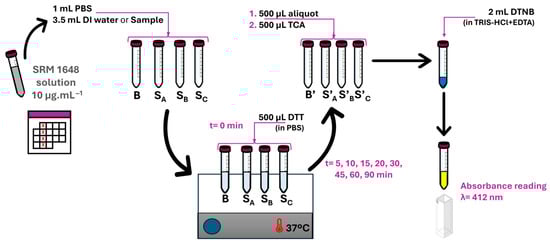
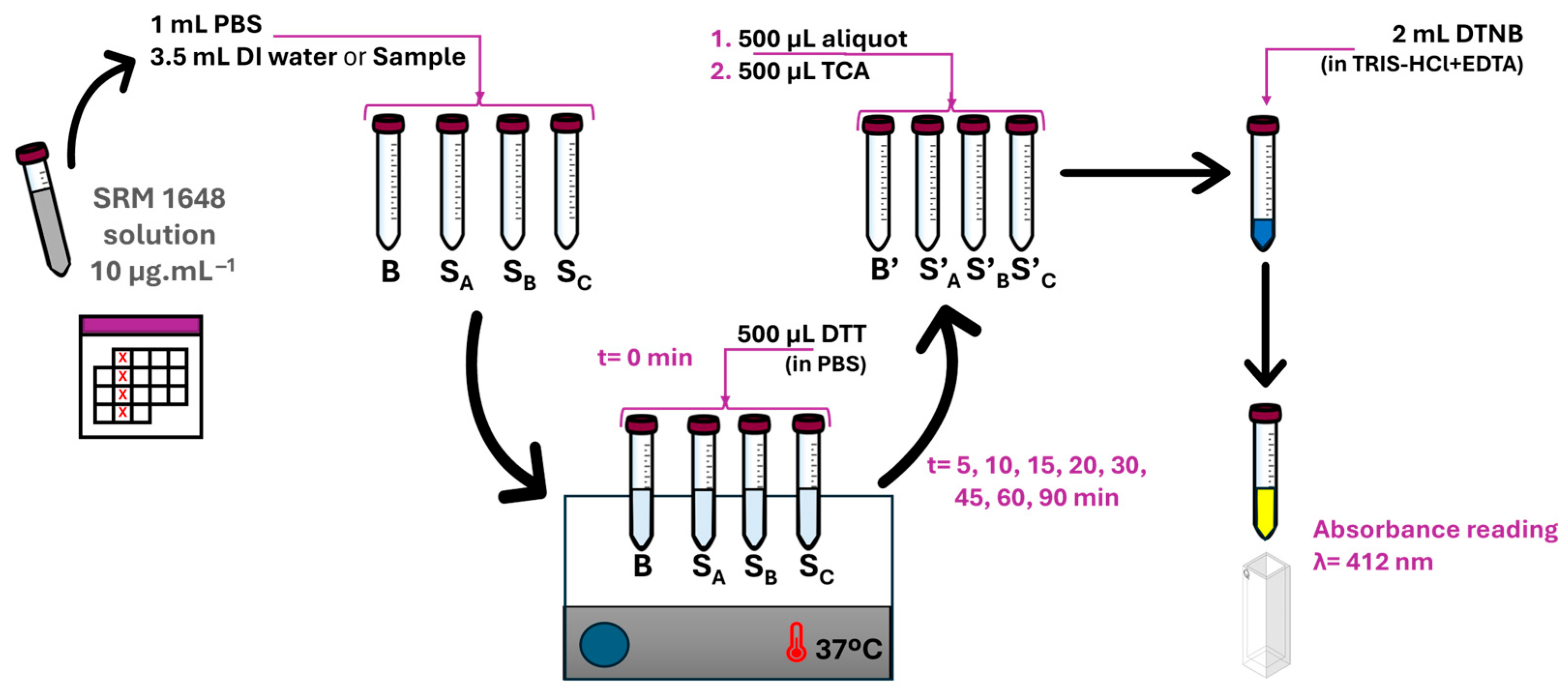
The OP was determined using the DTT assay, following the procedure described by Chirizzi et al. [15], which is an adaptation of the original protocol defined by Cho et al. [12] Briefly, in this method, 3.5 mL of a particulate matter sample was incubated with 500 µL of a 1 mM DTT solution (CAS No. 3483-12-3), and 1 mL of a phosphate buffer solution (PBS), at 37.0 ± 0.2 °C. The reaction was monitored over 90 min, with 500 µL aliquots withdrawn at specific reaction times (5, 10, 15, 20, 30, 45, 60, and 90 min). Typically, immediately after collection, each aliquot was mixed with 500 µL of a 10% (v/v) trichloroacetic acid (TCA) solution (CAS No. 76-03-9) to stop the reaction.
At the end of the reaction, 2 mL of a 0.5 mM solution of 5,5′-dithiobis-2-nitrobenzoic acid (DTNB) (CAS number 69-78-3), in TRIS-HCl solution (pH = 8.9) with EDTA, was added to the aliquots, and absorbance was measured at 412 nm, using a Shimadzu UV-1800 spectrophotometer (Shimadzu, Japan). Details on the preparation of solutions can be found in the Supplementary Material.
The DTT consumption rate (δDTT) is determined from the slope (δABS) and the intercept (ABS0) of the linear regression of measured absorbance versus reaction time, according to Equation (1),
where n0 is the number of DTT moles present in the reaction mixture at the beginning of the assay.
Outliers were removed from the absorbance data following the cumulative criteria: data points must follow a downward trend; the coefficient of determination (r2) must be as close as possible to 1 (r2 ≥ 0.98); and at least five points must remain in the regression.
The DTT activity for a sample is determined by subtracting the average DTT consumption rate of blanks (δblank) from that of each sample (δsample). The resulting activity was normalized in terms of the sampled PM mass (m), according to Equation (2), providing information related to the intrinsic properties of particulate matter [15].
2.2. Standard Reference Material Solution
According to the guidelines of the International Council for Harmonisation, reference materials should be used during analytical method validation to ensure reliability and comparability of the results [16].
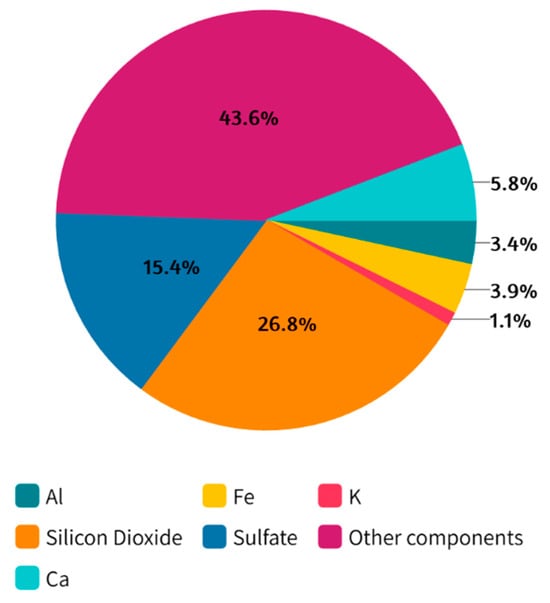
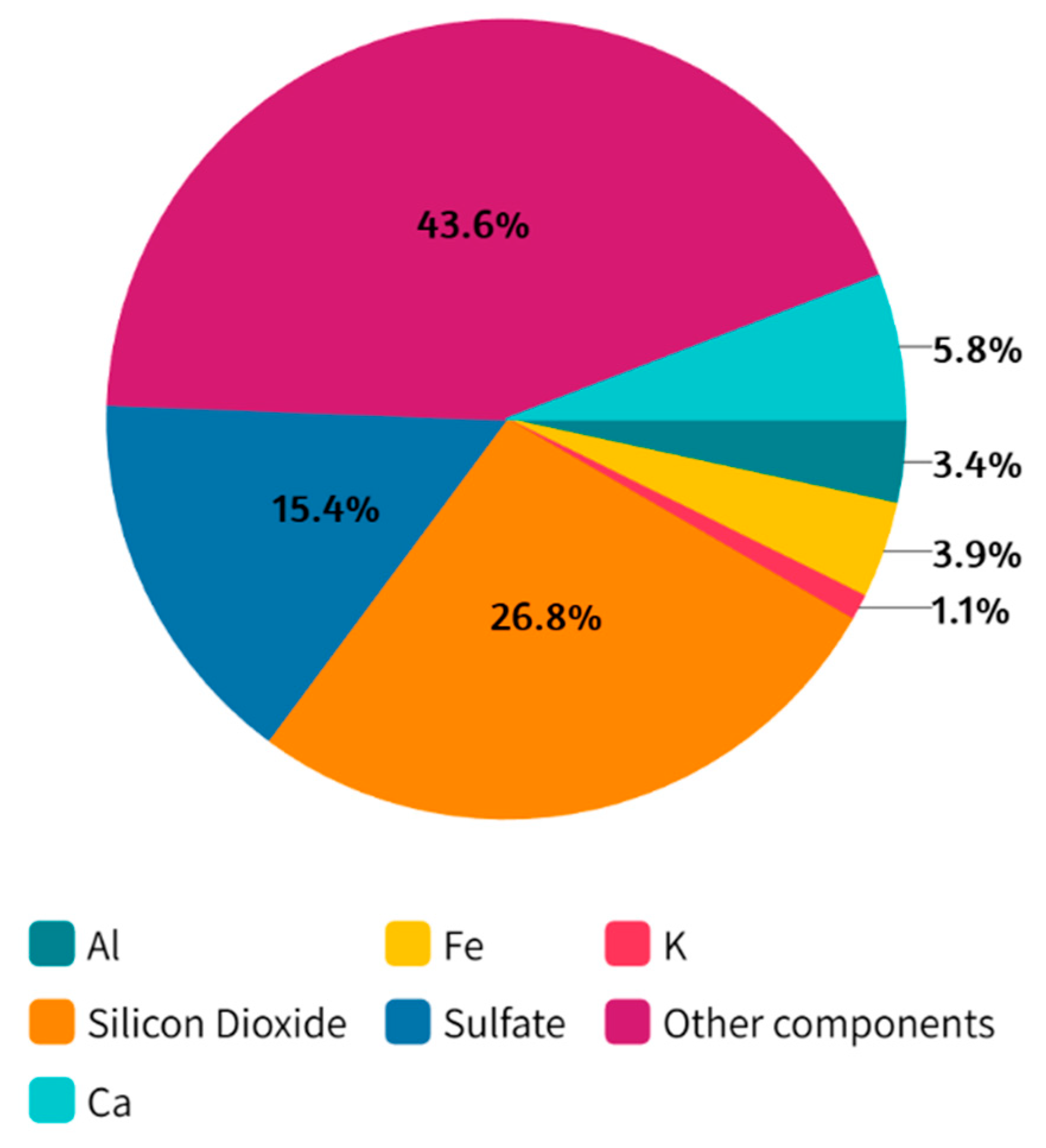
The standard reference material Urban Particulate Matter SRM 1648 (later updated to SRM 1648a), from the National Institute of Standards and Technology (NIST, USA), is “intended primarily for use as a control material and in the evaluation of methods used in the analysis of atmospheric particulate matter and material with a similar matrix” [17]. SRM 1648 was collected in St. Louis in the 1970s and is considered by NIST as a surrogate for total suspended particle matter [18]. This reference material has been used in studies investigating the effects of urban particle matter in biological systems, specifically regarding the mobilization of airborne iron [19,20,21]. The composition of SRM 1648 is illustrated in Figure 1 [17]. In the “other components” group are included the chemical species, whose mass fraction, in percentage, is less than 1%, such as Na, Pb, and Zn.
Figure 1.
Composition of SRM 1648, in mass fraction percentage (based on NIST, USA [17,18]).
For the first set of experiments of the present study, a solution of SRM 1648 with a concentration of 10 µg.mL−1 was prepared using deionized water (DI, Milli-Q; >18 MΩ, TOC = 4 ppb). For the second experiment, a new solution with the same concentration was prepared using deionized water (DI, Milli-Q; >18 MΩ, TOC = 6 ppb).
2.3. Experimental Design
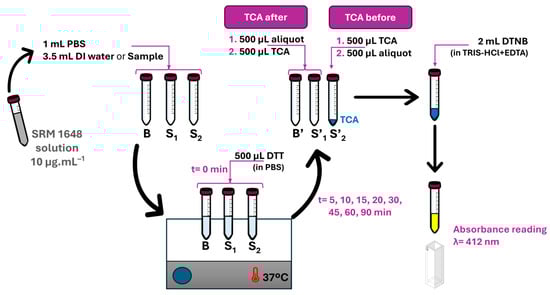
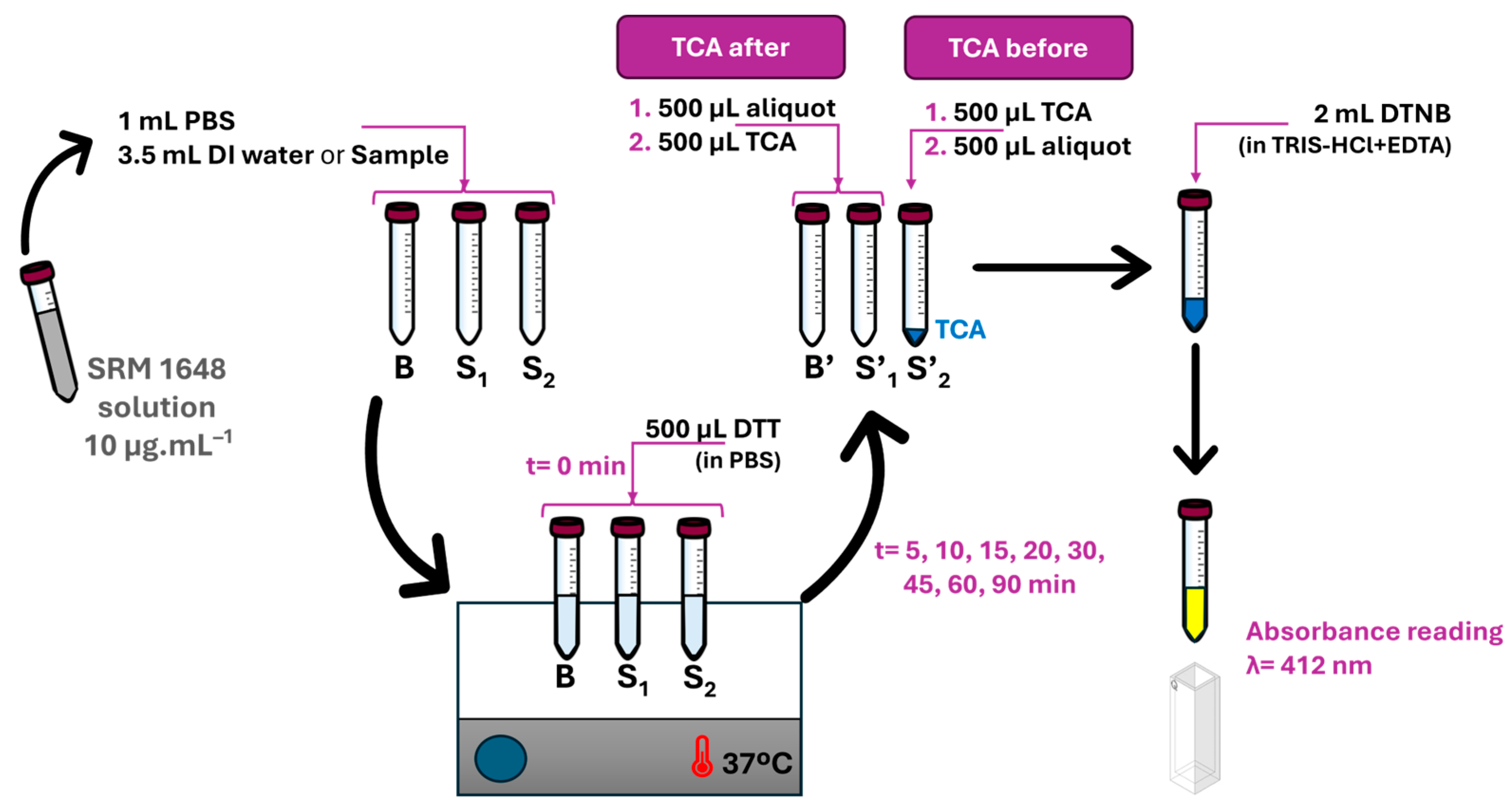
This study comprised two independent experiments designed to evaluate the DTT activity of a solution of SRM 1648–Urban Particulate Matter (NIST, USA), at a concentration of 10 µg.mL−1. The first experiment aimed to investigate two aspects: (i) the effect of the order of addition of the trichloroacetic acid (TCA) solution on the DTT activity results, and (ii) the feasibility of using an SRM 1648 solution as a reference material for OP determination. The SRM solution was prepared using deionized water. In each test, the DTT consumption rate of duplicates and a blank (consisting of deionized water) were measured. The duplicates differed in the order of TCA addition: in one case, TCA was added to the aliquot (“TCA after”), while in the other, the aliquot was added to the TCA solution (“TCA before”), as depicted in Figure 2. Each condition was tested in ten independent runs, with a total of 20 replicates, 10 from each test group.
Figure 2.
Schematic representation of the experimental design of the first experiment. B—Blank, consisting of deionized water, S1—SRM solution corresponding to “TCA After”, S2—SRM solution corresponding to “TCA Before”, B’—aliquot from blank, S’n—aliquot from sample.
The second experiment assessed the degradation of the SRM 1648 solution over 63 days. For this purpose, a fresh SRM solution was prepared using deionized water and each week, the DTT consumption rate of triplicate samples of that solution and a blank were determined under identical experimental conditions, as presented in Figure 3. This analysis was performed weekly, over nine weeks. During this period, the solution was maintained frozen, at −18 °C, between analysis. The solution was only agitated manually before weekly analyses.
Figure 3.
Schematic representation of the experimental design of the second experiment. B—Blank, consisting of deionized water, S—SRM solution, analyzed in triplicate (A, B, and C), B’—aliquot from blank, S’—aliquot from sample.
The statistical analysis was performed using IBM SPSS Statistics, version 30.0, OriginLab Corporation, Origin, version 2025b and Microsoft Excel.
2.4. Method Validation
Given the variety of acellular assays and the variability of protocols and ways of implementation within each assay, the results obtained in different laboratories are difficult to compare. Therefore, quality control is crucial, namely for the implementation of air quality directives such as the new Ambient Air Quality Directive (2024/2881) [10,12].
According to the International Council for Harmonization (ICH) guideline “Validation of Analytic Procedures–scientific guideline”, several key parameters should be considered when validating an analytical method, including the limits of detection and quantification, precision and accuracy [16].
The limit of detection (LOD) represents the minimum analyte concentration that produces a significantly different response from that of the blank, that is, the smallest amount or concentration of analyte that can be reliably distinguished from the blank [22,23]. At a confidence level of 95%, LOD can be determined as stated in Equation (3) [23],
where blank is the mean and σblank is the standard deviation of the blanks signal.
The limit of quantification (LOQ) corresponds to the minimum analyte concentration that can be measured with acceptable precision and accuracy [22], and can be determined as stated in Equation (4),
Precision reflects the level of agreement between replicate measurements. It can be evaluated through either reproducibility (interlaboratory) or repeatability (intralaboratory) [23]. In the present study, precision was assessed under repeatability conditions, as all measurements were carried out in a single laboratory by the same operator, using the same equipment. A full assessment of reproducibility would require an interlaboratory study and was beyond the scope of this work. Under these conditions, at least ten replicate measurements were required and performed. At a 95% confidence level, the repeatability coefficient (RC) was determined as stated in Equation (5) [24],
where σw is the within-subject standard deviation for the repeated measurements. The RC value represents the maximum absolute difference expected between two results of the same measurement, with 95% probability.
Accuracy is defined as the closeness of agreement between a test result and the accepted reference value of the analyte [23]. It can be evaluated using z-score, determined as described in Equation (6) [12]
where x is the test result, X is the reference value and σref is the standard deviation associated with the reference value. A indicates a deviation of 3 or more standard deviations from the reference value, and is considered unacceptable; , is acceptable with precaution; is acceptable [12].
3. Results and Discussion
This section is divided into three subsections. The first addresses the influence of the order of addition of the TCA solution and assesses the suitability of the SRM 1648 as a reference material for OPDTT determination. The second subsection presents the results of the stability test of the reference material, while the third provides the validation metrics for the analytical method.
3.1. Effect of the Order of Addition of the TCA Solution
The DTT activity of a 10 µg.mL−1 solution of the reference material SRM 1648 was determined in duplicate: in one duplicate, TCA was added to the aliquot (“TCA after”), whereas in the other, the aliquot was added to the TCA solution (“TCA before”). The experiment was repeated ten times to ensure statistical significance. Results, normalized to the mass, are summarized in Table 1. The total value comprises all the DTT activity results from the solution analysis. The average DTT consumption rate of the blanks was 444 ± 55 pmol.min−1, under the experimental conditions.
Table 1.
Oxidative potential of an SRM 1648 solution (10 µg.mL−1) under different conditions of TCA order of addition.
The results were submitted to the Mann–Whitney test to compare the two groups (“TCA before” and “TCA after”). The statistical analysis revealed that the order of addition of TCA had no significant influence on the results, as the DTT activity values were not statistically different (p-value > 0.05). However, a slightly higher variation was observed when the aliquot was added to the TCA solution (“TCA before”), as indicated by the coefficient of variation (18.0% compared to 15.9%). Therefore, adding TCA to the aliquot (“TCA after”) is considered the more consistent and suitable approach for OPDTT determination.
Based on these findings, a solution of SRM 1648 can be effectively applied as a reference standard for OPDTT determination in aqueous solution, with an average OPm of 14.6 ± 2.4 pmol.min−1.µg−1, at 37.0 ± 0.2 °C.
In a previous study [25], a more recent reference material, SRM 1649a–Urban Particulate Matter (NIST, USA), was analyzed using the DTT assay at PM concentrations of 25, 50, and 100 µg.mL−1, for 120 min. The OP values ranged between 479 and 905 nM.min−1, at 60 min reaction time, and demonstrated a non-linear positive dose–response. Despite the differences in composition between SRM 1648a and SRM 1649a, the OPm result obtained in the present study is similar to that reported by Shahpoury et al. [25].
3.2. SRM Solution Stability
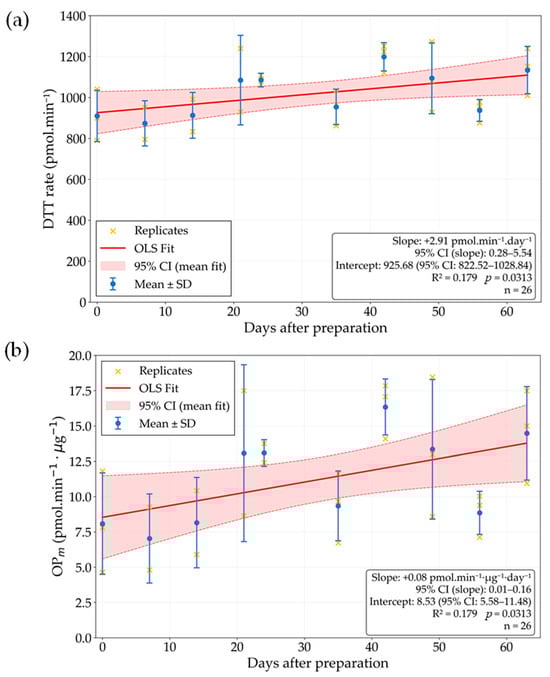
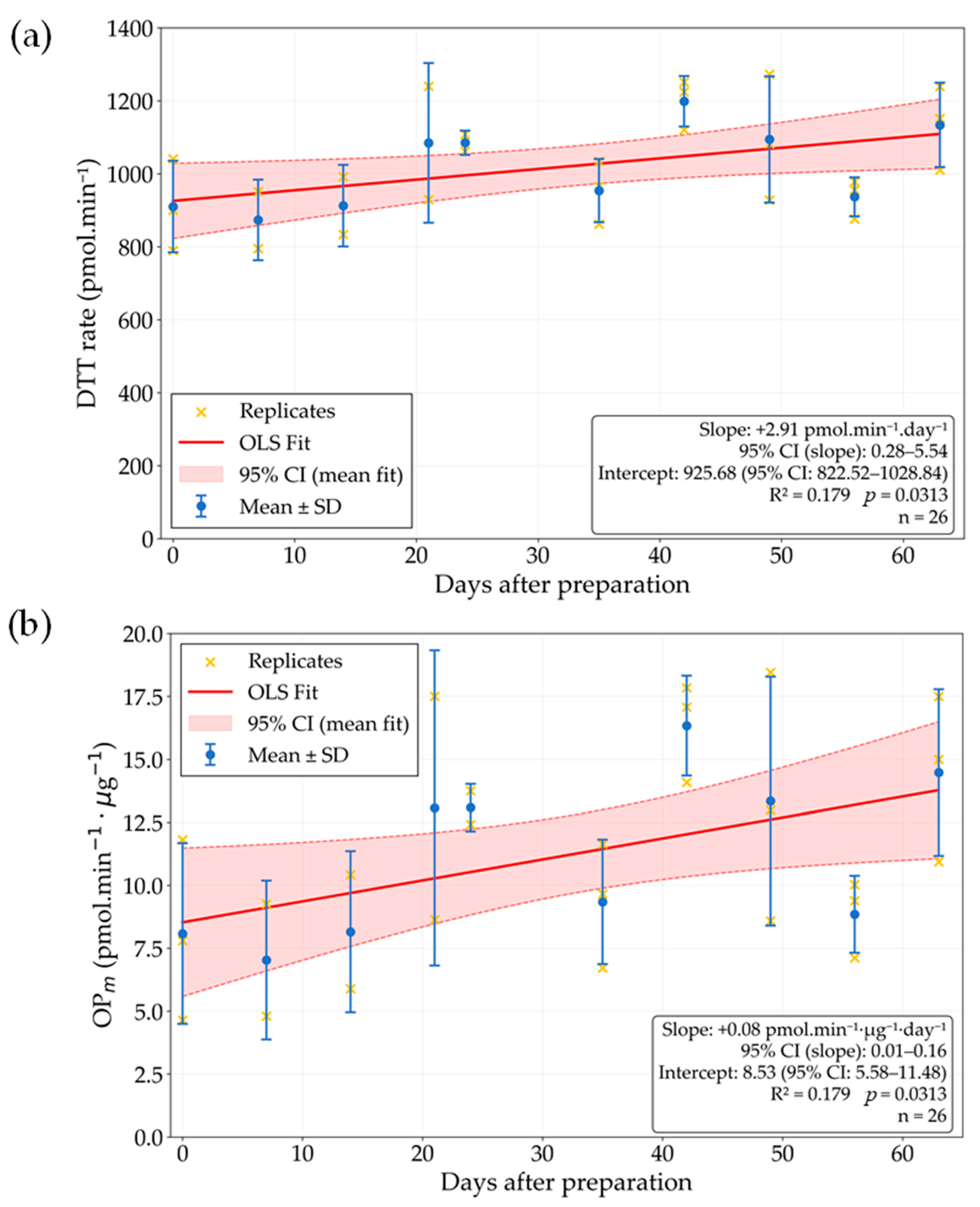
DTT activity of a 10 µg·mL−1 SRM 1648 suspension was measured weekly for 63 days, with triplicate measurements whenever possible and at least duplicate measurements otherwise. Figure 4 presents the obtained results. The average DTT consumption rate for the blanks was 627 ± 123 pmol.min−1 under the experimental conditions of these assays.
Figure 4.
Time evolution of the oxidative potential of an SRM 1648 suspension (10 µg.mL−1) over 63 days after preparation. Yellow × symbols show individual replicates at each time point; blue circles with error bars are day-wise mean ± SD (triplicates). The red solid line is the ordinary least squares (OLS) fit to all observations (n = 26); the pink shaded band with dashed bounds is the 95% confidence interval (CI) for the mean fit, for: (a) DTT consumption rate, and (b) Mass-normalized oxidative potential.
The SRM 1648 solution showed an overall DTT consumption rate of 1023 ± 142 pmol.min−1 (n = 26) and a mass-normalized DTT activity of 11.3 ± 4.1 pmol.min−1.µg−1 across the 63-day observation period. When assessed as a function of storage time, both endpoints displayed clear positive temporal trends. Ordinary least squares (OLS) regression estimated an increase of +2.91 (95% CI: 0.28–5.54) pmol.min−1.day−1 for the DTT rate (p = 0.0313) and +0.08 (95% CI: 0.01–0.16) pmol.min−1.µg−1.day−1 for the mass-normalized DTT activity (p < 0.0313).
The variation from the beginning to the end of the period was substantial: the mean DTT rate rose from 910 pmol.min−1 at day 0 to 1134 pmol.min−1 at day 63 (~25% increase), while the mass-normalized DTT activity increased from 8.1 pmol.min−1 µg−1 at day 0 to 14.5 pmol.min−1.µg−1 at day 63 (~79% increase). Rather than degradation, these patterns are consistent with progressive dissolution/disaggregation of SRM 1648 particulates. The repeated ice formation and melting caused by the repeated nine-week freeze/defrost cycles can promote both aggregation and mechanical damage or micro fracturing of particles, increasing the accessible surface area and facilitating progressive releasing of redox-active components into solution over time [26,27]. The mean mass-normalized DTT activities at days 0, 7 and 14 were 8.1, 7.0 and 8.2 pmol·min−1·µg−1, respectively, with no significant differences among these time points (one-way ANOVA, p = 0.930). In contrast, when measurements from days 0 to 14 were pooled and compared with those from days 21 to 63, the mean activity increased from 7.8 ± 2.8 to 12.6 ± 3.8 pmol·min−1·µg−1, and this difference was statistically significant (Welch two-sample t test, p = 0.003). These findings indicate that oxidative potential remains stable during the first 14 days of storage at −18 °C, while longer storage is associated with a systematic increase that is consistent with progressive dissolution or disaggregation of SRM 1648 particulates.
Taken together, the data do not support the assertion that the SRM 1648 solution is temporally stable over 63 days. For unbiased comparison of oxidative potential across samples or studies, we recommend analyzing freshly prepared SRM 1648 suspensions and, when stored at −18 °C, within a maximum of 14 days after preparation.
3.3. Quality Control Metrics
According to the ICH guidelines, limits of detection and quantification, precision and accuracy must be included in the validation of analytic protocols [16].
The LOD and LOQ for the procedure applied in the present study were calculated using Equations (3) and (4), respectively. Considering the blank values from both experiments described in the previous sections, the determined LOD was 967.9 pmol.min−1 (or 0.27 µM.min−1) and LOQ 1915.8 pmol.min−1 (or 0.55 µM. min−1).
A previous study that applied a similar methodology for OP determination, but with differences in the added volume of DTNB solution (1 mL instead of 2 mL), and by not using TCA or a chelating agent, revealed a LOD value of 0.09 μM.min−1, and a LOQ of 0.30 μM.min−1 [28]. These values are substantially lower than the ones obtained in the present study [28]. The absence of TCA addition and the reduced DTNB added volume provide a lower dilution of unreacted DTT. The combination of these two factors provides a higher analyte concentration, enhancing the analytical sensitivity of the method.
Precision was evaluated through the repeatability coefficient (RC), as stated in Equation (5). Within each measurement performed in triplicate, the absolute differences between each two values were compared to the RC value (229.1 pmol.min−1). Approximately 86% of these differences fell within the RC threshold, confirming satisfactory repeatability under the defined conditions.
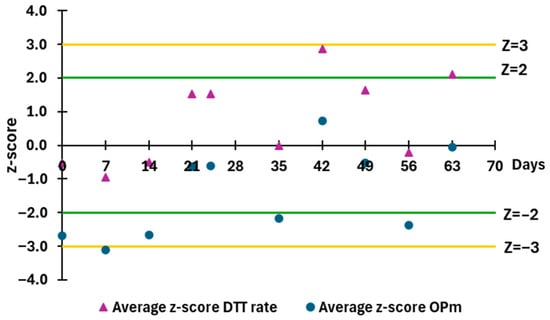
Accuracy was investigated using z-score, determined by Equation (6), considering the results from the first experiment (described in Section 3.1) as a reference value for this analysis. Z-scores for the OP values obtained during the SRM stability test (Section 3.2) are presented in Figure 5.
Figure 5.
Z-score of the DTT consumption rate ( and DTT activity (OPm) results obtained in the SRM stability test (Section 3.2.), compared with the reference values obtained from the experiment in Section 3.1.
The analysis revealed that all z-scores for the DTT consumption rate fell within acceptable limits, with only 20% of cases (two cases) classified as “acceptable with caution” (). For DTT activity values, 50% of the results were “acceptable” (demonstrating a ), and 40% of the results were “acceptable with caution”, with the occurrence of one “unacceptable” case. Given that the variation in DTT consumption rate and DTT activity over time was not negligible (Section 3.2.), it is not surprising that the z-scores were not always within the acceptable range. Furthermore, the differences in the z-score distribution between and OPm point to the influence of mass in the lack of agreement between results. In fact, as stated in Section 3.2., the SRM 1648 solution might have undergone progressive dissolution at the colloidal level, which increased the fraction of redox-active components accessible to the assay over time.
Dominutti et al. [12] performed an interlaboratory comparison study in which the eighteen participants performed the OP determination of three samples, using the DTT assay. In that interlaboratory study, half of the participants’ performances exhibited z-scores above 2 for at least one of the three measurements. However, none of the participants exhibited a poor performance on every sample, which implies that there is no systematic bias in the analysis. Comparing the obtained z-scores with the ones from that study, it is possible to verify that the fractions of results falling in the “acceptance zone” are similar.
Furthermore, despite the CV results obtained in this study (Section 3.1) being higher than the ones obtained in the interlaboratory comparison study (around 10%) [12], they still fall under the expected uncertainties for OPDTT determination described by Molina et al. (18% for PM10 and 16.3% for PM2.5) [28].
4. Conclusions
The present study addresses the quality control for the DTT assay used in the determination of the oxidative potential (OP) of particulate matter. The results demonstrate that the order of trichloroacetic acid (TCA) addition had no statistically significant influence on the OP values (p > 0.05). However, a lower variability was observed when TCA was added to the aliquot (“TCA after”), suggesting that this procedure provides more consistent results.
The SRM 1648 solution (10 µg.mL−1) was shown to be suitable as a reference material for OP determination in aqueous medium, with a mean OPₘ of 14.6 ± 2.4 pmol.min−1·µg−1 at 37.0 ± 0.2 °C. However, the 63-day time series showed a systematic rise in the DTT metrics, which is consistent with progressive solubilization, so the solution cannot be regarded as a stable standard over this period. Therefore, fresh preparation every 14 days, or a standardized, complete-dissolution protocol is recommended.
The analytical validation confirmed satisfactory sensitivity (LOD 967.9 pmol.min−1) and precision, with 86% of replicate differences within the repeatability coefficient. Nevertheless, the accuracy of the DTT activity, normalized to the mass, was moderate (with 40% of the results classified as “acceptable with caution” and one “unacceptable” case), probably reflecting the progressive solubilization of the reference material.
Overall, the results provide an insight into the complexities of the quality assurance of the DTT assay, even under controlled conditions. It is possible to conclude that a quality control protocol is essential, associated with a standardized protocol for the DTT assay. The results obtained in this study also highlight the potential and scope of the use of SRM 1648 as a reference material for quality control and method harmonization in OP determination.
Supplementary Materials
The following supporting information can be downloaded at: https://www.mdpi.com/article/10.3390/environments13010006/s1, S1: Preparation of Solutions.
Author Contributions
Conceptualization, N.C., S.M.A., C.G. and C.V.; methodology, N.C., C.V., S.G. and C.G.; validation, N.C., C.G. and S.M.A.; formal analysis, C.V., N.C. and C.G.; investigation, C.V. and S.G.; resources, N.C., C.G. and S.M.A.; data curation, C.V., S.G. and N.C.; writing—original draft preparation, C.V., C.G. and N.C.; writing—review and editing, N.C., C.G. and S.M.A.; visualization, C.V. and N.C.; supervision, N.C., C.G. and S.M.A. All authors have read and agreed to the published version of the manuscript.
Funding
This research was funded by the Portuguese Foundation for Science and Technology (FCT, Portugal), through the PhD fellowship PRT/BD/154533/2023 (https://doi.org/10.54499/PRT/BD/154533/2023) and the financial support to C2TN/IST (UID/04349/2025: https://doi.org/10.54499/UID/04349/2025).
Data Availability Statement
The raw data supporting the conclusions of this article will be made available by the authors on request.
Acknowledgments
During the preparation of this manuscript, the author(s) used ChatGPT (GPT-5, OpenAI) to assist in language refinement, and NotebookLM (version 1.15.0, Google) for bibliography revision. The authors have reviewed and edited the output and take full responsibility for the content of this publication.
Conflicts of Interest
The authors declare no conflicts of interest. The funders had no role in the design of the study; in the collection, analyses, or interpretation of data; in the writing of the manuscript; or in the decision to publish the results.
References
- Almetwally, A.A.; Bin-Jumah, M.; Allam, A.A. Ambient Air Pollution and Its Influence on Human Health and Welfare: An Overview. Environ. Sci. Pollut. Res. 2020, 27, 24815–24830. [Google Scholar] [CrossRef] [Scilit]
- Verma, V.; Sioutas, C.; Weber, R.J. Oxidative Properties of Ambient Particulate Matter—An Assessment of the Relative Contributions from Various Aerosol Components and Their Emission Sources. ACS Symp. Ser. 2018, 1299, 389–416. [Google Scholar] [CrossRef] [Scilit]
- Kanti Das, T.; Wati, M.R.; Fatima-Shad, K. Oxidative Stress Gated by Fenton and Haber Weiss Reactions and Its Association with Alzheimer’s Disease. Arch. Neurosci. 2014, 2, e60038. [Google Scholar] [CrossRef] [Scilit]
- Li, N.; Xia, T.; Nel, A.E. The Role of Oxidative Stress in Ambient Particulate Matter-Induced Lung Diseases and Its Implications in the Toxicity of Engineered Nanoparticles. Free Radic. Biol. Med. 2008, 44, 1689–1699. [Google Scholar] [CrossRef] [Scilit]
- Bates, J.T.; Fang, T.; Verma, V.; Zeng, L.; Weber, R.J.; Tolbert, P.E.; Abrams, J.Y.; Sarnat, S.E.; Klein, M.; Mulholland, J.A.; et al. Review of Acellular Assays of Ambient Particulate Matter Oxidative Potential: Methods and Relationships with Composition, Sources, and Health Effects. Environ. Sci. Technol. 2019, 53, 4003–4019. [Google Scholar] [CrossRef] [Scilit]
- Gao, D.; Mulholland, J.A.; Russell, A.G.; Weber, R.J. Characterization of Water-Insoluble Oxidative Potential of PM2.5 Using the Dithiothreitol Assay. Atmos. Environ. 2020, 224, 117327. [Google Scholar] [CrossRef] [Scilit]
- Preiser, J. Oxidative Stress. J. Parenter. Enter. Nutr. 2012, 36, 147–154. [Google Scholar] [CrossRef] [Scilit]
- Fang, T.; Verma, V.; Guo, H.; King, L.E.; Edgerton, E.S.; Weber, R.J. A Semi-Automated System for Quantifying the Oxidative Potential of Ambient Particles in Aqueous Extracts Using the Dithiothreitol (DTT) Assay: Results from the Southeastern Center for Air Pollution and Epidemiology (SCAPE). Atmos. Meas. Tech. 2015, 8, 471–482. [Google Scholar] [CrossRef] [Scilit]
- Paraskevopoulou, D.; Bougiatioti, A.; Stavroulas, I.; Fang, T.; Lianou, M.; Liakakou, E.; Gerasopoulos, E.; Weber, R.; Nenes, A.; Mihalopoulos, N. Yearlong Variability of Oxidative Potential of Particulate Matter in an Urban Mediterranean Environment. Atmos. Environ. 2019, 206, 183–196. [Google Scholar] [CrossRef] [Scilit]
- European Union. European Parliament Directive (EU) 2024/2881 of the European Parliament and of the Council of 23 October 2024 on Ambient Air Quality and Cleaner Air for Europe (Recast). Off. J. Eur. Union 2024, 1–70. Available online: http://data.europa.eu/eli/dir/2024/2881/oj (accessed on 3 November 2025).
- Gao, D.; Ripley, S.; Weichenthal, S.; Godri Pollitt, K.J. Ambient Particulate Matter Oxidative Potential: Chemical Determinants, Associated Health Effects, and Strategies for Risk Management. Free Radic. Biol. Med. 2020, 151, 7–25. [Google Scholar] [CrossRef] [Scilit]
- Dominutti, P.A.; Jaffrezo, J.-L.; Marsal, A.; Mhadhbi, T.; Elazzouzi, R.; Rak, C.; Cavalli, F.; Putaud, J.-P.; Bougiatioti, A.; Mihalopoulos, N.; et al. An Interlaboratory Comparison to Quantify Oxidative Potential Measurement in Aerosol Particles: Challenges and Recommendations for Harmonisation. Atmos. Meas. Tech. 2025, 18, 177–195. [Google Scholar] [CrossRef] [Scilit]
- Cho, A.K.; Sioutas, C.; Miguel, A.H.; Kumagai, Y.; Schmitz, D.A.; Singh, M.; Eiguren-Fernandez, A.; Froines, J.R. Redox Activity of Airborne Particulate Matter at Different Sites in the Los Angeles Basin. Environ. Res. 2005, 99, 40–47. [Google Scholar] [CrossRef] [Scilit]
- Charrier, J.G.; Anastasio, C. On Dithiothreitol (DTT) as a Measure of Oxidative Potential for Ambient Particles: Evidence for the Importance of Soluble Transition Metals. Atmos. Chem. Phys. 2012, 12, 9321–9333. [Google Scholar] [CrossRef] [Scilit]
- Chirizzi, D.; Cesari, D.; Guascito, M.R.; Dinoi, A.; Giotta, L.; Donateo, A.; Contini, D. Influence of Saharan Dust Outbreaks and Carbon Content on Oxidative Potential of Water-Soluble Fractions of PM2.5 and PM10. Atmos. Environ. 2017, 163, 1–8. [Google Scholar] [CrossRef] [Scilit]
- International Council for Harmonisation. ICH Q2(R2) Validation of Analytical Procedures—Scientific Guideline; International Council for Harmonisation: Geneva, Switzerland, 2023; Available online: https://www.ema.europa.eu/en/documents/scientific-guideline/ich-q2r2-guideline-validation-analytical-procedures-step-5-revision-1_en.pdf (accessed on 12 September 2025).
- National Institute of Standards & Technology. Standard Reference Material 1648. 1998. Available online: https://tsapps.nist.gov/srmext/certificates/archives/1648.pdf (accessed on 16 July 2025).
- National Institute of Standards & Technology. Certificate of Analysis Standard Reference Material 1648a Urban Particulate Matter; National Institute of Standards and Technology: Gaithersburg, MD, USA, 2020. Available online: https://tsapps.nist.gov/srmext/certificates/1648a.pdf (accessed on 10 September 2025).
- Mitkus, R.J.; Powell, J.L.; Zeisler, R.; Squibb, K.S. Comparative Physicochemical and Biological Characterization of NIST Interim Reference Material PM2.5 and SRM 1648 in Human A549 and Mouse RAW264.7 Cells. Toxicol. Vitr. 2013, 27, 2289–2298. [Google Scholar] [CrossRef] [Scilit]
- Ball, B.R.; Smith, K.R.; Veranth, J.M.; Aust, A.E. Bioavailability of Iron from Coal fly Ash: Mechanisms of Mobilization and of Biological Effects. Inhal. Toxicol. 2000, 12, 209–225. [Google Scholar] [CrossRef] [Scilit]
- Smith, K.R.; Aust, A.E. Mobilization of Iron from Urban Particulates Leads to Generation of Reactive Oxygen Species in Vitro and Induction of Ferritin Synthesis in Human Lung Epithelial Cells. Chem. Res. Toxicol. 1997, 10, 828–834. [Google Scholar] [CrossRef] [Scilit]
- Bernal, E. Limit of Detection and Limit of Quantification Determination in Gas Chromatography. In Advances in Gas Chromatography; Guo, X., Ed.; InTech: London, UK, 2014. [Google Scholar]
- Miller, J.N.; Miller, J.C. Statistics and Chemometrics for Analytical Chemistry; Pearson Education Limited: London, UK, 2010. [Google Scholar]
- Vaz, S.; Falkmer, T.; Passmore, A.E.; Parsons, R.; Andreou, P. The Case for Using the Repeatability Coefficient When Calculating Test–Retest Reliability. PLoS ONE 2013, 8, e73990. [Google Scholar] [CrossRef] [Scilit]
- Shahpoury, P.; Zhang, Z.W.; Filippi, A.; Hildmann, S.; Lelieveld, S.; Mashtakov, B.; Patel, B.R.; Traub, A.; Umbrio, D.; Wietzoreck, M.; et al. Inter-Comparison of Oxidative Potential Metrics for Airborne Particles Identifies Differences between Acellular Chemical Assays. Atmos. Pollut. Res. 2022, 13, 101596. [Google Scholar] [CrossRef] [Scilit]
- Farner, J.M.; De Tommaso, J.; Mantel, H.; Cheong, R.S.; Tufenkji, N. Effect of Freeze/Thaw on Aggregation and Transport of Nano-TiO2 in Saturated Porous Media. Environ. Sci. Nano 2020, 7, 1781–1793. [Google Scholar] [CrossRef] [Scilit]
- Yuan, J.; Chen, J.; Wang, Y.; Xia, J.; Chen, M. Research on the Effect of Freeze–Thaw Cycles at Different Temperatures on the Pore Structure of Water-Saturated Coal Samples. ACS Omega 2022, 7, 27649–27655. [Google Scholar] [CrossRef] [Scilit] [PubMed]
- Molina, C.; Andrade, C.; Manzano, C.A.; Richard Toro, A.; Verma, V.; Leiva-Guzmán, M.A. Dithiothreitol-Based Oxidative Potential for Airborne Particulate Matter: An Estimation of the Associated Uncertainty. Environ. Sci. Pollut. Res. 2020, 27, 29672–29680. [Google Scholar] [CrossRef] [Scilit] [PubMed]

Disclaimer/Publisher’s Note: The statements, opinions and data contained in all publications are solely those of the individual author(s) and contributor(s) and not of MDPI and/or the editor(s). MDPI and/or the editor(s) disclaim responsibility for any injury to people or property resulting from any ideas, methods, instructions or products referred to in the content. |
© 2025 by the authors. Licensee MDPI, Basel, Switzerland. This article is an open access article distributed under the terms and conditions of the Creative Commons Attribution (CC BY) license.