Article

Composite Catalysts Based on Manganese Carbonate Ore for Environmental Ozone Decomposition and Decolourization of Malachite Green Dye


by
Katerina Zaharieva
1,*,
Rositsa Titorenkova
1,
Vladislav Kostov-Kytin
1,2,
Petya Karakashkova
3,
Iliyana Yordanova
3,
Petya Todorova
1 and
Liliya Tsvetanova
1
1
Institute of Mineralogy and Crystallography, “Acad. I. Kostov”, Bulgarian Academy of Sciences, Acad. G. Bonchev St., Block 107, 1113 Sofia, Bulgaria
2
National Centre of Excellence Mechatronics and Clean Technologies, 8 bul. Kliment Ohridski, 1113 Sofia, Bulgaria
3
Institute of Catalysis, Bulgarian Academy of Sciences, “Acad. G. Bonchev” St., Bl. 11, 1113 Sofia, Bulgaria
*
Author to whom correspondence should be addressed.
Environments 2026, 13(1), 11; https://doi.org/10.3390/environments13010011
Submission received: 3 November 2025 / Revised: 9 December 2025 / Accepted: 19 December 2025 / Published: 24 December 2025

Abstract

Environmental pollution from ozone and wastewaters containing dyes from various industries is an important problem for humanity. In this study, novel composite catalysts based on manganese carbonate ore from the Obrochishte deposit, Bulgaria, were used successfully in two environmentally relevant catalytic processes—the ozone decomposition and photocatalytic decolourization of Malachite Green (MG) dye under UV illumination. Manganese carbonate ore/NiO, manganese oxides, and silver-containing composites were synthesized via co-precipitation, followed by calcination at 500 °C or hydrothermal treatment at 160 °C, and then thermal treatment. The phase and elemental composition, structure, morphology, and textural characteristics of the obtained composites were investigated using powder X-ray diffraction analysis, wavelength-dispersive X-ray fluorescence, Fourier-transform infrared spectroscopy, scanning electron microscopy, nitrogen adsorption–desorption isotherms, and the BET method. The materials exhibit a mesoporous structure. The results established that the thermally treated MnCO3 ore/NiO, manganese oxides, and Ag-containing composites demonstrate a higher catalytic efficiency for the removal of ozone (85%, 93%, and 99%) in comparison with hydrothermally treated analogues—79%, 66%, and 98%, respectively. The thermally treated manganese carbonate ore/silver-containing composite exhibits the highest photocatalytic ability (83% degree of decolourization of MG dye) compared to the other investigated catalysts.

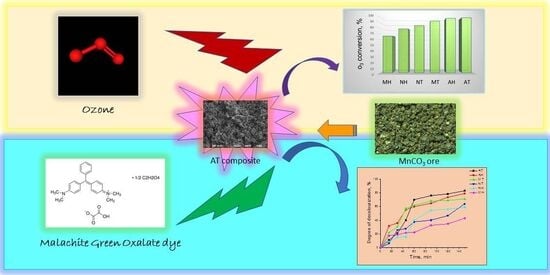
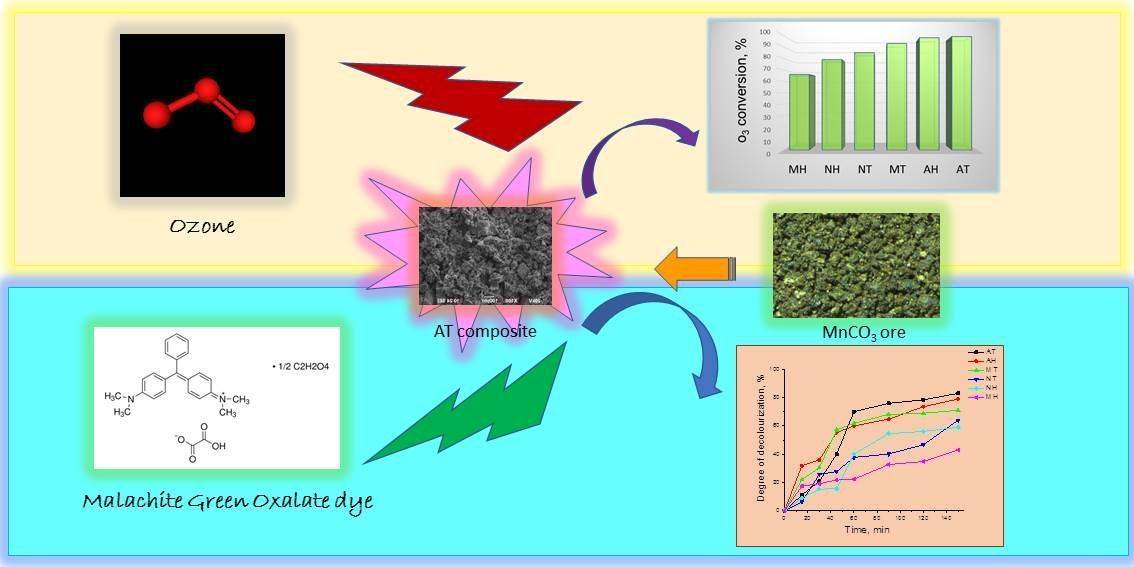
Graphical Abstract

1. Introduction

Nowadays, environmental contamination poses a significant challenge to sustainable development, related to factors such as industrialization, population growth, and urbanization. The most urgent problems are ozone contamination and the pollution of natural water sources, which adversely affect human health and ecosystems [1,2]. Ozone (O3) contamination in the troposphere has become increasingly serious in densely populated regions and countries in recent years [1,3]. Ozone is a strong oxidant, and excessive concentrations are harmful to ecosystems and can cause many health problems [4]. The issue of elevated ozone concentrations in confined spaces (such as indoors or in aircraft cabins) also requires attention [3,5]. The outside air supplied to aircraft cabins must be purified of ozone before it can circulate. In offices, cooling air from laser printers and photocopiers can release significant amounts of ozone generated by corona discharge processes and must be treated before being released into the environment. Ozone emissions from sterilization, deodorization, and wastewater treatment units also need to be reduced [6]. Therefore, the investigation of ozone decomposition is an important and urgent task for protecting human health and the environment [3,7]. In comparison with other methods for ozone treatment, catalytic decomposition is the most promising method for removing ozone at low temperatures or even under moist conditions due to its greater efficiency, higher safety, and better economy [8]. For this reason, it is a huge challenge to produce O3 decomposition catalysts with long-term stability, high activity, and high humidity resistance at ambient temperature in order to effectively reduce the destructive impact of ozone contamination on environmental and human health [4,9,10].
The existence of dyes in waters, even at very low concentrations, can be easily recognized and treated from an ecological perspective. This effect decreases the photosynthetic action in the ecosystem. Malachite Green (MG) dye can be found in wastewaters. This dye is a carcinogenic organic molecule which is still illegally utilized as a dye for silk, as a food colouring additive, and in wool, jute, leather, cotton, and paper. The carcinogenic and genotoxic effects of Malachite Green dye on the immune and reproductive systems have been established [11,12]. One of the new methods for the treatment of wastewater containing dyes is their photocatalytic degradation in solutions irradiated with UV illumination using an appropriate photocatalyst [13].
As an important strategic mineral resource, manganese ores are related to economic and social development and have been widely used as desulfurizers, deoxidizers, and alloying agents in steel manufacturing. Moreover, manganese compounds find applications as magnetic materials, electrode materials, catalysts, and building materials [14]. Manganese carbonate and manganese oxide ores are the two most important types of manganese resources found in nature, of which manganese carbonate ore accounts for more than two-thirds, about 73%, of the total manganese reserves [15]. In order to prepare more practical catalysts for applications of various scales in ozone and wastewater treatment to remove organic contaminants, natural minerals are an alternative to synthetic catalysts due to their lower cost, presence in large amounts in the Earth’s crust, and environmentally friendly behaviour [16,17].
G. Ye et al. reported the preparation of manganese ore/cobalt oxide composites via a oxalic-acid-assisted sol–gel method and investigated their catalytic ability in the oxidation degradation of gaseous chlorobenzene [18]. Manganese modified silicate ore catalysts were synthesized by the impregnation method and demonstrated an enhanced catalytic ability for the degradation of ciprofloxacin [19]. The silicate ore as a catalyst support was modified by the immobilization of cobalt oxide using the incipient wetness impregnation method. The prepared materials were highly efficient in catalytic ozonation for the degradation of tetracycline hydrochloride [20]. Silicate-ore-supported Fe2O3 were prepared and tested successfully for the catalytic ozonation of sulfamethoxazole [21]. The obtained Fe3O4/GO composite with iron derived from coastal Glagah Kulon Progo ore was investigated as a photocatalyst in the degradation of methyl orange dye. The degree of degradation (99.05%) was achieved under UV illumination for 240 min [22]. The hematite ore/ZnO composite was synthesized by the hydrothermal method. This composite possesses excellent photocatalytic efficiency towards the degradation of methylene blue dye under visible light [23]. M.L. Yola et al. established the high photocatalytic and adsorption ability of the prepared silver nanoparticles/colemanite ore waste composite for the removal of Reactive Yellow 86 and Reactive Red 2 from single and binary dye aqueous solutions [24]. S. Shenoy et al. determined that the obtained α/γ Fe2O3 (derived from hematite ores)/C3N4 degraded an aqueous solution of ofloxacin under visible light with remarkable efficiency [25]. The Fe2O3–TiO2 nanocomposite was synthesized from ilmenite ore by a thermal treatment at 700 °C and, after that, subjected to a ball-milling process for 4 h [26]. The tridoping of S, N, and C into TiO2 extracted from ilmenite ore by a hydrothermal process manifested an excellent catalytic activity toward the degradation of tetracycline [27]. Nanosized SO42−/TiO2 nanoparticles were successfully prepared from TiO2 (obtained from Binh Dinh ilmenite ore) and exhibited an enhanced catalytic ability towards Rhodamine B degradation under visible and solarlight [28]. The sulfated Fe2O3–TiO2 composite was synthesized by the treatment of ilmenite ore with sulfuric acid by Y.R. Smith et al. [29]. The sample calcined at 500 °C showed the highest photocatalytic activity [29]. J. Chen et al. obtained the Bi2O3 photocatalyst from bismuthinite ore [30]. The β-Bi2O3 demonstrated much higher photocatalytic activities than α and δ-Bi2O3 for the degradation of rhodamine B under visible light [30]. In the literature studies about the preparation and catalytic behaviour of MnCO3 ore/manganese oxides; NiO- or silver-containing composites are almost missing.
The main goals of the present study are the preparation of novel manganese carbonate ore/NiO, manganese oxides or Ag-containing composites using natural manganese ore from Obrochishte deposit, Bulgaria, and their environmental application as catalysts for ozone decomposition and the UV-initiated decolourization of Malachite Green dye.

2. Materials and Methods

2.1. Preparation of Composites Based on Manganese Carbonate Ore

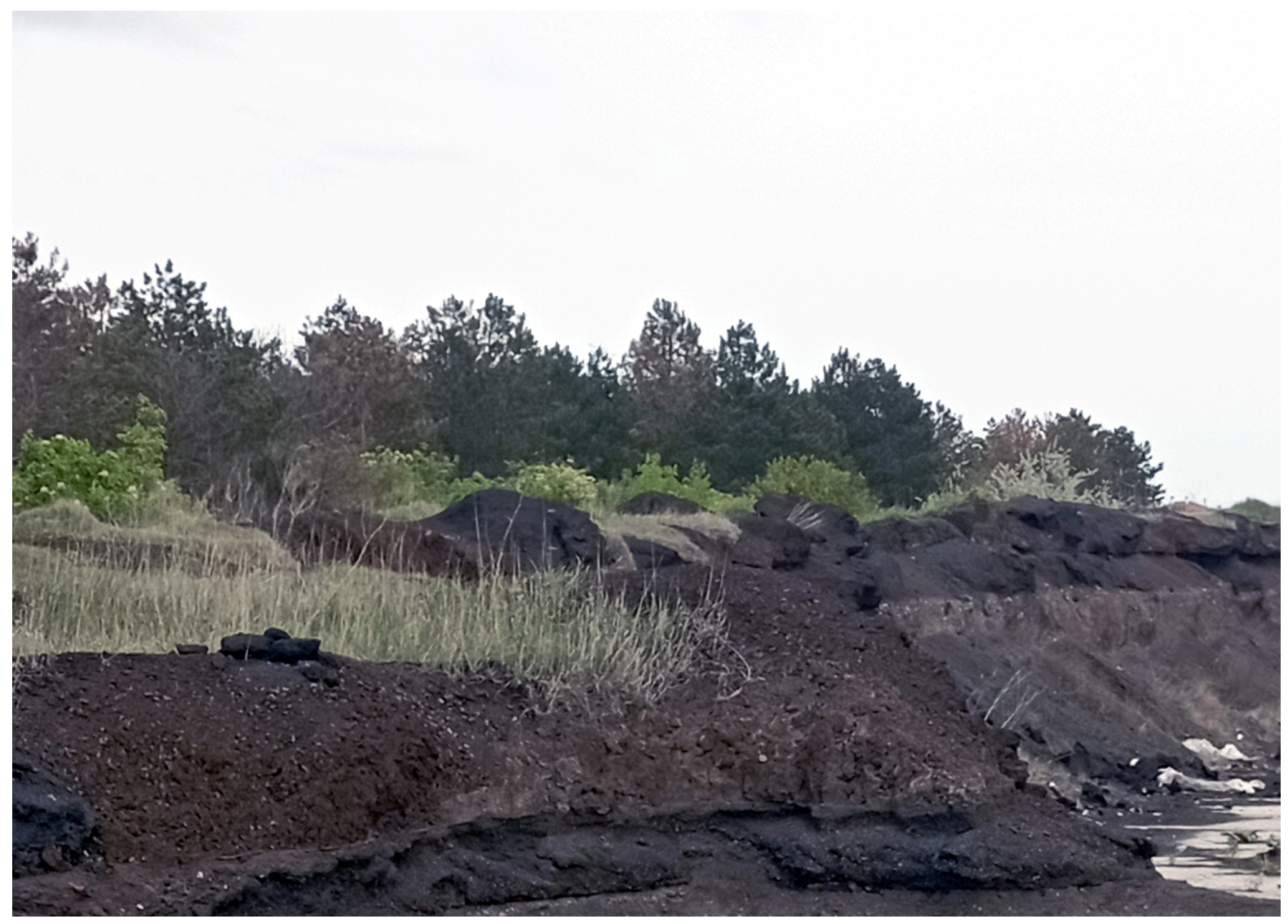
Natural manganese carbonate (MnCO3) ore (mineral name rhodochrosite) was collected from the Obrochishte manganese deposit, Varna District, northeastern Bulgaria (Figure 1). The deposit belongs to the Varna Manganese Ore District and represents one of the largest Early Oligocene sedimentary–oolitic manganese deposits in Europe. The ore occurs within laminated marls, clays, and carbonates, reflecting deposition in a shallow-marine environment with low detrital input [31,32,33,34,35].
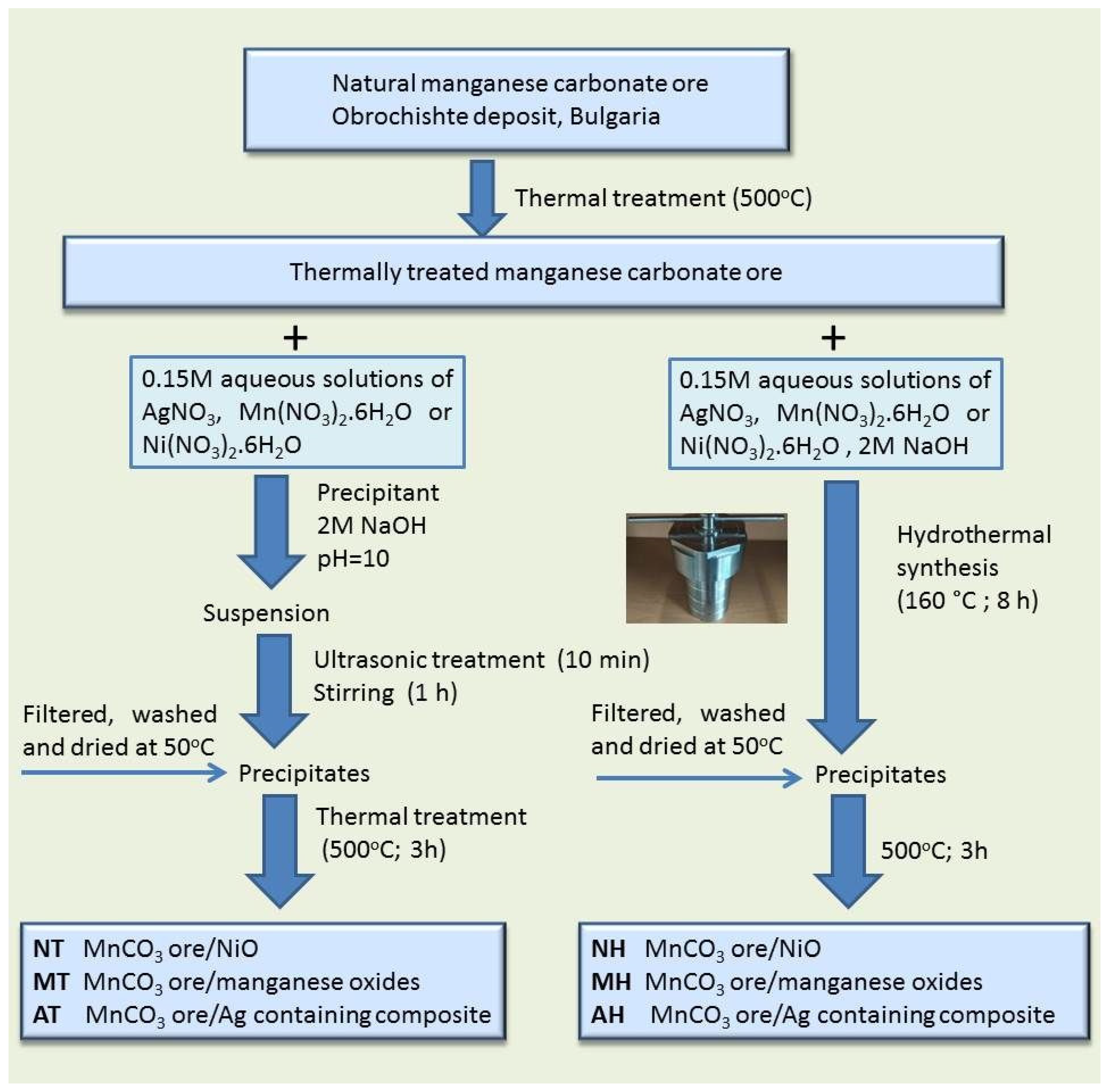
The composites based on manganese carbonate ore were prepared using two synthetic approaches I and II:
(I) The 0.15 M aqueous solutions of AgNO3 (Valerus Co., Sofia, Bulgaria), Mn(NO3)2·6H2O (Valerus Co., Sofia, Bulgaria), or Ni(NO3)2·6H2O (Valerus Co., Sofia, Bulgaria) were subjected to constant stirring for 10 min. After that, the 3 g thermally treated (500 °C) MnCO3 ore was added to the solution of nitrate precursor at constant stirring for 10 min. The manganese carbonate ore was thermally treated to eliminate the moisture and volatile organic pollutants. The precipitant 2M NaOH (Valerus Co., Sofia, Bulgaria) was added drop by drop in the mixture of aqueous solution of nitrate precursor and manganese carbonate ore until pH reached 10 at continuous stirring. After precipitation procedure, the suspension was ultrasonically treated for 10 min, and then it was stirred for 1 h. The obtained precipitate was filtered and washed with distilled water several times. The obtained precipitate was dried at 50 °C and thermally treated at 500 °C for 3 h in air. The obtained samples were denoted as AT, MT, and NT.
(II) The samples AH, MH, and NH were obtained using hydrothermal synthesis. The resulting mixture from 3 g MnCO3 ore and nitrate precursor (aqueous solutions of 0.15M AgNO3 (Valerus Co., Sofia, Bulgaria), Mn(NO3)2·6H2O (Valerus Co., Sofia, Bulgaria) or Ni(NO3)2·6H2O (Valerus Co., Sofia, Bulgaria) and 2M NaOH were transferred into an autoclave at 160 °C for 8 h. The so-obtained precipitates were washed and dried up in an oven, after which they were treated at 500 °C for 3 h in air. The two synthetic approaches for the preparation of manganese carbonate ore/NiO, manganese oxides or silver-containing composites are presented on the Figure 2.

2.2. Physicochemical Characterization of Prepared Composites Based on Manganese Carbonate Ore

The powder X-ray diffraction (PXRD) analysis was performed on an X-ray powder diffractometer “Empyrean” (Malvern Panalytical, Almelo, Netherlands) within the range of 2θ values between 3° and 90° using Cu Kα radiation (λ = 0.154060 nm) at 40 kV and 30 mA. The presence of phases was determined using High Score Plus, Version 4.9 (4.9.0.27512) software. The average crystallite size of phases was determined using the Powder Cell 2.0 software [36].
FT-infrared spectra were collected on a Tensor 37 spectrometer (Bruker, Berlin, Germany) in the spectral region 4000–400 cm−1, using KBr pellet technique at room temperature.
The elemental composition of the samples was determined by wavelength-dispersive X-ray fluorescence (WDXRF) using a Rigaku Supermini200 spectrometer (Osaka, Japan). Measurements were carried out at 50 kV and 4.0 mA. Powdered samples were pressed into pellets with a diameter of 40 mm. Analyses were conducted under vacuum, with a Pd-anode X-ray tube as the primary radiation source. Data acquisition and processing were performed with the ZSX software package (v.7.67), applying the semi-quantitative SQX method.
The specific surface area, pore volume, and pore size distribution of the studied samples were determined by low-temperature (77.4 K) nitrogen adsorption using a Quantachrome Nova 1200e (Boynton Beach, FL, USA) apparatus. The specific surface area was determined according to the BET method. The pore size distribution was calculated by the Barrett–Joyner–Halenda (BJH) method, using the desorption branch of the isotherm. Total pore volume (Vt) and average pore diameter (Dav) were calculated according to the Gurvich rule at a relative pressure close to 0.99. The samples were degassed at 110 °C for 18 h.
The surface morphology of the samples was investigated using scanning electron microscopy (SEM) with scanning electron microscope (JEOL SEM JSM-6390, Tokyo, Japan) with accelerating voltage of 20 keV. Samples were coated with thin layers of carbon.

2.3. Ozone Decomposition Study

The ozone conversion was examined by observing changes in ozone concentration. The experiment was carried out in a glass tube reactor containing 0.2 g of catalyst. Ozone was generated by passing dried oxygen (99.99% purity) through a 4–9 kV discharge in a self-made tubular ozone generator. An ozone–oxygen mixture, with an initial concentration of up to 11,000 ppm, was passed through the reactor at an ozone flow rate of approximately 6.0 L/h at room temperature. The ozone concentrations at the inlet and outlet of the reactor were measured using a BMT 964 UV absorption-type of ozone analyser (Stahnsdorf, Germany) for residence time 200 min.
The ozone conversion was examined by observing changes in ozone concentration. The time–conversion degree dependence has been measured in the course of 200 min time interval over the studied samples. The activity of the catalysts was calculated on the basis of the following equation:
O 3 c o n v e r s i o n = C 0 C C 0 × 100 %
where C0 and C are inlet and outlet concentrations of ozone, respectively.

2.4. Photocatalytic Activity Tests

The photocatalytic decolourization of Malachite Green oxalate (MG) dye (Sigma-Aldrich, St. Louis, MO, USA) as a model contaminant with an initial concentration of aqueous solution of the MG dye at 5 ppm and pH = 5.9 has been investigated. The prepared composites based on manganese carbonate ore as photocatalysts were used. Polychromatic UV-A lamp (Sylvania BLB, 18W) with an emission maximum at 365 nm and illumination intensity 2.6 mW/cm2 was used. The photocatalytic tests were carried out in semi-batch slurry photocatalytic reactor equipped with two frits blowing tiny bubbles of air (continuous flow) in order to saturate the solution in dissolved oxygen using 0.075 g of photocatalyst and 75 mL of dye solution under constant stirring and air flowing. In order to reach the adsorption–desorption equilibrium state, the studied systems were left in the dark for about 30 min before switching on the UV illumination for residence time of 150 min. The powder was separated from the aliquot solution by centrifugation. After that, the change in absorbance during the photocatalytic tests was monitored by Cary 4000 UV-Vis Spectrophotometer (Agilent, Santa Clara, CA, USA) in the wavelength range from 200 to 800 nm (λmax = 618 nm for MG). Then, the photocatalyst powder, together with the aliquot solution, was returned into the reaction vessel, which ensured operation under constant volume and amount of the photocatalytic sample (to maintain the ratio of mg of catalyst: mL of solution). The degree of dye decolourization was calculated using the following dependence:
Degree of decolourization (%) = ((C0C)/C0) × 100
where C0 and C were initial concentration before turning on the illumination and residual concentration of the dye solution after illumination for selected time interval.
The apparent rate constants (kapp) were calculated assuming a pseudo-first-order kinetic reaction:
ln C o C = t k a p p
where C0 and C are, respectively, initial concentration before turning on the illumination and residual concentration of the dye solution after illumination in the course of given time interval.
The adsorption capacity (in darkness for 30 min) of the materials was calculated using Formula (4):
Q = ( C 0 C ) . V m
where C0 is initial dye concentration, C is dye concentration after 30 min, V is solution volume, and m is sample mass.

3. Results and Discussion

3.1. Characterization of Prepared Composites Based on Manganese Carbonate Ore

3.1.1. Powder X-Ray Diffraction Study of Prepared Composites Based on Manganese Carbonate Ore

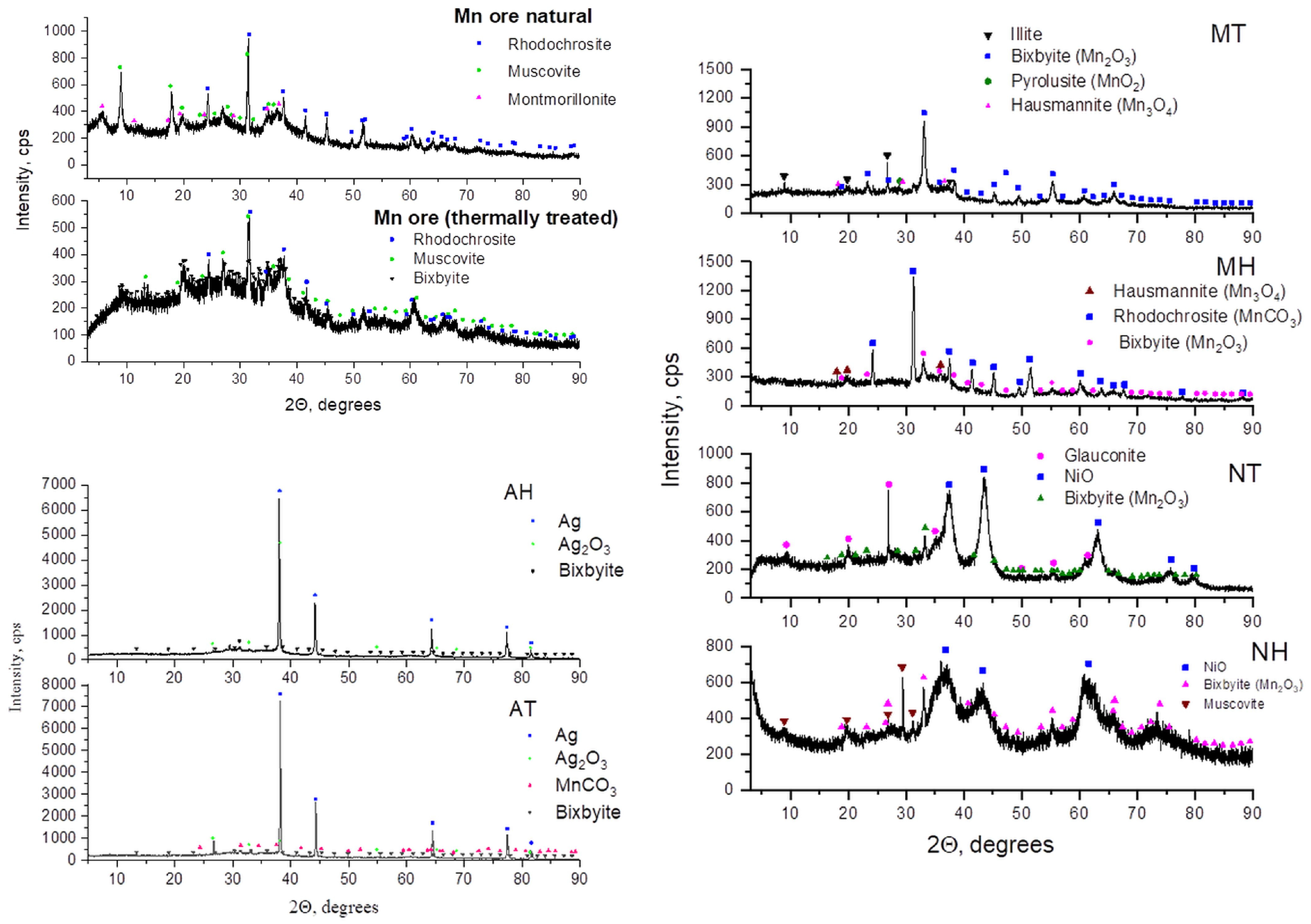
The powder X-ray diffraction analysis of the initial manganese carbonate ore established the presence of rhodochrosite (MnCO3) (Ref. Code: 01-073-4352), muscovite (KAl2(Si,Al)4O10(OH)2 (Ref. Code: 00-058-2037), and montmorillonite ((Ca,Na)0.3Al2(Si,Al)4O10(OH)2xH2O) (Ref. Code: 00-060-0319). The montmorillonite phase observed in the starting manganese carbonate ore disappeared at the thermally treated one (Figure 3). The recorded powder X-ray diffraction patterns of the synthesized composites based on manganese carbonate ore (MT, MH, NT, NH, AT, and AH) are also illustrated at Figure 3. The illite (K0.5(Al,Fe,Mg)3(Si,Al)4O10(OH)2 (Ref. Code: 00-009-0343), bixbyite (Mn2O3) (Ref. Code: 01-082-9911), pyrolusite (MnO2) (Ref. Code: 03-065-2821), and hausmannite (Mn3O4) (Ref. Code: 04-006-8109) phases are registered in the PXRD pattern of the MT composite. The MH material contains hausmannite, rhodochrosite, and bixbyite. The PXRD patterns of the manganese carbonate ore/nickel oxide-based composites NT and NH show the existence of the NiO (Ref. Code: 00-022-1189), glauconite ((K,Na)(Fe+3,Al,Mg)2(Si,Al)4O10(OH)2) (Ref. Code: 00-002-0466), muscovite, and bixbyite phases, respectively. The presence of Ag (Ref. Code: 00-004-0783), Ag2O3 (Ref. Code: 04-005-4327), and bixbyite is registered in the PXRD patterns of the AH and AT composites and, additionally, the rhodochrosite phase in AT. The prepared materials possess a mean crystallite size of 8–15 nm for NiO, Mn2O3, Mn3O4, and MnO2 and 50–67 nm for the silver-containing phases, respectively.

3.1.2. Wavelength-Dispersive X-Ray Fluorescence Analysis of Prepared Composites Based on Manganese Carbonate Ore

The results obtained by the WDXRF analyses for the elemental composition of natural manganese carbonate ore (non-treated and thermally treated) and the obtained composites based on manganese carbonate ore are presented in Table 1. The initial MnCO3 ore contains 51–52 wt.% Mn, together with significant amounts of Si, Mg, Ca, and Al, and is consistent with a manganese carbonate mineral such as rhodochrosite, associated with certain amounts of silicate phases such as illite (muscovite) and possibly smectite (montmorillonite). A notable enrichment of Mn (up to 73.8 wt.%) was detected in the MT composite obtained by thermal treatment. Silver- and nickel-modified systems also show enhanced metal fixation under thermal conditions, with AT reaching ~48 wt.% Ag and NT exhibiting increased Ni contents. Hydrothermal treatment results in a similar Mn enrichment (72.3 wt.% in MH), though slightly lower than in the thermally treated samples, reflecting dissolution–reprecipitation processes. Nickel incorporation is particularly effective under hydrothermal conditions, with NH reaching ~40 wt.%. In contrast, the silver contents in AH (~45 wt.%) are slightly reduced compared to AT, likely due to the partial redissolution or complexation of the silver phases. Trace elements such as Sr, Cu, Ti, and V display selective behaviour, being either enriched or depleted depending on the stability of their host phases under different treatment conditions. In summary, thermal treatment effectively concentrates the Mn and stabilizes the added metals, while hydrothermal processing enhances the incorporation of transition metals, particularly Ni, into the manganese-bearing phases.

3.1.3. SEM Analysis

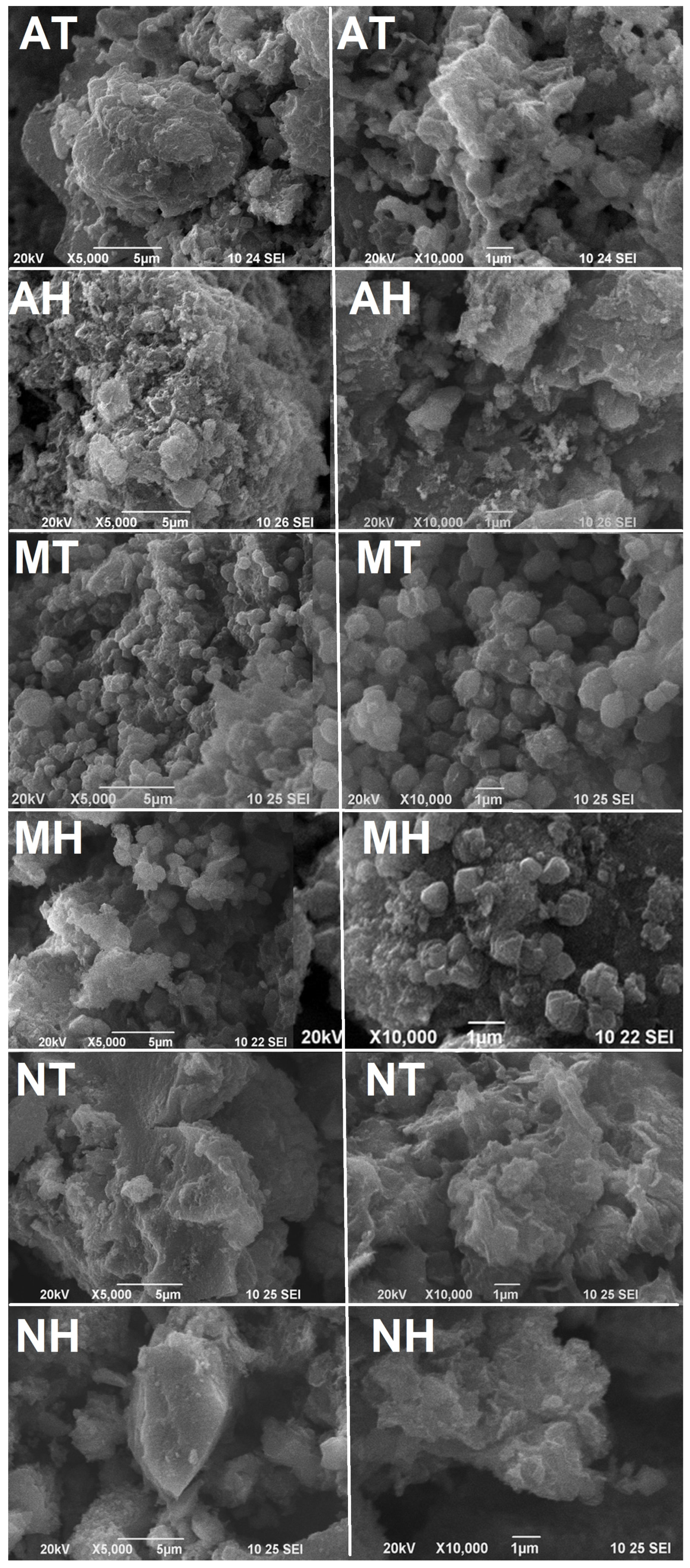
Morphologically, the obtained MnCO3 ore/NiO, manganese oxides, or Ag-containing composites are examined by scanning electron microscopy as illustrated on Figure 4. Most SEM micrographs reveal agglomerations of irregularly shaped particles. The porous structure of the investigated samples is also observed. The obtained MnCO3 ore/manganese oxide composites (MT and MH) consist of more rounded sphere-like particles dominating in the case of thermally synthesized material (MT).

3.1.4. Fourier-Transform Infrared Investigations of Prepared Composites Based on Manganese Carbonate Ore

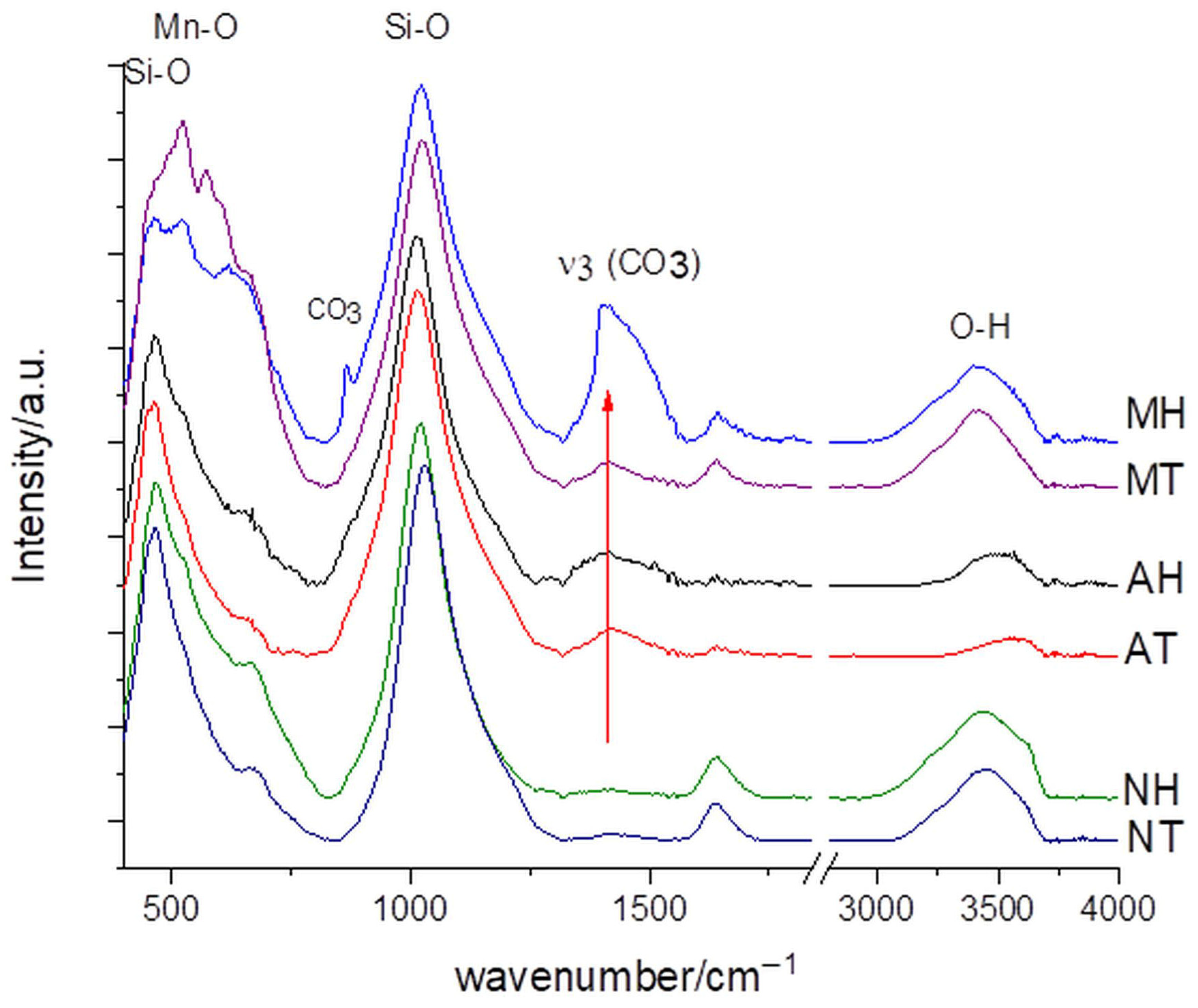
The infrared spectra of synthesized manganese carbonate ore/NiO, manganese oxides, or silver-containing composites are a superposition of the absorption peaks of the different phases, which leads to the broadening and shifting of the peak maxima (Figure 5).
Manganese oxides (Mn2O3; Mn3O4; and MnO2) demonstrate intensive absorption in the 400–700 cm−1 spectral range due to the Mn-O stretching vibrations. The maximum in the MT, MH, and AT samples is around 525–528 cm−1, while, in the NT and NH samples, the maximum is around 465 cm−1, which is probably due to the silicate bending vibrations, which also contribute to the intense absorption in this spectral range. The influence of the Ni-O stretching vibrations is visible near 600 cm−1.
The characteristic absorption bands of the carbonate group (CO32−) are visible in the MH, MT, AH, and AT samples, but are stronger in the MH sample obtained by hydrothermal synthesis. The most intense are the peaks of asymmetric carbonate stretching near 1415–1420 cm−1. The other peaks of the carbonate group bending vibrations are also more clearly expressed in the hydrothermally treated samples MH and AH. These peaks are evidence for the presence of rhodochrosite. This observation is in agreement with the XRD data according to which rhodochrosite was identified in the hydrothermally synthesized MH and AT sample.
In all samples, intense absorption around 1020 cm−1 in the Si-O stretching range is observed, indicating the presence of silicates. Phyllosilicates (mica; illite; glauconite; muscovite; and clay minerals) are aluminosilicates with a silicate framework with intensive absorption near 1000 cm−1 and hydroxyl groups with an OH stretching peak above 3600 cm−1. Water molecules are also detected in the MH, MT, NH, and NT samples with a broad band at 3400 and 1640 cm−1 [37,38,39,40].

3.1.5. Textural Characteristics of Prepared Composites Based on Manganese Carbonate Ore

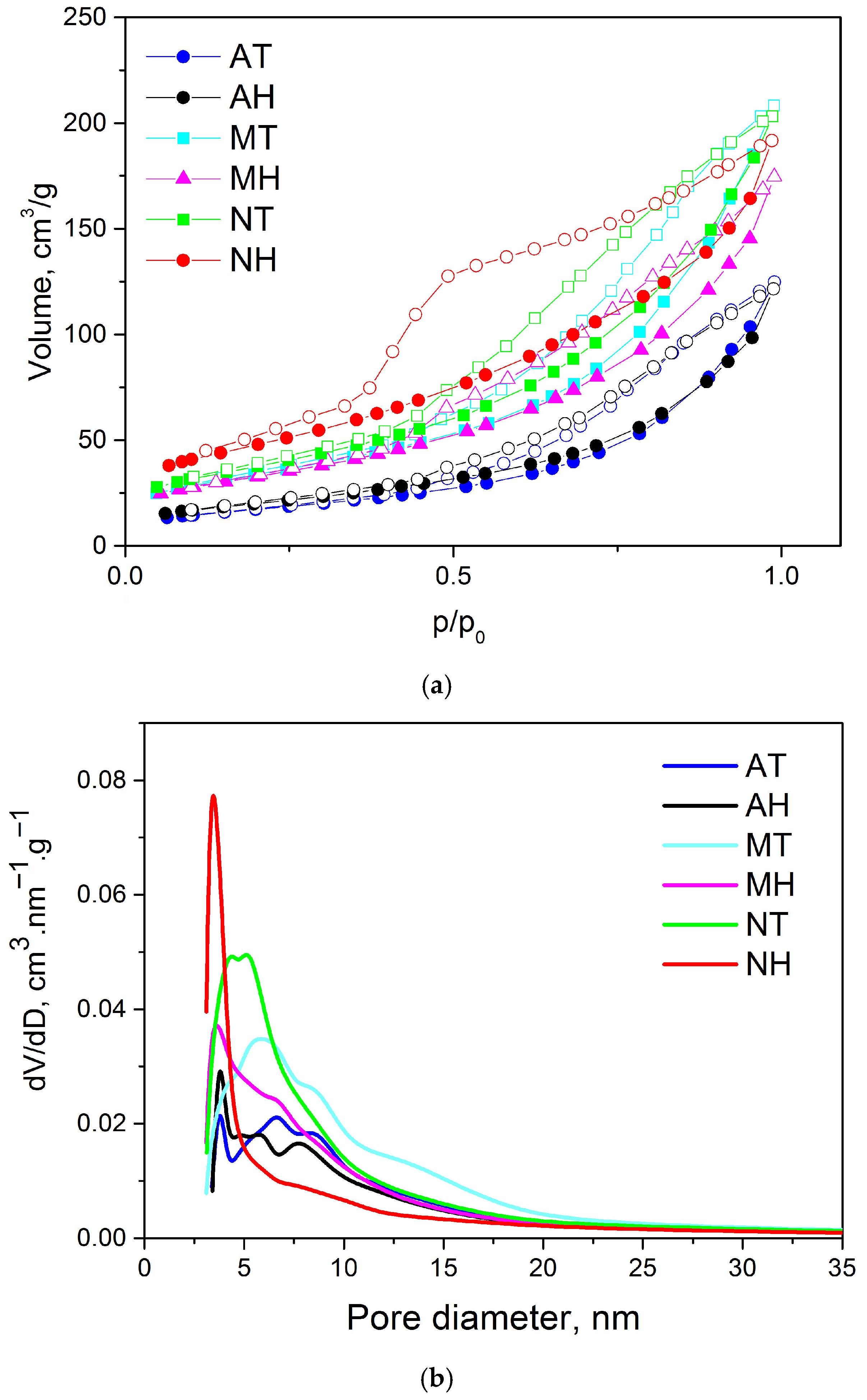
The nitrogen adsorption–desorption isotherms and the pore size distributions of the catalysts based on manganese carbonate ore (AT, AH, MT, MH, NT, and NH), as illustrated in Figure 6, reveal type II isotherms, which are indicative of mesoporous structural characteristics. All samples exhibit capillary condensation phenomena accompanied by an H3-type hysteresis loop, in accordance with the IUPAC classification, suggesting the presence of slit-shape pores between rigid particles. The isotherms of the investigated composite samples (AT, AH, MT, MH, NT, and NH) are almost the same, except for (NH), as no change in the type of isotherm and the type of hysteresis is observed.
The textural parameters of the prepared composite catalysts are placed in Table 2. The texture of the obtained samples does not change significantly depending on the type of treatment (thermal or hydrothermal). The results show the preservation of the pore volume in all materials, while the average pore diameter decreased in the hydrothermally obtained AH, MH, and NH samples. The specific surface area of the hydrothermally prepared composite catalysts AH (73 m2/g) and NH (171 m2/g) increases compared to the thermally synthesized AT (63 m2/g) and NT (137 m2/g) materials. An exception to this trend is sample MH (119 m2/g), which has a lower specific surface area than that of MT (123 m2/g) composite. The NH composite exhibits the highest specific surface area (171 m2/g) in comparison to those of the other samples.
The results obtained from the powder X-ray diffraction analysis, wavelength-dispersive X-ray fluorescence, Fourier-transform infrared spectroscopy, scanning electron microscopy, nitrogen adsorption–desorption isotherms, and BET method are in agreement.

3.2. Catalytic Ozone Decomposition over Prepared Composites Based on Manganese Carbonate Ore

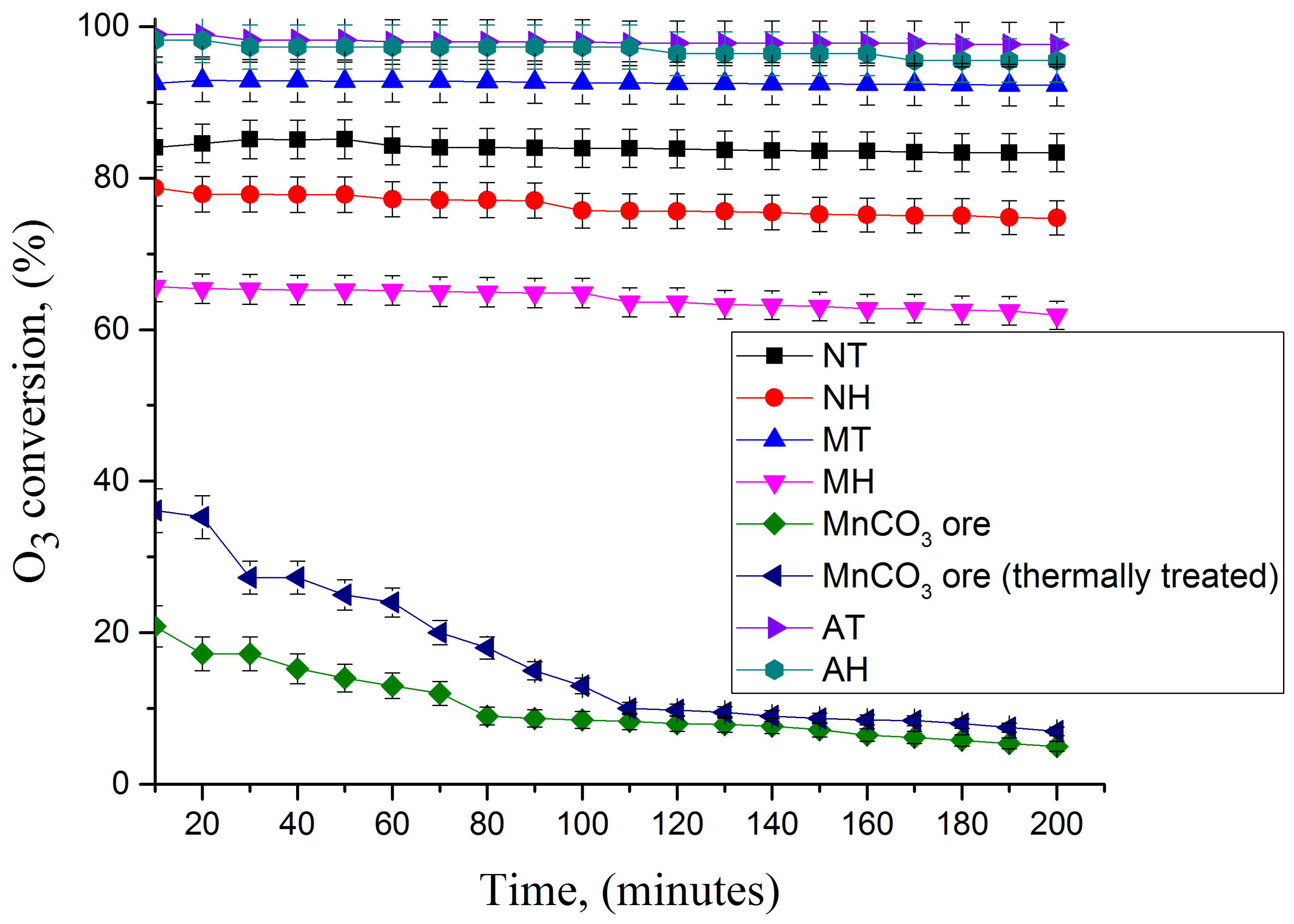
The catalytic activity of the prepared manganese carbonate ore/NiO, manganese oxides, or Ag-containing composites and natural manganese carbonate ore (untreated and thermally treated) with respect to the ozone decomposition reaction in the gaseous phase at room temperature is presented in Figure 7.
The natural manganese carbonate ore from the Obrochishte deposit, Bulgaria was investigated, but it showed low ozone decomposition activity (17%). An increase in catalytic ability is established using calcined manganese carbonate ore (35%). Similar results about the enhanced catalytic ability of calcined manganese and manganese sand ores from Australia and local mines in China as compared to non-treated ores were observed by other research groups [41,42,43]. The lower catalytic ability for ozone removal of the untreated natural manganese carbonate ore could be due to the humidity from the residual hydrated water deteriorating the catalytic efficiency [41]. The investigated manganese carbonate ore/NiO, manganese oxides, or Ag-containing composite catalysts (NH, NT, MH, MT, AH, and AT) exhibit high catalytic activity and excellent performance for ozone decomposition at room temperature over a 200 min period compared to the manganese carbonate ore. These results indicate that adding transition metals or their oxides considerably improves the catalytic efficiency, stability, and application of the investigated materials. Specifically, the manganese carbonate ore/silver-containing catalyst synthesized hydrothermally and the thermally treated composites achieved the highest ozone removal efficiencies of 98% and 99%, respectively. The catalytic system manganese carbonate ore/NiO demonstrates a lower degree of ozone decomposition than that of the manganese carbonate ore/silver-containing system, pointing to the high redox properties of Ag in ozone decomposition [1]. The thermally obtained MnCO3 ore/NiO and MnCO3 ore/manganese oxides demonstrate catalytic efficiency for the decomposition of ozone (85% and 93%) in comparison with hydrothermally treated MnCO3 ore/manganese oxides or NiO composites (66% and 79%), respectively. In all studied samples, the thermally treated composites demonstrated that higher efficiencies for the ozone decomposition reaction can be attributed to several factors related to the changes in the catalyst structure and surface properties as listed in [44]. As observed by many researchers, thermal treatment can adjust the oxidation states and redox properties of the metals and their oxides, affecting the catalyst’s ability to produce reactive oxygen species that are essential for efficient ozone decomposition [45,46]. For comparison, another research group, which has investigated the synthesized Mn2O3 and Mn3O4 catalysts, achieved 50% ozone conversion [47].
These results could be explained by considering the most probable mechanism of catalytic ozone decomposition [41,48,49,50,51,52,53]. The overall ozone decomposition process consists of the adsorption of the ozone molecule on the catalyst’s surface, and then its dissociation into an oxygen molecule and an atomic oxygen species. The surface properties of the catalysts determine the characteristics of the surface-active sites and their quantity. Manganese oxides exhibit surface reactivity due to their multiple oxidation states (Mn2+/Mn3+/Mn4+), and the abundant oxygen vacancies facilitate the electron transfer and stabilize the O2/O22− intermediates formed during O3 conversion [54]. During the ozone decomposition over NiO, an electron transfer from Ni2+ to ozone generates Ni3+ species and oxygen vacancies, promoting charge separation and enhancing catalytic activity [55]. The presence of Ag nanoparticles primarily enhances electron transfer and acts as efficient electron donors/acceptors, leading to an improved ozone decomposition performance [56]. The remaining atomic oxygen species then reacts with another ozone molecule to form either an adsorbed peroxide species (O22−) or a superoxide species (O2−), along with another oxygen molecule. Finally, the adsorbed peroxide or superoxide species decompose into oxygen molecules and desorb from the catalyst surface, regenerating the active sites, following Reactions (5)–(7):
O3 + * → O2 + O*
O*+ O3 → O2* + O2
O2* → O2 + *
The thermally treated samples (AT, MT, and NT) possess higher average pore diameters (12, 10, and 9 nm) and demonstrate higher catalytic activity compared to the hydrothermally synthesized AH, MH, and NH (10, 9, and 7 nm). The pore size and mesoporous structure positively affect the ozone decomposition and facilitate the adsorption and desorption of ozone molecules. The reason may be that the large average pore diameter enhances ozone degradation by improving O3 diffusion and increasing the residence time [57,58].

3.3. Photocatalytic Study of Prepared Composites Based on Manganese Carbonate Ore

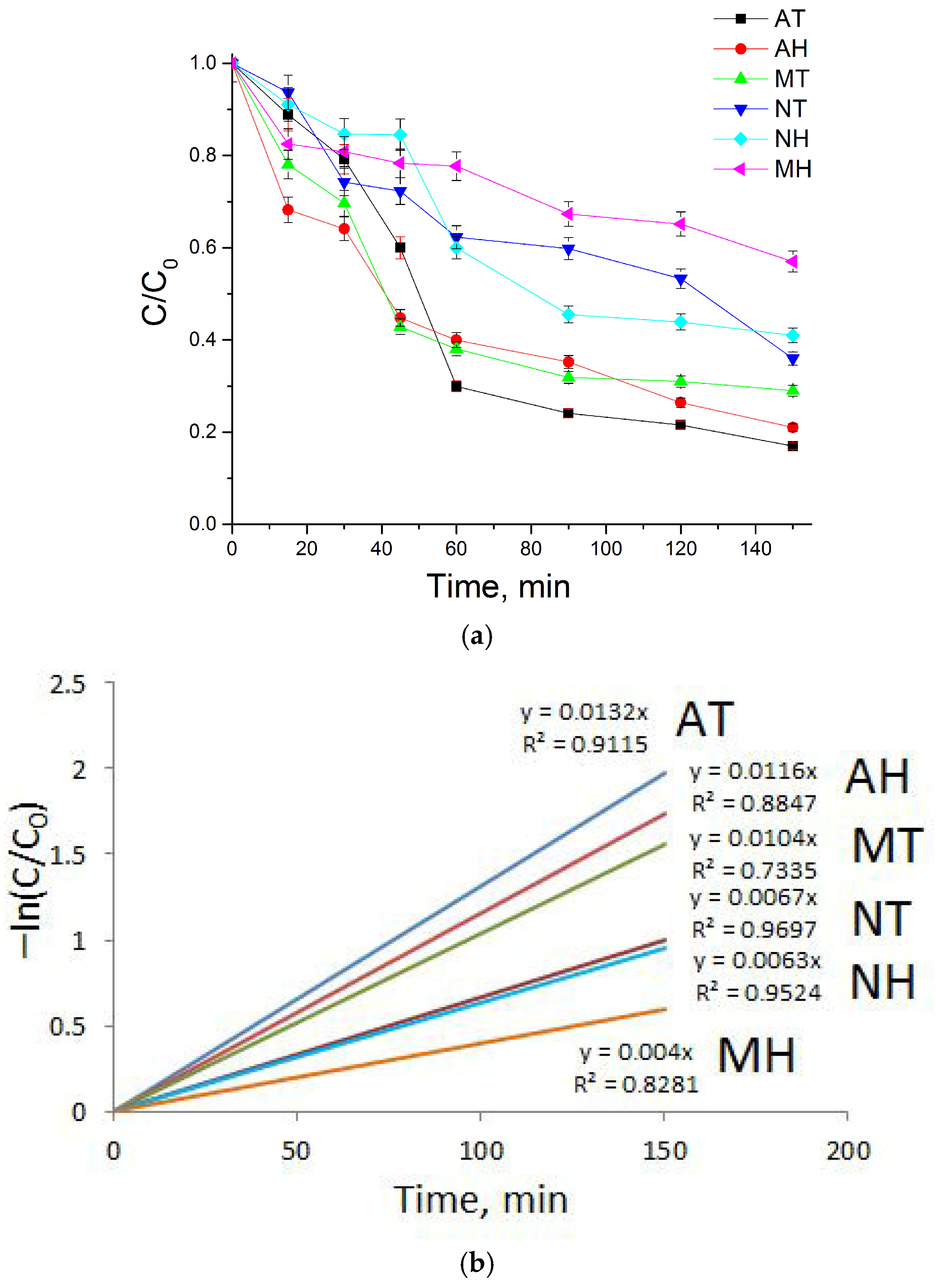
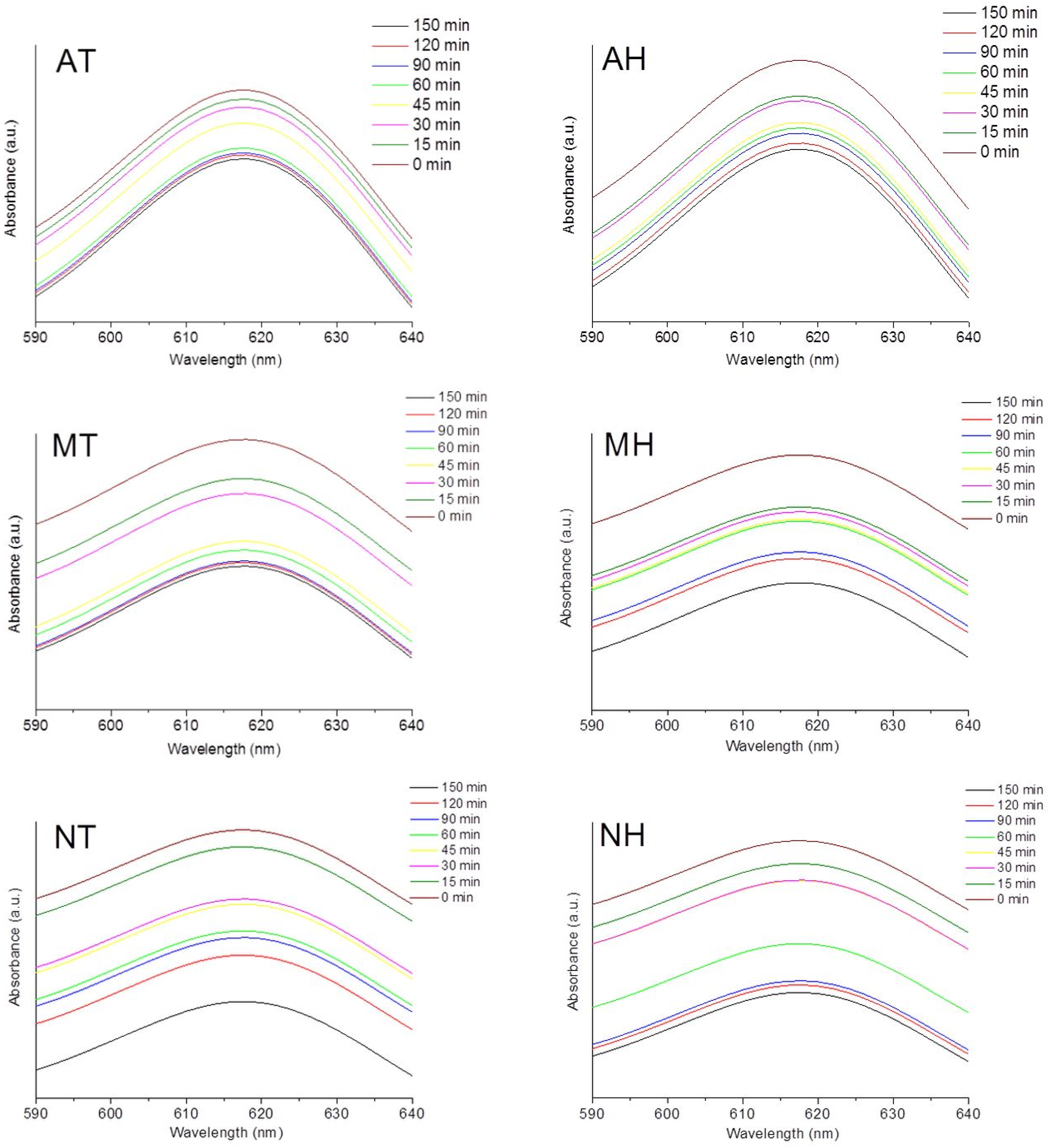
The photocatalytic decolourization of Malachite Green dye was performed using the obtained manganese carbonate ore/NiO, manganese oxides, or Ag-containing composites (NH, NT, MH, MT, AH, and AT) as photocatalysts. Figure 8a,b present the concentration changes C/C0 and kinetic curves of the UV-decolourization of Malachite Green dye as a model contaminant as a function of the time of UV irradiation. Figure 9 represents the UV–Vis absorption spectra of MG dye during the irradiation time period using prepared manganese carbonate ore/NiO, manganese oxides, or silver-containing composites (NH, NT, MH, MT, AH, and AT) as photocatalysts. The catalytic tests have revealed that, in the course of the photocatalytic reaction, the thermally synthesized manganese carbonate ore/silver-containing photocatalyst (AT) leads to the higher degree of decolourization of the Malachite Green dye (83%) after 150 min of UV illumination compared to that of the other studied composites (NH, NT, MH, MT, and AH). The thermally synthesized MnCO3 ore/NiO, manganese oxides, and silver-containing samples possess an enhanced photocatalytic ability for the decolourization of Malachite Green dye (64%, 71%, and 83%) compared to the hydrothermally treated MnCO3 ore/NiO, manganese oxides, and silver-containing composites (59%, 43%, and 79%), respectively. The enhanced catalytic activity of the thermally synthesized materials is favoured by their higher crystallinity, larger average pore diameter, and rounded sphere-like particles (dominant in the case of MT), as confirmed by PXRD, low-temperature nitrogen adsorption, and SEM studies.
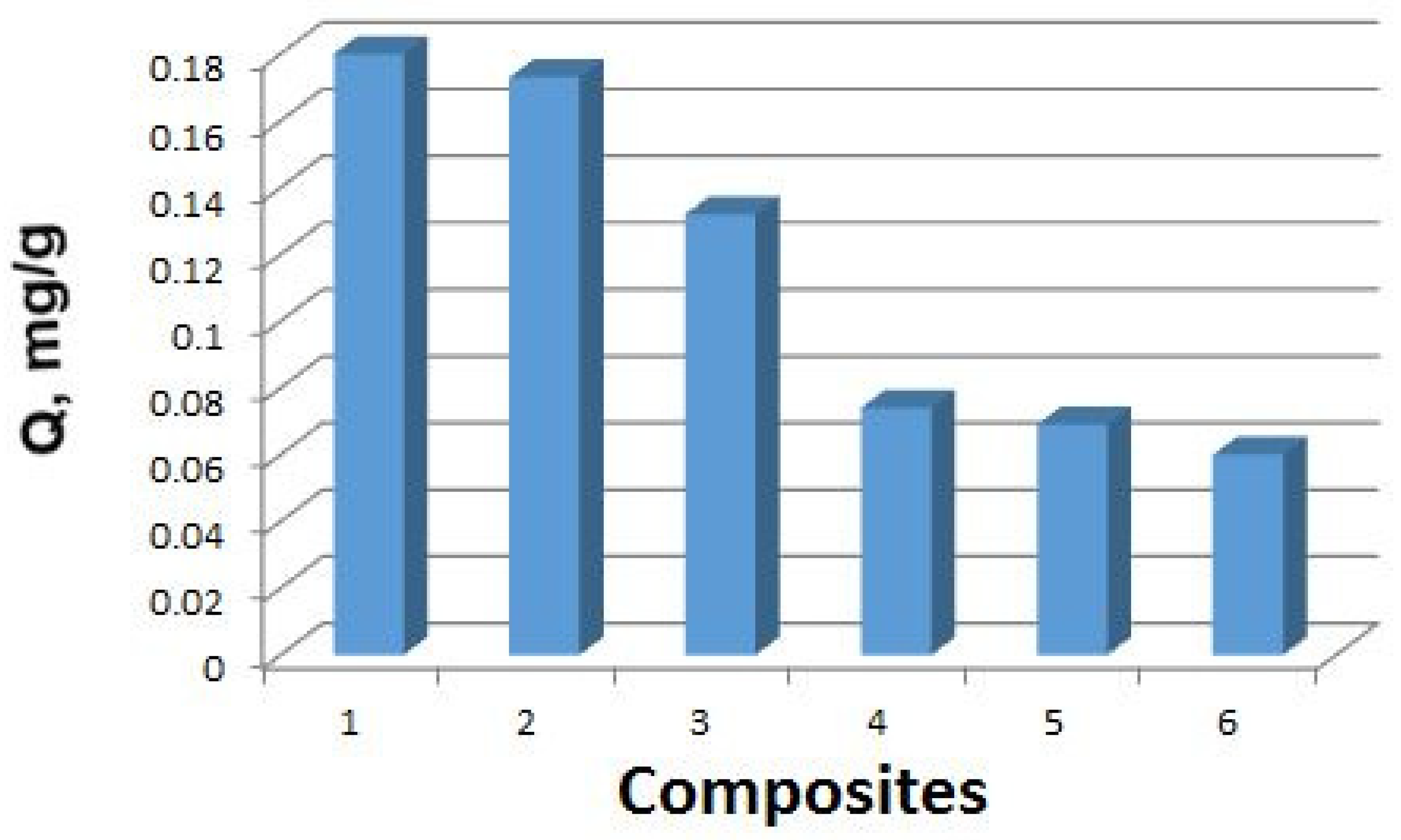
Figure 10 presents the adsorption capacities of the composite materials after a 30 min dark period. The adsorption capacities of the studied composite photocatalysts increase in the following order: 0.06 mg/g (MH) < 0.069 mg/g (NH) < 0.074 mg/g (NT) < 0.132 mg/g (MT) < 0.173 mg/g (AH) < 0.18 mg/g (AT). The photocatalytic results reveal that the adsorption capacity affects the photocatalytic performance: an increasing adsorption capacity leads to an enhanced photocatalytic activity. The thermally synthesized manganese carbonate ore/silver-containing material (AT) demonstrates the highest photocatalytic activity (kapp =13.2 × 10⁻³ min−1) for the decolourization of MG dye compared with the other materials (Table 3).
The improved photocatalytic efficiency of the manganese carbonate ore/Ag-containing composites can be attributed to the enhanced charge separation and increased reactive oxygen species generation enhanced by the silver nanoparticles [59,60]. According to the literature, due to the surface plasmon resonance of the Ag species, the photo-induced h+ on silver nanoparticles can also oxidize the Malachite Green (MG) dye molecules. In addition, the excellent electrical conductivity of the silver nanoparticles facilitates interfacial charge transfer and effectively suppresses electron–hole recombination. The excess electrons accumulated on the surface of Ag nanoparticles can either reduce the MG dye molecules directly or be trapped by O2 and H2O at the photocatalyst surface to form reactive oxygen species such as O2 or O2•. These reactive oxygen species further contribute to the degradation of MG dye [61].
The photocatalytic ability of the synthesized composite photocatalysts based on manganese carbonate ore could be explained with the following possible mechanism according the literature data [12]. The synergistic effect between the components of the composite photocatalysts leads to a faster production of oxidizing radicals, which enhances the decolourization of Malachite Green dye in aqueous solution [62]. The UV light illuminates the surface of the catalyst and electrons in the valence band become excited from the conduction band. This leads to the generation of positively charged holes in the valence band. These holes can either oxidize the molecules’ dye into reactive intermediates due to their strong oxidative potential or react with water molecules to generate hydroxyl radicals (•OH). Meanwhile, the excited electrons in the conduction band interact with oxygen, reducing them to superoxide anion radicals (•O2). Both •OH and •O2 are highly reactive species that play a key role in the decolourization of dye molecules [12,62,63]. The studied non-treated and calcined natural manganese carbonate ore do not exhibit photocatalytic activity towards the decolourization of Malachite Green dye.
For comparison, other researchers who have studied Mn2O3–CeO2 achieved 30% MG dye decolourization after 120 min of UV illumination [64].
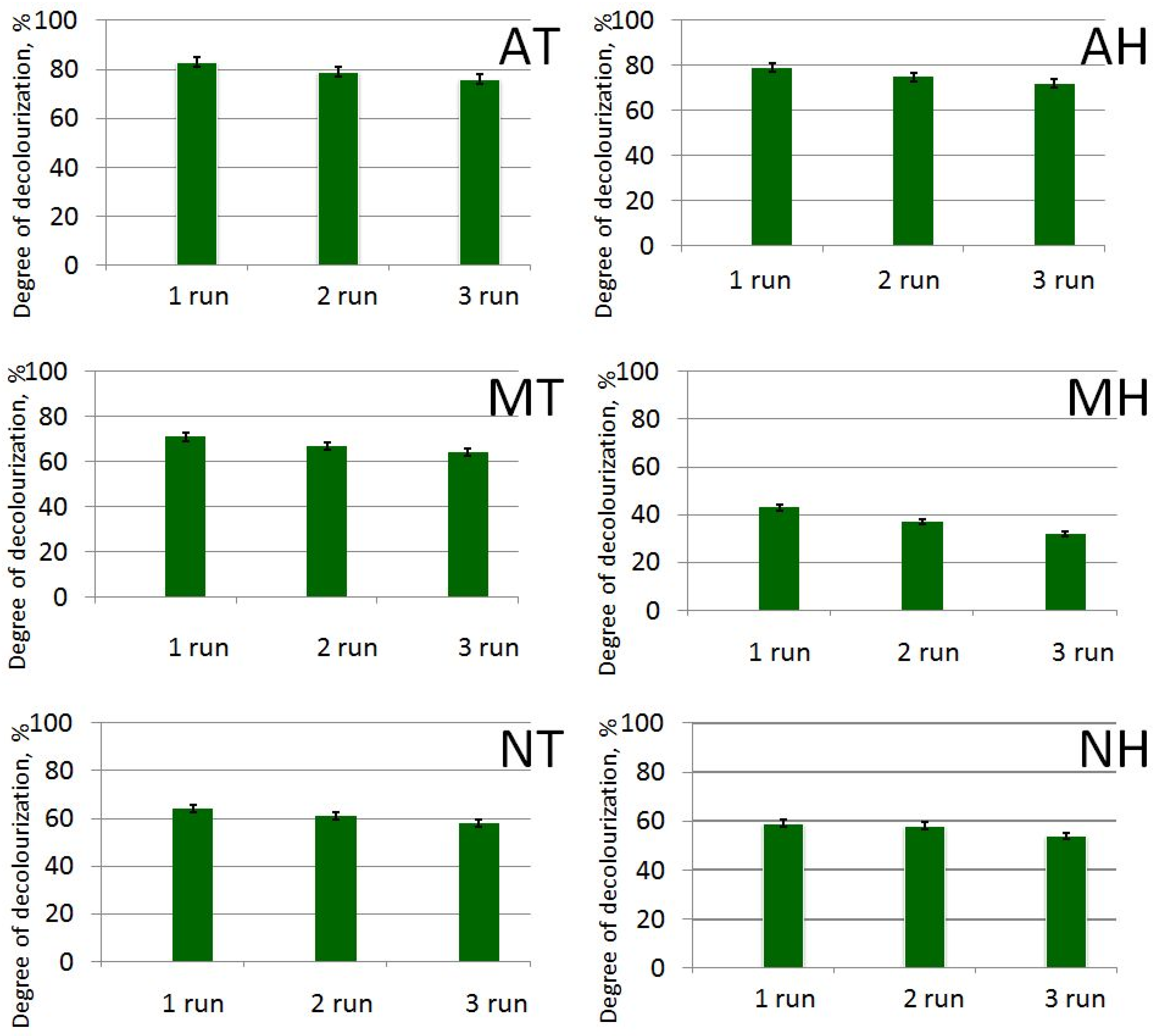
The reusability of the investigated composite catalysts based on manganese carbonate ore are tested in three consecutive photocatalytic runs for the UV-induced decolourization of Malachite Green dye. The photocatalytic results for the reusability of the studied manganese carbonate ore/NiO, manganese oxides, or silver-containing composite photocatalysts (NH, NT, MH, MT, AH, and AT) are presented on the Figure 11. As can be seen, the studied MnCO3 ore/NiO, manganese oxides, or Ag-containing composite photocatalysts are stable after three repeated photocatalytic cycles. The degree of the decolourization of Malachite Green dye decreased very slightly starting from the first until the third photocatalytic run.
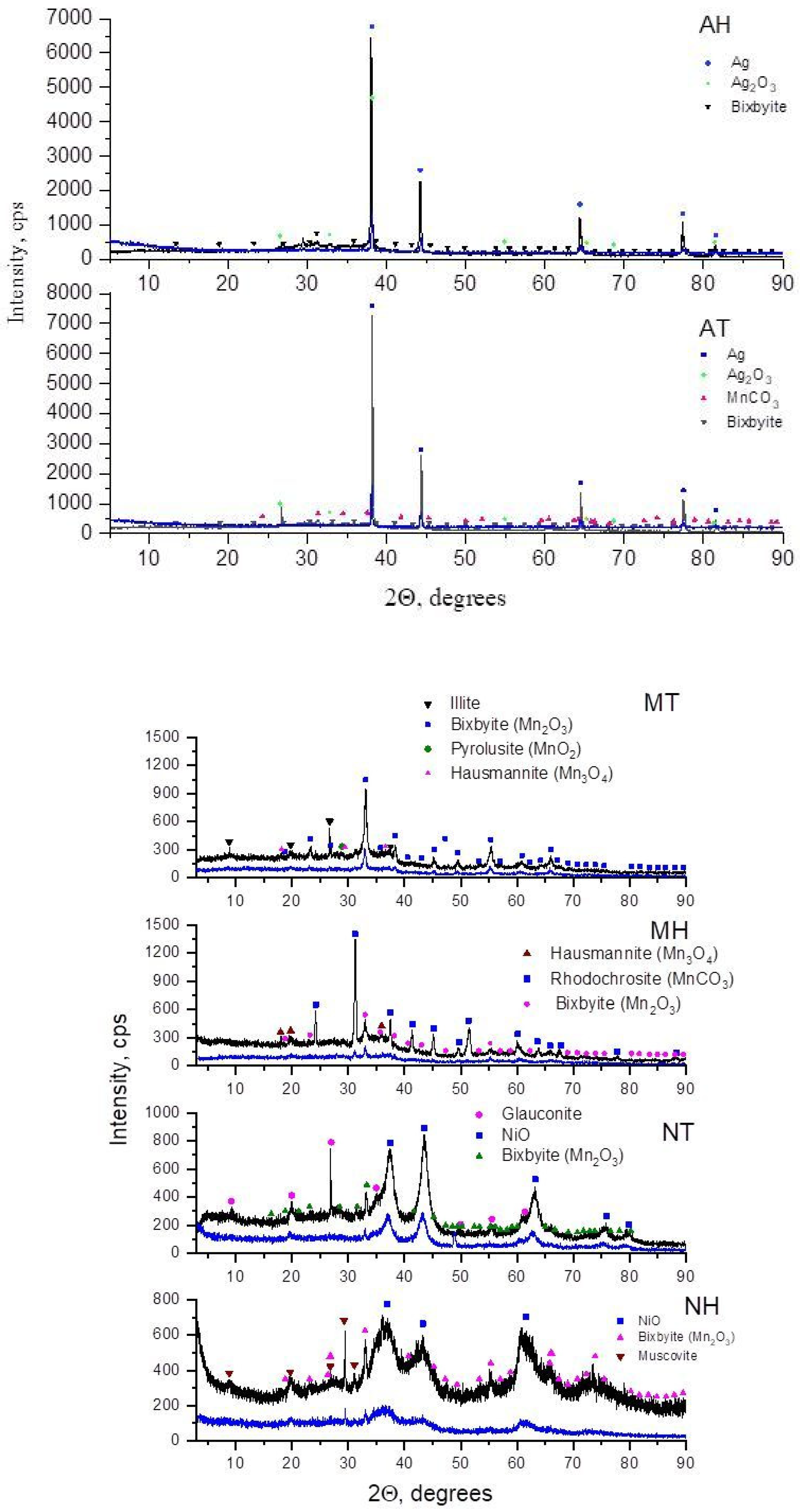
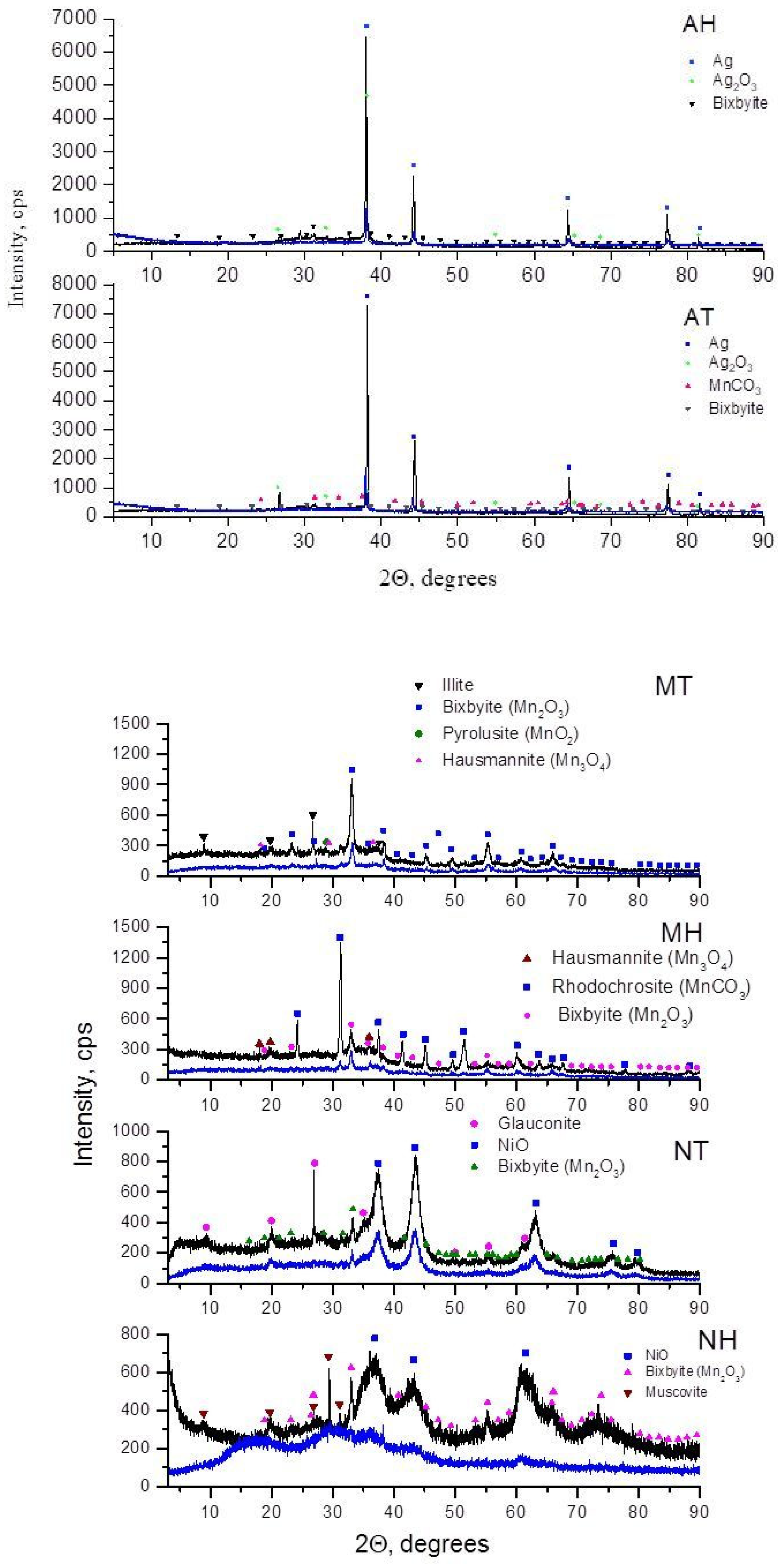
A powder X-ray diffraction study of the spent composite photocatalysts (AT, AH, MT, MH, NT, and NH) after the photocatalytic decolourization of Malachite Green dye and the catalytic decomposition of ozone was performed in order to evaluate a structural stability of the composites (Figure 12 and Figure 13). A decreasing intensity of all reflections is registered in all spent catalysts (AT, AH, MT, MH, NT, and NH) in comparison with the fresh catalysts. A similar decreasing in the intensity of the diffraction peaks was proven by other research groups [65,66]. The preservation of the phase composition of the spent photocatalysts after a photocatalytic reaction is established by a PXRD analysis. This proved the structural stability of the tested composite photocatalysts (AT, AH, MT, MH, NT, and NH). Structural changes are registered in the case of spent catalysts after the reaction of ozone decomposition. Decreasing of the Ag content, rhodochrosite (MnCO3), the illite, glauconite, and muscovite phases in the spent catalysts after ozone conversion is observed. Other research groups have reported similar structural changes of the catalysts after the ozone conversion reaction [3,48,67].

4. Conclusions

The novelty of the present study is the successful preparation of new manganese carbonate ore/NiO, manganese oxides, or silver-containing composites using natural MnCO3 ore by two synthesis approaches. The new aspect, regarding the use of a natural manganese carbonate ore from the Obrochishte deposit, Bulgaria as precursor, is the fact that it is a stable and low-cost natural material. The prepared materials possess an average crystallite size of 8–15 nm for NiO, Mn2O3, Mn3O4, and MnO2 and 50–67 nm for silver phases, respectively. The obtained composites based on manganese carbonate ore possess a mesoporous structure. The slit-shape pores between rigid particles are established in all investigated materials. The thermal treatment leads to the enhanced catalytic activity of MnCO3 ore/NiO, manganese oxides, or Ag-containing composites for the decolourization of Malachite Green dye under UV irradiation and the removal of ozone in comparison with hydrothermal procedure. The obtained manganese carbonate ore/Ag-containing composite catalysts exhibit a high catalytic activity, achieving 98–99% ozone decomposition and 79–83% MG dye decolourization. The prepared manganese ore-based composites could find an environmental application as promising catalysts, especially for removal of ozone and Malachite Green dye pollutants from atmosphere and wastewaters due to their good stability, enhanced catalytic ability, and low cost.

Author Contributions

Conceptualization, K.Z.; methodology, K.Z.; validation, K.Z. and R.T.; formal analysis, K.Z., R.T., V.K.-K., L.T., P.T. and I.Y.; investigation, K.Z., P.K. and R.T.; resources, K.Z. and R.T.; data curation, K.Z. and R.T.; writing—original draft preparation, K.Z., R.T., P.K., L.T. and I.Y.; writing—review and editing, K.Z., R.T. and V.K.-K.; visualization, K.Z.; supervision, K.Z.; project administration, K.Z. and R.T.; funding acquisition, R.T. and K.Z. All authors have read and agreed to the published version of the manuscript.

Funding

This research was funded by the National Science Program “Critical and strategic raw materials for a green transition and sustainable development”, approved by the Resolution of the Council of Ministers NO. 508/18.07.2024 and funded by the Ministry of Education and Science (MES) of Bulgaria.

Data Availability Statement

The original contributions presented in this study are included in the article. Further inquiries can be directed to the corresponding author(s).

Acknowledgments

This work has been carried out in the framework of the National Science Program “Critical and strategic raw materials for a green transition and sustainable development”, approved by the Resolution of the Council of Ministers No. 508/18.07.2024 and funded by the Ministry of Education and Science (MES) of Bulgaria. V.K.-K. thanks the European Regional Development Fund under “Research Innovation and Digitization for Smart Transformation” program 2021–2027 under the Project BG16RFPR002-1.014-0006 “National Centre of Excellence Mechatronics and Clean Technologies”.

Conflicts of Interest

The authors declare no conflicts of interest.

References

  1. Li, X.; Shao, X.; Wang, Z.; Ma, J.; He, H. Regulating the Chemical State of Silver via Surface Hydroxyl Groups to Enhance Ozone Decomposition Performance of Ag/Fe2O3 Catalyst. Catal. Today 2023, 410, 117–126. [Google Scholar] [CrossRef]
  2. Alraae, A.; Moussadik, A.; Benzaouak, A.; Kacimi, M.; Dahhou, M.; Sifou, A.; El Hamidi, A. Eco-Friendly Synthesis and Catalytic Activity of Cu Nanoparticles Deposited on Expanded Muscovite to Reduce Organic Pollutants. Results Surf. Interfaces 2024, 17, 100343. [Google Scholar] [CrossRef]
  3. Li, X.; Ma, J.; He, H. Tuning the Chemical State of Silver on Ag−Mn Catalysts to Enhance the Ozone Decomposition Performance. Environ. Sci. Technol. 2020, 54, 11566–11575. [Google Scholar] [CrossRef]
  4. Liu, Y.; Zhang, P.; Zhan, J.; Liu, L. Heat Treatment of MnCO3: An Easy Way to Obtain Efficient and Stable MnO2 for Humid O3 Decomposition. Appl. Surf. Sci. 2019, 463, 374–385. [Google Scholar] [CrossRef]
  5. Zhang, J.; Wei, Y.; Fang, Z. Ozone Pollution: A Major Health Hazard Worldwide. Front. Immunol. 2019, 10, 2518. [Google Scholar] [CrossRef]
  6. Dhandapani, B.; Oyama, S.T. Gas Phase Ozone Decomposition Catalysts. Appl. Catal. B Environ. 1997, 11, 129–166. [Google Scholar] [CrossRef]
  7. Tang, H.; Wang, Z.; Shao, J.; Lin, F.; Liu, P.; He, Y.; Zhu, Y. Catalytic Decomposition of Residual Ozone over Cactus-like MnO2 Nanosphere: Synergistic Mechanism and SO2 /H2 O Interference. ACS Omega 2022, 7, 9818–9833. [Google Scholar] [CrossRef]
  8. Wei, Y.; Min, X.; Li, Y.; Wang, H.; Qi, F.; Liang, P.; Li, H.; Hu, J.; Sun, T. Modification of Manganese Oxides for Enhancing Ozone Catalytic Decomposition under Moist Conditions. Appl. Catal. A Gen. 2022, 640, 118659. [Google Scholar] [CrossRef]
  9. Ma, J.; Cao, R.; Dang, Y.; Wang, J. A Recent Progress of Room–Temperature Airborne Ozone Decomposition Catalysts. Chin. Chem. Lett. 2021, 32, 2985–2993. [Google Scholar] [CrossRef]
  10. Li, X.; Ma, J.; He, H. Recent Advances in Catalytic Decomposition of Ozone. J. Environ. Sci. 2020, 94, 14–31. [Google Scholar] [CrossRef]
  11. Farhadian, M.; Kazemzad, M. Photocatalytic Degradation of Malachite Green by Magnetic Photocatalyst. Synth. React. Inorg. Met. Nano Met. Chem. 2016, 46, 458–463. [Google Scholar] [CrossRef]
  12. Xu, Z.; Zada, N.; Habib, F.; Ullah, H.; Hussain, K.; Ullah, N.; Bibi, M.; Bibi, M.; Ghani, H.; Khan, S.; et al. Enhanced Photocatalytic Degradation of Malachite Green Dye Using Silver–Manganese Oxide Nanoparticles. Molecules 2023, 28, 6241. [Google Scholar] [CrossRef]
  13. Sayılkan, F.; Asiltürk, M.; Tatar, P.; Kiraz, N.; Arpaç, E.; Sayılkan, H. Preparation of Re-Usable Photocatalytic Filter for Degradation of Malachite Green Dye under UV and Vis-Irradiation. J. Hazard. Mater. 2007, 148, 735–744. [Google Scholar] [CrossRef]
  14. Li, K.; Chen, J.; Peng, J.; Omran, M.; Chen, G. Efficient Improvement for Dissociation Behavior and Thermal Decomposition of Manganese Ore by Microwave Calcination. J. Clean. Prod. 2020, 260, 121074. [Google Scholar] [CrossRef]
  15. Tang, Z.; Wang, Y.; Liu, J.; Xu, B.; Ding, L.; Huang, W.; Dai, Z.; Jiang, W.; Yao, L.; Yang, L. Removal and Resource Utilization of High Concentration Flue Gas Sulfur Dioxide Using Manganese Carbonate Ore. Atmosphere 2023, 14, 835. [Google Scholar] [CrossRef]
  16. Shen, C.; Gu, X.; Yang, B.; Zhang, D.; Wang, Z.; Shu, Z.; Dick, J.; Lu, A. Mineralogical Characteristics and Photocatalytic Properties of Natural Sphalerite from China. J. Environ. Sci. 2020, 89, 156–166. [Google Scholar] [CrossRef]
  17. Xu, D.; Yang, Y.; Gan, L. Utilization of Natural Mineral Materials in Environmental Remediation: Processes and Applications. Minerals 2025, 15, 318. [Google Scholar] [CrossRef]
  18. Ye, G.; Lu, J.; Qian, L.; Xie, L.; Zhou, H.; Zhu, C. Synthesis of Manganese Ore/Co3O4 Composites by Sol–Gel Method for the Catalytic Oxidation of Gaseous Chlorobenzene. J. Saudi Chem. Soc. 2021, 25, 101229. [Google Scholar] [CrossRef]
  19. Luo, L.; Zou, D.; Lu, D.; Xin, B.; Zhou, M.; Zhai, X.; Ma, J. Heterogeneous Catalytic Ozonation of Ciprofloxacin in Aqueous Solution Using a Manganese-Modified Silicate Ore. RSC Adv. 2018, 8, 33534–33541. [Google Scholar] [CrossRef] [PubMed]
  20. Luo, L.; Zou, D.; Lu, D.; Yu, F.; Xin, B.; Ma, J. Study of Catalytic Ozonation for Tetracycline Hydrochloride Degradation in Water by Silicate Ore Supported Co3O4. RSC Adv. 2018, 8, 41109–41116. [Google Scholar] [CrossRef] [PubMed]
  21. Luo, L.; Sun, Z.; Chen, Y.; Zhang, H.; Sun, Y.; Lu, D.; Ma, J. Catalytic Ozonation of Sulfamethoxazole Using Low-Cost Natural Silicate Ore Supported Fe2O3: Influencing Factors, Reaction Mechanisms and Degradation Pathways. RSC Adv. 2023, 13, 1906–1913. [Google Scholar] [CrossRef]
  22. Prasetyowati, R.; Harahap, E.F.M.; Saputri, R.I.; Swastika, P.E.; Fauzi, F.; Supardi; Warsono; Ariswan; Dwandaru, W.S.B. Degradation of Methyl Orange Dye Using Fe3O4/GO Photocatalyst with Iron Derived from Coastal Glagah Kulon Progo Ore. Nano-Struct. Nano Objects 2024, 38, 101153. [Google Scholar] [CrossRef]
  23. Wu, Y.; Liu, L.; Yu, X.; Zhang, J.; Li, L.; Yan, C.; Zhu, B. Natural Hematite Ore Composited with ZnO Nanoneedles for Energy Applications. Compos. Part B Eng. 2018, 137, 178–183. [Google Scholar] [CrossRef]
  24. Yola, M.L.; Eren, T.; Atar, N.; Wang, S. Adsorptive and Photocatalytic Removal of Reactive Dyes by Silver Nanoparticle-Colemanite Ore Waste. Chem. Eng. J. 2014, 242, 333–340. [Google Scholar] [CrossRef]
  25. Shenoy, S.; Farahat, M.M.; Chuaicham, C.; Sekar, K.; Ramasamy, B.; Sasaki, K. Mixed-Phase Fe2O3 Derived from Natural Hematite Ores/C3N4 Z-Scheme Photocatalyst for Ofloxacin Removal. Catalysts 2023, 13, 792. [Google Scholar] [CrossRef]
  26. Tran, C.V.; Nguyen, P.T.H.; Nguyen, D.A.; Le, B.T.; Truong, T.N.; La, D.D. Facile Fabrication and Characterizations of Nanostructured Fe2O3-TiO2 Composite from Ilmenite Ore. Int. J. Adv. Eng. Manag. Sci. 2018, 4, 574–578. [Google Scholar] [CrossRef][Green Version]
  27. Lan, N.T.; Anh, V.H.; An, H.D.; Hung, N.P.; Nhiem, D.N.; Van Thang, B.; Lieu, P.K.; Khieu, D.Q. Synthesis of C-N-S-Tridoped TiO2 from Vietnam Ilmenite Ore and Its Visible Light-Driven-Photocatalytic Activity for Tetracyline Degradation. J. Nanomater. 2020, 2020, 1523164. [Google Scholar] [CrossRef]
  28. Nguyen, T.L.; Dinh Quoc, V.; Nguyen, T.L.; Le, T.T.T.; Dinh, T.K.; Nguyen, V.T.; Nguyen, P.H. Visible-Light-Driven SO42−/TiO2 Photocatalyst Synthesized from Binh Dinh (Vietnam) Ilmenite Ore for Rhodamine B Degradation. J. Nanomater. 2021, 2021, 8873181. [Google Scholar] [CrossRef]
  29. Smith, Y.R.; Joseph Antony Raj, K.; (Ravi) Subramanian, V.; Viswanathan, B. Sulfated Fe2O3–TiO2 Synthesized from Ilmenite Ore: A Visible Light Active Photocatalyst. Colloids Surf. A Physicochem. Eng. Asp. 2010, 367, 140–147. [Google Scholar] [CrossRef]
  30. Chen, J.; Zhan, J.; Li, Q. Exploration and Crystal Phase Engineering from Bismuthinite Ore to Visible-Light Responsive Photocatalyst of Bi2O3. J. Environ. Chem. Eng. 2019, 7, 103375. [Google Scholar] [CrossRef]
  31. Marchev, P.; Raicheva, R.; Ivanova, R.; Jicha, B.; Peytcheva, I. Age and Genesis of the Largest Phanerozoic Mn Deposits in the Paratethys: Inferences from 40Ar/39Ar and U/Pb Ages in NE Bulgaria and NW Turkey. J. Geochem. Explor. 2025, 274, 107764. [Google Scholar] [CrossRef]
  32. Kostov-Kytin, V. Encyclopedia Minerals in Bulgaria; Publishing House of Bulgarian Academy of Sciences “Prof. Marin Drinov”: Sofia, Bulgaria, 2023; pp. 244–246. (In Bulgarian) [Google Scholar]
  33. Kanazirski, M.M. Origin of Manganese Ore in the Obrochishte Deposit as Determined by the Chemical Processes of Ore Formation. C. R. L’Académie Bulg. Des. Sci. 1985, 38, 879. [Google Scholar]
  34. Dekov, V.M.; Maynard, J.B.; Kamenov, G.D.; Rouxel, O.; Lalonde, S.; Juranov, S. Origin of the Oligocene Manganese Deposit at Obrochishte (Bulgaria): Insights from C, O, Fe, Sr, Nd, and Pb Isotopes. Ore Geol. Rev. 2020, 122, 103550. [Google Scholar] [CrossRef]
  35. Kuleshov, V.N. Isotopic Composition (δ13C, δ18O) and Origin of Manganese Carbonate Ores from the Early Oligocene Deposits, the Eastern Paratethys. Geochemistry 2003, 63, 329–363. [Google Scholar] [CrossRef]
  36. Kraus, W.; Nolze, G. PowderCell 2.0 for Windows. Powder Diffr 1998, 13, 256. [Google Scholar]
  37. Chukanov, N.V. Infrared Spectra of Mineral Species: Extended Library; Springer Geochemistry/Mineralogy; Springer: Dordrecht, The Netherlands, 2014; ISBN 978-94-007-7127-7. [Google Scholar] [CrossRef]
  38. Salem, I.A.; El-Shibiny, N.H.; Monsef, M.A. Mineralogical and Geochemical Studies on Manganese Deposits at Abu Ghusun Area, South Eastern Desert, Egypt. J. Geogr. Earth Sci. 2016, 4, 51–74. [Google Scholar] [CrossRef]
  39. Swami, M.C.; Jayasheela, H.M.; Hulsure, V.C. Infrared Spectra of Manganese Ores from Deogiri of Sandur Schist Belt Area Karnataka India. Int. J. Res. Advent. Technol. 2014, 2, 341–344. [Google Scholar] [CrossRef]
  40. Pani, S.; Singh, S.K.; Mohapatra, B.K. Vibrational Spectroscopic Study for Qualitative Assessment of Mn-oxide Ore. Resour. Geol. 2016, 66, 12–23. [Google Scholar] [CrossRef]
  41. Lee, J.Y.; Kim, S.B.; Kim, G.S.; Hong, S.C.; Hong, S.H. Decomposition of Gas-Phase Ozone Using Natural Manganese Ore as a Catalyst at Room Temperature. In Proceedings of the Third International Symposium on Air Quality Management at Urban, Regional and Global Scales, Istanbul, Turkey, 26–30 September 2005; pp. 1094–1106. [Google Scholar]
  42. Feng, Y.; Li, X. Catalytic Ozonation of Phenylamine in Water with a Manganese Ore. RSC Adv. 2020, 10, 36192–36200. [Google Scholar] [CrossRef]
  43. Chen, C.; Yoza, B.A.; Chen, H.; Li, Q.X.; Guo, S. Manganese Sand Ore Is an Economical and Effective Catalyst for Ozonation of Organic Contaminants in Petrochemical Wastewater. Water Air Soil Pollut. 2015, 226, 182. [Google Scholar] [CrossRef]
  44. Jia, J.; Zhang, P.; Chen, L. Catalytic Decomposition of Gaseous Ozone over Manganese Dioxides with Different Crystal Structures. Appl. Catal. B Environ. 2016, 189, 210–218. [Google Scholar] [CrossRef]
  45. Dong, C.; Yang, J.-J.; Xie, L.-H.; Cui, G.; Fang, W.-H.; Li, J.-R. Catalytic Ozone Decomposition and Adsorptive VOCs Removal in Bimetallic Metal-Organic Frameworks. Nat. Commun. 2022, 13, 4991. [Google Scholar] [CrossRef]
  46. Ma, D.; Lian, Q.; Zhang, Y.; Huang, Y.; Guan, X.; Liang, Q.; He, C.; Xia, D.; Liu, S.; Yu, J. Catalytic Ozonation Mechanism over M1-N3C1 Active Sites. Nat. Commun. 2023, 14, 7011. [Google Scholar] [CrossRef]
  47. Truba, A.S.; Rakitskaya, T.L. Catalytic properties of synthetic hausmannite in the ozone decomposition reaction. Вісник ОНУ 2021, 26, 6–15. [Google Scholar] [CrossRef]
  48. Zhang, Y.; Cao, N.; Cheng, H.; Zhao, X.; Qiu, L.; Fang, Y.; Liao, J.; Cai, X.; Tian, X.; Lei, L.; et al. Interface Reconfiguration of MnCO3/Mn3O4 Heterostructure Enhances the Ozone Decomposition in the Entire Humidity Range. Appl. Catal. B Environ. Energy 2024, 355, 124171. [Google Scholar] [CrossRef]
  49. Jin, H.; Li, Z.; Min, X.; Zhong, L.; Chen, K.; Zhao, S. Efficient Ozone Decomposition by Optimizing Defect Sites of NiMn-Layered Double Hydroxides under High Humidity Air. J. Environ. Chem. Eng. 2024, 12, 114858. [Google Scholar] [CrossRef]
  50. Wang, Z.; Chen, Y.; Li, X.; Ma, J.; He, G.; He, H. A Superior Catalyst for Ozone Decomposition: NiFe Layered Double Hydroxide. J. Environ. Sci. 2023, 134, 2–10. [Google Scholar] [CrossRef]
  51. Zhao, H.; Wang, A.; Zhang, Q.; Han, C. Highly Efficient Removal of Ozone by Amorphous Manganese Oxides Synthesized with a Simple Hydrothermal Method. J. Environ. Sci. 2023, 134, 96–107. [Google Scholar] [CrossRef]
  52. Li, W.; Gibbs, G.V.; Oyama, S.T. Mechanism of Ozone Decomposition on a Manganese Oxide Catalyst. 1. In Situ Raman Spectroscopy and Ab Initio Molecular Orbital Calculations. J. Am. Chem. Soc. 1998, 120, 9041–9046. [Google Scholar] [CrossRef]
  53. Jia, J.; Zhang, P. Catalytic Decomposition of Airborne Ozone by MnCO3 and Its Mechanism. Ozone Sci. Eng. 2018, 40, 21–28. [Google Scholar] [CrossRef]
  54. Tang, W.-X.; Liu, H.-D.; Wu, X.-F.; Chen, Y.-F. Higher Oxidation State Responsible for Ozone Decomposition at Room Temperature over Manganese and Cobalt Oxides: Effect of Calcination Temperature. Ozone Sci. Eng. 2014, 36, 502–512. [Google Scholar] [CrossRef]
  55. Batakliev, T.; Georgiev, V.; Karakashkova, P.; Gabrovska, M.; Nikolova, D.; Anachkov, M.; Rakovsky, S. Gas Phase Ozone Decomposition over Co-Precipitated Ni-Based Catalysts. Bulg. Chem. Commun. 2017, 48, 24–29. [Google Scholar]
  56. Naydenov, A.; Konova, P.; Nikolov, P.e.n.; Klingstedt, F.; Kumar, N.; Kovacheva, D.; Stefanov, P.; Stoyanova, R.; Mehandjiev, D. Decomposition of Ozone on Ag/SiO2 Catalyst for Abatement of Waste Gases Emissions. Catal. Today 2008, 137, 471–474. [Google Scholar] [CrossRef]
  57. Yang, L.; Ma, J.; Li, X.; He, G.; Zhang, C.; He, H. Improving the Catalytic Performance of Ozone Decomposition over Pd-Ce-OMS-2 Catalysts under Harsh Conditions. Catal. Sci. Technol. 2020, 10, 7671–7680. [Google Scholar] [CrossRef]
  58. Gall, E.T.; Corsi, R.L.; Siegel, J.A. Impact of Physical Properties on Ozone Removal by Several Porous Materials. Environ. Sci. Technol. 2014, 48, 3682–3690. [Google Scholar] [CrossRef]
  59. Magesh, G.; Arun, A.P.; Poonguzhali, R.V.; Kumar, E.R.; Pradeep, I.; Ranjith Kumar, R.; El-Rehim, A.F.A. Pure α-MnO2 and Ag Decorated α-MnO2 Nanorods for Photocatalytic Activity. J. Mol. Struct. 2025, 1329, 141444. [Google Scholar] [CrossRef]
  60. Devi, N.S.; Rekha, P.; Lorena, C.P.; Patricia, V.S.; María, A.H.; Devi, R.R.; Thanikaikarasan, S. Silver Doped Manganese Dioxide as an Efficient Photocatalyst for Solar Light Induced Degradation of Malachite Green Dye and Antibacterial Activity. Int. J. Adv. Sci. Eng. 2024, 11, 4069–4086. [Google Scholar] [CrossRef]
  61. Teng, W.; Li, X.; Zhao, Q.; Zhao, J.; Zhang, D. In Situ Capture of Active Species and Oxidation Mechanism of RhB and MB Dyes over Sunlight-Driven Ag/Ag3PO4 Plasmonic Nanocatalyst. Appl. Catal. B Environ. 2012, 125, 538–545. [Google Scholar] [CrossRef]
  62. Shaikh, B.; Bhatti, M.A.; Shah, A.A.; Tahira, A.; Shah, A.K.; Usto, A.; Aftab, U.; Bukhari, S.I.; Alshehri, S.; Shah Bukhari, S.N.U.; et al. Mn3O4@ZnO Hybrid Material: An Excellent Photocatalyst for the Degradation of Synthetic Dyes Including Methylene Blue, Methyl Orange and Malachite Green. Nanomaterials 2022, 12, 3754. [Google Scholar] [CrossRef]
  63. Haleem, A.; Ullah, M.; Rehman, S.U.; Shah, A.; Farooq, M.; Saeed, T.; Ullah, I.; Li, H. In-Depth Photocatalytic Degradation Mechanism of the Extensively Used Dyes Malachite Green, Methylene Blue, Congo Red, and Rhodamine B via Covalent Organic Framework-Based Photocatalysts. Water 2024, 16, 1588. [Google Scholar] [CrossRef]
  64. Zaharieva, K.; Karakashkova, P.; Stoyanova, D.; Dimova, S.; Dimitrov, O.; Stambolova, I. Ceria-Manganese Oxide Catalyst Activity—Ozone Decomposition and Discoloration of Malachite Green Dye. Chem. Technol. Metall. 2023, 58, 1071–1079. [Google Scholar] [CrossRef]
  65. Zhang, J.; Su, C.; Xie, X.; Liu, P.; Huq, M.d.E. Enhanced Visible Light Photocatalytic Degradation of Dyes in Aqueous Solution Activated by HKUST-1: Performance and Mechanism. RSC Adv. 2020, 10, 37028–37034. [Google Scholar] [CrossRef] [PubMed]
  66. Zhuo, B.; Tan, A.; Xiang, Z.; Piao, J.; Zheng, W.; Wan, K.; Liang, Z.; Fu, Z. Ozonolysis–Oxidation-Driven Top-down Strategy for the Target Preparation of Ultrathin 2D Metal–Organic Framework Monolayers. Ind. Chem. Mater. 2024, 2, 110–117. [Google Scholar] [CrossRef]
  67. Waterhouse, G.I.N.; Bowmaker, G.A.; Metson, J.B. Oxidation of a Polycrystalline Silver Foil by Reaction with Ozone. Appl. Surf. Sci. 2001, 183, 191–204. [Google Scholar] [CrossRef]
Figure 1. The Obrochiste deposit, Bulgaria.
Environments 13 00011 g001
Figure 2. General preparation scheme for the synthesis of manganese carbonate ore/NiO, manganese oxides or silver-containing composite photocatalysts (NH, NT, MH, MT, AH, and AT).
Environments 13 00011 g002
Figure 3. PXRD patterns of natural manganese carbonate ore (untreated and thermally treated); prepared MnCO3 ore/NiO, manganese oxides or Ag-containing composites (NH, NT, MH, MT, AH, and AT).
Environments 13 00011 g003
Figure 4. SEM images of synthesized MnCO3 ore/NiO, manganese oxides or Ag-containing composites (NH, NT, MH, MT, AH, and AT).
Environments 13 00011 g004
Figure 5. FT-IR spectra of synthesized manganese carbonate ore/NiO, manganese oxides, or silver containing composites (NH, NT, MH, MT, AH, and AT).
Environments 13 00011 g005
Figure 6. (a) Nitrogen adsorption–desorption isotherms and (b) pore size distribution of the synthesized manganese carbonate ore/NiO, manganese oxides, or silver-containing composites (NH, NT, MH, MT, AH, and AT).
Environments 13 00011 g006
Figure 7. Ozone conversion reaction over manganese carbonate ore/NiO, manganese oxides, or silver-containing composite catalysts (NH, NT, MH, MT, AH, and AT).
Environments 13 00011 g007
Figure 8. (a) Concentration ratio C/C0 of Malachite Green dye as a function of UV irradiation time and (b) kinetic curves of UV-decolourization of Malachite Green dye using prepared manganese carbonate ore/NiO, manganese oxides, or silver-containing composites (NH, NT, MH, MT, AH, and AT) as photocatalysts.
Environments 13 00011 g008
Figure 9. This figure presents UV–Vis absorption spectra of MG dye recorded over the irradiation period using the prepared manganese carbonate ore/NiO, manganese oxides, or silver-containing composites (NH, NT, MH, MT, AH, and AT) as photocatalysts.
Environments 13 00011 g009
Figure 10. The adsorption capacities (Q) (mg/g) of prepared manganese carbonate ore/NiO, manganese oxides, or silver-containing composite photocatalysts (1-AT, 2-AH, 3-MT, 4-NT, 5-NH, and 6-MH). after 30 min dark period.
Environments 13 00011 g010
Figure 11. Reusability tests for the prepared manganese carbonate ore/NiO, manganese oxides, or silver-containing composite photocatalysts (AT, AH, MT, MH, NT, and NH), repeated 3 times, presenting the degree of MG dye decolourization after 150 min under UV irradiation.
Environments 13 00011 g011
Figure 12. PXRD patterns of fresh composite photocatalysts (NH, NT, MH, MT, AH, and AT) (black line) and spent catalysts after three consecutive photocatalytic runs (blue line).
Environments 13 00011 g012
Figure 13. PXRD patterns of fresh composite photocatalysts (NH, NT, MH, MT, AH, and AT) (black line) and spent catalysts after ozone decomposition (blue line).
Environments 13 00011 g013
Table 1. Elemental composition of a natural manganese carbonate ore (untreated and thermally treated) and prepared MnCO3 ore/NiO, manganese oxides, or Ag-containing composites (NH, NT, MH, MT, AH, and AT) analyzed by WDXRF.
Sample, Mass %MnCO3
Ore
Standard ErrorMnCO3
Ore
(Calcined)
Standard ErrorATStandard ErrorAHStandard ErrorMTStandard ErrorMHStandard ErrorNTStandard ErrorNHStandard
Error
Na0.418±0.0280.295±0.0360.3160.0330.363±0.0640.240±0.1030.915±0.0400.337±0.0850.989±0.045
Mg6.40±0.1726.44±0.0753.860.0523.93±0.0933.36±0.1173.43±0.2275.20±0.0774.51±0.149
Al4.06±0.0384.11±0.0172.280.0182.12±0.0302.14±0.0082.12±0.0173.07±0.0292.30±0.058
Si25.2±0.06625.3±0.05713.80.11513.0±0.08813.3±0.05713.6±0.05718.9±0.14513.6±0.185
P0.240±0.0100.240±0.0050.1350.0090.136±0.0040.136±0.0030.141±0.0080.197±0.0180.178±0.008
S0.176±0.0050.455±0.0080.1500.2230.162±0.0320.232±0.0070.126±0.0040.294±0.0040.138±0.005
Cl0.0190±0.0030.0167±0.004----0.0194±0.003--0.0157±0.004--
K1.14±0.0211.15±0.006----0.604±0.0120.745±0.0140.840±0.0090.699±0.012
Ca7.01±0.0147.21±0.0232.440.0403.16±0.0133.92±0.0034.18±0.0183.46±0.0113.77±0.008
Ti0.207±0.0140.150±0.0140.1550.070-±0.0720.115±0.0120.123±0.0040.119±0.0110.137±0.005
V0.0620±0.0240.0610±0.025------0.0350±0.003----
Mn51.6±0.12051.0±0.03326.90.08830.2±0.08873.8±0.14572.3±0.30526.6±0.03331.5±0.152
Fe3.40±0.0263.50±0.0341.880.0132.03±0.0252.15±0.0252.02±0.0101.71±0.0082.03±0.013
Ni0.0440±0.0010.0506±0.004----0.0443±0.012-±0.00539.2±0.14540.1±0.176
Cu0.0263±0.001--0.03220.0010.0466±0.001--0.0375±0.0000.0795±0.0090.0679±0.005
Sr0.0289±0.0010.0394±0.001------0.0247±0.002--0.0320±0.008
Ag----48.10.12044.9±0.120--0.156±0.011----
Table 2. Textural characteristics of the investigated composite catalysts (AT, AH, MT, MH, NT, and NH): specific surface area (SBET), total pore volume (Vt), and average pore diameter (Dav).
SampleSBET, m2/gVt, cm3/gDav, nm
AT630.212
AH730.210
MT1230.310
MH1190.39
NT1370.39
NH1710.37
Table 3. The adsorption capacities Q after 30 min dark period, decolourization at 150 min, and apparent rate constants (kapp) of photocatalytic discolouration of MG.
SamplesQ (mg/g)Decolourization (%)kapp × 10−3 (min−1)
AT0.188313.2
AH0.1737911.6
MT0.1327110.4
NT0.074646.7
NH0.069596.3
MH0.06434
Disclaimer/Publisher’s Note: The statements, opinions and data contained in all publications are solely those of the individual author(s) and contributor(s) and not of MDPI and/or the editor(s). MDPI and/or the editor(s) disclaim responsibility for any injury to people or property resulting from any ideas, methods, instructions or products referred to in the content.