Perfectionism Dimensions and Longitudinal Depressive Symptom Profiles in Adolescents: Distinguishing Evaluative Self-Criticism from Personal Standards

Abstract
1. Introduction
Hypotheses
2. Materials and Methods
2.1. Overview of Study Design and Analytic Approach
2.2. Participants and Procedure
2.3. Data Quality and Pre-Processing
2.4. Measures
2.4.1. Depressive Symptoms
2.4.2. Perfectionism Dimensions
2.5. Predictors of Depressive Symptom Profile Membership
2.6. Missing Data and Analytic Sample Flow
2.7. Data Analysis
3. Results
3.1. Descriptive Statistics
3.2. DPSCA Psychometric Checks
3.3. Latent Depressive Symptom Profile Model Selection
3.4. Characteristics of the Final Symptom Profiles
3.5. Perfectionism and Demographic Predictors of Profile Membership
3.6. Baseline CES-D Adjustment, Direct Coefficient Contrasts, and Sensitivity Analyses
4. Discussion
4.1. Principal Findings
4.2. Depressive Symptom Profiles and Perfectionism
4.3. Demographic Predictors
4.4. Implications
4.5. Strengths and Limitations
5. Conclusions
Supplementary Materials
Author Contributions
Funding
Institutional Review Board Statement
Informed Consent Statement
Data Availability Statement
Acknowledgments
Conflicts of Interest
References
- Asparouhov, T., & Muthén, B. (2014). Auxiliary variables in mixture modeling: Three-step approaches using Mplus. Structural Equation Modeling: A Multidisciplinary Journal, 21(3), 329–341. [Google Scholar] [CrossRef] [Scilit]
- Batterham, P. J., Maston, K., O’Dea, B., Brown, L., Calear, A. L., Larsen, M., Skinner, S. R., Christensen, H., & Werner-Seidler, A. (2026). Stress-diathesis based predictors of depression and anxiety trajectories in adolescence: A population-based longitudinal cohort study. Psychological Medicine, 56, e64. [Google Scholar] [CrossRef] [Scilit] [PubMed]
- Cohen, J. R., Hankin, B. L., Gibb, B. E., Hammen, C., Hazel, N. A., Ma, D., Yao, S., Zhu, X. Z., & Abela, J. R. Z. (2013). Negative attachment cognitions and emotional distress in mainland Chinese adolescents: A prospective multi-wave test of vulnerability-stress and stress generation models. Journal of Clinical Child & Adolescent Psychology, 42(4), 531–544. [Google Scholar] [CrossRef] [Scilit] [PubMed]
- De Lorenzo, A., Di Gesto, C., Graziano, F., Calandri, E., Kaakinen, M., Oksanen, A., & Rabaglietti, E. (2026). Psychometric properties of the Italian version of the 6-Item Identity Bubble Reinforcement Scale (IBRS-6). Humanities and Social Sciences Communications, 13, 932. [Google Scholar] [CrossRef] [Scilit]
- Dunkley, D. M., Blankstein, K. R., Zuroff, D. C., Lecce, S., & Hui, D. (2006). Self-critical and personal standards factors of perfectionism located within the five-factor model of personality. Personality and Individual Differences, 40(3), 409–420. [Google Scholar] [CrossRef] [Scilit]
- Flett, G. L., Hewitt, P. L., Besser, A., Su, C., Vaillancourt, T., Boucher, D., Munro, Y., Davidson, L. A., & Gale, O. (2016). The child–adolescent perfectionism scale: Development, psychometric properties, and associations with stress, distress, and psychiatric symptoms. Journal of Psychoeducational Assessment, 34(7), 634–652. [Google Scholar] [CrossRef] [Scilit]
- Hewitt, P. L., & Flett, G. L. (1991). Perfectionism in the self and social contexts: Conceptualization, assessment, and association with psychopathology. Journal of Personality and Social Psychology, 60(3), 456–470. [Google Scholar] [CrossRef] [PubMed]
- Jamil, B., Su, J., Elam, K. K., Lemery-Chalfant, K., Cruz, R., Grimm, K. J., & Seaton, E. K. (2025). Polygenic risk and trajectories of depressive symptoms in diverse adolescents: Gene–environment interplay with family conflict and parental acceptance. Development and Psychopathology. Advance online publication. [Google Scholar] [CrossRef] [Scilit] [PubMed]
- Limburg, K., Watson, H. J., Hagger, M. S., & Egan, S. J. (2017). The relationship between perfectionism and psychopathology: A meta-analysis. Journal of Clinical Psychology, 73(10), 1301–1326. [Google Scholar] [CrossRef] [Scilit] [PubMed]
- Lunn, J., Greene, D., Callaghan, T., & Egan, S. J. (2023). Associations between perfectionism and symptoms of anxiety, obsessive-compulsive disorder and depression in young people: A meta-analysis. Cognitive Behaviour Therapy, 52(5), 460–487. [Google Scholar] [CrossRef] [Scilit] [PubMed]
- Muthén, L. K., & Muthén, B. O. (1998–2017). Mplus user’s guide (8th ed.). Muthén & Muthén. [Google Scholar]
- Pakhomova, T. E., Beksinska, M., Dietrich, J. J., Salway, T. J., Gadermann, A., Closson, K., Rowlands, A., Jesson, J., Ndung’u, T., Brockman, M., Nduna, M., Vermaak, S., Smit, J., & Kaida, A. (2026). Twelve-month trajectories of depressive symptoms and associated socio-structural factors among adolescents and young adults in Soweto and Durban, South Africa. Journal of Affective Disorders, 393, 120409. [Google Scholar] [CrossRef] [Scilit] [PubMed]
- Radloff, L. S. (1977). The CES-D scale: A self-report depression scale for research in the general population. Applied Psychological Measurement, 1(3), 385–401. [Google Scholar] [CrossRef] [Scilit]
- Reck, A., Seaton, E. K., Oshri, A., & Kogan, S. M. (2024). Trajectories of depressive symptoms among Black American adolescents: Sociocultural, racism and familial predictors. Journal of Clinical Child & Adolescent Psychology, 53(5), 811–827. [Google Scholar] [CrossRef] [Scilit] [PubMed]
- Smith, M. M., Sherry, S. B., Ray, C., Hewitt, P. L., & Flett, G. L. (2021). Is perfectionism a vulnerability factor for depressive symptoms, a complication of depressive symptoms, or both? A meta-analytic test of 67 longitudinal studies. Clinical Psychology Review, 84, 101982. [Google Scholar] [CrossRef] [Scilit] [PubMed]
- Smith, M. M., Sherry, S. B., Vidovic, V., Hewitt, P. L., & Flett, G. L. (2020). Why does perfectionism confer risk for depressive symptoms? A meta-analytic test of the mediating role of stress and social disconnection. Journal of Research in Personality, 86, 103954. [Google Scholar] [CrossRef] [Scilit]
- StataCorp. (2017). Stata statistical software: Release 15 [Computer software]. StataCorp LLC. [Google Scholar]
- Stoeber, J., & Otto, K. (2006). Positive conceptions of perfectionism: Approaches, evidence, challenges. Personality and Social Psychology Review, 10(4), 295–319. [Google Scholar] [CrossRef] [Scilit] [PubMed]
- Thapar, A., Collishaw, S., Pine, D. S., & Thapar, A. K. (2012). Depression in adolescence. The Lancet, 379(9820), 1056–1067. [Google Scholar] [CrossRef] [Scilit] [PubMed]
- Vaillancourt, T., & Haltigan, J. D. (2018). Joint trajectories of depression and perfectionism across adolescence and childhood risk factors. Development and Psychopathology, 30(2), 461–477. [Google Scholar] [CrossRef] [Scilit] [PubMed]
- Zheng, S., Wang, J., Lu, S., & Xiao, J. (2024). A longitudinal investigation of the cross-dimensional mediating role of negative life events between neuroticism and depressive symptoms in adolescents. Journal of Affective Disorders, 355, 333–341. [Google Scholar] [CrossRef] [Scilit] [PubMed]
- Zotschew, T., Claus, N., Egan, S. J., Shafran, R., Ehring, T., Takano, K., Limburg, K., & Cludius, B. (2026). Perfectionism as a transdiagnostic process in depression and generalized anxiety disorder: Evidence from a longitudinal study of young women. Journal of Anxiety Disorders, 121, 103178. [Google Scholar] [CrossRef] [Scilit] [PubMed]


| Specification | K | LL | AIC | BIC | aBIC | Entropy | BLRT p | Status |
|---|---|---|---|---|---|---|---|---|
| FULL GMM | 3 | −21,131.809 | 42,309.619 | 42,425.288 | 42,352.233 | 0.834 | — | Retained |
| LCGA | 1 | −23,846.727 | 47,711.454 | 47,756.716 | 47,728.129 | — | — | Robustness |
| LCGA | 2 | −22,186.258 | 44,398.516 | 44,463.894 | 44,422.602 | 0.922 | <0.001 | Robustness |
| LCGA | 3 | −21,638.166 | 43,310.331 | 43,395.826 | 43,341.829 | 0.895 | <0.001 | Robustness |
| LCGA | 4 | −21,400.060 | 42,842.120 | 42,947.731 | 42,881.029 | 0.886 | <0.001 | Robustness |
| LCGA | 5 | −21,314.014 | 42,678.028 | 42,803.755 | 42,724.348 | 0.849 | <0.001 | Robustness |
| Class | Profile | N | % | APP | T1 | T2 | T3 | T4 | T5 | T6 |
|---|---|---|---|---|---|---|---|---|---|---|
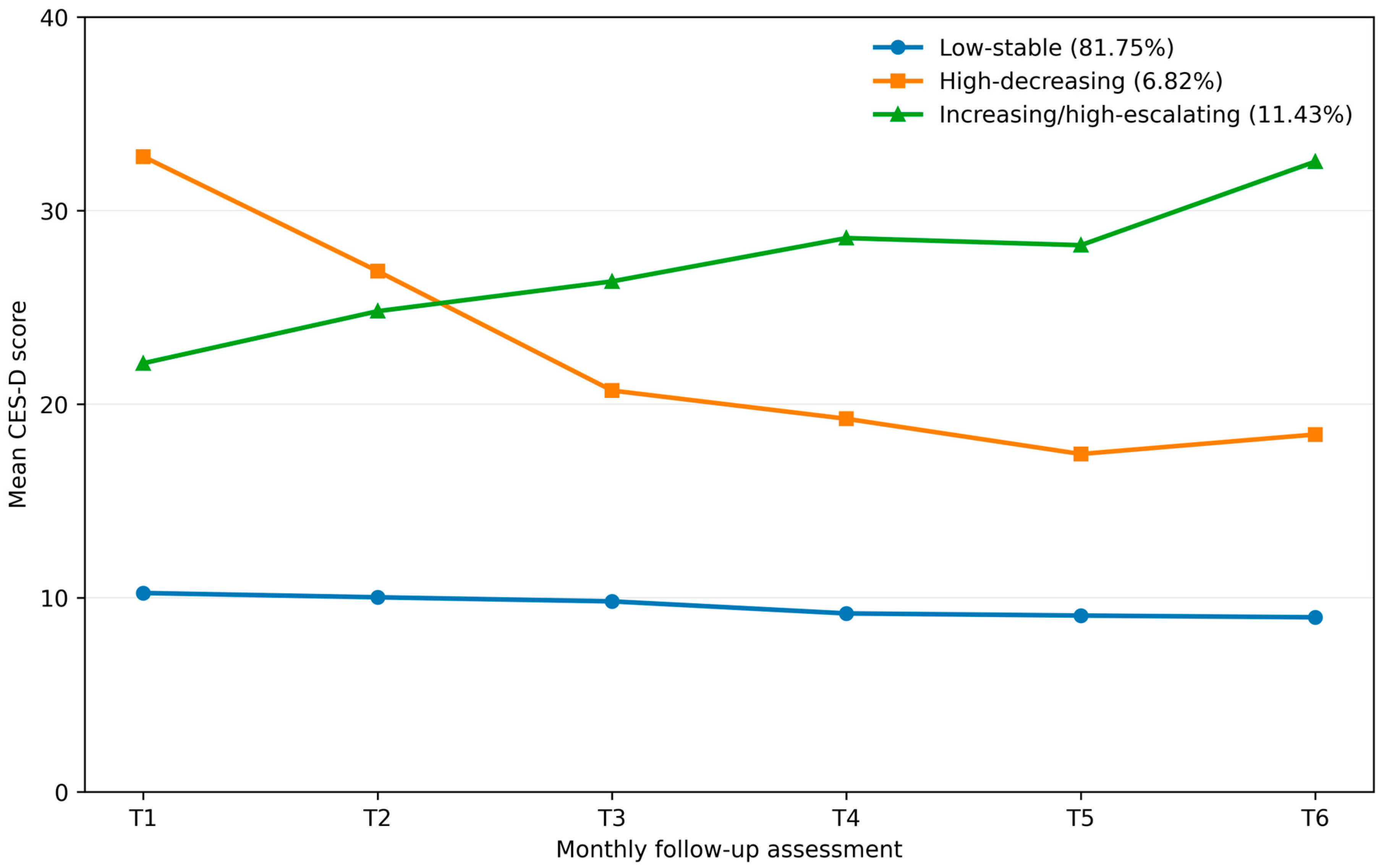
| 1 | Low-stable | 923 | 81.75 | 0.950 | 10.24 | 10.02 | 9.81 | 9.19 | 9.08 | 8.99 |
| 2 | High-decreasing | 77 | 6.82 | 0.854 | 32.79 | 26.87 | 20.70 | 19.24 | 17.42 | 18.43 |
| 3 | Increasing/high-escalating | 129 | 11.43 | 0.809 | 22.11 | 24.80 | 26.34 | 28.58 | 28.21 | 32.53 |
| Profile | Parameter | Estimate | SE | p | 95% CI |
|---|---|---|---|---|---|
| Low-stable | Intercept | 10.230 | 0.448 | <0.001 | [9.352, 11.107] |
| Low-stable | Linear slope | −0.323 | 0.235 | 0.170 | [−0.783, 0.138] |
| Low-stable | Quadratic slope | 0.013 | 0.044 | 0.775 | [−0.074, 0.099] |
| High-decreasing | Intercept | 31.173 | 1.574 | <0.001 | [28.089, 34.258] |
| High-decreasing | Linear slope | −6.799 | 1.415 | <0.001 | [−9.571, −4.026] |
| High-decreasing | Quadratic slope | 0.822 | 0.260 | 0.002 | [0.312, 1.331] |
| Increasing/high-escalating | Intercept | 21.749 | 1.310 | <0.001 | [19.182, 24.315] |
| Increasing/high-escalating | Linear slope | 1.584 | 0.917 | 0.084 | [−0.213, 3.381] |
| Increasing/high-escalating | Quadratic slope | 0.041 | 0.229 | 0.859 | [−0.408, 0.489] |
| Comparison | Predictor | Model 1 OR [95% CI]; p | Model 2 OR [95% CI]; p |
|---|---|---|---|
| High-decreasing vs. low-stable | Self-critical perfectionism (z) | 3.47 [2.48, 4.87]; <0.001 | 1.92 [1.30, 2.81]; 0.001 |
| High-decreasing vs. low-stable | Personal standards perfectionism (z) | 0.77 [0.57, 1.02]; 0.072 | 1.11 [0.74, 1.66]; 0.608 |
| High-decreasing vs. low-stable | Age | 1.16 [0.83, 1.62]; 0.386 | 1.24 [0.83, 1.84]; 0.288 |
| High-decreasing vs. low-stable | Sex: male vs. female | 0.79 [0.42, 1.51]; 0.481 | 1.00 [0.47, 2.13]; 0.990 |
| High-decreasing vs. low-stable | Urban vs. rural source | 1.20 [0.64, 2.25]; 0.566 | 1.67 [0.75, 3.72]; 0.206 |
| High-decreasing vs. low-stable | Highest parental education | 1.15 [0.85, 1.55]; 0.380 | 1.16 [0.80, 1.69]; 0.426 |
| High-decreasing vs. low-stable | Baseline CES-D | — | 1.26 [1.18, 1.33]; <0.001 |
| Increasing/high-escalating vs. low-stable | Self-critical perfectionism (z) | 3.13 [2.32, 4.23]; <0.001 | 1.79 [1.28, 2.49]; 0.001 |
| Increasing/high-escalating vs. low-stable | Personal standards perfectionism (z) | 0.90 [0.65, 1.26]; 0.549 | 1.44 [0.89, 2.31]; 0.134 |
| Increasing/high-escalating vs. low-stable | Age | 1.54 [1.12, 2.12]; 0.008 | 1.74 [1.10, 2.74]; 0.017 |
| Increasing/high-escalating vs. low-stable | Sex: male vs. female | 0.39 [0.21, 0.70]; 0.002 | 0.47 [0.22, 1.01]; 0.052 |
| Increasing/high-escalating vs. low-stable | Urban vs. rural source | 0.67 [0.37, 1.22]; 0.192 | 1.14 [0.52, 2.53]; 0.741 |
| Increasing/high-escalating vs. low-stable | Highest parental education | 1.62 [1.13, 2.31]; 0.008 | 1.72 [1.07, 2.76]; 0.025 |
| Increasing/high-escalating vs. low-stable | Baseline CES-D | — | 1.25 [1.18, 1.32]; <0.001 |
Disclaimer/Publisher’s Note: The statements, opinions and data contained in all publications are solely those of the individual author(s) and contributor(s) and not of MDPI and/or the editor(s). MDPI and/or the editor(s) disclaim responsibility for any injury to people or property resulting from any ideas, methods, instructions or products referred to in the content. |
© 2026 by the authors. Licensee MDPI, Basel, Switzerland. This article is an open access article distributed under the terms and conditions of the Creative Commons Attribution (CC BY) license.
Share and Cite
Yuan, M.; Huang, Y. Perfectionism Dimensions and Longitudinal Depressive Symptom Profiles in Adolescents: Distinguishing Evaluative Self-Criticism from Personal Standards. Behav. Sci. 2026, 16, 1678. https://doi.org/10.3390/bs16091678
Yuan M, Huang Y. Perfectionism Dimensions and Longitudinal Depressive Symptom Profiles in Adolescents: Distinguishing Evaluative Self-Criticism from Personal Standards. Behavioral Sciences. 2026; 16(9):1678. https://doi.org/10.3390/bs16091678
Chicago/Turabian StyleYuan, Meng, and Yuheng Huang. 2026. "Perfectionism Dimensions and Longitudinal Depressive Symptom Profiles in Adolescents: Distinguishing Evaluative Self-Criticism from Personal Standards" Behavioral Sciences 16, no. 9: 1678. https://doi.org/10.3390/bs16091678
APA StyleYuan, M., & Huang, Y. (2026). Perfectionism Dimensions and Longitudinal Depressive Symptom Profiles in Adolescents: Distinguishing Evaluative Self-Criticism from Personal Standards. Behavioral Sciences, 16(9), 1678. https://doi.org/10.3390/bs16091678