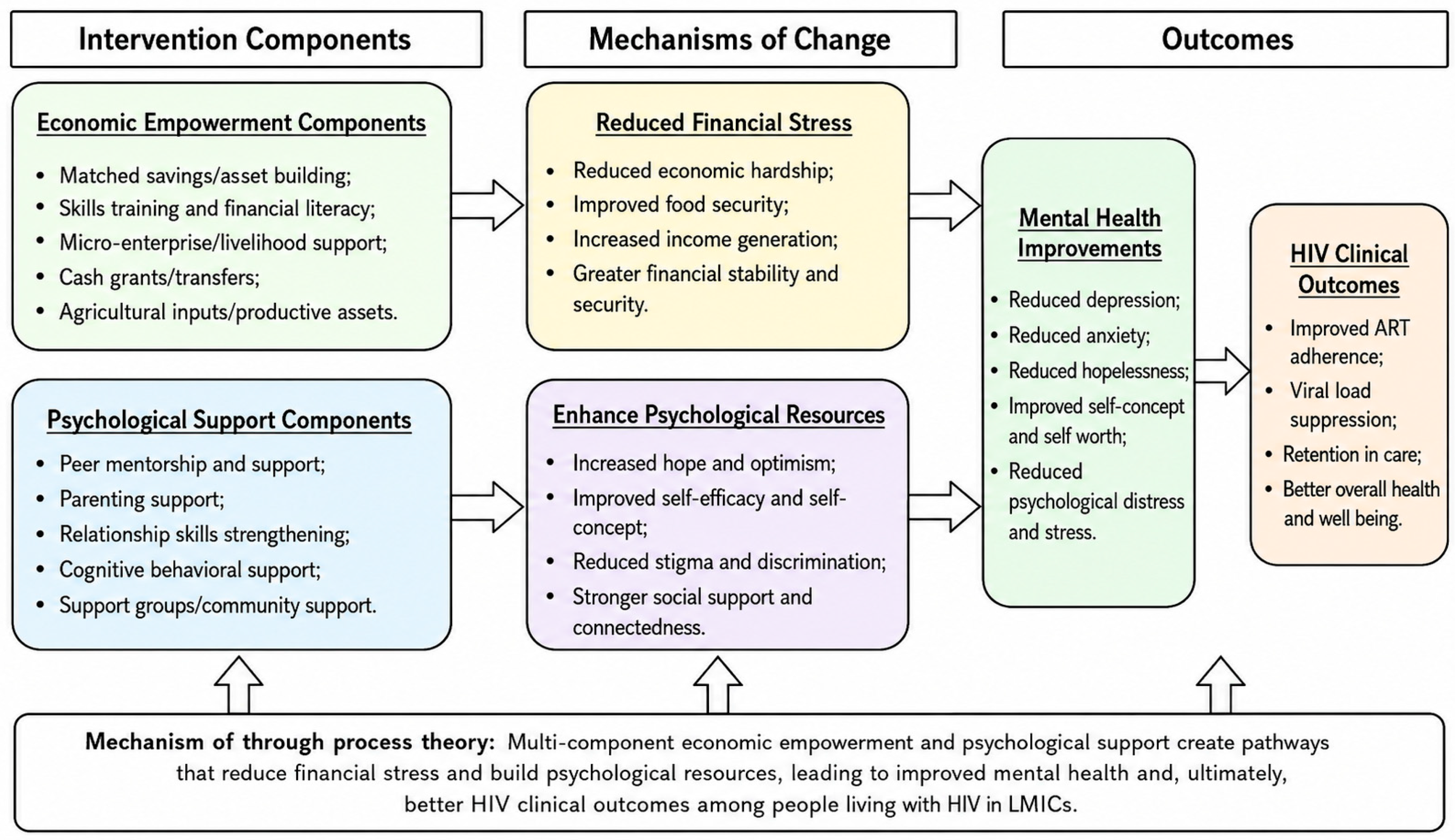
Economic Empowerment Interventions on Mental Health Outcomes Among People Living with HIV in Low and Middle-Income Countries: A Systematic Literature Review

 , ,
, ,
Abstract
1. Introduction
2. Methods
2.1. Study Design
2.2. Condition or Domain Being Studied
2.3. Eligibility Criteria
2.4. Search Strategy
2.5. Screening of the Article
2.6. Data Extraction
2.7. Quality Appraisal and Risk of Bias of the Included Studies
2.8. Strategy for Data Synthesis and Analysis
2.9. Registration
3. Results
3.1. Sensitivity Analysis and Exploration of Heterogeneity
3.2. Multi-Component Economic Programs (Savings + Training + Support)
3.3. Pure Economic Interventions (Cash Transfers Only)
3.4. Mechanisms of Action (Subgroup Effects)
4. Discussion
Limitations
5. Conclusions and Policy Recommendations
Future Directions
Author Contributions
Funding
Institutional Review Board Statement
Informed Consent Statement
Data Availability Statement
Acknowledgments
Conflicts of Interest
Abbreviations
| AIDS | Acquired Immunodeficiency Syndrome |
| ALHIV | Adolescents Living with HIV |
| ART | Antiretroviral Therapy |
| aOR | Adjusted Odds Ratio |
| aPR | Adjusted Prevalence Ratio |
| aPRR | Adjusted Prevalence Rate Ratio |
| ATT | Average Treatment Effect on the Treated |
| BHS | Beck Hopelessness Scale |
| CASP | Critical Appraisal Skills Programme |
| CBT | Cognitive Behavioral Therapy |
| CDI | Child Depression Inventory |
| CES-D | Center for Epidemiologic Studies Depression Scale |
| CI | Confidence Interval |
| DiD | Difference-in-Difference |
| EE | Economic empowerment interventions. |
| GAD-2 | Generalized Anxiety Disorder-2 |
| HIV | Human Immunodeficiency Virus |
| HSCL-25 | Hopkins Symptom Checklist-25 |
| HSCL-D | Hopkins Symptom Checklist for Depression |
| IPCW | Inverse Probability of Censoring Weighting |
| IQR | Interquartile Range |
| LMICs | Low- and Middle-Income Countries |
| MD | Mean Difference |
| Mo | Month |
| N | Sample Size |
| NS | Not Significant |
| OVC | Orphans and Vulnerable Children |
| PHQ | Patient Health Questionnaire |
| PLHIV | People Living with HIV |
| pp | Percentage Points |
| PRISMA | Preferred Reporting Items for Systematic Reviews and Meta-Analyses |
| PROSPERO | International Prospective Register of Systematic Reviews |
| PSS | Perceived Stress Scale |
| PTSD | Post-Traumatic Stress Disorder |
| RCT | Randomized Controlled Trial |
| RoB 2 | Risk of Bias 2 (Tool) |
| ROBINS-I | Risk Of Bias In Non-randomized Studies-of Interventions |
| SD | Standard Deviation |
| SDG | Sustainable Development Goals |
| SHG | Self-Help Group |
| TSCS | Tennessee Self-Concept Scale |
| UN | United Nations |
| VL | Viral Load |
| VSLA | Village Savings and Loan Association |
| WLHIV | Women Living with HIV |
| Y3 | Year 3 |
| NACWOLA | National Community of Women Living with HIV/AIDS |
| PMTCT | Prevention of Mother-to-Child Transmission. |
Appendix A

| Study | Intervention Category | Economic Components | Psychosocial Components | Mental Health Outcome(s) | Effect Direction | Population | Key Moderators Identified |
|---|---|---|---|---|---|---|---|
| Kizito et al. (2025) | Multi-component | Matched savings, financial literacy | Peer mentorship | Depression, hopelessness, self-concept | + (subgroup only) | ALHIV | Baseline assets |
| Shimizu et al. (2016) | Multi-component | VSLA, cash grants, skills training | Not specified | Depression | + | PLHIV | None reported |
| Cavazos-Rehg et al. (2021) | Multi-component | Child development accounts | Peer mentorship | Latent MH construct | + | ALHIV | Family assets (mediator) |
| Van Doren et al. (2026) | Multi-component | Joint savings, incentivized accounts | Relationship skills | Depression, stress, hopelessness | + | HIV+ couples | Gender |
| Cluver et al. (2019) | Multi-component | Cash transfer | Parenting support | Composite MH | + (combined only) | ALHIV | Parenting support |
| Chi et al. (2025) | Livelihood/Ag | Agricultural training, loans | None specified | Well-being (qual) | + (qual only) | PLHIV | Food security |
| Tuthill et al. (2023) | Multi-component | Cash transfers | Lactation support | Depression | 0 (quant), + (qual) | WLHIV | Financial stress |
| Chitle et al. (2024) | Cash only | Conditional cash incentives | None | Depression, anxiety | +/− | PLHIV | None |
| Sheira et al. (2024) | Cash only | Conditional cash incentives | None | Emotional distress | 0 | PLHIV | None |
| Rosen et al. (2021) | Multi-component | Economic strengthening (unspecified) | Kids Clubs, psychosocial | Depression | 0 | ALHIV + caregivers | Stigma (reduced) |
| Authors and Study Location | Study Objectives | Population at Baseline (N, % Female, Age) | Population at Endline (N, % Female, Age) | Tools for Assessment | Summary of Outcomes |
|---|---|---|---|---|---|
| Kizito et al. (2025) Southern Uganda | Examine the impact of family-based economic empowerment on viral suppression (primary) and mental health (secondary). | N = 702; 56.4% Female; Mean Age: 12.43 years (SD = 1.98, Range 10–16). All adolescents living with HIV (ALHIV) on ART. | 7-year follow-up; Attrition: 18% over 7 years. | Depression: Child Depression Inventory (CDI), CES-D; Hopelessness: Beck’s Hopelessness Scale; Self-Concept: Tennessee Self-Concept Scale. | No mental health effect for the full sample. Significant improvements in hopelessness and self-concept for the most economically vulnerable adolescents. |
| Shimizu et al. (2016) Cambodia | Examine impact of a livelihood program on depressive symptoms among people living with HIV (PLHIV). | N = 685 (Intervention: 357, Control: 328); 68.3% Female; Mean Age: 44.0 years (SD = 8.3). All PLHIV (97.8% on ART). | Single post-intervention assessment; Minimal attrition (1 excluded/group). | Depressive Symptoms: Hopkins Symptom Checklist-25 (HSCL-25). | Participation in the livelihood program was associated with 32% lower odds of depressive symptoms. |
| Cavazos-Rehg et al. (2021) Uganda | Examine mediating mechanisms between a family economic intervention and mental health of ALHIV. | N = 702; 56% Female; Age: 10–16 years. All ALHIV on ART. | 24, 36, 48-month follow-ups; Low attrition. | Latent Mental Health Construct from Beck Hopelessness Scale (BHS), Children’s Depression Inventory (CDI), Tennessee Self-Concept Scale (TSCS). | The intervention improved mental health, particularly at 36 months. The effect was primarily driven by improvements in family economic stability. |
| Chitle et al. (2024) Tanzania | Assess if financial incentives for clinic attendance improve mental health among adult ART initiates. | N = 1990; 59.5% Female; Mean Age: 36.7 years (SD = 11.5). Adults newly initiating ART. | 6 and 12-month follow-ups; Used IPCW for missing data. | Depression: PHQ-2; Anxiety: GAD-2. | A modest significant reduction in depression symptoms was found in the incentive arm at 12 months, but not at 6 months. |
| Chi et al. (2025) Kenya | Examine participant perspectives on community-level effects (spillover) of an agricultural livelihood intervention. | N = 70 (Int: 40, Con: 30); 60% Female; Mean Age: ~39.6 years. PLHIV with food insecurity/malnutrition. | End of intervention; Qualitative interviews. | (Qualitative Study) | Participants reported improved community empowerment, economic status, and food security, which contributed to improved psychological well-being. |
| (Sheira et al. (2024) Tanzania | Evaluate impact of financial incentives on mental health of adults initiating ART. | N = 530; 62.3% Female; Mean Age: 36.1 years (SD = 10.2). Adults initiating ART. | 6-month follow-up; Used multiple imputation. | Emotional Distress: Hopkins Symptom Checklist-25 (HSCL-25). | Cash incentives did not provide a statistically significant improvement in emotional distress over standard of care alone. |
| Tuthill et al. (2023) Kenya | Assess feasibility/acceptability of unconditional cash transfers + infant feeding support for WLHIV. | N = 40 (Int: 20, Con: 20); 100% Female; Mean Age: ~28.3 years. Pregnant/postpartum women living with HIV. | 6 months postpartum; 100% retention. | Depression: PHQ-9; Stress: PSS-10. | Quantitative analysis found no significant between-group difference in depressive symptoms, though scores decreased in both groups. |
| Van Doren et al. (2026) Malawi | To evaluate the effects of an economic and relationship-strengthening intervention (Mlambe) on mental health outcomes (depression, stress, hopelessness) among couples with HIV and unhealthy alcohol use. | N: 156 individuals (78 couples) Female: ~50% (equal number of male and female partners) Mean Age: 43.4 years (SD = 10.2; range: 21–80) | N: >96% retention, so approximately 150 individuals retained at both 10- and 15-month follow-ups. Female: ~50% (retention was high and equal by arm) Age: Not separately reported at endline. | Depression: 10-item Center for Epidemiologic Studies Depression Scale (CES-D) Stress: 10-item Perceived Stress Scale (PSS) Hopelessness: 20-item Beck Hopelessness Scale (BHS) | The Mlambe intervention resulted in statistically significant reductions in depression, stress, and hopelessness compared to the control group at both 10- and 15-month follow-ups. Women experienced significantly greater reductions in stress and hopelessness than men. |
| Kellett and Gnauck (2016) Uganda | To explore perceptions of HIV stigma among HIV-positive women with similar access to ART and peer support but varying levels of participation in economic empowerment programs. | N = 54 (LifeStitches full-time: n = 18; NACWOLA part-time: n = 18; PMTCT no EE: n = 18). 100% Female. Mean Age: LifeStitches 38 yrs; NACWOLA 43 yrs; PMTCT 26 yrs. Mean Education: LifeStitches Grade 6; NACWOLA Grade 3; PMTCT Grade 5. All HIV-positive women on ART. | Single assessment; qualitative focus groups. | Semi-structured focus group guide (30 stem questions + probes) covering: HIV/AIDS knowledge, transmission, testing/treatment, discrimination. Analysis: Thematic analysis with focused coding. | Stigma persists (blame, uselessness, disclosure avoidance). ART improved health status, changing perceptions from “useless” to “useful.” Peer support provided psychological well-being and reduced fear. Economic empowerment enhanced self-sufficiency, social status, hope, and positive thinking. Greatest benefits observed among full-time workshop participants (LifeStitches) |
| Authors & Study Location | Study Objectives | Population at Baseline (N, % Female, Age) | Population at Endline (N, % Female, Age) | Tools for Assessment | Summary of Outcomes |
|---|---|---|---|---|---|
| Cluver et al. (2019) South Africa | To test the UN Development Programme’s approach of “development accelerators” on achieving SDG-aligned targets among adolescents living with HIV. | N: 1063 % Female: 55% Age: Mean 13.8 years (Range: 10–19). Other: All on ART; 15% had good mental health at baseline. | N: 994 (94% retention) % Female and Age: Not specified, assumed similar. | Mental Health: Composite of no depression (Child Depression Inventory), anxiety (Revised Children’s Manifest Anxiety Scale), or PTSD (Child PTSD Checklist). | Cash transfers were not associated with improved mental health. Parenting support and safe schools were significant accelerators for good mental health and other SDG targets. |
| Rosen et al. (2021) Zambia | To evaluate the impact of the multi-component ZAMFAM Project on ALHIV and their caregivers. | N: 544 dyads. % Female (ALHIV): 58.5%; (Caregivers): 87.9% Age (ALHIV): Median 11 yrs; (Caregivers): Median 43 yrs. % Female: 52.9% Age: Range 8–29 years. | N: 494 dyads (91% retention). % Female and Age: Not specified. | Caregiver Stigma: Items from MEASURE Evaluation’s OVC Survey Toolkit. | Integrated interventions improved economic and psychosocial outcomes for caregivers. Few significant direct health changes for adolescents. |
References
- Ayano, G., Tsegay, L., & Solomon, M. (2020). Food insecurity and the risk of depression in people living with HIV/AIDS: A systematic review and meta-analysis. AIDS Research and Therapy, 17(1), 36. [Google Scholar] [CrossRef] [Scilit]
- Bernard, C., Dabis, F., & De Rekeneire, N. (2017). Prevalence and factors associated with depression in people living with HIV in sub-Saharan Africa: A systematic review and meta-analysis. PLoS ONE, 12(8), e0181960. [Google Scholar] [CrossRef] [Scilit]
- Campbell, M., McKenzie, J. E., Sowden, A., Katikireddi, S. V., Brennan, S. E., Ellis, S., Hartmann-Boyce, J., Ryan, R., Shepperd, S., Thomas, J., Welch, V., & Thomson, H. (2020). Synthesis without meta-analysis (SWiM) in systematic reviews: Reporting guideline. BMJ, 368, l6890. [Google Scholar] [CrossRef] [Scilit] [PubMed]
- Cavazos-Rehg, P., Byansi, W., Doroshenko, C., Neilands, T. B., Anako, N., Sensoy Bahar, O., Kasson, E., Nabunya, P., Mellins, C. A., & Ssewamala, F. M. (2021). Evaluating potential mediators for the impact of a family-based economic intervention (Suubi+Adherence) on the mental health of adolescents living with HIV in Uganda. Social Science & Medicine (1982), 280, 113946. [Google Scholar] [CrossRef] [Scilit]
- Chi, V., Weke, E., Cohen, C., Burger, R., Baylen, C., Wekesa, P., Bukusi, E. A., Dworkin, S. L., Butler, L., & Weiser, S. D. (2025). Spillover effects of an agricultural livelihood intervention among people living with HIV on community empowerment in Kenya. AIDS and Behavior, 29(5), 1580–1589. [Google Scholar] [CrossRef] [Scilit]
- Chitle, P., Sheira, L. A., Katabaro, E., Winters, S., Njau, P. F., Sabasaba, A., & McCoy, S. I. (2024). The impact of financial incentives on mental health among adults in HIV care in Lake Zone, Tanzania. AIDS, 38(11), 1677–1685. [Google Scholar] [CrossRef] [Scilit]
- Cluver, L. D., Hodes, R. J., Sherr, L., Mark Orkin, F., Meinck, F., Lim Ah Ken, P., Winder-Rossi, N. E., Wolfe, J., & Vicari, M. (2015). Social protection: Potential for improving HIV outcomes among adolescents. Journal of the International AIDS Society, 18, 20260. [Google Scholar] [CrossRef] [Scilit]
- Cluver, L. D., Orkin, F. M., Campeau, L., Toska, E., Webb, D., Carlqvist, A., & Sherr, L. (2019). Improving lives by accelerating progress towards the UN sustainable development goals for adolescents living with HIV: A prospective cohort study. The Lancet Child & Adolescent Health, 3(4), 245–254. [Google Scholar] [CrossRef] [Scilit]
- Cluver, L. D., Sherr, L., Toska, E., Zhou, S., Mellins, C.-A., Omigbodun, O., Li, X., Bojo, S., Thurman, T., Ameyan, W., Desmond, C., Willis, N., Laurenzi, C., Nombewu, A., Tomlinson, M., & Myeketsi, N. (2022). From surviving to thriving: Integrating mental health care into HIV, community, and family services for adolescents living with HIV. The Lancet Child & Adolescent Health, 6(8), 582–592. [Google Scholar] [CrossRef] [Scilit]
- Conteh, N. K., Latona, A., & Mahomed, O. (2023). Mapping the effectiveness of integrating mental health in HIV programs: A scoping review. BMC Health Services Research, 23(1), 396. [Google Scholar] [CrossRef] [Scilit]
- Covidence. (2026). Covidence systematic review software [Computer software]. Veritas Health Innovation. Available online: https://www.covidence.org (accessed on 17 November 2025).
- Critical Appraisal Skills Programme. (2024). Critical Appraisal Skills Programme (CASP). (Qualitative checklist). Available online: http://www.casp-uk.net/casp-tools-checklists (accessed on 17 November 2025).
- Evans, C., Jana, S., & Lambert, H. (2010). What makes a structural intervention? Reducing vulnerability to HIV in community settings, with particular reference to sex work. Global Public Health, 5(5), 449–461. [Google Scholar] [CrossRef] [Scilit]
- Gacau, K. K., Mugendi, G., Kiragu, G., Ngayo, M. O., & Omosa, G. (2024). Burden and predictors of anxiety disorder among HIV patients on ART in Nairobi Kenya. PLoS Mental Health, 1(2), e0000072. [Google Scholar] [CrossRef] [Scilit]
- Gibbs, A., Jacobson, J., & Kerr Wilson, A. (2017). A global comprehensive review of economic interventions to prevent intimate partner violence and HIV risk behaviours. Global Health Action, 10(Suppl. 2), 1290427. [Google Scholar] [CrossRef] [Scilit]
- Guimarães, N. S., Magno, L., De Paula, A. A., Silliman, M., Anderle, R. V. R., Rasella, D., Macinko, J., De Souza, L. E., & Dourado, I. (2023). The effects of cash transfer programmes on HIV/AIDS prevention and care outcomes: A systematic review and meta-analysis of intervention studies. The Lancet HIV, 10(6), e394–e403. [Google Scholar] [CrossRef] [Scilit]
- Gurnani, V., Beattie, T. S., Bhattacharjee, P., CFAR Team, Mohan, H., Maddur, S., Washington, R., Isac, S., Ramesh, B., Moses, S., & Blanchard, J. F. (2011). An integrated structural intervention to reduce vulnerability to HIV and sexually transmitted infections among female sex workers in Karnataka state, south India. BMC Public Health, 11(1), 755. [Google Scholar] [CrossRef] [Scilit]
- Iskarpatyoti, B. S., Lebov, J., Hart, L., Thomas, J., & Mandal, M. (2018). Evaluations of structural interventions for HIV prevention: A review of approaches and methods. AIDS and Behavior, 22(4), 1253–1264. [Google Scholar] [CrossRef] [Scilit]
- Katana, P. V., Abubakar, A., Nyongesa, M. K., Ssewanyana, D., Mwangi, P., Newton, C. R., & Jemutai, J. (2020). Economic burden and mental health of primary caregivers of perinatally HIV infected adolescents from Kilifi, Kenya. BMC Public Health, 20(1), 504. [Google Scholar] [CrossRef] [Scilit]
- Kellett, N. C., & Gnauck, K. (2016). The intersection of antiretroviral therapy, peer support programmes, and economic empowerment with HIV stigma among HIV-positive women in West Nile Uganda. African Journal of AIDS Research, 15(4), 341–348. [Google Scholar] [CrossRef] [Scilit]
- Kennedy, C. E., Fonner, V. A., O’Reilly, K. R., & Sweat, M. D. (2014). A systematic review of income generation interventions, including microfinance and vocational skills training, for HIV prevention. AIDS Care, 26(6), 659–673. [Google Scholar] [CrossRef] [Scilit]
- Kizito, S., Ssewamala, F. M., Nabayinda, J., Namuwonge, F., Neilands, T. B., Nabunya, P., Bahar, O. S., Ssentumbwe, V., & Nattabi, J. (2025). The long-term impact of family economic empowerment on viral suppression and mental health outcomes among adolescents living with HIV in low-income settings: A cluster-randomized controlled trial in Southern Uganda. Social Science & Medicine, 364, 117546. [Google Scholar] [CrossRef] [Scilit]
- Lund, C., Breen, A., Flisher, A. J., Kakuma, R., Corrigall, J., Joska, J. A., Swartz, L., & Patel, V. (2010). Poverty and common mental disorders in low and middle income countries: A systematic review. Social Science & Medicine, 71(3), 517–528. [Google Scholar] [CrossRef] [Scilit]
- Moore, G. F., Audrey, S., Barker, M., Bond, L., Bonell, C., Hardeman, W., Moore, L., O’Cathain, A., Tinati, T., Wight, D., & Baird, J. (2015). Process evaluation of complex interventions: Medical research council guidance. BMJ, 350, h1258. [Google Scholar] [CrossRef] [Scilit] [PubMed]
- Mwangala, P. N., Nasambu, C., Wagner, R. G., Newton, C. R., & Abubakar, A. (2022). Prevalence and factors associated with mild depressive and anxiety symptoms in older adults living with HIV from the Kenyan coast. Journal of the International AIDS Society, 25(S4), e25977. [Google Scholar] [CrossRef] [Scilit]
- Nadkarni, S., Genberg, B., & Galárraga, O. (2019). Microfinance interventions and HIV treatment outcomes: A synthesizing conceptual framework and systematic review. AIDS and Behavior, 23(9), 2238–2252. [Google Scholar] [CrossRef] [Scilit]
- Nakimuli-Mpungu, E., Musisi, S., Smith, C. M., Von Isenburg, M., Akimana, B., Shakarishvili, A., Nachega, J. B., Mills, E. J., Chibanda, D., Ribeiro, M., V Williams, A., & Joska, J. A. (2021). Mental health interventions for persons living with HIV in low- and middle-income countries: A systematic review. Journal of the International AIDS Society, 24(S2), e25722. [Google Scholar] [CrossRef] [Scilit]
- Nwogwugwu, C., Favor, C., Fu, Y., & Iheanacho, T. (2025). Interventions integrating mental health services into HIV care in Africa; a Scoping Review. International Journal of Public Health, 70, 1608137. [Google Scholar] [CrossRef] [Scilit]
- Nyongesa, M. K., Mwangi, P., Kinuthia, M., Hassan, A. S., Koot, H. M., Cuijpers, P., Newton, C. R. J. C., & Abubakar, A. (2021). Prevalence, risk and protective indicators of common mental disorders among young people living with HIV compared to their uninfected peers from the Kenyan coast: A cross-sectional study. BMC Psychiatry, 21(1), 90. [Google Scholar] [CrossRef] [Scilit]
- Rosen, J. G., Phiri, L., Chibuye, M., Namukonda, E. S., Mbizvo, M. T., & Kayeyi, N. (2021). Integrated psychosocial, economic strengthening, and clinical service-delivery to improve health and resilience of adolescents living with HIV and their caregivers: Findings from a prospective cohort study in Zambia. PLoS ONE, 16(1), e0243822. [Google Scholar] [CrossRef] [Scilit]
- Shamseer, L., Moher, D., Clarke, M., Ghersi, D., Liberati, A., Petticrew, M., Shekelle, P., Stewart, L. A., & the PRISMA-P Group. (2015). Preferred reporting items for systematic review and meta-analysis protocols (PRISMA-P) 2015: Elaboration and explanation. BMJ, 349, g7647. [Google Scholar] [CrossRef] [Scilit]
- Sheira, L. A., Ryan, K. P., Fahey, C. A., Katabaro, E. D., Sabasaba, A. N., Njau, P. F., & McCoy, S. I. (2024). The impact of cash incentives on mental health among adults initiating antiretroviral therapy in Tanzania. AIDS Care, 36(2), 195–203. [Google Scholar] [CrossRef] [Scilit]
- Shimizu, M., Yi, S., Tuot, S., Suong, S., Sron, S., Shibanuma, A., & Jimba, M. (2016). The impact of a livelihood program on depressive symptoms among people living with HIV in Cambodia. Global Health Action, 9(1), 31999. [Google Scholar] [CrossRef] [Scilit]
- Sterne, J. A. C., Hernán, M. A., Reeves, B. C., Savović, J., Berkman, N. D., Viswanathan, M., Henry, D., Altman, D. G., Ansari, M. T., Boutron, I., Carpenter, J. R., Chan, A.-W., Churchill, R., Deeks, J. J., Hróbjartsson, A., Kirkham, J., Jüni, P., Loke, Y. K., Pigott, T. D., … Higgins, J. P. (2016). ROBINS-I: A tool for assessing risk of bias in non-randomised studies of interventions. BMJ, 355, i4919. [Google Scholar] [CrossRef] [Scilit]
- Sterne, J. A. C., Savović, J., Page, M. J., Elbers, R. G., Blencowe, N. S., Boutron, I., Cates, C. J., Cheng, H.-Y., Corbett, M. S., Eldridge, S. M., Emberson, J. R., Hernán, M. A., Hopewell, S., Hróbjartsson, A., Junqueira, D. R., Jüni, P., Kirkham, J. J., Lasserson, T., Li, T., … Higgins, J. P. T. (2019). RoB 2: A revised tool for assessing risk of bias in randomised trials. BMJ, 366, l4898. [Google Scholar] [CrossRef] [Scilit] [PubMed]
- Stoner, M. C. D., Kilburn, K., Godfrey-Faussett, P., Ghys, P., & Pettifor, A. E. (2021). Cash transfers for HIV prevention: A systematic review. PLoS Medicine, 18(11), e1003866. [Google Scholar] [CrossRef] [Scilit]
- Taylor, K. S., Mahtani, K. R., & Aronson, J. K. (2021). Summarising good practice guidelines for data extraction for systematic reviews and meta-analysis. BMJ Evidence-Based Medicine, 26(3), 88–90. [Google Scholar] [CrossRef] [Scilit]
- Tsai, A. C., Bangsberg, D. R., Frongillo, E. A., Hunt, P. W., Muzoora, C., Martin, J. N., & Weiser, S. D. (2012). Food insecurity, depression and the modifying role of social support among people living with HIV/AIDS in rural Uganda. Social Science & Medicine, 74(12), 2012–2019. [Google Scholar] [CrossRef] [Scilit]
- Tuthill, E. L., Maltby, A. E., Odhiambo, B. C., Hoffmann, T. J., Nyaura, M., Shikari, R., Cohen, C. R., & Weiser, S. D. (2023). “It has changed my life”: Unconditional cash transfers and personalized infant feeding support—A feasibility intervention trial among women living with HIV in western Kenya. International Breastfeeding Journal, 18(1), 64. [Google Scholar] [CrossRef] [Scilit]
- Van Der Wal, R., Loutfi, D., Hong, Q. N., Vedel, I., Cockcroft, A., Johri, M., & Andersson, N. (2021). HIV-sensitive social protection for vulnerable young women in East and Southern Africa: A systematic review. Journal of the International AIDS Society, 24(9), e25787. [Google Scholar] [CrossRef] [Scilit]
- Van Doren, N., Mulauzi, N., Tebbetts, S., Mkandawire, J., Neilands, T. B., Ssewamala, F., Satre, D. D., & Conroy, A. A. (2026). Addressing depression, stress, and hopelessness through an economic and relationship-strengthening intervention: Findings from a pilot randomized controlled trial among people with HIV in Malawi. Journal of Affective Disorders, 392, 120196. [Google Scholar] [CrossRef] [Scilit]
- Watson, C. W.-M., Sundermann, E. E., Hussain, M. A., Umlauf, A., Thames, A. D., Moore, R. C., Letendre, S. L., Jeste, D. V., Morgan, E. E., & Moore, D. J. (2019). Effects of trauma, economic hardship, and stress on neurocognition and everyday function in HIV. Health Psychology, 38(1), 33–42. [Google Scholar] [CrossRef] [Scilit]
- Wollburg, C., Steinert, J. I., Reeves, A., & Nye, E. (2023). Do cash transfers alleviate common mental disorders in low- and middle-income countries? A systematic review and meta-analysis. PLoS ONE, 18(2), e0281283. [Google Scholar] [CrossRef] [Scilit]

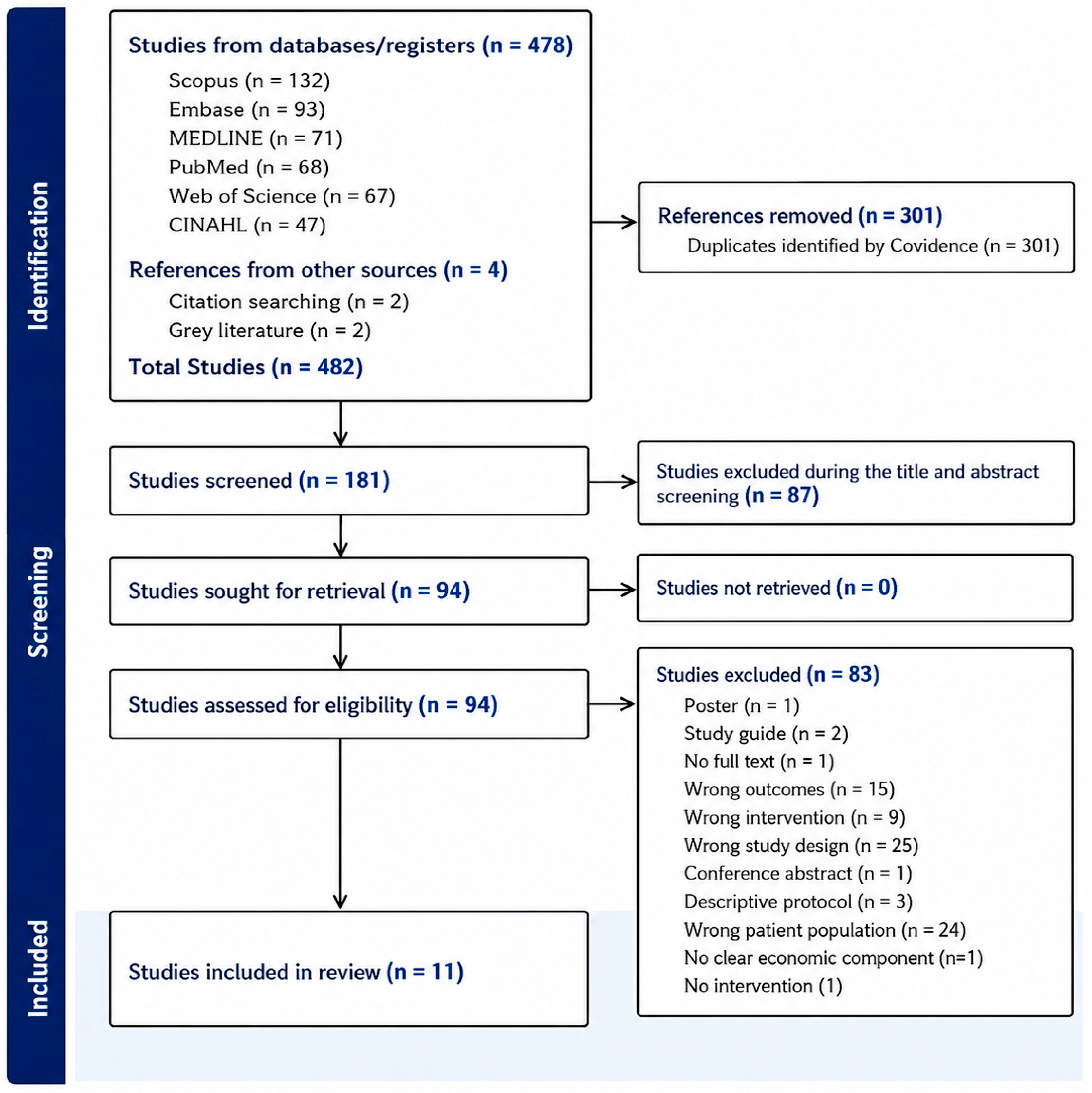
| Study Authors (Year) | Study Design | Risk of Bias/Quality Assessment Tool | Quality/Risk Rating |
|---|---|---|---|
| Tuthill et al. (2023) | Intervention (Non-Randomized) | ROBINS-I (for non-randomized studies) | Low Risk |
| Cluver et al. (2019) | Cohort | ROBINS-I (for non-randomized studies) | Moderate Risk |
| Rosen et al. (2021) | Cohort | ROBINS-I (for non-randomized studies) | Moderate Risk |
| Chi et al. (2025) | Qualitative | CASP (Qualitative Checklist) | High Quality |
| Kellett and Gnauck (2016) | Qualitative | CASP (Qualitative Checklist) | High Quality |
| Cavazos-Rehg et al. (2021) | RCT (Individual) | RoB 2 (for randomized trials) | Some concerns |
| Shimizu et al. (2016) | Quantitative (Program Evaluation) | RoB 2 (for randomized trials) | Some Concerns |
| Kizito et al. (2025) | RCT (Individual) | RoB 2 (for randomized trials) | High quality |
| Sheira et al. (2024) | RCT (Individual) | RoB 2 (for randomized trials) | Some Concerns |
| Van Doren et al. (2026) | RCT (Individual) | RoB 2 (for randomized trials) | Some Concerns |
| Chitle et al. (2024) | RCT (Individual) | RoB 2 (for randomized trials) | Some Concerns |
| Authors and Study Location | Study Objectives | Study Design: Intervention and Control | Outcome Effect Size | Summary of Outcomes | Other Outcomes |
|---|---|---|---|---|---|
| Kizito et al. (2025) Southern Uganda | Examine the impact of family-based economic empowerment on viral suppression (primary) and mental health (secondary). | Intervention (Suubi + Adherence): 24-month cluster RCT. Matched youth savings account, financial literacy training, microenterprise workshops. Control: Bolstered standard of care (adherence sessions, cartoon literature). | Full Sample: No significant main or interaction effects on mental health Low-Asset Subgroup: Significant improvement in hopelessness at Y3 MD = −1.19 ((95% CI: −2.00, −0.004), p = 0.004 and self-concept at Y3 MD = 2.50 ((95% CI: 0.48, 4.53), p = 0.016; and Y7 MD = 3.81 (95% CI: 0.76, 6.86), p = 0.014). | No mental health effect for the full sample. Significant improvements in hopelessness and self-concept for the most economically vulnerable adolescents. | Primary outcome (viral suppression) significantly improved at years 2, 3, and 4. |
| Shimizu et al. (2016) Cambodia | Examine impact of a livelihood program on depressive symptoms among people living with HIV (PLHIV). | Intervention: Quasi-experimental. KHANA livelihood program: Village savings/loan associations, skills training, small cash grants. Control: Non-participants from same health centers. | AOR: 0.68 (95% CI: 0.52–0.88); Propensity Score Matching ATT: T = −1.99. | Participation in the livelihood program was associated with 32% lower odds of depressive symptoms. | High baseline prevalence of depressive symptoms (59.2% total). |
| Cavazos-Rehg et al. (2021) Uganda | Examine mediating mechanisms between a family economic intervention and mental health of ALHIV. | Intervention: (Suubi + Adherence): Longitudinal cluster RCT. Child Development Accounts, workshops, peer mentorship. Control: Bolstered standard of care. | Mental Health at 36 mo: B = −0.45 (latent score combining depression, hopelessness and self-concept), β = −0.10 (Significant). Mediation: Family assets/employment was the only significant mediator (explained 42–72% of effect). | The intervention improved mental health, particularly at 36 months. The effect was primarily driven by improvements in family economic stability. | Other mediators (viral suppression, stigma, food security) were not significant. |
| Chitle et al. (2024) Tanzania | Assess if financial incentives for clinic attendance improve mental health among adult ART initiates. | Intervention: Two-arm cluster-RCT. Opportunity to earn 6 monthly cash incentives, conditional on clinic attendance. Control: Standard-of-care HIV primary care. | Depression at 12 mo (IPCW DiD): −5.5, pp (95% CI: −0.20, −10.8; p = 0.04). | A modest significant reduction in depression symptoms was found in the incentive arm at 12 months, but not at 6 months. | Both arms showed large improvements in mental health over time, attributed to ART initiation and care engagement. |
| Sheira et al. (2024) Tanzania | Evaluate impact of financial incentives on mental health of adults initiating ART. | Intervention: Three-arm RCT secondary analysis. Monthly conditional cash incentives (~$4.50 or $10) for clinic attendance. Control: Standard of care. | Diff-in-Diff (Emotional Distress): −2.7 pp (95% CI: −13.2, 7.7); not significant. | Cash incentives did not provide a statistically significant improvement in emotional distress over standard of care alone. | High baseline prevalence of mental health symptoms improved in both groups over time. |
| Tuthill et al. (2023) Kenya | Assess feasibility/acceptability of unconditional cash transfers + infant feeding support for WLHIV. | Intervention: Non-randomized feasibility trial. 10 monthly cash transfers + personalized lactation support. Control: Standard PMTCT care. | PHQ-9 at 6 mo PP: Coeff = −1.40 (95% CI: −4.51, 1.84), p = 0.38 (Not significant). | Quantitative analysis found no significant between-group difference in depressive symptoms, though scores decreased in both groups. | Qualitative findings strongly suggested the intervention reduced financial stress and improved mental wellbeing. Significant reduction in food insecurity. |
| Van Doren et al. (2026) Malawi | To evaluate the effects of an economic and relationship-strengthening intervention (Mlambe) on mental health outcomes (depression, stress, hopelessness) among couples with HIV and unhealthy alcohol use. | Design: Pilot randomized controlled trial (RCT) Intervention: Mlambe program (10 monthly sessions on economic empowerment and relationship skills, plus incentivized joint savings accounts). Control: Enhanced usual care (EUC), including brief alcohol counseling and standard HIV care. | Depression: Cohen’s d = 0.41–0.46; (p < 0.05). Stress: Cohen’s d = 0.52–0.54; (p < 0.05). Hopelessness: Cohen’s d = 0.26–0.29; (p < 0.05). | The Mlambe intervention resulted in statistically significant reductions in depression, stress, and hopelessness compared to the control group at both 10- and 15-month follow-ups. Women experienced significantly greater reductions in stress and hopelessness than men. |
|
| Authors and Study Location | Study Objectives | Study Design: Intervention and Control | Outcome Effect Size | Summary of Outcomes | Other Outcomes |
|---|---|---|---|---|---|
| Chi et al. (2025) Kenya | Examine participant perspectives on community-level effects (spillover) of an agricultural livelihood intervention. | Intervention: (“Shamba Maisha”): Qualitative sub-study nested in cluster RCT. Agricultural training, farming implements, and loan. Control: Standard care. | (Qualitative Study) | Participants reported improved community empowerment, economic status, and food security, which contributed to improved psychological well-being. | Themes included new leadership roles, women’s empowerment, and supporting vulnerable community members. |
| Kellett and Gnauck (2016) Uganda | To explore perceptions of HIV stigma among HIV-positive women with similar access to ART and peer support but varying levels of participation in economic empowerment programs. | Design: Qualitative focus group study. Intervention/Exposure: ART + HIV peer support groups + varying participation in economic empowerment programs (full-time, intermittent, none). Control/Comparison: Comparisons based on level of participation in economic empowerment programs. Activities. LifeStitches: Full-time sewing workshop providing income-generating skills, equipment, and market access (highest EE intensity). NACWOLA: National Community of Women Living with HIV/AIDS in Uganda; part-time crafts workshop providing counselling and peer support (medium EE intensity). PMTCT: Prevention of Mother-to-Child Transmission clinic peer support group; ART + peer support only, no EE program (comparison group). EE: Economic empowerment interventions. | (Qualitative Study) | Stigma persists (blame, uselessness, disclosure avoidance). ART improved health status, changing perceptions from “useless” to “useful.” Peer support provided psychological well-being and reduced fear. Economic empowerment enhanced self-sufficiency, social status, hope, and positive thinking. Greatest benefits observed among full-time workshop participants (LifeStitches). | HIV-negative infants through PMTCT enhanced self-confidence and family status. Full-time economic empowerment (LifeStitches) appeared to have synergistic effects with peer support in overcoming stigma. |
| Authors & Study Location | Study Objectives | Study Design: Intervention and Control | Outcome Effect Size | Summary of Outcomes | Other Outcomes |
|---|---|---|---|---|---|
| Cluver et al. (2019) South Africa | To test the UN Development Programme’s approach of “development accelerators” on achieving SDG-aligned targets among adolescents living with HIV. | Design: Prospective cohort study. Intervention/Exposure: Access to real-world provisions (e.g., parenting support, cash transfers, safe schools). Control/Comparison: No formal control group; comparisons based on level of access. | Cash Transfer and Mental Health: aOR = 1.10 (95% CI: 0.69–1.76; p = 0.70). Parenting Support and Mental Health: aOR = 2.13 (95% CI: 1.43–3.15; p < 0.0001). Safe Schools and Mental Health: aOR = 1.74 (95% CI: 1.30–2.34; p < 0.0001). | Cash transfers were not associated with improved mental health. Parenting support and safe schools were significant accelerators for good mental health and other SDG targets. | Cash transfers were associated with HIV care retention, school progression, and no emotional/physical abuse. Combinations of accelerators showed synergistic effects. |
| Rosen et al. (2021) Zambia | To evaluate the impact of the multi-component ZAMFAM Project on ALHIV and their caregivers. | Design: Prospective cohort study (non-randomized). Intervention: ZAMFAM Project (integrated psychosocial, economic, clinical support) in Central Province. Control: Usual care in Eastern Province. Intervention: Participation in monthly, hospital-linked “Kids Clubs” support groups. Control: No control group. | Caregiver Stigma: aPRR = 0.49 (95% CI: 0.28–0.88). ALHIV Depression: Not significant in adjusted analysis. | Integrated interventions improved economic and psychosocial outcomes for caregivers. Few significant direct health changes for adolescents. | For ALHIV: improvements in ART use, reduction in labor. For caregivers: reduced negative community attitudes, improved self-reported health. |
Disclaimer/Publisher’s Note: The statements, opinions and data contained in all publications are solely those of the individual author(s) and contributor(s) and not of MDPI and/or the editor(s). MDPI and/or the editor(s) disclaim responsibility for any injury to people or property resulting from any ideas, methods, instructions or products referred to in the content. |
© 2026 by the authors. Licensee MDPI, Basel, Switzerland. This article is an open access article distributed under the terms and conditions of the Creative Commons Attribution (CC BY) license.
Share and Cite
Mokaya, P.O.; Kiptulon, E.K.; Galgalo, D.A.; Elmadani, M.; Hideg-Fehér, G. Economic Empowerment Interventions on Mental Health Outcomes Among People Living with HIV in Low and Middle-Income Countries: A Systematic Literature Review. Behav. Sci. 2026, 16, 1680. https://doi.org/10.3390/bs16091680
Mokaya PO, Kiptulon EK, Galgalo DA, Elmadani M, Hideg-Fehér G. Economic Empowerment Interventions on Mental Health Outcomes Among People Living with HIV in Low and Middle-Income Countries: A Systematic Literature Review. Behavioral Sciences. 2026; 16(9):1680. https://doi.org/10.3390/bs16091680
Chicago/Turabian StyleMokaya, Peter Onchuru, Evans Kasmai Kiptulon, Dahabo Adi Galgalo, Mohammed Elmadani, and Gabriella Hideg-Fehér. 2026. "Economic Empowerment Interventions on Mental Health Outcomes Among People Living with HIV in Low and Middle-Income Countries: A Systematic Literature Review" Behavioral Sciences 16, no. 9: 1680. https://doi.org/10.3390/bs16091680
APA StyleMokaya, P. O., Kiptulon, E. K., Galgalo, D. A., Elmadani, M., & Hideg-Fehér, G. (2026). Economic Empowerment Interventions on Mental Health Outcomes Among People Living with HIV in Low and Middle-Income Countries: A Systematic Literature Review. Behavioral Sciences, 16(9), 1680. https://doi.org/10.3390/bs16091680