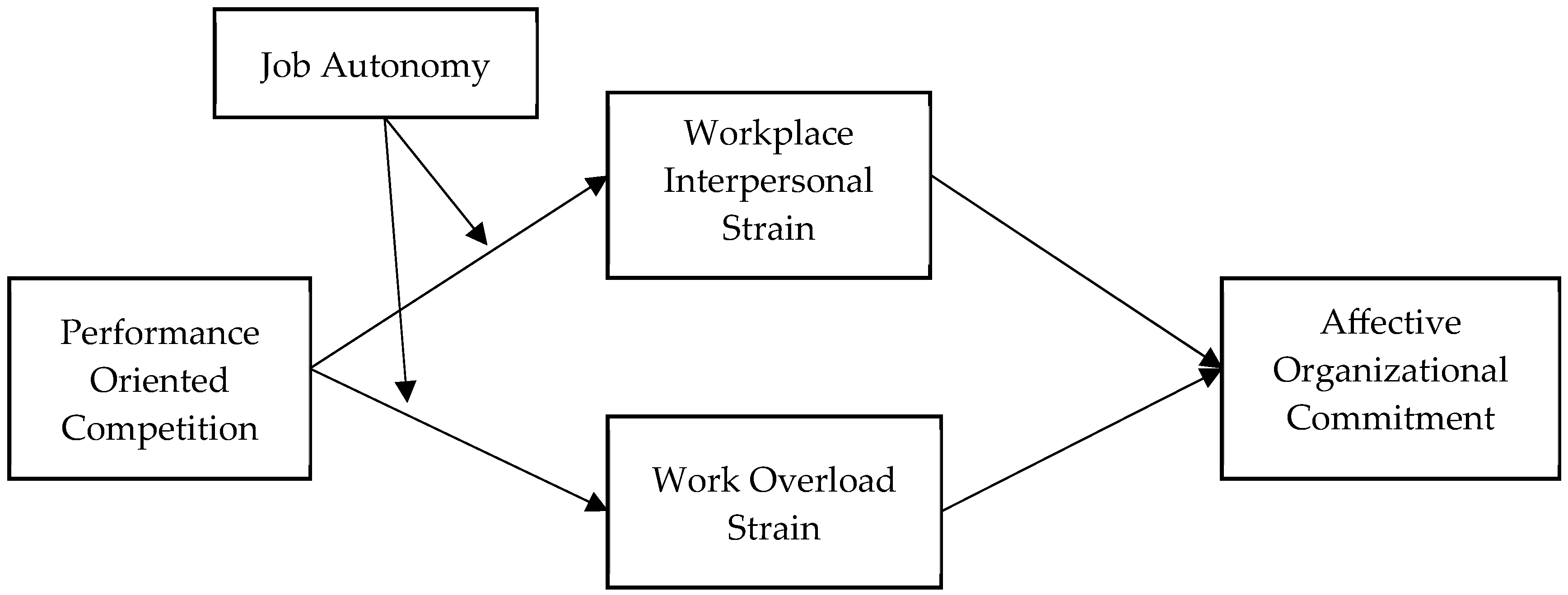
Dark Side of Performance-Oriented Competition: Dual Strain Pathways to Affective Organizational Commitment Among Female Managerial Employees
 , and
, and 
Abstract
1. Introduction
2. Theory and Hypotheses
2.1. Theoretical Background
2.2. POC and WIS
2.3. POC and WOS
2.4. WIS and AOC
2.5. WOS and AOC
2.6. Mediating Roles of WIS and WOS
2.7. Moderating Role of Job Autonomy
3. Method
3.1. Sample and Procedure
3.2. Measurements
4. Results
5. Discussion
5.1. Theoretical Contribution
5.2. Practical Implications
5.3. Limitations and Future Research Directions
Author Contributions
Funding
Institutional Review Board Statement
Informed Consent Statement
Data Availability Statement
Acknowledgments
Conflicts of Interest
Abbreviations
| POC | Performance-oriented competition |
| AOC | Affective organizational commitment |
| WIS | Workplace interpersonal strain |
| WOS | Work overload strain |
References
- Anand, A., Centobelli, P., & Cerchione, R. (2020). Why should I share knowledge with others? A review-based framework on events leading to knowledge hiding. Journal of Organizational Change Management, 33(2), 379–399. [Google Scholar] [CrossRef] [Scilit]
- Bae, K. B., & Yang, G. (2017). The effects of family-friendly policies on job satisfaction and organizational commitment: A panel study conducted on South Korea’s public institutions. Public Personnel Management, 46(1), 25–40. [Google Scholar] [CrossRef] [Scilit]
- Bakker, A. B., & Demerouti, E. (2007). The job demands–resources model: State of the art. Journal of Managerial Psychology, 22, 309–328. [Google Scholar] [CrossRef] [Scilit]
- Bakker, A. B., & Demerouti, E. (2024). Job demands–resources theory: Frequently asked questions. Journal of Occupational Health Psychology, 29(3), 188. [Google Scholar] [CrossRef] [Scilit] [PubMed]
- Bakker, A. B., Demerouti, E., & Sanz-Vergel, A. (2023a). Job demands–resources theory: Ten years later. Annual Review of Organizational Psychology and Organizational Behavior, 10(1), 25–53. [Google Scholar] [CrossRef] [Scilit]
- Bakker, A. B., Xanthopoulou, D., & Demerouti, E. (2023b). How does chronic burnout affect dealing with weekly job demands? A test of central propositions in JD-R and COR-theories. Applied Psychology, 72(1), 389–410. [Google Scholar] [CrossRef] [Scilit]
- Bartram, T., Cooper, B., Cooke, F. L., & Wang, J. (2023). Thriving in the face of burnout? The effects of wellbeing-oriented HRM on the relationship between workload, burnout, thriving and performance. Employee Relations: The International Journal, 45(5), 1234–1253. [Google Scholar] [CrossRef] [Scilit]
- Bergkvist, L., & Rossiter, J. R. (2007). The predictive validity of multiple-item versus single-item measures of the same constructs. Journal of Marketing Research, 44(2), 175–184. [Google Scholar] [CrossRef] [Scilit]
- Brown, S. P., Cron, W. L., & Slocum, J. W., Jr. (1998). Effects of trait competitiveness and perceived intraorganizational competition on salesperson goal setting and performance. Journal of Marketing, 62(4), 88–98. [Google Scholar] [CrossRef] [Scilit]
- Chen, C., & Liu, X. (2022). Relative team-member exchange, affective organizational commitment and innovative behavior: The moderating role of team-member exchange differentiation. Frontiers in Psychology, 13, 948578. [Google Scholar] [CrossRef] [Scilit] [PubMed]
- Cheung, F., & Lucas, R. E. (2014). Assessing the validity of single-item life satisfaction measures: Results from three large samples. Quality of Life Research, 23(10), 2809–2818. [Google Scholar] [CrossRef] [Scilit] [PubMed]
- Chiaburu, D. S., & Harrison, D. A. (2008). Do peers make the place? Conceptual synthesis and meta-analysis of coworker effects on perceptions, attitudes, OCBs, and performance. Journal of Applied Psychology, 93(5), 1082. [Google Scholar] [CrossRef] [Scilit] [PubMed]
- Cho, Y., Park, J., Ju, B., Han, S. J., Moon, H., Park, S., Ju, A., & Park, E. (2016). Women leaders’ work-life imbalance in South Korean companies: A collaborative qualitative study. Human Resource Development Quarterly, 27(4), 461–487. [Google Scholar] [CrossRef] [Scilit]
- Davcheva, M., & González-Romá, V. (2023). Proportion of women in work teams and team performance: A moderated mediation model. Current Psychology, 42(29), 25028–25041. [Google Scholar] [CrossRef] [Scilit]
- del Carmen Triana, M., Song, R., Um, C. T., & Huang, L. (2024). Stereotypical perception in management: A review and expansion of role congruity theory. Journal of Management, 50(1), 188–215. [Google Scholar] [CrossRef] [Scilit]
- Demerouti, E. (2025). Job demands-resources and conservation of resources theories: How do they help to explain employee well-being and future job design? Journal of Business Research, 192, 115296. [Google Scholar] [CrossRef] [Scilit]
- Diamantopoulos, A., Sarstedt, M., Fuchs, C., Wilczynski, P., & Kaiser, S. (2012). Guidelines for choosing between multi-item and single-item scales for construct measurement: A predictive validity perspective. Journal of the Academy of Marketing Science, 40(3), 434–449. [Google Scholar] [CrossRef] [Scilit]
- dos Santos, M. D. C. C., Coelho, F., & Gomes, J. F. (2023). Competitive psychological climate, conflict and psychological contract breach. European Management Review, 20(3), 561–575. [Google Scholar] [CrossRef] [Scilit]
- Eagly, A. H., & Karau, S. J. (2002). Role congruity theory of prejudice toward female leaders. Psychological Review, 109(3), 573. [Google Scholar] [CrossRef] [Scilit] [PubMed]
- Ekmekci, O. T., Xhako, D., & Camgoz, S. M. (2021). The buffering effect of perceived organizational support on the relationships among workload, work–family interference, and affective commitment: A study on nurses. Journal of Nursing Research, 29(2), e140. [Google Scholar] [CrossRef] [Scilit] [PubMed]
- Ely, R. J., & Meyerson, D. E. (2000). Theories of gender in organizations: A new approach to organizational analysis and change. Research in Organizational Behavior, 22, 103–151. [Google Scholar] [CrossRef] [Scilit]
- Fehr, L., & Koob, C. (2025). Associations between key job resources, job demands, and affective organizational commitment among nursing professionals in German hospitals: A cross-sectional study. BMC Nursing, 24(1), 442. [Google Scholar] [CrossRef] [Scilit] [PubMed]
- Fletcher, T. D., Major, D. A., & Davis, D. D. (2008). The interactive relationship of competitive climate and trait competitiveness with workplace attitudes, stress, and performance. Journal of Organizational Behavior, 29, 899–922. [Google Scholar] [CrossRef] [Scilit]
- Fletcher, T. D., & Nusbaum, D. N. (2010). Development of the competitive work environment scale: A multidimensional climate construct. Educational and Psychological Measurement, 70(1), 105–124. [Google Scholar] [CrossRef] [Scilit]
- Fousiani, K., Xu, S., & Stoyanova, S. (2026). How competitive climates trigger conflict with colleagues and supervisors and how team knowledge sharing helps. International Journal of Conflict Management. Advance online publication. [CrossRef] [Scilit]
- Furtner, N. C., Kocher, M. G., Martinsson, P., Matzat, D., & Wollbrant, C. (2021). Gender and cooperative preferences. Journal of Economic Behavior & Organization, 181, 39–48. [Google Scholar] [CrossRef] [Scilit]
- Halbesleben, J. R., Neveu, J. P., Paustian-Underdahl, S. C., & Westman, M. (2014). Getting to the “COR” understanding the role of resources in conservation of resources theory. Journal of Management, 40(5), 1334–1364. [Google Scholar]
- Halliday, C. S., Paustian-Underdahl, S. C., Ordóñez, Z., Rogelberg, S. G., & Zhang, H. (2018). Autonomy as a key resource for women in low gender egalitarian countries: A cross-cultural examination. Human Resource Management, 57(2), 601–615. [Google Scholar] [CrossRef] [Scilit]
- Herrero, S. G., Saldaña, M. Á. M., Rodriguez, J. G., & Ritzel, D. O. (2012). Influence of task demands on occupational stress: Gender differences. Journal of Safety Research, 43(5–6), 365–374. [Google Scholar] [CrossRef] [Scilit] [PubMed]
- Hobfoll, S. E. (2001). The influence of culture, community, and the nested-self in the stress process: Advancing conservation of resources theory. Applied Psychology, 50, 337–370. [Google Scholar] [CrossRef] [Scilit]
- Hobfoll, S. E., Halbesleben, J., Neveu, J. P., & Westman, M. (2018). Conservation of resources in the organizational context: The reality of resources and their consequences. Annual Review of Organizational Psychology and Organizational Behavior, 5, 103–128. [Google Scholar] [CrossRef] [Scilit]
- Hu, C., & Wang, S. (2022). When does competitive psychological climate hurt mentoring? The moderating roles of mentors’ job insecurity and trait competitiveness. Journal of Vocational Behavior, 132, 103663. [Google Scholar] [CrossRef] [Scilit]
- Jang, E., & Kim, Y. C. (2025). Autonomy constrained: The dynamic interplay among job autonomy, work engagement, and innovative behavior under performance pressure. Administrative Sciences, 15(3), 97. [Google Scholar] [CrossRef] [Scilit]
- Jerrim, J., & Sims, S. (2025). Interpersonal relationships and organisational commitment. Longitudinal evidence from school staff in England. Teachers and Teaching, 32(3), 520–541. [Google Scholar] [CrossRef] [Scilit]
- Jiandong, S., Fan, X., & Haitian, L. (2022). How do high-performance work systems affect work fatigue: The mediating effect of job responsibility and role overload. PLoS ONE, 17(7), e0269452. [Google Scholar] [CrossRef] [Scilit] [PubMed]
- Jones, J. L., Davis, W. D., & Thomas, C. H. (2017). Is competition engaging? Examining the interactive effects of goal orientation and competitive work environment on engagement. Human Resource Management, 56(3), 389–405. [Google Scholar] [CrossRef] [Scilit]
- Kacmar, K. M., Bachrach, D. G., Harris, K. J., & Noble, D. (2012). Exploring the role of supervisor trust in the associations between multiple sources of relationship conflict and organizational citizenship behavior. The Leadership Quarterly, 23, 43–54. [Google Scholar] [CrossRef] [Scilit]
- Kim, H., & Lee, J. S. (2025). Flexible work and organizational commitment among Korean managers: The mediating role of work–family conflict and CEO gender equality. Behavioral Sciences, 15(10), 1406. [Google Scholar] [CrossRef] [Scilit] [PubMed]
- Kim, K. Y., Eisenberger, R., & Baik, K. (2016). Perceived organizational support and affective organizational commitment: Moderating influence of perceived organizational competence. Journal of Organizational Behavior, 37(4), 558–583. [Google Scholar] [CrossRef] [Scilit]
- Kim, K. Y., Messersmith, J. G., Pieper, J. R., Baik, K., & Fu, S. (2023). High performance work systems and employee mental health: The roles of psychological empowerment, work role overload, and organizational identification. Human Resource Management, 62(6), 791–810. [Google Scholar] [CrossRef] [Scilit]
- Kline, R. B. (2005). Principles and practice of structural equation modeling (2nd ed.). Guilford Press. [Google Scholar]
- Ko, S. H., Choi, Y., Lee, S. H., Kim, J. Y., Kim, J., & Kang, H. C. (2022). Work overload and affective commitment: The roles of work engagement, positive psychological capital, and compassion. Social Behavior and Personality: An International Journal, 50(6), 72–86. [Google Scholar] [CrossRef] [Scilit]
- Konrad, A. M., Ritchie, J. E., Jr., Lieb, P., & Corrigall, E. A. (2000). Sex differences and similarities in job attribute preferences: A meta-analysis. Psychological Bulletin, 126(4), 593–641. [Google Scholar] [CrossRef] [Scilit] [PubMed]
- Lee, H., & Lee, S. Y. (2021). Is more commitment always better? A study on the side effects of excessive organizational commitment on work–family conflict. Review of Public Personnel Administration, 41(1), 25–56. [Google Scholar] [CrossRef] [Scilit]
- Lee, W. J. T., Sok, P., & Mao, S. (2022). When and why does competitive psychological climate affect employee engagement and burnout? Journal of Vocational Behavior, 139, 103810. [Google Scholar] [CrossRef] [Scilit]
- Lee, Y. (2017). Women workforce in the Korean context. International Review of Management and Marketing, 7(1), 403–412. [Google Scholar]
- Loes, C. N., & Tobin, M. B. (2018). Interpersonal conflict and organizational commitment among licensed practical nurses. The Health Care Manager, 37(2), 175–182. [Google Scholar] [CrossRef] [Scilit] [PubMed]
- Marsden, P. V., Kalleberg, A. L., & Cook, C. R. (1993). Gender differences in organizational commitment: Influences of work positions and family roles. Work and Occupations, 20, 368–390. [Google Scholar] [CrossRef] [Scilit]
- Meyer, J. P., & Allen, N. J. (1991). A three-component conceptualization of organizational commitment. Human Resource Management Review, 1(1), 61–89. [Google Scholar] [CrossRef] [Scilit]
- Meyer, J. P., Stanley, D. J., Herscovitch, L., & Topolnytsky, L. (2002). Affective, continuance, and normative commitment to the organization: A meta-analysis of antecedents, correlates, and consequences. Journal of Vocational Behavior, 61(1), 20–52. [Google Scholar] [CrossRef] [Scilit]
- Miller, A. R., Petrie, R., & Segal, C. (2024). Effects of workplace competition on work time and gender inequality. ILR Review, 77(2), 251–272. [Google Scholar] [CrossRef] [Scilit]
- Minibas-Poussard, J., Tuger, A. T., Seckin, T., Bingöl, H. B., & Poirot, M. (2025). Workplace bullying and turnover intention among boundary-spanning bank workers: The emotional mechanism and the amplifying role of workplace unfairness. Administrative Sciences, 15(12), 496. [Google Scholar] [CrossRef] [Scilit]
- Moreira, A., Tomás, C., & Antunes, A. (2024). The mediating effect of affective commitment on the relationship between competence development and turnover intentions: Does this relationship depend on the employee’s generation? Administrative Sciences, 14(5), 97. [Google Scholar] [CrossRef] [Scilit]
- Morgeson, F. P., & Humphrey, S. E. (2006). The work design questionnaire (WDQ): Developing and validating a comprehensive measure for assessing job design and the nature of work. Journal of Applied Psychology, 91(6), 1321. [Google Scholar] [CrossRef] [Scilit] [PubMed]
- Murtza, M. H., & Rasheed, M. I. (2023). The dark side of competitive psychological climate: Exploring the role of workplace envy. Journal of Hospitality and Tourism Insights, 6(3), 1400–1418. [Google Scholar] [CrossRef] [Scilit]
- Nguyen, N. T. H., & Tuan, L. T. (2022). Creating reasonable workload to enhance public employee job satisfaction: The role of supervisor support, co-worker support, and tangible job resources. Public Performance & Management Review, 45(1), 131–162. [Google Scholar] [CrossRef] [Scilit]
- OECD. (2025). OECD employment outlook 2025: Can we get through the demographic crunch? OECD Publishing. [Google Scholar] [CrossRef] [Scilit]
- Perreira, T. A., Berta, W., & Herbert, M. (2018). The employee retention triad in health care: Exploring relationships amongst organisational justice, affective commitment and turnover intention. Journal of Clinical Nursing, 27(7–8), e1451–e1461. [Google Scholar] [CrossRef] [Scilit] [PubMed]
- Peterson, M. F., Kara, A., Fanimokun, A., & Smith, P. B. (2019). Country culture moderators of the relationship between gender and organizational commitment. Baltic Journal of Management, 14(3), 389–410. [Google Scholar] [CrossRef] [Scilit]
- Peterson, M. F., Smith, P. B., Akande, A., Ayestaran, S., Bochner, S., Callan, V., Cho, N. G., Jesuino, J. C., D’Amorim, M., Francois, P. H., Hofmann, K. H., Koopman, P. L., Leung, K., Lim, T. K., Mortazavi, S., Munene, J., Radford, M., Ropo, A., Savage, G., … Viedge, C. (1995). Role conflict, ambiguity, and overload: A 21-nation study. Academy of Management Journal, 38(2), 429–452. [Google Scholar] [CrossRef] [Scilit]
- Rabbi, M. F., Park, Y., Aggarwal, J., & Sabharwal, M. (2026). Effect of ethical leadership on affective organizational commitment and the mediating role of Ethical Environment. Public Integrity, 28(1), 93–111. [Google Scholar] [CrossRef] [Scilit]
- Rai, A., Kim, M., & Beehr, T. A. (2024). Does competitive climate at work lead to problems at home? Examination of mediating pathways. Asia Pacific Journal of Human Resources, 62(1), e12362. [Google Scholar] [CrossRef] [Scilit]
- Reiley, P. J., & Jacobs, R. R. (2019). Linking leader power use and performance: The mediating role of follower satisfaction and commitment. Journal of Management & Organization, 28(4), 733–753. [Google Scholar] [CrossRef] [Scilit]
- Rhoades, L., Eisenberger, R., & Armeli, S. (2001). Affective commitment to the organization: The contribution of perceived organizational support. Journal of Applied Psychology, 86(5), 825. [Google Scholar] [CrossRef] [PubMed]
- Rudolph, C. W., Breevaart, K., & Zacher, H. (2025). When are job autonomy and workload “Too much of a good thing” for job crafting? Journal of Business and Psychology, 41(3), 601–623. [Google Scholar] [CrossRef] [Scilit]
- Schrock, W. A., Hughes, D. E., Fu, F. Q., Richards, K. A., & Jones, E. (2016). Better together: Trait competitiveness and competitive psychological climate as antecedents of salesperson organizational commitment and sales performance. Marketing Letters, 27(2), 351–360. [Google Scholar] [CrossRef] [Scilit]
- Shen, X., Shen, T., Chen, Y., Wang, Y., He, X., Lv, X., & Jin, Q. (2023). The associations between benevolent leadership, affective commitment, work engagement and helping behavior of nurses: A cross-sectional study. BMC Nursing, 22(1), 407. [Google Scholar] [CrossRef] [Scilit] [PubMed]
- Skinner, N., & Pocock, B. (2008). Work–life conflict: Is work time or work overload more important? Asia Pacific Journal of Human Resources, 46(3), 303–315. [Google Scholar] [CrossRef] [Scilit]
- Sofyan, Y., De Clercq, D., & Shang, Y. (2021). Detrimental effects of work overload on knowledge hiding in competitive organisational climates. Asia Pacific Journal of Human Resources, 61(2), 324–354. [Google Scholar] [CrossRef] [Scilit]
- Spurk, D., Keller, A. C., & Hirschi, A. (2019). Competition in career tournaments: Investigating the joint impact of trait competitiveness and competitive psychological climate on objective and subjective career success. Journal of Occupational and Organizational Psychology, 92(1), 74–97. [Google Scholar] [CrossRef] [Scilit]
- Stark, H. P., Smith, R. W., & Carter, N. T. (2025). Organizational commitment profiles and employee well-being: Exploratory and confirmatory latent profile analyses. Occupational Health Science, 9(3), 639–673. [Google Scholar] [CrossRef] [Scilit]
- Su, L., Li, M., & Swanson, S. R. (2024). The influence of organizational interpersonal climate on the belonging, well-being, and citizenship behaviors of tourism practitioners. Journal of Hospitality and Tourism Management, 58, 419–431. [Google Scholar] [CrossRef] [Scilit]
- The Korea Times. (2025, January 6). South Korea’s female employment rate low among OECD nations: Report. The Korea Times. Available online: https://www.koreatimes.co.kr/southkorea/society/20250106/south-koreas-female-employment-rate-low-among-oecd-nations-report (accessed on 15 April 2026).
- Thomas, J. L., Bliese, P. D., & Jex, S. M. (2005). Interpersonal conflict and organizational commitment: Examining two levels of supervisory support as multilevel moderators. Journal of Applied Social Psychology, 35(11), 2375–2398. [Google Scholar] [CrossRef] [Scilit]
- To, C., Kilduff, G. J., & Rosikiewicz, B. L. (2020). When interpersonal competition helps and when it harms: An integration via challenge and threat. Academy of Management Annals, 14(2), 908–934. [Google Scholar] [CrossRef] [Scilit]
- Wan, W., & Duffy, R. D. (2022). Decent work and turnover intention among new generation employees: The mediating role of job satisfaction and the moderating role of job autonomy. Sage Open, 12(2), 21582440221094591. [Google Scholar] [CrossRef] [Scilit]
- Wang, Y. (2022). Impact of interpersonal competition on knowledge hiding behavior among the employees: Mediating role of moral disengagement and work overload. Frontiers in Psychology, 13, 881220. [Google Scholar] [CrossRef] [Scilit] [PubMed]
- Wanous, J. P., & Reichers, A. E. (1997). Overall job satisfaction: How good are single-item measures? Journal of Applied Psychology, 82(2), 247–252. [Google Scholar] [CrossRef] [PubMed]
- Wright, T. A., & Hobfoll, S. E. (2004). Commitment, psychological well-being and job performance: An examination of conservation of resources (COR) theory and job burnout. Journal of Business and Management, 9(4), 389–406. [Google Scholar] [CrossRef] [Scilit]
- Xu, J., Chen, J., Lan, Q., & Zhao, M. (2025). To share or hide under performance pressure: The role of supervisor support in shaping subordinate knowledge management behaviors. Frontiers in Psychology, 16, 1586812. [Google Scholar] [CrossRef] [Scilit] [PubMed]
- Yim, S., Kim, M., & Park, Y. (2022). The influence of clan culture and supervisor support on Korean female managers’ subjective career success: Mediating role of leadership competencies. Industrial and Commercial Training, 54(3), 396–412. [Google Scholar] [CrossRef] [Scilit]
- Yıldız, S., Üngüren, E., Tekin, Ö. A., & Derman, E. (2023). Exploring the interplay of competition and justice: A moderated mediation model of competitive psychological climate, workplace envy, interpersonal citizenship behavior, and organizational justice. Behavioral Sciences, 14(1), 5. [Google Scholar] [CrossRef] [Scilit] [PubMed]
- Yun, J. A., Lee, Y., & Mastracci, S. (2019). The moderating effect of female managers on job stress and emotional labor for public employees in gendered organizations: Evidence from Korea. Public Personnel Management, 48(4), 535–564. [Google Scholar] [CrossRef] [Scilit]


| Variable | Mean | SD | 1 | 2 | 3 | 4 | 5 | 6 | 7 | 8 | 9 |
|---|---|---|---|---|---|---|---|---|---|---|---|
| 1. Age 1 | 44.08 | 5.50 | - | ||||||||
| 2. Education level 2 | 2.93 | 0.85 | 0.039 | - | |||||||
| 3. Marital status 3 | 0.75 | 0.42 | 0.103 ** | −0.003 | - | ||||||
| 4. Position 4 | 2.51 | 1.08 | 0.286 ** | 0.174 ** | 0.020 | - | |||||
| 5. POC | 2.75 | 0.78 | −0.034 | −0.002 | −0.008 | 0.012 | - | ||||
| 6. WIS | 2.31 | 0.81 | −0.023 | 0.011 | −0.081 ** | −0.026 | 0.248 ** | - | |||
| 7. WOS | 2.90 | 0.87 | −0.013 | 0.029 | −0.016 | 0.034 | 0.435 ** | 0.265 ** | - | ||
| 8. JA | 3.27 | 0.92 | 0.069 * | 0.001 | 0.056 * | 0.085 ** | –0.232 ** | −0.297 ** | −0.350 ** | - | |
| 9. AOC | 3.81 | 0.78 | 0.264 ** | 0.056 * | 0.138 ** | 0.160 ** | −0.163 ** | −0.309 ** | −0.159 ** | 0.265 ** | - |
| Variable | Dependent Variable | ||||||||
|---|---|---|---|---|---|---|---|---|---|
| WIS | WOS | AOC | |||||||
| b | 95% CI | b | 95% CI | b | 95% CI | ||||
| LLCI | ULCI | LLCI | ULCI | LLCI | ULCI | ||||
| Age | 0.001 | −0.008 | 0.008 | −0.001 | −0.009 | 0.007 | 0.031 *** | 0.024 | 0.038 |
| Education level | 0.016 | −0.035 | 0.066 | 0.026 | −0.024 | 0.076 | 0.034 | −0.011 | 0.079 |
| Marital status | −0.150 ** | −0.250 | −0.050 | −0.025 | −0.123 | 0.074 | 0.164 *** | 0.075 | 0.253 |
| Position | −0.023 | −0.065 | 0.019 | 0.021 | −0.020 | 0.062 | 0.061 ** | 0.024 | 0.098 |
| POC | 0.261 *** | 0.206 | 0.315 | 0.482 *** | 0.428 | 0.536 | −0.064 * | −0.119 | −0.010 |
| WIS | −0.249 *** | −0.298 | −0.201 | ||||||
| WOS | −0.055 * | −0.104 | −0.005 | ||||||
| R2 | 0.069 | 0.191 | 0.187 | ||||||
| F value | 19.508 *** | 62.209 *** | 43.368 *** | ||||||
| Path | Effect | SE | t-Value | p-Value | 95% CI | |||
|---|---|---|---|---|---|---|---|---|
| LLCI | ULCI | |||||||
| Total effect | ||||||||
| POC → AOC | −0.156 | 0.026 | −6.022 | p < 0.001 | −0.206 | −0.105 | ||
| Direct effect | ||||||||
| POC → AOC | −0.064 | 0.028 | −2.311 | p < 0.05 | −0.119 | −0.010 | ||
| Indirect effect | ||||||||
| Path | Effect | BootSE | BootLLCI | BootULCI | ||||
| POC → WIS → AOC | −0.065 | 0.010 | −0.087 | −0.046 | ||||
| POC → WOS → AOC | −0.026 | 0.012 | −0.051 | −0.002 | ||||
| Indirect effect contrast | ||||||||
| WIS-WOS | −0.039 | 0.017 | −0.072 | −0.005 | ||||
| Variable | Effect | SE | t | 95% CI | |
|---|---|---|---|---|---|
| LLCI | ULCI | ||||
| Outcome: Workplace Interpersonal Strain | |||||
| POC | 0.200 | 0.028 | 7.166 *** | 0.145 | 0.254 |
| JA | −0.221 | 0.024 | −9.320 *** | −0.267 | −0.174 |
| POC × JA | 0.008 | 0.026 | 0.307 | −0.043 | 0.059 |
| Outcome: Work Overload Strain | |||||
| POC | 0.411 | 0.027 | 15.181 *** | 0.358 | 0.464 |
| JA | −0.250 | 0.023 | −10.876 *** | −0.296 | −0.205 |
| POC × JA | 0.056 | 0.025 | 2.208 * | 0.006 | 0.105 |
| Levels of JA | |||||
| −1 SD | 0.360 | 0.036 | 9.919 *** | 0.289 | 0.431 |
| Mean | 0.411 | 0.027 | 15.181 *** | 0.358 | 0.464 |
| +1 SD | 0.462 | 0.035 | 13.180 *** | 0.393 | 0.531 |
Disclaimer/Publisher’s Note: The statements, opinions and data contained in all publications are solely those of the individual author(s) and contributor(s) and not of MDPI and/or the editor(s). MDPI and/or the editor(s) disclaim responsibility for any injury to people or property resulting from any ideas, methods, instructions or products referred to in the content. |
© 2026 by the authors. Licensee MDPI, Basel, Switzerland. This article is an open access article distributed under the terms and conditions of the Creative Commons Attribution (CC BY) license.
Share and Cite
Fayzullaev, A.K.u.; Dedahanov, A.T.; Shin, S.Y.; Yuldashev, F.V.u. Dark Side of Performance-Oriented Competition: Dual Strain Pathways to Affective Organizational Commitment Among Female Managerial Employees. Behav. Sci. 2026, 16, 1657. https://doi.org/10.3390/bs16091657
Fayzullaev AKu, Dedahanov AT, Shin SY, Yuldashev FVu. Dark Side of Performance-Oriented Competition: Dual Strain Pathways to Affective Organizational Commitment Among Female Managerial Employees. Behavioral Sciences. 2026; 16(9):1657. https://doi.org/10.3390/bs16091657
Chicago/Turabian StyleFayzullaev, Abdulkhamid Komil ugli, Alisher Tohirovich Dedahanov, Soo Young Shin, and Farkhodbek Vokhobzhon ugli Yuldashev. 2026. "Dark Side of Performance-Oriented Competition: Dual Strain Pathways to Affective Organizational Commitment Among Female Managerial Employees" Behavioral Sciences 16, no. 9: 1657. https://doi.org/10.3390/bs16091657
APA StyleFayzullaev, A. K. u., Dedahanov, A. T., Shin, S. Y., & Yuldashev, F. V. u. (2026). Dark Side of Performance-Oriented Competition: Dual Strain Pathways to Affective Organizational Commitment Among Female Managerial Employees. Behavioral Sciences, 16(9), 1657. https://doi.org/10.3390/bs16091657