Article

Validation of the German Version of the Creative Imagination Scale (CIS) in Individuals with Mild to Moderate Depressive Symptoms: A Comparison with the HGSHS-5:G

1
Institute of Social Medicine, Epidemiology and Health Economics, Charité—University Medical Center Berlin, Corporate Member of Freie Universität Berlin and Humboldt-Universität zu Berlin, Charitéplatz 1, 10117 Berlin, Germany
2
Department of Psychology, University of Fribourg, Rue P.A. de Faucigny 2, 1700 Fribourg, Switzerland
3
Campus Brandenburg an der Havel, Brandenburg Medical School Theodor Fontane (MHB), Nikolaiplatz 19, 14770 Brandenburg an der Havel, Germany
*
Author to whom correspondence should be addressed.
Behav. Sci. 2026, 16(9), 1502; https://doi.org/10.3390/bs16091502
Submission received: 6 February 2026 / Revised: 26 June 2026 / Accepted: 31 July 2026 / Published: 27 August 2026
(This article belongs to the Special Issue Hypnosis and the Brain: Emotion, Control, and Cognition)

Abstract

Imaginative suggestibility is an important component of hypnotic responsiveness. However, a validated German version of the Creative Imagination Scale (CIS) is lacking. This study aimed to evaluate the psychometric properties and convergent validity of the German CIS against the short form of the Harvard Group Scale of Hypnotic Susceptibility (HGSHS-5:G) in individuals with mild to moderate depressive symptoms. In this post hoc validation study, the German CIS was evaluated using reliability analyses, exploratory and confirmatory factor analyses, and mixed polychoric–tetrachoric correlations with the HGSHS-5:G. Among 97 participants, the CIS showed good internal consistency (α = 0.85, ω = 0.87). A two-factor model showed better fit than a unidimensional model, although absolute model fit remained suboptimal and the factors were highly correlated (r = 0.80). CIS and HGSHS-5:G scores were moderately correlated (r = 0.52, p < 0.001), supporting convergent validity. This first validation of the German CIS demonstrated good reliability and preliminary evidence for a two-factor structure, warranting replication in larger samples. The CIS may complement behavioral measures of hypnotic responsiveness in research and clinical applications.

1. Introduction

Hypnotic responsiveness is commonly assessed using behavioral scales that rely on a formal hypnotic induction and index hypnotic susceptibility, defined as responsiveness to suggestions delivered following induction. In contrast, the Creative Imagination Scale (CIS) was developed to assess imaginative suggestibility without induction, focusing on individuals’ capacity for voluntary imaginative involvement in suggested experiences.
Rather than assessing hypnotic susceptibility in the induction-dependent sense, the CIS captures responsiveness to non-induction-based suggestions and thus reflects the broader construct of suggestibility (Wilson & Barber, 1978). The CIS consists of ten standardized experiential suggestions—such as arm heaviness, imagined anesthesia, gustatory imagery, time distortion, and age regression—which respondents are instructed to visualize or experience through imagination.
Empirical studies and normative applications have demonstrated acceptable psychometric properties for the CIS, supporting its use as a valid measure of imaginative responsiveness to suggestion that is conceptually related to—but distinct from—hypnotic susceptibility (Barber & Wilson, 1978; Wilson & Barber, 1978).
In a series of initial investigations, normative data for the CIS were established, and the scale was shown to possess satisfactory psychometric properties, including test–retest reliability, split-half reliability, and factorial validity, supporting its coherence as a measure of imaginative responsiveness to suggestion (Barber & Wilson, 1978; Wilson & Barber, 1978).
Previous work has raised the question of whether imaginative suggestibility, as assessed by the CIS, is fully unitary. Factor-analytic investigations have suggested that CIS items may differentially reflect imagery-related absorption and performance-related perceptual alterations. In particular, Hilgard et al. (1981) reported a two-factor structure comprising an Absorption/Imagination factor and a Hypnotic Performance factor, with CIS items loading on both dimensions. At the same time, earlier descriptive and psychometric work had often treated the CIS as a largely unidimensional measure (e.g., Wilson & Barber, 1978).
Comparative research has further examined the construct validity of the CIS by comparing it with induction-based measures of hypnotic susceptibility. For example, McConkey et al. (1979) reported a modest positive correlation between CIS scores and scores on the Harvard Group Scale of Hypnotic Susceptibility, Form A (HGSHS:A; r = 0.28). Their findings indicate that, although the two measures share some variance related to suggestibility, they reflect largely distinct underlying dimensions, with the CIS primarily assessing imagery- and imagination-based processes.
Additional empirical work has reported acceptable internal consistency of the CIS and significant correlations with theoretically related constructs such as absorption, providing support for its reliability and convergent validity (Sapp & Hitchcock, 2003). In their study, the CIS demonstrated a coefficient alpha of approximately 0.84 and showed significant correlations with scores on the Tellegen Absorption Scale (TAS).
Although classical studies have reported modest positive correlations between the CIS and the full HGSHS:A (e.g., McConkey et al., 1979), direct empirical correlations between the CIS and the recently developed short form HGSHS-5:G (Harvard Group Scale of Hypnotic Susceptibility—5 item short form, German version) have not yet been reported.
Riegel and colleagues proposed a 5-item short version of the HGSHS:A to reduce test time and facilitate broader use. In German samples, the HGSHS-5:G demonstrated acceptable validity, reliability, and classification agreement relative to the original HGSHS:A (Riegel et al., 2021).
This reveals a research gap: although the HGSHS-5:G has been standardized in German as an economical measure of the motor challenge dimension of hypnotic susceptibility, a validated German version of the CIS is still lacking. Comparing both instruments in a clinical sample, such as individuals with mild to moderate depressive symptoms, may therefore provide important insights into their convergent and discriminant validity.
Although the CIS was originally developed to assess imaginative suggestibility in non-clinical contexts, examining the scale in individuals with depressive symptoms is theoretically meaningful because several CIS items rely on vivid imagination, absorption, and responsiveness to internally generated experiences. Mental imagery has been shown to evoke stronger emotional responses than verbal representation and may contribute to the maintenance of emotional disorders (Holmes & Mathews, 2010). Furthermore, in individuals with depressive disorders, negative mental imagery induced stronger negative affect compared to healthy controls, and a positive imagery deficit was observed in the explicit measure (Görgen et al., 2015). Given that depressive symptomatology is associated with imagery-related cognitive and affective processes, it may influence mechanisms relevant to responses on the CIS. Investigating CIS scores in individuals with mild to moderate depressive symptoms therefore provides an opportunity to examine the construct validity of the scale in a population in which mental imagery processes are relevant to depressive symptomatology. Importantly, the psychometric properties of suggestibility-related measures cannot be assumed to generalize from healthy to clinical populations, as depressive symptomatology is associated with alterations in cognitive, affective, and motivational processes that are directly relevant to imaginative engagement. Examining the CIS in a clinical sample thus allows for a more ecologically valid assessment of how imaginative suggestibility (CIS) and the motor challenge dimension of hypnotic susceptibility (HGSHS-5:G) differ in this population.

2. Materials and Methods

2.1. Participants and Procedure

Participants were recruited as part of the HypnoDeep randomized controlled trial, which examined the effects of telemedical hypnosis, progressive muscle relaxation, and routine care in individuals with mild to moderate depressive symptoms and elevated stress. Participants had clinically diagnosed depressive episodes, classified as mild according to ICD-10 criteria (International Classification of Diseases, 10th revision). Self-reported depressive symptoms at baseline, assessed with the Beck Depression Inventory–II (BDI-II), were in the mild to moderate range and were assessed as a continuous variable to characterize the sample. Perceived stress was assessed using the Perceived Stress Scale (PSS) and a visual analog scale for stress (VAS-Stress).
Recruitment was conducted in Germany via online advertisements, newsletters, and outpatient clinical networks. After an online screening for eligibility, participants were enrolled and provided written informed consent before participation.
In the original trial, participants were randomly assigned to one of 12 online groups: four received guided hypnotherapy, four progressive muscle relaxation, and four served as a wait-list control group without intervention. Questionnaires and demographic data were administered during the pre-intervention assessment phase. In total, 100 participants were enrolled and randomized in the HypnoDeep trial. Three participants were mistakenly randomized, did not complete any baseline assessments, and did not receive the allocated intervention. They were therefore excluded from all analyses. The present study is based on the remaining 97 participants, of whom 94 (97%) completed both the CIS and the HGSHS-5:G.
The final sample consisted of 69 women (71.1%), 26 men (26.8%), and 2 participants identifying as diverse (2.1%), with a mean age of 39.2 years (SD = 12.02; range = 20–68 years).
Inclusion criteria were: age between 18 and 70 years, mild to moderate depressive symptoms according to ICD-10 criteria (F32.0 or F33.0), and a self-reported stress level of ≥40 mm on a visual analog scale. Exclusion criteria included current or past psychotic disorder, post-traumatic stress disorder, personality disorder, acute suicidality, substance abuse, or severe medical illness that could interfere with participation.

2.2. Measures

2.2.1. CIS

The CIS (Wilson & Barber, 1978) is a 10-item measure of imaginative suggestibility, designed to be administered without a formal hypnotic induction. Items tap into a range of imaginative experiences (arm heaviness, finger anesthesia, gustatory hallucinations, time distortion, age regression) and are rated on a 5-point scale according to participants’ subjective experience from 0 to 4 (0, not at all the same [experience]; 1, a little the same; 2, between a little and much the same; 3, much the same; 4, almost exactly the same), resulting in a total sum score between 0 and 40. A German CIS version based on the translation by Bahlinger (1995), which was used and documented in the diploma thesis by Egbers (1998; Imaginative Processing of Directly and Indirectly Formulated Texts Depending on Attentional Demand), was used in the present study. In the thesis, the full wording of the German CIS was provided in the appendix and the scale was used to assess imaginative ability. To our knowledge, however, no formal psychometric validation of this German version has previously been published. The translated items were administered in their original German wording as documented by Egbers (1998).

2.2.2. HGSHS-5:G—5-Item Short Form

The HGSHS-5:G (Riegel et al., 2021; Zech et al., 2024) is a recently validated German short version of the HGSHS:A (Shor & Orne, 1962), containing five motor challenge items (arm immobility, finger lock, arm rigidity, head shaking inhibition, eye catalepsy). Items are scored dichotomously (0 = fail, 1 = pass), yielding a total score between 0 and 5.

2.3. Statistical Analyses

All analyses were conducted in R (version 4.5.1; R Core Team, 2025) using RStudio (version 2025.05.1+513 Mariposa Orchid by Posit Software, 2025). The data were prepared, cleaned, and analyzed in a fully reproducible workflow with tidyverse packages (Wickham et al., 2019). Analyses were conducted in several steps corresponding to the psychometric evaluation of the German CIS and its comparison with the HGSHS-5:G. Data were imported from SPSS files originally generated using SPSS version 29 (IBM Corp.) via the haven (Wickham et al., 2025) and here packages (Müller, 2025) to ensure reproducible file paths.
Descriptive statistics: Descriptive statistics (means, standard deviations, skewness, and kurtosis) were computed for all variables with the sjPlot (Lüdecke, 2025a), sjstats (Lüdecke, 2025b) and sjlabelled (Lüdecke, 2022) packages. Missing values were visualized and inspected for patterns using Amelia (Honaker et al., 2011). For descriptive tables and summary outputs, gtsummary (Sjoberg et al., 2021) was used.
Item analysis: Item difficulty, discrimination, and corrected item–total correlations were calculated using sjPlot (Lüdecke, 2025a), sjstats (Lüdecke, 2025b), performance (Lüdecke et al., 2021a) and custom functions from the strengejacke package (Lüdecke, 2019). Mean inter-item correlations were inspected as an additional reliability indicator.
Reliability analysis: Internal consistency was assessed via Cronbach’s α and McDonald’s ω using the psych package (Revelle, 2025). For the CIS, both α and ω total were computed; for the HGSHS-5:G (dichotomous items), α was interpreted as equivalent to KR-20. Confidence intervals for α and item-deleted reliabilities were also examined.
Exploratory factor analysis (EFA): Sampling adequacy was tested with the Kaiser–Meyer–Olkin (KMO) statistic and Bartlett’s test of sphericity (Revelle, 2025). To explore the dimensionality of the CIS and HGSHS-5:G, principal components analyses were conducted with psych and parameters (Lüdecke et al., 2020). Principal component analyses with varimax rotation were run using parameters, supplemented by maximum likelihood factor analysis on tetrachoric correlation matrices for the HGSHS-5:G.
Confirmatory factor analysis (CFA): Competing one- and two-factor models and a second-order CFA model of the CIS were evaluated using the lavaan package (Rosseel, 2012). CFAs were conducted using maximum likelihood estimation (ML), which is appropriate given the approximately symmetric response distributions (skewness: −0.25 to 0.37) and five response categories of the CIS. Model fit was judged according to established criteria (Hu & Bentler, 1999), reporting χ2 tests, CFI, TLI, RMSEA with 90% CI, and SRMR. Nested models were compared using χ2 difference testing.
Visualization and reporting: Factor loadings, item characteristics, and reliability indices were visualized with see (Lüdecke et al., 2021b) and ggplot2 (Wickham, 2016; Wickham et al., 2019). Results were summarized in APA-style tables using knitr (Xie, 2014, 2015, 2025) and report (Makowski et al., 2023). All analyses were fully reproducible, with package management handled through pacman (Rinker & Kurkiewicz, 2018) and selected GitHub packages (strengejacke/strengejacke, easystats/report, easystats/see, easystats/performance).
Correlation analysis: Correlations between ordinal CIS items and dichotomous HGSHS-5:G items were computed using mixed polychoric–tetrachoric–polyserial correlations implemented in the psych::mixedCor() function (Revelle, 2025). Correlations between the CIS and HGSHS-5:G total scores were computed using Pearson’s r and Spearman’s ρ, as both composite scores can be considered approximately continuous.

2.4. Sample Size Considerations

There is ongoing debate about the minimum sample size required for factor-analytic procedures. Rules of thumb typically recommend at least 5–10 participants per item (Gorsuch, 1983), with absolute minimums of n = 100–200 for exploratory factor analysis (MacCallum et al., 1999). For confirmatory factor analysis (CFA), many authors suggest N ≥ 200 as a general lower bound (Kline, 2016), though the exact requirements depend strongly on factor loadings, the number of items per factor, and overall model complexity (Wolf et al., 2013). Reliability analyses such as Cronbach’s α also require sufficient sample sizes for stable estimates, with N ≥ 100 considered adequate for exploratory work, but N ≥ 300 recommended for precise confidence intervals (Bonett, 2002). Against this background, our sample size of approximately 100 participants can be considered sufficient for an initial validation, while acknowledging that larger replications will be required to confirm the CFA results and provide stable estimates of reliability.

3. Results

3.1. Baseline Characteristics

The analytic sample comprised N = 97 participants allocated to Control (n = 32), PMR (n = 31), and Hypnosis (n = 34). Mean age in the overall sample was 39.22 years (SD = 12.02; range = 20–68); group means were Control: M = 38.09 (SD = 12.13), PMR: M = 39.19 (SD = 12.41), and Hypnosis: M = 40.29 (SD = 11.81). Age was missing for 3 participants overall (Control = 1, PMR = 2, Hypnosis = 0). Overall, 69 (71%) identified as female, 26 (27%) as male, and 2 (2.1%) as diverse (3 missing overall, see Table 1).
For the CIS sum score, the overall mean was M = 17.64 (SD = 7.67; range = 2–35). Group means were Control M = 18.56 (SD = 8.84), PMR M = 17.34 (SD = 7.53), and Hypnosis M = 17.00 (SD = 6.67). Missingness for CIS totaled 6 (Control = 1, PMR = 4, Hypnosis = 1, see Table 1).
For the HGSHS-5:G sum score, the overall mean was M = 2.88 (SD = 1.64; range = 0–5). Group means were Control M = 2.53 (SD = 1.63), PMR M = 3.10 (SD = 1.67), and Hypnosis M = 3.03 (SD = 1.62). Missingness for HGSHS-5:G totaled 6 (Control = 1, PMR = 3, Hypnosis = 2, see Table 1).

3.2. Missing Data Analysis

Prior to factor analysis, missing values were inspected across the ten CIS and five HGSHS-5:G items. The proportion of missing data resulted in a total of six incomplete cases (6%). Because this proportion was well below the commonly accepted 10% threshold (Bennett, 2001) and no systematic missingness was observed, listwise deletion was applied, resulting in a valid n = 94 for the factor analyses.

3.3. Psychometric Evaluation of the CIS

3.3.1. Sampling Adequacy and Sphericity

The KMO measure of sampling adequacy was 0.81, indicating a “meritorious” level of common variance (Kaiser & Rice, 1974). Individual item measures of sampling adequacy (MSA) all exceeded 0.70 (range 0.75–0.89). Bartlett’s test of sphericity was χ2(45) = 353.78, p < 0.001, rejecting the null hypothesis of an identity matrix and confirming that the correlation matrix was suitable for factor analysis.

3.3.2. Determining the Number of Factors

To identify the optimal number of underlying dimensions, the n_factors() function from the parameters package (Lüdecke et al., 2020), which incorporates functions from psych (Revelle, 2025) and psycho (Makowski, 2018), was applied. This procedure summarizes 19 extraction methods following the Method Agreement Procedure (MAP).
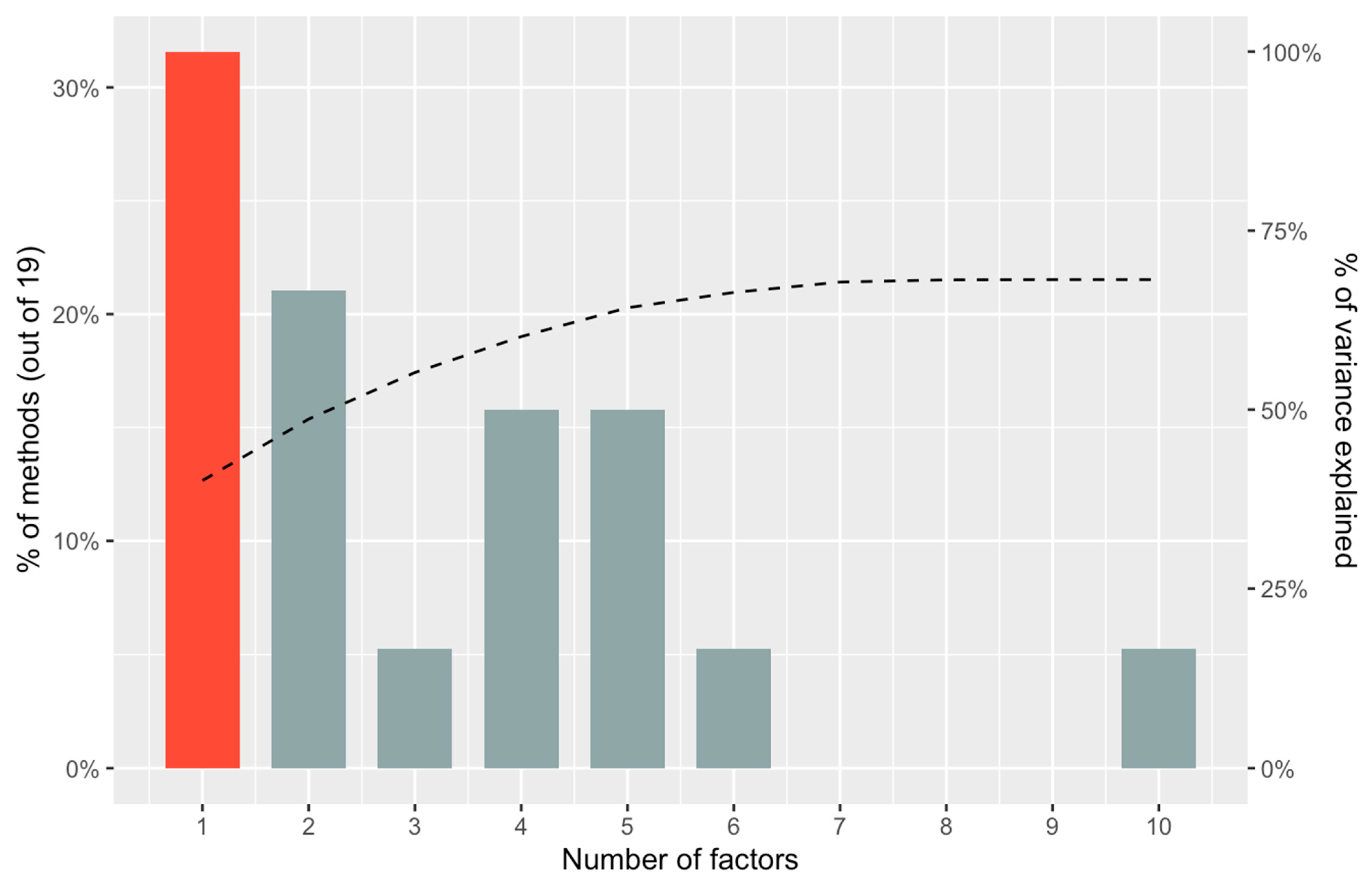
Recommendations varied across methods: six methods (31.6%) supported a one-factor solution (Acceleration Factor, Scree (SE), Scree (R2), VSS Complexity 1, Velicer’s MAP, and BIC), while four (21%) suggested two factors (Optimal Coordinates, Parallel Analysis, Kaiser Criterion, VSS Complexity 2). The first factor accounted for 40% of the total variance, and a two-factor solution explained 48.6%. (see Figure 1 and Table 2). Higher-order suggestions (three to five factors) explained minimal additional variance and were theoretically implausible.
Overall, most indices pointed toward a predominantly unidimensional structure, but several theoretically grounded procedures—particularly the parallel analysis and Kaiser criterion—supported a two-factor solution.
Given this mixed evidence and the theoretical distinction in older studies between a factor Hypnotic Performance and an Absorption/Imagination factor, a two-factor model was retained for further evaluation in the confirmatory analyses.

3.3.3. Component Structure of the CIS

Two principal-component analyses (PCA) were performed using parameters::principal_components() with varimax rotation to explore the component structure of the ten CIS items. In the one-component model, all items loaded positively on a single principal component (PC1; loadings = 0.55–0.78; see Table 3). The individual item measures of sampling adequacy (MSA) ranged from 0.75 to 0.89, indicating sampling adequacy at the item level. This single component accounted for 43.14% of the total variance in the item set.
A second PCA specifying two components produced a clearer separation of content domains. After varimax rotation, loadings on PC1 ranged from 0.63 to 0.77 for items 1, 2, 3, 4,7 and 10, representing imaginative absorption and perceptual alteration, whereas loadings on PC2 ranged from 0.60 to 0.82 for items 5, 6, 8 and 9, representing motor or behavioral enactment (see Table 3). Items 5 and 10 showed notable cross-loadings (item complexity = 1.95 and 2.00, respectively), indicating that they share variance across both components.
Together, the two components explained 55.24% of the total variance (PC1 = 30.85%; PC2 = 24.38%). These findings suggest that while the CIS is largely dominated by a general imagination component, a two-component structure may better capture the variance pattern among items.

3.3.4. Hierarchical Reliability Analysis

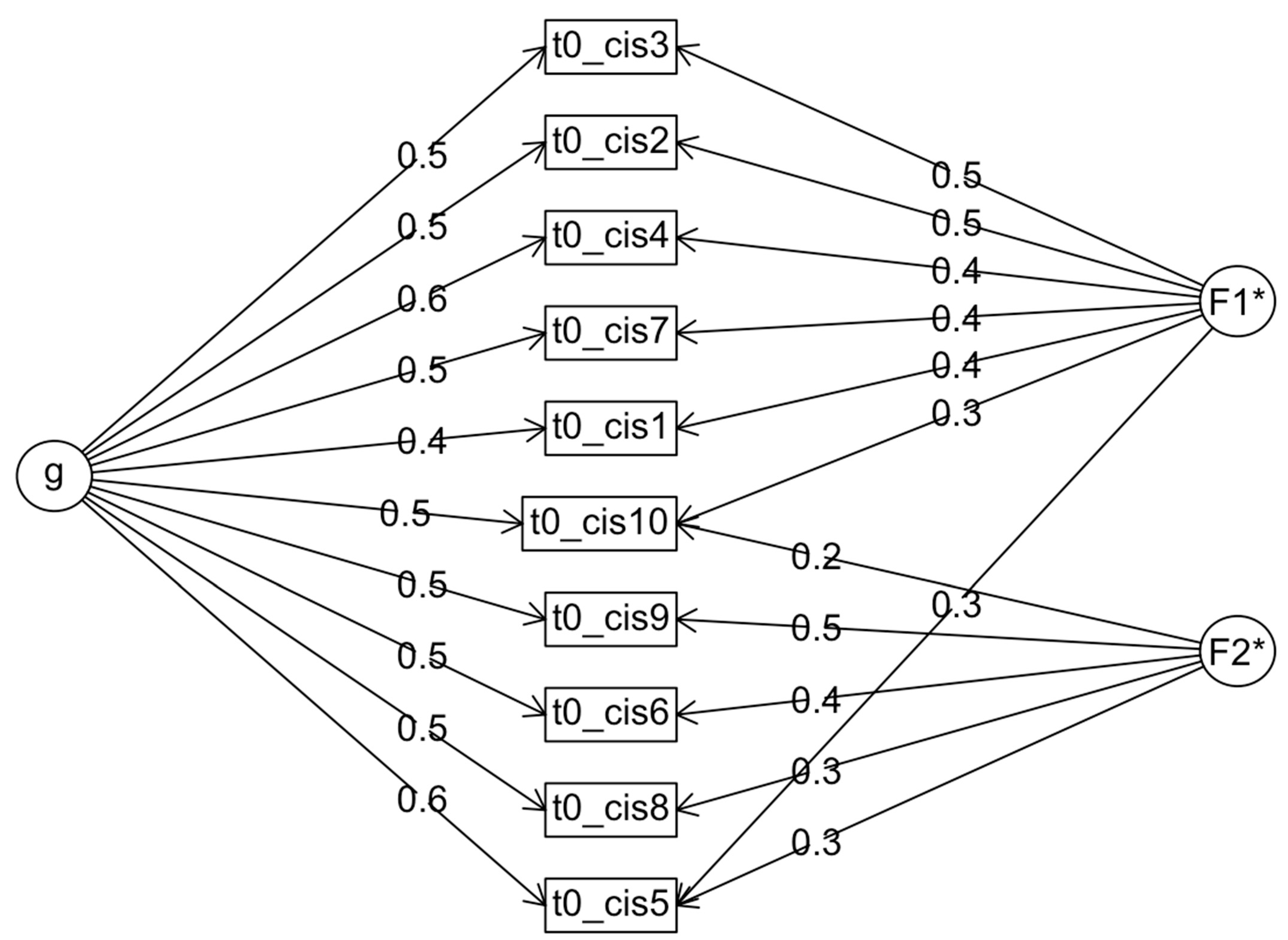
A hierarchical reliability analysis using omega() (Revelle, 2025) was conducted to estimate the proportion of variance attributable to general and group factors within the CIS. The results indicated good internal consistency for the total scale (Cronbach’s α = 0.85; Guttman’s λ6 = 0.87). The total omega (ωt) was 0.87, suggesting that 87% of the total score variance reflects common variance among items.
The hierarchical omega (ωh) was 0.62, indicating that approximately 62% of the reliable variance can be attributed to a single general factor of imaginative suggestibility, while the remaining variance reflects group or subfactor influences. The asymptotic ωh value of 0.71 supports the stability of this general factor across samples. The Schmid–Leiman decomposition showed that the general factor explained 60% of the common variance, whereas the two group factors (F1* and F2*, see Table 4) accounted for smaller proportions (sum of squares = 1.10 and 0.67, respectively). Fit indices indicated an acceptable fit for the bifactor model (χ2(26) = 62.08, p < 0.001; RMSEA = 0.117, 90% CI [0.081, 0.157]; BIC = −57.65). In contrast, a model including only a single general factor showed poorer fit (χ2(35) = 107.27, p < 0.001; RMSEA = 0.143, 90% CI [0.114, 0.176]; BIC = −53.91). Measures of factor score adequacy showed that factor scores correlated moderately to strongly with their latent factors (r(g) = 0.79; r(F1) = 0.65; r(F2) = 0.62), with corresponding squared multiple correlations (R2) of 0.63, 0.43, and 0.38, respectively. The subscale reliabilities indicated ωt = 0.81 for F1* and ωt = 0.75 for F2*, with corresponding ωh = 0.49 and 0.50, respectively (see Table 4 and Figure 2). Overall, these results confirm that the CIS primarily reflects a dominant general factor of imaginative suggestibility, while smaller but meaningful proportions of reliable variance are captured by two subordinate group factors related to Imagination/Absorption and Performance/Perceptual Alteration.

3.3.5. Reliability and Item Analysis

Item-level statistics for the German CIS are presented in Table 5. Across the ten items, the proportion of missing data was consistent at 6%, indicating good completion rates. Item means ranged from 1.60 to 2.10 (SD = 1.07–1.25), showing moderate endorsement across imaginative scenarios on the 0–5 response scale. Skewness values were close to zero (−0.25 ≤ skew ≤ 0.37), suggesting approximately symmetric response distributions. Item difficulty indices (mean item score/maximum possible score) ranged between 0.40 and 0.52, indicating balanced item difficulty. Corrected item–total correlations (discrimination indices) ranged from 0.45 to 0.69, demonstrating that all items contributed meaningfully to the total score. No item deletion would have improved internal consistency, as “α if deleted” values varied narrowly between 0.82 and 0.84. The mean inter-item correlation (MIIC) was 0.36, falling squarely within the recommended 0.15–0.50 range for homogeneous but non-redundant items (Clark & Watson, 1995). The overall Cronbach’s α = 0.85 indicates good internal consistency, comparable to previous validations of the CIS, and confirms that the ten items form a coherent unidimensional scale of imaginative suggestibility.

3.3.6. Confirmatory Factor Analysis (CFA)

To test the potential multidimensionality of the CIS more formally, confirmatory factor analyses were conducted using lavaan (Rosseel, 2012). Three competing models were estimated: (1) a unidimensional model representing general imaginative suggestibility, (2) a correlated two-factor model representing Imagination/Absorption and Performance/Perceptual Alteration, and (3) to address the possibility of a hierarchical factor structure, a second-order CFA model was additionally estimated in which the two first-order factors (Imagery/Absorption and Performance/Perceptual Alteration) load onto a superordinate CIS factor.
The one-factor model showed poor-to-marginal fit (see Table 6): χ2(35) = 89.95, p < 0.001; CFI = 0.820; TLI = 0.769; RMSEA = 0.129 (90% CI [0.097, 0.162]); SRMR = 0.082.
The two-factor model provided a statistically superior fit: χ2(34) = 75.98, p < 0.001; CFI = 0.863; TLI = 0.818; RMSEA = 0.115 (90% CI [0.080, 0.149]); SRMR = 0.073.
A chi-square difference test confirmed the better fit of the two-factor model, Δχ2(1) = 13.97, p < 0.001. The two latent factors were highly correlated (r = 0.80, p < 0.001).
The second-order model yielded fit indices identical to those of the correlated two-factor model (χ2(34) = 75.98, CFI = 0.863, RMSEA = 0.115 [0.080, 0.149], SRMR = 0.073), with a chi-square difference of Δχ2(1) = ~0, p = 1.0, indicating that the two models are statistically equivalent. This equivalence is a mathematical consequence of specifying exactly two first-order factors: the second-order factor merely reparametrizes the interfactor correlation (r = 0.80) as a higher-order loading without imposing additional constraints. Given this equivalence, the correlated two-factor model is retained as the primary solution on grounds of parsimony and interpretability. Evidence for a general higher-order factor is instead provided by the hierarchical omega and bifactor analyses reported in Section 3.3.4, which demonstrated that a dominant general factor accounts for 60% of common variance (ωh = 0.62).
These results indicate that, while the CIS can be treated as predominantly unidimensional for practical purposes, its structure may be best represented by two correlated factors, reflecting both imaginative absorption and performance-related perceptual alteration.

3.4. Psychometric Results of the HGSHS-5:G

The HGSHS-5:G demonstrated satisfactory psychometric properties. Bartlett’s test confirmed sufficient inter-item correlations (χ2(10) = 79.24, p < 0.001), and the KMO measure indicated middling sampling adequacy (0.74). Factor analyses consistently supported a unidimensional structure. Internal consistency was acceptable for a short dichotomous scale (Cronbach’s α = 0.68; mean inter-item correlation = 0.30). Detailed results of the factor analysis and item-level statistics are provided in Supplementary Materials.

3.5. Comparison Between the CIS and HGSHS-5:G

To examine the relationship between imaginative suggestibility (CIS) and behavioral hypnotic responsiveness (HGSHS-5:G), both item-level and scale-level correlations were computed. Mixed correlations (polychoric for ordinal CIS items and tetrachoric for dichotomous HGSHS-5:G items) revealed a predominantly positive pattern of associations between corresponding items of both instruments, with coefficients ranging from r = 0.18 to 0.56 (see Table 7). Stronger cross-measure correlations were observed for the CIS items involving perceptual or motor imagery (CIS Items 3–5, 7, 10) and the HGSHS-5:G items reflecting behavioral enactment (HGSHS-5:G Items 3–5). At the aggregate level, the total CIS score correlated moderately with the HGSHS-5:G total score, r = 0.52, p < 0.001.
This finding indicates that individuals scoring high on imaginative and absorptive suggestibility also tend to exhibit stronger behavioral responses to standardized hypnotic suggestions. The moderate magnitude of this association supports convergent validity between the two measures while demonstrating that they assess related but non-redundant constructs—cognitive–imaginative versus behavioral aspects of hypnotic suggestibility. Correlations among individual CIS items and the HGSHS-5:G sum score ranged from r = 0.20 to 0.42 (p < 0.05), further reinforcing this pattern.

4. Discussion

The present study represents the first validation of the German version of the CIS in a clinical sample of individuals with mild to moderate depressive symptoms. The study further compared the German CIS with the HGSHS-5:G to examine convergent and discriminant aspects of imaginative versus behavioral suggestibility. Establishing a validated German CIS was necessary, as no standardized measure of imaginative suggestibility currently exists for German-speaking clinical populations.
Overall, the results demonstrate that the German CIS shows good internal consistency and preliminary but limited evidence for a two-factor structure—though absolute CFA fit was suboptimal in the present sample, which should be interpreted in light of the relatively small sample size—alongside a moderate positive correlation with the HGSHS-5:G, supporting convergent validity while indicating that imaginative and behavioral suggestibility represent related but distinct constructs.

4.1. Psychometric Properties of the CIS

The German CIS demonstrated good internal consistency, comparable to or exceeding reliability estimates reported in earlier English-language studies of the CIS in experimental and clinical samples (Wilson & Barber, 1978; Sheehan et al., 1978; Laidlaw & Large, 1997). Exploratory and confirmatory factor analyses indicated that a two-factor model provided a slightly better fit compared to a unidimensional structure. The factors, interpretable as Imagination/Absorption and Performance/Perceptual Alteration, are consistent with previous factor-analytic work suggesting that imaginative suggestibility encompasses multiple dimensions (Hilgard et al., 1981; Laurence et al., 2008). This is tentatively consistent with the view that the CIS may capture multiple dimensions of imaginative suggestibility, though the high interfactor correlation (r = 0.80) and suboptimal model fit in the present sample limit the strength of this conclusion.
Overall, these findings are broadly consistent with earlier psychometric and comparative work on the CIS, including studies reporting acceptable reliability as well as investigations of its factor structure and relationship to other suggestibility measures (e.g., Wilson & Barber, 1978; Hilgard et al., 1981; McConkey et al., 1979). The present study extends this work by providing initial validation data for a German clinical sample with depressive symptoms. The CFA results extend the EFA findings by providing preliminary support for a correlated two-factor solution as a better representation of the CIS structure than the unidimensional model. Neither model reached conventional thresholds for acceptable fit (CFI > 0.90, RMSEA < 0.08), which should be interpreted in light of the relatively small sample size. The two latent dimensions were highly correlated (r = 0.80), indicating substantial shared variance; they may therefore be better understood as correlated facets of a broader imaginative suggestibility construct than as independent dimensions. This is consistent with prior work on multidimensional structures of suggestibility scales (McConkey et al., 1980; Piesbergen & Peter, 2006; Polito et al., 2014; Zahedi et al., 2024) and suggests that a two-dimensional conceptualization warrants further investigation, though firm conclusions about subscale utility are premature pending replication in larger samples.

4.2. Psychometric Properties of the HGSHS-5:G

The HGSHS-5:G was confirmed as a reliable and unidimensional instrument, consistent with recent German validation studies (Riegel et al., 2021; Zech et al., 2024). Although internal consistency was only modest (α = 0.68), this level of reliability is acceptable given the brevity and heterogeneity of the five dichotomous motor challenge items. This supports the scale’s use as an efficient behavioral index of hypnotic responsiveness, even in clinical populations with mild depressive symptoms.

4.3. Convergent Validity and Distinctiveness

The CIS and the HGSHS-5:G showed a moderate positive correlation (r = 0.52), with a disattenuated correlation of approximately 0.68, indicating substantial shared variance alongside clear conceptual distinctiveness. This result is broadly consistent with earlier English-language studies comparing the CIS with the HGSHS:A. For example, McConkey et al. (1979) reported a modest positive correlation between CIS and HGSHS:A scores (r = 0.28), while demonstrating that the two instruments reflect largely independent underlying dimensions. Importantly, the HGSHS:A comprises a broader range of hypnotic suggestions, whereas the HGSHS-5:G focuses exclusively on motor challenge items. Differences in scale composition, sample characteristics, and clinical context may therefore partly account for the stronger correlation observed in the present study. Overall, these findings support the view that imaginative suggestibility, as assessed by the CIS, and behavioral hypnotic responsiveness under induction, as assessed by the HGSHS-5:G, are related but non-redundant constructs.

4.4. Clinical and Theoretical Implications

From a clinical perspective, these results are highly relevant. Hypnotic suggestibility has been linked to treatment outcomes in hypnotherapy (Montgomery et al., 2011). In addition, hypnotherapy has been shown to be non-inferior to cognitive behavioral therapy in the treatment of mild to moderate depressive episodes (Fuhr et al., 2021). The CIS may be particularly valuable as a brief, non-induction-based screening tool for imaginative abilities in patients with depression, where imagery-based interventions (e.g., guided imagery, hypnosis, or mental imagery training) have shown therapeutic potential (Holmes et al., 2016; Renner et al., 2017). For clinical use, the total CIS score currently represents the more robust index, as the preliminary nature of the two-factor solution and the high interfactor correlation (r = 0.80) warrant caution in interpreting subscale scores until replication in larger samples is available. The moderate convergence between CIS and HGSHS-5:G also indicates that both instruments tap into core mechanisms of suggestibility, but in complementary ways: one through imaginative absorption, the other through motor challenge performance. This suggests that the two measures may be differentially sensitive to individual differences in cognitive style and clinical symptomatology.

4.5. Limitations

A key limitation of the present study concerns the relatively modest sample size (N ≈ 94), which falls below many recommended thresholds for confirmatory factor analysis and reliability estimation (Kline, 2016; Wolf et al., 2013). For exploratory factor analysis specifically, the adequacy of a given sample size depends critically on the level of communality and factor overdetermination: while 100–200 cases may suffice when communalities are high (>0.60) and factors are well-defined, lower communalities and weakly determined factors increase the required sample to 300 or more (MacCallum et al., 1999). In the present data, item communalities ranged from 0.43 to 0.67 (M = 0.55), suggesting that the EFA results in particular should be interpreted with appropriate caution. Although our sample size was sufficient to support exploratory analyses, the structural findings remain preliminary. Future research with larger and more diverse samples is needed to confirm the robustness of the two-factor structure of the CIS and to refine its psychometric properties. Moreover, because the EFA and the CFA were performed on the same dataset and the CIS comprises a small and heterogeneous set of items, the structural validation results should be interpreted with caution, as this design limits the robustness of the factor-analytic evidence.

4.6. Strengths

Despite these limitations, the present study has several notable strengths. It represents the first validation of the German CIS in a clinical sample of individuals with mild to moderate depressive symptoms, addressing a critical gap in suggestibility assessment for German-speaking populations. The study employed a rigorous psychometric approach, combining exploratory and confirmatory factor analyses and examining both internal consistency and convergent validity with the HGSHS-5:G. By integrating a non-induction-based measure of imaginative suggestibility (CIS) and a behavioral measure of hypnotic performance (HGSHS-5:G), the study provides a comprehensive and differentiated assessment of suggestibility, highlighting the multidimensional nature of the construct.


5. Conclusions

This study represents the first systematic attempt to evaluate a German version of the CIS, filling a critical gap in the literature. As no prior German-language validation has been available, the present findings provide an important first benchmark for the use of the CIS in clinical and research contexts. Conducted in a sample of individuals with mild to moderate depressive symptoms, the study extends previous work by demonstrating that the German CIS is a reliable instrument for assessing imaginative suggestibility in clinical populations, with preliminary evidence for a two-factor structure pending replication in larger independent samples. While replication with larger and more diverse samples is essential, its brief, non-induction-based format may facilitate the assessment of imaginative abilities in both clinical and experimental settings, complementing existing behavioral measures of suggestibility.

Supplementary Materials

The following supporting information can be downloaded at: https://www.mdpi.com/article/10.3390/bs16091502/s1, Figure S1: Determining the number of factors using the Method Agreement Procedure (MAP) for HGSHS-5:G. Bars showing the percentage of method agreement and the dotted line the prognosted percentage of variance explained by factor number; Table S1: HGSHS-5:G Rotated loadings from Principal Components Analysis (varimax-rotation); Table S2: Item level descriptive statistics, difficulty, discrimination and Cronbach’s alpha.

Author Contributions

Conceptualization, M.T. and J.S.; methodology, M.H. and J.S.; software, M.H.; validation, M.H.; formal analysis, M.H.; investigation, M.T. and J.S.; data curation, M.H.; writing—original draft preparation, M.H., J.S. and B.R.; writing—review and editing, B.B. and M.T.; visualization, M.H., B.R. and J.S.; supervision, M.T.; project administration, M.T. and B.B.; funding acquisition, J.S. All authors have read and agreed to the published version of the manuscript.

Funding

This research was partly supported by the Karl und Veronica Carstens-Stiftung as part of the Young Clinician Scientists grant program (grant recipient: Julia Siewert; grant number KVC 0/126/2022).

Institutional Review Board Statement

The study was conducted in accordance with the Declaration of Helsinki and the ICH E6 (R2) Good Clinical Practice guidelines. Ethical approval was obtained prospectively from the Ethics Committee of Charité—Universitätsmedizin Berlin (reference number EA2/271/22, 20 April 2023). The study was retrospectively registered in the German Clinical Trials Register (DRKS00032115) on 20 July 2023.

Informed Consent Statement

Informed consent was obtained from all subjects involved in the study.

Data Availability Statement

The datasets generated and/or analyzed during the current study are available from the corresponding author upon reasonable request for scientific purposes and in compliance with data protection regulations.

Acknowledgments

The authors used ChatGPT (GPT-5.2; OpenAI) and Claude (Claude Opus 4.6; Anthropic) for the purposes of language review and stylistic refinement. The authors have reviewed and edited the output and take full responsibility for the content of this publication. We thank the entire study team, including Margit Cree and Katharina Kleinsteuber (HypnoDeep study secretary), for their excellent support and coordination throughout the study.

Conflicts of Interest

M.T. is a member of the Deutsche Gesellschaft für Hypnose und Hypnotherapie (DGH). M.T. received payments and travel expenses for teaching hypnosis within the hypnotherapy training programs of the DGH. B.R. is a member of the Milton Erickson Gesellschaft für Klinische Hypnose (M.E.G.). B.R. received payments and travel expenses for teaching hypnosis within the hypnotherapy training programs of the M.E.G. B.R. received payments and travel expenses for teaching hypnosis within the hypnotherapy training programs of the M.E.G. The other authors declare no conflicts of interest.

Abbreviations

The following abbreviations are used in this manuscript:
CISCreative Imagination Scale
HGSHS:AHarvard Group Scale of Hypnotic Susceptibility, Form A
HGSHS-5:GHarvard Group Scale of Hypnotic Susceptibility, 5-item German short form
CFAConfirmatory Factor Analysis
EFAExploratory Factor Analysis
αCronbach’s Alpha
ωMcDonald’s Omega
KMOKaiser–Meyer–Olkin
MSAMeasure of sampling adequacy
RMSEARoot Mean Square Error of Approximation
TLITucker–Lewis-Index
CFIComparative Fit Index
SRMRStandardized Root Mean Square Residual
CIConfidence Interval
DRKSDeutsches Register Klinischer Studien (German Clinical Trials Register)

References

  1. Bahlinger, V. (1995). Die Auswirkungen der Konfusionstechnik, Imagination und Suggestibilität auf physiologische Variablen und die Lebhaftigkeit von Vorstellungsinhalten [Unpublished diploma thesis]. Universität Konstanz.
  2. Barber, T. X., & Wilson, S. C. (1978). The barber suggestibility scale and the creative imagination scale: Experimental and clinical applications. American Journal of Clinical Hypnosis, 21(2–3), 84–108. [Google Scholar] [CrossRef] [Scilit] [PubMed]
  3. Bennett, D. A. (2001). How can I deal with missing data in my study? Australian and New Zealand Journal of Public Health, 25(5), 464–469. [Google Scholar] [CrossRef]
  4. Bonett, D. G. (2002). Sample size requirements for estimating intraclass correlations with desired precision. Statistics in Medicine, 21(9), 1331–1335. [Google Scholar] [CrossRef] [Scilit] [PubMed]
  5. Clark, L. A., & Watson, D. (1995). Constructing validity: Basic issues in objective scale development. Psychological Assessment, 7(3), 309–319. [Google Scholar] [CrossRef]
  6. Egbers, S. (1998). Imaginative Verarbeitung direkt und indirekt formulierter Texte in Abhängigkeit vom Aufmerksamkeitsbedarf [Doctoral dissertation, Universität Konstanz, Sozialwissenschaftliche Fakultät, Fachgruppe Psychologie]. [Google Scholar]
  7. Fuhr, K., Meisner, C., Broch, A., Cyrny, B., Hinkel, J., Jaberg, J., Petrasch, M., Schweizer, C., Stiegler, A., Zeep, C., & Batra, A. (2021). Efficacy of hypnotherapy compared to cognitive behavioral therapy for mild to moderate depression—Results of a randomized controlled rater-blind clinical trial. Journal of Affective Disorders, 286, 166–173. [Google Scholar] [CrossRef] [Scilit] [PubMed]
  8. Gorsuch, R. L. (1983). Factor analysis (2nd ed.). Erlbaum. [Google Scholar]
  9. Görgen, S. M., Joormann, J., Hiller, W., & Witthöft, M. (2015). The role of mental imagery in depression: Negative mental imagery induces strong implicit and explicit affect in depression. Frontiers in Psychiatry, 6, 94. [Google Scholar] [CrossRef] [Scilit] [PubMed]
  10. Hilgard, E. R., Sheehan, P. W., Monteiro, K. P., & Macdonald, H. (1981). Factorial structure of the creative imagination scale as a measure of hypnotic responsiveness: An international comparative study. The International Journal of Clinical and Experimental Hypnosis, 29(1), 66–76. [Google Scholar] [CrossRef] [Scilit] [PubMed]
  11. Holmes, E. A., Blackwell, S. E., Burnett Heyes, S., Renner, F., & Raes, F. (2016). Mental imagery in depression: Phenomenology, potential mechanisms, and treatment implications. Annual Review of Clinical Psychology, 12, 249–280. [Google Scholar] [CrossRef] [Scilit] [PubMed]
  12. Holmes, E. A., & Mathews, A. (2010). Mental imagery in emotion and emotional disorders. Clinical Psychology Review, 30(3), 349–362. [Google Scholar] [CrossRef] [Scilit] [PubMed]
  13. Honaker, J., King, G., & Blackwell, M. (2011). Amelia II: A program for missing data. Journal of Statistical Software, 45(7), 1–47. [Google Scholar] [CrossRef] [Scilit]
  14. Hu, L.-T., & Bentler, P. M. (1999). Cutoff criteria for fit indexes in covariance structure analysis: Conventional criteria versus new alternatives. Structural Equation Modeling: A Multidisciplinary Journal, 6(1), 1–55. [Google Scholar] [CrossRef] [Scilit]
  15. Kaiser, H. F., & Rice, J. (1974). Little jiffy, mark IV. Educational and Psychological Measurement, 34(1), 111–117. [Google Scholar] [CrossRef] [Scilit]
  16. Kline, R. B. (2016). Principles and practice of structural equation modeling (4th ed.). Guilford Press. [Google Scholar]
  17. Laidlaw, T. M., & Large, R. G. (1997). Harvard group scale of hypnotic susceptibility and the creative imagination scale: Defining two separate but correlated abilities. Contemporary Hypnosis, 14(1), 26–36. [Google Scholar] [CrossRef] [Scilit]
  18. Laurence, J. R., Beaulieu-Prévost, D., & Du Chéné, T. (2008). Measuring and understanding individual differences in hypnotizability. In M. R. Nash, & A. J. Barnier (Eds.), The Oxford handbook of hypnosis: Theory, research, and practice (pp. 225–253). Oxford University Press. [Google Scholar]
  19. Lüdecke, D. (2019). strengejacke (Version 0.5.0) [R package]. Available online: https://github.com/strengejacke/strengejacke (accessed on 15 July 2026).
  20. Lüdecke, D. (2022). sjlabelled (Version 1.2.0) [R package]. Available online: https://CRAN.R-project.org/package=sjlabelled (accessed on 15 July 2026).
  21. Lüdecke, D. (2025a). sjPlot (Version 2.9.0) [R package]. Available online: https://CRAN.R-project.org/package=sjPlot (accessed on 15 July 2026).
  22. Lüdecke, D. (2025b). sjstats (Version 0.19.1) [R package]. Available online: https://CRAN.R-project.org/package=sjstats (accessed on 15 July 2026).
  23. Lüdecke, D., Ben-Shachar, M., Patil, I., & Makowski, D. (2020). Extracting, computing and exploring the parameters of statistical models using R. Journal of Open Source Software, 5(53), 2445. [Google Scholar] [CrossRef] [Scilit]
  24. Lüdecke, D., Ben-Shachar, M., Patil, I., Waggoner, P., & Makowski, D. (2021a). Performance: An R package for assessment, comparison and testing of statistical models. Journal of Open Source Software, 6(60), 3139. [Google Scholar] [CrossRef] [Scilit]
  25. Lüdecke, D., Patil, I., Ben-Shachar, M., Wiernik, B., Waggoner, P., & Makowski, D. (2021b). See: An R package for visualizing statistical models. Journal of Open Source Software, 6(64), 3393. [Google Scholar] [CrossRef] [Scilit]
  26. MacCallum, R. C., Widaman, K. F., Zhang, S., & Hong, S. (1999). Sample size in factor analysis. Psychological Methods, 4(1), 84–99. [Google Scholar] [CrossRef] [Scilit]
  27. Makowski, D. (2018). The psycho package: An efficient and publishing-oriented workflow for psychological science. Journal of Open Source Software, 3(22), 470. [Google Scholar] [CrossRef] [Scilit]
  28. Makowski, D., Lüdecke, D., Patil, I., Thériault, R., Ben-Shachar, M., & Wiernik, B. (2023). Automated results reporting as a practical tool to improve reproducibility and methodological best practices adoption. Available online: https://easystats.github.io/report/ (accessed on 15 July 2026).
  29. McConkey, K. M., Sheehan, P. W., & White, K. D. (1979). Comparison of the creative imagination scale and the Harvard group scale of hypnotic susceptibility, form A. International Journal of Clinical and Experimental Hypnosis, 27(3), 265–277. [Google Scholar] [CrossRef] [Scilit] [PubMed]
  30. McConkey, K. M., Sheehan, P. W., & White, K. D. (1980). Structural analysis of the Harvard group scale of hypnotic susceptibility, form A. International Journal of Clinical and Experimental Hypnosis, 28(2), 164–175. [Google Scholar] [CrossRef] [Scilit] [PubMed]
  31. Montgomery, G. H., Schnur, J. B., & David, D. (2011). The impact of hypnotic suggestibility in clinical care settings. International Journal of Clinical and Experimental Hypnosis, 59(3), 294–309. [Google Scholar] [CrossRef] [Scilit] [PubMed]
  32. Müller, K. (2025). here (Version 1.0.2) [R package]. Available online: https://CRAN.R-project.org/package=here (accessed on 15 July 2026).
  33. Piesbergen, C., & Peter, B. (2006). An investigation of the factor structure of the Harvard group scale of hypnotic susceptibility, form A (HGSHS:A). Contemporary Hypnosis, 23(2), 59–71. [Google Scholar] [CrossRef] [Scilit]
  34. Polito, V., Barnier, A. J., & Cox, R. (2014). Measuring agency change across the domain of hypnosis. Psychology of Consciousness: Theory, Research, and Practice, 1(1), 3. [Google Scholar] [CrossRef] [Scilit]
  35. R Core Team. (2025). R: A language and environment for statistical computing. Available online: https://www.R-project.org/ (accessed on 15 July 2026).
  36. Renner, F., Ji, J. L., Pictet, A., Holmes, E. A., & Blackwell, S. E. (2017). Effects of engaging in repeated mental imagery of future positive events on behavioural activation in individuals with major depressive disorder. Cognitive Therapy and Research, 41(3), 369–380. [Google Scholar] [CrossRef] [Scilit] [PubMed]
  37. Revelle, W. (2025). psych (Version 2.5.6). Available online: https://CRAN.R-project.org/package=psych (accessed on 15 July 2026).
  38. Riegel, B., Tönnies, S., Hansen, E., Zech, N., Eck, S., Batra, A., & Peter, B. (2021). German norms of the Harvard group scale of hypnotic susceptibility (HGSHS:A) and proposal of a 5-item short-version (HGSHS-5:G). International Journal of Clinical and Experimental Hypnosis, 69(1), 112–123. [Google Scholar] [CrossRef] [Scilit] [PubMed]
  39. Rinker, T. W., & Kurkiewicz, D. (2018). pacman (Version 0.5.0). Available online: http://github.com/trinker/pacman (accessed on 15 July 2026).
  40. Rosseel, Y. (2012). lavaan: An R package for structural equation modeling. Journal of Statistical Software, 48(2), 1–36. [Google Scholar] [CrossRef] [Scilit]
  41. Sapp, M., & Hitchcock, K. (2003). Creative imagination, absorption, and dissociation with African American college students. Sleep and Hypnosis, 5(2), 95–104. [Google Scholar]
  42. Sheehan, P. W., McConkey, K. M., & Law, H. G. (1978). Imagery facilitation and performance on the creative imagination scale. Journal of Mental Imagery, 2(2), 265–274. [Google Scholar]
  43. Shor, R. E., & Orne, E. C. (1962). Harvard group scale of hypnotic susceptibility, form A. Consulting Psychologists Press. [Google Scholar]
  44. Sjoberg, D., Whiting, K., Curry, M., Lavery, J., & Larmarange, J. (2021). Reproducible summary tables with the gtsummary package. The R Journal, 13, 570–580. [Google Scholar] [CrossRef] [Scilit]
  45. Wickham, H. (2016). ggplot2: Elegant graphics for data analysis. Springer. Available online: https://ggplot2.tidyverse.org (accessed on 15 July 2026).
  46. Wickham, H., Averick, M., Bryan, J., Chang, W., McGowan, L. D., François, R., Grolemund, G., Hayes, A., Henry, L., Hester, J., Kuhn, M., Pedersen, T. L., Miller, E., Bache, S. M., Müller, K., Ooms, J., Robinson, D., Seidel, D. P., Spinu, V., … Yutani, H. (2019). Welcome to the tidyverse. Journal of Open Source Software, 4(43), 1686. [Google Scholar] [CrossRef] [Scilit]
  47. Wickham, H., Miller, E., & Smith, D. (2025). haven (Version 2.5.5) [R package]. Available online: https://CRAN.R-project.org/package=haven (accessed on 15 July 2026).
  48. Wilson, S. C., & Barber, T. X. (1978). The creative imagination scale as a measure of hypnotic responsiveness: Applications to experimental and clinical hypnosis. The American Journal of Clinical Hypnosis, 20(4), 235–249. [Google Scholar] [CrossRef] [Scilit] [PubMed]
  49. Wolf, E. J., Harrington, K. M., Clark, S. L., & Miller, M. W. (2013). Sample size requirements for structural equation models: An evaluation of power, bias, and solution propriety. Educational and Psychological Measurement, 73(6), 913–934. [Google Scholar]
  50. Xie, Y. (2014). knitr: A comprehensive tool for reproducible research in R. In V. Stodden, F. Leisch, & R. D. Peng (Eds.), Implementing reproducible computational research. Chapman and Hall/CRC. [Google Scholar]
  51. Xie, Y. (2015). Dynamic documents with R and knitr (2nd ed.). Chapman and Hall/CRC. [Google Scholar]
  52. Xie, Y. (2025). knitr (Version 1.50) [R package]. Available online: https://yihui.org/knitr/ (accessed on 15 July 2026).
  53. Zahedi, A., Lynn, S. J., & Sommer, W. (2024). Cognitive simulation along with neural adaptation explain effects of suggestions: A novel theoretical framework. Frontiers in Psychology, 15, 1388347. [Google Scholar] [CrossRef] [Scilit] [PubMed]
  54. Zech, N., Riegel, B., Rasch, B., Peter, B., & Hansen, E. (2024). HGSHS-5:G—First results with the short version of the test for the Harvard group scale of hypnotic susceptibility and a comparison with the full version. Frontiers in Psychology, 15, 1422920. [Google Scholar] [CrossRef] [Scilit] [PubMed]
Figure 1. Summary plot showing the result of the Method Agreement Procedure (MAP). Bars showing the percentage of method agreement and the dashed line the predicted percentage of variance explained by factor number.
Behavsci 16 01502 g001
Figure 2. Graphical representation of the one (g) versus the theoretical two-factor solution (F1 and F2) from the omega analysis. * Subscale reliabilities: ωt = 0.81 for F1 and ωt = 0.75 for F2, with g ωh = 0.49 and 0.50.
Behavsci 16 01502 g002
Table 1. Table summarizing patients’ baseline characteristics, VAS, CIS and HGSHS-5:G scores.
Treatment Received
VariableOverall N = 97 1Control N = 32 1PMR N = 31 1Hypnosis N = 34 1
Age39.22 (12.02, 20.00, 68.00)38.09 (12.13, 22.00, 68.00)39.19 (12.41, 20.00, 64.00)40.29 (11.81, 20.00, 60.00)
(Missing)3120
Sex
Woman69/97 (71%)27/32 (84%)22/31 (71%)20/34 (59%)
Man26/97 (27%)5/32 (16%)8/31 (26%)13/34 (38%)
Diverse2/97 (2.1%)0/32 (0%)1/31 (3.2%)1/34 (2.9%)
(Missing)3120
VAS70.56 (11.58, 42.00, 100.00)69.19 (11.84, 42.00, 100.00)70.16 (11.92, 45.00, 99.00)72.24 (11.13, 42.00, 95.00)
(Missing)2110
CIS score17.64 (7.67, 2.00, 35.00)18.56 (8.84, 2.00, 35.00)17.34 (7.53, 3.00, 31.00)17.00 (6.67, 2.00, 33.00)
(Missing)6141
HGSHS-5:G score2.88 (1.64, 0.00, 5.00)2.53 (1.63, 0.00, 5.00)3.10 (1.67, 0.00, 5.00)3.03 (1.62, 0.00, 5.00)
(Missing)6132
1 Mean (SD, Min, Max); n/N (%); VAS = Visual Analog Scale (stress); HGSHS = Harvard Group Scale of Hypnotic Susceptibility; CIS = Creative Imagination Scale.
Table 2. Summary of factor-extraction recommendations from the Method Agreement Procedure (MAP).
N Factors 1MethodFamilyCumulative Variance
1Acceleration factorScree0.400
1Scree (SE)Scree_SE0.400
1Scree (R2)Scree_SE0.400
1VSS complexity 1VSS0.400
1Velicer’s MAPVelicers_MAP0.400
1BICBIC0.400
2Optimal coordinatesScree0.486
2Parallel analysisScree0.486
2Kaiser criterionScree0.486
2VSS complexity 2VSS0.486
3CNGCNG0.551
4betaMultiple_regression0.601
4tMultiple_regression0.601
4pMultiple_regression0.601
1 Number of suggested factors by method used.
Table 3. Overview of the component structure from principal components analysis for one- and two-component solutions of the CIS.
Principal Component Analysis with One ComponentPrincipal Component Analysis with Two Components
VariablePC1ComplexityUniquenessMSAPC1PC2ComplexityUniquenessMSA
t0_cis10.610.640.80.630.171.140.570.8
t0_cis20.7110.490.830.770.181.110.370.83
t0_cis30.6710.550.80.760.121.050.40.8
t0_cis40.7210.480.790.670.311.420.450.79
t0_cis50.7810.40.840.510.61.950.370.84
t0_cis60.6110.630.790.170.761.10.390.79
t0_cis70.6210.610.750.680.151.090.510.75
t0_cis80.6110.630.890.260.651.320.520.89
t0_cis90.5510.70.790.040.821.010.330.79
t0_cis100.6710.550.820.480.4720.550.82
The single principal component (varimax rotation) accounted for 43.14% of the total variance of the original data.The 2 principal components (varimax rotation) accounted for 55.24% of the total variance of the original data (PC1 = 30.85%, PC2 = 24.38%).
Table 4. Table summarizing factor scores for one general factor g and two theoretical two-factor solutions, F1 and F2, from omega analysis.
VariableEnglishGermangF1*F2*
t0_cis1Dictionaries HandWörterbücher Hand0.430.36
t0_cis2Water jet HandWasserstrahl Hand0.540.49
t0_cis3Narcotics HandBetäubungsmittel Hand0.490.5
t0_cis4Drinking cool mountain waterKühles Bergwasser trinken0.550.41
t0_cis5Smelling orangesOrange riechen0.650.270.3
t0_cis6Beautiful musicWunderschöne Musik0.52 0.42
t0_cis7Sun on your handSonne auf die Hand0.450.4
t0_cis8Time slows downZeit verlangsamt0.49 0.31
t0_cis9Thinking back to elementary schoolZeit zurückzudenken Grundschule0.49 0.5
t0_cis10Sun on the beachSonne am Strand0.520.260.2
* Subscale reliabilities: ωt = 0.81 for F1 and ωt = 0.75 for F2, with g ωh = 0.49 and 0.50.
Table 5. Item-level descriptive and reliability statistics for the CIS with one factor.
RowMissingsMeanSDSkewItem DifficultyItem Discriminationα If Deleted
cis16.00%2.061.18−0.250.520.490.84
cis26.00%1.811.200.190.450.610.83
cis36.00%1.601.180.310.400.560.84
cis46.00%1.611.080.370.400.610.83
cis56.00%1.781.190.100.440.690.82
cis66.00%1.601.250.240.400.520.84
cis76.00%1.641.130.080.410.520.84
cis86.00%1.661.240.190.410.520.84
cis96.00%1.801.220.180.450.450.84
cis106.00%2.101.07−0.140.520.570.83
Mean inter-item-correlation = 0.364. Cronbach’s α = 0.850.
Table 6. Table summarizing fit indices for the one- and two-factor CFA models of the CIS.
Modelχ2 (df)pCFITLIRMSEA [90% CI]SRMRΔχ2 (df Diff)Factor Correlation
CIS 1-Factor CFA89.95 (35)<0.0010.8200.7690.129 [0.097, 0.162]0.082--
CIS 2-Factor CFA75.98 (34)<0.0010.8630.8180.115 [0.080, 0.149]0.07313.97 (1), p < 0.001r = 0.80
CIS 2nd-Order CFA 75.98 (34)<0.0010.8630.8180.115 [0.080, 0.149]0.073~0 (1), p = 1.0-
The second-order CFA model specifies Imagery and Performance as first-order factors loading onto a superordinate CIS factor. With exactly two first-order factors, the model is not identified without constraints; a residual variance constraint was therefore applied (Imagery ~~ 0*Imagery). This renders the model statistically equivalent to the correlated two-factor solution (Δχ2(1) = ~0, p = 1.0), confirming that the interfactor correlation (r = 0.80) is fully accounted for by the higher-order factor. The bifactor analysis in Section 3.3.4 provides a more informative test of the higher-order structure.
Table 7. Mixed correlations (polychoric/tetrachoric) between all CIS and all HGSHS-5:G items.
t0_cis1t0_cis2t0_cis3t0_cis4t0_cis5t0_cis6t0_cis7t0_cis8t0_cis9t0_cis10t0_hgshs_1t0_hgshs_2t0_hgshs_3t0_hgshs_4t0_hgshs_5
t0_cis1
t0_cis20.59
t0_cis30.300.45
t0_cis40.370.470.54
t0_cis50.400.470.390.63
t0_cis60.240.270.280.260.51
t0_cis70.280.430.530.290.320.34
t0_cis80.310.260.330.320.410.440.29
t0_cis90.210.270.150.280.410.450.130.37
t0_cis100.230.400.360.420.450.300.480.330.42
t0_hgshs_10.300.220.350.270.220.180.250.290.200.27
t0_hgshs_20.160.030.000.07−0.080.080.020.120.020.100.05
t0_hgshs_30.180.160.370.400.330.140.230.140.120.270.440.33
t0_hgshs_40.330.340.270.560.320.170.230.210.190.180.430.360.55
t0_hgshs_50.280.270.390.390.200.240.290.200.300.280.600.370.700.63
Note. Values below the diagonal represent mixed polychoric (CIS × CIS), tetrachoric (HGSHS-5:G × HGSHS-5:G), and polychoric–tetrachoric (CIS × HGSHS-5:G) correlations. Diagonal entries (·) are omitted. CIS = Creative Imagination Scale; HGSHS-5:G = Harvard Group Scale of Hypnotic Susceptibility, Short Form, German version.
Disclaimer/Publisher’s Note: The statements, opinions and data contained in all publications are solely those of the individual author(s) and contributor(s) and not of MDPI and/or the editor(s). MDPI and/or the editor(s) disclaim responsibility for any injury to people or property resulting from any ideas, methods, instructions or products referred to in the content.