

Pretense and Executive Function: Testing the Roles of Representational Hierarchical Complexity and Embodiment

Abstract
1. Introduction
2. Materials and Methods
2.1. Participants
2.2. Experimental Design and Procedure
2.2.1. Operationalization of Representational Hierarchical Complexity
2.2.2. Manipulation of Embodiment
2.3. Measures
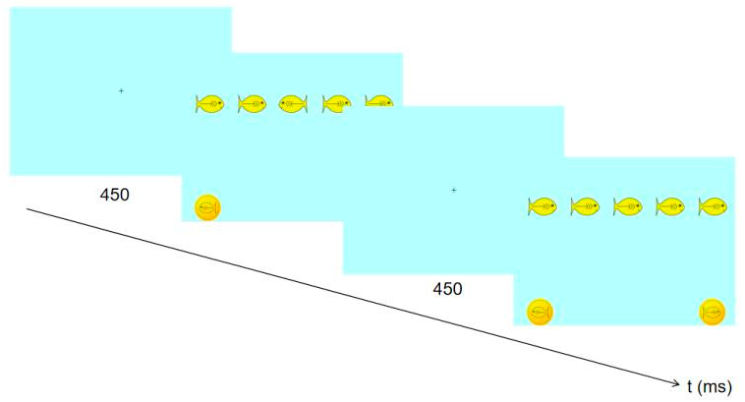
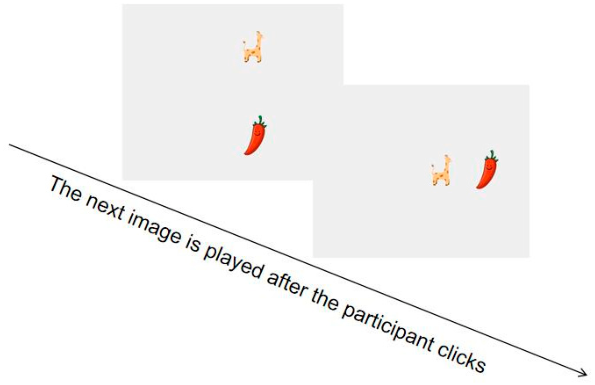
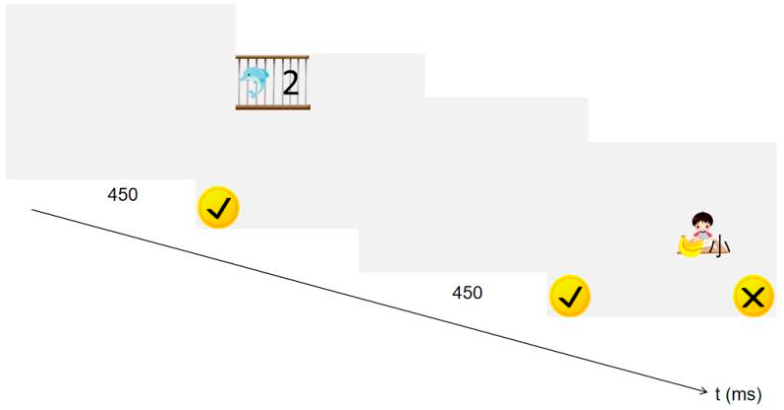
2.3.1. Executive Function
2.3.2. Second-Order Theory of Mind
3. Results
3.1. Preliminary Analyses
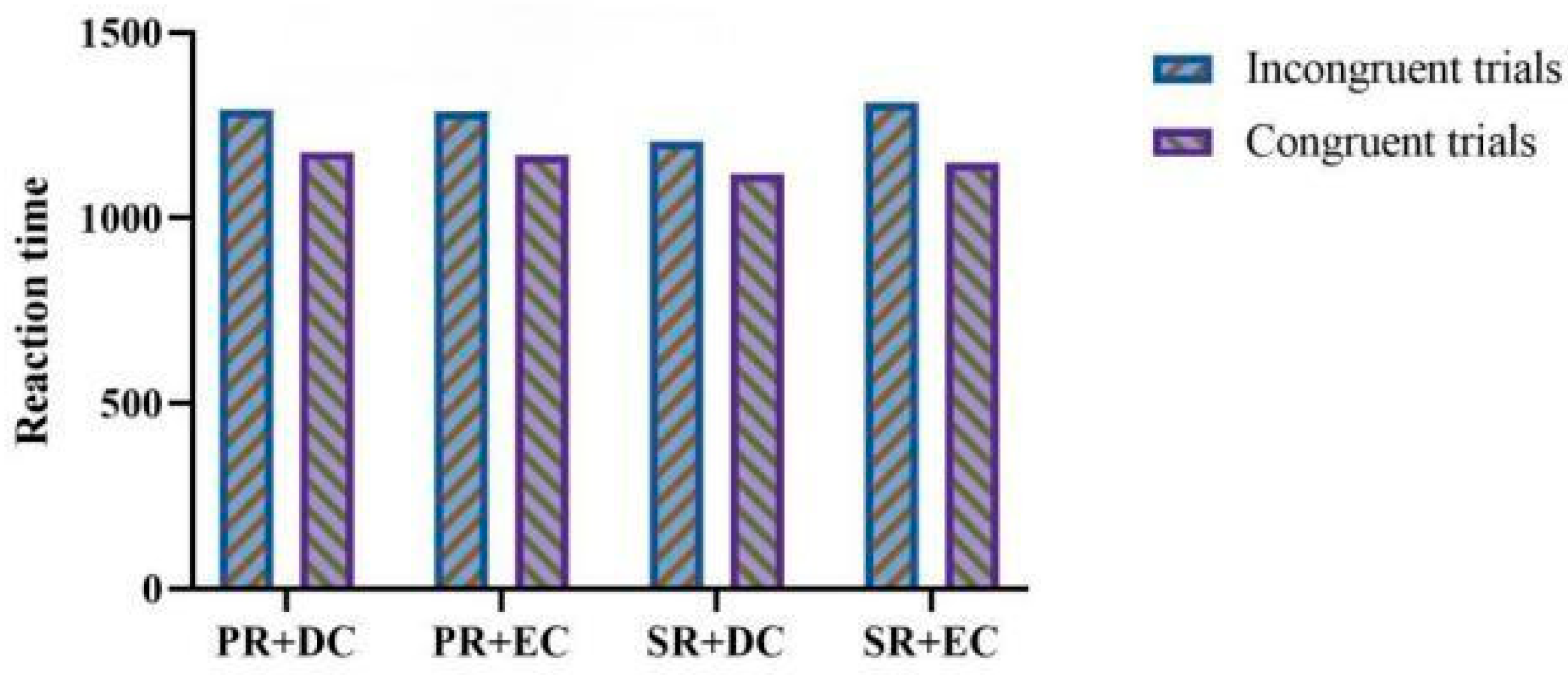
3.2. Effects of Representational Hierarchical Complexity and Embodiment on Executive Function
4. Discussion
5. Conclusions
Supplementary Materials
Author Contributions
Funding
Institutional Review Board Statement
Informed Consent Statement
Data Availability Statement
Acknowledgments
Conflicts of Interest
Abbreviations
| EF | Executive Function |
| IR | Iterative Reprocessing |
| SES | Socioeconomic Status |
References
- Abrahamson, D., Nathan, M. J., Williams-Pierce, C., Walkington, C., Ottmar, E. R., Soto, H., & Alibali, M. W. (2020). The future of embodied design for mathematics teaching and learning. Frontiers in Education, 5(147), 147. [Google Scholar] [CrossRef] [Scilit]
- Bunce, L., & Woolley, J. D. (2021). Fantasy orientation and creativity in childhood: A closer look. Cognitive Development, 57, 100979. [Google Scholar] [CrossRef] [Scilit]
- Calamia, M., Markon, K., & Tranel, D. (2012). Scoring higher the second time around: Meta-analyses of practice effects in neuropsychological assessment. The Clinical Neuropsychologist, 26(4), 543–570. [Google Scholar] [CrossRef] [Scilit]
- Castro-Alonso, J. C., Ayres, P., Zhang, S., De Koning, B. B., & Paas, F. (2024). Research avenues supporting embodied cognition in learning and instruction. Educational Psychology Review, 36(1), 10. [Google Scholar] [CrossRef] [Scilit]
- Castro-Alonso, J. C., de Koning, B. B., Fiorella, L., & Paas, F. (2021). Five strategies for optimizing instructional materials: Instructor- and learner-managed cognitive load. Educational Psychology Review, 33(4), 1379–1407. [Google Scholar] [CrossRef] [Scilit]
- Cohen, J. (1992). Quantitative methods in psychology: A power primer. Psychological Bulletin, 112(1), 155–159. [Google Scholar] [CrossRef] [PubMed]
- Constien, T., Moran, S., Rooney, B., & Downes, M. (2026). A head taller: A meta-analysis on the relation between pretend play and executive functions in early childhood. Developmental Review, 79, 101249. [Google Scholar] [CrossRef] [Scilit]
- Cunningham, W. A., Zelazo, P. D., Packer, D. J., & Van Bavel, J. J. (2007). The iterative reprocessing model: A multi-level framework for attitudes and evaluation. Social Cognition, 25, 736–760. [Google Scholar] [CrossRef] [Scilit]
- Diamond, A. (2013). Executive functions. Annual Review of Psychology, 64(1), 135–168. [Google Scholar] [CrossRef] [Scilit] [PubMed]
- Diamond, A., & Ling, D. S. (2016). Conclusions about interventions, programs, and approaches for improving executive functions that appear justified and those that, despite much hype, do not. Developmental Cognitive Neuroscience, 18, 34–48. [Google Scholar] [CrossRef] [Scilit]
- Doebel, S., & Lillard, A. S. (2023). How does play foster development? A new executive function perspective. Developmental Review, 68, 101064. [Google Scholar] [CrossRef] [Scilit]
- Fiorella, L., & Mayer, R. E. (2016). Eight ways to promote generative learning. Educational Psychology Review, 28(4), 717–741. [Google Scholar] [CrossRef] [Scilit]
- Fletcher, P. C., Happé, F., Frith, U., Baker, S. C., Dolan, R. J., Frackowiak, R. S. J., & Frith, C. D. (1995). Other minds in the brain: A functional imaging study of “theory of mind” in story comprehension. Cognition, 57(2), 109–128. [Google Scholar] [CrossRef] [Scilit]
- Foglia, L., & Wilson, R. A. (2013). Embodied cognition. Wiley Interdisciplinary Reviews: Cognitive Science, 4(3), 319–325. [Google Scholar] [CrossRef] [Scilit]
- Frye, D., Zelazo, P. D., & Palfai, T. (1995). Theory of mind and rule-based reasoning. Cognitive Development, 10(4), 483–527. [Google Scholar] [CrossRef] [Scilit]
- Glenberg, A. M. (1997). What memory is for: Creating meaning in the service of action. Behavioral and Brain Sciences, 20(1), 41–50. [Google Scholar] [CrossRef] [Scilit]
- Glenberg, A. M., Witt, J. K., & Metcalfe, J. (2013). From the revolution to embodiment: 25 years of cognitive psychology. Perspectives on Psychological Science, 8(5), 573–585. [Google Scholar] [CrossRef] [Scilit]
- Hongwanishkul, D., Happaney, K. R., Lee, W. S. C., & Zelazo, P. D. (2005). Assessment of hot and cool executive function in young children: Age-related changes and individual differences. Developmental Neuropsychology, 28(2), 617–644. [Google Scholar] [CrossRef] [Scilit]
- Kassai, R., Futo, J., Demetrovics, Z., & Takacs, Z. K. (2019). A meta-analysis of the experimental evidence on the near- and far-transfer effects among children’s executive function skills. Psychological Bulletin, 145(2), 1652010033188. [Google Scholar] [CrossRef] [Scilit]
- Kobayashi, C., Glover, G. H., & Temple, E. (2008). Switching language switches mind: Linguistic effects on developmental neural bases of ‘theory of mind’. Social Cognitive and Affective Neuroscience, 3(1), 62–70. [Google Scholar] [CrossRef] [Scilit]
- Kostyrka-Allchorne, K., Cooper, N. R., & Simpson, A. (2019). Disentangling the effects of video pace and story realism on children’s attention and response inhibition. Cognitive Development, 49, 94–104. [Google Scholar] [CrossRef] [Scilit]
- Krasnor, L. R., & Pepler, D. J. (1980). The study of children’s play: Some suggested future directions. New Directions for Child and Adolescent Development, 1980(9), 85–95. [Google Scholar] [CrossRef] [Scilit]
- Lee, K., Ng, S. F., Pe, M. L., Ang, S. Y., Hasshim, M. N. A. M., & Bull, R. (2012). The cognitive underpinnings of emerging mathematical skills: Executive functioning, patterns, numeracy, and arithmetic. British Journal of Educational Psychology, 82(1), 82–99. [Google Scholar] [CrossRef] [Scilit]
- Levy, K. J. (1980). A Monte Carlo study of analysis of covariance under violations of the assumptions of normality and equal regression slopes. Educational and Psychological Measurement, 40(4), 835–840. [Google Scholar] [CrossRef] [Scilit]
- Lillard, A. S., Lerner, M. D., Hopkins, E. J., Dore, R. A., Smith, E. D., & Palmquist, C. M. (2013). The impact of pretend play on children’s development: A review of the evidence. Psychological Bulletin, 139(1), 1–34. [Google Scholar] [CrossRef] [Scilit]
- Martinovic, D., Burgess, G. H., Pomerleau, C. M., & Marin, C. (2015). Comparison of children’s gaming scores to NEPSY-II scores: Validation of computer games as cognitive tools. Computers in Human Behavior, 49(2), 487−498. [Google Scholar] [CrossRef] [Scilit]
- Metaferia, B. K., Futo, J., Drew, R., & Takacs, Z. K. (2020a). Parents’ beliefs about play and the purpose of preschool education, preschoolers’ home activity and executive functions. Frontiers in Psychology, 11, 1104. [Google Scholar] [CrossRef] [Scilit]
- Metaferia, B. K., Futo, J., & Takacs, Z. K. (2021). Parents’ views on play and the goal of early childhood education in relation to children’s home activity and executive functions: A cross-cultural investigation. Frontiers in Psychology, 12, 646074. [Google Scholar] [CrossRef] [Scilit]
- Metaferia, B. K., Takacs, Z. K., & Futo, J. (2020b). The relationship between parental play beliefs, preschoolers’ home experience, and executive functions: An exploratory study in Ethiopia. Frontiers in Psychology, 11, 624. [Google Scholar] [CrossRef] [Scilit]
- Miller, S. A. (2009). Children’s understanding of second-order mental states. Psychological Bulletin, 135(5), 749–773. [Google Scholar] [CrossRef] [Scilit]
- Miyake, A., Friedman, N. P., Emerson, M. J., Witzki, A. H., Howerter, A., & Wager, T. D. (2000). The unity and diversity of executive functions and their contributions to complex “frontal lobe” tasks: A latent variable analysis. Cognitive Psychology, 41(1), 49–100. [Google Scholar] [CrossRef] [Scilit] [PubMed]
- Moffitt, T. E., Arseneault, L., Belsky, D., Dickson, N., Hancox, R. J., Harrington, H., Houts, R., Poulton, R., Roberts, B. W., Ross, S., Sears, M. R., Thomson, W. M., & Caspi, A. (2011). A gradient of childhood self-control predicts health, wealth, and public safety. Proceedings of the National Academy of Sciences, 108(7), 2693–2698. [Google Scholar] [CrossRef] [Scilit]
- Montroy, J. J., Bowles, R. P., Skibbe, L. E., McClelland, M. M., & Morrison, F. J. (2016). The development of self-regulation across early childhood. Developmental Psychology, 52(11), 1744–1762. [Google Scholar] [CrossRef] [Scilit]
- Morgan, P. L., Farkas, G., Hillemeier, M. M., Pun, W. H., & Maczuga, S. (2019). Kindergarten children’s executive functions predict their second-grade academic achievement and behavior. Child Development, 90(5), 1802–1816. [Google Scholar] [CrossRef] [Scilit]
- Müller, U., Kerns, K. A., & Konkin, K. (2012). Test–retest reliability and practice effects of executive function tasks in preschool children. The Clinical Neuropsychologist, 26(2), 271–287. [Google Scholar] [CrossRef] [Scilit]
- Naderi, A., Shaabani, F., Esmaeili, A., Salman, Z., Borella, E., & Degens, H. (2019). Effects of low and moderate acute resistance exercise on executive function in community-living older adults. Sport, Exercise, and Performance Psychology, 8(1), 106. [Google Scholar] [CrossRef] [Scilit]
- Peng, P., & Kievit, R. A. (2019). The development of academic achievement and cognitive abilities: A bidirectional perspective. Child Development Perspectives, 14(1), 15–20. [Google Scholar] [CrossRef] [Scilit]
- Perner, J., & Wimmer, H. (1985). “John thinks that Mary thinks that…” attribution of second-order beliefs by 5-to 10-year-old children. Journal of Experimental Child Psychology, 39(3), 437–471. [Google Scholar] [CrossRef] [Scilit]
- Pouw, W., Wassenburg, S. I., Hostetter, A. B., de Koning, B. B., & Paas, F. (2020). Does gesture strengthen sensorimotor knowledge of objects? The case of the size-weight illusion. Psychological Research Psychologische Forschung, 84(4), 966–980. [Google Scholar] [CrossRef] [Scilit]
- Ribeiro, F., Cavaglia, R., & Rato, J. R. (2021). Sex differences in response inhibition in young children. Cognitive Development, 58, 101047. [Google Scholar] [CrossRef] [Scilit]
- Rueda, M. R., Fan, J., McCandliss, B. D., Halparin, J. D., Gruber, D. B., Lercari, L. P., & Posner, M. I. (2004). Development of attentional networks in childhood. Neuropsychologia, 42, 1029–1040. [Google Scholar] [CrossRef] [Scilit]
- Russ, S. W., & Dillon, J. A. (2011). Changes in children’s pretend play over two decades. Creativity Research Journal, 23(4), 330–338. [Google Scholar] [CrossRef] [Scilit]
- Rutherford, A. (2011). ANOVA and ANCOVA: A GLM approach (2nd ed.). John Wiley & Sons. [Google Scholar]
- Saxe, R., & Powell, L. J. (2006). It’s the thought that counts: Specific brain regions for one component of theory of mind. Psychological Science, 17(8), 692–699. [Google Scholar] [CrossRef] [Scilit]
- Senn, S. (2006). Change from baseline and analysis of covariance revisited. Statistics in Medicine, 25(24), 4334–4344. [Google Scholar] [CrossRef] [Scilit]
- Silverman, I. W. (2021). Gender differences in inhibitory control as assessed on simple delay tasks in early childhood: A meta-analysis. International Journal of Behavioral Development, 45(6), 533–544. [Google Scholar] [CrossRef] [Scilit]
- Stolz, S. A. (2015). Embodied learning. Educational Philosophy and Theory, 47(5), 474–487. [Google Scholar] [CrossRef] [Scilit]
- Thibodeau, R. B., Gilpin, A. T., Brown, M. M., & Meyer, B. A. (2016). The effects of fantastical pretend-play on the development of executive functions: An intervention study. Journal of Experimental Child Psychology, 145, 120–138. [Google Scholar] [CrossRef] [Scilit]
- Thibodeau-Nielsen, R. B., & Gilpin, A. T. (2020). The role of emotion regulation in the relationship between pretense and executive function in early childhood: For whom is the relationship strongest? Infant and Child Development, 29(5), e2193. [Google Scholar] [CrossRef] [Scilit]
- Thibodeau-Nielsen, R. B., Gilpin, A. T., Nancarrow, A. F., Pierucci, J. M., & Brown, M. M. (2020a). Fantastical pretense’s effects on executive function in a diverse sample of preschoolers. Journal of Applied Developmental Psychology, 68, 101137. [Google Scholar] [CrossRef] [Scilit]
- Thibodeau-Nielsen, R. B., Gilpin, A. T., Palermo, F., Nancarrow, A. F., Farrell, C. B., Turley, D., DeCaro, J. A., Lochman, J. E., & Boxmeyer, C. L. (2020b). Pretend play as a protective factor for developing executive functions among children living in poverty. Cognitive Development, 56, 100964. [Google Scholar] [CrossRef] [Scilit]
- Thompson, B. N., & Goldstein, T. R. (2019). Disentangling pretend play measurement: Defining the essential elements and developmental progression of pretense. Developmental Review, 52, 24–41. [Google Scholar] [CrossRef] [Scilit]
- van Breukelen, G. J. P. (2006). ANCOVA versus change from baseline had more power in randomized studies and more bias in nonrandomized studies. Journal of Clinical Epidemiology, 59, 920–925. [Google Scholar] [CrossRef] [Scilit]
- Van Reet, J. (2020). The relation between pretence and emergent executive functioning in toddlers. Infant and Child Development, 29(6), e2200. [Google Scholar] [CrossRef] [Scilit]
- Vasilopoulos, F., & Dumontheil, I. (2024). Predictors of cognitive and motor creativity in childhood. Psychology of Aesthetics, Creativity, and the Arts, 20(2), 317–330. [Google Scholar] [CrossRef] [Scilit]
- Vickers, A. J., & Altman, D. G. (2001). Analysing controlled trials with baseline and follow up measurements. BMJ, 323(7321), 1123–1124. [Google Scholar] [CrossRef] [Scilit]
- Vygotsky, L. S. (1967). Play and its role in the mental development of the child. Soviet Psychology, 5, 6–18. [Google Scholar] [CrossRef] [Scilit]
- Vygotsky, L. S. (1978). Mind in society: The development of higher psychological processes. Harvard University Press. [Google Scholar]
- Wan, F. (2018). Analyzing pre-post randomized studies with one post-randomization score using repeated measures and ANCOVA models. Statistical Methods in Medical Research, 28(10–11), 2952–2974. [Google Scholar] [CrossRef] [Scilit]
- Wan, F. (2021). Statistical analysis of two arm randomized pre-post designs with one post-treatment measurement. BMC Medical Research Methodology, 21, 150. [Google Scholar] [CrossRef] [Scilit]
- Weisberg, D. S. (2015). Pretend play. Wiley Interdisciplinary Reviews: Cognitive Science, 6(3), 249–261. [Google Scholar] [CrossRef] [Scilit]
- White, R. E., & Carlson, S. M. (2016). What would Batman do? Self-distancing improves executive function in young children. Developmental Science, 19(3), 419–426. [Google Scholar] [CrossRef] [Scilit]
- White, R. E., & Carlson, S. M. (2021). Pretending with realistic and fantastical stories facilitates executive function in 3-year-old children. Journal of Experimental Child Psychology, 207, 105090. [Google Scholar] [CrossRef] [Scilit]
- White, R. E., Prager, E. O., Schaefer, C., Kross, E., Duckworth, A. L., & Carlson, S. M. (2017). The “batman effect”: Improving perseverance in young children. Child Development, 88(5), 1563–1571. [Google Scholar] [CrossRef] [Scilit]
- White, R. E., Thibodeau-Nielsen, R. B., Palermo, F., & Mikulski, A. M. (2021). Engagement in social pretend play predicts preschoolers’ executive function gains across the school year. Early Childhood Research Quarterly, 56, 103–113. [Google Scholar] [CrossRef] [Scilit]
- White, S., Hill, E., Happé, F., & Frith, U. (2009). Revisiting the Strange Stories: Revealing mentalizing impairments in autism. Child Development, 80(4), 1097–1117. [Google Scholar] [CrossRef] [Scilit]
- Wilson, M. (2002). Six views of embodied cognition. Psychonomic Bulletin & Review, 9(4), 625–636. [Google Scholar] [CrossRef] [Scilit]
- Yang, H., & Yang, S. (2014). Positive affect facilitates task switching in the dimensional change card sort task: Implications for the shifting aspect of executive function. Cognition and Emotion, 28, 1242–1254. [Google Scholar] [CrossRef] [Scilit]
- Zelazo, P. D. (2015). Executive function: Reflection, iterative reprocessing, complexity, and the developing brain. Developmental Review, 38, 55–68. [Google Scholar] [CrossRef] [Scilit]
- Zelazo, P. D. (2020). Executive function and psychopathology: A neurodevelopmental perspective. Annual Review of Clinical Psychology, 16(1), 431–454. [Google Scholar] [CrossRef] [Scilit]
- Zelazo, P. D., Muller, U., Frye, D., & Marcovitch, S. (2003). The development of executive function in early childhood. Monographs of the Society for Research in Child Development, 68(3), vii-137. [Google Scholar] [CrossRef] [Scilit]
- Zhang, S., de Koning, B. B., & Paas, F. (2023). Effects of finger and mouse pointing on learning from online split-attention examples. British Journal of Educational Psychology, 93, 287–304. [Google Scholar] [CrossRef] [Scilit]
- Zysset, A. E., Kakebeeke, T. H., Messerli-Bürgy, N., Meyer, A. H., Stülb, K., Leeger-Aschmann, C. S., Schmutz, E. A., Arhab, A., Puder, J. J., Kriemler, S., Munsch, S., & Jenni, O. G. (2018). Predictors of executive functions in preschoolers: Findings from the SPLASHY study. Frontiers in Psychology, 9, 2060. [Google Scholar] [CrossRef] [Scilit]



| Variable | Frequency (Mother) | Percentage (Mother, %) | Frequency (Father) | Percentage (Father, %) |
|---|---|---|---|---|
| Education level | ||||
| Primary school and below | 6 | 4.6 | 3 | 2.3 |
| Junior high school | 15 | 11.5 | 21 | 16.0 |
| High school or secondary school | 33 | 25.2 | 33 | 25.2 |
| College | 27 | 20.6 | 29 | 22.1 |
| University | 28 | 21.4 | 25 | 19.1 |
| Master’s degree or above | 1 | 0.8 | 0 | 0 |
| Not reported | 21 | 16.0 | 20 | 15.3 |
| Occupation | ||||
| Jobless, unemployed and semi-unemployed | 25 | 19.1 | 7 | 5.3 |
| Employees in service and manual labour | 15 | 11.5 | 25 | 19.1 |
| Employees in transactional work | 14 | 10.7 | 13 | 9.9 |
| Self-employed with no or few employees | 25 | 19.1 | 32 | 24.4 |
| Owners of large and medium-sized enterprises | 0 | 0 | 1 | 0.8 |
| Middle managers of enterprises | 6 | 4.6 | 5 | 3.8 |
| Military or police officers | 0 | 0 | 0 | 0 |
| Professionals and technicians | 17 | 13.0 | 21 | 16.0 |
| National public officials | 3 | 2.3 | 1 | 0.8 |
| Not reported | 26 | 19.8 | 26 | 19.8 |
| Embodiment | |||
|---|---|---|---|
| Disembodied Condition | Embodied Condition | ||
| Representational Hierarchical Complexity | Primary Representation Group | Listen to a story requiring understanding of the primary representation of a character Use small dolls and mini props for enactment | Listen to a story requiring understanding of the primary representation of a character Use full-sized costumes and props for enactment |
| Secondary Representation Group | Listen to a story requiring understanding of the secondary representation of a character Use small dolls and mini props for enactment | Listen to a story requiring understanding of the secondary representation of a character Use full-sized costumes and props for enactment | |
| Objective Event | Primary Representation (Embedded Condition: The Fox Either Does or Does Not Want to Invite) | Secondary Representation (Embedded Condition: The Crane Either Believes or Does Not Believe the Fox) | |
|---|---|---|---|
| Primary Representation Group | The fox invites the crane for a meal | The fox really wants to invite the crane for a meal | |
| Secondary Representation Group | The fox invites the crane for a meal | The fox does not really want to invite the crane for a meal | The crane believes the fox genuinely wants to invite them for a meal |
| Variable | PR + DC | PR + EC | SR + DC | SR + EC | ||||
|---|---|---|---|---|---|---|---|---|
| Pre-Test | Post-Test | Pre-Test | Post-Test | Pre-Test | Post-Test | Pre-Test | Post-Test | |
| Incongruent Trial Reaction Time for Inhibition Task (ms) | 1509.38 ± 539.79 | 1293.40 ± 313.79 | 1812.08 ± 722.14 | 1288.73 ± 353.37 | 1624.32 ± 607.04 | 1215.30 ± 237.22 | 1754.64 ± 593.47 | 1308.14 ± 409.19 |
| Working Memory Span | 5.02 ± 1.34 | 5.86 ± 1.47 | 5.45 ± 1.15 | 5.53 ± 1.31 | 5.47 ± 1.32 | 5.94 ± 1.48 | 5.70 ± 1.37 | 5.65 ± 1.23 |
| Accuracy of Response in Shifting Trials | 89.66 ± 6.86 | 89.00 ± 7.92 | 88.70 ± 9.13 | 88.49 ± 8.24 | 89.14 ± 8.18 | 91.15 ± 8.04 | 90.43 ± 8.00 | 92.16 ± 7.23 |
| Second-Order Theory of Mind | 0.97 ± 0.97 | / | 1.21 ± 0.96 | / | 1.24 ± 0.89 | / | 0.97 ± 1.00 | / |
Disclaimer/Publisher’s Note: The statements, opinions and data contained in all publications are solely those of the individual author(s) and contributor(s) and not of MDPI and/or the editor(s). MDPI and/or the editor(s) disclaim responsibility for any injury to people or property resulting from any ideas, methods, instructions or products referred to in the content. |
© 2026 by the authors. Licensee MDPI, Basel, Switzerland. This article is an open access article distributed under the terms and conditions of the Creative Commons Attribution (CC BY) license.
Share and Cite
Yin, K.; Wu, Q.; Gai, X. Pretense and Executive Function: Testing the Roles of Representational Hierarchical Complexity and Embodiment. Behav. Sci. 2026, 16, 1495. https://doi.org/10.3390/bs16091495
Yin K, Wu Q, Gai X. Pretense and Executive Function: Testing the Roles of Representational Hierarchical Complexity and Embodiment. Behavioral Sciences. 2026; 16(9):1495. https://doi.org/10.3390/bs16091495
Chicago/Turabian StyleYin, Ke, Qiong Wu, and Xiaosong Gai. 2026. "Pretense and Executive Function: Testing the Roles of Representational Hierarchical Complexity and Embodiment" Behavioral Sciences 16, no. 9: 1495. https://doi.org/10.3390/bs16091495
APA StyleYin, K., Wu, Q., & Gai, X. (2026). Pretense and Executive Function: Testing the Roles of Representational Hierarchical Complexity and Embodiment. Behavioral Sciences, 16(9), 1495. https://doi.org/10.3390/bs16091495