


Family Support and Somatic Symptoms: The Serial Mediating Roles of Anxiety and Depression—A Multi-Group Comparison Between Peer Counselors and General Students
Abstract
1. Introduction
1.1. Current Mental Health Status and Somatic Symptoms Among College Students
1.2. Protective Mechanisms of Family Support
1.3. Psychological Advantages of Peer Counselors
1.4. Theoretical Integration Framework
1.5. The Sequential Cascade of Anxiety and Depression: A Chain-Mediated Model
2. Methods
2.1. Participants
2.2. Measures
2.2.1. University Personality Inventory
2.2.2. Depression Anxiety and Stress Scale
2.2.3. Perceived Social Support Scale
2.3. Statistical Analysis
3. Results
3.1. Control and Testing of Common Method Bias
3.2. Multicollinearity Test
3.3. Difference and Correlation Analyses
3.4. Multiple-Group Mediation Analysis
3.4.1. Group Comparison of the Mediating Effect of Depression
3.4.2. Group Comparison of the Serial Mediation Effect of Anxiety and Depression
4. Discussion
4.1. Group Differences: Resource Transformation Advantages of Peer Counselors
4.2. The Independent Mediating Effect of Depression
4.3. The Mediating Path Between Anxiety and Depression: Independent Mediating Advantage and Emotional Cascade Dependence
5. Conclusions
Supplementary Materials
Author Contributions
Funding
Institutional Review Board Statement
Informed Consent Statement
Data Availability Statement
Conflicts of Interest
References
- Arnett, J. J. (2000). Emerging adulthood. A theory of development from the late teens through the twenties. American Psychologist, 55(5), 469–480. [Google Scholar] [CrossRef] [Scilit]
- Chen, D., Zhu, Y., Shang, Z., & Chen, W. (2026). The impact of family intimacy on college students’ negative emotions—The chain mediating effect of social support and psychological resilience. Frontiers in Psychology, 17, 1783366. [Google Scholar] [CrossRef] [Scilit] [PubMed]
- Chen, H., Liu, Y., Qi, T., Qin, Z., Zheng, S., & Guo, S. (2025). Exploring the influence of college students’ crisis life events on suicidal ideation: A chain multiple mediation model linking social support, anxiety and depression. Current Psychology, 44(18), 15021–15033. [Google Scholar] [CrossRef] [Scilit]
- Chen, X., & Chen, S. (2025). The relationship between intolerable uncertainty and anxiety in college students: The mediating role of family support and friend support. Psychological Monthly, 20(11), 80–83. (In Chinese) [Google Scholar]
- Chen, Y., Zhang, J., & Gong, L. (2017). A pilot study on effect of peer-counseling on mental health and social support of college students taking Anhui University of Chinese Medicine as an example. Journal of Jinzhou Medical University (Social Science Edition), 15(1), 67–69. (In Chinese) [Google Scholar]
- Cheng, L., & Yang, Y. (2024). Effect of subjective social status on college students’ depression: The role type of different social support and its gender differences. Journal of Campus Life & Mental Health, 22(1), 1–8. (In Chinese) [Google Scholar]
- Fang, Y., Li, P. Y., & Chen, Z. Y. (2025). Report on the mental health status of college students in 2024. In X. H. Sun, & Y. Jiang (Eds.), Report on national mental health development in China (2023–2024) (pp. 67–93). Social Sciences Academic Press. (In Chinese) [Google Scholar]
- Gong, X., Xie, X. Y., Xu, R., & Luo, Y. J. (2010). Psychometric properties of the Chinese versions of DASS-21 in Chinese college students. Chinese Journal of Clinical Psychology, 18(4), 443–446. (In Chinese) [Google Scholar]
- Hakanen, J. J., Perhoniemi, R., & Toppinen-Tanner, S. (2008). Positive gain spirals at work: From job resources to work engagement, personal initiative and work-unit innovativeness. Journal of Vocational Behavior, 73(1), 78–91. [Google Scholar] [CrossRef] [Scilit]
- Halbesleben, J. R. B., & Wheeler, A. R. (2015). To invest or not? The role of coworker support and trust in daily reciprocal gain spirals of helping behavior. Journal of Management, 41(6), 1628–1650. [Google Scholar] [CrossRef] [Scilit]
- Han, S. S., Zhang, Y. S., Zhu, W., Ye, Y. P., Li, Y. X., Meng, S. Q., Feng, S., Li, H., Cui, Z. L., Zhang, Y., & Zhang, Q. (2025). Status and epidemiological characteristics of depression and anxiety among Chinese university students in 2023. BMC Public Health, 25(1), 1189. [Google Scholar] [CrossRef] [Scilit] [PubMed]
- Hayes, A. F. (2018). Introduction to mediation, moderation, and conditional process analysis: A regression-based approach (Methodology in the social sciences) (2nd ed.). The Guilford Press. [Google Scholar]
- Hobfoll, S. E. (1989). Conservation of resources. A new attempt at conceptualizing stress. American Psychologist, 44(3), 513. [Google Scholar] [CrossRef] [Scilit] [PubMed]
- Jacobson, N. C., & Newman, M. G. (2017). Anxiety and depression as bidirectional risk factors for one another: A meta-analysis of longitudinal studies. Psychological Bulletin, 143(11), 1155–1200. [Google Scholar] [CrossRef] [Scilit] [PubMed]
- Jia, H., Chuang, Y., Zheng, L., Xie, X., Song, Z., & Lai, L. (2024). The role of altruistic behavior and genetic influence of drd4 in resource gain and resource loss spirals. Asia Pacific Journal of Management, 41(2), 719–741. [Google Scholar] [CrossRef] [Scilit]
- Jiang, T., Zhang, S., & Jiang, D. (2026). Key factors and serial mediation analysis of anxiety and depression among university students: A cross-sectional study. Frontiers in Psychology, 17, 1809332. [Google Scholar] [CrossRef] [Scilit] [PubMed]
- Li, C., Ma, X., Chen, C., & Lyu, Y. (2021). Status and risk factors of depression with somatization symptoms in college students during the pandemic of COVID-19. Sichuan Mental Health, 34(2), 153. (In Chinese) [Google Scholar]
- Li, W., Zhao, Z., Chen, D., Peng, Y., & Lu, Z. (2022). Prevalence and associated factors of depression and anxiety symptoms among college students: A systematic review and meta-analysis. Journal of Child Psychology and Psychiatry, and Allied Disciplines, 63(11), 1222–1230. [Google Scholar] [CrossRef] [Scilit] [PubMed]
- Liu, X., & Huang, X. (2010). Social support and its mechanism for mental health. Psychological Research, 3(1), 3–8. (In Chinese) [Google Scholar]
- Liu, Y., Liu, X., Wang, C., & Cheng, L. (2025). The effect of family support, cognitive reappraisal, and resilience on social anxiety: A comparison between gifted and nongifted children. Chinese Journal of Clinical Psychology, 33(4), 763–769 + 836. (In Chinese) [Google Scholar]
- Long, E. E., Young, J. F., & Hankin, B. L. (2018). Temporal dynamics and longitudinal co-occurrence of depression and different anxiety syndromes in youth: Evidence for reciprocal patterns in a 3-year prospective study. Journal of Affective Disorders, 234(1), 20–27. [Google Scholar] [CrossRef] [Scilit] [PubMed]
- Lovibond, P. F., & Lovibond, S. H. (1995). The structure of negative emotional states: Comparison of the depression anxiety stress scales (DASS) with the beck depression and anxiety inventories. Behaviour Research & Therapy, 33(3), 335–343. [Google Scholar] [CrossRef] [Scilit] [PubMed]
- Lovibond, S., & Lovibond, P. (1995). Manual for the depression anxiety stress scales (2nd ed.). Sydney Psychology Foundation. [Google Scholar]
- Lu, F., Zhai, H., Huo, Q., & Huang, B. (2025). Effects of cumulative family risk on internalizing problems in university students. Chinese Journal of School Health, 46(8), 1142–1146. (In Chinese) [Google Scholar]
- Marcos-Escobar, G., Gómez, M. E., & Unanue, W. (2025). Understanding the transition from stress to depression: A longitudinal mediational analysis of anxiety in adults from the Metropolitan Region of Chile. Frontiers in Psychology, 16, 1668518. [Google Scholar] [CrossRef] [Scilit] [PubMed]
- Nakai, D., Chino, R., & Sano, T. (2007). UPI’s investigation about the mental health of university students. Tsukuba Gakuin University Bulletin, 2, 159–173. (In Japanese) [Google Scholar]
- O’Brien, R. M. (2007). A caution regarding rules of thumb for variance inflation factors. Quality & Quantity, 41(5), 673–690. [Google Scholar] [CrossRef] [Scilit]
- Oswalt, S. B., Lederer, A. M., Chestnut-Steich, K., Day, C., Halbritter, A., & Ortiz, D. (2020). Trends in college students’ mental health diagnoses and utilization of services, 2009–2015. Journal of American College Health: Journal of ACH, 68(1), 41–51. [Google Scholar] [CrossRef] [Scilit] [PubMed]
- Pan, L., Xue, X., Li, X., Yang, J., Lu, Q., Jiang, Y., & Xu, H. (2025). Path analysis of influencing factors of depressive symptoms among college students. Journal of Campus Life & Mental Health, 23(4), 325–333. (In Chinese) [Google Scholar] [CrossRef] [Scilit] [PubMed]
- Qi, Y., Zhao, M., Geng, T., Tu, Z., Lu, Q., Li, R., Niu, L., Qu, W., Zhong, Y., & Gao, Y. (2024). The relationship between family functioning and social media addiction among university students: A moderated mediation model of depressive symptoms and peer support. BMC Psychology, 12(1), 341. [Google Scholar] [CrossRef] [Scilit] [PubMed]
- Shi, H. (2024). The effect of social support on home isolation anxiety and depression among college students in the post-pandemic era: The mediating effect of perceived loss of control and the moderating role of family socioeconomic status. Frontiers in Public Health, 12, 1288848. [Google Scholar] [CrossRef] [Scilit] [PubMed]
- Takahashi, T., Komuro, R., & Fukuda, N. (1995). Association between residential status and the University Personality Inventory test among first-year university students. Bulletin of Toyo Women’s Junior College, 27, 33–42. (In Japanese) [Google Scholar]
- Tan, P., Wang, R., Long, T., Wang, Y., Ma, C., & Ma, Y. (2024). Associations between parental autonomy support and depressive symptoms among Chinese college students: The chain-mediating effects of mindfulness and self-esteem. Frontiers in Psychology, 15(15), 1301662. [Google Scholar] [CrossRef] [Scilit] [PubMed]
- Tang, H.-B., & Kuang, C.-X. (2009). Summary of anxiety theories. Chinese Journal of Clinical Psychology, 17(2), 176–177 + 199. (In Chinese) [Google Scholar]
- Wang, H., Sun, W., Zhou, Y., Li, T., & Zhou, P. (2022). Teachers’ assessment literacy improves teaching efficacy: A view from conservation of resources theory. Frontiers in Psychology, 13, 1007830. [Google Scholar] [CrossRef] [Scilit] [PubMed]
- Wang, J., Chen, Z., Wang, Q., & Wang, Y. (2021). Effect of competence of class psychological commissioners on psychological health: The chain mediating role of perceived social support and resilience. Psychological Exploration, 41(2), 10. (In Chinese) [Google Scholar]
- Wang, X., Yang, S., Fu, K., Zhang, Y., & Tang, C. (2026). Early-life adversities are associated with anxiety and somatic symptoms among university students: Moderation by family support. BMC Psychology, 14(1), 164. [Google Scholar] [CrossRef] [Scilit] [PubMed]
- Xu, H., Xiong, H., Chen, Y., Wang, L., Liu, T., Kang, Y., Fu, L., Kang, L., Li, T., & Deng, W. (2013). Anxiety, depression and somatization symptoms of undergraduates in comprehensive universities and their influencing factors. Journal of Sichuan University (Medical Science Edition), 44(4), 669–672. (In Chinese) [Google Scholar]
- Xue, C., Peng, H., Li, G., Fang, J., Wang, X., Zhao, B., Liu, P., Liang, Z., & Tang, W. (2026). Exploring the relationship between family support and eating behaviors among college students with subjective well-being as the central mediating variable. Frontiers in Psychology, 17, 1735152. [Google Scholar] [CrossRef] [Scilit] [PubMed]
- Yang, F., Gao, Y., & Liu, F. (2025). Physical exercise and depression in university students with psychological resilience as a mediator and family support as a moderator. Scientific Reports, 15(1), 31293. [Google Scholar] [CrossRef] [Scilit] [PubMed]
- Yang, X. J., Kong, X. N., & Li, T. (2004). Application of perceived social support scale in China. Chinese Journal of Clinical Psychology, 12(1), 41–43. (In Chinese) [Google Scholar]
- Yang, Y., Wang, X., Peng, Y., Kang, Z., Zhang, J., Wang, S., & Hu, X. (2024). Depression and anxiety and their related factors among college students in Lanzhou, Gansu Province. Journal of Lanzhou University (Medical Sciences), 50(7), 52–59. (In Chinese) [Google Scholar]
- Yu, Z., Zhang, L., & Ma, Y. (2023). The influence of parent-child attachment on psychological commissioners’ competency: A moderated mediation model. Psychology: Techniques and Applications, 11(11), 650–659. (In Chinese) [Google Scholar]
- Zhang, F., Zhu, S. Z., & Deng, P. J. (2018). Application of perceived social support scale in Chinese hospitalized patients. Nursing Research, 32(13), 2048–2052. (In Chinese) [Google Scholar]
- Zhang, J. (2015). Investigation and analysis of the mental health status of the backbone of contemporary college students’ psychological education. The Party Building and Ideological Education in Schools, (5), 3. (In Chinese) [Google Scholar]
- Zhang, M., Yang, F., & Zhou, M. (2000). Study on the relationship between psychosomatic status and personality factors of medical students. Chinese Journal of School Health, 21(2), 1. (In Chinese) [Google Scholar]
- Zhou, L., Ma, S., Xiong, J., Song, Y., & Zou, Z. (2024). Asociation between plysical activity and anxiety/depression symptoms among college students in Jiangxi Province. Chinese Journal of School Health, 45(12), 1722–1726. (In Chinese) [Google Scholar]
- Zimet, G. D., Dahlem, N. W., Zimet, S. G., & Farley, G. K. (1988). The multidimensional scale of perceived social support. Journal of Personality Assessment, 52(1), 30–41. [Google Scholar] [CrossRef] [Scilit]



| Peer Counselors | General Students | |||
|---|---|---|---|---|
| Male | Female | Male | Female | |
| Freshman year | 557 | 301 | 1127 | 499 |
| Sophomore year | 620 | 255 | 1171 | 411 |
| Junior year | 318 | 203 | 837 | 384 |
| Senior year | 183 | 139 | 738 | 279 |
| Variable | Peer Counselors (n = 2576) | General Students (n = 5446) | t | 95% CI | Cohen’s d |
|---|---|---|---|---|---|
| M ± SD | M ± SD | ||||
| Family Support | 19.97 ± 4.95 | 18.90 ± 5.36 | 8.56 *** | [0.83, 1.32] | 0.21 |
| Anxiety | 5.56 ± 6.62 | 6.49 ± 7.14 | −5.56 *** | [−0.63, −0.30] | −0.13 |
| Depression | 5.17 ± 6.86 | 6.51 ± 7.57 | −7.61 *** | [−0.84, −0.50] | −0.18 |
| Somatic Symptoms | 1.61 ± 2.33 | 1.75 ± 2.46 | −2.34 ** | [−0.25, −0.02] | −0.06 |
| Peer Counselors | Family Support | Anxiety | Depression | Somatic Symptoms | |
|---|---|---|---|---|---|
| General Students | |||||
| Family Support | −0.298 *** | −0.325 *** | −0.190 *** | ||
| Anxiety | −0.260 *** | 0.866 *** | 0.518 *** | ||
| Depression | −0.295 *** | 0.862 *** | 0.426 *** | ||
| Somatic Symptoms | −0.149 *** | 0.491 *** | 0.437 *** | ||
| Path | Peer Counselors | General Students | ||||||
|---|---|---|---|---|---|---|---|---|
| Effect Value | BootSE | 95% CI | Ratio | Effect Value | BootSE | 95% CI | Ratio | |
| Direct Effect | −0.062 ** | 0.021 | [−0.104, −0.021] | 31.6% | −0.027 * | 0.013 | [−0.052, −0.002] | 17.4% |
| Indirect Effect | −0.134 *** | 0.013 | [−0.161, −0.109] | 68.4% | −0.128 *** | 0.008 | [−0.145, −0.112] | 82.6% |
| Total Effect | −0.196 *** | 0.023 | [−0.242, −0.151] | 100.0% | −0.155 *** | 0.015 | [−0.184, −0.126] | 100.0% |
| Criterion | Predictor | Peer Counselors | General Students | ||||||||
|---|---|---|---|---|---|---|---|---|---|---|---|
| β | SE | t | R2 | F | β | SE | t | R2 | F | ||
| Depression | Gender | −0.017 | 0.018 | −0.936 | 0.093 | 87.94 *** | 0.026 | 0.012 | 2.108 * | 0.070 | 136.49 *** |
| Grade | 0.058 | 0.019 | 2.976 ** | 0.048 | 0.013 | 3.623 *** | |||||
| Family Support | −0.300 | 0.023 | −12.889 *** | −0.259 | 0.015 | −17.148 *** | |||||
| Anxiety | Gender | 0.054 | 0.010 | 5.447 *** | 0.758 | 2013.81 *** | 0.030 | 0.007 | 4.377 *** | 0.749 | 4076.43 *** |
| Grade | −0.010 | 0.010 | −1.019 | −0.015 | 0.007 | −2.165 * | |||||
| Family Support | −0.071 | 0.011 | −6.544 *** | −0.075 | 0.008 | −9.943 *** | |||||
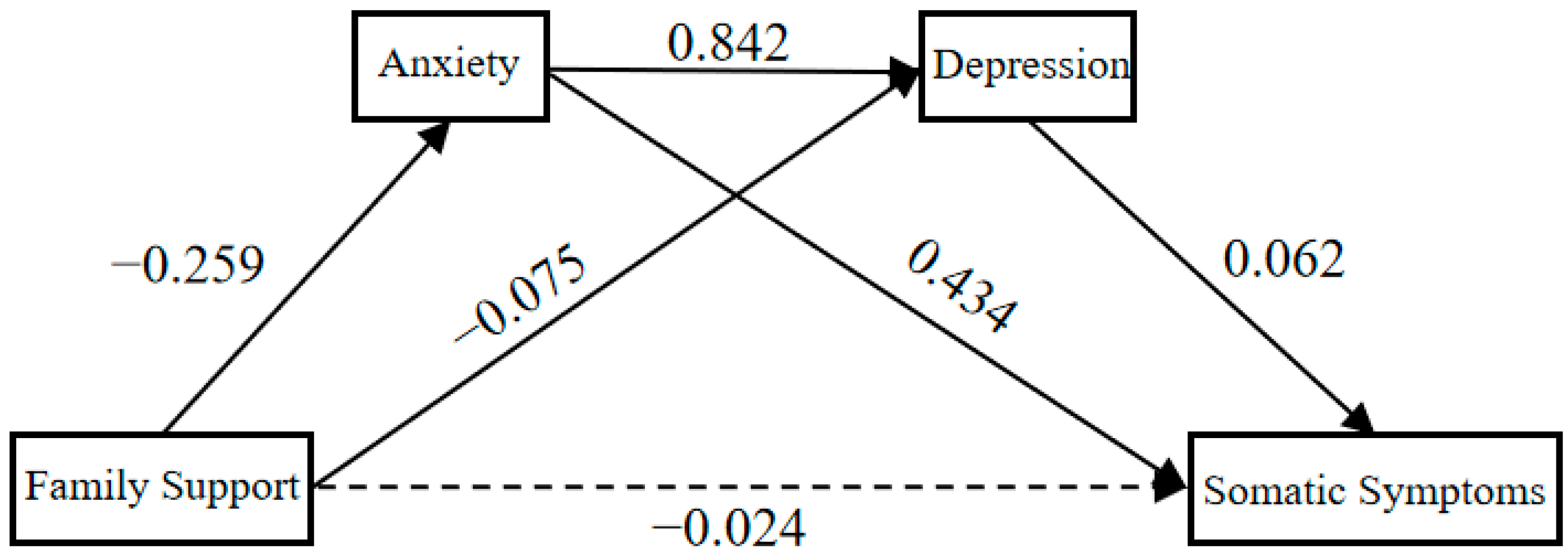
| Depression | 0.845 | 0.015 | 56.283 *** | 0.842 | 0.008 | 100.441 *** | |||||
| Somatic Symptoms | Gender | −0.104 | 0.017 | −6.105 *** | 0.283 | 203.13 *** | −0.105 | 0.012 | −8.863 *** | 0.254 | 371.37 *** |
| Grade | 0.025 | 0.017 | 1.510 | 0.026 | 0.012 | 2.202 * | |||||
| Family Support | −0.051 | 0.020 | −2.475 * | −0.024 | 0.012 | −1.926 | |||||
| Depression | 0.572 | 0.046 | 12.457 *** | 0.434 | 0.031 | 14.132 *** | |||||
| Anxiety | −0.081 | 0.043 | −1.880 | 0.062 | 0.029 | 2.127 * | |||||
| Path | Peer Counselors | General Students | |||||
|---|---|---|---|---|---|---|---|
| Effect Value | BootSE | 95% CI | Effect Value | BootSE | 95% CI | ||
| Direct Effect | FS → SS | −0.051 * | 0.020 | [−0.093, −0.012] | −0.024 | 0.012 | [−0.048, 0.000] |
| Indirect Effect | FS → A → SS | −0.172 *** | 0.018 | [−0.211, −0.139] | −0.112 *** | 0.010 | [−0.133, −0.094] |
| FS → D → SS | 0.006 | 0.003 | [−0.0004, 0.013] | −0.005 * | 0.002 | [−0.009, −0.0003] | |
| FS → A → D → SS | 0.021 | 0.011 | [−0.001, 0.043] | −0.013 * | 0.006 | [−0.026, −0.001] | |
| Total Indirect Effect | −0.145 * | 0.013 | [−0.172, −0.120] | −0.130 * | 0.011 | [−0.147, −0.115] | |
| Total Effect | −0.196 *** | 0.023 | [−0.241, −0.151] | −0.154 *** | 0.015 | [−0.184, −0.126] | |
| Path | Peer Counselors | |||
|---|---|---|---|---|
| Effect Value | BootSE | 95% CI | Ratio | |
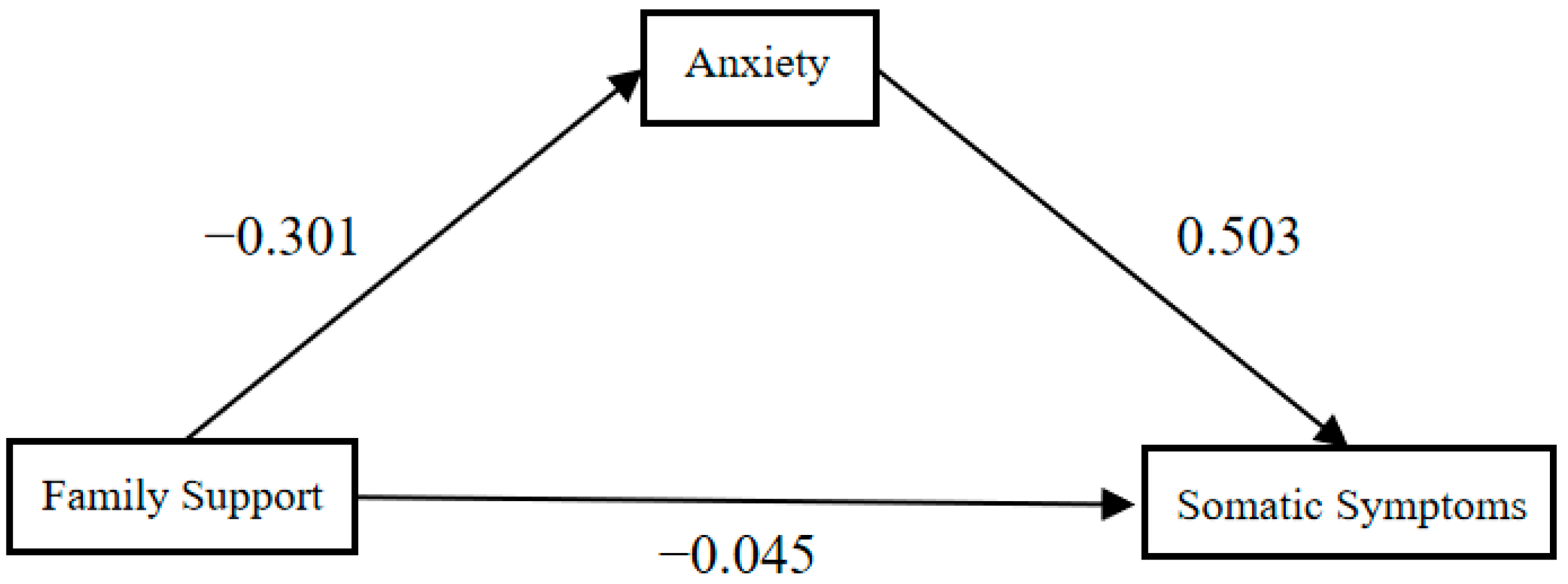
| Direct Effect | −0.045 * | 0.020 | [−0.086, −0.006] | 23.0% |
| Indirect Effect | −0.151 *** | 0.015 | [−0181, −0.125] | 77.0% |
| Total Effect | −0.196 *** | 0.023 | [−0.241, −0.151] | 100.0% |
| Path | Standardized Difference Estimate (Peer Counselors—General Students) | BootSE | p | 95% CI | |
|---|---|---|---|---|---|
| Indirect Effect | FS → A → SS | −0.059 ** | 0.021 | 0.005 | [−0.102, −0.020] |
| FS → D → SS | 0.010 ** | 0.004 | 0.008 | [0.003, 0.019] | |
| FS → A → D → SS | 0.034 ** | 0.013 | 0.008 | [0.010, 0.060] | |
| Direct Effect | FS→SS | −0.027 | 0.024 | 0.256 | [−0.075, 0.018] |
| Total Effect | −0.042 | 0.027 | 0.123 | [−0.095, 0.011] | |
Disclaimer/Publisher’s Note: The statements, opinions and data contained in all publications are solely those of the individual author(s) and contributor(s) and not of MDPI and/or the editor(s). MDPI and/or the editor(s) disclaim responsibility for any injury to people or property resulting from any ideas, methods, instructions or products referred to in the content. |
© 2026 by the authors. Licensee MDPI, Basel, Switzerland. This article is an open access article distributed under the terms and conditions of the Creative Commons Attribution (CC BY) license.
Share and Cite
Yu, J.; Yang, H.; Liang, Z. Family Support and Somatic Symptoms: The Serial Mediating Roles of Anxiety and Depression—A Multi-Group Comparison Between Peer Counselors and General Students. Behav. Sci. 2026, 16, 1465. https://doi.org/10.3390/bs16091465
Yu J, Yang H, Liang Z. Family Support and Somatic Symptoms: The Serial Mediating Roles of Anxiety and Depression—A Multi-Group Comparison Between Peer Counselors and General Students. Behavioral Sciences. 2026; 16(9):1465. https://doi.org/10.3390/bs16091465
Chicago/Turabian StyleYu, Jin, Haibo Yang, and Zhixing Liang. 2026. "Family Support and Somatic Symptoms: The Serial Mediating Roles of Anxiety and Depression—A Multi-Group Comparison Between Peer Counselors and General Students" Behavioral Sciences 16, no. 9: 1465. https://doi.org/10.3390/bs16091465
APA StyleYu, J., Yang, H., & Liang, Z. (2026). Family Support and Somatic Symptoms: The Serial Mediating Roles of Anxiety and Depression—A Multi-Group Comparison Between Peer Counselors and General Students. Behavioral Sciences, 16(9), 1465. https://doi.org/10.3390/bs16091465