Effect of Perceived Stress on Sleep Procrastination in College Students: A Chain-Mediated Role Between Depression and Inhibitory Control
 ,
,
Abstract
1. Introduction
2. Materials and Methods
2.1. Ethical Approval Statement
2.2. Participants and Procedure
2.3. Measures
2.4. Statistical Methods
3. Results
3.1. Demographics
3.2. Correlation Analysis of Perceived Stress, Depression, Inhibitory Control and Sleep Procrastination Scores
3.3. Multiple Regression Analysis of Factors Influencing Sleep Procrastination Among College Students
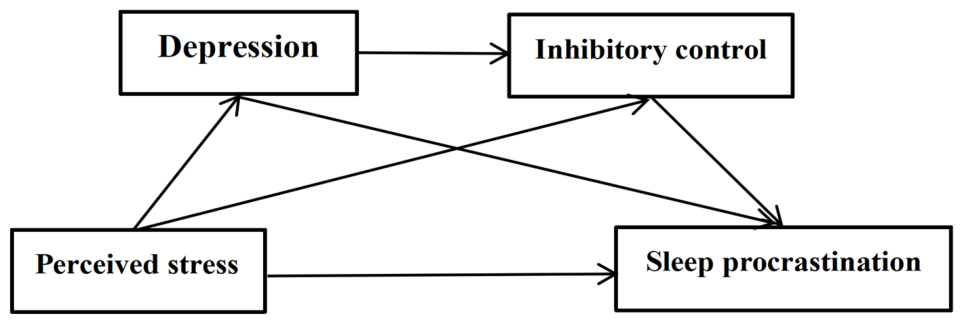
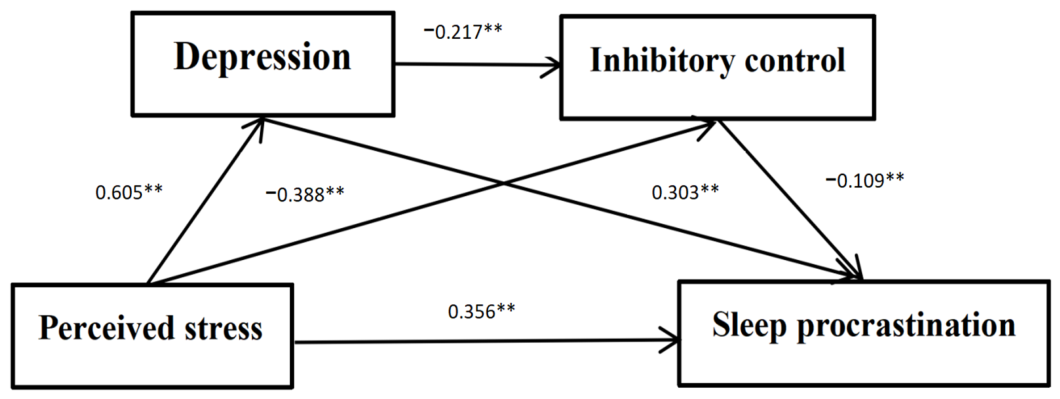
3.4. Mediating Role of Depression and Inhibitory Control in the Chain Between Perceived Stress and Sleep Procrastination of College Students
4. Discussion
5. Conclusions
Author Contributions
Funding
Institutional Review Board Statement
Informed Consent Statement
Data Availability Statement
Acknowledgments
Conflicts of Interest
References
- Alloy, L. B., Abramson, L. Y., Metalsky, G. I., & Hartlage, S. (1988). The hopelessness theory of depression: Attributional aspects. British Journal of Clinical Psychology, 27(1), 5–21. [Google Scholar] [CrossRef] [Scilit]
- Baumeister, R. F. (2002). Yielding to temptation: Self-control failure, impulsive purchasing, and consumer behavior. Journal of Consumer Research, 28(4), 670–676. [Google Scholar] [CrossRef] [Scilit] [PubMed]
- Bernecker, K., & Job, V. (2020). Too exhausted to go to bed: Implicit theories about willpower and stress predict bedtime procrastination. British Journal of Psychology, 111(1), 126–147. [Google Scholar] [CrossRef] [Scilit] [PubMed]
- Bleuler, M. (1963). Conception of schizophrenia within the last fifty years and today [abridged]. SAGE Publications. [Google Scholar]
- Chi, Z., Qian, L., Haihua, L., & Nuoxun, L. (2021). The impact of Chinese college students’ perceived stress on anxiety during the COVID-19 epidemic: The mediating role of irrational beliefs. Frontiers in Psychiatry, 12, 731874. [Google Scholar] [CrossRef] [Scilit] [PubMed]
- Cohen, K. R., & Peachey, D. (2014). Access to psychological services for Canadians: Getting what works to work for Canada’s mental and behavioural health. Canadian Psychology/Psychologie Canadienne, 55(2), 126–130. [Google Scholar] [CrossRef] [Scilit]
- Cohen, S., Kamarck, T., & Mermelstein, R. (1983). A global measure of perceived stress. Journal of Health and Social Behavior, 24, 385–396. [Google Scholar] [CrossRef] [Scilit]
- De Raedt, R., & Koster, E. H. (2010). Understanding vulnerability for depression from a cognitive neuroscience perspective: A reappraisal of attentional factors and a new conceptual framework. Cognitive, Affective, & Behavioral Neuroscience, 10(1), 50–70. [Google Scholar] [CrossRef] [Scilit] [PubMed]
- Dorina, I., Mullan, B., & Boyes, M. (2024). Clarifying the importance and moderating roles of temporal self-regulation theory across behaviour types. Psychology & Health, 41(3), 287–305. [Google Scholar] [CrossRef] [Scilit] [PubMed]
- Eerde, W. V. (2003). Procrastination at work and time management training. The Journal of Psychology, 137(5), 421–434. [Google Scholar] [CrossRef] [Scilit] [PubMed]
- Federico, G., Alfano, V., Garramone, F., Mele, G., Salvatore, M., Aiello, M., & Cavaliere, C. (2022). Self-reported sleep quality across age modulates resting-state functional connectivity in limbic and fronto-temporo-parietal networks: An exploratory cross-sectional fMRI study. Frontiers in Aging Neuroscience, 14, 806374. [Google Scholar] [CrossRef] [Scilit] [PubMed]
- Gandaputra, S. A., Waluyo, I., Efendi, F., & Wang, J.-Y. (2021). Insomnia status of middle school students in Indonesia and its association with playing games before sleep: Gender difference. International Journal of Environmental Research and Public Health, 18(2), 691. [Google Scholar] [CrossRef] [Scilit] [PubMed]
- Gioia, G. A., Guy, S. C., & Kenworthy, L. (2000). Behavior rating inventory of executive function. Child Neuropsychology, 6, 235–238. [Google Scholar]
- Goeleven, E., De Raedt, R., Baert, S., & Koster, E. H. (2006). Deficient inhibition of emotional information in depression. Journal of Affective Disorders, 93(1–3), 149–157. [Google Scholar] [CrossRef] [Scilit] [PubMed]
- Gustavson, D. E., Miyake, A., Hewitt, J. K., & Friedman, N. P. (2015). Understanding the cognitive and genetic underpinnings of procrastination: Evidence for shared genetic influences with goal management and executive function abilities. Journal of Experimental Psychology: General, 144(6), 1063–1079. [Google Scholar] [CrossRef] [Scilit] [PubMed]
- Hall, P. A., & Fong, G. T. (2007). Temporal self-regulation theory: A model for individual health behavior. Health Psychology Review, 1(1), 6–52. [Google Scholar] [CrossRef] [Scilit]
- Hayes, A. F. (2022). Introduction to mediation, moderation, and conditional process analysis: A regression-based approach (3rd ed.). The Guilford Press. [Google Scholar]
- Heatherton, T., & Tice, D. M. (1994). Losing control: How and why people fail at self-regulation. Academic Press. [Google Scholar]
- Herzog-Krzywoszanska, R., Jewula, B., & Krzywoszanski, L. (2021). Bedtime procrastination partially mediates the impact of personality characteristics on daytime fatigue resulting from sleep deficiency. Frontiers in Neuroscience, 15, 727440. [Google Scholar] [CrossRef] [Scilit] [PubMed]
- Hill, V. M., Rebar, A. L., Ferguson, S. A., Shriane, A. E., & Vincent, G. E. (2022). Go to bed! A systematic review and meta-analysis of bedtime procrastination correlates and sleep outcomes. Sleep Medicine Reviews, 66, 101697. [Google Scholar] [CrossRef] [Scilit] [PubMed]
- Huang, T., Liu, Y., Tan, T. C., Wang, D., Zheng, K., & Liu, W. (2023). Mobile phone dependency and sleep quality in college students during COVID-19 outbreak: The mediating role of bedtime procrastination and fear of missing out. BMC Public Health, 23(1), 1200. [Google Scholar] [CrossRef] [Scilit] [PubMed]
- Kashani, M., Eliasson, A., & Vernalis, M. (2012). Perceived stress correlates with disturbed sleep: A link connecting stress and cardiovascular disease. Stress, 15(1), 45–51. [Google Scholar] [CrossRef] [Scilit] [PubMed]
- Kroenke, K., Spitzer, R. L., & Williams, J. B. (2001). The PHQ-9: Validity of a brief depression severity measure. Journal of General Internal Medicine, 16(9), 606–613. [Google Scholar] [PubMed]
- Kroese, F. M., De Ridder, D. T., Evers, C., & Adriaanse, M. A. (2014). Bedtime procrastination: Introducing a new area of procrastination. Frontiers in Psychology, 5, 89333. [Google Scholar] [CrossRef] [Scilit] [PubMed]
- Lazarus, R., & Folkman, S. (1984). Coping and adaptation. The handbook of behavioral medicine (Vol. 282325). The Guildford Press. [Google Scholar]
- Liu, D., Tian, Y., Liu, M., & Yang, S. (2025). The impact of physical exercise on sleep quality among college students: The chain mediating effects of perceived stress and ruminative thinking. Psychology Research and Behavior Management, 2025, 361–373. [Google Scholar] [CrossRef] [Scilit] [PubMed]
- Liu, Z., Liu, R., Zhang, Y., Zhang, R., Liang, L., Wang, Y., Wei, Y., Zhu, R., & Wang, F. (2021). Association between perceived stress and depression among medical students during the outbreak of COVID-19: The mediating role of insomnia. Journal of Affective Disorders, 292, 89–94. [Google Scholar] [CrossRef] [Scilit] [PubMed]
- Nauts, S., Kamphorst, B. A., Stut, W., De Ridder, D. T., & Anderson, J. H. (2019). The explanations people give for going to bed late: A qualitative study of the varieties of bedtime procrastination. Behavioral Sleep Medicine, 17(6), 753–762. [Google Scholar] [CrossRef] [Scilit] [PubMed]
- Nikčević, A. V., Caselli, G., Green, D., & Spada, M. M. (2014). Negative recurrent thinking as a moderator of the relationship between perceived stress and depressive symptoms. Journal of Rational-Emotive & Cognitive-Behavior Therapy, 32(4), 248–256. [Google Scholar] [CrossRef] [Scilit]
- Rebetez, M. M. L., Rochat, L., Barsics, C., & Van der Linden, M. (2018). Procrastination as a self-regulation failure: The role of impulsivity and intrusive thoughts. Psychological Reports, 121(1), 26–41. [Google Scholar] [CrossRef] [Scilit] [PubMed]
- Roth, R. M., Isquith, P. K., & Gioia, G. A. (2005). BRIEF-A: Behavior rating inventory of executive function—Adult version: Professional manual. Psychological Assessment Resources. [Google Scholar]
- Schmidt, L. I., Baetzner, A. S., Dreisbusch, M. I., Mertens, A., & Sieverding, M. (2024). Postponing sleep after a stressful day: Patterns of stress, bedtime procrastination, and sleep outcomes in a daily diary approach. Stress and Health, 40(3), e3330. [Google Scholar] [CrossRef] [Scilit] [PubMed]
- Sirois, F. M., Stride, C. B., & Pychyl, T. A. (2023). Procrastination and health: A longitudinal test of the roles of stress and health behaviours. British Journal of Health Psychology, 28(3), 860–875. [Google Scholar] [CrossRef] [Scilit] [PubMed]
- Tsai, L.-L., & Li, S.-P. (2004). Sleep patterns in college students: Gender and grade differences. Journal of Psychosomatic Research, 56(2), 231–237. [Google Scholar] [PubMed]
- Walsh, J. J., & Ugumba-Agwunobi, G. (2002). Individual differences in statistics anxiety: The roles of perfectionism, procrastination and trait anxiety. Personality and Individual Differences, 33(2), 239–251. [Google Scholar] [CrossRef] [Scilit]
- Zhu, Y., Huang, J., & Yang, M. (2022). Association between chronotype and sleep quality among Chinese college students: The role of bedtime procrastination and sleep hygiene awareness. International Journal of Environmental Research and Public Health, 20(1), 197. [Google Scholar] [CrossRef] [Scilit] [PubMed]
- Zung, W. W. (1965). A self-rating depression scale. Archives of General Psychiatry, 12(1), 63–70. [Google Scholar] [CrossRef] [Scilit] [PubMed]



| Variable | Number of People (%) | M ± SD | t/F | p |
|---|---|---|---|---|
| Gender | 2.127 | 0.034 | ||
| Male | 950 (56.78%) | 37.38 ± 3.66 | ||
| Female | 723 (43.22%) | 36.97 ± 4.15 | ||
| Whether is an only child | 1.735 | 0.083 | ||
| Yes | 630 (37.66%) | 37.41 ± 3.75 | ||
| No | 1043 (62.34%) | 37.07 ± 3.96 | ||
| Family relationship | 0.639 | 0.590 | ||
| In perfect harmony | 334 (19.96%) | 37.35 ± 3.86 | ||
| Very harmonious | 438 (26.18%) | 37.10 ± 3.82 | ||
| Normal | 627 (37.48%) | 37.11 ± 3.93 | ||
| Disharmony | 274 (16.38%) | 37.41 ± 3.92 | ||
| Frequency of communication with parents | 1.908 | 0.126 | ||
| A lot | 271 (16.20%) | 36.98 ± 3.77 | ||
| More | 423 (25.28%) | 36.95 ± 3.95 | ||
| normal | 637 (38.08%) | 37.27 ± 4.00 | ||
| Very few | 342 (20.44%) | 37.56 ± 3.65 | ||
| Stress and burden this school year | 1.515 | 0.195 | ||
| None | 150 (8.96%) | 37.09 ± 3.56 | ||
| Lesser | 278 (16.62%) | 36.94 ± 4.21 | ||
| Normal | 549 (32.82%) | 37.02 ± 3.75 | ||
| Larger | 406 (24.27%) | 37.48 ± 3.81 | ||
| Maximum | 290 (17.33%) | 37.46 ± 4.04 | ||
| Average daily sleep duration | 4.053 | 0.007 | ||
| More than 8 h | 671 (40.11%) | 37.13 ± 3.85 | ||
| 7–8 h | 604 (36.10%) | 36.96 ± 3.94 | ||
| 6–7 h | 255 (15.24%) | 37.42 ± 3.95 | ||
| Less than 6 h | 143 (8.55%) | 38.16 ± 3.58 | ||
| The number of days that you exercised for more than 30 min in the past 7 days | 5.491 | 0.004 | ||
| More than 5 days | 435 (26.00%) | 37.05 ± 3.89 | ||
| 3–5 days | 519 (31.02%) | 36.84 ± 4.19 | ||
| 0–3 days | 719 (42.98%) | 37.55 ± 3.62 |
| Variable | M ± SD | Perceived Stress | Depression | Inhibitory Control | Sleep Procrastination |
|---|---|---|---|---|---|
| Perceived stress | 58.24 ± 5.72 | 1 | |||
| Depression | 18.90 ± 4.70 | 0.605 ** | 1 | ||
| Inhibitory control | 12.22 ± 1.93 | −0.520 ** | −0.452 ** | 1 | |
| Sleep procrastination | 37.20 ± 3.88 | 0.596 ** | 0.568 ** | −0.431 ** | 1 |
| B | Standard Error | β | t | p | Tolerance | VIF | |
|---|---|---|---|---|---|---|---|
| constant | 21.090 | 1.220 | - | 17.292 | <0.001 | - | - |
| Perceived stress | 0.241 | 0.017 | 0.356 | 14.397 | <0.001 | 0.557 | 2.211 |
| Depression | 0.251 | 0.020 | 0.303 | 12.807 | <0.001 | 0.607 | 1.944 |
| Inhibitory control | −0.220 | 0.044 | −0.109 | −4.958 | <0.001 | 0.700 | 1.492 |
| Influencing Factors | Step One | Step Two | Step Three | |||
|---|---|---|---|---|---|---|
| Dependent Variables: Depression | Dependent Variables: Inhibitory Control | Dependent Variables: Sleep Procrastination | ||||
| β | t | β | t | β | t | |
| Perceived stress | 0.605 | 31.101 ** | −0.388 | −15.078 ** | 0.356 | 14.397 ** |
| Depression | −0.217 | −8.446 | 0.303 | 12.807 ** | ||
| Inhibitory control | −0.109 | −4.958 ** | ||||
| R2 | 0.367 | 0.300 | 0.432 | |||
| F | 967.267 ** | 357.522 ** | 422.474 ** | |||
| Effect | BootSE | 95%CI | |
|---|---|---|---|
| X → M1 → Y | 0.180 | 0.017 | [0.147, 0.215] |
| X → M2 → Y | 0.042 | 0.011 | [0.021, 0.064] |
| X → M1 → M2 → Y | 0.014 | 0.004 | [0.007, 0.023] |
Disclaimer/Publisher’s Note: The statements, opinions and data contained in all publications are solely those of the individual author(s) and contributor(s) and not of MDPI and/or the editor(s). MDPI and/or the editor(s) disclaim responsibility for any injury to people or property resulting from any ideas, methods, instructions or products referred to in the content. |
© 2026 by the authors. Licensee MDPI, Basel, Switzerland. This article is an open access article distributed under the terms and conditions of the Creative Commons Attribution (CC BY) license.
Share and Cite
Ke, R.; Miao, X.; Peng, C.; Yu, F.; Han, D.; Zhang, R.; Chen, W.; Li, R.; Liu, X.; Qiao, Z.; et al. Effect of Perceived Stress on Sleep Procrastination in College Students: A Chain-Mediated Role Between Depression and Inhibitory Control. Behav. Sci. 2026, 16, 1419. https://doi.org/10.3390/bs16081419
Ke R, Miao X, Peng C, Yu F, Han D, Zhang R, Chen W, Li R, Liu X, Qiao Z, et al. Effect of Perceived Stress on Sleep Procrastination in College Students: A Chain-Mediated Role Between Depression and Inhibitory Control. Behavioral Sciences. 2026; 16(8):1419. https://doi.org/10.3390/bs16081419
Chicago/Turabian StyleKe, Ran, Xin Miao, Chundi Peng, Fei Yu, Dong Han, Ruobing Zhang, Weiye Chen, Ruyi Li, Xinyao Liu, Zhengxue Qiao, and et al. 2026. "Effect of Perceived Stress on Sleep Procrastination in College Students: A Chain-Mediated Role Between Depression and Inhibitory Control" Behavioral Sciences 16, no. 8: 1419. https://doi.org/10.3390/bs16081419
APA StyleKe, R., Miao, X., Peng, C., Yu, F., Han, D., Zhang, R., Chen, W., Li, R., Liu, X., Qiao, Z., & Yang, Y. (2026). Effect of Perceived Stress on Sleep Procrastination in College Students: A Chain-Mediated Role Between Depression and Inhibitory Control. Behavioral Sciences, 16(8), 1419. https://doi.org/10.3390/bs16081419