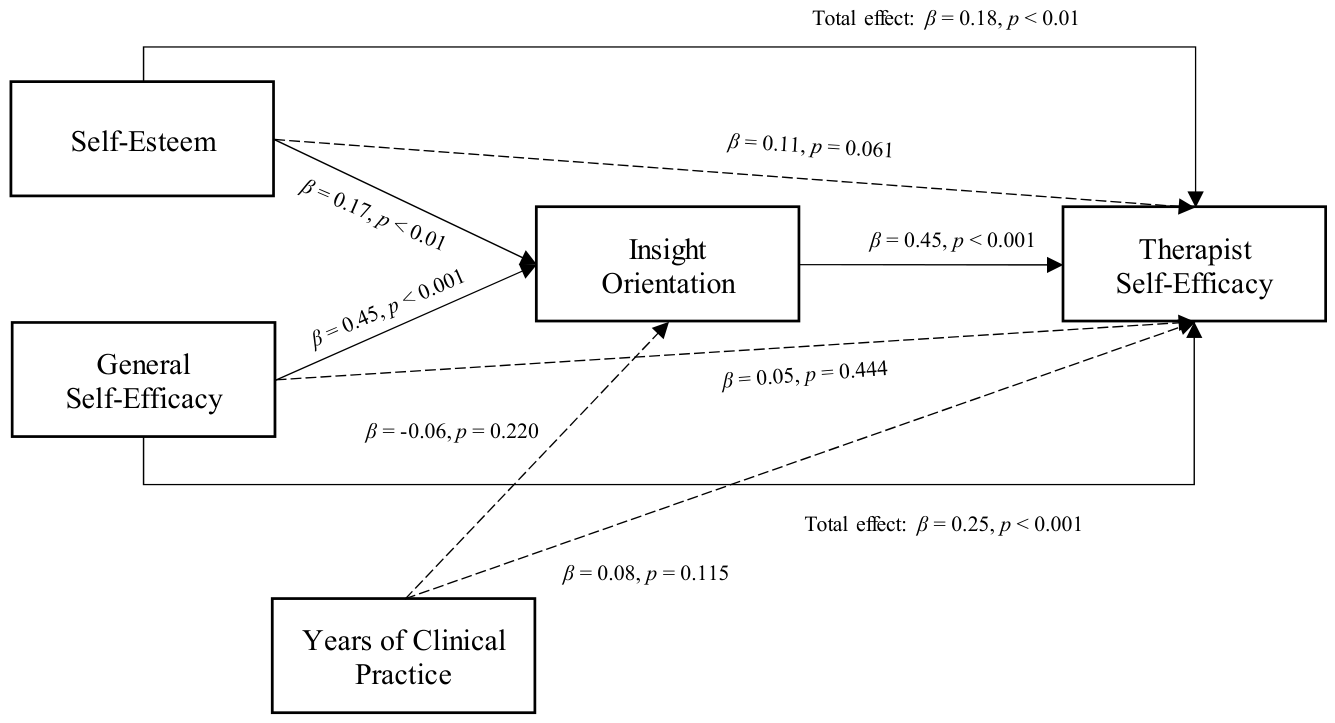
Therapists’ Personal Identity Factors and Professional Self-Efficacy: A Path Analysis Model


Abstract
1. Introduction
2. Materials and Methods
2.1. Study Design, Participants, and Procedure
2.2. Measures
2.2.1. Therapist Self-Efficacy Scale (T-SES)
2.2.2. General Self-Efficacy Scale (GSE)
2.2.3. Rosenberg Self-Esteem Scale (RSES)
2.2.4. Insight Orientation Scale (IOS)
2.3. Data Analysis
3. Results
4. Discussion
5. Conclusions
Author Contributions
Funding
Institutional Review Board Statement
Informed Consent Statement
Data Availability Statement
Conflicts of Interest
References
- Aafjes-Van Doorn, K., Békés, V., Luo, X., & Hopwood, C. J. (2024). Therapists’ perception of the working alliance, real relationship and therapeutic presence in in-person therapy versus tele-therapy. Psychotherapy Research, 34(5), 574–588. [Google Scholar] [CrossRef] [Scilit] [PubMed]
- Alves, S., & Gazzola, N. (2011). Professional identity: A qualitative inquiry of experienced counsellors. Canadian Journal of Counselling and Psychotherapy, 45(3), 189–207. Available online: https://files.eric.ed.gov/fulltext/EJ944808.pdf (accessed on 14 July 2026).
- American Psychological Association. (2012). Revised competency benchmarks in professional psychology. American Psychological Association. Available online: https://www.apa.org/ed/graduate/benchmarks-evaluation-system (accessed on 6 December 2020).
- Bandura, A. (1986). The explanatory and predictive scope of self-efficacy theory. Journal of Social and Clinical Psychology, 4(3), 359–373. [Google Scholar] [CrossRef] [Scilit]
- Bandura, A. (1997). Self-efficacy: The exercise of self-control. Freeman. [Google Scholar]
- Barkham, M., Lutz, W., Lambert, M. J., & Saxon, D. (2017). Therapist effects, effective therapists, and the law of variability. In L. G. Castonguay, & C. E. Hill (Eds.), How and why are some therapists better than others? Understanding therapist effects (pp. 13–36). American Psychological Association. [Google Scholar]
- Barnett, P., Goulding, L., Casetta, C., Jordan, H., Sheridan-Rains, L., Steare, T., & Johnson, S. (2021). Tele-mental health services: A rapid umbrella review of pre-COVID-19 literature. Journal of Medical Internet Research, 23(7), e26492. [Google Scholar] [CrossRef] [Scilit] [PubMed]
- Bashshur, R. L., Shannon, G. W., Bashshur, N., & Yellowlees, P. M. (2016). The empirical evidence for telemedicine interventions in mental disorders. Telemedicine and e-Health, 22(2), 87–113. [Google Scholar] [CrossRef] [Scilit] [PubMed]
- Berzonsky, M. D. (1992). Identity style and coping strategies. Journal of Personality, 60(4), 771–788. [Google Scholar] [CrossRef] [Scilit] [PubMed]
- Betz, N. E., & Klein, K. L. (1996). Relationships among measures of career self-efficacy, generalized self-efficacy, and global self-esteem. Journal of Career Assessment, 4(3), 285–298. [Google Scholar] [CrossRef] [Scilit]
- Békés, V., Aafjes-van Doorn, K., Luo, X., Balarajan, S., & Hopwood, C. J. (2023). Mastery of teletherapy is related to better therapeutic relationship and presence in teletherapy: The development of the teletherapy intervention scale. Frontiers in Psychology, 14, 1206960. [Google Scholar] [CrossRef] [Scilit] [PubMed]
- Békés, V., Aafjes-van Doorn, K., Luo, X., Prout, T. A., & Hoffman, L. (2021). Psychotherapists’ challenges with online therapy during COVID-19: Concerns about connectedness predict therapists’ negative view of online therapy and its perceived efficacy over time. Frontiers in Psychology, 12, 705699. [Google Scholar] [CrossRef] [Scilit] [PubMed]
- Bollen, K. A., & Long, J. S. (1993). Testing structural equation models (Vol. 154). Sage. [Google Scholar]
- Bowling, N. A., Eschleman, K. J., Wang, Q., Kirkendall, C., & Alarcon, G. (2010). A meta-analysis of the predictors and consequences of organization-based self-esteem. Journal of Occupational and Organizational Psychology, 83(3), 601–626. [Google Scholar] [CrossRef] [Scilit]
- British Psychological Society. (2006). Core competencies—Clinical psychology: A guide. Leicester. [Google Scholar]
- Byrne, B. M. (1994). Structural equation modeling with EQS and EQS/windows: Basic concepts, applications, and programming. Sage. [Google Scholar]
- Castonguay, L. G., & Hill, C. E. (2007). Insight in psychotherapy. American Psychological Association. [Google Scholar]
- Céspedes, C., Rubio, A., Viñas, F., Malo Cerrato, S., Lara-Órdenes, E., & Ríos, J. (2021). Relationship between self-concept, self-efficacy, and subjective well-being of native and migrant adolescents. Frontiers in Psychology, 11, 620782. [Google Scholar] [CrossRef] [Scilit] [PubMed]
- Chen, W.-C., Chan, H.-Y., Sung, Y.-H., Chen, P.-L., Hung, Y.-F., Huang, K.-C., & Hsu, S.-S. (2023). Therapists’ practical implementation and preparation of online counseling in the post-pandemic era. Current Psychology, 42, 30548–30560. [Google Scholar] [CrossRef] [Scilit] [PubMed]
- Cheng, L., Chen, Q., & Zhang, F. (2021). Mediating effects of meaning in life on the relationship between general self-efficacy and nursing professional commitment in nursing students: A structural equation modeling approach. Medicine, 100(29), e26754. [Google Scholar] [CrossRef] [Scilit] [PubMed]
- Choi, B. Y., Park, H., Yang, E., Lee, S. K., Lee, Y., & Lee, S. M. (2012). Understanding career decision self-efficacy: A meta-analytic approach. Journal of Career Development, 39(5), 443–460. [Google Scholar] [CrossRef] [Scilit]
- Cohen, J. (1988). Statistical power analysis for the behavioral sciences. Lawrence Erlbaum Associates. [Google Scholar]
- Cowden, R. G., & Meyer-Weitz, A. (2016). Self-reflection and self-insight predict resilience and stress in competitive tennis. Social Behavior and Personality: An International Journal, 44(7), 1133–1149. [Google Scholar] [CrossRef] [Scilit]
- Daniels, J. A., & Larson, L. M. (2001). The impact of performance feedback on counseling self-efficacy and counselor anxiety. Counselor Education and Supervision, 41(2), 120–130. [Google Scholar] [CrossRef] [Scilit]
- Dobson, R., Variava, R., Douglas, M., & Reynolds, L. M. (2022). Digital competency of psychologists in Aotearoa New Zealand: A cross-sectional survey. Frontiers in Digital Health, 4, 951366. [Google Scholar] [CrossRef] [Scilit] [PubMed]
- Dogan, T., Totan, T., & Sapmaz, F. (2013). The role of self-esteem, psychological well-being, emotional self-efficacy, and affect balance on happiness: A path model. European Scientific Journal, 9(20), 31–42. [Google Scholar]
- Faul, F., Erdfelder, E., Buchner, A., & Lang, A.-G. (2009). Statistical power analyses using G*Power 3.1: Tests for correlation and regression analyses. Behavior Research Methods, 41(4), 1149–1160. [Google Scholar] [CrossRef] [Scilit] [PubMed]
- Feltz, D. L., Short, S. E., & Sullivan, P. J. (2008). Self-efficacy in sport. Human Kinetics. [Google Scholar]
- Fraser, J. A., Flemington, T., Doan, D. T. N., Le Doan, B. T., & Ha, T. M. (2018). Professional self-efficacy for responding to child abuse presentations. Journal of Children’s Services, 13(3/4), 81–92. [Google Scholar] [CrossRef] [Scilit]
- Gabbard, G. O. (2014). Psychodynamic psychiatry in clinical practice. American Psychiatric Pub. [Google Scholar]
- Gibbons, M. B. C., Crits-Christoph, P., Barber, J. P., Wiltsey Stirman, S., Gallop, R., Goldstein, L. A., Temes, C. M., & Ring-Kurtz, S. (2009). Unique and common mechanisms of change across cognitive and dynamic psychotherapies. Journal of Consulting and Clinical Psychology, 77(5), 801–813. [Google Scholar] [CrossRef] [Scilit] [PubMed]
- Glotova, G., & Wilhelm, A. (2014). Teacher’s self-concept and self-esteem in pedagogical communication. Procedia-Social and Behavioral Sciences, 132, 509–514. [Google Scholar] [CrossRef] [Scilit]
- Gori, A., Arcioni, A., Topino, E., Craparo, G., & Lauro Grotto, R. (2021a). Development of a new measure for assessing mentalizing: The multidimensional mentalizing questionnaire (MMQ). Journal of Personalized Medicine, 11(4), 305. [Google Scholar] [CrossRef] [Scilit] [PubMed]
- Gori, A., Arcioni, A., Topino, E., Palazzeschi, L., & Di Fabio, A. (2021b). Constructing well-being in organizations: First empirical results on job crafting, personality traits, and insight. International Journal of Environmental Research and Public Health, 18(12), 6661. [Google Scholar] [CrossRef] [Scilit] [PubMed]
- Gori, A., Craparo, G., Giannini, M., Loscalzo, Y., Caretti, V., La Barbera, D., & Schuldberg, D. (2015). Development of a new measure for assessing insight: Psychometric properties of the insight orientation scale (IOS). Schizophrenia Research, 169(1–3), 298–302. [Google Scholar] [CrossRef] [Scilit] [PubMed]
- Gori, A., & Topino, E. (2020). Predisposition to change is linked to job satisfaction: Assessing the mediation roles of workplace relation civility and insight. International Journal of Environmental Research and Public Health, 17(6), 2141. [Google Scholar] [CrossRef] [Scilit] [PubMed]
- Gori, A., Topino, E., Brugnera, A., & Compare, A. (2022a). Assessment of professional self-efficacy in psychological interventions and psychotherapy sessions: Development of the Therapist Self-Efficacy Scale (T-SES) and its application for eTherapy. Journal of Clinical Psychology, 78(11), 2122–2144. [Google Scholar] [CrossRef] [Scilit] [PubMed]
- Gori, A., Topino, E., Cacioppo, M., Schimmenti, A., & Caretti, V. (2023). Definition and criteria for the assessment of expertise in psychotherapy: Development of the psychotherapy expertise questionnaire (PEQ). European Journal of Investigation in Health, Psychology and Education, 13(11), 2478–2497. [Google Scholar] [CrossRef] [Scilit] [PubMed]
- Gori, A., Topino, E., Svicher, A., Schuldberg, D., & Di Fabio, A. (2022b). Insight orientation scale: A promising tool for organizational outcomes—A psychometric analysis using item response theory. Frontiers in Psychology, 13, 987931. [Google Scholar] [CrossRef] [Scilit] [PubMed]
- Gunduz, B. (2012). Self-efficacy and burnout in professional school counselors. Educational Sciences: Theory and Practice, 12(3), 1761–1767. [Google Scholar]
- Hahn, D., Weck, F., Witthöft, M., & Kühne, F. (2021). Assessment of counseling self-efficacy: Validation of the German counselor activity self-efficacy scales-revised. Frontiers in Psychology, 12, 780088. [Google Scholar] [CrossRef] [Scilit] [PubMed]
- Hatcher, R. L., Fouad, N. A., Grus, C. L., Campbell, L. C., McCutcheon, S. R., & Leahy, K. L. (2013). Competence benchmarks: Practical steps toward a culture of competence. Training and Education in Professional Psychology, 7, 84–91. [Google Scholar] [CrossRef] [Scilit]
- Heled, E., & Davidovitch, N. (2021). Personal and group professional identity in the 21st century: Case study: The school counseling profession. Journal of Education and Learning, 10(3), 64–82. [Google Scholar] [CrossRef] [Scilit]
- Hilty, D. M., Ferrer, D. C., Parish, M. B., Johnston, B., Callahan, E. J., & Yellowlees, P. M. (2013). The effectiveness of telemental health: A 2013 review. Telemedicine Journal and e-Health, 19(6), 444–454. [Google Scholar] [CrossRef] [Scilit] [PubMed]
- Holland, K., Middleton, L., & Uys, L. (2012). Professional confidence: A concept analysis. Scandinavian Journal of Occupational Therapy, 19(2), 214–224. [Google Scholar] [CrossRef] [Scilit] [PubMed]
- Hooper, D., Coughlan, J., & Mullen, M. R. (2008). Structural equation modelling: Guidelines for determining model fit. Electronic Journal of Business Research Methods, 6(1), 53–60. [Google Scholar] [CrossRef]
- Hu, L. T., & Bentler, P. M. (1999). Cutoff criteria for fit indexes in covariance structure analysis: Conventional criteria versus new alternatives. Structural Equation Modeling: A Multidisciplinary Journal, 6(1), 1–55. [Google Scholar] [CrossRef] [Scilit]
- Kline, R. B. (2015). Principles and practice of structural equation modeling (4th ed.). The Guilford Press. [Google Scholar]
- Knapp, S., Gottlieb, M. C., & Handelsman, M. M. (2017). Self-awareness questions for effective psychotherapists: Helping good psychotherapists become even better. Practice Innovations, 2(4), 163–172. [Google Scholar] [CrossRef] [Scilit]
- Kondratowicz, B., Godlewska-Werner, D., Połomski, P., & Khosla, M. (2022). Satisfaction with job and life and remote work in the COVID-19 pandemic: The role of perceived stress, self-efficacy and self-esteem. Current Issues in Personality Psychology, 9(1), 49–60. [Google Scholar] [CrossRef] [Scilit] [PubMed]
- Kwan, V. S. Y., John, O. P., Kenny, D. A., Bond, M. H., & Robins, R. W. (2004). Reconceptualizing individual differences in self-enhancement bias: An interpersonal approach. Psychological Review, 111(1), 94–110. [Google Scholar] [CrossRef] [Scilit] [PubMed]
- Lee, T. W., & Ko, Y. K. (2010). Effects of self-efficacy, affectivity and collective efficacy on nursing performance of hospital nurses. Journal of Advanced Nursing, 66(4), 839–848. [Google Scholar] [CrossRef] [Scilit] [PubMed]
- Lent, R. W., do Céu Taveira, M., Sheu, H. B., & Singley, D. (2009). Social cognitive predictors of academic adjustment and life satisfaction in Portuguese college students: A longitudinal analysis. Journal of Vocational Behavior, 74(2), 190–198. [Google Scholar] [CrossRef] [Scilit]
- Leykin, Y., Thekdi, S. M., Shumay, D. M., Munoz, R. F., Riba, M., & Dunn, L. B. (2012). Internet interventions for improving psychological well-being in psycho-oncology: Review and recommendations. Psycho-Oncology, 21(9), 1016–1025. [Google Scholar] [CrossRef] [Scilit] [PubMed]
- Lin, T., Heckman, T. G., & Anderson, T. (2022). The efficacy of synchronous teletherapy versus in-person therapy: A meta-analysis of randomized clinical trials. Clinical Psychology: Science and Practice, 29(2), 167–178. [Google Scholar] [CrossRef] [Scilit]
- Luyckx, K., Klimstra, T. A., Duriez, B., Van Petegem, S., Beyers, W., Teppers, E., & Goossens, L. (2013). Personal identity processes and self-esteem: Temporal sequences in high school and college students. Journal of Research in Personality, 47(2), 159–170. [Google Scholar] [CrossRef] [Scilit]
- Marques, L., LeBlanc, N. J., Weingarden, H. M., Timpano, K. R., Jenike, M., & Wilhelm, S. (2010). Barriers to treatment and service utilization in an internet sample of individuals with obsessive–compulsive symptoms. Depression and Anxiety, 27(5), 470–475. [Google Scholar] [CrossRef] [Scilit] [PubMed]
- Marsh, H. W., & Hocevar, D. (1985). Application of confirmatory factor analysis to the study of self-concept: First- and higher-order factor models and their invariance across groups. Psychological Bulletin, 97(3), 562–582. [Google Scholar] [CrossRef]
- Meyer, J. M. (2015). Counseling self-efficacy: On-campus and distance education students. Rehabilitation Counseling Bulletin, 58(3), 165–172. [Google Scholar] [CrossRef] [Scilit]
- Molero Jurado, M. D. M., Pérez-Fuentes, M. D. C., Gázquez Linares, J. J., & Barragán Martín, A. B. (2018). Burnout in health professionals according to their self-esteem, social support and empathy profile. Frontiers in Psychology, 9, 424. [Google Scholar] [CrossRef] [Scilit] [PubMed]
- Nissen-Lie, H. A., Rønnestad, M. H., Høglend, P. A., Havik, O. E., Solbakken, O. A., Stiles, T. C., & Monsen, J. T. (2017). Love yourself as a person, doubt yourself as a therapist? Clinical Psychology & Psychotherapy, 24(1), 48–60. [Google Scholar] [CrossRef] [Scilit] [PubMed]
- Nuttman-Schwartz, O. (2017). Rethinking professional identity in a globalized world. Clinical Social Work Journal, 45, 1–9. [Google Scholar] [CrossRef] [Scilit]
- Orkaizagirre-Gómara, A., Sánchez De Miguel, M., Ortiz de Elguea, J., & Ortiz de Elguea, A. (2020). Testing general self-efficacy, perceived competence, resilience, and stress among nursing students: An integrator evaluation. Nursing & Health Sciences, 22(3), 529–538. [Google Scholar] [CrossRef] [Scilit] [PubMed]
- Pandey, R., Tiwari, G. K., Parihar, P., & Rai, P. K. (2021). Positive, not negative, self-compassion mediates the relationship between self-esteem and well-being. Psychology and Psychotherapy: Theory, Research and Practice, 94(1), 1–15. [Google Scholar] [CrossRef] [Scilit] [PubMed]
- Peng, J., Zhang, J., Zhou, X., Wan, Z., Yuan, W., Gui, J., & Zhu, X. (2021). Validation of the occupational self-efficacy scale in a sample of Chinese employees. Frontiers in Psychology, 12, 755134. [Google Scholar] [CrossRef] [Scilit] [PubMed]
- Poletti, B., Tagini, S., Brugnera, A., Parolin, L., Pievani, L., Ferrucci, R., & Silani, V. (2020). Telepsychotherapy: A leaflet for psychotherapists in the age of COVID-19. A review of the evidence. Counselling Psychology Quarterly, 34, 352–367. [Google Scholar] [CrossRef] [Scilit]
- Prasko, J., Ociskova, M., Abeltina, M., Krone, I., Kantor, K., Vanek, J., Slepecky, M., Minarikova, K., Mozny, P., Piliarova, M., & Bite, I. (2023). The importance of self-experience and self-reflection in training of cognitive behavioral therapy. Neuroendocrinology Letters, 44(3), 152–163. [Google Scholar] [PubMed]
- Preacher, K. J., & Hayes, A. F. (2008). Asymptotic and resampling strategies for assessing and comparing indirect effects in multiple mediator models. Behavior Research Methods, 40(3), 879–891. [Google Scholar] [CrossRef] [Scilit] [PubMed]
- Prezza, M., Trombaccia, F. R., & Armento, L. (1997). La scala dell’autostima di Rosenberg: Traduzione e validazione italiana [The Rosenberg Self-Esteem Scale: Italian translation and validation]. Giunti Organizzazioni Speciali, 223, 35–44. [Google Scholar]
- Pyszczynski, T., Greenberg, J., Solomon, S., Arndt, J., & Schimel, J. (2004). Why do people need self-esteem? A theoretical and empirical review. Psychological Bulletin, 130(3), 435–468. [Google Scholar] [CrossRef] [Scilit] [PubMed]
- Reese, R. J., Aldarondo, F., Anderson, C. R., Lee, S. J., Miller, T. W., & Burton, D. (2009). Telehealth in clinical supervision: A comparison of supervision formats. Journal of Telemedicine and Telecare, 15(7), 356–361. [Google Scholar] [CrossRef] [Scilit] [PubMed]
- Reilly, E., Dhingra, K., & Boduszek, D. (2014). Teachers’ self-efficacy beliefs, self-esteem, and job stress as determinants of job satisfaction. International Journal of Educational Management, 28(4), 365–378. [Google Scholar] [CrossRef] [Scilit]
- Rochlen, A. B., Zack, J. S., & Speyer, C. (2004). Online therapy: Review of relevant definitions, debates, and current empirical support. Journal of Clinical Psychology, 60(3), 269–283. [Google Scholar] [CrossRef] [Scilit] [PubMed]
- Rosenberg, M. (1965a). Rosenberg self-esteem scale (RSE). Acceptance and Commitment Therapy: Measures Package, 61(52), 18. [Google Scholar]
- Rosenberg, M. (1965b). Society and the adolescent self-image. Princeton University Press. [Google Scholar]
- Rønnestad, M. H., & Skovholt, T. M. (2003). The journey of the counselor and therapist: Research findings and perspectives on professional development. Journal of Career Development, 30(1), 5–44. [Google Scholar] [CrossRef] [Scilit]
- Salanova, M., Llorens, S., & Schaufeli, W. B. (2011). “Yes, I can, I feel good, and I just do it!” On gain cycles and spirals of efficacy beliefs, affect, and engagement. Applied Psychology: An International Review, 60, 255–285. [Google Scholar] [CrossRef] [Scilit]
- Saleem, T., & Hawamdeh, E. S. (2022). Counselor self-efficacy, spiritual well-being and compassion satisfaction/fatigue among mental health professionals in Pakistan. Current Psychology. Advance online publication. [Google Scholar] [CrossRef] [Scilit]
- Scharff, J. S. (2012). Clinical issues in analyses over the telephone and the Internet. The International Journal of Psychoanalysis, 93(1), 81–95. [Google Scholar] [CrossRef] [Scilit] [PubMed]
- Scholz, U., Gutiérrez Doña, B., Sud, S., & Schwarzer, R. (2002). Is general self-efficacy a universal construct? Psychometric findings from 25 countries. European Journal of Psychological Assessment, 18(3), 242–251. [Google Scholar] [CrossRef] [Scilit]
- Schwarzer, R., & Jerusalem, M. (1995). Generalized self-efficacy scale. In J. Weinman, S. Wright, & M. Johnston (Eds.), Measures in health psychology: A user’s portfolio. Causal and control beliefs (pp. 35–37). NFER-NELSON. [Google Scholar]
- Sibilia, L., Schwarzer, R., & Jerusalem, M. (1995). Italian adaptation of the general self-efficacy scale. Available online: http://userpage.fu-berlin.de/~health/italian.htm (accessed on 6 December 2020).
- Simpson, S. G., & Reid, C. L. (2014). Therapeutic alliance in videoconferencing psychotherapy: A review. Australian Journal of Rural Health, 22(6), 280–299. [Google Scholar] [CrossRef] [Scilit] [PubMed]
- Sowislo, J. F., & Orth, U. (2013). Does low self-esteem predict depression and anxiety? A meta-analysis of longitudinal studies. Psychological Bulletin, 139(1), 213–240. [Google Scholar] [CrossRef] [Scilit] [PubMed]
- Stoll, J., Müller, J. A., & Trachsel, M. (2020). Ethical issues in online psychotherapy: A narrative review. Frontiers in Psychiatry, 10, 993. [Google Scholar] [CrossRef] [Scilit] [PubMed]
- Tan, C. P., Van der Molen, H. T., & Schmidt, H. G. (2017). A measure of professional identity development for professional education. Studies in Higher Education, 42(8), 1504–1519. [Google Scholar] [CrossRef] [Scilit]
- van Seggelen-Damen, I., & van Dam, K. (2016). Self-reflection as a mediator between self-efficacy and well-being. Journal of Managerial Psychology, 31(1), 18–33. [Google Scholar] [CrossRef] [Scilit]
- Waller, G., Pugh, M., Mulkens, S., Moore, E., Mountford, V. A., Carter, J., & Smit, V. (2020). Cognitive-behavioral therapy in the time of coronavirus: Clinician tips for working with eating disorders via telehealth when face-to-face meetings are not possible. International Journal of Eating Disorders, 53(7), 1132–1141. [Google Scholar] [CrossRef] [Scilit] [PubMed]
- Wampold, B. E., Baldwin, S. A., Holtforth, M. G., & Imel, Z. E. (2017). What characterizes effective therapists? In L. G. Castonguay, & C. E. Hill (Eds.), How and why are some therapists better than others? Understanding therapist effects (pp. 37–53). American Psychological Association. [Google Scholar]
- Wijeyesinghe, C. L., & Jones, S. R. (2014). Intersectionality, identity, and systems of power and inequality. In D. Mitchell, C. Y. Simmons, & L. A. Greyerbiehl (Eds.), Intersectionality and higher education: Theory, research, and praxis (pp. 9–19). Peter Lang. [Google Scholar]
- Wiles, F. (2013). “Not easily put into a box”: Constructing professional identity. Social Work Education, 32(7), 854–866. [Google Scholar] [CrossRef] [Scilit]
- Yao, X., Yu, L., Shen, Y., Kang, Z., & Wang, X. (2021). The role of self-efficacy in mediating between professional identity and self-reported competence among nursing students in the internship period: A quantitative study. Nurse Education in Practice, 57, 103252. [Google Scholar] [CrossRef] [Scilit] [PubMed]
- Yoo, S. Y., & Cho, H. (2020). Exploring the influences of nurses’ partnership with parents, attitude to families’ importance in nursing care, and professional self-efficacy on quality of pediatric nursing care: A path model. International Journal of Environmental Research and Public Health, 17(15), 5452. [Google Scholar] [CrossRef] [Scilit] [PubMed]
- Zhou, M. (2016). A revisit of General Self-Efficacy Scale: Uni- or multi-dimensional? Current Psychology, 35, 427–436. [Google Scholar] [CrossRef] [Scilit]


| Characteristics | M ± SD | n | % | |
|---|---|---|---|---|
| Age | 38.25 ± 8.40 | |||
| Sex | Females | 257 | 88.6 | |
| Males | 33 | 11.4 | ||
| Professional Qualification | Psychologists | 112 | 38.6 | |
| Psychotherapists | 178 | 61.4 | ||
| Years of Clinical Practice | Less than a year | 22 | 7.6 | |
| 1–2 years | 34 | 11.7 | ||
| 2–5 years | 63 | 21.7 | ||
| 5–10 years | 78 | 26.9 | ||
| More than 10 years | 93 | 32.1 | ||
| Theoretical Orientation (Psychotherapists only) | Psychoanalytic | 15 | 5.2 | |
| Psychodynamic | 28 | 9.7 | ||
| Cognitive | 18 | 6.2 | ||
| Cognitive behavioral | 30 | 10.3 | ||
| Humanistic | 17 | 5.9 | ||
| Integrated | 38 | 13.1 | ||
| Systemic | 32 | 11.0 |
| General Self-Efficacy | Self-Esteem | Insight Orientation | Therapist Self-Efficacy | |
|---|---|---|---|---|
| General Self-Efficacy | 1 | |||
| Self-Esteem | 0.44 | 1 | ||
| Insight Orientation | 0.52 | 0.37 | 1 | |
| Therapist Self-Efficacy | 0.33 | 0.29 | 0.51 | 1 |
| Estimate | SE | p | BootLLCI | BootULCI | |
|---|---|---|---|---|---|
| Total effects | |||||
| Self-Esteem → Therapist Self-Efficacy | 0.183 | 0.062 | <0.01 | 0.061 | 0.365 |
| General Self-Efficacy → Therapist Self-Efficacy | 0.247 | 0.060 | <0.001 | 0.127 | 0.364 |
| Direct effects | |||||
| Self-Esteem → Therapist Self-Efficacy | 0.107 | 0.059 | 0.083 | −0.015 | 0.216 |
| General Self-Efficacy → Therapist Self-Efficacy | 0.047 | 0.058 | 0.389 | −0.063 | 0.165 |
| Indirect effects | |||||
| Self-Esteem → Insight Orientation → Therapist Self-Efficacy | 0.077 | 0.032 | <0.001 | 0.034 | 0.133 |
| General Self-Efficacy → Insight Orientation → Therapist Self-Efficacy | 0.200 | 0.033 | <0.001 | 0.133 | 0.282 |
Disclaimer/Publisher’s Note: The statements, opinions and data contained in all publications are solely those of the individual author(s) and contributor(s) and not of MDPI and/or the editor(s). MDPI and/or the editor(s) disclaim responsibility for any injury to people or property resulting from any ideas, methods, instructions or products referred to in the content. |
© 2026 by the authors. Licensee MDPI, Basel, Switzerland. This article is an open access article distributed under the terms and conditions of the Creative Commons Attribution (CC BY) license.
Share and Cite
Gori, A.; Topino, E. Therapists’ Personal Identity Factors and Professional Self-Efficacy: A Path Analysis Model. Behav. Sci. 2026, 16, 1425. https://doi.org/10.3390/bs16081425
Gori A, Topino E. Therapists’ Personal Identity Factors and Professional Self-Efficacy: A Path Analysis Model. Behavioral Sciences. 2026; 16(8):1425. https://doi.org/10.3390/bs16081425
Chicago/Turabian StyleGori, Alessio, and Eleonora Topino. 2026. "Therapists’ Personal Identity Factors and Professional Self-Efficacy: A Path Analysis Model" Behavioral Sciences 16, no. 8: 1425. https://doi.org/10.3390/bs16081425
APA StyleGori, A., & Topino, E. (2026). Therapists’ Personal Identity Factors and Professional Self-Efficacy: A Path Analysis Model. Behavioral Sciences, 16(8), 1425. https://doi.org/10.3390/bs16081425