

The Effect of Influencer Image Types on Purchase Intention: The Mediating Role of Persuasion Knowledge and the Moderating Role of Parasocial Relationships

Abstract
1. Introduction
2. Literature Review and Hypothesis Development
2.1. Image Types, Self-Referential Processing, and Purchase Intention
2.2. Persuasion Knowledge as a Cognitive Mechanism
2.3. PSRs as a Relational Context in Influencer Marketing
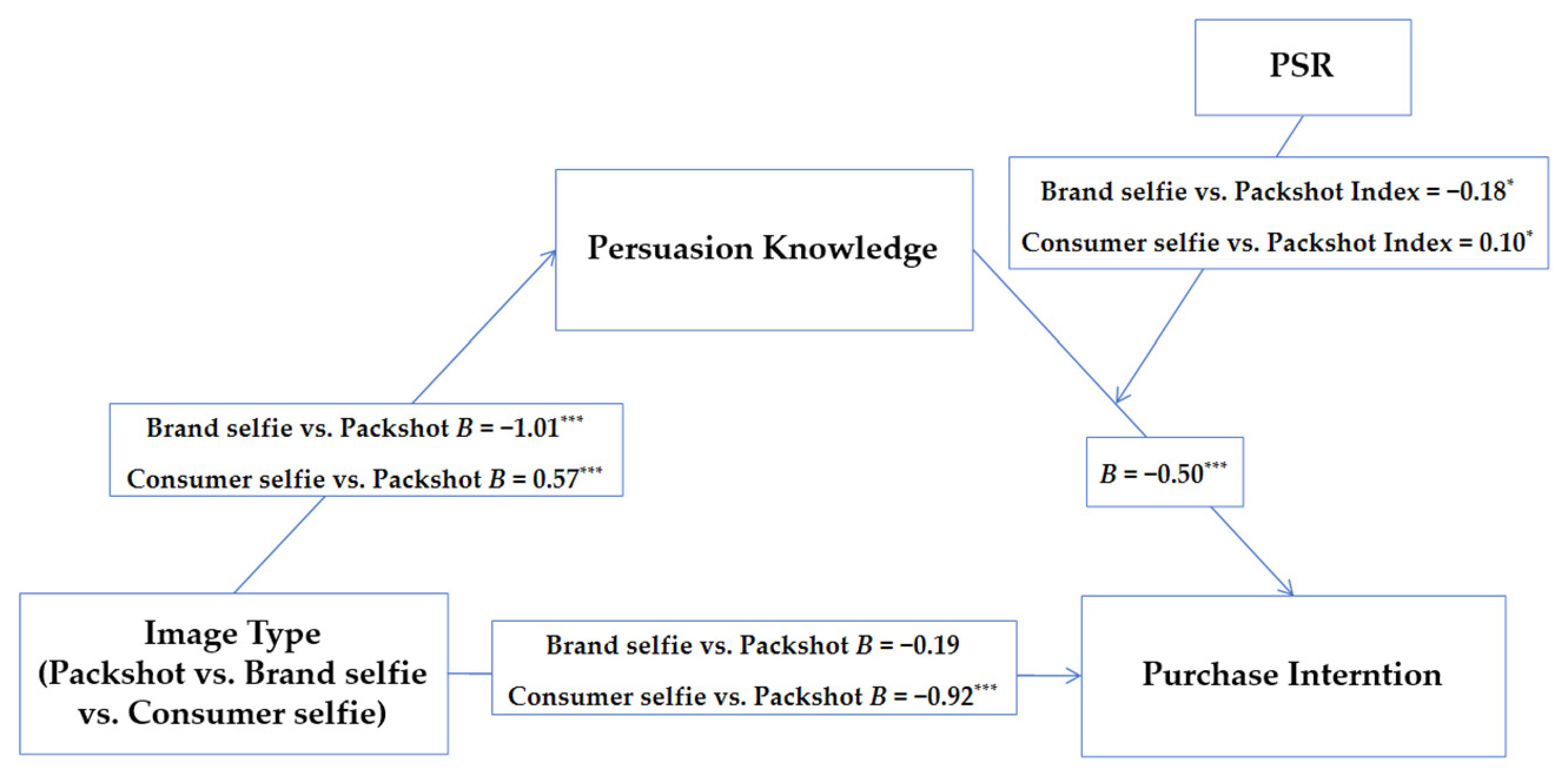
2.4. The Conceptual Model
3. Materials and Methods
3.1. Experimental Design and Stimuli
3.2. Procedure
3.3. Measures
3.4. Reliability and Validity Assessment
4. Results
4.1. Manipulation Checks
4.2. Statistical Assumptions and Preliminary Analyses
4.3. Main Effect of Image Type on Purchase Intention
4.4. Mediating Effect of Persuasion Knowledge
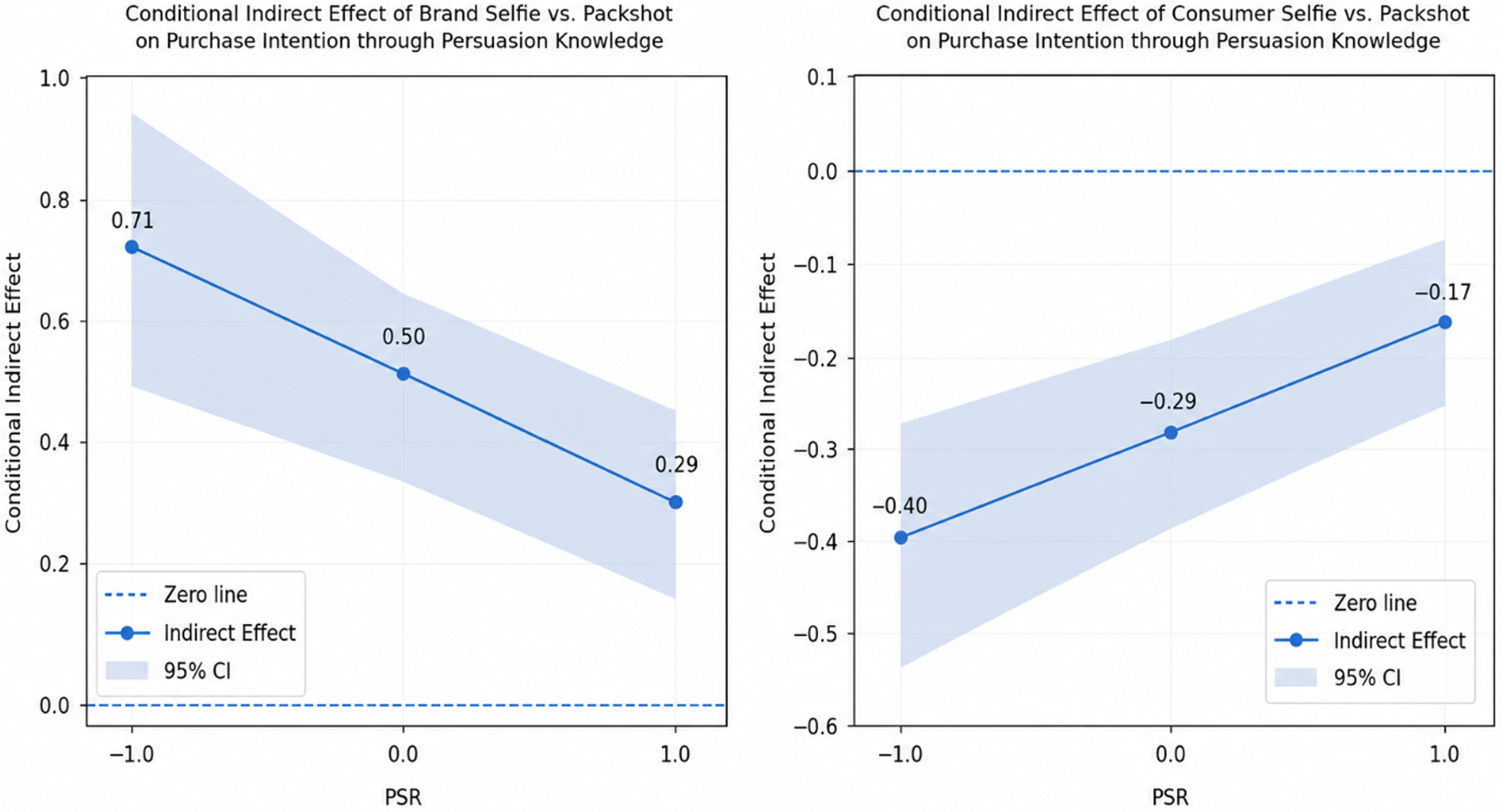
4.5. Moderated Mediation by PSR
5. Discussion
5.1. Summary and Interpretation of Findings
5.2. Theoretical Implications
5.3. Managerial Implications
5.4. Limitations and Future Research Directions
6. Conclusions
Author Contributions
Funding
Institutional Review Board Statement
Informed Consent Statement
Data Availability Statement
Acknowledgments
Conflicts of Interest
Appendix A
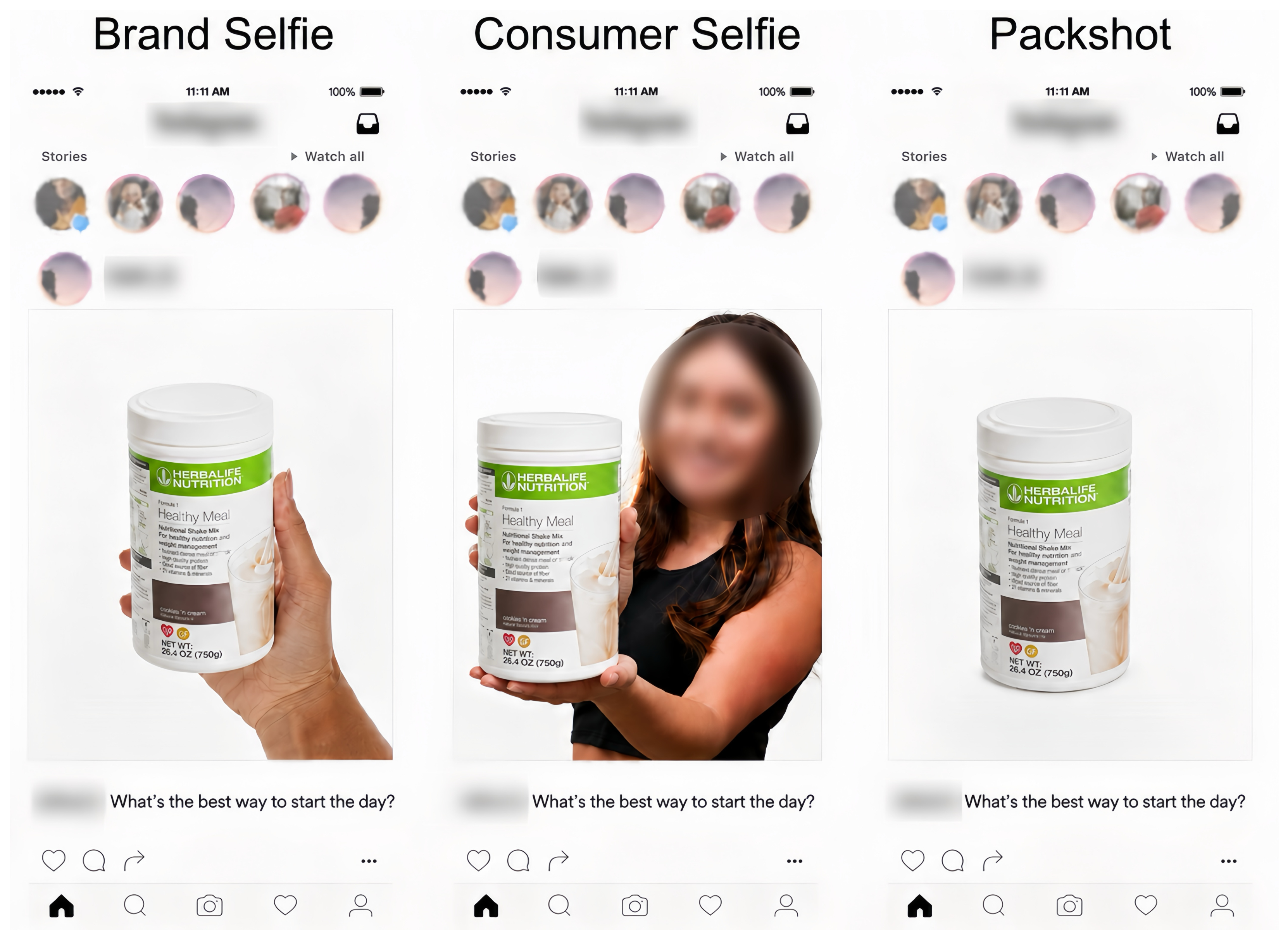
References
- Arora, T., & Agarwal, B. (2019). Empirical study on perceived value and attitude of millennials towards social media advertising: A structural equation modelling approach. Vision, 23(1), 56–69. [Google Scholar] [CrossRef]
- Arora, T., Kumar, A., & Agarwal, B. (2020). Impact of social media advertising on millennials buying behaviour. International Journal of Intelligent Enterprise, 7(4), 481–500. [Google Scholar] [CrossRef]
- Audrezet, A., de Kerviler, G., & Moulard, J. G. (2020). Authenticity under threat: When social media influencers need to go beyond self-presentation. Journal of Business Research, 117, 557–569. [Google Scholar] [CrossRef]
- Aw, E. C.-X., & Labrecque, L. I. (2020). Celebrity endorsement in social media contexts: Understanding the role of parasocial interactions and the need to belong. Journal of Consumer Marketing, 37(7), 895–908. [Google Scholar] [CrossRef]
- Bakhshi, S., Shamma, D. A., & Gilbert, E. (2014). Faces engage us: Photos with faces attract more likes and comments on instagram. In Proceedings of the SIGCHI conference on human factors in computing systems (pp. 965–974). Association for Computing Machinery. [Google Scholar] [CrossRef]
- Balaban, D. C., Szambolics, J., & Chirică, M. (2022). Parasocial relations and social media influencers’ persuasive power. Exploring the moderating role of product involvement. Acta Psychologica, 230, 103731. [Google Scholar] [CrossRef] [PubMed]
- Bartlett, M. S. (1954). A note on the multiplying factors for various χ2 approximations. Journal of the Royal Statistical Society. Series B (Methodological), 16, 296–298. [Google Scholar] [CrossRef]
- Boerman, S. C., Tessitore, T., & Müller, C. M. (2021). Long-term effects of brand placement disclosure on persuasion knowledge and brand responses. International Journal of Advertising, 40(1), 26–48. [Google Scholar]
- Boerman, S. C., & van Reijmersdal, E. A. (2016). Informing consumers about “hidden” advertising: A literature review of the effects of disclosing sponsored content. In P. De Pelsmacker (Ed.), Advertising in new formats and media: Current research and implications for marketers (pp. 115–146). Emerald Group Publishing Limited. [Google Scholar]
- Boerman, S. C., & van Reijmersdal, E. A. (2020). Disclosing influencer marketing on YouTube to children: The moderating role of para-social relationship. Frontiers in Psychology, 10, 3042. [Google Scholar] [CrossRef] [PubMed]
- Boerman, S. C., van Reijmersdal, E. A., & Neijens, P. C. (2012). Sponsorship disclosure: Effects of duration on persuasion knowledge and brand responses. Journal of Communication, 62(6), 1047–1064. [Google Scholar] [CrossRef]
- Boerman, S. C., Willemsen, L. M., & Van Der Aa, E. P. (2017). “This post is sponsored” effects of sponsorship disclosure on persuasion knowledge and electronic word of mouth in the context of Facebook. Journal of Interactive Marketing, 38, 82–92. [Google Scholar] [CrossRef]
- Bond, B. J. (2016). Following your “friend”: Social media and the strength of adolescents’ parasocial relationships with media personae. Cyberpsychology, Behavior, and Social Networking, 19(11), 656–660. [Google Scholar] [CrossRef] [PubMed]
- Bone, P. F., & Ellen, P. S. (1992). The generation and consequences of communication-evoked imagery. Journal of Consumer Research, 19(1), 93–104. [Google Scholar] [CrossRef]
- Borchers, N. S., Hagelstein, J., & Beckert, J. (2022). Are many too much? Examining the effects of multiple influencer endorsements from a persuasion knowledge model perspective. International Journal of Advertising, 41(6), 974–996. [Google Scholar] [CrossRef]
- Breves, P., Amrehn, J., Heidenreich, A., Liebers, N., & Schramm, H. (2021). Blind trust? The importance and interplay of parasocial relationships and advertising disclosures in explaining influencers’ persuasive effects on their followers. International Journal of Advertising, 40(7), 1209–1228. [Google Scholar] [CrossRef]
- Breves, P., Liebers, N., Abt, M., & Kunze, A. (2019). The perceived fit between Instagram influencers and the endorsed brand: How influencer-brand fit affects source credibility and persuasive effectiveness. Journal of Advertising Research, 59(4), 440–454. [Google Scholar] [CrossRef]
- Brinson, N. H., Holiday, S., & George, J. L. (2024). Response to advertising delivered by voice assistants: The mediating role of persuasion knowledge, perceived control, social presence, and privacy concerns. Journal of Interactive Advertising, 24(4), 344–367. [Google Scholar] [CrossRef]
- Campbell, C., & Farrell, J. R. (2020). More than meets the eye: The functional components underlying influencer marketing. Business Horizons, 63(4), 469–479. [Google Scholar] [CrossRef]
- Campbell, M. C., & Kirmani, A. (2000). Consumers’ use of persuasion knowledge: The effects of accessibility and cognitive capacity on perceptions of an influence agent. Journal of Consumer Research, 27(1), 69–83. [Google Scholar] [CrossRef]
- Carter, D. (2016). Hustle and brand: The sociotechnical shaping of influence. Social Media + Society, 2(3), 2056305116666305. [Google Scholar] [CrossRef]
- Casaló, L. V., Flavián, C., & Ibáñez-Sánchez, S. (2020). Influencers on Instagram: Antecedents and consequences of opinion leadership. Journal of Business Research, 117, 510–519. [Google Scholar] [CrossRef]
- Chung, S., & Cho, H. (2017). Fostering parasocial relationships with celebrities on social media: Implications for celebrity endorsement. Psychology & Marketing, 34(4), 481–495. [Google Scholar] [CrossRef]
- Dash, G., & Paul, J. (2021). CB-SEM vs. PLS-SEM methods for research in social sciences and technology forecasting. Technological Forecasting and Social Change, 173, 121092. [Google Scholar] [CrossRef]
- De Battista, I., Curmi, F., & Konietzny, J. (2025). The value of retargeted advertisements: An empirical study on young people. Cogent Business & Management, 12(1), 2560646. [Google Scholar] [CrossRef]
- Djafarova, E., & Rushworth, C. (2017). Exploring the credibility of online celebrities’ Instagram profiles in influencing the purchase decisions of young female users. Computers in Human Behavior, 68, 1–7. [Google Scholar] [CrossRef]
- Eisend, M., & Tarrahi, F. (2022). How marketer actions influence persuasion knowledge: Meta-analytic evidence of a nonlinear relationship. Journal of Public Policy & Marketing, 41(2), 107–123. [Google Scholar] [CrossRef]
- Elder, R. S., & Krishna, A. (2012). The “visual depiction effect” in advertising: Facilitating embodied mental simulation through product orientation. Journal of Consumer Research, 38(6), 988–1003. [Google Scholar] [CrossRef]
- Escalas, J. E. (2007). Self-referencing and persuasion: Narrative transportation versus analytical elaboration. Journal of Consumer Research, 33(4), 421–429. [Google Scholar] [CrossRef]
- Ferchaud, A., Grzeslo, J., Orme, S., & LaGroue, J. (2018). Parasocial attributes and YouTube personalities: Exploring content trends across the most subscribed YouTube channels. Computers in Human Behavior, 80, 88–96. [Google Scholar] [CrossRef]
- Field, A. (2024). Discovering statistics using IBM SPSS statistics. Sage Publications Limited. [Google Scholar]
- Fornell, C., & Larcker, D. F. (1981). Evaluating structural equation models with unobservable variables and measurement error. Journal of Marketing Research, 18(1), 39–50. [Google Scholar] [CrossRef]
- Freberg, K., Graham, K., McGaughey, K., & Freberg, L. A. (2011). Who are the social media influencers? A study of public perceptions of personality. Public Relations Review, 37(1), 90–92. [Google Scholar] [CrossRef]
- Friestad, M., & Wright, P. (1994). The persuasion knowledge model: How people cope with persuasion attempts. Journal of Consumer Research, 21(1), 1–31. [Google Scholar] [CrossRef]
- Ghasemi, A., & Zahediasl, S. (2012). Normality tests for statistical analysis: A guide for non-statisticians. International Journal of Endocrinology and Metabolism, 10(2), 486. [Google Scholar] [CrossRef] [PubMed]
- Ham, C.-D., Nelson, M. R., & Das, S. (2015). How to measure persuasion knowledge. International Journal of Advertising, 34(1), 17–53. [Google Scholar] [CrossRef]
- Harman, H. H. (1976). Modern factor analysis. University of Chicago Press. [Google Scholar]
- Hartmann, J., Heitmann, M., Schamp, C., & Netzer, O. (2021). The power of brand selfies. Journal of Marketing Research, 58(6), 1159–1177. [Google Scholar] [CrossRef]
- Hayes, A. F. (2017). Introduction to mediation, moderation, and conditional process analysis: A regression-based approach. Guilford Publications. [Google Scholar]
- Henseler, J., Ringle, C. M., & Sarstedt, M. (2015). A new criterion for assessing discriminant validity in variance-based structural equation modeling. Journal of the Academy of Marketing Science, 43(1), 115–135. [Google Scholar]
- Holzwarth, M., Janiszewski, C., & Neumann, M. (2006). The influence of avatars on online consumer shopping behavior. Journal of Marketing, 70(4), 19–36. [Google Scholar] [CrossRef]
- Horton, D., & Wohl, R. R. (1956). Mass communication and para-social interaction: Observations on intimacy at a distance. Psychiatry, 19(3), 215–229. [Google Scholar] [CrossRef] [PubMed]
- Hu, Y., Manikonda, L., & Kambhampati, S. (2014). What we Instagram: A first analysis of Instagram photo content and user types. Proceedings of the International AAAI Conference on Web and Social Media, 8(1), 595–598. [Google Scholar] [CrossRef]
- Hudders, L., & De Jans, S. (2022). Gender effects in influencer marketing: An experimental study on the efficacy of endorsements by same- vs. other-gender social media influencers on Instagram. International Journal of Advertising, 41(1), 128–149. [Google Scholar] [CrossRef]
- Hur, S., Lim, H., & Lyu, J. (2020). “I” or “she/he”? The effects of visual perspective on consumers’ evaluation of brands’ social media marketing: From imagery fluency perspective. Journal of Global Fashion Marketing, 11(1), 1–17. [Google Scholar]
- Hwang, K., & Zhang, Q. (2018). Influence of parasocial relationship between digital celebrities and their followers on followers’ purchase and electronic word-of-mouth intentions, and persuasion knowledge. Computers in Human Behavior, 87, 155–173. [Google Scholar] [CrossRef]
- Influencer Marketing Hub. (2026). Influencer marketing benchmark report 2026. Available online: https://influencermarketinghub.com/influencer-marketing-benchmark-report/ (accessed on 20 July 2026).
- Isaac, M. S., & Grayson, K. (2017). Beyond skepticism: Can accessing persuasion knowledge bolster credibility? Journal of Consumer Research, 43(6), 895–912. [Google Scholar]
- Jin, S. V., & Ryu, E. (2020). “I’ll buy what she’s# wearing”: The roles of envy toward and parasocial interaction with influencers in Instagram celebrity-based brand endorsement and social commerce. Journal of Retailing and Consumer Services, 55, 102121. [Google Scholar]
- Kaiser, H. F. (1974). An index of factorial simplicity. Psychometrika, 39(1), 31–36. [Google Scholar] [CrossRef]
- Kietzmann, J. H., Hermkens, K., McCarthy, I. P., & Silvestre, B. S. (2011). Social media? Get serious! Understanding the functional building blocks of social media. Business Horizons, 54(3), 241–251. [Google Scholar] [CrossRef]
- Kim, H., Ko, E., & Kim, J. (2015). SNS users’ para-social relationships with celebrities: Social media effects on purchase intentions. Journal of Global Scholars of Marketing Science, 25(3), 279–294. [Google Scholar] [CrossRef]
- Labrecque, L. I. (2014). Fostering consumer-brand relationships in social media environments: The role of parasocial interaction. Journal of Interactive Marketing, 28(2), 134–148. [Google Scholar] [CrossRef]
- Levene, H. (1960). Robust tests for equality of variances. In Contributions to probability and statistics (pp. 278–292). Stanford University Press. [Google Scholar]
- Libby, L. K., & Eibach, R. P. (2011). Visual perspective in mental imagery: A representational tool that functions in judgment, emotion, and self-insight. In Advances in experimental social psychology (Vol. 44, pp. 185–245). Elsevier. [Google Scholar]
- Libby, L. K., Valenti, G., Pfent, A., & Eibach, R. P. (2011). Seeing failure in your life: Imagery perspective determines whether self-esteem shapes reactions to recalled and imagined failure. Journal of Personality and Social Psychology, 101(6), 1157. [Google Scholar] [CrossRef] [PubMed]
- Luangrath, A. W., Peck, J., & Gustafsson, A. (2020). Should I touch the customer? Rethinking interpersonal touch effects from the perspective of the touch initiator. Journal of Consumer Research, 47(4), 588–607. [Google Scholar] [CrossRef]
- MacInnis, D. J., & Jaworski, B. J. (1989). Information processing from advertisements: Toward an integrative framework. Journal of Marketing, 53(4), 1–23. [Google Scholar] [CrossRef]
- McCabe, D. B., & Nowlis, S. M. (2003). The effect of examining actual products or product descriptions on consumer preference. Journal of Consumer Psychology, 13(4), 431–439. [Google Scholar] [CrossRef]
- Muntinga, D. G., Moorman, M., & Smit, E. G. (2011). Introducing COBRAs exploring motivations for brand-related social media use. International Journal of Advertising, 30(1), 13–46. [Google Scholar] [CrossRef]
- Ohanian, R. (1990). Construction and validation of a scale to measure celebrity endorsers’ perceived expertise, trustworthiness, and attractiveness. Journal of Advertising, 19(3), 39–52. [Google Scholar] [CrossRef]
- Paivio, A. (1990). Mental representations: A dual coding approach. Oxford University Press. [Google Scholar]
- Peck, J., & Childers, T. L. (2003). To have and to hold: The influence of haptic information on product judgments. Journal of Marketing, 67(2), 35–48. [Google Scholar] [CrossRef]
- Petty, R. E., & Cacioppo, J. T. (1986). Message elaboration versus peripheral cues. In Communication and persuasion: Central and peripheral routes to attitude change (pp. 141–172). Springer. [Google Scholar]
- Pink, S. (2015). Going forward through the world: Thinking theoretically about first person perspective digital ethnography. Integrative Psychological and Behavioral Science, 49(2), 239–252. [Google Scholar] [CrossRef] [PubMed]
- Podsakoff, P. M., MacKenzie, S. B., Lee, J.-Y., & Podsakoff, N. P. (2003). Common method biases in behavioral research: A critical review of the literature and recommended remedies. Journal of Applied Psychology, 88(5), 879. [Google Scholar] [CrossRef] [PubMed]
- Pronin, E., & Ross, L. (2006). Temporal differences in trait self-ascription: When the self is seen as an other. Journal of Personality and Social Psychology, 90(2), 197. [Google Scholar] [CrossRef] [PubMed]
- Reinikainen, H., Munnukka, J., Maity, D., & Luoma-aho, V. (2020). ‘You really are a great big sister’—Parasocial relationships, credibility, and the moderating role of audience comments in influencer marketing. Journal of Marketing Management, 36(3–4), 279–298. [Google Scholar] [CrossRef]
- Rogers, T. B., Kuiper, N. A., & Kirker, W. S. (1977). Self-reference and the encoding of personal information. Journal of Personality and Social Psychology, 35(9), 677. [Google Scholar] [CrossRef] [PubMed]
- Sheldon, P., & Bryant, K. (2016). Instagram: Motives for its use and relationship to narcissism and contextual age. Computers in Human Behavior, 58, 89–97. [Google Scholar] [CrossRef]
- Shrum, L. J., Liu, M., Nespoli, M., & Lowrey, T. M. (2012). Persuasion in the marketplace: How theories of persuasion apply to marketing and advertising. In J. P. Dillard, & L. Shen (Eds.), The persuasion handbook: Developments in theory and practice (2nd ed., pp. 314–330). SAGE Publications. [Google Scholar][Green Version]
- Smith, B. G., Kendall, M. C., Knighton, D., & Wright, T. (2018). Rise of the brand ambassador: Social stake, corporate social responsibility and influence among the social media influencers. Communication Management Review, 3(01), 6–29. [Google Scholar] [CrossRef]
- Spiller, S. A., Fitzsimons, G. J., Lynch, J. G., Jr., & McClelland, G. H. (2013). Spotlights, floodlights, and the magic number zero: Simple effects tests in moderated regression. Journal of Marketing Research, 50(2), 277–288. [Google Scholar] [CrossRef]
- To, R. N., & Patrick, V. M. (2021). How the eyes connect to the heart: The influence of eye gaze direction on advertising effectiveness. Journal of Consumer Research, 48(1), 123–146. [Google Scholar]
- Trope, Y., & Liberman, N. (2010). Construal-level theory of psychological distance. Psychological Review, 117(2), 440. [Google Scholar] [CrossRef] [PubMed]
- Tukachinsky, R., & Stever, G. (2019). Theorizing development of parasocial engagement. Communication Theory, 29(3), 297–318. [Google Scholar]
- van Reijmersdal, E. A., Boerman, S. C., & van Noort, G. (2022). Effects of online behaviorally targeted native advertising on persuasion: A test of two competing mechanisms. Computers in Human Behavior Reports, 7, 100221. [Google Scholar] [CrossRef]
- Vashisht, D., & Royne, M. (2016). Advergame speed influence and brand recall: The moderating effects of brand placement strength and gamers’ persuasion knowledge. Computers in Human Behavior, 63, 162–169. [Google Scholar] [CrossRef]
- Voorveld, H. A. M., van Noort, G., Muntinga, D. G., & Bronner, F. (2018). Engagement with social media and social media advertising: The differentiating role of platform type. Journal of Advertising, 47(1), 38–54. [Google Scholar] [CrossRef]
- Welch, B. L. (1951). On the comparison of several mean values: An alternative approach. Biometrika, 38(3/4), 330–336. [Google Scholar] [CrossRef]
- Wojdynski, B. W. (2016). The deceptiveness of sponsored news articles: How readers recognize and perceive native advertising. American Behavioral Scientist, 60(12), 1475–1491. [Google Scholar] [CrossRef]
- Wojdynski, B. W., Evans, N. J., & Hoy, M. G. (2018). Measuring sponsorship transparency in the age of native advertising. Journal of Consumer Affairs, 52(1), 115–137. [Google Scholar]
- Xu, R., Feng, W., Yu, I. Y., & Chang, D. (2026). How relationship norms between consumers and micro-influencers shape endorsement effectiveness: The mediating role of persuasion knowledge. Journal of Research in Interactive Marketing, 20(6), 847–868. [Google Scholar]
- Yoo, J., & Kim, M. (2014). The effects of online product presentation on consumer responses: A mental imagery perspective. Journal of Business Research, 67(11), 2464–2472. [Google Scholar] [CrossRef]
- Yuan, S., & Lou, C. (2020). How social media influencers foster relationships with followers: The roles of source credibility and fairness in parasocial relationship and product interest. Journal of Interactive Advertising, 20(2), 133–147. [Google Scholar] [CrossRef]
- Zhang, J., & Yang, X. (2015). Stylistic properties and regulatory fit: Examining the role of self-regulatory focus in the effectiveness of an actor’s vs. observer’s visual perspective. Journal of Consumer Psychology, 25(3), 449–458. [Google Scholar] [CrossRef]
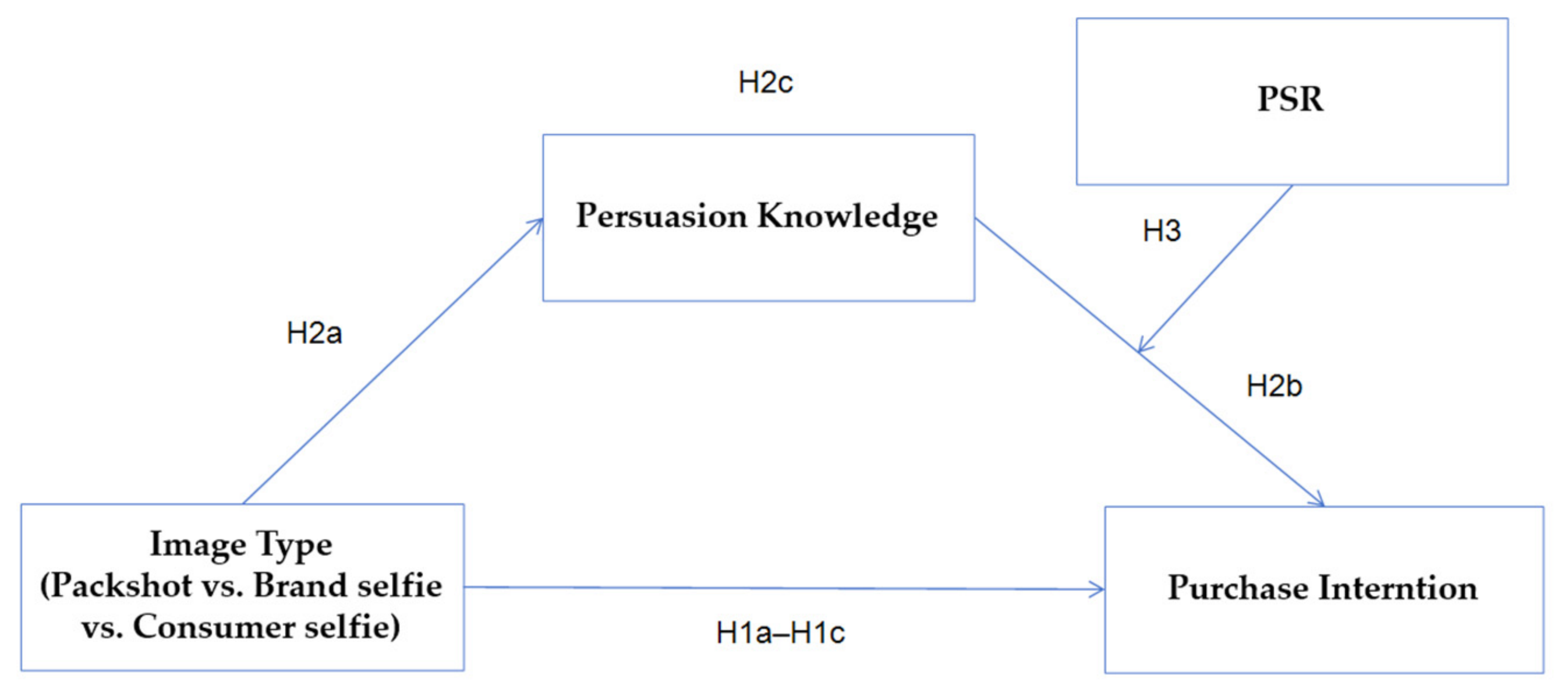
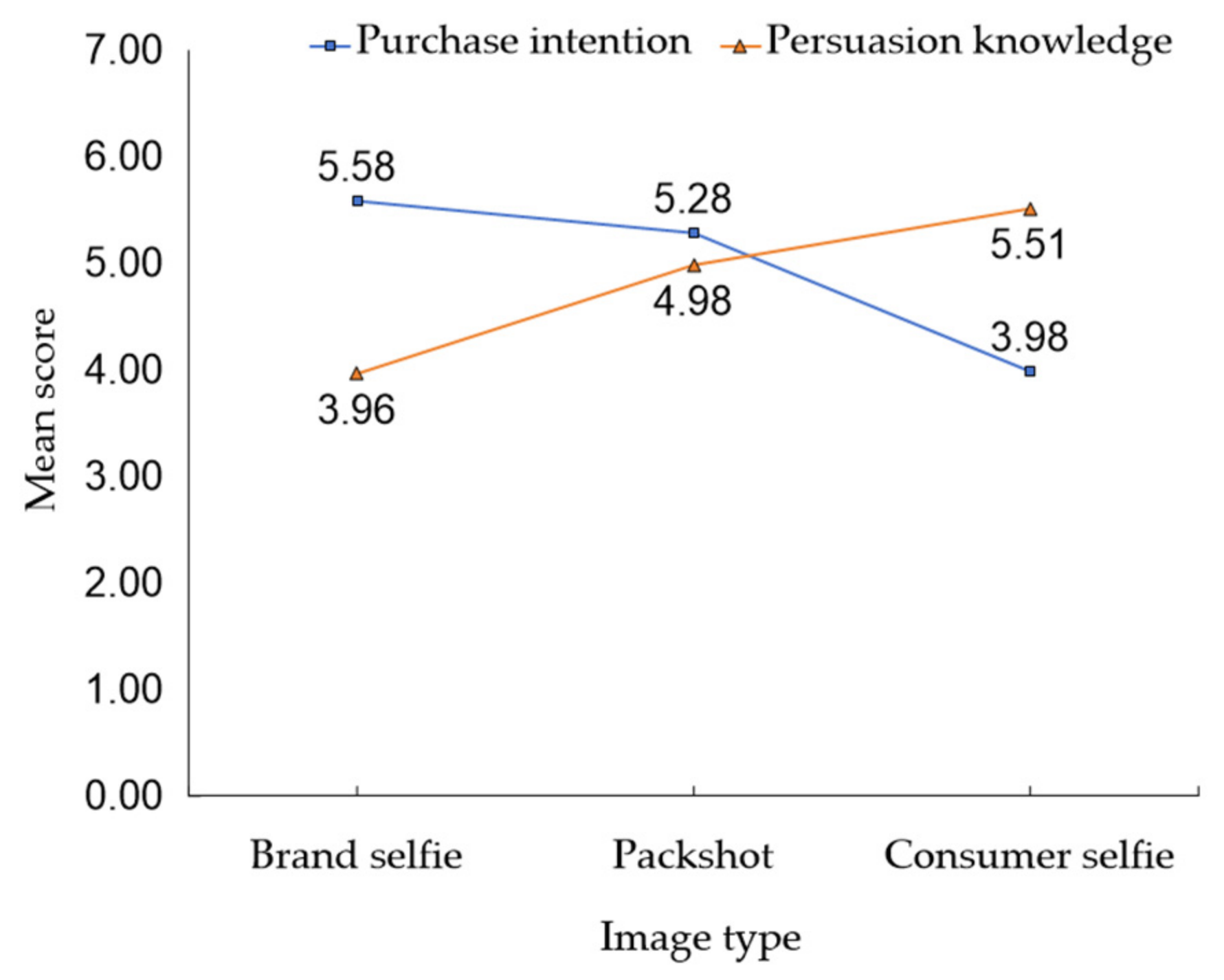
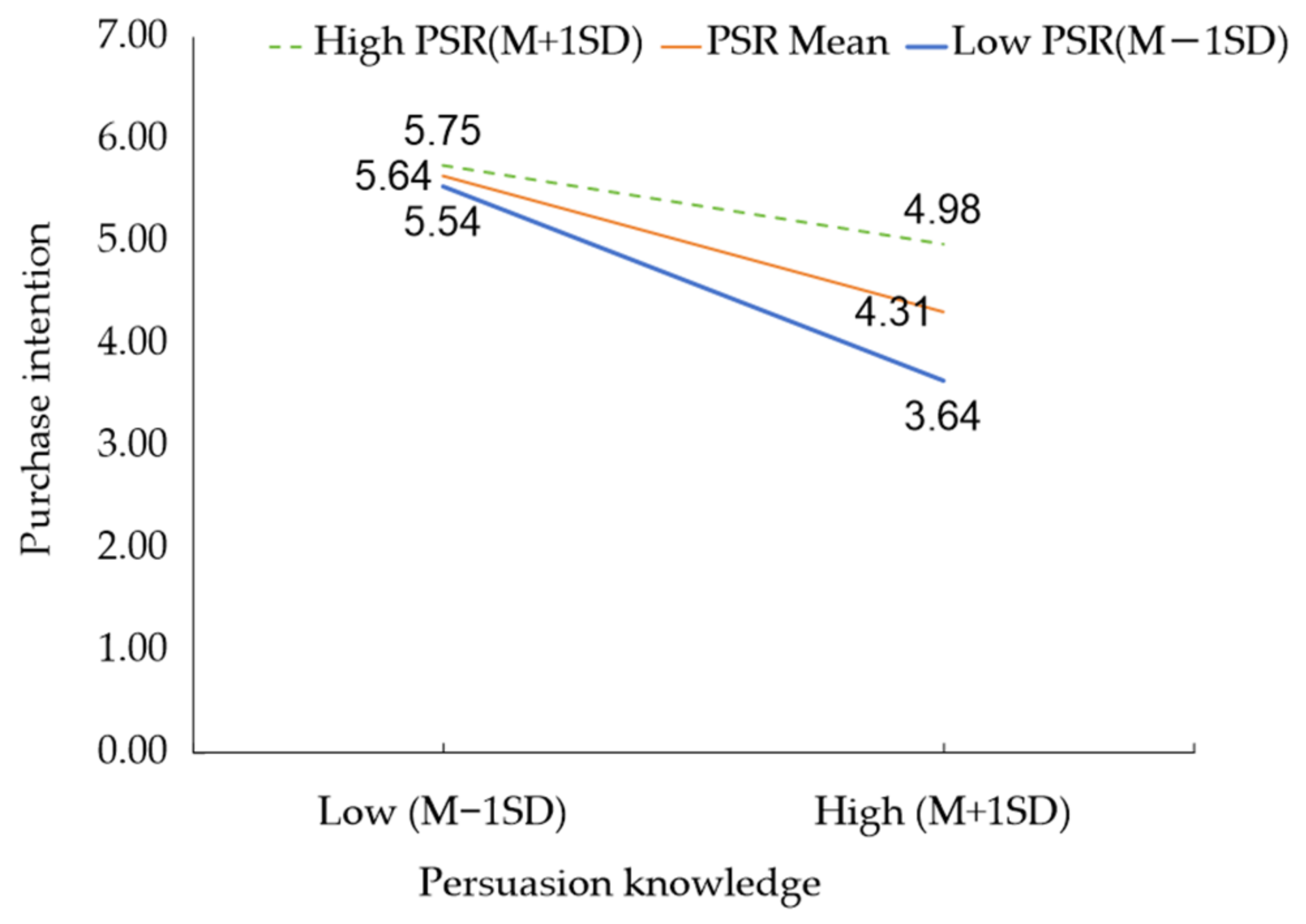

| Construct | Description | Loading | Cronbach’s Alpha | CR | AVE |
|---|---|---|---|---|---|
| Persuasion knowledge (Mean = 4.820) | The way this Instagram post image that Kate sent tries to persuade people seems acceptable to me (reverse coding) | 0.830 | 0.917 | 0.917 | 0.614 |
| Kate tries to manipulate the audience in ways that I don’t like. | 0.806 | ||||
| I am annoyed by this post because Kate seemed to be trying to inappropriately manage or control the audience. | 0.752 | ||||
| The post that Kate sent was fair in what was said and shown (reverse coding). | 0.777 | ||||
| When I see the Instagram post image that Kate sent, I think it’s pretty obvious the post is trying to persuade me to buy the Herbalife’s protein powder. | 0.811 | ||||
| I noticed tricks in this post image that Kate sent to promote the Herbalife’s protein powder. | 0.721 | ||||
| This post image that Kate sent is meant to sell the Herbalife’s protein powder. | 0.783 | ||||
| PSR (Mean = 5.017) | I feel close enough to Kate to use her Instagram. | 0.767 | 0.885 | 0.885 | 0.562 |
| I feel comfortable about Kate’s message on her Instagram. | 0.729 | ||||
| I feel Kate is fascinating on her Instagram. | 0.757 | ||||
| I think that Kate’s Instagram is helpful for my interests in health. | 0.733 | ||||
| I can rely on information I get from Kate. | 0.716 | ||||
| In the past, I pitied Kate when she made a mistake on her Instagram. | 0.792 | ||||
| Purchase intention (Mean = 4.941) | I would like to try the Herbalife’s protein powder in the post image. | 0.747 | 0.848 | 0.851 | 0.657 |
| I have the intention to buy the Herbalife’s protein powder in the post image. | 0.850 | ||||
| I am interested to know more where to buy the Herbalife’s protein powder in the post image. | 0.830 |
| Construct | Persuasion Knowledge | PSR | Purchase Intention |
|---|---|---|---|
| Persuasion knowledge | 0.784 | ||
| PSR | −0.142 | 0.750 | |
| Purchase intention | −0.641 | 0.452 | 0.811 |
| Constructs | HTMT |
|---|---|
| Persuasion knowledge–Purchase intention | 0.654 |
| PSR–Purchase intention | 0.451 |
| Persuasion knowledge–PSR | 0.142 |
| Test | Result |
|---|---|
| KMO | 0.928 |
| Bartlett’s χ2 | 4123.019 |
| df | 120 |
| p | <0.001 |
| Variance explained by the first factor | 38.721% |
| Packshot (N = 152) | Brand Selfie (N = 153) | Consumer Selfie (N = 155) | Total (N = 460) | |
|---|---|---|---|---|
| M (SD) | M (SD) | M (SD) | M (SD) | |
| Persuasion knowledge | 4.98 (1.23) | 3.96 (1.23) | 5.51 (1.03) | 4.82 (1.33) |
| PSR | 5.01 (1.18) | 5.16 (1.06) | 4.88 (1.33) | 5.02 (1.20) |
| Purchase intention | 5.28 (1.25) | 5.58 (1.04) | 3.98 (1.50) | 4.94 (1.45) |
| Attention to Herbalife’s protein powder | 5.62 (1.02) | 5.75 (1.03) | 5.31 (1.37) | 5.56 (1.16) |
| Prominent of the Herbalife’s protein powder | 5.70 (0.99) | 5.78 (1.05) | 5.34 (1.32) | 5.61 (1.15) |
| Brand familiarity | 5.48 (1.27) | 4.84 (1.70) | 4.10 (1.95) | 4.80 (1.76) |
| Attitude toward the brand | 5.19 (1.23) | 4.78 (1.80) | 3.84 (1.77) | 4.60 (1.72) |
| Frequency of health supplement purchases | 2.70 (0.76) | 2.78 (0.81) | 3.00 (0.78) | 2.83 (0.79) |
| Dependent Variable | Levene’s F | p | Welch’s F | p |
|---|---|---|---|---|
| Persuasion knowledge | 6.741 | 0.001 | 71.932 | <0.001 |
| Purchase intention | 13.992 | <0.001 | 60.544 | <0.001 |
| Hypothesis | Relationship Tested | Test Result |
|---|---|---|
| H1a | Brand selfie > Consumer selfie (Purchase intention) | Supported |
| H1b | Brand selfie > Packshot (Purchase intention) | Not supported |
| H1c | Packshot > Consumer selfie (Purchase intention) | Supported |
| H2a | Image type → Persuasion knowledge | Supported |
| H2b | Persuasion knowledge → Purchase intention | Supported |
| H2c | Image type → Persuasion knowledge → Purchase intention (mediation) | Supported |
| H3 | Moderated mediation: Image type → Persuasion knowledge → Purchase intention (moderated by PSR) | Supported |
Disclaimer/Publisher’s Note: The statements, opinions and data contained in all publications are solely those of the individual author(s) and contributor(s) and not of MDPI and/or the editor(s). MDPI and/or the editor(s) disclaim responsibility for any injury to people or property resulting from any ideas, methods, instructions or products referred to in the content. |
© 2026 by the authors. Licensee MDPI, Basel, Switzerland. This article is an open access article distributed under the terms and conditions of the Creative Commons Attribution (CC BY) license.
Share and Cite
Qu, Y.; Lee, J. The Effect of Influencer Image Types on Purchase Intention: The Mediating Role of Persuasion Knowledge and the Moderating Role of Parasocial Relationships. Behav. Sci. 2026, 16, 1270. https://doi.org/10.3390/bs16081270
Qu Y, Lee J. The Effect of Influencer Image Types on Purchase Intention: The Mediating Role of Persuasion Knowledge and the Moderating Role of Parasocial Relationships. Behavioral Sciences. 2026; 16(8):1270. https://doi.org/10.3390/bs16081270
Chicago/Turabian StyleQu, Yubing, and Jieun Lee. 2026. "The Effect of Influencer Image Types on Purchase Intention: The Mediating Role of Persuasion Knowledge and the Moderating Role of Parasocial Relationships" Behavioral Sciences 16, no. 8: 1270. https://doi.org/10.3390/bs16081270
APA StyleQu, Y., & Lee, J. (2026). The Effect of Influencer Image Types on Purchase Intention: The Mediating Role of Persuasion Knowledge and the Moderating Role of Parasocial Relationships. Behavioral Sciences, 16(8), 1270. https://doi.org/10.3390/bs16081270

