How Language Attitudes Shape French Language Achievement: The Mediating Role of Student Engagement


Abstract
1. Introduction
2. Literature Review
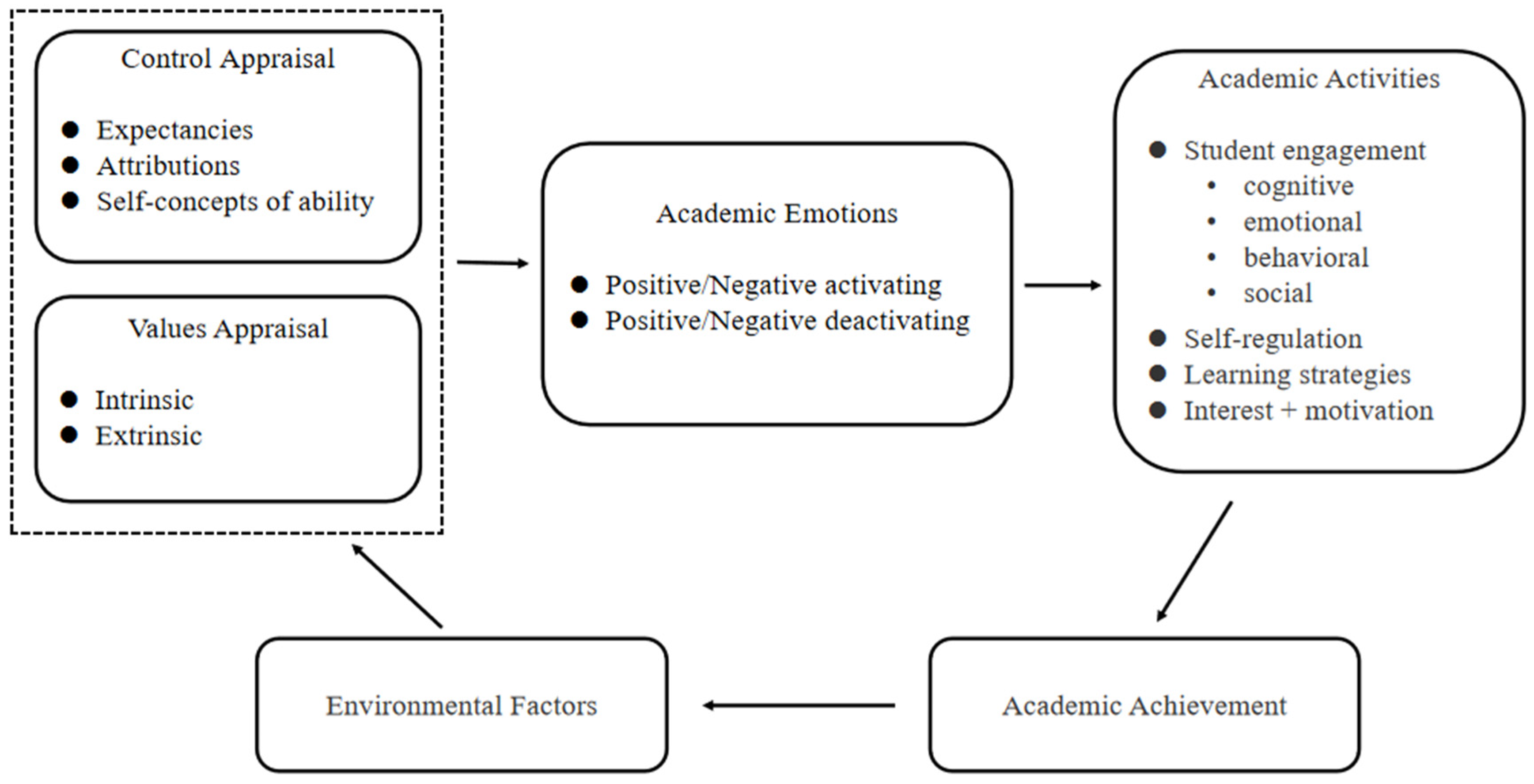
2.1. Control-Value Theory
2.2. Language Attitudes and FL Achievement
2.3. Language Attitudes and Student Engagement
2.4. Student Engagement and FL Achievement
3. Rationale and Research Questions
- (1)
- What are the interrelationships among language attitudes, student engagement, and French achievement?
- (2)
- Do the various dimensions of student engagement mediate the relationship between language attitudes and French achievement?
4. Methodology
4.1. Participants and Context
4.2. Instruments
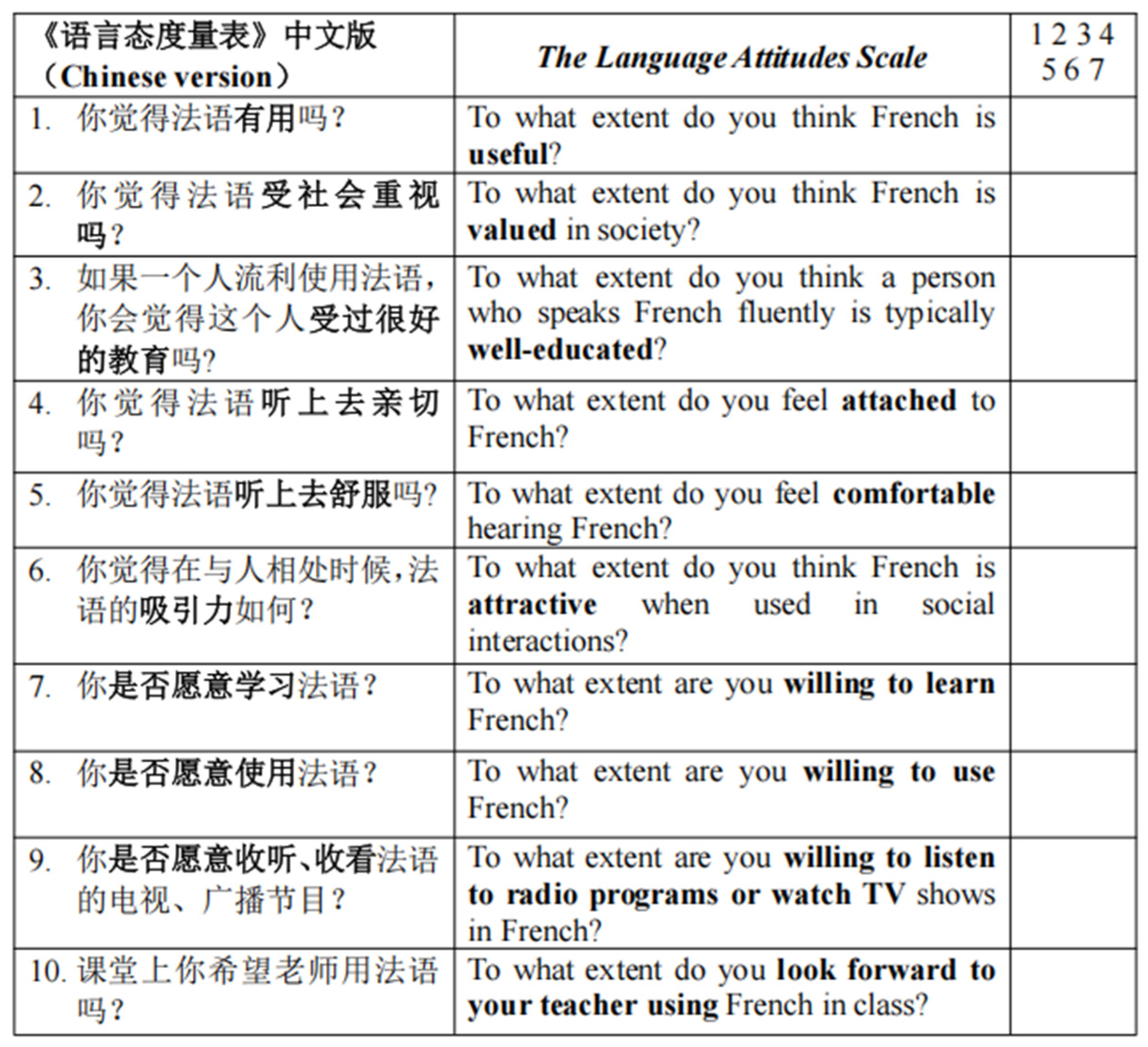
4.2.1. Language Attitudes Scale
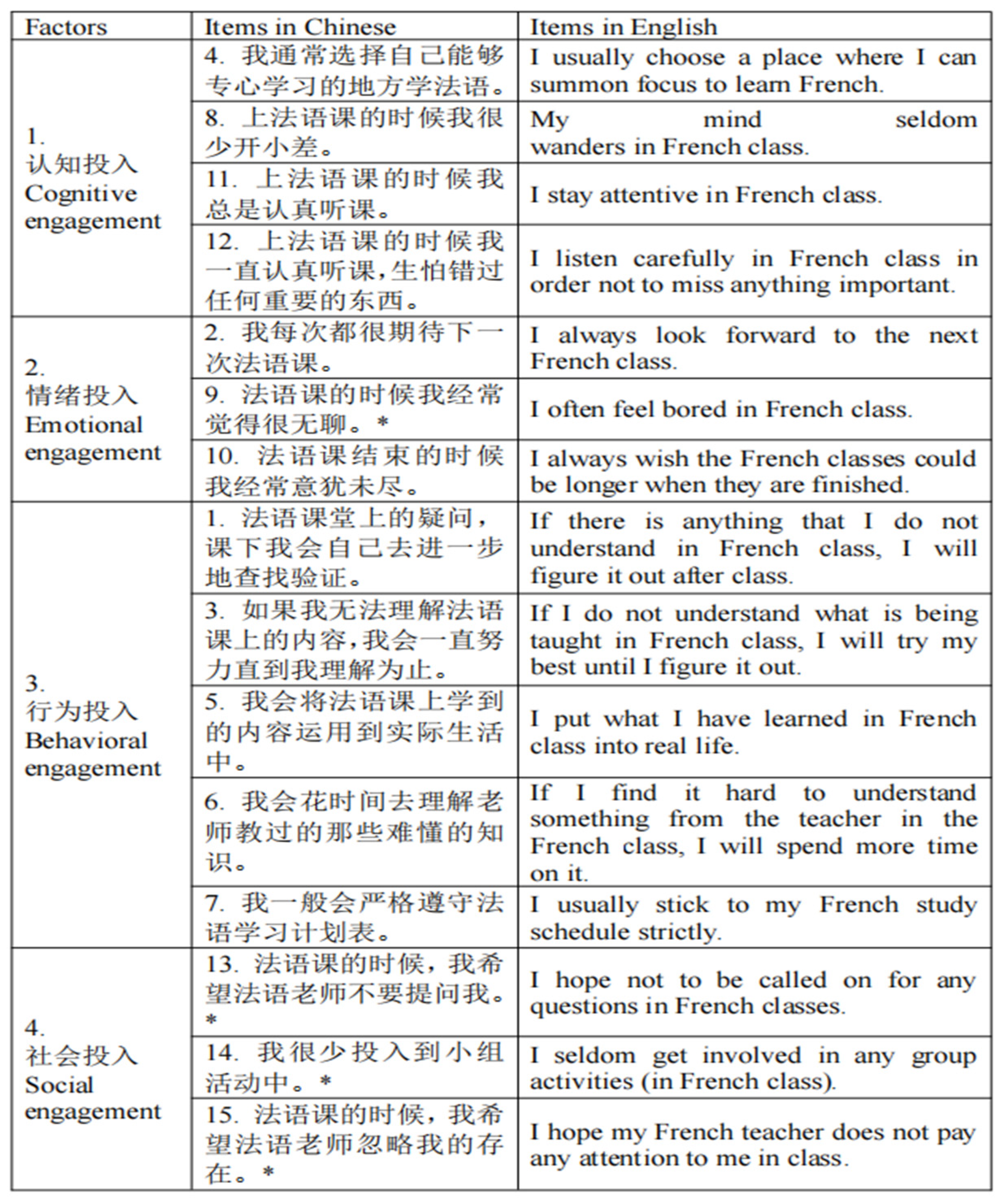
4.2.2. Student Engagement Scale
4.2.3. French Achievement
4.3. Data Analysis
5. Results
5.1. Descriptive Statistics
5.2. Correlation Analysis
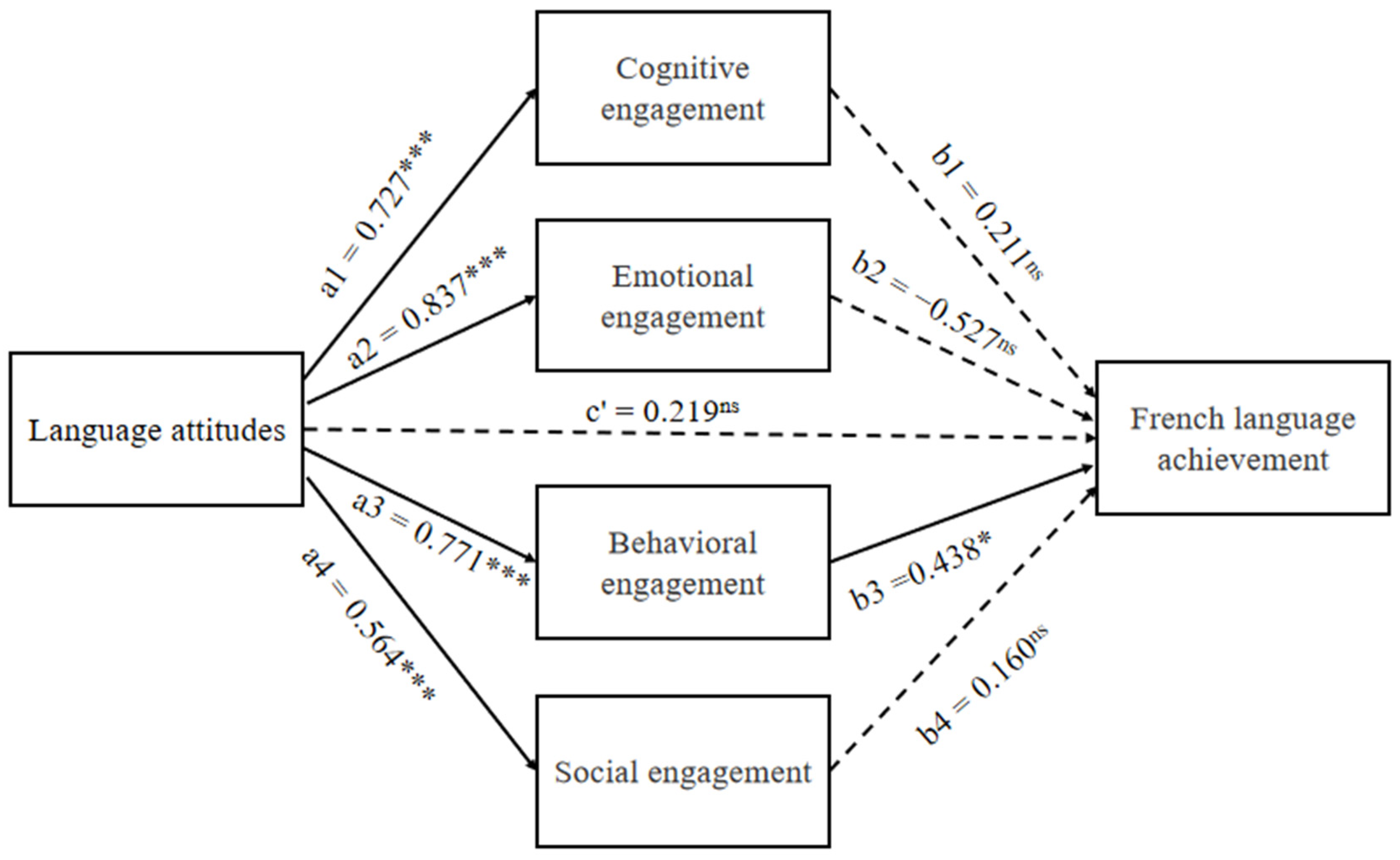
5.3. Mediation Model Analysis
6. Discussion
6.1. Correlations Among Language Attitudes, Student Engagement, and French Achievement
6.2. The Mediating Role of the Four Dimensions of Student Engagement Between Language Attitudes and French Achievement
7. Conclusions
Author Contributions
Funding
Institutional Review Board Statement
Informed Consent Statement
Data Availability Statement
Acknowledgments
Conflicts of Interest
Abbreviations
| FFL | French-as-a-foreign-language |
| EFL | English-as-a-foreign-language |
| FL | Foreign language |
| LOTE | Languages Other Than English |
| SLA | Second language acquisition |
| CVT | Control-Value Theory |
Appendix A

Appendix B

References
- Adler, A., & Plewnia, A. (2018). Möglichkeiten und grenzen der quantitativen spracheinstellungsforschung. In Variation–normen–identitäten. Walter de Gruyter. [Google Scholar]
- Alrashidi, O., & Alshammari, S. H. (2024). The effects of self-efficacy, teacher support, and positive academic emotions on student engagement in online courses among EFL university students. Education and Information Technologies, 30(6), 8139–8157. [Google Scholar] [CrossRef]
- Belsley, D. A., Kuh, E., & Welsch, R. E. (1980). Regression diagnostics: Identifying influential data and sources of collinearity. Wiley. [Google Scholar] [CrossRef]
- Botes, E., Dewaele, J.-M., & Greiff, S. (2020). The foreign language classroom anxiety scale and academic achievement: An overview of the prevailing literature and a meta-analysis. Journal for the Psychology of Language Learning, 2(1), 26–56. [Google Scholar] [CrossRef]
- Caldwell-Harris, C. L., & MacWhinney, B. (2023). Age effects in second language acquisition: Expanding the emergentist account. Brain and Language, 241, 105269. [Google Scholar] [CrossRef] [PubMed]
- Candog, A. K., Calanas, T. G., Escuadro, K. Y., & Gabuat, F. S. (2024). Quantifying the English language attitude and classroom engagement levels among humanities and social sciences students. Asian Journal of Education and Social Studies, 50(7), 599–608. [Google Scholar] [CrossRef]
- Clément, R., Dörnyei, Z., & Noels, K. A. (1994). Motivation, self-confidence, and group cohesion in the foreign language classroom. Language Learning, 44(3), 417–448. [Google Scholar] [CrossRef]
- Cohen, L., Manion, L., & Morrison, K. (2018). Research methods in education (8th ed.). Routledge. [Google Scholar]
- Eerdemutu, L., Dewaele, J.-M., & Wang, J. (2024). Developing a short language classroom engagement scale (LCES) and linking it with needs satisfaction and achievement. System, 120, 103189. [Google Scholar] [CrossRef]
- Flores, J. S., Huguet, À., Fernández-Costales, A., & Senar, F. (2025). The effect of perception of Spanish-speaking communities on the development of attitudes and motivation towards learning Spanish as a second language: A study in the Portuguese university context. Journal of Multilingual and Multicultural Development, 1–14. [Google Scholar] [CrossRef]
- Fredricks, J. A., Filsecker, M., & Lawson, M. A. (2016). Student engagement, context, and adjustment: Addressing definitional, measurement, and methodological issues. Learning and Instruction, 43, 1–4. [Google Scholar] [CrossRef]
- Gao, X. (2017). The relationship between writers’ strategy use and writing proficiency in integrated listening/reading-to-write tasks. Foreign Language and Literature, 34(2), 113–121. [Google Scholar] [CrossRef]
- Gardner, R. C. (1988). Attitudes and motivation. Annual Review of Applied Linguistics, 9, 135–148. [Google Scholar] [CrossRef]
- Gardner, R. C., Tremblay, P. F., & Masgoret, A.-M. (1997). Towards a full model of second language learning: An empirical investigation. Modern Language Journal, 81(3), 344–362. [Google Scholar] [CrossRef]
- Garrett, P. (2010). Attitudes to language. Cambridge University Press. [Google Scholar]
- Guo, J., Liu, G., & Yang, L. (2021). The influence mechanism and model of college students’ learning engagement: Based on a survey of 311 undergraduate universities. Educational Research, 42(8), 104–115. [Google Scholar]
- Guo, J., Zhou, M., & Liu, X. (2022). The construct of English learners’ multiple interactive value and its relationship with behavioral engagement and academic achievement. Foreign Languages and Their Teaching, 5, 43–52, 145–146. [Google Scholar] [CrossRef]
- Guo, Y., Xu, J., & Chen, C. (2024). A study on the dynamic development of college students’ engagement in English classroom learning. Journal of Xi’an International Studies University, 32(4), 69–74. [Google Scholar] [CrossRef]
- Hair, J. F., Black, W. C., Babin, B. J., & Anderson, R. E. (2019). Multivariate data analysis (8th ed.). Cengage. [Google Scholar]
- Hiver, P., Al-Hoorie, A. H., & Mercer, S. (2021). Student engagement in the language classroom. Multilingual Matters. [Google Scholar] [CrossRef]
- Hsieh, H.-C. (2008). The effects of type of exposure and type of post-exposure task on L2 development. Journal of Foreign Language Instruction, 2, 117–138. [Google Scholar] [CrossRef]
- Hu, L., & Bentler, P. M. (1995). Evaluating model fit. In R. H. Hoyle (Ed.), Structural equation modeling: Concepts, issues, and applications (pp. 76–99). Sage. [Google Scholar]
- Hu, L., & Bentler, P. M. (1999). Cutoff criteria for fit indexes in covariance structure analysis: Conventional criteria versus new alternatives. Structural Equation Modeling: A Multidisciplinary Journal, 6(1), 1–55. [Google Scholar] [CrossRef]
- Hu, S., & McCormick, A. C. (2012). An engagement-based student typology and its relationship to college outcomes. Research in Higher Education, 53(7), 738–754. [Google Scholar] [CrossRef]
- Hudgens Henderson, M., Nagai, M., & Zhang, W. (2020). What languages do undergraduates study, and why? Proceedings of the Linguistic Society of America, 5(1), 722. [Google Scholar] [CrossRef]
- Huguet, Á. (2006). Attitudes and motivation versus language achievement in cross-linguistic settings. What is cause and what effect? Journal of Multilingual and Multicultural Development, 27(5), 413–429. [Google Scholar] [CrossRef]
- Kenny, D. A., Kaniskan, B., & McCoach, D. B. (2015). The performance of RMSEA in models with small degrees of freedom. Sociological Methods & Research, 44(3), 486–507. [Google Scholar] [CrossRef]
- Kuh, G. D., Cruce, T. M., Shoup, R., Kinzie, J., & Gonyea, R. M. (2008). Unmasking the effects of student engagement on first-year college grades and persistence. The Journal of Higher Education, 79, 540–563. [Google Scholar] [CrossRef]
- Li, C. (2020). Exploring the relationship between emotional intelligence and English academic achievement: The multiple mediating effects of enjoyment, anxiety, and burnout. Foreign Language World, 1, 69–78. [Google Scholar] [CrossRef]
- Li, C., & Dewaele, J.-M. (2020). The predictive effects of trait emotional intelligence and perceived online learning harvest on foreign language classroom boredom. Foreign Languages and Their Teaching, 5, 33–44. [Google Scholar] [CrossRef]
- Li, C., & Feng, E. (2025). A longitudinal and interactive study of L2 achievement goals and learning engagement. Foreign Languages and Their Teaching, 3, 1–12, 145. [Google Scholar] [CrossRef]
- Li, C., & Han, Y. (2022). The predictive effects of foreign language enjoyment, anxiety, and boredom on online learning effectiveness. Modern Foreign Languages, 45(2), 207–219. [Google Scholar] [CrossRef]
- Li, C., & Li, W. (2024). The relationship among language attitudes, emotions and foreign language achievement: A rural-urban comparative study based on structural equation modeling. Foreign Languages and Their Teaching, 1, 57–69, 148. [Google Scholar] [CrossRef]
- Li, C., & Wei, L. (2022). Anxiety, enjoyment, and boredom in language learning amongst junior secondary students in rural China: How do they contribute to L2 achievement? Studies in Second Language Acquisition, 45(1), 93–108. [Google Scholar] [CrossRef]
- Li, C., & Wei, L. (2025). Language attitudes: Construct, measurement, and associations with language achievements. Journal of Multilingual and Multicultural Development, 46(10), 3324–3349. [Google Scholar] [CrossRef]
- Li, C., Wei, L., & Cai, J. (2023). Life satisfaction and L2 engagement in adolescents. ELT Journal, 78(2), 149–159. [Google Scholar] [CrossRef]
- Lou, Y., Li, C., & Zhao, H. (2024). A meta-analysis of the relationship between willingness to communicate and anxiety in a second language. Contemporary Foreign Languages Studies, 1, 150–160, 190. [Google Scholar]
- Lü, Z., & Yang, Y. (2013). The relationship between college students’ L2 motivational self system and learning engagement: An empirical study of non-English major freshmen at Tsinghua University. Tsinghua Journal of Education, 34(3), 118–124. [Google Scholar] [CrossRef]
- Makrami, B. H. (2011). Motivation and attitude of Saudi university’s learners of English for specific purposes [Doctoral dissertation, UMI Dissertation Publishing]. [Google Scholar]
- Malallah, S. (2000). English in an Arabic environment: Current attitudes to English among Kuwait University students. International Journal of Bilingual Education and Bilingualism, 3(1), 19–43. [Google Scholar] [CrossRef]
- Masgoret, A.-M., & Gardner, R. C. (2003). Attitudes, motivation, and second language learning: A meta-analysis of studies conducted by Gardner and associates. Language Learning, 53(1), 123–163. [Google Scholar] [CrossRef]
- Mercer, S. (2019). Language learner engagement: Setting the scene. In X. Gao (Ed.), Second handbook of English language teaching. Springer. [Google Scholar] [CrossRef]
- Myers-Scotton, C. (2006). Multiple voices: An introduction to bilingualism. Blackwell. [Google Scholar]
- Newman, F. M., Wehlage, G. G., & Lamborn, S. D. (1992). The significance and sources of student engagement. In F. M. Newman (Ed.), Student engagement and achievement in American secondary schools (pp. 11–39). Teachers College Press. [Google Scholar]
- Oga-Baldwin, W. L. Q. (2019). Acting, thinking, feeling, making, collaborating: The engagement process in foreign language learning. System, 86, 102128. [Google Scholar] [CrossRef]
- Oga-Baldwin, W. L. Q., & Fryer, L. K. (2018). Schools can improve motivational quality: Profile transitions across early foreign language learning experiences. Motivation and Emotion, 42(4), 527–545. [Google Scholar] [CrossRef]
- Oga-Baldwin, W. L. Q., & Nakata, Y. (2017). Engagement, gender, and motivation: A predictive model for Japanese young language learners. System, 65, 151–163. [Google Scholar] [CrossRef]
- Park, S., & Yun, H. (2017). The influence of motivational regulation strategies on online students’ behavioral, emotional, and cognitive engagement. American Journal of Distance Education, 32(1), 43–56. [Google Scholar] [CrossRef]
- Pekrun, R. (2006). The control-value theory of achievement emotions: Assumptions, corollaries, and implications for educational research and practice. Educational Psychology Review, 18(4), 315–341. [Google Scholar] [CrossRef]
- Pekrun, R., & Stephens, E. J. (2010). Achievement emotions: A control-value approach. Social and Personality Psychology Compass, 4(4), 238–255. [Google Scholar] [CrossRef]
- Philp, J., & Duchesne, S. (2016). Exploring engagement in tasks in the language classroom. Annual Review of Applied Linguistics, 36, 50–72. [Google Scholar] [CrossRef]
- Reeve, J., & Lee, W. (2014). Students’ classroom engagement produced longitudinal changes in classroom motivation. Journal of Educational Psychology, 2, 527–540. [Google Scholar] [CrossRef]
- Reeve, J., & Tseng, C.-M. (2011). Agency as a fourth aspect of students’ engagement during learning activities. Contemporary Educational Psychology, 36(4), 257–267. [Google Scholar] [CrossRef]
- Schaefer, B. A., & McDermott, P. A. (1999). Learning behavior and intelligence as explanations for children’s scholastic achievement. Journal of School Psychology, 37(3), 299–313. [Google Scholar] [CrossRef]
- Scherer, G. A. C., & Wertheimer, M. (1964). A psycholinguistic experiment in foreign-language teaching. McGraw-Hill. [Google Scholar]
- Schlenker, B. R., Schlenker, P. A., & Schlenker, K. A. (2013). Antecedents of academic engagement and the implications for college grades. Learning and Individual Differences, 27, 75–81. [Google Scholar] [CrossRef]
- Seligman, M. (2018). PERMA and the building blocks of well-being. The Journal of Positive Psychology, 13(4), 333–335. [Google Scholar] [CrossRef]
- Shu, D. (2021). The “Shanghai experience” in Chinese basic foreign language education. Foreign Language Teaching and Research, 53(6), 864–873, 959–960. [Google Scholar] [CrossRef]
- Sinatra, G. M., Heddy, B. C., & Lombardi, D. (2015). The challenges of defining and measuring student engagement in science. Educational Psychologist, 50(1), 1–13. [Google Scholar] [CrossRef]
- Smith, A. N. (1971). The importance of attitude in foreign language learning. The Modern Language Journal, 55(2), 82–88. [Google Scholar] [CrossRef]
- Sulis, G., & Philp, J. (2021). Exploring connections between classroom environment and engagement in the foreign language classroom. In P. Hiver, A. H. Al-Hoorie, & S. Mercer (Eds.), Student engagement in the language classroom (pp. 101–119). Multilingual Matters. [Google Scholar]
- Sung, Y.-T., Chao, T.-Y., & Tseng, F.-L. (2016). Reexamining the relationship between test anxiety and learning achievement: An individual-differences perspective. Contemporary Educational Psychology, 46, 241–252. [Google Scholar] [CrossRef]
- Tong, Y., & Singh, B. S. M. (2025). The interaction between learning engagement and academic achievement in second language acquisition: A multivariate analysis. Forum for Linguistic Studies, 7(7), 386–401. [Google Scholar] [CrossRef]
- Wang, C. (2015). Why continuation tasks effectively promote learning. Foreign Language Teaching and Research, 47(5), 753–762, 801. [Google Scholar]
- Wang, M.-T., & Fredricks, J. A. (2014). The reciprocal links between school engagement, youth problem behaviors, and school dropout during adolescence. Child Development, 85(2), 722–737. [Google Scholar] [CrossRef] [PubMed]
- Wang, M.-T., & Holcombe, R. (2010). Adolescents’ perceptions of school environment, engagement, and academic achievement in middle school. American Educational Research Journal, 47(3), 633–662. [Google Scholar] [CrossRef]
- Wei, X., Chen, F., & Zhao, X. (2025). The impact of control-value appraisals on L2 academic achievement: The mediating roles of L2 grit and academic emotions. Foreign Language World, 4, 45–54. [Google Scholar] [CrossRef]
- Wesarg-Menzel, C., Ebbes, R., Hensums, M., Wagemaker, E., Zaharieva, M. S., Staaks, J. P. C., van den Akker, A. L., Visser, I., Hoeve, M., Brummelman, E., Dekkers, T. J., Schuitema, J. A., Larsen, H., Colonnesi, C., Jansen, B. R. J., Overbeek, G., Huizenga, H. M., & Wiers, R. W. (2023). Development and socialization of self-regulation from infancy to adolescence: A meta-review differentiating between self-regulatory abilities, goals, and motivation. Developmental Review, 69, 101090. [Google Scholar] [CrossRef]
- Xiao, Z. (2017). Dilemmas and breakthrough strategies in French oral teaching: A review of “Research on French major teaching in China (Issue 6)”. Journal of The Chinese Society of Education, 4, 140. [Google Scholar]
- Xu, H. (2023). The impact of embodied teacher support on the learning engagement of high school students in rural-urban fringe areas: A chain mediation effect analysis based on student self-esteem and psychological resilience. Journal of Basic Education, 20(3), 94–102, 112. [Google Scholar]
- Xu, J. (2021). International trends and frontier analysis of applied linguistics research. Modern Foreign Languages, 44(4), 448–455. [Google Scholar]
- Xu, J., Yang, J., & He, D. (2023). Control-value appraisals, academic emotions, and student engagement: A case of Chinese EFL undergraduates. Language Teaching Research, 13621688231215276. [Google Scholar] [CrossRef]
- Yan, N. (2024). An exploratory study on the relationship between language learning attitude, engagement, and communication skills among Chinese EFL learners. International Journal of Research and Innovation in Social Science, 8(3), 1317–1336. [Google Scholar] [CrossRef]
- Yang, S. (2011). A study on the autonomous learning model of students in the basic teaching stage of French majors in universities. Journal of National Academy of Education Administration, 10, 31–35. [Google Scholar]
- Yuan, C., & Lo Bianco, J. (2022). L2 Chinese teachers’ beliefs about engagement strategies for students in Australia: Findings from Q methodology research. System, 106, 102792. [Google Scholar] [CrossRef]
- Zhang, J. (2022). A study on the influence of test task conditions on the cognitive process of continuation task. Foreign Language and Literature, 39(5), 38–47, 134. [Google Scholar]
- Zhang, Q., & Wang, J. (2023). Exploring the relationship between teacher support and college students’ foreign language learning engagement: The multiple mediating roles of academic emotions. Foreign Languages in China, 20(5), 69–77. [Google Scholar] [CrossRef]
- Zhong, S., Wang, Y., & Wu, W. (2023). Exploring the mediating role of emotions between growth language mindset and engagement among EFL learners. The Asia-Pacific Education Researcher, 33(5), 1037–1049. [Google Scholar] [CrossRef]
- Zhu, X., Yao, Y., Pang, W., & Zhu, S. (2022). Investigating the relationship between linguistic competence, ideal self, learning engagement, and integrated writing performance: A structural equation modeling approach. Journal of Psycholinguistic Research, 52(3), 787–808. [Google Scholar] [CrossRef] [PubMed]



| Variables | M | SD | Min | Max | Skewness | SE | Kurtosis | SE |
|---|---|---|---|---|---|---|---|---|
| Language attitudes | 5.42 | 1.34 | 1 | 7 | −1.06 | 0.13 | 0.76 | 0.27 |
| Overall student engagement | 3.63 | 0.86 | 1 | 5 | −0.74 | 0.13 | 0.56 | 0.27 |
| Cognitive engagement | 3.70 | 0.99 | 1 | 5 | −0.74 | 0.13 | 0.21 | 0.27 |
| Emotional engagement | 3.66 | 0.98 | 1 | 5 | −0.59 | 0.13 | −0.08 | 0.27 |
| Behavioral engagement | 3.44 | 1.01 | 1 | 5 | −0.51 | 0.13 | −0.13 | 0.27 |
| Social engagement | 3.85 | 1.05 | 1 | 5 | −0.91 | 0.13 | 0.30 | 0.27 |
| French achievement | 70.00 | 17.02 | 8 | 100 | −0.95 | 0.13 | 0.77 | 0.27 |
| Variables | 1 | 2 | 3 | 4 | 5 | 6 | 7 |
|---|---|---|---|---|---|---|---|
| 1. Language attitudes | - | - | - | - | - | - | - |
| 2. Overall student engagement | 0.769 *** | - | - | - | - | - | - |
| 3. Cognitive engagement | 0.675 *** | 0.899 *** | - | - | - | - | - |
| 4. Emotional engagement | 0.717 *** | 0.886 *** | 0.745 *** | - | - | - | - |
| 5. Behavioral engagement | 0.721 *** | 0.890 *** | 0.739 *** | 0.731 *** | - | - | - |
| 6. Social engagement | 0.487 *** | 0.726 *** | 0.560 *** | 0.602 *** | 0.446 *** | - | - |
| 7. French achievement | 0.328 *** | 0.382 *** | 0.366 *** | 0.296 *** | 0.365 *** | 0.248 *** | - |
| Variable 1 | Variable 2 | r | 95% CI | p |
|---|---|---|---|---|
| Language attitudes | Overall student engagement | 0.769 | [0.721, 0.809] | <0.001 |
| Language attitudes | Cognitive engagement | 0.675 | [0.613, 0.730] | <0.001 |
| Language attitudes | Emotional engagement | 0.717 | [0.660, 0.765] | <0.001 |
| Language attitudes | Behavioral engagement | 0.721 | [0.665, 0.769] | <0.001 |
| Language attitudes | Social engagement | 0.487 | [0.401, 0.565] | <0.001 |
| Language attitudes | French achievement | 0.328 | [0.228, 0.422] | <0.001 |
| Overall student engagement | French achievement | 0.382 | [0.285, 0.471] | <0.001 |
| Cognitive engagement | French achievement | 0.366 | [0.268, 0.457] | <0.001 |
| Emotional engagement | French achievement | 0.296 | [0.194, 0.391] | <0.001 |
| Behavioral engagement | French achievement | 0.364 | [0.266, 0.455] | <0.001 |
| Social engagement | French achievement | 0.248 | [0.144, 0.346] | <0.001 |
| Model | Chi-Square (df) | CFI | TLI | RMSEA | SRMR | AIC | BIC |
|---|---|---|---|---|---|---|---|
| Five-factor | 537.4 (262) | 0.942 | 0.934 | 0.056 | 0.057 | 22,464.9 | 22,800.6 |
| E + B combined | 607.5 (266) | 0.928 | 0.919 | 0.062 | 0.062 | 22,554.7 | 22,875.1 |
| C + E + B combined | 803.7 (269) | 0.888 | 0.875 | 0.077 | 0.064 | 22,817.0 | 23,125.9 |
| S + C + E + B combined | 956.4 (271) | 0.856 | 0.841 | 0.087 | 0.072 | 23,022.0 | 23,323.4 |
| Single-factor | 1592.7 (275) | 0.724 | 0.699 | 0.120 | 0.076 | 23,927.1 | 24,213.2 |
| Effect | Path | Std. Estimate | SE | p | 95% Bootstrap CI |
|---|---|---|---|---|---|
| Direct effect | Language attitudes -> French achievement | 0.219 | 0.157 | 0.163 | [−0.053, 0.505] |
| Total effect | Language attitudes -> French achievement | 0.359 | 0.068 | <0.001 | [0.219, 0.488] |
| Total indirect | Language attitudes -> engagement dimensions -> French achievement | 0.140 | 0.138 | 0.307 | [−0.116, 0.368] |
| Specific indirect | Language attitudes -> Cognitive engagement -> French achievement | 0.153 | 0.114 | 0.178 | [−0.018, 0.392] |
| Specific indirect | Language attitudes -> Emotional engagement -> French achievement | −0.441 | 0.342 | 0.197 | [−1.117, 0.235] |
| Specific indirect | Language attitudes -> Behavioral engagement -> French achievement | 0.338 | 0.157 | 0.031 | [0.108, 0.672] |
| Specific indirect | Language attitudes -> Social engagement -> French achievement | 0.090 | 0.073 | 0.214 | [−0.021, 0.249] |
Disclaimer/Publisher’s Note: The statements, opinions and data contained in all publications are solely those of the individual author(s) and contributor(s) and not of MDPI and/or the editor(s). MDPI and/or the editor(s) disclaim responsibility for any injury to people or property resulting from any ideas, methods, instructions or products referred to in the content. |
© 2026 by the authors. Licensee MDPI, Basel, Switzerland. This article is an open access article distributed under the terms and conditions of the Creative Commons Attribution (CC BY) license.
Share and Cite
Gong, J.; Chen, X.; Li, Y. How Language Attitudes Shape French Language Achievement: The Mediating Role of Student Engagement. Behav. Sci. 2026, 16, 1255. https://doi.org/10.3390/bs16071255
Gong J, Chen X, Li Y. How Language Attitudes Shape French Language Achievement: The Mediating Role of Student Engagement. Behavioral Sciences. 2026; 16(7):1255. https://doi.org/10.3390/bs16071255
Chicago/Turabian StyleGong, Jiarui, Xinli Chen, and Yinuo Li. 2026. "How Language Attitudes Shape French Language Achievement: The Mediating Role of Student Engagement" Behavioral Sciences 16, no. 7: 1255. https://doi.org/10.3390/bs16071255
APA StyleGong, J., Chen, X., & Li, Y. (2026). How Language Attitudes Shape French Language Achievement: The Mediating Role of Student Engagement. Behavioral Sciences, 16(7), 1255. https://doi.org/10.3390/bs16071255