

Pragmatic Competence Modulates Counterfactual Emotion Processing: Eye-Tracking Evidence from Mandarin Chinese


Abstract
1. Introduction
1.1. Counterfactuals and Pragmatic Inference
1.2. The Emotional Processing of Counterfactuals
1.3. The Present Study
2. Methods
2.1. Participants
2.2. Materials
2.3. Procedure
3. Results
3.1. Methods of Analysis

| Regret | Relief | |||
|---|---|---|---|---|
| Consistent | Inconsistent | Consistent | Inconsistent | |
| Pre-critical region | ||||
| First fixation duration (ms) | 198 (78) | 195 (59) | 213 (87) | 206 (69) |
| First-pass reading time (ms) | 205 (86) | 199 (71) | 229 (104) | 221 (100) |
| Regression path reading time (ms) | 214 (94) | 209 (87) | 243 (131) | 242 (132) |
| Total reading time (ms) | 249 (171) | 278 (207) | 256 (148) | 287 (184) |
| Critical region | ||||
| First fixation duration (ms) | 222 (90) | 227 (91) | 216 (84) | 237 (100) |
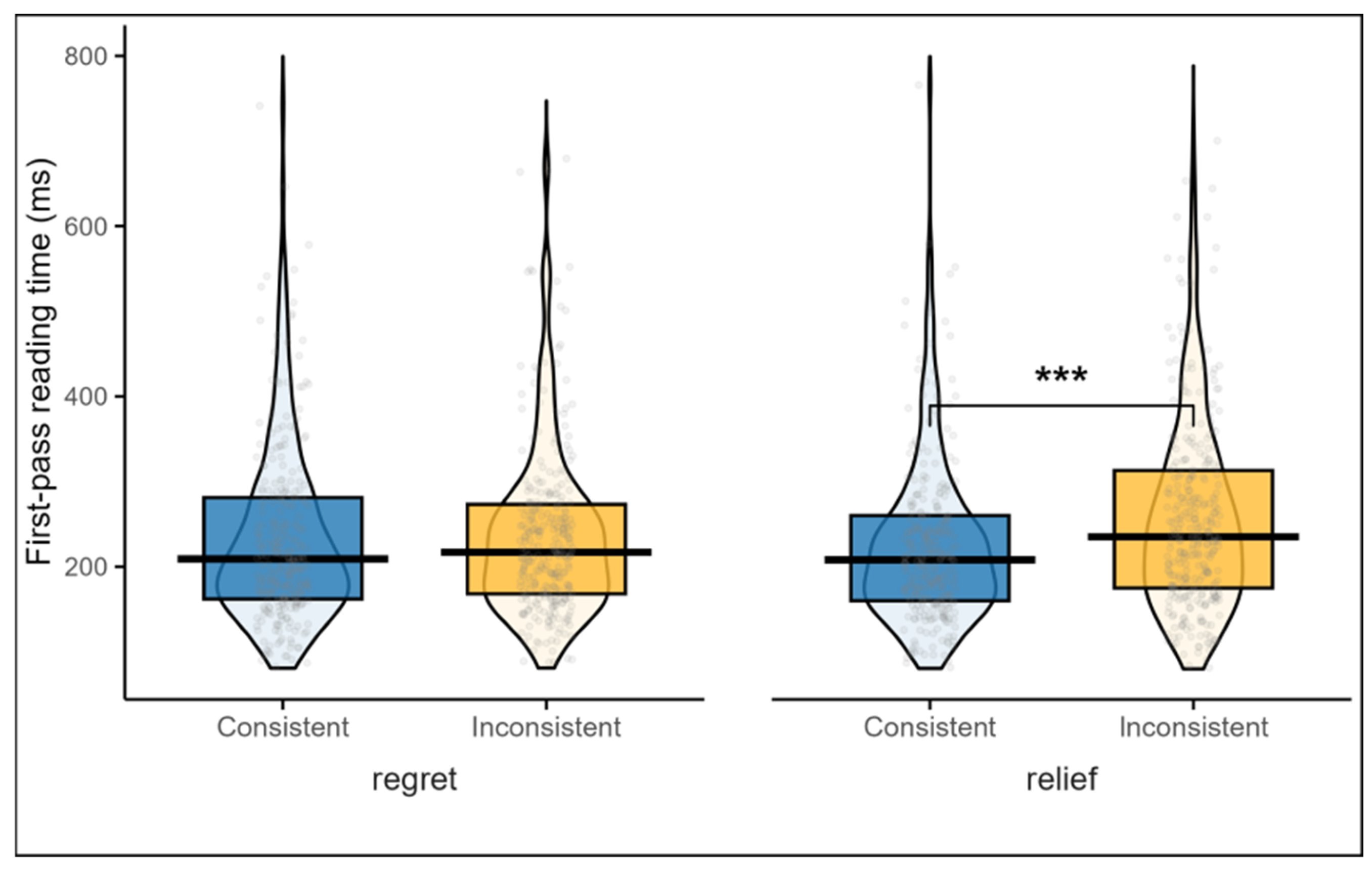
| First-pass reading time (ms) | 235 (110) | 237 (100) | 226 (97) | 259 (117) |
| Regression path reading time (ms) | 305 (181) | 346 (222) | 309 (197) | 370 (230) |
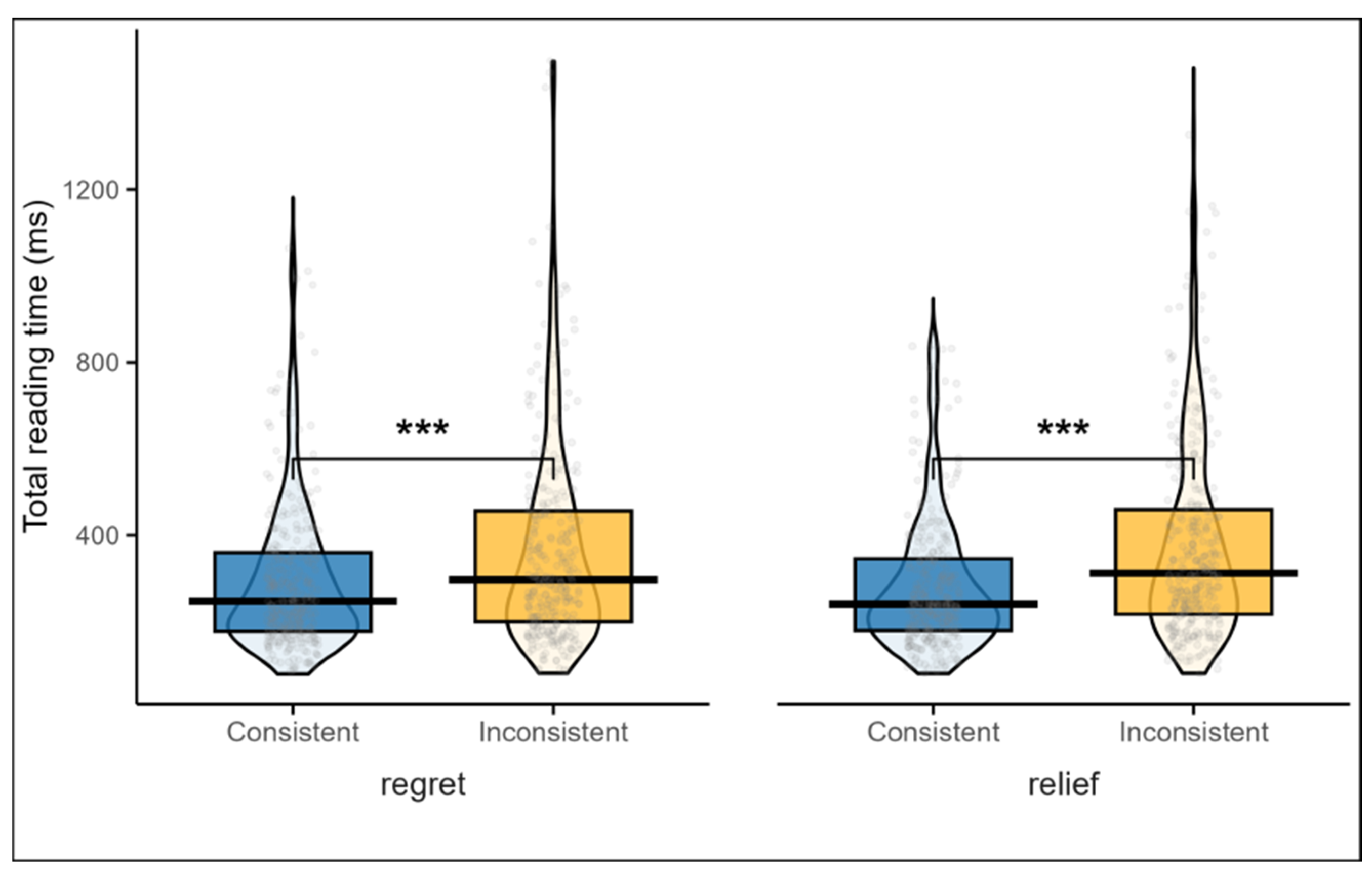
| Total reading time (ms) | 296 (170) | 366 (235) | 286 (157) | 378 (231) |
| Post-critical region | ||||
| First fixation duration (ms) | 211 (84) | 210 (83) | 212 (98) | 200 (73) |
| First-pass reading time (ms) | 220 (115) | 216 (90) | 215 (101) | 207 (83) |
| Regression path reading time (ms) | 417 (281) | 550 (372) | 422 (299) | 582 (429) |
| Total reading time (ms) | 279 (174) | 308 (190) | 271 (160) | 319 (199) |
| First Fixation Duration | First-Pass Reading Time | Regression Path Time | Total Reading Time | |||||||||
|---|---|---|---|---|---|---|---|---|---|---|---|---|
| Est. | SE | t-Value | Est. | SE | t-Value | Est. | SE | t-Value | Est. | SE | t-Value | |
| Pre-critical region | ||||||||||||
| Emotion | 0.023 | 0.012 | 1.929 | 0.039 | 0.013 | 2.907 ** | 0.044 | 0.015 | 2.964 ** | 0.016 | 0.018 | 0.864 |
| Consistency | −0.002 | 0.012 | −0.159 | −0.006 | 0.013 | −0.436 | −0.001 | 0.015 | −0.088 | 0.035 | 0.018 | 1.954 |
| Emotion: Consistency | −0.019 | 0.025 | −0.771 | −0.016 | 0.027 | −0.586 | 0.001 | 0.03 | 0.037 | −0.004 | 0.036 | −0.111 |
| Critical region | ||||||||||||
| Emotion | 0.002 | 0.009 | 0.191 | 0.008 | 0.010 | 0.809 | 0.016 | 0.013 | 1.189 | 0.005 | 0.013 | 0.35 |
| Consistency | 0.023 | 0.009 | 2.519 * | 0.032 | 0.010 | 3.140 ** | 0.065 | 0.014 | 4.779 *** | 0.092 | 0.013 | 6.968 *** |
| Emotion: Consistency | 0.023 | 0.019 | 1.217 | 0.045 | 0.020 | 2.251 * | 0.035 | 0.027 | 1.307 | 0.034 | 0.026 | 1.283 |
| Post-critical region | ||||||||||||
| Emotion | −0.014 | 0.01 | −1.372 | −0.015 | 0.011 | −1.405 | 0.017 | 0.018 | 0.924 | 0.002 | 0.015 | 0.148 |
| Consistency | −0.007 | 0.01 | −0.697 | −0.005 | 0.011 | −0.507 | 0.121 | 0.018 | 6.602 *** | 0.050 | 0.015 | 3.250 ** |
| Emotion: Consistency | −0.015 | 0.02 | −0.755 | −0.010 | 0.021 | −0.447 | 0.030 | 0.036 | 0.834 | 0.024 | 0.030 | 0.800 |
3.2. Eye-Movement Results
3.2.1. Pre-Critical Region
3.2.2. Critical Region
3.2.3. Post-Critical Region
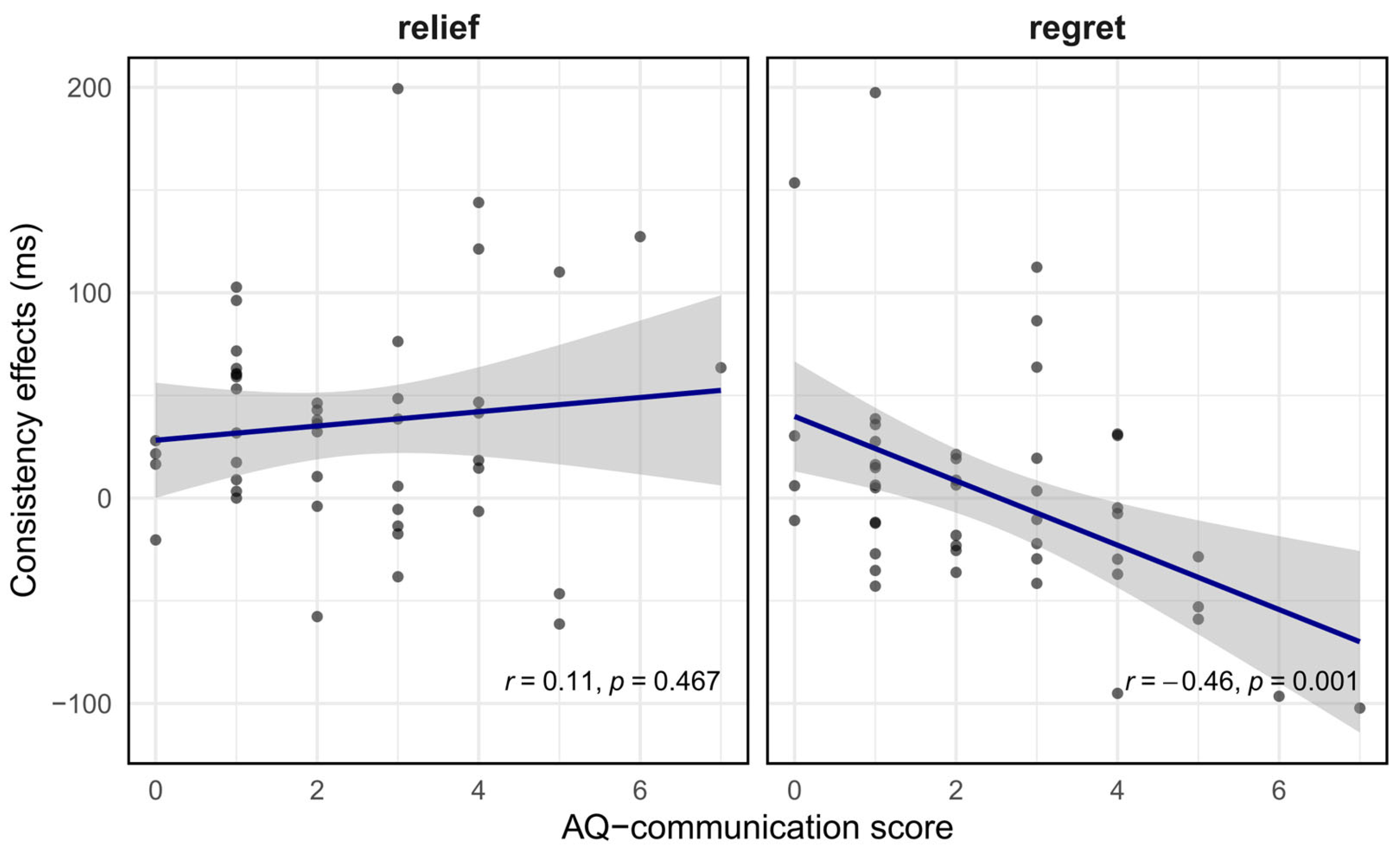
3.3. Correlations with AQ-Communication Scores
4. Discussion
4.1. The Emotion Processing in Chinese Counterfactuals
4.2. Pragmatic Competence Modulates Counterfactual Emotion Processing
5. Conclusions
Author Contributions
Funding
Institutional Review Board Statement
Data Availability Statement
Acknowledgments
Conflicts of Interest
References
- Baron-Cohen, S., Wheelwright, S., Skinner, R., Martin, J., & Clubley, E. (2001). The autism-spectrum quotient (AQ): Evidence from Asperger syndrome/high-functioning autism, males and females, scientists and mathematicians. Journal of Autism and Developmental Disorders, 31(1), 5–17. [Google Scholar] [CrossRef] [Scilit] [PubMed]
- Barr, D. J., Levy, R., Scheepers, C., & Tily, H. J. (2013). Random effects structure for confirmatory hypothesis testing: Keep it maximal. Journal of Memory and Language, 68, 255–278. [Google Scholar] [CrossRef] [Scilit]
- Bates, D., Machler, M., Bolker, B., & Walker, S. (2015). Fitting linear mixed-effects models using lme4. Journal of Statistical Software, 67(1), 1–48. [Google Scholar] [CrossRef] [Scilit]
- Begeer, S., De Rosnay, M., Lunenburg, P., Stegge, H., & Terwogt, M. M. (2014). Understanding of emotions based on counterfactual reasoning in children with autism spectrum disorders. Autism, 18, 301–310. [Google Scholar] [PubMed]
- Black, J., Barzy, M., Williams, D., & Ferguson, H. (2019). Intact counterfactual emotion processing in autism spectrum disorder: Evidence from eye-tracking. Autism Research, 12, 422–444. [Google Scholar] [CrossRef] [Scilit] [PubMed]
- Broadbent, J., Galic, I., & Stokes, M. A. (2013). Validation of autism spectrum quotient adult version in an Australian sample (pp. 1–7). Autism Research and Treatment. [Google Scholar]
- Byrne, R. M. J. (2016). Counterfactual thought. The Annual Review of Psychology, 67, 135–157. [Google Scholar] [CrossRef] [Scilit] [PubMed]
- Coricelli, G., Critchley, H. D., Joffily, M., O’Doherty, J. P., Sirigu, A., & Dolan, R. J. (2005). Regret and its avoidance: A neuroimaging study of choice behavior. Nature Neuroscience, 8, 1255–1262. [Google Scholar] [CrossRef] [Scilit] [PubMed]
- Dai, H. Y., Chen, L. J., Ni, C. B., & Xu, X. D. (2019). Literature reading modulates pronoun resolution in counterfactual world: Evidence from event-related potentials. Journal of Experimental Psychology: Learning, Memory, and Cognition, 45(5), 904–919. [Google Scholar] [CrossRef] [Scilit] [PubMed]
- Dai, H. Y., Kaan, E., & Xu, X. D. (2021). Understanding counterfactuals in transparent and non-transparent context: An ERP investigation. Journal of Experimental Psychology: Learning, Memory and Cognition, 47(8), 1299–1366. [Google Scholar] [CrossRef] [Scilit] [PubMed]
- Dai, H. Y., & Ni, C. B. (2023). Higher L2 proficiency predicts better L1 counterfactual processing. Modern Foreign Languages, 46(3), 411–423. [Google Scholar]
- Delaney-Busch, N., & Kuperberg, G. (2013). Friendly drug dealers and terrifying puppies: Affective primacy can attenuate the N400 effect in emotional discourse contexts. Cognitive, Affective, & Behavioral Neuroscience, 13(3), 473–490. [Google Scholar] [CrossRef] [Scilit] [PubMed]
- Ellis, N. (2002). Frequency effects in language processing: A review with implications for theories of implicit and explicit language acquisition. Studies in Second Language Acquisition, 24(2), 143–188. [Google Scholar] [CrossRef] [Scilit]
- Epstude, K., & Roese, N. J. (2008). The functional theory of counterfactual thinking. Personality and Social Psychology Review, 12(2), 168–192. [Google Scholar] [CrossRef] [Scilit] [PubMed]
- Ferguson, H. J. (2012). Eye movements reveal rapid concurrent access to factual and counterfactual interpretations of the world. Quarterly Journal of Experimental Psychology: Human Experimental Psychology, 65(5), 939–961. [Google Scholar] [CrossRef] [Scilit] [PubMed]
- Ferguson, H. J., Black, J., & Williams, D. (2019). Distinguishing reality from fantasy in adults with autism spectrum disorder: Evidence from eye movements and reading. Journal of Memory and Language, 106, 95–107. [Google Scholar] [CrossRef] [Scilit]
- Ferguson, H. J., & Cane, J. E. (2015). Examining the cognitive costs of counterfactual language comprehension: Evidence from ERPs. Brain Research, 1622, 252–269. [Google Scholar] [CrossRef] [Scilit] [PubMed]
- Gernsbacher, M. A., Hallada, B. M., & Robertson, R. R. W. (1998). How automatically do readers infer fictional characters’ emotional states? Scientific Studies of Reading, 2, 271–300. [Google Scholar] [CrossRef] [Scilit] [PubMed]
- Grice, H. P. (1975). Logic and conversation. In P. Cole, & J. Morgan (Eds.), Syntax and semantics: Vol. 3. Speech acts (pp. 41–58). Academic Press. [Google Scholar]
- Gries, S. T., & Ellis, N. (2015). Statistical measures for usage-based linguistics. Language Learning, 65(S1), 1–28. [Google Scholar] [CrossRef] [Scilit]
- Guttentag, R., & Ferrell, J. (2004). Reality compared with its alternatives: Age differences in judgments of regret and relief. Developmental Psychology, 40, 764–775. [Google Scholar] [CrossRef] [Scilit] [PubMed]
- Guttentag, R., & Ferrell, J. (2008). Children’s understanding of anticipatory regret and disappointment. Cognition & Emotion, 22, 815–832. [Google Scholar] [CrossRef] [Scilit]
- Hinojosa, J. A., Moreno, E. M., & Ferré, P. (2020). Affective neurolinguistics: Towards a framework for reconciling language and emotion. Language, Cognition and Neuroscience, 35(7), 813–839. [Google Scholar] [CrossRef] [Scilit]
- Hoemann, K., Lee, Y., Dussault, È., Devylder, S., Ungar, L. H., Geeraerts, D., & Mesquita, B. (2025). The construction of emotional meaning in language. Communications Psychology, 3, 99. [Google Scholar] [CrossRef] [Scilit] [PubMed]
- Jia, G. (2019). A study of Chinese EFL learners use of counterfactual expressions. Foreign Language Teaching and Research, 51(6), 850–860. [Google Scholar]
- Jiang, Y. (2011). Approaching formal pragmatics. Shanghai Educational Publishing House. [Google Scholar]
- Jiang, Y. (2019). Ways of expressing counterfactual conditionals in mandarin Chinese. Linguistics Vanguard, 5(3), 20190009. [Google Scholar] [CrossRef] [Scilit]
- Kintsch, W. (1988). The role of knowledge in discourse comprehension: A construction-integration model. Psychological Review, 95, 163–182. [Google Scholar] [CrossRef] [Scilit] [PubMed]
- Kong, L., Sun, Y., & Jiang, X. (2024). Exploring pragmatic factors on the logical relationships of conditional reasoning: A study of counterfactual and hypothetical conditionals. Behavioral Science, 14, 686. [Google Scholar] [CrossRef] [Scilit] [PubMed]
- Kulakova, E., Aichhorn, M., Schurz, M., Kronbichler, M., & Perner, J. (2013). Processing counterfactual and hypothetical conditionals: An fMRI investigation. NeuroImage, 72, 265–271. [Google Scholar] [CrossRef] [Scilit] [PubMed]
- Kulakova, E., Freunberger, D., & Roehm, D. (2014). Marking the counterfactual: ERP evidence for pragmatic processing of German subjunctives. Frontiers in Human Neuroscience, 8, 548. [Google Scholar] [CrossRef] [Scilit] [PubMed]
- Kulakova, E., & Nieuwland, M. S. (2016). Pragmatic skills predict online counterfactual comprehension: Evidence from the N400. Cognitive, Affective & Behavioral Neuroscience, 16, 814–824. [Google Scholar] [CrossRef] [Scilit] [PubMed]
- Liao, Q. Y., Kong, L. D., & Jiang, X. M. (2023). The influence of temporal information on online processing of counterfactual conditional sentences: Evidence from ERPs on temporal indicators. Journal of Neurolinguistics, 68, 101143. [Google Scholar] [CrossRef] [Scilit]
- Lüdtke, J., & Jacobs, A. M. (2015). The emotion potential of simple sentences: Additive or interactive effects of nouns and adjectives? Frontiers in Psychology, 6, 1137. [Google Scholar] [CrossRef] [Scilit] [PubMed]
- Markman, K. D., & McMullen, M. N. (2003). A reflection and evaluation model of comparative thinking. Personality and Social Psychology Review, 7, 244–267. [Google Scholar] [CrossRef] [Scilit] [PubMed]
- McCormack, T., O’Connor, E., Beck, S., & Feeney, A. (2016). The development of regret and relief about the outcomes of risky decisions. Journal of Experimental Child Psychology, 148, 1–19. [Google Scholar] [CrossRef] [Scilit] [PubMed]
- McEleney, D. A., & Byrne, R. M. J. (2006). Spontaneous counterfactual thoughts and causal explanations. Thinking & Reasoning, 12, 235–255. [Google Scholar] [CrossRef] [Scilit]
- Nieuwland, M. S. (2012). Establishing propositional truthvalue in counterfactual and real-world contexts during sentence comprehension: Differential sensitivity of the left and right inferior frontal gyri. NeuroImage, 59, 3433–3440. [Google Scholar] [CrossRef] [Scilit] [PubMed]
- R Core Team. (2020). R: A language and environment for statistical computing. R Foundation for Statistical Computing. Available online: http://www.r-project.org (accessed on 1 June 2021).
- Roese, N. J. (1994). The functional basis of counterfactual thinking. Journal of Personality and Social Psychology, 66, 805–818. [Google Scholar] [CrossRef]
- Roese, N. J. (1997). Counterfactual thinking. Psychological Bulletin, 121(1), 133–148. [Google Scholar] [CrossRef] [Scilit] [PubMed]
- Scarantino, A. (2017). How to do things with emotional expressions: The theory of affective pragmatics. Psychological Inquiry, 28, 165–185. [Google Scholar] [CrossRef] [Scilit]
- Spotorno, N., & Noveck, I. A. (2014). When is irony effortful? Journal of Experimental Psychology: General, 143(4), 1649–1665. [Google Scholar] [CrossRef] [Scilit] [PubMed]
- Tong, W., Yang, Z., & Yao, C. R. (2013). The development counterfactual emotion and its influential factors of children from 5 to 12 years. Studies of Psychology and Behavior, 11(6), 774–779. [Google Scholar]
- van Berkum, J. J. A. (2018). Language comprehension, emotion, and sociality: Aren’t we missing something? In S. Rueschemeyer, & G. Gaskell (Eds.), The oxford handbook of psycholinguistics (pp. 644–669). Oxford University Press. [Google Scholar]
- van Berkum, J. J. A. (2019). Language comprehension and emotion: Where are the interfaces and who cares? In G. de Zubicaray, & N. O. Schiller (Eds.), Oxford handbook of psycholinguistics (pp. 736–766). Oxford University Press. [Google Scholar]
- Varma, M. M., Chowdhury, A., & Yu, R. (2023). The road not taken: Common and distinct neural correlates of regret and relief. NeuroImage, 283, 120413. [Google Scholar] [CrossRef] [Scilit] [PubMed]
- Wang, C. H. (2016). The accessible factors of counterfactual meaning of Chinese conditionals-a composite system. Chinese Language Learning, 1(1), 12–20. [Google Scholar]
- Wang, T. Y., & Xu, X. D. (2022). Better I than he: Personal perspective modulates counterfactual processing. Brain and Language, 228, 105105. [Google Scholar] [CrossRef] [Scilit] [PubMed]
- Wang, T. Y., & Xu, X. D. (2025). Narrative alignment: How ways of sharing personal stories modulate brain-to-brain synchronization. Cerebral Cortex, 35, bhaf301. [Google Scholar] [CrossRef] [Scilit] [PubMed]
- Weisberg, D. P., & Beck, S. R. (2010). Children’s thinking about their own and others’ regret and relief. Journal of Experimental Child Psychology, 106, 184–191. [Google Scholar] [CrossRef] [Scilit] [PubMed]
- Weisberg, D. P., & Beck, S. R. (2012). The development of children’s regret and relief. Cognition & Emotion, 26, 820–835. [Google Scholar] [CrossRef] [Scilit]
- Wharton, T., & de Saussure, L. (2022). The pragmatics of emotion, argument and conflict. In G. L. Schiewer, J. Altarriba, & B. C. Ng (Eds.), Handbook on language and emotion (Vol. 1, pp. 664–680). De Gruyter Mouton. [Google Scholar] [CrossRef] [Scilit]
- Wharton, T., & de Saussure, L. (2024). Pragmatics and emotion. Cambridge University Press. [Google Scholar]
- Wu, H. F. (1994). If triangles were circles: A study of counterfactuals in Chinese and in English. Crane Publishing. [Google Scholar]
- Yong, Q. (2015). The typological stage of morphology in Chinese counterfactuals. Waiguoyu, 38, 30–41. [Google Scholar]
- Yong, Q. (2016). A corpus-based study of counterfactuals in mandarin. Language and Linguistics, 17(6), 891–915. [Google Scholar] [CrossRef] [Scilit]
- Yuan, Y. L. (2015). Counterfactual expressions in Chinese and the distinctive thinking they reflect. Social Sciences in China, 8, 126–144. [Google Scholar]
- Yuan, Y. L., & Zhang, C. (2016). Optimistic tendencies in Chinese undergraduates’ counterfactual thinking and expressions. Chinese Linguistics, 56(4), 27–40. [Google Scholar]
- Zajonc, R. B. (1980). Feeling and thinking: Preferences need no inferences. American Psychologist, 35, 151–175. [Google Scholar] [CrossRef]
- Zhang, X. P., Zhang, Y. P., Yang, X. H., & Yang, Y. F. (2017). Emotion comprehension in discourse and its cognitive neural mechanism. Advances in Psychological Science, 25(8), 1289–1298. [Google Scholar] [CrossRef] [Scilit]
- Zhuo, L. (2024). Theory of affective pragmatics under biolinguistics. Frontiers in Psychology, 15, 1404067. [Google Scholar] [CrossRef] [Scilit] [PubMed]
- Zwaan, R. A., Langston, M. C., & Graesser, A. C. (1995). The construction of situation models in narrative comprehension: An event-indexing model. Psychological Science, 6, 292–297. [Google Scholar] [CrossRef] [Scilit]


| Relief Consistent | 无论是步行还是坐公交车,小朱都要花半小时去上班。因为她喜欢锻炼身体,所以她几乎每天都选择步行。可是今天,小朱十分疲惫,于是她决定乘公交车去上班。正当她在车上找到座位并准备坐下时,外面突然下起了倾盆大雨。如果小朱早上没有乘公交车,而是像往常一样步行上班,那么她就要淋雨了。/她很pre-critical/庆幸critical/自己post-critical/做了这样的决定。 |
| It takes half an hour for Xiao Zhu to get to work whether she walks or takes the bus. She always chooses to walk because she enjoys exercising. However, today Xiao Zhu felt very tired, so she decided to take the bus to work. Just as she found a seat on the bus and was about to sit down, it suddenly started pouring rain outside. If Xiao Zhu had walked to work as usual, instead of taking the bus, she would have gotten drenched. She felt very glad about the decision she had made. | |
| Inconsistent | 无论是步行还是坐公交车,小朱都要花半小时去上班。因为她喜欢锻炼身体,所以她几乎每天都选择步行。可是今天,小朱十分疲惫,于是她决定乘公交车去上班。正当她在车上找到座位并准备坐下时,外面突然下起了倾盆大雨。如果小朱早上没有乘公交车,而是像往常一样步行上班,那么她就要淋雨了。/她很pre-critical/后悔critical/自己post-critical/做了这样的决定。 |
| It takes half an hour for Xiao Zhu to get to work whether she walks or takes the bus. She always chooses to walk because she enjoys exercising. However, today Xiao Zhu felt very tired, so she decided to take the bus to work. Just as she found a seat on the bus and was about to sit down, it suddenly started pouring rain outside. If Xiao Zhu had walked to work as usual, instead of taking the bus, she would have gotten drenched. She felt very upset about the decision she had made. | |
| Regret Consistent | 无论是步行还是坐公交车,小朱都要花半小时去上班。为了方便,她几乎每天都选择乘公交车。可是今天,小朱想锻炼一下身体,于是她决定步行去上班。小朱走了还没一会儿,外面突然下起了倾盆大雨。当她赶到单位时,她的衣服全被雨打湿了。如果小朱早上没有选择步行,而是像往常一样乘公交车上班,那么她就不会淋雨了。/她很pre-critical/后悔critical/自己post-critical/做了这样的决定。 |
| It takes half an hour for Xiao Zhu to get to work whether she walks or takes the bus. For convenience, she always chooses to take the bus. However, today Xiao Zhu wanted to get some exercise, so she decided to walk to work. Not long after she set out, it suddenly started pouring rain. By the time she arrived at the office, her clothes were completely soaked. If Xiao Zhu had taken the bus as usual, instead of walking to work, she would not have gotten wet. She felt very upset about the decision she had made. | |
| Inconsistent | 无论是步行还是坐公交车,小朱都要花半小时去上班。为了方便,她几乎每天都选择乘公交车。可是今天,小朱想锻炼一下身体,于是她决定步行去上班。小朱走了还没一会儿,外面突然下起了倾盆大雨。当她赶到单位时,她的衣服全被雨打湿了。如果小朱早上没有选择步行,而是像往常一样乘公交车上班,那么她就不会淋雨了。/她很pre-critical/庆幸critical/自己post-critical/做了这样的决定。 |
| It takes half an hour for Xiao Zhu to get to work whether she walks or takes the bus. For convenience, she always chooses to take the bus. However, today Xiao Zhu wanted to get some exercise, so she decided to walk to work. Not long after she set out, it suddenly started pouring rain. By the time she arrived at the office, her clothes were completely soaked. If Xiao Zhu had taken the bus as usual, instead of walking to work, she would not have gotten wet. She felt very glad about the decision she had made. |
Disclaimer/Publisher’s Note: The statements, opinions and data contained in all publications are solely those of the individual author(s) and contributor(s) and not of MDPI and/or the editor(s). MDPI and/or the editor(s) disclaim responsibility for any injury to people or property resulting from any ideas, methods, instructions or products referred to in the content. |
© 2026 by the authors. Licensee MDPI, Basel, Switzerland. This article is an open access article distributed under the terms and conditions of the Creative Commons Attribution (CC BY) license.
Share and Cite
Dai, H.; Xu, Y.; Bian, J. Pragmatic Competence Modulates Counterfactual Emotion Processing: Eye-Tracking Evidence from Mandarin Chinese. Behav. Sci. 2026, 16, 1164. https://doi.org/10.3390/bs16071164
Dai H, Xu Y, Bian J. Pragmatic Competence Modulates Counterfactual Emotion Processing: Eye-Tracking Evidence from Mandarin Chinese. Behavioral Sciences. 2026; 16(7):1164. https://doi.org/10.3390/bs16071164
Chicago/Turabian StyleDai, Haoyun, Yanhao Xu, and Jing Bian. 2026. "Pragmatic Competence Modulates Counterfactual Emotion Processing: Eye-Tracking Evidence from Mandarin Chinese" Behavioral Sciences 16, no. 7: 1164. https://doi.org/10.3390/bs16071164
APA StyleDai, H., Xu, Y., & Bian, J. (2026). Pragmatic Competence Modulates Counterfactual Emotion Processing: Eye-Tracking Evidence from Mandarin Chinese. Behavioral Sciences, 16(7), 1164. https://doi.org/10.3390/bs16071164