Bridging the Gap: How High School Belonging and Innovative Behavior Retrospective Links Long-Term Pro-Environmental Behavior Through an Extended Theory of Planned Behavior Model


Abstract
1. Introduction
2. Methods
2.1. Participants
2.2. Procedures
2.3. Measures
2.3.1. Pro-Environmental Behavior
2.3.2. Pro-Environmental Attitudes
2.3.3. Intention to Engage in Pro-Environmental Behavior
2.3.4. Perceived Behavioral Control
2.3.5. Subjective Norms
2.3.6. Pro-Environmental Innovative Behavior
2.3.7. Sense of School Belonging
2.4. Data Analysis
3. Results
3.1. Common Method Bias Assessment
3.2. Descriptive Statistics and Correlations
3.3. Measurement Model
3.4. Structural Model and Hypothesis Testing
3.5. Measurement Invariance and Multigroup Analysis by Gender
4. Discussion
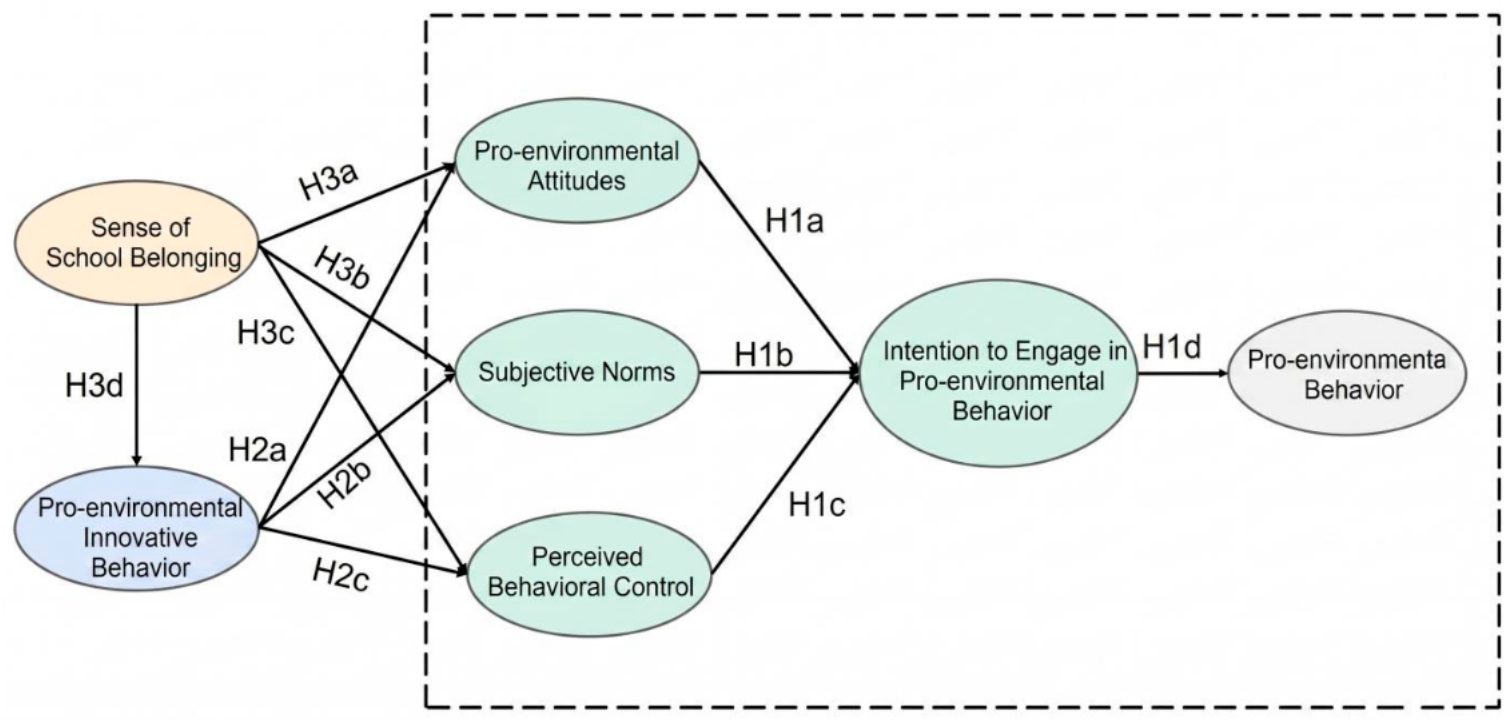
4.1. TPB Relationships and Behavioral Mechanisms (H1a–H1d)
4.2. The Role of Pro-Environmental Innovative Behavior (H2a–H2c)
4.3. The Influence of School Belonging as a Distal Contextual Factor (H3a–H3d)
4.4. Gender Differences in Structural Relationships
4.5. Theoretical Contributions
4.6. Practical Implications
4.7. Limitations and Future Research
Author Contributions
Funding
Institutional Review Board Statement
Informed Consent Statement
Data Availability Statement
Conflicts of Interest
References
- Ajzen, I. (1991). The theory of planned behavior. Organizational Behavior and Human Decision Processes, 50(2), 179–211. [Google Scholar] [CrossRef]
- Ajzen, I. (2002). Perceived behavioral control, self-efficacy, locus of control, and the theory of planned behavior. Journal of Applied Social Psychology, 32(4), 665–683. [Google Scholar]
- Ajzen, I., Fishbein, M., Lohmann, S., & Albarracín, D. (2018). The influence of attitudes on behavior. In The handbook of attitudes, volume 1: Basic principles (pp. 197–255). Taylor & Francis Group. [Google Scholar]
- Allen, K. A., Kern, M. L., Rozek, C. S., McInerney, D. M., & Slavich, G. M. (2021). Belonging: A review of conceptual issues, an integrative framework, and directions for future research. Australian Journal of Psychology, 73(1), 87–102. [Google Scholar] [CrossRef] [PubMed]
- Bamberg, S., & Möser, G. (2007). Twenty years after Hines, Hungerford, and Tomera: A new meta-analysis of psycho-social determinants of pro-environmental behaviour. Journal of Environmental Psychology, 27(1), 14–25. [Google Scholar]
- Bandura, A. (2001). Social cognitive theory: An agentic perspective. Annual review of psychology, 52(1), 1–26. [Google Scholar] [CrossRef] [PubMed]
- Bandura, A., & Wessels, S. (1997). Self-efficacy (Vol. 10). Cambridge University Press. [Google Scholar]
- Benner, A. D., Boyle, A. E., & Sadler, S. (2016). Parental involvement and adolescents’ educational success: The roles of prior achievement and socioeconomic status. Journal of Youth and Adolescence, 45(6), 1053–1064. [Google Scholar] [CrossRef] [PubMed]
- Bronfenbrenner, U. (1979). Contexts of child rearing: Problems and prospects. American Psychologist, 34(10), 844–850. [Google Scholar] [CrossRef]
- Chrobak, B. (2024). Narrowing (achievement) gaps in higher education with a social-belonging intervention: A systematic review. Educational Psychology Review, 36(1), 33. [Google Scholar] [CrossRef]
- Cialdini, R. B., Reno, R. R., & Kallgren, C. A. (1990). A focus theory of normative conduct: Recycling the concept of norms to reduce littering in public places. Journal of Personality and Social Psychology, 58(6), 1015–1026. [Google Scholar] [CrossRef]
- Ciocîrlan, A. B., Baird, H., & Rowe, R. (2025). A systematic review and meta-analysis of the relationships between pro-environmental behaviours. Journal of Environmental Psychology, 108, 102807. [Google Scholar] [CrossRef]
- Conway, M., & Ross, M. (1984). Getting what you want by revising what you had. Journal of Personality and Social Psychology, 47(4), 738–748. [Google Scholar] [CrossRef]
- De Jong, J., & Den Hartog, D. (2010). Measuring innovative work behaviour. Creativity and Innovation Management, 19(1), 23–36. [Google Scholar] [CrossRef]
- DeVellis, R. F., & Thorpe, C. T. (2021). Scale development: Theory and applications. Sage Publications. [Google Scholar]
- Dunlap, R. E., Van Liere, K. D., Mertig, A. G., & Jones, R. E. (2000). Measuring endorsement of the new ecological paradigm: A revised NEP scale–statistical data included. Journal of Social Issues, 56(3), 425–442. [Google Scholar]
- Eccles, J., Wigfield, A., Harold, R. D., & Blumenfeld, P. (1993). Age and gender differences in children’s self-and task perceptions during elementary school. Child Development, 64(3), 830–847. [Google Scholar] [CrossRef] [PubMed]
- Evans, G. W., Otto, S., & Kaiser, F. G. (2018). Childhood origins of young adult environmental behavior. Psychological Science, 29(5), 679–687. [Google Scholar] [CrossRef] [PubMed]
- Fishbein, M., & Ajzen, I. (2011). Predicting and changing behavior: The reasoned action approach. Psychology Press. [Google Scholar]
- Fornara, F., Molinario, E., Scopelliti, M., Bonnes, M., Bonaiuto, F., Cicero, L., Admiraal, J., Beringer, A., Dedeurwaerdere, T., de Groot, W., Hiedanpää, J., Knights, P., Knippenberg, L., Ovenden, C., Horvat, K. P., Popa, F., Porras-Gomez, C., Smrekar, A., Soethe, N., … Bonaiuto, M. (2020). The extended Value-Belief-Norm theory predicts committed action for nature and biodiversity in Europe. Environmental Impact Assessment Review, 81, 106338. [Google Scholar] [CrossRef]
- Fornell, C., & Larcker, D. F. (1981). Evaluating structural equation models with unobservable variables and measurement error. Journal of Marketing Research, 18(1), 39–50. [Google Scholar] [CrossRef]
- Goodenow, C. (1993). The psychological sense of school membership among adolescents: Scale development and educational correlates. Psychology in the Schools, 30(1), 79–90. [Google Scholar] [CrossRef]
- Hair, J. F., Black, W. C., Babin, B. J., & Anderson, R. E. (2019). Multivariate data analysis (8th ed.). Pearson. [Google Scholar]
- Henseler, J., Ringle, C. M., & Sarstedt, M. (2015). A new criterion for assessing discriminant validity in variance-based structural equation modeling. Journal of the Academy of Marketing Science, 43(1), 115–135. [Google Scholar]
- Kaiser, F. G., Hübner, G., & Bogner, F. X. (2005). Contrasting the theory of planned behavior with the value-belief-norm model in explaining conservation behavior. Journal of Applied Social Psychology, 35(10), 2150–2170. [Google Scholar]
- Kaiser, F. G., & Wilson, M. (2000). Assessing people’s general ecological behavior: A cross-cultural measure. Journal of Applied Social Psychology, 30(5), 952–978. [Google Scholar]
- Kollmuss, A., & Agyeman, J. (2002). Mind the gap: Why do people act environmentally and what are the barriers to pro-environmental behavior? Environmental Education Research, 8(3), 239–260. [Google Scholar] [CrossRef]
- Krumm, L. (2024). The relationship between pro-environmental behavior, subjective well-being, and environmental impact: A meta-analysis. Environmental Research Letters, 19(9), 094056. [Google Scholar] [CrossRef]
- McCright, A. M., & Dunlap, R. E. (2015). Comparing two measures of social movement identity: The environmental movement as an example. Social Science Quarterly, 96(2), 400–416. [Google Scholar] [CrossRef]
- Monroe, M. C., Plate, R. R., Oxarart, A., Bowers, A., & Chaves, W. A. (2019). Identifying effective climate change education strategies: A systematic review of the research. Environmental Education Research, 25(6), 791–812. [Google Scholar]
- Osterman, K. F. (2000). Students’ need for belonging in the school community. Review of Educational Research, 70(3), 323–367. [Google Scholar] [CrossRef]
- Otto, S., Pensini, P., Zabel, S., Diaz-Siefer, P., Burnham, E., Navarro-Villarroel, C., & Neaman, A. (2021). The prosocial origin of sustainable behavior: A case study in the ecological domain. Global Environmental Change, 69, 102312. [Google Scholar] [CrossRef]
- Podsakoff, P. M., MacKenzie, S. B., Lee, J. Y., & Podsakoff, N. P. (2003). Common method biases in behavioral research: A critical review of the literature and recommended remedies. Journal of Applied Psychology, 88(5), 879. [Google Scholar] [CrossRef] [PubMed]
- Prinzing, M. M., & Laffan, K. (2024). Leveraging the link between pro-environmental behaviour and well-being to encourage sustainable lifestyle shifts. npj Climate Action, 3(1), 73. [Google Scholar] [CrossRef]
- Putnick, D. L., & Bornstein, M. H. (2016). Measurement invariance conventions and reporting: The state of the art and future directions for psychological research. Developmental review, 41, 71–90. [Google Scholar] [CrossRef] [PubMed]
- Ryan, R. M., & Deci, E. L. (2000). Intrinsic and extrinsic motivations: Classic definitions and new directions. Contemporary Educational Psychology, 25(1), 54–67. [Google Scholar] [CrossRef] [PubMed]
- Sahoo, S., Kumar, A., & Upadhyay, A. (2023). How do green knowledge management and green technology innovation impact corporate environmental performance? Understanding the role of green knowledge acquisition. Business Strategy and the Environment, 32(1), 551–569. [Google Scholar]
- Scott, S. G., & Bruce, R. A. (1994). Determinants of innovative behavior: A path model of individual innovation in the workplace. Academy of Management Journal, 37(3), 580–607. [Google Scholar] [CrossRef]
- Symonds, J. E., Guo, J., Tang, X., Upadyaya, K., Yu, J., Vaccaro, N., Guigui, D., Ponce, S., Costello, N., & Salmela-Aro, K. (2026). Student engagement declines across adolescence: A meta-analysis of longitudinal studies. Review of Education, 14(1), e70134. [Google Scholar]
- Tran, N. T., Nguyen, T. D., Nguyen, M., & Pham, P. M. (2025). Climate vulnerability and green innovation: A cross-country analysis. Journal of Open Innovation: Technology, Market, and Complexity, 11(2), 100548. [Google Scholar] [CrossRef]
- Treffinger, D. J., Schoonover, P. F., & Selby, E. C. (2021). Educating for creativity and innovation: A comprehensive guide for research-based practice. Routledge. [Google Scholar]
- Vesely, S., Masson, T., Chokrai, P., Becker, A. M., Fritsche, I., Klöckner, C. A., Tiberio, L., Carrus, G., & Panno, A. (2021). Climate change action as a project of identity: Eight meta-analyses. Global Environmental Change, 70, 102322. [Google Scholar] [CrossRef]
- Wentzel, K. R. (1998). Social relationships and motivation in middle school: The role of parents, teachers, and peers. Journal of Educational Psychology, 90(2), 202–209. [Google Scholar] [CrossRef]
- West, M. A., & Farr, J. L. (1990). Innovation at work. John Wiley & Sons. [Google Scholar]
- Wild, S., & Schulze Heuling, L. (2024). Exploring the role of identity in pro-environmental behavior: Cultural and educational influences on younger generations. Frontiers in Psychology, 15, 1459165. [Google Scholar] [CrossRef] [PubMed]
- Zelezny, L. C., Chua, P. P., & Aldrich, C. (2000). New ways of thinking about environmentalism: Elaborating on gender differences in environmentalism. Journal of Social Issues, 56(3), 443–457. [Google Scholar] [CrossRef]
- Zelezny, L. C., & Schultz, P. W. (2000). Psychology of promoting environmentalism: Promoting environmentalism. Journal of Social Issues, 56(3), 365–371. [Google Scholar] [CrossRef]


| Variable | M | SD | 1 | 2 | 3 | 4 | 5 | 6 | 7 |
|---|---|---|---|---|---|---|---|---|---|
| 1. PEA | 4.31 | 0.65 | 1 | ||||||
| 2. SN | 3.28 | 0.81 | 0.42 ** | 1 | |||||
| 3. PBC | 3.95 | 0.74 | 0.46 ** | 0.44 ** | 1 | ||||
| 4. IPB | 4.12 | 0.72 | 0.83 ** | 0.40 ** | 0.51 ** | 1 | |||
| 5. IB | 3.76 | 0.82 | 0.15 ** | 0.45 ** | 0.34 ** | 0.21 ** | 1 | ||
| 6. SB | 3.58 | 0.68 | 0.18 ** | 0.35 ** | 0.27 ** | 0.16 ** | 0.23 ** | 1 | |
| 7. PEB | 3.92 | 0.68 | 0.41 ** | 0.38 ** | 0.35 ** | 0.50 ** | 0.36 ** | 0.25 ** | 1 |
| Construct | Abbreviation | Standardized Factor Loadings | Composite Reliability (CR) | Average Variance Extracted (AVE) |
|---|---|---|---|---|
| Pro-environmental Attitudes | PEA | 0.668–0.859 | 0.894 | 0.629 |
| Subjective Norms | SN | 0.808–0.885 | 0.881 | 0.712 |
| Perceived Behavioral Control | PBC | 0.758–0.841 | 0.844 | 0.644 |
| Intention to Engage in PEB | Intention | 0.555–0.880 | 0.896 | 0.594 |
| Pro-environmental Behavior | PEB | 0.421–0.753 | 0.851 | 0.528 |
| Pro-environmental Innovative Behavior | IB | 0.585–0.756 | 0.892 | 0.481 |
| Sense of School Belonging | SB | 0.452–0.744 | 0.923 | 0.512 |
| Hypothesis | Path | B | SE | β | t | p |
|---|---|---|---|---|---|---|
| H1a | PEA → IPB | 0.952 | 0.039 | 0.921 | 24.12 | <0.001 |
| H1b | SN → IPB | 0.272 | 0.021 | 0.305 | 12.85 | <0.001 |
| H1c | PBC → IPB | 0.485 | 0.027 | 0.514 | 18.22 | <0.001 |
| H1d | IPB → PEB | 0.638 | 0.022 | 0.681 | 28.5 | <0.001 |
| H2a | IB → PEA | 0.198 | 0.021 | 0.219 | 9.45 | <0.001 |
| H2b | IB → SN | 0.465 | 0.026 | 0.486 | 17.65 | <0.001 |
| H2c | IB → PBC | 0.245 | 0.022 | 0.271 | 11.2 | <0.001 |
| H3a | SB → PEA | 0.185 | 0.021 | 0.205 | 8.85 | <0.001 |
| H3b | SB → SN | 0.382 | 0.026 | 0.402 | 14.9 | <0.001 |
| H3c | SB → PBC | 0.188 | 0.021 | 0.208 | 9.15 | <0.001 |
| H3d | SB → IB | 0.342 | 0.022 | 0.379 | 15.3 | <0.001 |
| Hypothesis | Path | β (Female) | p (F) | β (Male) | p (M) | Path Difference |
|---|---|---|---|---|---|---|
| H1a | PEA → IPB | 0.885 | <0.001 | 0.945 | <0.001 | Stronger in males |
| H1b | SN → IPB | 0.282 | <0.001 | 0.32 | <0.001 | Comparable |
| H1c | PBC → IPB | 0.49 | <0.001 | 0.525 | <0.001 | Comparable |
| H1d | IPB → PEB | 0.655 | <0.001 | 0.705 | <0.001 | Stronger in males |
| H2a | IB → PEA | 0.205 | <0.001 | 0.23 | <0.001 | Comparable |
| H2b | IB → SN | 0.455 | <0.001 | 0.505 | <0.001 | Comparable |
| H2c | IB → PBC | 0.255 | <0.001 | 0.285 | <0.001 | Comparable |
| H3a | SB → PEA | 0.18 | <0.001 | 0.225 | <0.001 | Stronger in males |
| H3b | SB → SN | 0.375 | <0.001 | 0.42 | <0.001 | Comparable |
| H3c | SB → PBC | 0.19 | 0.003 | 0.225 | <0.001 | Stronger in males |
| H3d | SB → IB | 0.355 | <0.001 | 0.4 | <0.001 | Comparable |
Disclaimer/Publisher’s Note: The statements, opinions and data contained in all publications are solely those of the individual author(s) and contributor(s) and not of MDPI and/or the editor(s). MDPI and/or the editor(s) disclaim responsibility for any injury to people or property resulting from any ideas, methods, instructions or products referred to in the content. |
© 2026 by the authors. Licensee MDPI, Basel, Switzerland. This article is an open access article distributed under the terms and conditions of the Creative Commons Attribution (CC BY) license.
Share and Cite
He, Y.; Xiao, L.; Wang, M.; Ren, F. Bridging the Gap: How High School Belonging and Innovative Behavior Retrospective Links Long-Term Pro-Environmental Behavior Through an Extended Theory of Planned Behavior Model. Behav. Sci. 2026, 16, 1144. https://doi.org/10.3390/bs16071144
He Y, Xiao L, Wang M, Ren F. Bridging the Gap: How High School Belonging and Innovative Behavior Retrospective Links Long-Term Pro-Environmental Behavior Through an Extended Theory of Planned Behavior Model. Behavioral Sciences. 2026; 16(7):1144. https://doi.org/10.3390/bs16071144
Chicago/Turabian StyleHe, Yaqiong, Liufeng Xiao, Mengcheng Wang, and Fen Ren. 2026. "Bridging the Gap: How High School Belonging and Innovative Behavior Retrospective Links Long-Term Pro-Environmental Behavior Through an Extended Theory of Planned Behavior Model" Behavioral Sciences 16, no. 7: 1144. https://doi.org/10.3390/bs16071144
APA StyleHe, Y., Xiao, L., Wang, M., & Ren, F. (2026). Bridging the Gap: How High School Belonging and Innovative Behavior Retrospective Links Long-Term Pro-Environmental Behavior Through an Extended Theory of Planned Behavior Model. Behavioral Sciences, 16(7), 1144. https://doi.org/10.3390/bs16071144