The Association Between Negative Emotion and Suicidal Ideation in Chinese Migrant Workers: A Chain Mediation Model of Meaning in Life and Social Connectedness

Abstract
1. Introduction
1.1. The Relationship Between Negative Emotion and Suicidal Ideation
1.2. Meaning in Life as a Potential Mediator
1.3. Social Connectedness as a Potential Mediator
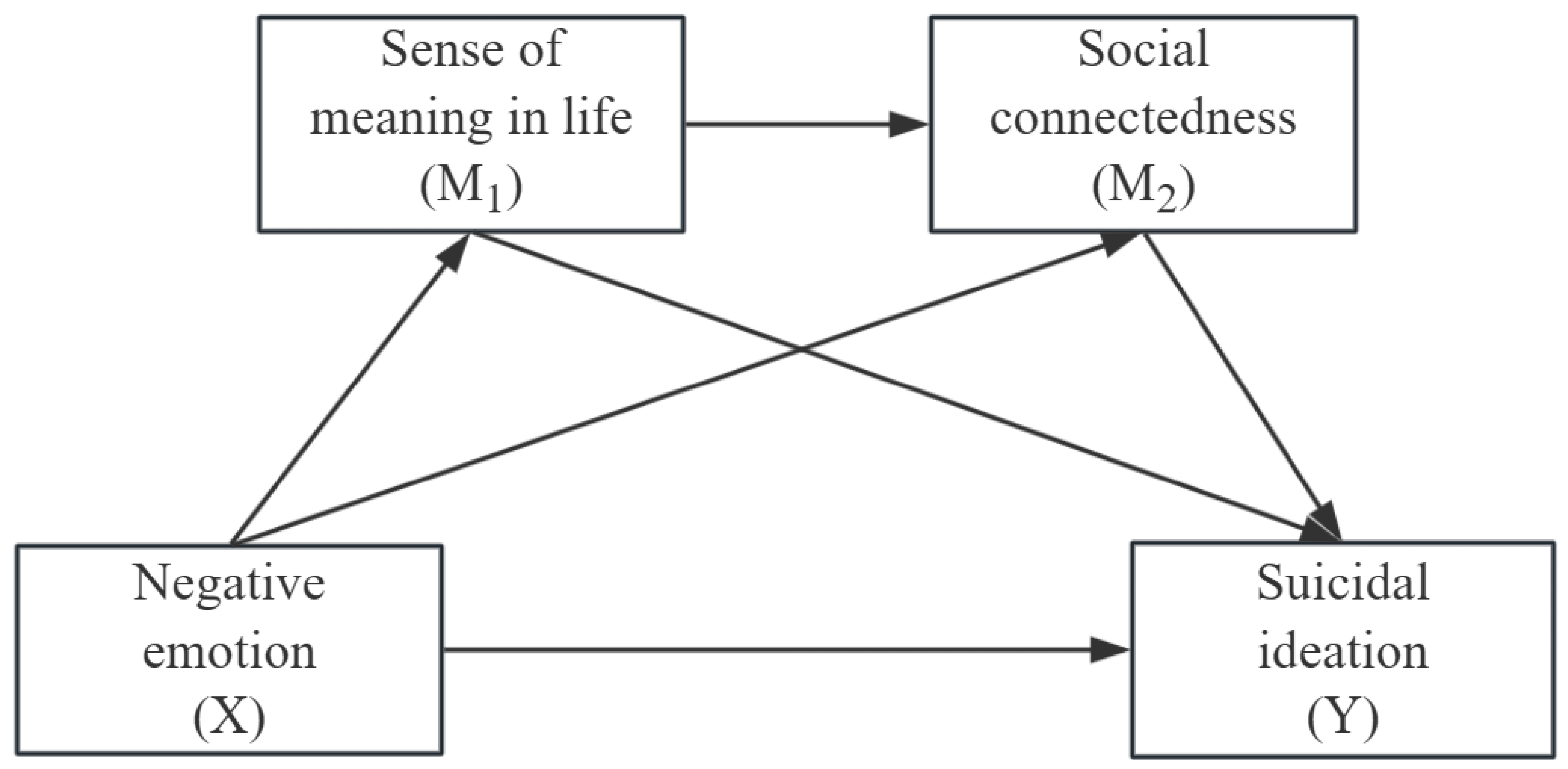
1.4. The Mediating Role of Meaning in Life and Social Connectedness
2. Methods
2.1. Participants
2.2. Measures
2.2.1. Negative Emotion
2.2.2. Meaning in Life
2.2.3. Social Connectedness
2.2.4. Suicidal Ideation
2.3. Data Analysis
3. Results
3.1. Descriptive Statistics and Correlation Analysis
3.2. Negative Emotion Predicts Suicidal Ideation
3.3. Mediating Effect of Meaning in Life
3.4. Mediating Effect of Social Connectedness
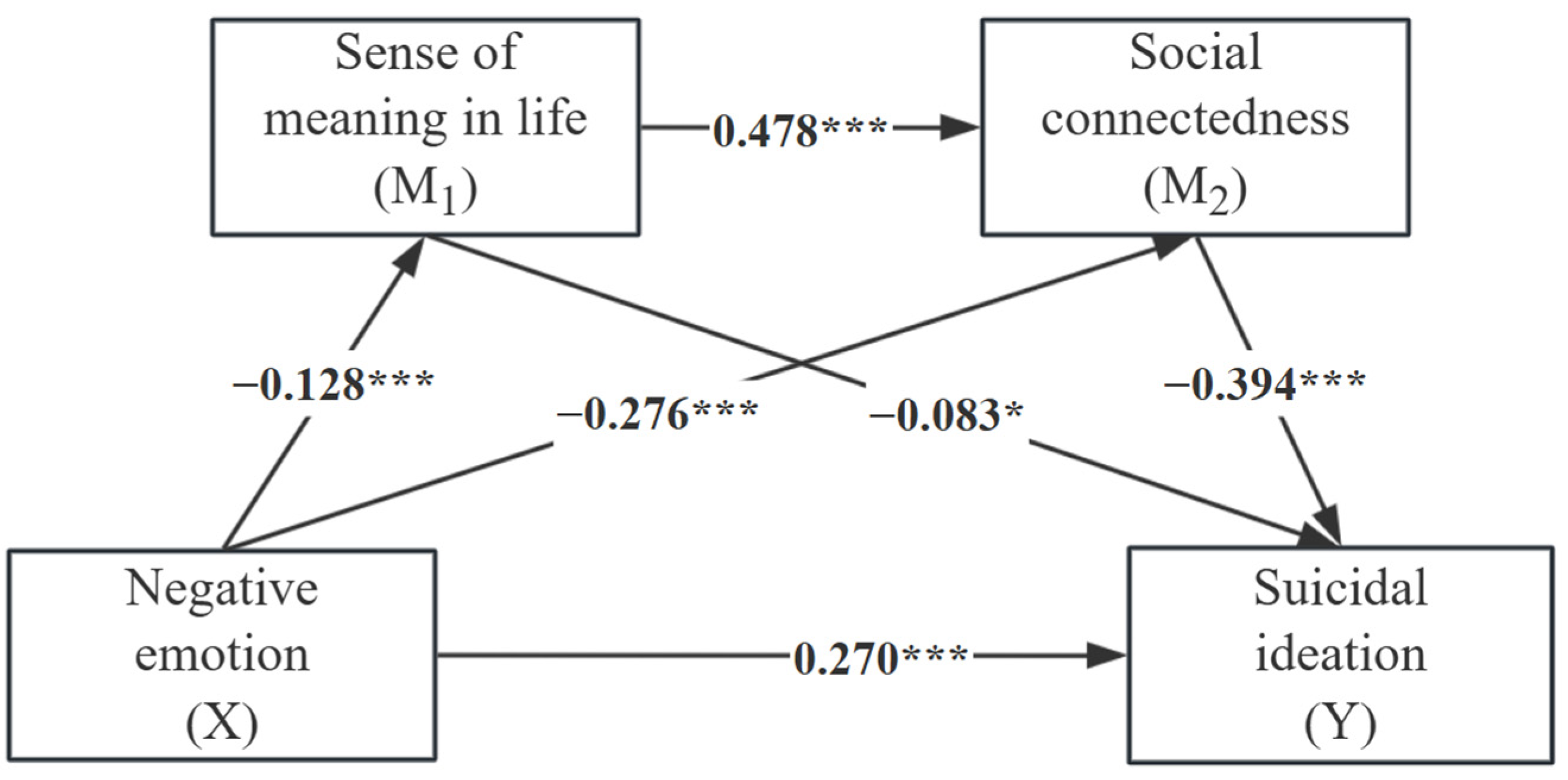
3.5. Chain Mediating Effect of Meaning in Life and Social Connectedness
4. Discussion
4.1. Negative Emotion and Suicidal Ideation
4.2. The Mediating Role of Meaning in Life
4.3. The Mediating Role of Social Connectedness
4.4. The Chain Mediating Role of Meaning in Life and Social Connectedness
4.5. Implications
4.6. Limitations and Future Directions
5. Conclusions
Author Contributions
Funding
Institutional Review Board Statement
Informed Consent Statement
Data Availability Statement
Acknowledgments
Conflicts of Interest
References
- Al-Dajani, N., & Uliaszek, A. A. (2021). The after-effects of momentary suicidal ideation: A preliminary examination of emotion intensity changes following suicidal thoughts. Psychiatry Research, 302, 114027. [Google Scholar] [CrossRef]
- Algoe, S. B. (2012). Find, remind, and bind: The functions of gratitude in everyday relationships. Social and Personality Psychology Compass, 6(6), 455–469. [Google Scholar] [CrossRef]
- Arslan, G., & Yıldırım, M. (2021). A longitudinal examination of the association between meaning in life, resilience, and mental well-being in times of coronavirus pandemic. Frontiers in Psychology, 12, 645597. [Google Scholar] [CrossRef]
- Bourassa, K. J., Dennis, P. A., Patel, P., Qin, X. J., Sbarra, D. A., Hauser, E. R., Ashley-Koch, A. E., Program, M. V., Beckham, J. C., & Kimbrel, N. A. (2024). Social connection and suicidal thoughts and behaviors in the Million Veteran Program cohort. Journal of Psychiatric Research, 180, 500–505. [Google Scholar] [CrossRef]
- Brown, G. K., Beck, A. T., Steer, R. A., & Grisham, J. R. (2000). Risk factors for suicide in psychiatric outpatients: A 20-year prospective study. Journal of Consulting and Clinical Psychology, 68(3), 371–377. [Google Scholar] [CrossRef]
- Cacioppo, J. T., & Cacioppo, S. (2014). Social relationships and health: The toxic effects of perceived social isolation. Social and Personality Psychology Compass, 8(2), 58–72. [Google Scholar] [CrossRef]
- Cai, Y., Kong, W., Lian, Y., & Jin, X. (2021). Depressive symptoms among Chinese informal employees in the digital era. International Journal of Environmental Research and Public Health, 18(10), 5211. [Google Scholar] [CrossRef] [PubMed]
- Cao, X. L., Zhong, B. L., Xiang, Y. T., Ungvari, G. S., Lai, K. Y., Chiu, H. F., & Caine, E. D. (2015). Prevalence of suicidal ideation and suicide attempts in the general population of China: A meta-analysis. International Journal of Psychiatry in Medicine, 49(4), 296–308. [Google Scholar] [CrossRef]
- Celik, I., & Cakar, B. (2025). Exploring risk and protective factors for suicidality and physical self-harm: A cross-sectional analysis in Nordic adolescents. Issues in Mental Health Nursing, 46(2), 165–179. [Google Scholar] [CrossRef]
- Chen, J. (2011). Internal migration and health: Re-examining the healthy migrant phenomenon in China. Social Science & Medicine, 72(8), 1294–1301. [Google Scholar] [CrossRef]
- Chen, L., Ngoubene-Atioky, A. J., Zanardelli, G., Yuanping, D., & Yu, L. (2020). Childhood abuse and suicidal behaviors among Chinese migrant workers: The mediating role of alexithymia and social support. Archives of Suicide Research, 24(4), 633–647. [Google Scholar] [CrossRef] [PubMed]
- Chu, C., Buchman-Schmitt, J. M., Stanley, I. H., Hom, M. A., Tucker, R. P., Hagan, C. R., Rogers, M. L., Podlogar, M. C., Chiurliza, B., Ringer, F. B., Michaels, M. S., Patros, C. H. G., & Joiner, T. E. (2017). The interpersonal theory of suicide: A systematic review and meta-analysis of a decade of cross-national research. Psychological Bulletin, 143(12), 1313–1345. [Google Scholar] [CrossRef]
- Costin, V., & Vignoles, V. L. (2020). Meaning is about mattering: Evaluating coherence, purpose, and existential mattering as precursors of meaning in life judgments. Journal of Personality and Social Psychology, 118(4), 864–884. [Google Scholar] [CrossRef]
- Fredrickson, B. L. (2001). The role of positive emotions in positive psychology: The broaden-and-build theory of positive emotions. American Psychologist, 56(3), 218–226. [Google Scholar] [CrossRef]
- Harmer, B., Lee, S., Rizvi, A., & Saadabadi, A. (2024). Suicidal ideation. In StatPearls. StatPearls Publishing. [Google Scholar]
- He, X., Yang, P., Yu, Q., & Yang, B. (2023). Correlations between negative life events and suicidal ideation among Chinese adolescents: A meta-analysis. Frontiers in Psychiatry, 14, 1201786. [Google Scholar] [CrossRef]
- Heisel, M. J., & Flett, G. L. (2014). Do meaning in life and purpose in life protect against suicide ideation among community-residing older adults? In A. Batthyany, & P. Russo-Netzer (Eds.), Meaning in positive and existential psychology (pp. 303–324). Springer Science + Business Media. [Google Scholar] [CrossRef]
- Holt-Lunstad, J. (2021). Loneliness and social isolation as risk factors: The power of social connection in prevention. American Journal of Lifestyle Medicine, 15(5), 567–573. [Google Scholar] [CrossRef]
- Holt-Lunstad, J. (2024). Social connection as a critical factor for mental and physical health: Evidence, trends, challenges, and future implications. World Psychiatry, 23(3), 312–332. [Google Scholar] [CrossRef]
- King, L. A., & Hicks, J. A. (2021). The science of meaning in life. Annual Review of Psychology, 72, 561–584. [Google Scholar] [CrossRef] [PubMed]
- Kleiman, E. M., Adams, L. M., Kashdan, T. B., & Riskind, J. H. (2013). Gratitude and grit indirectly reduce risk of suicidal ideations by enhancing meaning in life: Evidence for a mediated moderation model. Journal of Research in Personality, 47(5), 539–546. [Google Scholar] [CrossRef]
- Lau, J. T., Cheng, Y., Gu, J., Zhou, R., Yu, C., Holroyd, E., & Yeung, N. C. (2012). Suicides in a mega-size factory in China: Poor mental health among young migrant workers in China. Occupational and Environmental Medicine, 69(7), 526. [Google Scholar] [CrossRef] [PubMed]
- Lee, R. M., & Robbins, S. B. (1995). Measuring belongingness: The social connectedness and the social assurance scales. Journal of Counseling Psychology, 42(2), 232–241. [Google Scholar] [CrossRef]
- Lee, R. M., & Robbins, S. B. (1998). The relationship between social connectedness and anxiety, self-esteem, and social identity. Journal of Counseling Psychology, 45(3), 338–345. [Google Scholar] [CrossRef]
- Li, J., & Rose, N. (2017). Urban social exclusion and mental health of China’s rural-urban migrants—A review and call for research. Health & Place, 48, 20–30. [Google Scholar] [CrossRef]
- Li, S., Luo, H., Huang, F., Wang, Y., & Siu Fai Yip, P. (2024). Associations between meaning in life and suicidal ideation in young people: A systematic review and meta-analysis. Children and Youth Services Review, 158, 107477. [Google Scholar] [CrossRef]
- Liu, R. T., & Miller, I. (2014). Life events and suicidal ideation and behavior: A systematic review. Clinical Psychology Review, 34(3), 181–192. [Google Scholar] [CrossRef] [PubMed]
- Long, D., Bonsel, G. J., Lubetkin, E. I., Janssen, M. F., & Haagsma, J. A. (2022). Anxiety, depression, and social connectedness among the general population of eight countries during the COVID-19 pandemic. Archives of Public Health, 80(1), 237. [Google Scholar] [CrossRef] [PubMed]
- Lovibond, P. F., & Lovibond, S. H. (1995). The structure of negative emotional states: Comparison of the depression anxiety stress scales (DASS) with the beck depression and anxiety inventories. Behaviour Research and Therapy, 33(3), 335–343. [Google Scholar] [CrossRef]
- Mo, P. K. H., Cheng, Y., & Lau, J. T. F. (2022). Work-related factors on mental health among migrant factory workers in China: Application of the demand-control and effort-reward imbalance model. Health & Social Care in the Community, 30(2), 656–667. [Google Scholar] [CrossRef]
- National Bureau of Statistics of China. (2024). Statistical communique of the People’s Republic of China on the 2023 national economic and social development. Available online: https://www.stats.gov.cn/sj/zxfb/202402/t20240228_1947915.html (accessed on 29 February 2024).
- Park, C. L. (2010). Making sense of the meaning literature: An integrative review of meaning making and its effects on adjustment to stressful life events. Psychological Bulletin, 136(2), 257–301. [Google Scholar] [CrossRef] [PubMed]
- Qiu, T., Klonsky, E. D., & Klein, D. N. (2017). Hopelessness predicts suicide ideation but not attempts: A 10-year longitudinal study. Suicide and Life-Threatening Behavior, 47(6), 718–722. [Google Scholar] [CrossRef]
- Ren, S., Zhang, J., & Hennessy, D. (2018). Psychological strains and psychological distress among Chinese rural migrant workers. Asian and Pacific Migration Journal, 27, 1283874147. [Google Scholar] [CrossRef]
- Reynolds, C. J., Smith, S. M., & Conway, P. (2022). Intrinsic religiosity attenuates the negative relationship between social disconnectedness and meaning in life. Psychology of Religion and Spirituality, 14(3), 390–394. [Google Scholar] [CrossRef]
- Stavrova, O., & Luhmann, M. (2016). Social connectedness as a source and consequence of meaning in life. The Journal of Positive Psychology, 11(5), 470–479. [Google Scholar] [CrossRef]
- Steger, M. F., Frazier, P., Oishi, S., & Kaler, M. (2006). The meaning in life questionnaire: Assessing the presence of and search for meaning in life. Journal of Counseling Psychology, 53(1), 80–93. [Google Scholar] [CrossRef]
- Stillman, T. F., Lambert, N. M., Fincham, F. D., & Baumeister, R. F. (2011). Meaning as magnetic force: Evidence that meaning in life promotes interpersonal appeal. Social Psychological and Personality Science, 2(1), 13–20. [Google Scholar] [CrossRef]
- Van Orden, K. A., Witte, T. K., Cukrowicz, K. C., Braithwaite, S. R., Selby, E. A., & Joiner, T. E., Jr. (2010). The interpersonal theory of suicide. Psychological Review, 117(2), 575–600. [Google Scholar] [CrossRef]
- Wang, B., Li, X., Stanton, B., & Fang, X. (2010). The influence of social stigma and discriminatory experience on psychological distress and quality of life among rural-to-urban migrants in China. Social Science & Medicine, 71(1), 84–92. [Google Scholar] [CrossRef]
- Wang, M. C., & Dai, X. Y. (2008). Applicability of the Chinese life meaning questionnaire (C–MLQ) among college students. Chinese Journal of Clinical Psychology, 16(5), 459–461. [Google Scholar]
- Wang, Y., Zhang, L., & Li, J. (2025). Network analysis of depressive and anxiety symptoms and suicidal ideation among migrant workers in Shenzhen. Journal of Affective Disorders, 345, 123–134. [Google Scholar] [CrossRef]
- Watson, D., Clark, L. A., & Tellegen, A. (1988). Development and validation of brief measures of positive and negative affect: The PANAS scales. Journal of Personality and Social Psychology, 54(6), 1063–1070. [Google Scholar] [CrossRef]
- Wildschut, T., Sedikides, C., Arndt, J., & Routledge, C. (2006). Nostalgia: Content, triggers, functions. Journal of Personality and Social Psychology, 91(5), 975–993. [Google Scholar] [CrossRef]
- Wong, D. F. K., & Leung, G. (2008). The functions of social support in the mental health of male and female migrant workers in China. Health & Social Work, 33(4), 275–285. [Google Scholar] [CrossRef] [PubMed]
- Wong, D. F. K., Li, C. Y., & Song, H. X. (2007). Rural migrant workers in urban China: Living a marginalised life. International Journal of Social Welfare, 16(1), 32–40. [Google Scholar] [CrossRef]
- Woo, J. (2022). Exploring multiple pathways from low-wage work to worker health: A mixed-methods study [Doctoral dissertation, University of Pittsburgh]. University of Pittsburgh Institutional Repository. Available online: http://d-scholarship.pitt.edu/id/eprint/42355 (accessed on 10 October 2025).
- Xia, C. Y., Wang, D. B., He, X. D., Ye, J. H., & Wu, S. Q. (2007). 自杀意念自评量表 (SIOSS) 在大学生中的应用 [Application of the Self-rating Idea of Suicide Scale (SIOSS) in college students]. In Proceedings of the 2007 annual conference of Zhejiang provincial society of psychiatry (pp. 46–50). Zhejiang Provincial Society of Psychiatry. [Google Scholar]
- Xiao, H., Li, X., Zhou, Z., Liu, H., Hu, C., Liu, T., Chen, D., & You, L. (2022). Negative coping style mediates the relationship between negative mental and suicide risk among migrant workers in China. Scientific Reports, 12(1), 305. [Google Scholar] [CrossRef] [PubMed]
- Xu, Q., Wang, L., Zhang, Y., & Jiang, X. (2023). On-call work and depressive mood: A cross-sectional survey among rural migrant workers in China. Frontiers in Psychology, 13, 1068663. [Google Scholar] [CrossRef] [PubMed]
- Yang, T., Xu, X., Li, M., Rockett, I. R., Zhu, W., & Ellison-Barnes, A. (2012). Mental health status and related characteristics of Chinese male rural-urban migrant workers. Community Mental Health Journal, 48(3), 342–351. [Google Scholar] [CrossRef]
- Yang, Y., Wang, P., & Chen, H. (2023). The impact of perceived discrimination on social connectedness among Chinese migrant workers: The mediating role of identity conflict. Journal of Community Psychology, 51(2), 789–805. [Google Scholar] [CrossRef]
- Yıldırım, M., Arslan, G., & Wong, P. T. P. (2022). Meaningful living, resilience, affective balance, and psychological health problems among Turkish young adults during coronavirus pandemic. Current Psychology, 41(11), 7812–7823. [Google Scholar] [CrossRef] [PubMed]
- Zhang, B., Wang, A., Ye, Y., Liu, J., & Lin, L. (2024). The relationship between meaning in life and mental health in Chinese undergraduates: The mediating roles of self-esteem and interpersonal trust. Behavioral Sciences, 14(8), 720. [Google Scholar] [CrossRef]
- Zhang, W., Diao, J., & Schick, C. J. (2004). Cross-cultural psychometric assessment of positive and negative affect: Testing the dimensional structure of the PANAS. Psychological Science, 27(1), 77–79. [Google Scholar] [CrossRef]
- Zhang, X., Ren, Y., You, J., Huang, C., Jiang, Y., Lin, M. P., & Leung, F. (2017). Distinguishing pathways from negative emotions to suicide ideation and to suicide attempt: The differential mediating effects of nonsuicidal self-injury. Journal of Abnormal Child Psychology, 45(8), 1609–1619. [Google Scholar] [CrossRef] [PubMed]
- Zhong, B. L., Liu, T. B., Chan, S. S., Chiu, H. F., & Hu, C. Y. (2016). The evolution of mental health policies and services for migrant populations in China: A contemporary review. International Journal of Mental Health Systems, 10(1), 63. [Google Scholar] [CrossRef]
- Zhong, B. L., Liu, T. B., Chan, S. S., Jin, D., Hu, C. Y., Dai, J., & Chiu, H. F. (2019). Suicide ideation and attempts in Chinese rural-to-urban migrant workers: A systematic review and meta-analysis. Journal of Affective Disorders, 244, 102–113. [Google Scholar]



| Demographic Variable | Category | Frequency | Percentage (%) |
|---|---|---|---|
| Age | 18–20 | 149 | 20.16 |
| 21–30 | 520 | 70.36 | |
| 31–40 | 68 | 9.20 | |
| 41–46 | 2 | 0.28 | |
| Gender | Male | 683 | 92.42 |
| Female | 56 | 7.58 | |
| Total | 739 | 100 |
| Variables | M (SD) | 1 | 2 | 3 | 4 |
|---|---|---|---|---|---|
| 1 Negative emotion | 1.982 ± 0.654 | ||||
| 2 Sense of meaning in life | 5.442 ± 1.047 | −0.128 ** | |||
| 3 Social connectedness | 6.012 ± 1.074 | −0.337 ** | 0.513 ** | ||
| 4 Suicidal ideation | 0.092 ± 0.137 | 0.414 ** | −0.320 ** | −0.528 ** |
| Mediation Pathways | β | Boot SE | 95% CI [Lower, Upper] |
|---|---|---|---|
| Total | 0.144 | 0.021 | [0.101, 0.184] |
| Ind1 | 0.011 | 0.006 | [0.001, 0.023] |
| Ind2 | 0.109 | 0.017 | [0.077, 0.143] |
| Ind3 | 0.024 | 0.009 | [0.008, 0.042] |
Disclaimer/Publisher’s Note: The statements, opinions and data contained in all publications are solely those of the individual author(s) and contributor(s) and not of MDPI and/or the editor(s). MDPI and/or the editor(s) disclaim responsibility for any injury to people or property resulting from any ideas, methods, instructions or products referred to in the content. |
© 2026 by the authors. Licensee MDPI, Basel, Switzerland. This article is an open access article distributed under the terms and conditions of the Creative Commons Attribution (CC BY) license.
Share and Cite
Hong, C.; Liu, L.; Pan, T.; Yan, W.; Wang, Y.; Chen, N.; Liu, W. The Association Between Negative Emotion and Suicidal Ideation in Chinese Migrant Workers: A Chain Mediation Model of Meaning in Life and Social Connectedness. Behav. Sci. 2026, 16, 1120. https://doi.org/10.3390/bs16071120
Hong C, Liu L, Pan T, Yan W, Wang Y, Chen N, Liu W. The Association Between Negative Emotion and Suicidal Ideation in Chinese Migrant Workers: A Chain Mediation Model of Meaning in Life and Social Connectedness. Behavioral Sciences. 2026; 16(7):1120. https://doi.org/10.3390/bs16071120
Chicago/Turabian StyleHong, Chen, Lili Liu, Ting Pan, Weiman Yan, Yu Wang, Ning Chen, and Wei Liu. 2026. "The Association Between Negative Emotion and Suicidal Ideation in Chinese Migrant Workers: A Chain Mediation Model of Meaning in Life and Social Connectedness" Behavioral Sciences 16, no. 7: 1120. https://doi.org/10.3390/bs16071120
APA StyleHong, C., Liu, L., Pan, T., Yan, W., Wang, Y., Chen, N., & Liu, W. (2026). The Association Between Negative Emotion and Suicidal Ideation in Chinese Migrant Workers: A Chain Mediation Model of Meaning in Life and Social Connectedness. Behavioral Sciences, 16(7), 1120. https://doi.org/10.3390/bs16071120