Transitions in Depressive Symptom Profiles Among Adolescents with Persistent Bullying Victimization: A Latent Transition Analysis

Abstract
1. Introduction
2. Method
2.1. Participants
2.2. Ethics and Procedures
2.3. Measurement
2.3.1. School Bullying
2.3.2. Depressive Symptoms
2.3.3. Physical Activity
2.3.4. Substance Use
2.3.5. Sleep Duration
2.3.6. Demographic Variables
2.4. Statistical Analysis
2.4.1. Longitudinal Measurement Invariance Testing
2.4.2. Latent Profile Analysis (LPA) and Parameter Selection
2.4.3. Latent Transition Analysis (LTA) and Inclusion of Covariates
3. Results
3.1. Sample Characteristics
3.2. Longitudinal Measurement Invariance Across Time
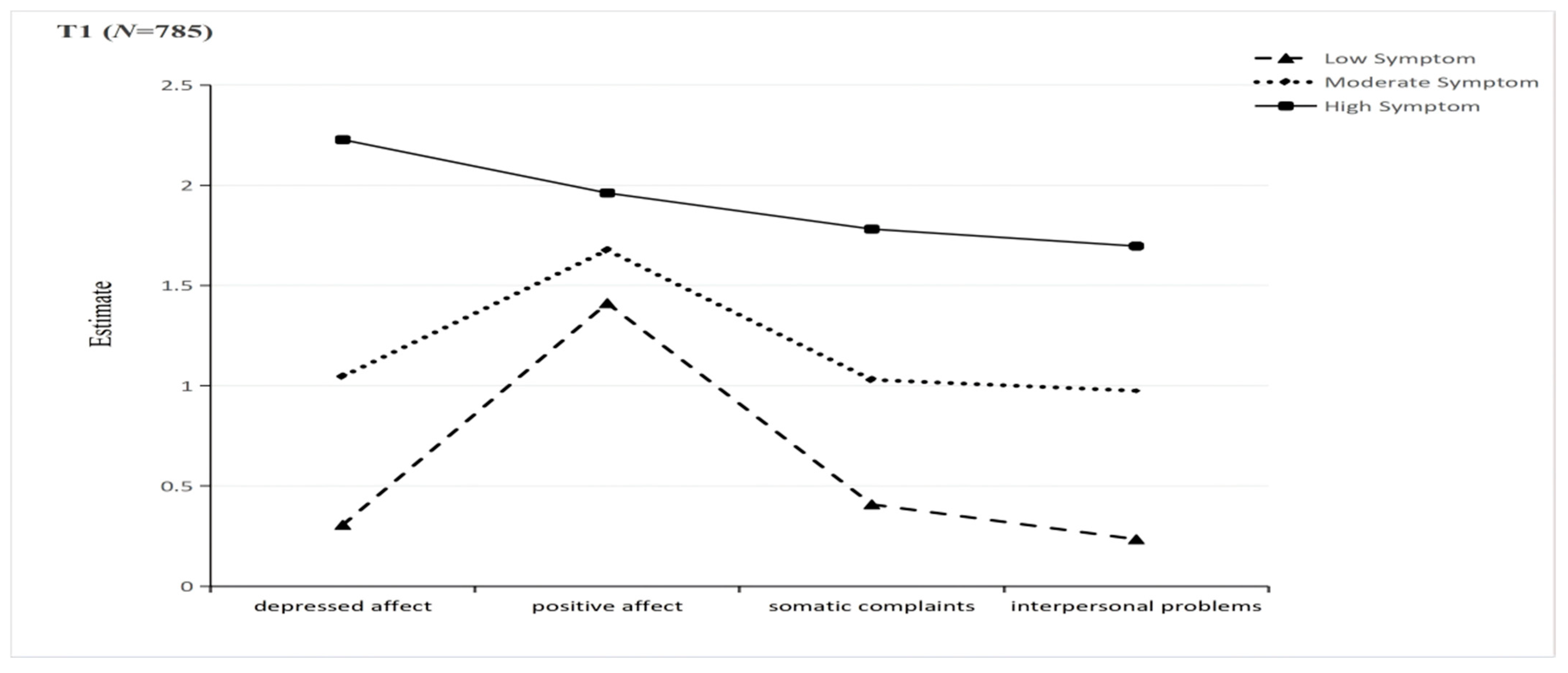
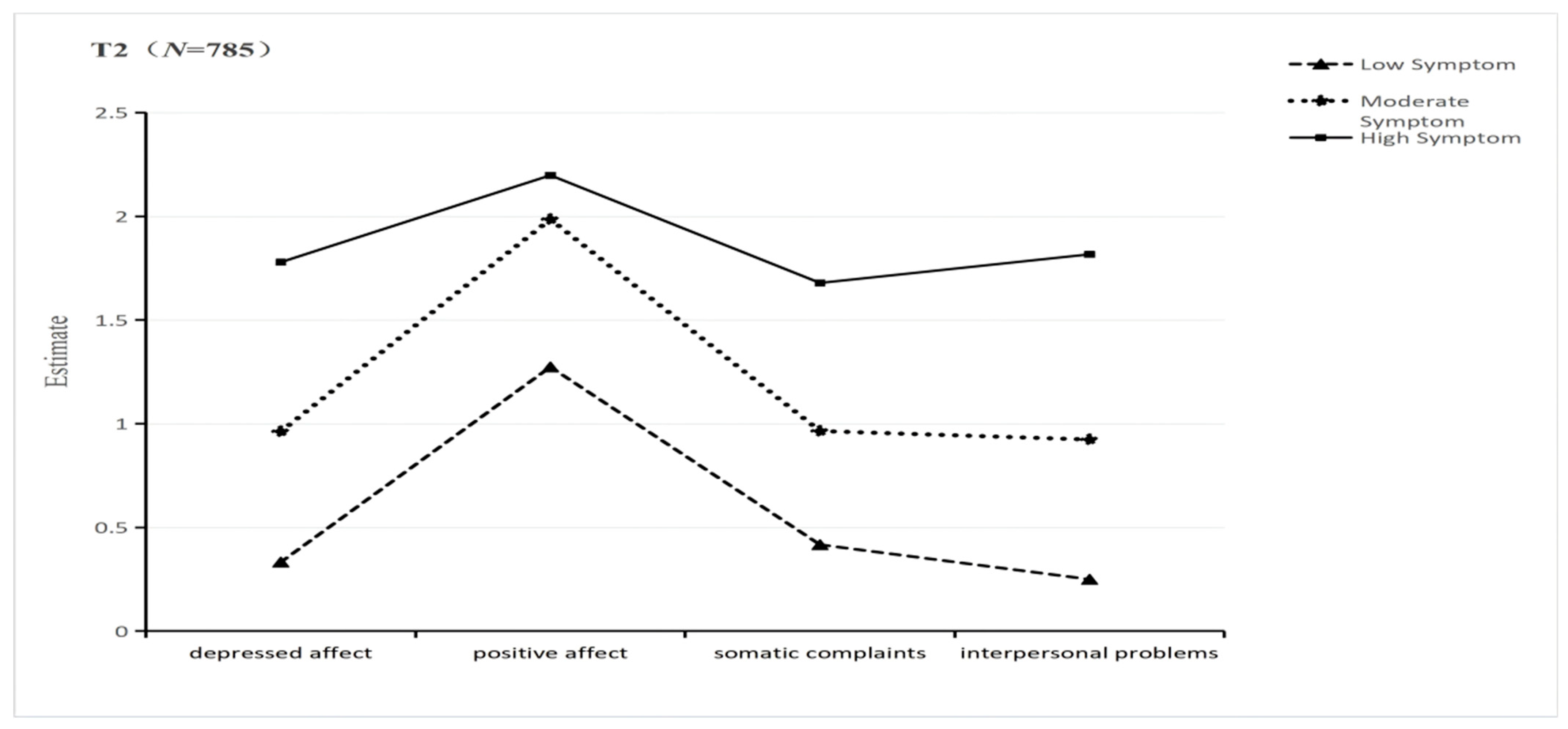
3.3. Construction of Latent Depressive Symptom Profiles at Two Time Points
3.4. Latent Status Changes Among Persistently Bullied Victims
4. Discussion
4.1. Profiles of Depressive Symptoms
4.2. Stability and Changes in Depressive Symptoms
4.3. Influence of Physical Activity, Sleep Duration, and Substance Use on Adolescent Depression Transitions
5. Limitations
- The follow-up period of this study was 12 months, and the relatively limited time span may not fully reflect the long-term developmental trajectories of depressive symptoms in adolescents, thereby limiting the generalizability of the findings to some extent. Future studies could extend the follow-up period and increase the number of measurement waves to more precisely capture dynamic changes in depressive symptoms across different developmental stages.
- This study mainly focused on the effects of health behavior factors, including physical activity, sleep duration, and substance use, on transitions in depressive states, and the range of variables was relatively limited. Future studies could further include multidimensional factors such as family environment, peer relationships, social support, and individual psychological traits to more comprehensively explore the mechanisms underlying transitions in adolescent depressive symptoms.
- The data in this study were mainly derived from self-reports, which may be affected by factors such as social desirability effects or recall bias, thereby introducing certain measurement bias. Future studies could combine clinical interviews, teacher or parent reports, and objective measurement indicators to validate the findings using multiple methods and improve the reliability of the conclusions.
6. Conclusions
Author Contributions
Funding
Institutional Review Board Statement
Informed Consent Statement
Data Availability Statement
Conflicts of Interest
References
- Abd Razak, M. A., Ahmad, N. A., Abd Aziz, F. A., Jamaluddin, R., Sidik, S. M., Awaluddin, S. M., Ibrahim, N., Tan, L., & Sooryanarayana, R. (2019). Being bullied is associated with depression among Malaysian adolescents: Findings from a cross-sectional study in Malaysia. Asia Pacific Journal of Public Health, 31(Suppl. 8), 30S–37S. [Google Scholar] [CrossRef] [Scilit]
- Adams, R. E., Santo, J. B., & Bukowski, W. M. (2021). Indirect effects of HPA axis dysregulation in the association between peer victimization and depressed affect during early adolescence. Psychoneuroendocrinology, 132, 105356. [Google Scholar] [CrossRef] [Scilit] [PubMed]
- Ajibewa, T. A., Kershaw, K. N., Carnethon, M. R., Heard-Garris, N. J., Beach, L. B., & Allen, N. B. (2025). Peer bullying victimization, psychological distress, and the protective role of school connectedness among adolescents. BMC Public Health, 25(1), 2763. [Google Scholar] [CrossRef] [Scilit] [PubMed]
- Akaike, H. (1974). A new look at the statistical model identification. IEEE Transactions on Automatic Control, 19(6), 716–723. [Google Scholar] [CrossRef] [Scilit]
- Ariani, T. A., Putri, A. R., Firdausi, F. A., & Aini, N. (2025). Global prevalence and psychological impact of bullying among children and adolescents: A meta-analysis. Journal of Affective Disorders, 385, 119446. [Google Scholar] [CrossRef] [Scilit] [PubMed]
- Băjenaru, L., Balog, A., Dobre, C., Drăghici, R., & Prada, G.-I. (2022). Latent profile analysis for quality of life in older patients. BMC Geriatrics, 22(1), 848. [Google Scholar] [CrossRef] [Scilit] [PubMed]
- Bozdogan, H. (1987). Model selection and Akaike’s Information Criterion (AIC): The general theory and its analytical extensions. Psychometrika, 52(3), 345–370. [Google Scholar] [CrossRef] [Scilit]
- Carvajal, F., Lerma-Cabrera, J. M., de León, P. H.-P., & López-Arana, S. (2024). Depression symptoms are associated with demographic characteristics, nutritional status, and social support among young adults in Chile: A latent class analysis. BMC Public Health, 24(1), 2781. [Google Scholar] [CrossRef] [Scilit] [PubMed]
- Chen, G., Kong, Y., Deater-Deckard, K., & Zhang, W. (2018). Bullying victimization heightens cortisol response to psychosocial stress in Chinese children. Journal of Abnormal Child Psychology, 46(5), 1051–1059. [Google Scholar] [CrossRef] [Scilit] [PubMed]
- Cheung, G. W., & Rensvold, R. B. (2002). Evaluating goodness-of-fit indexes for testing measurement invariance. Structural Equation Modeling, 9(2), 233–255. [Google Scholar] [CrossRef] [Scilit]
- Dai, Y., Shen, L., Zhang, S., Wu, Z., Zhang, J., Li, Q., & Xiao, J. (2025). Trajectories and influences of depression in adolescents: A latent profile transition analysis study. Stress and Health, 41(1), e3528. [Google Scholar] [CrossRef] [Scilit] [PubMed]
- Dou, D., Shek, D. T. L., Zhu, X., & Zhao, L. (2021). Dimensionality of the Chinese CES-D: Is it stable across gender, time, and samples? International Journal of Environmental Research and Public Health, 18(22), 11818. [Google Scholar] [CrossRef] [Scilit] [PubMed]
- Fraga, S., Soares, S., Peres, F. S., & Barros, H. (2022). Household dysfunction is associated with bullying behavior in 10-year-old children: Do socioeconomic circumstances matter? Journal of Interpersonal Violence, 37(15–16), NP13877–NP13901. [Google Scholar] [PubMed]
- Ghosh, J. K. (2010). Latent class and latent transition analysis: With applications in the social, behavioral, and health sciences by Linda M. Collins, Stephanie T. Lanza. Wiley Online Library. [Google Scholar]
- Giuliani, A., Petruccelli, I., & D’Urso, G. (2025). Longitudinal evidence on peer victimisation and persistent mental health outcomes in youth: A systematic review. Behavioral Sciences, 15(12), 1734. [Google Scholar] [CrossRef] [Scilit] [PubMed]
- Goldstein, A. N., & Walker, M. P. (2014). The role of sleep in emotional brain function. Annual Review of Clinical Psychology, 10(1), 679–708. [Google Scholar] [CrossRef] [Scilit] [PubMed]
- Gong, Z., Han, Z., Zhang, H., & Zhang, G. (2019). Weight status and school bullying experiences in urban China: The difference between boys and girls. Journal of Interpersonal Violence, 35(15–16), 2663–2686. [Google Scholar] [CrossRef] [Scilit] [PubMed]
- Guo, Q.-Z., Ma, W.-J., Nie, S.-P., Xu, Y.-J., Xu, H.-F., & Zhang, Y.-R. (2010). Relationships between weight status and bullying victimization among school-aged adolescents in Guangdong province of China. Biomedical and Environmental Sciences, 23(2), 108–112. [Google Scholar] [CrossRef] [Scilit] [PubMed]
- Jiang, Q., She, X., Dill, S.-E., Sylvia, S., Singh, M. K., Wang, H., Boswell, M., & Rozelle, S. (2022). Depressive and anxiety symptoms among children and adolescents in rural China: A large-scale epidemiological study. International Journal of Environmental Research and Public Health, 19(9), 5026. [Google Scholar] [CrossRef] [Scilit] [PubMed]
- Kandola, A., Ashdown-Franks, G., Hendrikse, J., Sabiston, C. M., & Stubbs, B. (2019). Physical activity and depression: Towards understanding the antidepressant mechanisms of physical activity. Neuroscience & Biobehavioral Reviews, 107, 525–539. [Google Scholar] [CrossRef] [Scilit]
- Källmén, H., & Hallgren, M. (2021). Bullying at school and mental health problems among adolescents: A repeated cross-sectional study. Child and Adolescent Psychiatry and Mental Health, 15(1), 74. [Google Scholar] [CrossRef] [Scilit] [PubMed]
- Kelly, E. V., Newton, N. C., Stapinski, L. A., Slade, T., Barrett, E. L., Conrod, P. J., & Teesson, M. (2015). Concurrent and prospective associations between bullying victimization and substance use among Australian adolescents. Drug and Alcohol Dependence, 154, 63–68. [Google Scholar] [CrossRef] [Scilit] [PubMed]
- Klein, R. J., Nguyen, N. D., Gyorda, J. A., & Jacobson, N. C. (2022). Adolescent emotion regulation and future psychopathology: A prospective transdiagnostic analysis. Journal of Research on Adolescence, 32(4), 1592–1611. [Google Scholar] [CrossRef] [Scilit] [PubMed]
- Lee, S. A., Mukherjee, D., Lanza, S. T., & Almeida, D. M. (2025). Longitudinal profiles of affect dynamics in middle and later life: A latent transition analysis. Psychology and Aging, 41(2), 256–267. [Google Scholar] [PubMed]
- Levková, T., Přibík, A., Klocek, A., & Kollerová, L. (2025). Associations between school bullying or victimization and students’ sleep problems—A systematic review and meta-analysis. Trauma Violence Abuse. OnlineFirst. [Google Scholar] [CrossRef] [Scilit] [PubMed]
- Li, G., Liu, J., Wen, H., & Shen, Q. (2023). Changes in depression among adolescents: A multiple-group latent profile transition analysis. Psychology Research and Behavior Management, 16, 319–332. [Google Scholar] [CrossRef] [Scilit] [PubMed]
- Li, M., Huang, Z., Ding, J., Wu, H., & Liang, S. (2025). Longitudinal trajectories of depressive symptoms in adolescent students. BMC Psychology, 14(1), 90. [Google Scholar] [CrossRef] [Scilit] [PubMed]
- Liang, Y., Wang, Q., Chen, J., Zhang, Y., Li, S., Xiong, M., & Ren, P. (2023). Profiles and transitions of loneliness and depressive symptoms among migrant children: Predictive role of bullying victimization. Journal of Youth and Adolescence, 52(12), 2606–2619. [Google Scholar] [CrossRef] [Scilit] [PubMed]
- Ling, Y., Liu, C., Scott Huebner, E., Zeng, Y., Zhao, N., & Li, Z. (2021). A study on classification features of depressive symptoms in adolescents. Journal of Mental Health, 30(2), 208–215. [Google Scholar] [PubMed]
- Little, T. D. (2024). Longitudinal structural equation modeling. Guilford Publications. [Google Scholar]
- McLachlan, G. J., Lee, S. X., & Rathnayake, S. I. (2019). Finite mixture models. Annual Review of Statistics and Its Application, 6(1), 355–378. [Google Scholar] [CrossRef] [Scilit]
- Murray, A., Wright, H., Casey, H., King, J., Zhu, X., Yang, Y., Xiao, Z., & Li, X. (2025). Is emotion dysregulation in childhood a precursor to internalising problems in adolescence? Journal of Affective Disorders, 386, 119433. [Google Scholar] [CrossRef] [Scilit] [PubMed]
- Muthén, B., & Muthén, L. (2017). Mplus. In Handbook of item response theory (pp. 507–518). Chapman and Hall/CRC. [Google Scholar]
- Muyiduli, X., Zhang, R., Zhang, J., Zhe, W., Dong, Y., Wang, W., Fang, P., Zhang, Y., Zhang, S., Sulidan, A., Rejiafu, S., & Sun, J. (2024). Prevalence and relevant factors of depression among adolescents in Xinjiang, China: A cross-sectional survey. Medicine, 103(7), e37090. [Google Scholar] [CrossRef] [Scilit] [PubMed]
- Nylund-Gibson, K., Garber, A. C., Carter, D. B., Chan, M., Arch, D. A., Simon, O., Whaling, K., Tartt, E., & Lawrie, S. I. (2023). Ten frequently asked questions about latent transition analysis. Psychological Methods, 28(2), 284. [Google Scholar] [CrossRef] [Scilit] [PubMed]
- Olweus, D. (1996). Revised olweus bully/victim questionnaire. APA PsycTests. [Google Scholar] [CrossRef] [Scilit]
- Östberg, V., Låftman, S. B., Modin, B., & Lindfors, P. (2018). Bullying as a stressor in mid-adolescent girls and boys—Associations with perceived stress, recurrent pain, and salivary cortisol. International Journal of Environmental Research and Public Health, 15(2), 364. [Google Scholar] [CrossRef] [Scilit] [PubMed]
- Pan, L., Huang, A., Chen, P., Sun, S., Zhang, H., & Li, R. (2024). Categorical characteristics of depressive symptoms in the Chinese residents: From preadolescent period to old age. Current Psychology, 43(40), 31559–31567. [Google Scholar] [CrossRef] [Scilit]
- Pang, R. D., Farrahi, L., Glazier, S., Sussman, S., & Leventhal, A. M. (2014). Depressive symptoms, negative urgency and substance use initiation in adolescents. Drug and Alcohol Dependence, 144, 225–230. [Google Scholar] [CrossRef] [Scilit] [PubMed]
- Paruthi, S., Brooks, L. J., D’Ambrosio, C., Hall, W. A., Kotagal, S., Lloyd, R. M., Malow, B. A., Maski, K., Nichols, C., & Quan, S. F. (2016). Recommended amount of sleep for pediatric populations: A consensus statement of the American academy of sleep medicine. Journal of Clinical Sleep Medicine, 12(6), 785–786. [Google Scholar] [CrossRef] [Scilit] [PubMed]
- Peng, S., Wang, Y., Huang, X., Zhang, X., & Ge, J. (2025). Association between adolescent life events and depressive symptoms: Data from the Shanghai area. Frontiers in Psychiatry, 16, 1651770. [Google Scholar] [CrossRef] [Scilit] [PubMed]
- Radloff, L. S. (1977). The CES-D scale: A self-report depression scale for research in the general population. Applied Psychological Measurement, 1(3), 385–401. [Google Scholar] [CrossRef] [Scilit]
- Rodríguez-Ruiz, J., & Espejo-Siles, R. (2025). What moderates the link between peers’ and individual’s substance use in adolescence? A systematic scoping review. Adolescent Research Review, 10(2), 285–307. [Google Scholar] [CrossRef] [Scilit]
- Rogosch, F., & Cicchetti, D. (2002). A developmental psychopathology perspective on adolescence. Journal of Consulting and Clinical Psychology, 70(1), 6–20. [Google Scholar] [CrossRef]
- Scaramutti, C., Seixas, A., & Schwartz, S. (2024). 0137 Exploring the nexus of sleep restlessness and depressive symptoms: A study of venezuelan dyads in the U.S. Sleep, 47(Suppl. 1), A60. [Google Scholar] [CrossRef] [Scilit]
- Schepers, S. A., Russell, K., Berlin, K. S., Zhang, H., Wang, F., & Phipps, S. (2020). Daily mood profiles and psychosocial adjustment in youth with newly diagnosed cancer and healthy peers. Health Psychology, 39(1), 1. [Google Scholar] [CrossRef] [Scilit] [PubMed]
- Schwarz, G. (1978). Estimating the dimension of a model. The Annals of Statistics, 6, 461–464. [Google Scholar] [CrossRef] [Scilit]
- Shadur, J. M., & Lejuez, C. W. (2015). Adolescent substance use and comorbid psychopathology: Emotion regulation deficits as a transdiagnostic risk factor. Current Addiction Reports, 2(4), 354–363. [Google Scholar] [CrossRef] [Scilit] [PubMed]
- Shore, L., Toumbourou, J. W., Lewis, A. J., & Kremer, P. (2018). Longitudinal trajectories of child and adolescent depressive symptoms and their predictors—A systematic review and meta-analysis. Child and Adolescent Mental Health, 23(2), 107–120. [Google Scholar] [PubMed]
- Sigurdson, J. F., Undheim, A. M., Wallander, J. L., Lydersen, S., & Sund, A. M. (2015). The long-term effects of being bullied or a bully in adolescence on externalizing and internalizing mental health problems in adulthood. Child and Adolescent Psychiatry and Mental Health, 9(1), 42. [Google Scholar] [CrossRef] [Scilit] [PubMed]
- Sourander, A., Helstelä, L., Helenius, H., & Piha, J. (2000). Persistence of bullying from childhood to adolescence—A longitudinal 8-year follow-up study. Child Abuse & Neglect, 24(7), 873–881. [Google Scholar] [CrossRef] [Scilit] [PubMed]
- Tempesta, D., Socci, V., De Gennaro, L., & Ferrara, M. (2018). Sleep and emotional processing. Sleep Medicine Reviews, 40, 183–195. [Google Scholar] [CrossRef] [Scilit] [PubMed]
- Thapar, A., Eyre, O., Patel, V., & Brent, D. (2022). Depression in young people. The Lancet, 400(10352), 617–631. [Google Scholar] [CrossRef] [Scilit] [PubMed]
- Vuong, Q. H. (1989). Likelihood ratio tests for model selection and non-nested hypotheses. Econometrica, 57(2), 307–333. [Google Scholar] [CrossRef] [Scilit]
- Wang, K., & Qiu, F. (2025). Longitudinal association between physical activity and school bullying in adolescents: A cross-lagged panel model. Behavioral Sciences, 15(9), 1236. [Google Scholar] [CrossRef] [Scilit] [PubMed]
- Wang, Y., Cai, J., Wang, C., Mu, Y. F., Deng, Z. Y., Deng, A. P., Song, H. J., Huang, Y., Yin, L., Zhang, W., Jiang, T. T., Shen, W. W., & Ran, M. S. (2025). The prevalence and association of traditional bullying and cyber bullying with mental health among adolescent and youth students in China: A study after the lifting of COVID-19 restrictions. BMC Public Health, 25(1), 618. [Google Scholar] [CrossRef] [Scilit] [PubMed]
- Winding, T. N., Skouenborg, L. A., Mortensen, V. L., & Andersen, J. H. (2020). Is bullying in adolescence associated with the development of depressive symptoms in adulthood?: A longitudinal cohort study. BMC Psychology, 8(1), 122. [Google Scholar] [CrossRef] [Scilit] [PubMed]
- World Health Organization. (2020). WHO guidelines on physical activity and sedentary behaviour: At a glance. World Health Organization. Available online: https://iris.who.int/handle/10665/337001 (accessed on 28 January 2026).
- Yan, L., Zhu, Q., Tu, X., Zuo, X., Yu, C., Lou, C., & Lian, Q. (2018). Bullying victimization and child sexual abuse among left-behind and non-left-behind children in China. PeerJ, 6, e4865. [Google Scholar] [CrossRef] [Scilit] [PubMed]
- Yang, W., Xiong, G., Garrido, L. E., Zhang, J. X., Wang, M. C., & Wang, C. (2018). Factor structure and criterion validity across the full scale and ten short forms of the CES-D among Chinese adolescents. Psychological Assessment, 30(9), 1186–1198. [Google Scholar] [CrossRef] [Scilit] [PubMed]
- Yang, Y., Lin, Y., Wang, F., Wang, S. J., Wang, J. H., Tong, F., & Gong, Q. H. (2025). Comparison of bullying victimization and depression symptoms among Chinese adolescents before and after the end of the dynamic zero-COVID-19 policy: A repeated cross-sectional study. BMC Psychiatry, 25(1), 92. [Google Scholar] [CrossRef] [Scilit] [PubMed]
- Yang, Y., Zha, S., & Li, T. (2024). Secular trends in depressive symptoms in adolescents in Yunnan, Southwest China from before COVID-19 to during the COVID-19 pandemic: Longitudinal, observational study. JMIR Public Health and Surveillance, 10(1), e52683. [Google Scholar] [CrossRef] [Scilit] [PubMed]
- Yang, Y., Zheng, C., Xie, M., Yuan, S., Zeng, Y., Zhou, M., Huang, S., Zhu, Y., Ye, X., Zou, Z., Wang, Y., & Baker, J. S. (2021). Bullying victimization and life satisfaction among rural left-behind children in China: A cross-sectional study. Frontiers in Pediatrics, 9, 671543. [Google Scholar] [CrossRef] [Scilit] [PubMed]
- Ye, Z., Wu, D., He, X., Ma, Q., Peng, J., Mao, G., Feng, L., & Tong, Y. (2023). Meta-analysis of the relationship between bullying and depressive symptoms in children and adolescents. BMC Psychiatry, 23(1), 215. [Google Scholar] [CrossRef] [Scilit] [PubMed]
- Zhao, N., Yang, S., Zhang, Q., Wang, J., Xie, W., Tan, Y., & Zhou, T. (2024). School bullying results in poor psychological conditions: Evidence from a survey of 95,545 subjects. Frontiers in Psychology, 15, 1279872. [Google Scholar] [CrossRef] [Scilit] [PubMed]


| Variable | M (SD)/n (%) | 1 | 2 | 3 | 4 | 5 | 6 | 7 | 8 | 9 | 10 | 11 | 12 | 13 | |
|---|---|---|---|---|---|---|---|---|---|---|---|---|---|---|---|
| 1 | Age, years | 13.92 ± 1.69 | |||||||||||||
| 2 | Gender, male | 478 (60.9%) | |||||||||||||
| 3 | T1_depressed affect | 0.73 ± 0.69 | - | ||||||||||||
| 4 | T1_positive affect | 1.54 ± 0.89 | 0.222 *** | - | |||||||||||
| 5 | T1_somatic complaints | 0.74 ± 0.57 | 0.753 *** | 0.126 ** | - | ||||||||||
| 6 | T1_interpersonal problems | 0.60 ± 0.74 | 0.613 *** | 0.110 ** | 0.516 *** | - | |||||||||
| 7 | T2_depressed affect | 0.95 ± 0.63 | 0.704 *** | 0.170 *** | 0.504 *** | 0.416 *** | - | ||||||||
| 8 | T2_positive affect | 1.81 ± 0.83 | 0.113 * | 0.713 *** | 0.088 * | 0.083 * | 0.344 *** | - | |||||||
| 9 | T2_somatic complaints | 0.95 ± 0.57 | 0.403 *** | 0.094 * | 0.622 *** | 0.295 *** | 0.708 *** | 0.348 *** | - | ||||||
| 10 | T2_interpersonal problems | 0.84 ± 0.76 | 0.299 *** | 0.103 *** | 0.243 *** | 0.660 *** | 0.509 *** | 0.290 *** | 0.502 *** | - | |||||
| 11 | Physical activity, adequate | 352 (44.8%) | −0.093 * | −0.121 * | −0.098 * | −0.103 * | −0.379 *** | −0.318 *** | −0.395 *** | −0.292 *** | - | ||||
| 12 | substance use, yes | 413 (52.6%) | 0.316 *** | 0.115 * | 0.309 *** | 0.246 *** | 0.425 *** | 0.273 *** | 0.415 *** | 0.299 *** | −0.249 *** | - | |||
| 13 | Sleep time, adequate | 340 (43.3%) | −0.183 *** | −0.131 ** | −0.181 *** | −0.107 * | −0.428 *** | −0.303 *** | −0.445 *** | −0.296 *** | 0.696 *** | −0.295 *** | - |
| Model Tested | χ2 | df | CFI | TLI | RMSEA | [90% CI] | ΔCFI | |
|---|---|---|---|---|---|---|---|---|
| Depressive symptoms (4 subdimensions) | Configural invariance | 802.2382 | 327 | 0.9738 | 0.9695 | 0.0431 | [0.039, 0.047] | - |
| Metric invariance | 778.7290 | 343 | 0.9760 | 0.9734 | 0.0403 | [0.037, 0.044] | <0.01 | |
| Scalar invariance | 878.5962 | 365 | 0.9717 | 0.9705 | 0.0424 | [0.039, 0.046] | <0.01 | |
| Error variance invariance | 891.7411 | 383 | 0.9719 | 0.9722 | 0.0412 | [0.038, 0.045] | <0.01 |
| Model | AIC | BIC | ABIC | Entropy | p-Value of VLMR | p-Value of BLRT | Proportion (%) | |
|---|---|---|---|---|---|---|---|---|
| T1 | 1 | 6855.9 | 6893.23 | 6856.09 | - | - | - | 100 |
| 2 | 5969.17 | 6029.83 | 5969.65 | 0.883 | <0.001 | <0.001 | 77.9/22.1 | |
| 3 | 5644.99 | 5728.98 | 5645.89 | 0.846 | <0.001 | <0.001 | 58.4/30.9/10.7 | |
| 4 | 5551.98 | 5659.29 | 5553.43 | 0.861 | <0.05 | <0.001 | 52.7/32.3/11.1/3.9 | |
| 5 | 5449.25 | 5579.89 | 5451.4 | 0.853 | 0.379 | <0.001 | 53.7/7.3/25.8/6.3/7 | |
| T2 | 1 | 6653.22 | 6690.54 | 6653.4 | - | - | - | 100 |
| 2 | 5776.96 | 5837.62 | 5777.43 | 0.802 | <0.001 | <0.001 | 64.4/35.6 | |
| 3 | 5466.12 | 5550.1 | 5467.01 | 0.809 | <0.001 | <0.001 | 32.1/45.3/22.6 | |
| 4 | 5429.65 | 5536.96 | 5431.1 | 0.778 | 0.054 | <0.001 | 35.5/31.3/10.8/22.4 | |
| 5 | 5349.16 | 5479.8 | 5351.31 | 0.838 | <0.05 | <0.001 | 21.7/16.4/8/36.6/17.2 |
| Depressed Affect | Positive Affect | Somatic Complaints | Interpersonal Problems | ||||||
|---|---|---|---|---|---|---|---|---|---|
| M (SD) | F | M (SD) | F | M (SD) | M (SD) | F | |||
| T1 | LS | 0.31 (0.01) | 1275.48 *** | 1.41 (0.04) | 22.82 *** | 0.41 (0.01) | 560.16 *** | 0.23 (0.02) | 263.34 *** |
| MS | 1.05 (0.02) | 1.68 (0.04) | 1.03 (0.02) | 0.97 (0.04) | |||||
| HS | 2.23 (0.04) | 1.96 (0.07) | 1.78 (0.05) | 1.70 (0.09) | |||||
| T2 | LS | 0.33 (0.02) | 1148.50 *** | 1.27 (0.05) | 107.04 *** | 0.42 (0.02) | 832.92 *** | 0.25 (0.02) | 660.90 *** |
| MS | 0.96 (0.02) | 1.99 (0.03) | 0.97 (0.02) | 0.92 (0.03) | |||||
| HS | 1.78 (0.03) | 2.20 (0.05) | 1.68 (0.03) | 1.82 (0.04) | |||||
| T2 | ||||
|---|---|---|---|---|
| LS-P | MS-P | HS-P | ||
| T1 | LS-P | 0.488 | 0.512 | 0.00 |
| MS-P | 0.076 | 0.505 | 0.419 | |
| HS-P | 0.118 | 0.124 | 0.758 | |
| Influencing Factor | Latent State | LS-P | MS-P | HS-P | ||||||
|---|---|---|---|---|---|---|---|---|---|---|
| B (SE) | OR | 95% CI | B (SE) | OR | 95% CI | B (SE) | OR | 95% CI | ||
| T1–T2 Physical activity | LS-P | Ref | −1.796 *** (0.366) | 0.166 | [0.081, 0.340] | −4.842 *** (0.675) | 0.008 | [0.002, 0.030] | ||
| MS-P | 1.796 *** (0.366) | 6.026 | [2.941, 12.346] | Ref | −3.046 *** (0.489) | 0.048 | [0.018, 0.124] | |||
| HS-P | NA | 3.046 *** (0.489) | 21.031 | [8.065, 54.841] | Ref | |||||
| T1–T2 substance use | LS-P | Ref | 1.715 *** (0.226) | 5.557 | [3.568, 8.654] | 1.764 *** (0.359) | 5.836 | [2.887, 11.794] | ||
| MS-P | −1.715 *** (0.226) | 0.180 | [0.116, 0.280] | Ref | 0.048 (0.341) | 1.049 | [0.538, 2.047] | |||
| HS-P | NA | −0.048 (0.341) | 0.953 | [0.489, 1.860] | Ref | |||||
| T1–T2 Sleep time | LS-P | Ref | −2.035 *** (0.261) | 0.131 | [0.078, 0.218] | −4.599 *** (0.422) | 0.010 | [0.004, 0.023] | ||
| MS-P | 2.035 *** (0.261) | 7.652 | [4.588, 12.763] | Ref | −2.564 *** (0.378) | 0.077 | [0.037, 0.161] | |||
| HS-P | NA | 2.564 *** (0.378) | 12.988 | [6.191, 27.245] | Ref | |||||
Disclaimer/Publisher’s Note: The statements, opinions and data contained in all publications are solely those of the individual author(s) and contributor(s) and not of MDPI and/or the editor(s). MDPI and/or the editor(s) disclaim responsibility for any injury to people or property resulting from any ideas, methods, instructions or products referred to in the content. |
© 2026 by the authors. Licensee MDPI, Basel, Switzerland. This article is an open access article distributed under the terms and conditions of the Creative Commons Attribution (CC BY) license.
Share and Cite
Zheng, J.; Li, Q.; Liu, R. Transitions in Depressive Symptom Profiles Among Adolescents with Persistent Bullying Victimization: A Latent Transition Analysis. Behav. Sci. 2026, 16, 1072. https://doi.org/10.3390/bs16071072
Zheng J, Li Q, Liu R. Transitions in Depressive Symptom Profiles Among Adolescents with Persistent Bullying Victimization: A Latent Transition Analysis. Behavioral Sciences. 2026; 16(7):1072. https://doi.org/10.3390/bs16071072
Chicago/Turabian StyleZheng, Jiannan, Qi Li, and Ruifeng Liu. 2026. "Transitions in Depressive Symptom Profiles Among Adolescents with Persistent Bullying Victimization: A Latent Transition Analysis" Behavioral Sciences 16, no. 7: 1072. https://doi.org/10.3390/bs16071072
APA StyleZheng, J., Li, Q., & Liu, R. (2026). Transitions in Depressive Symptom Profiles Among Adolescents with Persistent Bullying Victimization: A Latent Transition Analysis. Behavioral Sciences, 16(7), 1072. https://doi.org/10.3390/bs16071072