Provider-Recommended Strategies to Support Caregiver Needs After Inpatient Rehabilitation for Pediatric TBI

 , , , and
Abstract
1. Introduction
The Current Study
2. Methods
2.1. Study Population
2.2. Research Description/Reflexivity Statement
2.3. Data Collection and Transcription
2.4. Analysis
3. Results
3.1. Sample Characteristics
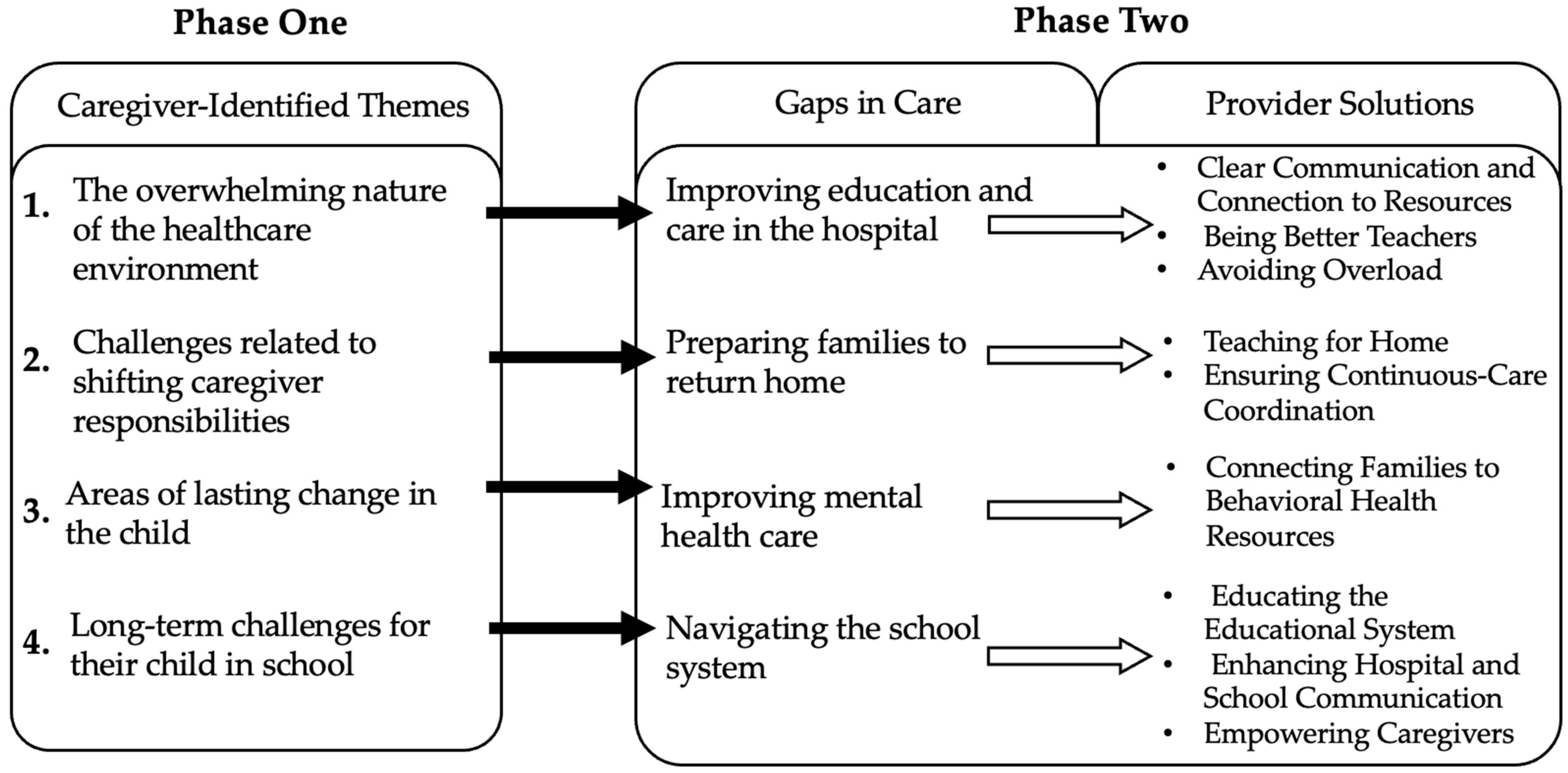
3.2. Provider-Proposed Solutions
3.3. Gap 1: Improving Education and Care in the Hospital
3.3.1. Provide Clear Communication and Connection to Resources
- A point person for questions and resources: provide a consistent individual to advocate for families, coordinate information, and support care transitions.
- Consistent communication: regularly schedule provider care conferences to provide a consistent message to families regarding prognosis and treatment planning.
- Care team introductions: repeatedly introduce care team members and explain each provider’s role; provide visual references (e.g., pictures with provider names and roles on the patient’s wall).
3.3.2. Be a Better Teacher
- Include the parent in their own learning: invite caregivers to participate in therapy sessions, empower caregivers to ask questions, and explain the intention behind therapeutic activities.
- Employ specific teaching strategies: adjust to the caregivers’ preferred learning style, simplify messages into smaller pieces, constantly repeat information, and use teach-back methods to verify caregivers’ understanding.
- Provide knowledge-tracking materials: use tools, such as care journals, to document strategies the caregivers have learned and education they have received so the team knows which remaining items need to be taught before discharge.
3.3.3. Avoid Overload
- Assess family readiness: assess indicators of readiness including initial caregiver behavior with the provider (e.g., are caregivers engaging with the provider or receptive to the interaction?), the caregiver’s response to any physical materials, and the tenuousness of their child’s prognosis.
- Wait to educate, when possible: allow caregivers to decide when they would like to receive education, with an optimal window during the middle of a hospital stay. However, providers noted that if education is necessary early in the hospitalization, messages should be simplified to emphasize key points. Providers should also give one piece of information at a time.
3.4. Gap 2: Preparing Families to Go Home
3.4.1. Teach for Home
- Educate caregivers on the realities of home life: compare home and hospital life and repeatedly emphasize that caregivers will have to do what the hospital staff do in addition to their preexisting responsibilities as caregivers at home (e.g., employment, caring for other children).
- Plan for home realities: schedule care conferences aimed at anticipating family barriers and daily care needs to develop concrete discharge plans and recommendations.
- Provide sufficient hands-on experience prior to discharge: give multiple opportunities for families to independently practice caregiving in a real-world setting, with as little support from the medical team as possible. Providers viewed this as a form of “home practice” after which families could work with hospital staff to resolve outstanding areas of need before their final discharge.
3.4.2. Ensure Continuous Care Coordination
- Facilitate TBI care for TBI patients: educate outpatient providers on best practices for treatment of children post-TBI; establish outpatient clinics dedicated to children with brain injury; create specialized day treatment programs that act as a step-down from inpatient care.
- Provide dedicated follow-up services: create a position for a personalized care coordinator (also described as a case worker) who could help navigate the transition home by serving as the intermediary between families and the medical system, checking in on families, coordinating appointments and transportation, and connecting families with community resources.
3.5. Gap 3: Improving Behavioral Health Care
Connect Families to Behavioral Health Resources
- Make behavioral health a top priority: start discussing behavioral health as early as possible with families and emphasize that their child and family may benefit from support adjusting to post-injury life; gauge family openness to behavioral health care.
- Coordinate behavioral health care from the hospital: establish follow-up behavioral health care before discharge, provide local behavioral health resources, and/or reconnect with families after discharge to continue to offer services as new needs might arise once they are home.
- Find a community of care: connect families to community and social supports including respite care, mentorship, and peer groups. If a comprehensive outpatient clinic is established, it could include behavioral health providers who are specialists in TBI to provide ongoing support following discharge.
3.6. Gap 4: Navigating the Schools
3.6.1. Educate the Educational System
- Raise awareness through trainings and resources: educate schools through presentations by clinicians or families, video modules, professional development opportunities and advocate for adding pediatric TBI to the curriculum for future educators. Helpful resources for educators included clinical notes on maximizing student performance and comprehensive lists of potential accommodations.
- Think long-term: regularly assess children with a history of TBI as their needs may change over time and be aware of how recovery following pediatric TBI is unpredictable. Testing may be most important at times of transition from elementary to middle school and middle to high school.
3.6.2. Enhance Hospital and School Communication
- Share medical information with schools: establish communication with schools as early as possible with medical releases of information and schedule regular school reintegration meetings including families, the medical team, and relevant school personnel. During meetings, educators and hospital staff could discuss the child’s needs, related resources, and recommended accommodations. Designate a hospital contact person to help answer questions from the school, during and after the hospitalization.
- Encourage school involvement before discharge: ask for a school representative to follow the child in the hospital and provide more regular updates to the school as the child progresses throughout their admission.
3.6.3. Empower Caregivers with Resources
- Empower caregivers: connect them with advocates or mentors and inform them of their educational rights; advocate for state funded care coordination to ensure caregivers and children are connected to appropriate educational resources.
3.7. Provider Perceived Barriers to Care
3.7.1. Patient and Family Barriers
- TBI is an invisible injury. Providers expressed that caregivers and school personnel may interpret the physical recovery as representing a full recovery and thus the end of the child’s therapeutic needs. Likewise, for children with lasting physical disabilities, caregivers and school personnel may prioritize these visible needs over “unseen” disabilities such as cognitive or behavioral health challenges. A focus on physical recovery status may result in reduced efforts to establish or seek services for lasting cognitive and behavioral needs. Similarly, providers discussed how hard it is to explain that TBI symptoms might change over time and across development, which then might delay appropriate care in the future.
- Families face unique stress and burdens. Providers highlighted how caregivers experience stress in managing their child’s medical care and can feel overwhelmed with new information and fears for their child. Providers acknowledged that financial stressors (e.g., increased pressure to maintain employment while caring for a child with medical needs, new medical expenses, transportation challenges) may prevent families from being available for both inpatient and outpatient therapy sessions, creating barriers to not only education but overall medical care. Unique stressors may lead to diminished follow-up care or make caregivers feel cognitively overwhelmed during their child’s admission and appointments. Stressors may also contribute to caregivers being less able to take in education, for example, while their child is hospitalized.
3.7.2. Medical and System Barriers
- Provider schedules limit accessibility and flexibility. Demanding schedules make it difficult for providers to devote as much time as they would like to patient care and additional meetings, such as care conferences or school reintegration meetings. Busyness also likely limits the number of providers who are willing and able to see children with TBI, leading to long waitlists for outpatient care.
- Insurance limits access to care. Insurance coverage may dictate what services and providers are approved/denied which could impact access to care and lengthen already long wait times. Providers often feel pressure from insurance companies to discharge as soon as possible, even at times when families or the medical team may not feel the child is ready to return home yet.
- COVID-19 changed healthcare. During the pandemic, providers were limited in their ability to perform pre-discharge home or school visits. Providers also discussed that they believed the COVID-19 pandemic led to increased educator stress and burden, which in turn may have affected their ability to meet the needs of students with TBIs.
4. Discussion
4.1. Improving Education and Care in the Hospital
4.2. Preparing Families to Return Home
4.3. Meeting Behavioral Health Needs
4.4. Returning to School
4.5. All Roads Lead to Care Coordination
4.6. Overcoming Barriers to Proposed Solutions
4.7. Limitations
5. Conclusions and Future Directions
Supplementary Materials
Author Contributions
Funding
Institutional Review Board Statement
Informed Consent Statement
Data Availability Statement
Acknowledgments
Conflicts of Interest
Abbreviations
| TBI | Traumatic Brain Injury |
References
- Anderson, V., Brown, S., Newitt, H., & Hoile, H. (2009). Educational, vocational, psychosocial, and quality-of-life outcomes for adult survivors of childhood traumatic brain injury. Journal of Head Trauma Rehabilitation, 24(5), 303–312. [Google Scholar] [CrossRef] [PubMed]
- Appleton, J. V., & King, L. (2002). Journeying from the philosophical contemplation of constructivism to the methodological pragmatics of health services research. Journal of Advanced Nursing, 40(6), 641–648. [Google Scholar] [CrossRef] [PubMed]
- Baum, F., MacDougall, C., & Smith, D. (2006). Participatory action research. Journal of Epidemiology and Community Health, 60(10), 854–857. [Google Scholar] [CrossRef] [PubMed]
- Braun, V., & Clarke, V. (2019). Reflecting on reflexive thematic analysis. Qualitative Research in Sport, Exercise and Health, 11(4), 589–597. [Google Scholar] [CrossRef]
- Braun, V., & Clarke, V. (2022). Thematic analysis: A practical guide. SAGE. [Google Scholar]
- Braun, V., & Clarke, V. (2023). Is thematic analysis used well in health psychology? A critical review of published research, with recommendations for quality practice and reporting. Health Psychology Review, 17(4), 695–718. [Google Scholar] [CrossRef] [PubMed]
- Carroll, A. R., Johnson, J. A., Stassun, J. C., Greevy, R. A., Mixon, A. S., & Williams, D. J. (2024). Health literacy–informed communication to reduce discharge medication errors in hospitalized children: A randomized clinical trial. JAMA Network Open, 7(1), e2350969. [Google Scholar] [CrossRef] [PubMed]
- Dahl, H. M., Holthe, I. L., Andelic, N., Løvstad, M., & Myhre, M. C. (2024). Unmet health care needs over the first 2 years after pediatric traumatic brain injury. European Journal of Paediatric Neurology, 49, 73–81. [Google Scholar] [CrossRef] [PubMed]
- Davies, S. C., Lundine, J. P., & Justice, A. F. (2022). Care coordination for children with special health care needs: A scoping review to inform strategies for students with traumatic brain injuries. Journal of School Health, 92(3), 270–281. [Google Scholar] [CrossRef] [PubMed]
- Diener, M. L., Kirby, A. V., Sumsion, F., Canary, H. E., & Green, M. M. (2022). Community reintegration needs following paediatric brain injury: Perspectives of caregivers and service providers. Disability and Rehabilitation, 44(19), 5592–5602. [Google Scholar] [CrossRef] [PubMed]
- Ergh, T. C., Rapport, L. J., Coleman, R. D., & Hanks, R. A. (2002). Predictors of caregiver and family functioning following traumatic brain injury: Social support moderates caregiver distress. Journal of Head Trauma Rehabilitation, 17(3), 155–174. [Google Scholar] [CrossRef] [PubMed]
- Fisher, A. P., Aguilar, J. M., Zhang, N., Yeates, K. O., Taylor, H. G., Kurowski, B. G., Narad, M. E., & Wade, S. L. (2021). Caregiver and child behavioral health service utilization following pediatric traumatic brain injury. Research on Child and Adolescent Psychopathology, 49(4), 491–501. [Google Scholar] [CrossRef] [PubMed]
- Fuentes, M. M., Wang, J., Haarbauer-Krupa, J., Yeates, K. O., Durbin, D., Zonfrillo, M. R., Jaffe, K. M., Temkin, N., Tulsky, D., Bertisch, H., & Rivara, F. P. (2018). Unmet rehabilitation needs after hospitalization for traumatic brain injury. Pediatrics, 141(5), e20172859. [Google Scholar] [CrossRef] [PubMed]
- Glick, A. F., Farkas, J. S., Nicholson, J., Dreyer, B. P., Fears, M., Bandera, C., Stolper, T., Gerber, N., & Yin, H. S. (2017). Parental management of discharge instructions: A systematic review. Pediatrics, 140(2), e20164165. [Google Scholar] [CrossRef] [PubMed]
- Greenspan, A. I., & MacKenzie, E. J. (2000). Use and need for post-acute services following paediatric head injury. Brain Injury, 14(5), 417–429. [Google Scholar] [CrossRef] [PubMed]
- Haarbauer-Krupa, J., Ciccia, A., Dodd, J., Ettel, D., Kurowski, B., Lumba-Brown, A., & Suskauer, S. (2017). Service delivery in the healthcare and educational systems for children following traumatic brain injury: Gaps in care. Journal of Head Trauma Rehabilitation, 32(6), 367–377. [Google Scholar] [CrossRef] [PubMed]
- Haarbauer-Krupa, J., Lee, A. H., Bitsko, R. H., Zhang, X., & Kresnow-Sedacca, M. (2018). Prevalence of parent-reported traumatic brain injury in children and associated health conditions. JAMA Pediatrics, 172(11), 1078. [Google Scholar] [CrossRef] [PubMed]
- Haarbauer-Krupa, J., Thigpen, S., Glang, A., Eagan-Johnson, B., McAvoy, K., Brunken, C., Chininis, M., Kurowski, B. G., Suskauer, S., Crowley, M., & Denslow, P. (2023). Return to school after traumatic brain injury: Description of implementation settings. Journal of Head Trauma Rehabilitation, 38(4), 329–335. [Google Scholar] [CrossRef] [PubMed]
- Hanks, R. A., Rapport, L. J., Wertheimer, J., & Koviak, C. (2012). Randomized controlled trial of peer mentoring for individuals with traumatic brain injury and their significant others. Archives of Physical Medicine and Rehabilitation, 93(8), 1297–1304. [Google Scholar] [CrossRef] [PubMed]
- Hennink, M., & Kaiser, B. N. (2022). Sample sizes for saturation in qualitative research: A systematic review of empirical tests. Social Science & Medicine, 292, 114523. [Google Scholar] [CrossRef] [PubMed]
- Hibbard, M. R., Cantor, J., Charatz, H., Rosenthal, R., Ashman, T., Gundersen, N., Ireland-Knight, L., Gordon, W., Avner, J., & Gartner, A. (2002). Peer support in the community: Initial findings of a mentoring program for individuals with traumatic brain injury and their families. Journal of Head Trauma Rehabilitation, 17(2), 112–131. [Google Scholar] [CrossRef] [PubMed]
- Hoffmann, J. A., Alegría, M., Alvarez, K., Anosike, A., Shah, P. P., Simon, K. M., & Lee, L. K. (2022). Disparities in pediatric mental and behavioral health conditions. Pediatrics, 150(4), e2022058227. [Google Scholar] [CrossRef] [PubMed]
- Keenan, R. P., Lovanio, K., Lapidus, G., Chenard, D., & Smith, S. (2020). Improved concussion discharge instructions in a pediatric emergency department. Advanced Emergency Nursing Journal, 42(1), 63–70. [Google Scholar] [CrossRef] [PubMed]
- Kirk, S., Fallon, D., Fraser, C., Robinson, G., & Vassallo, G. (2015). Supporting parents following childhood traumatic brain injury: A qualitative study to examine information and emotional support needs across key care transitions. Child: Care, Health and Development, 41(2), 303–313. [Google Scholar] [CrossRef] [PubMed]
- Lever, K., Peng, J., Lundine, J. P., Caupp, S., Wheeler, K. K., Sribnick, E. A., & Xiang, H. (2019). Attending follow-up appointments after pediatric traumatic brain injury: Caregiver-perceived barriers and facilitators. Journal of Head Trauma Rehabilitation, 34(2), E21–E34. [Google Scholar] [CrossRef] [PubMed]
- Lumivero. (2023). Nvivo (Version 14) [Computer software]. Lumivero. Available online: https://lumivero.com/products/nvivo/ (accessed on 5 May 2026).
- Lundine, J. P., Hagen, E., & Davies, S. (2023). Perspectives on care coordination for youth with TBI: Moving forward to provide better care. NeuroRehabilitation, 52(4), 585–596. [Google Scholar] [CrossRef] [PubMed]
- Lundine, J. P., Utz, M., Jacob, V., & Ciccia, A. H. (2019). Putting the person in person-centered care: Stakeholder experiences in pediatric traumatic brain injury. Journal of Pediatric Rehabilitation Medicine, 12(1), 21–35. [Google Scholar] [CrossRef] [PubMed]
- Lundine, J. P., Viola, N., Koterba, C., & Ciccia, A. (in press). “Brain injuries affect everything”: Long-term caregiver perspectives on medical and educational needs following inpatient rehabilitation for pediatric TBI. Behavioral Sciences. under revision.
- McCart, M., Todis, B., Gomez, D., & Glang, A. (2023). School experiences following traumatic brain injury: A longitudinal qualitative study. NeuroRehabilitation, 52(4), 529–537. [Google Scholar] [CrossRef] [PubMed]
- McDonald, K. M., Sundaram, V., Bravata, D. M., Lewis, R., Lin, N., Kraft, S. A., McKinnon, M., Paguntalan, H., & Owens, D. K. (2007). Closing the quality gap: A critical analysis of quality improvement strategies (Vol. 7: Care Coordination). Agency for Healthcare Research and Quality (US). Available online: http://www.ncbi.nlm.nih.gov/books/NBK44015/ (accessed on 5 May 2026).
- Micklewright, J. L., King, T. Z., O’Toole, K., Henrich, C., & Floyd, F. J. (2012). Parental distress, parenting practices, and child adaptive outcomes following traumatic brain injury. Journal of the International Neuropsychological Society, 18(2), 343–350. [Google Scholar] [CrossRef] [PubMed]
- Miley, A. E., Elleman, C. B., Chiu, R. Y., Moscato, E. L., Fisher, A. P., Slomine, B. S., Kirkwood, M. W., Baum, K. T., Walsh, K. E., & Wade, S. L. (2022). Professional stakeholders’ perceptions of barriers to behavioral health care following pediatric traumatic brain injury. Brain Injury, 36(4), 536–543. [Google Scholar] [CrossRef] [PubMed]
- Moscato, E. L., Peugh, J., Taylor, H. G., Stancin, T., Kirkwood, M. W., & Wade, S. L. (2021). Bidirectional effects of behavior problems and parenting behaviors following adolescent brain injury. Rehabilitation Psychology, 66(3), 273–285. [Google Scholar] [CrossRef] [PubMed]
- Narad, M. E., Moscato, E., Yeates, K. O., Taylor, H. G., Stancin, T., & Wade, S. L. (2019). Behavioral health service utilization and unmet need after traumatic brain injury in childhood. Journal of Developmental and Behavioral Pediatrics: JDBP, 40(6), 451–457. [Google Scholar] [CrossRef] [PubMed]
- Palusak, C., Shook, B., Davies, S. C., & Lundine, J. P. (2022). A scoping review to inform care coordination strategies for youth with traumatic brain injuries: Care coordination personnel. International Journal of Care Coordination, 25(1), 21–38. [Google Scholar] [CrossRef]
- Raj, S. P., Wade, S. L., Cassedy, A., Taylor, H. G., Stancin, T., Brown, T. M., & Kirkwood, M. W. (2013). Parent psychological functioning and communication predict externalizing behavior problems after pediatric traumatic brain injury. Journal of Pediatric Psychology, 39(1), 84–95. [Google Scholar] [CrossRef] [PubMed][Green Version]
- Roscigno, C. I., Fleig, D. K., & Knafl, K. A. (2015). Parent management of the school reintegration needs of children and youth following moderate or severe traumatic brain injury. Disability and Rehabilitation, 37(6), 523–533. [Google Scholar] [CrossRef] [PubMed]
- Roscigno, C. I., Savage, T. A., Grant, G., & Philipsen, G. (2013). How healthcare provider talk with parents of children following severe traumatic brain injury is perceived in early acute care. Social Science & Medicine, 90, 32–39. [Google Scholar] [CrossRef] [PubMed][Green Version]
- Roscigno, C. I., & Swanson, K. M. (2011). Parents’ experiences following children’s moderate to severe traumatic brain injury: A clash of cultures. Qualitative Health Research, 21(10), 1413–1426. [Google Scholar] [CrossRef] [PubMed]
- Sartore, G.-M., Pourliakas, A., & Lagioia, V. (2021). Peer support interventions for parents and carers of children with complex needs. Cochrane Database of Systematic Reviews, 2021(12), CD010618. [Google Scholar] [CrossRef] [PubMed]
- Shook, B., Palusak, C., Davies, S. C., & Lundine, J. P. (2022). A scoping review to inform care coordination strategies for youth with traumatic brain injuries: Care coordination tools. International Journal of Care Coordination, 25(1), 5–20. [Google Scholar] [CrossRef]
- Sisk, B. A., Zavadil, J. A., Blazin, L. J., Baker, J. N., Mack, J. W., & DuBois, J. M. (2021). Assume it will break: Parental perspectives on negative communication experiences in pediatric oncology. JCO Oncology Practice, 17(6), e859–e871. [Google Scholar] [CrossRef] [PubMed]
- Slomine, B. S., McCarthy, M. L., Ding, R., MacKenzie, E. J., Jaffe, K. M., Aitken, M. E., Durbin, D. R., Christensen, J. R., Dorsch, A. M., Paidas, C. N., & The CHAT Study Group. (2006). Health care utilization and needs after pediatric traumatic brain injury. Pediatrics, 117(4), e663–e674. [Google Scholar] [CrossRef] [PubMed]
- Taylor, H. G., Yeates, K. O., Wade, S. L., Drotar, D., Stancin, T., & Minich, N. (2002). A prospective study of short- and long-term outcomes after traumatic brain injury in children: Behavior and achievement. Neuropsychology, 16(1), 15–27. [Google Scholar] [CrossRef] [PubMed]
- Taylor, H. G., Yeates, K. O., Wade, S. L., Drotar, D., Stancin, T., & Montpetite, M. (2003). Long-term educational interventions after traumatic brain injury in children. Rehabilitation Psychology, 48(4), 227–236. [Google Scholar] [CrossRef]
- The Kennedy Forum. (2026, January). Mental health parity index. Available online: https://www.parityindex.org/home (accessed on 4 May 2026).
- Todis, B., McCart, M., & Glang, A. (2018). Hospital to school transition following traumatic brain injury: A qualitative longitudinal study. NeuroRehabilitation, 42(3), 269–276. [Google Scholar] [CrossRef] [PubMed]
- Unruh, D., Gomez, D., Slocumb, J., McCart, M., Davies, S., Haarbauer-Krupa, J., & Glang, A. (2023). Stakeholder perspectives on the school experiences of students with traumatic brain injury: The effects of COVID-19 pandemic on service delivery. Journal of School Health, 93(5), 378–385. [Google Scholar] [CrossRef] [PubMed]
- Witten, J. A., Ferrer, J., Mamman, R., & Schmidt, J. (2025). The impact of peer support for informal caregivers of adults with moderate to severe traumatic brain injury: A scoping review. Journal of Evidence-Based Social Work, 22(6), 854–868. [Google Scholar] [CrossRef] [PubMed]


| Focus Group Participants | Total yrs. Practicing | pTBI Experience | Sex | Focus Group | Age | Highest Level of Education |
|---|---|---|---|---|---|---|
| Discharge Planner | 19 | 13 | Female | 1 | 45 | Bachelor’s Degree |
| Inpatient Nurse 1 | 22 | 22 | Female | 1 | 45 | Bachelor’s Degree |
| Physical Therapist 1 | 37 | 35 | Female | 1 | 59 | Bachelor’s Degree |
| Neuropsychologist 1 | 6 | 1.5 | Female | 1 | 33 | Doctoral Degree (PhD) |
| Social Worker | 7 | 5 | Female | 1 | 40 | Master’s Degree |
| Occupational Therapist 1 | 35 | 35 | Female | 2 | 58 | Master’s Degree |
| Speech Language Pathologist 1 | 18.5 | 18 | Female | 2 | 42 | Master’s Degree |
| * Surgeon | 5.5 | 7.5 | Male | 2 | 41 | Professional Degree (MD) |
| Physical Therapist 2 | 5 | 5 | Female | 2 | 31 | Professional Degree (DPT) |
| * Neurosurgeon | 5 | 10 | Male | 2 | 44 | Professional Degree (MD, PhD) |
| Child Life Specialist 2 | 9 | 9 | Female | 3 | 31 | Bachelor’s Degree |
| Recreation Therapist | 16 | 15 | Female | 3 | 39 | Bachelor’s Degree |
| Teacher 1 | 38 | 33 | Female | 3 | 61 | Master’s Degree |
| Speech Language Pathologist 2 | 16 | 15 | Female | 3 | 41 | Master’s Degree |
| Physiatrist 1 | 6 | 12 | Male | 3 | 39 | Professional Degree (MD) |
| School Psychologist 1 | 25 | 15 | Female | 3 | 49 | Professional Degree (Ed.S.) |
| Occupational Therapist 2 * | 5.5 | 7 | Female | 3 | 30 | Professional Degree (OTD) |
| Psychologist 1 * | 5 | 7 | Female | 4 | 35 | Doctoral Degree (PhD) |
| Teacher 2 | 15 | 7 | Female | 4 | 39 | Master’s Degree |
| Inpatient Nurse 2 * | 13.75 | 14.75 | Female | 4 | 36 | Master’s Degree |
| Nurse Practitioner * | 24 | 25 | Male | 4 | 45 | Master’s Degree |
| Outpatient Nurse 1 | 36 | 20 | Female | 4 | 56 | Master’s Degree |
| Physiatrist 2 * | 6 | 10 | Male | 4 | 39 | Professional Degree (MD) |
| Physiatrist 3 | 6 | 5 | Female | 4 | 36 | Professional Degree (MD) |
| Physiatrist 4 | 11 | 11 | Male | 4 | 43 | Professional Degree (MD) |
| Outpatient Nurse 2 | 10 | 10 | Female | 5 | 61 | Bachelor’s Degree |
| Psychologist 2 * | 0.5 | 2.5 | Female | 5 | 30 | Doctoral Degree (PhD) |
| Psychologist 3 * | 11 | 12 | Female | 5 | 41 | Doctoral Degree (PhD) |
| School Psychologist 2 | 8 | 2 | Female | 5 | 42 | Doctoral Degree (PhD) |
| Solution | Specific Recommendation | Exemplar Quote (Speaker) |
|---|---|---|
| Improving education and care in the hospital | ||
| Clear Communication and Connection to Resources | Having a point person for questions and resources | “I’m going to be your resource, I may not have all the answers for you, but I can get them and I can find them” (Nurse Practitioner) |
| Ensuring consistent communication | “Everyone from medical students all the way up to intern’s, resident’s, fellow’s, and attending’s that can give messages” (Surgeon) | |
| Introducing the care team | “I always introduce myself, … the service I’m with, even if I’ve seen this parent and the child 12 times” (Physiatrist 3) | |
| Being Better Teachers | Including the parent in their own learning | “I would like you to be part of therapies and actually do things with me” (Inpatient Nurse 2) |
| Employing specific teaching strategies | “Not just like giving the education but making sure that they’re receiving it” (Occupational Therapist 2) | |
| Providing knowledge-tracking materials | “Having something that I can go back in and check off” (School psychologist 1) | |
| Avoiding Overload | Assessing family readiness | “you have to kind of gauge where the family is at, do they wanna ton of information is that too much?” (Speech Language Pathologist 2) |
| Waiting to educate | “Sometimes it’s like literally them being like I can’t have this conversation right now” (Psychologist 3) | |
| Preparing Families to Go Home | ||
| Teaching for Home | Educating caregivers on the realities of home life | “Just let them know that things are going to look a lot different once they get outside these four walls of the hospital” (Physiatrist 3) |
| Planning for home realities | “Our discharge planner, constantly asking what are the barriers, what are some strategies where we can provide more assistance” (Occupational Therapist 1) | |
| Providing sufficient hands-on experience prior to discharge | “Simulate real world experiences as much as possible” (Occupational Therapist 2) | |
| Ensuring Continuous-Care Coordination | Identifying TBI care for TBI patients | “Getting better trained therapists that are really dedicated to the TBI population on our outpatient team” (Physical Therapist 1) |
| Following the family | “I think that’s the disconnect too is like they go through these transitions of care um and there’s not like a single person that’s helping them” (Physical Therapist 2) | |
| Improving Behavioral health Care | ||
| Connecting Families to Behavioral Health Resources | Setting the priority | “It could just be a mandated or not mandated but a suggested recommended normal part of any treatment” (School Psychologist 2) |
| Coordinating behavioral health care from the hospital | “it is part of the treatment plan upon discharge and even appointments set up before they leave” (Outpatient Nurse 2) | |
| Finding a community of care | “You have … support groups natural happens [at a] comprehensive clinic and I know I’m kind of beating a dead horse but it just works really well” (Neurosurgeon) | |
| Navigating the Schools | ||
| Educating the Educational System | Providing trainings, resources and raising awareness. | “meeting with the school therapist or providing education to the teachers and I know we do a school meeting to kind of hand off, but then it’s like okay this teacher is actually ready to work with this kid” (Speech Language Pathologist 2) |
| Thinking long term | “Every couple years updating the neuro psych testing … if nothing else, just with a new group of teachers … maybe even a new building or new school if they’ve moved just to kind of reset hey, this is what you can do, this is how you can help the individual” (Physiatrist 4) | |
| Enhancing Hospital and School Communication | Sharing information | “I think from a ground game standpoint communication with just a guidance counselor at each of these schools… I mean if they had a pipeline to our clinics you know we could answer some questions about you know is this appropriate is this not.” (Neurosurgeon) |
| Encouraging involvement before discharge | “I update them throughout the student’s stay and then they are part of the discharge meeting if they can be and then parents know that they have a contact person who can go to the IEP meetings with them” (Teacher 1) | |
| Empowering Caregivers | Empowering Caregivers | “I think encouraging the families to reach out for help when they’re not getting what they need from their school and then, would allow outreach maybe to that school regarding that individual situation” (Psychologist 2) |
Disclaimer/Publisher’s Note: The statements, opinions and data contained in all publications are solely those of the individual author(s) and contributor(s) and not of MDPI and/or the editor(s). MDPI and/or the editor(s) disclaim responsibility for any injury to people or property resulting from any ideas, methods, instructions or products referred to in the content. |
© 2026 by the authors. Licensee MDPI, Basel, Switzerland. This article is an open access article distributed under the terms and conditions of the Creative Commons Attribution (CC BY) license.
Share and Cite
Nichols, S.; Viola, N.; Ciccia, A.; Koterba, C.; Lundine, J.P. Provider-Recommended Strategies to Support Caregiver Needs After Inpatient Rehabilitation for Pediatric TBI. Behav. Sci. 2026, 16, 1073. https://doi.org/10.3390/bs16071073
Nichols S, Viola N, Ciccia A, Koterba C, Lundine JP. Provider-Recommended Strategies to Support Caregiver Needs After Inpatient Rehabilitation for Pediatric TBI. Behavioral Sciences. 2026; 16(7):1073. https://doi.org/10.3390/bs16071073
Chicago/Turabian StyleNichols, Sophia, Nicole Viola, Angela Ciccia, Christine Koterba, and Jennifer P. Lundine. 2026. "Provider-Recommended Strategies to Support Caregiver Needs After Inpatient Rehabilitation for Pediatric TBI" Behavioral Sciences 16, no. 7: 1073. https://doi.org/10.3390/bs16071073
APA StyleNichols, S., Viola, N., Ciccia, A., Koterba, C., & Lundine, J. P. (2026). Provider-Recommended Strategies to Support Caregiver Needs After Inpatient Rehabilitation for Pediatric TBI. Behavioral Sciences, 16(7), 1073. https://doi.org/10.3390/bs16071073